
Hearing Officer Title IX Training: Hearings and
LS
Published · 76 slides · 0 views

1 / 1


Description
Hearing Officer Title IX Training: Hearings and Determinations Under the New Rules Office of University Counsel Megan Clark, megan.clarkcu.edu Jeanne Baak, jeanne.baakcolorado.edu What Well Cover Required training for Decision-Makers
Related Topics
Share
Embed code
Download this presentation From Below
"Hearing Officer Title IX Training: Hearings and" is the property of its rightful owner. Permission is granted to download and print the materials on this website for personal, non-commercial use only, and to display it on your personal computer provided you do not modify the materials and that you retain all copyright notices contained in the materials. By downloading content from our website, you accept the terms of this agreement.
Presentation Transcript
01
Hearing Officer Title IX Training: Hearings and Determinations Under the New Rules Office of University Counsel
Megan Clark, megan.clark@cu.edu
Jeanne Baak, jeanne.baak@colorado.edu<br>
Megan Clark, megan.clark@cu.edu
Jeanne Baak, jeanne.baak@colorado.edu<br>
02
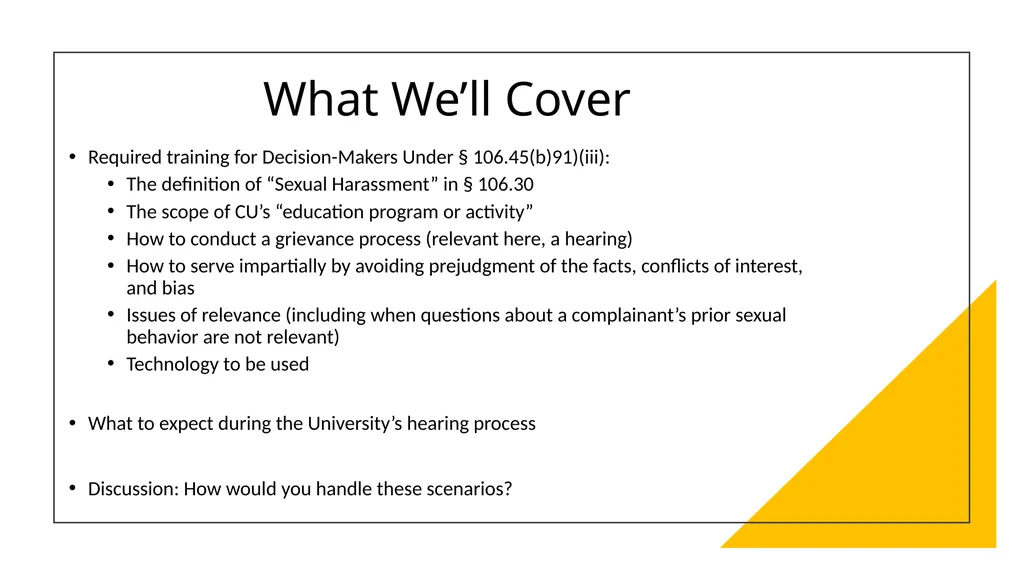
What We’ll Cover Required training for Decision-Makers Under § 106.45(b)91)(iii):
The definition of “Sexual Harassment” in § 106.30
The scope of CU’s “education program or activity”
How to conduct a grievance process (relevant here, a hearing)
How to serve impartially by avoiding prejudgment of the facts, conflicts of interest, and bias
Issues of relevance (including when questions about a complainant’s prior sexual behavior are not relevant)
Technology to be used
What to expect during the University’s hearing process
Discussion: How would you handle these scenarios?<br>
03
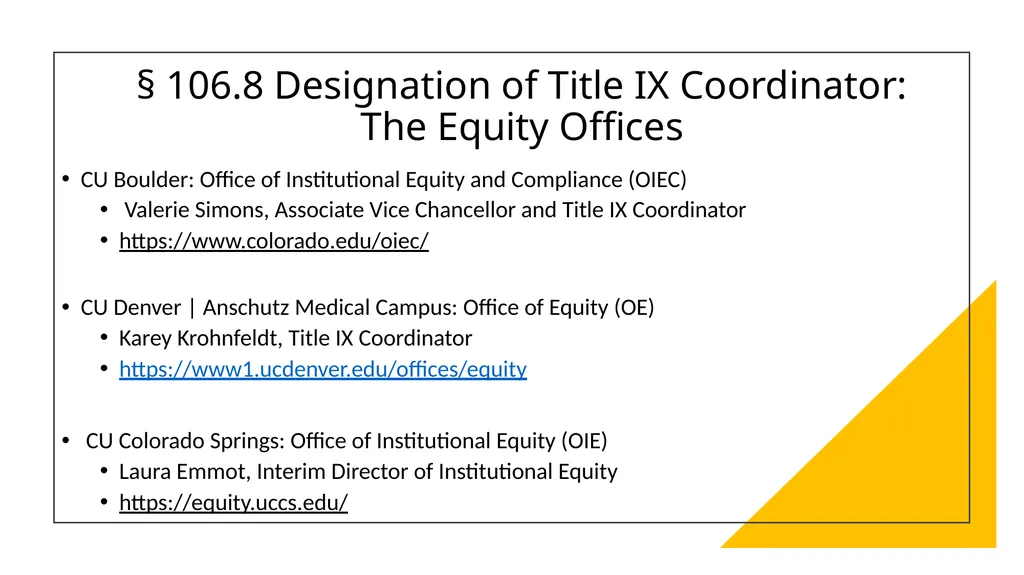
§ 106.8 Designation of Title IX Coordinator: The Equity Offices CU Boulder: Office of Institutional Equity and Compliance (OIEC)
Valerie Simons, Associate Vice Chancellor and Title IX Coordinator
https://www.colorado.edu/oiec/
CU Denver | Anschutz Medical Campus: Office of Equity (OE)
Karey Krohnfeldt, Title IX Coordinator
https://www1.ucdenver.edu/offices/equity
CU Colorado Springs: Office of Institutional Equity (OIE)
Laura Emmot, Interim Director of Institutional Equity
https://equity.uccs.edu/<br>
04
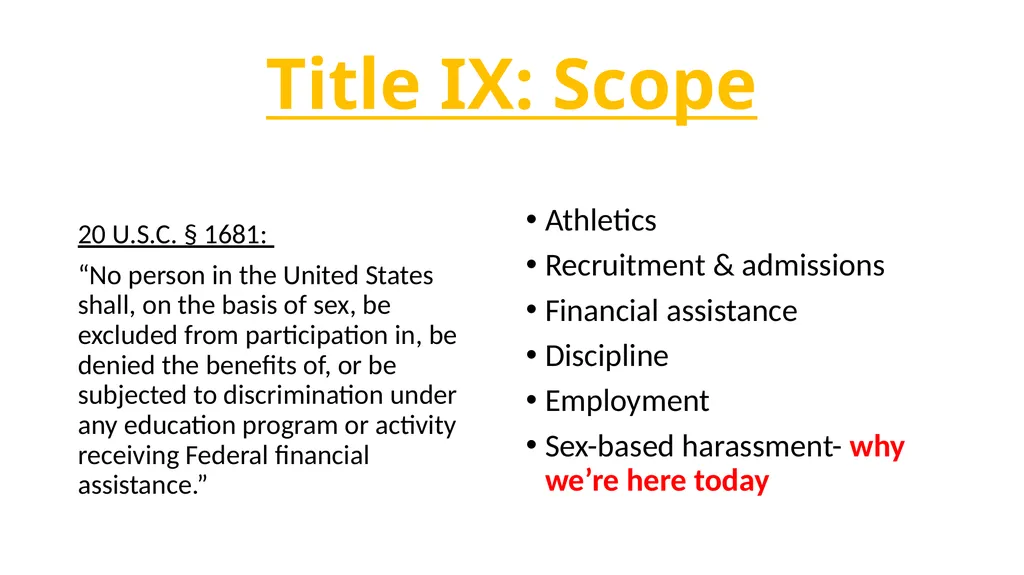
Title IX: Scope 20 U.S.C. § 1681:
“No person in the United States shall, on the basis of sex, be excluded from participation in, be denied the benefits of, or be subjected to discrimination under any education program or activity receiving Federal financial assistance.” Athletics
Recruitment & admissions
Financial assistance
Discipline
Employment
Sex-based harassment- why we’re here today<br>
05
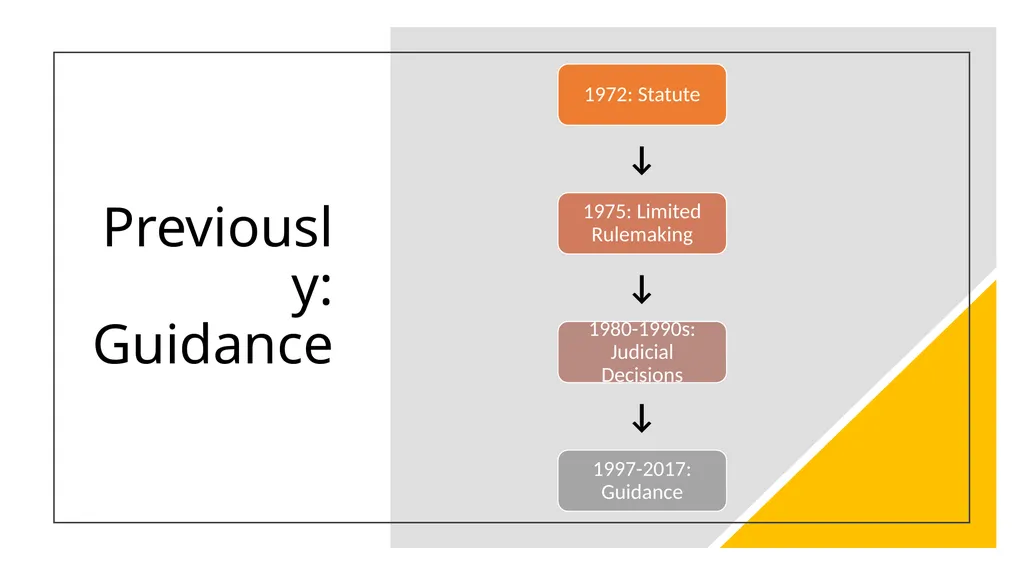
Previously: Guidance<br>
06
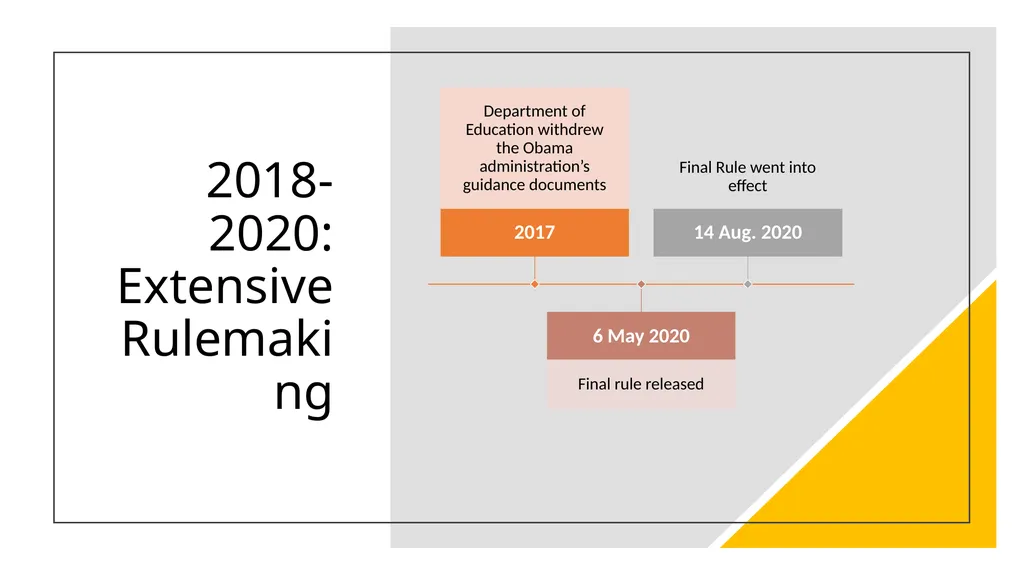
2018-2020: Extensive Rulemaking<br>
07
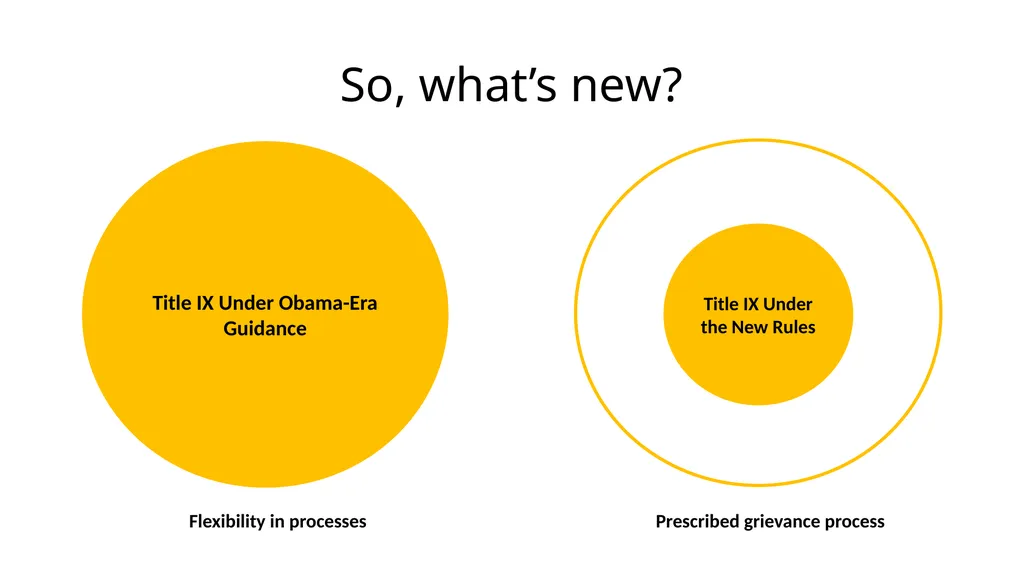
So, what’s new? Title IX Under Obama-Era Guidance Title IX Under the New Rules Flexibility in processes Prescribed grievance process<br>
08
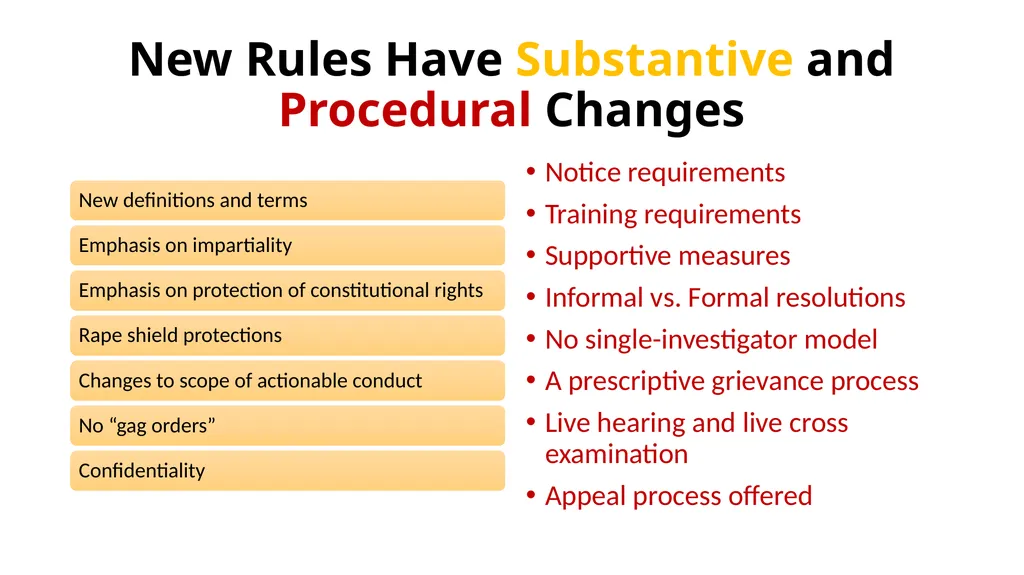
New Rules Have Substantive and Procedural Changes Notice requirements
Training requirements
Supportive measures
Informal vs. Formal resolutions
No single-investigator model
A prescriptive grievance process
Live hearing and live cross examination
Appeal process offered<br>
Training requirements
Supportive measures
Informal vs. Formal resolutions
No single-investigator model
A prescriptive grievance process
Live hearing and live cross examination
Appeal process offered<br>
09
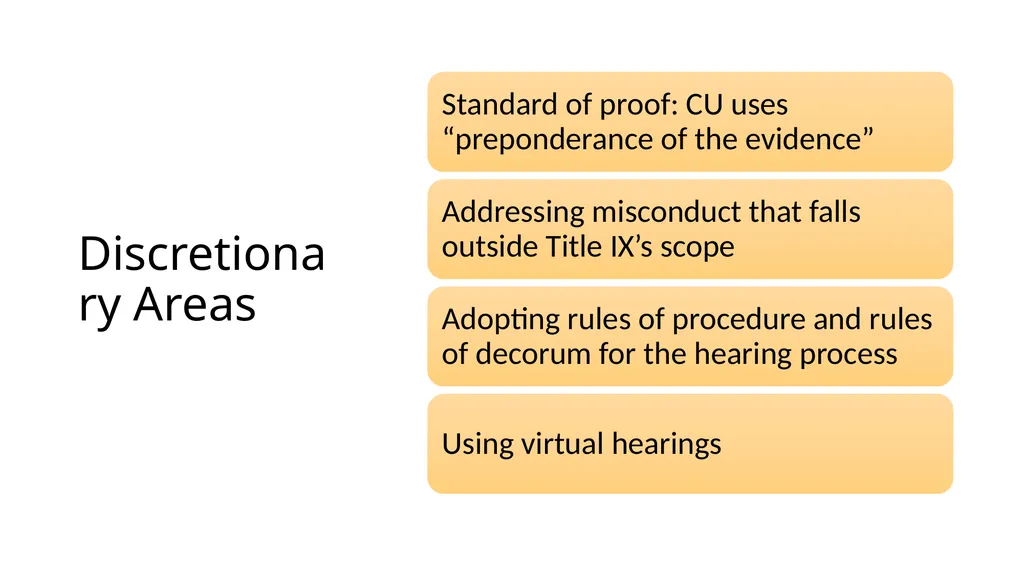
Discretionary Areas<br>
10
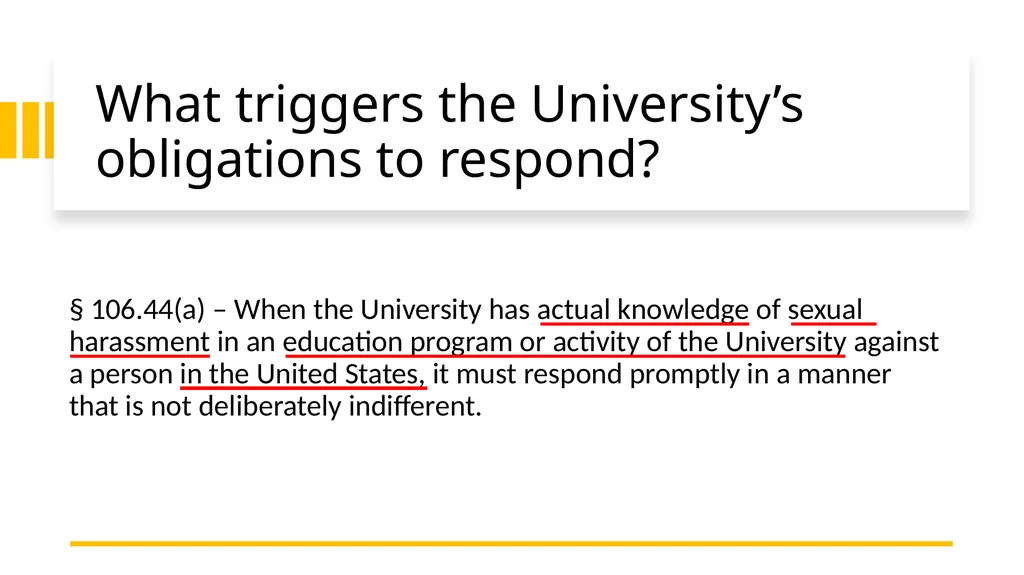
What triggers the University’s obligations to respond? § 106.44(a) – When the University has actual knowledge of sexual harassment in an education program or activity of the University against a person in the United States, it must respond promptly in a manner that is not deliberately indifferent.<br>
11
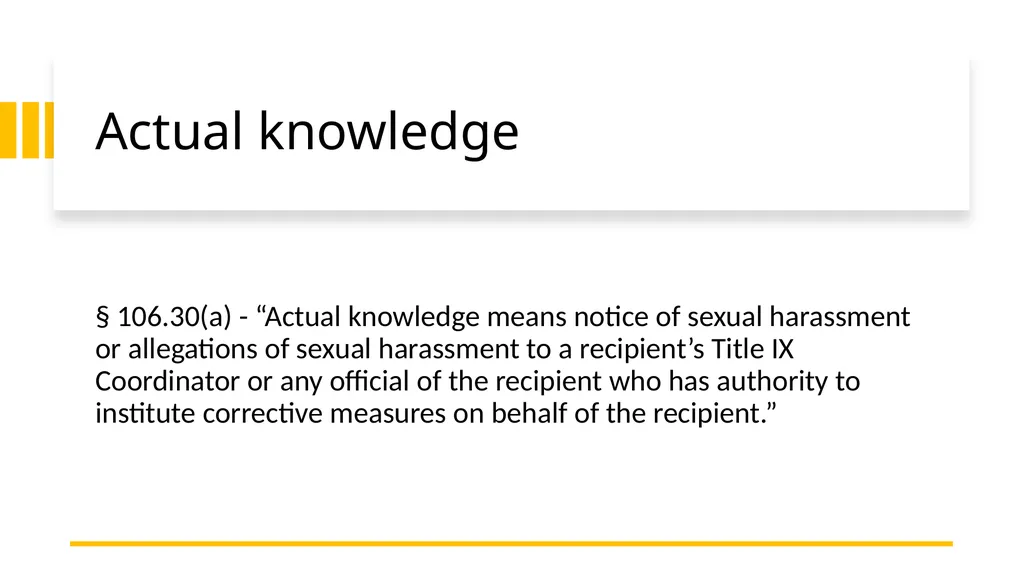
Actual knowledge § 106.30(a) - “Actual knowledge means notice of sexual harassment or allegations of sexual harassment to a recipient’s Title IX Coordinator or any official of the recipient who has authority to institute corrective measures on behalf of the recipient.”<br>
12
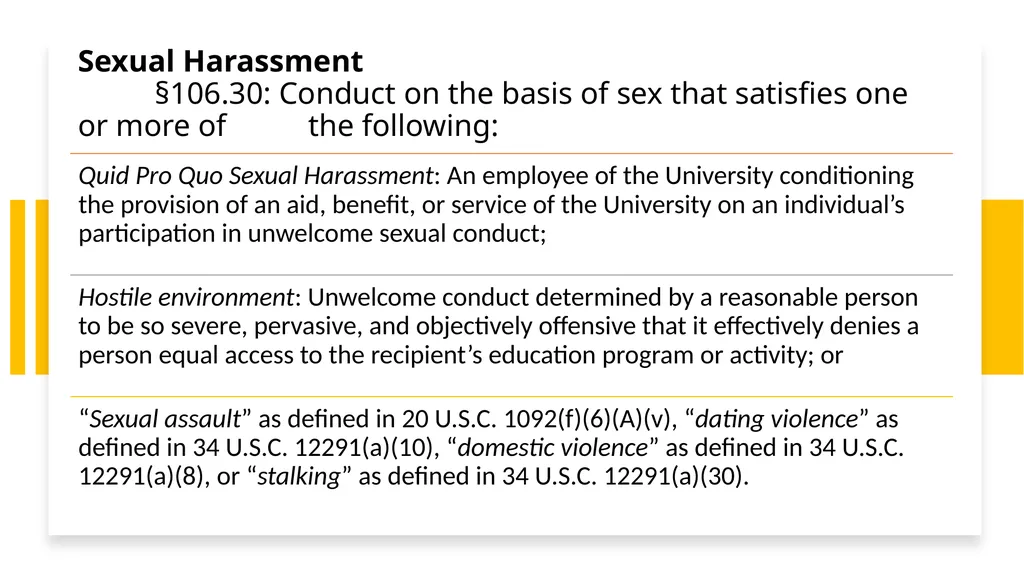
Sexual Harassment
§106.30: Conduct on the basis of sex that satisfies one or more of the following:<br>
13
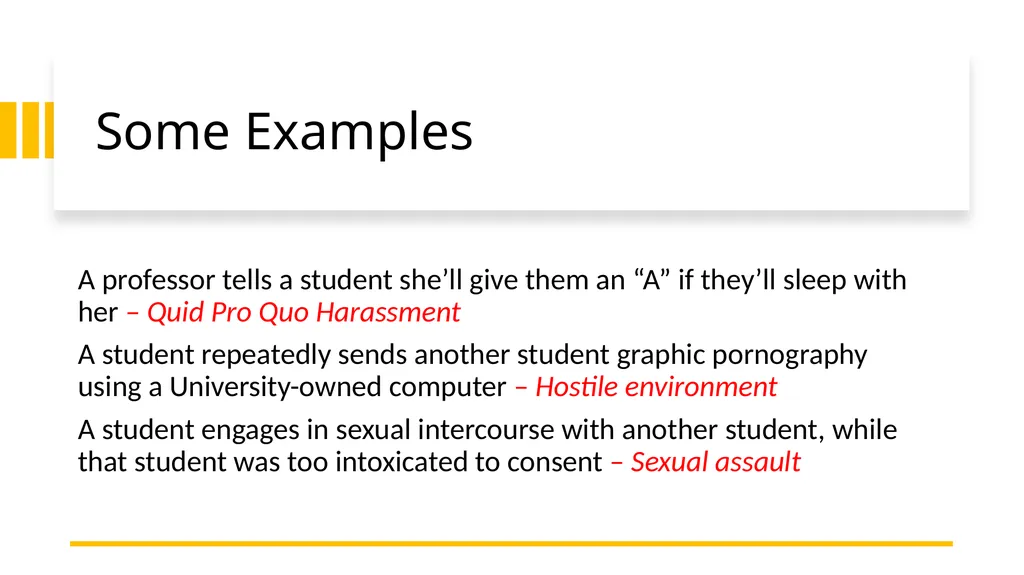
Some Examples A professor tells a student she’ll give them an “A” if they’ll sleep with her – Quid Pro Quo Harassment
A student repeatedly sends another student graphic pornography using a University-owned computer – Hostile environment
A student engages in sexual intercourse with another student, while that student was too intoxicated to consent – Sexual assault<br>
A student repeatedly sends another student graphic pornography using a University-owned computer – Hostile environment
A student engages in sexual intercourse with another student, while that student was too intoxicated to consent – Sexual assault<br>
14
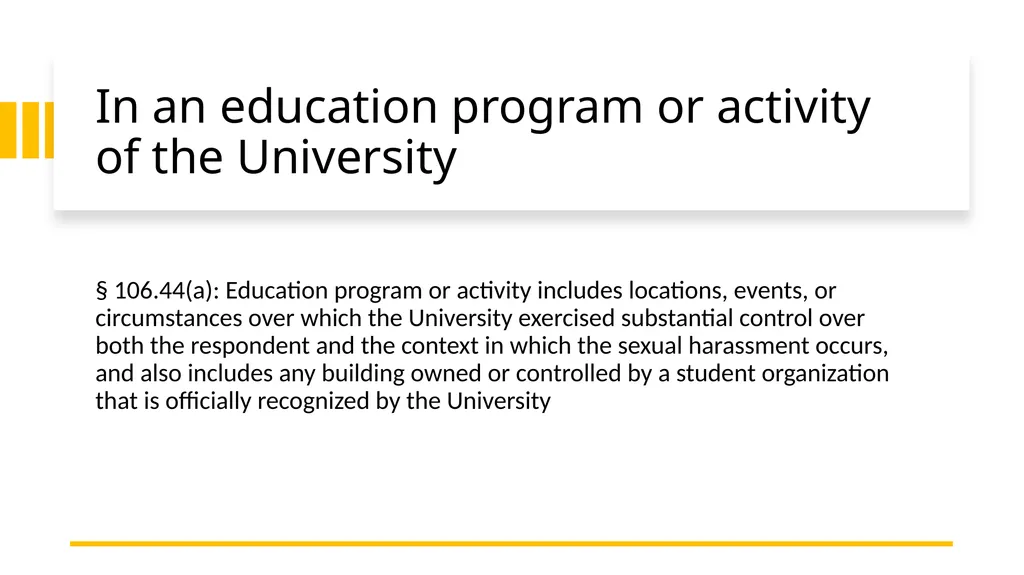
In an education program or activity of the University § 106.44(a): Education program or activity includes locations, events, or circumstances over which the University exercised substantial control over both the respondent and the context in which the sexual harassment occurs, and also includes any building owned or controlled by a student organization that is officially recognized by the University<br>
15
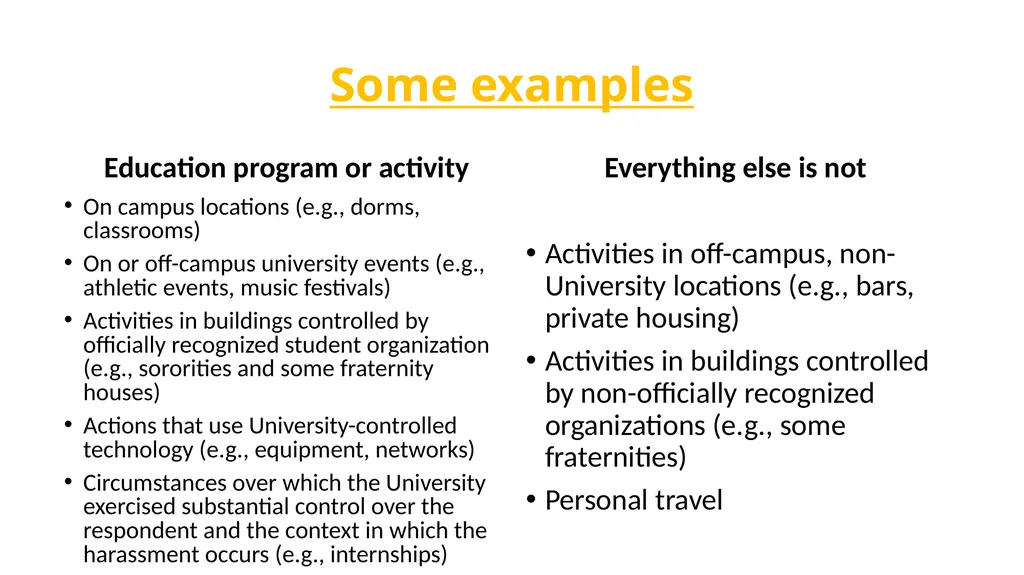
Some examples Education program or activity On campus locations (e.g., dorms, classrooms)
On or off-campus university events (e.g., athletic events, music festivals)
Activities in buildings controlled by officially recognized student organization (e.g., sororities and some fraternity houses)
Actions that use University-controlled technology (e.g., equipment, networks)
Circumstances over which the University exercised substantial control over the respondent and the context in which the harassment occurs (e.g., internships) Everything else is not Activities in off-campus, non-University locations (e.g., bars, private housing)
Activities in buildings controlled by non-officially recognized organizations (e.g., some fraternities)
Personal travel<br>
16
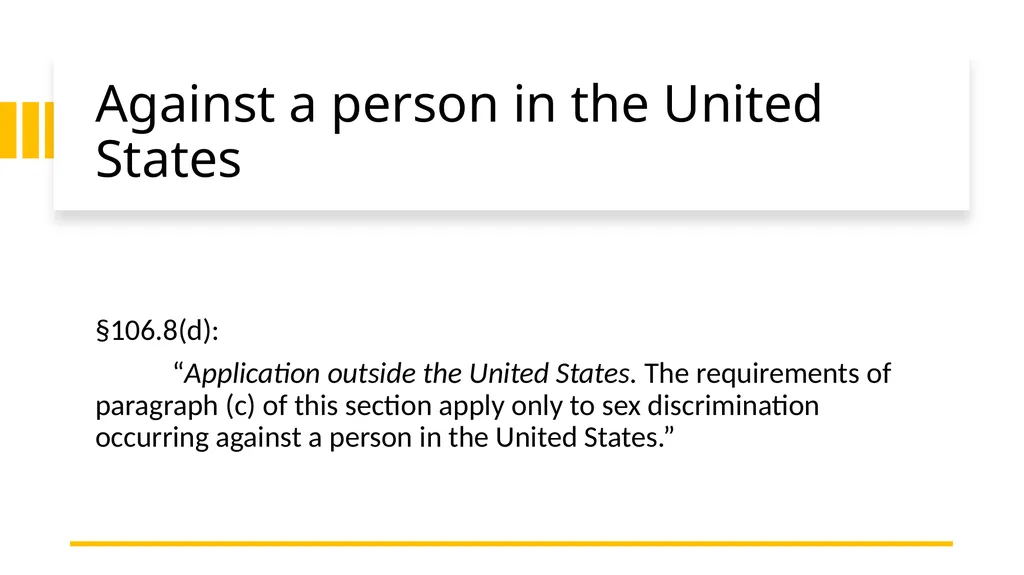
Against a person in the United States §106.8(d):
“Application outside the United States. The requirements of paragraph (c) of this section apply only to sex discrimination occurring against a person in the United States.”<br>
“Application outside the United States. The requirements of paragraph (c) of this section apply only to sex discrimination occurring against a person in the United States.”<br>
17
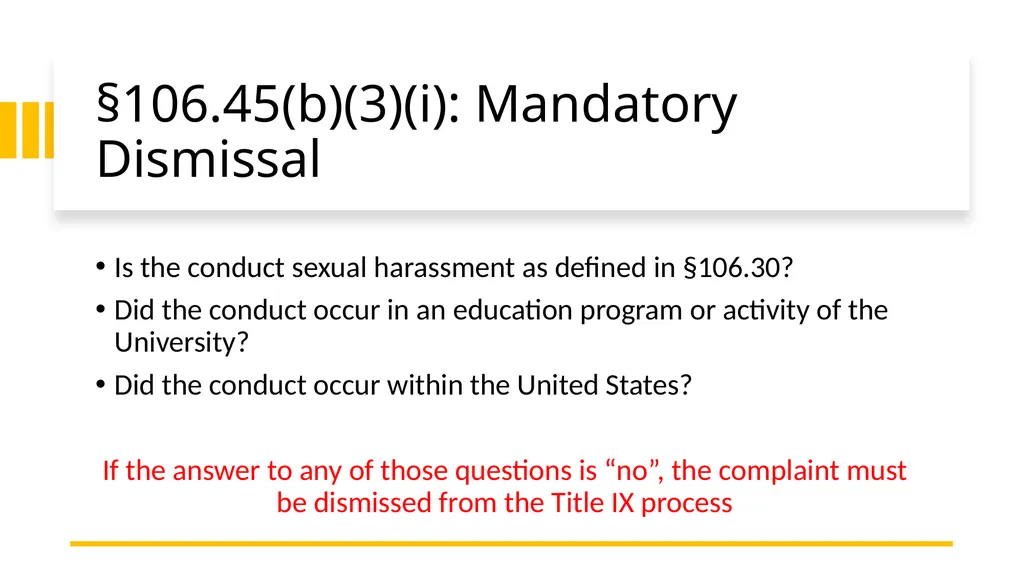
§106.45(b)(3)(i): Mandatory Dismissal Is the conduct sexual harassment as defined in §106.30?
Did the conduct occur in an education program or activity of the University?
Did the conduct occur within the United States?
If the answer to any of those questions is “no”, the complaint must be dismissed from the Title IX process<br>
Did the conduct occur in an education program or activity of the University?
Did the conduct occur within the United States?
If the answer to any of those questions is “no”, the complaint must be dismissed from the Title IX process<br>
18
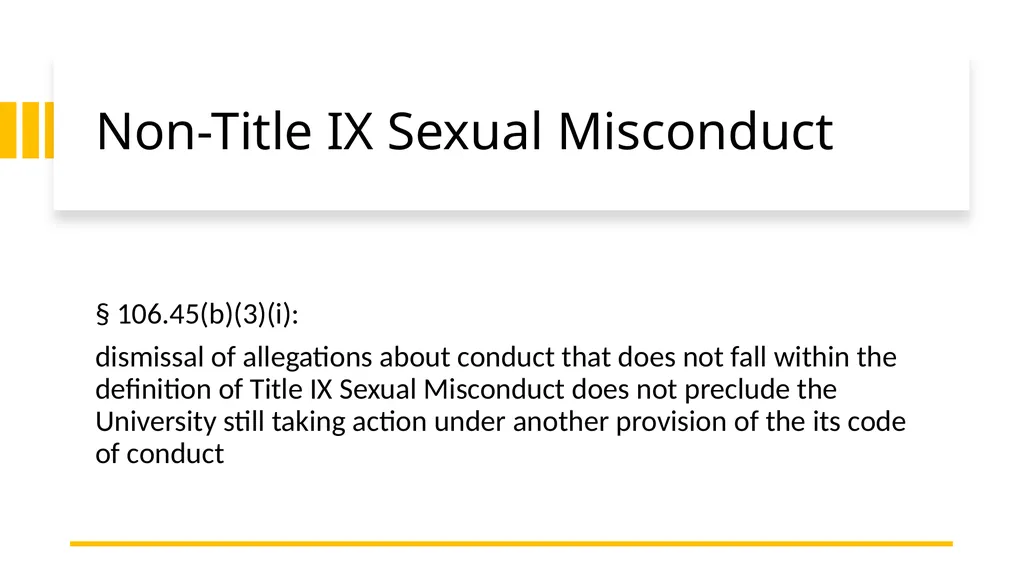
Non-Title IX Sexual Misconduct § 106.45(b)(3)(i):
dismissal of allegations about conduct that does not fall within the definition of Title IX Sexual Misconduct does not preclude the University still taking action under another provision of the its code of conduct<br>
dismissal of allegations about conduct that does not fall within the definition of Title IX Sexual Misconduct does not preclude the University still taking action under another provision of the its code of conduct<br>
19
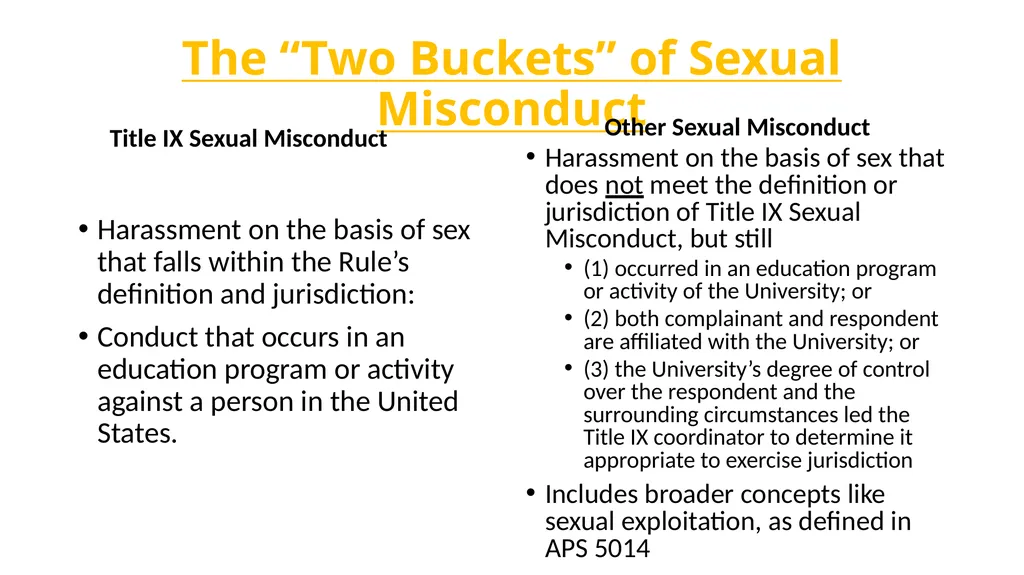
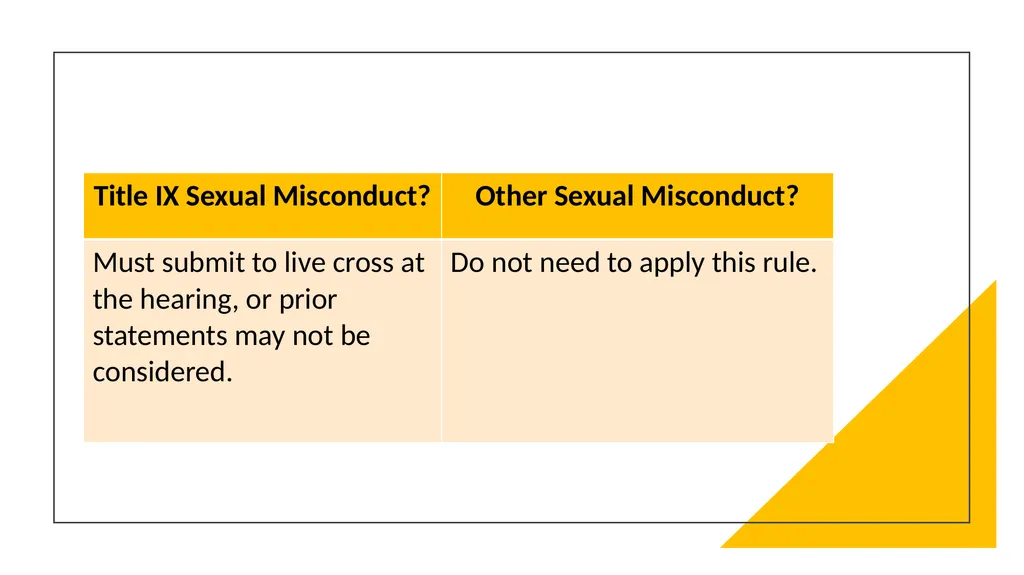
The “Two Buckets” of Sexual Misconduct Title IX Sexual Misconduct Harassment on the basis of sex that falls within the Rule’s definition and jurisdiction:
Conduct that occurs in an education program or activity against a person in the United States. Other Sexual Misconduct Harassment on the basis of sex that does not meet the definition or jurisdiction of Title IX Sexual Misconduct, but still
(1) occurred in an education program or activity of the University; or
(2) both complainant and respondent are affiliated with the University; or
(3) the University’s degree of control over the respondent and the surrounding circumstances led the Title IX coordinator to determine it appropriate to exercise jurisdiction
Includes broader concepts like sexual exploitation, as defined in APS 5014<br>
20
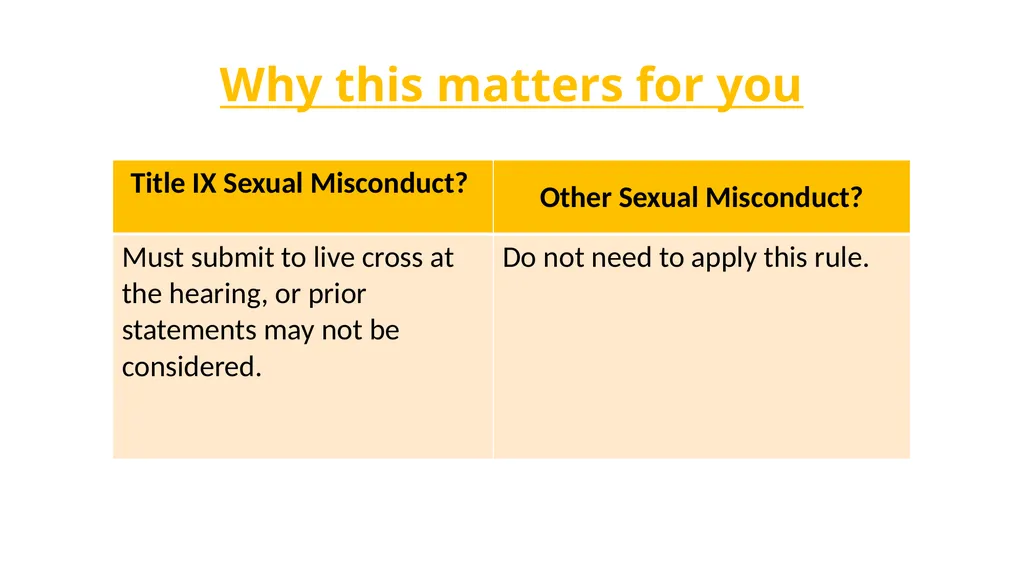
Why this matters for you<br>
21
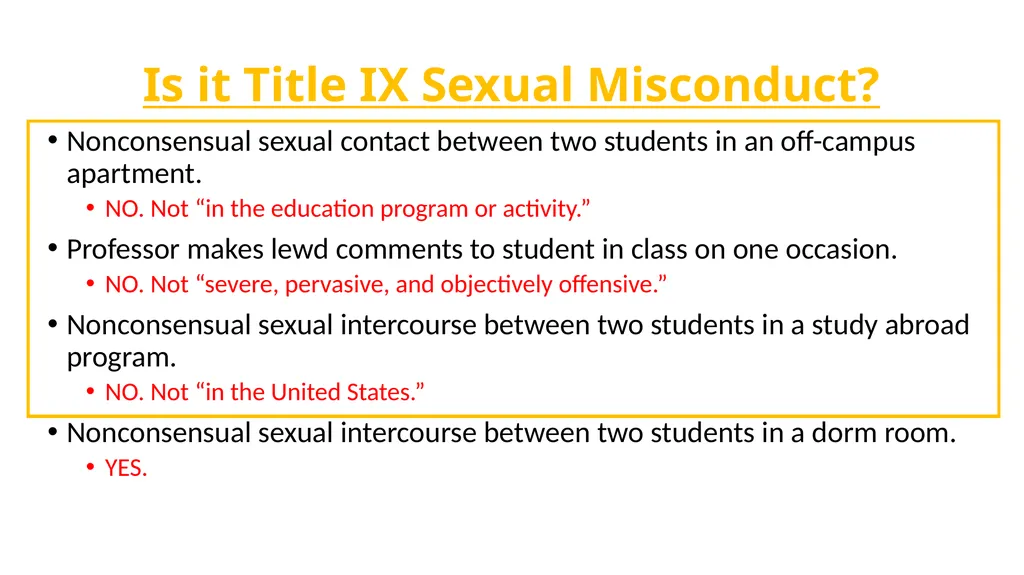
Is it Title IX Sexual Misconduct? Nonconsensual sexual contact between two students in an off-campus apartment.
NO. Not “in the education program or activity.”
Professor makes lewd comments to student in class on one occasion.
NO. Not “severe, pervasive, and objectively offensive.”
Nonconsensual sexual intercourse between two students in a study abroad program.
NO. Not “in the United States.”
Nonconsensual sexual intercourse between two students in a dorm room.
YES.<br>
22
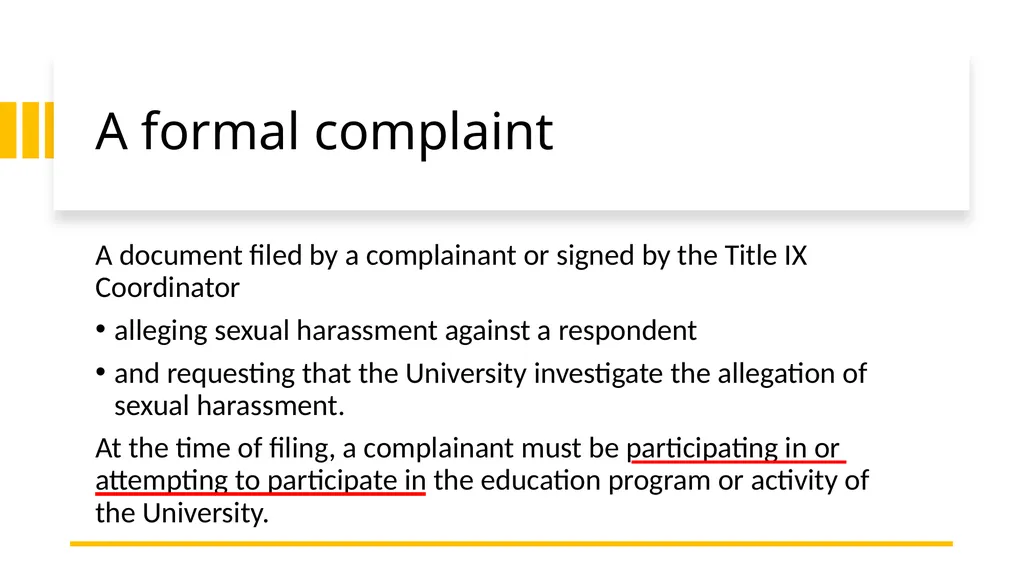
A formal complaint A document filed by a complainant or signed by the Title IX Coordinator
alleging sexual harassment against a respondent
and requesting that the University investigate the allegation of sexual harassment.
At the time of filing, a complainant must be participating in or attempting to participate in the education program or activity of the University.<br>
alleging sexual harassment against a respondent
and requesting that the University investigate the allegation of sexual harassment.
At the time of filing, a complainant must be participating in or attempting to participate in the education program or activity of the University.<br>
23
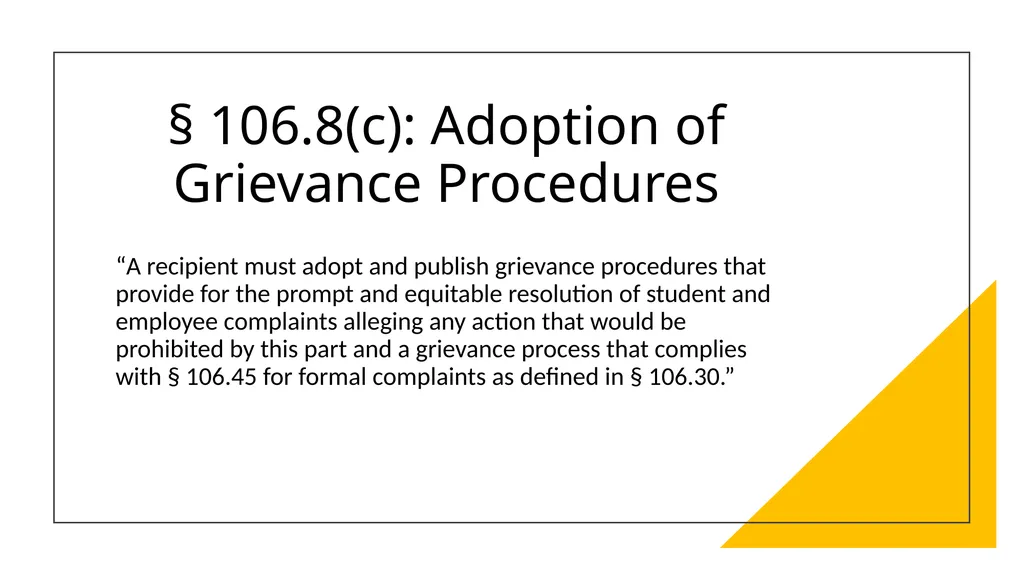
§ 106.8(c): Adoption of Grievance Procedures “A recipient must adopt and publish grievance procedures that provide for the prompt and equitable resolution of student and employee complaints alleging any action that would be prohibited by this part and a grievance process that complies with § 106.45 for formal complaints as defined in § 106.30.”<br>
24
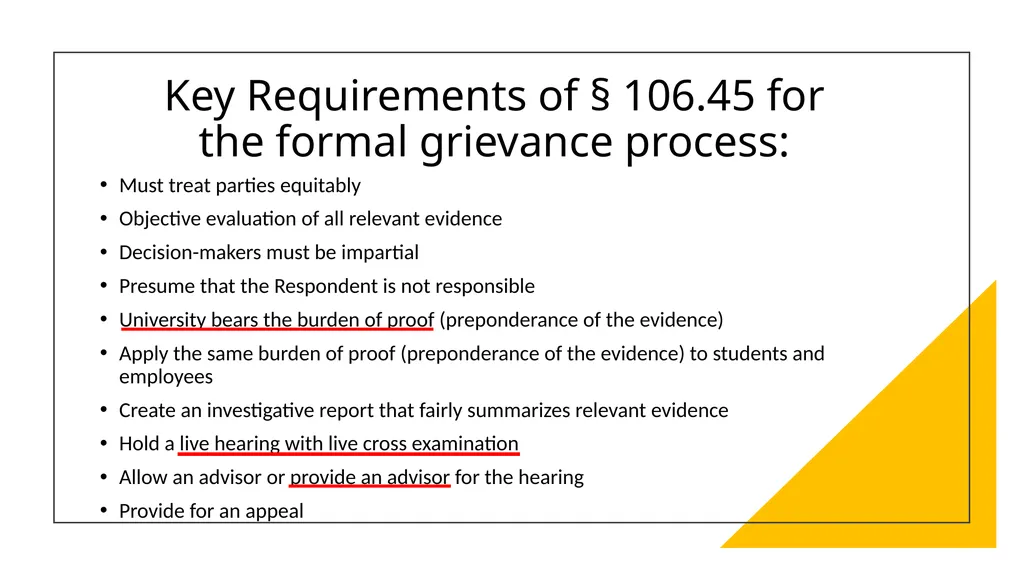
Key Requirements of § 106.45 for the formal grievance process: Must treat parties equitably
Objective evaluation of all relevant evidence
Decision-makers must be impartial
Presume that the Respondent is not responsible
University bears the burden of proof (preponderance of the evidence)
Apply the same burden of proof (preponderance of the evidence) to students and employees
Create an investigative report that fairly summarizes relevant evidence
Hold a live hearing with live cross examination
Allow an advisor or provide an advisor for the hearing
Provide for an appeal<br>
25
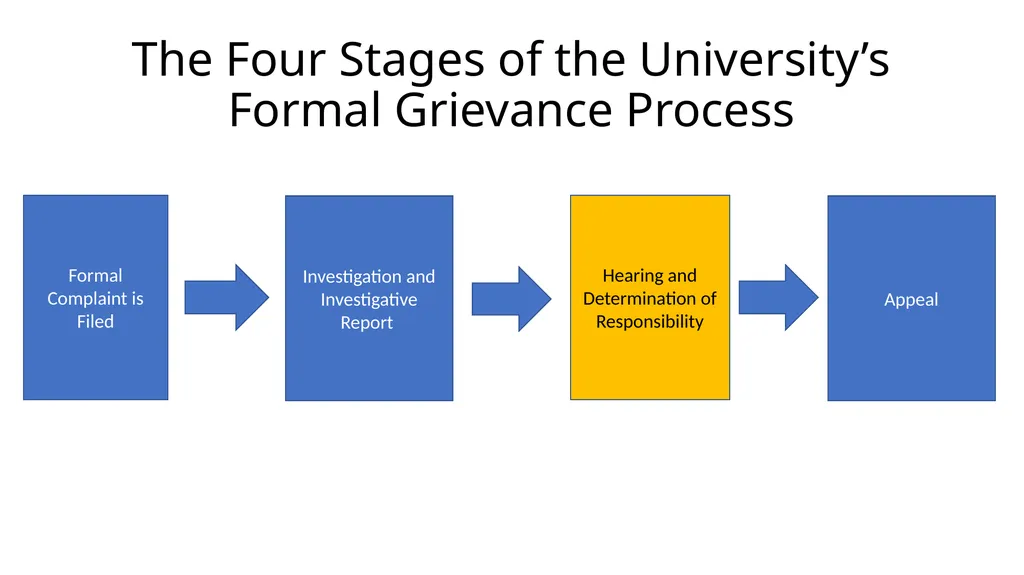
Formal Complaint is Filed Investigation and Investigative Report Hearing and Determination of Responsibility Appeal The Four Stages of the University’s Formal Grievance Process<br>
26
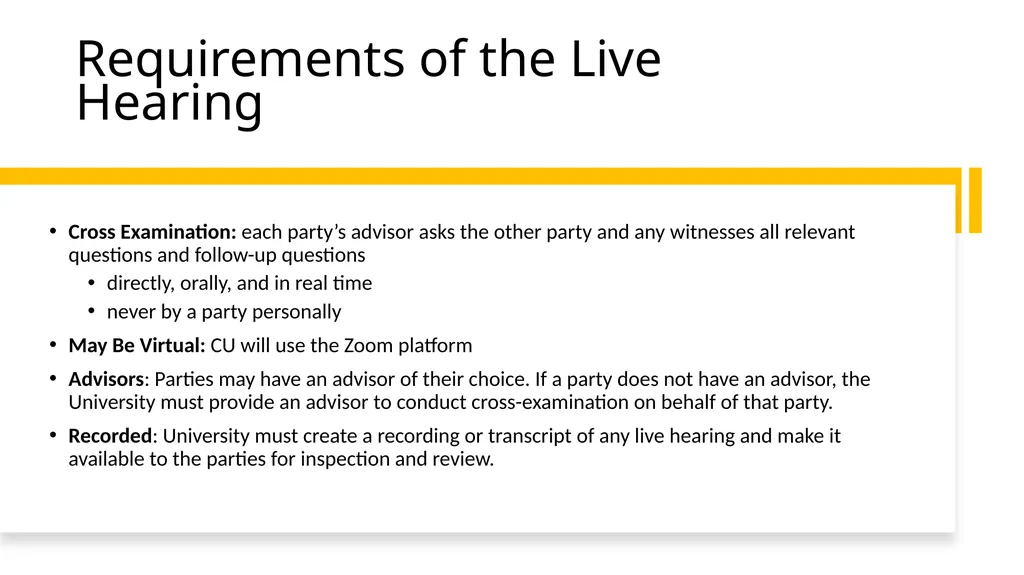
Requirements of the Live Hearing Cross Examination: each party’s advisor asks the other party and any witnesses all relevant questions and follow-up questions
directly, orally, and in real time
never by a party personally
May Be Virtual: CU will use the Zoom platform
Advisors: Parties may have an advisor of their choice. If a party does not have an advisor, the University must provide an advisor to conduct cross-examination on behalf of that party.
Recorded: University must create a recording or transcript of any live hearing and make it available to the parties for inspection and review.<br>
27
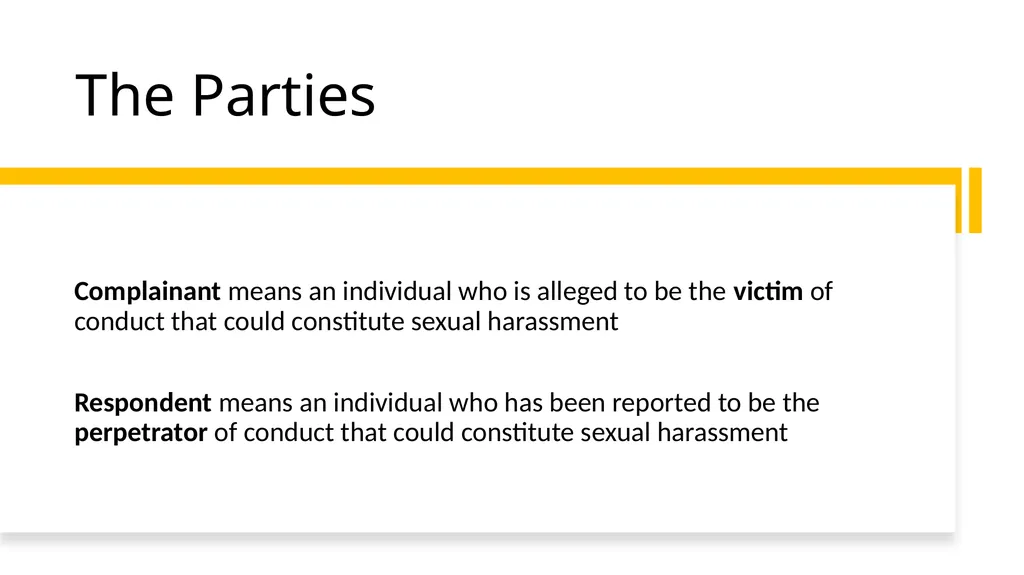
The Parties Complainant means an individual who is alleged to be the victim of conduct that could constitute sexual harassment
Respondent means an individual who has been reported to be the perpetrator of conduct that could constitute sexual harassment<br>
Respondent means an individual who has been reported to be the perpetrator of conduct that could constitute sexual harassment<br>
28
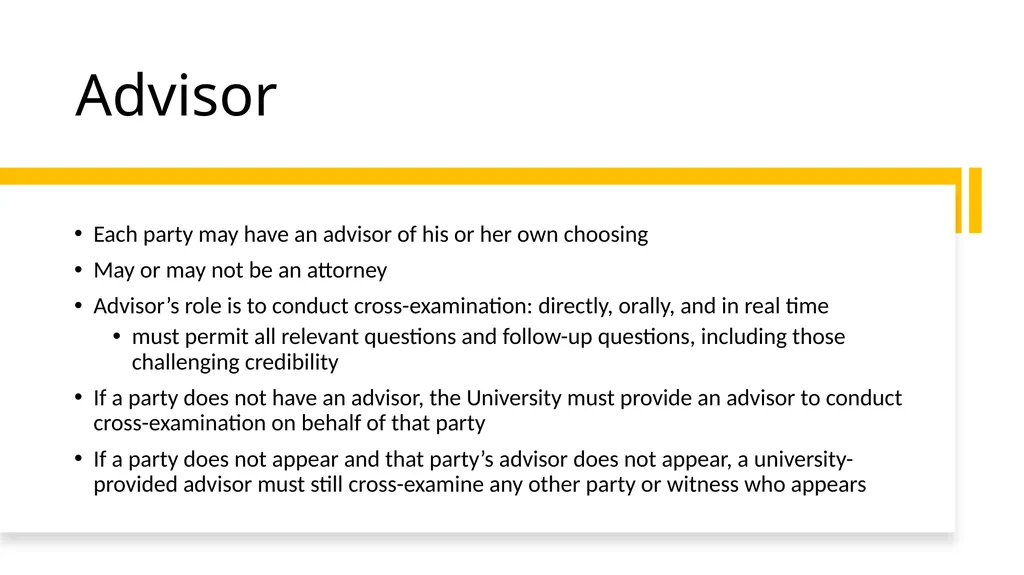
Advisor Each party may have an advisor of his or her own choosing
May or may not be an attorney
Advisor’s role is to conduct cross-examination: directly, orally, and in real time
must permit all relevant questions and follow-up questions, including those challenging credibility
If a party does not have an advisor, the University must provide an advisor to conduct cross-examination on behalf of that party
If a party does not appear and that party’s advisor does not appear, a university-provided advisor must still cross-examine any other party or witness who appears<br>
29
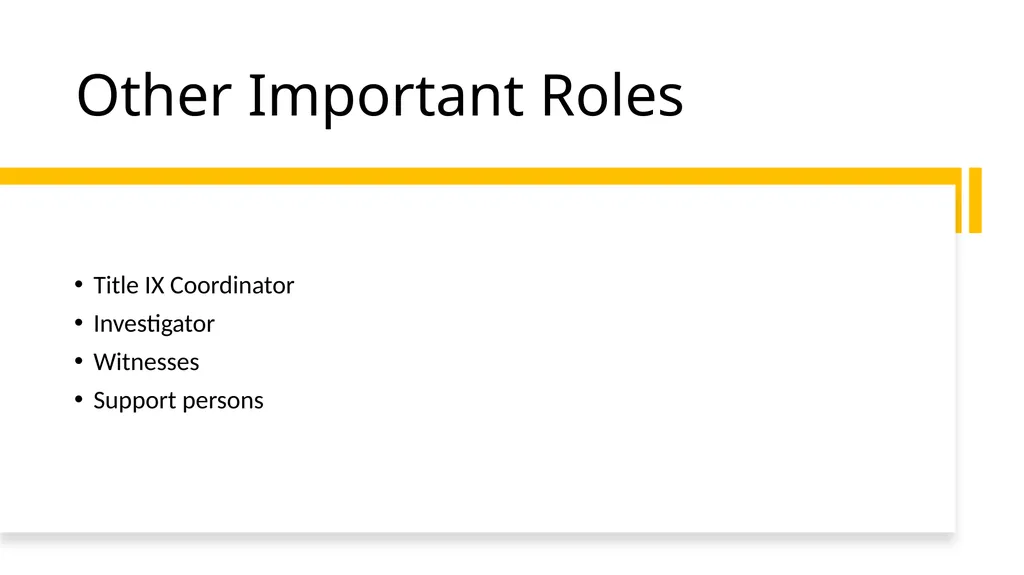
Other Important Roles Title IX Coordinator
Investigator
Witnesses
Support persons<br>
Investigator
Witnesses
Support persons<br>
30
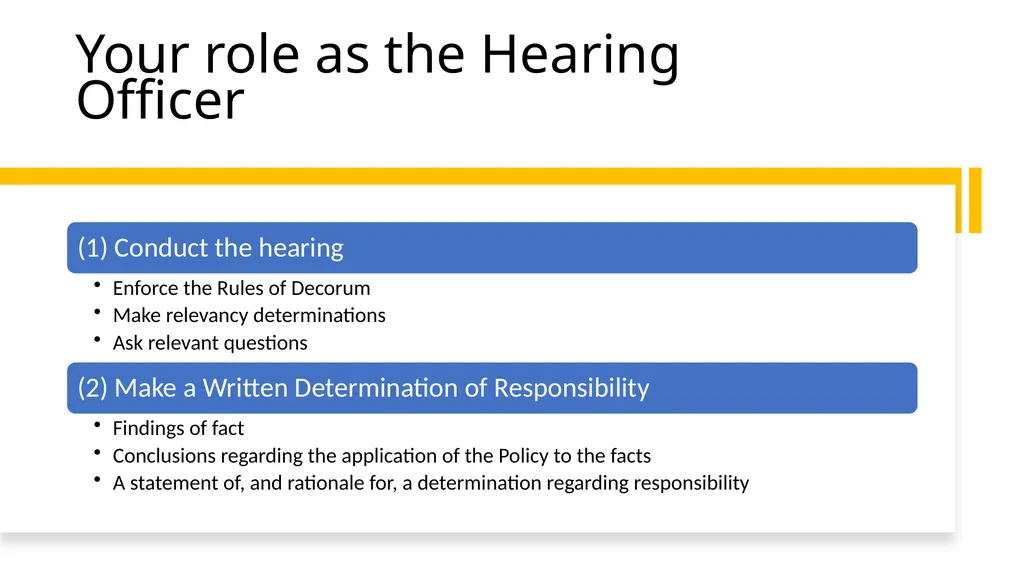
Your role as the Hearing Officer<br>
31
Conducting the Hearing<br>
32
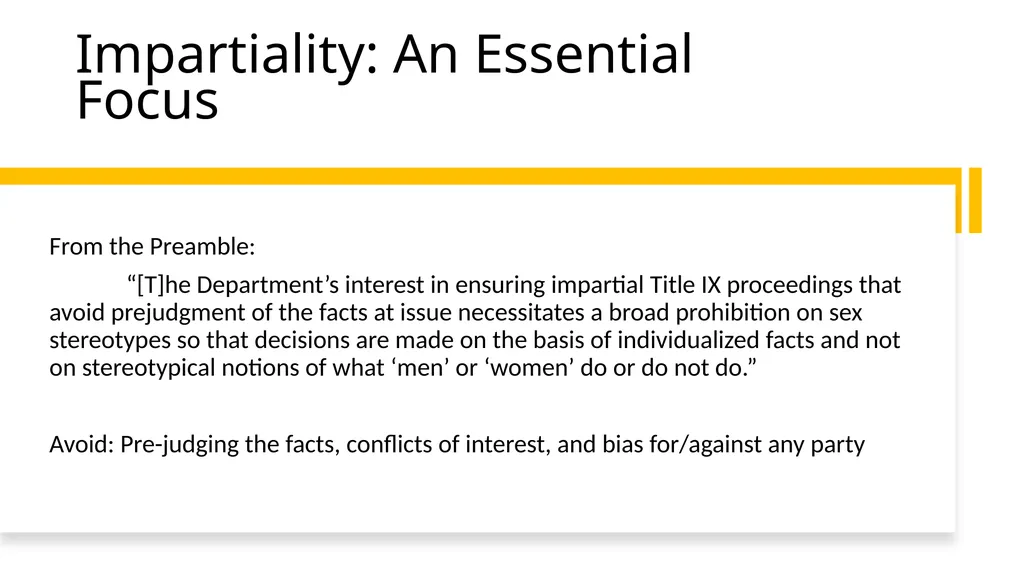
Impartiality: An Essential Focus From the Preamble:
“[T]he Department’s interest in ensuring impartial Title IX proceedings that avoid prejudgment of the facts at issue necessitates a broad prohibition on sex stereotypes so that decisions are made on the basis of individualized facts and not on stereotypical notions of what ‘men’ or ‘women’ do or do not do.”
Avoid: Pre-judging the facts, conflicts of interest, and bias for/against any party<br>
33
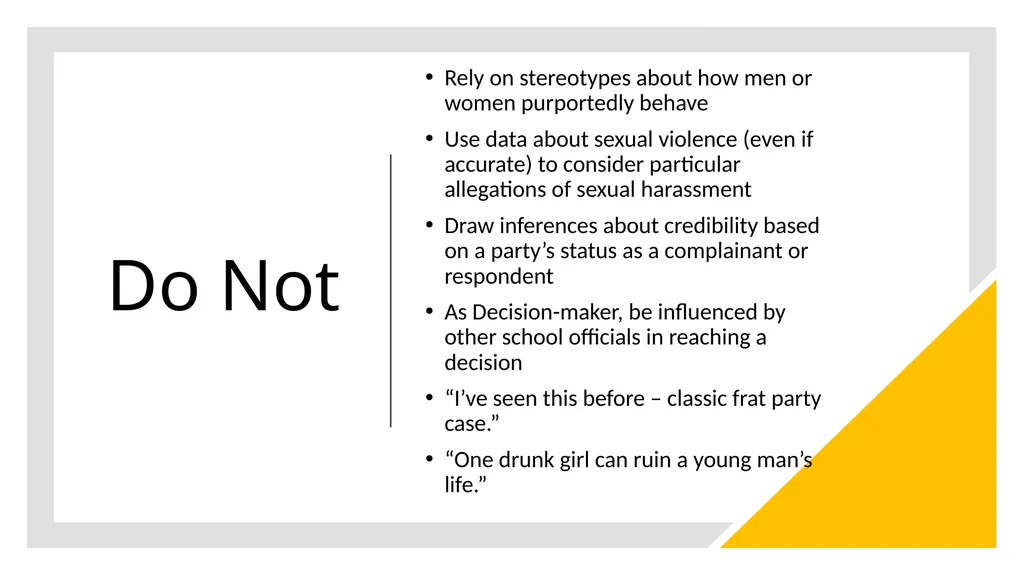
Do Not Rely on stereotypes about how men or women purportedly behave
Use data about sexual violence (even if accurate) to consider particular allegations of sexual harassment
Draw inferences about credibility based on a party’s status as a complainant or respondent
As Decision-maker, be influenced by other school officials in reaching a decision
“I’ve seen this before – classic frat party case.”
“One drunk girl can ruin a young man’s life.”<br>
34
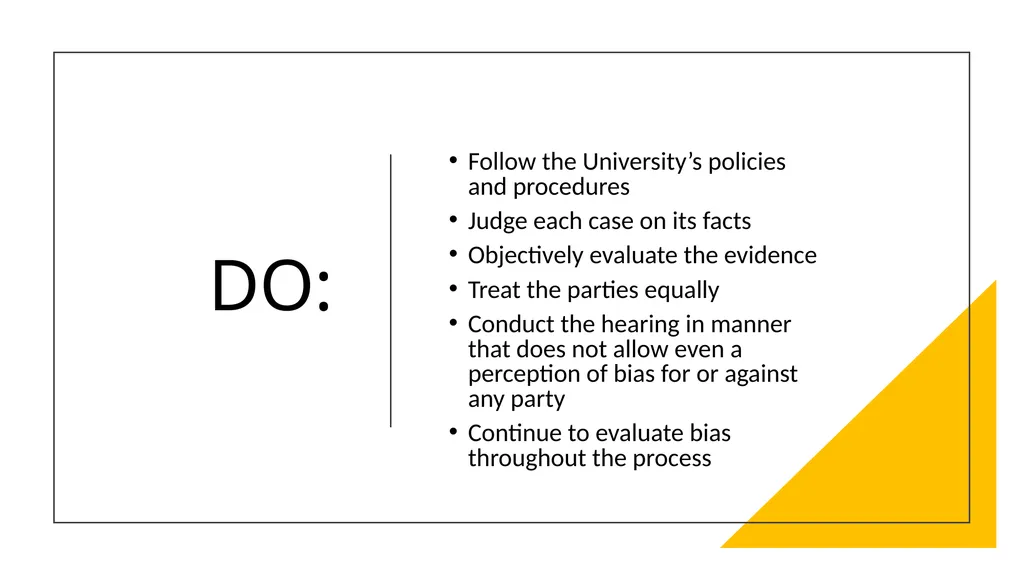
DO: Follow the University’s policies and procedures
Judge each case on its facts
Objectively evaluate the evidence
Treat the parties equally
Conduct the hearing in manner that does not allow even a perception of bias for or against any party
Continue to evaluate bias throughout the process<br>
Judge each case on its facts
Objectively evaluate the evidence
Treat the parties equally
Conduct the hearing in manner that does not allow even a perception of bias for or against any party
Continue to evaluate bias throughout the process<br>
35
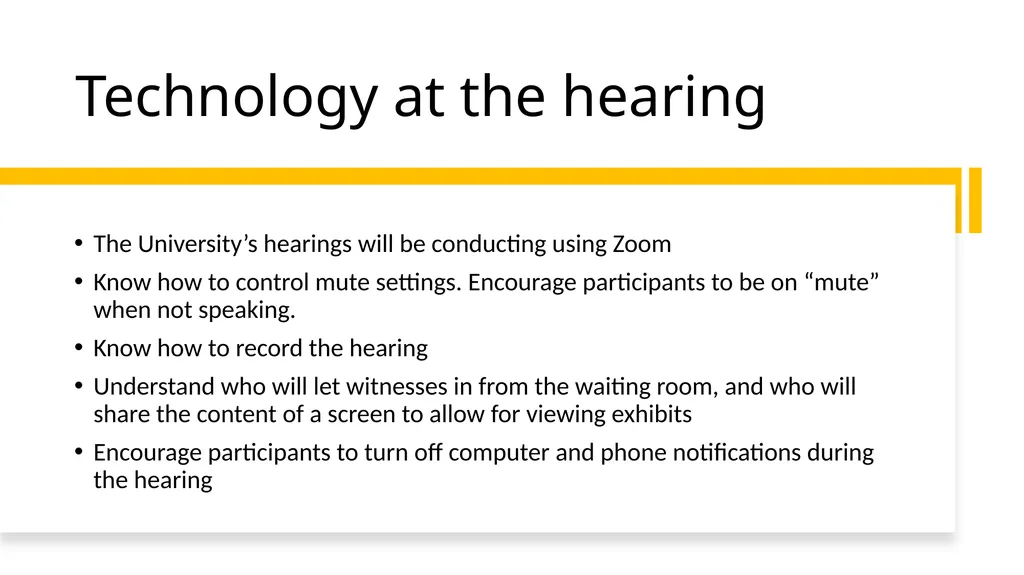
Technology at the hearing The University’s hearings will be conducting using Zoom
Know how to control mute settings. Encourage participants to be on “mute” when not speaking.
Know how to record the hearing
Understand who will let witnesses in from the waiting room, and who will share the content of a screen to allow for viewing exhibits
Encourage participants to turn off computer and phone notifications during the hearing<br>
36
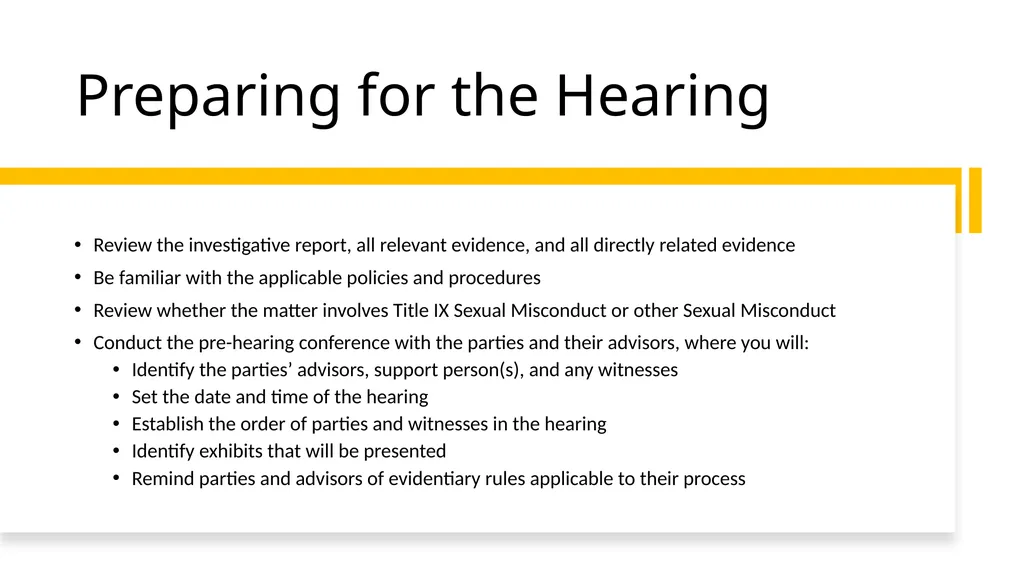
Preparing for the Hearing Review the investigative report, all relevant evidence, and all directly related evidence
Be familiar with the applicable policies and procedures
Review whether the matter involves Title IX Sexual Misconduct or other Sexual Misconduct
Conduct the pre-hearing conference with the parties and their advisors, where you will:
Identify the parties’ advisors, support person(s), and any witnesses
Set the date and time of the hearing
Establish the order of parties and witnesses in the hearing
Identify exhibits that will be presented
Remind parties and advisors of evidentiary rules applicable to their process<br>
37
Enforcing the Rules of Decorum Although less formal than courtroom proceedings, the University requires a respectful hearing.
Any abuse, interference, or failure to comply with university hearing processes could result in the exclusion of individuals from the hearing process or referral to other university offices for resolution.
Advisors who violate these expectations after warnings to cease may be asked to leave and may be precluded from attendance at future meetings or hearings.
The Hearing Officer has broad discretion and authority to respond to disruptive or harassing behaviors, including adjourning the hearing or excluding disruptive persons.<br>
38
Relevant Evidence: the only guidepost From DOE: “The § 106.45 grievance process is designed to bring all relevant evidence concerning sexual harassment allegations to the decision maker’s attention so that a determination regarding responsibility is reached fairly and reliably.”
The Rules of Evidence do not apply, and the University is prohibited from adopting rules that contravene the purposes of the evidentiary requirements under § 106.45 (for instance, cannot adopt a rule prohibiting relevant evidence that is unduly prejudicial).<br>
The Rules of Evidence do not apply, and the University is prohibited from adopting rules that contravene the purposes of the evidentiary requirements under § 106.45 (for instance, cannot adopt a rule prohibiting relevant evidence that is unduly prejudicial).<br>
39
The investigator must collect and make available to the parties for review all relevant and directly related evidence.
§ 106.45(b)(3)(vi)
This must include:
the evidence that the University does not intend to rely on in making a determination of responsibility
inculpatory or exculpatory evidence, whether obtained from a party or another source The investigative report and the determination of responsibility may only be based on relevant evidence. § 106.45(b)(3)(vi)<br>
40
Directly Related vs. Relevant Evidence “Directly related” is not defined in the rules.
Directly related is a broader universe than “relevant.” Relevant is not defined in the rules.
The Preamble states relevant evidence is:
“evidence pertinent to proving whether facts material to the allegations under investigation are more or less likely to be true.”<br>
Directly related is a broader universe than “relevant.” Relevant is not defined in the rules.
The Preamble states relevant evidence is:
“evidence pertinent to proving whether facts material to the allegations under investigation are more or less likely to be true.”<br>
41
Making on-the-spot relevancy rulings Only relevant cross-examination and other questions may be asked of a party or witness.
Before a party or witness answers a cross-examination question, the Hearing Officer must first determine whether the question is relevant and explain any decision to exclude it.
You may allow the advisors to conduct cross examination without pausing for an affirmative ruling on relevance, only interjecting when there are relevance concerns.<br>
42
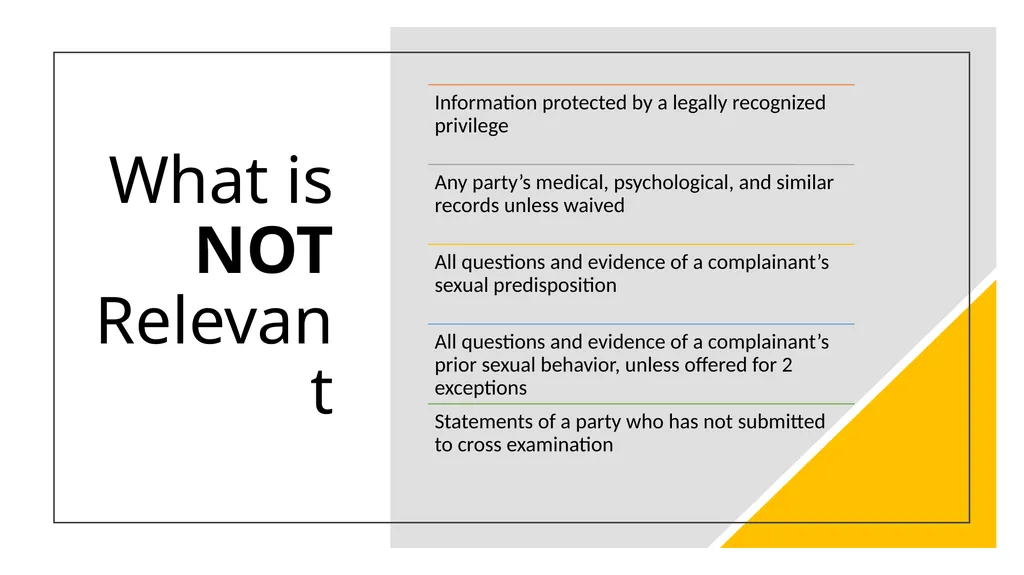
What is NOT Relevant<br>
43
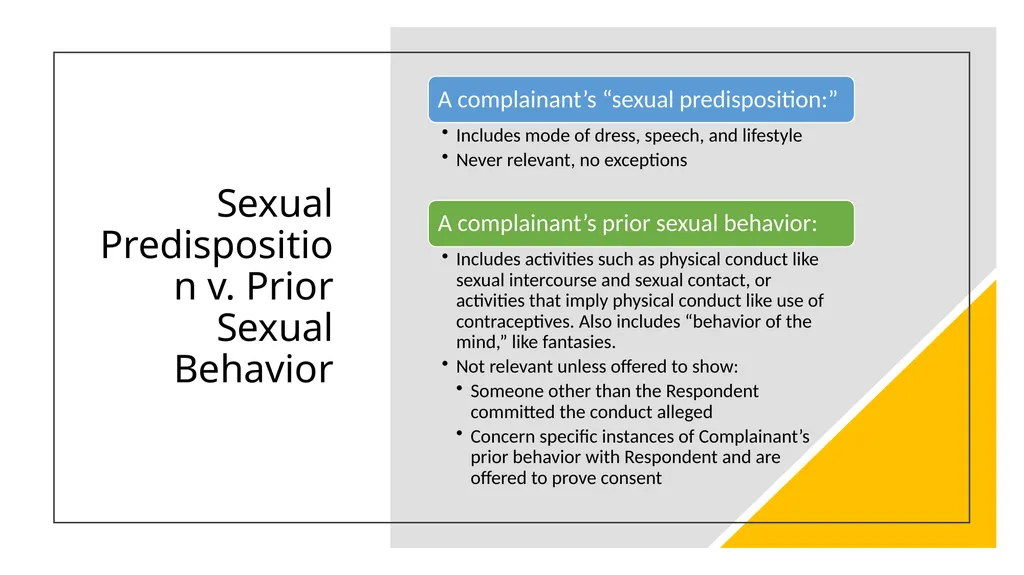
Sexual Predisposition v. Prior Sexual Behavior<br>
44
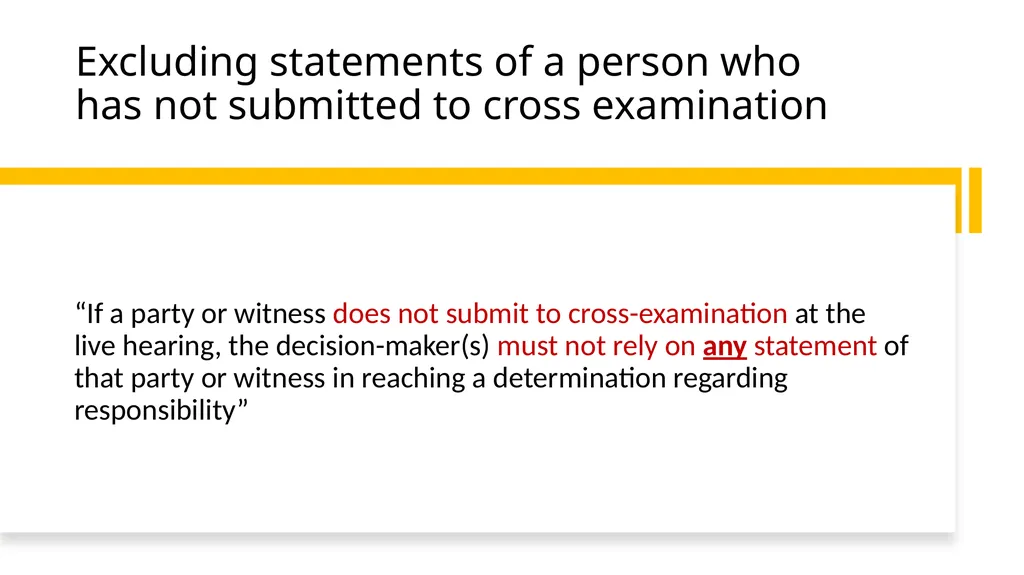
Excluding statements of a person who has not submitted to cross examination “If a party or witness does not submit to cross-examination at the live hearing, the decision-maker(s) must not rely on any statement of that party or witness in reaching a determination regarding responsibility”<br>
45
Making the Determination<br>
46
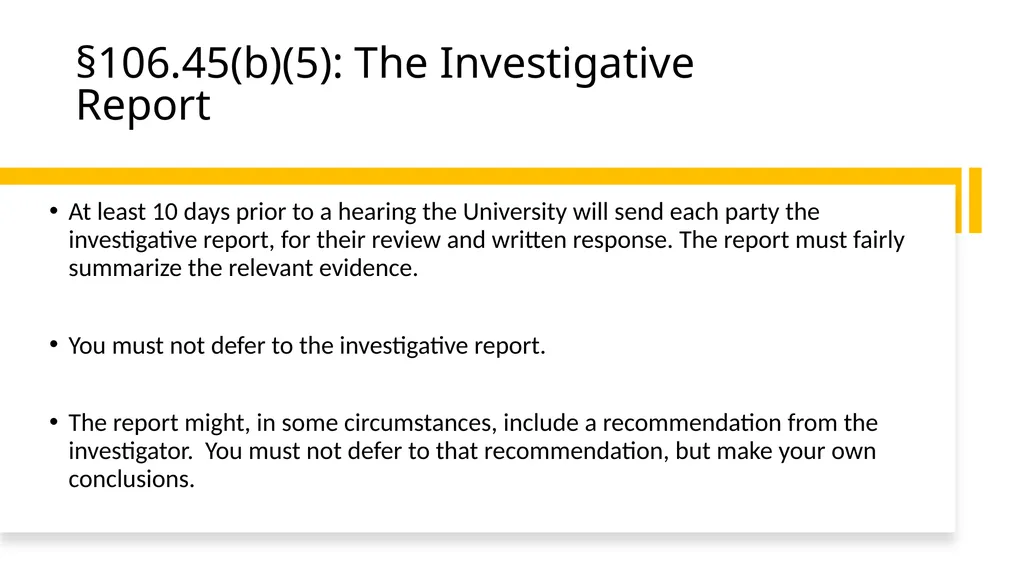
§106.45(b)(5): The Investigative Report At least 10 days prior to a hearing the University will send each party the investigative report, for their review and written response. The report must fairly summarize the relevant evidence.
You must not defer to the investigative report.
The report might, in some circumstances, include a recommendation from the investigator. You must not defer to that recommendation, but make your own conclusions.<br>
You must not defer to the investigative report.
The report might, in some circumstances, include a recommendation from the investigator. You must not defer to that recommendation, but make your own conclusions.<br>
47
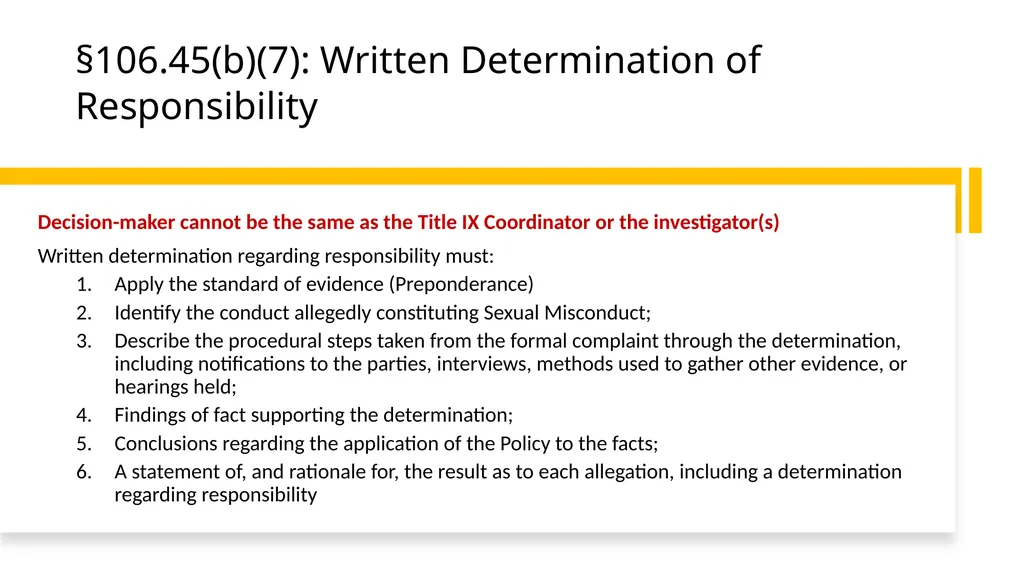
§106.45(b)(7): Written Determination of Responsibility Decision-maker cannot be the same as the Title IX Coordinator or the investigator(s)
Written determination regarding responsibility must:
Apply the standard of evidence (Preponderance)
Identify the conduct allegedly constituting Sexual Misconduct;
Describe the procedural steps taken from the formal complaint through the determination, including notifications to the parties, interviews, methods used to gather other evidence, or hearings held;
Findings of fact supporting the determination;
Conclusions regarding the application of the Policy to the facts;
A statement of, and rationale for, the result as to each allegation, including a determination regarding responsibility<br>
48
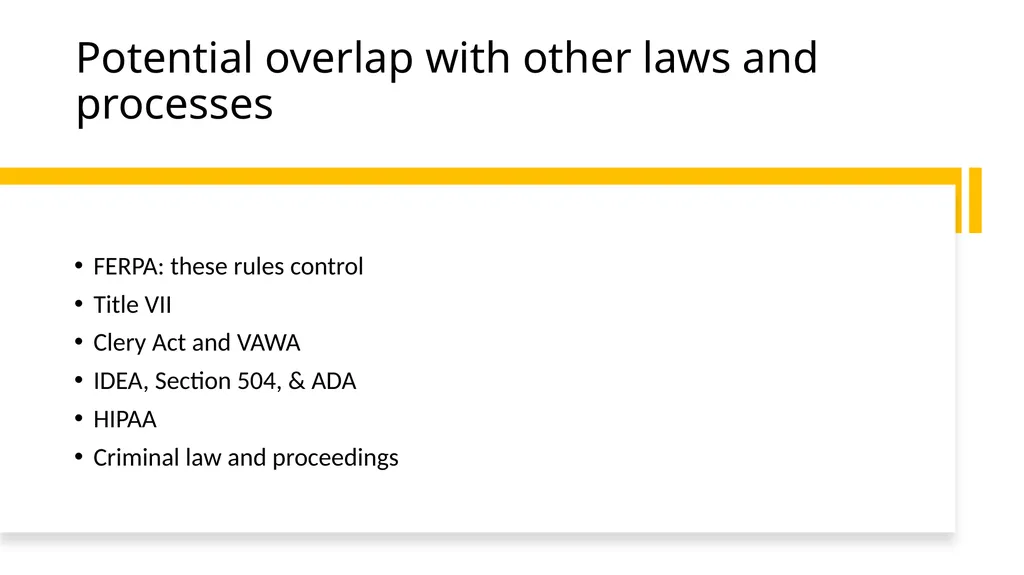
Potential overlap with other laws and processes FERPA: these rules control
Title VII
Clery Act and VAWA
IDEA, Section 504, & ADA
HIPAA
Criminal law and proceedings<br>
Title VII
Clery Act and VAWA
IDEA, Section 504, & ADA
HIPAA
Criminal law and proceedings<br>
49
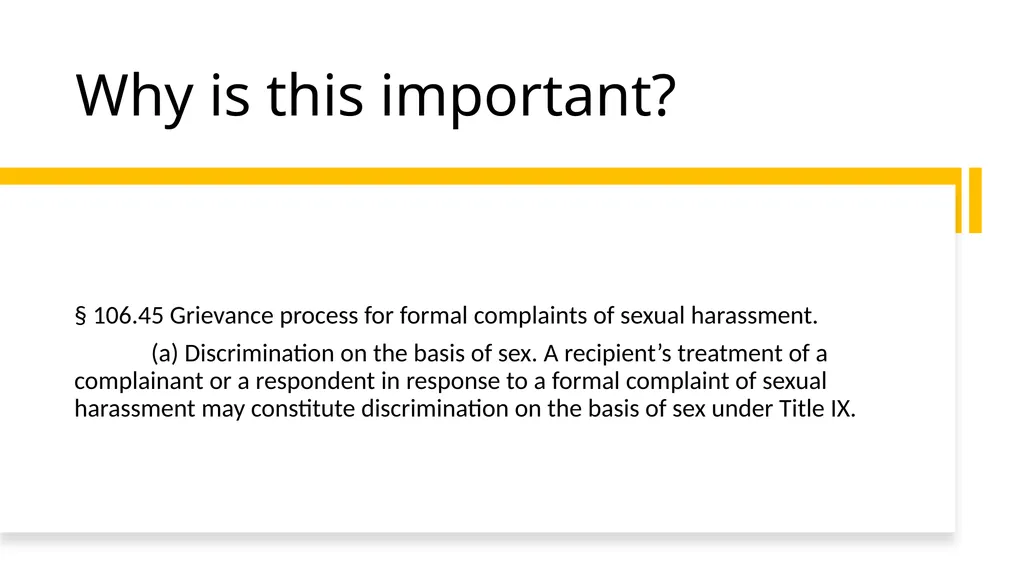
Why is this important? § 106.45 Grievance process for formal complaints of sexual harassment.
(a) Discrimination on the basis of sex. A recipient’s treatment of a complainant or a respondent in response to a formal complaint of sexual harassment may constitute discrimination on the basis of sex under Title IX.<br>
(a) Discrimination on the basis of sex. A recipient’s treatment of a complainant or a respondent in response to a formal complaint of sexual harassment may constitute discrimination on the basis of sex under Title IX.<br>
50
Discussion Scenarios<br>
51
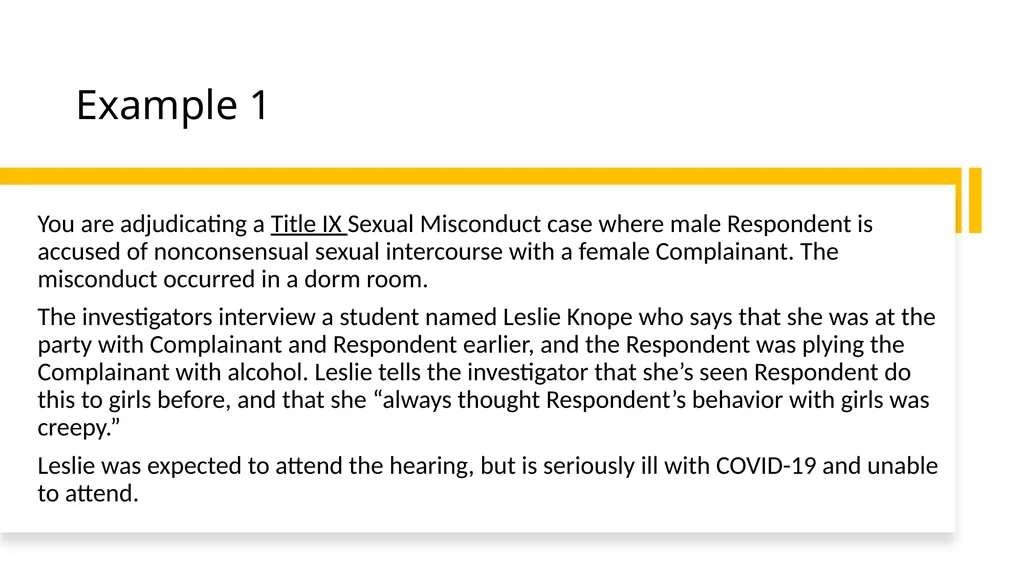
Example 1 You are adjudicating a Title IX Sexual Misconduct case where male Respondent is accused of nonconsensual sexual intercourse with a female Complainant. The misconduct occurred in a dorm room.
The investigators interview a student named Leslie Knope who says that she was at the party with Complainant and Respondent earlier, and the Respondent was plying the Complainant with alcohol. Leslie tells the investigator that she’s seen Respondent do this to girls before, and that she “always thought Respondent’s behavior with girls was creepy.”
Leslie was expected to attend the hearing, but is seriously ill with COVID-19 and unable to attend.<br>
52
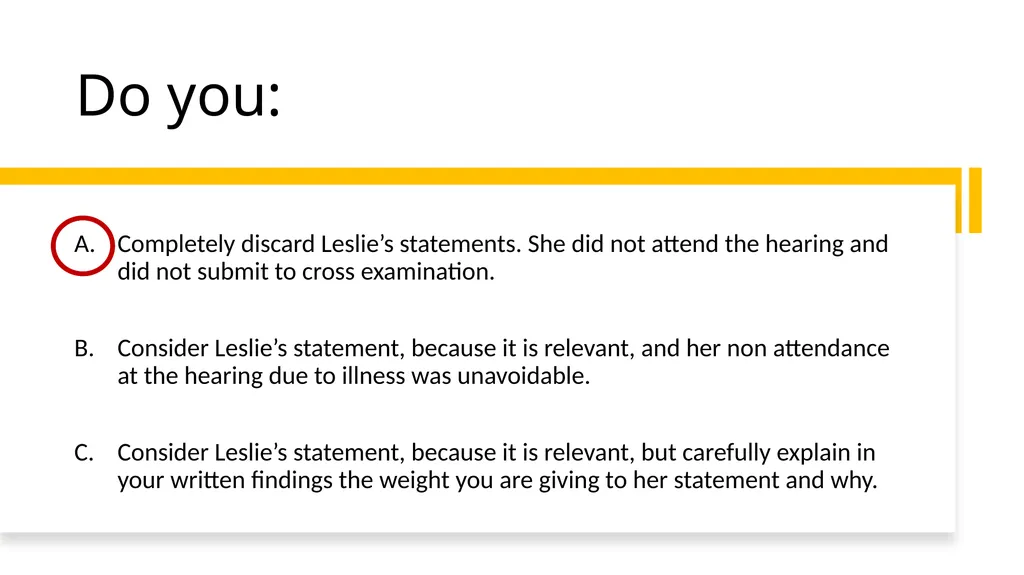
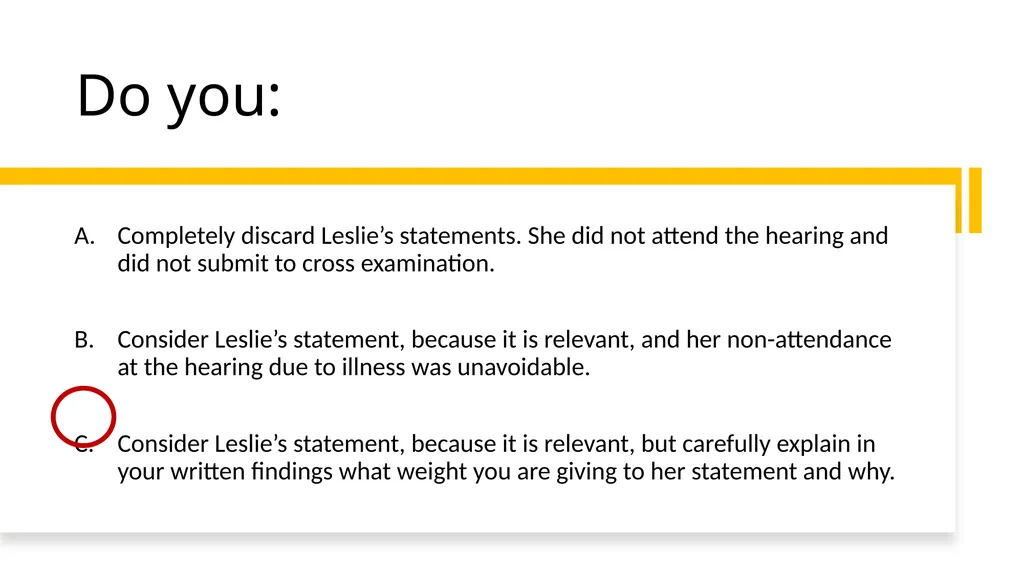
Do you: Completely discard Leslie’s statements. She did not attend the hearing and did not submit to cross examination.
Consider Leslie’s statement, because it is relevant, and her non attendance at the hearing due to illness was unavoidable.
Consider Leslie’s statement, because it is relevant, but carefully explain in your written findings the weight you are giving to her statement and why.<br>
Consider Leslie’s statement, because it is relevant, and her non attendance at the hearing due to illness was unavoidable.
Consider Leslie’s statement, because it is relevant, but carefully explain in your written findings the weight you are giving to her statement and why.<br>
53
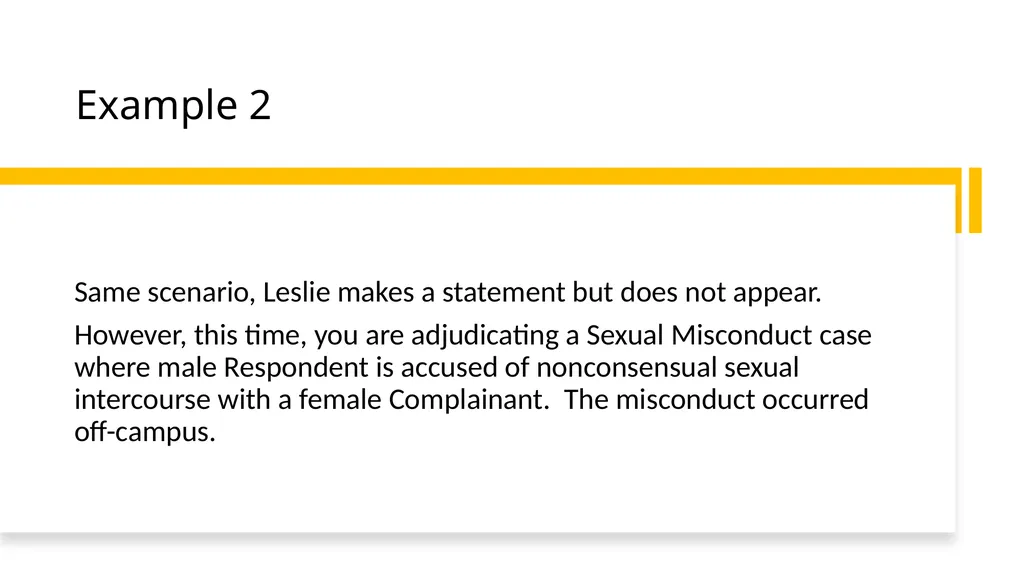
Example 2 Same scenario, Leslie makes a statement but does not appear.
However, this time, you are adjudicating a Sexual Misconduct case where male Respondent is accused of nonconsensual sexual intercourse with a female Complainant. The misconduct occurred off-campus.<br>
However, this time, you are adjudicating a Sexual Misconduct case where male Respondent is accused of nonconsensual sexual intercourse with a female Complainant. The misconduct occurred off-campus.<br>
54
Do you: Completely discard Leslie’s statements. She did not attend the hearing and did not submit to cross examination.
Consider Leslie’s statement, because it is relevant, and her non-attendance at the hearing due to illness was unavoidable.
Consider Leslie’s statement, because it is relevant, but carefully explain in your written findings what weight you are giving to her statement and why.<br>
Consider Leslie’s statement, because it is relevant, and her non-attendance at the hearing due to illness was unavoidable.
Consider Leslie’s statement, because it is relevant, but carefully explain in your written findings what weight you are giving to her statement and why.<br>
55
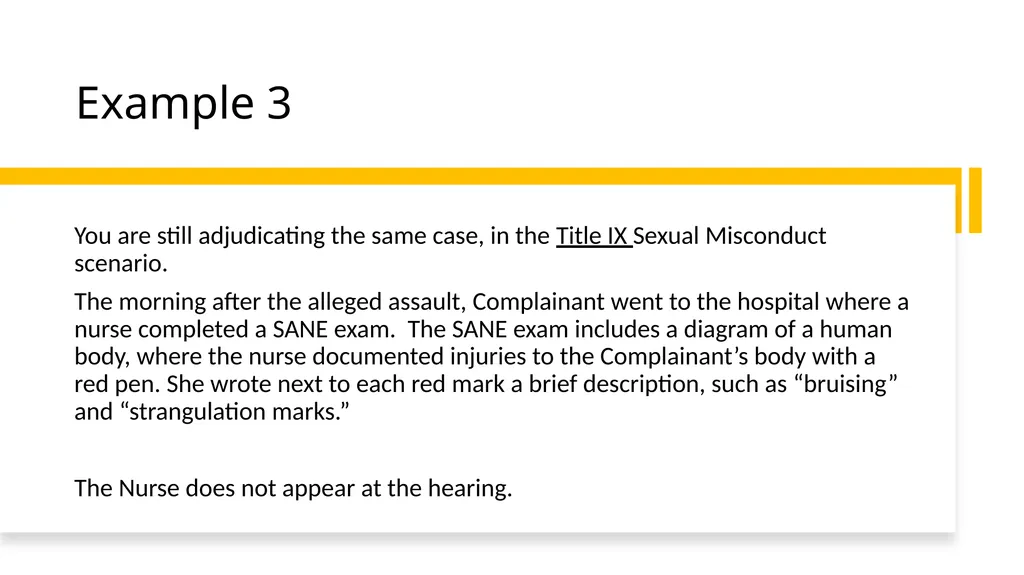
Example 3 You are still adjudicating the same case, in the Title IX Sexual Misconduct scenario.
The morning after the alleged assault, Complainant went to the hospital where a nurse completed a SANE exam. The SANE exam includes a diagram of a human body, where the nurse documented injuries to the Complainant’s body with a red pen. She wrote next to each red mark a brief description, such as “bruising” and “strangulation marks.”
The Nurse does not appear at the hearing.<br>
56
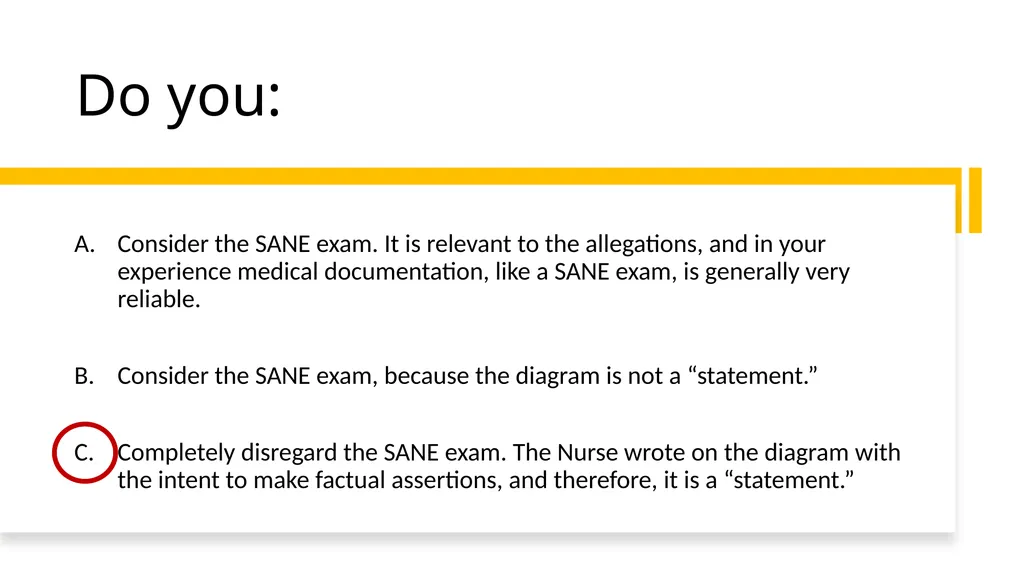
Do you: Consider the SANE exam. It is relevant to the allegations, and in your experience medical documentation, like a SANE exam, is generally very reliable.
Consider the SANE exam, because the diagram is not a “statement.”
Completely disregard the SANE exam. The Nurse wrote on the diagram with the intent to make factual assertions, and therefore, it is a “statement.”<br>
Consider the SANE exam, because the diagram is not a “statement.”
Completely disregard the SANE exam. The Nurse wrote on the diagram with the intent to make factual assertions, and therefore, it is a “statement.”<br>
57
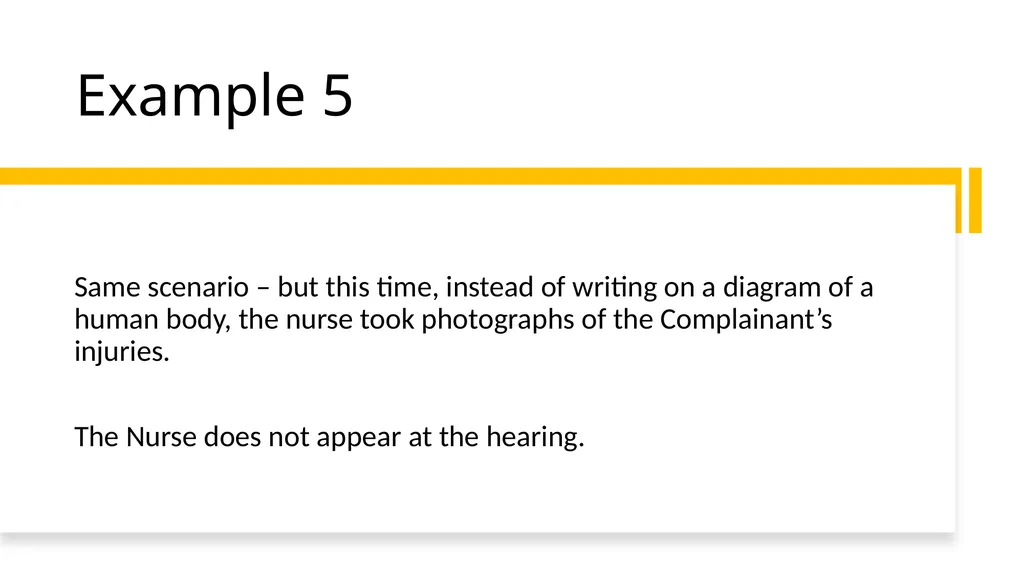
Example 5 Same scenario – but this time, instead of writing on a diagram of a human body, the nurse took photographs of the Complainant’s injuries.
The Nurse does not appear at the hearing.<br>
The Nurse does not appear at the hearing.<br>
58
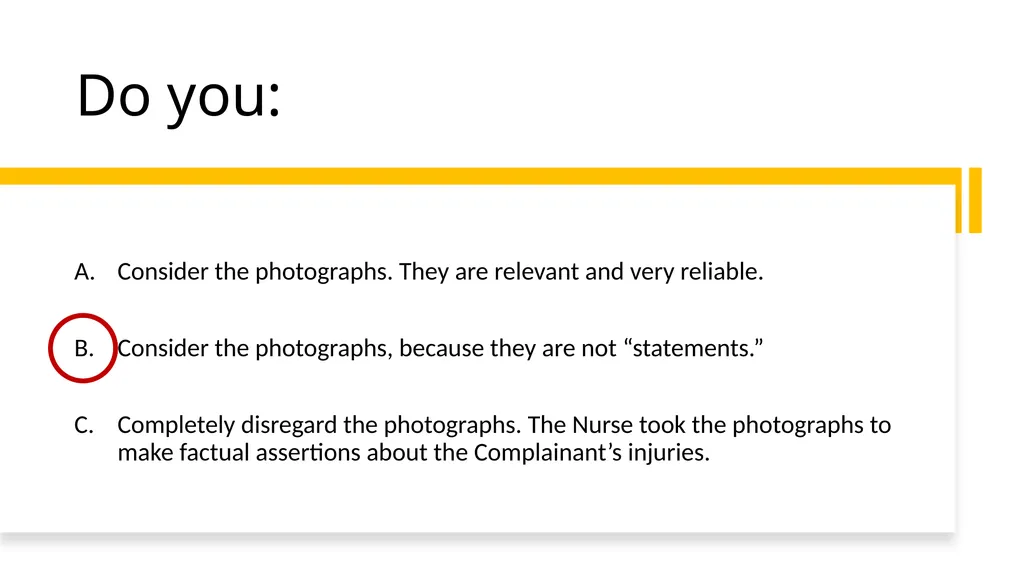
Do you: Consider the photographs. They are relevant and very reliable.
Consider the photographs, because they are not “statements.”
Completely disregard the photographs. The Nurse took the photographs to make factual assertions about the Complainant’s injuries.<br>
Consider the photographs, because they are not “statements.”
Completely disregard the photographs. The Nurse took the photographs to make factual assertions about the Complainant’s injuries.<br>
59
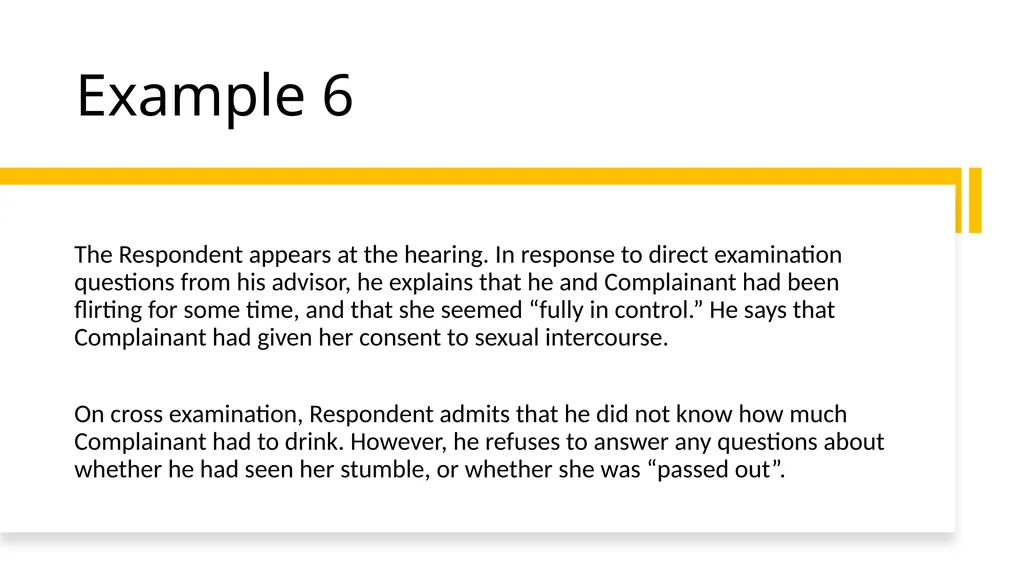
Example 6 The Respondent appears at the hearing. In response to direct examination questions from his advisor, he explains that he and Complainant had been flirting for some time, and that she seemed “fully in control.” He says that Complainant had given her consent to sexual intercourse.
On cross examination, Respondent admits that he did not know how much Complainant had to drink. However, he refuses to answer any questions about whether he had seen her stumble, or whether she was “passed out”.<br>
On cross examination, Respondent admits that he did not know how much Complainant had to drink. However, he refuses to answer any questions about whether he had seen her stumble, or whether she was “passed out”.<br>
60
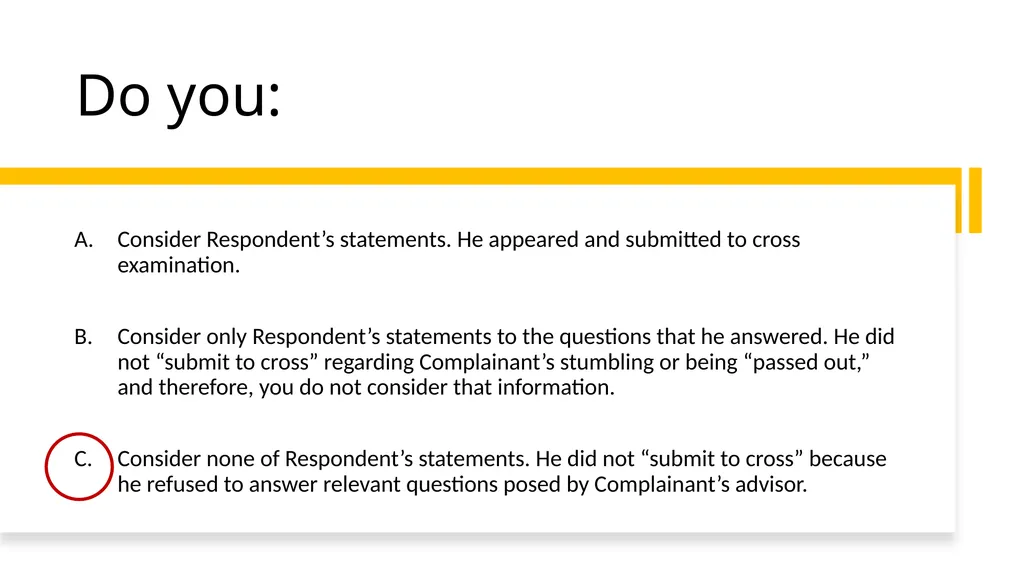
Do you: Consider Respondent’s statements. He appeared and submitted to cross examination.
Consider only Respondent’s statements to the questions that he answered. He did not “submit to cross” regarding Complainant’s stumbling or being “passed out,” and therefore, you do not consider that information.
Consider none of Respondent’s statements. He did not “submit to cross” because he refused to answer relevant questions posed by Complainant’s advisor.<br>
61
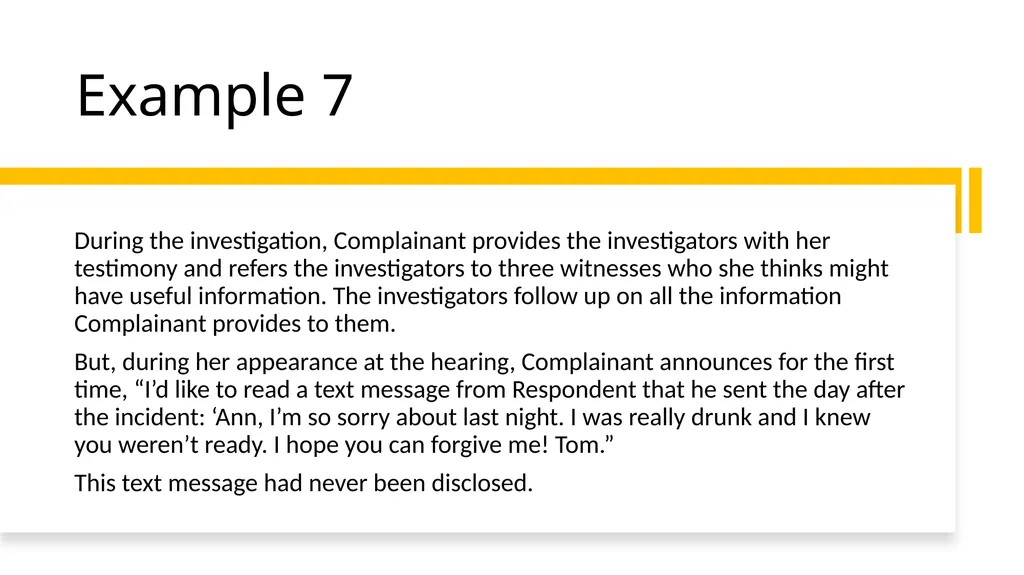
Example 7 During the investigation, Complainant provides the investigators with her testimony and refers the investigators to three witnesses who she thinks might have useful information. The investigators follow up on all the information Complainant provides to them.
But, during her appearance at the hearing, Complainant announces for the first time, “I’d like to read a text message from Respondent that he sent the day after the incident: ‘Ann, I’m so sorry about last night. I was really drunk and I knew you weren’t ready. I hope you can forgive me! Tom.”
This text message had never been disclosed.<br>
62
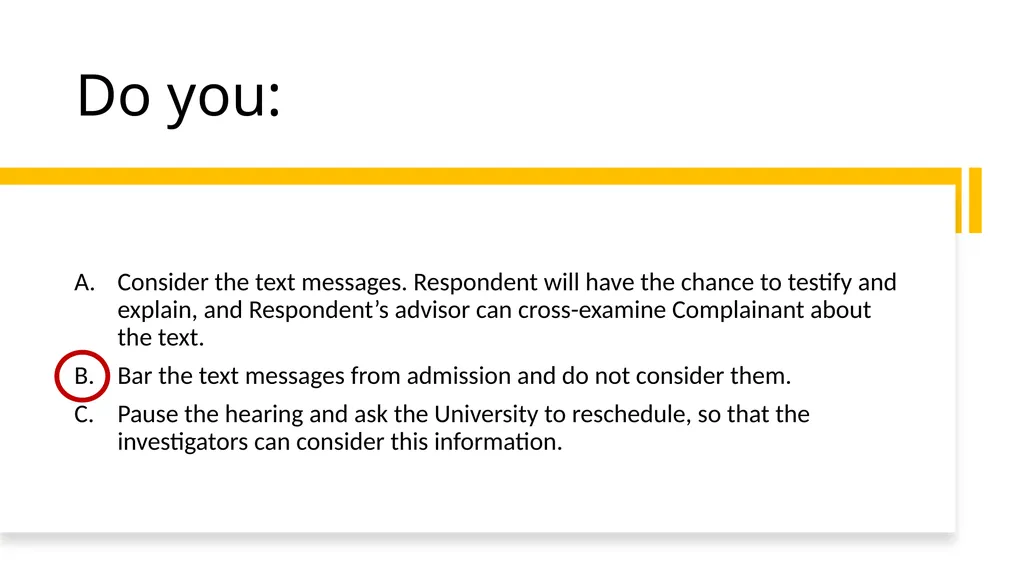
Do you: Consider the text messages. Respondent will have the chance to testify and explain, and Respondent’s advisor can cross-examine Complainant about the text.
Bar the text messages from admission and do not consider them.
Pause the hearing and ask the University to reschedule, so that the investigators can consider this information.<br>
Bar the text messages from admission and do not consider them.
Pause the hearing and ask the University to reschedule, so that the investigators can consider this information.<br>
63
Example 8 Similar to previous: during the investigation, Complainant provides the investigators with her testimony and witnesses, but does not reveal the text from Respondent.
However, this time at the prehearing conference, Complainant announces that she has a text message from Respondent to introduce into evidence at the upcoming hearing.
Because this text message had never been disclosed, the investigators had not reviewed or included it in their investigative report.<br>
64
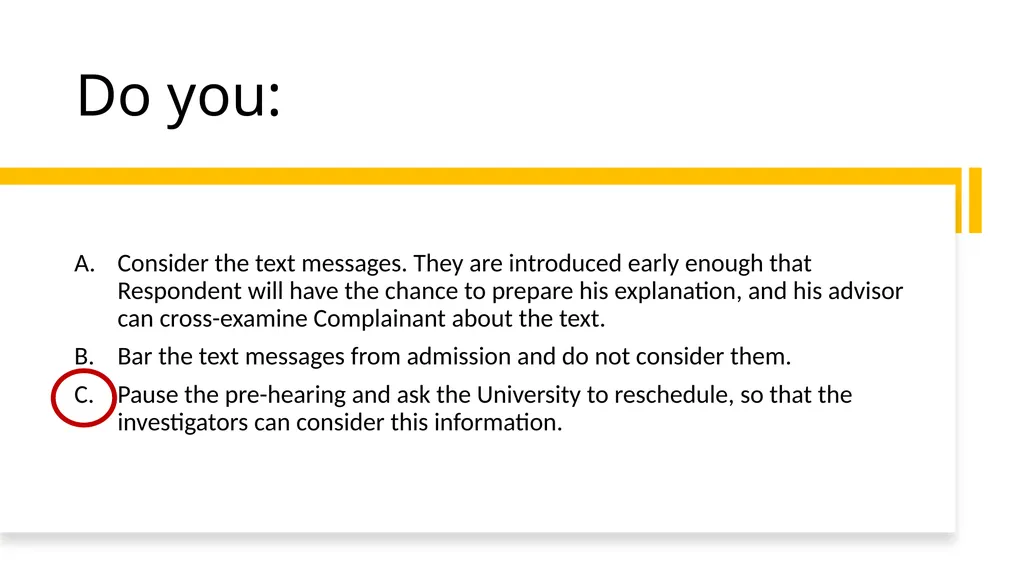
Do you: Consider the text messages. They are introduced early enough that Respondent will have the chance to prepare his explanation, and his advisor can cross-examine Complainant about the text.
Bar the text messages from admission and do not consider them.
Pause the pre-hearing and ask the University to reschedule, so that the investigators can consider this information.<br>
Bar the text messages from admission and do not consider them.
Pause the pre-hearing and ask the University to reschedule, so that the investigators can consider this information.<br>
65
Example 9 Same scenario, except this time, Complainant did provide to the investigators the text message from Respondent, sent the day after the incident, which reads: ‘Ann, I’m so sorry about last night. I was really drunk and I knew you weren’t ready. I hope you can forgive me! Tom.”
However, Respondent refuses to answer any questions and does not submit to cross examination. Respondent is also facing criminal charges from this same incident, and invokes his right against self-incrimination.<br>
However, Respondent refuses to answer any questions and does not submit to cross examination. Respondent is also facing criminal charges from this same incident, and invokes his right against self-incrimination.<br>
66
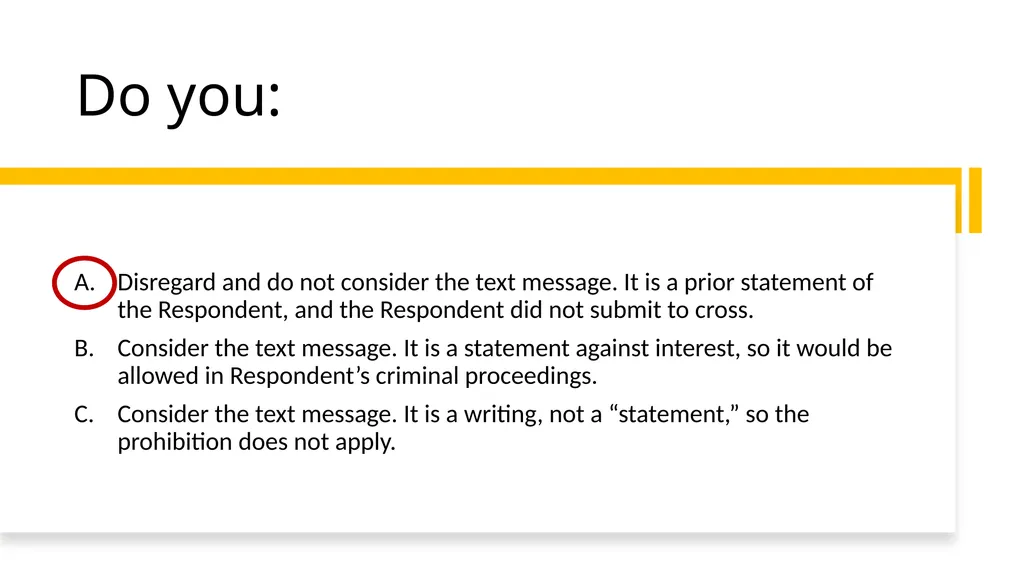
Do you: Disregard and do not consider the text message. It is a prior statement of the Respondent, and the Respondent did not submit to cross.
Consider the text message. It is a statement against interest, so it would be allowed in Respondent’s criminal proceedings.
Consider the text message. It is a writing, not a “statement,” so the prohibition does not apply.<br>
Consider the text message. It is a statement against interest, so it would be allowed in Respondent’s criminal proceedings.
Consider the text message. It is a writing, not a “statement,” so the prohibition does not apply.<br>
67
Example 10 On the morning of the hearing, you get an email from Respondent. His advisor, Ron Swanson, has also become seriously ill with COVID-19 and will not be able to attend.
The Respondent says he would just like to get this over with today, and he’s fine to proceed to the hearing without an advisor. He wasn’t planning to ask the Complainant any questions.<br>
The Respondent says he would just like to get this over with today, and he’s fine to proceed to the hearing without an advisor. He wasn’t planning to ask the Complainant any questions.<br>
68
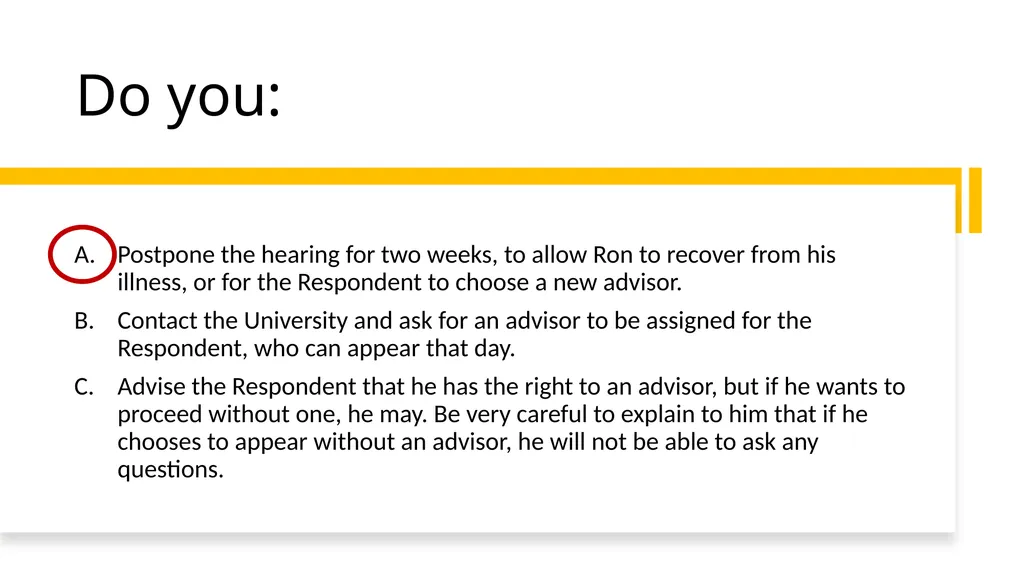
Do you: Postpone the hearing for two weeks, to allow Ron to recover from his illness, or for the Respondent to choose a new advisor.
Contact the University and ask for an advisor to be assigned for the Respondent, who can appear that day.
Advise the Respondent that he has the right to an advisor, but if he wants to proceed without one, he may. Be very careful to explain to him that if he chooses to appear without an advisor, he will not be able to ask any questions.<br>
69
Example 11 Ron Swanson has recovered and is able to attend as Respondent’s advisor. Ron sets his virtual Zoom background to be a photoshopped picture of the Complainant in crosshairs. You remind him of the rules of decorum, caution him that you have the authority to exclude advisors from the hearing, and tell him that he must take it down. He refuses.<br>
70
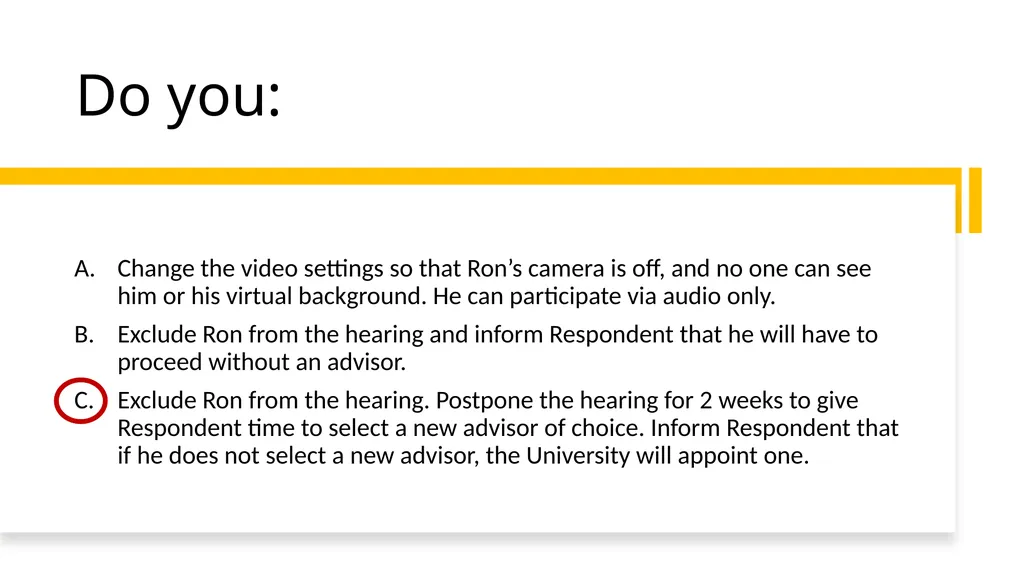
Do you: Change the video settings so that Ron’s camera is off, and no one can see him or his virtual background. He can participate via audio only.
Exclude Ron from the hearing and inform Respondent that he will have to proceed without an advisor.
Exclude Ron from the hearing. Postpone the hearing for 2 weeks to give Respondent time to select a new advisor of choice. Inform Respondent that if he does not select a new advisor, the University will appoint one.<br>
71
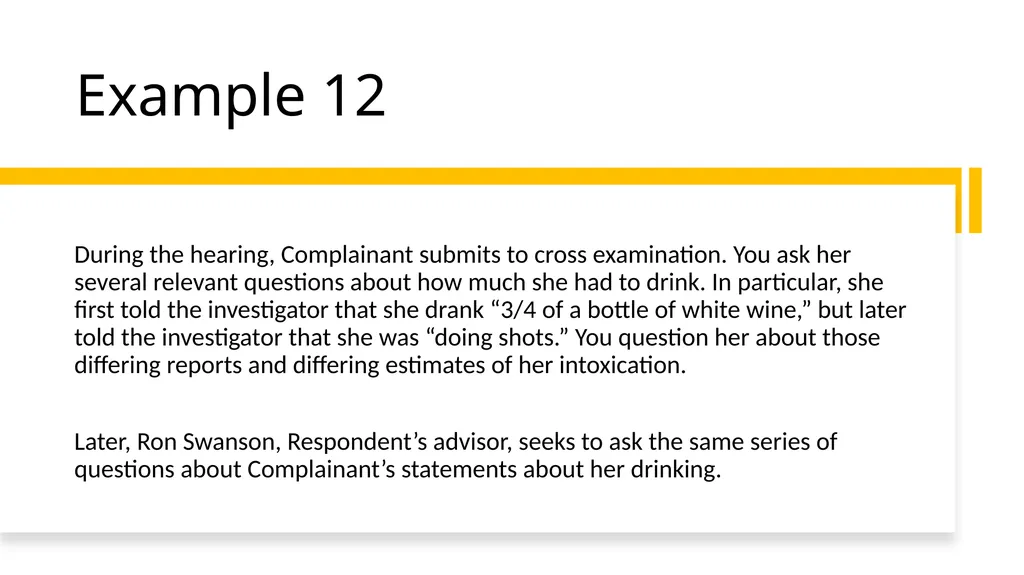
Example 12 During the hearing, Complainant submits to cross examination. You ask her several relevant questions about how much she had to drink. In particular, she first told the investigator that she drank “3/4 of a bottle of white wine,” but later told the investigator that she was “doing shots.” You question her about those differing reports and differing estimates of her intoxication.
Later, Ron Swanson, Respondent’s advisor, seeks to ask the same series of questions about Complainant’s statements about her drinking.<br>
Later, Ron Swanson, Respondent’s advisor, seeks to ask the same series of questions about Complainant’s statements about her drinking.<br>
72
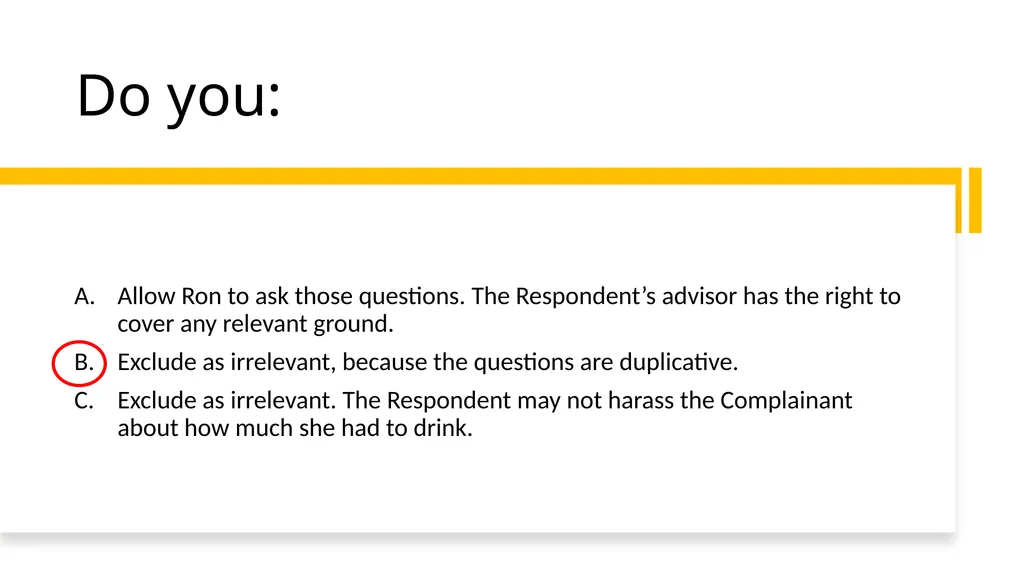
Do you: Allow Ron to ask those questions. The Respondent’s advisor has the right to cover any relevant ground.
Exclude as irrelevant, because the questions are duplicative.
Exclude as irrelevant. The Respondent may not harass the Complainant about how much she had to drink.<br>
Exclude as irrelevant, because the questions are duplicative.
Exclude as irrelevant. The Respondent may not harass the Complainant about how much she had to drink.<br>
73
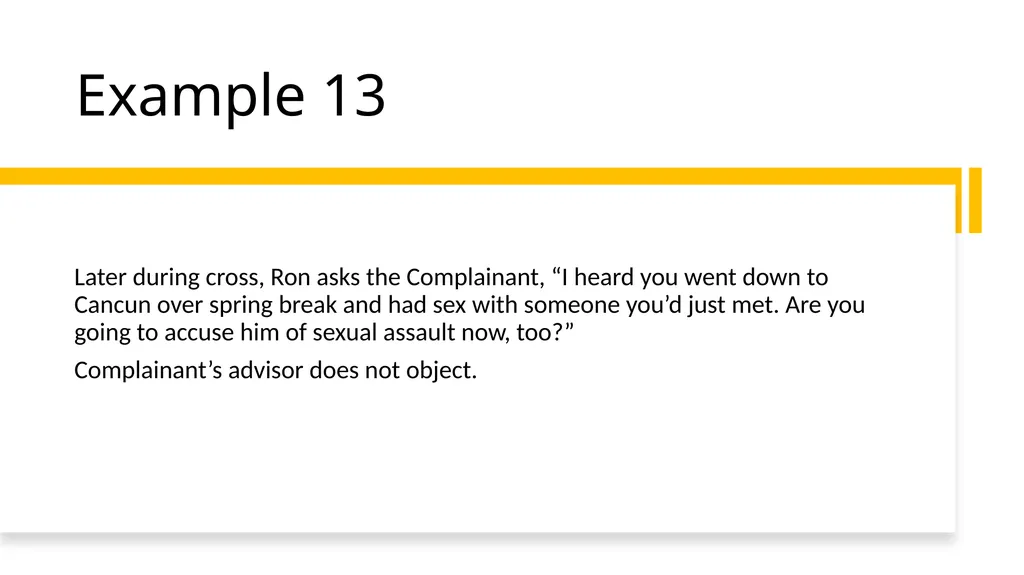
Example 13 Later during cross, Ron asks the Complainant, “I heard you went down to Cancun over spring break and had sex with someone you’d just met. Are you going to accuse him of sexual assault now, too?”
Complainant’s advisor does not object.<br>
Complainant’s advisor does not object.<br>
74
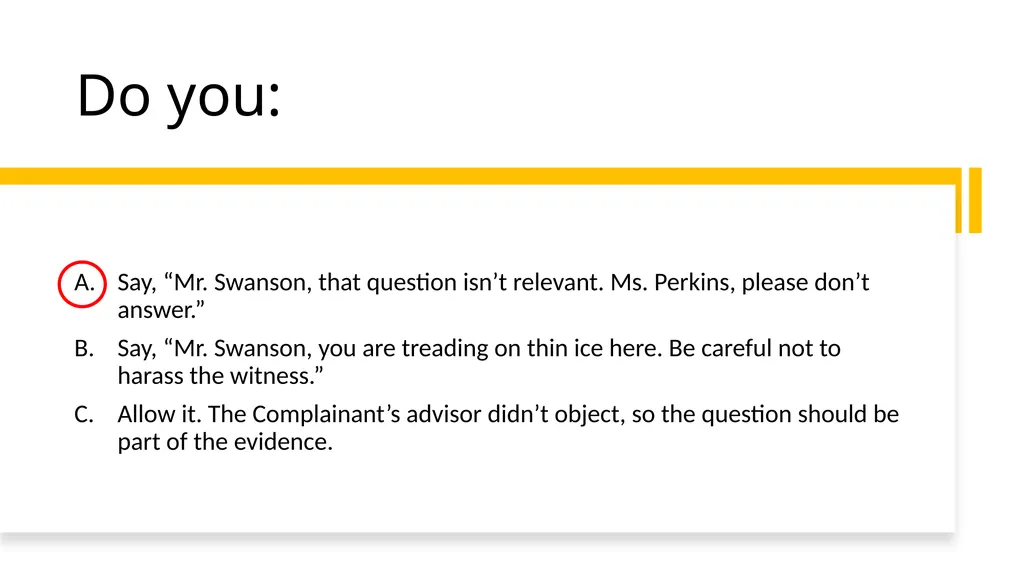
Do you: Say, “Mr. Swanson, that question isn’t relevant. Ms. Perkins, please don’t answer.”
Say, “Mr. Swanson, you are treading on thin ice here. Be careful not to harass the witness.”
Allow it. The Complainant’s advisor didn’t object, so the question should be part of the evidence.<br>
Say, “Mr. Swanson, you are treading on thin ice here. Be careful not to harass the witness.”
Allow it. The Complainant’s advisor didn’t object, so the question should be part of the evidence.<br>
75
Questions?<br>