
Hedging with FTRs and CCfDs Introduction This
CS
Published · 17 slides · 0 views
1 / 1
Description
Hedging with FTRs and CCfDs Introduction This document discusses hedging with Financial Transmission Rights (FTRs) and Cross-border Contracts for Difference (CCfDs) Further, the presentation discusses Contracts for Difference (CfDs) and
Related Topics
Share
Embed code
Download this presentation From Below
"Hedging with FTRs and CCfDs Introduction This" is the property of its rightful owner. Permission is granted to download and print the materials on this website for personal, non-commercial use only, and to display it on your personal computer provided you do not modify the materials and that you retain all copyright notices contained in the materials. By downloading content from our website, you accept the terms of this agreement.
Presentation Transcript
01
Hedging with FTRs and CCfDs
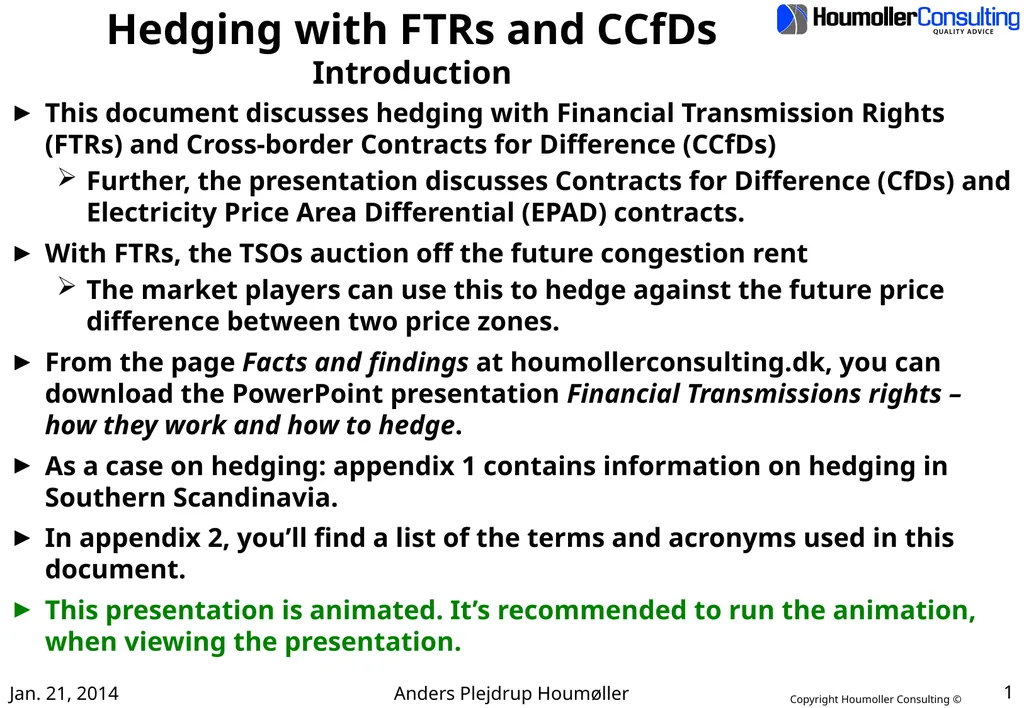
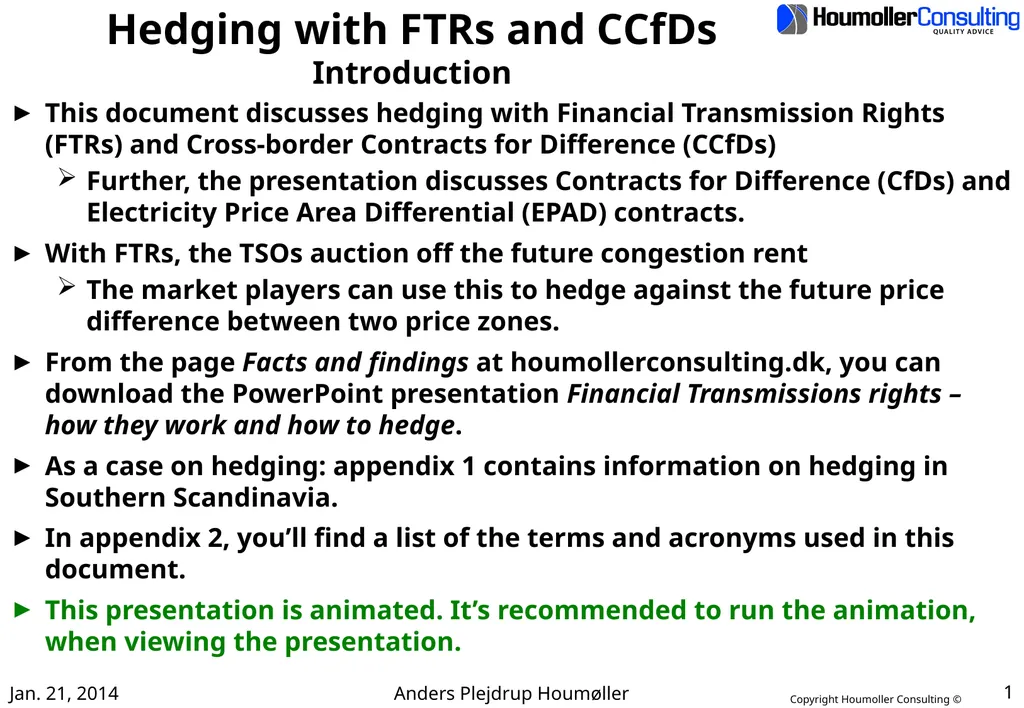
Introduction This document discusses hedging with Financial Transmission Rights (FTRs) and Cross-border Contracts for Difference (CCfDs)
Further, the presentation discusses Contracts for Difference (CfDs) and Electricity Price Area Differential (EPAD) contracts.
With FTRs, the TSOs auction off the future congestion rent
The market players can use this to hedge against the future price difference between two price zones.
From the page Facts and findings at houmollerconsulting.dk, you can download the PowerPoint presentation Financial Transmissions rights – how they work and how to hedge.
As a case on hedging: appendix 1 contains information on hedging in Southern Scandinavia.
In appendix 2, you’ll find a list of the terms and acronyms used in this document.
This presentation is animated. It’s recommended to run the animation, when viewing the presentation. Jan. 21, 2014 Anders Plejdrup Houmøller 1<br>
Further, the presentation discusses Contracts for Difference (CfDs) and Electricity Price Area Differential (EPAD) contracts.
With FTRs, the TSOs auction off the future congestion rent
The market players can use this to hedge against the future price difference between two price zones.
From the page Facts and findings at houmollerconsulting.dk, you can download the PowerPoint presentation Financial Transmissions rights – how they work and how to hedge.
As a case on hedging: appendix 1 contains information on hedging in Southern Scandinavia.
In appendix 2, you’ll find a list of the terms and acronyms used in this document.
This presentation is animated. It’s recommended to run the animation, when viewing the presentation. Jan. 21, 2014 Anders Plejdrup Houmøller 1<br>
02
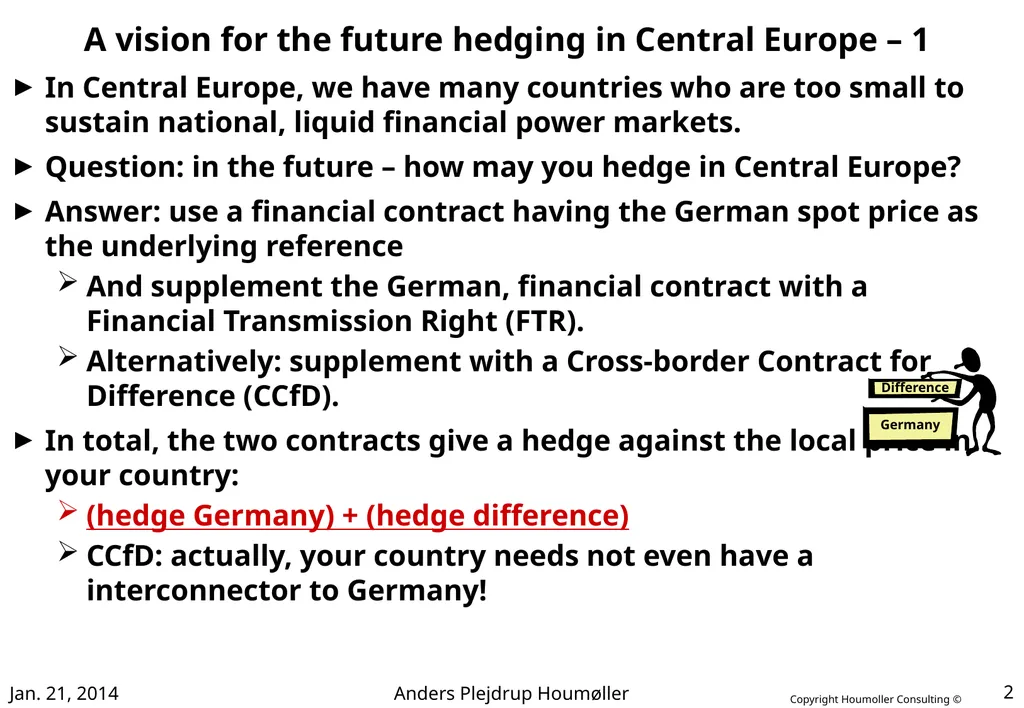
A vision for the future hedging in Central Europe – 1 In Central Europe, we have many countries who are too small to sustain national, liquid financial power markets.
Question: in the future – how may you hedge in Central Europe?
Answer: use a financial contract having the German spot price as the underlying reference
And supplement the German, financial contract with a Financial Transmission Right (FTR).
Alternatively: supplement with a Cross-border Contract for Difference (CCfD).
In total, the two contracts give a hedge against the local price in your country:
(hedge Germany) + (hedge difference)
CCfD: actually, your country needs not even have a interconnector to Germany! 2 Jan. 21, 2014 Anders Plejdrup Houmøller<br>
Question: in the future – how may you hedge in Central Europe?
Answer: use a financial contract having the German spot price as the underlying reference
And supplement the German, financial contract with a Financial Transmission Right (FTR).
Alternatively: supplement with a Cross-border Contract for Difference (CCfD).
In total, the two contracts give a hedge against the local price in your country:
(hedge Germany) + (hedge difference)
CCfD: actually, your country needs not even have a interconnector to Germany! 2 Jan. 21, 2014 Anders Plejdrup Houmøller<br>
03
A vision for the future hedging in Central Europe – 2 For countries with interconnectors to Germany: via FTR auctions, TSOs will be initial market makers for CCfD.
The prices at the FTR auctions will give a reference for the prices of the CCfDs.
As there will always be players at the FRT auctions, regular auctions will thereby regularly feed liquidity to the CCfDs
Hence, we’ll avoid the liquidity problem plaguing the Baltic-Nordic EPADs. Jan. 21, 2014 Anders Plejdrup Houmøller 3<br>
The prices at the FTR auctions will give a reference for the prices of the CCfDs.
As there will always be players at the FRT auctions, regular auctions will thereby regularly feed liquidity to the CCfDs
Hence, we’ll avoid the liquidity problem plaguing the Baltic-Nordic EPADs. Jan. 21, 2014 Anders Plejdrup Houmøller 3<br>
04
Jan. 21, 2014 4 Appendix 1
A case on hedging:
Hedging in Southern Scandinavia Anders Plejdrup Houmøller<br>
A case on hedging:
Hedging in Southern Scandinavia Anders Plejdrup Houmøller<br>
05
Hedging in the Nordic area – 1 Question: why do we have the Nordic System Price?
Answer: there’s not a “Germany” in the Nordic area
No Nordic country is big enough to be used as the starting point for hedging.
The Nordic System Price is a virtual price:
It’s the theoretical, common Nordic price, we would have if there were no grid bottlenecks in the Nordic area.
Two Nordic players operating in different countries may use the System Price for hedging
For example, a Norwegian producer and a Finnish retailer can enter into a financial contract using the System Price as the underlying reference. Jan. 21, 2014 Anders Plejdrup Houmøller 5<br>
Answer: there’s not a “Germany” in the Nordic area
No Nordic country is big enough to be used as the starting point for hedging.
The Nordic System Price is a virtual price:
It’s the theoretical, common Nordic price, we would have if there were no grid bottlenecks in the Nordic area.
Two Nordic players operating in different countries may use the System Price for hedging
For example, a Norwegian producer and a Finnish retailer can enter into a financial contract using the System Price as the underlying reference. Jan. 21, 2014 Anders Plejdrup Houmøller 5<br>
06
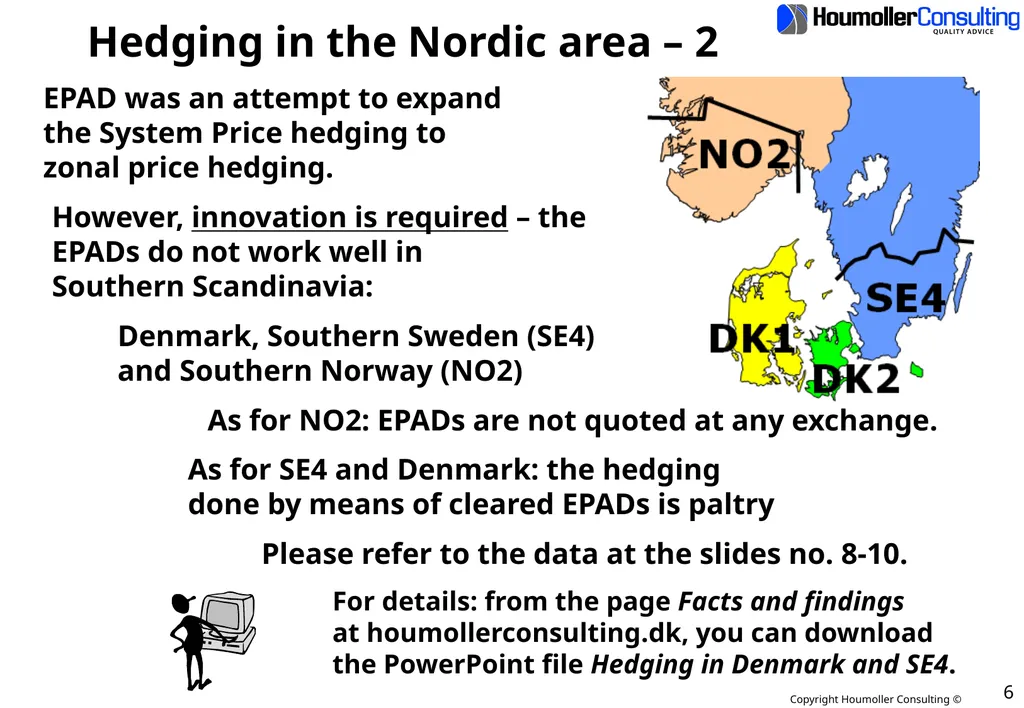
Hedging in the Nordic area – 2 EPAD was an attempt to expand
the System Price hedging to
zonal price hedging. However, innovation is required – the
EPADs do not work well in
Southern Scandinavia: As for NO2: EPADs are not quoted at any exchange. As for SE4 and Denmark: the hedging
done by means of cleared EPADs is paltry Please refer to the data at the slides no. 8-10. 6<br>
the System Price hedging to
zonal price hedging. However, innovation is required – the
EPADs do not work well in
Southern Scandinavia: As for NO2: EPADs are not quoted at any exchange. As for SE4 and Denmark: the hedging
done by means of cleared EPADs is paltry Please refer to the data at the slides no. 8-10. 6<br>
07
SE4 and DK2 7 The correlation between the daily averages of the spot prices in SE4 and DK2:
Correlation(priceSE4 , priceDK2) = 0.89
This is the correlation during the ten months from November 2011 to August 2012.
This is an indication of how to launch a CCfD contract for SE4+DK2:
As the underlying reference, use the difference between the German spot price and the volume-weighted average of the spot prices in the two zones:
(priceSE4+DK2 - priceGermany)
Refer to slide no. 3: the FTR auctions on the interconnector between Germany and DK2 will feed liquidity to this financial contract. Jan. 21, 2014 Anders Plejdrup Houmøller<br>
Correlation(priceSE4 , priceDK2) = 0.89
This is the correlation during the ten months from November 2011 to August 2012.
This is an indication of how to launch a CCfD contract for SE4+DK2:
As the underlying reference, use the difference between the German spot price and the volume-weighted average of the spot prices in the two zones:
(priceSE4+DK2 - priceGermany)
Refer to slide no. 3: the FTR auctions on the interconnector between Germany and DK2 will feed liquidity to this financial contract. Jan. 21, 2014 Anders Plejdrup Houmøller<br>
08
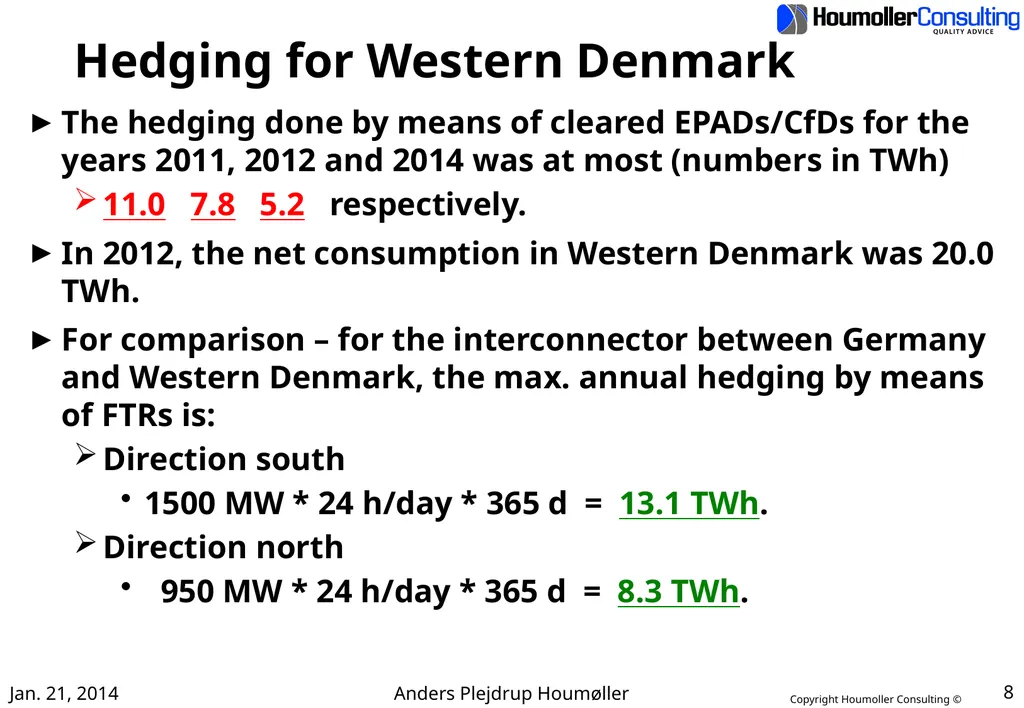
Hedging for Western Denmark The hedging done by means of cleared EPADs/CfDs for the years 2011, 2012 and 2014 was at most (numbers in TWh)
11.0 7.8 5.2 respectively.
In 2012, the net consumption in Western Denmark was 20.0 TWh.
For comparison – for the interconnector between Germany and Western Denmark, the max. annual hedging by means of FTRs is:
Direction south
1500 MW * 24 h/day * 365 d = 13.1 TWh.
Direction north
950 MW * 24 h/day * 365 d = 8.3 TWh. Jan. 21, 2014 Anders Plejdrup Houmøller 8<br>
11.0 7.8 5.2 respectively.
In 2012, the net consumption in Western Denmark was 20.0 TWh.
For comparison – for the interconnector between Germany and Western Denmark, the max. annual hedging by means of FTRs is:
Direction south
1500 MW * 24 h/day * 365 d = 13.1 TWh.
Direction north
950 MW * 24 h/day * 365 d = 8.3 TWh. Jan. 21, 2014 Anders Plejdrup Houmøller 8<br>
09
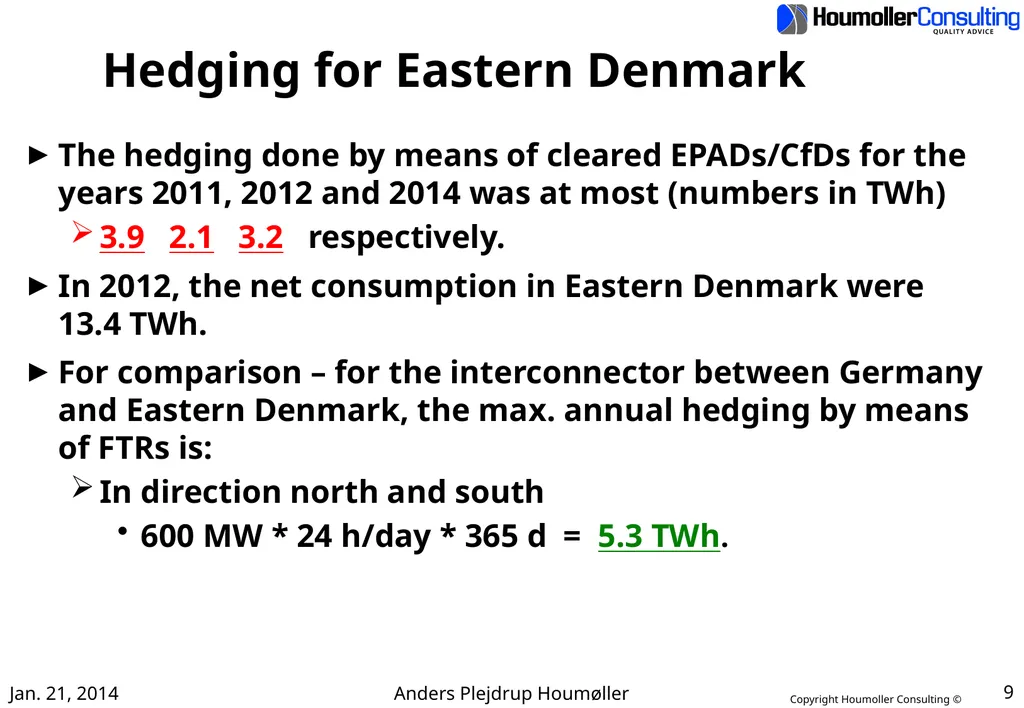
Hedging for Eastern Denmark The hedging done by means of cleared EPADs/CfDs for the years 2011, 2012 and 2014 was at most (numbers in TWh)
3.9 2.1 3.2 respectively.
In 2012, the net consumption in Eastern Denmark were 13.4 TWh.
For comparison – for the interconnector between Germany and Eastern Denmark, the max. annual hedging by means of FTRs is:
In direction north and south
600 MW * 24 h/day * 365 d = 5.3 TWh. Jan. 21, 2014 Anders Plejdrup Houmøller 9<br>
3.9 2.1 3.2 respectively.
In 2012, the net consumption in Eastern Denmark were 13.4 TWh.
For comparison – for the interconnector between Germany and Eastern Denmark, the max. annual hedging by means of FTRs is:
In direction north and south
600 MW * 24 h/day * 365 d = 5.3 TWh. Jan. 21, 2014 Anders Plejdrup Houmøller 9<br>
10
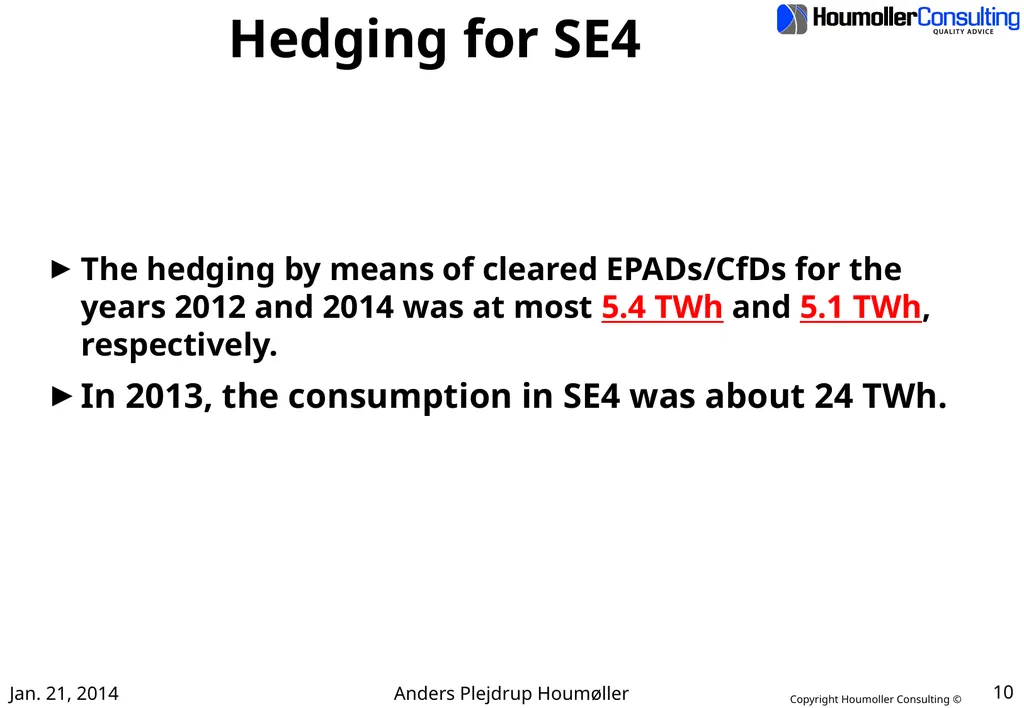
Hedging for SE4 The hedging by means of cleared EPADs/CfDs for the years 2012 and 2014 was at most 5.4 TWh and 5.1 TWh, respectively.
In 2013, the consumption in SE4 was about 24 TWh. Jan. 21, 2014 Anders Plejdrup Houmøller 10<br>
In 2013, the consumption in SE4 was about 24 TWh. Jan. 21, 2014 Anders Plejdrup Houmøller 10<br>
11
Jan. 21, 2014 11 Appendix 2
Terminology and acronyms Anders Plejdrup Houmøller<br>
Terminology and acronyms Anders Plejdrup Houmøller<br>
12
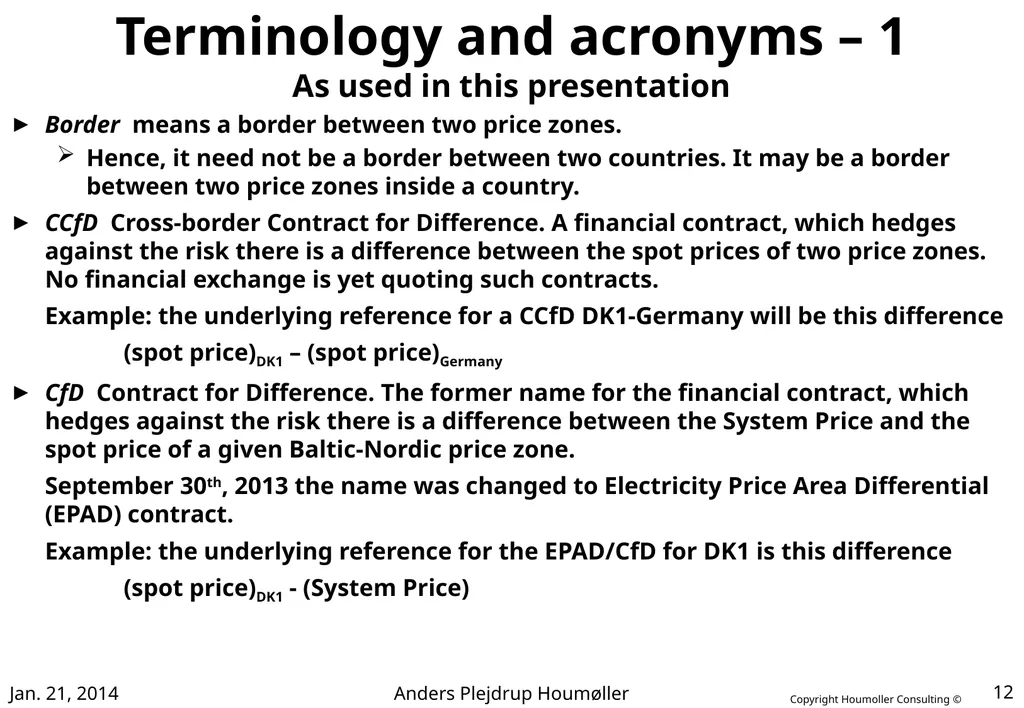
Terminology and acronyms – 1
As used in this presentation Border means a border between two price zones.
Hence, it need not be a border between two countries. It may be a border between two price zones inside a country.
CCfD Cross-border Contract for Difference. A financial contract, which hedges against the risk there is a difference between the spot prices of two price zones. No financial exchange is yet quoting such contracts.
Example: the underlying reference for a CCfD DK1-Germany will be this difference
(spot price)DK1 – (spot price)Germany
CfD Contract for Difference. The former name for the financial contract, which hedges against the risk there is a difference between the System Price and the spot price of a given Baltic-Nordic price zone.
September 30th, 2013 the name was changed to Electricity Price Area Differential (EPAD) contract.
Example: the underlying reference for the EPAD/CfD for DK1 is this difference
(spot price)DK1 - (System Price) 12 Jan. 21, 2014 Anders Plejdrup Houmøller<br>
Hence, it need not be a border between two countries. It may be a border between two price zones inside a country.
CCfD Cross-border Contract for Difference. A financial contract, which hedges against the risk there is a difference between the spot prices of two price zones. No financial exchange is yet quoting such contracts.
Example: the underlying reference for a CCfD DK1-Germany will be this difference
(spot price)DK1 – (spot price)Germany
CfD Contract for Difference. The former name for the financial contract, which hedges against the risk there is a difference between the System Price and the spot price of a given Baltic-Nordic price zone.
September 30th, 2013 the name was changed to Electricity Price Area Differential (EPAD) contract.
Example: the underlying reference for the EPAD/CfD for DK1 is this difference
(spot price)DK1 - (System Price) 12 Jan. 21, 2014 Anders Plejdrup Houmøller<br>
13
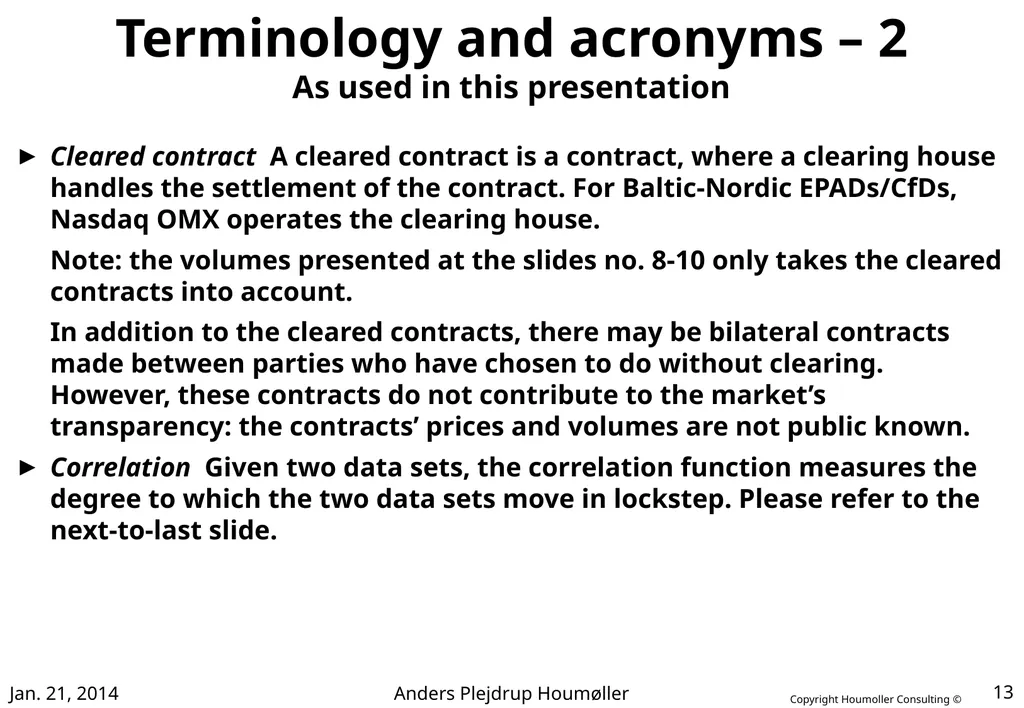
Terminology and acronyms – 2
As used in this presentation Cleared contract A cleared contract is a contract, where a clearing house handles the settlement of the contract. For Baltic-Nordic EPADs/CfDs, Nasdaq OMX operates the clearing house.
Note: the volumes presented at the slides no. 8-10 only takes the cleared contracts into account.
In addition to the cleared contracts, there may be bilateral contracts made between parties who have chosen to do without clearing. However, these contracts do not contribute to the market’s transparency: the contracts’ prices and volumes are not public known.
Correlation Given two data sets, the correlation function measures the degree to which the two data sets move in lockstep. Please refer to the next-to-last slide. 13 Jan. 21, 2014 Anders Plejdrup Houmøller<br>
Note: the volumes presented at the slides no. 8-10 only takes the cleared contracts into account.
In addition to the cleared contracts, there may be bilateral contracts made between parties who have chosen to do without clearing. However, these contracts do not contribute to the market’s transparency: the contracts’ prices and volumes are not public known.
Correlation Given two data sets, the correlation function measures the degree to which the two data sets move in lockstep. Please refer to the next-to-last slide. 13 Jan. 21, 2014 Anders Plejdrup Houmøller<br>
14
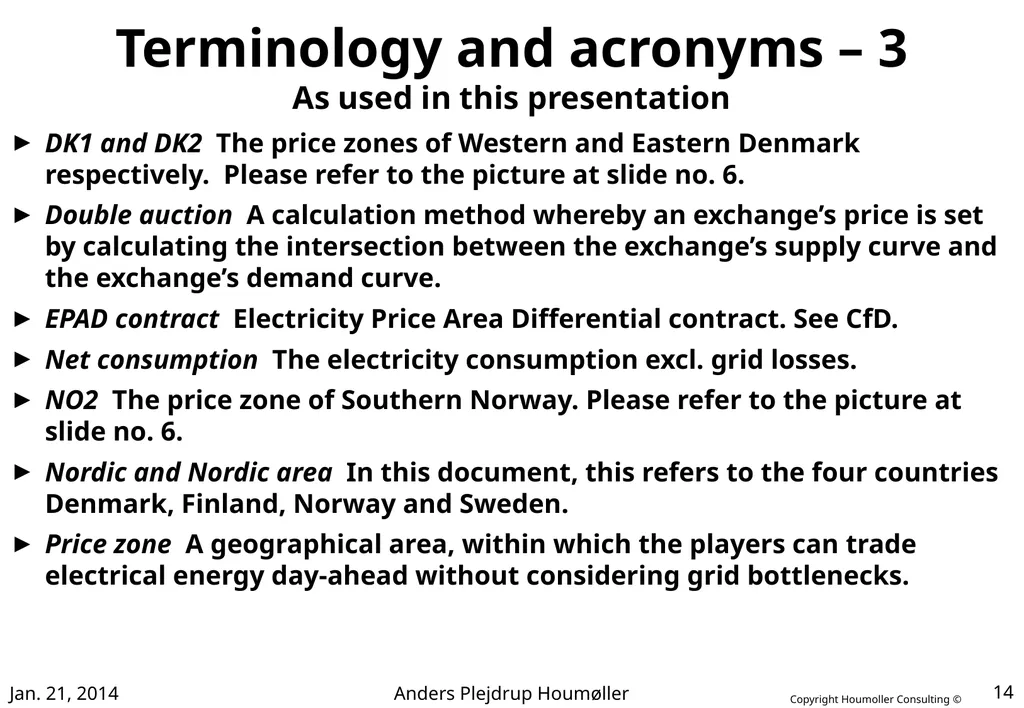
Terminology and acronyms – 3
As used in this presentation DK1 and DK2 The price zones of Western and Eastern Denmark respectively. Please refer to the picture at slide no. 6.
Double auction A calculation method whereby an exchange’s price is set by calculating the intersection between the exchange’s supply curve and the exchange’s demand curve.
EPAD contract Electricity Price Area Differential contract. See CfD.
Net consumption The electricity consumption excl. grid losses.
NO2 The price zone of Southern Norway. Please refer to the picture at slide no. 6.
Nordic and Nordic area In this document, this refers to the four countries Denmark, Finland, Norway and Sweden.
Price zone A geographical area, within which the players can trade electrical energy day-ahead without considering grid bottlenecks. 14 Jan. 21, 2014 Anders Plejdrup Houmøller<br>
Double auction A calculation method whereby an exchange’s price is set by calculating the intersection between the exchange’s supply curve and the exchange’s demand curve.
EPAD contract Electricity Price Area Differential contract. See CfD.
Net consumption The electricity consumption excl. grid losses.
NO2 The price zone of Southern Norway. Please refer to the picture at slide no. 6.
Nordic and Nordic area In this document, this refers to the four countries Denmark, Finland, Norway and Sweden.
Price zone A geographical area, within which the players can trade electrical energy day-ahead without considering grid bottlenecks. 14 Jan. 21, 2014 Anders Plejdrup Houmøller<br>
15
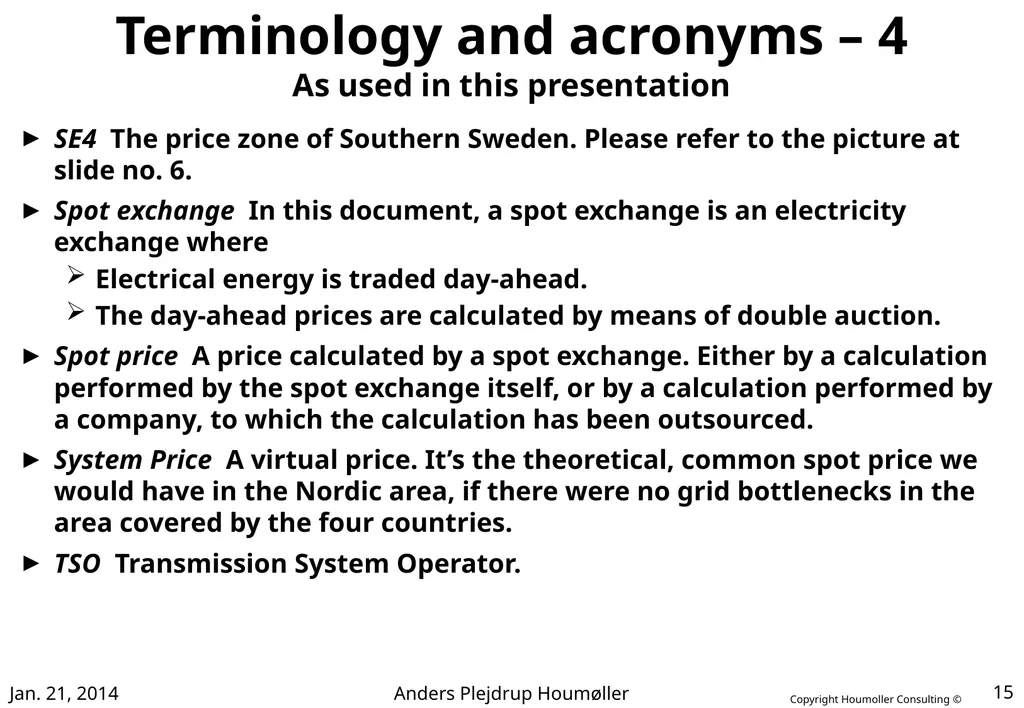
Terminology and acronyms – 4
As used in this presentation SE4 The price zone of Southern Sweden. Please refer to the picture at slide no. 6.
Spot exchange In this document, a spot exchange is an electricity exchange where
Electrical energy is traded day-ahead.
The day-ahead prices are calculated by means of double auction.
Spot price A price calculated by a spot exchange. Either by a calculation performed by the spot exchange itself, or by a calculation performed by a company, to which the calculation has been outsourced.
System Price A virtual price. It’s the theoretical, common spot price we would have in the Nordic area, if there were no grid bottlenecks in the area covered by the four countries.
TSO Transmission System Operator. 15 Jan. 21, 2014 Anders Plejdrup Houmøller<br>
Spot exchange In this document, a spot exchange is an electricity exchange where
Electrical energy is traded day-ahead.
The day-ahead prices are calculated by means of double auction.
Spot price A price calculated by a spot exchange. Either by a calculation performed by the spot exchange itself, or by a calculation performed by a company, to which the calculation has been outsourced.
System Price A virtual price. It’s the theoretical, common spot price we would have in the Nordic area, if there were no grid bottlenecks in the area covered by the four countries.
TSO Transmission System Operator. 15 Jan. 21, 2014 Anders Plejdrup Houmøller<br>
16
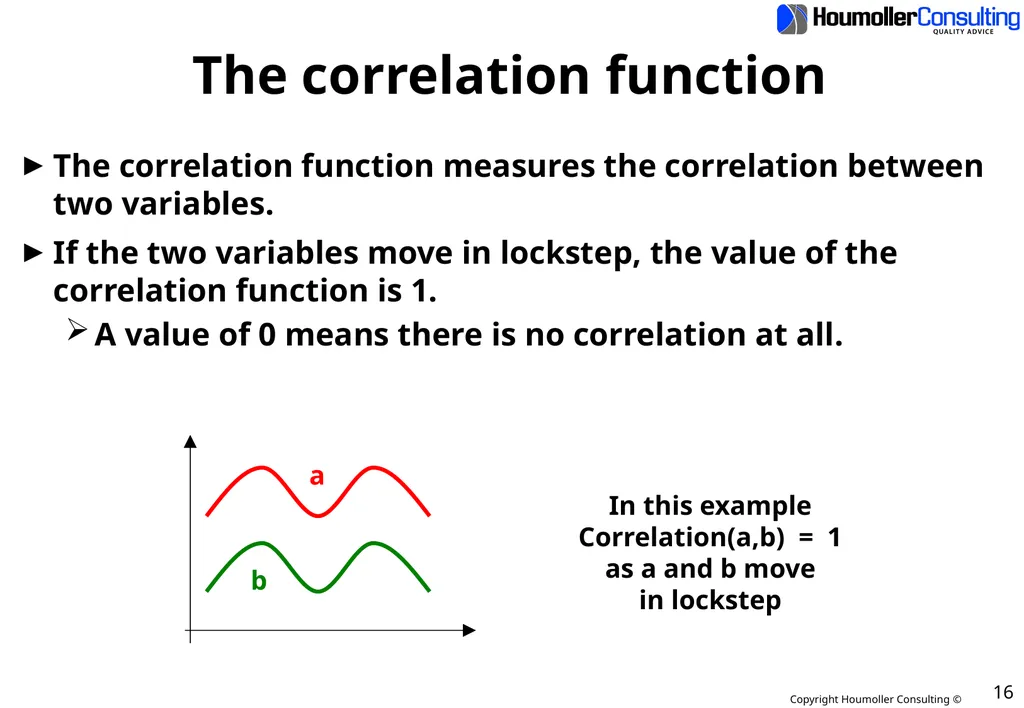
16 The correlation function The correlation function measures the correlation between two variables.
If the two variables move in lockstep, the value of the correlation function is 1.
A value of 0 means there is no correlation at all. In this example
Correlation(a,b) = 1
as a and b move
in lockstep<br>
If the two variables move in lockstep, the value of the correlation function is 1.
A value of 0 means there is no correlation at all. In this example
Correlation(a,b) = 1
as a and b move
in lockstep<br>
17
Thank you for your attention! 17 Anders Plejdrup Houmøller
Houmoller Consulting
Tel. +45 28 11 23 00
anders@houmollerconsulting.dk
Web houmollerconsulting.dk<br>
Houmoller Consulting
Tel. +45 28 11 23 00
anders@houmollerconsulting.dk
Web houmollerconsulting.dk<br>