
Hektoen Enteric Agar Author: Multiple Authors








Description: Hektoen Enteric Agar Author: Multiple Authors Citation: Multiple Authors. 2010. Hektoen enteric agar. Publication Date: November 2010 Salmonella enterica on Hektoen Enteric Agar Salmonella enterica on Hektoen enteric agar. Note the black
Related Topics
Download Presentation
"Hektoen Enteric Agar Author: Multiple Authors" is the property of its rightful owner. Permission is granted to download and print the materials on this website for personal, non-commercial use only, and to display it on your personal computer provided you do not modify the materials and that you retain all copyright notices contained in the materials. By downloading content from our website, you accept the terms of this agreement.
Presentation Transcript
slide1. Hektoen Enteric Agar Author: Multiple Authors
Citation: Multiple Authors. 2010. Hektoen enteric agar.
Publication Date: November 2010<br>
slide2. Salmonella enterica on Hektoen Enteric Agar
Salmonella enterica on Hektoen enteric agar. Note the black center of the transparent colonies, indicating H2S production in the absence of carbohydrate fermentation. All serotypes of Salmonella have this appearance on Hektoen enteric agar except for serotype Typhi, which is a weak H2S producer. (Jan Hudzicki, University of Kansas Medical Center, Kansas City, KS) American Society For Microbiology ©<br>
slide3. Shigella flexneri on Hektoen Enteric Agar
Shigella
flexneri on Hektoen enteric agar. Note the transparent colonies, indicating the absence of carbohydrate fermentation. The lack of black colonies indicates no H2S production. All species of Shigella have this appearance on Hektoen enteric agar. (Jan Hudzicki, University of Kansas Medical Center, Kansas City, KS) American Society For Microbiology ©<br>
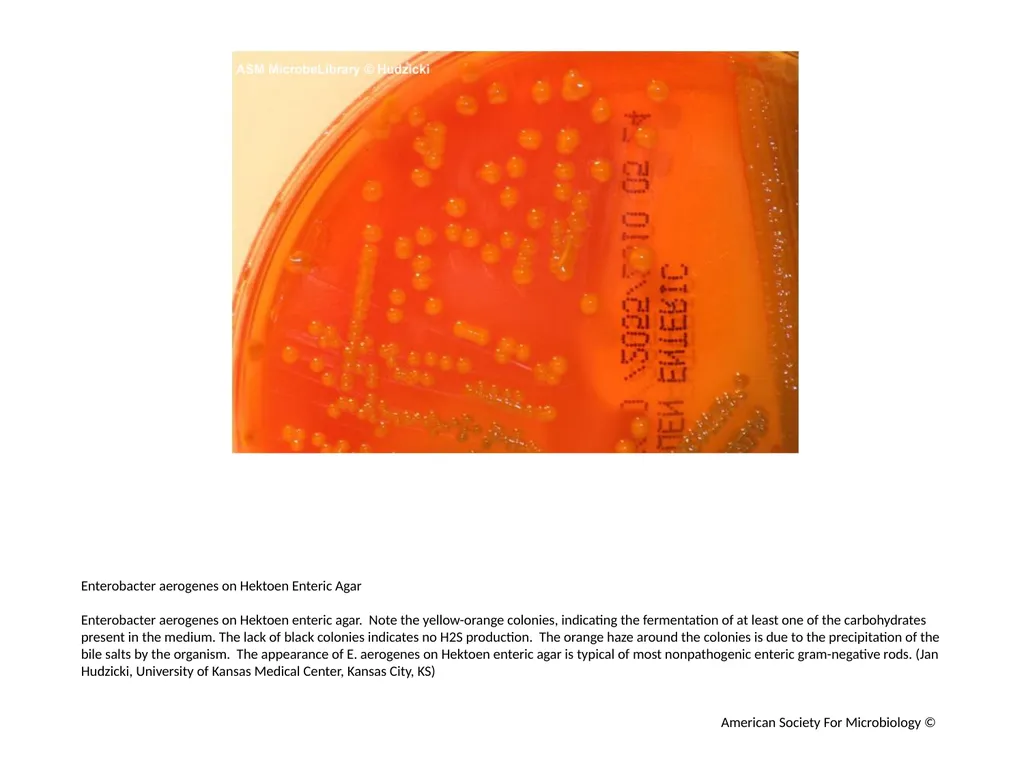
slide4. Enterobacter aerogenes on Hektoen Enteric Agar
Enterobacter aerogenes on Hektoen enteric agar. Note the yellow-orange colonies, indicating the fermentation of at least one of the carbohydrates present in the medium. The lack of black colonies indicates no H2S production. The orange haze around the colonies is due to the precipitation of the bile salts by the organism. The appearance of E. aerogenes on Hektoen enteric agar is typical of most nonpathogenic enteric gram-negative rods. (Jan Hudzicki, University of Kansas Medical Center, Kansas City, KS) American Society For Microbiology ©<br>
slide5. Proteus vulgaris on Hektoen Enteric Agar
Proteus vulgaris on Hektoen enteric agar. Note the yellow-orange colonies, indicating the fermentation of at least one of the carbohydrates present in the medium. The lack of black colonies indicates no H2S production. The lack of orange haze around the colonies indicates there is no precipitation of the bile salts by this organism. (Jan Hudzicki, University of Kansas Medical Center, Kansas City, KS) American Society For Microbiology ©<br>
slide6. Stool Culture on Hektoen Enteric Agar
Stool culture on Hektoen enteric agar: mixed flora including Escherichia coli (normal flora), Salmonella, and Proteus vulgaris. (Rebecca Buxton, University of Utah, Salt Lake City, UT) American Society For Microbiology ©<br>
slide7. Stool Culture on Hektoen Enteric Agar (Labeled)
Stool culture on Hektoen enteric agar: mixed flora including Escherichia coli (red arrow),
Salmonella (blue arrow), and Proteus vulgaris (yellow arrow). (Rebecca Buxton, University of Utah, Salt Lake City, UT) American Society For Microbiology ©<br>
slide8. Stool Culture on Hektoen Enteric Agar
Stool culture on Hektoen enteric agar: Salmonella mixed with normal fecal flora. (Rebecca Buxton, University of Utah, Salt Lake City, UT) American Society For Microbiology ©<br>
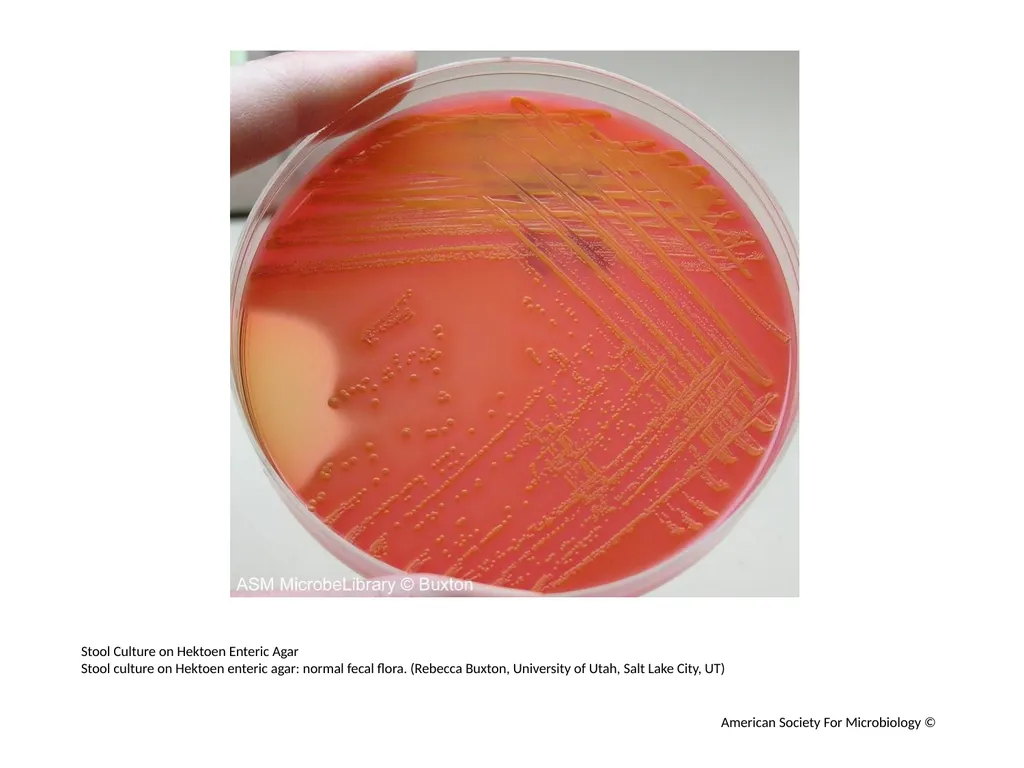
slide9. Stool Culture on Hektoen Enteric Agar
Stool culture on Hektoen enteric agar: normal fecal flora. (Rebecca Buxton, University of Utah, Salt Lake City, UT) American Society For Microbiology ©<br>
slide10. Stool Culture on Hektoen Enteric Agar
Stool culture on Hektoen enteric agar: heavy growth of Salmonella
mixed with another non-lactose-fermenting fecal organism. (Rebecca Buxton, University of Utah, Salt Lake City, UT) American Society For Microbiology ©<br>
slide11. Stool Culture on Hektoen Enteric Agar
Stool culture on Hektoen enteric agar: Shigella sonnei mixed with normal fecal flora. (Rebecca Buxton, University of Utah, Salt Lake City, UT) American Society For Microbiology ©<br>
Citation: Multiple Authors. 2010. Hektoen enteric agar.
Publication Date: November 2010<br>
slide2. Salmonella enterica on Hektoen Enteric Agar
Salmonella enterica on Hektoen enteric agar. Note the black center of the transparent colonies, indicating H2S production in the absence of carbohydrate fermentation. All serotypes of Salmonella have this appearance on Hektoen enteric agar except for serotype Typhi, which is a weak H2S producer. (Jan Hudzicki, University of Kansas Medical Center, Kansas City, KS) American Society For Microbiology ©<br>
slide3. Shigella flexneri on Hektoen Enteric Agar
Shigella
flexneri on Hektoen enteric agar. Note the transparent colonies, indicating the absence of carbohydrate fermentation. The lack of black colonies indicates no H2S production. All species of Shigella have this appearance on Hektoen enteric agar. (Jan Hudzicki, University of Kansas Medical Center, Kansas City, KS) American Society For Microbiology ©<br>
slide4. Enterobacter aerogenes on Hektoen Enteric Agar
Enterobacter aerogenes on Hektoen enteric agar. Note the yellow-orange colonies, indicating the fermentation of at least one of the carbohydrates present in the medium. The lack of black colonies indicates no H2S production. The orange haze around the colonies is due to the precipitation of the bile salts by the organism. The appearance of E. aerogenes on Hektoen enteric agar is typical of most nonpathogenic enteric gram-negative rods. (Jan Hudzicki, University of Kansas Medical Center, Kansas City, KS) American Society For Microbiology ©<br>
slide5. Proteus vulgaris on Hektoen Enteric Agar
Proteus vulgaris on Hektoen enteric agar. Note the yellow-orange colonies, indicating the fermentation of at least one of the carbohydrates present in the medium. The lack of black colonies indicates no H2S production. The lack of orange haze around the colonies indicates there is no precipitation of the bile salts by this organism. (Jan Hudzicki, University of Kansas Medical Center, Kansas City, KS) American Society For Microbiology ©<br>
slide6. Stool Culture on Hektoen Enteric Agar
Stool culture on Hektoen enteric agar: mixed flora including Escherichia coli (normal flora), Salmonella, and Proteus vulgaris. (Rebecca Buxton, University of Utah, Salt Lake City, UT) American Society For Microbiology ©<br>
slide7. Stool Culture on Hektoen Enteric Agar (Labeled)
Stool culture on Hektoen enteric agar: mixed flora including Escherichia coli (red arrow),
Salmonella (blue arrow), and Proteus vulgaris (yellow arrow). (Rebecca Buxton, University of Utah, Salt Lake City, UT) American Society For Microbiology ©<br>
slide8. Stool Culture on Hektoen Enteric Agar
Stool culture on Hektoen enteric agar: Salmonella mixed with normal fecal flora. (Rebecca Buxton, University of Utah, Salt Lake City, UT) American Society For Microbiology ©<br>
slide9. Stool Culture on Hektoen Enteric Agar
Stool culture on Hektoen enteric agar: normal fecal flora. (Rebecca Buxton, University of Utah, Salt Lake City, UT) American Society For Microbiology ©<br>
slide10. Stool Culture on Hektoen Enteric Agar
Stool culture on Hektoen enteric agar: heavy growth of Salmonella
mixed with another non-lactose-fermenting fecal organism. (Rebecca Buxton, University of Utah, Salt Lake City, UT) American Society For Microbiology ©<br>
slide11. Stool Culture on Hektoen Enteric Agar
Stool culture on Hektoen enteric agar: Shigella sonnei mixed with normal fecal flora. (Rebecca Buxton, University of Utah, Salt Lake City, UT) American Society For Microbiology ©<br>