Helen Elliott September 2016 Trading made simple Non-trading receipts What is trading? Can charities trade? Trading exemptions for charities Using a trading company Recent developments Agenda 2 Grants, donations, gifts Sale of donated goods
"Helen Elliott September 2016 Trading made simple" is the property of its rightful owner. Permission is granted to
download and print the materials on this website for personal, non-commercial use only, and to display it
on your personal computer provided you do not modify the materials and that you retain all copyright
notices contained in the materials. By downloading content from our website, you accept the terms of this
agreement.
Presentation Transcript
01
Helen Elliott
September 2016 Trading made simple<br>
02
Non-trading receipts
What is trading?
Can charities trade?
Trading exemptions for charities
Using a trading company
Recent developments Agenda 2<br>
03
Grants, donations, gifts
Sale of donated goods (seen as realisation of a gift)
Letting out property (not seen as trading)
Investment income
Passive IP rights (e.g. licence to use logo)
Can all be received by a charity without incurring a direct tax liability – provided income applied for charitable purposes only 1. Non-trading receipts 3<br>
04
Profit seeking motive
Repeated transactions – though one off transactions can be trading
Nature of the asset – do the assets have any other purpose?
Similarity to recognised trades
Method of sale and interval between purchase and sale
Method of acquisition of assets sold – sale of assets acquired by gift less likely to be trade 2. What is trading? 4<br>
05
Charities can carry out:
Trading which contributes directly to the furtherance of the charitable objects
Fundraising trading provided it does not involve significant risk to the charity
But the governing documents may impose stricter limitations
E.g. “no substantial permanent trading activities” 3. When can a charity trade? 5<br>
06
Some types of trading are exempt from income / corporation tax when undertaken by a charity:
Primary purpose trading – exercised in the course of carrying out the charity’s objects
Beneficiary trading – work mainly carried out by the charity’s beneficiaries
Ancillary trading – e.g. café in theatre for theatre-goers
Lotteries – the lottery must comply with gaming legislation
Fundraising events – all trading in connection with a qualifying fundraising event is exempt 4. Exempt trading 6<br>
07
If the level of other trading activity is below the small trades limit then can carry out in charity without incurring a tax liability
Small trades limit = 25% of charity’s total incoming resources, subject to overall limit of £50,000
Useful for small scale trades – e.g. selling Christmas cards, photocopies, magazine & website ads etc. 4. Small trades limit 7<br>
08
If carry out non-exempt trading above small trades limit in a charity then charity will pay income / corporation tax on any profits
But can avoid by transferring the non-exempt trade to a subsidiary company
Subsidiary company then gift aids any profit to the charity – reduces taxable profit to nil
Accepted and approved by HMRC and the Charity Commission 5. When do you need a trading co? 8<br>
09
Care with lending to the subsidiary
Providing working capital is an investment by charity
Small separate board
Transfer profits by gift aid donation to charity
Up to 9 months after the end of year if subsidiary 100% owned 5. Setting up a subsidiary 9<br>
10
Charge on a cost reimbursement basis for staff time and use of other charity resources
This is VATable – charity may need to register
Consider a VAT group
Better to keep fixed assets in charity – charge for use 5. Management charges 10<br>
11
Advantages
Protects charity from tax liability
Clarifies objectives
Limited liability
Can undertake more activities
VAT planning 5. Do you need a trading subsidiary? 11<br>
12
Disadvantages
Added costs
Tax knowledge needed
Corporation tax needed, audit may be
Must operate at ‘an arm’s length’
Management charges and VAT
Rate relief lost 5. Do you need a trading subsidiary? 12<br>
13
Sponsorship - Need to consider what is provided to the sponsor
Minimal benefit – donation
Substantial benefit – trading
Cause related marketing
Exempt or non primary purpose trading 5. Trading scenarios 13<br>
14
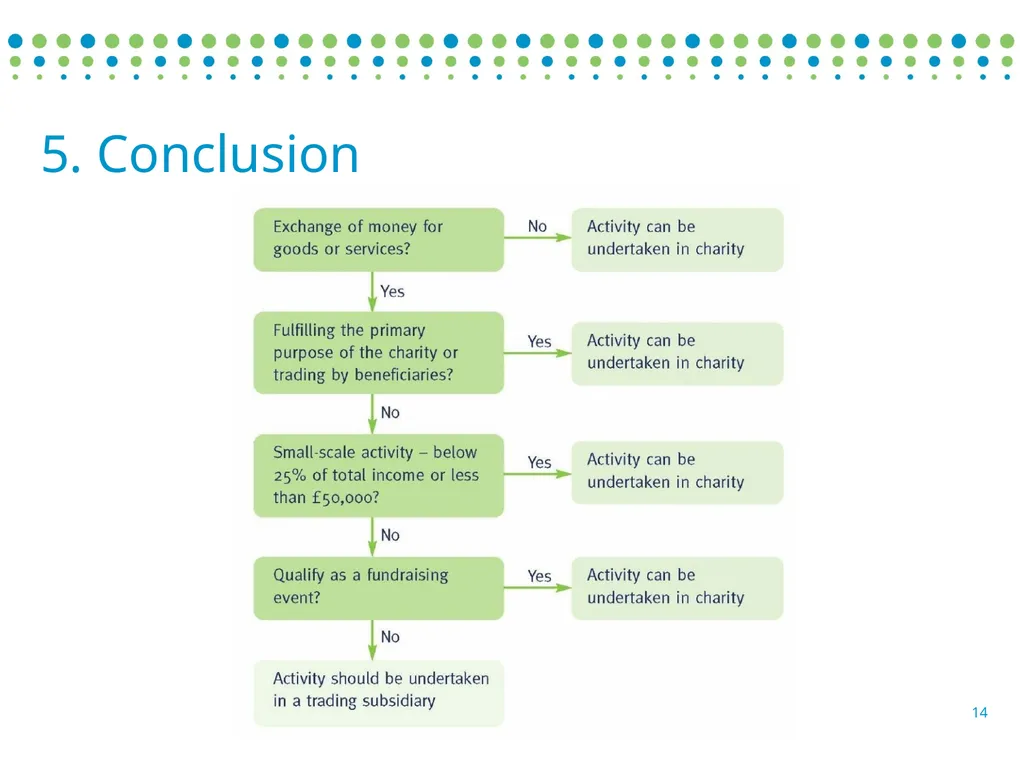
5. Conclusion 14<br>
15
How much can be gift aided?
Theatrical productions tax relief
Orchestra tax relief 6. Recent developments 15<br>
16
For Company Law purposes, gift aid payments from a subsidiary to its parent are distributions
As such Companies Act s830 limits distributions to accumulated realised profits
Any distribution in excess of this is illegal
Hence cannot gift aid more than this 6. How much can be gift aided? 16<br>
17
Previously Charity Commission guidance stated that could gift aid more than distributable reserves
In Feb 2016 HMRC announced that it will not permit a subsidiary tax deduction for illegal distributions made in periods from 1 April 2015 onwards 6. How much can be gift aided? 17<br>
18
From 1 September 2014
Corporation Tax only – if charitable trust must set up corporate subsidiary for productions
Administered by special HMRC entertainment industry unit 6. Theatrical productions tax relief 18<br>
19
A qualifying production is treated as a separate trade
Qualifying costs of that production attract an 80% additional deduction
Qualifying costs = production creation, setup and close down but not running, marketing, financing
Can use the additional deduction to reduce a profit, and hence reduce tax liability (if taxable) 6. Theatrical productions tax relief 19<br>
20
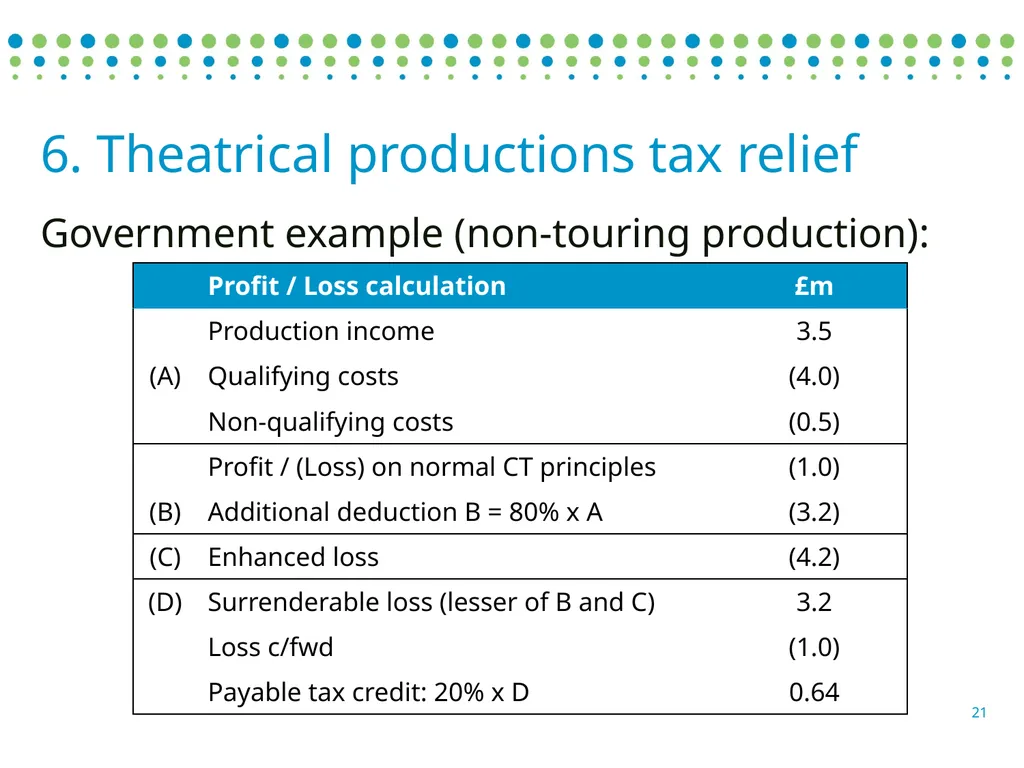
If there is a loss (after including the additional deduction) – can surrender all or a part of the loss for a payable tax credit:
25% for a touring production
20% for a non-touring production
Max surrender amount is lower of the enhanced loss and the additional deduction
Any un-surrendered loss is carried forward 6. Theatrical productions tax relief 20<br>
21
Government example (non-touring production): 6. Theatrical productions tax relief 21<br>
22
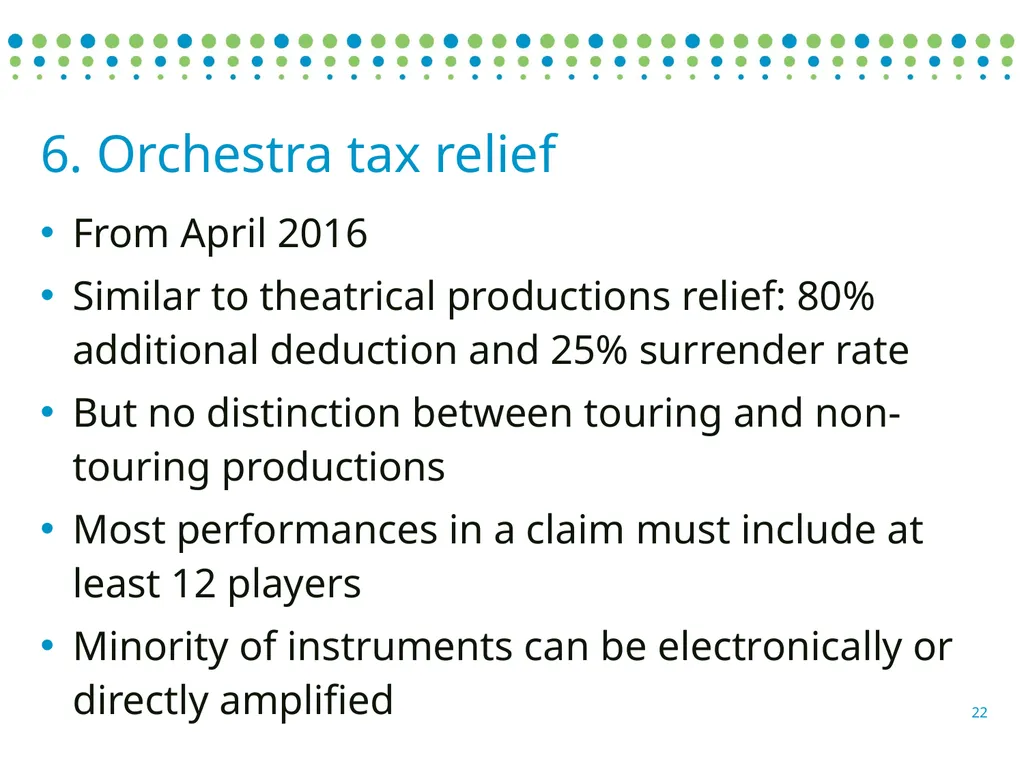
From April 2016
Similar to theatrical productions relief: 80% additional deduction and 25% surrender rate
But no distinction between touring and non-touring productions
Most performances in a claim must include at least 12 players
Minority of instruments can be electronically or directly amplified 6. Orchestra tax relief 22<br>
23
The players in the orchestra must be primary focus of each performance
Relief focussed on traditional classical music orchestras
Excludes:
Choirs and most choral music (focus must be players)
Chamber music (min 12 performers)
Music competitions
Performances to be recorded
Amplified music 6. Orchestra tax relief 23<br>
24
Helen.Elliott@sayervincent.co.uk
Publications
www.sayervincent.co.uk Sayer Vincent contact details 24<br>