Hi Everyone, I will often provide pre-lecture material (called tutorials in the TBL lexicon) for you to read before a lecture. Not every part of a TBL curriculum works in Gross Anatomy. But one thing that we know work is providing some
"Hi Everyone, I will often provide pre-lecture" is the property of its rightful owner. Permission is granted to
download and print the materials on this website for personal, non-commercial use only, and to display it
on your personal computer provided you do not modify the materials and that you retain all copyright
notices contained in the materials. By downloading content from our website, you accept the terms of this
agreement.
Presentation Transcript
01
Hi Everyone,
I will often provide pre-lecture material (called “tutorials” in the TBL lexicon) for you to read before a lecture. Not every part of a TBL curriculum works in Gross Anatomy. But one thing that we know work is providing some pre-lecture summaries. This helps to prepare you for lecture so that we can all make use of our time in the amphitheater much more effectively. There are some simple concepts that are silly for me to repeat in front of you in lecture. It wastes your time to have me recite it. But you do need to know about these basic details before class. There are also often some over-arching ideas that would be good for you to have in mind before lecture. These tutorials cover, to varying degrees, big issues and basic facts you need to before we start. I hope you find these helpful.
Sincerely, Daniel Pre-lecture material for Lecture 1 GA 2016:
TBS and anatomical planes.<br>
02
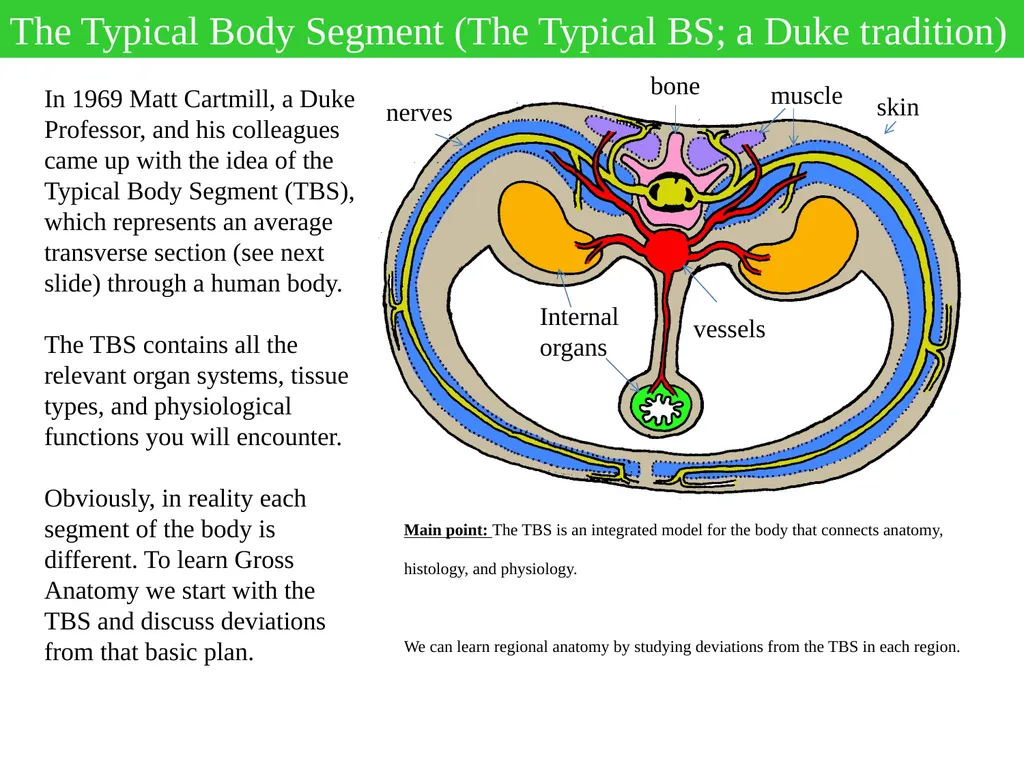
Main point: The TBS is an integrated model for the body that connects anatomy, histology, and physiology.
We can learn regional anatomy by studying deviations from the TBS in each region. muscle nerves skin vessels Internal
organs bone In 1969 Matt Cartmill, a Duke Professor, and his colleagues came up with the idea of the Typical Body Segment (TBS), which represents an average transverse section (see next slide) through a human body.
The TBS contains all the relevant organ systems, tissue types, and physiological functions you will encounter.
Obviously, in reality each segment of the body is different. To learn Gross Anatomy we start with the TBS and discuss deviations from that basic plan. The Typical Body Segment (The Typical BS; a Duke tradition)<br>
03
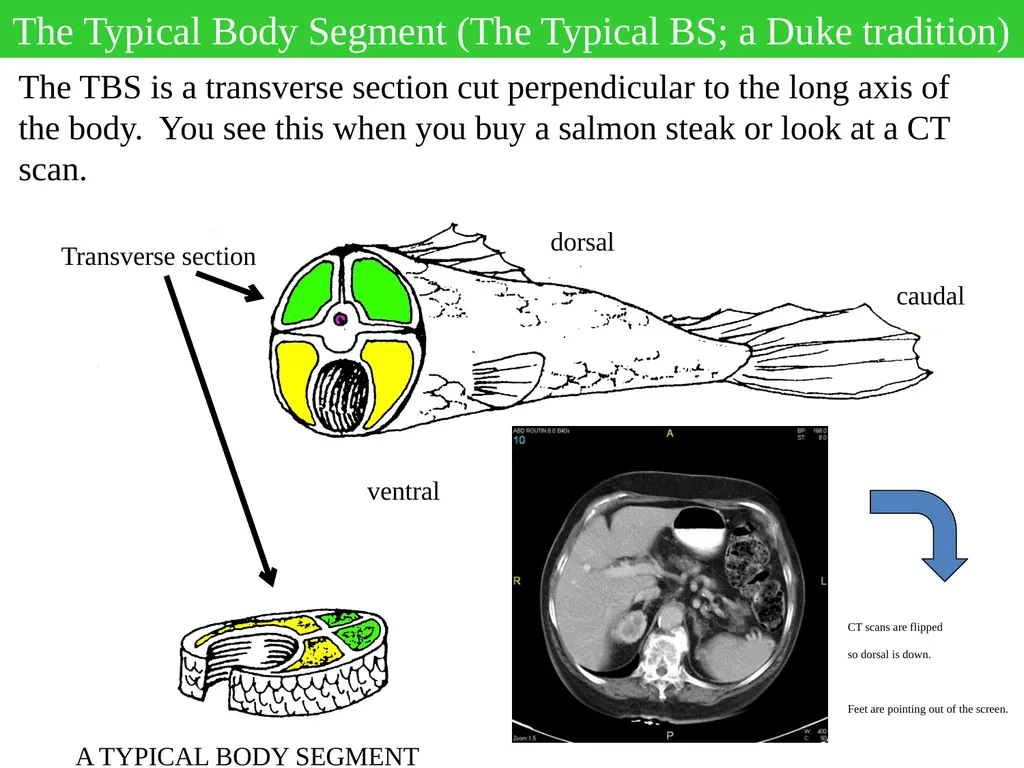
A TYPICAL BODY SEGMENT dorsal ventral caudal Transverse section CT scans are flipped
so dorsal is down.
Feet are pointing out of the screen. The TBS is a transverse section cut perpendicular to the long axis of the body. You see this when you buy a salmon steak or look at a CT scan. The Typical Body Segment (The Typical BS; a Duke tradition)<br>
04
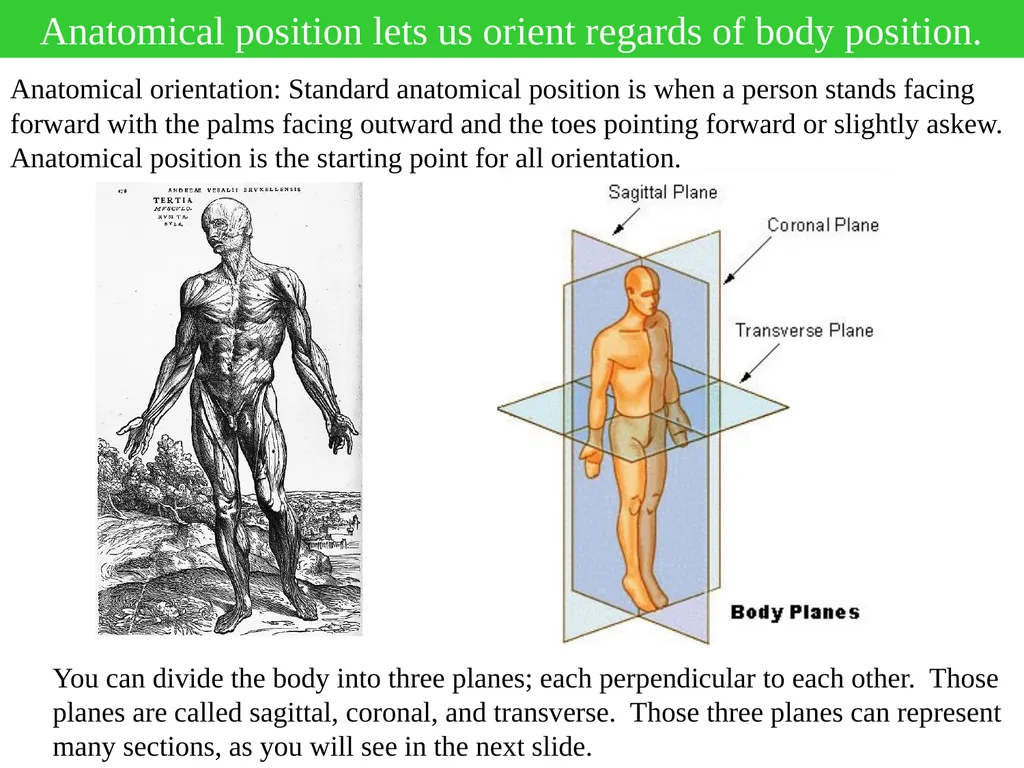
Anatomical orientation: Standard anatomical position is when a person stands facing forward with the palms facing outward and the toes pointing forward or slightly askew. Anatomical position is the starting point for all orientation. You can divide the body into three planes; each perpendicular to each other. Those planes are called sagittal, coronal, and transverse. Those three planes can represent many sections, as you will see in the next slide. Anatomical position lets us orient regards of body position.<br>
05
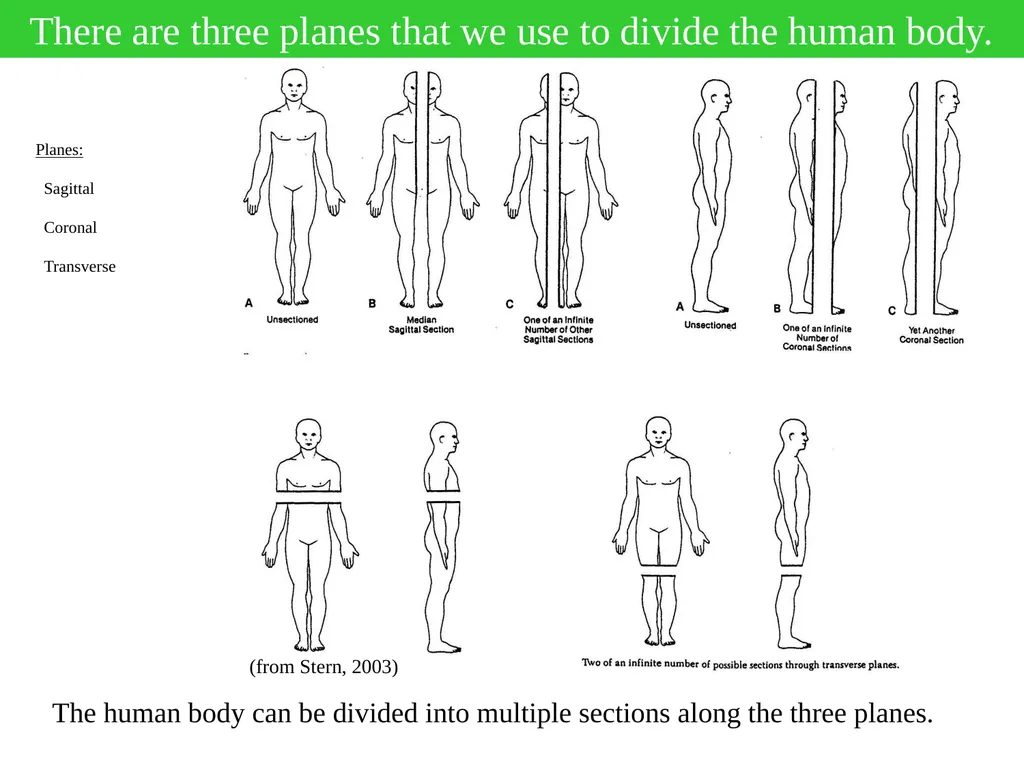
Planes:
Sagittal
Coronal
Transverse The human body can be divided into multiple sections along the three planes. (from Stern, 2003) There are three planes that we use to divide the human body.<br>
06
We do talk about the dorsum or the ventrum or the dorsal and ventral surfaces. We also talk about the proximal or distal end of a bone. But when we are being precise we use these terms in a relative way that allows rapid and consist description in any setting and is especially valuable in a clinical setting. Here are examples: The heart is dorsal to the sternum. The vertebra is dorsal to the heart. The wrist is distal to the elbow. The nipple is lateral to the sternum. The heart is medial to the lung. etc. etc. Once you know planes and orientation you
can now consider different surfaces and
levels of the body. To avoid confusion we
use relative terms that designate the position
of one structure relative to another.
Relative Locations:
Dorsal (posterior): toward the back
Ventral (anterior): toward the front
Cranial (superior): toward the head
Caudal (inferior): toward the tail/feet
Medial: close to the midline
Lateral: further from the midline
Proximal: on a limb; close to the midline
Distal: on a limb; further from the midline We describe position in relative terms within the body.<br>