
HIGH ALTITUDE DISEASES & COLD INJURIES LESSON-24
PC
Published · 34 slides · 0 views

1 / 1



Description
HIGH ALTITUDE DISEASES COLD INJURIES LESSON-24 BY PRAVIN DUDHE INSPPH OBJECTIVES Upon completion of this lesson you will be able to: List the signs, symptoms management of Ac. Mountain Sickness State the predisposing factors,
Related Topics
Share
Embed code
Download this presentation From Below
"HIGH ALTITUDE DISEASES & COLD INJURIES LESSON-24" is the property of its rightful owner. Permission is granted to download and print the materials on this website for personal, non-commercial use only, and to display it on your personal computer provided you do not modify the materials and that you retain all copyright notices contained in the materials. By downloading content from our website, you accept the terms of this agreement.
Presentation Transcript
01
HIGH ALTITUDE DISEASES & COLD INJURIES LESSON-24 BY
PRAVIN DUDHE
INSP/PH<br>
PRAVIN DUDHE
INSP/PH<br>
02
OBJECTIVES
Upon completion of this lesson you will be able to:
List the signs, symptoms & management of Ac. Mountain Sickness
State the predisposing factors, signs/symptoms and management of HAPO
Describe HACO, its signs/symptoms and management
Explain briefly about Monge’s Disease
Explain the various cold injuries and their prevention & management
Define Hypothermia, its signs/symptoms and management
Explain the Acclimatization Schedule<br>
Upon completion of this lesson you will be able to:
List the signs, symptoms & management of Ac. Mountain Sickness
State the predisposing factors, signs/symptoms and management of HAPO
Describe HACO, its signs/symptoms and management
Explain briefly about Monge’s Disease
Explain the various cold injuries and their prevention & management
Define Hypothermia, its signs/symptoms and management
Explain the Acclimatization Schedule<br>
03
II. DEVELOPMENT:
Altitude above 9000 feet or 2500m is termed as High Altitude. At such altitudes, the atmospheric pressure is low and partial pressure of oxygen is also low. Apart from this, the intensity of cosmic (solar rays) is quite high and atmospheric temperature and humidity is also progressively low.<br>
Altitude above 9000 feet or 2500m is termed as High Altitude. At such altitudes, the atmospheric pressure is low and partial pressure of oxygen is also low. Apart from this, the intensity of cosmic (solar rays) is quite high and atmospheric temperature and humidity is also progressively low.<br>
04
Whenever a person ascends to high altitude, due to low partial pressure of oxygen, there is reduced alveolar oxygen and tissue hypoxia. To compensate this, respiratory rate as well heart rate increase in the initial stage. Gradually there are other physiological changes in the blood and respiration to maintain sufficient cardiac output and tissue perfusion at such low oxygen pressure. These physiological changes constitute acclimatization
The stimulus for this physiological adaptation takes place at an altitude of 9000 feet.<br>
The stimulus for this physiological adaptation takes place at an altitude of 9000 feet.<br>
05
ACUTE MOUNTAIN SICKNESS
It is an illness caused due to rapid ascent in high altitudes
without sufficient acclimatization and physiological adaptation.
Common signs and symptoms:
Mild to moderate headache (principal symptom)
Fatigue and anorexia
Nausea and vomiting
Ataxia and peripheral oedema
Occasional palpitation
Insomnia and disturbed sleep<br>
It is an illness caused due to rapid ascent in high altitudes
without sufficient acclimatization and physiological adaptation.
Common signs and symptoms:
Mild to moderate headache (principal symptom)
Fatigue and anorexia
Nausea and vomiting
Ataxia and peripheral oedema
Occasional palpitation
Insomnia and disturbed sleep<br>
06
Usually occurs with rapid ascent above 3000M and develops
within 6 -24 hours. With gradual worsening and
severity, following features develop
Severe headache
Persistent insomnia
Giddiness
Lack of concentration and disinclination to work
Loss of appetite
Muscular weakness
Severe breathlessness<br>
within 6 -24 hours. With gradual worsening and
severity, following features develop
Severe headache
Persistent insomnia
Giddiness
Lack of concentration and disinclination to work
Loss of appetite
Muscular weakness
Severe breathlessness<br>
07
Management:
- Thorough acclimatization to prevent occurrence
- Rest and simple analgesic
- Intake of more fluid at frequent intervals
- Descent to lower altitude
- Tab. Acetazolamide (Diamox) 250mg 8 hrly, in severe cases Hallucination
Mental irritability Palpitation<br>
- Thorough acclimatization to prevent occurrence
- Rest and simple analgesic
- Intake of more fluid at frequent intervals
- Descent to lower altitude
- Tab. Acetazolamide (Diamox) 250mg 8 hrly, in severe cases Hallucination
Mental irritability Palpitation<br>
08
HIGH ALTITUDE PULMONARY OEDEMA (HAPO)
It is a serious and potentially fatal condition due to high
altitude effect. The predisposing factors are:
Rapid ascent with Improper acclimatization
Presence of mountain sickness
Youth
Heavy exertion
Associated respiratory tract infection, ischemic episode, hypertension<br>
It is a serious and potentially fatal condition due to high
altitude effect. The predisposing factors are:
Rapid ascent with Improper acclimatization
Presence of mountain sickness
Youth
Heavy exertion
Associated respiratory tract infection, ischemic episode, hypertension<br>
09
Signs & symptoms:
Dyspnea/breathlessness
Dry cough or blood stained sputum
Chest discomfort
Nausea and vomiting
Crepitations in both lungs
Profound hypoxemia<br>
Dyspnea/breathlessness
Dry cough or blood stained sputum
Chest discomfort
Nausea and vomiting
Crepitations in both lungs
Profound hypoxemia<br>
10
Management:
Immediate descent to lower altitude
Bed rest
High flow oxygen
Use of HAPO bag if descent is not possible immediately
Cap. Nifedipine 5mg tds with careful BP monitoring can be tried<br>
Immediate descent to lower altitude
Bed rest
High flow oxygen
Use of HAPO bag if descent is not possible immediately
Cap. Nifedipine 5mg tds with careful BP monitoring can be tried<br>
11
HIGH ALTITUDE CEREBRAL OEDEMA (HACO)
It is another potentially fatal high altitude illness and represents a severe form of acute mountain sickness
It usually occurs usually above 3500 M
Symptoms:
Rapidly progressive cerebral symptoms like –
Hallucinations/ Behavioral change
Confusion/ Ataxia
Visual loss, papilloedema, retinal haemorrhages
Loss of consciousness<br>
It is another potentially fatal high altitude illness and represents a severe form of acute mountain sickness
It usually occurs usually above 3500 M
Symptoms:
Rapidly progressive cerebral symptoms like –
Hallucinations/ Behavioral change
Confusion/ Ataxia
Visual loss, papilloedema, retinal haemorrhages
Loss of consciousness<br>
12
Management:
Immediate descent
Administration of high flow oxygen
T. Acetazolamide 250 mg 8thhrly 24 -48 hours prior to ascent may be prophylactic<br>
Immediate descent
Administration of high flow oxygen
T. Acetazolamide 250 mg 8thhrly 24 -48 hours prior to ascent may be prophylactic<br>
13
CHRONIC MOUNTAIN SICKNESS (MONGE’S DISESE)
It is a chronic disease manifesting in middle-aged people after sustained stay at high altitude.
Symptoms include Headache; Dizziness; Irritability; Drowsiness (most striking)
Management: descent to sea level and avoidance of ascent to high-altitude again<br>
It is a chronic disease manifesting in middle-aged people after sustained stay at high altitude.
Symptoms include Headache; Dizziness; Irritability; Drowsiness (most striking)
Management: descent to sea level and avoidance of ascent to high-altitude again<br>
14
COLD INJURIES
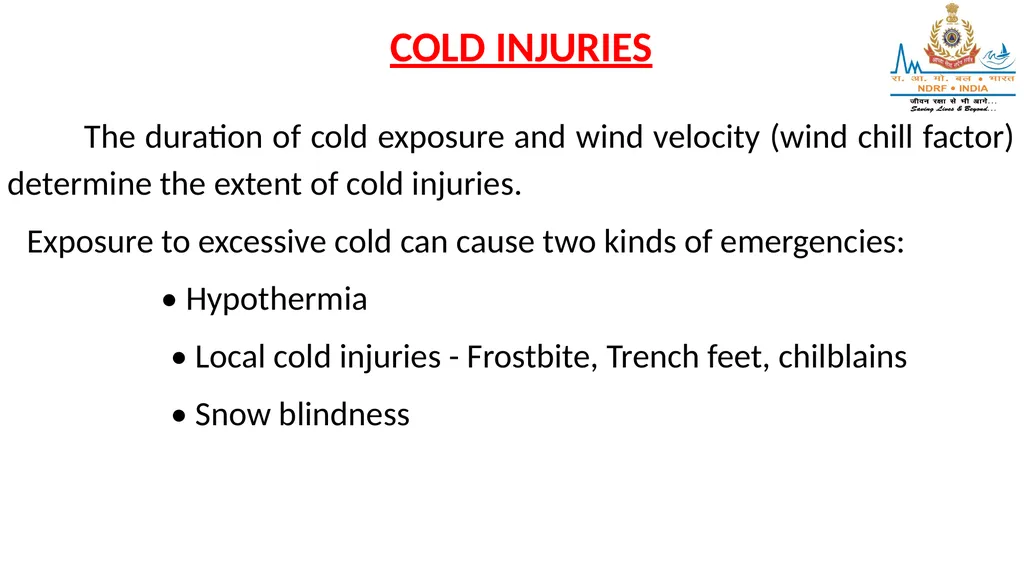
The duration of cold exposure and wind velocity (wind chill factor) determine the extent of cold injuries.
Exposure to excessive cold can cause two kinds of emergencies:
• Hypothermia
• Local cold injuries - Frostbite, Trench feet, chilblains
• Snow blindness<br>
The duration of cold exposure and wind velocity (wind chill factor) determine the extent of cold injuries.
Exposure to excessive cold can cause two kinds of emergencies:
• Hypothermia
• Local cold injuries - Frostbite, Trench feet, chilblains
• Snow blindness<br>
15
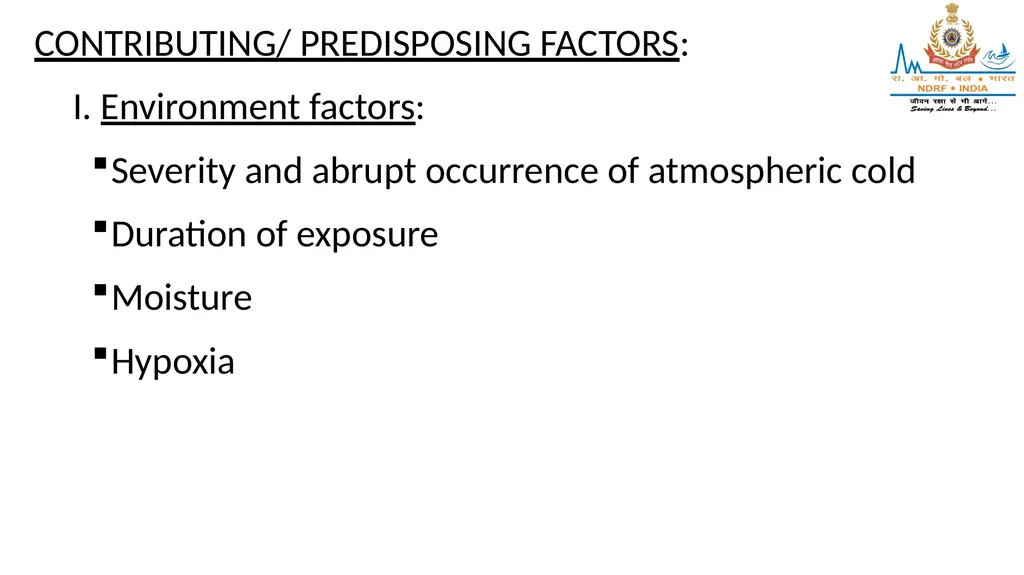
CONTRIBUTING/ PREDISPOSING FACTORS:
I. Environment factors:
Severity and abrupt occurrence of atmospheric cold
Duration of exposure
Moisture
Hypoxia<br>
I. Environment factors:
Severity and abrupt occurrence of atmospheric cold
Duration of exposure
Moisture
Hypoxia<br>
16
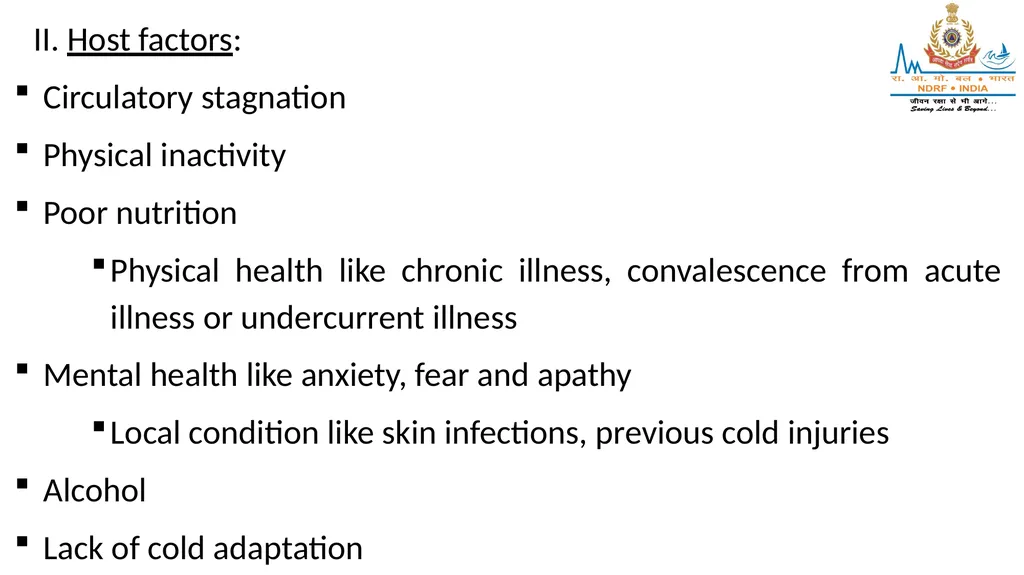
II. Host factors:
Circulatory stagnation
Physical inactivity
Poor nutrition
Physical health like chronic illness, convalescence from acute illness or undercurrent illness
Mental health like anxiety, fear and apathy
Local condition like skin infections, previous cold injuries
Alcohol
Lack of cold adaptation<br>
Circulatory stagnation
Physical inactivity
Poor nutrition
Physical health like chronic illness, convalescence from acute illness or undercurrent illness
Mental health like anxiety, fear and apathy
Local condition like skin infections, previous cold injuries
Alcohol
Lack of cold adaptation<br>
17
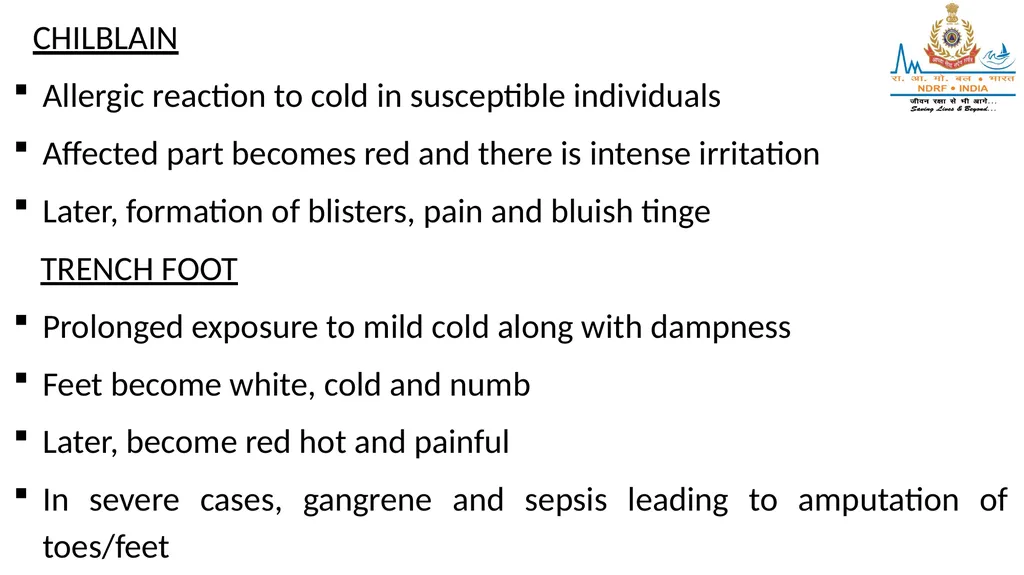
CHILBLAIN
Allergic reaction to cold in susceptible individuals
Affected part becomes red and there is intense irritation
Later, formation of blisters, pain and bluish tinge
TRENCH FOOT
Prolonged exposure to mild cold along with dampness
Feet become white, cold and numb
Later, become red hot and painful
In severe cases, gangrene and sepsis leading to amputation of toes/feet<br>
Allergic reaction to cold in susceptible individuals
Affected part becomes red and there is intense irritation
Later, formation of blisters, pain and bluish tinge
TRENCH FOOT
Prolonged exposure to mild cold along with dampness
Feet become white, cold and numb
Later, become red hot and painful
In severe cases, gangrene and sepsis leading to amputation of toes/feet<br>
18
FROST BITE
Usually due to freezing and ice crystal formation in skin and deeper tissues of exposed parts like nose, ears, fingers & toes
Initially the part becomes numb, white and doughy
Later blister formation, hard and gangrenous leading to loss of the part MANAGEMENT OF COLD INJURIES:
Remove patient to sheltered place and avoid further exertion
Aim is to preserve and raise the temperature of the body fast without over-warming<br>
Usually due to freezing and ice crystal formation in skin and deeper tissues of exposed parts like nose, ears, fingers & toes
Initially the part becomes numb, white and doughy
Later blister formation, hard and gangrenous leading to loss of the part MANAGEMENT OF COLD INJURIES:
Remove patient to sheltered place and avoid further exertion
Aim is to preserve and raise the temperature of the body fast without over-warming<br>
19
Slowly re warm the frozen part in luke warm water and ensure that it is constantly kept warm and not re-exposed to cold
Do not expose the frozen part to fire
Remove all constricting items of clothing like boots, gloves and socks and maintain general body warmth
For severe pain on re warming administer simple analgesic like Aspirin
Do not aspirate the vesicle or blister; cover with loose dry dressing and protect from further injury
Give warm fluids and good nutritious diet
Do not let the patient smoke or drink alcohol as it impairs healing<br>
Do not expose the frozen part to fire
Remove all constricting items of clothing like boots, gloves and socks and maintain general body warmth
For severe pain on re warming administer simple analgesic like Aspirin
Do not aspirate the vesicle or blister; cover with loose dry dressing and protect from further injury
Give warm fluids and good nutritious diet
Do not let the patient smoke or drink alcohol as it impairs healing<br>
20
!!! CAUTION
Never rub or massage the affected area of a local cold injury. Ice crystals under the skin could damage the fragile capillaries and tissues, making the injury worse.<br>
Never rub or massage the affected area of a local cold injury. Ice crystals under the skin could damage the fragile capillaries and tissues, making the injury worse.<br>
21
PROTECTIVE MEASURES AGAINST COLD INJURY:
Protective clothing: loose and in layers; outer layer should be wind and water proof; face neck and head should be well protected
Socks: every one should have at least three to four pairs of good socks; change immediately, if it becomes wet
Boots: always have a spare pair and change immediately if feet get wet
Avoid direct contact with metal objects
Protect eyes from snow blindness by wearing tinted glasses<br>
Protective clothing: loose and in layers; outer layer should be wind and water proof; face neck and head should be well protected
Socks: every one should have at least three to four pairs of good socks; change immediately, if it becomes wet
Boots: always have a spare pair and change immediately if feet get wet
Avoid direct contact with metal objects
Protect eyes from snow blindness by wearing tinted glasses<br>
22
Golden principles of prevention of cold injury:
C – keep clothes ‘clean’
O – avoid ‘overheating’
L - always put on clothes / socks ‘ loose’& in ‘layers’
D – keep the body / clothes / socks etc ‘dry’<br>
C – keep clothes ‘clean’
O – avoid ‘overheating’
L - always put on clothes / socks ‘ loose’& in ‘layers’
D – keep the body / clothes / socks etc ‘dry’<br>
23
SNOW BLINDNESS
The greatest danger of contracting snow-blindness is when the sun is shining through thin clouds, due to UV ray reflection from the snow.
It causes rapidly painful and temporary blindness
Eyes become congested, photophobic to light and irritable with watering
Management: Place patient in a dark room; Instill analgesic drops like fluribrufen 6 hrly& Antibiotic drops like ciprofloxacin 6 hrly; do not allow patient to rub the eyes; eye-pads
Prevention: By wearing tinted, good quality UV filtration goggles<br>
The greatest danger of contracting snow-blindness is when the sun is shining through thin clouds, due to UV ray reflection from the snow.
It causes rapidly painful and temporary blindness
Eyes become congested, photophobic to light and irritable with watering
Management: Place patient in a dark room; Instill analgesic drops like fluribrufen 6 hrly& Antibiotic drops like ciprofloxacin 6 hrly; do not allow patient to rub the eyes; eye-pads
Prevention: By wearing tinted, good quality UV filtration goggles<br>
24
HYPOTHERMIA
When cooling affects the entire body, it causes a condition known as hypothermia, or generalized cooling. The core temperature of the body goes below 350 C. Hypothermia can develop in temperatures well above freezing.<br>
When cooling affects the entire body, it causes a condition known as hypothermia, or generalized cooling. The core temperature of the body goes below 350 C. Hypothermia can develop in temperatures well above freezing.<br>
25
SIGNS AND SYMPTOMS OF MILD HYPOTHERMIA
• Chills
• Drowsiness
• Rapid breathing, slow pulse
• Loss of vision
• Sluggish pupils
• Uncontrollable shivering<br>
• Chills
• Drowsiness
• Rapid breathing, slow pulse
• Loss of vision
• Sluggish pupils
• Uncontrollable shivering<br>
26
SIGNS AND SYMPTOMS OF SEVERE HYPOTHERMIA
• Extremely slow breathing rate
• Extremely slow pulse rate
• Unresponsiveness
• Fixed and dilated pupils
• Rigid extremities
• Absence of shivering<br>
• Extremely slow breathing rate
• Extremely slow pulse rate
• Unresponsiveness
• Fixed and dilated pupils
• Rigid extremities
• Absence of shivering<br>
27
MANAGEMENT OF HYPOTHERMIA
Handle patient very gently and offer comfort and reassurance.
1) Conduct initial assessment and physical exam.
2) Remove the patient from the cold environment.
3) Maintain open airway and administer oxygen
4) Remove any wet clothing and cover patient with a blanket. Keep the patient dry.
5) If the patient is alert, offer warm liquids (non-stimulant) slowly.
6) Constantly assess vital signs.<br>
Handle patient very gently and offer comfort and reassurance.
1) Conduct initial assessment and physical exam.
2) Remove the patient from the cold environment.
3) Maintain open airway and administer oxygen
4) Remove any wet clothing and cover patient with a blanket. Keep the patient dry.
5) If the patient is alert, offer warm liquids (non-stimulant) slowly.
6) Constantly assess vital signs.<br>
28
7) If patient is conscious, slowly re-warm the patient with dry clothing, warm liquids and light nutritious diet.
8) If unconscious, evacuate the patient to hospital at the earliest with above first aid measures. ACCLIMATISATION SCHEDULE
Acclimatization takes place in three stages, above 9000 feet or 2500M
STAGE I:
For heights between 9000 feet to 12,000 feet and consists of a period of 06 days.<br>
8) If unconscious, evacuate the patient to hospital at the earliest with above first aid measures. ACCLIMATISATION SCHEDULE
Acclimatization takes place in three stages, above 9000 feet or 2500M
STAGE I:
For heights between 9000 feet to 12,000 feet and consists of a period of 06 days.<br>
29
1st and 2nd days:
i) Rest
ii) Short walks in lines only
iii) No climbing
3rd and 4th days:
i) Walk at slow pace for 1 km; avoid climbing
5th and 6th days:
i) Walk upto 5 km and climb upto 1000 feet at slow pace<br>
i) Rest
ii) Short walks in lines only
iii) No climbing
3rd and 4th days:
i) Walk at slow pace for 1 km; avoid climbing
5th and 6th days:
i) Walk upto 5 km and climb upto 1000 feet at slow pace<br>
30
STAGE II:
For heights between 12,000 feet and 15,000 feet and consists of 04 days.
1st and 2nd days:
i) Walk upto 1 km at slow pace; avoidance of steep climbs
3rd day:
i) Slow walk and climb upto 1000 feet
4th day:
i) Climb upto 1000 feet without carrying any weight<br>
For heights between 12,000 feet and 15,000 feet and consists of 04 days.
1st and 2nd days:
i) Walk upto 1 km at slow pace; avoidance of steep climbs
3rd day:
i) Slow walk and climb upto 1000 feet
4th day:
i) Climb upto 1000 feet without carrying any weight<br>
31
STAGE III:
For height above 15,000 feet and consists of 4 days.
1st and 2nd days:
Slow walk and climb up to 1000 feet
3rd and 4th days:
i) Climb upto 1000 feet every day without weight on back<br>
For height above 15,000 feet and consists of 4 days.
1st and 2nd days:
Slow walk and climb up to 1000 feet
3rd and 4th days:
i) Climb upto 1000 feet every day without weight on back<br>
32
RE-ENTRY:
Within 10 days : No need for re-acclimatization
After 10 days : Same schedule as during first induction<br>
Within 10 days : No need for re-acclimatization
After 10 days : Same schedule as during first induction<br>
33
Avoid Smoking and alcohol consumption as it will reduce functional capacity of lungs and hypothermia respectively; Take plenty of Fluids
Rapid ascent to altitudes above 18000 feet should be avoided; it should be accomplished in not less than 15 days
Evacuation to lower altitude immediately on showing HA effects
Work at high altitude and sleep at low altitude
Protect exposed parts of the body from extreme cold<br>
Rapid ascent to altitudes above 18000 feet should be avoided; it should be accomplished in not less than 15 days
Evacuation to lower altitude immediately on showing HA effects
Work at high altitude and sleep at low altitude
Protect exposed parts of the body from extreme cold<br>
34
ANY QUESTION THANKS<br>