
High Level Change Impact Assessment SAMPLE
Description: High Level Change Impact Assessment SAMPLE Sub-Function Specific Topic Change Impacts Sub-Function Impact Assessment Captures impacts by relevant requirements, broken out by sub function Collected during requirements sessions Includes
Related Topics
Download Presentation
"High Level Change Impact Assessment SAMPLE" is the property of its rightful owner. Permission is granted to download and print the materials on this website for personal, non-commercial use only, and to display it on your personal computer provided you do not modify the materials and that you retain all copyright notices contained in the materials. By downloading content from our website, you accept the terms of this agreement.
Presentation Transcript
slide1. High Level Change Impact Assessment
SAMPLE<br>
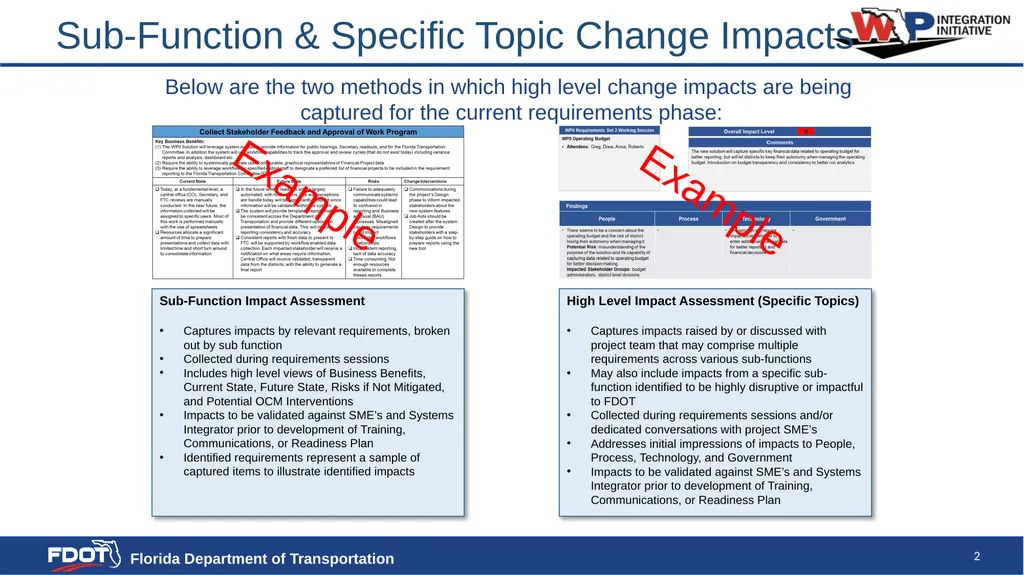
slide2. Sub-Function & Specific Topic Change Impacts Sub-Function Impact Assessment
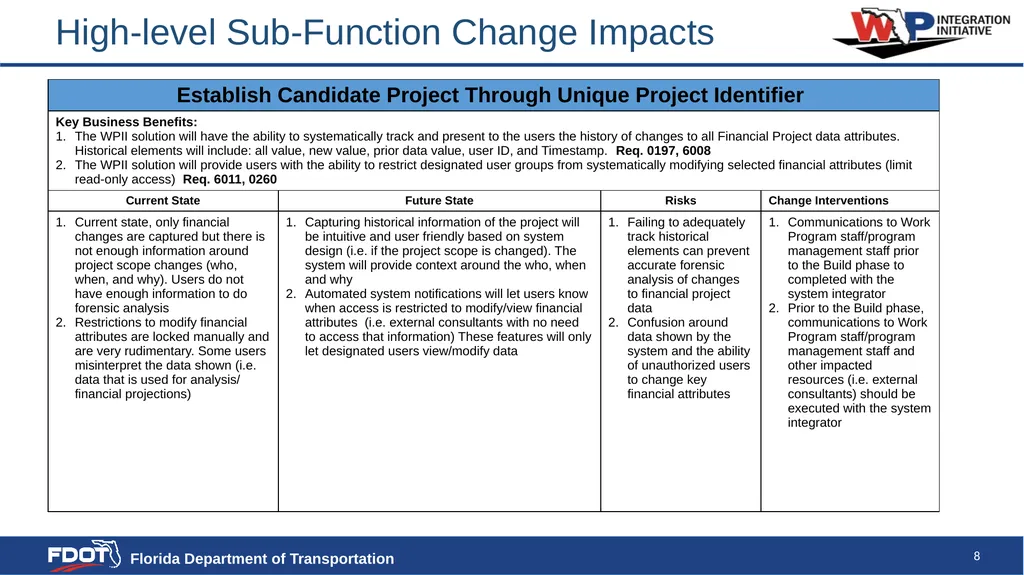
Captures impacts by relevant requirements, broken out by sub function
Collected during requirements sessions
Includes high level views of Business Benefits, Current State, Future State, Risks if Not Mitigated, and Potential OCM Interventions
Impacts to be validated against SME’s and Systems Integrator prior to development of Training, Communications, or Readiness Plan
Identified requirements represent a sample of captured items to illustrate identified impacts High Level Impact Assessment (Specific Topics)
Captures impacts raised by or discussed with project team that may comprise multiple requirements across various sub-functions
May also include impacts from a specific sub-function identified to be highly disruptive or impactful to FDOT
Collected during requirements sessions and/or dedicated conversations with project SME’s
Addresses initial impressions of impacts to People, Process, Technology, and Government
Impacts to be validated against SME’s and Systems Integrator prior to development of Training, Communications, or Readiness Plan Example Example Below are the two methods in which high level change impacts are being captured for the current requirements phase:<br>
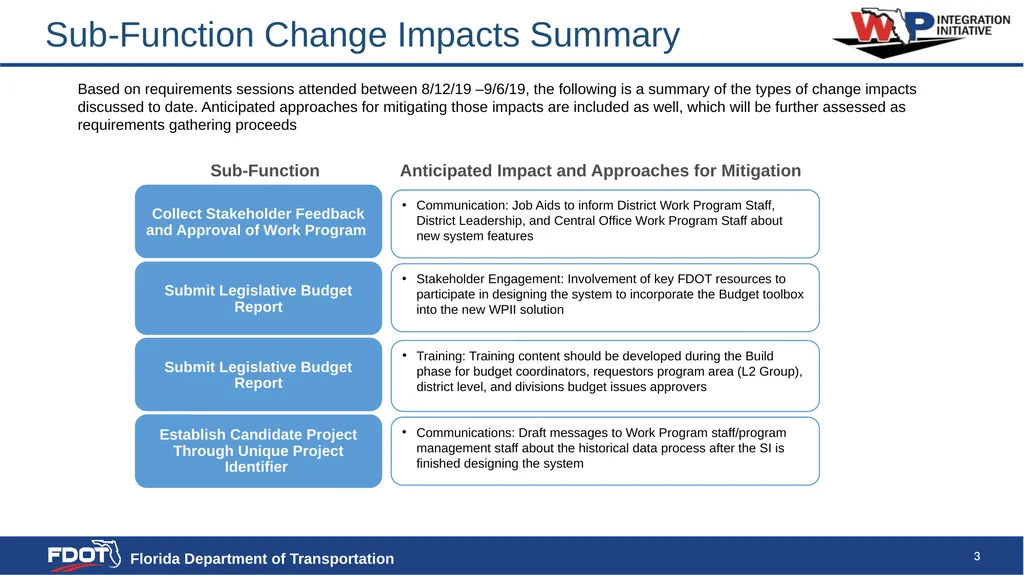
slide3. Based on requirements sessions attended between 8/12/19 –9/6/19, the following is a summary of the types of change impacts discussed to date. Anticipated approaches for mitigating those impacts are included as well, which will be further assessed as requirements gathering proceeds Sub-Function Change Impacts Summary Sub-Function Anticipated Impact and Approaches for Mitigation Communication: Job Aids to inform District Work Program Staff, District Leadership, and Central Office Work Program Staff about new system features Stakeholder Engagement: Involvement of key FDOT resources to participate in designing the system to incorporate the Budget toolbox into the new WPII solution Training: Training content should be developed during the Build phase for budget coordinators, requestors program area (L2 Group), district level, and divisions budget issues approvers Communications: Draft messages to Work Program staff/program management staff about the historical data process after the SI is finished designing the system<br>
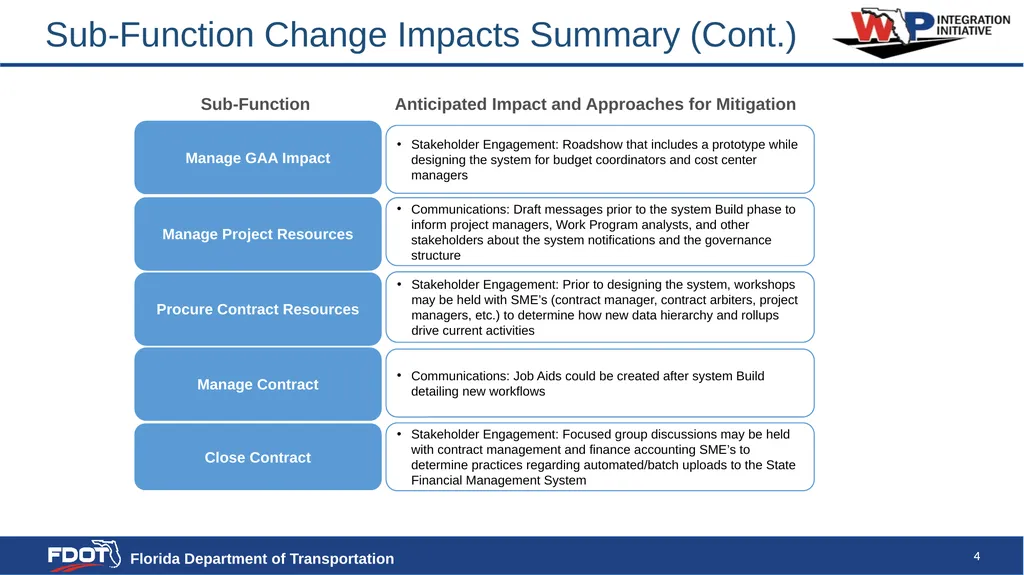
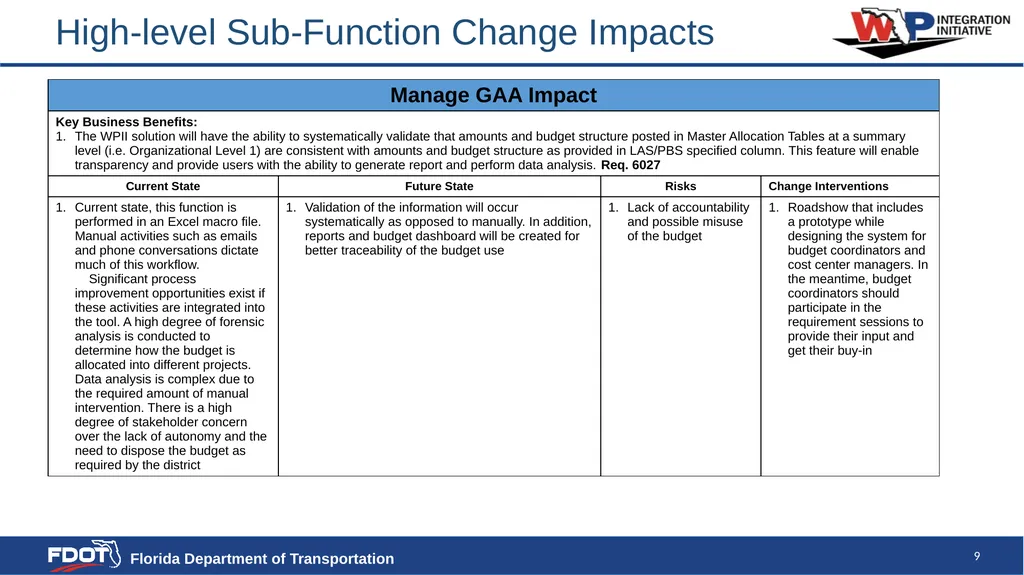
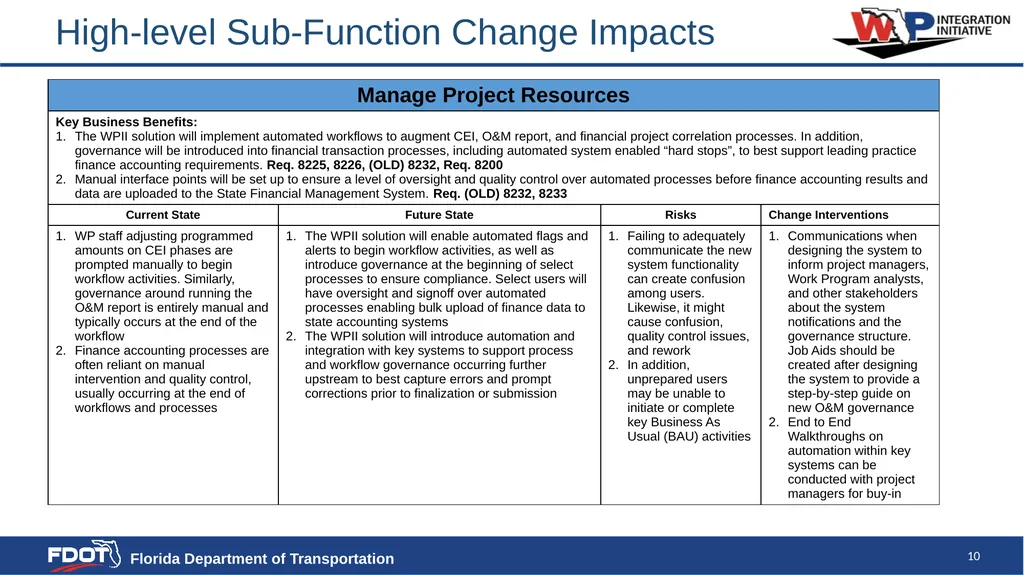
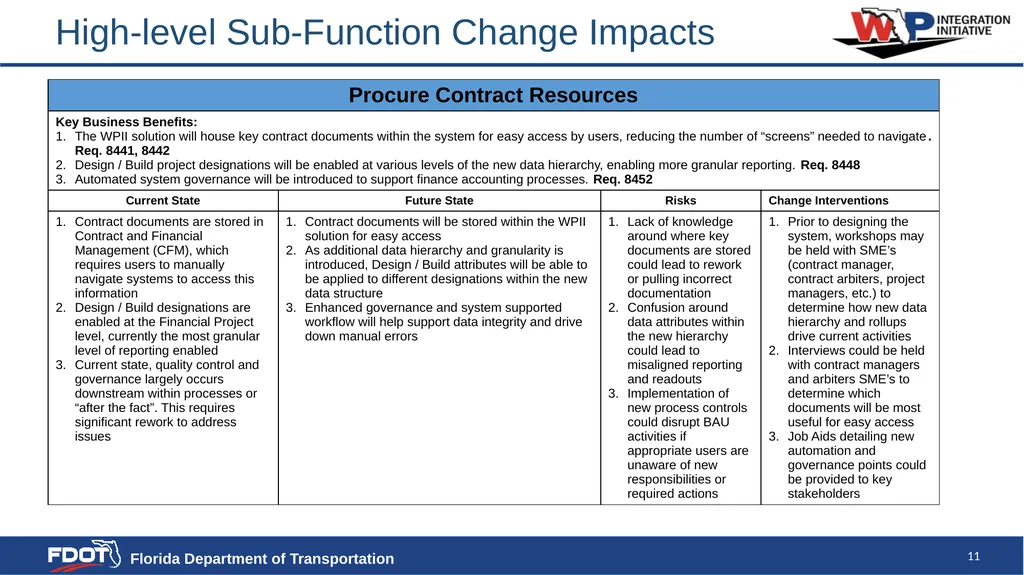
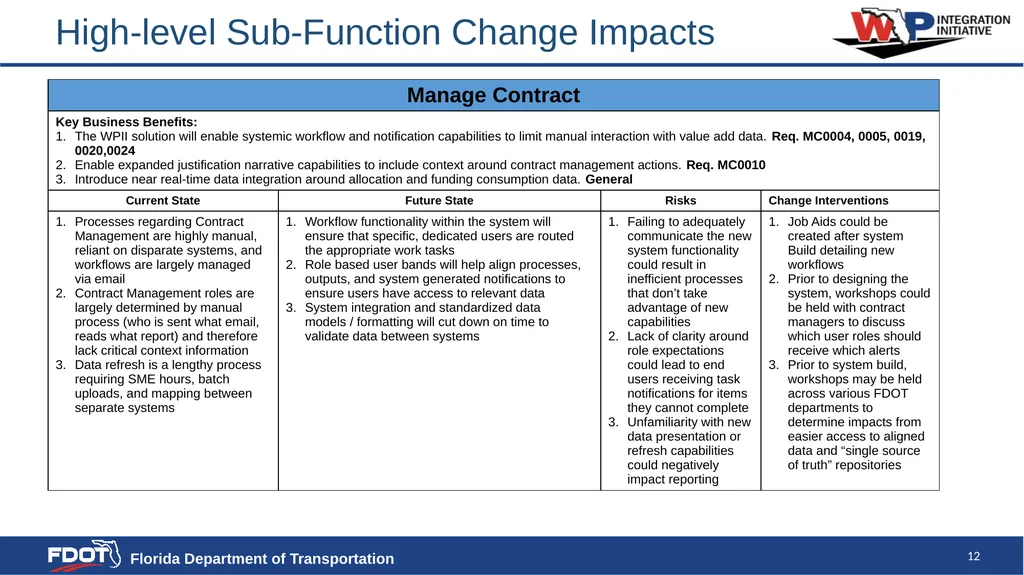
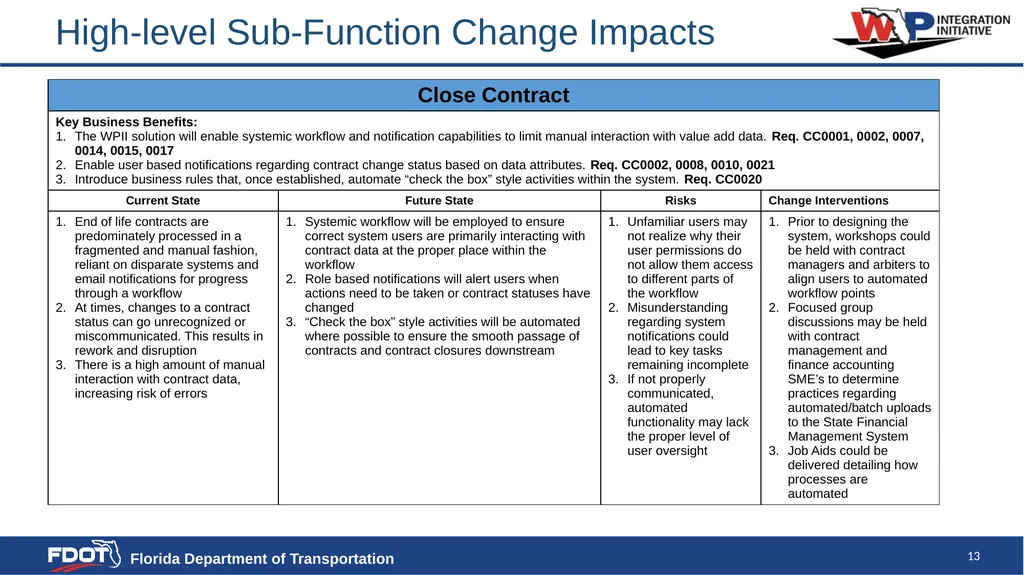
slide4. Manage GAA Impact Manage Project Resources Procure Contract Resources Manage Contract Sub-Function Anticipated Impact and Approaches for Mitigation Stakeholder Engagement: Roadshow that includes a prototype while designing the system for budget coordinators and cost center managers Communications: Draft messages prior to the system Build phase to inform project managers, Work Program analysts, and other stakeholders about the system notifications and the governance structure Stakeholder Engagement: Prior to designing the system, workshops may be held with SME’s (contract manager, contract arbiters, project managers, etc.) to determine how new data hierarchy and rollups drive current activities Communications: Job Aids could be created after system Build detailing new workflows Stakeholder Engagement: Focused group discussions may be held with contract management and finance accounting SME’s to determine practices regarding automated/batch uploads to the State Financial Management System Close Contract Sub-Function Change Impacts Summary (Cont.)<br>
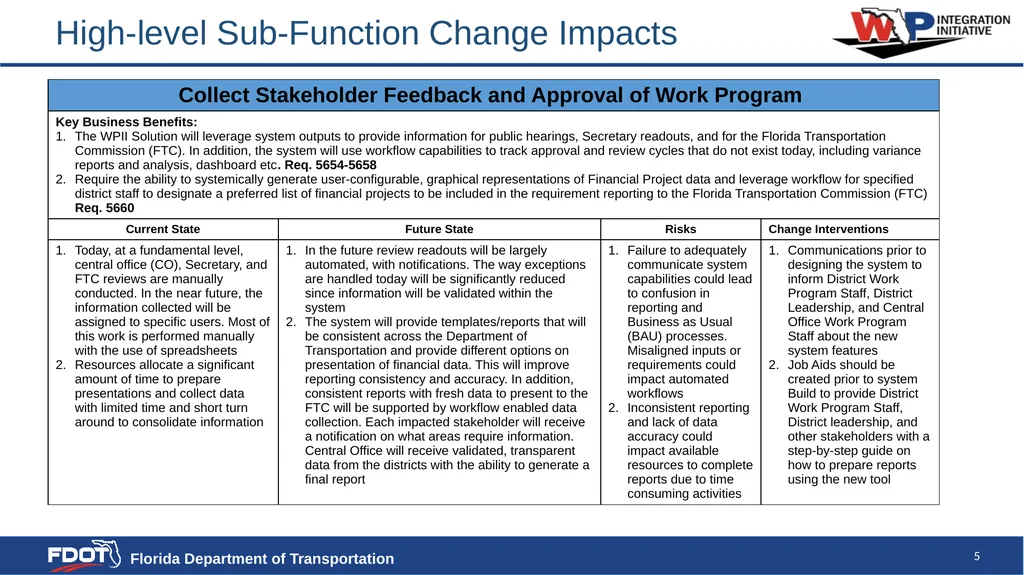
slide5. High-level Sub-Function Change Impacts<br>
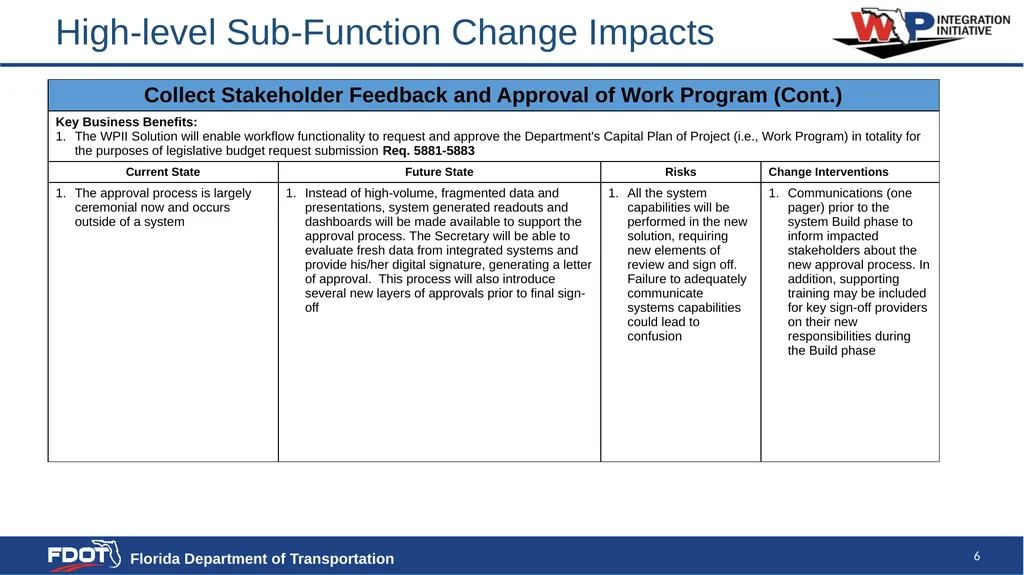
slide6. High-level Sub-Function Change Impacts<br>
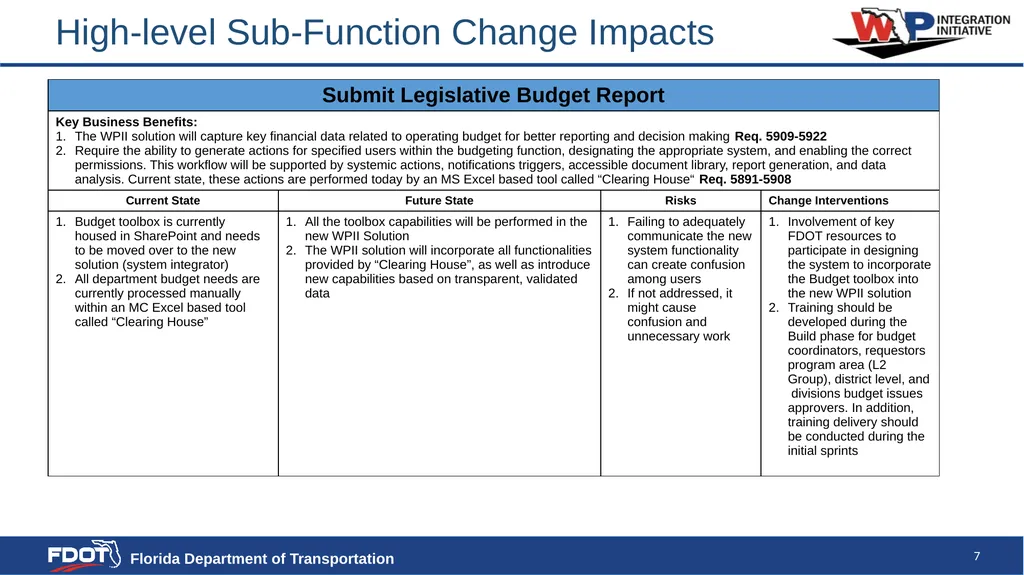
slide7. High-level Sub-Function Change Impacts<br>
slide8. High-level Sub-Function Change Impacts<br>
slide9. High-level Sub-Function Change Impacts<br>
slide10. High-level Sub-Function Change Impacts<br>
slide11. High-level Sub-Function Change Impacts<br>
slide12. High-level Sub-Function Change Impacts<br>
slide13. High-level Sub-Function Change Impacts<br>
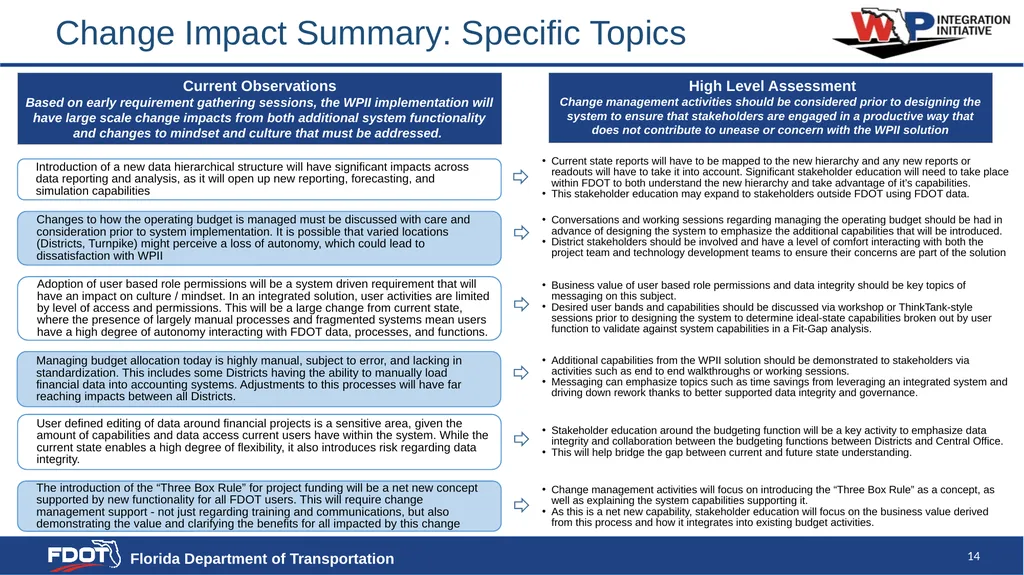
slide14. Current Observations
Based on early requirement gathering sessions, the WPII implementation will have large scale change impacts from both additional system functionality and changes to mindset and culture that must be addressed. High Level Assessment
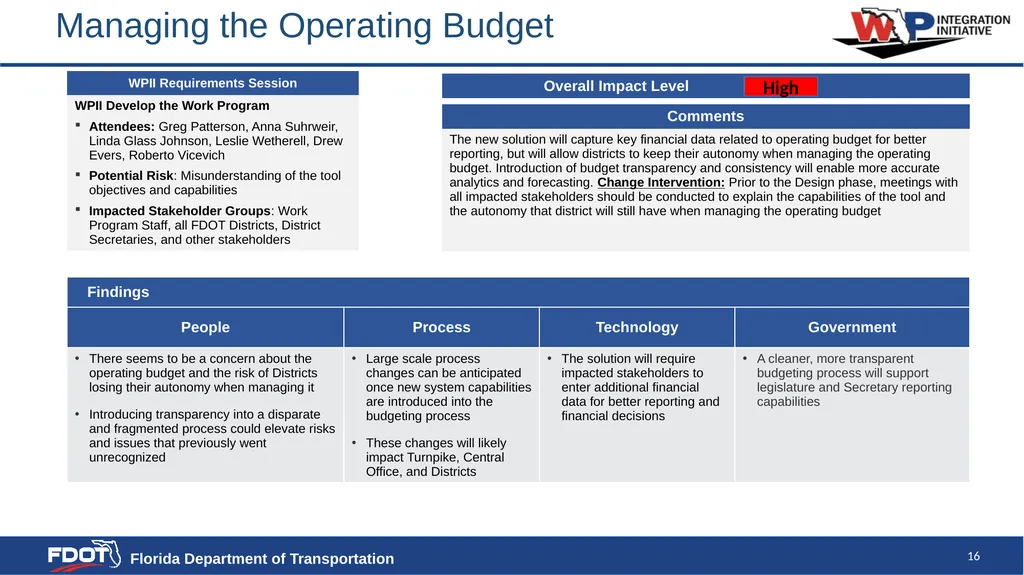
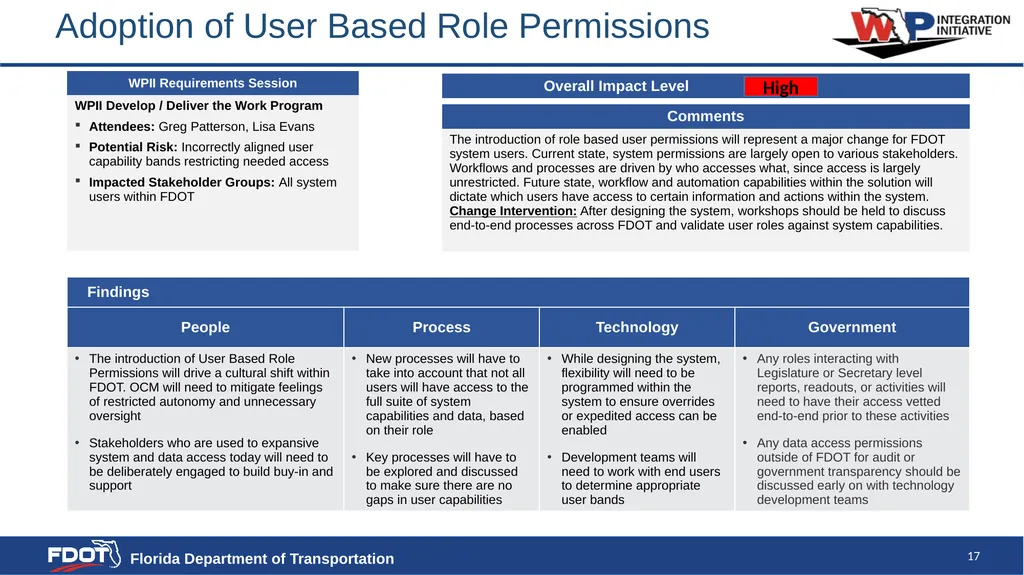
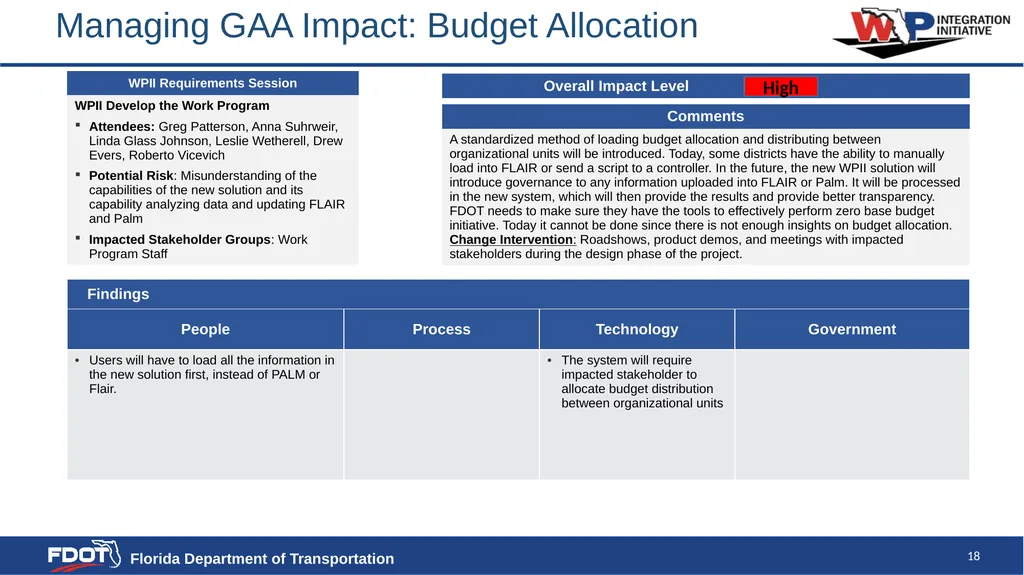
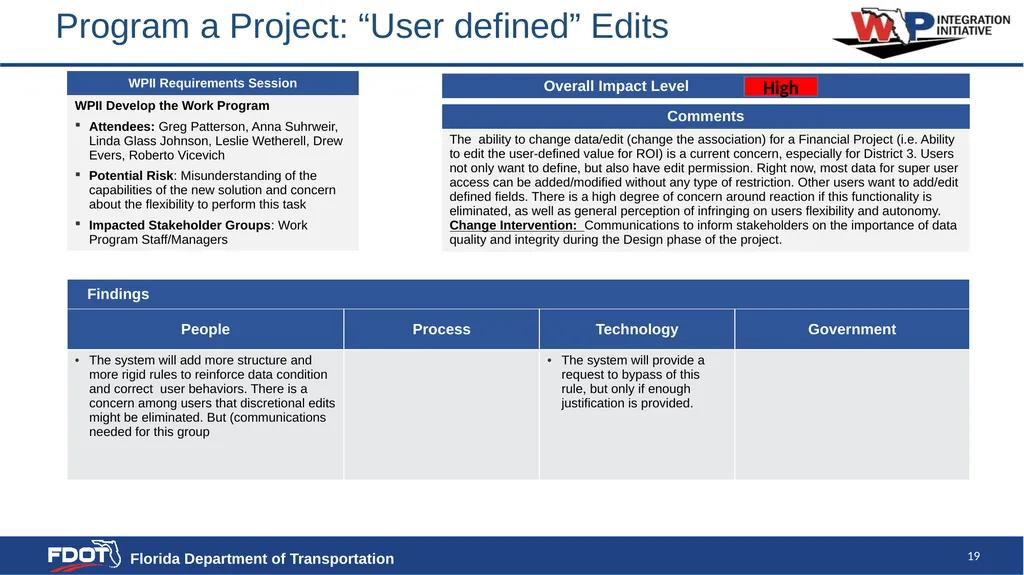
Change management activities should be considered prior to designing the system to ensure that stakeholders are engaged in a productive way that does not contribute to unease or concern with the WPII solution The introduction of the “Three Box Rule” for project funding will be a net new concept supported by new functionality for all FDOT users. This will require change management support - not just regarding training and communications, but also demonstrating the value and clarifying the benefits for all impacted by this change Adoption of user based role permissions will be a system driven requirement that will have an impact on culture / mindset. In an integrated solution, user activities are limited by level of access and permissions. This will be a large change from current state, where the presence of largely manual processes and fragmented systems mean users have a high degree of autonomy interacting with FDOT data, processes, and functions. Managing budget allocation today is highly manual, subject to error, and lacking in standardization. This includes some Districts having the ability to manually load financial data into accounting systems. Adjustments to this processes will have far reaching impacts between all Districts. User defined editing of data around financial projects is a sensitive area, given the amount of capabilities and data access current users have within the system. While the current state enables a high degree of flexibility, it also introduces risk regarding data integrity. Introduction of a new data hierarchical structure will have significant impacts across data reporting and analysis, as it will open up new reporting, forecasting, and simulation capabilities Changes to how the operating budget is managed must be discussed with care and consideration prior to system implementation. It is possible that varied locations (Districts, Turnpike) might perceive a loss of autonomy, which could lead to dissatisfaction with WPII Current state reports will have to be mapped to the new hierarchy and any new reports or readouts will have to take it into account. Significant stakeholder education will need to take place within FDOT to both understand the new hierarchy and take advantage of it’s capabilities.
This stakeholder education may expand to stakeholders outside FDOT using FDOT data. Conversations and working sessions regarding managing the operating budget should be had in advance of designing the system to emphasize the additional capabilities that will be introduced.
District stakeholders should be involved and have a level of comfort interacting with both the project team and technology development teams to ensure their concerns are part of the solution Business value of user based role permissions and data integrity should be key topics of messaging on this subject.
Desired user bands and capabilities should be discussed via workshop or ThinkTank-style sessions prior to designing the system to determine ideal-state capabilities broken out by user function to validate against system capabilities in a Fit-Gap analysis. Additional capabilities from the WPII solution should be demonstrated to stakeholders via activities such as end to end walkthroughs or working sessions.
Messaging can emphasize topics such as time savings from leveraging an integrated system and driving down rework thanks to better supported data integrity and governance. Stakeholder education around the budgeting function will be a key activity to emphasize data integrity and collaboration between the budgeting functions between Districts and Central Office.
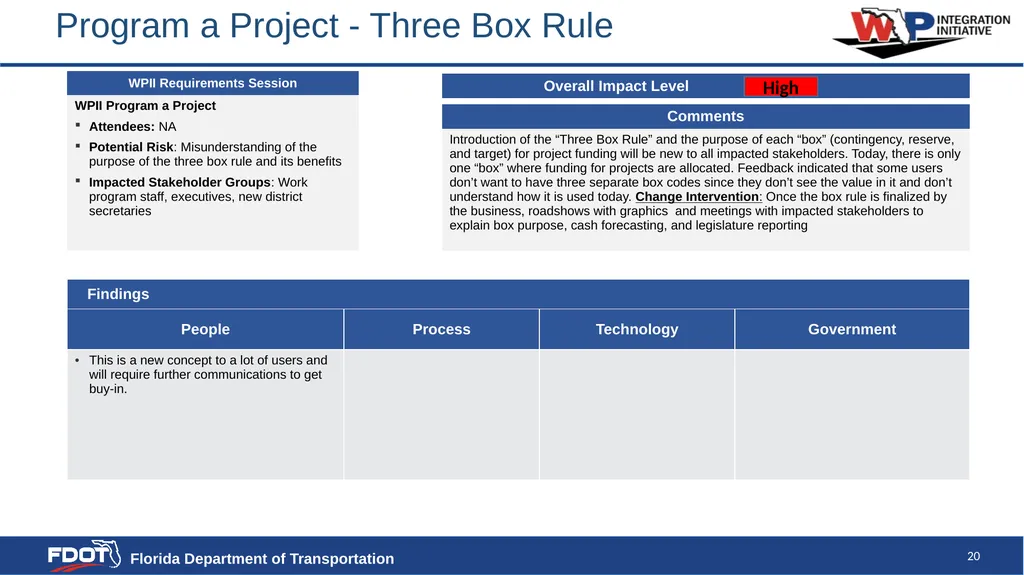
This will help bridge the gap between current and future state understanding. Change management activities will focus on introducing the “Three Box Rule” as a concept, as well as explaining the system capabilities supporting it.
As this is a net new capability, stakeholder education will focus on the business value derived from this process and how it integrates into existing budget activities. Change Impact Summary: Specific Topics<br>
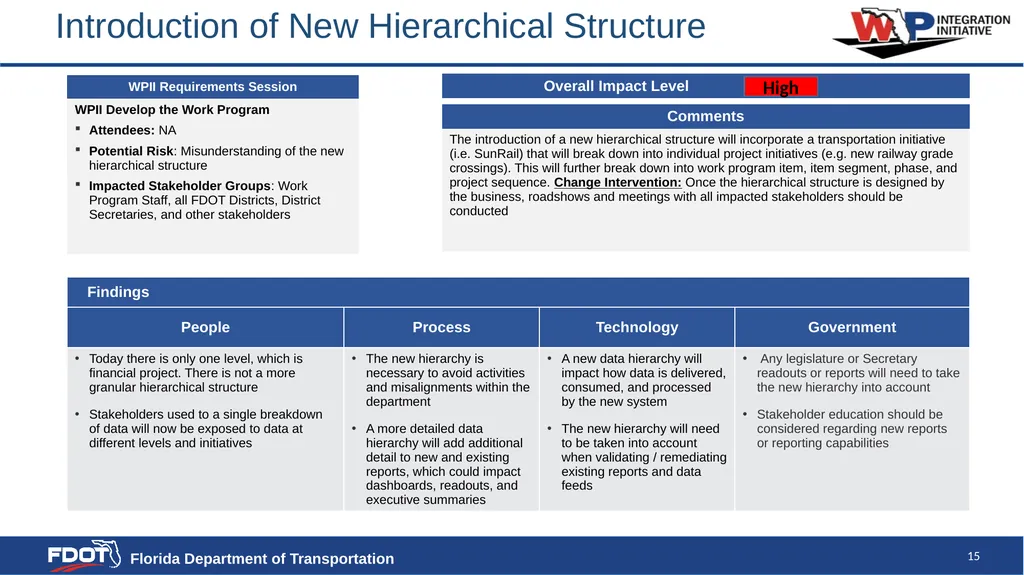
slide15. Introduction of New Hierarchical Structure High<br>
slide16. Managing the Operating Budget High<br>
slide17. Adoption of User Based Role Permissions High<br>
slide18. Managing GAA Impact: Budget Allocation High<br>
slide19. Program a Project: “User defined” Edits High<br>
slide20. Program a Project - Three Box Rule High<br>
slide21. Appendix<br>
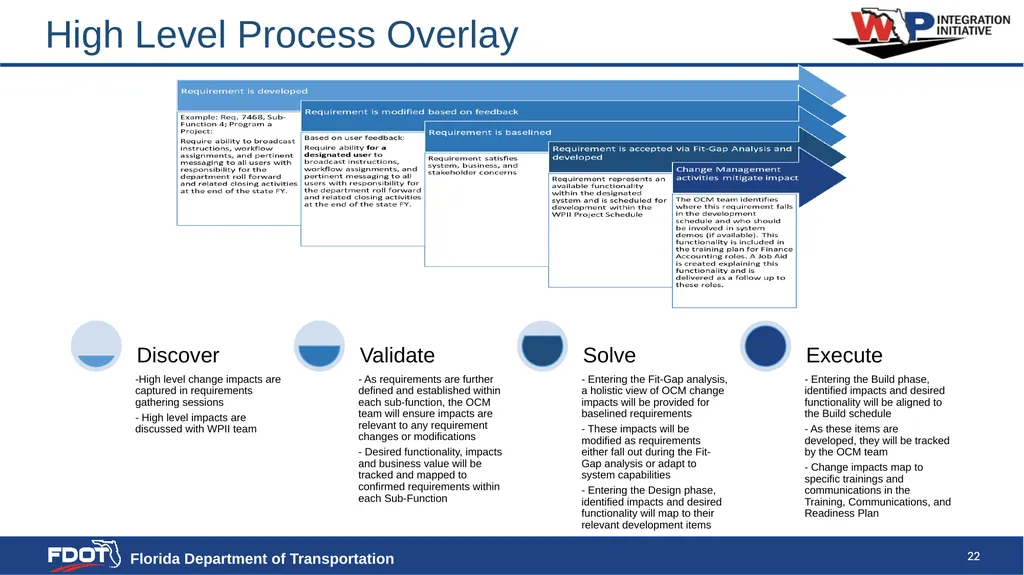
slide22. High Level Process Overlay<br>
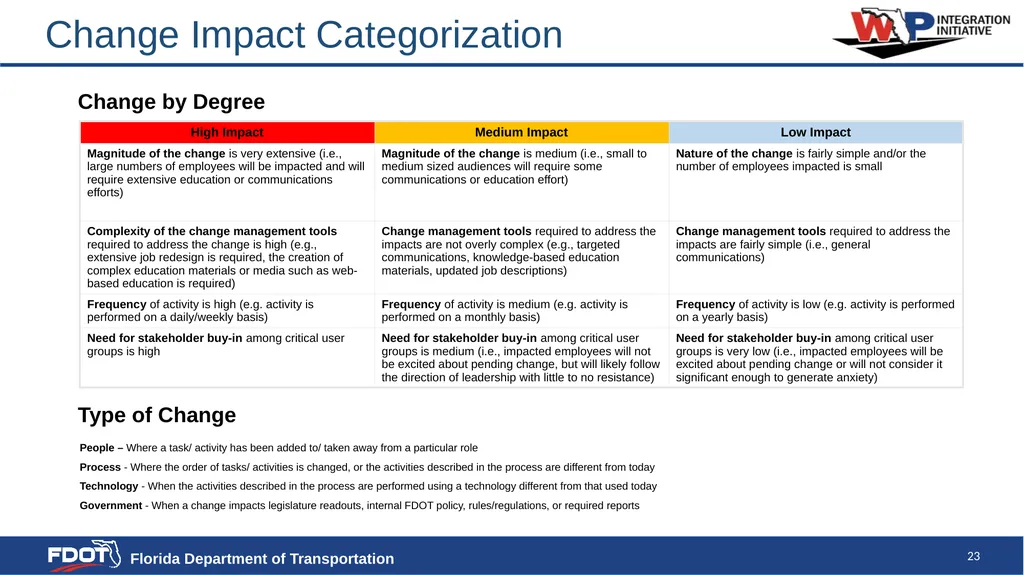
slide23. Change by Degree People – Where a task/ activity has been added to/ taken away from a particular role
Process - Where the order of tasks/ activities is changed, or the activities described in the process are different from today
Technology - When the activities described in the process are performed using a technology different from that used today
Government - When a change impacts legislature readouts, internal FDOT policy, rules/regulations, or required reports Type of Change Change Impact Categorization<br>
slide2. Sub-Function & Specific Topic Change Impacts Sub-Function Impact Assessment
Captures impacts by relevant requirements, broken out by sub function
Collected during requirements sessions
Includes high level views of Business Benefits, Current State, Future State, Risks if Not Mitigated, and Potential OCM Interventions
Impacts to be validated against SME’s and Systems Integrator prior to development of Training, Communications, or Readiness Plan
Identified requirements represent a sample of captured items to illustrate identified impacts High Level Impact Assessment (Specific Topics)
Captures impacts raised by or discussed with project team that may comprise multiple requirements across various sub-functions
May also include impacts from a specific sub-function identified to be highly disruptive or impactful to FDOT
Collected during requirements sessions and/or dedicated conversations with project SME’s
Addresses initial impressions of impacts to People, Process, Technology, and Government
Impacts to be validated against SME’s and Systems Integrator prior to development of Training, Communications, or Readiness Plan Example Example Below are the two methods in which high level change impacts are being captured for the current requirements phase:<br>
slide3. Based on requirements sessions attended between 8/12/19 –9/6/19, the following is a summary of the types of change impacts discussed to date. Anticipated approaches for mitigating those impacts are included as well, which will be further assessed as requirements gathering proceeds Sub-Function Change Impacts Summary Sub-Function Anticipated Impact and Approaches for Mitigation Communication: Job Aids to inform District Work Program Staff, District Leadership, and Central Office Work Program Staff about new system features Stakeholder Engagement: Involvement of key FDOT resources to participate in designing the system to incorporate the Budget toolbox into the new WPII solution Training: Training content should be developed during the Build phase for budget coordinators, requestors program area (L2 Group), district level, and divisions budget issues approvers Communications: Draft messages to Work Program staff/program management staff about the historical data process after the SI is finished designing the system<br>
slide4. Manage GAA Impact Manage Project Resources Procure Contract Resources Manage Contract Sub-Function Anticipated Impact and Approaches for Mitigation Stakeholder Engagement: Roadshow that includes a prototype while designing the system for budget coordinators and cost center managers Communications: Draft messages prior to the system Build phase to inform project managers, Work Program analysts, and other stakeholders about the system notifications and the governance structure Stakeholder Engagement: Prior to designing the system, workshops may be held with SME’s (contract manager, contract arbiters, project managers, etc.) to determine how new data hierarchy and rollups drive current activities Communications: Job Aids could be created after system Build detailing new workflows Stakeholder Engagement: Focused group discussions may be held with contract management and finance accounting SME’s to determine practices regarding automated/batch uploads to the State Financial Management System Close Contract Sub-Function Change Impacts Summary (Cont.)<br>
slide5. High-level Sub-Function Change Impacts<br>
slide6. High-level Sub-Function Change Impacts<br>
slide7. High-level Sub-Function Change Impacts<br>
slide8. High-level Sub-Function Change Impacts<br>
slide9. High-level Sub-Function Change Impacts<br>
slide10. High-level Sub-Function Change Impacts<br>
slide11. High-level Sub-Function Change Impacts<br>
slide12. High-level Sub-Function Change Impacts<br>
slide13. High-level Sub-Function Change Impacts<br>
slide14. Current Observations
Based on early requirement gathering sessions, the WPII implementation will have large scale change impacts from both additional system functionality and changes to mindset and culture that must be addressed. High Level Assessment
Change management activities should be considered prior to designing the system to ensure that stakeholders are engaged in a productive way that does not contribute to unease or concern with the WPII solution The introduction of the “Three Box Rule” for project funding will be a net new concept supported by new functionality for all FDOT users. This will require change management support - not just regarding training and communications, but also demonstrating the value and clarifying the benefits for all impacted by this change Adoption of user based role permissions will be a system driven requirement that will have an impact on culture / mindset. In an integrated solution, user activities are limited by level of access and permissions. This will be a large change from current state, where the presence of largely manual processes and fragmented systems mean users have a high degree of autonomy interacting with FDOT data, processes, and functions. Managing budget allocation today is highly manual, subject to error, and lacking in standardization. This includes some Districts having the ability to manually load financial data into accounting systems. Adjustments to this processes will have far reaching impacts between all Districts. User defined editing of data around financial projects is a sensitive area, given the amount of capabilities and data access current users have within the system. While the current state enables a high degree of flexibility, it also introduces risk regarding data integrity. Introduction of a new data hierarchical structure will have significant impacts across data reporting and analysis, as it will open up new reporting, forecasting, and simulation capabilities Changes to how the operating budget is managed must be discussed with care and consideration prior to system implementation. It is possible that varied locations (Districts, Turnpike) might perceive a loss of autonomy, which could lead to dissatisfaction with WPII Current state reports will have to be mapped to the new hierarchy and any new reports or readouts will have to take it into account. Significant stakeholder education will need to take place within FDOT to both understand the new hierarchy and take advantage of it’s capabilities.
This stakeholder education may expand to stakeholders outside FDOT using FDOT data. Conversations and working sessions regarding managing the operating budget should be had in advance of designing the system to emphasize the additional capabilities that will be introduced.
District stakeholders should be involved and have a level of comfort interacting with both the project team and technology development teams to ensure their concerns are part of the solution Business value of user based role permissions and data integrity should be key topics of messaging on this subject.
Desired user bands and capabilities should be discussed via workshop or ThinkTank-style sessions prior to designing the system to determine ideal-state capabilities broken out by user function to validate against system capabilities in a Fit-Gap analysis. Additional capabilities from the WPII solution should be demonstrated to stakeholders via activities such as end to end walkthroughs or working sessions.
Messaging can emphasize topics such as time savings from leveraging an integrated system and driving down rework thanks to better supported data integrity and governance. Stakeholder education around the budgeting function will be a key activity to emphasize data integrity and collaboration between the budgeting functions between Districts and Central Office.
This will help bridge the gap between current and future state understanding. Change management activities will focus on introducing the “Three Box Rule” as a concept, as well as explaining the system capabilities supporting it.
As this is a net new capability, stakeholder education will focus on the business value derived from this process and how it integrates into existing budget activities. Change Impact Summary: Specific Topics<br>
slide15. Introduction of New Hierarchical Structure High<br>
slide16. Managing the Operating Budget High<br>
slide17. Adoption of User Based Role Permissions High<br>
slide18. Managing GAA Impact: Budget Allocation High<br>
slide19. Program a Project: “User defined” Edits High<br>
slide20. Program a Project - Three Box Rule High<br>
slide21. Appendix<br>
slide22. High Level Process Overlay<br>
slide23. Change by Degree People – Where a task/ activity has been added to/ taken away from a particular role
Process - Where the order of tasks/ activities is changed, or the activities described in the process are different from today
Technology - When the activities described in the process are performed using a technology different from that used today
Government - When a change impacts legislature readouts, internal FDOT policy, rules/regulations, or required reports Type of Change Change Impact Categorization<br>