
High-Precision Pendulum Seismometers for


Description: High-Precision Pendulum Seismometers for Seismic-Field Characterization and Newtonian Noise Subtraction Nelson Leon 8202026 ET-ISB-Meeting 1 Report Reference and Acknowledgements Core Study Team Nelson Leon Leonardo Gonzalez Britney
Related Topics
Download Presentation
"High-Precision Pendulum Seismometers for" is the property of its rightful owner. Permission is granted to download and print the materials on this website for personal, non-commercial use only, and to display it on your personal computer provided you do not modify the materials and that you retain all copyright notices contained in the materials. By downloading content from our website, you accept the terms of this agreement.
Presentation Transcript
slide1. High-Precision Pendulum Seismometers for Seismic-Field Characterization and Newtonian Noise Subtraction Nelson Leon 8/20/2026 ET-ISB-Meeting 1<br>
slide2. Report Reference and Acknowledgements Core Study Team
Nelson Leon
Leonardo Gonzalez
Britney Gallego
Harry Themann
Marina Mondin
Riccardo DeSalvo
Fabian Peña Arellano Acknowledgements
Marcel Beck
Oliver Gerberding
Shreevathsa Chalathadka Subrahmanya
DFMI / compact-interferometer sensitivity estimates and technical feedback 8/20/2026 ET-ISB-Meeting 2 High-Precision Pendulum Seismometers for Seismic-Field Characterization and Newtonian Noise Subtraction ET-0534A-26: https://apps.et-gw.eu/tds/ql/?c=18893<br>
slide3. Newtonian Noise Limits on Low-Frequency Sensitivity Newtonian noise is one of the dominant low-frequency noise sources for the Einstein Telescope.
Newtonian noise arises from time-varying mass-density perturbations in the environment, including seismic motion of the surrounding rock.
Unlike mechanical vibration, it cannot be isolated or shielded.
It must be measured and subtracted using environmental witness sensors.
Improved witness-sensor sensitivity and spatial information can increase the potential for Newtonian-noise subtraction. 8/20/2026 3 ET-ISB-Meeting Source: F. Amann et al., Rev. Sci. Instrum. 91, 094504 (2020),<br>
slide4. Current Newtonian-Noise Monitoring Approach Conventional NN-subtraction approach
Distributed arrays of commercial seismometers measure the surrounding seismic field.
Numerical models reconstruct the associated density perturbations.
Adaptive filters estimate and subtract the Newtonian-noise contribution from the detector signal.
Current limitations
Sensor self-noise, implementation quality and ambient noise can limit low-frequency measurements.
Translational motion and tilt are difficult to separate.
Conventional environmental sensors cannot generally sample the seismic field exactly at the test-mass location.
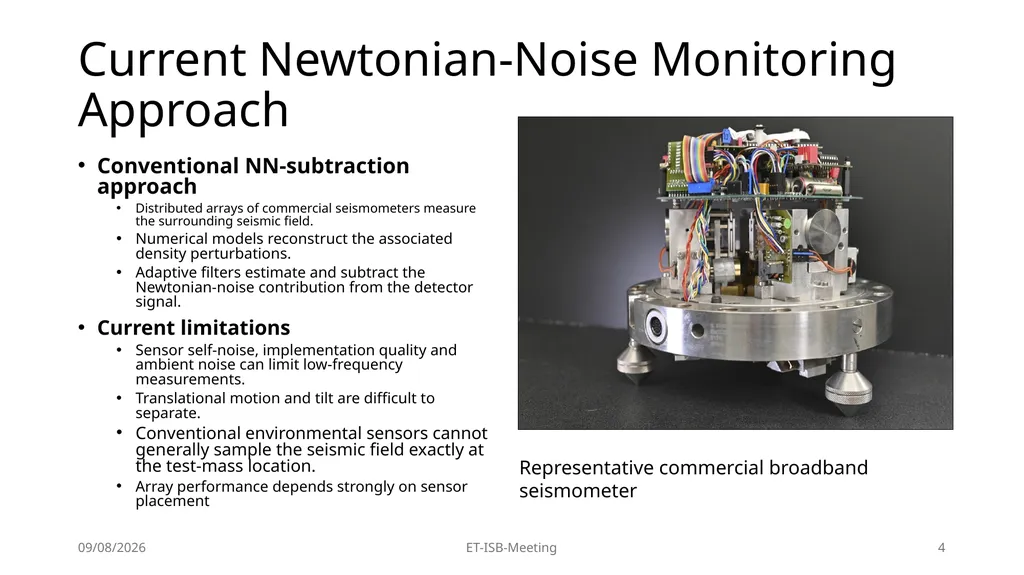
Array performance depends strongly on sensor placement Representative commercial broadband seismometer 8/20/2026 4 ET-ISB-Meeting<br>
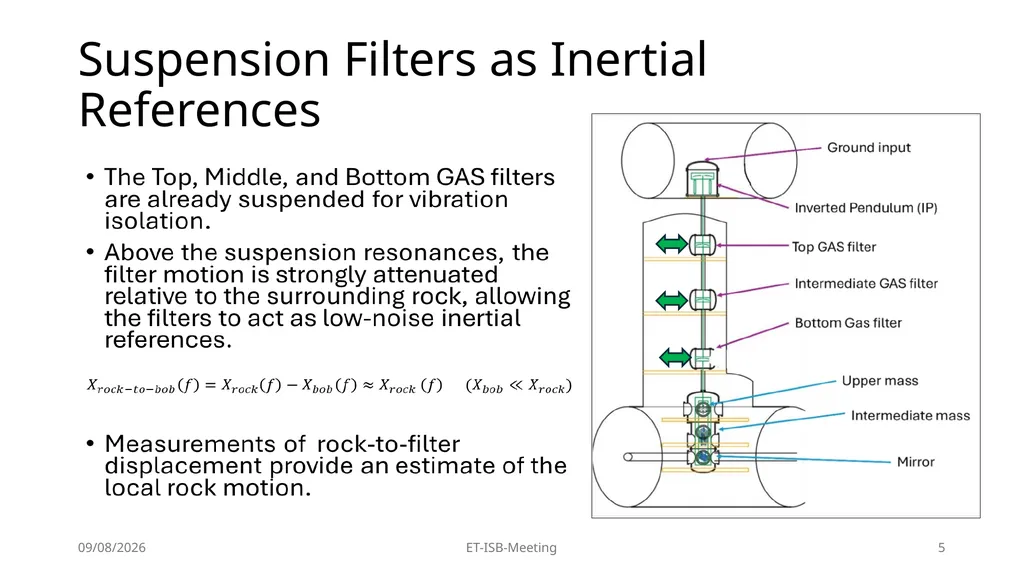
slide5. Suspension Filters as Inertial References 8/20/2026 5 ET-ISB-Meeting<br>
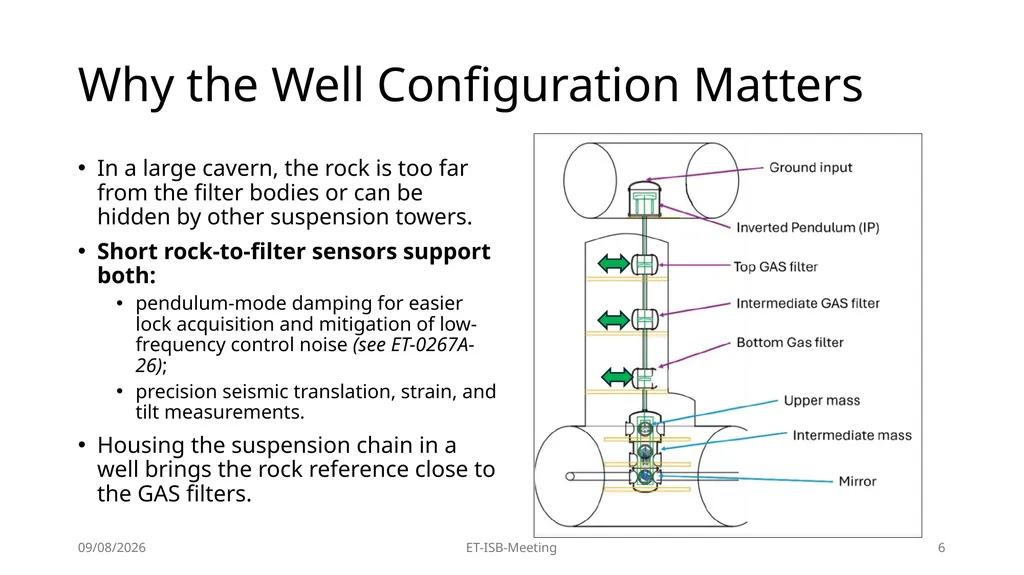
slide6. Why the Well Configuration Matters In a large cavern, the rock is too far from the filter bodies or can be hidden by other suspension towers.
Short rock-to-filter sensors support both:
pendulum-mode damping for easier lock acquisition and mitigation of low-frequency control noise (see ET-0267A-26);
precision seismic translation, strain, and tilt measurements.
Housing the suspension chain in a well brings the rock reference close to the GAS filters. 8/20/2026 6 ET-ISB-Meeting<br>
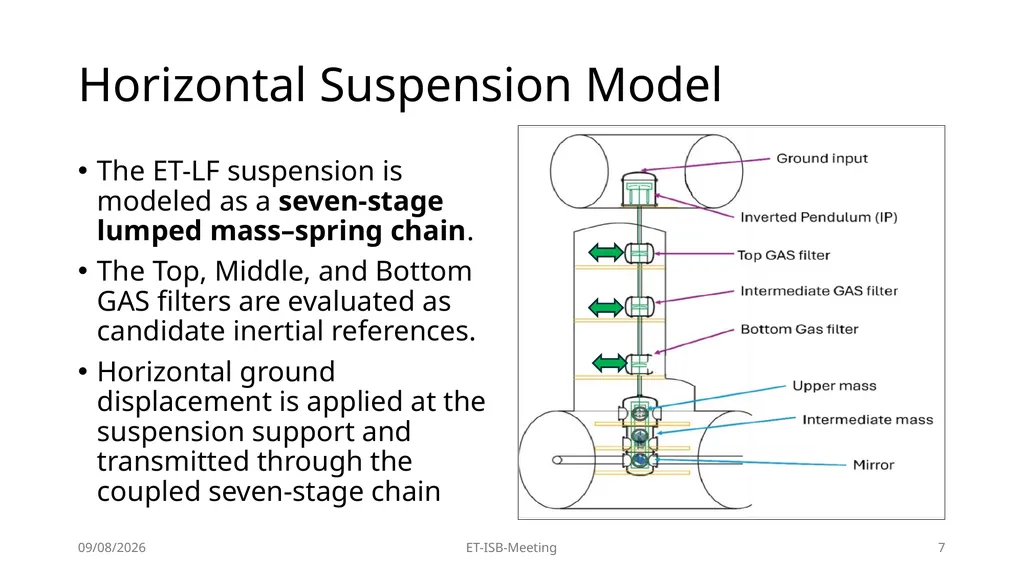
slide7. Horizontal Suspension Model The ET-LF suspension is modeled as a seven-stage lumped mass–spring chain.
The Top, Middle, and Bottom GAS filters are evaluated as candidate inertial references.
Horizontal ground displacement is applied at the suspension support and transmitted through the coupled seven-stage chain 8/20/2026 7 ET-ISB-Meeting<br>
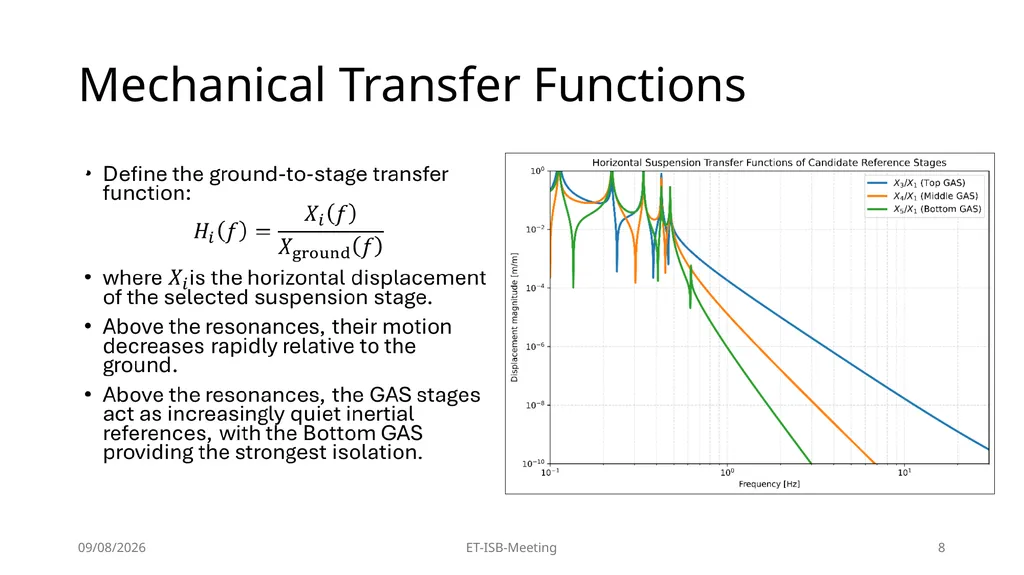
slide8. Mechanical Transfer Functions 8/20/2026 8 ET-ISB-Meeting<br>
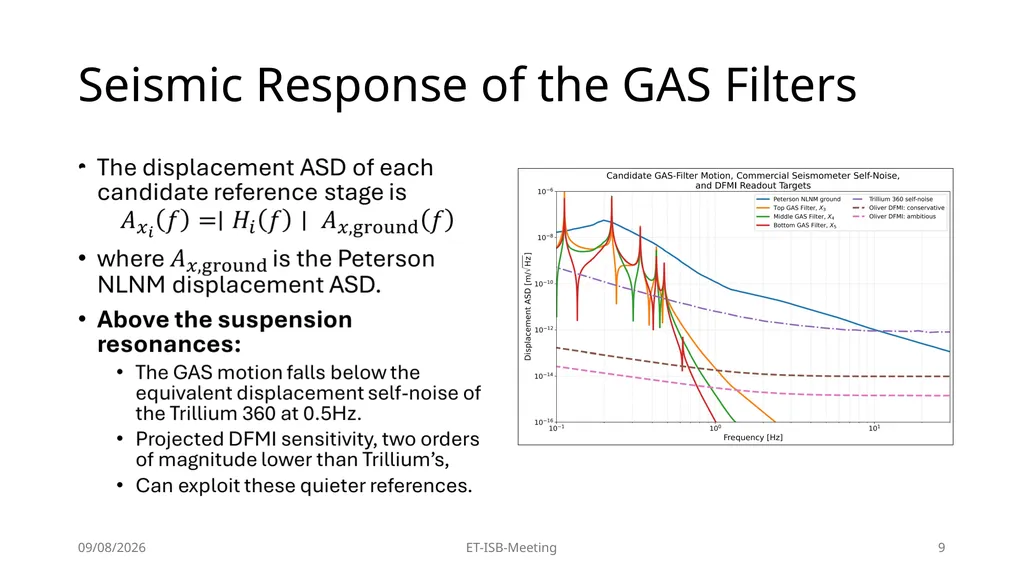
slide9. Seismic Response of the GAS Filters 8/20/2026 9 ET-ISB-Meeting<br>
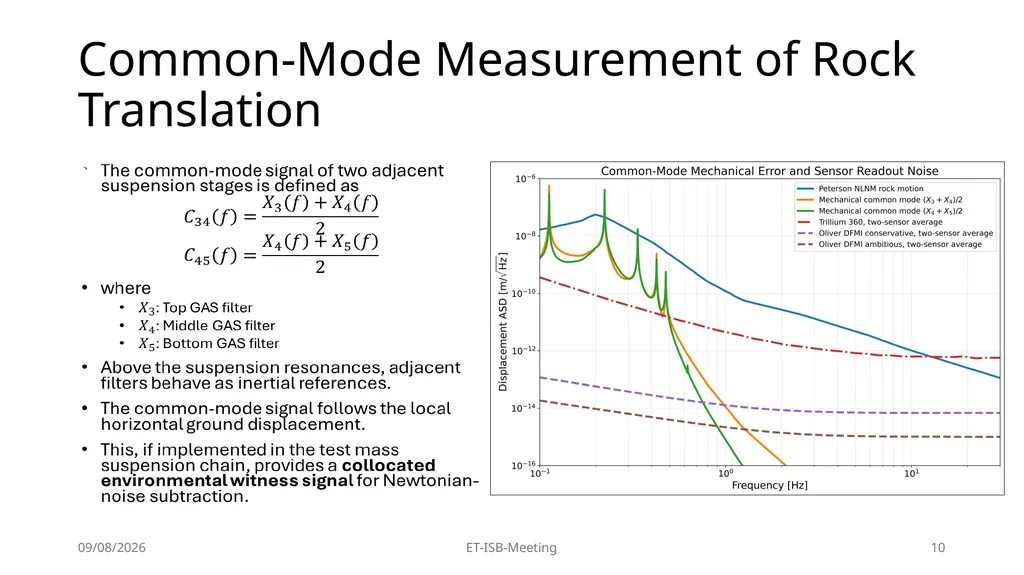
slide10. Common-Mode Measurement of Rock Translation 8/20/2026 10 ET-ISB-Meeting<br>
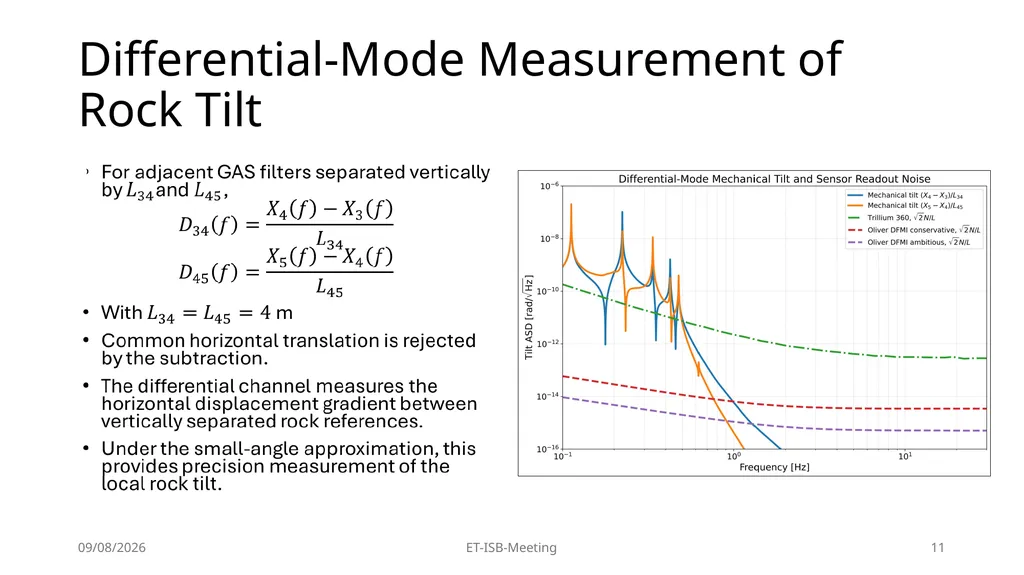
slide11. Differential-Mode Measurement of Rock Tilt 8/20/2026 11 ET-ISB-Meeting<br>
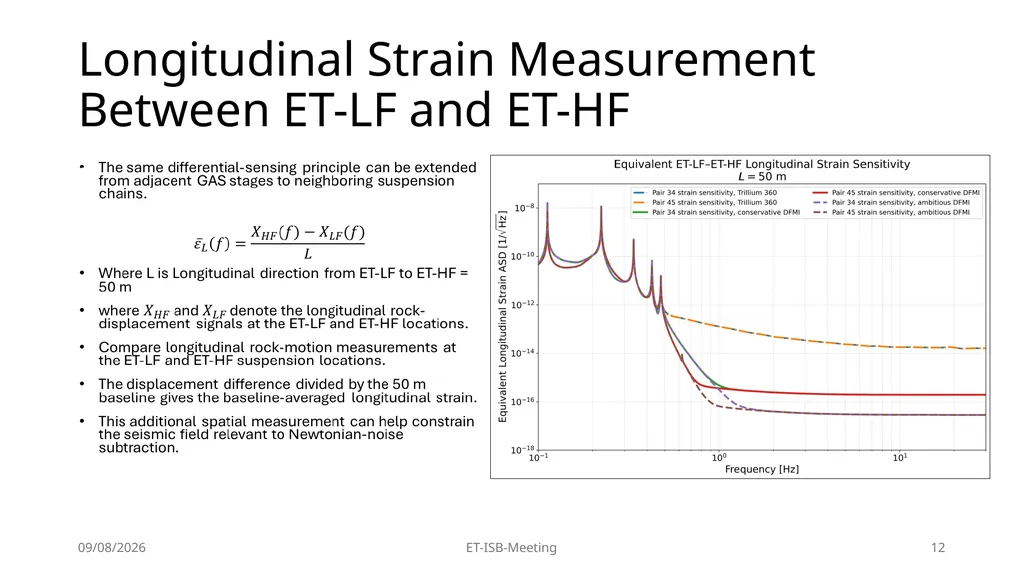
slide12. Longitudinal Strain Measurement Between ET-LF and ET-HF 8/20/2026 12 ET-ISB-Meeting<br>
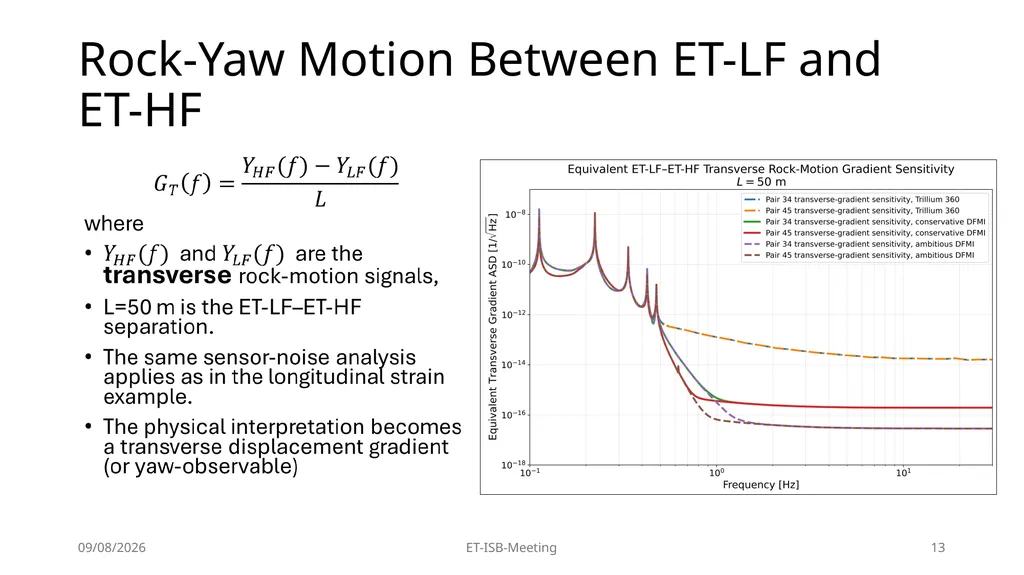
slide13. Rock-Yaw Motion Between ET-LF and ET-HF 8/20/2026 13 ET-ISB-Meeting<br>
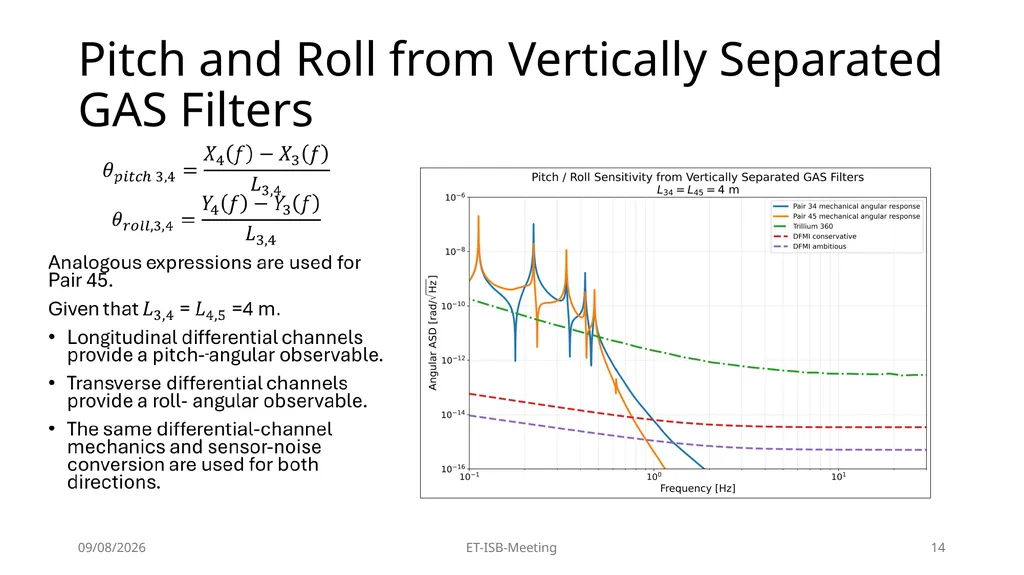
slide14. Pitch and Roll from Vertically Separated GAS Filters 8/20/2026 14 ET-ISB-Meeting<br>
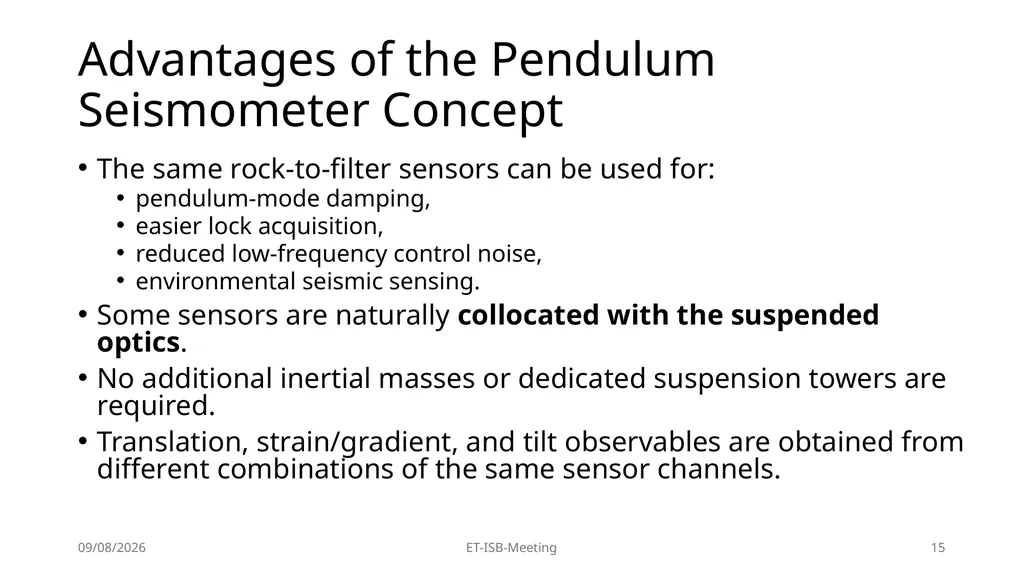
slide15. Advantages of the Pendulum Seismometer Concept The same rock-to-filter sensors can be used for:
pendulum-mode damping,
easier lock acquisition,
reduced low-frequency control noise,
environmental seismic sensing.
Some sensors are naturally collocated with the suspended optics.
No additional inertial masses or dedicated suspension towers are required.
Translation, strain/gradient, and tilt observables are obtained from different combinations of the same sensor channels. 8/20/2026 15 ET-ISB-Meeting<br>
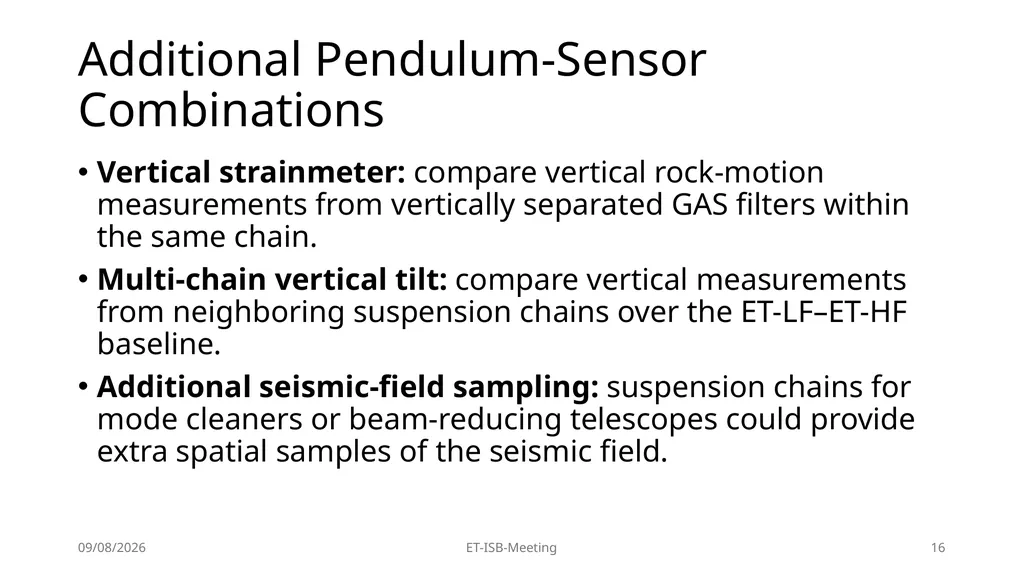
slide16. Additional Pendulum-Sensor Combinations Vertical strainmeter: compare vertical rock-motion measurements from vertically separated GAS filters within the same chain.
Multi-chain vertical tilt: compare vertical measurements from neighboring suspension chains over the ET-LF–ET-HF baseline.
Additional seismic-field sampling: suspension chains for mode cleaners or beam-reducing telescopes could provide extra spatial samples of the seismic field. 8/20/2026 16 ET-ISB-Meeting<br>
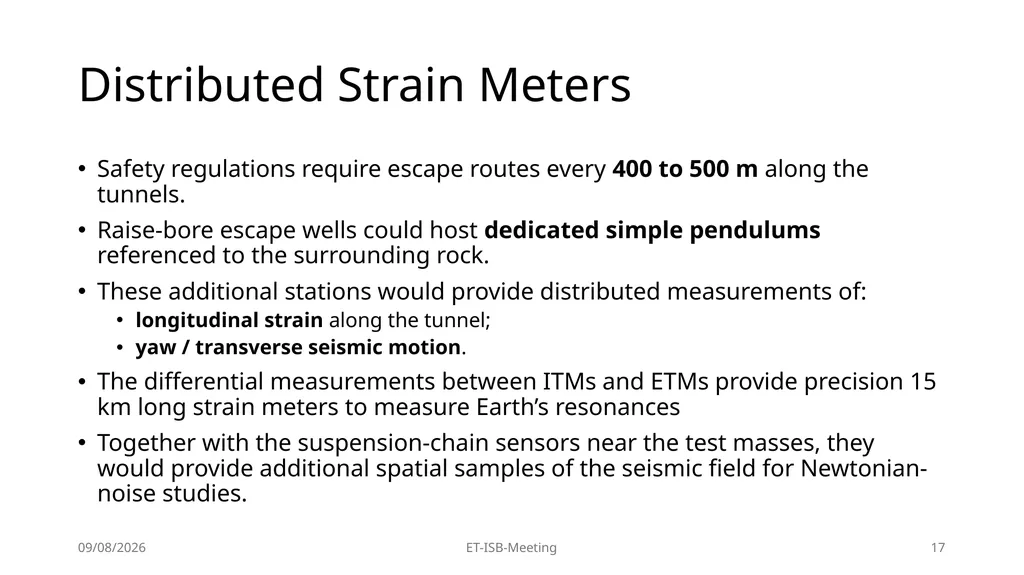
slide17. Distributed Strain Meters Safety regulations require escape routes every 400 to 500 m along the tunnels.
Raise-bore escape wells could host dedicated simple pendulums referenced to the surrounding rock.
These additional stations would provide distributed measurements of:
longitudinal strain along the tunnel;
yaw / transverse seismic motion.
The differential measurements between ITMs and ETMs provide precision 15 km long strain meters to measure Earth’s resonances
Together with the suspension-chain sensors near the test masses, they would provide additional spatial samples of the seismic field for Newtonian-noise studies. 8/20/2026 ET-ISB-Meeting 17<br>
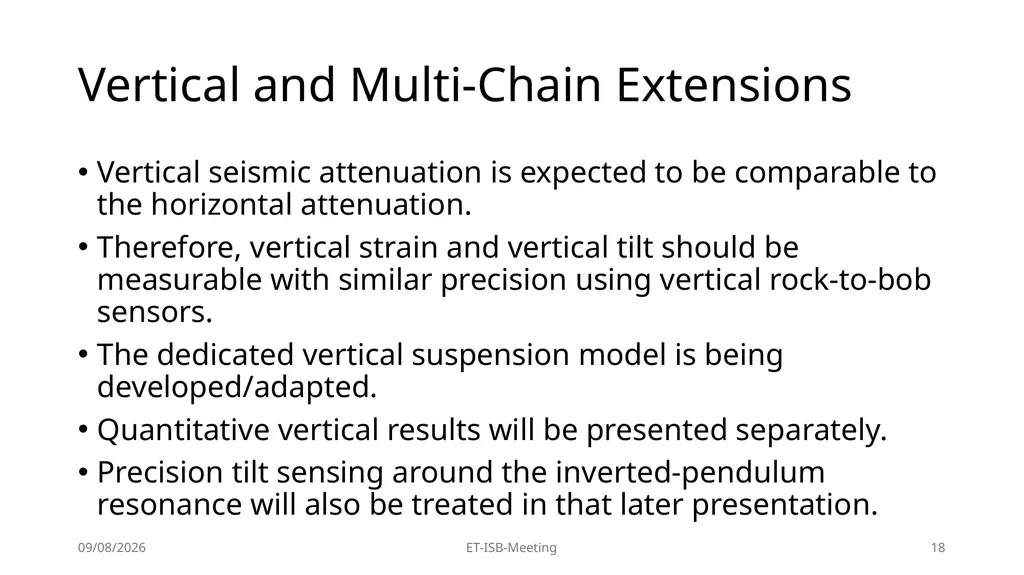
slide18. Vertical and Multi-Chain Extensions Vertical seismic attenuation is expected to be comparable to the horizontal attenuation.
Therefore, vertical strain and vertical tilt should be measurable with similar precision using vertical rock-to-bob sensors.
The dedicated vertical suspension model is being developed/adapted.
Quantitative vertical results will be presented separately.
Precision tilt sensing around the inverted-pendulum resonance will also be treated in that later presentation. 8/20/2026 18 ET-ISB-Meeting<br>
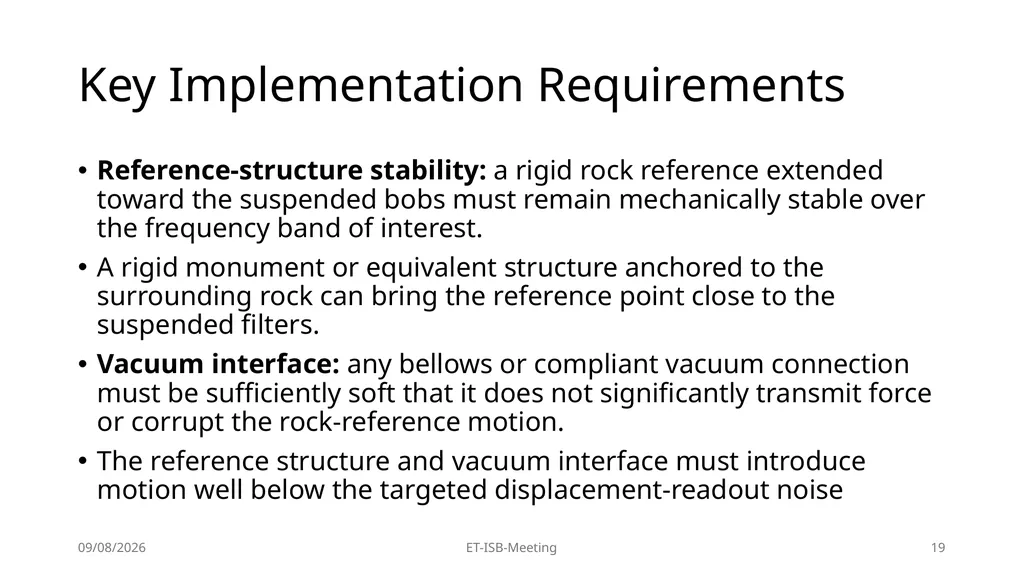
slide19. Key Implementation Requirements Reference-structure stability: a rigid rock reference extended toward the suspended bobs must remain mechanically stable over the frequency band of interest.
A rigid monument or equivalent structure anchored to the surrounding rock can bring the reference point close to the suspended filters.
Vacuum interface: any bellows or compliant vacuum connection must be sufficiently soft that it does not significantly transmit force or corrupt the rock-reference motion.
The reference structure and vacuum interface must introduce motion well below the targeted displacement-readout noise 8/20/2026 19 ET-ISB-Meeting<br>
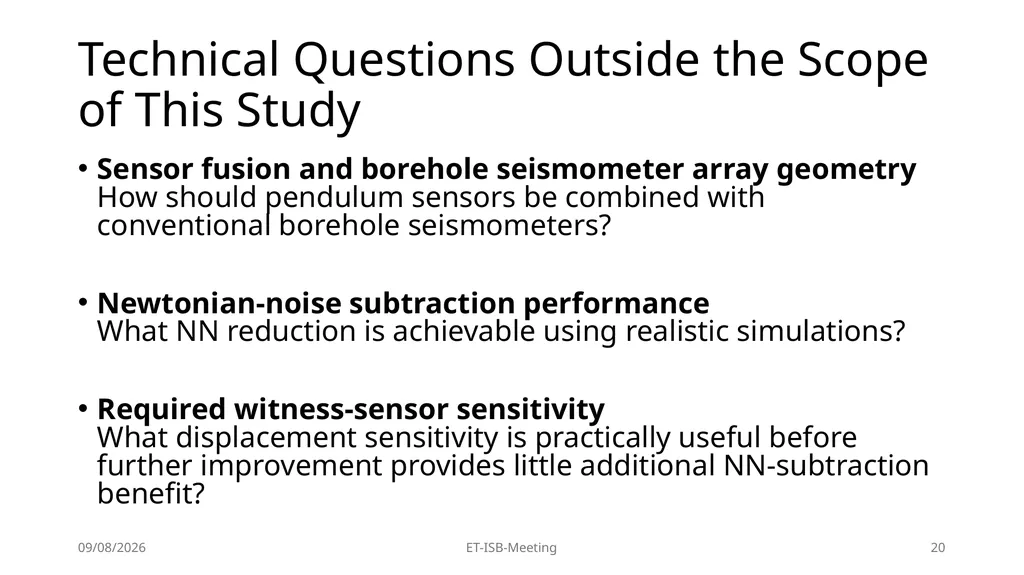
slide20. Technical Questions Outside the Scope of This Study Sensor fusion and borehole seismometer array geometry How should pendulum sensors be combined with conventional borehole seismometers?
Newtonian-noise subtraction performance What NN reduction is achievable using realistic simulations?
Required witness-sensor sensitivity What displacement sensitivity is practically useful before further improvement provides little additional NN-subtraction benefit? 8/20/2026 20 ET-ISB-Meeting<br>
slide21. Thank you for your time Any question? 8/20/2026 21 ET-ISB-Meeting<br>
slide2. Report Reference and Acknowledgements Core Study Team
Nelson Leon
Leonardo Gonzalez
Britney Gallego
Harry Themann
Marina Mondin
Riccardo DeSalvo
Fabian Peña Arellano Acknowledgements
Marcel Beck
Oliver Gerberding
Shreevathsa Chalathadka Subrahmanya
DFMI / compact-interferometer sensitivity estimates and technical feedback 8/20/2026 ET-ISB-Meeting 2 High-Precision Pendulum Seismometers for Seismic-Field Characterization and Newtonian Noise Subtraction ET-0534A-26: https://apps.et-gw.eu/tds/ql/?c=18893<br>
slide3. Newtonian Noise Limits on Low-Frequency Sensitivity Newtonian noise is one of the dominant low-frequency noise sources for the Einstein Telescope.
Newtonian noise arises from time-varying mass-density perturbations in the environment, including seismic motion of the surrounding rock.
Unlike mechanical vibration, it cannot be isolated or shielded.
It must be measured and subtracted using environmental witness sensors.
Improved witness-sensor sensitivity and spatial information can increase the potential for Newtonian-noise subtraction. 8/20/2026 3 ET-ISB-Meeting Source: F. Amann et al., Rev. Sci. Instrum. 91, 094504 (2020),<br>
slide4. Current Newtonian-Noise Monitoring Approach Conventional NN-subtraction approach
Distributed arrays of commercial seismometers measure the surrounding seismic field.
Numerical models reconstruct the associated density perturbations.
Adaptive filters estimate and subtract the Newtonian-noise contribution from the detector signal.
Current limitations
Sensor self-noise, implementation quality and ambient noise can limit low-frequency measurements.
Translational motion and tilt are difficult to separate.
Conventional environmental sensors cannot generally sample the seismic field exactly at the test-mass location.
Array performance depends strongly on sensor placement Representative commercial broadband seismometer 8/20/2026 4 ET-ISB-Meeting<br>
slide5. Suspension Filters as Inertial References 8/20/2026 5 ET-ISB-Meeting<br>
slide6. Why the Well Configuration Matters In a large cavern, the rock is too far from the filter bodies or can be hidden by other suspension towers.
Short rock-to-filter sensors support both:
pendulum-mode damping for easier lock acquisition and mitigation of low-frequency control noise (see ET-0267A-26);
precision seismic translation, strain, and tilt measurements.
Housing the suspension chain in a well brings the rock reference close to the GAS filters. 8/20/2026 6 ET-ISB-Meeting<br>
slide7. Horizontal Suspension Model The ET-LF suspension is modeled as a seven-stage lumped mass–spring chain.
The Top, Middle, and Bottom GAS filters are evaluated as candidate inertial references.
Horizontal ground displacement is applied at the suspension support and transmitted through the coupled seven-stage chain 8/20/2026 7 ET-ISB-Meeting<br>
slide8. Mechanical Transfer Functions 8/20/2026 8 ET-ISB-Meeting<br>
slide9. Seismic Response of the GAS Filters 8/20/2026 9 ET-ISB-Meeting<br>
slide10. Common-Mode Measurement of Rock Translation 8/20/2026 10 ET-ISB-Meeting<br>
slide11. Differential-Mode Measurement of Rock Tilt 8/20/2026 11 ET-ISB-Meeting<br>
slide12. Longitudinal Strain Measurement Between ET-LF and ET-HF 8/20/2026 12 ET-ISB-Meeting<br>
slide13. Rock-Yaw Motion Between ET-LF and ET-HF 8/20/2026 13 ET-ISB-Meeting<br>
slide14. Pitch and Roll from Vertically Separated GAS Filters 8/20/2026 14 ET-ISB-Meeting<br>
slide15. Advantages of the Pendulum Seismometer Concept The same rock-to-filter sensors can be used for:
pendulum-mode damping,
easier lock acquisition,
reduced low-frequency control noise,
environmental seismic sensing.
Some sensors are naturally collocated with the suspended optics.
No additional inertial masses or dedicated suspension towers are required.
Translation, strain/gradient, and tilt observables are obtained from different combinations of the same sensor channels. 8/20/2026 15 ET-ISB-Meeting<br>
slide16. Additional Pendulum-Sensor Combinations Vertical strainmeter: compare vertical rock-motion measurements from vertically separated GAS filters within the same chain.
Multi-chain vertical tilt: compare vertical measurements from neighboring suspension chains over the ET-LF–ET-HF baseline.
Additional seismic-field sampling: suspension chains for mode cleaners or beam-reducing telescopes could provide extra spatial samples of the seismic field. 8/20/2026 16 ET-ISB-Meeting<br>
slide17. Distributed Strain Meters Safety regulations require escape routes every 400 to 500 m along the tunnels.
Raise-bore escape wells could host dedicated simple pendulums referenced to the surrounding rock.
These additional stations would provide distributed measurements of:
longitudinal strain along the tunnel;
yaw / transverse seismic motion.
The differential measurements between ITMs and ETMs provide precision 15 km long strain meters to measure Earth’s resonances
Together with the suspension-chain sensors near the test masses, they would provide additional spatial samples of the seismic field for Newtonian-noise studies. 8/20/2026 ET-ISB-Meeting 17<br>
slide18. Vertical and Multi-Chain Extensions Vertical seismic attenuation is expected to be comparable to the horizontal attenuation.
Therefore, vertical strain and vertical tilt should be measurable with similar precision using vertical rock-to-bob sensors.
The dedicated vertical suspension model is being developed/adapted.
Quantitative vertical results will be presented separately.
Precision tilt sensing around the inverted-pendulum resonance will also be treated in that later presentation. 8/20/2026 18 ET-ISB-Meeting<br>
slide19. Key Implementation Requirements Reference-structure stability: a rigid rock reference extended toward the suspended bobs must remain mechanically stable over the frequency band of interest.
A rigid monument or equivalent structure anchored to the surrounding rock can bring the reference point close to the suspended filters.
Vacuum interface: any bellows or compliant vacuum connection must be sufficiently soft that it does not significantly transmit force or corrupt the rock-reference motion.
The reference structure and vacuum interface must introduce motion well below the targeted displacement-readout noise 8/20/2026 19 ET-ISB-Meeting<br>
slide20. Technical Questions Outside the Scope of This Study Sensor fusion and borehole seismometer array geometry How should pendulum sensors be combined with conventional borehole seismometers?
Newtonian-noise subtraction performance What NN reduction is achievable using realistic simulations?
Required witness-sensor sensitivity What displacement sensitivity is practically useful before further improvement provides little additional NN-subtraction benefit? 8/20/2026 20 ET-ISB-Meeting<br>
slide21. Thank you for your time Any question? 8/20/2026 21 ET-ISB-Meeting<br>