Higher Education as Self-formation Simon Marginson Professorial Lecture 29 November 2017 ESRCHEFCE Centre for Global Higher Education UCL Institute of Education, University College London Agency freedom Amartya Sens three aspects of
"Higher Education as Self-formation Simon Marginson" is the property of its rightful owner. Permission is granted to
download and print the materials on this website for personal, non-commercial use only, and to display it
on your personal computer provided you do not modify the materials and that you retain all copyright
notices contained in the materials. By downloading content from our website, you accept the terms of this
agreement.
Presentation Transcript
01
Higher Education as Self-formation Simon Marginson Professorial Lecture 29 November 2017 ESRC/HEFCE Centre for Global Higher Education UCL Institute of Education, University College London<br>
02
Agency freedom<br>
03
Amartya Sen’s three aspects of freedom Control freedom (negative freedom): freedom of the individual from external threat, coercion or constraint
Effective freedom (positive freedom): Freedom as the capacity of the individual to act
Agency freedom (will-power): freedom as the active human will, the capacity for self-directed conscious action
Sen, A. (1985). Well-being, agency and freedom: The Dewey Lectures 1984. The Journal of Philosophy 82 (4), 169-221.
Sen, A. (1992). Inequality Re-examined. Cambridge: Harvard University Press.<br>
04
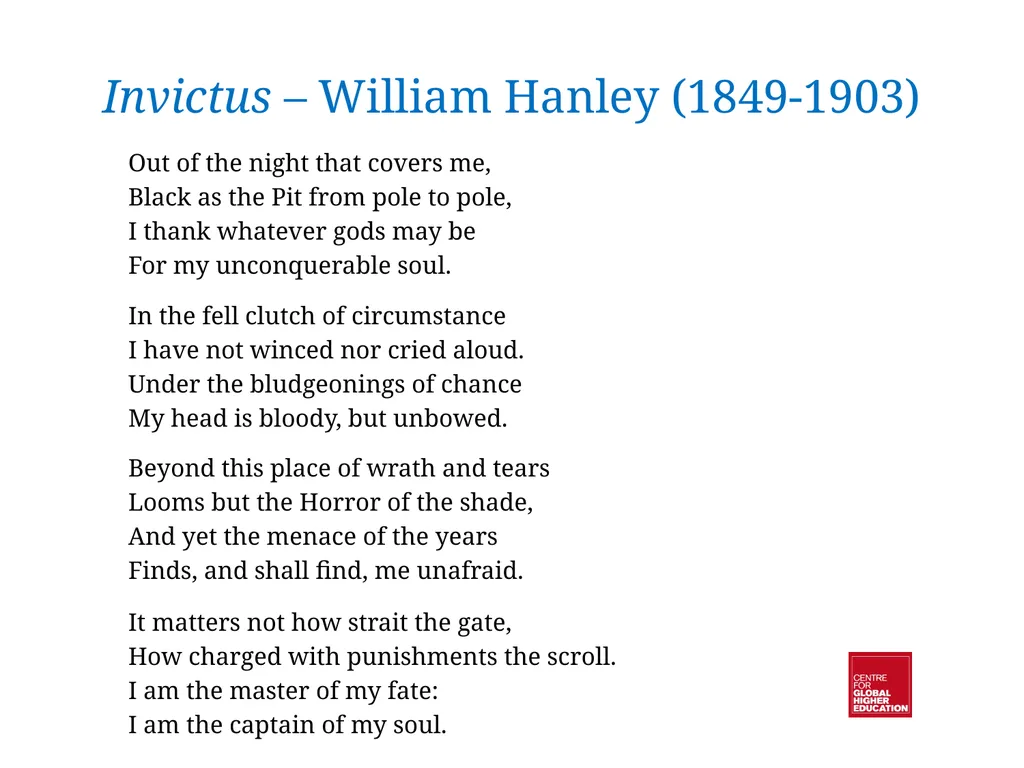
Invictus – William Hanley (1849-1903) Out of the night that covers me,
Black as the Pit from pole to pole,
I thank whatever gods may be
For my unconquerable soul.
In the fell clutch of circumstance
I have not winced nor cried aloud.
Under the bludgeonings of chance
My head is bloody, but unbowed.
Beyond this place of wrath and tears
Looms but the Horror of the shade,
And yet the menace of the years
Finds, and shall find, me unafraid.
It matters not how strait the gate,
How charged with punishments the scroll.
I am the master of my fate:
I am the captain of my soul.<br>
05
Research finds that people who achieve higher education, on average … Have a larger range of employment options
Are more likely to be in good health, as are their families
Have more advanced skill in the use of information and communications technology (electronic agency)
Are more geographically mobile, independent of income level (personal confidence and agency freedom)
Report higher levels of inter-personal trust (also = greater personal agency)
Are more likely to state that they have a say in government (also = greater personal agency)
Are more positive about migration and cultural diversity Walter McMahon, Higher Learning, Greater Good (2009); OECD, Education at a Glance (2015); OECD, Perspectives on Global Development 2017: International migration in a shifting world (2016) etc<br>
06
Michel Foucault “Freedom is the capacity and the opportunity to participate in one’s own self-formation.”
- Stephen Ball, Foucault as Educator. Cham: Springer, p. 69<br>
07
Last words “But what I would like to stress in conclusion is this: there is no establishment of the truth without an essential position of otherness; the truth is never the same; there can be truth only in the form of the other world and the other life.” (l’autre monde et de la vie autre).
- Foucault, M. (2011). The Courage of Truth: Lectures at the College de France 1983-84. Translated by Graham Burchell. Houndmills: Palgrave, p. 340<br>
08
Self-cultivation<br>
09
“ The great strength of modern East Asia is its self-definition as a learning civilization.” This may be “the most precious legacy of Confucian humanism.” - Weiming Tu (2013). Confucian humanism in perspective. Frontiers of Literary Studies in China, 7 (3), pp. 333-338 Confucian self-cultivation<br>
10
Bildung The aim of education is “the active autonomous person within the framework of social life”, a rational subject who uses reason in a public way and “lives in the public sphere among other individual beings.”
- Kivela, A. (2012). From Immanuel Kant to Johann Gottlieb Fichte – Concept of education and German idealism. In Siljander, P., Kivela, A. and Sutinen, A. (eds.) (2012). Theories of Bildung and Growth: Connections and controversies between Continental educational thinking and American pragmatism. Rotterdam: Sense Publishers, p. 59<br>
11
Knowledge<br>
12
Social formation<br>
13
“ The true development of thinking is not from the individual to the social, it is from the social to the individual.” - Lev Vygotsky (1986). Thought and Language. Cambridge, MA: MIT Press, p. 36<br>
14
“ The Confucian emphasis on sympathy and empathy suggests a radically different approach. Self-interest, no matter how enlightened, is never adequate as a basic principle for personal growth, let alone a cornerstone of national policy” - Weiming Tu (1996). Beyond the Enlightenment mentality: A Confucian perspective on ethics, migration and global stewardship. The International Migration Review, 30 (1), p. 68.<br>
15
Other explanations<br>
16
Human capital theory
Employability
Positional goods
Social capital
Cultural capital
Immersion in knowledge
Cultural and political activism
Finding a mate
Growing up
etc etc<br>
17
Conclusions<br>
18
“ What is needed is an integration of the East Asian and Western traditions and influences” - Rui Yang (2016). In I. Jung, M. Nishimura and T. Sasao (eds.), The East-West Axis? Liberal Arts Education in East Asian Universities. Springer, pp. 27-37<br>
19
Higher education as student self-formation People use higher education to change themselves and their conditions of life. They want to become something new, though they do not always know what this will be. It doesn’t always evolve as expected
There is no necessary conflict between ‘instrumental’ goals (education for job, career and earnings, education for social position, etc), and people enrolling because they love learning, or want to find themselves. Many students want all these things. Students decide the balance between goals, which evolves.
The point is that all of these uses of higher education are aspects of student self-formation. It is a general theory<br>