
Higher Education Institutions and Financial Crime
MY
Published · 22 slides · 0 views

1 / 1



Description
Higher Education Institutions and Financial Crime Presented by Professor Nicholas Ryder Dr Sam Mapston Date: 141025 Introduction Financial Crime Risks Higher Education Institutions (HEIs) and their Students Application of Anti-Money
Related Topics
Share
Embed code
Download this presentation From Below
"Higher Education Institutions and Financial Crime" is the property of its rightful owner. Permission is granted to download and print the materials on this website for personal, non-commercial use only, and to display it on your personal computer provided you do not modify the materials and that you retain all copyright notices contained in the materials. By downloading content from our website, you accept the terms of this agreement.
Presentation Transcript
01
Higher Education Institutions and Financial Crime Presented by Professor Nicholas Ryder
Dr Sam Mapston Date: 14/10/25<br>
Dr Sam Mapston Date: 14/10/25<br>
02
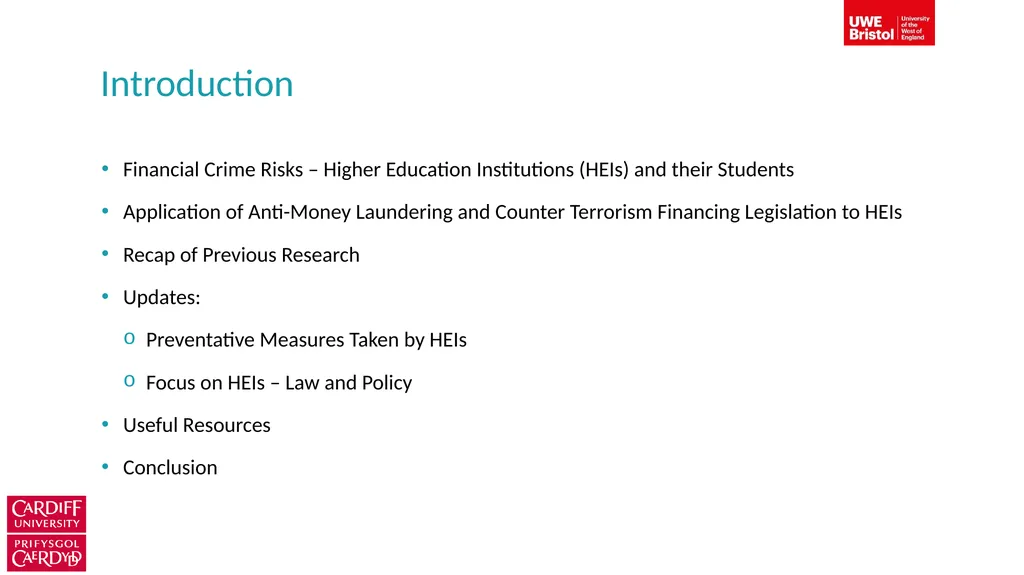
Introduction Financial Crime Risks – Higher Education Institutions (HEIs) and their Students
Application of Anti-Money Laundering and Counter Terrorism Financing Legislation to HEIs
Recap of Previous Research
Updates:
Preventative Measures Taken by HEIs
Focus on HEIs – Law and Policy
Useful Resources
Conclusion<br>
Application of Anti-Money Laundering and Counter Terrorism Financing Legislation to HEIs
Recap of Previous Research
Updates:
Preventative Measures Taken by HEIs
Focus on HEIs – Law and Policy
Useful Resources
Conclusion<br>
03
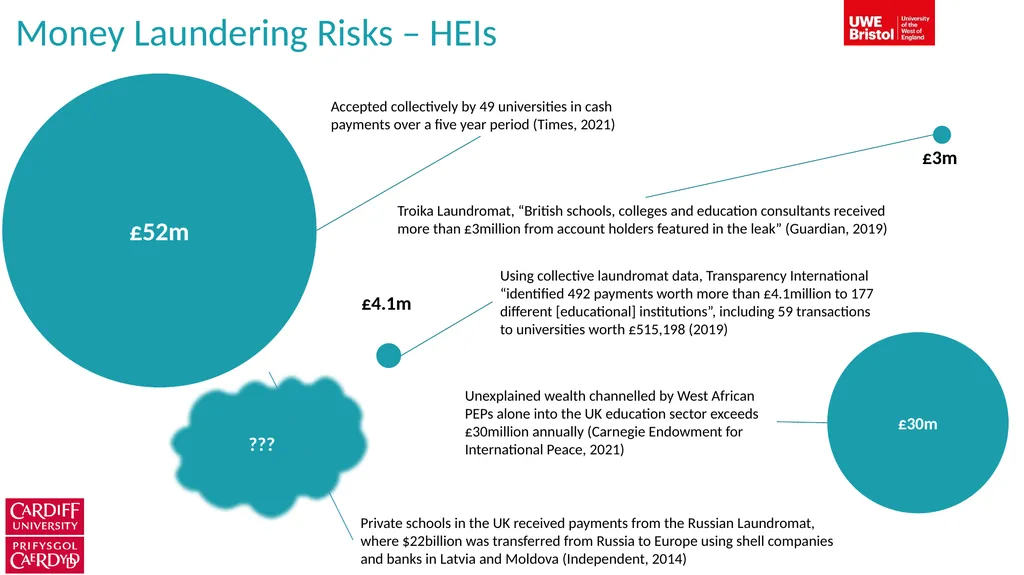
£52m Accepted collectively by 49 universities in cash payments over a five year period (Times, 2021) Troika Laundromat, “British schools, colleges and education consultants received more than £3million from account holders featured in the leak” (Guardian, 2019) Using collective laundromat data, Transparency International “identified 492 payments worth more than £4.1million to 177 different [educational] institutions”, including 59 transactions to universities worth £515,198 (2019) £3m £4.1m £30m Unexplained wealth channelled by West African PEPs alone into the UK education sector exceeds £30million annually (Carnegie Endowment for International Peace, 2021) ??? Private schools in the UK received payments from the Russian Laundromat, where $22billion was transferred from Russia to Europe using shell companies and banks in Latvia and Moldova (Independent, 2014) Money Laundering Risks – HEIs<br>
04
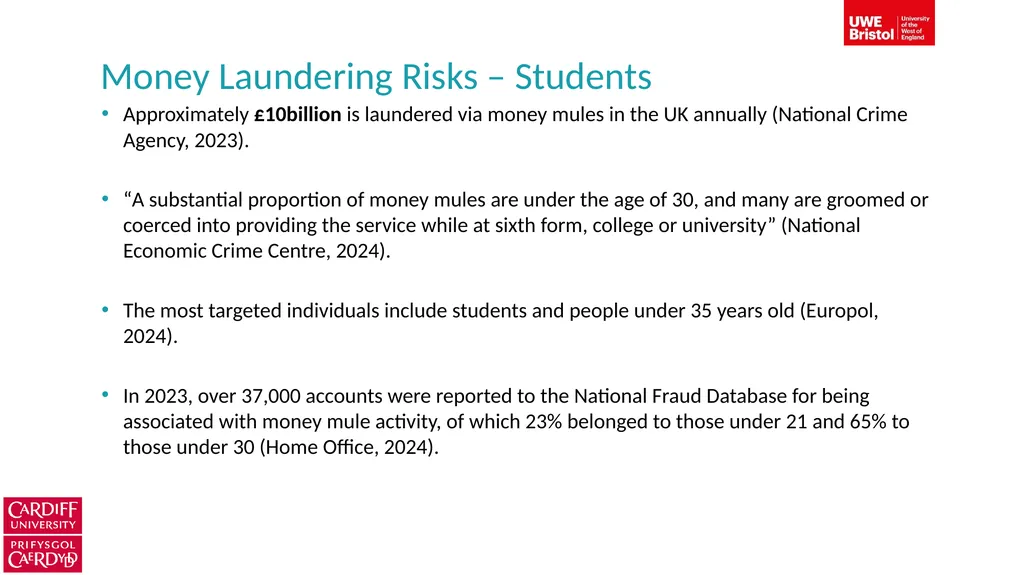
Money Laundering Risks – Students Approximately £10billion is laundered via money mules in the UK annually (National Crime Agency, 2023).
“A substantial proportion of money mules are under the age of 30, and many are groomed or coerced into providing the service while at sixth form, college or university” (National Economic Crime Centre, 2024).
The most targeted individuals include students and people under 35 years old (Europol, 2024).
In 2023, over 37,000 accounts were reported to the National Fraud Database for being associated with money mule activity, of which 23% belonged to those under 21 and 65% to those under 30 (Home Office, 2024).<br>
05
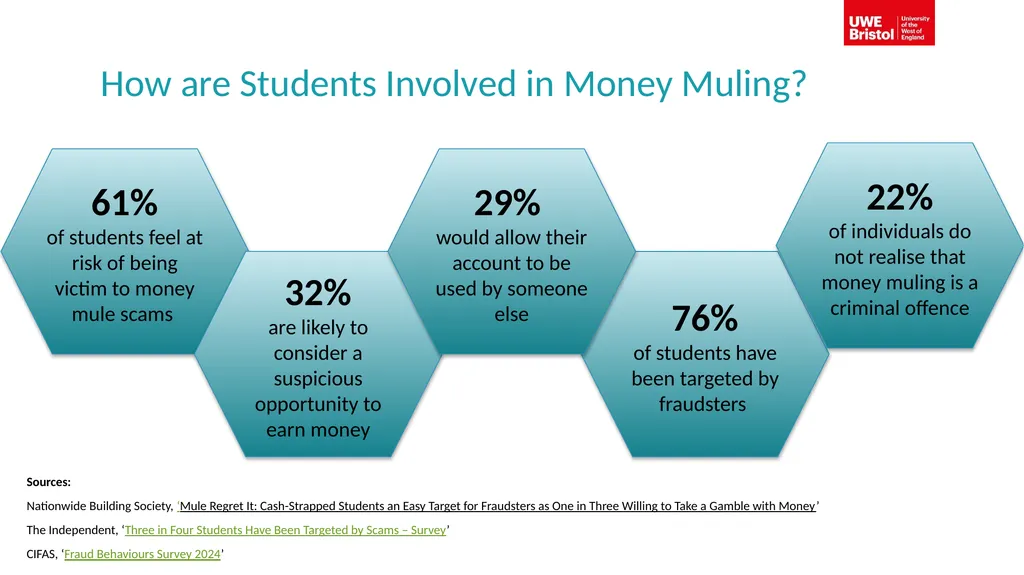
How are Students Involved in Money Muling? 76%
of students have been targeted by fraudsters 61%
of students feel at risk of being victim to money mule scams 32%
are likely to consider a suspicious opportunity to earn money 29%
would allow their account to be used by someone else 22%
of individuals do not realise that money muling is a criminal offence Sources:
Nationwide Building Society, ‘Mule Regret It: Cash-Strapped Students an Easy Target for Fraudsters as One in Three Willing to Take a Gamble with Money’
The Independent, ‘Three in Four Students Have Been Targeted by Scams – Survey’
CIFAS, ‘Fraud Behaviours Survey 2024’<br>
06
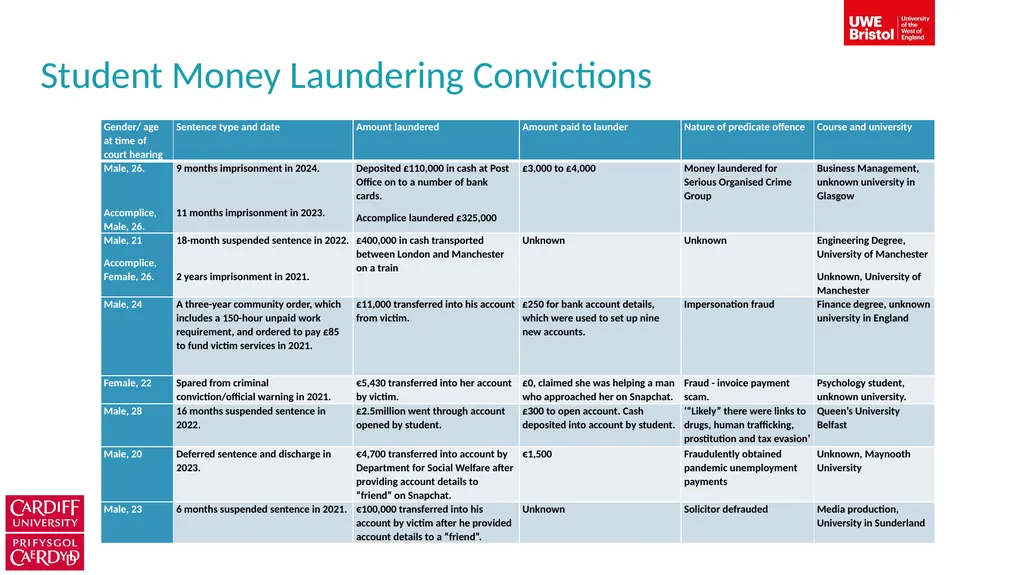
Student Money Laundering Convictions<br>
07
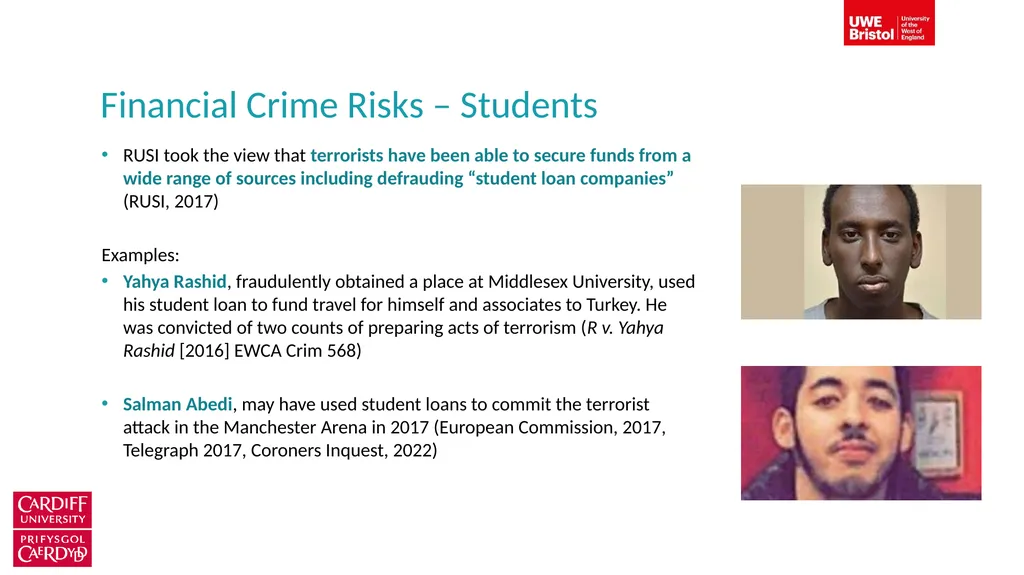
Financial Crime Risks – Students RUSI took the view that terrorists have been able to secure funds from a wide range of sources including defrauding “student loan companies” (RUSI, 2017)
Examples:
Yahya Rashid, fraudulently obtained a place at Middlesex University, used his student loan to fund travel for himself and associates to Turkey. He was convicted of two counts of preparing acts of terrorism (R v. Yahya Rashid [2016] EWCA Crim 568)
Salman Abedi, may have used student loans to commit the terrorist attack in the Manchester Arena in 2017 (European Commission, 2017, Telegraph 2017, Coroners Inquest, 2022)<br>
08
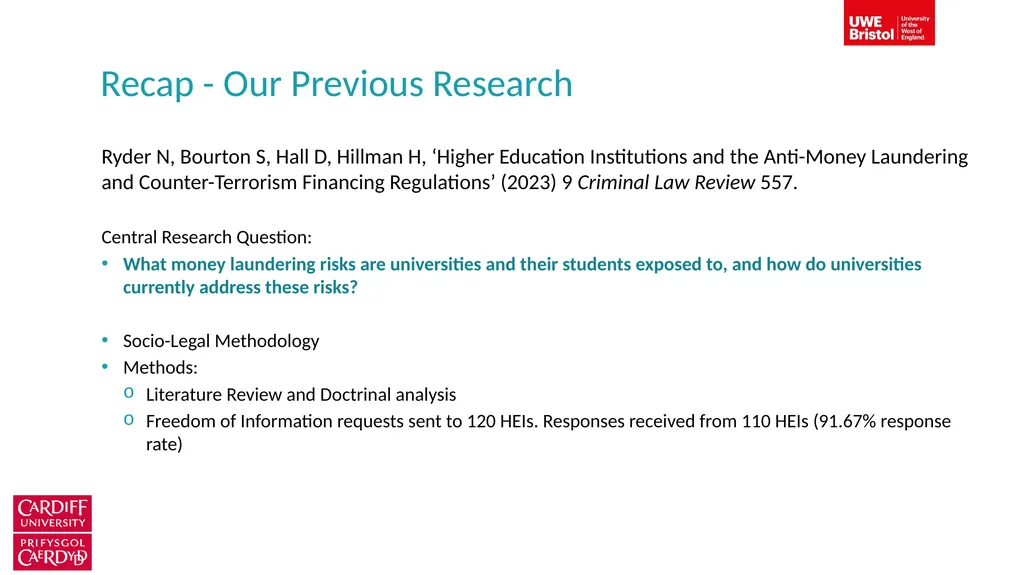
Recap - Our Previous Research Ryder N, Bourton S, Hall D, Hillman H, ‘Higher Education Institutions and the Anti-Money Laundering and Counter-Terrorism Financing Regulations’ (2023) 9 Criminal Law Review 557.
Central Research Question:
What money laundering risks are universities and their students exposed to, and how do universities currently address these risks?
Socio-Legal Methodology
Methods:
Literature Review and Doctrinal analysis
Freedom of Information requests sent to 120 HEIs. Responses received from 110 HEIs (91.67% response rate)<br>
09
AML/CTF Legislation - Applicability to HEIs Money Laundering, Terrorist Financing and Transfer of Funds (Information on the Payer) Regulations 2017
The MLRs only apply to the regulated sector (Regulation 8(2)) and HEIs are not part of the regulated sector.
HEIs are not considered a High-Value Dealer (Only 2 out of 110 HEIs considered themselves to be High Value Dealers)
Accordingly, the Money Laundering Regulations 2017 do not apply to HEIs
However…
Proceeds of Crime Act 2002 and the Terrorism Act 2000
University employees may commit money laundering and terrorism financing offences if they deal with suspicious funds, which are in fact the proceeds of crime or are to be used for the purpose of terrorism.
If senior managers commit money laundering offences, criminal liability could be attributed to the academic institution under the Economic Crime and Corporate Transparency Act 2023, s.196
They can be protected from prosecution by submitting a Suspicious Activity Report to the National Crime Agency.<br>
10
Recap - Measures Taken by HEIs to Address AML/CTF Risks This section of the presentation provides a recap of the answers provided by 110 HEIs in the UK in response to a questionnaire submitted as a FOI request
The responses were received between November 2021 and March 2022
All the responses have been anonymised by the researchers<br>
The responses were received between November 2021 and March 2022
All the responses have been anonymised by the researchers<br>
11
Measures Currently Taken by HEIs to Address AML/CTF Risks Awareness of AML Legislation and AML Policies
All HEIs that responded to the relevant question had an awareness of AML legislation, including POCA 2002 and the Money Laundering Regulations 2017
74 HEIs, or over 67%, have a specific AML policy in place. Only 5 HEIs, or just over 4.5%, do not appear to include AML as part of any policy and do not appear to have plans to implement an AML policy in the near future<br>
12
Measures Currently Taken by HEIs to Address AML/CTF Risks Staff Training
84 HEIs, or over 76%, noted that they provided some form of AML training and guidance to staff
21 HEIs, or 19.1%, stated that they do not provide any internal AML training
Of these respondents, 5 HEIs suggested that they were in the progress of developing AML training for their staff, while others suggested that training was provided by external organisations, such as accounting bodies and financial institutions<br>
13
Measures Currently Taken by HEIs to Address AML/CTF Risks Student Guidance
76 HEIs, or around 69%, provide at least some form of guidance to students
Some HEIs reported making information available on an ad hoc basis, while others routinely provided resources and information to students online
Some HEIs reported providing guidance to particularly at risk, or vulnerable, students, while others provided guidance to all students as part of induction talks or as part of their course
25 HEIs, or over 22%, do not provide any guidance to their students Are Students Provided with Guidance on Financial Crime and/or Organised Crime, Including the Risks and Dangers Posed to Students?<br>
14
Measures Currently Taken by HEIs to Address AML/CTF Risks Cash Payments
79 HEIs, or over 71%, do not accept cash payments for tuition fees or accommodation
HEIs appear to be less willing to accept cash payments than they were a few years ago (49 HEIs accepted £52million in cash payments from students for fees over the past five years; Times, 2021)
Nonetheless, 22 HEIs, or approximately 20%, are willing to accept cash payments. Some of these HEIs have a limit on cash transactions, the lowest being £500, whereas others do not impose any limit on the amount that can be paid in cash
39 HEIs provided information relating to the total value of cash payments received in 2019/20. The 39 HEIs received over £12million in cash payments in 2019/20, with 3 HEIs receiving cash payments totalling more than £1million and 3 HEIs receiving £977,944, £975,891 and £824,000 respectively<br>
15
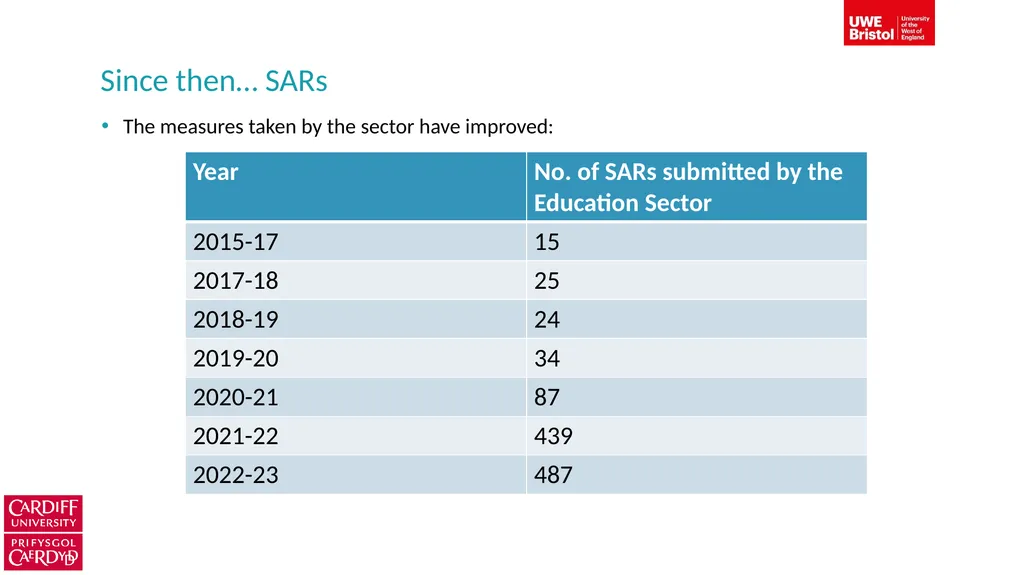
Since then… SARs The measures taken by the sector have improved:<br>
16
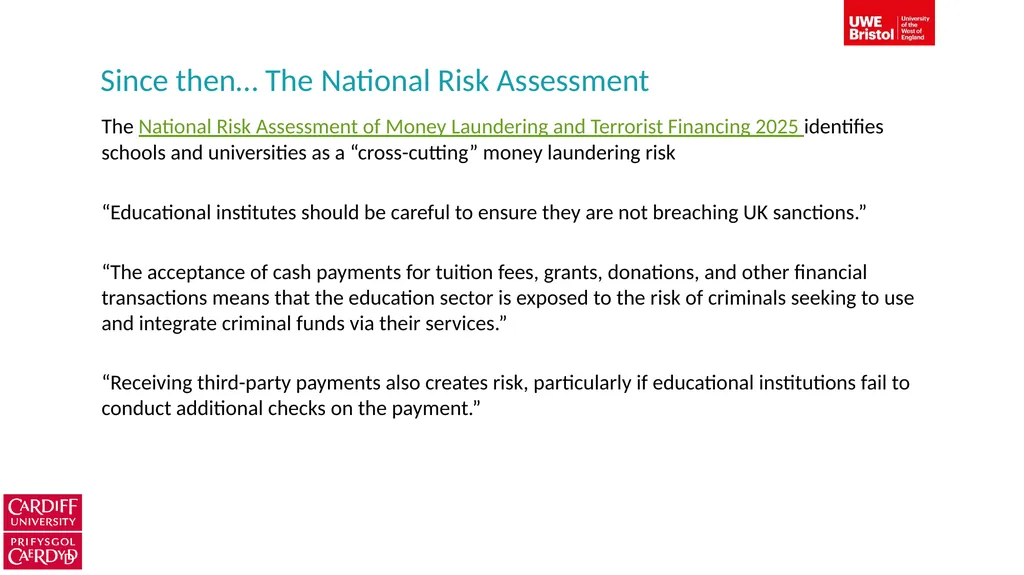
Since then… The National Risk Assessment The National Risk Assessment of Money Laundering and Terrorist Financing 2025 identifies schools and universities as a “cross-cutting” money laundering risk
“Educational institutes should be careful to ensure they are not breaching UK sanctions.”
“The acceptance of cash payments for tuition fees, grants, donations, and other financial transactions means that the education sector is exposed to the risk of criminals seeking to use and integrate criminal funds via their services.”
“Receiving third-party payments also creates risk, particularly if educational institutions fail to conduct additional checks on the payment.”<br>
17
Since then… Focus on Money Muling Money Mule and Financial Exploitation Action Plan (Home Office, 2024):
Recognises that many young people are being exploited by OCGs.
Highlights the importance of research, data sharing, and education.
“HMRC has also worked to engage university leaders on how best to educate their students about the risks through the UK’s network of Vice Chancellors.”
The National Risk Assessment of Money Laundering and Terrorist Financing 2025 also notes that “educational institutions should ensure that students understand the risks involved and that this activity potentially constitutes a criminal offence.”<br>
18
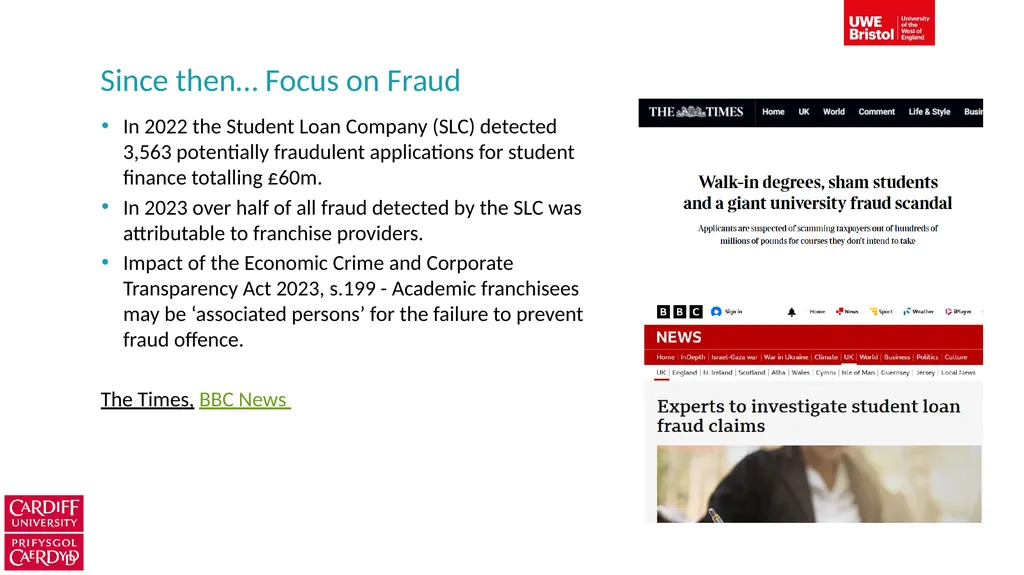
Since then… Focus on Fraud In 2022 the Student Loan Company (SLC) detected 3,563 potentially fraudulent applications for student finance totalling £60m.
In 2023 over half of all fraud detected by the SLC was attributable to franchise providers.
Impact of the Economic Crime and Corporate Transparency Act 2023, s.199 - Academic franchisees may be ‘associated persons’ for the failure to prevent fraud offence.
The Times, BBC News<br>
In 2023 over half of all fraud detected by the SLC was attributable to franchise providers.
Impact of the Economic Crime and Corporate Transparency Act 2023, s.199 - Academic franchisees may be ‘associated persons’ for the failure to prevent fraud offence.
The Times, BBC News<br>
19
Useful Resources Financial Fraud Awareness Campaign
Students Against Scams
Crooks on Campus
Money Laundering-Linked Financial Exploitation Guidance for Frontline Professionals
Advice for Students from the National Crime Agency
Work with your Local Police and Regional Organised Crime Units
Flywire!
Ask the Research Team<br>
Students Against Scams
Crooks on Campus
Money Laundering-Linked Financial Exploitation Guidance for Frontline Professionals
Advice for Students from the National Crime Agency
Work with your Local Police and Regional Organised Crime Units
Flywire!
Ask the Research Team<br>
20
Research Team Professor Nic Ryder
School of Law and Politics, Cardiff University
RyderN@Cardiff.ac.uk
Dr Sam Mapston
Senior Lecturer in Law, University of the West of England
Samantha.Mapston@uwe.ac.uk
Publications:
Ryder N, Bourton S, Hall D, Hillman H, ‘Higher Education Institutions and the Anti-Money Laundering and Counter-Terrorism Financing Regulations’ (2023) 9 Criminal Law Review 557
Mapston S, ‘Money Laundering in Universities: Implementing a Risk-Based Approach to Regulation’ (2025) (Submitted to Criminal Law Review)
Ongoing Research Projects:
Impact of Educational Initiatives on Student Involvement in Money Muling
Education, Money Laundering and Law Enforcement - An Alternative Perspective?<br>
21
Conclusion HEIs, their employees, and their students, are at risk of money laundering, terrorism financing and criminal liability
Our previous research found that there is awareness within the HEI sector of AML legislation, but there is a disparity among universities regarding how effectively it is implemented
Since then, the measures taken by the sector have improved
However, the focus on HEIs has also increased
Preventative measures must be taken to preserve the safety, integrity and reputation of HEIs<br>
22
Questions?<br>