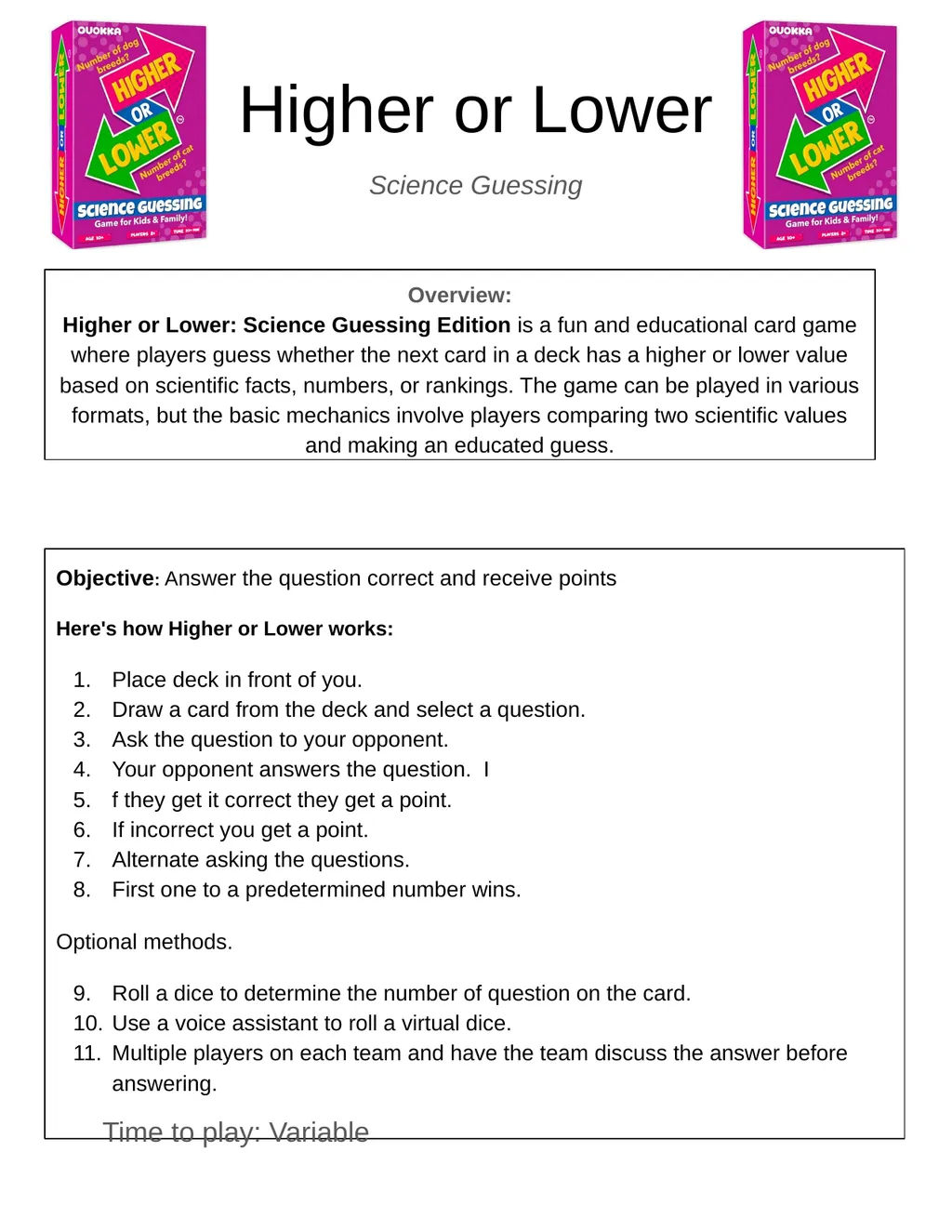
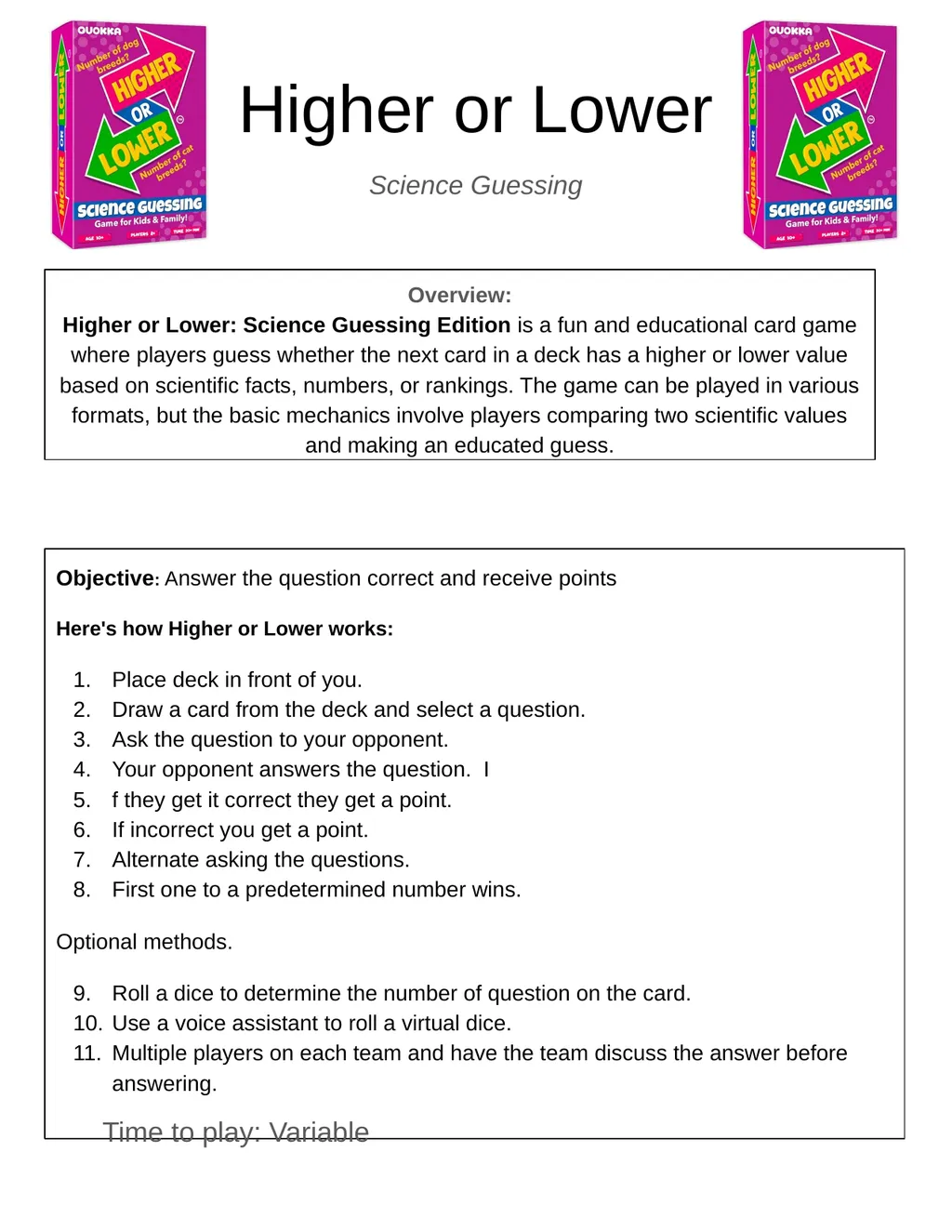
Higher or Lower Science Guessing Overview: Higher or Lower: Science Guessing Edition is a fun and educational card game where players guess whether the next card in a deck has a higher or lower value based on scientific facts, numbers, or
"Higher or Lower Science Guessing Overview: Higher" is the property of its rightful owner. Permission is granted to
download and print the materials on this website for personal, non-commercial use only, and to display it
on your personal computer provided you do not modify the materials and that you retain all copyright
notices contained in the materials. By downloading content from our website, you accept the terms of this
agreement.
Presentation Transcript
01
Higher or Lower Science Guessing Overview:
Higher or Lower: Science Guessing Edition is a fun and educational card game where players guess whether the next card in a deck has a higher or lower value based on scientific facts, numbers, or rankings. The game can be played in various formats, but the basic mechanics involve players comparing two scientific values and making an educated guess. Objective: Answer the question correct and receive points
Here's how Higher or Lower works:
Place deck in front of you.
Draw a card from the deck and select a question.
Ask the question to your opponent.
Your opponent answers the question. I
f they get it correct they get a point.
If incorrect you get a point.
Alternate asking the questions.
First one to a predetermined number wins.
Optional methods.
Roll a dice to determine the number of question on the card.
Use a voice assistant to roll a virtual dice.
Multiple players on each team and have the team discuss the answer before answering. Time to play: Variable<br>
02
Learning Goals:
The Quokka Higher or Lower Science Guessing Game is designed to be both educational and entertaining, helping players develop scientific literacy and critical thinking. Here are the key learning goals:
1. Develop Scientific Knowledge
Learn and reinforce key scientific facts and numerical values (e.g., atomic numbers, planet sizes, speeds of natural phenomena).
Familiarize players with comparative scientific data in an engaging way.
2. Improve Estimation & Critical Thinking Skills
Encourage logical reasoning by making informed guesses based on prior knowledge.
Develop approximation skills, helping players make educated assumptions even without exact knowledge.
Foster pattern recognition, as players start noticing relationships between different scientific concepts.
3. Enhance Memory & Retention
Reinforce recall of scientific facts and figures through repetition and gameplay.
Improve long-term retention of information by associating learning with a fun and interactive experience.
4. Encourage Curiosity & Engagement in Science
Spark curiosity by introducing fascinating scientific concepts in a playful format.
Motivate players to research and learn more about topics beyond the game.
Create a positive and enjoyable association with STEM (Science, Technology, Engineering, and Math) learning.
5. Foster Social & Communication Skills (For Group Play)
Encourage discussion and teamwork when played in groups.
Develop persuasive skills when debating whether a value is higher or lower.
Promote a fun, low-pressure learning environment where players can learn from each other.<br>
03
NGSS Standards Related to Higher or Lower Science Guessing Game: Science and Engineering Practices (SEPs)
✅ Analyzing and Interpreting Data (SEP 4)
Players compare numerical data related to scientific concepts (e.g., atomic numbers, speeds, sizes) and make informed predictions.
✅ Using Mathematics and Computational Thinking (SEP 5)
The game encourages estimation, numerical reasoning, and the ability to compare different scientific values.
✅ Constructing Explanations and Designing Solutions (SEP 6)
Players develop reasoning skills when justifying their choices (e.g., "I think Mars is smaller than Earth because I know it's farther from the Sun but has lower gravity.").
✅ Engaging in Argument from Evidence (SEP 7)
In group play, players discuss and defend their guesses, supporting claims with scientific reasoning.
2. Crosscutting Concepts (CCCs)
✅ Patterns
Players recognize patterns in scientific data, such as how atomic numbers increase across the periodic table or how larger planets tend to have more moons.
✅ Scale, Proportion, and Quantity
The game reinforces an understanding of how different quantities relate to each other, such as planetary distances or speeds of various forces.
✅ Cause and Effect
Players develop reasoning about why certain values are higher or lower based on scientific principles (e.g., "Larger objects tend to have more mass, so Jupiter’s gravity should be higher than Earth’s.").
3. Disciplinary Core Ideas (DCIs)
Depending on the card topics, the game can align with various NGSS disciplinary core ideas, such as:
📌 Physical Science (PS)
PS1.A: Structure of Matter (Atomic numbers, periodic table trends)
PS3.A: Definitions of Energy (Energy values, speeds, heat levels)
📌 Earth & Space Science (ESS)
ESS1.A: The Universe and Its Stars (Planetary sizes, distances, temperatures)
ESS2.C: The Roles of Water in Earth's Surface Processes (Boiling/freezing points, water properties)
📌 Life Science (LS)
LS1.C: Organization for Matter and Energy Flow in Organisms (Lifespans, metabolism, growth rates)
LS4.A: Evidence of Common Ancestry and Diversity (Evolutionary traits, species sizes)<br>
04
Teaching Ideas: Disclaimer: Most of these ideas were taken or adapted from teacher posts on social media.<br>