
Historical School By Dr Pramod Kumar Historical



Description: Historical School By Dr Pramod Kumar Historical School The historical school follows the concept of man-made laws. Law is formulated for the people and by the people means that the law should be according to the changing needs of the
Related Topics
Download Presentation
"Historical School By Dr Pramod Kumar Historical" is the property of its rightful owner. Permission is granted to download and print the materials on this website for personal, non-commercial use only, and to display it on your personal computer provided you do not modify the materials and that you retain all copyright notices contained in the materials. By downloading content from our website, you accept the terms of this agreement.
Presentation Transcript
slide1. Historical School By Dr Pramod Kumar<br>
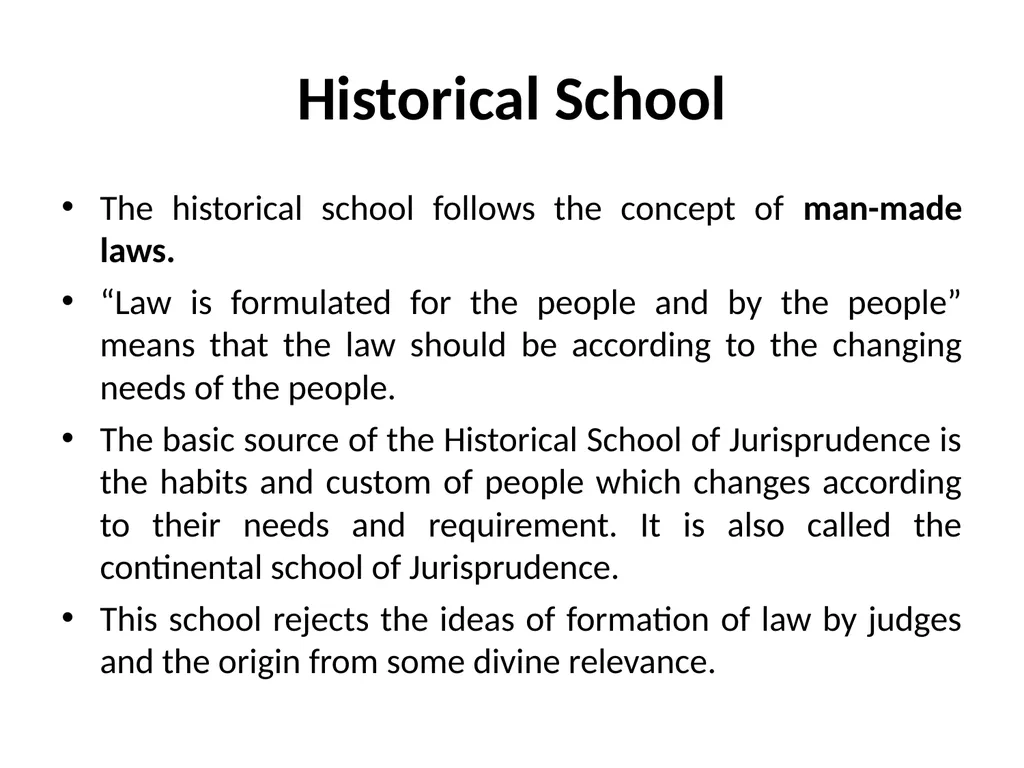
slide2. Historical School The historical school follows the concept of man-made laws.
“Law is formulated for the people and by the people” means that the law should be according to the changing needs of the people.
The basic source of the Historical School of Jurisprudence is the habits and custom of people which changes according to their needs and requirement. It is also called the continental school of Jurisprudence.
This school rejects the ideas of formation of law by judges and the origin from some divine relevance.<br>
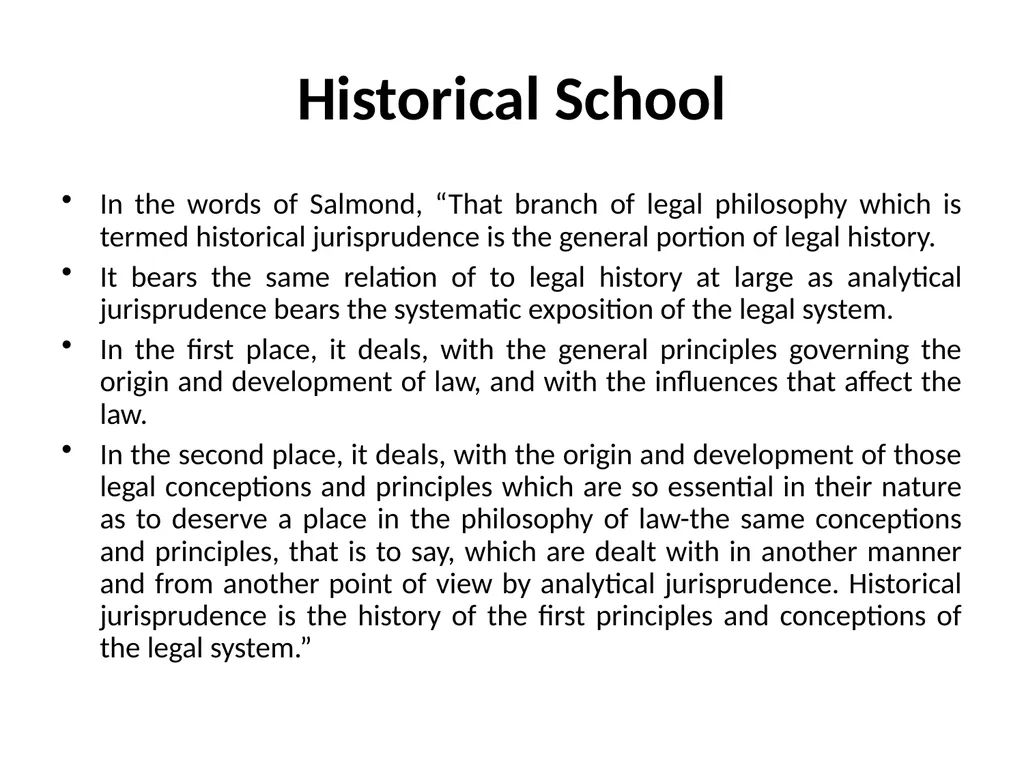
slide3. Historical School In the words of Salmond, “That branch of legal philosophy which is termed historical jurisprudence is the general portion of legal history.
It bears the same relation of to legal history at large as analytical jurisprudence bears the systematic exposition of the legal system.
In the first place, it deals, with the general principles governing the origin and development of law, and with the influences that affect the law.
In the second place, it deals, with the origin and development of those legal conceptions and principles which are so essential in their nature as to deserve a place in the philosophy of law-the same conceptions and principles, that is to say, which are dealt with in another manner and from another point of view by analytical jurisprudence. Historical jurisprudence is the history of the first principles and conceptions of the legal system.”<br>
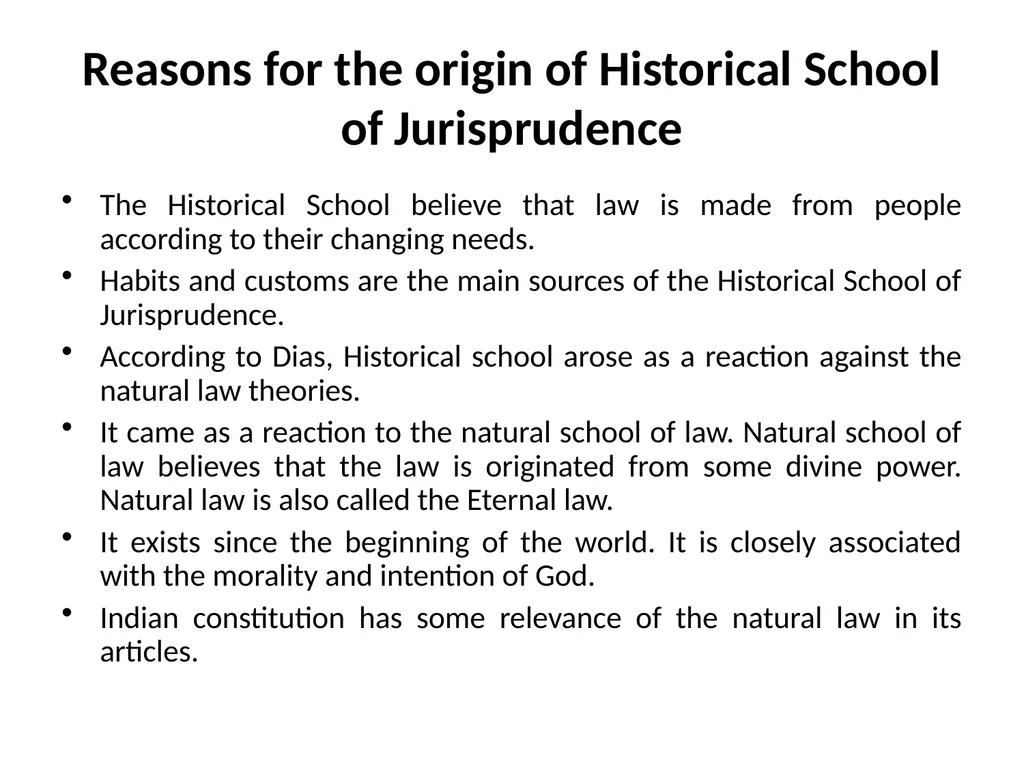
slide4. Reasons for the origin of Historical School of Jurisprudence The Historical School believe that law is made from people according to their changing needs.
Habits and customs are the main sources of the Historical School of Jurisprudence.
According to Dias, Historical school arose as a reaction against the natural law theories.
It came as a reaction to the natural school of law. Natural school of law believes that the law is originated from some divine power. Natural law is also called the Eternal law.
It exists since the beginning of the world. It is closely associated with the morality and intention of God.
Indian constitution has some relevance of the natural law in its articles.<br>
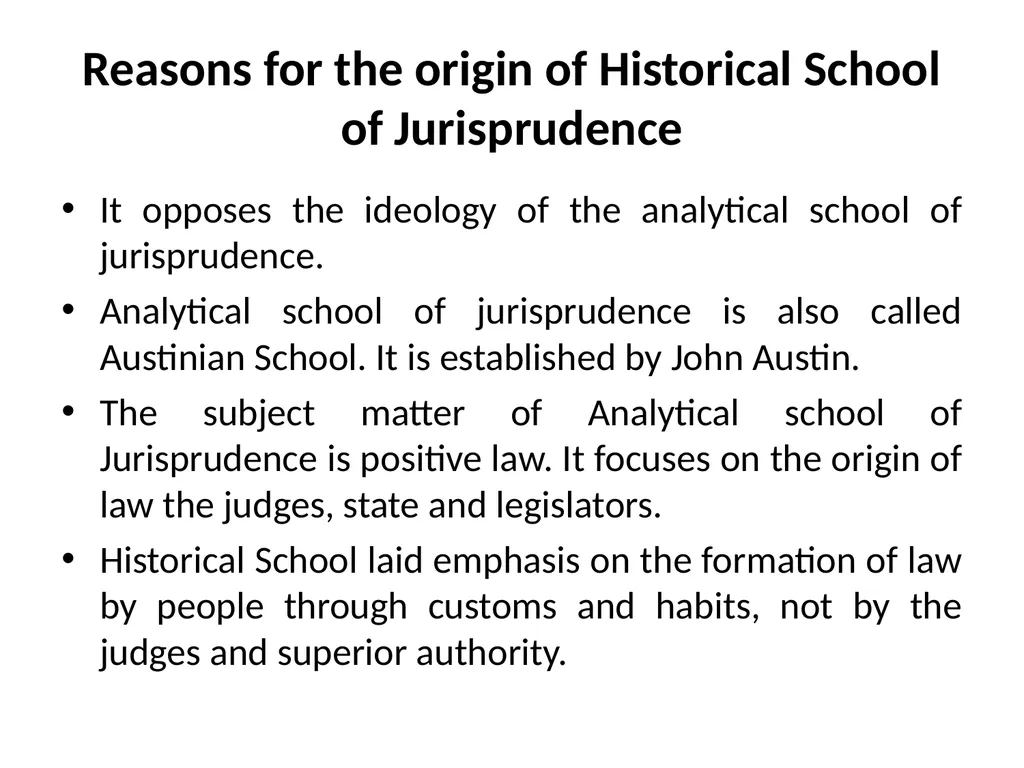
slide5. Reasons for the origin of Historical School of Jurisprudence It opposes the ideology of the analytical school of jurisprudence.
Analytical school of jurisprudence is also called Austinian School. It is established by John Austin.
The subject matter of Analytical school of Jurisprudence is positive law. It focuses on the origin of law the judges, state and legislators.
Historical School laid emphasis on the formation of law by people through customs and habits, not by the judges and superior authority.<br>
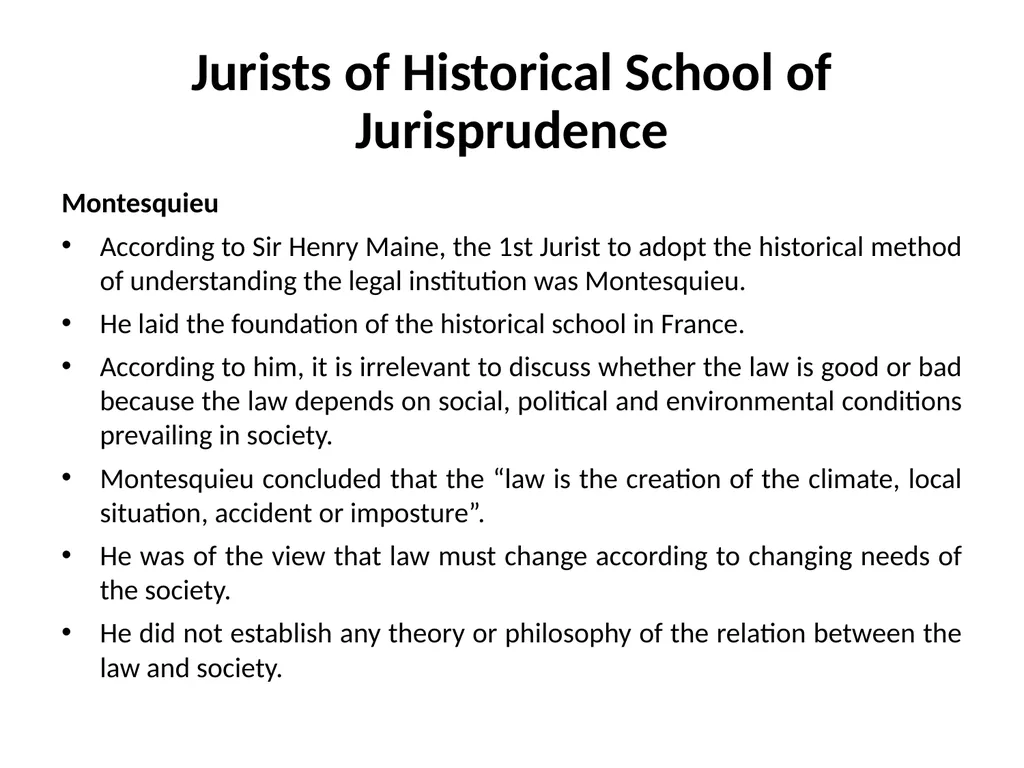
slide6. Jurists of Historical School of Jurisprudence Montesquieu
According to Sir Henry Maine, the 1st Jurist to adopt the historical method of understanding the legal institution was Montesquieu.
He laid the foundation of the historical school in France.
According to him, it is irrelevant to discuss whether the law is good or bad because the law depends on social, political and environmental conditions prevailing in society.
Montesquieu concluded that the “law is the creation of the climate, local situation, accident or imposture”.
He was of the view that law must change according to changing needs of the society.
He did not establish any theory or philosophy of the relation between the law and society.<br>
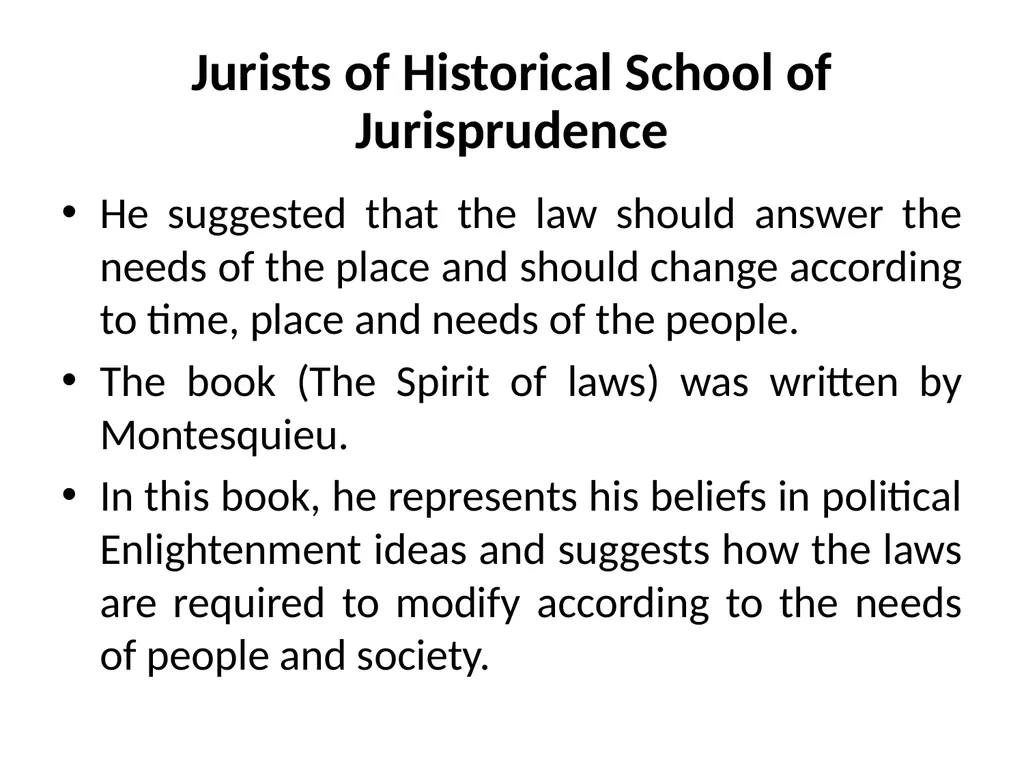
slide7. Jurists of Historical School of Jurisprudence He suggested that the law should answer the needs of the place and should change according to time, place and needs of the people.
The book (The Spirit of laws) was written by Montesquieu.
In this book, he represents his beliefs in political Enlightenment ideas and suggests how the laws are required to modify according to the needs of people and society.<br>
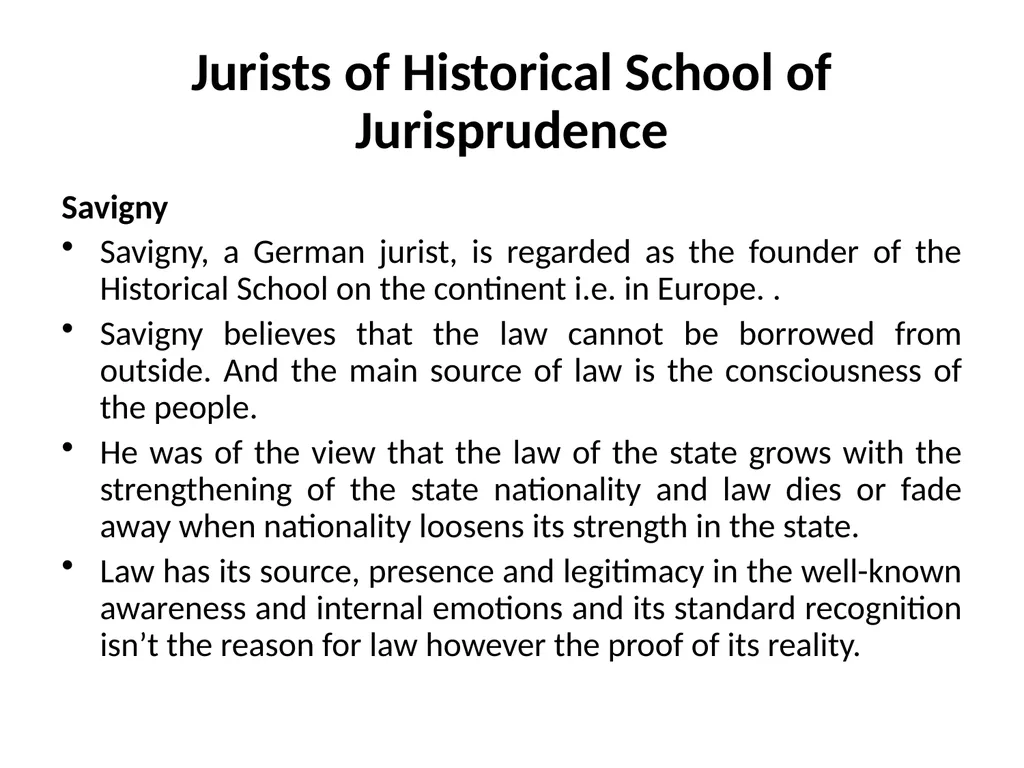
slide8. Jurists of Historical School of Jurisprudence Savigny
Savigny, a German jurist, is regarded as the founder of the Historical School on the continent i.e. in Europe. .
Savigny believes that the law cannot be borrowed from outside. And the main source of law is the consciousness of the people.
He was of the view that the law of the state grows with the strengthening of the state nationality and law dies or fade away when nationality loosens its strength in the state.
Law has its source, presence and legitimacy in the well-known awareness and internal emotions and its standard recognition isn’t the reason for law however the proof of its reality.<br>
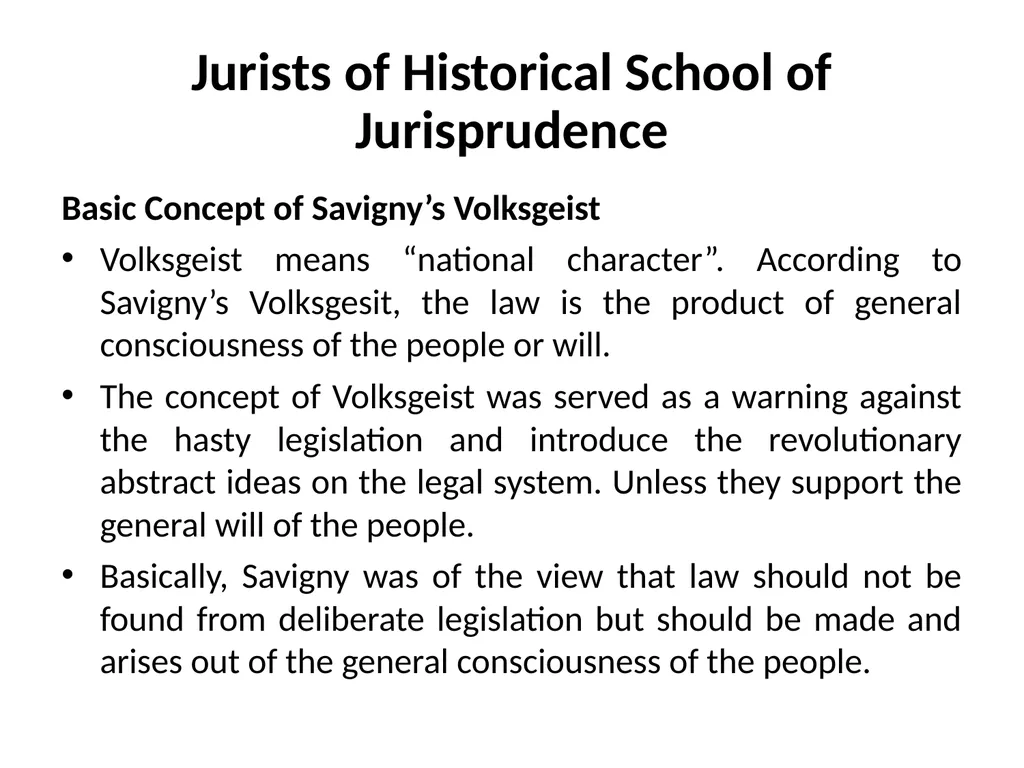
slide9. Jurists of Historical School of Jurisprudence Basic Concept of Savigny’s Volksgeist
Volksgeist means “national character”. According to Savigny’s Volksgesit, the law is the product of general consciousness of the people or will.
The concept of Volksgeist was served as a warning against the hasty legislation and introduce the revolutionary abstract ideas on the legal system. Unless they support the general will of the people.
Basically, Savigny was of the view that law should not be found from deliberate legislation but should be made and arises out of the general consciousness of the people.<br>
slide10. Jurists of Historical School of Jurisprudence Criticism of Savigny’s View
The views of Savigny were criticized by many jurists:
Charles Allen
Charles Allen criticized Savigny’s view that law should be found or based on the customs. Allen was of the view that customs are not the outcome of common consciousness of people. But they are the outcome of the interest of a powerful and strong of a ruling class. For example, slavery which was recognized and prevailed in certain societies by the powerful classes of society.
Prof. Stone
Prof. Stone criticized the Savigny and says that he (Savigny) ignored the efficiency of the legislation and planned law and social change. And over emphasized on the consciousness of people.
For example, In India, the abolition of Sati and widow’s remarriage are brought in to change because of powerful and effective legislation.<br>
slide11. Jurists of Historical School of Jurisprudence Sir Henry Maine
Sir Henry Maine was the founder of the English Historical School of Law. Savigny’s views of Historical school was carried forward in England by Sir Henry Maine.
Major Works by Sir Henry Maine
The first work of Maine ‘Ancient Law’ was published in 1861.
He also wrote Village Communities (1871),
Early History of Institutions (1875)
Dissertations of Early Law and Custom (1883).
Maine studied the Indian legal system deeply as he was law member in the Council of the Governor–General of India b/w 1861 to 1869. Maine’s ideas were incorporated by the best things in the theories of Savigny and Montesquieu.<br>
slide12. Jurists of Historical School of Jurisprudence Henry Maine describes the development of law in four stages:
First stage: Rulers are believed to be acting under divine inspiration. And the laws are made on the commands of the rulers. The judgment of the king was considered to be the judgment of God or some divine body. King was merely an executor of judgments of God, not the law-maker.
Second stage: Then the commands of King converted into customary law. The custom prevails in the ruler or majority class. Customs seems to have succeeded to the right and authorities of the king.
Third stage: The knowledge and administration of customs goes into the hands of a minority, Due to the weakening of the lawmaking power of the original law-makers like Priests the knowledge of customs goes into the hands of a minority class or ordinary class. And the ruler is superseded by a minority who obtain control over the law.
Fourth stage: In the fourth and last stage, the law is codified and promulgated.<br>
slide13. Static and Progressive Society Static societies: Societies which does not progress and develop their legal structure after the fourth stage of development of law are Static society. Static societies don’t progress beyond the era of codes.
Progressive Society: Societies which go on progressing after the fourth stage of development of law are Progressive Societies.<br>
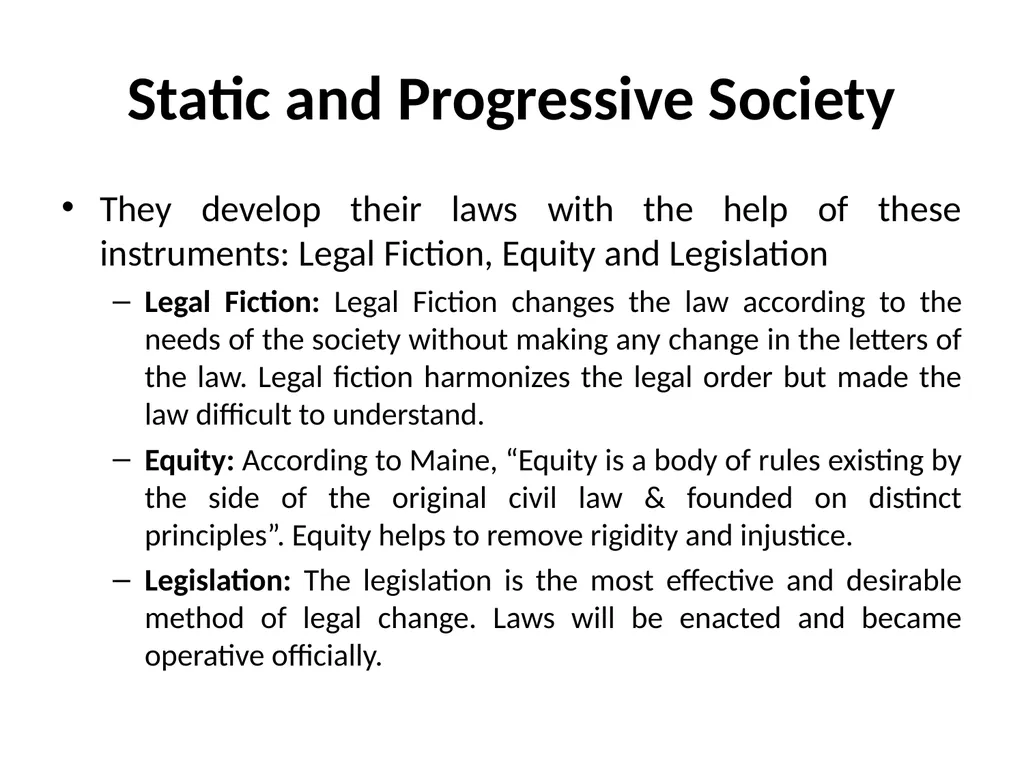
slide14. Static and Progressive Society They develop their laws with the help of these instruments: Legal Fiction, Equity and Legislation
Legal Fiction: Legal Fiction changes the law according to the needs of the society without making any change in the letters of the law. Legal fiction harmonizes the legal order but made the law difficult to understand.
Equity: According to Maine, “Equity is a body of rules existing by the side of the original civil law & founded on distinct principles”. Equity helps to remove rigidity and injustice.
Legislation: The legislation is the most effective and desirable method of legal change. Laws will be enacted and became operative officially.<br>
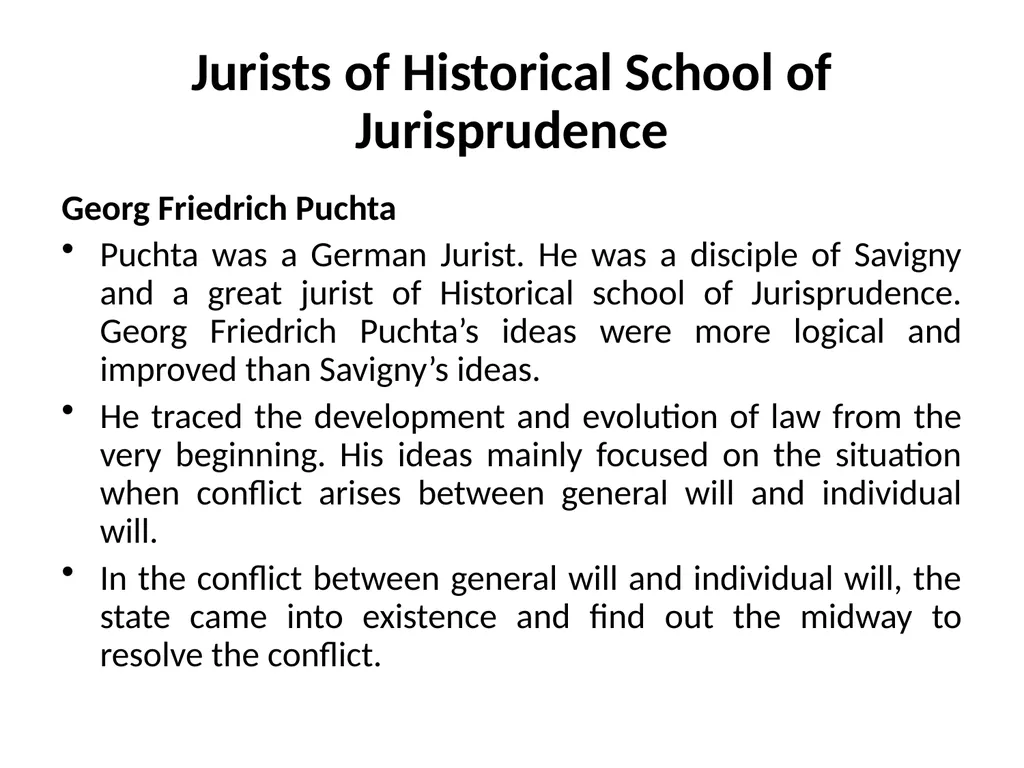
slide15. Jurists of Historical School of Jurisprudence Georg Friedrich Puchta
Puchta was a German Jurist. He was a disciple of Savigny and a great jurist of Historical school of Jurisprudence. Georg Friedrich Puchta’s ideas were more logical and improved than Savigny’s ideas.
He traced the development and evolution of law from the very beginning. His ideas mainly focused on the situation when conflict arises between general will and individual will.
In the conflict between general will and individual will, the state came into existence and find out the midway to resolve the conflict.<br>
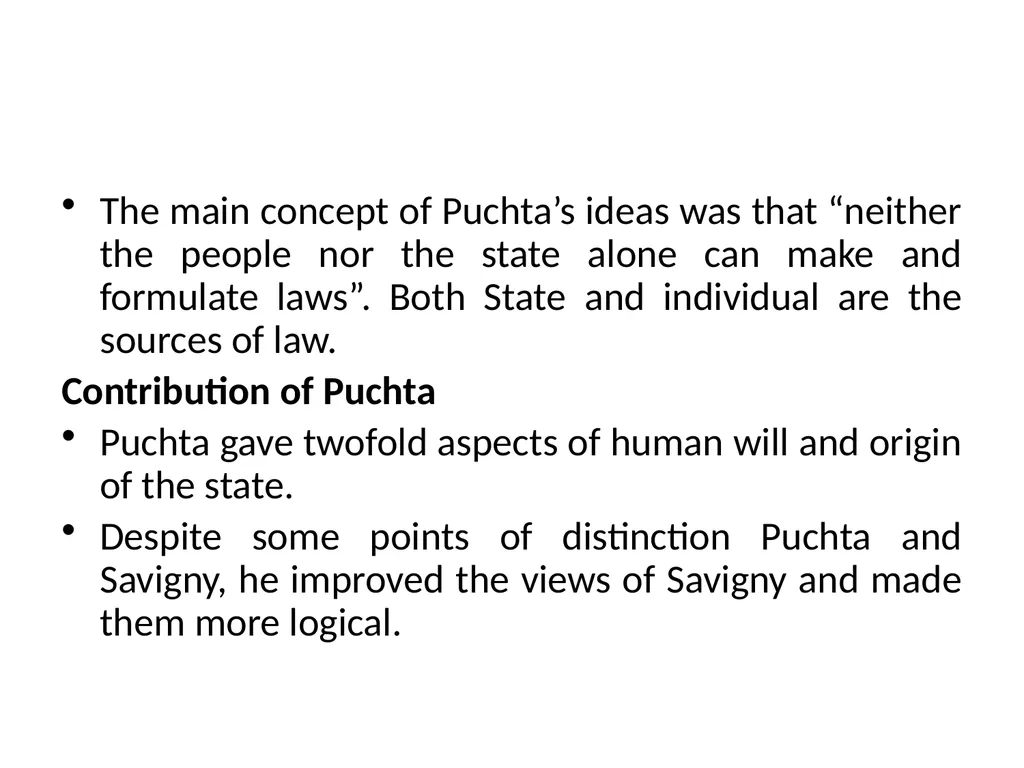
slide16. The main concept of Puchta’s ideas was that “neither the people nor the state alone can make and formulate laws”. Both State and individual are the sources of law.
Contribution of Puchta
Puchta gave twofold aspects of human will and origin of the state.
Despite some points of distinction Puchta and Savigny, he improved the views of Savigny and made them more logical.<br>
slide17. THANK YOU<br>
slide2. Historical School The historical school follows the concept of man-made laws.
“Law is formulated for the people and by the people” means that the law should be according to the changing needs of the people.
The basic source of the Historical School of Jurisprudence is the habits and custom of people which changes according to their needs and requirement. It is also called the continental school of Jurisprudence.
This school rejects the ideas of formation of law by judges and the origin from some divine relevance.<br>
slide3. Historical School In the words of Salmond, “That branch of legal philosophy which is termed historical jurisprudence is the general portion of legal history.
It bears the same relation of to legal history at large as analytical jurisprudence bears the systematic exposition of the legal system.
In the first place, it deals, with the general principles governing the origin and development of law, and with the influences that affect the law.
In the second place, it deals, with the origin and development of those legal conceptions and principles which are so essential in their nature as to deserve a place in the philosophy of law-the same conceptions and principles, that is to say, which are dealt with in another manner and from another point of view by analytical jurisprudence. Historical jurisprudence is the history of the first principles and conceptions of the legal system.”<br>
slide4. Reasons for the origin of Historical School of Jurisprudence The Historical School believe that law is made from people according to their changing needs.
Habits and customs are the main sources of the Historical School of Jurisprudence.
According to Dias, Historical school arose as a reaction against the natural law theories.
It came as a reaction to the natural school of law. Natural school of law believes that the law is originated from some divine power. Natural law is also called the Eternal law.
It exists since the beginning of the world. It is closely associated with the morality and intention of God.
Indian constitution has some relevance of the natural law in its articles.<br>
slide5. Reasons for the origin of Historical School of Jurisprudence It opposes the ideology of the analytical school of jurisprudence.
Analytical school of jurisprudence is also called Austinian School. It is established by John Austin.
The subject matter of Analytical school of Jurisprudence is positive law. It focuses on the origin of law the judges, state and legislators.
Historical School laid emphasis on the formation of law by people through customs and habits, not by the judges and superior authority.<br>
slide6. Jurists of Historical School of Jurisprudence Montesquieu
According to Sir Henry Maine, the 1st Jurist to adopt the historical method of understanding the legal institution was Montesquieu.
He laid the foundation of the historical school in France.
According to him, it is irrelevant to discuss whether the law is good or bad because the law depends on social, political and environmental conditions prevailing in society.
Montesquieu concluded that the “law is the creation of the climate, local situation, accident or imposture”.
He was of the view that law must change according to changing needs of the society.
He did not establish any theory or philosophy of the relation between the law and society.<br>
slide7. Jurists of Historical School of Jurisprudence He suggested that the law should answer the needs of the place and should change according to time, place and needs of the people.
The book (The Spirit of laws) was written by Montesquieu.
In this book, he represents his beliefs in political Enlightenment ideas and suggests how the laws are required to modify according to the needs of people and society.<br>
slide8. Jurists of Historical School of Jurisprudence Savigny
Savigny, a German jurist, is regarded as the founder of the Historical School on the continent i.e. in Europe. .
Savigny believes that the law cannot be borrowed from outside. And the main source of law is the consciousness of the people.
He was of the view that the law of the state grows with the strengthening of the state nationality and law dies or fade away when nationality loosens its strength in the state.
Law has its source, presence and legitimacy in the well-known awareness and internal emotions and its standard recognition isn’t the reason for law however the proof of its reality.<br>
slide9. Jurists of Historical School of Jurisprudence Basic Concept of Savigny’s Volksgeist
Volksgeist means “national character”. According to Savigny’s Volksgesit, the law is the product of general consciousness of the people or will.
The concept of Volksgeist was served as a warning against the hasty legislation and introduce the revolutionary abstract ideas on the legal system. Unless they support the general will of the people.
Basically, Savigny was of the view that law should not be found from deliberate legislation but should be made and arises out of the general consciousness of the people.<br>
slide10. Jurists of Historical School of Jurisprudence Criticism of Savigny’s View
The views of Savigny were criticized by many jurists:
Charles Allen
Charles Allen criticized Savigny’s view that law should be found or based on the customs. Allen was of the view that customs are not the outcome of common consciousness of people. But they are the outcome of the interest of a powerful and strong of a ruling class. For example, slavery which was recognized and prevailed in certain societies by the powerful classes of society.
Prof. Stone
Prof. Stone criticized the Savigny and says that he (Savigny) ignored the efficiency of the legislation and planned law and social change. And over emphasized on the consciousness of people.
For example, In India, the abolition of Sati and widow’s remarriage are brought in to change because of powerful and effective legislation.<br>
slide11. Jurists of Historical School of Jurisprudence Sir Henry Maine
Sir Henry Maine was the founder of the English Historical School of Law. Savigny’s views of Historical school was carried forward in England by Sir Henry Maine.
Major Works by Sir Henry Maine
The first work of Maine ‘Ancient Law’ was published in 1861.
He also wrote Village Communities (1871),
Early History of Institutions (1875)
Dissertations of Early Law and Custom (1883).
Maine studied the Indian legal system deeply as he was law member in the Council of the Governor–General of India b/w 1861 to 1869. Maine’s ideas were incorporated by the best things in the theories of Savigny and Montesquieu.<br>
slide12. Jurists of Historical School of Jurisprudence Henry Maine describes the development of law in four stages:
First stage: Rulers are believed to be acting under divine inspiration. And the laws are made on the commands of the rulers. The judgment of the king was considered to be the judgment of God or some divine body. King was merely an executor of judgments of God, not the law-maker.
Second stage: Then the commands of King converted into customary law. The custom prevails in the ruler or majority class. Customs seems to have succeeded to the right and authorities of the king.
Third stage: The knowledge and administration of customs goes into the hands of a minority, Due to the weakening of the lawmaking power of the original law-makers like Priests the knowledge of customs goes into the hands of a minority class or ordinary class. And the ruler is superseded by a minority who obtain control over the law.
Fourth stage: In the fourth and last stage, the law is codified and promulgated.<br>
slide13. Static and Progressive Society Static societies: Societies which does not progress and develop their legal structure after the fourth stage of development of law are Static society. Static societies don’t progress beyond the era of codes.
Progressive Society: Societies which go on progressing after the fourth stage of development of law are Progressive Societies.<br>
slide14. Static and Progressive Society They develop their laws with the help of these instruments: Legal Fiction, Equity and Legislation
Legal Fiction: Legal Fiction changes the law according to the needs of the society without making any change in the letters of the law. Legal fiction harmonizes the legal order but made the law difficult to understand.
Equity: According to Maine, “Equity is a body of rules existing by the side of the original civil law & founded on distinct principles”. Equity helps to remove rigidity and injustice.
Legislation: The legislation is the most effective and desirable method of legal change. Laws will be enacted and became operative officially.<br>
slide15. Jurists of Historical School of Jurisprudence Georg Friedrich Puchta
Puchta was a German Jurist. He was a disciple of Savigny and a great jurist of Historical school of Jurisprudence. Georg Friedrich Puchta’s ideas were more logical and improved than Savigny’s ideas.
He traced the development and evolution of law from the very beginning. His ideas mainly focused on the situation when conflict arises between general will and individual will.
In the conflict between general will and individual will, the state came into existence and find out the midway to resolve the conflict.<br>
slide16. The main concept of Puchta’s ideas was that “neither the people nor the state alone can make and formulate laws”. Both State and individual are the sources of law.
Contribution of Puchta
Puchta gave twofold aspects of human will and origin of the state.
Despite some points of distinction Puchta and Savigny, he improved the views of Savigny and made them more logical.<br>
slide17. THANK YOU<br>