02
The Scope of Victimization Every crime has at least one victim
NCVS (2012):
6,842,593 violent victimizations
19,622,977 household victimizations
Victimization: events that harm individuals, households, businesses, communities, or institutions
Criminal victimization: harm is suffered as a result of a violation of the criminal law<br>
04
Victimological Research Estimating the extent of different types of victimization
Explaining:
Why victimization occurs
To whom it occurs
Where it occurs
Understanding the consequences of victimization
Victims’ rights and remedies
Victims’ roles in the criminal justice (CJ) system<br>
05
Victimology and Criminology Complementary areas of study
Criminology considers crime from the offender’s perspective
Victimology considers crime from the victim’s perspective
Opinions differ as to whether victimology is a subfield of criminology, a separate field, or a distinct field with overlapping focus<br>
06
Academic Origins of Victimology “First-generation” victimologists
First theory of victimization: victim precipitation
Victims contribute to the crime event through:
Victim facilitation
Victims often set in motion the events that result in their own victimization
Victim provocation
Victims can overtly act in ways that result in their victimization<br>
07
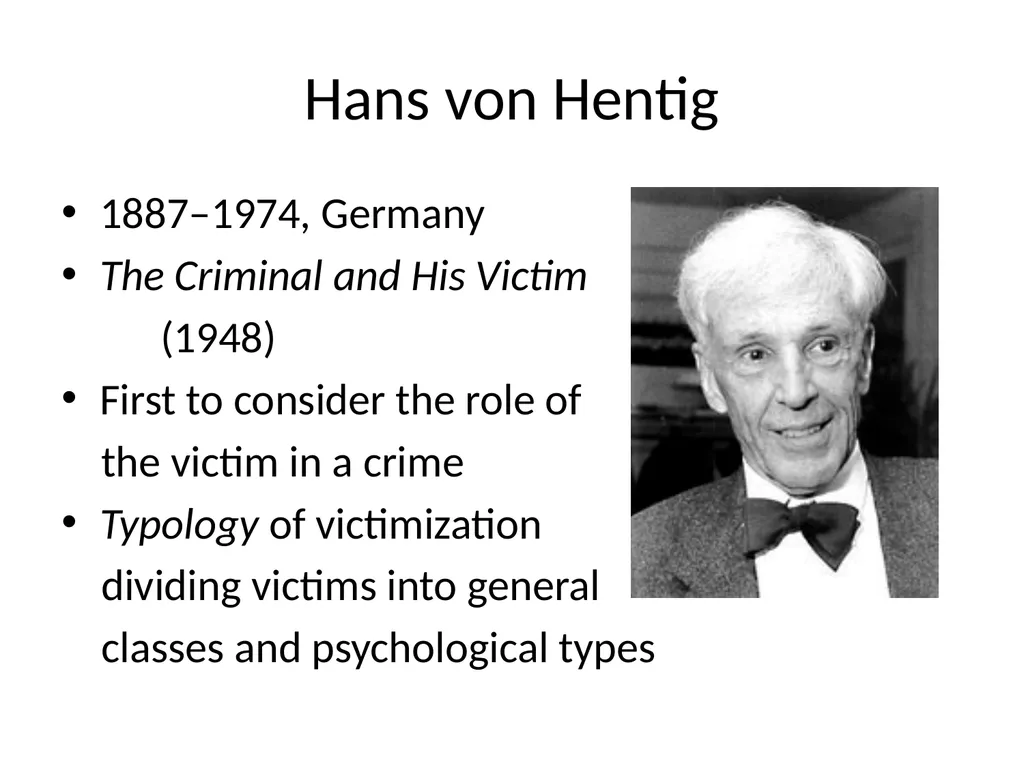
Hans von Hentig 1887‒1974, Germany
The Criminal and His Victim
(1948)
First to consider the role of
the victim in a crime
Typology of victimization
dividing victims into general
classes and psychological types<br>
08
von Hentig’s Typology General Classes of Victims
1. The young
2. The female
3. The old
4. The mentally defective and other mentally deranged
5. Immigrants, minorities, and dull normals
Psychological Types of Victims
6. The depressed
7. The acquisitive (Ponzi schemes)
8. The wanton
9. The lonesome and the heartbroken
10. The tormentor
11. Blocked, exempted, and fighting victims (drug dealer robbery)<br>
09
Beniamin Mendelsohn 1990‒1998
Israeli defense attorney
“Father of Victimology”
Coined term “victimology”
Advocated the study of victims to be separate from criminology
Typology categorizing victims according to their degree of responsibility<br>
10
Mendelsohn’s Typology 1. The completely innocent victim
Example: children
2. The victim with minor guilt (also known as “victims due to ignorance”)
Example: robbery
3. The victim who is as guilty as the offender (also known as “voluntary victims”)
Example: fistfight
4. The victim who is more guilty than the offender
Example: attacking abuser
5. The most guilty victim (also known as “victims who are guilty alone”)
Example: self-defense
6. The imaginary victim (also known as “simulating victims”)
Example: senile person<br>
11
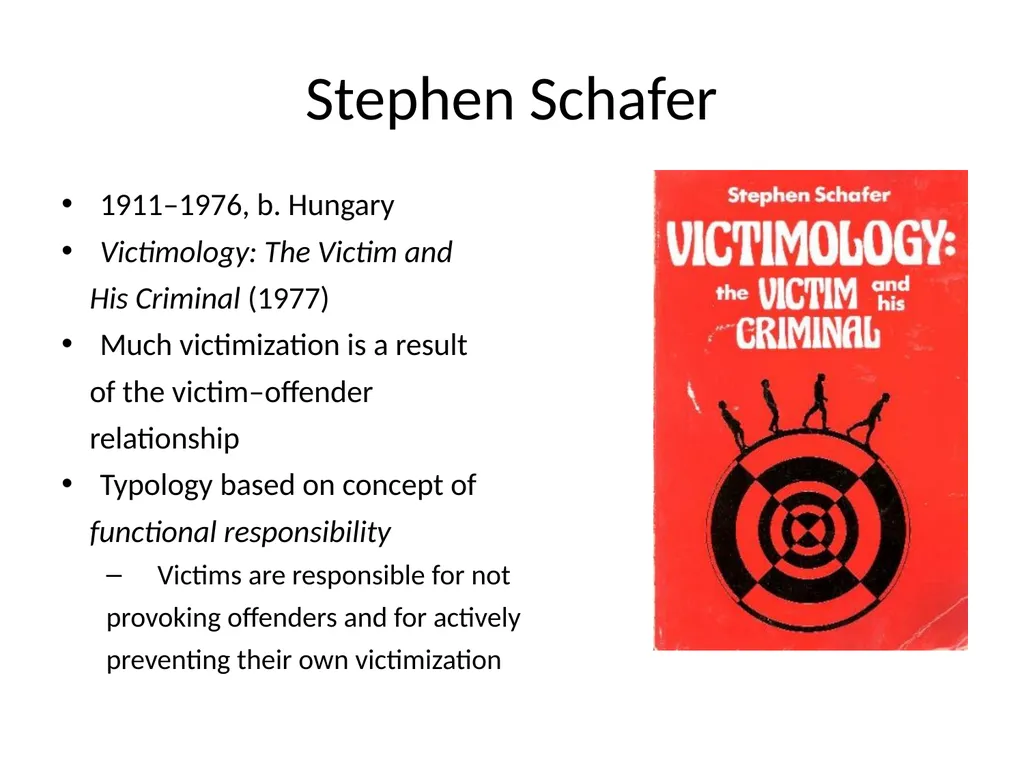
Stephen Schafer 1911‒1976, b. Hungary
Victimology: The Victim and
His Criminal (1977)
Much victimization is a result
of the victim‒offender
relationship
Typology based on concept of
functional responsibility
Victims are responsible for not
provoking offenders and for actively
preventing their own victimization<br>
12
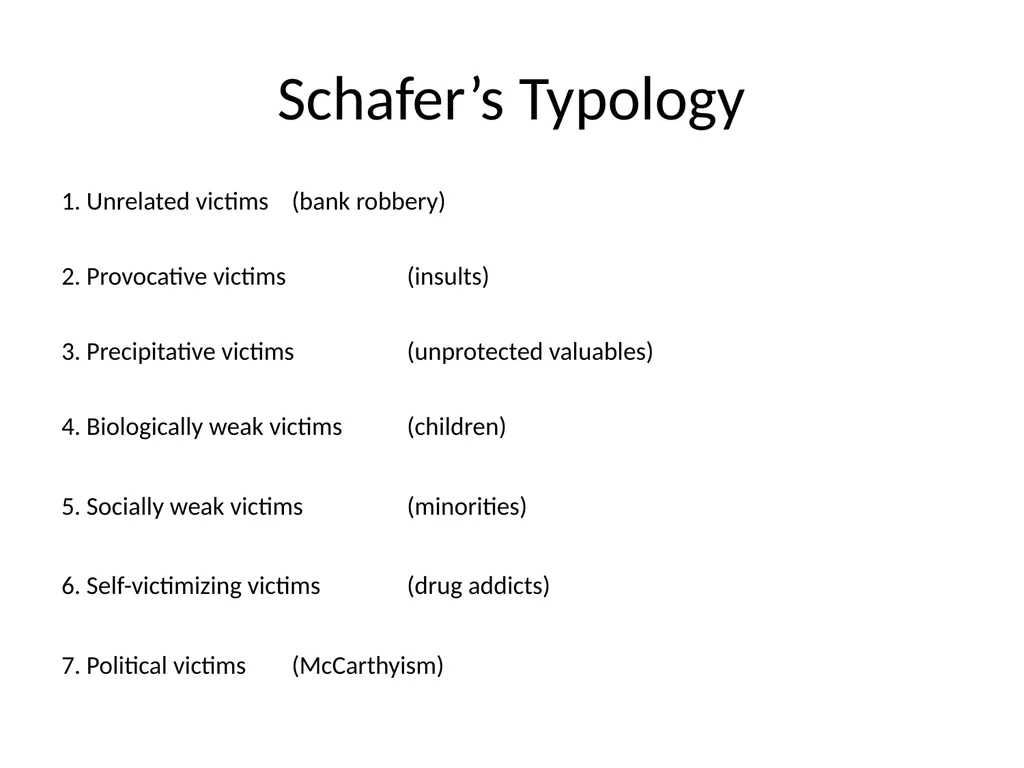
Schafer’s Typology 1. Unrelated victims (bank robbery)
2. Provocative victims (insults)
3. Precipitative victims (unprotected valuables)
4. Biologically weak victims (children)
5. Socially weak victims (minorities)
6. Self-victimizing victims (drug addicts)
7. Political victims (McCarthyism)<br>
13
Marvin E. Wolfgang 1924‒1998
Patterns in Criminal Homicide
(1957)
Examined victim-precipitated
homicide
First to use official data
Philadelphia Police Dept. homicides from 1948 to 1952
588 homicide victims, 26% victim precipitated<br>
14
Sellin and Wolfgang’s Typology 1. Primary victimization
Individuals personally victimized by offenders
Robbery
2. Secondary victimization
Impersonal targets
Shoplifting
3. Tertiary victimization
Public or society at large
4. Mutual victimization
Victim consents and is also an offender
Assisted suicide
5. No victimization
No victim or offense is minor and unrecognizable<br>
15
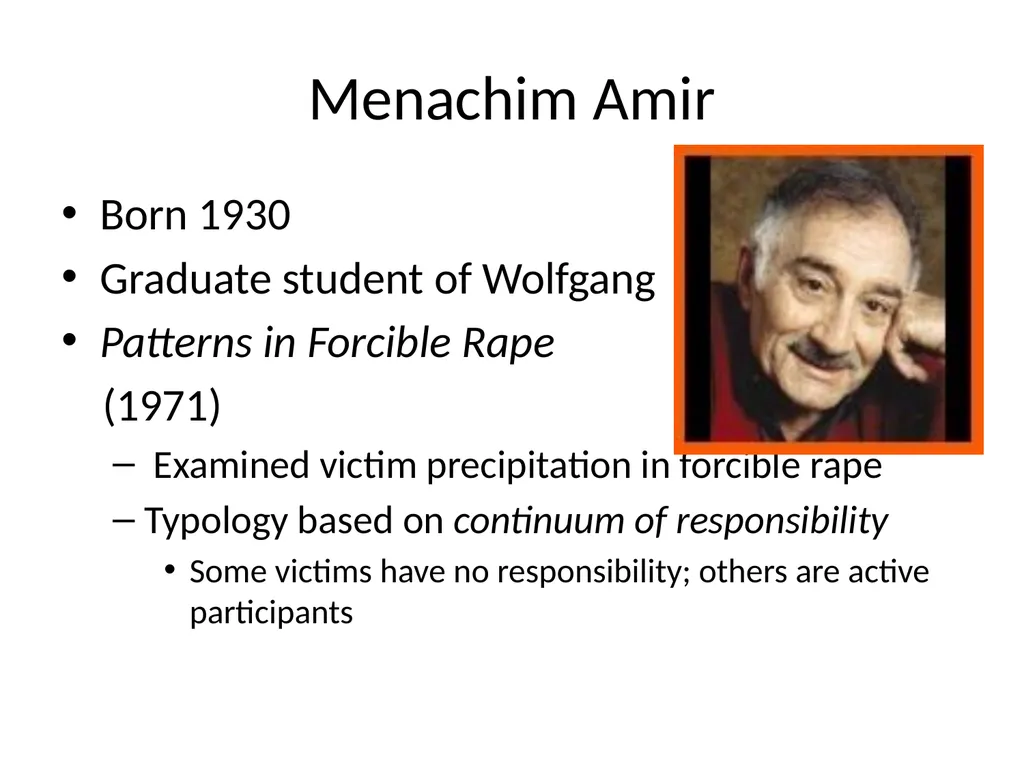
Menachim Amir Born 1930
Graduate student of Wolfgang
Patterns in Forcible Rape
(1971)
Examined victim precipitation in forcible rape
Typology based on continuum of responsibility
Some victims have no responsibility; others are active participants<br>
16
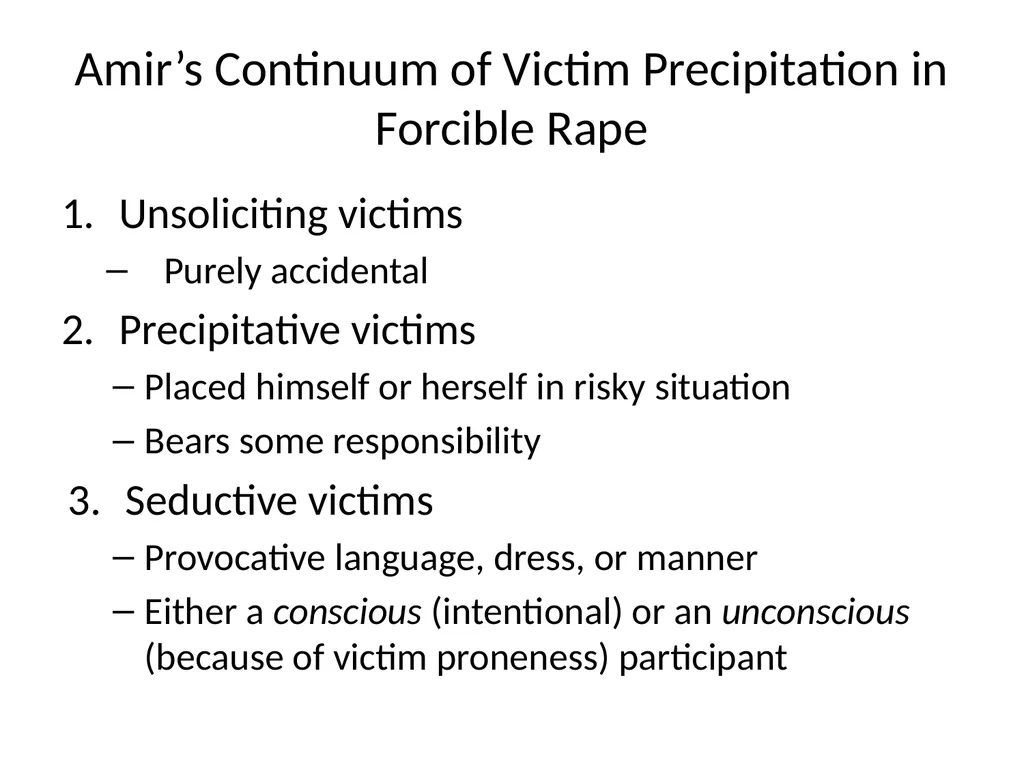
Amir’s Continuum of Victim Precipitation in Forcible Rape Unsoliciting victims
Purely accidental
Precipitative victims
Placed himself or herself in risky situation
Bears some responsibility
Seductive victims
Provocative language, dress, or manner
Either a conscious (intentional) or an unconscious (because of victim proneness) participant<br>
17
Criticisms of Amir’s Typology Implies that some victims have a psychological, unconscious desire to be raped
Based on rapist’s perception of behavior
Victim blaming
Led to rejection of Amir’s work, as well as stopping the progression of victim precipitation as an explanation for victimization<br>
18
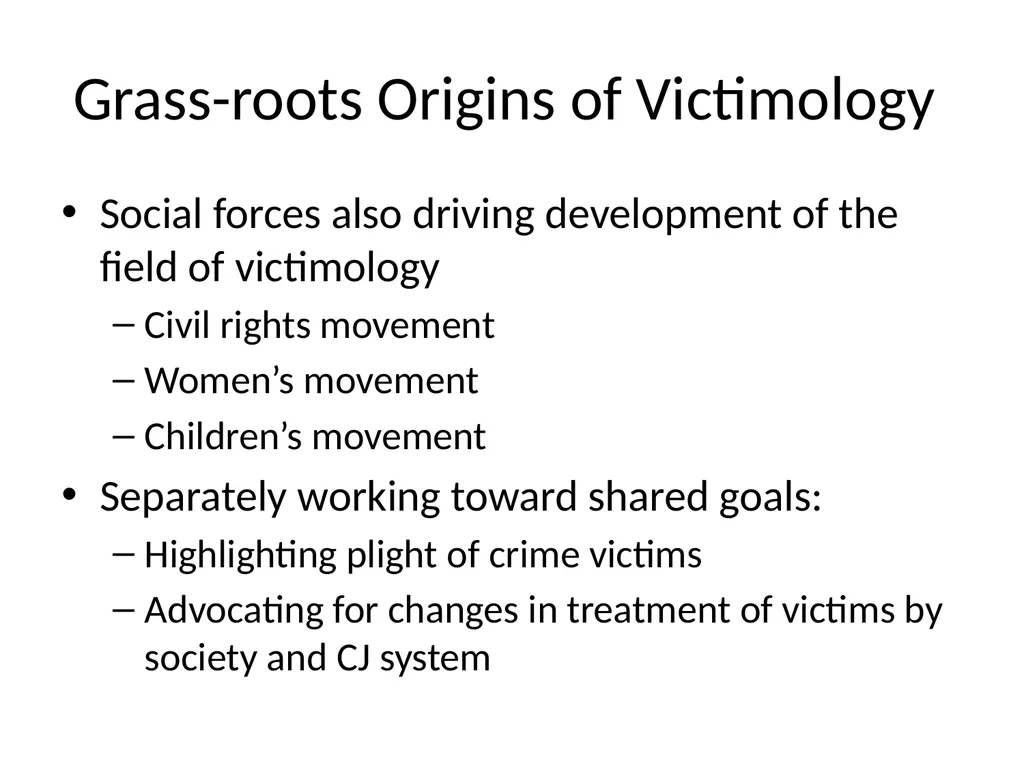
Grass-roots Origins of Victimology Social forces also driving development of the field of victimology
Civil rights movement
Women’s movement
Children’s movement
Separately working toward shared goals:
Highlighting plight of crime victims
Advocating for changes in treatment of victims by society and CJ system<br>
19
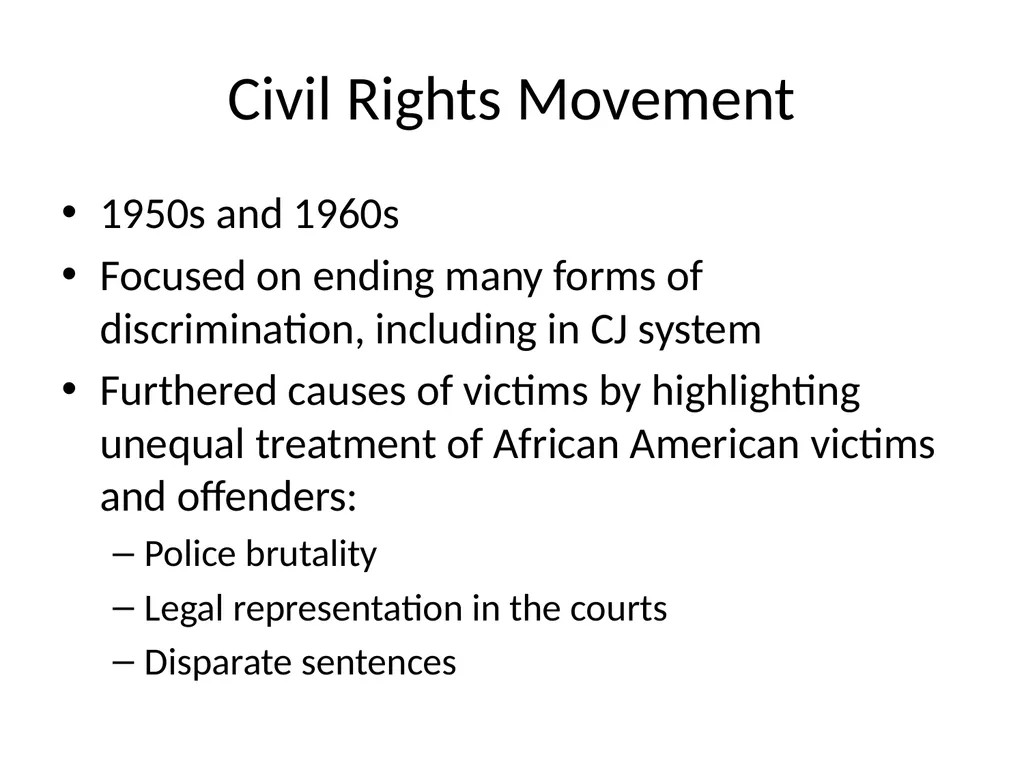
Civil Rights Movement 1950s and 1960s
Focused on ending many forms of discrimination, including in CJ system
Furthered causes of victims by highlighting unequal treatment of African American victims and offenders:
Police brutality
Legal representation in the courts
Disparate sentences<br>
20
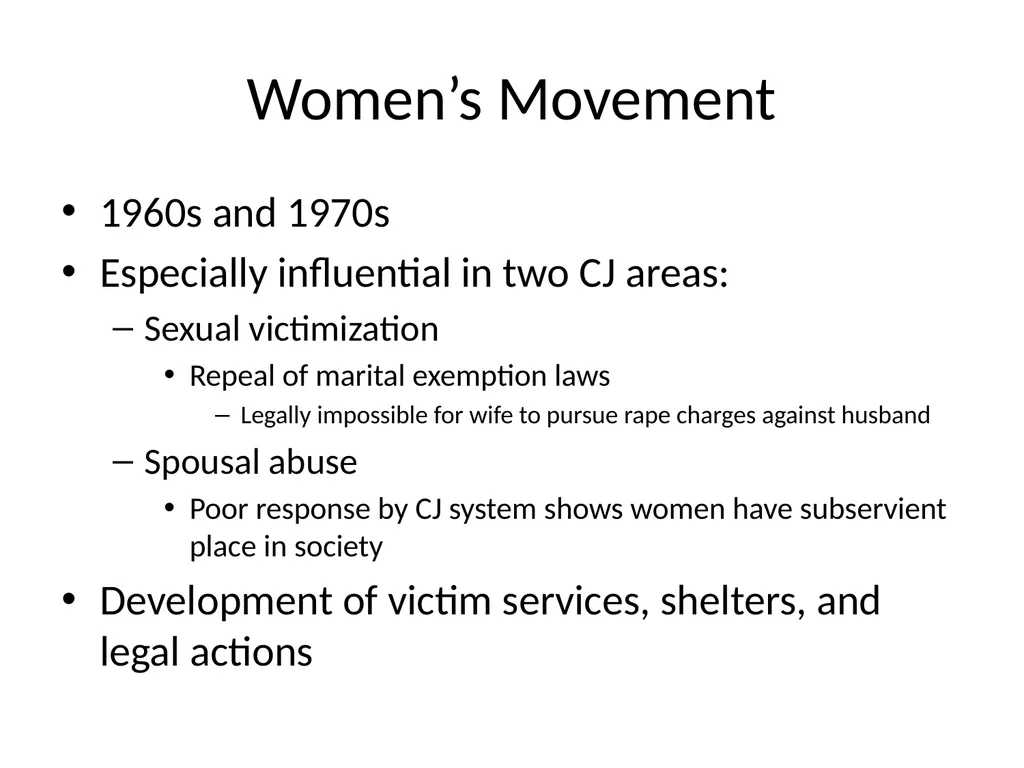
Women’s Movement 1960s and 1970s
Especially influential in two CJ areas:
Sexual victimization
Repeal of marital exemption laws
Legally impossible for wife to pursue rape charges against husband
Spousal abuse
Poor response by CJ system shows women have subservient place in society
Development of victim services, shelters, and legal actions<br>
21
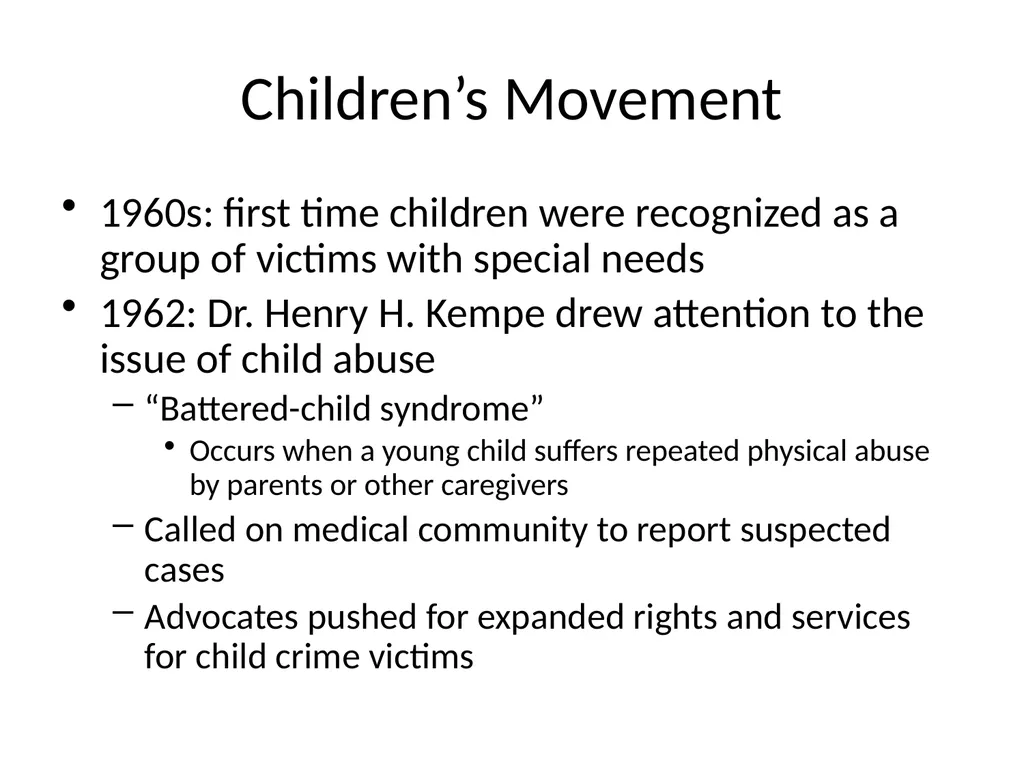
Children’s Movement 1960s: first time children were recognized as a group of victims with special needs
1962: Dr. Henry H. Kempe drew attention to the issue of child abuse
“Battered-child syndrome”
Occurs when a young child suffers repeated physical abuse by parents or other caregivers
Called on medical community to report suspected cases
Advocates pushed for expanded rights and services for child crime victims<br>
22
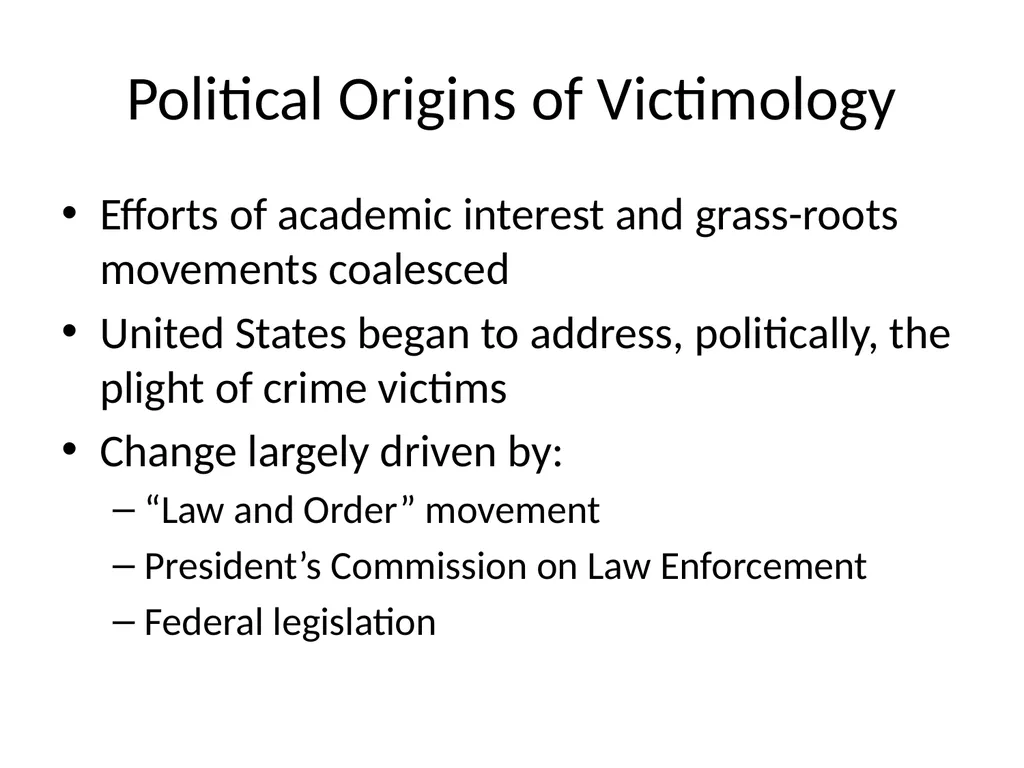
Political Origins of Victimology Efforts of academic interest and grass-roots movements coalesced
United States began to address, politically, the plight of crime victims
Change largely driven by:
“Law and Order” movement
President’s Commission on Law Enforcement
Federal legislation<br>
23
“Law and Order” Movement 1960s and 1970s
Based on particular crime-control philosophy
Swift justice
Harsh punishments
CJ efficiency
Support for victims’ rights
Victims’ changing roles in CJ process<br>
24
President’s Commission on Law Enforcement 1960s
Law Enforcement Assistance Act (LEAA)
1965
Office of Law Enforcement Assistance
The Challenge of Crime in a Free Society
1967
Recommendation for CJ response to victims, among other issues addressed<br>
25
Federal Legislation 1980s and 1990s
Many federal laws passed
For example:
Child Abuse Prevention and Treatment Act, 1975
Victims of Crime Act, 1984
Violence against Women Act, 1994
“Megan’s Law,” 1996<br>
26
Summary of Origins of Victimology First-generation academic origins
Assessed degree to which victims contribute to criminal events through precipitation, facilitation, and provocation
Development of typologies, early empirical research
Grass-roots origins
Separate social justice movements
Aimed at improving lives of marginalized groups, including crime victims
Political origins
Changes in policy and law related to victims<br>