History of Forensic Science Major Developments in the History of Forensic Science 700 AD: Chinese used fingerprints to establish identity of documents and clay sculptures. 1000: Roman courts determined that bloody palm prints were used to
"History of Forensic Science Major Developments in" is the property of its rightful owner. Permission is granted to
download and print the materials on this website for personal, non-commercial use only, and to display it
on your personal computer provided you do not modify the materials and that you retain all copyright
notices contained in the materials. By downloading content from our website, you accept the terms of this
agreement.
Presentation Transcript
01
History of Forensic Science<br>
02
Major Developments in the History of Forensic Science 700 AD: Chinese used fingerprints to establish identity of documents and clay sculptures.
1000: Roman courts determined that bloody palm prints were used to frame a man in his brother’s murder.
1149: King Richard of England introduced the idea of the coroner to investigate questionable deaths.
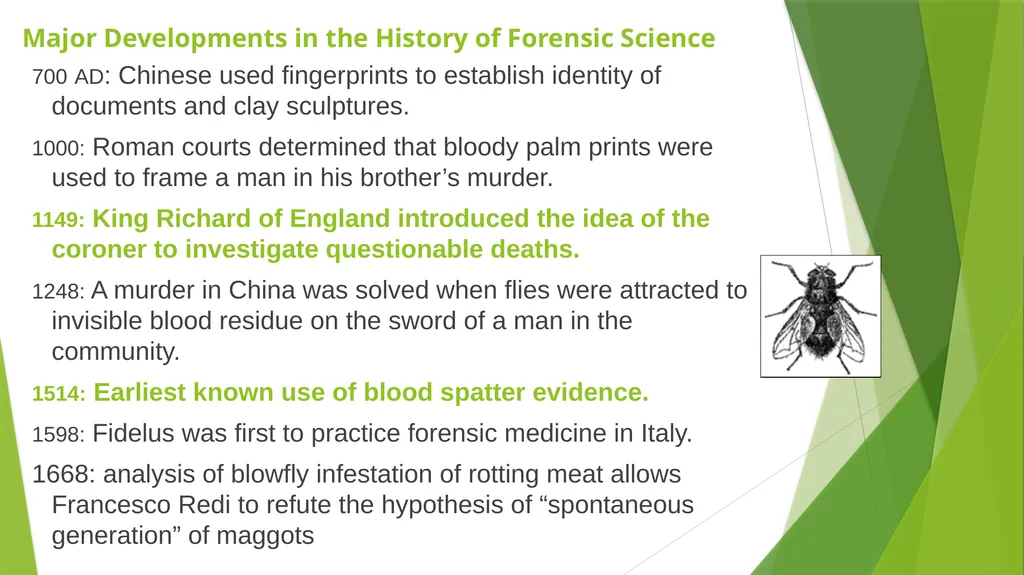
1248: A murder in China was solved when flies were attracted to invisible blood residue on the sword of a man in the community.
1514: Earliest known use of blood spatter evidence.
1598: Fidelus was first to practice forensic medicine in Italy.
1668: analysis of blowfly infestation of rotting meat allows Francesco Redi to refute the hypothesis of “spontaneous generation” of maggots<br>
03
1670: Anton Van Leeuwenhoek constructed the first high-powered microscope.
1776: Paul Revere identified the body of General Joseph Warren based on the false teeth he had made for him.
1784: John Toms was convicted of murder on the basis of the torn edge of a wad of paper in a pistol matching a piece of paper in his pocket.
1810: First recorded use of questioned document analysis involving chemical test for a particular dye
1816: A farm laborer is convicted of murder based upon impression evidence
1840: Forensic toxicology is first used to convict Marie Lafarge, by use of the March test (detects arsenic compounds), of poisoning her husband.
1856: Herschel uses thumbprints on documents to identify workers
1859: Gustav Kirchhoff and Robert Bunsen developed the science of spectroscopy. Major Developments in the History of Forensic Science, continued<br>
04
1863: The first presumptive test for blood is developed (hydrogen peroxide)
1864: Crime scene photography developed.
1879: Alphonse Bertillon developed a system to identify people using particular body measurements.
1889: Alexandre Lacassagne publishes a text on matching bullets to individual gun barrels
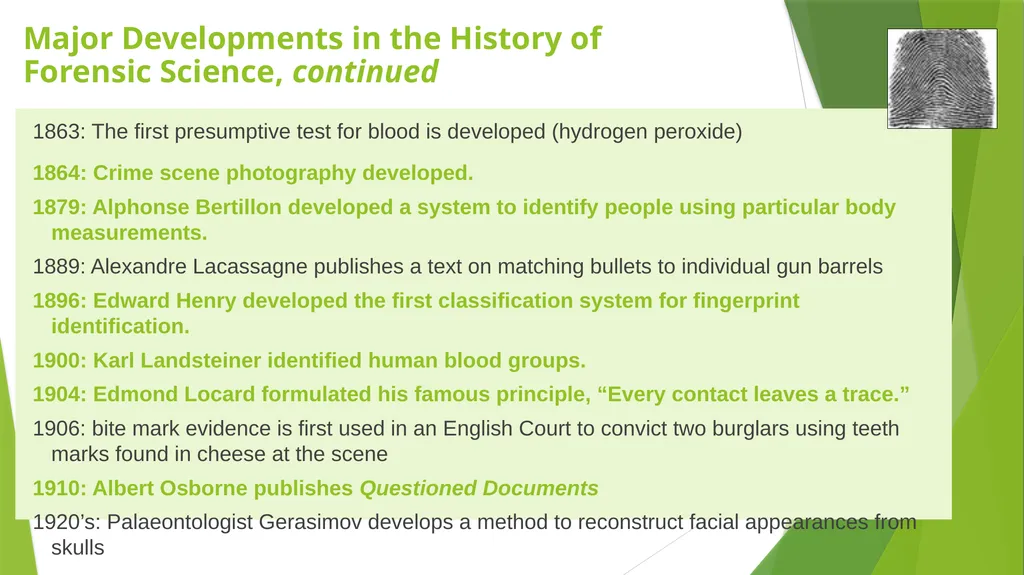
1896: Edward Henry developed the first classification system for fingerprint identification.
1900: Karl Landsteiner identified human blood groups.
1904: Edmond Locard formulated his famous principle, “Every contact leaves a trace.”
1906: bite mark evidence is first used in an English Court to convict two burglars using teeth marks found in cheese at the scene
1910: Albert Osborne publishes Questioned Documents
1920’s: Palaeontologist Gerasimov develops a method to reconstruct facial appearances from skulls Major Developments in the History of Forensic Science, continued<br>
05
1922: Francis Aston developed the mass spectrometer.
1932: The FBI crime laboratory is created
1959: James Watson and Francis Crick discovered the DNA double helix.
1972: The Forensic Anthropology Center (aka “The Body Farm”) is started at the University of Tennessee.
1975: Federal Rules of Evidence are enacted
1977: AFIS developed by the FBI; fully automated in 1996.
1984: Jeffreys developed and used the first DNA tests to be applied to a criminal case.
1986: The polymerase chain reaction (PCR) is developed to replicate DNA for forensics
1992: DNA short tandem repeats (STR) are used in forensic DNA analysis
1998: FBI index of DNA profiles is formed, CODIS (combined DNA Index System) Major Developments in the History of Forensic Science, continued<br>
06
Forensic Scientists<br>
07
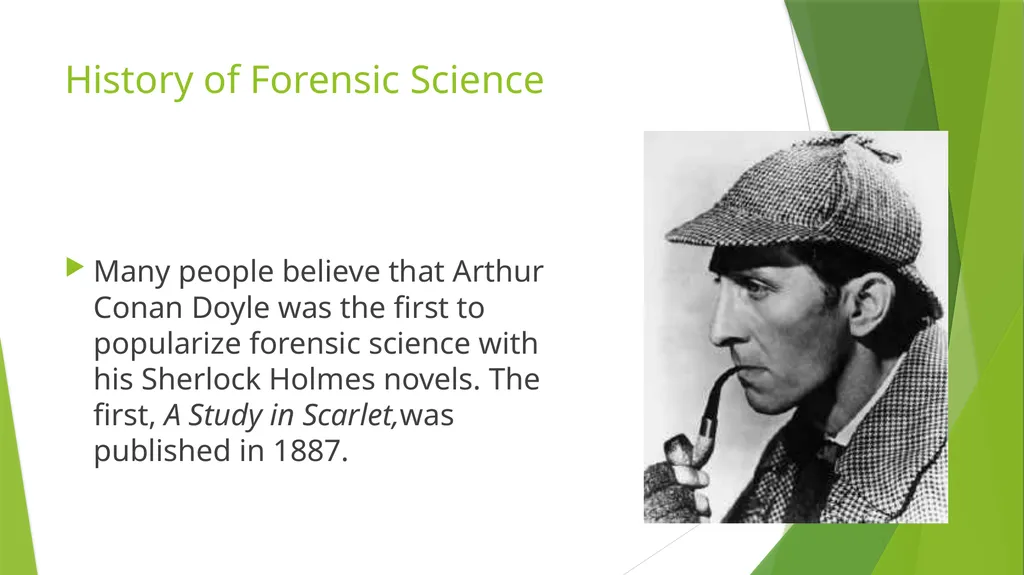
History of Forensic Science Many people believe that Arthur Conan Doyle was the first to popularize forensic science with his Sherlock Holmes novels. The first, A Study in Scarlet,was published in 1887.<br>
08
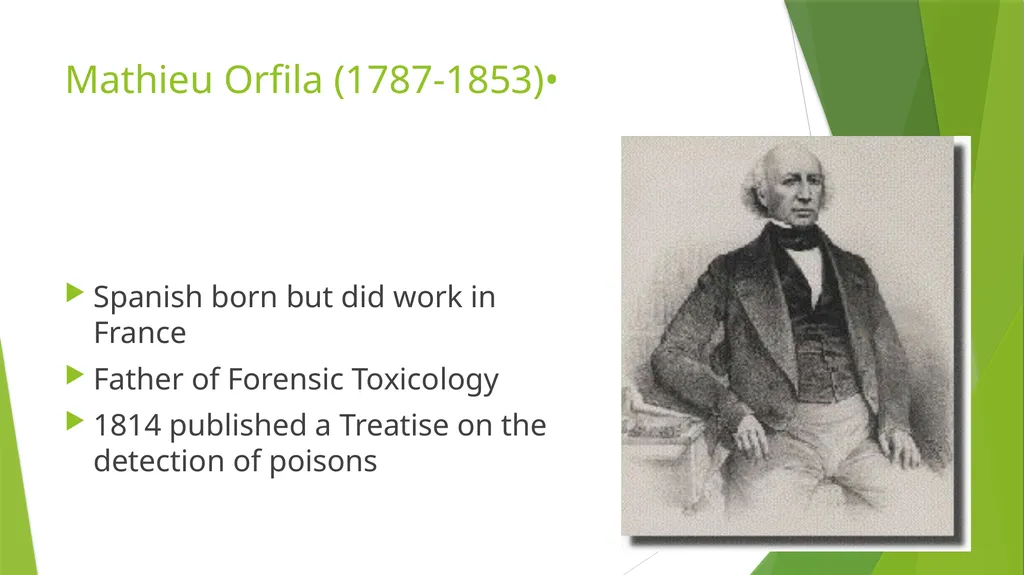
Mathieu Orfila (1787-1853)• Spanish born but did work in France
Father of Forensic Toxicology
1814 published a Treatise on the detection of poisons<br>
09
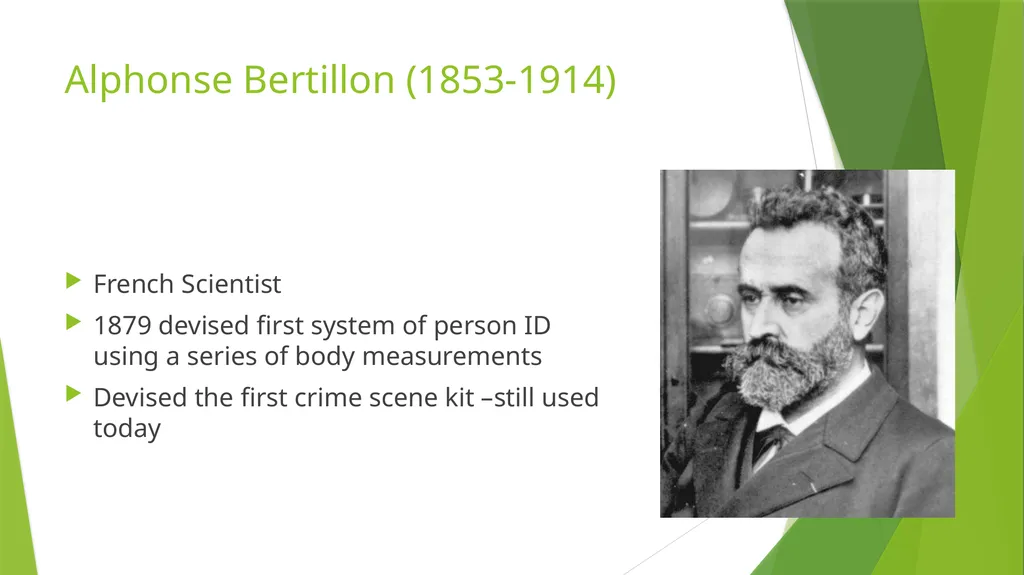
Alphonse Bertillon (1853-1914) French Scientist
1879 devised first system of person ID using a series of body measurements
Devised the first crime scene kit –still used today<br>
10
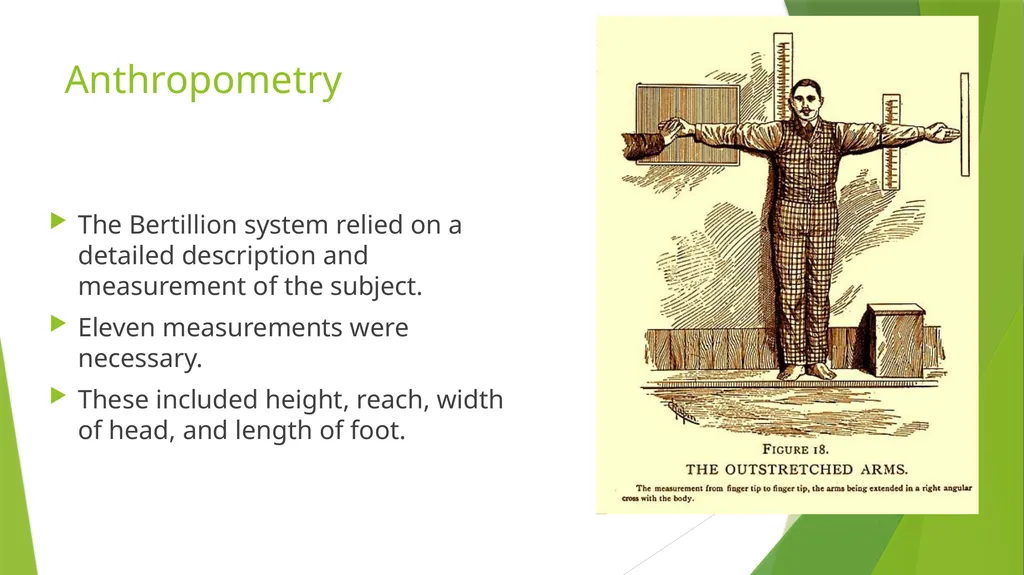
Anthropometry The Bertillion system relied on a detailed description and measurement of the subject.
Eleven measurements were necessary.
These included height, reach, width of head, and length of foot.<br>
11
Will West/William West The down fall of Anthropometry occurred in 1903 at Leavenworth Federal Prison. A prisoner named Will West was brought to the prison and had his measurements taken. His measurements matched a prisoner already in the prison named William West. Despite the system there was no way to tell the two apart. The only noticeable difference between the two men was their fingerprints. Thus Anthropometry was abandoned and the fingerprint (Henry) system was adopted.<br>
12
Francis) Galton (1822-1911) British Scientist.
1892 published the book “Finger Prints”which contained the 1ststatistical proof supporting the uniqueness of fingerprints.
Laid the foundation of modern fingerprints.<br>
13
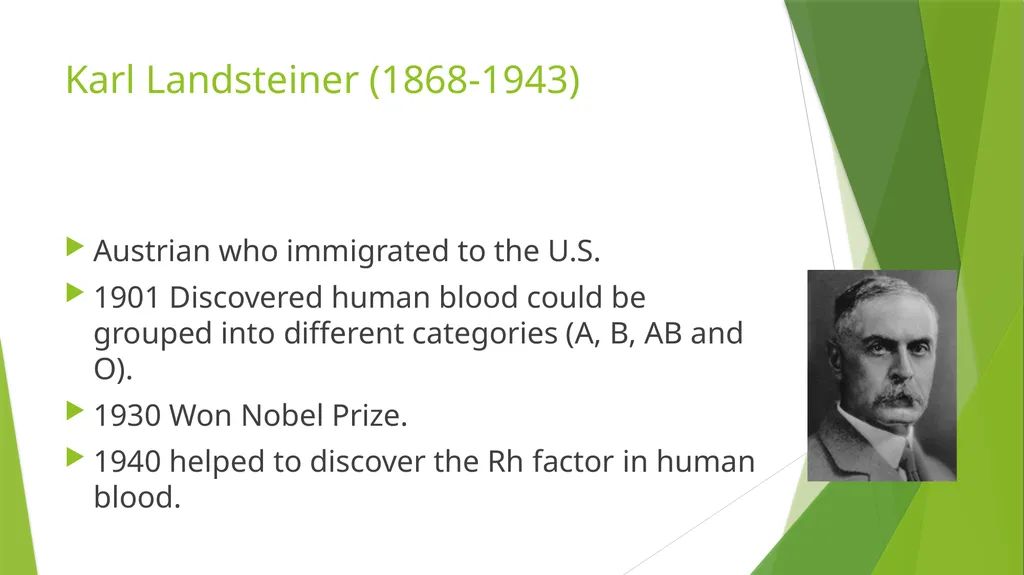
Karl Landsteiner (1868-1943) Austrian who immigrated to the U.S.
1901 Discovered human blood could be grouped into different categories (A, B, AB and O).
1930 Won Nobel Prize.
1940 helped to discover the Rh factor in human blood.<br>
14
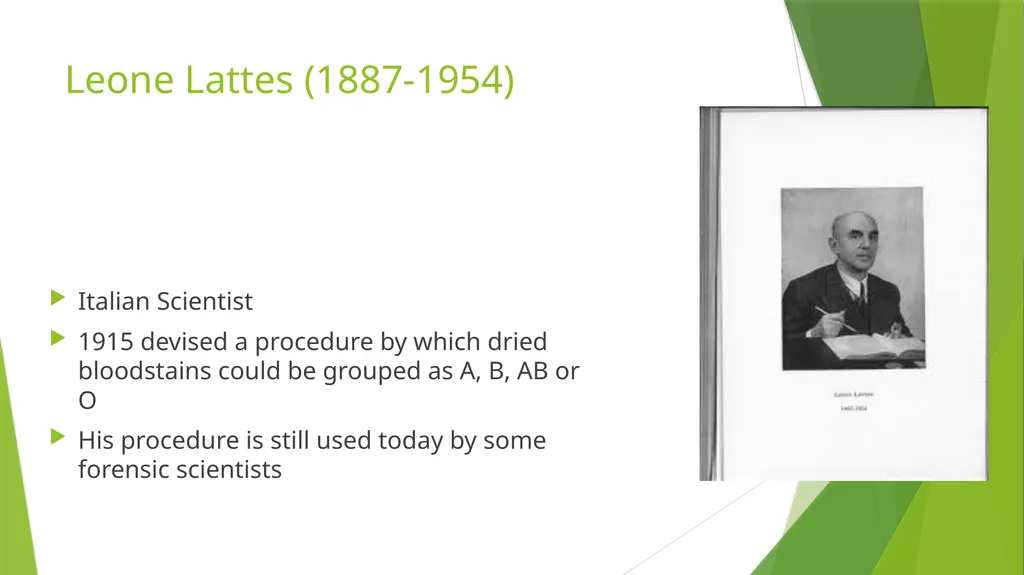
Leone Lattes (1887-1954) Italian Scientist
1915 devised a procedure by which dried bloodstains could be grouped as A, B, AB or O
His procedure is still used today by some forensic scientists<br>
15
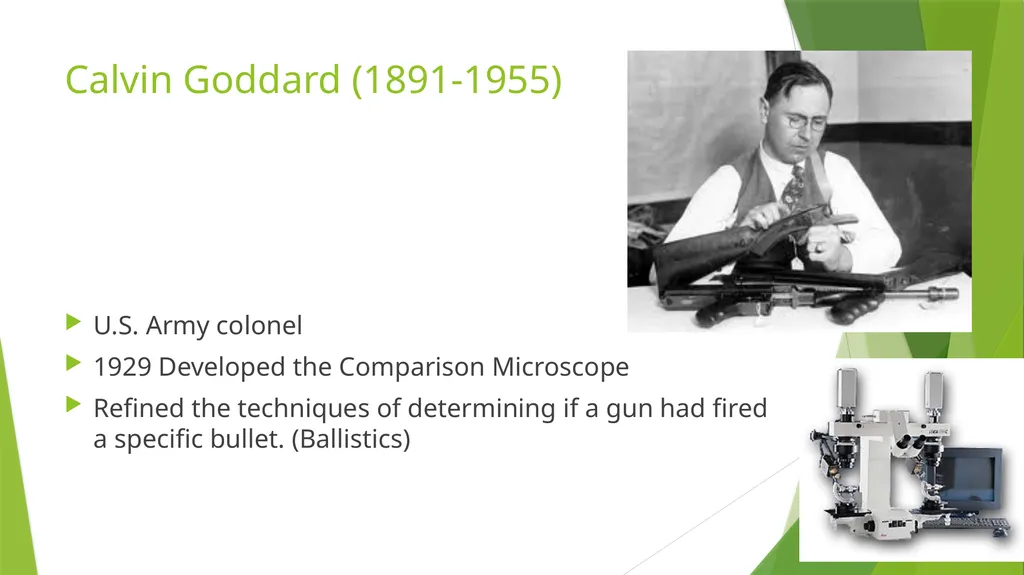
Calvin Goddard (1891-1955) U.S. Army colonel
1929 Developed the Comparison Microscope
Refined the techniques of determining if a gun had fired a specific bullet. (Ballistics)<br>
16
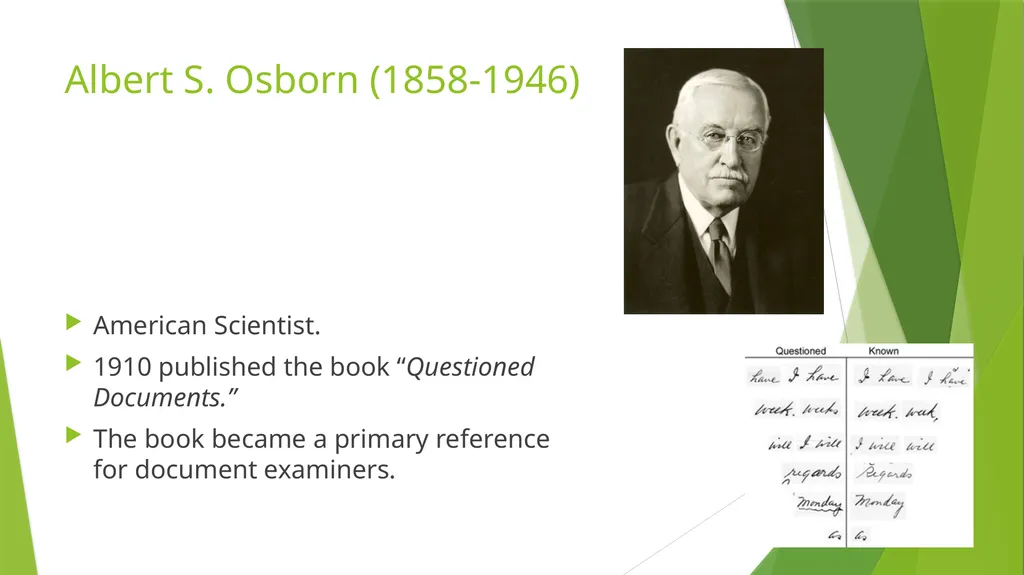
Albert S. Osborn (1858-1946) American Scientist.
1910 published the book “Questioned Documents.”
The book became a primary reference for document examiners.<br>
17
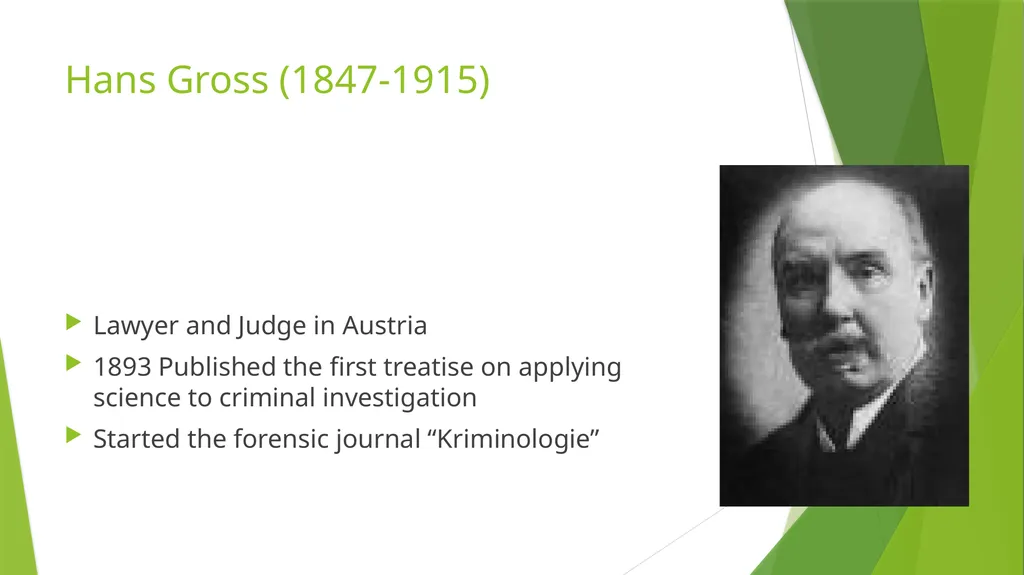
Hans Gross (1847-1915) Lawyer and Judge in Austria
1893 Published the first treatise on applying science to criminal investigation
Started the forensic journal “Kriminologie”<br>
18
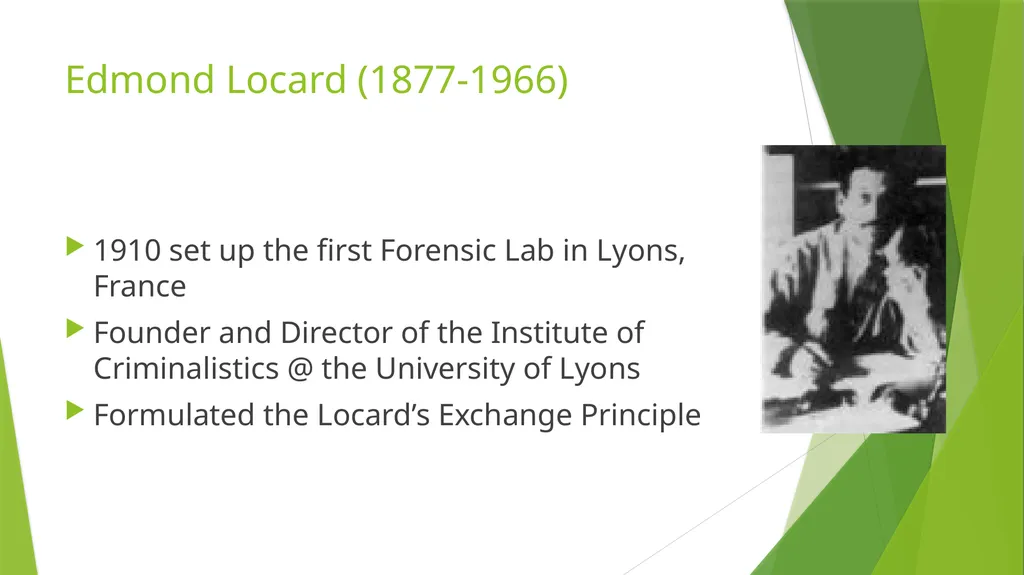
Edmond Locard (1877-1966) 1910 set up the first Forensic Lab in Lyons, France
Founder and Director of the Institute of Criminalistics @ the University of Lyons
Formulated the Locard’s Exchange Principle<br>
19
Locard’s Exchange Principle When a criminal comes in contact with an object or person, a cross-transfer of evidence occurs
The criminal either removes something from the crime scene or leaves something behind
Either way this exchange can link the criminal to the crime scene<br>
20
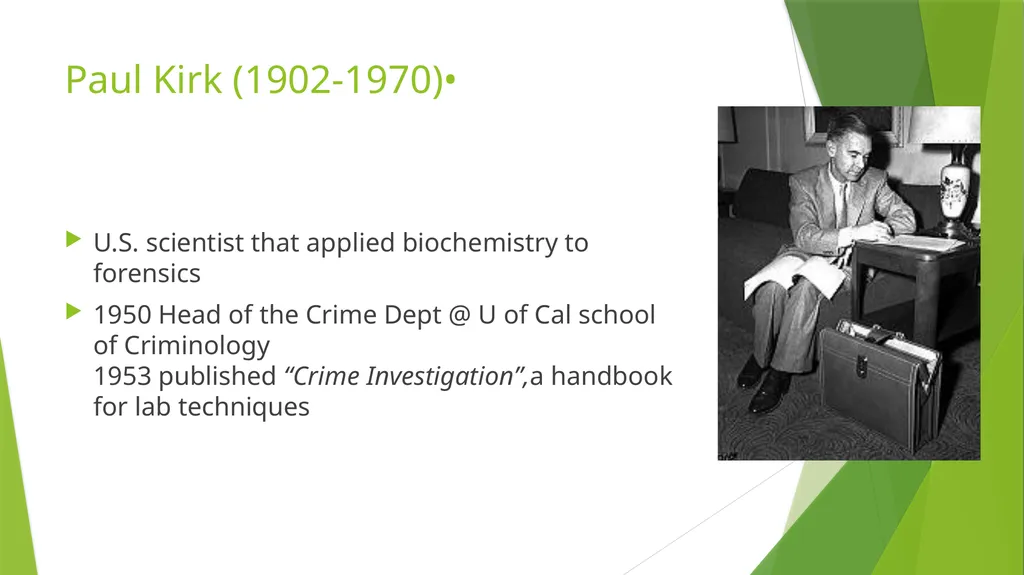
Paul Kirk (1902-1970)• U.S. scientist that applied biochemistry to forensics
1950 Head of the Crime Dept @ U of Cal school of Criminology 1953 published “Crime Investigation”,a handbook for lab techniques<br>
21
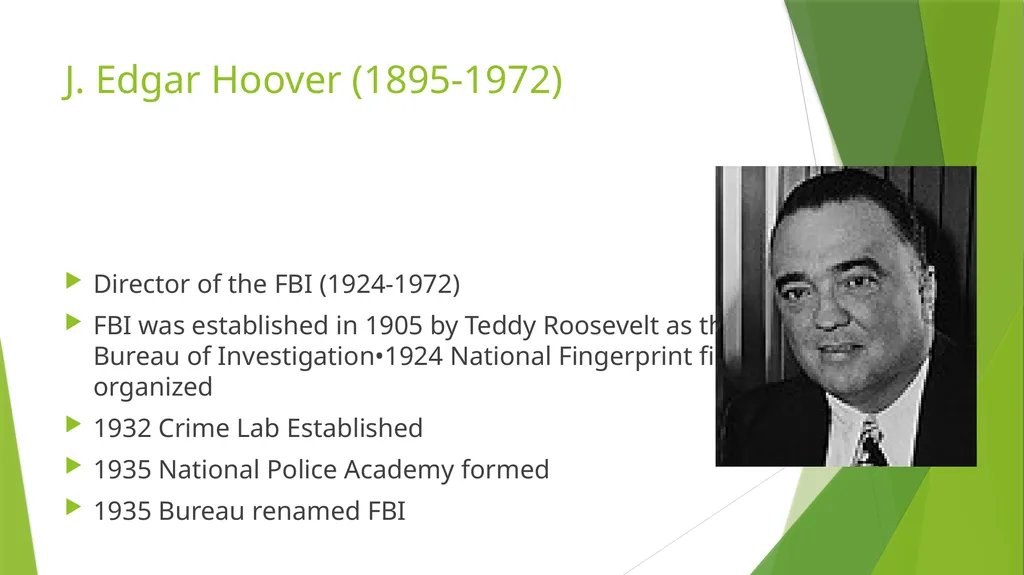
J. Edgar Hoover (1895-1972) Director of the FBI (1924-1972)
FBI was established in 1905 by Teddy Roosevelt as the Bureau of Investigation•1924 National Fingerprint file organized
1932 Crime Lab Established
1935 National Police Academy formed
1935 Bureau renamed FBI<br>