
Hobart Consultation Summary Fourth Action Plan of
EM
Published · 10 slides · 0 views
1 / 1

Description
Hobart Consultation Summary Fourth Action Plan of the National Plan to Reduce Violence against Women and their Children 2010-2022 Summary of Consultation - 21 September 2018 Community engagement workshops facilitated by ThinkPlace, and
Related Topics
Share
Embed code
Download this presentation From Below
"Hobart Consultation Summary Fourth Action Plan of" is the property of its rightful owner. Permission is granted to download and print the materials on this website for personal, non-commercial use only, and to display it on your personal computer provided you do not modify the materials and that you retain all copyright notices contained in the materials. By downloading content from our website, you accept the terms of this agreement.
Presentation Transcript
01
Hobart Consultation Summary Fourth Action Plan of the National Plan to Reduce Violence against Women and their Children 2010-2022
Summary of Consultation - 21 September 2018 Community engagement workshops facilitated by ThinkPlace, and report written in collaboration between ThinkPlace and DSS.<br>
Summary of Consultation - 21 September 2018 Community engagement workshops facilitated by ThinkPlace, and report written in collaboration between ThinkPlace and DSS.<br>
02
The Department of Social Services acknowledges the traditional owners of country throughout Australia, and their continuing connection to land, water and community.
We pay our respects to them and their cultures, and to Elders past, present and emerging.<br>
03
Fourth Action Plan of the National Plan to Reduce Violence Against Women and Their Children - Consultation Workshop Summary About this document This material was commissioned by the Commonwealth of Australia to assist in the collection of information from consultation sessions workshops around Australia. The purpose of this material is to summarise consultations held by the Department of Social Services as part of the development of the Fourth Action Plan in Hobart, Tasmania. This session was facilitated by ThinkPlace.
The Department of Social Services thanks all participants of this discussion for their contributions as part of the development of the Fourth Action Plan. The views expressed in this material do not necessarily reflect those of the Commonwealth, or indicate a particular course of action.
Copyright notice — 2018
This document is licensed under the Creative Commons Attribution 4.0 International Licence Licence URL: https://creativecommons.org/licenses/by/4.0/legalcode Please attribute: © Commonwealth of Australia (Department of Social Services) 2018 Notice identifying other material or rights in this publication: 1. Australian Commonwealth Coat of Arms — not Licensed under Creative Commons, see https://www.itsanhonour.gov.au/coat-arms/index.cfm 2. Certain images and photographs (as marked) — not licensed under Creative Commons’ 3<br>
The Department of Social Services thanks all participants of this discussion for their contributions as part of the development of the Fourth Action Plan. The views expressed in this material do not necessarily reflect those of the Commonwealth, or indicate a particular course of action.
Copyright notice — 2018
This document is licensed under the Creative Commons Attribution 4.0 International Licence Licence URL: https://creativecommons.org/licenses/by/4.0/legalcode Please attribute: © Commonwealth of Australia (Department of Social Services) 2018 Notice identifying other material or rights in this publication: 1. Australian Commonwealth Coat of Arms — not Licensed under Creative Commons, see https://www.itsanhonour.gov.au/coat-arms/index.cfm 2. Certain images and photographs (as marked) — not licensed under Creative Commons’ 3<br>
04
Key themes 4<br>
05
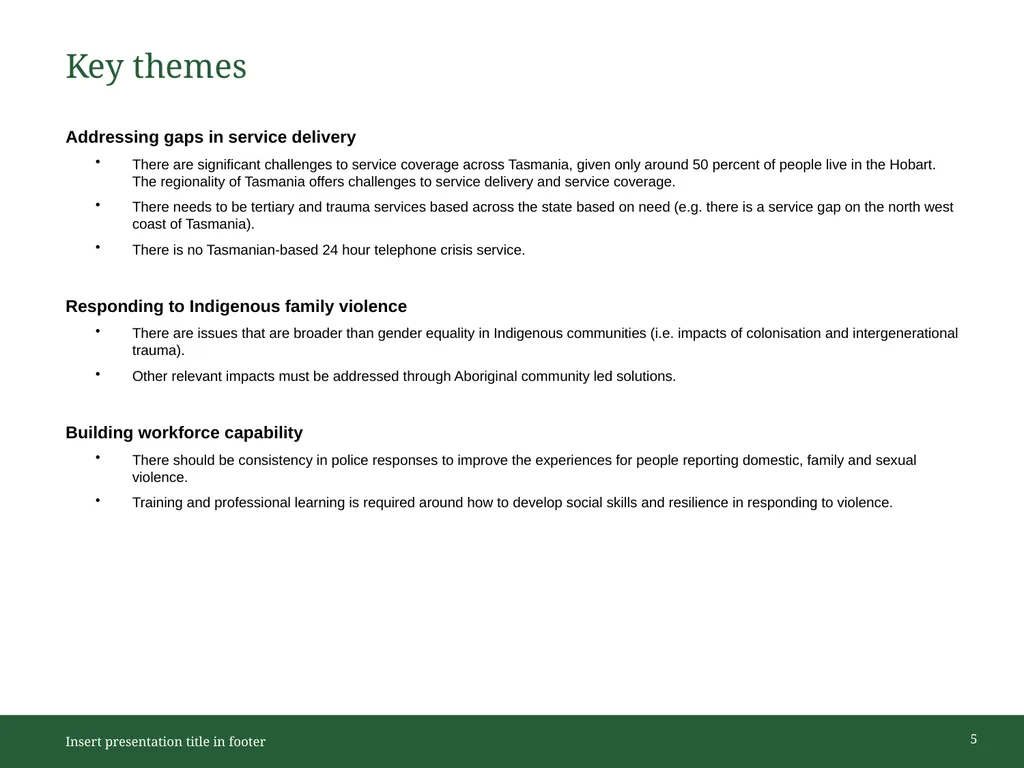
Insert presentation title in footer Key themes Addressing gaps in service delivery
There are significant challenges to service coverage across Tasmania, given only around 50 percent of people live in the Hobart. The regionality of Tasmania offers challenges to service delivery and service coverage.
There needs to be tertiary and trauma services based across the state based on need (e.g. there is a service gap on the north west coast of Tasmania).
There is no Tasmanian-based 24 hour telephone crisis service.
Responding to Indigenous family violence
There are issues that are broader than gender equality in Indigenous communities (i.e. impacts of colonisation and intergenerational trauma).
Other relevant impacts must be addressed through Aboriginal community led solutions.
Building workforce capability
There should be consistency in police responses to improve the experiences for people reporting domestic, family and sexual violence.
Training and professional learning is required around how to develop social skills and resilience in responding to violence. 5<br>
There are significant challenges to service coverage across Tasmania, given only around 50 percent of people live in the Hobart. The regionality of Tasmania offers challenges to service delivery and service coverage.
There needs to be tertiary and trauma services based across the state based on need (e.g. there is a service gap on the north west coast of Tasmania).
There is no Tasmanian-based 24 hour telephone crisis service.
Responding to Indigenous family violence
There are issues that are broader than gender equality in Indigenous communities (i.e. impacts of colonisation and intergenerational trauma).
Other relevant impacts must be addressed through Aboriginal community led solutions.
Building workforce capability
There should be consistency in police responses to improve the experiences for people reporting domestic, family and sexual violence.
Training and professional learning is required around how to develop social skills and resilience in responding to violence. 5<br>
06
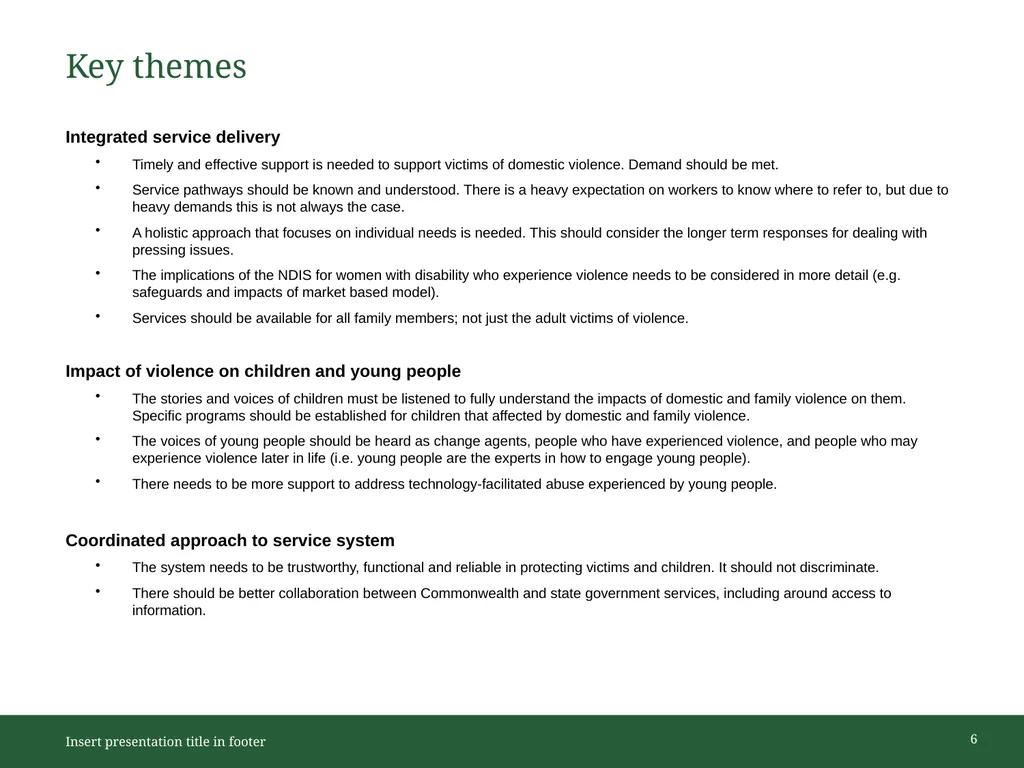
Insert presentation title in footer Key themes Integrated service delivery
Timely and effective support is needed to support victims of domestic violence. Demand should be met.
Service pathways should be known and understood. There is a heavy expectation on workers to know where to refer to, but due to heavy demands this is not always the case.
A holistic approach that focuses on individual needs is needed. This should consider the longer term responses for dealing with pressing issues.
The implications of the NDIS for women with disability who experience violence needs to be considered in more detail (e.g. safeguards and impacts of market based model).
Services should be available for all family members; not just the adult victims of violence.
Impact of violence on children and young people
The stories and voices of children must be listened to fully understand the impacts of domestic and family violence on them. Specific programs should be established for children that affected by domestic and family violence.
The voices of young people should be heard as change agents, people who have experienced violence, and people who may experience violence later in life (i.e. young people are the experts in how to engage young people).
There needs to be more support to address technology-facilitated abuse experienced by young people.
Coordinated approach to service system
The system needs to be trustworthy, functional and reliable in protecting victims and children. It should not discriminate.
There should be better collaboration between Commonwealth and state government services, including around access to information. 6<br>
Timely and effective support is needed to support victims of domestic violence. Demand should be met.
Service pathways should be known and understood. There is a heavy expectation on workers to know where to refer to, but due to heavy demands this is not always the case.
A holistic approach that focuses on individual needs is needed. This should consider the longer term responses for dealing with pressing issues.
The implications of the NDIS for women with disability who experience violence needs to be considered in more detail (e.g. safeguards and impacts of market based model).
Services should be available for all family members; not just the adult victims of violence.
Impact of violence on children and young people
The stories and voices of children must be listened to fully understand the impacts of domestic and family violence on them. Specific programs should be established for children that affected by domestic and family violence.
The voices of young people should be heard as change agents, people who have experienced violence, and people who may experience violence later in life (i.e. young people are the experts in how to engage young people).
There needs to be more support to address technology-facilitated abuse experienced by young people.
Coordinated approach to service system
The system needs to be trustworthy, functional and reliable in protecting victims and children. It should not discriminate.
There should be better collaboration between Commonwealth and state government services, including around access to information. 6<br>
07
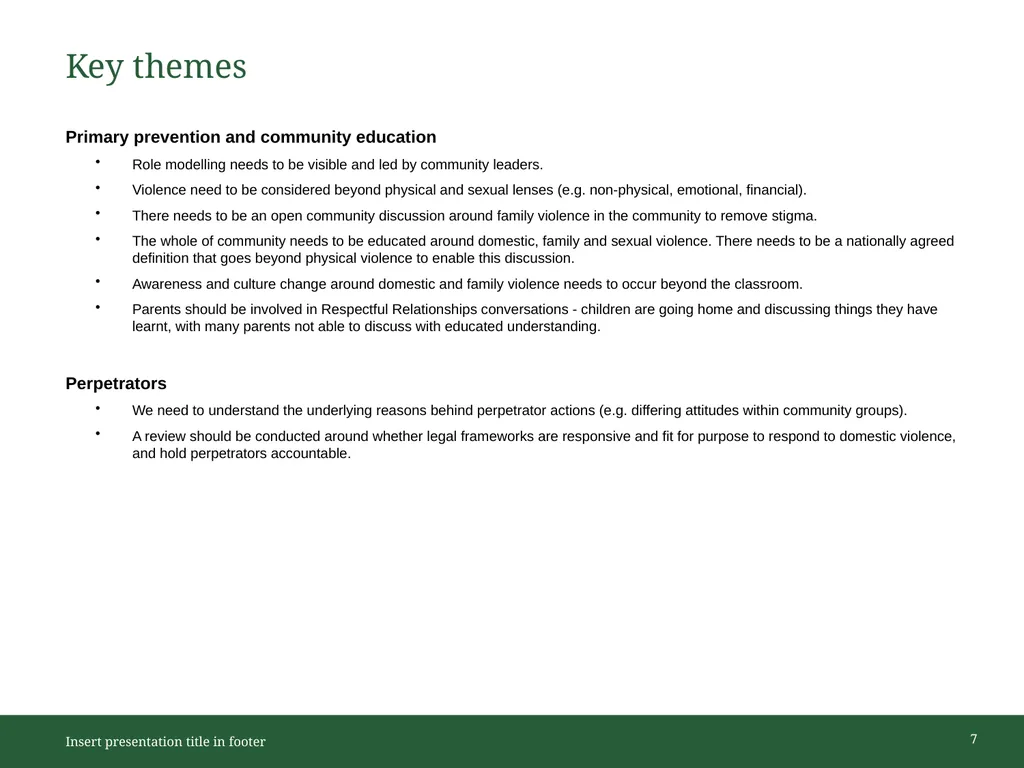
Insert presentation title in footer Key themes Primary prevention and community education
Role modelling needs to be visible and led by community leaders.
Violence need to be considered beyond physical and sexual lenses (e.g. non-physical, emotional, financial).
There needs to be an open community discussion around family violence in the community to remove stigma.
The whole of community needs to be educated around domestic, family and sexual violence. There needs to be a nationally agreed definition that goes beyond physical violence to enable this discussion.
Awareness and culture change around domestic and family violence needs to occur beyond the classroom.
Parents should be involved in Respectful Relationships conversations - children are going home and discussing things they have learnt, with many parents not able to discuss with educated understanding.
Perpetrators
We need to understand the underlying reasons behind perpetrator actions (e.g. differing attitudes within community groups).
A review should be conducted around whether legal frameworks are responsive and fit for purpose to respond to domestic violence, and hold perpetrators accountable. 7<br>
Role modelling needs to be visible and led by community leaders.
Violence need to be considered beyond physical and sexual lenses (e.g. non-physical, emotional, financial).
There needs to be an open community discussion around family violence in the community to remove stigma.
The whole of community needs to be educated around domestic, family and sexual violence. There needs to be a nationally agreed definition that goes beyond physical violence to enable this discussion.
Awareness and culture change around domestic and family violence needs to occur beyond the classroom.
Parents should be involved in Respectful Relationships conversations - children are going home and discussing things they have learnt, with many parents not able to discuss with educated understanding.
Perpetrators
We need to understand the underlying reasons behind perpetrator actions (e.g. differing attitudes within community groups).
A review should be conducted around whether legal frameworks are responsive and fit for purpose to respond to domestic violence, and hold perpetrators accountable. 7<br>
08
Priority actions 8<br>
09
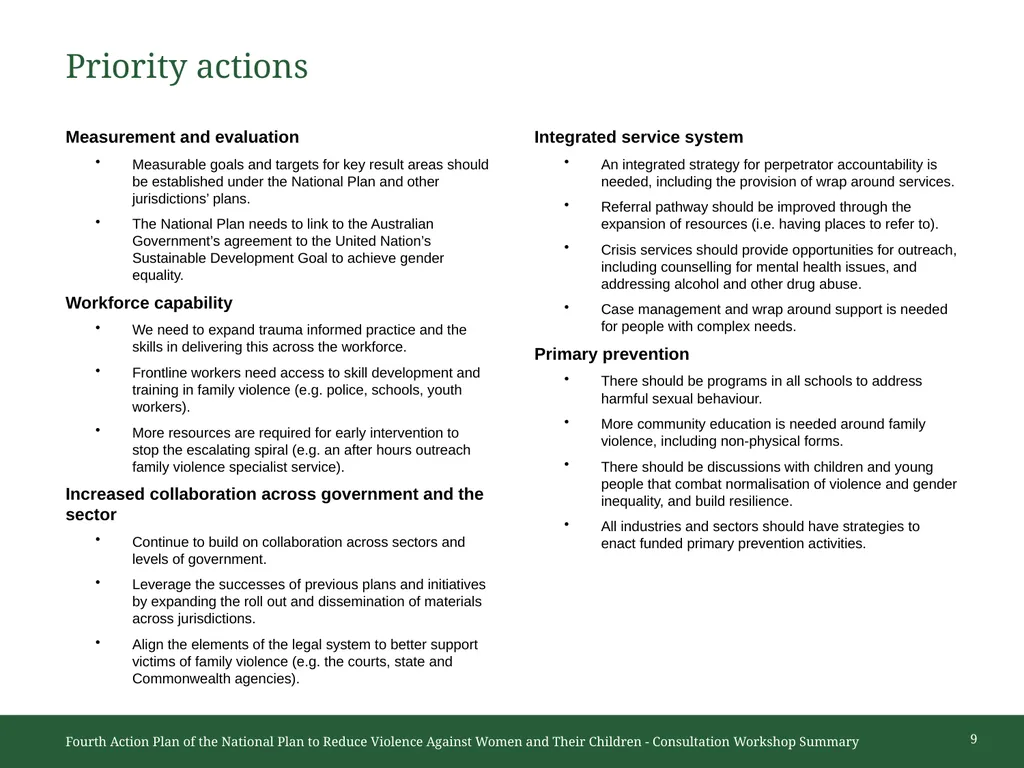
Fourth Action Plan of the National Plan to Reduce Violence Against Women and Their Children - Consultation Workshop Summary Priority actions Measurement and evaluation
Measurable goals and targets for key result areas should be established under the National Plan and other jurisdictions’ plans.
The National Plan needs to link to the Australian Government’s agreement to the United Nation’s Sustainable Development Goal to achieve gender equality.
Workforce capability
We need to expand trauma informed practice and the skills in delivering this across the workforce.
Frontline workers need access to skill development and training in family violence (e.g. police, schools, youth workers).
More resources are required for early intervention to stop the escalating spiral (e.g. an after hours outreach family violence specialist service).
Increased collaboration across government and the sector
Continue to build on collaboration across sectors and levels of government.
Leverage the successes of previous plans and initiatives by expanding the roll out and dissemination of materials across jurisdictions.
Align the elements of the legal system to better support victims of family violence (e.g. the courts, state and Commonwealth agencies). 9 Integrated service system
An integrated strategy for perpetrator accountability is needed, including the provision of wrap around services.
Referral pathway should be improved through the expansion of resources (i.e. having places to refer to).
Crisis services should provide opportunities for outreach, including counselling for mental health issues, and addressing alcohol and other drug abuse.
Case management and wrap around support is needed for people with complex needs.
Primary prevention
There should be programs in all schools to address harmful sexual behaviour.
More community education is needed around family violence, including non-physical forms.
There should be discussions with children and young people that combat normalisation of violence and gender inequality, and build resilience.
All industries and sectors should have strategies to enact funded primary prevention activities.<br>
Measurable goals and targets for key result areas should be established under the National Plan and other jurisdictions’ plans.
The National Plan needs to link to the Australian Government’s agreement to the United Nation’s Sustainable Development Goal to achieve gender equality.
Workforce capability
We need to expand trauma informed practice and the skills in delivering this across the workforce.
Frontline workers need access to skill development and training in family violence (e.g. police, schools, youth workers).
More resources are required for early intervention to stop the escalating spiral (e.g. an after hours outreach family violence specialist service).
Increased collaboration across government and the sector
Continue to build on collaboration across sectors and levels of government.
Leverage the successes of previous plans and initiatives by expanding the roll out and dissemination of materials across jurisdictions.
Align the elements of the legal system to better support victims of family violence (e.g. the courts, state and Commonwealth agencies). 9 Integrated service system
An integrated strategy for perpetrator accountability is needed, including the provision of wrap around services.
Referral pathway should be improved through the expansion of resources (i.e. having places to refer to).
Crisis services should provide opportunities for outreach, including counselling for mental health issues, and addressing alcohol and other drug abuse.
Case management and wrap around support is needed for people with complex needs.
Primary prevention
There should be programs in all schools to address harmful sexual behaviour.
More community education is needed around family violence, including non-physical forms.
There should be discussions with children and young people that combat normalisation of violence and gender inequality, and build resilience.
All industries and sectors should have strategies to enact funded primary prevention activities.<br>
10
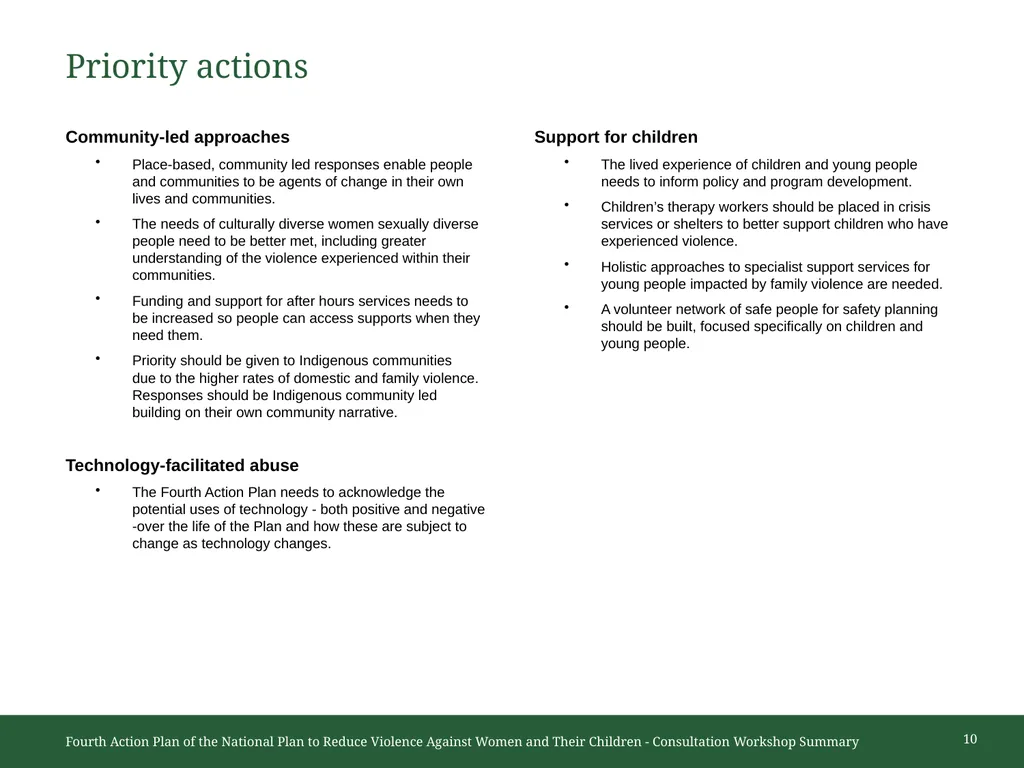
Fourth Action Plan of the National Plan to Reduce Violence Against Women and Their Children - Consultation Workshop Summary Priority actions Community-led approaches
Place-based, community led responses enable people and communities to be agents of change in their own lives and communities.
The needs of culturally diverse women sexually diverse people need to be better met, including greater understanding of the violence experienced within their communities.
Funding and support for after hours services needs to be increased so people can access supports when they need them.
Priority should be given to Indigenous communities due to the higher rates of domestic and family violence. Responses should be Indigenous community led building on their own community narrative.
Technology-facilitated abuse
The Fourth Action Plan needs to acknowledge the potential uses of technology - both positive and negative -over the life of the Plan and how these are subject to change as technology changes. 10 Support for children
The lived experience of children and young people needs to inform policy and program development.
Children’s therapy workers should be placed in crisis services or shelters to better support children who have experienced violence.
Holistic approaches to specialist support services for young people impacted by family violence are needed.
A volunteer network of safe people for safety planning should be built, focused specifically on children and young people.<br>
Place-based, community led responses enable people and communities to be agents of change in their own lives and communities.
The needs of culturally diverse women sexually diverse people need to be better met, including greater understanding of the violence experienced within their communities.
Funding and support for after hours services needs to be increased so people can access supports when they need them.
Priority should be given to Indigenous communities due to the higher rates of domestic and family violence. Responses should be Indigenous community led building on their own community narrative.
Technology-facilitated abuse
The Fourth Action Plan needs to acknowledge the potential uses of technology - both positive and negative -over the life of the Plan and how these are subject to change as technology changes. 10 Support for children
The lived experience of children and young people needs to inform policy and program development.
Children’s therapy workers should be placed in crisis services or shelters to better support children who have experienced violence.
Holistic approaches to specialist support services for young people impacted by family violence are needed.
A volunteer network of safe people for safety planning should be built, focused specifically on children and young people.<br>