
House Allocation and Kidney Exchange 1 House
LO
Published · 36 slides · 0 views

1 / 1



Description
House Allocation and Kidney Exchange 1 House allocation problems In some matching markets, only one side of the market has preferences (or we care mostly about the preferences of one side). Examples students picking housing on campus.
Related Topics
Share
Embed code
Download this presentation From Below
"House Allocation and Kidney Exchange 1 House" is the property of its rightful owner. Permission is granted to download and print the materials on this website for personal, non-commercial use only, and to display it on your personal computer provided you do not modify the materials and that you retain all copyright notices contained in the materials. By downloading content from our website, you accept the terms of this agreement.
Presentation Transcript
01
House Allocation and Kidney Exchange 1<br>
02
House allocation problems In some matching markets, only one side of the market has preferences (or we care mostly about the preferences of one side).
Examples
students picking housing on campus.
students picking freshman seminars
sports teams picking players out of college 2<br>
Examples
students picking housing on campus.
students picking freshman seminars
sports teams picking players out of college 2<br>
03
House allocation problem N individuals and N houses
Each individual has strict preference over houses.
Goal: assign each individual to a house.
What would be a “good” outcome?
An allocation is Pareto efficient if no pair of individuals, or set of individuals, can all do (weakly) better by trading houses. 3<br>
Each individual has strict preference over houses.
Goal: assign each individual to a house.
What would be a “good” outcome?
An allocation is Pareto efficient if no pair of individuals, or set of individuals, can all do (weakly) better by trading houses. 3<br>
04
(Random) Serial Dictatorship Each student gets a priority (perhaps randomly assigned as in the housing draw).
Students pick houses in order of their priority.
Theorem. Serial dictatorship is efficient (i.e. no mutually agreeable trades afterwards) and strategy-proof. 4<br>
Students pick houses in order of their priority.
Theorem. Serial dictatorship is efficient (i.e. no mutually agreeable trades afterwards) and strategy-proof. 4<br>
05
Proof Strategy-proof
Individual with first pick gets her preferred house, so clearly no incentive to lie.
Individual with second pick gets her preferred house among remaining houses, so again no reason to lie.
and so on… 5<br>
Individual with first pick gets her preferred house, so clearly no incentive to lie.
Individual with second pick gets her preferred house among remaining houses, so again no reason to lie.
and so on… 5<br>
06
Proof Efficiency
Individual with priority one doesn’t want to trade.
Given that she is out, individual with priority two doesn’t want to trade.
And so on…. 6<br>
Individual with priority one doesn’t want to trade.
Given that she is out, individual with priority two doesn’t want to trade.
And so on…. 6<br>
07
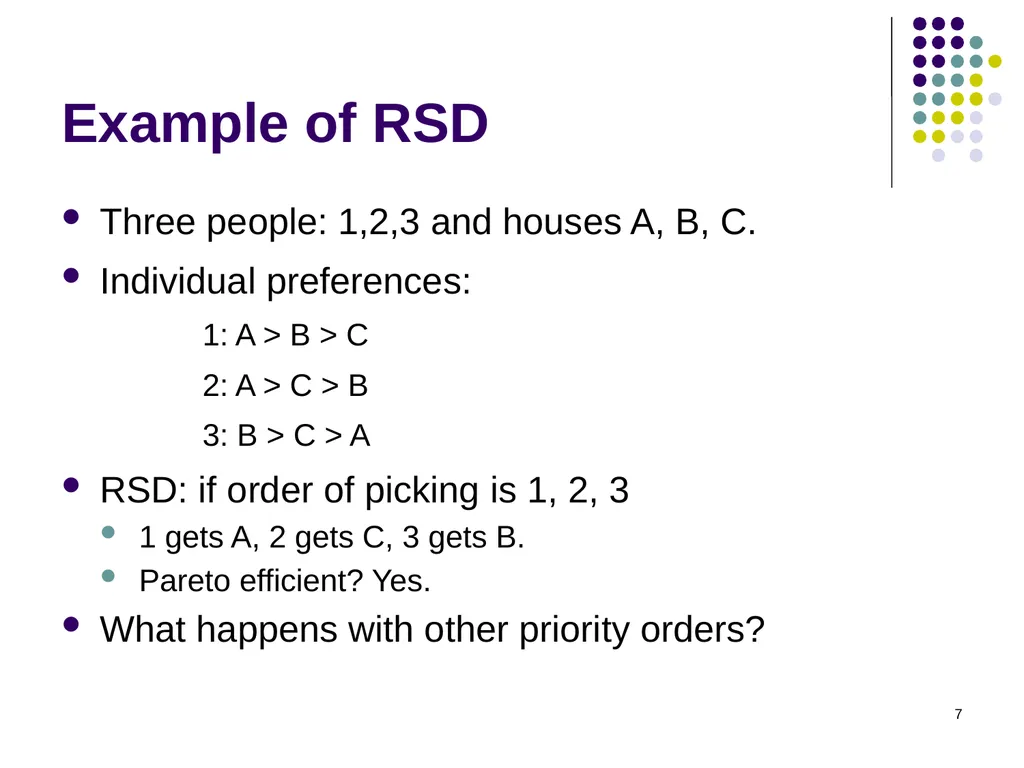
Example of RSD Three people: 1,2,3 and houses A, B, C.
Individual preferences:
1: A > B > C
2: A > C > B
3: B > C > A
RSD: if order of picking is 1, 2, 3
1 gets A, 2 gets C, 3 gets B.
Pareto efficient? Yes.
What happens with other priority orders? 7<br>
Individual preferences:
1: A > B > C
2: A > C > B
3: B > C > A
RSD: if order of picking is 1, 2, 3
1 gets A, 2 gets C, 3 gets B.
Pareto efficient? Yes.
What happens with other priority orders? 7<br>
08
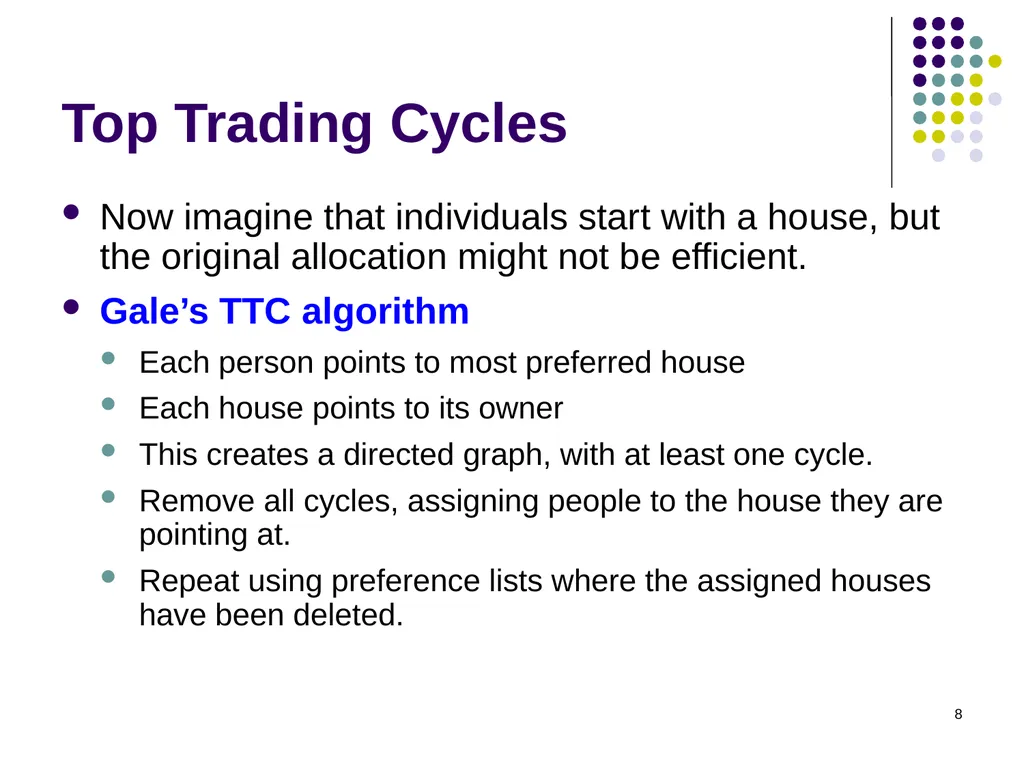
Top Trading Cycles Now imagine that individuals start with a house, but the original allocation might not be efficient.
Gale’s TTC algorithm
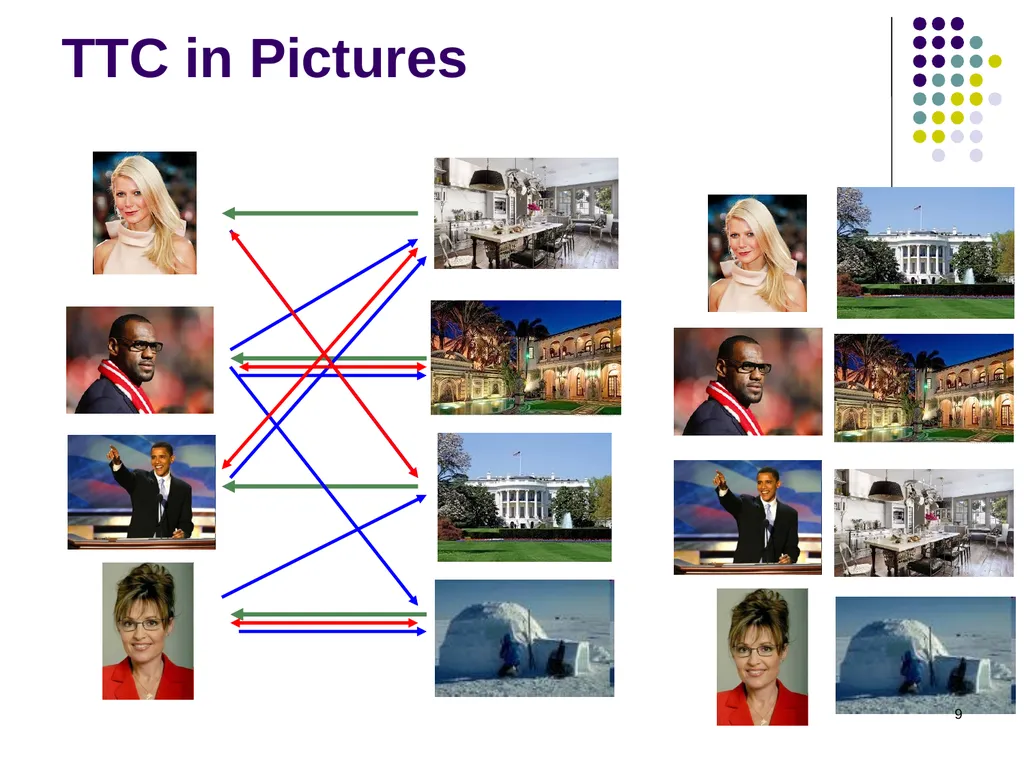
Each person points to most preferred house
Each house points to its owner
This creates a directed graph, with at least one cycle.
Remove all cycles, assigning people to the house they are pointing at.
Repeat using preference lists where the assigned houses have been deleted. 8<br>
Gale’s TTC algorithm
Each person points to most preferred house
Each house points to its owner
This creates a directed graph, with at least one cycle.
Remove all cycles, assigning people to the house they are pointing at.
Repeat using preference lists where the assigned houses have been deleted. 8<br>
09
TTC in Pictures 9<br>
10
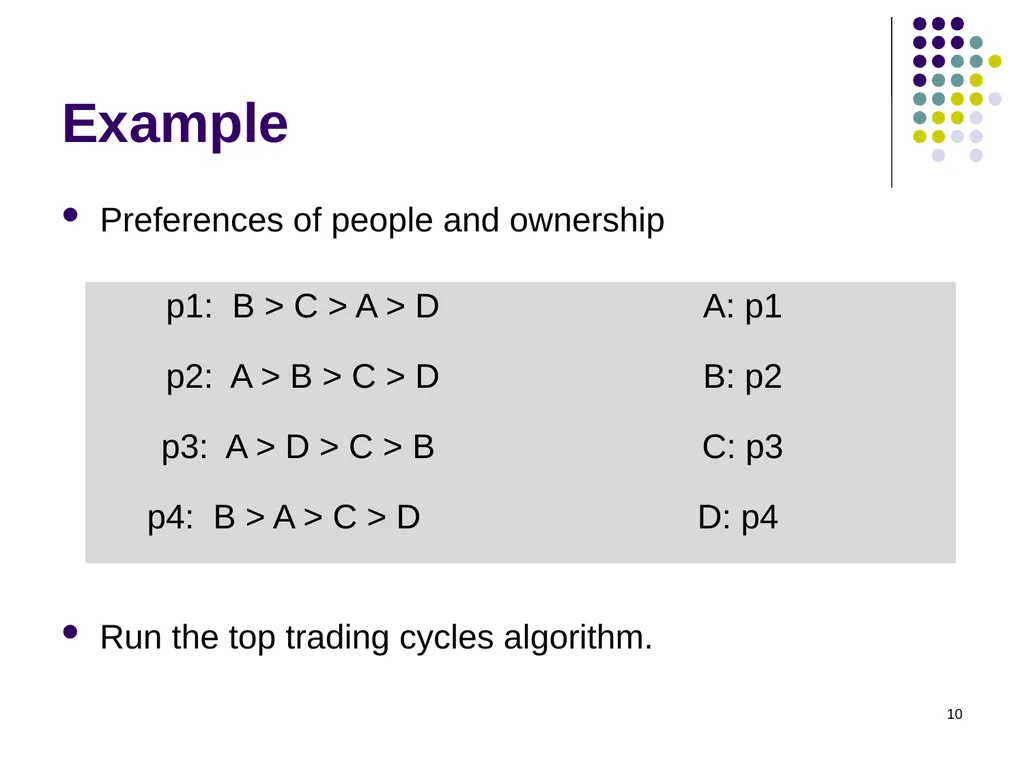
Example Preferences of people and ownership 10 Run the top trading cycles algorithm.<br>
11
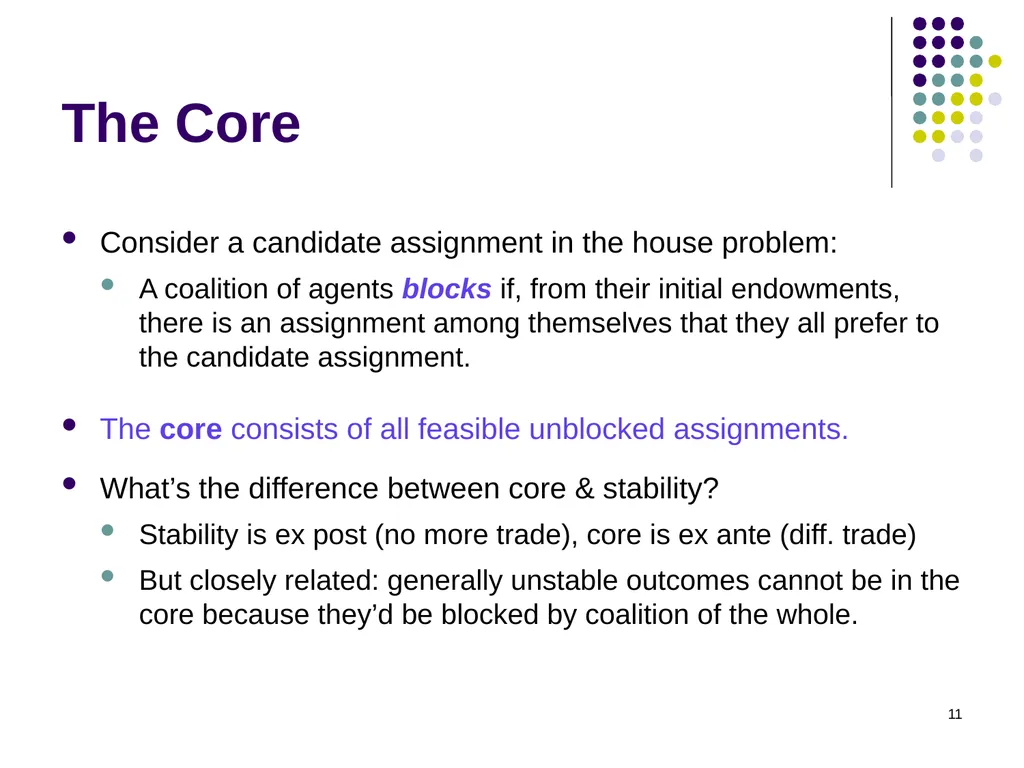
The Core Consider a candidate assignment in the house problem:
A coalition of agents blocks if, from their initial endowments, there is an assignment among themselves that they all prefer to the candidate assignment.
The core consists of all feasible unblocked assignments.
What’s the difference between core & stability?
Stability is ex post (no more trade), core is ex ante (diff. trade)
But closely related: generally unstable outcomes cannot be in the core because they’d be blocked by coalition of the whole. 11<br>
A coalition of agents blocks if, from their initial endowments, there is an assignment among themselves that they all prefer to the candidate assignment.
The core consists of all feasible unblocked assignments.
What’s the difference between core & stability?
Stability is ex post (no more trade), core is ex ante (diff. trade)
But closely related: generally unstable outcomes cannot be in the core because they’d be blocked by coalition of the whole. 11<br>
12
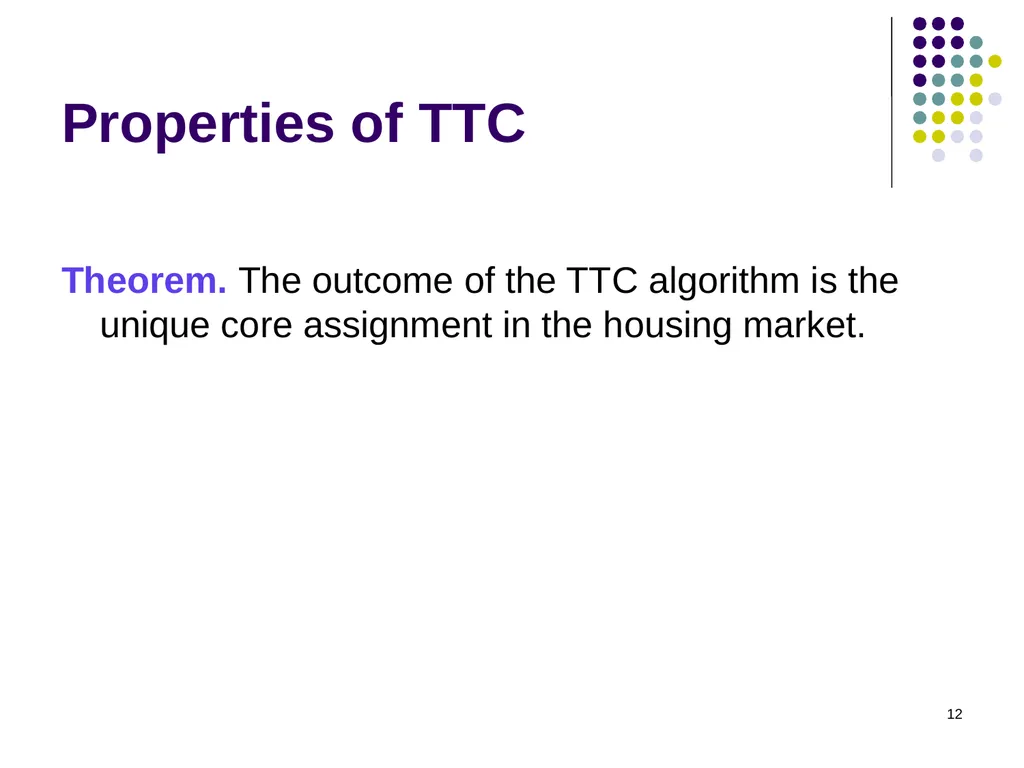
Properties of TTC Theorem. The outcome of the TTC algorithm is the unique core assignment in the housing market. 12<br>
13
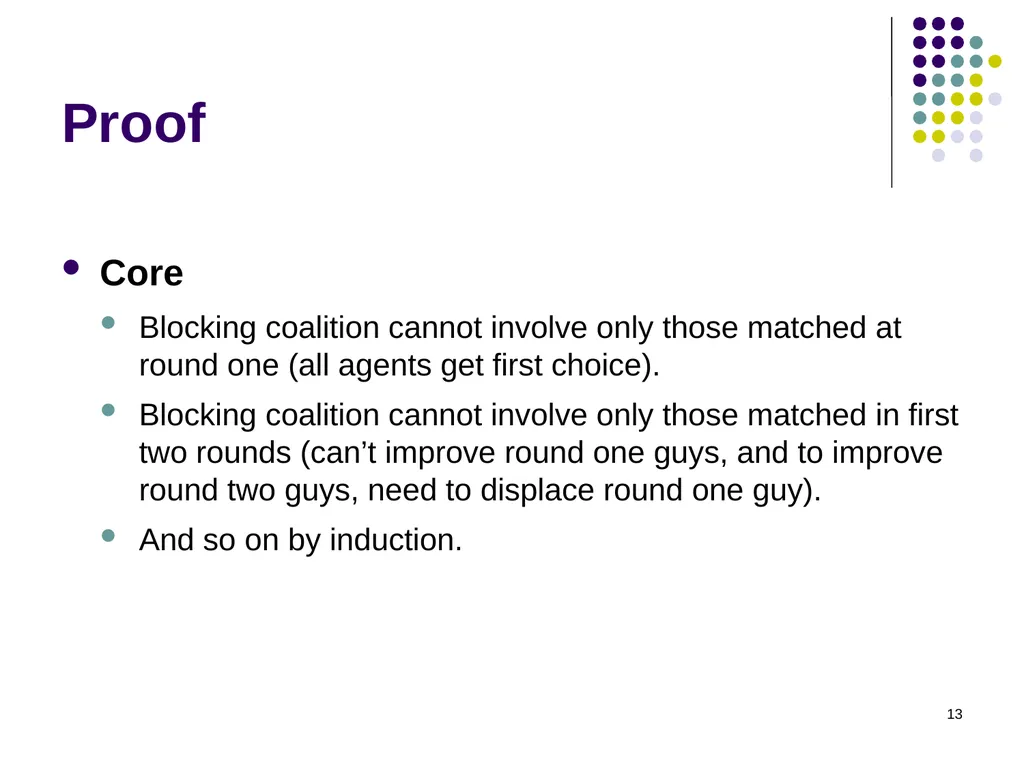
Proof Core
Blocking coalition cannot involve only those matched at round one (all agents get first choice).
Blocking coalition cannot involve only those matched in first two rounds (can’t improve round one guys, and to improve round two guys, need to displace round one guy).
And so on by induction. 13<br>
Blocking coalition cannot involve only those matched at round one (all agents get first choice).
Blocking coalition cannot involve only those matched in first two rounds (can’t improve round one guys, and to improve round two guys, need to displace round one guy).
And so on by induction. 13<br>
14
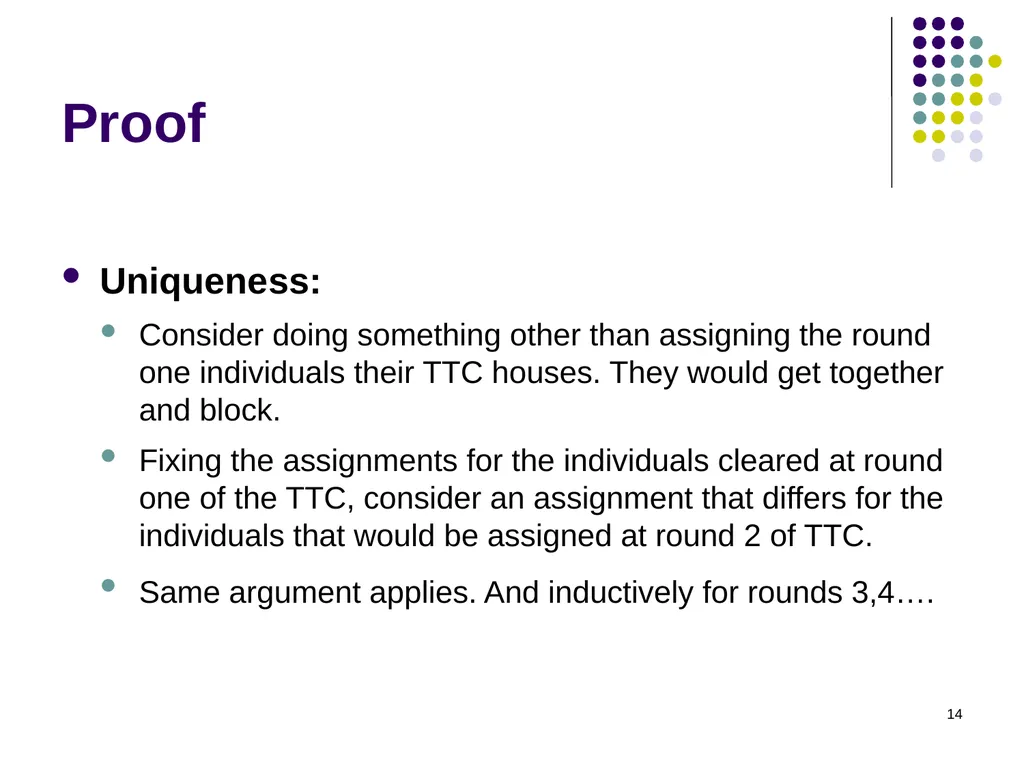
Proof Uniqueness:
Consider doing something other than assigning the round one individuals their TTC houses. They would get together and block.
Fixing the assignments for the individuals cleared at round one of the TTC, consider an assignment that differs for the individuals that would be assigned at round 2 of TTC.
Same argument applies. And inductively for rounds 3,4…. 14<br>
Consider doing something other than assigning the round one individuals their TTC houses. They would get together and block.
Fixing the assignments for the individuals cleared at round one of the TTC, consider an assignment that differs for the individuals that would be assigned at round 2 of TTC.
Same argument applies. And inductively for rounds 3,4…. 14<br>
15
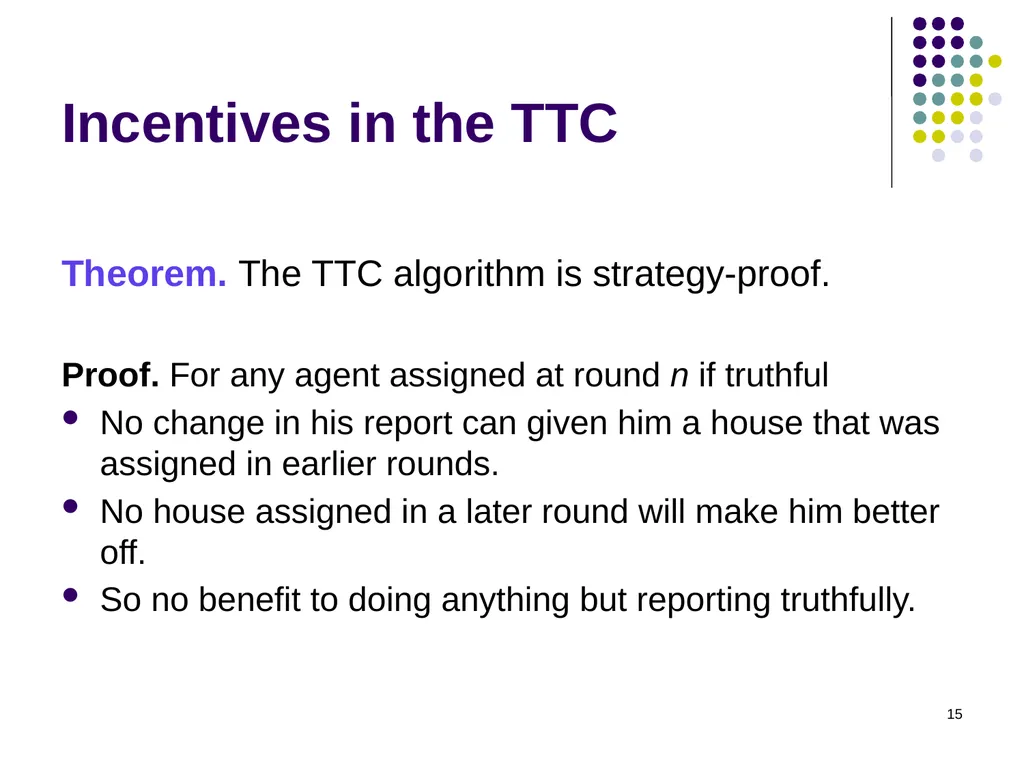
Incentives in the TTC Theorem. The TTC algorithm is strategy-proof.
Proof. For any agent assigned at round n if truthful
No change in his report can given him a house that was assigned in earlier rounds.
No house assigned in a later round will make him better off.
So no benefit to doing anything but reporting truthfully. 15<br>
Proof. For any agent assigned at round n if truthful
No change in his report can given him a house that was assigned in earlier rounds.
No house assigned in a later round will make him better off.
So no benefit to doing anything but reporting truthfully. 15<br>
16
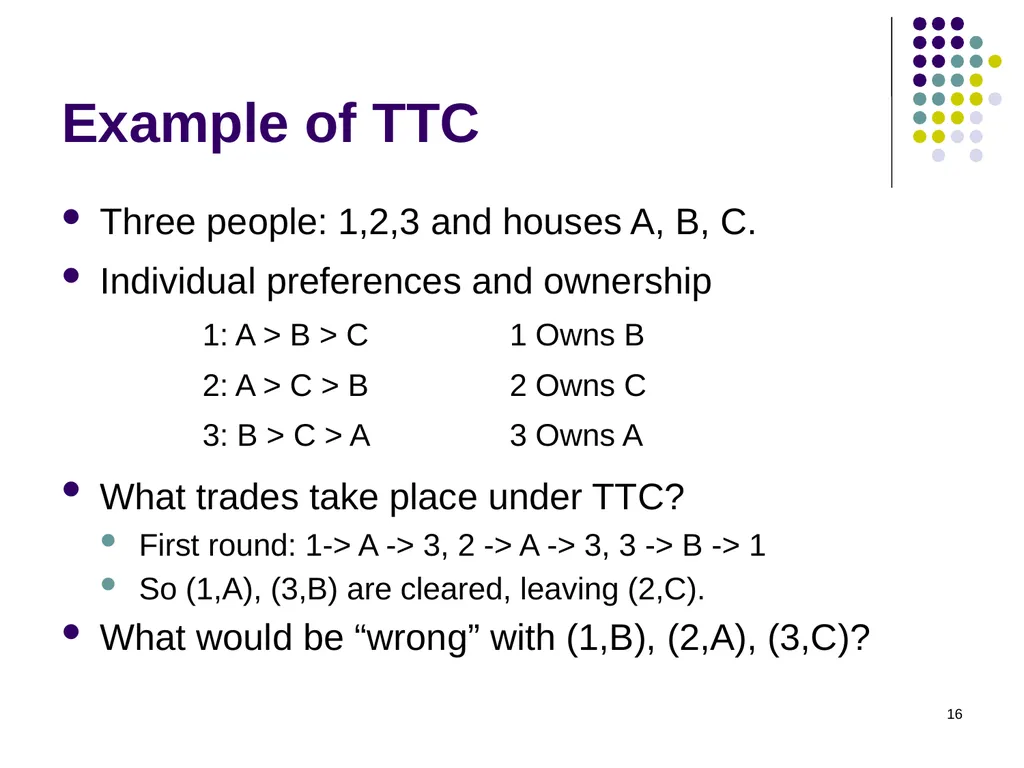
Example of TTC Three people: 1,2,3 and houses A, B, C.
Individual preferences and ownership
1: A > B > C 1 Owns B
2: A > C > B 2 Owns C
3: B > C > A 3 Owns A
What trades take place under TTC?
First round: 1-> A -> 3, 2 -> A -> 3, 3 -> B -> 1
So (1,A), (3,B) are cleared, leaving (2,C).
What would be “wrong” with (1,B), (2,A), (3,C)? 16<br>
Individual preferences and ownership
1: A > B > C 1 Owns B
2: A > C > B 2 Owns C
3: B > C > A 3 Owns A
What trades take place under TTC?
First round: 1-> A -> 3, 2 -> A -> 3, 3 -> B -> 1
So (1,A), (3,B) are cleared, leaving (2,C).
What would be “wrong” with (1,B), (2,A), (3,C)? 16<br>
17
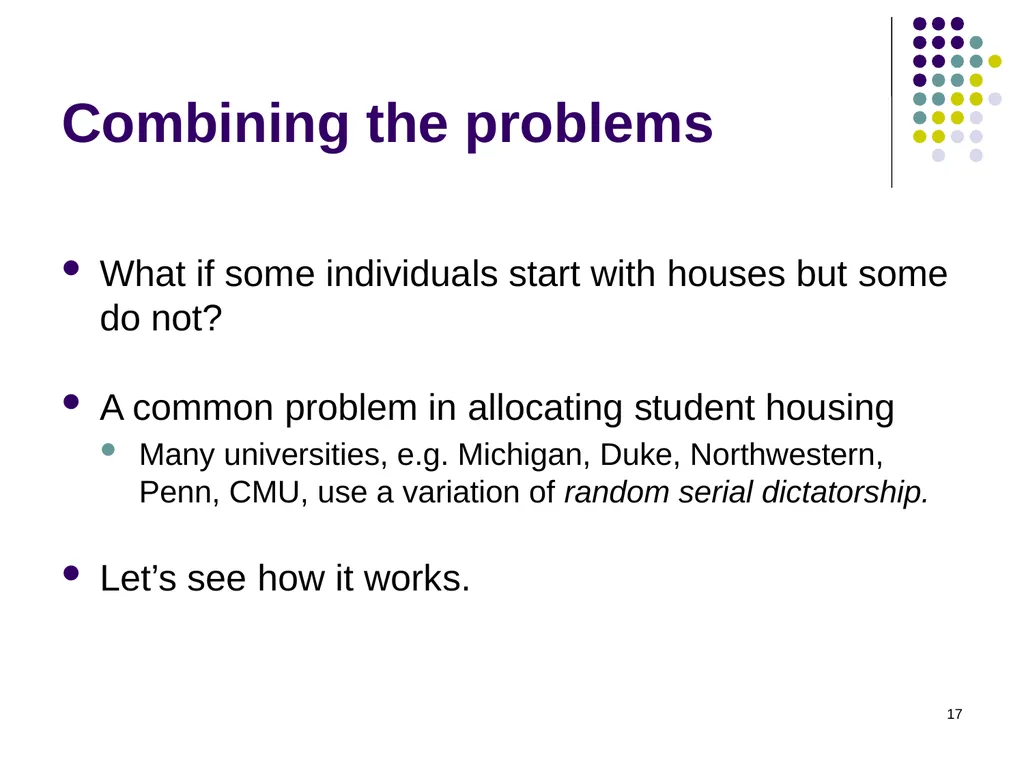
Combining the problems What if some individuals start with houses but some do not?
A common problem in allocating student housing
Many universities, e.g. Michigan, Duke, Northwestern, Penn, CMU, use a variation of random serial dictatorship.
Let’s see how it works. 17<br>
A common problem in allocating student housing
Many universities, e.g. Michigan, Duke, Northwestern, Penn, CMU, use a variation of random serial dictatorship.
Let’s see how it works. 17<br>
18
Random Serial Dictatorship with Incumbency Each agent with a house decides whether to keep their house or enter a lottery.
Agents who keep their house are done.
Houses that are abandoned are available later on.
Lottery used to order newcomers and agents who gave up their house (can be completely random or favor particular agents).
Serial dictatorship applied using order from lottery and selection from available houses. 18<br>
Agents who keep their house are done.
Houses that are abandoned are available later on.
Lottery used to order newcomers and agents who gave up their house (can be completely random or favor particular agents).
Serial dictatorship applied using order from lottery and selection from available houses. 18<br>
19
RSD with incumbency There is a problem…
Existing tenants are not guaranteed to get at least as good a house as their current house!
This may cause existing tenants to avoid the lottery and the market may not exploit all the possible gains from trade.
Is there a way to protect existing tenants, while getting pareto efficient outcomes and maybe strategy-proofness? 19<br>
Existing tenants are not guaranteed to get at least as good a house as their current house!
This may cause existing tenants to avoid the lottery and the market may not exploit all the possible gains from trade.
Is there a way to protect existing tenants, while getting pareto efficient outcomes and maybe strategy-proofness? 19<br>
20
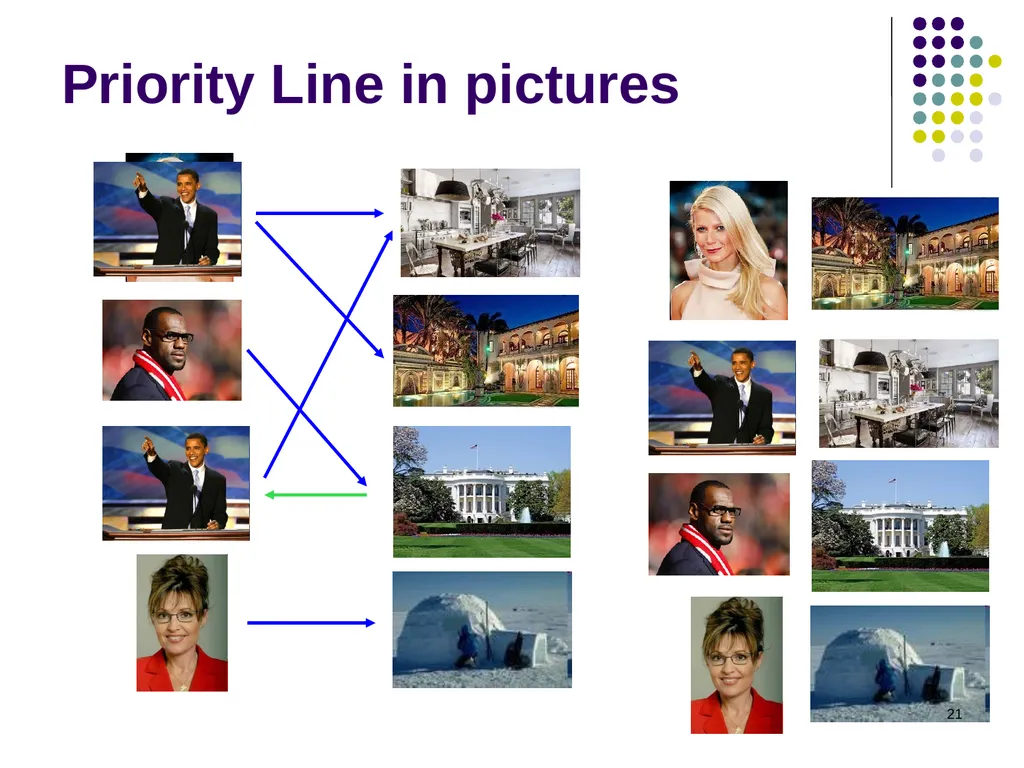
Priority Line Mechanism aka “you request my house – I get your turn”.
All agents are ordered according to some priority
Agent with top priority chooses a house, then second agent, and so on, until someone requests the house of an existing tenant.
If the existing tenant has already chosen a house, continue. If not, insert that tenant above the requestor and re-start the procedure with the existing tenant.
If a cycle forms, it is formed exclusively by existing tenants – clear the cycle and proceed with the priority order. 20<br>
All agents are ordered according to some priority
Agent with top priority chooses a house, then second agent, and so on, until someone requests the house of an existing tenant.
If the existing tenant has already chosen a house, continue. If not, insert that tenant above the requestor and re-start the procedure with the existing tenant.
If a cycle forms, it is formed exclusively by existing tenants – clear the cycle and proceed with the priority order. 20<br>
21
Priority Line in pictures 21<br>
22
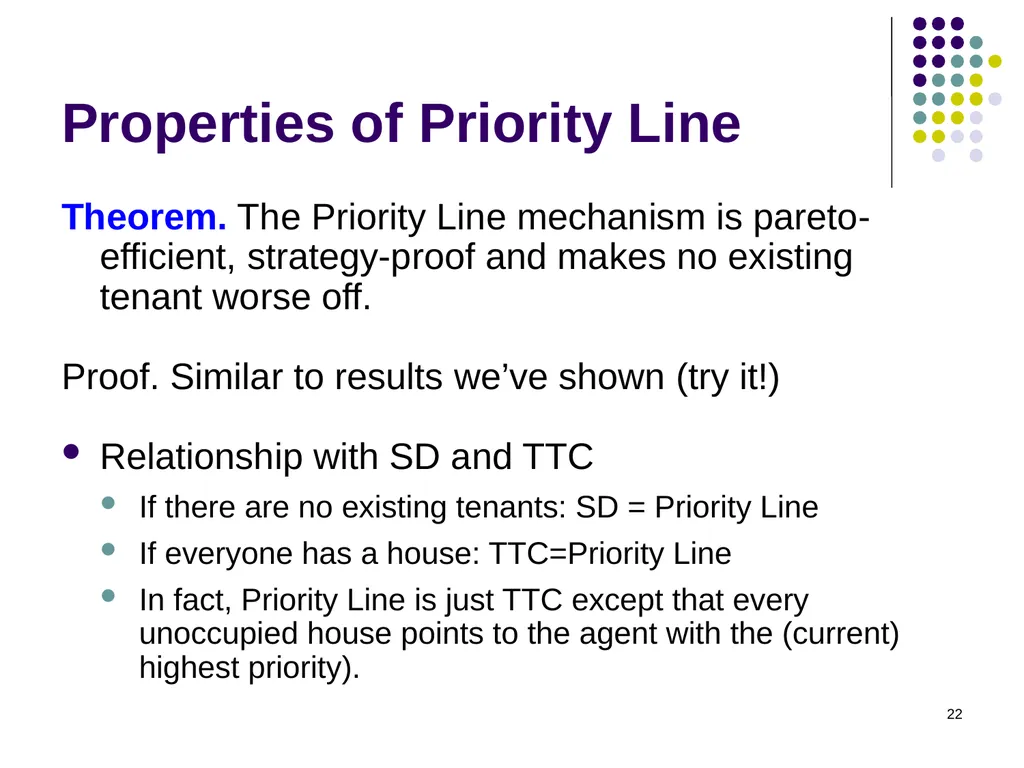
Properties of Priority Line Theorem. The Priority Line mechanism is pareto-efficient, strategy-proof and makes no existing tenant worse off.
Proof. Similar to results we’ve shown (try it!)
Relationship with SD and TTC
If there are no existing tenants: SD = Priority Line
If everyone has a house: TTC=Priority Line
In fact, Priority Line is just TTC except that every unoccupied house points to the agent with the (current) highest priority). 22<br>
Proof. Similar to results we’ve shown (try it!)
Relationship with SD and TTC
If there are no existing tenants: SD = Priority Line
If everyone has a house: TTC=Priority Line
In fact, Priority Line is just TTC except that every unoccupied house points to the agent with the (current) highest priority). 22<br>
23
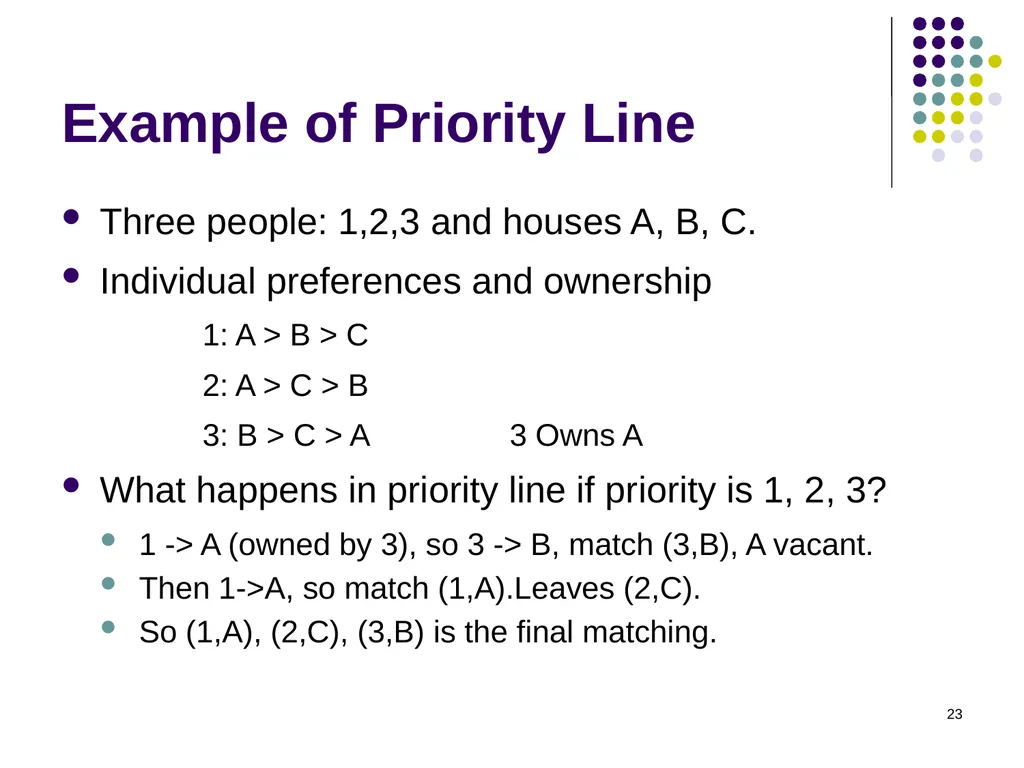
Example of Priority Line Three people: 1,2,3 and houses A, B, C.
Individual preferences and ownership
1: A > B > C
2: A > C > B
3: B > C > A 3 Owns A
What happens in priority line if priority is 1, 2, 3?
1 -> A (owned by 3), so 3 -> B, match (3,B), A vacant.
Then 1->A, so match (1,A).Leaves (2,C).
So (1,A), (2,C), (3,B) is the final matching. 23<br>
Individual preferences and ownership
1: A > B > C
2: A > C > B
3: B > C > A 3 Owns A
What happens in priority line if priority is 1, 2, 3?
1 -> A (owned by 3), so 3 -> B, match (3,B), A vacant.
Then 1->A, so match (1,A).Leaves (2,C).
So (1,A), (2,C), (3,B) is the final matching. 23<br>
24
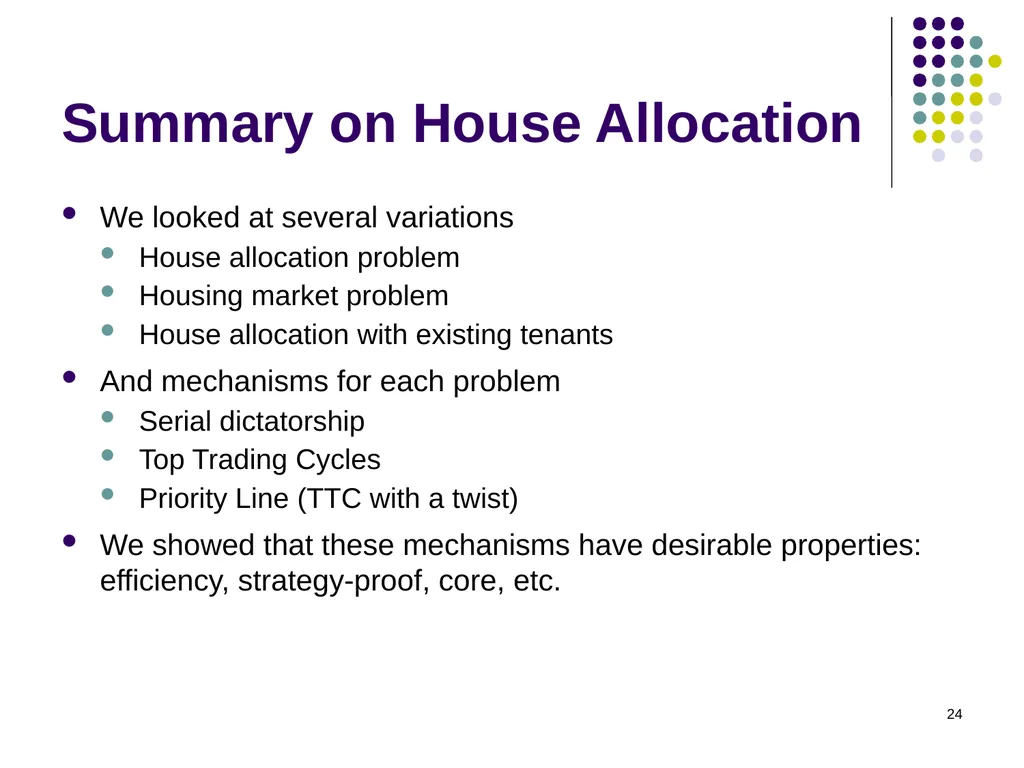
Summary on House Allocation We looked at several variations
House allocation problem
Housing market problem
House allocation with existing tenants
And mechanisms for each problem
Serial dictatorship
Top Trading Cycles
Priority Line (TTC with a twist)
We showed that these mechanisms have desirable properties: efficiency, strategy-proof, core, etc. 24<br>
House allocation problem
Housing market problem
House allocation with existing tenants
And mechanisms for each problem
Serial dictatorship
Top Trading Cycles
Priority Line (TTC with a twist)
We showed that these mechanisms have desirable properties: efficiency, strategy-proof, core, etc. 24<br>
25
Kidney Exchange 25<br>
26
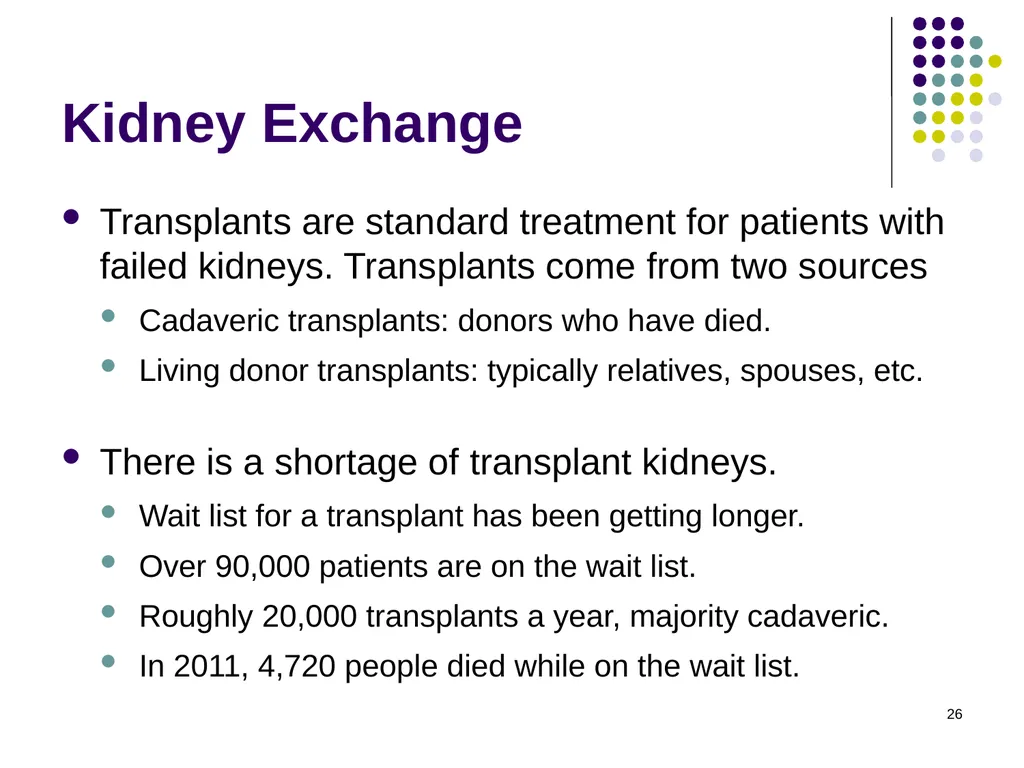
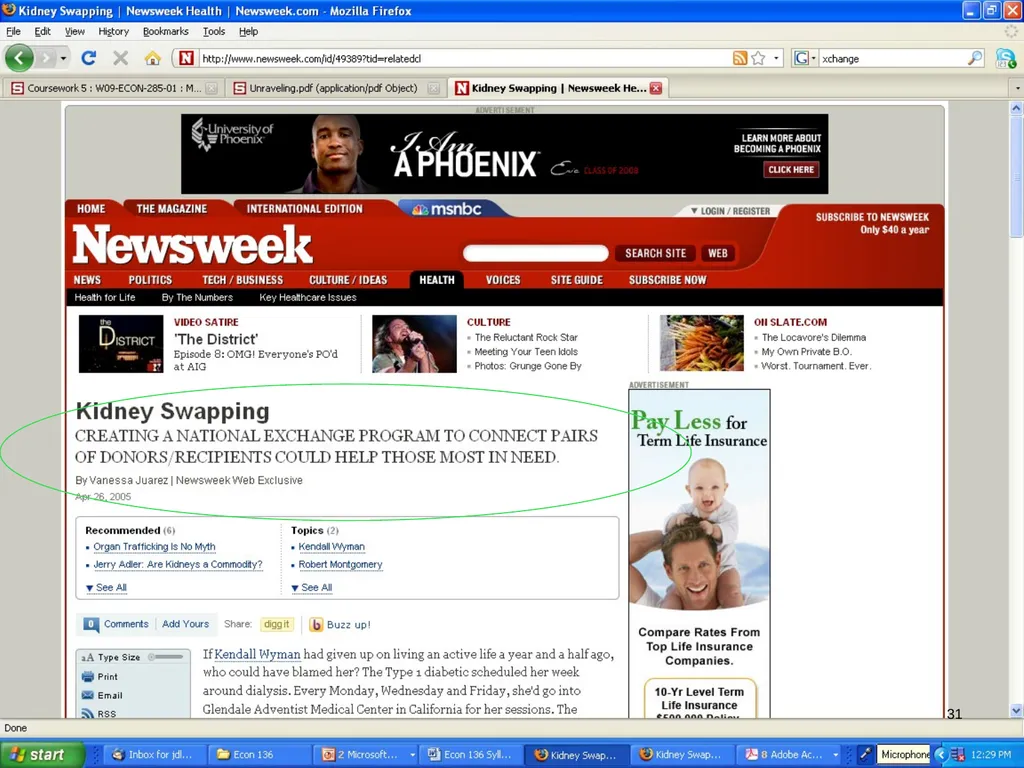
Kidney Exchange Transplants are standard treatment for patients with failed kidneys. Transplants come from two sources
Cadaveric transplants: donors who have died.
Living donor transplants: typically relatives, spouses, etc.
There is a shortage of transplant kidneys.
Wait list for a transplant has been getting longer.
Over 90,000 patients are on the wait list.
Roughly 20,000 transplants a year, majority cadaveric.
In 2011, 4,720 people died while on the wait list. 26<br>
Cadaveric transplants: donors who have died.
Living donor transplants: typically relatives, spouses, etc.
There is a shortage of transplant kidneys.
Wait list for a transplant has been getting longer.
Over 90,000 patients are on the wait list.
Roughly 20,000 transplants a year, majority cadaveric.
In 2011, 4,720 people died while on the wait list. 26<br>
27
Resolving the shortage Buying and selling kidneys is illegal.
Section 301 of National Organ Transplant Act
“it shall be unlawful for any person to knowingly acquire, receive or otherwise transfer any human organ for valuable consideration for use in human transplantation.”
There are probably ways to increase the supply of cadaveric kidneys (e.g. make donation the default).
We’re going to focus on ways to increase the supply of living donor kidneys. 27<br>
Section 301 of National Organ Transplant Act
“it shall be unlawful for any person to knowingly acquire, receive or otherwise transfer any human organ for valuable consideration for use in human transplantation.”
There are probably ways to increase the supply of cadaveric kidneys (e.g. make donation the default).
We’re going to focus on ways to increase the supply of living donor kidneys. 27<br>
28
Compatibility Donor kidney must be compatible with patient
Blood type match
O type patients can receive O kidneys
A type patients can receive O or A kidneys
B type patients can receive O or B kidneys
AB type patients can receive any blood type
Also tissue type match (HLA compatibility).
Potential inefficiency: if a patient has a donor but can’t use the donor’s kidney, the donor goes home. 28<br>
Blood type match
O type patients can receive O kidneys
A type patients can receive O or A kidneys
B type patients can receive O or B kidneys
AB type patients can receive any blood type
Also tissue type match (HLA compatibility).
Potential inefficiency: if a patient has a donor but can’t use the donor’s kidney, the donor goes home. 28<br>
29
Paired Exchange Paired exchange: match two donor-patient pairs...
Donor 1 is compatible with Patient 2, not Patient 1
Donor 2 is compatible with Patient 1, but Patient 2
List exchange: match one incompatible donor-patient pair and the waiting list
Donor of incompatible pair donates to patient at the top of the waiting list.
Patient of incompatible pair goes to the top of the wait list. 29<br>
Donor 1 is compatible with Patient 2, not Patient 1
Donor 2 is compatible with Patient 1, but Patient 2
List exchange: match one incompatible donor-patient pair and the waiting list
Donor of incompatible pair donates to patient at the top of the waiting list.
Patient of incompatible pair goes to the top of the wait list. 29<br>
30
Do we know this problem? Problem seems very similar to house allocation with existing tenants.
Roth, Sonmez and Unver (2004, QJE)
The problems are (essentially) equivalent
TTC can be used to efficiently assign kidneys.
In 2004, RSU and doctors in Boston established first clearinghouse for New England. 30<br>
Roth, Sonmez and Unver (2004, QJE)
The problems are (essentially) equivalent
TTC can be used to efficiently assign kidneys.
In 2004, RSU and doctors in Boston established first clearinghouse for New England. 30<br>
31
31<br>
32
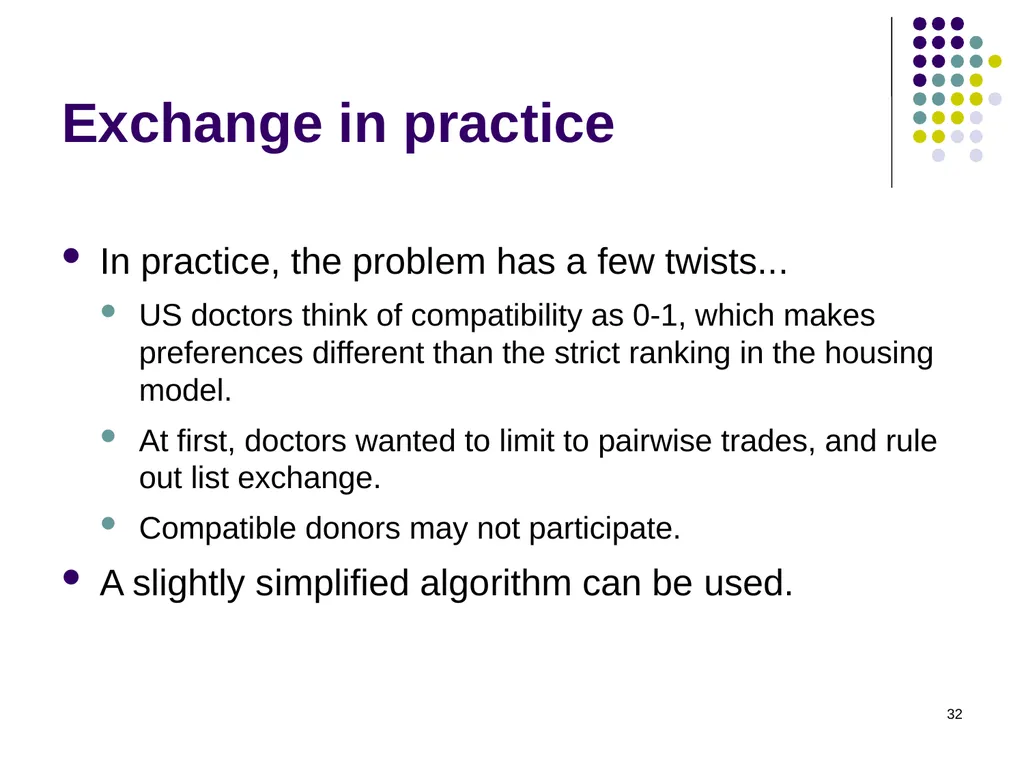
Exchange in practice In practice, the problem has a few twists...
US doctors think of compatibility as 0-1, which makes preferences different than the strict ranking in the housing model.
At first, doctors wanted to limit to pairwise trades, and rule out list exchange.
Compatible donors may not participate.
A slightly simplified algorithm can be used. 32<br>
US doctors think of compatibility as 0-1, which makes preferences different than the strict ranking in the housing model.
At first, doctors wanted to limit to pairwise trades, and rule out list exchange.
Compatible donors may not participate.
A slightly simplified algorithm can be used. 32<br>
33
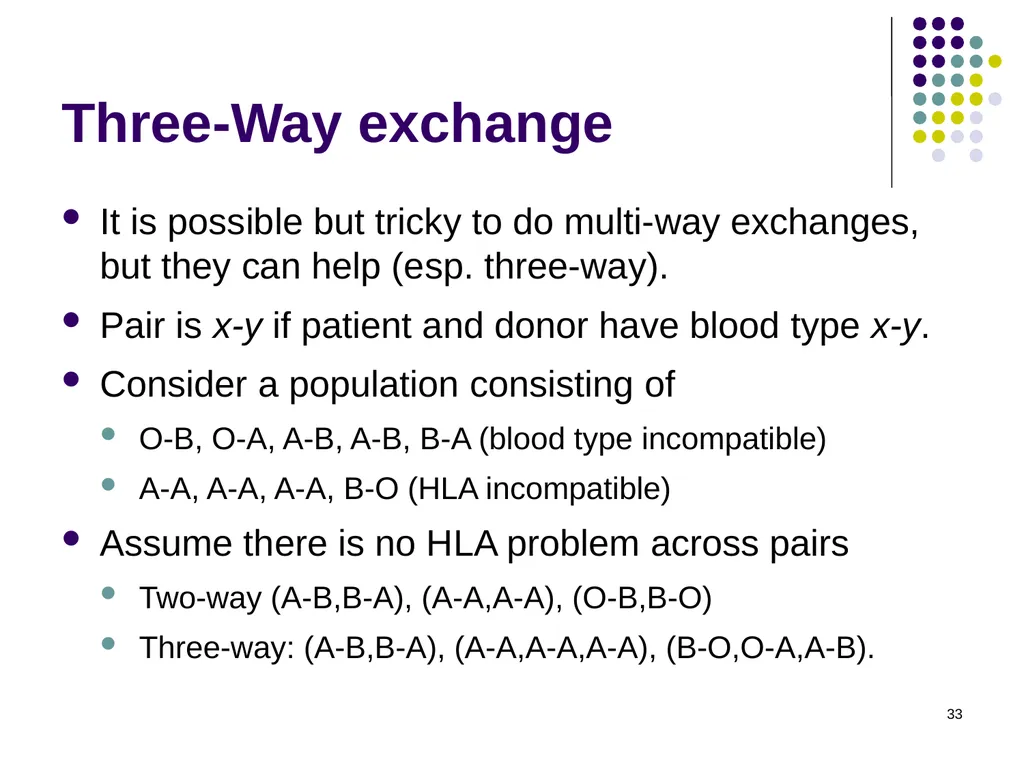
Three-Way exchange It is possible but tricky to do multi-way exchanges, but they can help (esp. three-way).
Pair is x-y if patient and donor have blood type x-y.
Consider a population consisting of
O-B, O-A, A-B, A-B, B-A (blood type incompatible)
A-A, A-A, A-A, B-O (HLA incompatible)
Assume there is no HLA problem across pairs
Two-way (A-B,B-A), (A-A,A-A), (O-B,B-O)
Three-way: (A-B,B-A), (A-A,A-A,A-A), (B-O,O-A,A-B). 33<br>
Pair is x-y if patient and donor have blood type x-y.
Consider a population consisting of
O-B, O-A, A-B, A-B, B-A (blood type incompatible)
A-A, A-A, A-A, B-O (HLA incompatible)
Assume there is no HLA problem across pairs
Two-way (A-B,B-A), (A-A,A-A), (O-B,B-O)
Three-way: (A-B,B-A), (A-A,A-A,A-A), (B-O,O-A,A-B). 33<br>
34
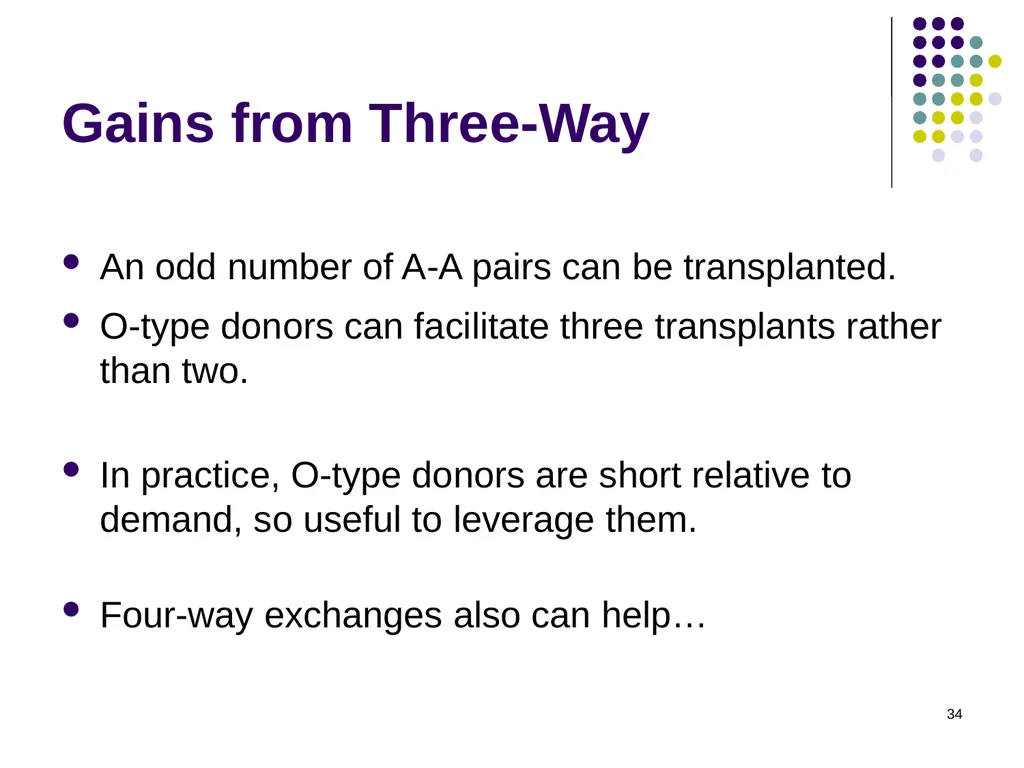
Gains from Three-Way An odd number of A-A pairs can be transplanted.
O-type donors can facilitate three transplants rather than two.
In practice, O-type donors are short relative to demand, so useful to leverage them.
Four-way exchanges also can help… 34<br>
O-type donors can facilitate three transplants rather than two.
In practice, O-type donors are short relative to demand, so useful to leverage them.
Four-way exchanges also can help… 34<br>
35
Donor Chains In July 2007, Alliance for paired donations started an “Altruistic Donor Chain”
Altruistic donor in Michigan donated kidney to woman in Phoenix.
Husband of Phoenix woman gave kidney to woman in Toledo.
Her mom gave kidney to patient A in Columbus, whose daugher simultaneously gave kidney to patient B in columbus.
And so on…. 35<br>
Altruistic donor in Michigan donated kidney to woman in Phoenix.
Husband of Phoenix woman gave kidney to woman in Toledo.
Her mom gave kidney to patient A in Columbus, whose daugher simultaneously gave kidney to patient B in columbus.
And so on…. 35<br>
36
A Long Donor Chain 36<br>