
How can We Increase Pro-Social Behavior? An



Description: How can We Increase Pro-Social Behavior? An Experiment with Referees at the Journal of Public Economics Raj Chetty, Harvard Emmanuel Saez, UC Berkeley Laszlo Sandor, Harvard February 2014 Introduction Specific question: how can we improve
Related Topics
Download Presentation
"How can We Increase Pro-Social Behavior? An" is the property of its rightful owner. Permission is granted to download and print the materials on this website for personal, non-commercial use only, and to display it on your personal computer provided you do not modify the materials and that you retain all copyright notices contained in the materials. By downloading content from our website, you accept the terms of this agreement.
Presentation Transcript
slide1. How can We Increase Pro-Social Behavior?
An Experiment with Referees at the Journal of Public Economics Raj Chetty, Harvard
Emmanuel Saez, UC Berkeley
Laszlo Sandor, Harvard
February 2014<br>
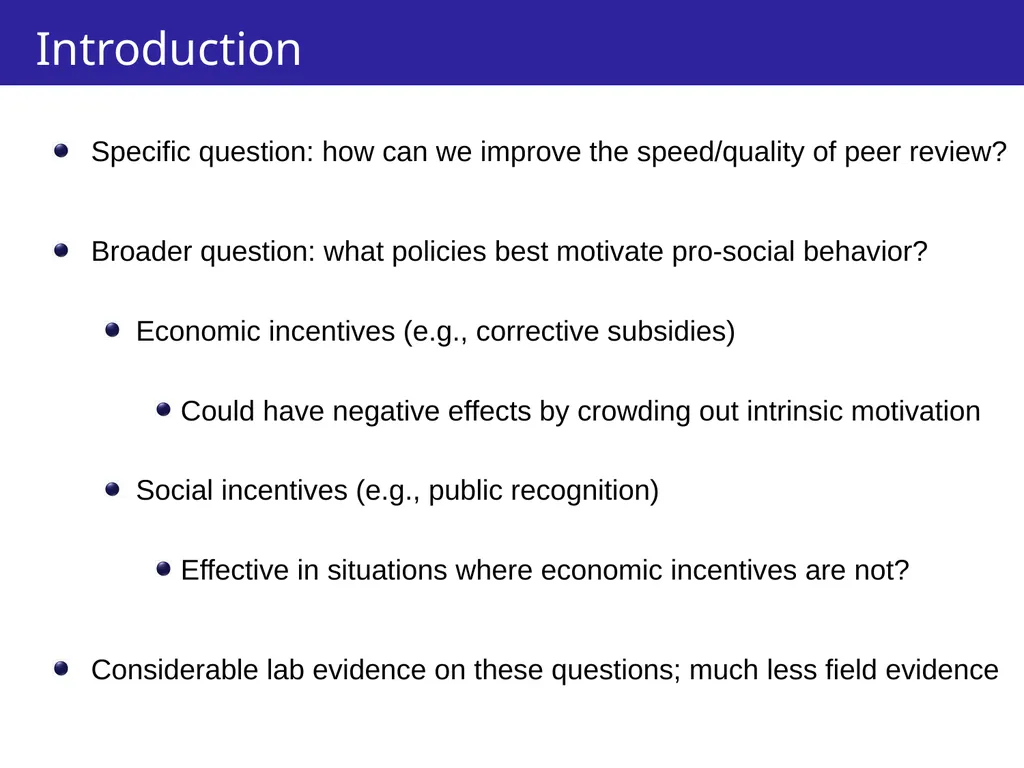
slide2. Introduction Specific question: how can we improve the speed/quality of peer review?
Broader question: what policies best motivate pro-social behavior?
Economic incentives (e.g., corrective subsidies)
Could have negative effects by crowding out intrinsic motivation
Social incentives (e.g., public recognition)
Effective in situations where economic incentives are not?
Considerable lab evidence on these questions; much less field evidence<br>
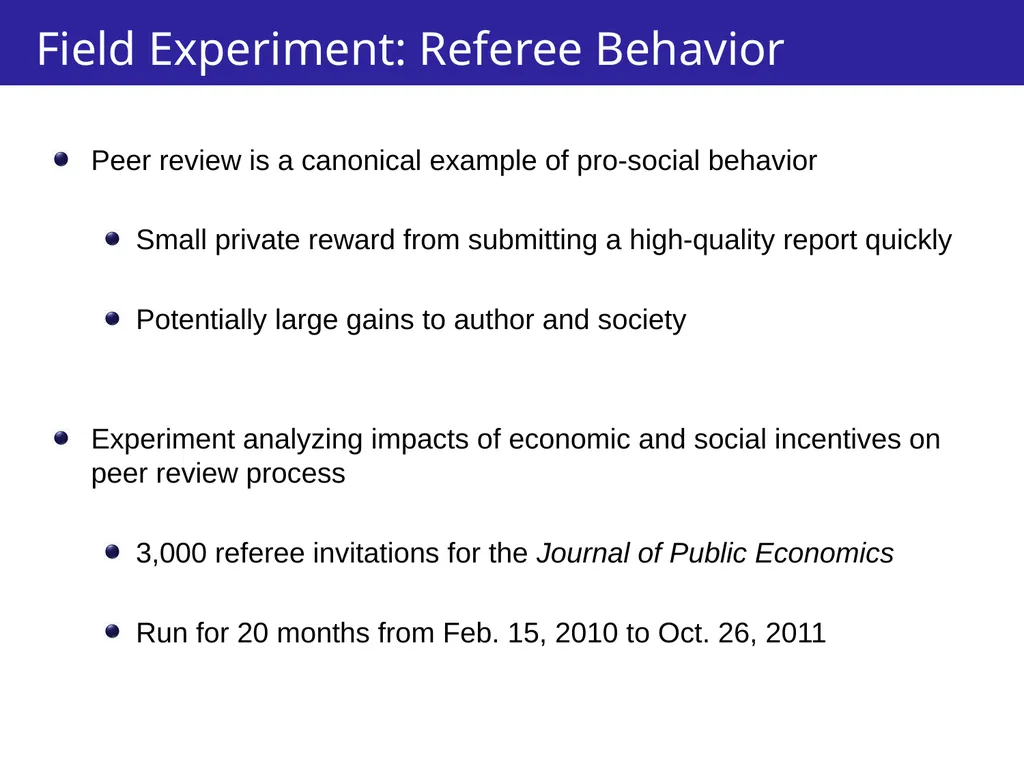
slide3. Field Experiment: Referee Behavior Peer review is a canonical example of pro-social behavior
Small private reward from submitting a high-quality report quickly
Potentially large gains to author and society
Experiment analyzing impacts of economic and social incentives on peer review process
3,000 referee invitations for the Journal of Public Economics
Run for 20 months from Feb. 15, 2010 to Oct. 26, 2011<br>
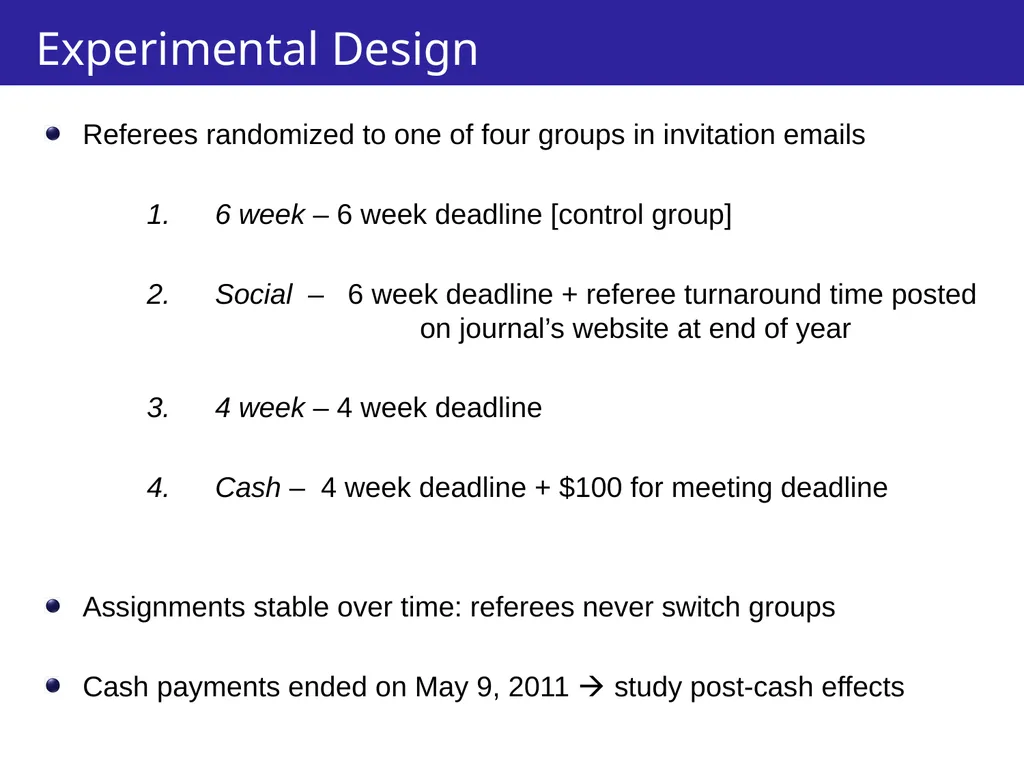
slide4. Experimental Design Referees randomized to one of four groups in invitation emails
6 week – 6 week deadline [control group]
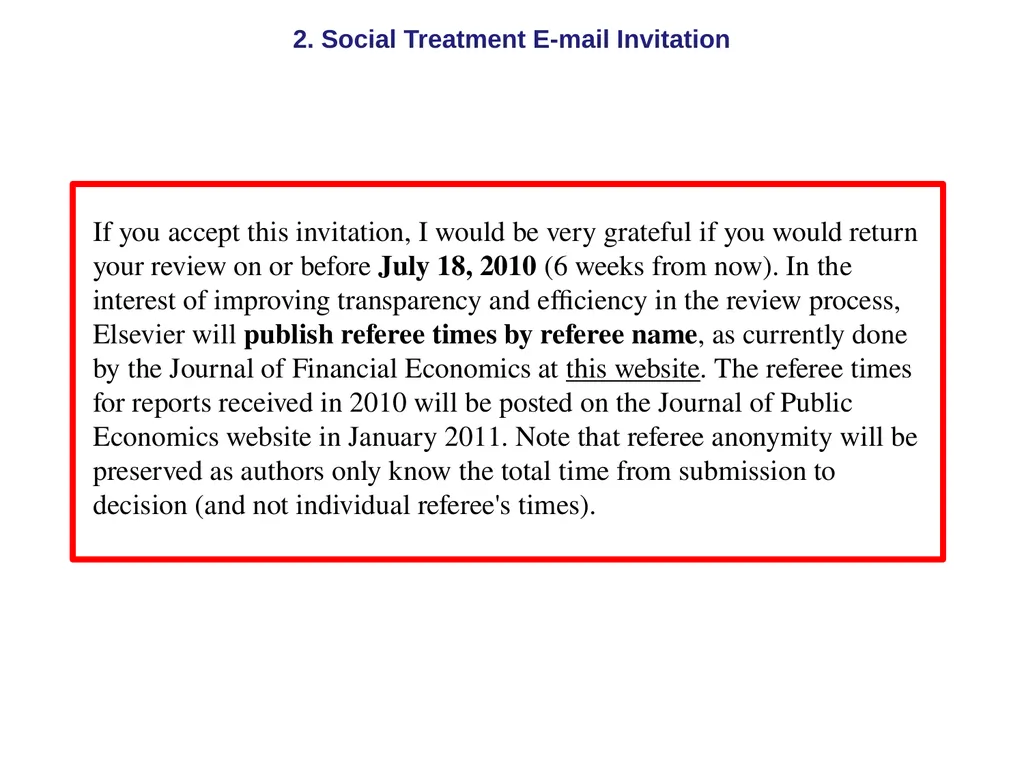
Social – 6 week deadline + referee turnaround time posted on journal’s website at end of year
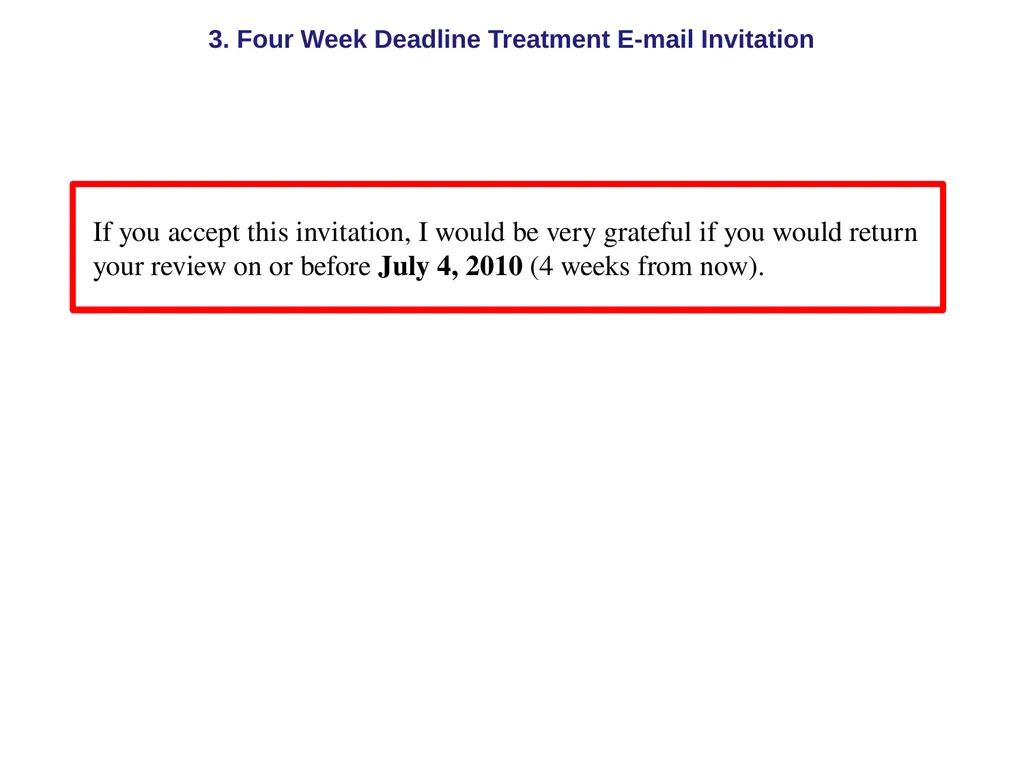
4 week – 4 week deadline
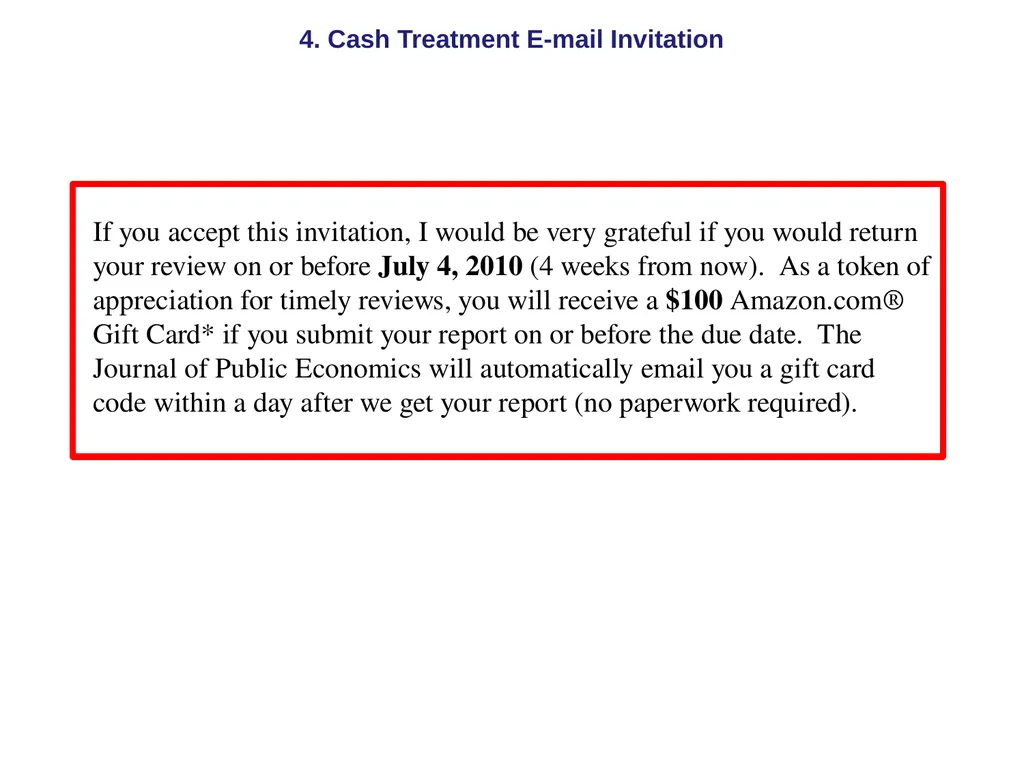
Cash – 4 week deadline + $100 for meeting deadline
Assignments stable over time: referees never switch groups
Cash payments ended on May 9, 2011 study post-cash effects<br>
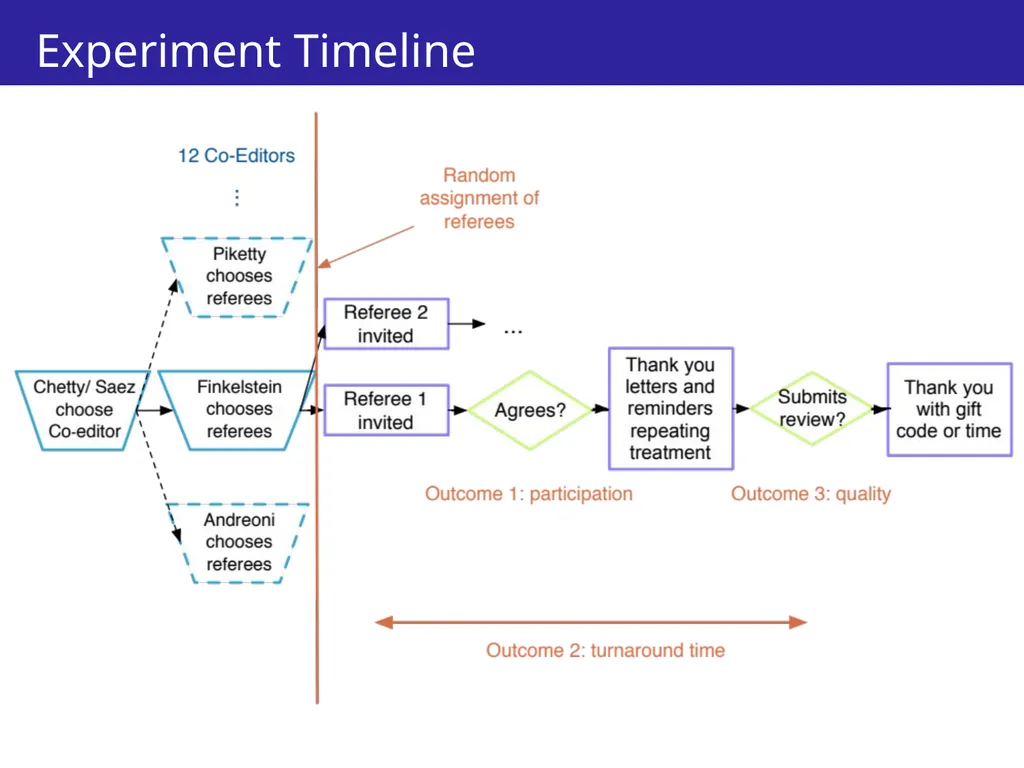
slide5. Experiment Timeline<br>
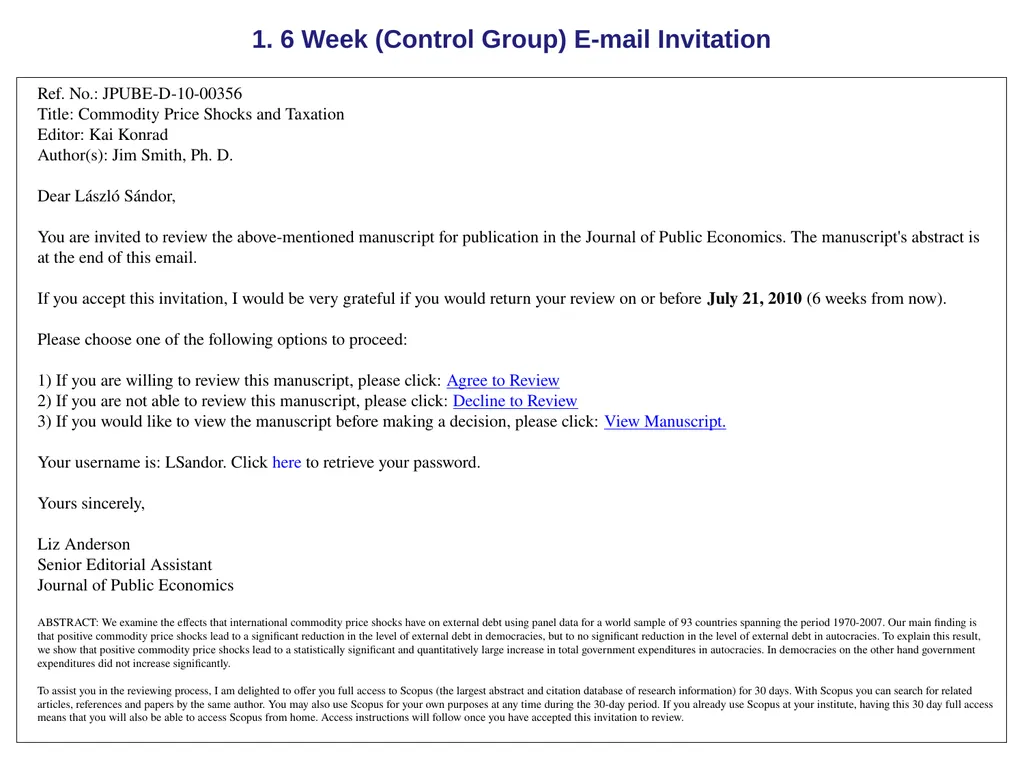
slide6. Ref. No.: JPUBE-D-10-00356
Title: Commodity Price Shocks and Taxation
Editor: Kai Konrad
Author(s): Jim Smith, Ph. D.
Dear László Sándor,
You are invited to review the above-mentioned manuscript for publication in the Journal of Public Economics. The manuscript's abstract is at the end of this email.
If you accept this invitation, I would be very grateful if you would return your review on or before July 21, 2010 (6 weeks from now).
Please choose one of the following options to proceed:
1) If you are willing to review this manuscript, please click: Agree to Review
2) If you are not able to review this manuscript, please click: Decline to Review
3) If you would like to view the manuscript before making a decision, please click: View Manuscript.
Your username is: LSandor. Click here to retrieve your password.
Yours sincerely,
Liz Anderson
Senior Editorial Assistant
Journal of Public Economics
ABSTRACT: We examine the effects that international commodity price shocks have on external debt using panel data for a world sample of 93 countries spanning the period 1970-2007. Our main finding is that positive commodity price shocks lead to a significant reduction in the level of external debt in democracies, but to no significant reduction in the level of external debt in autocracies. To explain this result, we show that positive commodity price shocks lead to a statistically significant and quantitatively large increase in total government expenditures in autocracies. In democracies on the other hand government expenditures did not increase significantly.
To assist you in the reviewing process, I am delighted to offer you full access to Scopus (the largest abstract and citation database of research information) for 30 days. With Scopus you can search for related articles, references and papers by the same author. You may also use Scopus for your own purposes at any time during the 30-day period. If you already use Scopus at your institute, having this 30 day full access means that you will also be able to access Scopus from home. Access instructions will follow once you have accepted this invitation to review. 1. 6 Week (Control Group) E-mail Invitation<br>
slide7. Ref. No.: JPUBE-D-10-00356
Title: Commodity Price Shocks and Taxation
Editor: Kai Konrad
Author(s): Jim Smith, Ph. D.
Dear László Sándor,
You are invited to review the above-mentioned manuscript for publication in the Journal of Public Economics. The manuscript's abstract is at the end of this email.
If you accept this invitation, I would be very grateful if you would return your review on or before July 18, 2010 (6 weeks from now).
Please choose one of the following options to proceed:
1) If you are willing to review this manuscript, please click: Agree to Review
2) If you are not able to review this manuscript, please click: Decline to Review
3) If you would like to view the manuscript before making a decision, please click: View Manuscript.
Your username is: LSandor. Click here to retrieve your password.
Yours sincerely,
Liz Anderson
Senior Editorial Assistant
Journal of Public Economics
ABSTRACT: We examine the effects that international commodity price shocks have on external debt using panel data for a world sample of 93 countries spanning the period 1970-2007. Our main finding is that positive commodity price shocks lead to a significant reduction in the level of external debt in democracies, but to no significant reduction in the level of external debt in autocracies. To explain this result, we show that positive commodity price shocks lead to a statistically significant and quantitatively large increase in total government expenditures in autocracies. In democracies on the other hand government expenditures did not increase significantly.
To assist you in the reviewing process, I am delighted to offer you full access to Scopus (the largest abstract and citation database of research information) for 30 days. With Scopus you can search for related articles, references and papers by the same author. You may also use Scopus for your own purposes at any time during the 30-day period. If you already use Scopus at your institute, having this 30 day full access means that you will also be able to access Scopus from home. Access instructions will follow once you have accepted this invitation to review. 1. 6 Week (Control Group) E-mail Invitation<br>
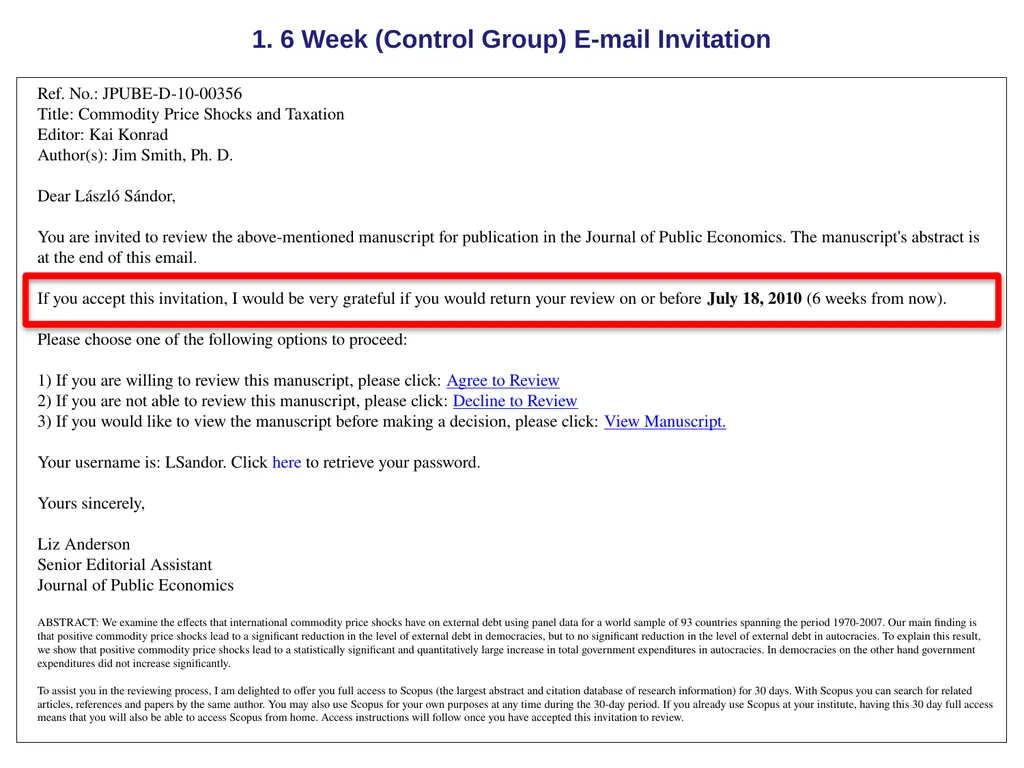
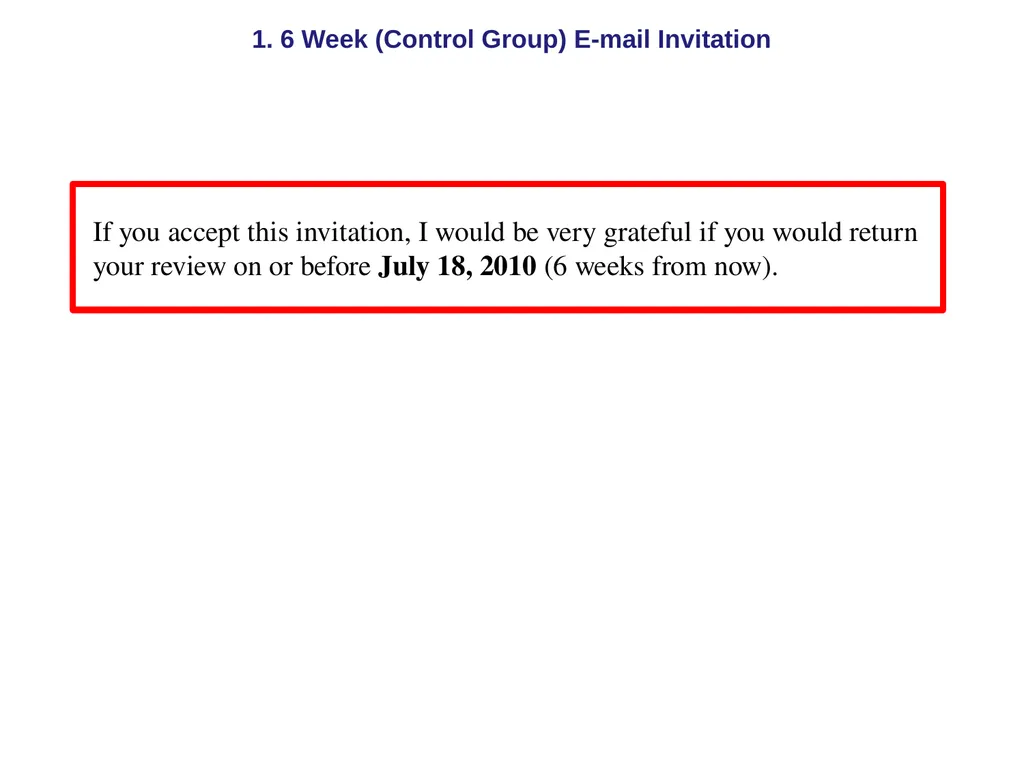
slide8. If you accept this invitation, I would be very grateful if you would return your review on or before July 18, 2010 (6 weeks from now). 1. 6 Week (Control Group) E-mail Invitation<br>
slide9. If you accept this invitation, I would be very grateful if you would return your review on or before July 18, 2010 (6 weeks from now). In the interest of improving transparency and efficiency in the review process, Elsevier will publish referee times by referee name, as currently done by the Journal of Financial Economics at this website. The referee times for reports received in 2010 will be posted on the Journal of Public Economics website in January 2011. Note that referee anonymity will be preserved as authors only know the total time from submission to decision (and not individual referee's times). 2. Social Treatment E-mail Invitation<br>
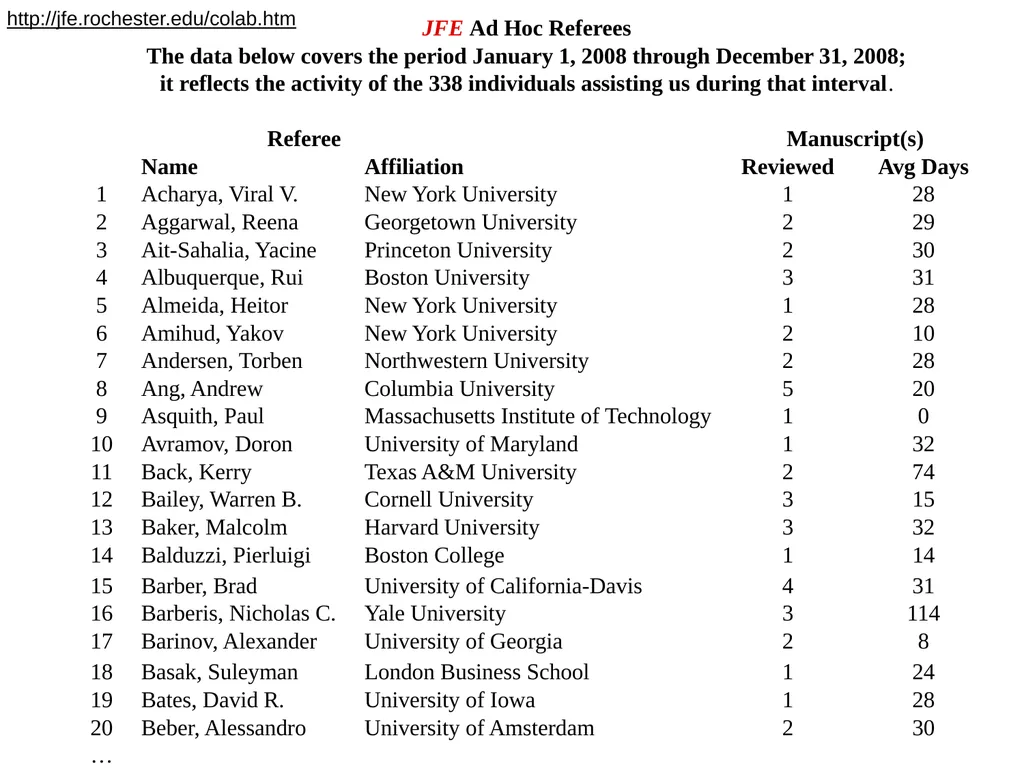
slide10. http://jfe.rochester.edu/colab.htm<br>
slide11. If you accept this invitation, I would be very grateful if you would return your review on or before July 4, 2010 (4 weeks from now). 3. Four Week Deadline Treatment E-mail Invitation<br>
slide12. If you accept this invitation, I would be very grateful if you would return your review on or before July 4, 2010 (4 weeks from now). As a token of appreciation for timely reviews, you will receive a $100 Amazon.com® Gift Card* if you submit your report on or before the due date. The Journal of Public Economics will automatically email you a gift card code within a day after we get your report (no paperwork required). 4. Cash Treatment E-mail Invitation<br>
slide13. Ref. No.: JPUBE-D-10-00356
Title: Commodity Price Shocks and Taxation
Editor: Kai Konrad
Author(s): Jim Smith, Ph. D.
Journal of Public Economics
Dear László Sándor,
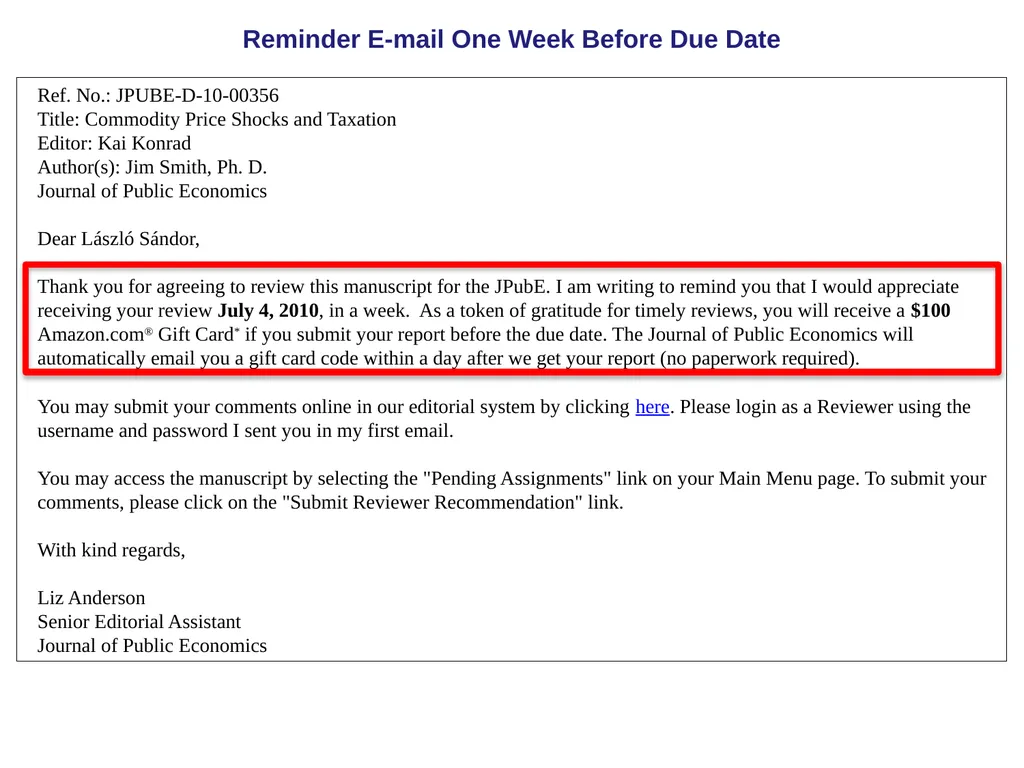
Thank you for agreeing to review this manuscript for the JPubE. I am writing to remind you that I would appreciate receiving your review July 4, 2010, in a week. As a token of gratitude for timely reviews, you will receive a $100 Amazon.com® Gift Card* if you submit your report before the due date. The Journal of Public Economics will automatically email you a gift card code within a day after we get your report (no paperwork required).
You may submit your comments online in our editorial system by clicking here. Please login as a Reviewer using the username and password I sent you in my first email.
You may access the manuscript by selecting the "Pending Assignments" link on your Main Menu page. To submit your comments, please click on the "Submit Reviewer Recommendation" link.
With kind regards,
Liz Anderson
Senior Editorial Assistant
Journal of Public Economics Reminder E-mail One Week Before Due Date<br>
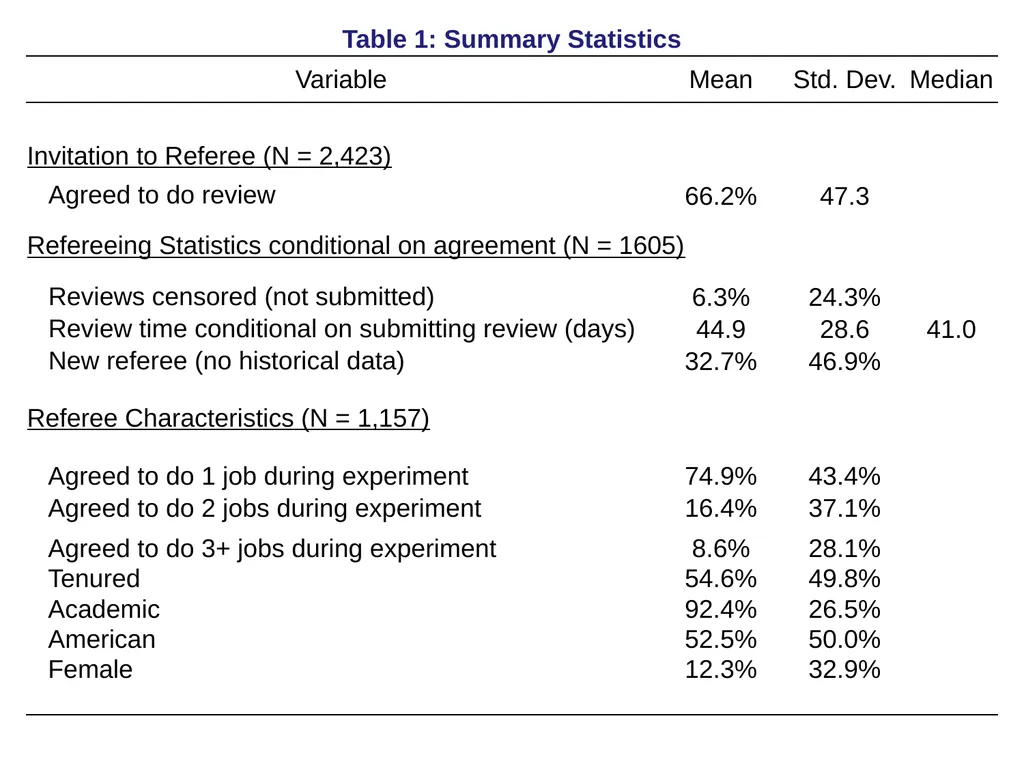
slide14. Table 1: Summary Statistics<br>
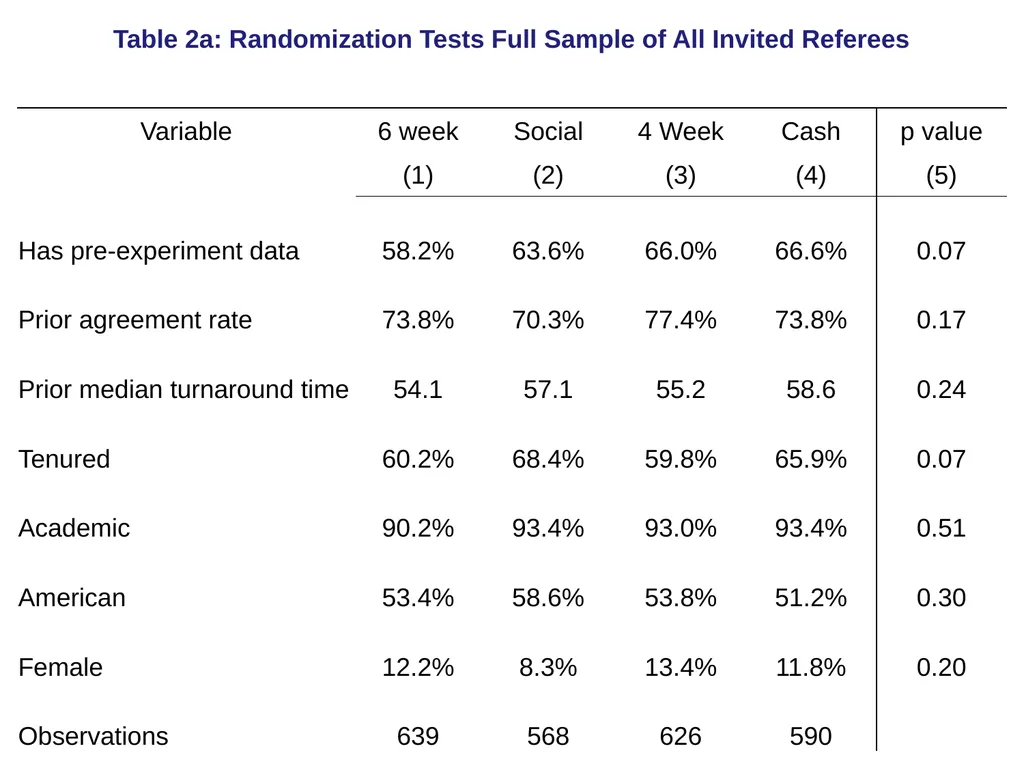
slide15. Table 2a: Randomization Tests Full Sample of All Invited Referees<br>
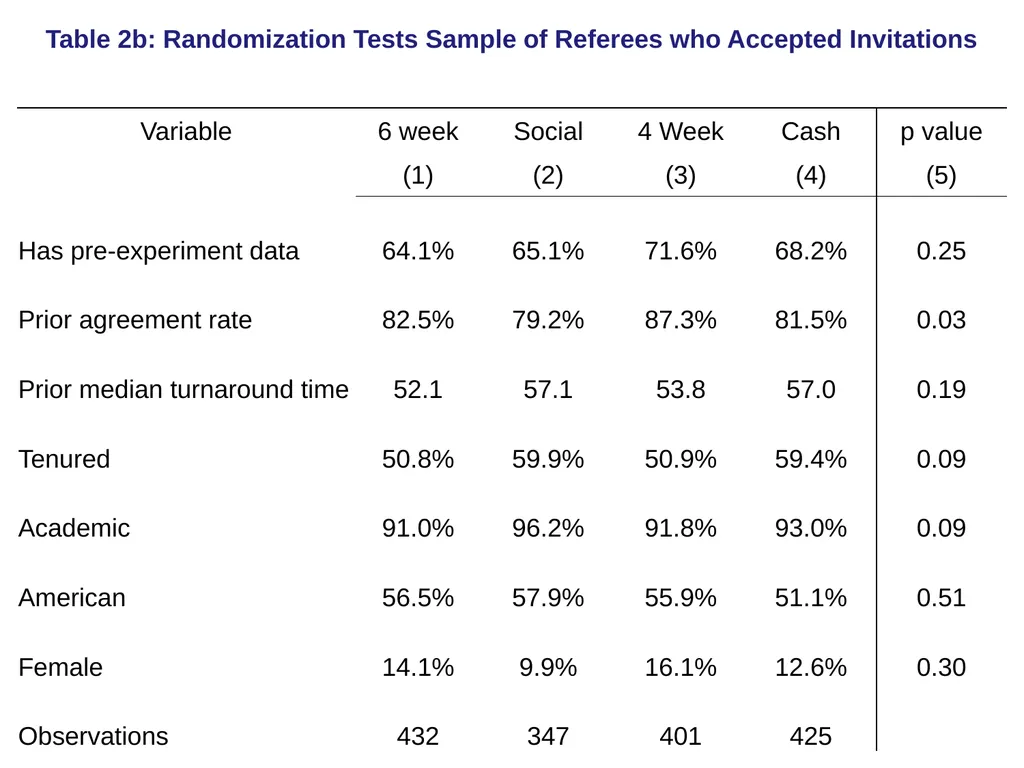
slide16. Table 2b: Randomization Tests Sample of Referees who Accepted Invitations<br>
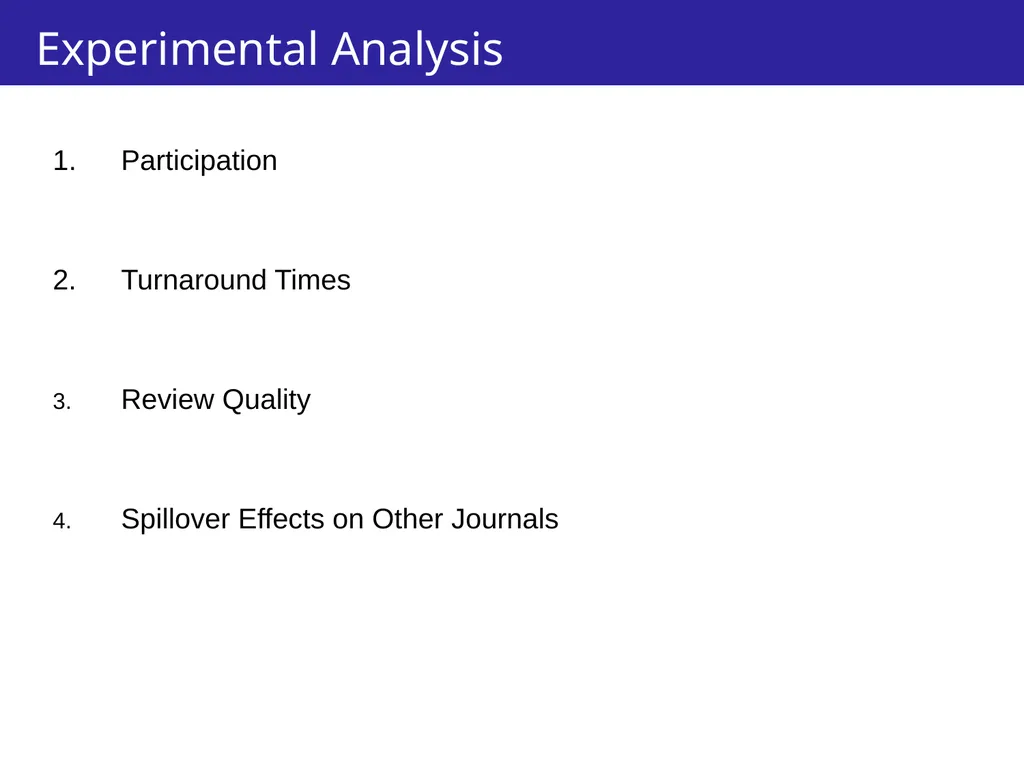
slide17. Experimental Analysis Participation
2. Turnaround Times
Review Quality
Spillover Effects on Other Journals<br>
slide18. Outcome 1: Participation Test if treatments affect the fraction of referees who accept invitation to write reports<br>
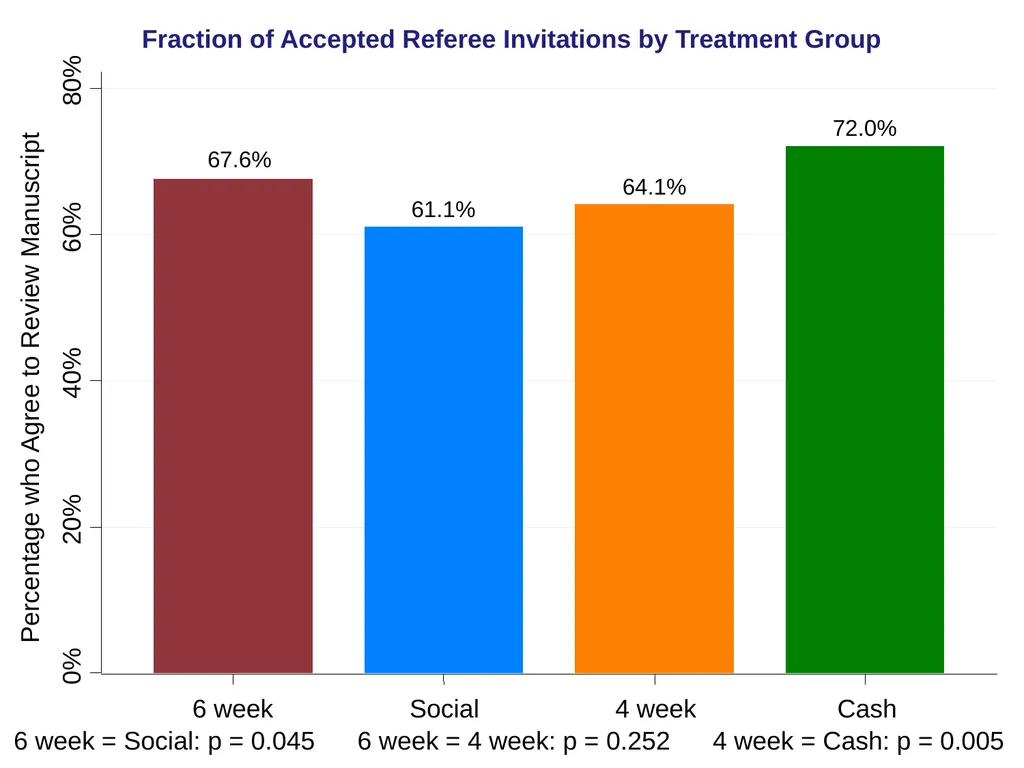
slide19. 0% 20% 40% 60% 80% Percentage who Agree to Review Manuscript 6 week = Social: p = 0.045 6 week = 4 week: p = 0.252 4 week = Cash: p = 0.005 67.6% 61.1% 64.1% 72.0% Fraction of Accepted Referee Invitations by Treatment Group 6 week Social 4 week Cash<br>
slide20. “I am sorry to have to decline this “invitation” to work for free.... For me, this practice has become too discouraging. Can't Elsevier offer a better reward for the time they ask to devote to this screening?” Selection into cash “I was surprised to receive an email stating the journal is posting referee times by names. I don't like Elsevier's way of showing its appreciation for free labor, particularly given how much it charges for its journals. I would like to withdraw my agreement to referee this paper. Sorry about that. I would have been happy to send in a report on time under a different policy.” Selection out of social Selection: Anecdotal Evidence<br>
slide21. Outcome 2: Turnaround Time Now analyze impacts of treatments on time taken to submit report
Treatment effects may be biased by selection into agreement to referee
Ex: faster referees may accept cash invitation
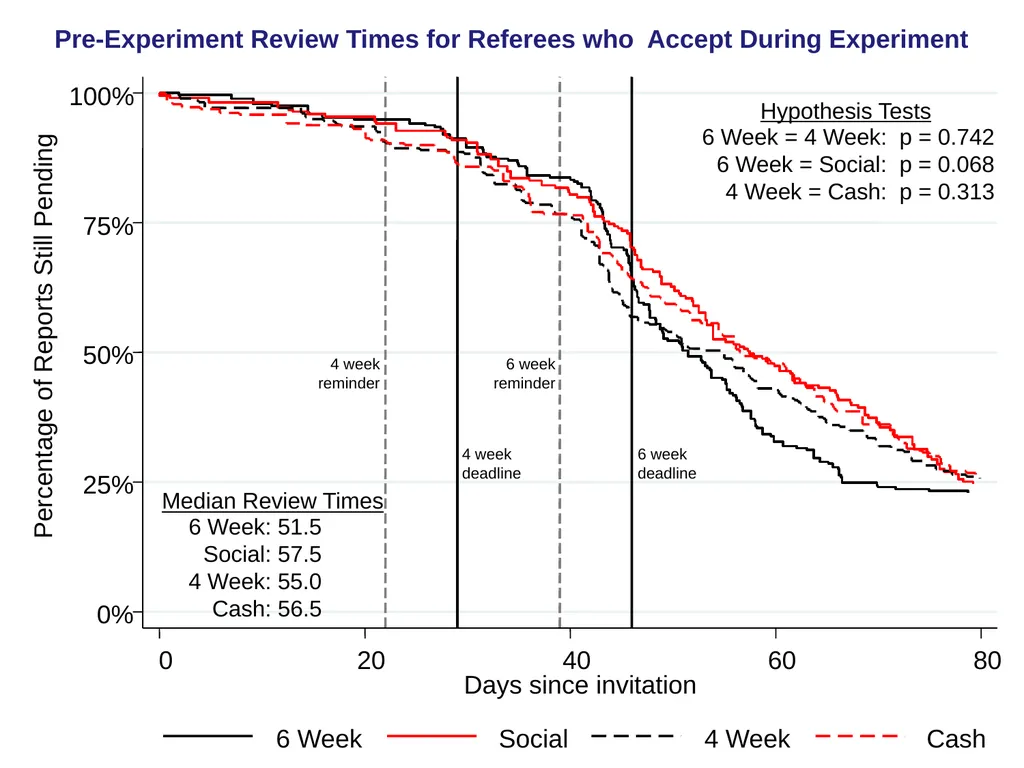
To test for such selection, analyze pre-experiment turnaround among referees who agree to participate<br>
slide22. Pre-Experiment Review Times for Referees who Accept During Experiment<br>
slide23. Outcome 2: Turnaround Time Now analyze impacts of treatments on time taken to submit report
Treatment effects may be biased by selection into agreement to referee
Ex: faster referees may accept cash invitation
To test for such selection, analyze pre-experiment turnaround among referees who agree to participate
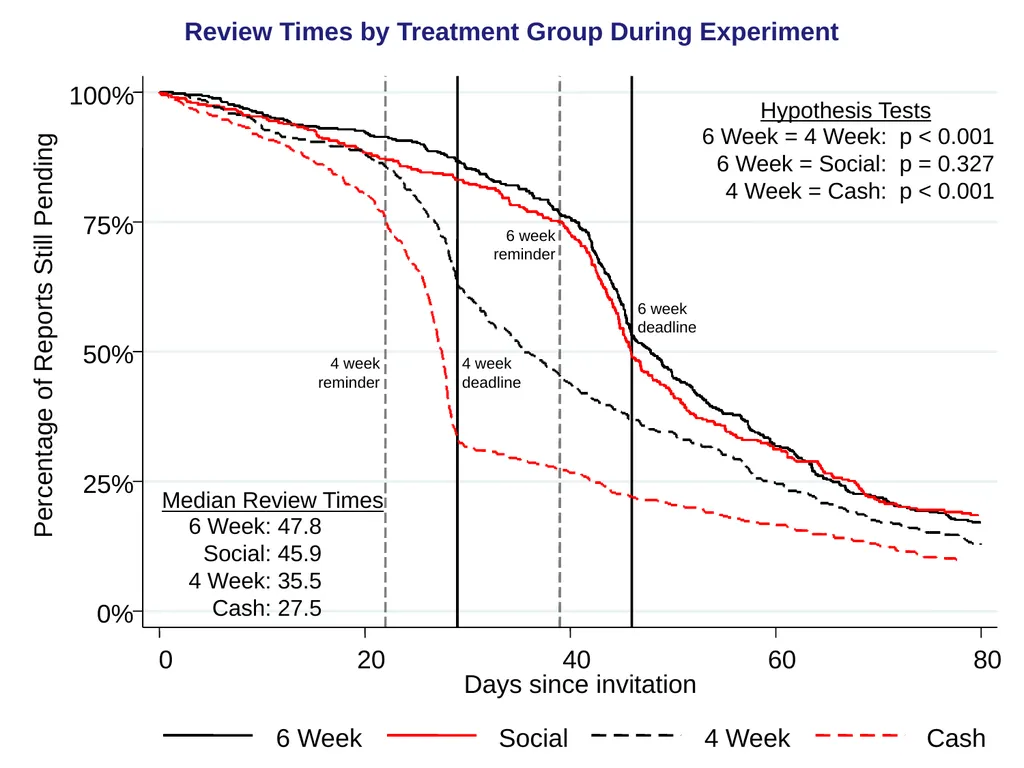
Account for any selection by reweighting using pre-experiment turnaround times [Dinardo, Fortin, Lemieux 1996]
Most results also robust to use of non-parametric trimming bounds instead [Lee 2009]<br>
slide24. Review Times by Treatment Group During Experiment<br>
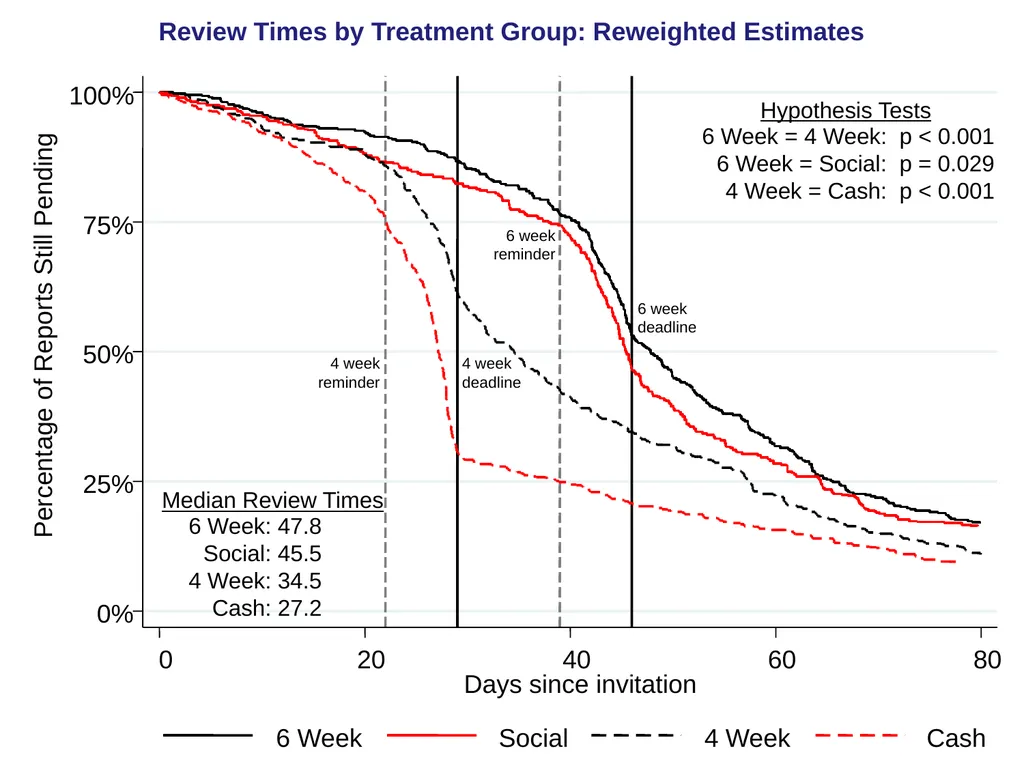
slide25. Review Times by Treatment Group: Reweighted Estimates<br>
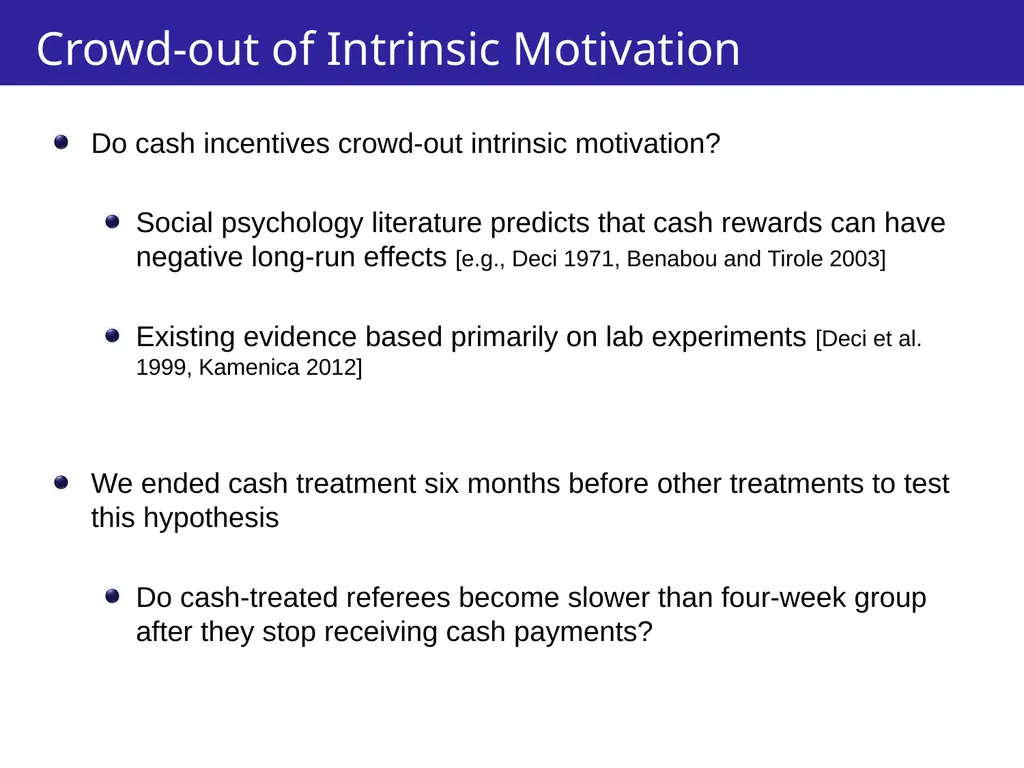
slide26. Crowd-out of Intrinsic Motivation Do cash incentives crowd-out intrinsic motivation?
Social psychology literature predicts that cash rewards can have negative long-run effects [e.g., Deci 1971, Benabou and Tirole 2003]
Existing evidence based primarily on lab experiments [Deci et al. 1999, Kamenica 2012]
We ended cash treatment six months before other treatments to test this hypothesis
Do cash-treated referees become slower than four-week group after they stop receiving cash payments?<br>
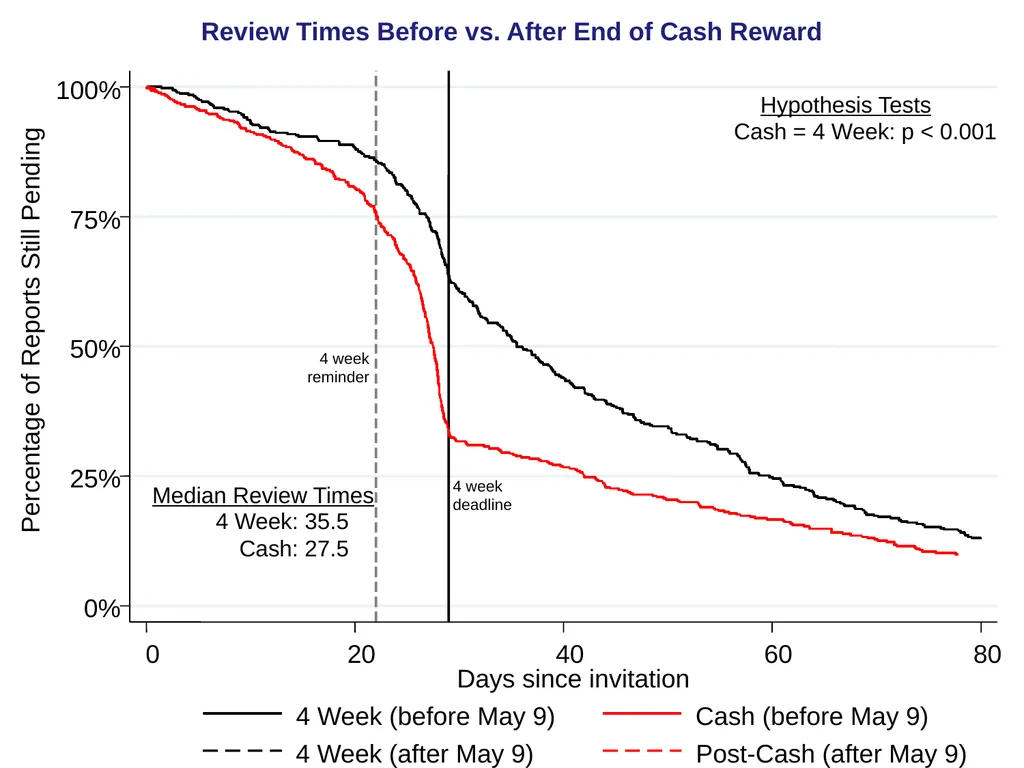
slide27. Review Times Before vs. After End of Cash Reward 0% 25% 50% 75% 100% Percentage of Reports Still Pending 0 20 40 60 80 Days since invitation 4 Week (before May 9) Cash (before May 9) 4 Week (after May 9) Post-Cash (after May 9) Median Review Times 4 week
reminder Cash = 4 Week: p < 0.001 4 Week: 35.5
Cash: 27.5 Hypothesis Tests 4 week
deadline<br>
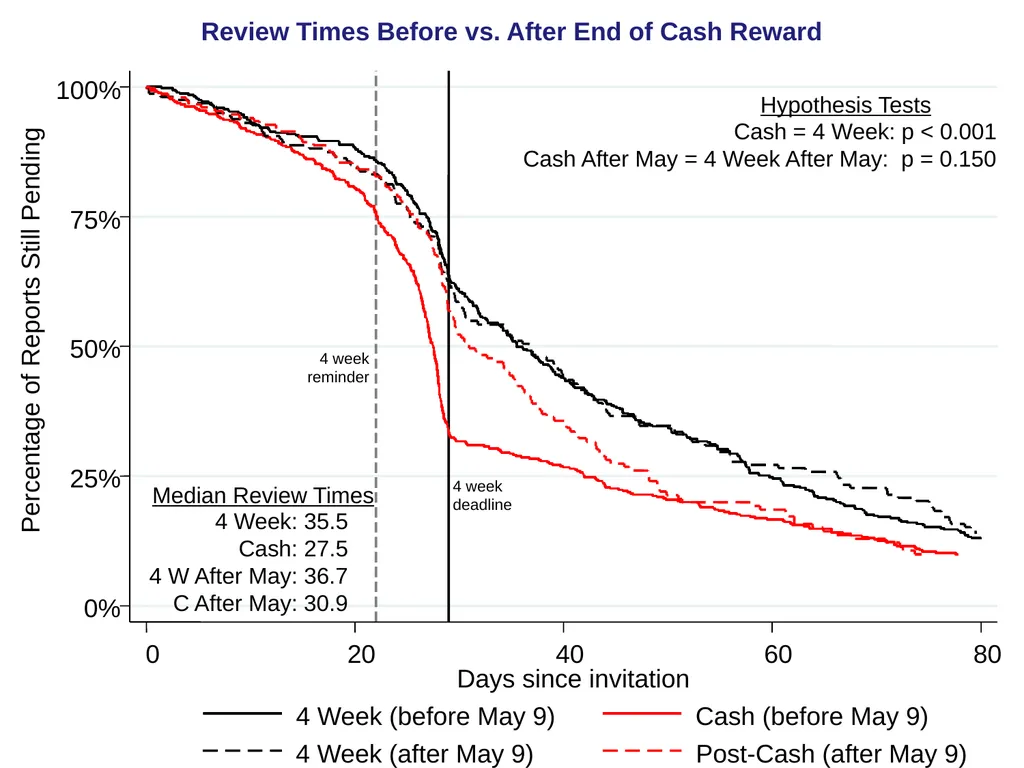
slide28. Review Times Before vs. After End of Cash Reward 0% 25% 50% 75% 100% Percentage of Reports Still Pending 0 20 40 60 80 Days since invitation 4 Week (before May 9) Cash (before May 9) 4 Week (after May 9) Post-Cash (after May 9) Median Review Times 4 week
reminder Cash = 4 Week: p < 0.001
Cash After May = 4 Week After May: p = 0.150 4 Week: 35.5
Cash: 27.5
4 W After May: 36.7
C After May: 30.9 Hypothesis Tests 4 week
deadline<br>
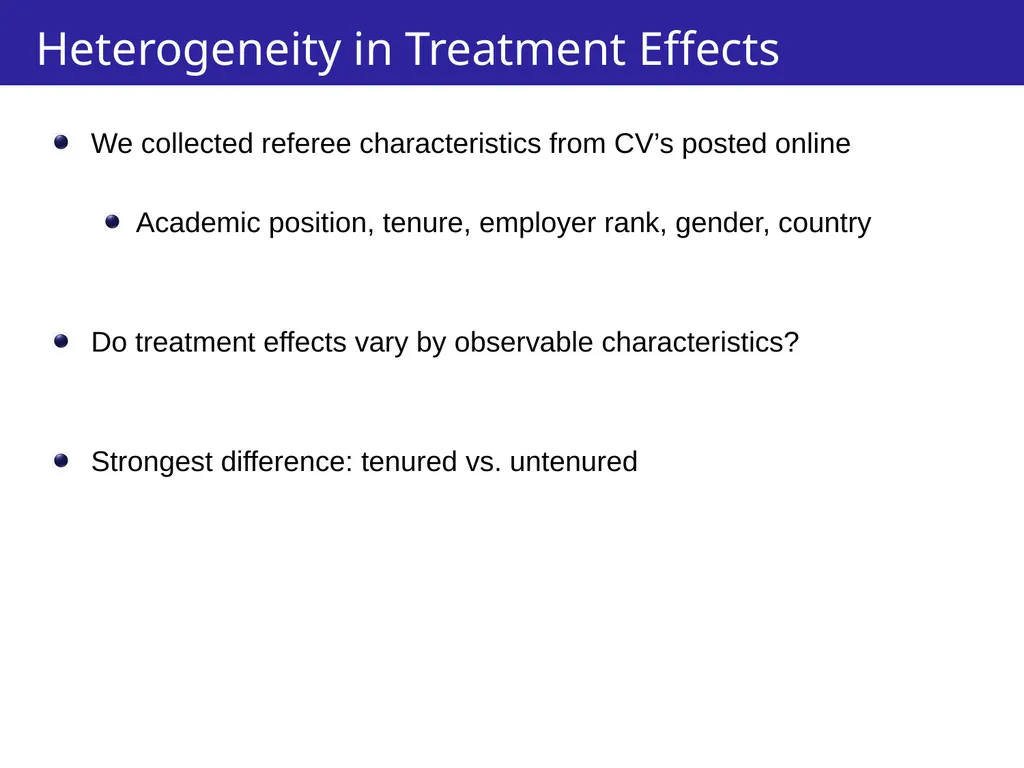
slide29. Heterogeneity in Treatment Effects We collected referee characteristics from CV’s posted online
Academic position, tenure, employer rank, gender, country
Do treatment effects vary by observable characteristics?
Strongest difference: tenured vs. untenured<br>
slide30. Turnaround Times by Treatment Group: Tenured Referees<br>
slide31. Turnaround Times by Treatment Group: Untenured Referees 0% 25% 50% 75% 100% Percentage of Reports Still Pending 0 20 40 60 80 Days since invitation 6 Week Social 4 Week Cash Median Review Times 6 Week = 4 Week: p < 0.001
6 Week = Social: p = 0.827
4 Week = Cash: p < 0.001 6 Week: 45.9
Social: 45.5
4 Week: 31.7
Cash: 27.3 Hypothesis Tests 4 week
reminder 4 week
deadline 6 week
reminder 6 week
deadline<br>
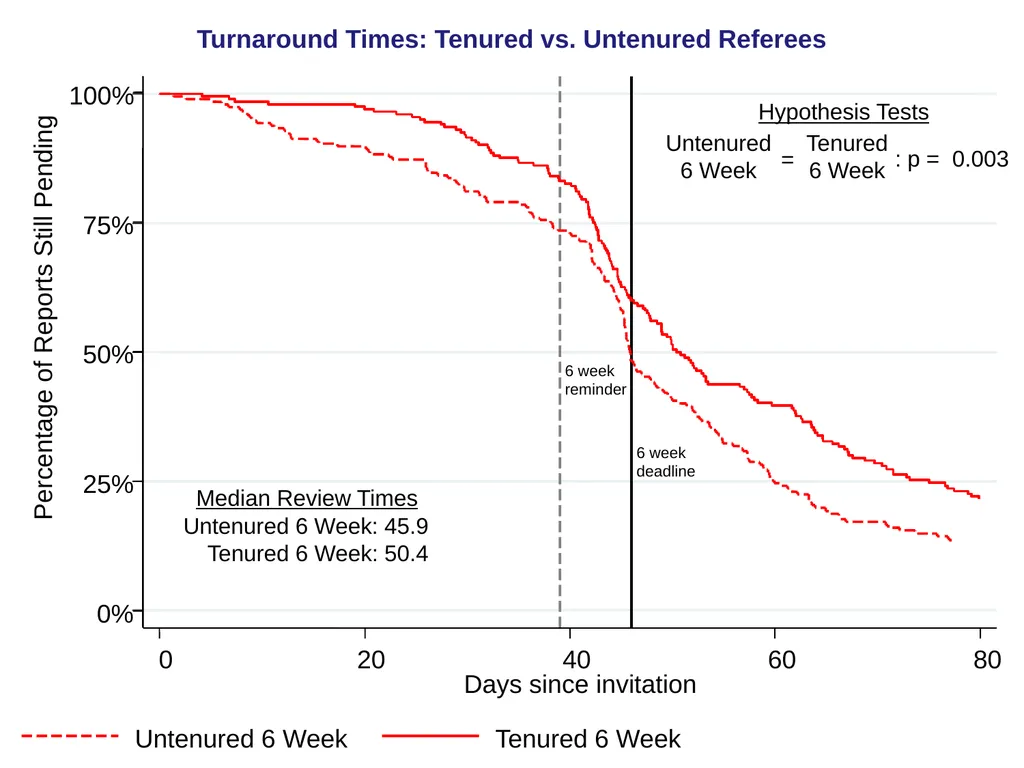
slide32. Turnaround Times: Tenured vs. Untenured Referees Percentage of Reports Still Pending Hypothesis Tests Untenured
6 Week Tenured
6 Week = : p = 0.003 Median Review Times Untenured 6 Week: 45.9
Tenured 6 Week: 50.4 6 week
reminder 6 week
deadline 0% 25% 50% 75% 100% 0 20 40 60 80 Tenured 6 Week Untenured 6 Week Days since invitation<br>
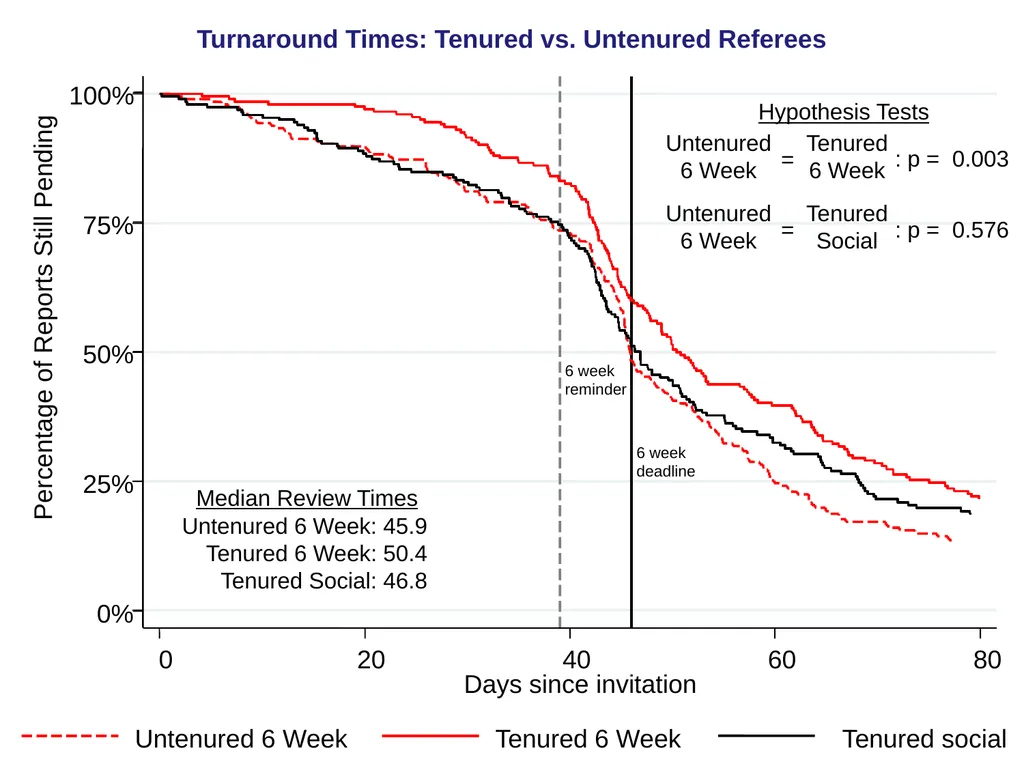
slide33. Turnaround Times: Tenured vs. Untenured Referees Percentage of Reports Still Pending Hypothesis Tests Untenured
6 Week Tenured
6 Week = : p = 0.003 Untenured
6 Week Tenured
Social = : p = 0.576 Median Review Times Untenured 6 Week: 45.9
Tenured 6 Week: 50.4
Tenured Social: 46.8 6 week
reminder 6 week
deadline 0% 25% 50% 75% 100% 0 20 40 60 80 Tenured 6 Week Untenured 6 Week Tenured social Days since invitation<br>
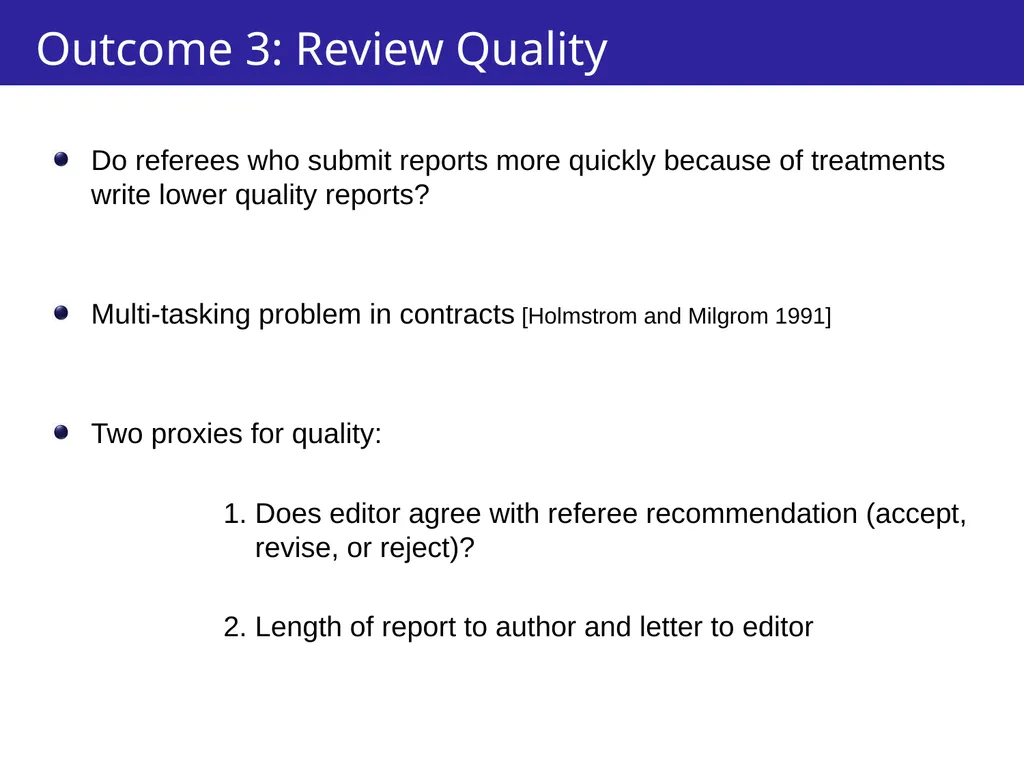
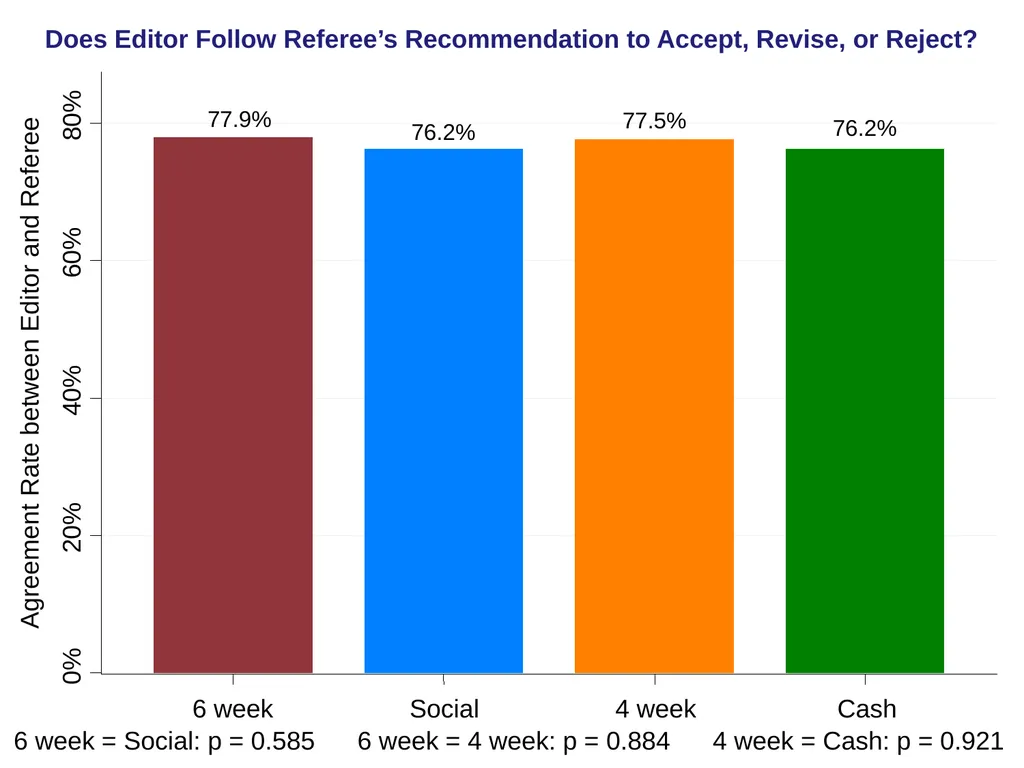
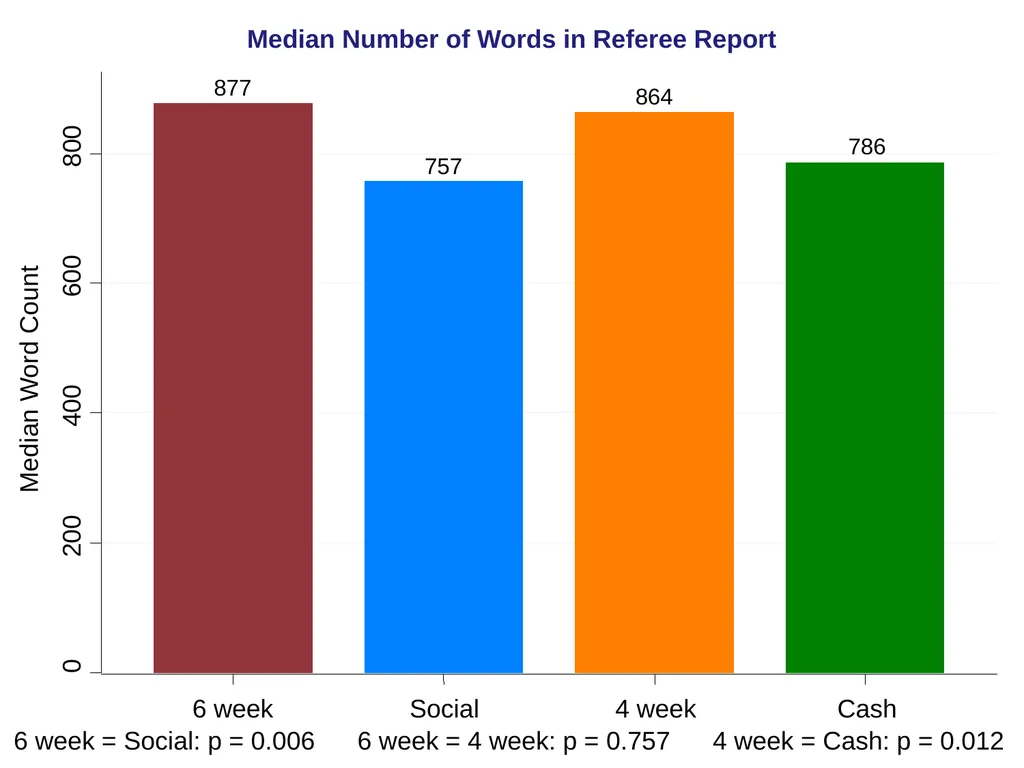
slide34. Outcome 3: Review Quality Do referees who submit reports more quickly because of treatments write lower quality reports?
Multi-tasking problem in contracts [Holmstrom and Milgrom 1991]
Two proxies for quality:
1. Does editor agree with referee recommendation (accept, revise, or reject)?
2. Length of report to author and letter to editor<br>
slide35. 6 week = Social: p = 0.585 6 week = 4 week: p = 0.884 4 week = Cash: p = 0.921 77.9% 76.2% 77.5% 76.2% Does Editor Follow Referee’s Recommendation to Accept, Revise, or Reject? Agreement Rate between Editor and Referee 0% 20% 40% 60% 80% 6 week Social 4 week Cash<br>
slide36. Median Number of Words in Referee Report 6 week = Social: p = 0.006 6 week = 4 week: p = 0.757 4 week = Cash: p = 0.012 Median Word Count 0 200 400 600 800 6 week Social 4 week Cash 877 757 864 786<br>
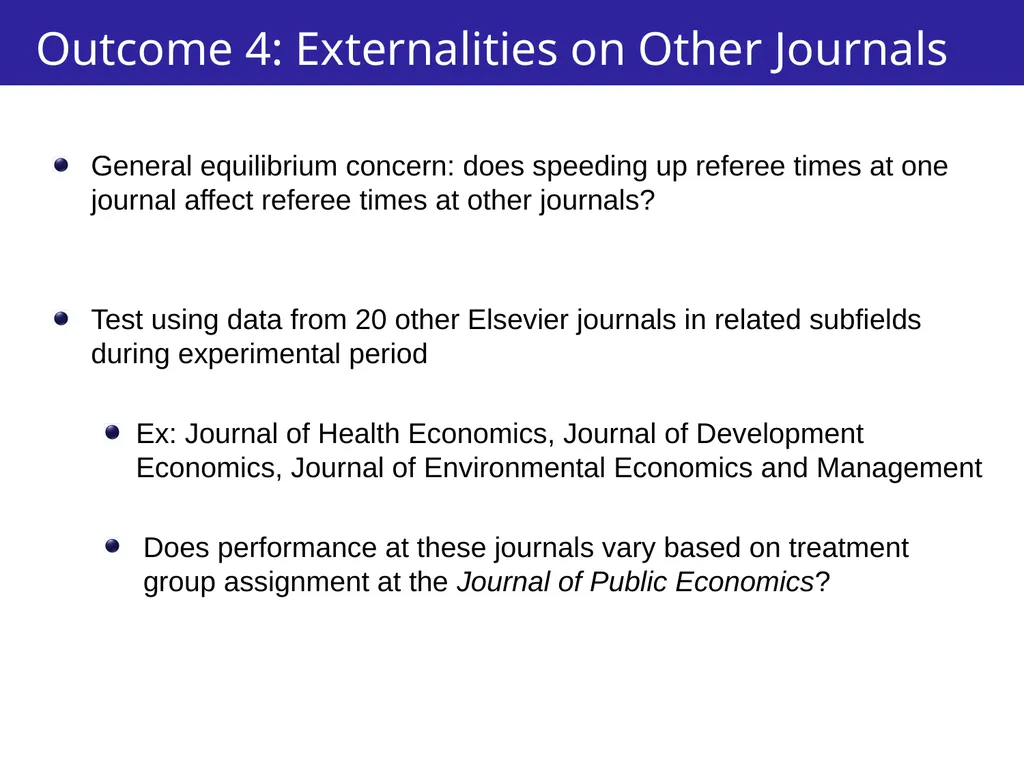
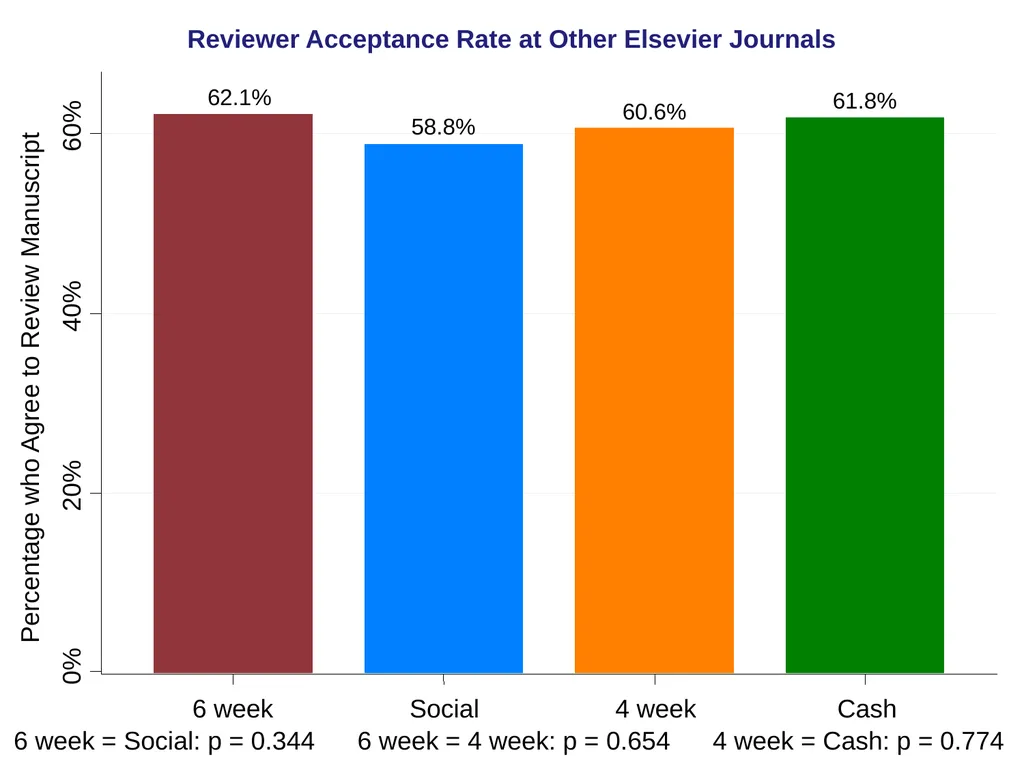
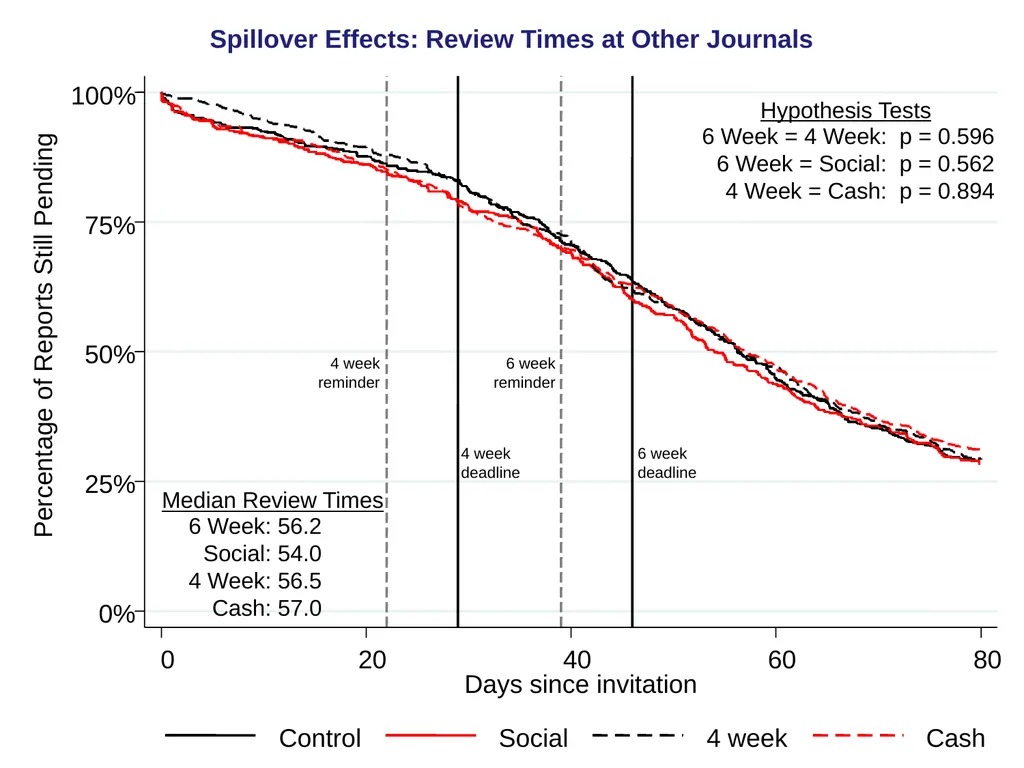
slide37. Outcome 4: Externalities on Other Journals General equilibrium concern: does speeding up referee times at one journal affect referee times at other journals?
Test using data from 20 other Elsevier journals in related subfields during experimental period
Ex: Journal of Health Economics, Journal of Development Economics, Journal of Environmental Economics and Management
Does performance at these journals vary based on treatment group assignment at the Journal of Public Economics?<br>
slide38. Reviewer Acceptance Rate at Other Elsevier Journals 6 week = Social: p = 0.344 6 week = 4 week: p = 0.654 4 week = Cash: p = 0.774 Percentage who Agree to Review Manuscript 0% 20% 40% 60% 6 week Social 4 week Cash 62.1% 58.8% 60.6% 61.8%<br>
slide39. Spillover Effects: Review Times at Other Journals<br>
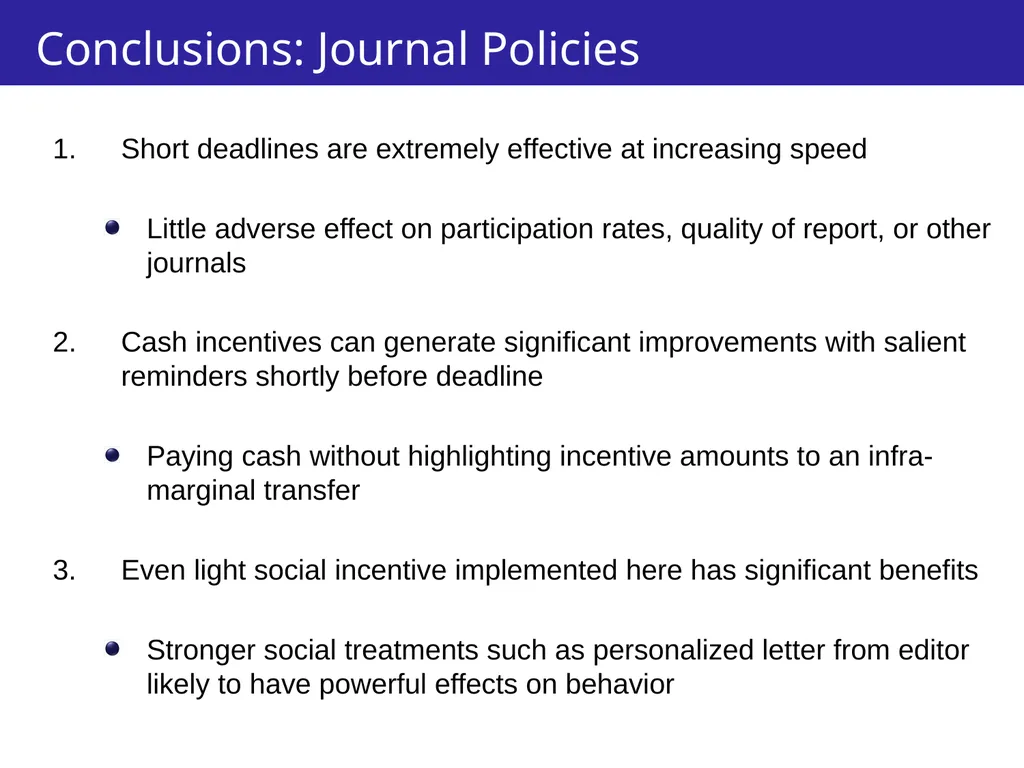
slide40. Conclusions: Journal Policies Short deadlines are extremely effective at increasing speed
Little adverse effect on participation rates, quality of report, or other journals
Cash incentives can generate significant improvements with salient reminders shortly before deadline
Paying cash without highlighting incentive amounts to an infra-marginal transfer
3. Even light social incentive implemented here has significant benefits
Stronger social treatments such as personalized letter from editor likely to have powerful effects on behavior<br>
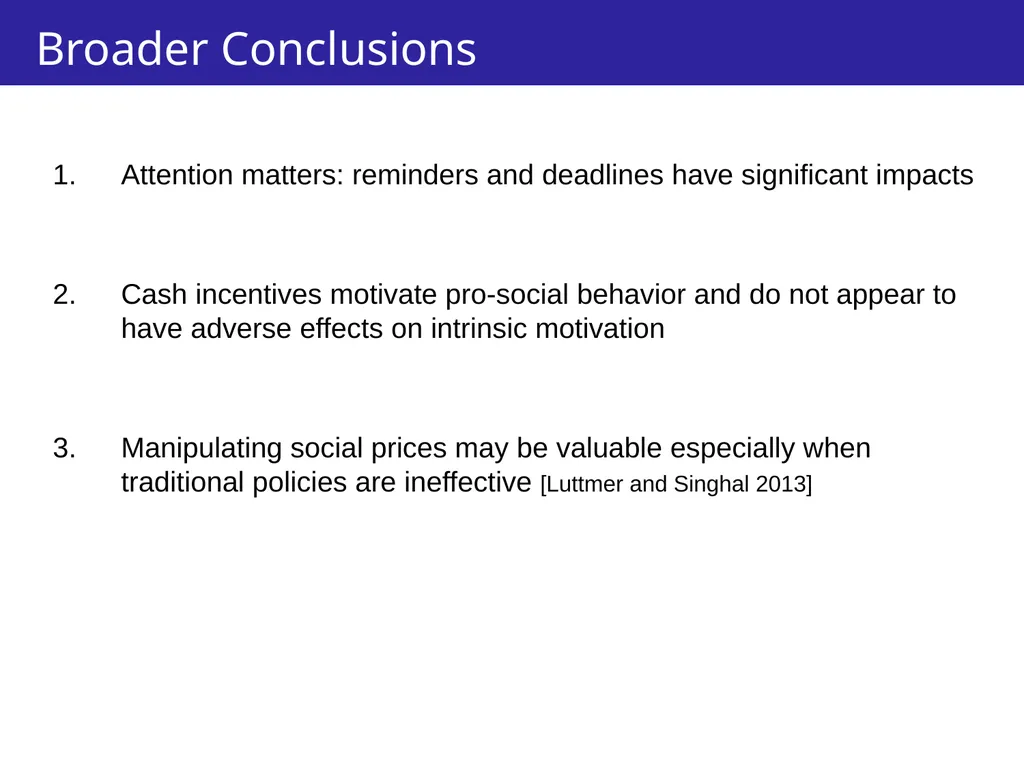
slide41. Broader Conclusions Attention matters: reminders and deadlines have significant impacts
Cash incentives motivate pro-social behavior and do not appear to have adverse effects on intrinsic motivation
Manipulating social prices may be valuable especially when traditional policies are ineffective [Luttmer and Singhal 2013]<br>
Emmanuel Saez, UC Berkeley
Laszlo Sandor, Harvard
February 2014<br>
slide2. Introduction Specific question: how can we improve the speed/quality of peer review?
Broader question: what policies best motivate pro-social behavior?
Economic incentives (e.g., corrective subsidies)
Could have negative effects by crowding out intrinsic motivation
Social incentives (e.g., public recognition)
Effective in situations where economic incentives are not?
Considerable lab evidence on these questions; much less field evidence<br>
slide3. Field Experiment: Referee Behavior Peer review is a canonical example of pro-social behavior
Small private reward from submitting a high-quality report quickly
Potentially large gains to author and society
Experiment analyzing impacts of economic and social incentives on peer review process
3,000 referee invitations for the Journal of Public Economics
Run for 20 months from Feb. 15, 2010 to Oct. 26, 2011<br>
slide4. Experimental Design Referees randomized to one of four groups in invitation emails
6 week – 6 week deadline [control group]
Social – 6 week deadline + referee turnaround time posted on journal’s website at end of year
4 week – 4 week deadline
Cash – 4 week deadline + $100 for meeting deadline
Assignments stable over time: referees never switch groups
Cash payments ended on May 9, 2011 study post-cash effects<br>
slide5. Experiment Timeline<br>
slide6. Ref. No.: JPUBE-D-10-00356
Title: Commodity Price Shocks and Taxation
Editor: Kai Konrad
Author(s): Jim Smith, Ph. D.
Dear László Sándor,
You are invited to review the above-mentioned manuscript for publication in the Journal of Public Economics. The manuscript's abstract is at the end of this email.
If you accept this invitation, I would be very grateful if you would return your review on or before July 21, 2010 (6 weeks from now).
Please choose one of the following options to proceed:
1) If you are willing to review this manuscript, please click: Agree to Review
2) If you are not able to review this manuscript, please click: Decline to Review
3) If you would like to view the manuscript before making a decision, please click: View Manuscript.
Your username is: LSandor. Click here to retrieve your password.
Yours sincerely,
Liz Anderson
Senior Editorial Assistant
Journal of Public Economics
ABSTRACT: We examine the effects that international commodity price shocks have on external debt using panel data for a world sample of 93 countries spanning the period 1970-2007. Our main finding is that positive commodity price shocks lead to a significant reduction in the level of external debt in democracies, but to no significant reduction in the level of external debt in autocracies. To explain this result, we show that positive commodity price shocks lead to a statistically significant and quantitatively large increase in total government expenditures in autocracies. In democracies on the other hand government expenditures did not increase significantly.
To assist you in the reviewing process, I am delighted to offer you full access to Scopus (the largest abstract and citation database of research information) for 30 days. With Scopus you can search for related articles, references and papers by the same author. You may also use Scopus for your own purposes at any time during the 30-day period. If you already use Scopus at your institute, having this 30 day full access means that you will also be able to access Scopus from home. Access instructions will follow once you have accepted this invitation to review. 1. 6 Week (Control Group) E-mail Invitation<br>
slide7. Ref. No.: JPUBE-D-10-00356
Title: Commodity Price Shocks and Taxation
Editor: Kai Konrad
Author(s): Jim Smith, Ph. D.
Dear László Sándor,
You are invited to review the above-mentioned manuscript for publication in the Journal of Public Economics. The manuscript's abstract is at the end of this email.
If you accept this invitation, I would be very grateful if you would return your review on or before July 18, 2010 (6 weeks from now).
Please choose one of the following options to proceed:
1) If you are willing to review this manuscript, please click: Agree to Review
2) If you are not able to review this manuscript, please click: Decline to Review
3) If you would like to view the manuscript before making a decision, please click: View Manuscript.
Your username is: LSandor. Click here to retrieve your password.
Yours sincerely,
Liz Anderson
Senior Editorial Assistant
Journal of Public Economics
ABSTRACT: We examine the effects that international commodity price shocks have on external debt using panel data for a world sample of 93 countries spanning the period 1970-2007. Our main finding is that positive commodity price shocks lead to a significant reduction in the level of external debt in democracies, but to no significant reduction in the level of external debt in autocracies. To explain this result, we show that positive commodity price shocks lead to a statistically significant and quantitatively large increase in total government expenditures in autocracies. In democracies on the other hand government expenditures did not increase significantly.
To assist you in the reviewing process, I am delighted to offer you full access to Scopus (the largest abstract and citation database of research information) for 30 days. With Scopus you can search for related articles, references and papers by the same author. You may also use Scopus for your own purposes at any time during the 30-day period. If you already use Scopus at your institute, having this 30 day full access means that you will also be able to access Scopus from home. Access instructions will follow once you have accepted this invitation to review. 1. 6 Week (Control Group) E-mail Invitation<br>
slide8. If you accept this invitation, I would be very grateful if you would return your review on or before July 18, 2010 (6 weeks from now). 1. 6 Week (Control Group) E-mail Invitation<br>
slide9. If you accept this invitation, I would be very grateful if you would return your review on or before July 18, 2010 (6 weeks from now). In the interest of improving transparency and efficiency in the review process, Elsevier will publish referee times by referee name, as currently done by the Journal of Financial Economics at this website. The referee times for reports received in 2010 will be posted on the Journal of Public Economics website in January 2011. Note that referee anonymity will be preserved as authors only know the total time from submission to decision (and not individual referee's times). 2. Social Treatment E-mail Invitation<br>
slide10. http://jfe.rochester.edu/colab.htm<br>
slide11. If you accept this invitation, I would be very grateful if you would return your review on or before July 4, 2010 (4 weeks from now). 3. Four Week Deadline Treatment E-mail Invitation<br>
slide12. If you accept this invitation, I would be very grateful if you would return your review on or before July 4, 2010 (4 weeks from now). As a token of appreciation for timely reviews, you will receive a $100 Amazon.com® Gift Card* if you submit your report on or before the due date. The Journal of Public Economics will automatically email you a gift card code within a day after we get your report (no paperwork required). 4. Cash Treatment E-mail Invitation<br>
slide13. Ref. No.: JPUBE-D-10-00356
Title: Commodity Price Shocks and Taxation
Editor: Kai Konrad
Author(s): Jim Smith, Ph. D.
Journal of Public Economics
Dear László Sándor,
Thank you for agreeing to review this manuscript for the JPubE. I am writing to remind you that I would appreciate receiving your review July 4, 2010, in a week. As a token of gratitude for timely reviews, you will receive a $100 Amazon.com® Gift Card* if you submit your report before the due date. The Journal of Public Economics will automatically email you a gift card code within a day after we get your report (no paperwork required).
You may submit your comments online in our editorial system by clicking here. Please login as a Reviewer using the username and password I sent you in my first email.
You may access the manuscript by selecting the "Pending Assignments" link on your Main Menu page. To submit your comments, please click on the "Submit Reviewer Recommendation" link.
With kind regards,
Liz Anderson
Senior Editorial Assistant
Journal of Public Economics Reminder E-mail One Week Before Due Date<br>
slide14. Table 1: Summary Statistics<br>
slide15. Table 2a: Randomization Tests Full Sample of All Invited Referees<br>
slide16. Table 2b: Randomization Tests Sample of Referees who Accepted Invitations<br>
slide17. Experimental Analysis Participation
2. Turnaround Times
Review Quality
Spillover Effects on Other Journals<br>
slide18. Outcome 1: Participation Test if treatments affect the fraction of referees who accept invitation to write reports<br>
slide19. 0% 20% 40% 60% 80% Percentage who Agree to Review Manuscript 6 week = Social: p = 0.045 6 week = 4 week: p = 0.252 4 week = Cash: p = 0.005 67.6% 61.1% 64.1% 72.0% Fraction of Accepted Referee Invitations by Treatment Group 6 week Social 4 week Cash<br>
slide20. “I am sorry to have to decline this “invitation” to work for free.... For me, this practice has become too discouraging. Can't Elsevier offer a better reward for the time they ask to devote to this screening?” Selection into cash “I was surprised to receive an email stating the journal is posting referee times by names. I don't like Elsevier's way of showing its appreciation for free labor, particularly given how much it charges for its journals. I would like to withdraw my agreement to referee this paper. Sorry about that. I would have been happy to send in a report on time under a different policy.” Selection out of social Selection: Anecdotal Evidence<br>
slide21. Outcome 2: Turnaround Time Now analyze impacts of treatments on time taken to submit report
Treatment effects may be biased by selection into agreement to referee
Ex: faster referees may accept cash invitation
To test for such selection, analyze pre-experiment turnaround among referees who agree to participate<br>
slide22. Pre-Experiment Review Times for Referees who Accept During Experiment<br>
slide23. Outcome 2: Turnaround Time Now analyze impacts of treatments on time taken to submit report
Treatment effects may be biased by selection into agreement to referee
Ex: faster referees may accept cash invitation
To test for such selection, analyze pre-experiment turnaround among referees who agree to participate
Account for any selection by reweighting using pre-experiment turnaround times [Dinardo, Fortin, Lemieux 1996]
Most results also robust to use of non-parametric trimming bounds instead [Lee 2009]<br>
slide24. Review Times by Treatment Group During Experiment<br>
slide25. Review Times by Treatment Group: Reweighted Estimates<br>
slide26. Crowd-out of Intrinsic Motivation Do cash incentives crowd-out intrinsic motivation?
Social psychology literature predicts that cash rewards can have negative long-run effects [e.g., Deci 1971, Benabou and Tirole 2003]
Existing evidence based primarily on lab experiments [Deci et al. 1999, Kamenica 2012]
We ended cash treatment six months before other treatments to test this hypothesis
Do cash-treated referees become slower than four-week group after they stop receiving cash payments?<br>
slide27. Review Times Before vs. After End of Cash Reward 0% 25% 50% 75% 100% Percentage of Reports Still Pending 0 20 40 60 80 Days since invitation 4 Week (before May 9) Cash (before May 9) 4 Week (after May 9) Post-Cash (after May 9) Median Review Times 4 week
reminder Cash = 4 Week: p < 0.001 4 Week: 35.5
Cash: 27.5 Hypothesis Tests 4 week
deadline<br>
slide28. Review Times Before vs. After End of Cash Reward 0% 25% 50% 75% 100% Percentage of Reports Still Pending 0 20 40 60 80 Days since invitation 4 Week (before May 9) Cash (before May 9) 4 Week (after May 9) Post-Cash (after May 9) Median Review Times 4 week
reminder Cash = 4 Week: p < 0.001
Cash After May = 4 Week After May: p = 0.150 4 Week: 35.5
Cash: 27.5
4 W After May: 36.7
C After May: 30.9 Hypothesis Tests 4 week
deadline<br>
slide29. Heterogeneity in Treatment Effects We collected referee characteristics from CV’s posted online
Academic position, tenure, employer rank, gender, country
Do treatment effects vary by observable characteristics?
Strongest difference: tenured vs. untenured<br>
slide30. Turnaround Times by Treatment Group: Tenured Referees<br>
slide31. Turnaround Times by Treatment Group: Untenured Referees 0% 25% 50% 75% 100% Percentage of Reports Still Pending 0 20 40 60 80 Days since invitation 6 Week Social 4 Week Cash Median Review Times 6 Week = 4 Week: p < 0.001
6 Week = Social: p = 0.827
4 Week = Cash: p < 0.001 6 Week: 45.9
Social: 45.5
4 Week: 31.7
Cash: 27.3 Hypothesis Tests 4 week
reminder 4 week
deadline 6 week
reminder 6 week
deadline<br>
slide32. Turnaround Times: Tenured vs. Untenured Referees Percentage of Reports Still Pending Hypothesis Tests Untenured
6 Week Tenured
6 Week = : p = 0.003 Median Review Times Untenured 6 Week: 45.9
Tenured 6 Week: 50.4 6 week
reminder 6 week
deadline 0% 25% 50% 75% 100% 0 20 40 60 80 Tenured 6 Week Untenured 6 Week Days since invitation<br>
slide33. Turnaround Times: Tenured vs. Untenured Referees Percentage of Reports Still Pending Hypothesis Tests Untenured
6 Week Tenured
6 Week = : p = 0.003 Untenured
6 Week Tenured
Social = : p = 0.576 Median Review Times Untenured 6 Week: 45.9
Tenured 6 Week: 50.4
Tenured Social: 46.8 6 week
reminder 6 week
deadline 0% 25% 50% 75% 100% 0 20 40 60 80 Tenured 6 Week Untenured 6 Week Tenured social Days since invitation<br>
slide34. Outcome 3: Review Quality Do referees who submit reports more quickly because of treatments write lower quality reports?
Multi-tasking problem in contracts [Holmstrom and Milgrom 1991]
Two proxies for quality:
1. Does editor agree with referee recommendation (accept, revise, or reject)?
2. Length of report to author and letter to editor<br>
slide35. 6 week = Social: p = 0.585 6 week = 4 week: p = 0.884 4 week = Cash: p = 0.921 77.9% 76.2% 77.5% 76.2% Does Editor Follow Referee’s Recommendation to Accept, Revise, or Reject? Agreement Rate between Editor and Referee 0% 20% 40% 60% 80% 6 week Social 4 week Cash<br>
slide36. Median Number of Words in Referee Report 6 week = Social: p = 0.006 6 week = 4 week: p = 0.757 4 week = Cash: p = 0.012 Median Word Count 0 200 400 600 800 6 week Social 4 week Cash 877 757 864 786<br>
slide37. Outcome 4: Externalities on Other Journals General equilibrium concern: does speeding up referee times at one journal affect referee times at other journals?
Test using data from 20 other Elsevier journals in related subfields during experimental period
Ex: Journal of Health Economics, Journal of Development Economics, Journal of Environmental Economics and Management
Does performance at these journals vary based on treatment group assignment at the Journal of Public Economics?<br>
slide38. Reviewer Acceptance Rate at Other Elsevier Journals 6 week = Social: p = 0.344 6 week = 4 week: p = 0.654 4 week = Cash: p = 0.774 Percentage who Agree to Review Manuscript 0% 20% 40% 60% 6 week Social 4 week Cash 62.1% 58.8% 60.6% 61.8%<br>
slide39. Spillover Effects: Review Times at Other Journals<br>
slide40. Conclusions: Journal Policies Short deadlines are extremely effective at increasing speed
Little adverse effect on participation rates, quality of report, or other journals
Cash incentives can generate significant improvements with salient reminders shortly before deadline
Paying cash without highlighting incentive amounts to an infra-marginal transfer
3. Even light social incentive implemented here has significant benefits
Stronger social treatments such as personalized letter from editor likely to have powerful effects on behavior<br>
slide41. Broader Conclusions Attention matters: reminders and deadlines have significant impacts
Cash incentives motivate pro-social behavior and do not appear to have adverse effects on intrinsic motivation
Manipulating social prices may be valuable especially when traditional policies are ineffective [Luttmer and Singhal 2013]<br>