
How to conduct Effective Stage-1 Audit Training
LO
Published · 21 slides · 0 views

1 / 1

Description
How to conduct Effective Stage-1 Audit Training document of TNV Training Agenda Points : How to conduct effective stage-01 Audit objective of Audit Documentation review. Location evaluation Employee interviews Audit planning B. check the
Related Topics
Share
Embed code
Download this presentation From Below
"How to conduct Effective Stage-1 Audit Training" is the property of its rightful owner. Permission is granted to download and print the materials on this website for personal, non-commercial use only, and to display it on your personal computer provided you do not modify the materials and that you retain all copyright notices contained in the materials. By downloading content from our website, you accept the terms of this agreement.
Presentation Transcript
01
How to conduct Effective Stage-1 Audit Training document of TNV<br>
02
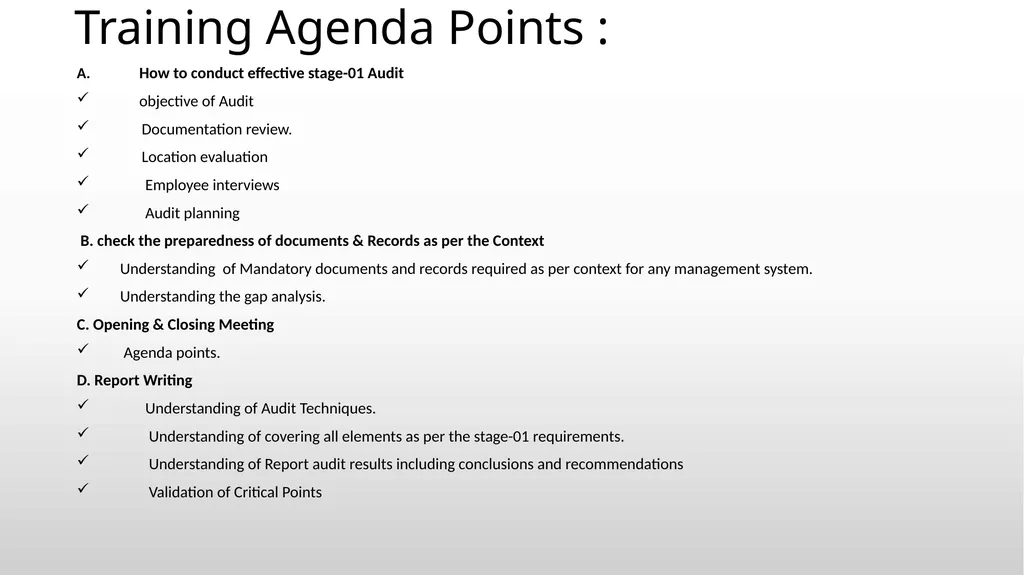
Training Agenda Points : How to conduct effective stage-01 Audit
objective of Audit
Documentation review.
Location evaluation
Employee interviews
Audit planning
B. check the preparedness of documents & Records as per the Context
Understanding of Mandatory documents and records required as per context for any management system.
Understanding the gap analysis.
C. Opening & Closing Meeting
Agenda points.
D. Report Writing
Understanding of Audit Techniques.
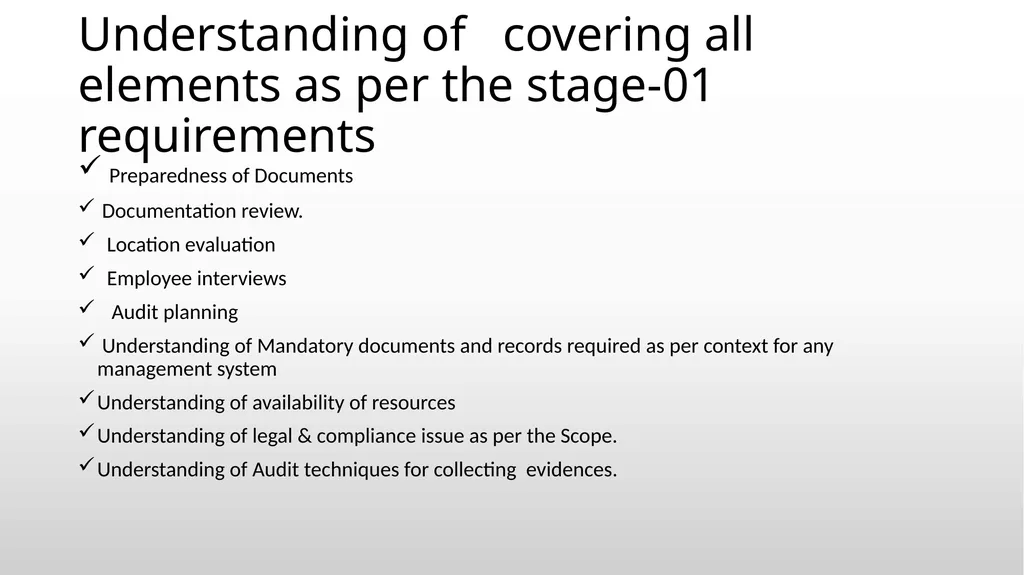
Understanding of covering all elements as per the stage-01 requirements.
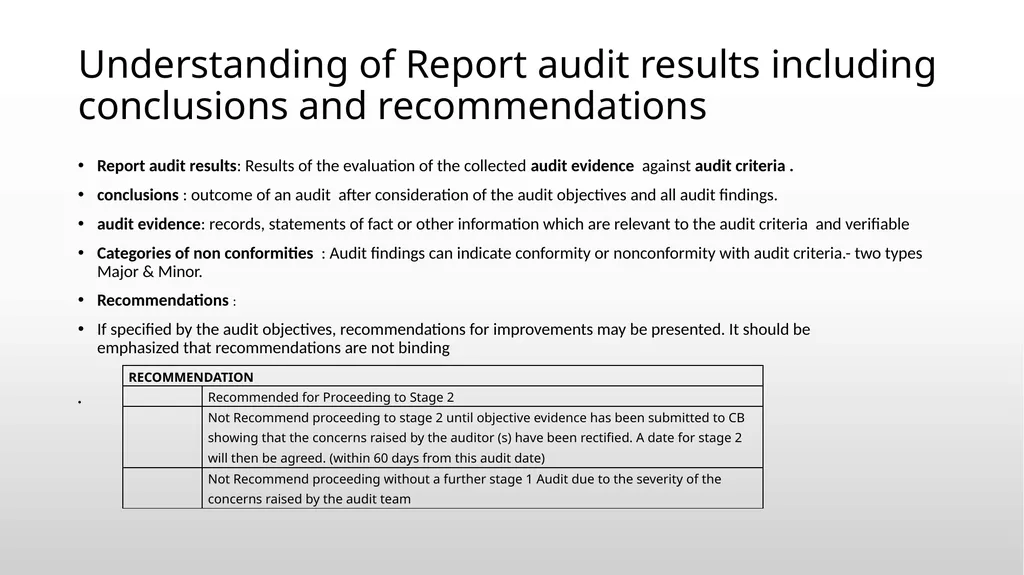
Understanding of Report audit results including conclusions and recommendations
Validation of Critical Points<br>
objective of Audit
Documentation review.
Location evaluation
Employee interviews
Audit planning
B. check the preparedness of documents & Records as per the Context
Understanding of Mandatory documents and records required as per context for any management system.
Understanding the gap analysis.
C. Opening & Closing Meeting
Agenda points.
D. Report Writing
Understanding of Audit Techniques.
Understanding of covering all elements as per the stage-01 requirements.
Understanding of Report audit results including conclusions and recommendations
Validation of Critical Points<br>
03
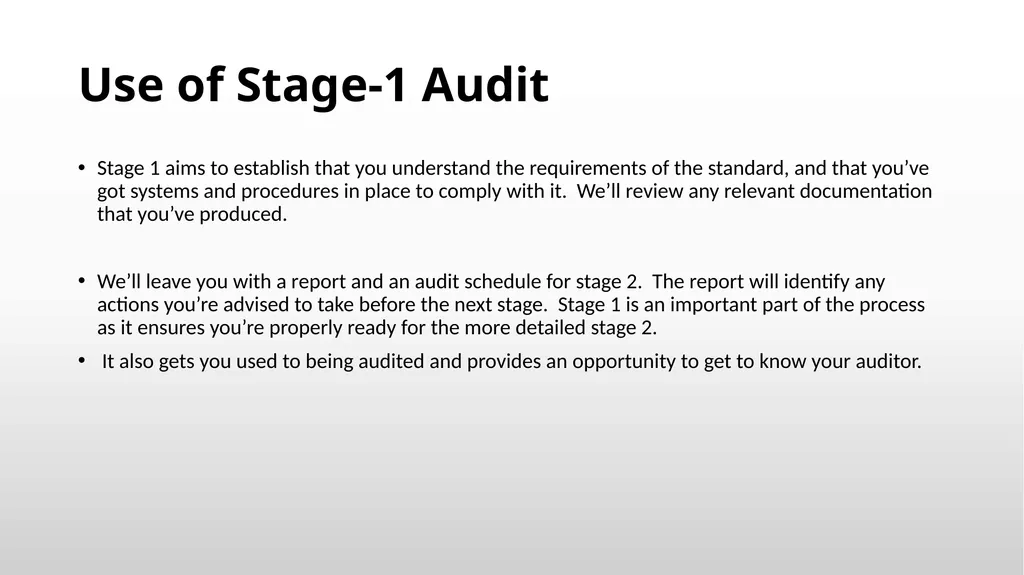
Use of Stage-1 Audit Stage 1 aims to establish that you understand the requirements of the standard, and that you’ve got systems and procedures in place to comply with it. We’ll review any relevant documentation that you’ve produced.
We’ll leave you with a report and an audit schedule for stage 2. The report will identify any actions you’re advised to take before the next stage. Stage 1 is an important part of the process as it ensures you’re properly ready for the more detailed stage 2.
It also gets you used to being audited and provides an opportunity to get to know your auditor.<br>
We’ll leave you with a report and an audit schedule for stage 2. The report will identify any actions you’re advised to take before the next stage. Stage 1 is an important part of the process as it ensures you’re properly ready for the more detailed stage 2.
It also gets you used to being audited and provides an opportunity to get to know your auditor.<br>
04
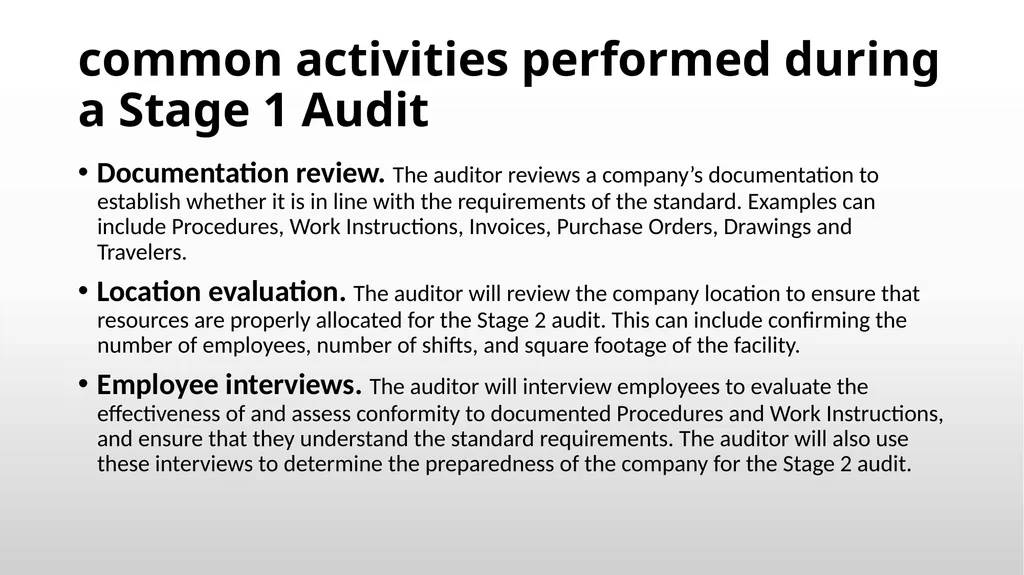
common activities performed during a Stage 1 Audit Documentation review. The auditor reviews a company’s documentation to establish whether it is in line with the requirements of the standard. Examples can include Procedures, Work Instructions, Invoices, Purchase Orders, Drawings and Travelers.
Location evaluation. The auditor will review the company location to ensure that resources are properly allocated for the Stage 2 audit. This can include confirming the number of employees, number of shifts, and square footage of the facility.
Employee interviews. The auditor will interview employees to evaluate the effectiveness of and assess conformity to documented Procedures and Work Instructions, and ensure that they understand the standard requirements. The auditor will also use these interviews to determine the preparedness of the company for the Stage 2 audit.<br>
Location evaluation. The auditor will review the company location to ensure that resources are properly allocated for the Stage 2 audit. This can include confirming the number of employees, number of shifts, and square footage of the facility.
Employee interviews. The auditor will interview employees to evaluate the effectiveness of and assess conformity to documented Procedures and Work Instructions, and ensure that they understand the standard requirements. The auditor will also use these interviews to determine the preparedness of the company for the Stage 2 audit.<br>
05
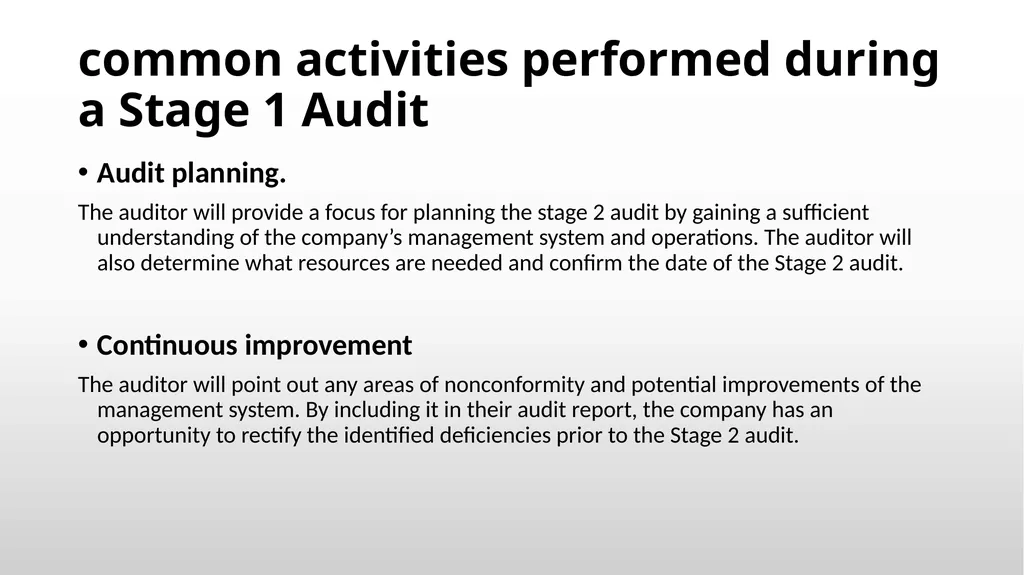
common activities performed during a Stage 1 Audit Audit planning.
The auditor will provide a focus for planning the stage 2 audit by gaining a sufficient understanding of the company’s management system and operations. The auditor will also determine what resources are needed and confirm the date of the Stage 2 audit.
Continuous improvement
The auditor will point out any areas of nonconformity and potential improvements of the management system. By including it in their audit report, the company has an opportunity to rectify the identified deficiencies prior to the Stage 2 audit.<br>
The auditor will provide a focus for planning the stage 2 audit by gaining a sufficient understanding of the company’s management system and operations. The auditor will also determine what resources are needed and confirm the date of the Stage 2 audit.
Continuous improvement
The auditor will point out any areas of nonconformity and potential improvements of the management system. By including it in their audit report, the company has an opportunity to rectify the identified deficiencies prior to the Stage 2 audit.<br>
06
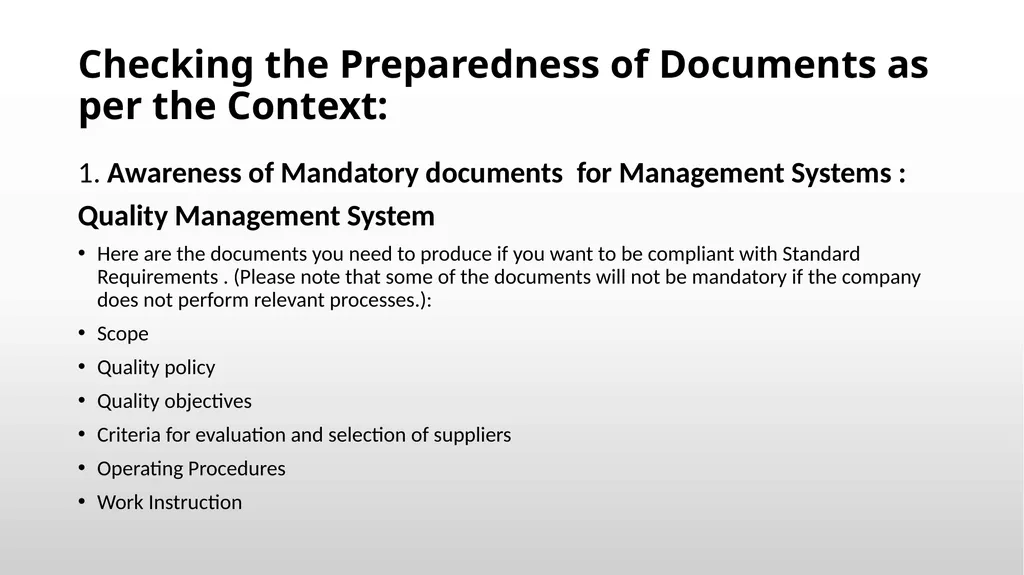
Checking the Preparedness of Documents as per the Context: 1. Awareness of Mandatory documents for Management Systems :
Quality Management System
Here are the documents you need to produce if you want to be compliant with Standard Requirements . (Please note that some of the documents will not be mandatory if the company does not perform relevant processes.):
Scope
Quality policy
Quality objectives
Criteria for evaluation and selection of suppliers
Operating Procedures
Work Instruction<br>
Quality Management System
Here are the documents you need to produce if you want to be compliant with Standard Requirements . (Please note that some of the documents will not be mandatory if the company does not perform relevant processes.):
Scope
Quality policy
Quality objectives
Criteria for evaluation and selection of suppliers
Operating Procedures
Work Instruction<br>
07
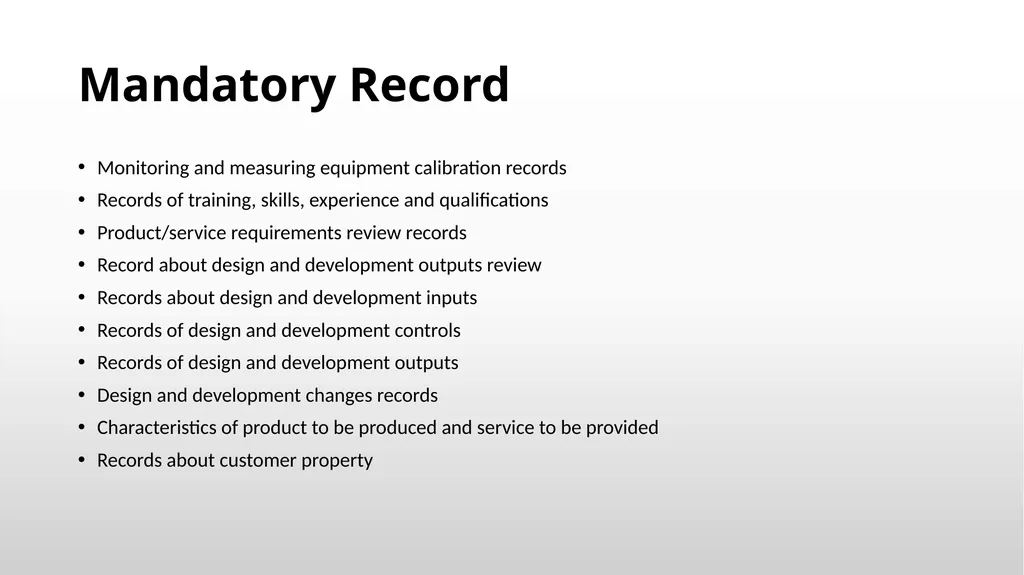
Mandatory Record Monitoring and measuring equipment calibration records
Records of training, skills, experience and qualifications
Product/service requirements review records
Record about design and development outputs review
Records about design and development inputs
Records of design and development controls
Records of design and development outputs
Design and development changes records
Characteristics of product to be produced and service to be provided
Records about customer property<br>
Records of training, skills, experience and qualifications
Product/service requirements review records
Record about design and development outputs review
Records about design and development inputs
Records of design and development controls
Records of design and development outputs
Design and development changes records
Characteristics of product to be produced and service to be provided
Records about customer property<br>
08
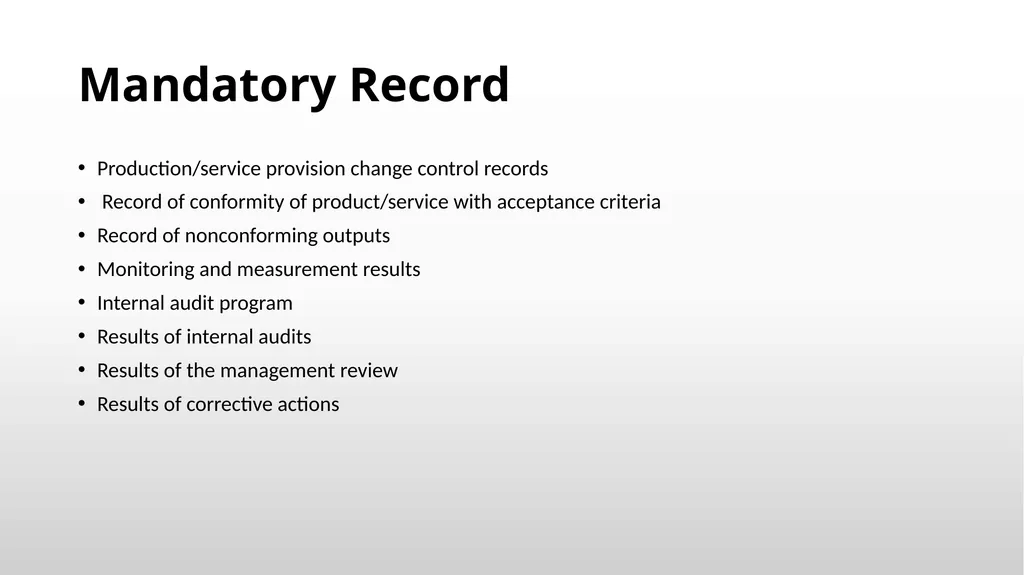
Mandatory Record Production/service provision change control records
Record of conformity of product/service with acceptance criteria
Record of nonconforming outputs
Monitoring and measurement results
Internal audit program
Results of internal audits
Results of the management review
Results of corrective actions<br>
Record of conformity of product/service with acceptance criteria
Record of nonconforming outputs
Monitoring and measurement results
Internal audit program
Results of internal audits
Results of the management review
Results of corrective actions<br>
09
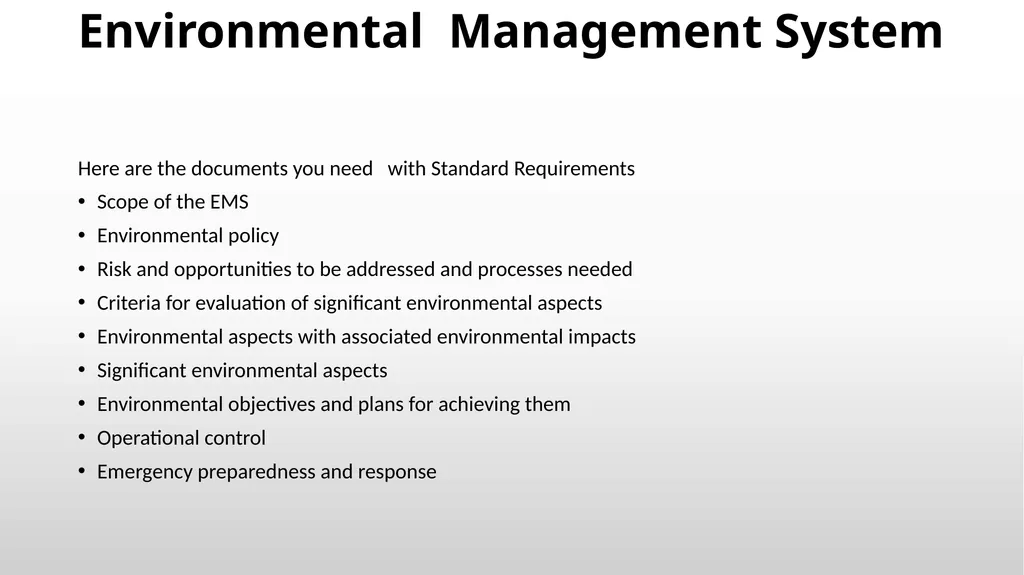
Environmental Management System Here are the documents you need with Standard Requirements
Scope of the EMS
Environmental policy
Risk and opportunities to be addressed and processes needed
Criteria for evaluation of significant environmental aspects
Environmental aspects with associated environmental impacts
Significant environmental aspects
Environmental objectives and plans for achieving them
Operational control
Emergency preparedness and response<br>
Scope of the EMS
Environmental policy
Risk and opportunities to be addressed and processes needed
Criteria for evaluation of significant environmental aspects
Environmental aspects with associated environmental impacts
Significant environmental aspects
Environmental objectives and plans for achieving them
Operational control
Emergency preparedness and response<br>
10
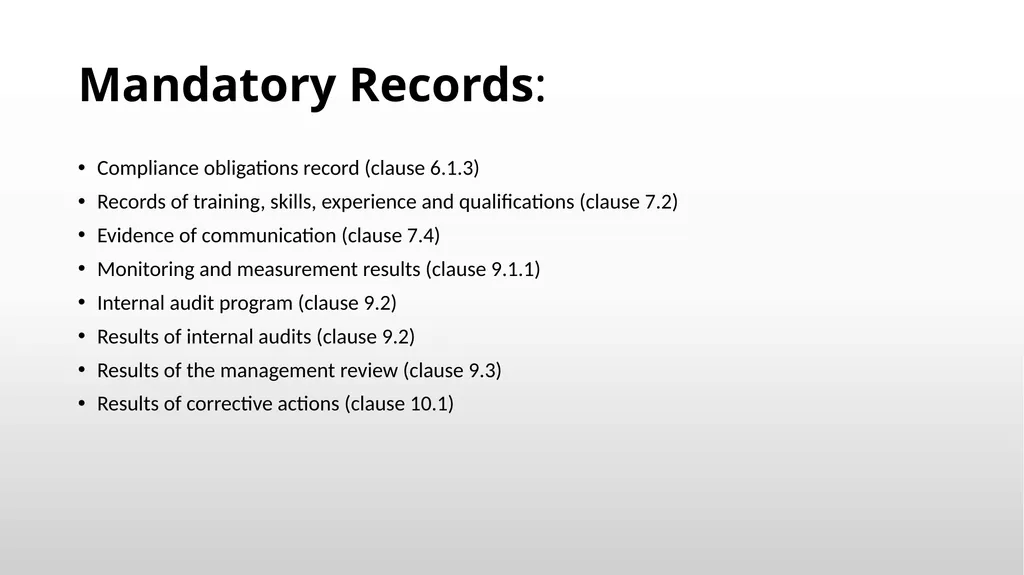
Mandatory Records: Compliance obligations record (clause 6.1.3)
Records of training, skills, experience and qualifications (clause 7.2)
Evidence of communication (clause 7.4)
Monitoring and measurement results (clause 9.1.1)
Internal audit program (clause 9.2)
Results of internal audits (clause 9.2)
Results of the management review (clause 9.3)
Results of corrective actions (clause 10.1)<br>
Records of training, skills, experience and qualifications (clause 7.2)
Evidence of communication (clause 7.4)
Monitoring and measurement results (clause 9.1.1)
Internal audit program (clause 9.2)
Results of internal audits (clause 9.2)
Results of the management review (clause 9.3)
Results of corrective actions (clause 10.1)<br>
11
Occupational health and safety management systems Here are the documents you need
Scope of the OH&S management system (clause 4.3)
OH&S policy (clause 5.2)
Responsibilities and authorities within OH&SMS (clause 5.3)
OH&S process for addressing risks and opportunities (clause 6.1.1)
Methodology and criteria for assessment of OH&S risks (clause 6.1.2.2)
OH&S objectives and plans for achieving them (clause 6.2.2)
Emergency preparedness and response process (clause 8.2)<br>
Scope of the OH&S management system (clause 4.3)
OH&S policy (clause 5.2)
Responsibilities and authorities within OH&SMS (clause 5.3)
OH&S process for addressing risks and opportunities (clause 6.1.1)
Methodology and criteria for assessment of OH&S risks (clause 6.1.2.2)
OH&S objectives and plans for achieving them (clause 6.2.2)
Emergency preparedness and response process (clause 8.2)<br>
12
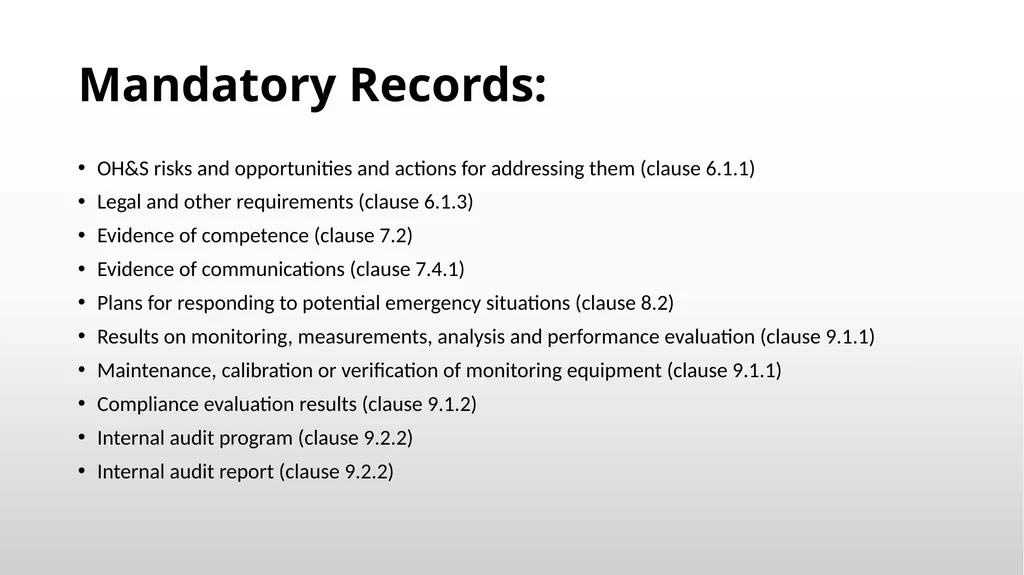
Mandatory Records: OH&S risks and opportunities and actions for addressing them (clause 6.1.1)
Legal and other requirements (clause 6.1.3)
Evidence of competence (clause 7.2)
Evidence of communications (clause 7.4.1)
Plans for responding to potential emergency situations (clause 8.2)
Results on monitoring, measurements, analysis and performance evaluation (clause 9.1.1)
Maintenance, calibration or verification of monitoring equipment (clause 9.1.1)
Compliance evaluation results (clause 9.1.2)
Internal audit program (clause 9.2.2)
Internal audit report (clause 9.2.2)<br>
Legal and other requirements (clause 6.1.3)
Evidence of competence (clause 7.2)
Evidence of communications (clause 7.4.1)
Plans for responding to potential emergency situations (clause 8.2)
Results on monitoring, measurements, analysis and performance evaluation (clause 9.1.1)
Maintenance, calibration or verification of monitoring equipment (clause 9.1.1)
Compliance evaluation results (clause 9.1.2)
Internal audit program (clause 9.2.2)
Internal audit report (clause 9.2.2)<br>
13
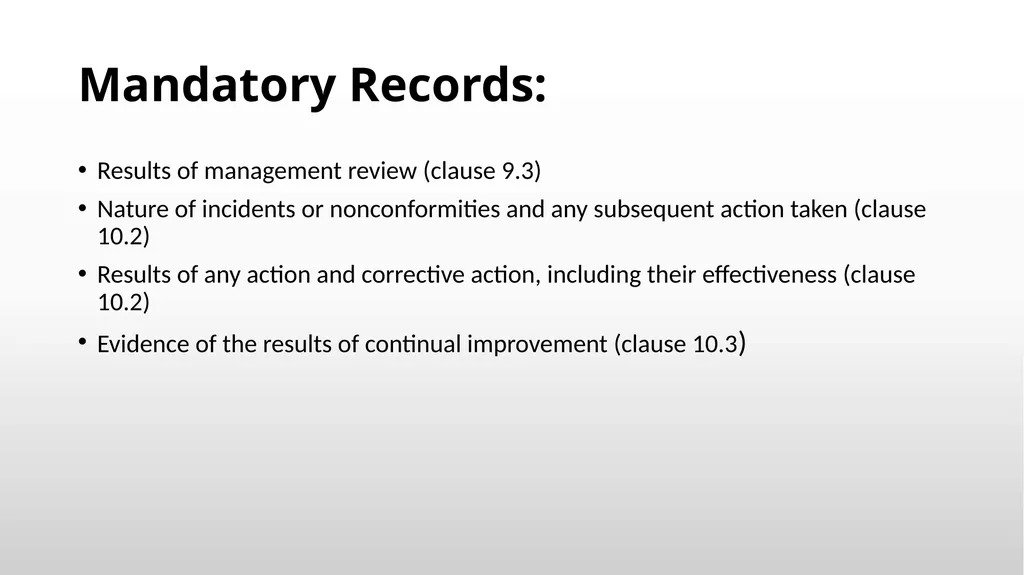
Mandatory Records: Results of management review (clause 9.3)
Nature of incidents or nonconformities and any subsequent action taken (clause 10.2)
Results of any action and corrective action, including their effectiveness (clause 10.2)
Evidence of the results of continual improvement (clause 10.3)<br>
Nature of incidents or nonconformities and any subsequent action taken (clause 10.2)
Results of any action and corrective action, including their effectiveness (clause 10.2)
Evidence of the results of continual improvement (clause 10.3)<br>
14
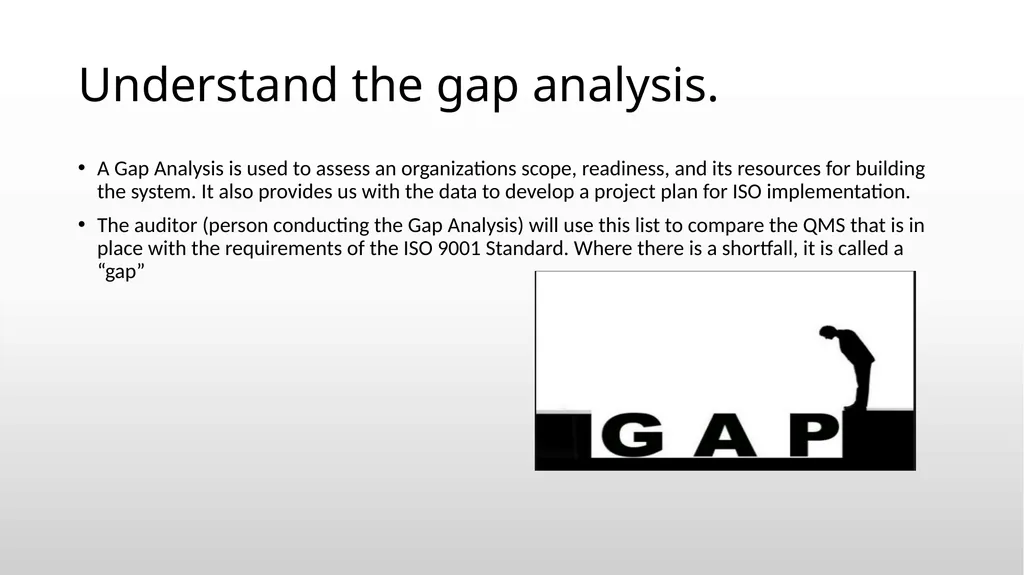
Understand the gap analysis. A Gap Analysis is used to assess an organizations scope, readiness, and its resources for building the system. It also provides us with the data to develop a project plan for ISO implementation.
The auditor (person conducting the Gap Analysis) will use this list to compare the QMS that is in place with the requirements of the ISO 9001 Standard. Where there is a shortfall, it is called a “gap”<br>
The auditor (person conducting the Gap Analysis) will use this list to compare the QMS that is in place with the requirements of the ISO 9001 Standard. Where there is a shortfall, it is called a “gap”<br>
15
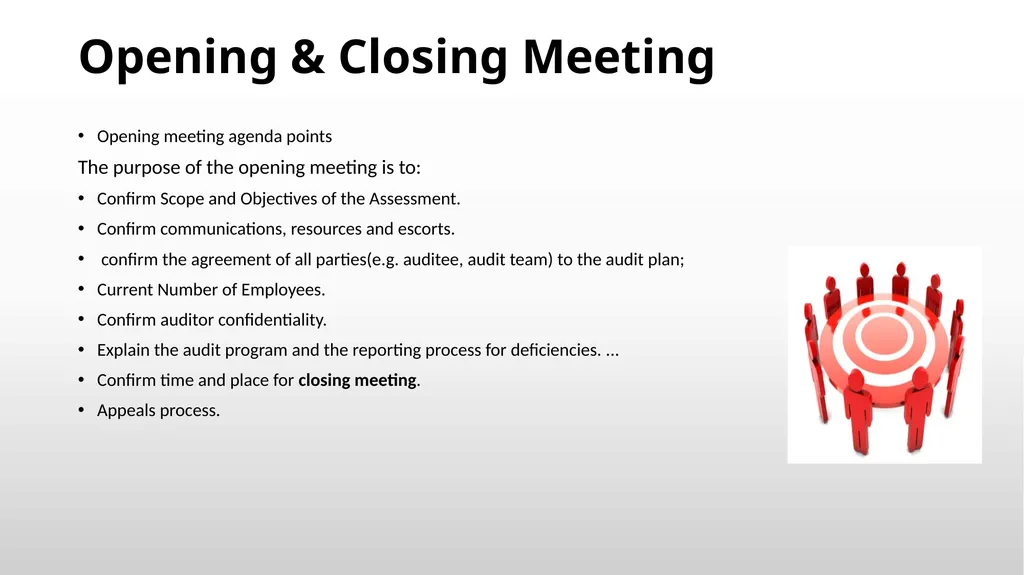
Opening & Closing Meeting Opening meeting agenda points
The purpose of the opening meeting is to:
Confirm Scope and Objectives of the Assessment.
Confirm communications, resources and escorts.
confirm the agreement of all parties(e.g. auditee, audit team) to the audit plan;
Current Number of Employees.
Confirm auditor confidentiality.
Explain the audit program and the reporting process for deficiencies. ...
Confirm time and place for closing meeting.
Appeals process.<br>
The purpose of the opening meeting is to:
Confirm Scope and Objectives of the Assessment.
Confirm communications, resources and escorts.
confirm the agreement of all parties(e.g. auditee, audit team) to the audit plan;
Current Number of Employees.
Confirm auditor confidentiality.
Explain the audit program and the reporting process for deficiencies. ...
Confirm time and place for closing meeting.
Appeals process.<br>
16
closing meeting The purpose of the closing meeting is to:
A closing meeting, facilitated by the audit team leader, should be held to present the audit findings and conclusions.
Participants in the closing meeting should include the management of the auditee and, where appropriate, those responsible for the functions or processes which have been audited, and may also include the audit client and other parties.
If applicable, the audit team leader should advise the auditee of situations encountered during the audit that may decrease the confidence that can be placed in the audit conclusions.
If defined in the management system or by agreement with the audit client, the participants should agree on the time frame for an action plan to address audit findings.<br>
A closing meeting, facilitated by the audit team leader, should be held to present the audit findings and conclusions.
Participants in the closing meeting should include the management of the auditee and, where appropriate, those responsible for the functions or processes which have been audited, and may also include the audit client and other parties.
If applicable, the audit team leader should advise the auditee of situations encountered during the audit that may decrease the confidence that can be placed in the audit conclusions.
If defined in the management system or by agreement with the audit client, the participants should agree on the time frame for an action plan to address audit findings.<br>
17
Understanding of Audit Techniques. Audit techniques stand for the methods that are adopted by an auditor to obtain evidence.
1. Inspection
a. Documents and records:
b. Physical Verification
2. Observation
. The auditor makes his observations to evaluate the efficiency and effectiveness of the system followed by the organization.
3. Computation
An auditor makes appropriate calculations and verifies the accuracy of the records.
4. Analytical analysis
The purpose of analysis is to ensure consistency of Management methods and also to evaluate the efficiency of the management by comparing the results of several years<br>
1. Inspection
a. Documents and records:
b. Physical Verification
2. Observation
. The auditor makes his observations to evaluate the efficiency and effectiveness of the system followed by the organization.
3. Computation
An auditor makes appropriate calculations and verifies the accuracy of the records.
4. Analytical analysis
The purpose of analysis is to ensure consistency of Management methods and also to evaluate the efficiency of the management by comparing the results of several years<br>
18
Understanding of covering all elements as per the stage-01 requirements Preparedness of Documents
Documentation review.
Location evaluation
Employee interviews
Audit planning
Understanding of Mandatory documents and records required as per context for any management system
Understanding of availability of resources
Understanding of legal & compliance issue as per the Scope.
Understanding of Audit techniques for collecting evidences.<br>
Documentation review.
Location evaluation
Employee interviews
Audit planning
Understanding of Mandatory documents and records required as per context for any management system
Understanding of availability of resources
Understanding of legal & compliance issue as per the Scope.
Understanding of Audit techniques for collecting evidences.<br>
19
Understanding of Report audit results including conclusions and recommendations Report audit results: Results of the evaluation of the collected audit evidence against audit criteria .
conclusions : outcome of an audit after consideration of the audit objectives and all audit findings.
audit evidence: records, statements of fact or other information which are relevant to the audit criteria and verifiable
Categories of non conformities : Audit findings can indicate conformity or nonconformity with audit criteria.- two types Major & Minor.
Recommendations :
If specified by the audit objectives, recommendations for improvements may be presented. It should be emphasized that recommendations are not binding<br>
conclusions : outcome of an audit after consideration of the audit objectives and all audit findings.
audit evidence: records, statements of fact or other information which are relevant to the audit criteria and verifiable
Categories of non conformities : Audit findings can indicate conformity or nonconformity with audit criteria.- two types Major & Minor.
Recommendations :
If specified by the audit objectives, recommendations for improvements may be presented. It should be emphasized that recommendations are not binding<br>
20
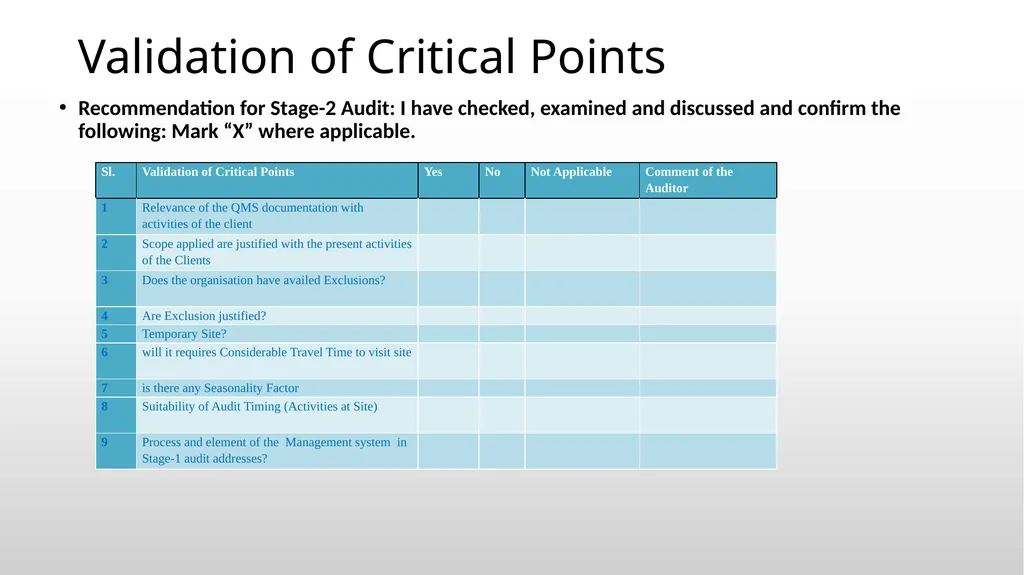
Validation of Critical Points Recommendation for Stage-2 Audit: I have checked, examined and discussed and confirm the following: Mark “X” where applicable.<br>
21
END<br>