
How to Open Source Dr. David A. Wheeler dwheeler @
MY
Published · 82 slides · 0 views
1 / 1




Description
How to Open Source Dr. David A. Wheeler dwheeler ida . org 2013-08-13 13 August 2013 1 Outline Introduction Whats Open source software (OSS) why government cares Use OSS is commercial, security doesnt block, OSS not freeware Release
Related Topics
Share
Embed code
Download this presentation From Below
"How to Open Source Dr. David A. Wheeler dwheeler @" is the property of its rightful owner. Permission is granted to download and print the materials on this website for personal, non-commercial use only, and to display it on your personal computer provided you do not modify the materials and that you retain all copyright notices contained in the materials. By downloading content from our website, you accept the terms of this agreement.
Presentation Transcript
01
How to Open Source Dr. David A. Wheeler
dwheeler @ ida . org
2013-08-13<br>
dwheeler @ ida . org
2013-08-13<br>
02
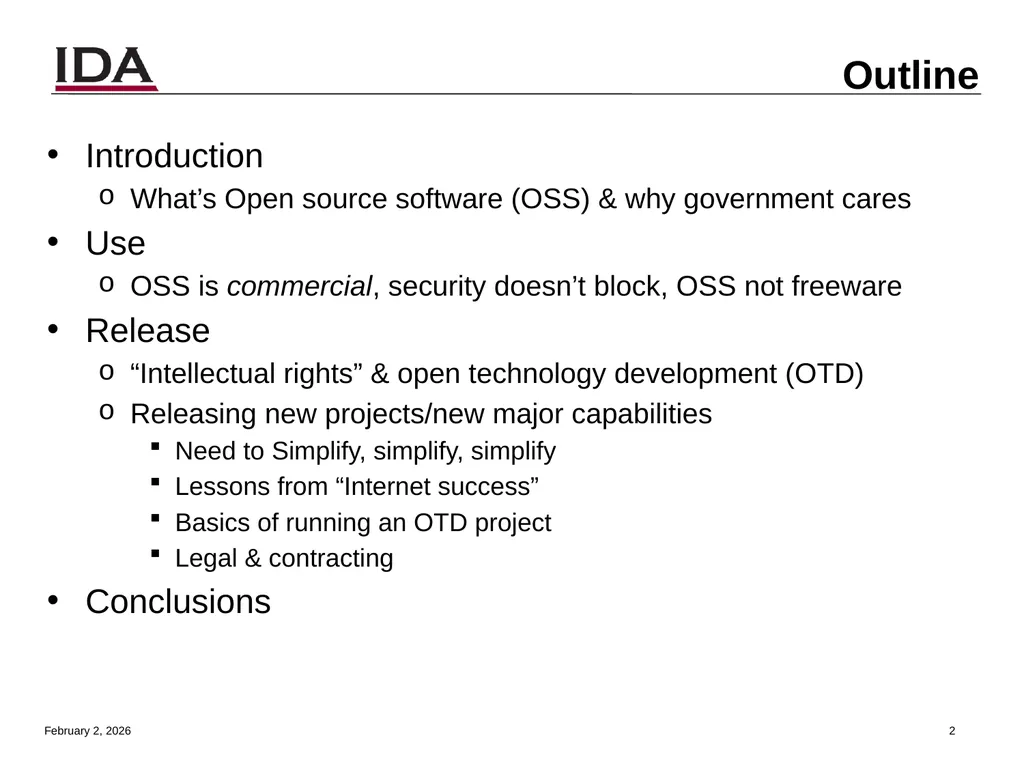
13 August 2013 1 Outline Introduction
What’s Open source software (OSS) & why government cares
Use
OSS is commercial, security doesn’t block, OSS not freeware
Release
“Intellectual rights” & open technology development (OTD)
Releasing new projects/new major capabilities
Need to Simplify, simplify, simplify
Lessons from “Internet success”
Basics of running an OTD project
Legal & contracting
Conclusions<br>
What’s Open source software (OSS) & why government cares
Use
OSS is commercial, security doesn’t block, OSS not freeware
Release
“Intellectual rights” & open technology development (OTD)
Releasing new projects/new major capabilities
Need to Simplify, simplify, simplify
Lessons from “Internet success”
Basics of running an OTD project
Legal & contracting
Conclusions<br>
03
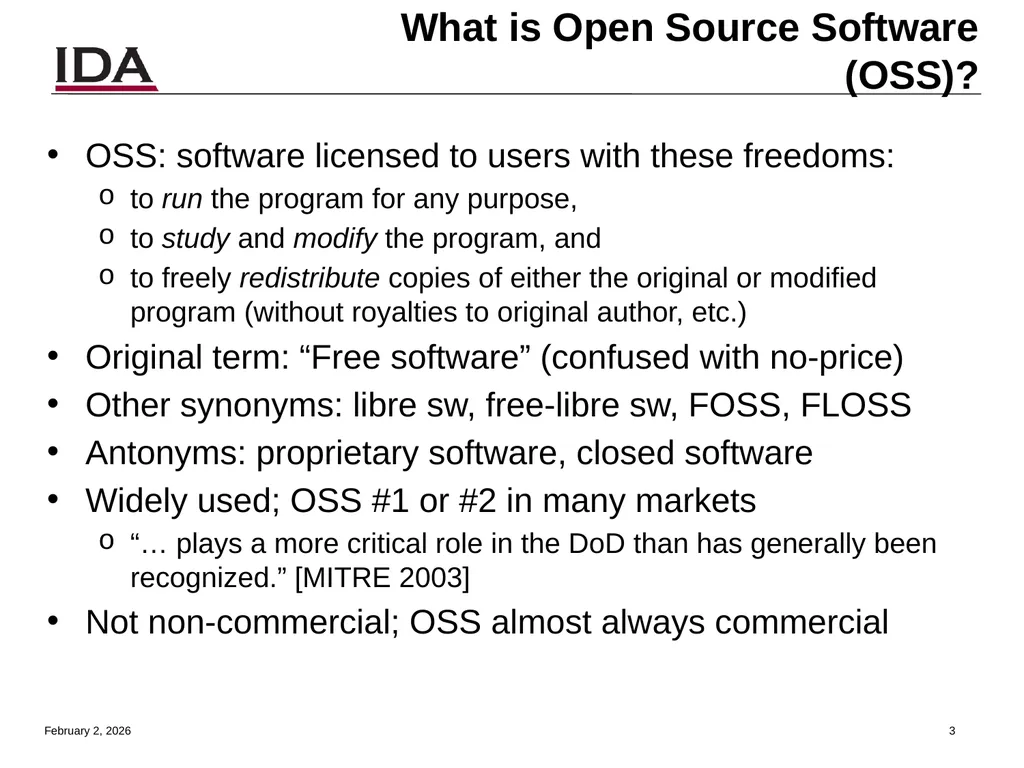
What is Open Source Software (OSS)? OSS: software licensed to users with these freedoms:
to run the program for any purpose,
to study and modify the program, and
to freely redistribute copies of either the original or modified program (without royalties to original author, etc.)
Original term: “Free software” (confused with no-price)
Other synonyms: libre sw, free-libre sw, FOSS, FLOSS
Antonyms: proprietary software, closed software
Widely used; OSS #1 or #2 in many markets
“… plays a more critical role in the DoD than has generally been recognized.” [MITRE 2003]
Not non-commercial; OSS almost always commercial 13 August 2013 2<br>
to run the program for any purpose,
to study and modify the program, and
to freely redistribute copies of either the original or modified program (without royalties to original author, etc.)
Original term: “Free software” (confused with no-price)
Other synonyms: libre sw, free-libre sw, FOSS, FLOSS
Antonyms: proprietary software, closed software
Widely used; OSS #1 or #2 in many markets
“… plays a more critical role in the DoD than has generally been recognized.” [MITRE 2003]
Not non-commercial; OSS almost always commercial 13 August 2013 2<br>
04
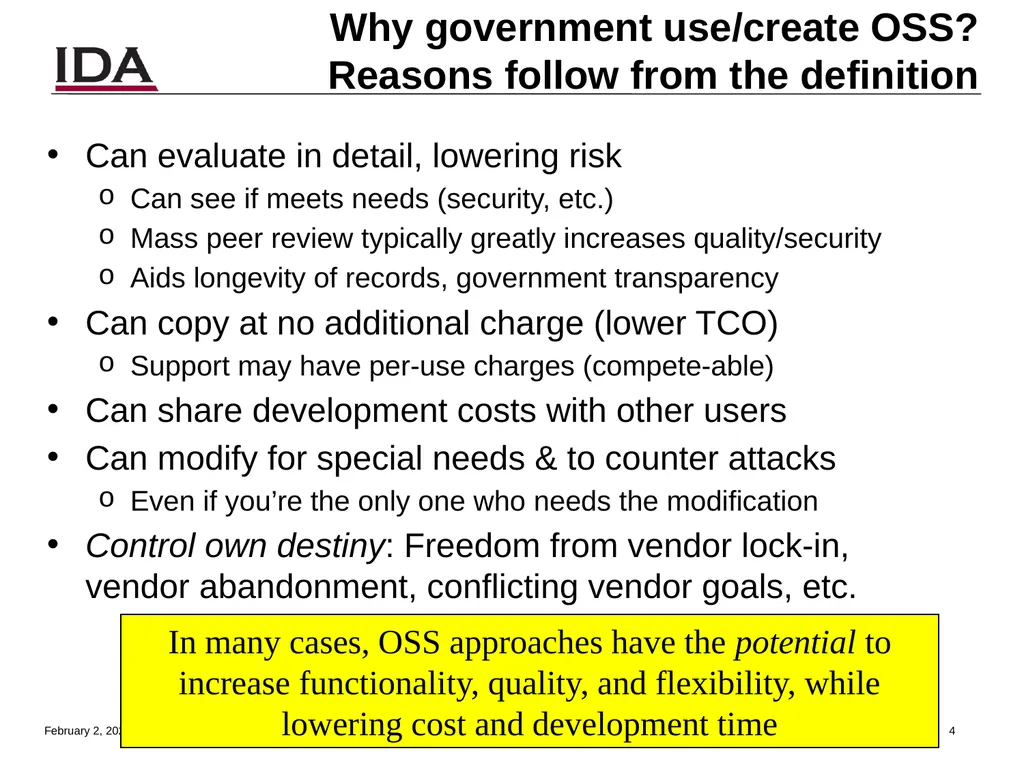
Why government use/create OSS?
Reasons follow from the definition Can evaluate in detail, lowering risk
Can see if meets needs (security, etc.)
Mass peer review typically greatly increases quality/security
Aids longevity of records, government transparency
Can copy at no additional charge (lower TCO)
Support may have per-use charges (compete-able)
Can share development costs with other users
Can modify for special needs & to counter attacks
Even if you’re the only one who needs the modification
Control own destiny: Freedom from vendor lock-in, vendor abandonment, conflicting vendor goals, etc. 13 August 2013 3 In many cases, OSS approaches have the potential to increase functionality, quality, and flexibility, while lowering cost and development time<br>
Can see if meets needs (security, etc.)
Mass peer review typically greatly increases quality/security
Aids longevity of records, government transparency
Can copy at no additional charge (lower TCO)
Support may have per-use charges (compete-able)
Can share development costs with other users
Can modify for special needs & to counter attacks
Even if you’re the only one who needs the modification
Control own destiny: Freedom from vendor lock-in, vendor abandonment, conflicting vendor goals, etc. 13 August 2013 3 In many cases, OSS approaches have the potential to increase functionality, quality, and flexibility, while lowering cost and development time<br>
05
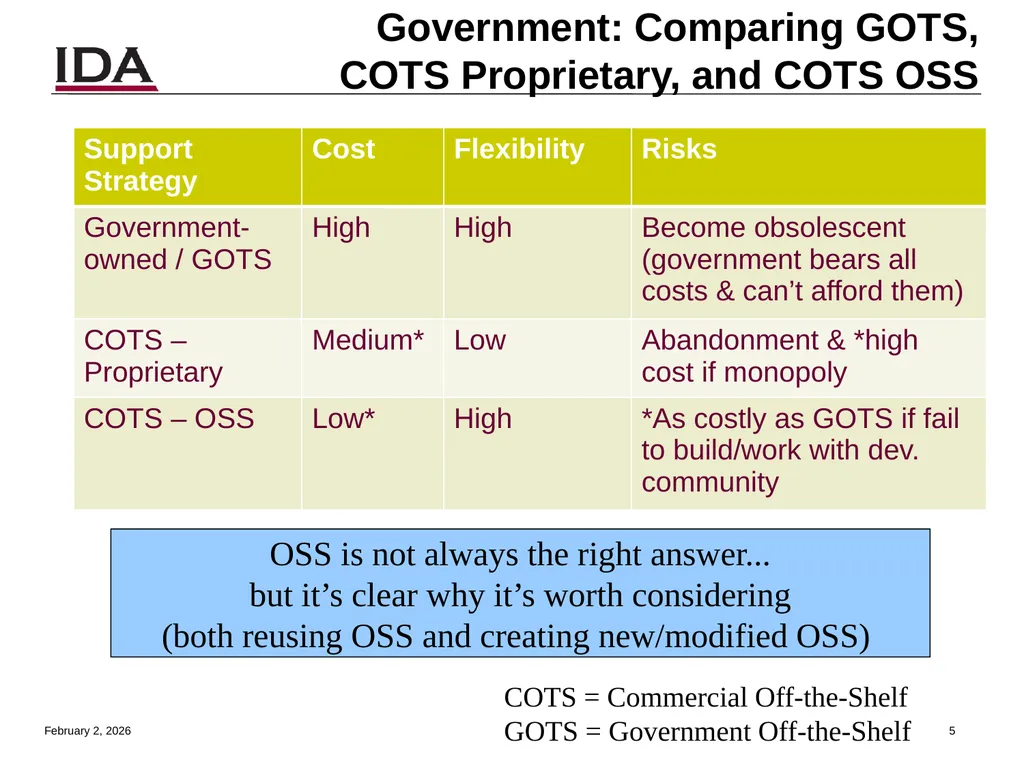
Government: Comparing GOTS, COTS Proprietary, and COTS OSS 13 August 2013 4 OSS is not always the right answer...
but it’s clear why it’s worth considering
(both reusing OSS and creating new/modified OSS) COTS = Commercial Off-the-Shelf
GOTS = Government Off-the-Shelf<br>
but it’s clear why it’s worth considering
(both reusing OSS and creating new/modified OSS) COTS = Commercial Off-the-Shelf
GOTS = Government Off-the-Shelf<br>
06
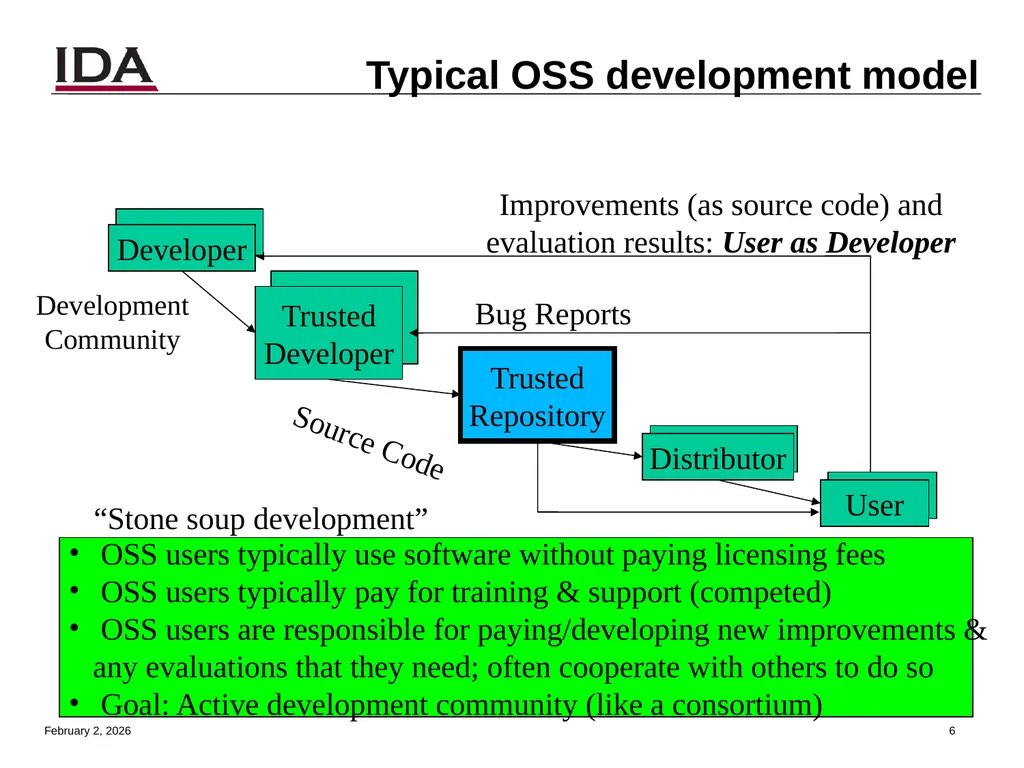
Typical OSS development model 13 August 2013 5 Developer Trusted
Developer OSS users typically use software without paying licensing fees
OSS users typically pay for training & support (competed)
OSS users are responsible for paying/developing new improvements & any evaluations that they need; often cooperate with others to do so
Goal: Active development community (like a consortium) Trusted Repository Distributor User Source Code Bug Reports Improvements (as source code) and evaluation results: User as Developer “Stone soup development” Development
Community<br>
OSS users typically pay for training & support (competed)
OSS users are responsible for paying/developing new improvements & any evaluations that they need; often cooperate with others to do so
Goal: Active development community (like a consortium) Trusted Repository Distributor User Source Code Bug Reports Improvements (as source code) and evaluation results: User as Developer “Stone soup development” Development
Community<br>
07
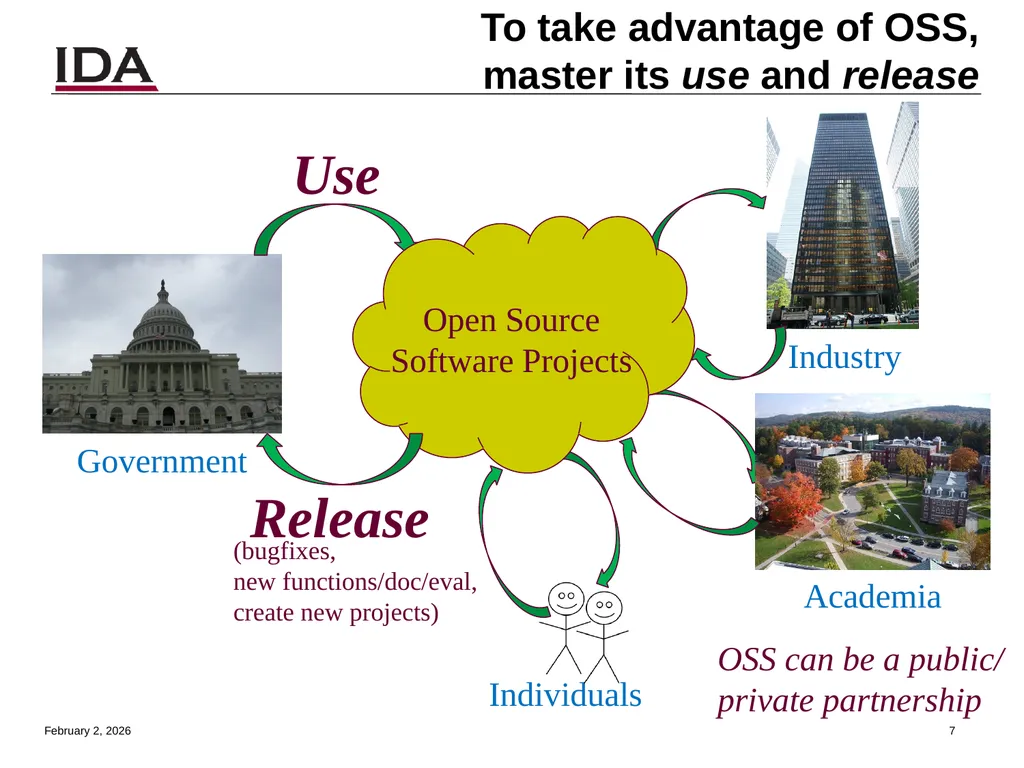
To take advantage of OSS,
master its use and release 13 August 2013 6 Government Industry Academia Individuals Open Source
Software Projects Use Release (bugfixes,
new functions/doc/eval,
create new projects) OSS can be a public/
private partnership<br>
Software Projects Use Release (bugfixes,
new functions/doc/eval,
create new projects) OSS can be a public/
private partnership<br>
08
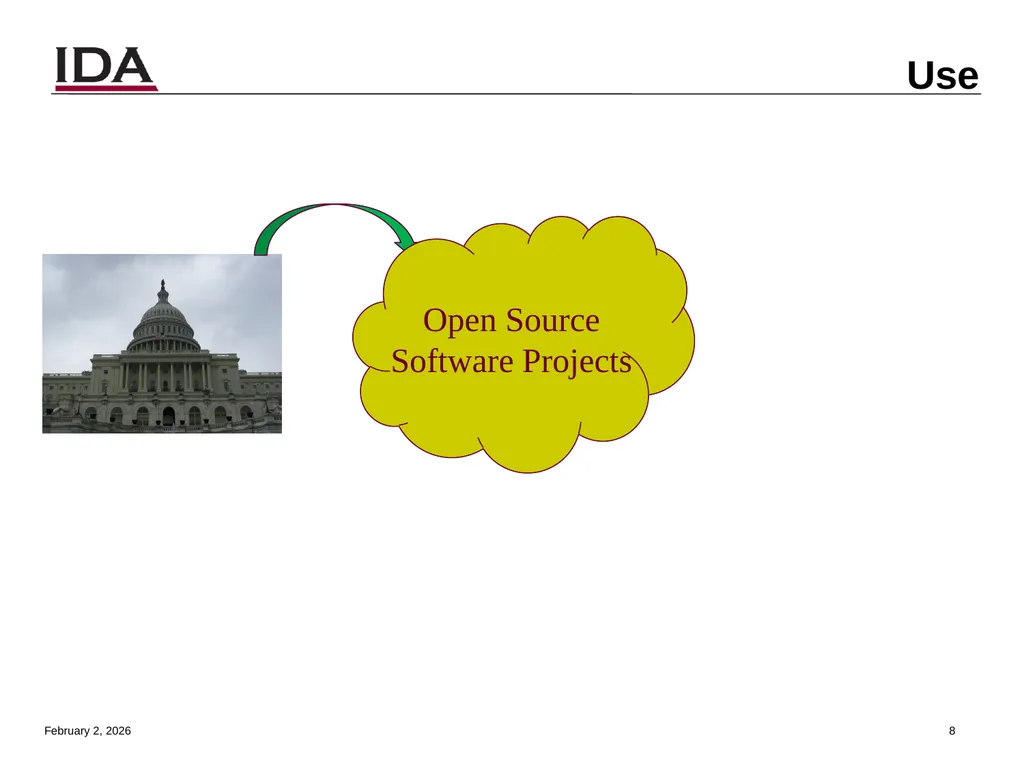
Use 13 August 2013 7 Open Source
Software Projects<br>
Software Projects<br>
09
Use You can use OSS in the government, today!
Given tight budgets, it’s absurd to ignore OSS
Government already uses OSS
Whitehouse.gov: Drupal
MITRE 2003 survey of DoD OSS use:
OSS “plays a more critical role in the DoD than has generally been recognized”
Banning it “would have immediate, broad, and strongly negative impacts on the ability of many sensitive and security-focused DoD groups to defend against cyberattacks.”
Certain myths hold OSS back 13 August 2013 8<br>
Given tight budgets, it’s absurd to ignore OSS
Government already uses OSS
Whitehouse.gov: Drupal
MITRE 2003 survey of DoD OSS use:
OSS “plays a more critical role in the DoD than has generally been recognized”
Banning it “would have immediate, broad, and strongly negative impacts on the ability of many sensitive and security-focused DoD groups to defend against cyberattacks.”
Certain myths hold OSS back 13 August 2013 8<br>
10
Myth: OSS is non-commercial.
Reality: OSS is commercial (1) Nearly all OSS are commercial items, & if extant, COTS
U.S. Law (41 USC 403), FAR (2.101), & DFARS (212.212 & 252.227-7014(a)(1)):
Commercial item is “(1) Any item, other than real property, that is of a type customarily used by the general public or by non-governmental entities for purposes [not government-unique], and (i) Has been sold, leased, or licensed to the general public; or (ii) Has been offered for sale, lease, or license to the general public... (3) [Above with] (i) Modifications of a type customarily available in the commercial marketplace; or (ii) Minor modifications…”
Intentionally broad; "enables the Government to take greater advantage of the commercial marketplace” [DoD AT&L]
Confirmed by DoD “Clarifying Guidance Regarding OSS” (Oct 16, 2009) & Navy “OSS Guidance” (June 5, 2007) 13 August 2013 9<br>
U.S. Law (41 USC 403), FAR (2.101), & DFARS (212.212 & 252.227-7014(a)(1)):
Commercial item is “(1) Any item, other than real property, that is of a type customarily used by the general public or by non-governmental entities for purposes [not government-unique], and (i) Has been sold, leased, or licensed to the general public; or (ii) Has been offered for sale, lease, or license to the general public... (3) [Above with] (i) Modifications of a type customarily available in the commercial marketplace; or (ii) Minor modifications…”
Intentionally broad; "enables the Government to take greater advantage of the commercial marketplace” [DoD AT&L]
Confirmed by DoD “Clarifying Guidance Regarding OSS” (Oct 16, 2009) & Navy “OSS Guidance” (June 5, 2007) 13 August 2013 9<br>
11
Myth: OSS is non-commercial.
Reality: OSS is commercial (2) OSS projects seek improvements = financial gain per
17 USC 101: “financial gain” inc. “receipt, or expectation of receipt, of anything of value, including the receipt of other copyrighted works.”
OMB Memo M-03-14: Commercial software, OSS support
Important because U.S. Law (41 USC 403), FAR, & DFARS require preference of commercial items (inc. COTS) & NDI:
Agencies must “(a) Conduct market research to determine [if] commercial items or nondevelopmental items are available … (b) Acquire [them when available] (c) Require prime contractors and subcontractors at all tiers to incorporate, to the maximum extent practicable, [them] as components...” 13 August 2013 10<br>
17 USC 101: “financial gain” inc. “receipt, or expectation of receipt, of anything of value, including the receipt of other copyrighted works.”
OMB Memo M-03-14: Commercial software, OSS support
Important because U.S. Law (41 USC 403), FAR, & DFARS require preference of commercial items (inc. COTS) & NDI:
Agencies must “(a) Conduct market research to determine [if] commercial items or nondevelopmental items are available … (b) Acquire [them when available] (c) Require prime contractors and subcontractors at all tiers to incorporate, to the maximum extent practicable, [them] as components...” 13 August 2013 10<br>
12
Watch your language In a US government context, never say nonsense like:
“Open source software or commercial software”
Instead, say:
“Commercial software, including proprietary and open source software, …” 13 August 2013 11<br>
“Open source software or commercial software”
Instead, say:
“Commercial software, including proprietary and open source software, …” 13 August 2013 11<br>
13
Myth: OSS always or never
more secure Extreme claims
“OSS is always more secure”
“Proprietary is always more secure”
Reality: Neither OSS nor proprietary always better
Some specific OSS programs are more secure than their competing proprietary competitors
Include OSS options when acquiring, then evaluate
There is a principle that gives OSS a potential advantage… 13 August 2013 12<br>
“OSS is always more secure”
“Proprietary is always more secure”
Reality: Neither OSS nor proprietary always better
Some specific OSS programs are more secure than their competing proprietary competitors
Include OSS options when acquiring, then evaluate
There is a principle that gives OSS a potential advantage… 13 August 2013 12<br>
14
Open design:
A security fundamental Saltzer & Schroeder [1974/1975] - Open design principle
the protection mechanism must not depend on attacker ignorance
OSS better fulfills this principle
Security experts perceive OSS advantage
Bruce Schneier: “demand OSS for anything related to security”
Vincent Rijmen (AES): “forces people to write more clear code & adhere to standards”
Whitfield Diffie: “it’s simply unrealistic to depend on secrecy for security”
Assume nothing; evaluate specific products 13 August 2013 13<br>
the protection mechanism must not depend on attacker ignorance
OSS better fulfills this principle
Security experts perceive OSS advantage
Bruce Schneier: “demand OSS for anything related to security”
Vincent Rijmen (AES): “forces people to write more clear code & adhere to standards”
Whitfield Diffie: “it’s simply unrealistic to depend on secrecy for security”
Assume nothing; evaluate specific products 13 August 2013 13<br>
15
Myth: OSS conflicts with DoDD 8500.1/DoDI 8500.2 DCPD-1 DoDD 8500.1/DoDI 8500.2 DCPD-1 "Public Domain Software Controls” often misinterpreted
“Binary or machine executable ... software products and other software products with limited or no warranty such as those commonly known as freeware or shareware are not [to be] used in DoD information systems ...” don’t stop here!
“[because they’re] difficult or impossible to review, repair, or extend, given that the Government does not have access to the original source code and there is no owner who could make such repairs on behalf of the Government.”
Clearly doesn’t apply to OSS – source code is available
Applies to abandoned binary-only. OSS is not freeware
NIST Special Publication (SP) 800-53 clearer 13 August 2013 14 OSS ≠ Freeware or Shareware<br>
“Binary or machine executable ... software products and other software products with limited or no warranty such as those commonly known as freeware or shareware are not [to be] used in DoD information systems ...” don’t stop here!
“[because they’re] difficult or impossible to review, repair, or extend, given that the Government does not have access to the original source code and there is no owner who could make such repairs on behalf of the Government.”
Clearly doesn’t apply to OSS – source code is available
Applies to abandoned binary-only. OSS is not freeware
NIST Special Publication (SP) 800-53 clearer 13 August 2013 14 OSS ≠ Freeware or Shareware<br>
16
US government policies/guidance OMB “Technology Neutrality” memo, January 7, 2011
“In… developing requirements and planning acquisitions for software… [generally] agencies should analyze alternatives that include proprietary, open source, and mixed source technologies… [as] officials work together to develop requirements and plan acquisitions, they should follow technology neutral principles and practices.”
"Clarifying Guidance Regarding Open Source Software (OSS)", signed by David M. Wennergren on 16 October 2009. This is the DoD policy memo on open source software (OSS)
Cendi.gov, e.g., “Frequently Asked Questions about Copyright and Computer Software” http://www.cendi.gov/publications/09-1FAQ_OpenSourceSoftware_FINAL_110109.pdf
Consumer Financial Protection Bureau (CFPB)’s Source Code Policy
Two parts, “use of external OSS” & “Redistribution,” based on DoD’s
http://www.consumerfinance.gov/developers/sourcecodepolicy/
New Hampshire, HB418 (2012)
Requires consideration of OSS in all acquisitions 13 August 2013 15 US federal government requires considering OSS<br>
“In… developing requirements and planning acquisitions for software… [generally] agencies should analyze alternatives that include proprietary, open source, and mixed source technologies… [as] officials work together to develop requirements and plan acquisitions, they should follow technology neutral principles and practices.”
"Clarifying Guidance Regarding Open Source Software (OSS)", signed by David M. Wennergren on 16 October 2009. This is the DoD policy memo on open source software (OSS)
Cendi.gov, e.g., “Frequently Asked Questions about Copyright and Computer Software” http://www.cendi.gov/publications/09-1FAQ_OpenSourceSoftware_FINAL_110109.pdf
Consumer Financial Protection Bureau (CFPB)’s Source Code Policy
Two parts, “use of external OSS” & “Redistribution,” based on DoD’s
http://www.consumerfinance.gov/developers/sourcecodepolicy/
New Hampshire, HB418 (2012)
Requires consideration of OSS in all acquisitions 13 August 2013 15 US federal government requires considering OSS<br>
17
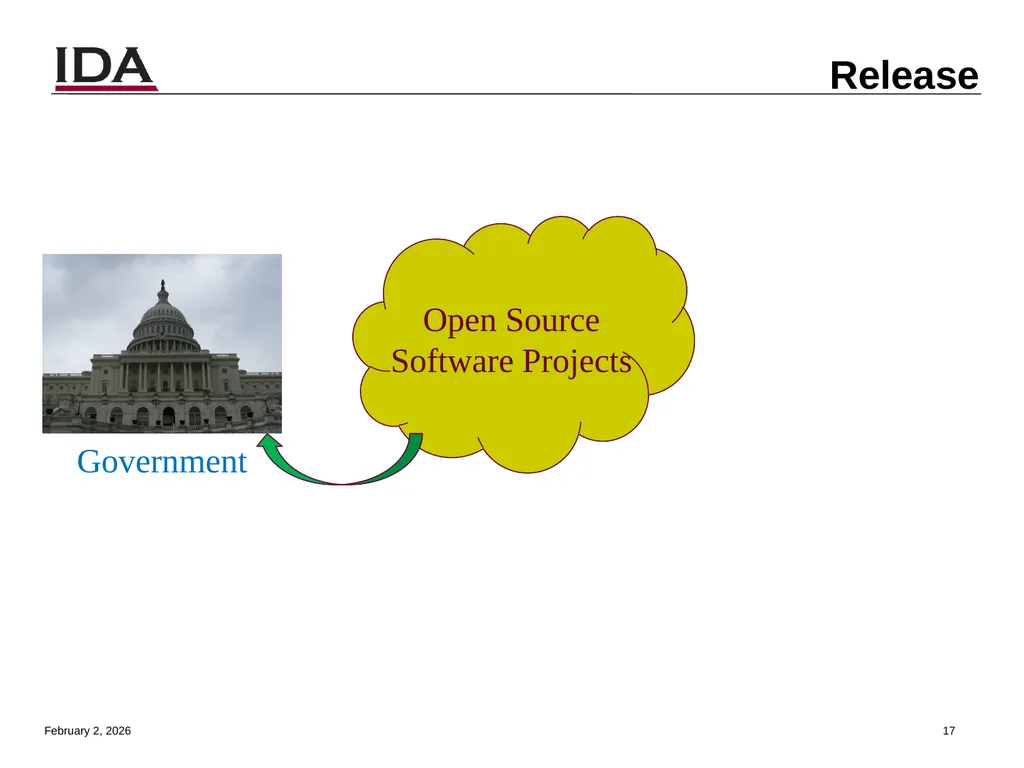
Release 13 August 2013 16 Government Open Source
Software Projects<br>
Software Projects<br>
18
Quick aside: “Intellectual rights” Software laws often called “intellectual property rights”
Copyright, trademark, patent, trade secret, ...
“Property” term extremely misleading
If I take your car, you have no car
If I copy your software.. you still have the software
Formal term: non-rivalrous
Failure to understand differences of physical property vs. intellectual works leads to mistaken thinking, including re: OSS
Knowledge & physical property fundamentally different
U.S. Constitution permits exclusive rights only for limited times, solely “to promote the progress of science and useful arts”
Use term “intellectual rights” or “data rights” instead
Avoids mis-thinking & clarifies that all parties have rights
If you do say “property” understand why it can mislead 13 August 2013 17<br>
Copyright, trademark, patent, trade secret, ...
“Property” term extremely misleading
If I take your car, you have no car
If I copy your software.. you still have the software
Formal term: non-rivalrous
Failure to understand differences of physical property vs. intellectual works leads to mistaken thinking, including re: OSS
Knowledge & physical property fundamentally different
U.S. Constitution permits exclusive rights only for limited times, solely “to promote the progress of science and useful arts”
Use term “intellectual rights” or “data rights” instead
Avoids mis-thinking & clarifies that all parties have rights
If you do say “property” understand why it can mislead 13 August 2013 17<br>
19
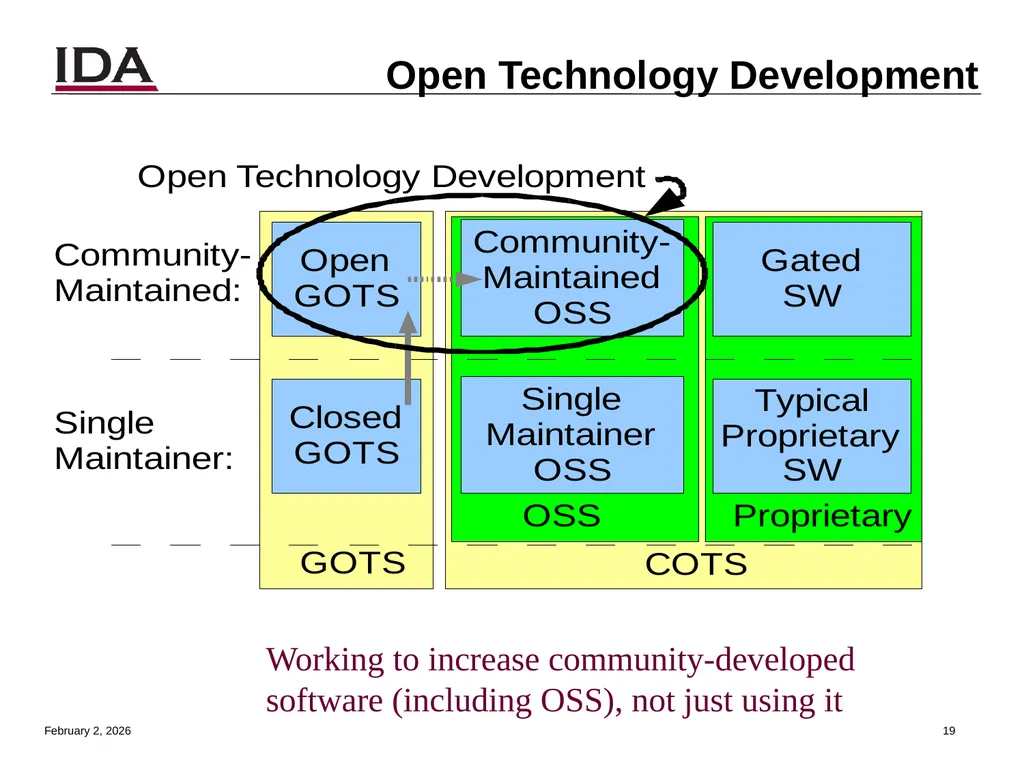
Open Technology Development 13 August 2013 18 Working to increase community-developed software (including OSS), not just using it<br>
20
When should the government
release as OSS? Consumer Financial Protection Bureau (CFPB): Default!
DoD 2009 OSS memo says that “software items, including code fixes and enhancements, developed for the Government should be released to the public (such as under an open source license) when all of the following conditions are met:
The project manager, program manager, or other comparable official determines that it is in the Government’s interest to do so, such as through the expectation of future enhancements by others.
The Government has the rights …
The public release… is not restricted by other law or regulation…”
Releasing software as OSS enables future competition
“We the people” paid for it! 13 August 2013 19<br>
DoD 2009 OSS memo says that “software items, including code fixes and enhancements, developed for the Government should be released to the public (such as under an open source license) when all of the following conditions are met:
The project manager, program manager, or other comparable official determines that it is in the Government’s interest to do so, such as through the expectation of future enhancements by others.
The Government has the rights …
The public release… is not restricted by other law or regulation…”
Releasing software as OSS enables future competition
“We the people” paid for it! 13 August 2013 19<br>
21
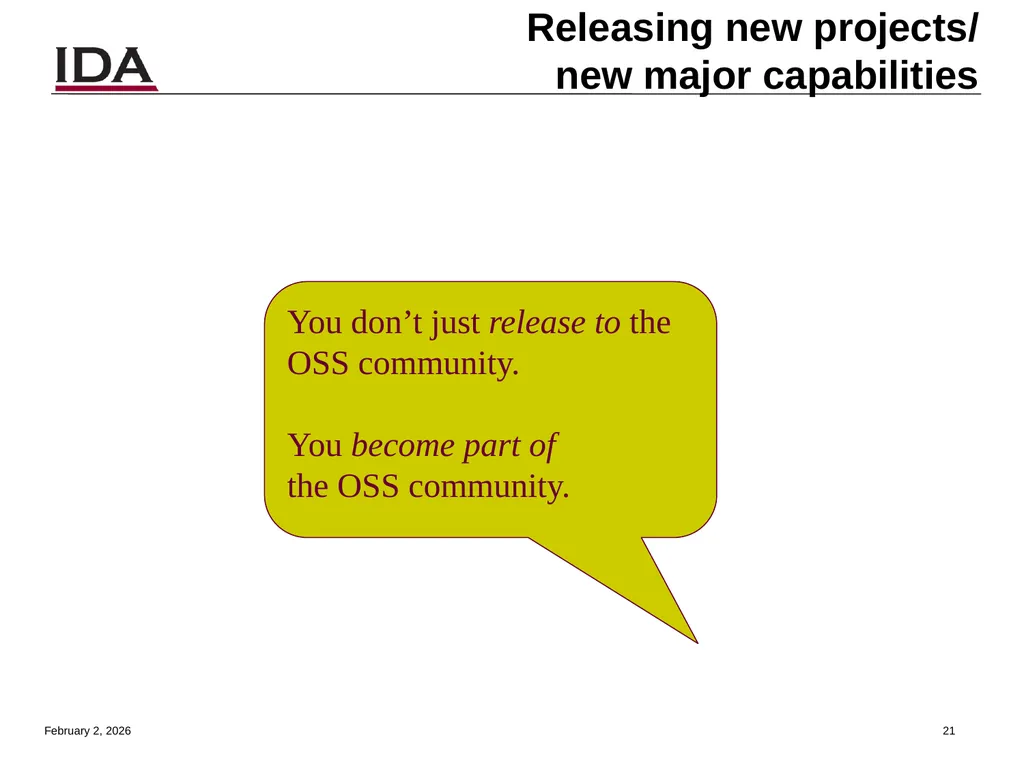
Releasing new projects/
new major capabilities 13 August 2013 20 You don’t just release to the
OSS community.
You become part of the OSS community.<br>
You become part of the OSS community.<br>
22
Simplify, simplify, simplify OTD is all about enabling collaboration
Collaboration inhibited by unnecessary complexity
Continuously strive to simplify the project
Ensure intellectual rights issues are simple and clear (e.g., through clear and common licenses)
Material is easily available to all who should be able to access it
Technical designs are clearly modular
Minimize number of minutes (seconds?) it takes someone new to:
Find the project
Learn what it does & its status
Download, install, “run to do something”
Make a change/improvement (use standard conventions!)
Get it submitted back to the larger project 13 August 2013 21<br>
Collaboration inhibited by unnecessary complexity
Continuously strive to simplify the project
Ensure intellectual rights issues are simple and clear (e.g., through clear and common licenses)
Material is easily available to all who should be able to access it
Technical designs are clearly modular
Minimize number of minutes (seconds?) it takes someone new to:
Find the project
Learn what it does & its status
Download, install, “run to do something”
Make a change/improvement (use standard conventions!)
Get it submitted back to the larger project 13 August 2013 21<br>
23
“Internet Success” (1) “Internet Success: A Study of Open-Source Software Commons” by Schweik and English (MIT)
5 years quantitative analysis “what factors lead to success?” in OSS initiation & growth
During initiation (before first release), in order:
Put in the hours. Work hard toward creating your first release.” If leader put > 1.5 hours/week (average), 73% success, else 35%
Practice leadership - administering your project well, think through and articulate your vision & goals for project
Establish a high-quality Web site to showcase & promote your project
“Create good documentation for your user and developer community.”
“Advertise and market your project, and communicate your plans and goals with the hope of getting help from others.”
More users, better. Successful tend to have >= 200 users 13 August 2013 22<br>
5 years quantitative analysis “what factors lead to success?” in OSS initiation & growth
During initiation (before first release), in order:
Put in the hours. Work hard toward creating your first release.” If leader put > 1.5 hours/week (average), 73% success, else 35%
Practice leadership - administering your project well, think through and articulate your vision & goals for project
Establish a high-quality Web site to showcase & promote your project
“Create good documentation for your user and developer community.”
“Advertise and market your project, and communicate your plans and goals with the hope of getting help from others.”
More users, better. Successful tend to have >= 200 users 13 August 2013 22<br>
24
“Internet Success” (2) Growth (post initial release):
Goal: Create “virtuous circle” where “others help to improve the software, thereby attracting more users and other developers, which in turn leads to more improvements in the software” – continue initiation recommendations
“Advertise and market your project.”
Successful growth projects frequently add at least one new developer in the growth stage
Have some small tasks available for contributors with limited time
Welcome competition - favors success
Consider accepting offers of financing or paid developers
Keep institutions (rules and project governance) “as lean and informal as possible, but do not be afraid to move toward more formalization if it appears necessary.” 13 August 2013 23<br>
Goal: Create “virtuous circle” where “others help to improve the software, thereby attracting more users and other developers, which in turn leads to more improvements in the software” – continue initiation recommendations
“Advertise and market your project.”
Successful growth projects frequently add at least one new developer in the growth stage
Have some small tasks available for contributors with limited time
Welcome competition - favors success
Consider accepting offers of financing or paid developers
Keep institutions (rules and project governance) “as lean and informal as possible, but do not be afraid to move toward more formalization if it appears necessary.” 13 August 2013 23<br>
25
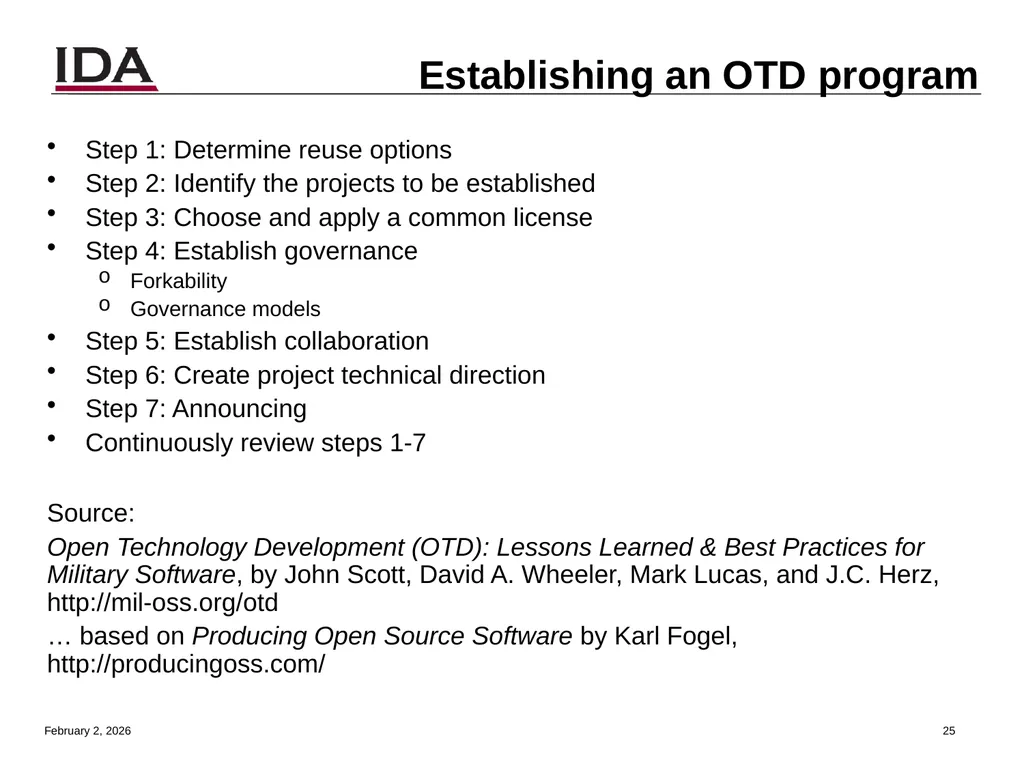
Establishing an OTD program Step 1: Determine reuse options
Step 2: Identify the projects to be established
Step 3: Choose and apply a common license
Step 4: Establish governance
Forkability
Governance models
Step 5: Establish collaboration
Step 6: Create project technical direction
Step 7: Announcing
Continuously review steps 1-7
Source:
Open Technology Development (OTD): Lessons Learned & Best Practices for Military Software, by John Scott, David A. Wheeler, Mark Lucas, and J.C. Herz, http://mil-oss.org/otd
… based on Producing Open Source Software by Karl Fogel, http://producingoss.com/ 13 August 2013 24<br>
Step 2: Identify the projects to be established
Step 3: Choose and apply a common license
Step 4: Establish governance
Forkability
Governance models
Step 5: Establish collaboration
Step 6: Create project technical direction
Step 7: Announcing
Continuously review steps 1-7
Source:
Open Technology Development (OTD): Lessons Learned & Best Practices for Military Software, by John Scott, David A. Wheeler, Mark Lucas, and J.C. Herz, http://mil-oss.org/otd
… based on Producing Open Source Software by Karl Fogel, http://producingoss.com/ 13 August 2013 24<br>
26
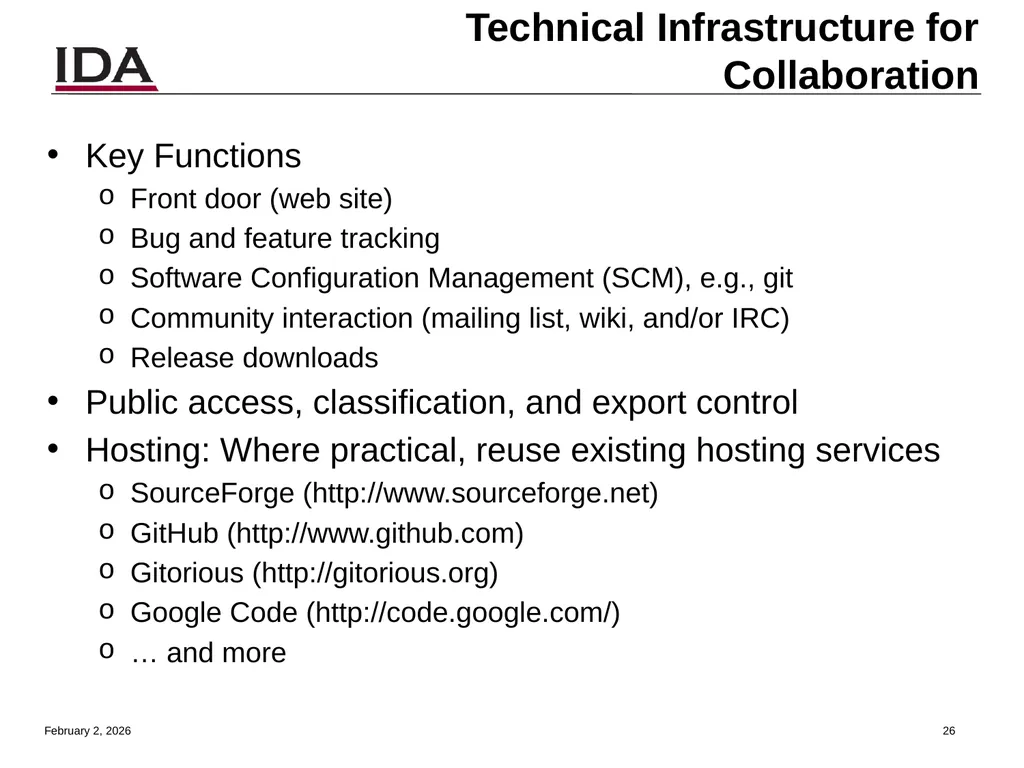
Technical Infrastructure for Collaboration Key Functions
Front door (web site)
Bug and feature tracking
Software Configuration Management (SCM), e.g., git
Community interaction (mailing list, wiki, and/or IRC)
Release downloads
Public access, classification, and export control
Hosting: Where practical, reuse existing hosting services
SourceForge (http://www.sourceforge.net)
GitHub (http://www.github.com)
Gitorious (http://gitorious.org)
Google Code (http://code.google.com/)
… and more 13 August 2013 25<br>
Front door (web site)
Bug and feature tracking
Software Configuration Management (SCM), e.g., git
Community interaction (mailing list, wiki, and/or IRC)
Release downloads
Public access, classification, and export control
Hosting: Where practical, reuse existing hosting services
SourceForge (http://www.sourceforge.net)
GitHub (http://www.github.com)
Gitorious (http://gitorious.org)
Google Code (http://code.google.com/)
… and more 13 August 2013 25<br>
27
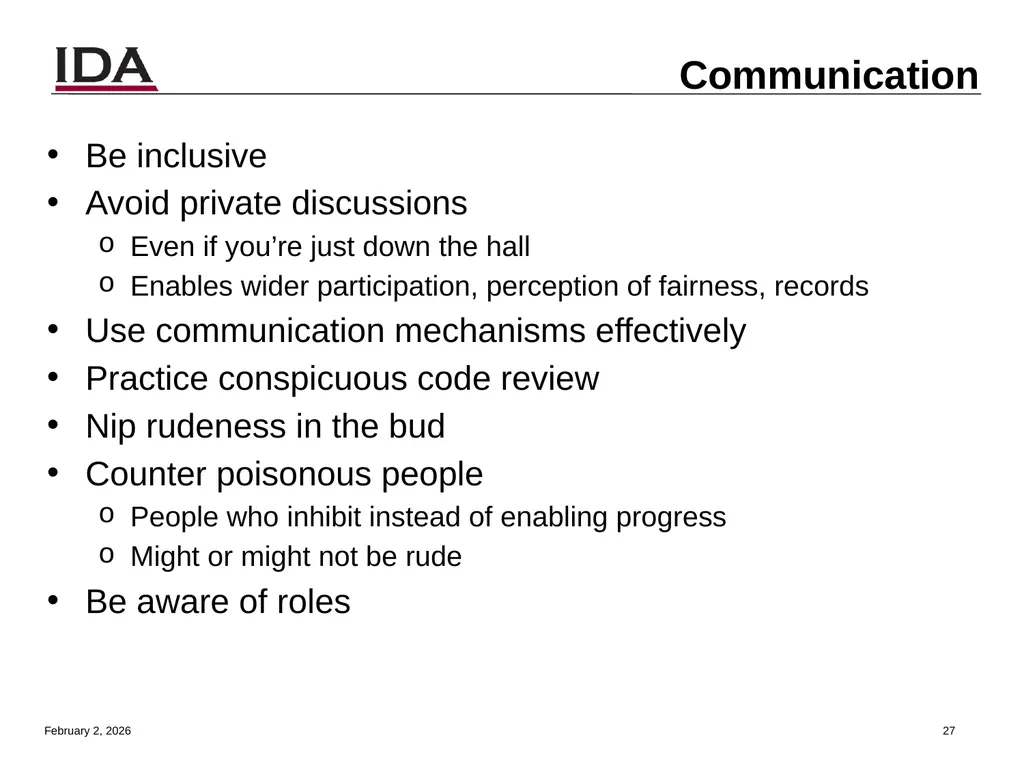
Communication Be inclusive
Avoid private discussions
Even if you’re just down the hall
Enables wider participation, perception of fairness, records
Use communication mechanisms effectively
Practice conspicuous code review
Nip rudeness in the bud
Counter poisonous people
People who inhibit instead of enabling progress
Might or might not be rude
Be aware of roles 13 August 2013 26<br>
Avoid private discussions
Even if you’re just down the hall
Enables wider participation, perception of fairness, records
Use communication mechanisms effectively
Practice conspicuous code review
Nip rudeness in the bud
Counter poisonous people
People who inhibit instead of enabling progress
Might or might not be rude
Be aware of roles 13 August 2013 26<br>
28
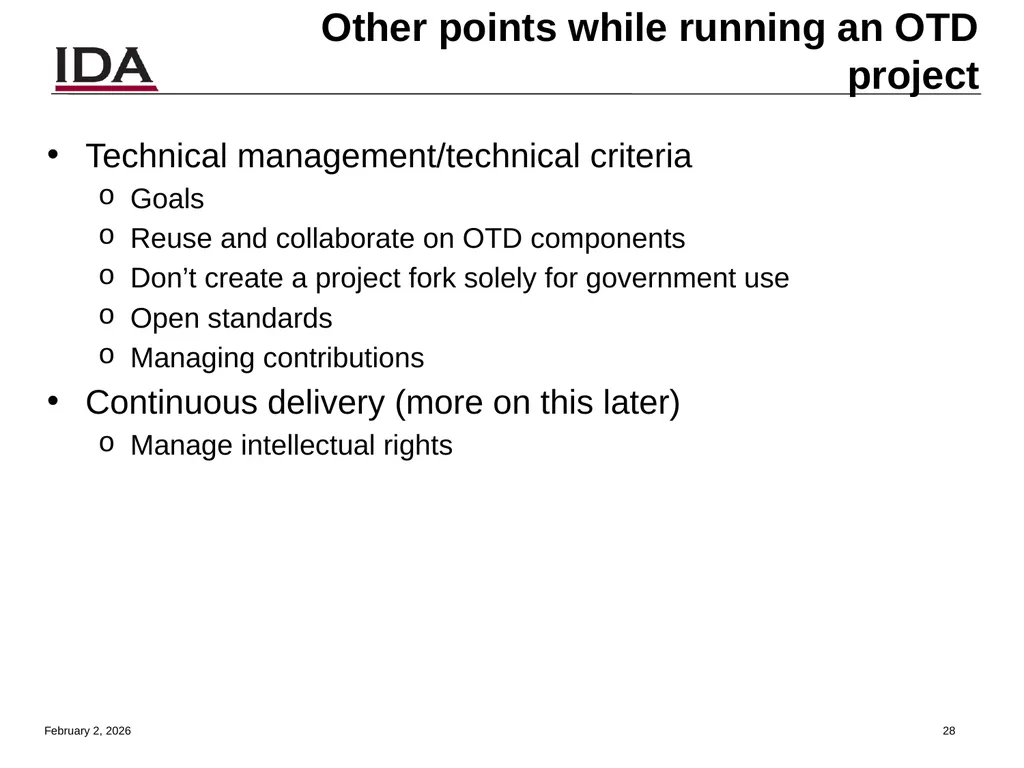
Other points while running an OTD project Technical management/technical criteria
Goals
Reuse and collaborate on OTD components
Don’t create a project fork solely for government use
Open standards
Managing contributions
Continuous delivery (more on this later)
Manage intellectual rights 13 August 2013 27<br>
Goals
Reuse and collaborate on OTD components
Don’t create a project fork solely for government use
Open standards
Managing contributions
Continuous delivery (more on this later)
Manage intellectual rights 13 August 2013 27<br>
29
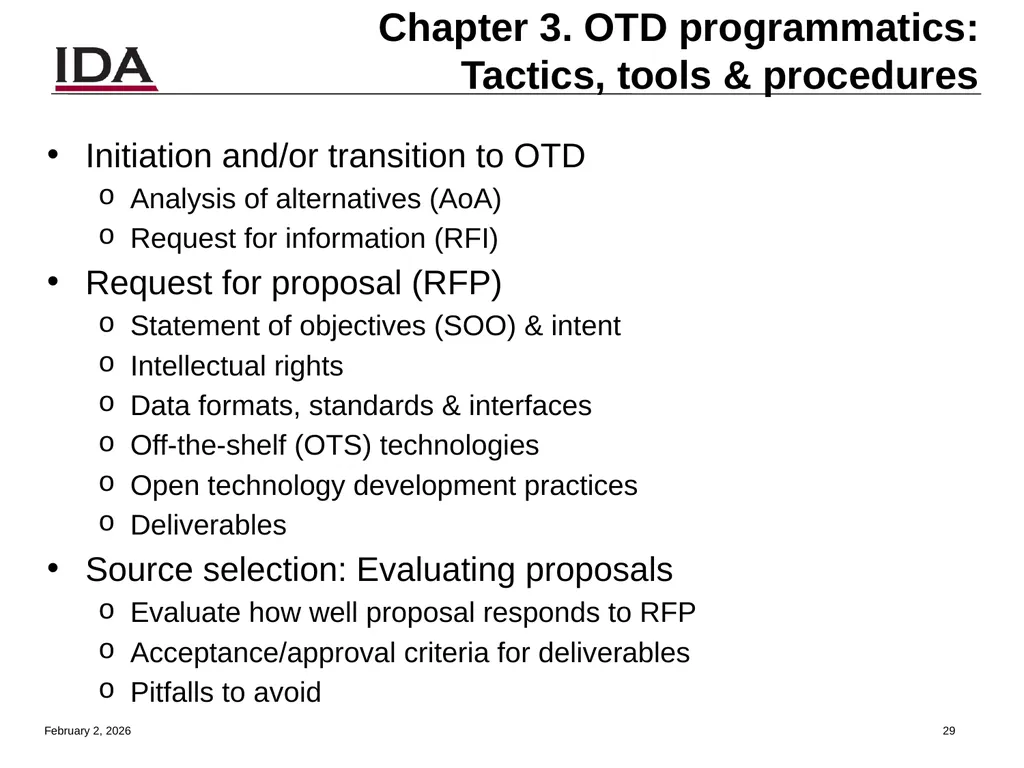
Chapter 3. OTD programmatics: Tactics, tools & procedures Initiation and/or transition to OTD
Analysis of alternatives (AoA)
Request for information (RFI)
Request for proposal (RFP)
Statement of objectives (SOO) & intent
Intellectual rights
Data formats, standards & interfaces
Off-the-shelf (OTS) technologies
Open technology development practices
Deliverables
Source selection: Evaluating proposals
Evaluate how well proposal responds to RFP
Acceptance/approval criteria for deliverables
Pitfalls to avoid 13 August 2013 28<br>
Analysis of alternatives (AoA)
Request for information (RFI)
Request for proposal (RFP)
Statement of objectives (SOO) & intent
Intellectual rights
Data formats, standards & interfaces
Off-the-shelf (OTS) technologies
Open technology development practices
Deliverables
Source selection: Evaluating proposals
Evaluate how well proposal responds to RFP
Acceptance/approval criteria for deliverables
Pitfalls to avoid 13 August 2013 28<br>
30
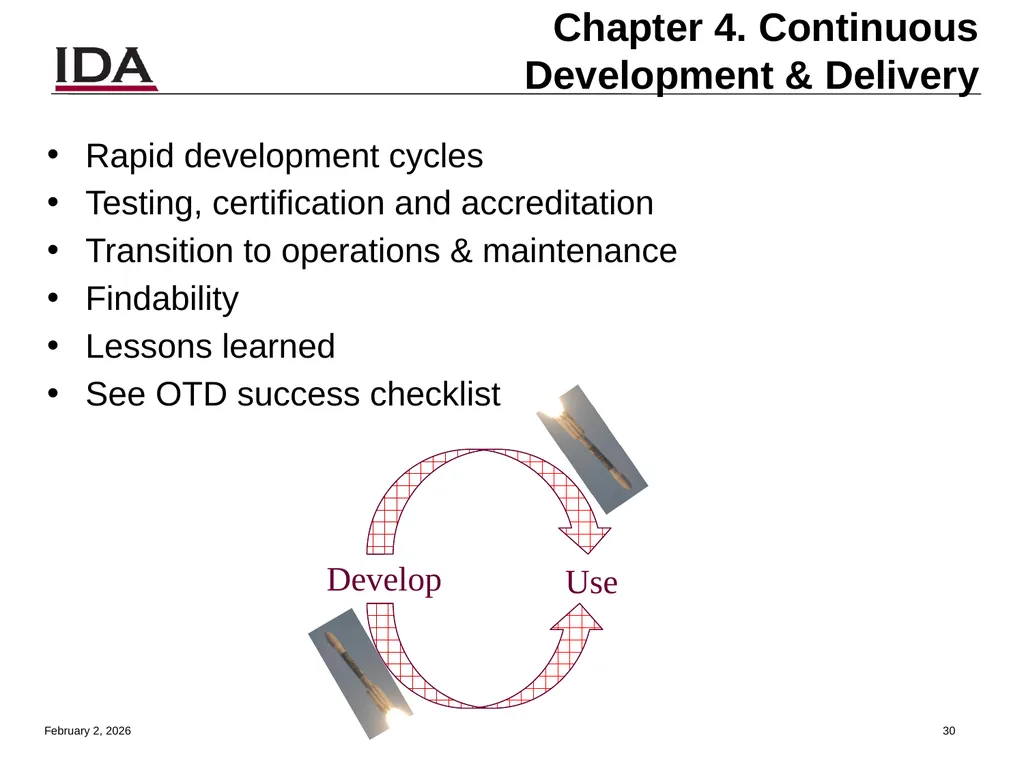
Chapter 4. Continuous Development & Delivery Rapid development cycles
Testing, certification and accreditation
Transition to operations & maintenance
Findability
Lessons learned
See OTD success checklist 13 August 2013 29 Develop Use<br>
Testing, certification and accreditation
Transition to operations & maintenance
Findability
Lessons learned
See OTD success checklist 13 August 2013 29 Develop Use<br>
31
Legal & contracting When can existing software (developed using government funds) be released as OSS? 13 August 2013 30<br>
32
“Answer me these questions ‘five’” The US federal government or contractors may release software developed using government funds to the public, as open source software (OSS), depending on:
What contract applies (including terms & decisions)?
Do you have the necessary copyright-related rights?
Do you have the other intellectual rights (e.g. patents)?
Do you have permission to release to the public?
Do you have all the materials (source code) & are they properly marked? 13 August 2013 31<br>
What contract applies (including terms & decisions)?
Do you have the necessary copyright-related rights?
Do you have the other intellectual rights (e.g. patents)?
Do you have permission to release to the public?
Do you have all the materials (source code) & are they properly marked? 13 August 2013 31<br>
33
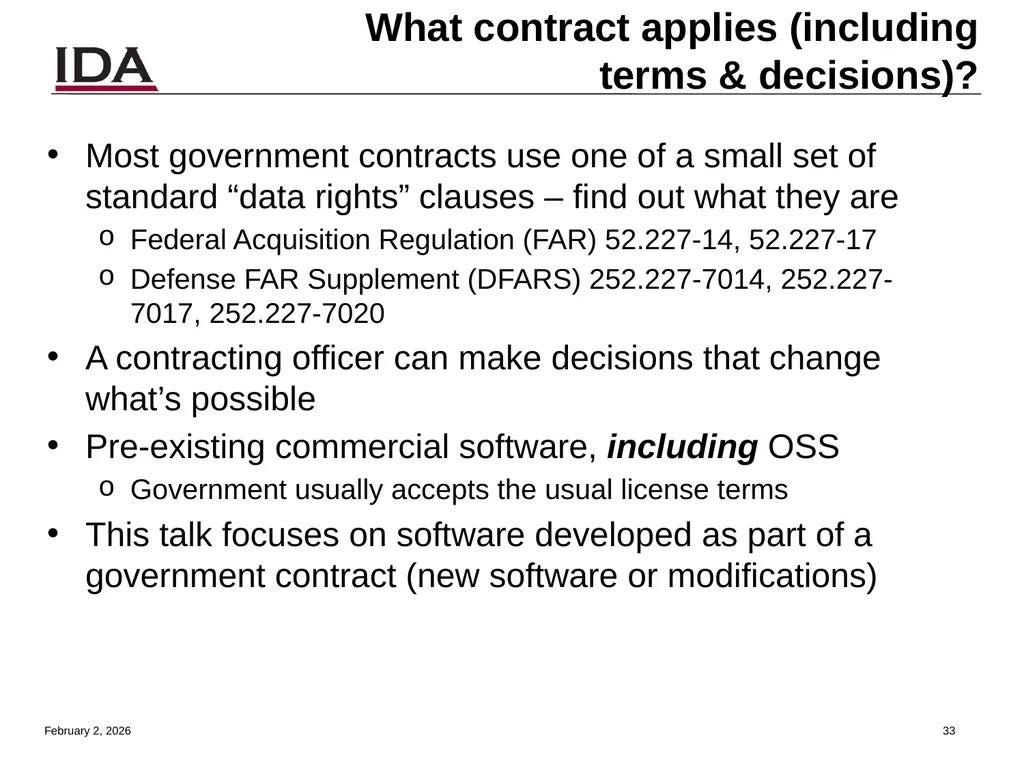
What contract applies (including terms & decisions)? Most government contracts use one of a small set of standard “data rights” clauses – find out what they are
Federal Acquisition Regulation (FAR) 52.227-14, 52.227-17
Defense FAR Supplement (DFARS) 252.227-7014, 252.227-7017, 252.227-7020
A contracting officer can make decisions that change what’s possible
Pre-existing commercial software, including OSS
Government usually accepts the usual license terms
This talk focuses on software developed as part of a government contract (new software or modifications) 13 August 2013 32<br>
Federal Acquisition Regulation (FAR) 52.227-14, 52.227-17
Defense FAR Supplement (DFARS) 252.227-7014, 252.227-7017, 252.227-7020
A contracting officer can make decisions that change what’s possible
Pre-existing commercial software, including OSS
Government usually accepts the usual license terms
This talk focuses on software developed as part of a government contract (new software or modifications) 13 August 2013 32<br>
34
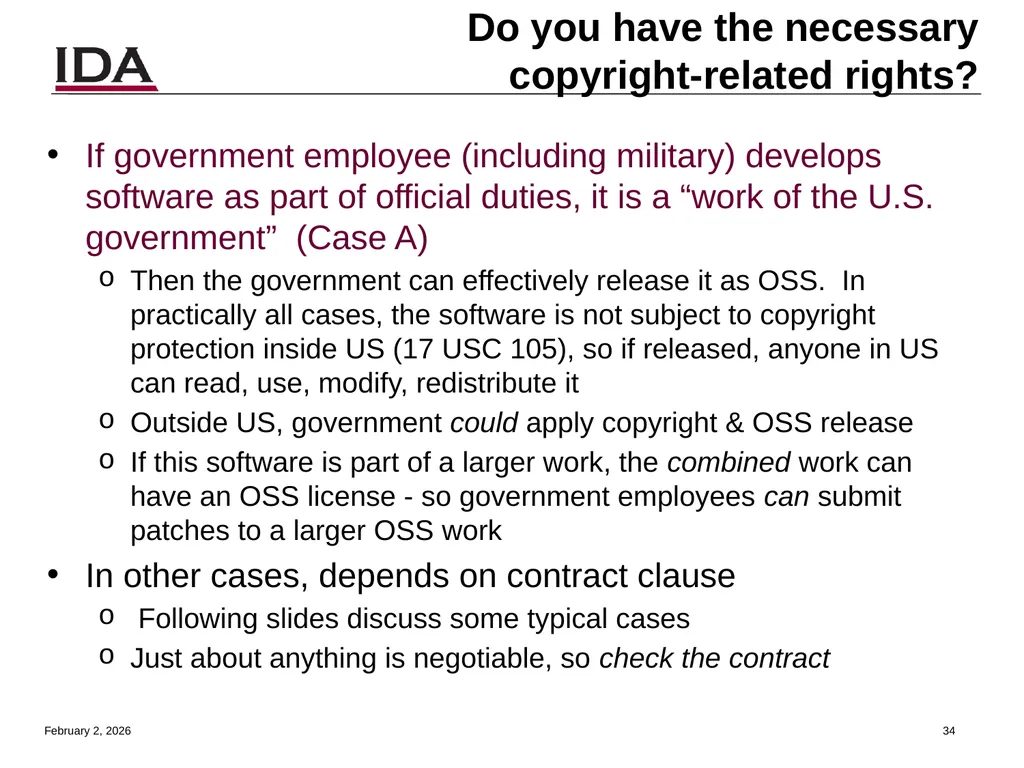
Do you have the necessary copyright-related rights? If government employee (including military) develops software as part of official duties, it is a “work of the U.S. government” (Case A)
Then the government can effectively release it as OSS. In practically all cases, the software is not subject to copyright protection inside US (17 USC 105), so if released, anyone in US can read, use, modify, redistribute it
Outside US, government could apply copyright & OSS release
If this software is part of a larger work, the combined work can have an OSS license - so government employees can submit patches to a larger OSS work
In other cases, depends on contract clause
Following slides discuss some typical cases
Just about anything is negotiable, so check the contract 13 August 2013 33<br>
Then the government can effectively release it as OSS. In practically all cases, the software is not subject to copyright protection inside US (17 USC 105), so if released, anyone in US can read, use, modify, redistribute it
Outside US, government could apply copyright & OSS release
If this software is part of a larger work, the combined work can have an OSS license - so government employees can submit patches to a larger OSS work
In other cases, depends on contract clause
Following slides discuss some typical cases
Just about anything is negotiable, so check the contract 13 August 2013 33<br>
35
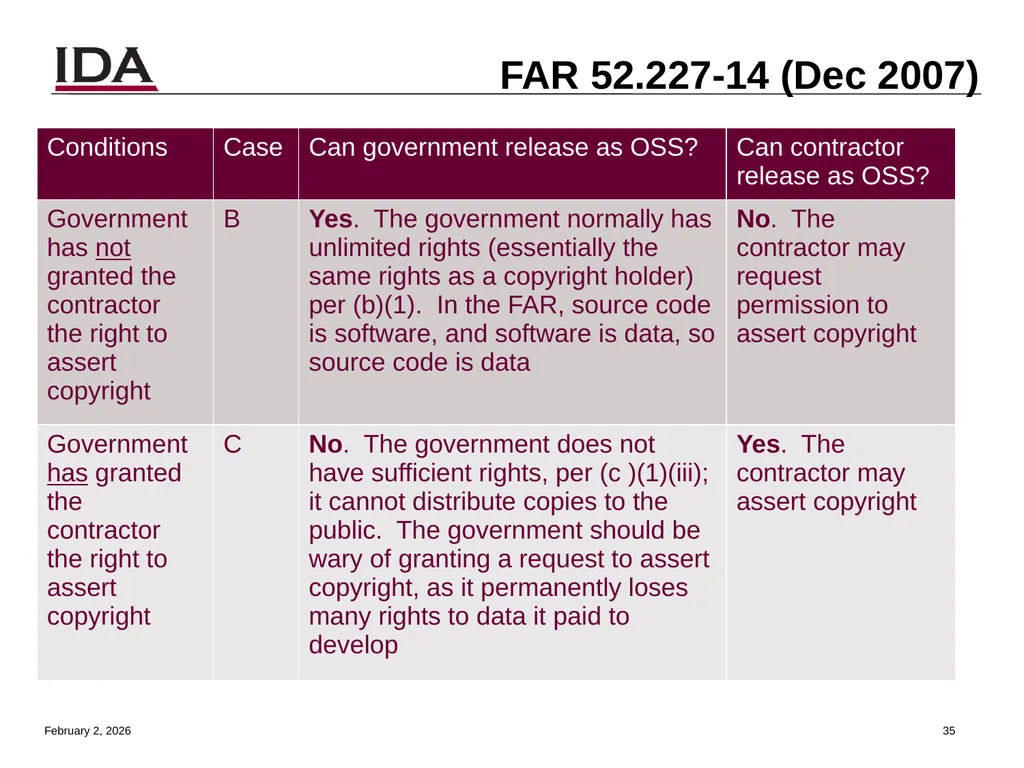
FAR 52.227-14 (Dec 2007) 13 August 2013 34<br>
36
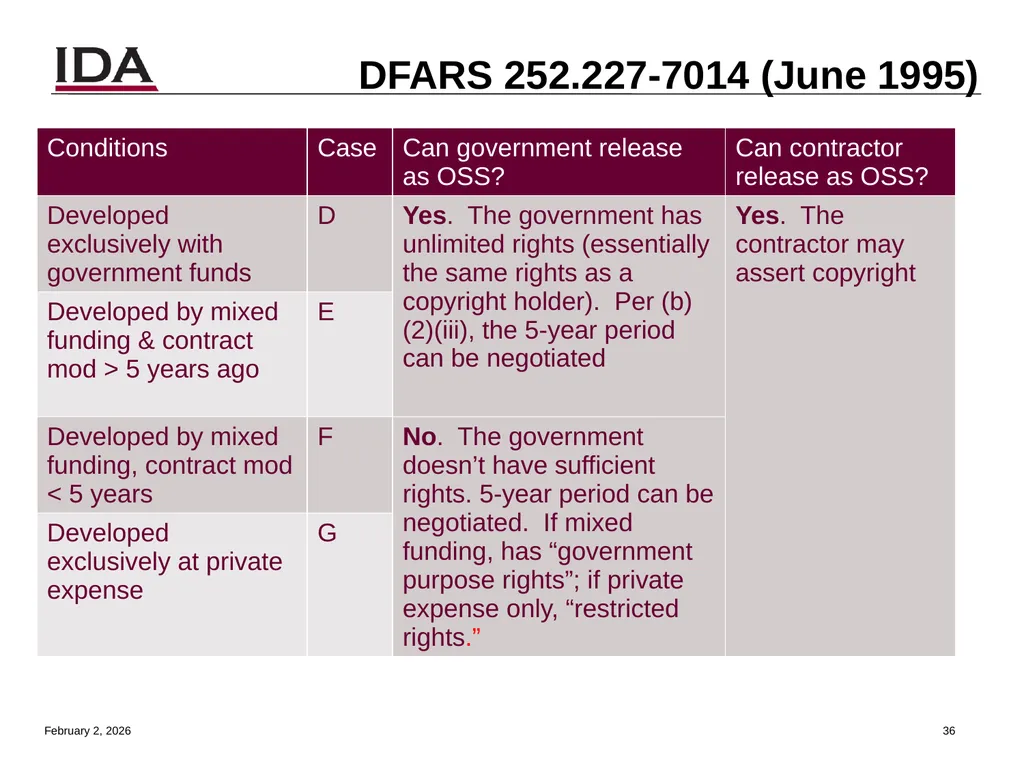
DFARS 252.227-7014 (June 1995) 13 August 2013 35<br>
37
Do you have the other intellectual rights (e.g., patents)? FAR & DFARS call these “data rights”
Often called “intellectual property rights” — but the term “property” is misleading
Intellectual works (e.g., software) are fundamentally different from physical property; they can be consumed by one without preventing simultaneous consumption by others (“non-rivalrous”)
Determine if there are any relevant patents, and if so, what they are
Patents create many more complications!
Trademarks & government seals: Remove if needed (not usually a big deal) 13 August 2013 36<br>
Often called “intellectual property rights” — but the term “property” is misleading
Intellectual works (e.g., software) are fundamentally different from physical property; they can be consumed by one without preventing simultaneous consumption by others (“non-rivalrous”)
Determine if there are any relevant patents, and if so, what they are
Patents create many more complications!
Trademarks & government seals: Remove if needed (not usually a big deal) 13 August 2013 36<br>
38
Do you have permission to release to the public? Classification
Sometimes source code can be handled through document classification reviews
Distribution statements (for contractors)
Export controls
Export Administration Regulations (EAR) issued by Dept of Commerce
International Traffic in Arms Regulations (ITAR) issued by Dept of State
DoD does not have the authority to grant export control licenses
If software is intended to be released to the public, ask the cognizant U.S. government department or agency (e.g., DoD) approve its public release: 15 CFE 734.3(b)(3) & 22 CFR 125.4(13) 13 August 2013 37<br>
Sometimes source code can be handled through document classification reviews
Distribution statements (for contractors)
Export controls
Export Administration Regulations (EAR) issued by Dept of Commerce
International Traffic in Arms Regulations (ITAR) issued by Dept of State
DoD does not have the authority to grant export control licenses
If software is intended to be released to the public, ask the cognizant U.S. government department or agency (e.g., DoD) approve its public release: 15 CFE 734.3(b)(3) & 22 CFR 125.4(13) 13 August 2013 37<br>
39
Possession is 9/10ths of the law You have to have the source code to release it
Government & upper-tier contractors should insist on receiving it
Make sure it’s really the source, not just binaries or pictures of the source code or automatically-generated source code
Make sure it’s marked correctly
Companies may include inappropriate restrictive markings
Challenge inappropriate markings promptly and early
DFARS 227.7203-13 includes a 3-year time limit for challenges
Improper markings often copied elsewhere
Fixing early fixes saves everyone time 13 August 2013 38<br>
Government & upper-tier contractors should insist on receiving it
Make sure it’s really the source, not just binaries or pictures of the source code or automatically-generated source code
Make sure it’s marked correctly
Companies may include inappropriate restrictive markings
Challenge inappropriate markings promptly and early
DFARS 227.7203-13 includes a 3-year time limit for challenges
Improper markings often copied elsewhere
Fixing early fixes saves everyone time 13 August 2013 38<br>
40
Who has authority? Determining authority between contractors can be tricky
Depends on the contracts, not always the lead contractor
Inside contractor: Depends on the company
On DoD government side, 2009 memo says it is decided by the “program manager, program manager, or other comparable official” 13 August 2013 39<br>
Depends on the contracts, not always the lead contractor
Inside contractor: Depends on the company
On DoD government side, 2009 memo says it is decided by the “program manager, program manager, or other comparable official” 13 August 2013 39<br>
41
Government has released OSS Whitehouse.gov Drupal extensions
Petitions (“We the people”), accessibility (section 508), mobile app display (Android & iOS), scaleability
Security-enhanced Linux (SELinux)
Longer lists:
http://www.dwheeler.com/government-oss-released/ - short URL to list started by Scott Goodwin, CIO for Space Operations at NASA HQ
http://gsa.github.io/federal-open-source-repos/ - github-specific 13 August 2013 40<br>
Petitions (“We the people”), accessibility (section 508), mobile app display (Android & iOS), scaleability
Security-enhanced Linux (SELinux)
Longer lists:
http://www.dwheeler.com/government-oss-released/ - short URL to list started by Scott Goodwin, CIO for Space Operations at NASA HQ
http://gsa.github.io/federal-open-source-repos/ - github-specific 13 August 2013 40<br>
42
Conclusions The government can use and release OSS
If you (in the government) plan to release as OSS, plan ahead-of-time and include it in the contract
Make sure software source code is delivered
Make sure it’s released with the appropriate rights
Talk to others who have experience with OSS
For day-to-day how-to, see:
Open Technology Development (OTD): Lessons Learned & Best Practices for Military Software
Producing Open Source Software by Karl Fogel, http://producingoss.com/
IT CAN BE DONE!!
Get started! 13 August 2013 41<br>
If you (in the government) plan to release as OSS, plan ahead-of-time and include it in the contract
Make sure software source code is delivered
Make sure it’s released with the appropriate rights
Talk to others who have experience with OSS
For day-to-day how-to, see:
Open Technology Development (OTD): Lessons Learned & Best Practices for Military Software
Producing Open Source Software by Karl Fogel, http://producingoss.com/
IT CAN BE DONE!!
Get started! 13 August 2013 41<br>
43
Backup slides 13 August 2013 42<br>
44
U.S. federal government acquisition 101 (grossly simplified) 13 August 2013 43 Judicial Executive Legislative Constitution Law (US Code) Defense Homeland
Security State Regulations, incl.
Federal Acquisition
Regulation (FAR) Regulations, incl.
DoD FAR
Supplement (DFARS) … PM … Lead Contractor Subcontractors Request for Proposal
Proposals Submitted
Contract Awarded … Branch Department Sub-subcontractors Local regulations… U.S. Federal
Government<br>
Security State Regulations, incl.
Federal Acquisition
Regulation (FAR) Regulations, incl.
DoD FAR
Supplement (DFARS) … PM … Lead Contractor Subcontractors Request for Proposal
Proposals Submitted
Contract Awarded … Branch Department Sub-subcontractors Local regulations… U.S. Federal
Government<br>
45
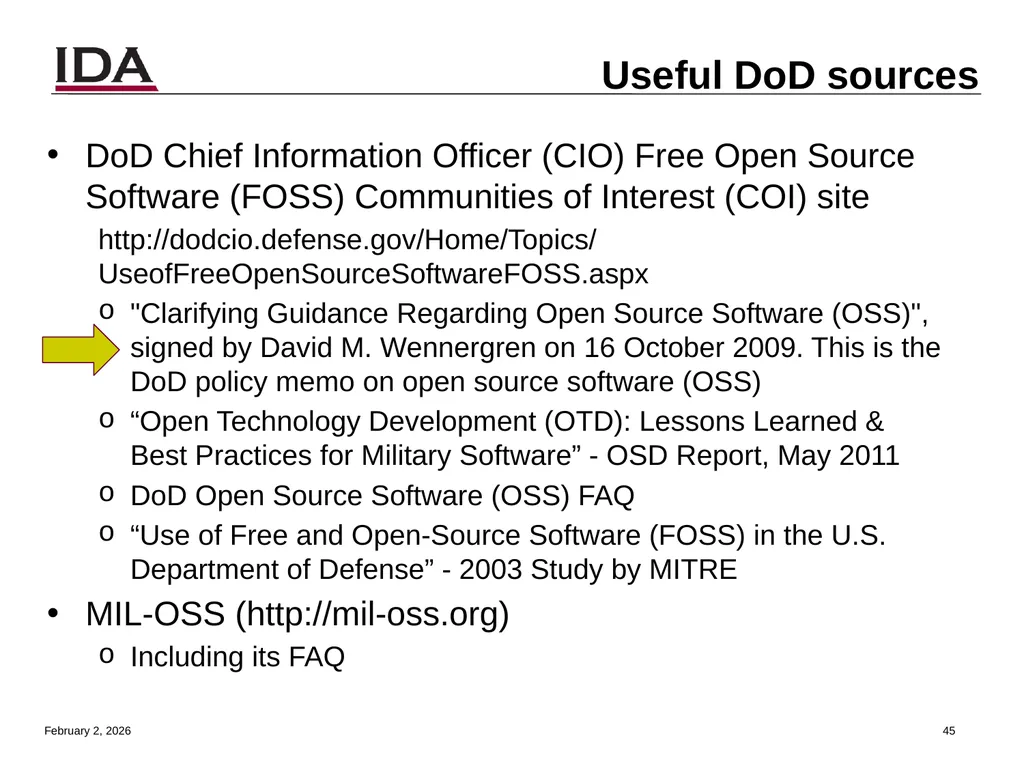
13 August 2013 44 Useful DoD sources DoD Chief Information Officer (CIO) Free Open Source Software (FOSS) Communities of Interest (COI) site
http://dodcio.defense.gov/Home/Topics/UseofFreeOpenSourceSoftwareFOSS.aspx
"Clarifying Guidance Regarding Open Source Software (OSS)", signed by David M. Wennergren on 16 October 2009. This is the DoD policy memo on open source software (OSS)
“Open Technology Development (OTD): Lessons Learned & Best Practices for Military Software” - OSD Report, May 2011
DoD Open Source Software (OSS) FAQ
“Use of Free and Open-Source Software (FOSS) in the U.S. Department of Defense” - 2003 Study by MITRE
MIL-OSS (http://mil-oss.org)
Including its FAQ<br>
http://dodcio.defense.gov/Home/Topics/UseofFreeOpenSourceSoftwareFOSS.aspx
"Clarifying Guidance Regarding Open Source Software (OSS)", signed by David M. Wennergren on 16 October 2009. This is the DoD policy memo on open source software (OSS)
“Open Technology Development (OTD): Lessons Learned & Best Practices for Military Software” - OSD Report, May 2011
DoD Open Source Software (OSS) FAQ
“Use of Free and Open-Source Software (FOSS) in the U.S. Department of Defense” - 2003 Study by MITRE
MIL-OSS (http://mil-oss.org)
Including its FAQ<br>
46
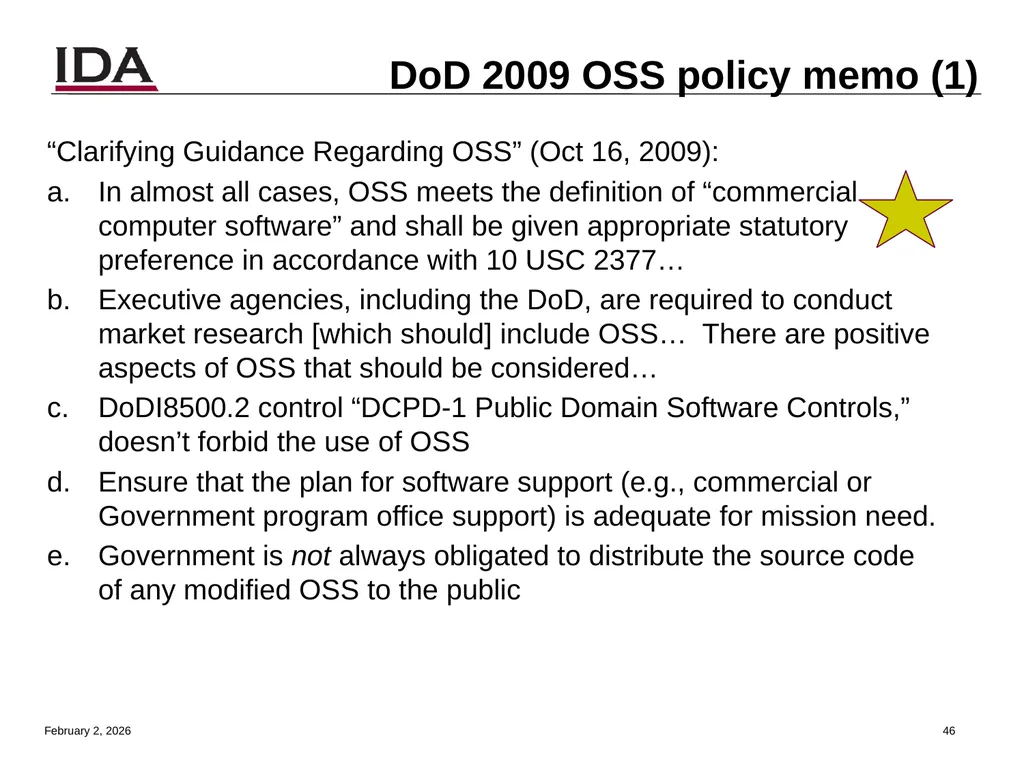
DoD 2009 OSS policy memo (1) “Clarifying Guidance Regarding OSS” (Oct 16, 2009):
In almost all cases, OSS meets the definition of “commercial computer software” and shall be given appropriate statutory preference in accordance with 10 USC 2377…
Executive agencies, including the DoD, are required to conduct market research [which should] include OSS… There are positive aspects of OSS that should be considered…
DoDI8500.2 control “DCPD-1 Public Domain Software Controls,” doesn’t forbid the use of OSS
Ensure that the plan for software support (e.g., commercial or Government program office support) is adequate for mission need.
Government is not always obligated to distribute the source code of any modified OSS to the public 13 August 2013 45<br>
In almost all cases, OSS meets the definition of “commercial computer software” and shall be given appropriate statutory preference in accordance with 10 USC 2377…
Executive agencies, including the DoD, are required to conduct market research [which should] include OSS… There are positive aspects of OSS that should be considered…
DoDI8500.2 control “DCPD-1 Public Domain Software Controls,” doesn’t forbid the use of OSS
Ensure that the plan for software support (e.g., commercial or Government program office support) is adequate for mission need.
Government is not always obligated to distribute the source code of any modified OSS to the public 13 August 2013 45<br>
47
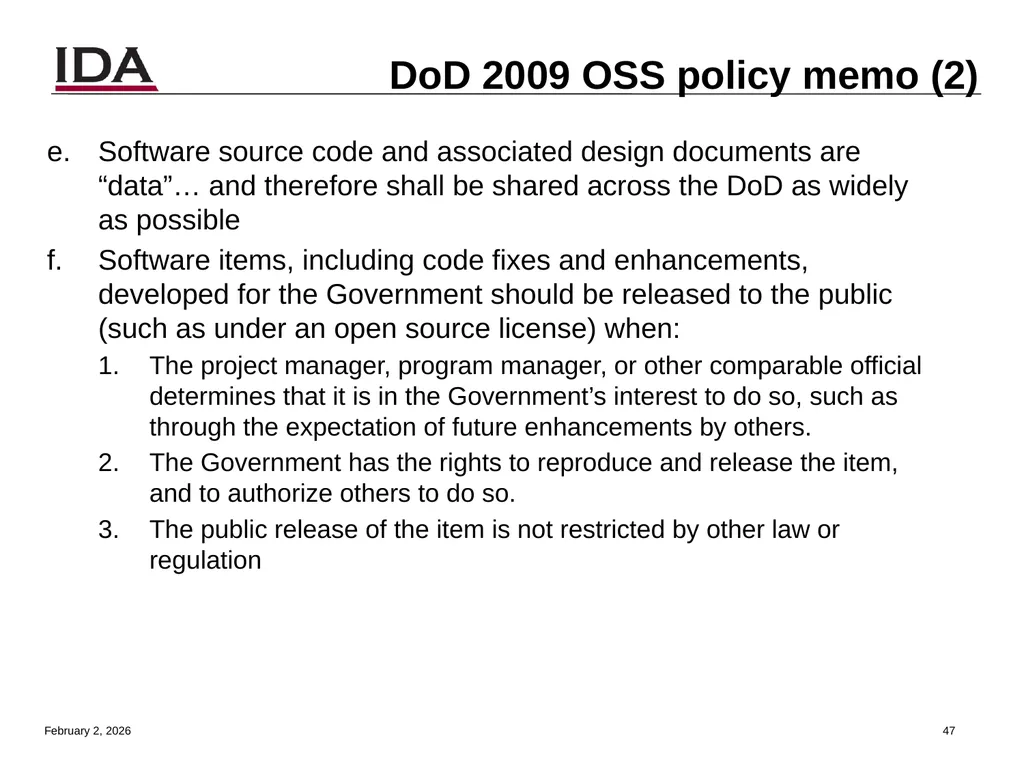
DoD 2009 OSS policy memo (2) Software source code and associated design documents are “data”… and therefore shall be shared across the DoD as widely as possible
Software items, including code fixes and enhancements, developed for the Government should be released to the public (such as under an open source license) when:
The project manager, program manager, or other comparable official determines that it is in the Government’s interest to do so, such as through the expectation of future enhancements by others.
The Government has the rights to reproduce and release the item, and to authorize others to do so.
The public release of the item is not restricted by other law or regulation 13 August 2013 46<br>
Software items, including code fixes and enhancements, developed for the Government should be released to the public (such as under an open source license) when:
The project manager, program manager, or other comparable official determines that it is in the Government’s interest to do so, such as through the expectation of future enhancements by others.
The Government has the rights to reproduce and release the item, and to authorize others to do so.
The public release of the item is not restricted by other law or regulation 13 August 2013 46<br>
48
Positive OSS aspects stated in DoD 2009 OSS memo (1) “The continuous and broad peer-review enabled by publicly available source code supports software reliability and security efforts through the identification and elimination of defects that might otherwise go unrecognized by a more limited core development team.
The unrestricted ability to modify software source code enables the Department to respond more rapidly to changing situations, missions, and future threats.
Reliance on a particular software developer or vendor due to proprietary restrictions may be reduced by the use of OSS, which can be operated and maintained by multiple vendors, thus reducing barriers to entry and exit.
Open source licenses do not restrict who can use the software or the fields of endeavor in which the software can be used. Therefore, OSS provides a net-centric licensing model that enables rapid provisioning of both known and unanticipated users. 13 August 2013 47<br>
The unrestricted ability to modify software source code enables the Department to respond more rapidly to changing situations, missions, and future threats.
Reliance on a particular software developer or vendor due to proprietary restrictions may be reduced by the use of OSS, which can be operated and maintained by multiple vendors, thus reducing barriers to entry and exit.
Open source licenses do not restrict who can use the software or the fields of endeavor in which the software can be used. Therefore, OSS provides a net-centric licensing model that enables rapid provisioning of both known and unanticipated users. 13 August 2013 47<br>
49
Positive OSS aspects stated in DoD 2009 OSS memo (2) Since OSS typically does not have a per-seat licensing cost, it can provide a cost advantage in situations where many copies of the software may be required, and can mitigate risk of cost growth due to licensing in situations where the total number of users may not be known in advance.
By sharing the responsibility for maintenance of OSS with other users, the Department can benefit by reducing the total cost of ownership for software, particularly compared with software for which the Department has sole responsibility for maintenance (e.g., GOTS).
OSS is particularly suitable for rapid prototyping and experimentation, where the ability to ‘test drive’ the software with minimal costs and administrative delays can be important.” 13 August 2013 48 “While these considerations may be relevant, they may not be the overriding aspects to any decision… Ultimately, the software that best meets the needs and mission of the Department should be used, regardless of whether the software is open source.”<br>
By sharing the responsibility for maintenance of OSS with other users, the Department can benefit by reducing the total cost of ownership for software, particularly compared with software for which the Department has sole responsibility for maintenance (e.g., GOTS).
OSS is particularly suitable for rapid prototyping and experimentation, where the ability to ‘test drive’ the software with minimal costs and administrative delays can be important.” 13 August 2013 48 “While these considerations may be relevant, they may not be the overriding aspects to any decision… Ultimately, the software that best meets the needs and mission of the Department should be used, regardless of whether the software is open source.”<br>
50
Myth: OSS is non-commercial.
Reality: OSS is commercial (3) Many OSS projects supported by commercial companies
IBM, Red Hat (solely OSS, market cap $4.3B), Novell, Microsoft (WiX, IronPython, SFU, Codeplex site)
Big money in OSS companies
Red Hat bought JBoss ($350 million), ...
IBM reports invested $1B in 2001, made it back in 2002
Venture capital invested $1.44B in OSS 2001-2006 [InfoWorld]
Paid developers
Linux: 37K/38K changes; 70%+ of its developers paid to do it
Apache: >1000 committers, 1 unpaid
OSS licenses/projects approve of commercial support
Many business models can build on OSS
Sell service/hardware, commoditize complements, avoid costs
Use COTS/NDI because users share costs – OSS does! 13 August 2013 49<br>
IBM, Red Hat (solely OSS, market cap $4.3B), Novell, Microsoft (WiX, IronPython, SFU, Codeplex site)
Big money in OSS companies
Red Hat bought JBoss ($350 million), ...
IBM reports invested $1B in 2001, made it back in 2002
Venture capital invested $1.44B in OSS 2001-2006 [InfoWorld]
Paid developers
Linux: 37K/38K changes; 70%+ of its developers paid to do it
Apache: >1000 committers, 1 unpaid
OSS licenses/projects approve of commercial support
Many business models can build on OSS
Sell service/hardware, commoditize complements, avoid costs
Use COTS/NDI because users share costs – OSS does! 13 August 2013 49<br>
51
Credits & More information Material based on Open Technology Development (OTD): Lessons Learned & Best Practices for Military Software, OSD Report, May 2011
http://dodcio.defense.gov/Home/Topics/UseofFreeOpenSourceSoftwareFOSS.aspx
Which was based on Producing Open Source Software by Karl Fogel, http://producingoss.com 13 August 2013 50<br>
http://dodcio.defense.gov/Home/Topics/UseofFreeOpenSourceSoftwareFOSS.aspx
Which was based on Producing Open Source Software by Karl Fogel, http://producingoss.com 13 August 2013 50<br>
52
13 August 2013 51 Useful sources on releasing OSS “Publicly Releasing Open Source Software Developed for the U.S. Government” by Dr. David A. Wheeler, DoD Software Tech News, February 2011, Vol. 14, Number 1, http://journal.thedacs.com/issue/56/180
1-page summary “OSS Releasability Quick Reference” by Kane McLean, http:// mil-oss.org/resources/software-copyright-assertion-rights-quick-reference.pdf
Open Technology Development (OTD): Lessons Learned & Best Practices for Military Software, by John Scott, David A. Wheeler, Mark Lucas, and J.C. Herz, http://mil-oss.org/otd (includes “Publicly Releasing...”)
Producing Open Source Software by Karl Fogel, http://producingoss.com/<br>
1-page summary “OSS Releasability Quick Reference” by Kane McLean, http:// mil-oss.org/resources/software-copyright-assertion-rights-quick-reference.pdf
Open Technology Development (OTD): Lessons Learned & Best Practices for Military Software, by John Scott, David A. Wheeler, Mark Lucas, and J.C. Herz, http://mil-oss.org/otd (includes “Publicly Releasing...”)
Producing Open Source Software by Karl Fogel, http://producingoss.com/<br>
53
Conclusions OSS is practically always “commercial software”
Federal organizations & their contractors (at all tiers) are required to consider using it
To release software to the public as OSS, ask:
What contract applies (including terms & decisions)?
Do you have the necessary copyright-related rights?
Do you have the other intellectual rights (e.g. patents)?
Do you have permission to release to the public?
Do you have all the materials (source code) & are they properly marked?
If you plan to do it ahead-of-time, put it in the contract!
It’s often possible to release, as OSS, software developed using government funds 13 August 2013 52<br>
Federal organizations & their contractors (at all tiers) are required to consider using it
To release software to the public as OSS, ask:
What contract applies (including terms & decisions)?
Do you have the necessary copyright-related rights?
Do you have the other intellectual rights (e.g. patents)?
Do you have permission to release to the public?
Do you have all the materials (source code) & are they properly marked?
If you plan to do it ahead-of-time, put it in the contract!
It’s often possible to release, as OSS, software developed using government funds 13 August 2013 52<br>
54
Why would contractors use/develop OSS? Same list as previous, plus...
OSS use—similar advantages to use of proprietary commercial item
Competitive advantage (if uses & others don’t), because shared development of item across many users (cost, time, quality, innovation) tends to produce better results
Can focus on problem not lower-level issues (if everyone uses)
Avoids risks of depending on proprietary commercial items
Proprietary third-party: Vendor lock-in risks (costs, abandon,...)
A contractor: All other contractors will avoid (to avoid the risk of complete dependence on a direct competitor), inhibiting sharing
OSS development: First-mover advantage
First one to release defines architecture & has best expertise in the OSS component, leading to competitive advantage 13 August 2013 53<br>
OSS use—similar advantages to use of proprietary commercial item
Competitive advantage (if uses & others don’t), because shared development of item across many users (cost, time, quality, innovation) tends to produce better results
Can focus on problem not lower-level issues (if everyone uses)
Avoids risks of depending on proprietary commercial items
Proprietary third-party: Vendor lock-in risks (costs, abandon,...)
A contractor: All other contractors will avoid (to avoid the risk of complete dependence on a direct competitor), inhibiting sharing
OSS development: First-mover advantage
First one to release defines architecture & has best expertise in the OSS component, leading to competitive advantage 13 August 2013 53<br>
55
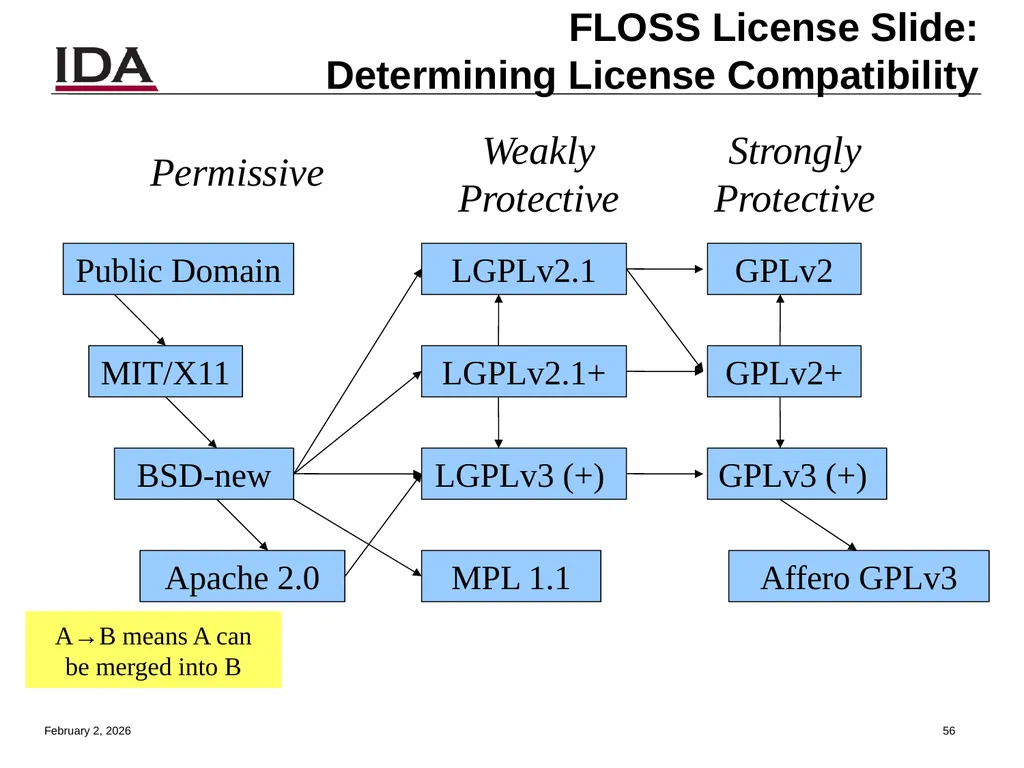
Types of OSS licenses Copyright law: Must have permission to copy software
Permission is given by a license
Proprietary software: Pay for a license to use a copy/copies
OSS licenses grant more rights, but still conditional licenses
Over 100 OSS licenses, but only a few widely used
Can be grouped into three categories (differing goals):
Permissive: Can make proprietary versions (MIT, BSD-new)
Strongly protective: Can’t distribute proprietary version or combined (linked) into proprietary work; if give someone the binary, must give them the source if asked (GPL)
Weakly protective: Can’t distribute proprietary version of this component, but can link into larger proprietary work (LGPL)
The most popular OSS licenses tend to be compatible
Compatible = you can create larger programs by combining software with different licenses (must obey all of them) 13 August 2013 54<br>
Permission is given by a license
Proprietary software: Pay for a license to use a copy/copies
OSS licenses grant more rights, but still conditional licenses
Over 100 OSS licenses, but only a few widely used
Can be grouped into three categories (differing goals):
Permissive: Can make proprietary versions (MIT, BSD-new)
Strongly protective: Can’t distribute proprietary version or combined (linked) into proprietary work; if give someone the binary, must give them the source if asked (GPL)
Weakly protective: Can’t distribute proprietary version of this component, but can link into larger proprietary work (LGPL)
The most popular OSS licenses tend to be compatible
Compatible = you can create larger programs by combining software with different licenses (must obey all of them) 13 August 2013 54<br>
56
FLOSS License Slide:
Determining License Compatibility 13 August 2013 55 Public Domain MIT/X11 BSD-new Apache 2.0 Permissive Weakly
Protective Strongly
Protective LGPLv2.1 LGPLv2.1+ LGPLv3 (+) MPL 1.1 GPLv2 GPLv2+ GPLv3 (+) Affero GPLv3 A→B means A can be merged into B<br>
Protective Strongly
Protective LGPLv2.1 LGPLv2.1+ LGPLv3 (+) MPL 1.1 GPLv2 GPLv2+ GPLv3 (+) Affero GPLv3 A→B means A can be merged into B<br>
57
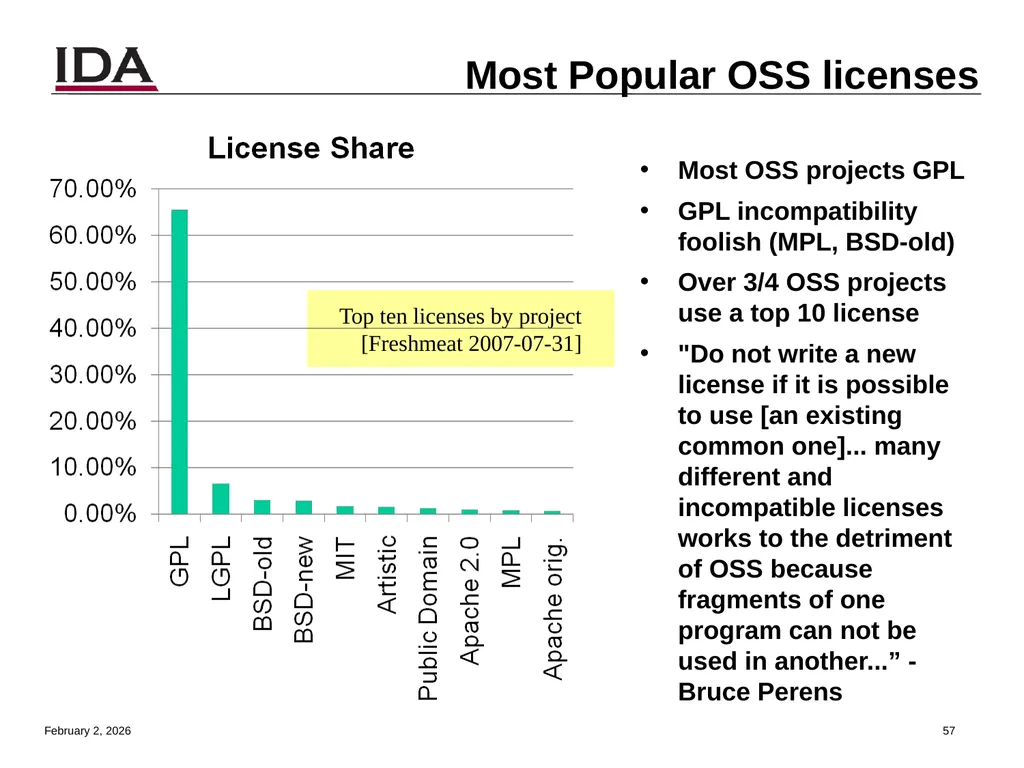
Most Popular OSS licenses 13 August 2013 56 Most OSS projects GPL
GPL incompatibility foolish (MPL, BSD-old)
Over 3/4 OSS projects use a top 10 license
"Do not write a new license if it is possible to use [an existing common one]... many different and incompatible licenses works to the detriment of OSS because fragments of one program can not be used in another...” - Bruce Perens Top ten licenses by project [Freshmeat 2007-07-31]<br>
GPL incompatibility foolish (MPL, BSD-old)
Over 3/4 OSS projects use a top 10 license
"Do not write a new license if it is possible to use [an existing common one]... many different and incompatible licenses works to the detriment of OSS because fragments of one program can not be used in another...” - Bruce Perens Top ten licenses by project [Freshmeat 2007-07-31]<br>
58
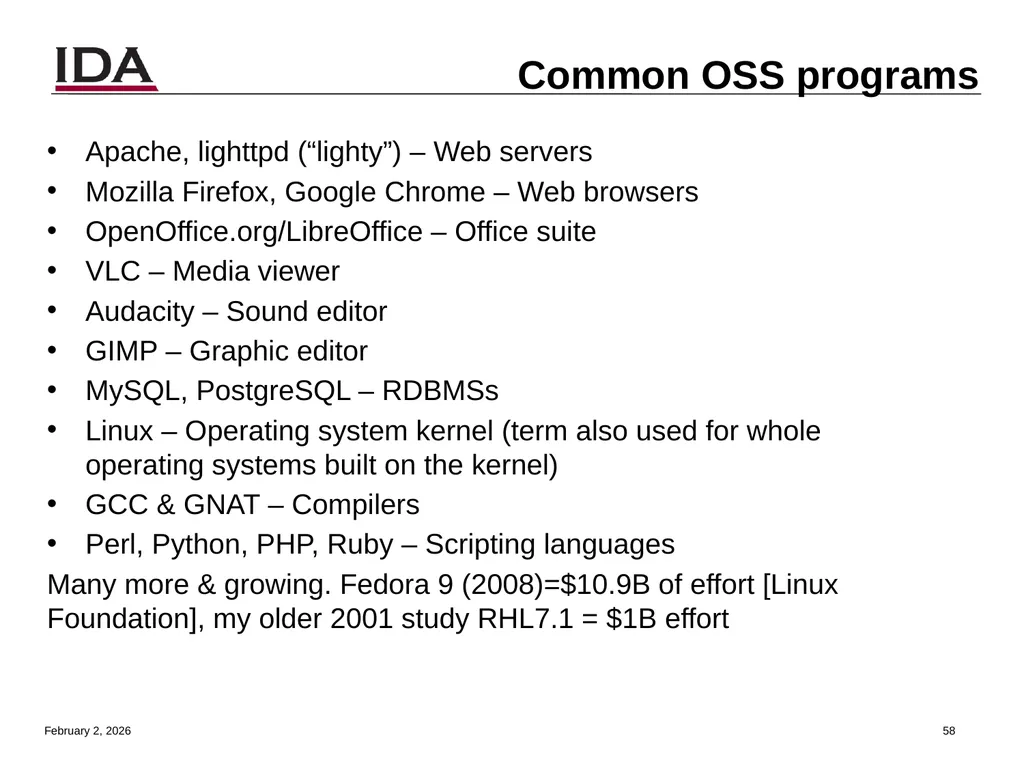
Common OSS programs Apache, lighttpd (“lighty”) – Web servers
Mozilla Firefox, Google Chrome – Web browsers
OpenOffice.org/LibreOffice – Office suite
VLC – Media viewer
Audacity – Sound editor
GIMP – Graphic editor
MySQL, PostgreSQL – RDBMSs
Linux – Operating system kernel (term also used for whole operating systems built on the kernel)
GCC & GNAT – Compilers
Perl, Python, PHP, Ruby – Scripting languages
Many more & growing. Fedora 9 (2008)=$10.9B of effort [Linux Foundation], my older 2001 study RHL7.1 = $1B effort 13 August 2013 57<br>
Mozilla Firefox, Google Chrome – Web browsers
OpenOffice.org/LibreOffice – Office suite
VLC – Media viewer
Audacity – Sound editor
GIMP – Graphic editor
MySQL, PostgreSQL – RDBMSs
Linux – Operating system kernel (term also used for whole operating systems built on the kernel)
GCC & GNAT – Compilers
Perl, Python, PHP, Ruby – Scripting languages
Many more & growing. Fedora 9 (2008)=$10.9B of effort [Linux Foundation], my older 2001 study RHL7.1 = $1B effort 13 August 2013 57<br>
59
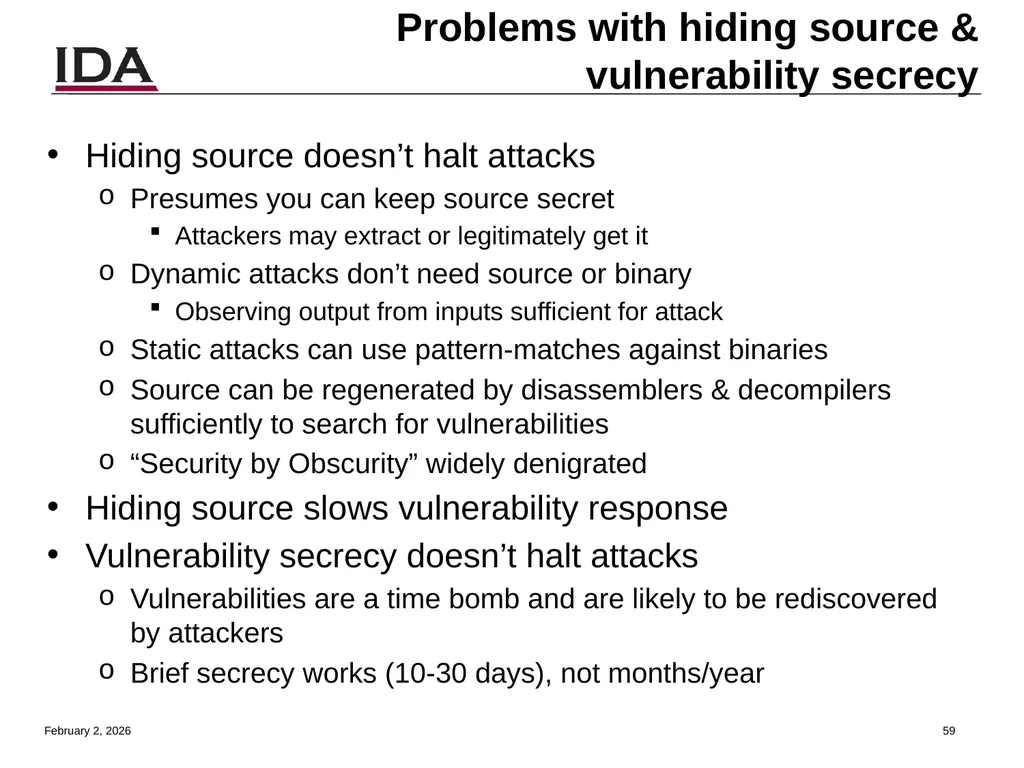
Problems with hiding source & vulnerability secrecy Hiding source doesn’t halt attacks
Presumes you can keep source secret
Attackers may extract or legitimately get it
Dynamic attacks don’t need source or binary
Observing output from inputs sufficient for attack
Static attacks can use pattern-matches against binaries
Source can be regenerated by disassemblers & decompilers sufficiently to search for vulnerabilities
“Security by Obscurity” widely denigrated
Hiding source slows vulnerability response
Vulnerability secrecy doesn’t halt attacks
Vulnerabilities are a time bomb and are likely to be rediscovered by attackers
Brief secrecy works (10-30 days), not months/year 13 August 2013 58<br>
Presumes you can keep source secret
Attackers may extract or legitimately get it
Dynamic attacks don’t need source or binary
Observing output from inputs sufficient for attack
Static attacks can use pattern-matches against binaries
Source can be regenerated by disassemblers & decompilers sufficiently to search for vulnerabilities
“Security by Obscurity” widely denigrated
Hiding source slows vulnerability response
Vulnerability secrecy doesn’t halt attacks
Vulnerabilities are a time bomb and are likely to be rediscovered by attackers
Brief secrecy works (10-30 days), not months/year 13 August 2013 58<br>
60
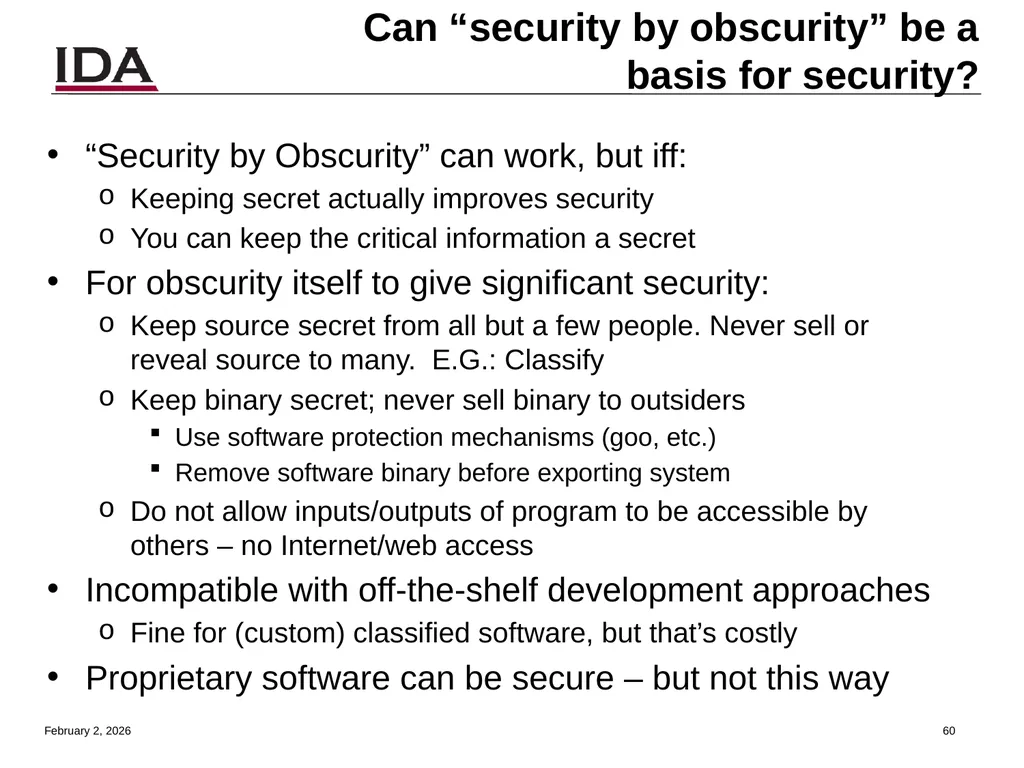
Can “security by obscurity” be a basis for security? “Security by Obscurity” can work, but iff:
Keeping secret actually improves security
You can keep the critical information a secret
For obscurity itself to give significant security:
Keep source secret from all but a few people. Never sell or reveal source to many. E.G.: Classify
Keep binary secret; never sell binary to outsiders
Use software protection mechanisms (goo, etc.)
Remove software binary before exporting system
Do not allow inputs/outputs of program to be accessible by others – no Internet/web access
Incompatible with off-the-shelf development approaches
Fine for (custom) classified software, but that’s costly
Proprietary software can be secure – but not this way 13 August 2013 59<br>
Keeping secret actually improves security
You can keep the critical information a secret
For obscurity itself to give significant security:
Keep source secret from all but a few people. Never sell or reveal source to many. E.G.: Classify
Keep binary secret; never sell binary to outsiders
Use software protection mechanisms (goo, etc.)
Remove software binary before exporting system
Do not allow inputs/outputs of program to be accessible by others – no Internet/web access
Incompatible with off-the-shelf development approaches
Fine for (custom) classified software, but that’s costly
Proprietary software can be secure – but not this way 13 August 2013 59<br>
61
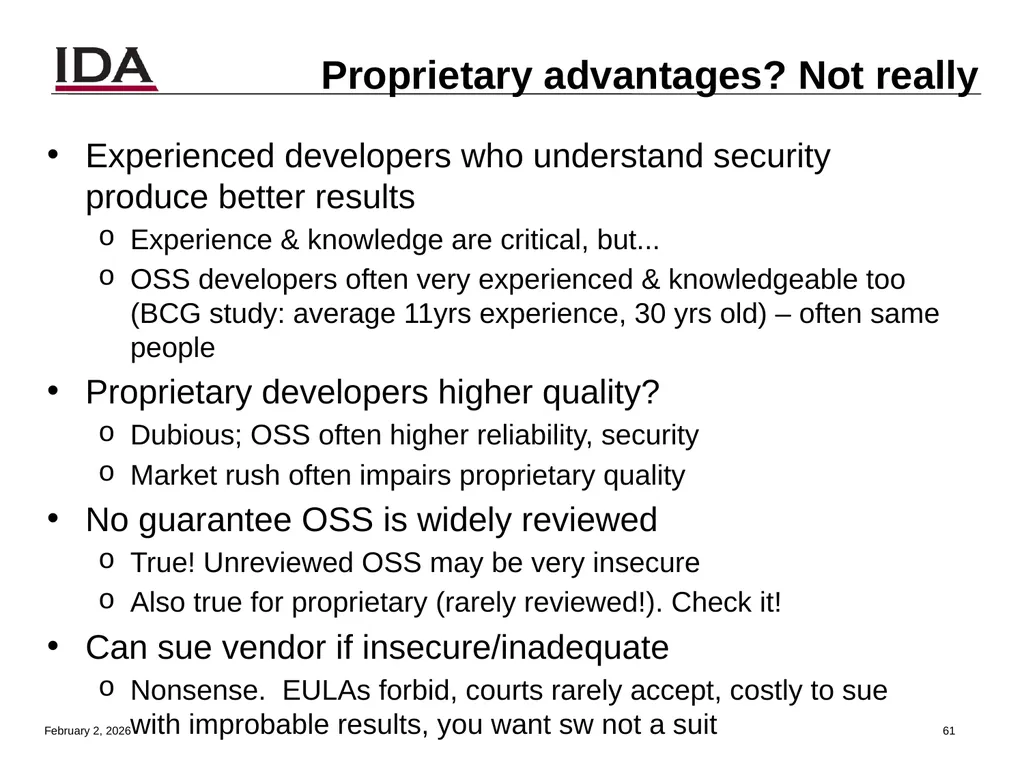
Proprietary advantages? Not really Experienced developers who understand security produce better results
Experience & knowledge are critical, but...
OSS developers often very experienced & knowledgeable too (BCG study: average 11yrs experience, 30 yrs old) – often same people
Proprietary developers higher quality?
Dubious; OSS often higher reliability, security
Market rush often impairs proprietary quality
No guarantee OSS is widely reviewed
True! Unreviewed OSS may be very insecure
Also true for proprietary (rarely reviewed!). Check it!
Can sue vendor if insecure/inadequate
Nonsense. EULAs forbid, courts rarely accept, costly to sue with improbable results, you want sw not a suit 13 August 2013 60<br>
Experience & knowledge are critical, but...
OSS developers often very experienced & knowledgeable too (BCG study: average 11yrs experience, 30 yrs old) – often same people
Proprietary developers higher quality?
Dubious; OSS often higher reliability, security
Market rush often impairs proprietary quality
No guarantee OSS is widely reviewed
True! Unreviewed OSS may be very insecure
Also true for proprietary (rarely reviewed!). Check it!
Can sue vendor if insecure/inadequate
Nonsense. EULAs forbid, courts rarely accept, costly to sue with improbable results, you want sw not a suit 13 August 2013 60<br>
62
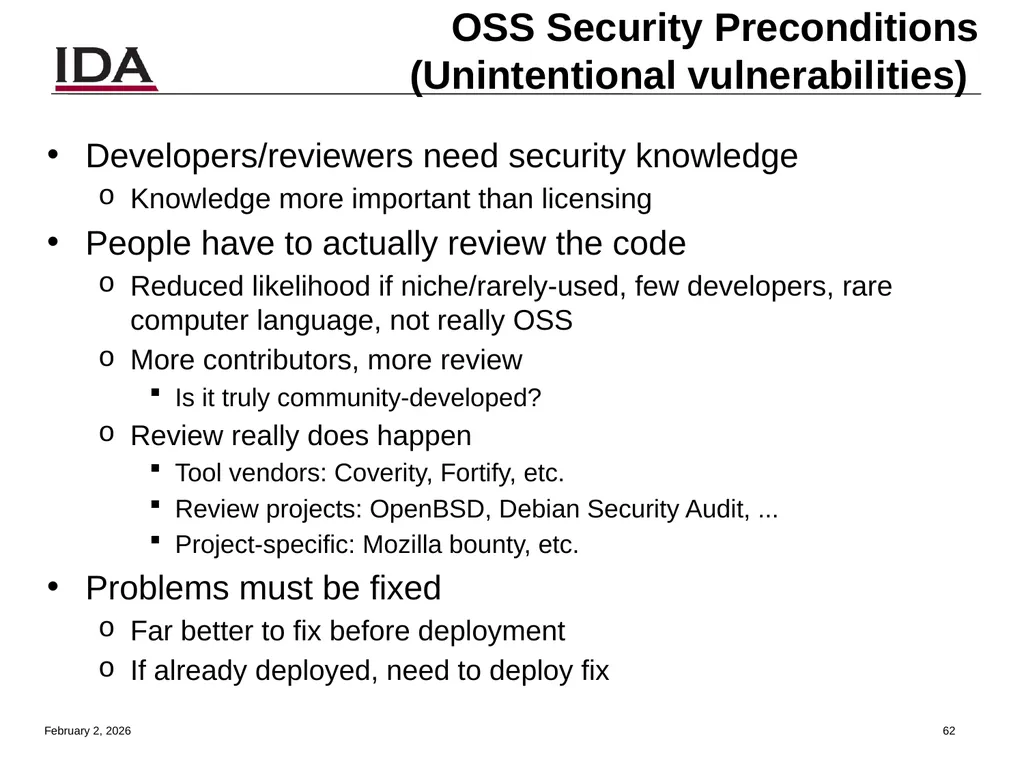
OSS Security Preconditions
(Unintentional vulnerabilities) Developers/reviewers need security knowledge
Knowledge more important than licensing
People have to actually review the code
Reduced likelihood if niche/rarely-used, few developers, rare computer language, not really OSS
More contributors, more review
Is it truly community-developed?
Review really does happen
Tool vendors: Coverity, Fortify, etc.
Review projects: OpenBSD, Debian Security Audit, ...
Project-specific: Mozilla bounty, etc.
Problems must be fixed
Far better to fix before deployment
If already deployed, need to deploy fix 13 August 2013 61<br>
Knowledge more important than licensing
People have to actually review the code
Reduced likelihood if niche/rarely-used, few developers, rare computer language, not really OSS
More contributors, more review
Is it truly community-developed?
Review really does happen
Tool vendors: Coverity, Fortify, etc.
Review projects: OpenBSD, Debian Security Audit, ...
Project-specific: Mozilla bounty, etc.
Problems must be fixed
Far better to fix before deployment
If already deployed, need to deploy fix 13 August 2013 61<br>
63
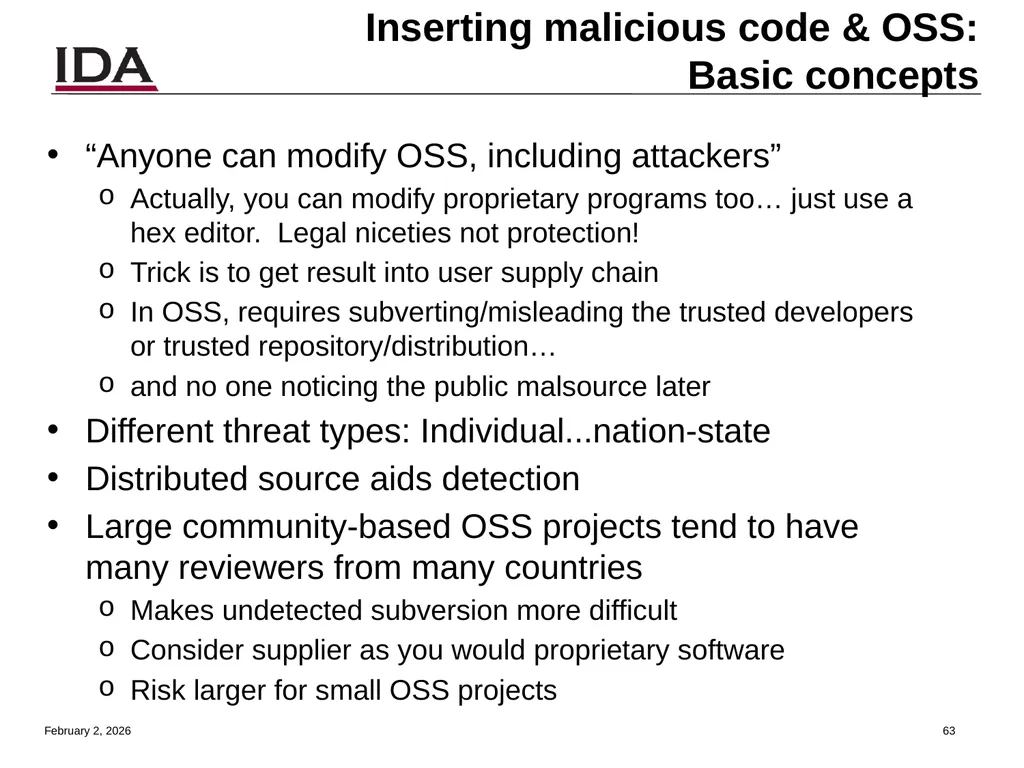
Inserting malicious code & OSS: Basic concepts “Anyone can modify OSS, including attackers”
Actually, you can modify proprietary programs too… just use a hex editor. Legal niceties not protection!
Trick is to get result into user supply chain
In OSS, requires subverting/misleading the trusted developers or trusted repository/distribution…
and no one noticing the public malsource later
Different threat types: Individual...nation-state
Distributed source aids detection
Large community-based OSS projects tend to have many reviewers from many countries
Makes undetected subversion more difficult
Consider supplier as you would proprietary software
Risk larger for small OSS projects 13 August 2013 62<br>
Actually, you can modify proprietary programs too… just use a hex editor. Legal niceties not protection!
Trick is to get result into user supply chain
In OSS, requires subverting/misleading the trusted developers or trusted repository/distribution…
and no one noticing the public malsource later
Different threat types: Individual...nation-state
Distributed source aids detection
Large community-based OSS projects tend to have many reviewers from many countries
Makes undetected subversion more difficult
Consider supplier as you would proprietary software
Risk larger for small OSS projects 13 August 2013 62<br>
64
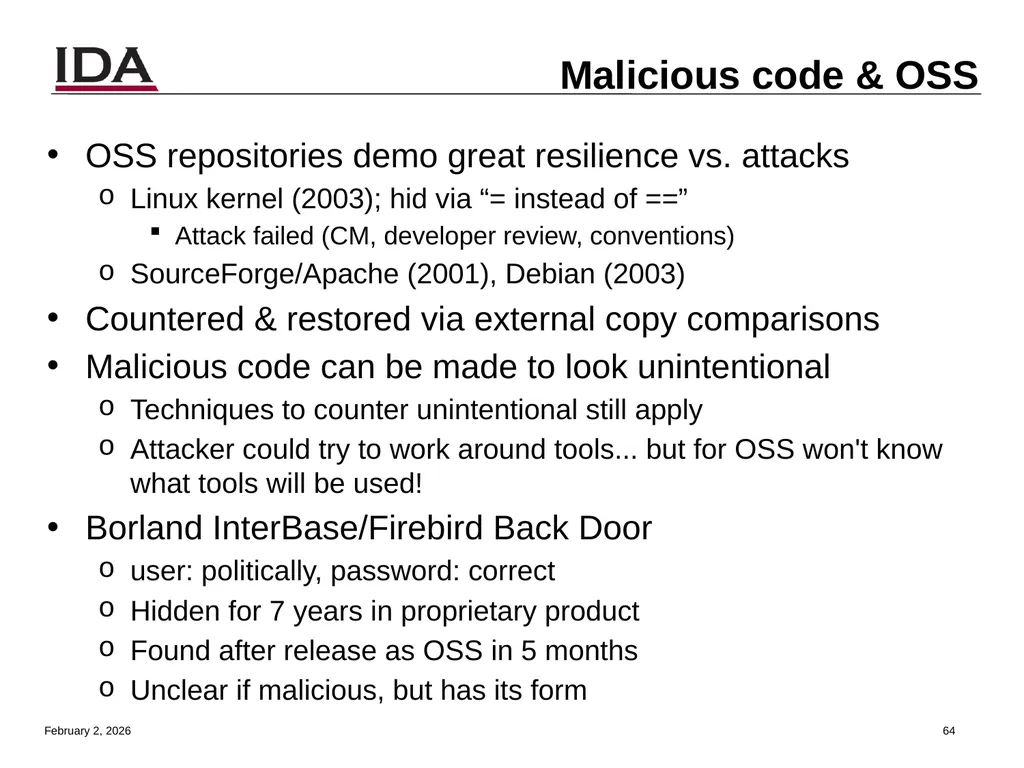
Malicious code & OSS OSS repositories demo great resilience vs. attacks
Linux kernel (2003); hid via “= instead of ==”
Attack failed (CM, developer review, conventions)
SourceForge/Apache (2001), Debian (2003)
Countered & restored via external copy comparisons
Malicious code can be made to look unintentional
Techniques to counter unintentional still apply
Attacker could try to work around tools... but for OSS won't know what tools will be used!
Borland InterBase/Firebird Back Door
user: politically, password: correct
Hidden for 7 years in proprietary product
Found after release as OSS in 5 months
Unclear if malicious, but has its form 13 August 2013 63<br>
Linux kernel (2003); hid via “= instead of ==”
Attack failed (CM, developer review, conventions)
SourceForge/Apache (2001), Debian (2003)
Countered & restored via external copy comparisons
Malicious code can be made to look unintentional
Techniques to counter unintentional still apply
Attacker could try to work around tools... but for OSS won't know what tools will be used!
Borland InterBase/Firebird Back Door
user: politically, password: correct
Hidden for 7 years in proprietary product
Found after release as OSS in 5 months
Unclear if malicious, but has its form 13 August 2013 63<br>
65
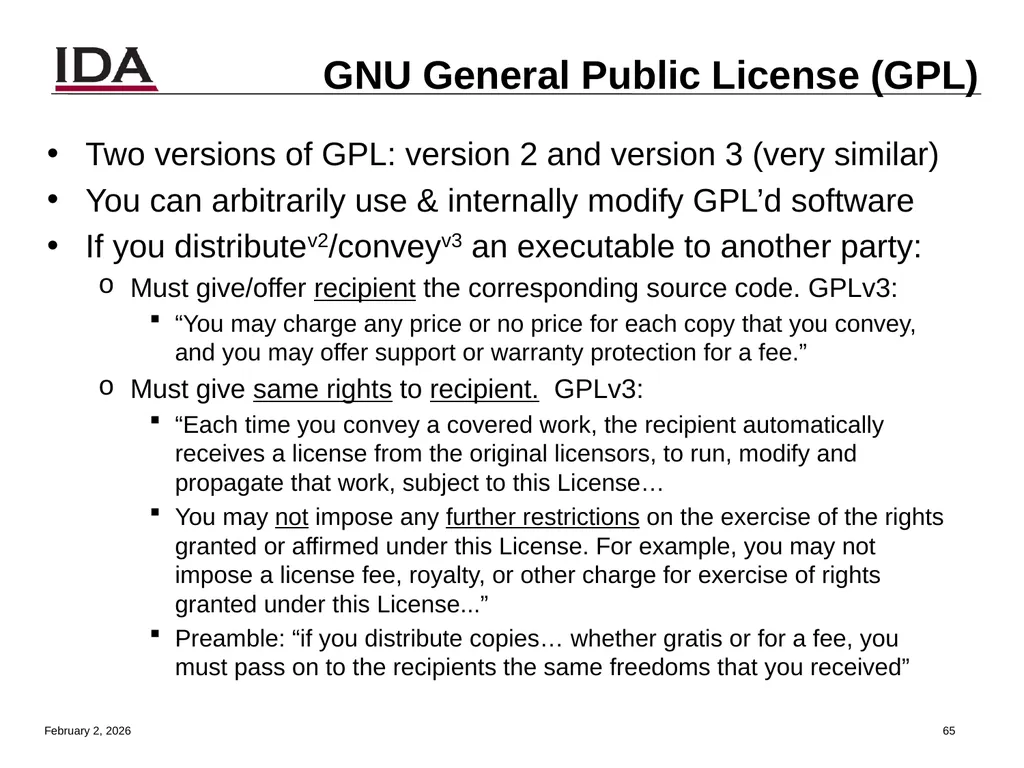
GNU General Public License (GPL) Two versions of GPL: version 2 and version 3 (very similar)
You can arbitrarily use & internally modify GPL’d software
If you distributev2/conveyv3 an executable to another party:
Must give/offer recipient the corresponding source code. GPLv3:
“You may charge any price or no price for each copy that you convey, and you may offer support or warranty protection for a fee.”
Must give same rights to recipient. GPLv3:
“Each time you convey a covered work, the recipient automatically receives a license from the original licensors, to run, modify and propagate that work, subject to this License…
You may not impose any further restrictions on the exercise of the rights granted or affirmed under this License. For example, you may not impose a license fee, royalty, or other charge for exercise of rights granted under this License...”
Preamble: “if you distribute copies… whether gratis or for a fee, you must pass on to the recipients the same freedoms that you received” 13 August 2013 64<br>
You can arbitrarily use & internally modify GPL’d software
If you distributev2/conveyv3 an executable to another party:
Must give/offer recipient the corresponding source code. GPLv3:
“You may charge any price or no price for each copy that you convey, and you may offer support or warranty protection for a fee.”
Must give same rights to recipient. GPLv3:
“Each time you convey a covered work, the recipient automatically receives a license from the original licensors, to run, modify and propagate that work, subject to this License…
You may not impose any further restrictions on the exercise of the rights granted or affirmed under this License. For example, you may not impose a license fee, royalty, or other charge for exercise of rights granted under this License...”
Preamble: “if you distribute copies… whether gratis or for a fee, you must pass on to the recipients the same freedoms that you received” 13 August 2013 64<br>
66
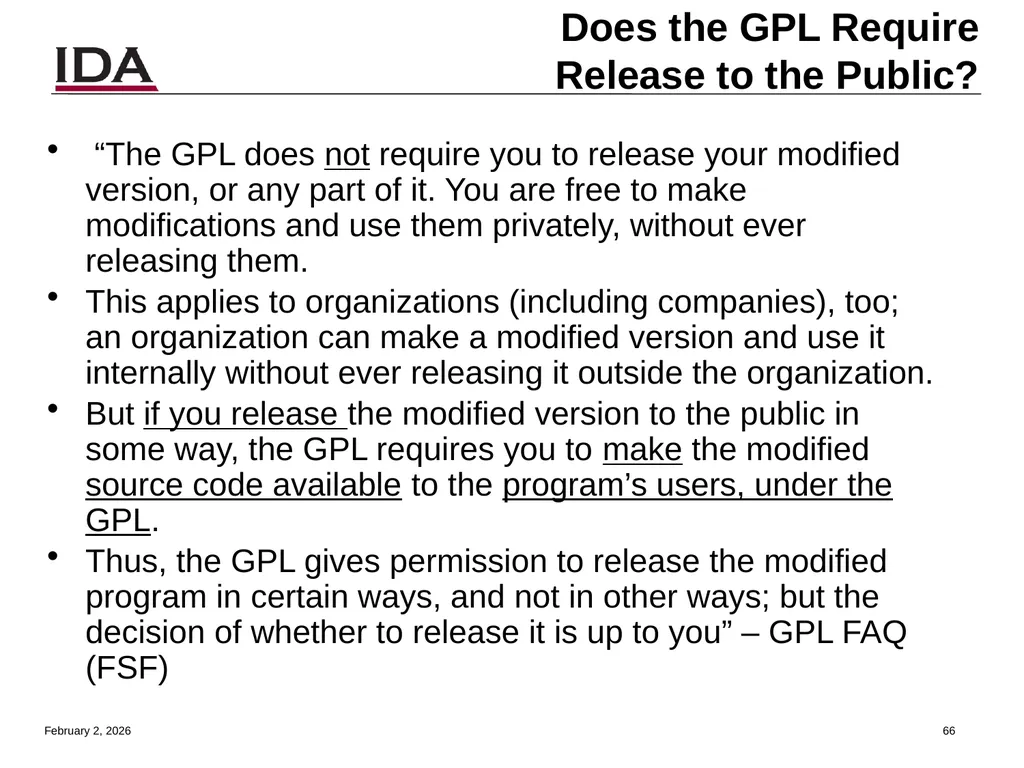
Does the GPL Require
Release to the Public? “The GPL does not require you to release your modified version, or any part of it. You are free to make modifications and use them privately, without ever releasing them.
This applies to organizations (including companies), too; an organization can make a modified version and use it internally without ever releasing it outside the organization.
But if you release the modified version to the public in some way, the GPL requires you to make the modified source code available to the program’s users, under the GPL.
Thus, the GPL gives permission to release the modified program in certain ways, and not in other ways; but the decision of whether to release it is up to you” – GPL FAQ (FSF) 13 August 2013 65<br>
This applies to organizations (including companies), too; an organization can make a modified version and use it internally without ever releasing it outside the organization.
But if you release the modified version to the public in some way, the GPL requires you to make the modified source code available to the program’s users, under the GPL.
Thus, the GPL gives permission to release the modified program in certain ways, and not in other ways; but the decision of whether to release it is up to you” – GPL FAQ (FSF) 13 August 2013 65<br>
67
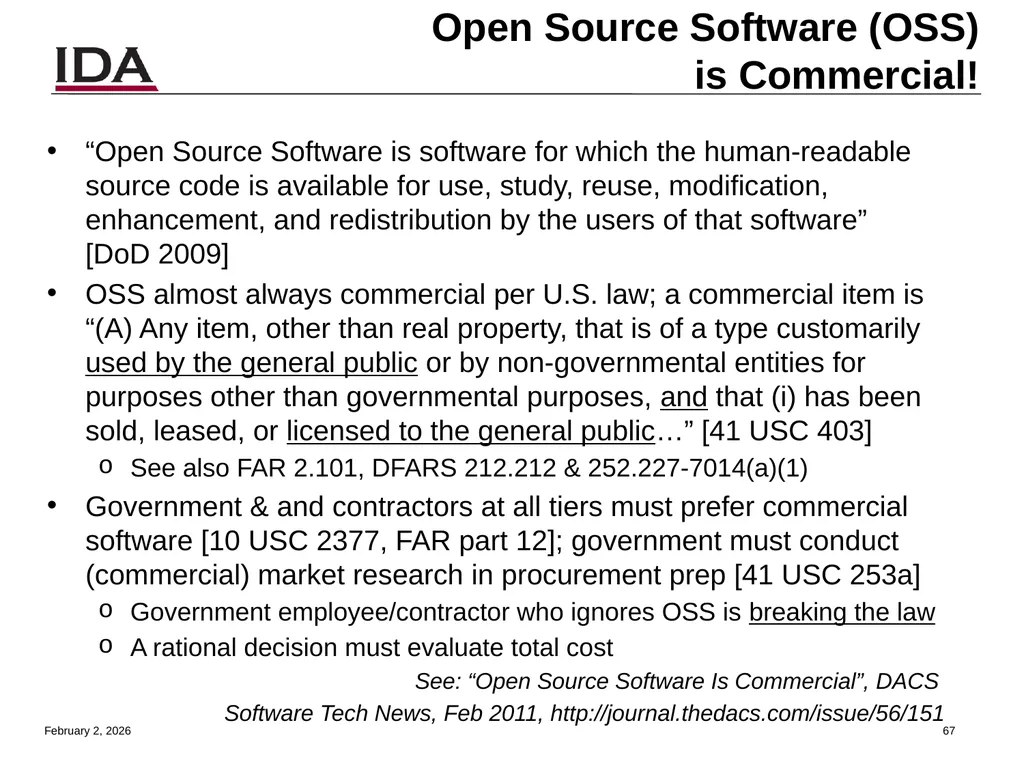
Open Source Software (OSS)
is Commercial! “Open Source Software is software for which the human-readable source code is available for use, study, reuse, modification, enhancement, and redistribution by the users of that software” [DoD 2009]
OSS almost always commercial per U.S. law; a commercial item is “(A) Any item, other than real property, that is of a type customarily used by the general public or by non-governmental entities for purposes other than governmental purposes, and that (i) has been sold, leased, or licensed to the general public…” [41 USC 403]
See also FAR 2.101, DFARS 212.212 & 252.227-7014(a)(1)
Government & and contractors at all tiers must prefer commercial software [10 USC 2377, FAR part 12]; government must conduct (commercial) market research in procurement prep [41 USC 253a]
Government employee/contractor who ignores OSS is breaking the law
A rational decision must evaluate total cost
See: “Open Source Software Is Commercial”, DACS
Software Tech News, Feb 2011, http://journal.thedacs.com/issue/56/151 13 August 2013 66<br>
OSS almost always commercial per U.S. law; a commercial item is “(A) Any item, other than real property, that is of a type customarily used by the general public or by non-governmental entities for purposes other than governmental purposes, and that (i) has been sold, leased, or licensed to the general public…” [41 USC 403]
See also FAR 2.101, DFARS 212.212 & 252.227-7014(a)(1)
Government & and contractors at all tiers must prefer commercial software [10 USC 2377, FAR part 12]; government must conduct (commercial) market research in procurement prep [41 USC 253a]
Government employee/contractor who ignores OSS is breaking the law
A rational decision must evaluate total cost
See: “Open Source Software Is Commercial”, DACS
Software Tech News, Feb 2011, http://journal.thedacs.com/issue/56/151 13 August 2013 66<br>
68
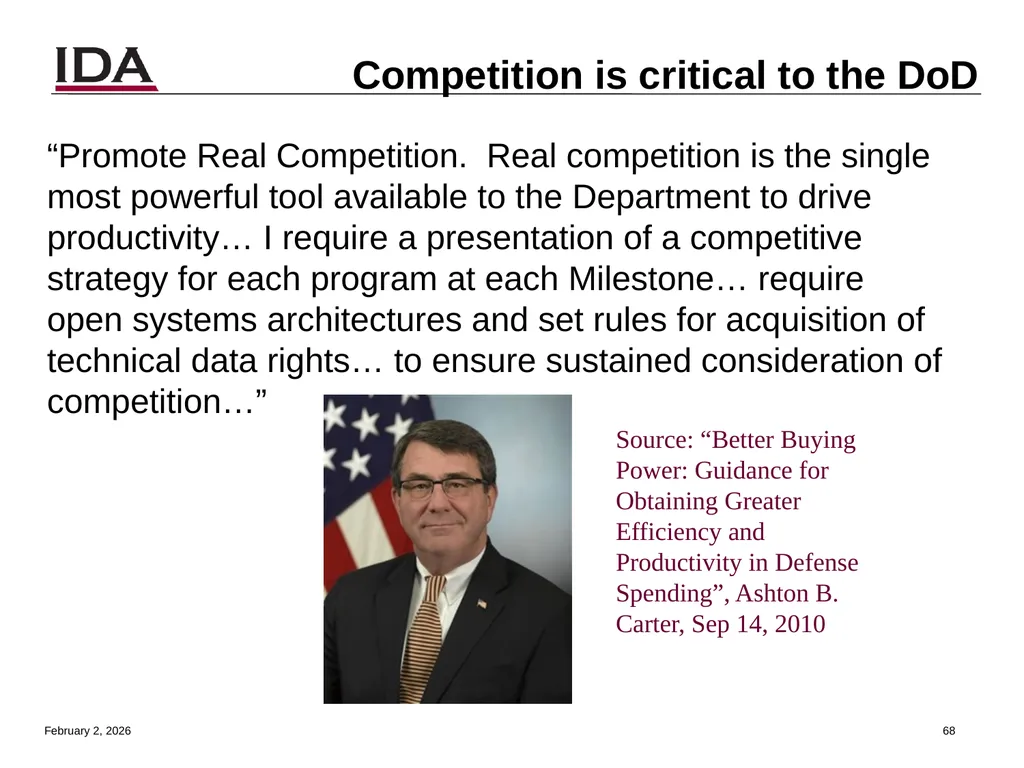
Competition is critical to the DoD “Promote Real Competition. Real competition is the single most powerful tool available to the Department to drive productivity… I require a presentation of a competitive strategy for each program at each Milestone… require open systems architectures and set rules for acquisition of technical data rights… to ensure sustained consideration of competition…” 13 August 2013 67 Source: “Better Buying Power: Guidance for Obtaining Greater Efficiency and Productivity in Defense Spending”, Ashton B. Carter, Sep 14, 2010<br>
69
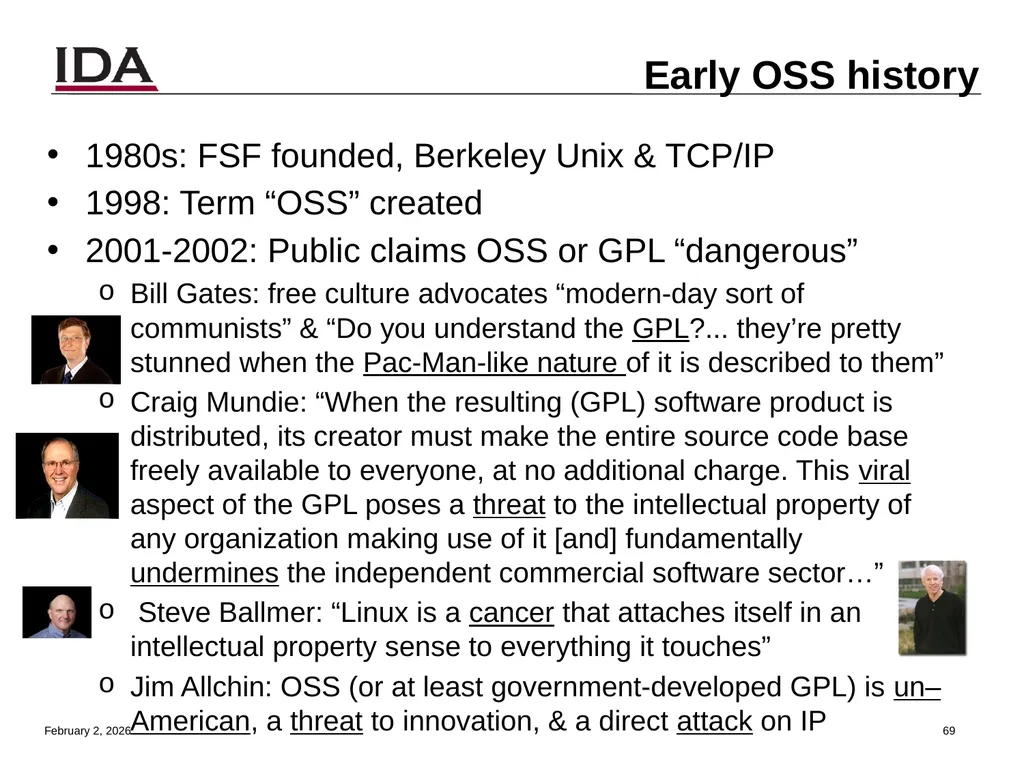
Early OSS history 1980s: FSF founded, Berkeley Unix & TCP/IP
1998: Term “OSS” created
2001-2002: Public claims OSS or GPL “dangerous”
Bill Gates: free culture advocates “modern-day sort of communists” & “Do you understand the GPL?... they’re pretty stunned when the Pac-Man-like nature of it is described to them”
Craig Mundie: “When the resulting (GPL) software product is distributed, its creator must make the entire source code base freely available to everyone, at no additional charge. This viral aspect of the GPL poses a threat to the intellectual property of any organization making use of it [and] fundamentally undermines the independent commercial software sector…”
Steve Ballmer: “Linux is a cancer that attaches itself in an intellectual property sense to everything it touches”
Jim Allchin: OSS (or at least government-developed GPL) is un‒American, a threat to innovation, & a direct attack on IP 13 August 2013 68<br>
1998: Term “OSS” created
2001-2002: Public claims OSS or GPL “dangerous”
Bill Gates: free culture advocates “modern-day sort of communists” & “Do you understand the GPL?... they’re pretty stunned when the Pac-Man-like nature of it is described to them”
Craig Mundie: “When the resulting (GPL) software product is distributed, its creator must make the entire source code base freely available to everyone, at no additional charge. This viral aspect of the GPL poses a threat to the intellectual property of any organization making use of it [and] fundamentally undermines the independent commercial software sector…”
Steve Ballmer: “Linux is a cancer that attaches itself in an intellectual property sense to everything it touches”
Jim Allchin: OSS (or at least government-developed GPL) is un‒American, a threat to innovation, & a direct attack on IP 13 August 2013 68<br>
70
History of OSS in DoD Jan 2003: MITRE study “Use of FOSS in DoD” released
OSS already in wide use!
May 2003: DoD OSS policy memo
July 2004: OMB memo “Software Acquisition”
Apr 2006: OTD Roadmap
June 2007: Navy “OSS Guidance” (OSS = commercial)
Oct 2009: Updated DoD policy memo, + FAQ
May 2011: Open Technology Development (OTD): Lessons Learned & Best Practices for Military Software
Oct 2011: Updated “Application Security & Development Security Technical Implementation Guide (STIG)” 13 August 2013 69<br>
OSS already in wide use!
May 2003: DoD OSS policy memo
July 2004: OMB memo “Software Acquisition”
Apr 2006: OTD Roadmap
June 2007: Navy “OSS Guidance” (OSS = commercial)
Oct 2009: Updated DoD policy memo, + FAQ
May 2011: Open Technology Development (OTD): Lessons Learned & Best Practices for Military Software
Oct 2011: Updated “Application Security & Development Security Technical Implementation Guide (STIG)” 13 August 2013 69<br>
71
MITRE 2003 study “The main conclusion of the analysis was that FOSS software plays a more critical role in the DoD than has generally been recognized. FOSS applications are most important in four broad areas:”
Infrastructure Support: “banning FOSS products would… result in a significant short-term cost spike… no evidence [of] benefits”
Software Development: Alternatives often costly or none exist
Security: Security depends on FOSS, see next slide
Research: “DoD research would [be] seriously damaged by a ban on FOSS… [it extends] limited budgets… provides resources [with] no equivalent commercial alternatives… [and] provides a form of ‘active publishing’ that researchers use to share not just printed results, but software that can be immediately used to support further work”
“Neither the survey nor the analysis supports the premise that banning or seriously restricting FOSS would benefit DoD security or defensive capabilities. To the contrary, the combination of an ambiguous status and largely ungrounded fears that it cannot be used with other types of software are keeping FOSS from reaching optimal levels of use.” 13 August 2013 70<br>
Infrastructure Support: “banning FOSS products would… result in a significant short-term cost spike… no evidence [of] benefits”
Software Development: Alternatives often costly or none exist
Security: Security depends on FOSS, see next slide
Research: “DoD research would [be] seriously damaged by a ban on FOSS… [it extends] limited budgets… provides resources [with] no equivalent commercial alternatives… [and] provides a form of ‘active publishing’ that researchers use to share not just printed results, but software that can be immediately used to support further work”
“Neither the survey nor the analysis supports the premise that banning or seriously restricting FOSS would benefit DoD security or defensive capabilities. To the contrary, the combination of an ambiguous status and largely ungrounded fears that it cannot be used with other types of software are keeping FOSS from reaching optimal levels of use.” 13 August 2013 70<br>
72
MITRE 2003 study: Security & OSS “One unexpected result was the degree… Security depends on FOSS. Banning [it would]:
remove certain types of infrastructure components (e.g., OpenBSD) that currently help support network security.
... limit DoD access to—and overall expertise in—the use of powerful FOSS analysis and detection applications that hostile groups could use to help stage cyberattacks.
... remove the demonstrated ability of FOSS applications to be updated rapidly in response to new types of cyberattack.
Taken together, these factors imply that banning FOSS would have immediate, broad, and strongly negative impacts on the ability of many sensitive and security-focused DoD groups to defend against cyberattacks.” - Use of Free and Open Source Software in the US Dept. of Defense (MITRE, sponsored by DISA), Jan. 2, 2003
Later summarized: “In cyberspace, coding is maneuver” - Jim Stogdill; see http://www.slideshare.net/jstogdill/coding-is-maneuver 13 August 2013 71<br>
remove certain types of infrastructure components (e.g., OpenBSD) that currently help support network security.
... limit DoD access to—and overall expertise in—the use of powerful FOSS analysis and detection applications that hostile groups could use to help stage cyberattacks.
... remove the demonstrated ability of FOSS applications to be updated rapidly in response to new types of cyberattack.
Taken together, these factors imply that banning FOSS would have immediate, broad, and strongly negative impacts on the ability of many sensitive and security-focused DoD groups to defend against cyberattacks.” - Use of Free and Open Source Software in the US Dept. of Defense (MITRE, sponsored by DISA), Jan. 2, 2003
Later summarized: “In cyberspace, coding is maneuver” - Jim Stogdill; see http://www.slideshare.net/jstogdill/coding-is-maneuver 13 August 2013 71<br>
73
The magic cookie parable Have a magic cookie!
One will supply all food needs for a whole year, first one $1
but there’s a catch...
Can only eat magic cookies (everything else poisonous afterwards)
There is only one supplier of magic cookies
Think it’ll be $1 next year?
Dependence on single supplier is a security problem
Not attacking suppliers… need suppliers… not dependence on 1
Only a few IT strategies that counter dependency:
Build & control it yourself (expensive!)
Open systems/open standards
Open source software (sometimes confused with open systems)
Combination
[Cookie image by Bob Smith, released under CC Attribution 2.5 license] 13 August 2013 72<br>
One will supply all food needs for a whole year, first one $1
but there’s a catch...
Can only eat magic cookies (everything else poisonous afterwards)
There is only one supplier of magic cookies
Think it’ll be $1 next year?
Dependence on single supplier is a security problem
Not attacking suppliers… need suppliers… not dependence on 1
Only a few IT strategies that counter dependency:
Build & control it yourself (expensive!)
Open systems/open standards
Open source software (sometimes confused with open systems)
Combination
[Cookie image by Bob Smith, released under CC Attribution 2.5 license] 13 August 2013 72<br>
74
Myth: OSS always unreliable
Reality: OSS often very reliable Fuzz studies found OSS apps
significantly more reliable [U Wisconsin]
Proprietary Unix failure rate: 28%,23%
OSS: Slackware Linux 9%, GNU utilities 6%
Windows: 100%; 45% if forbid certain Win32 message formats
IIS web servers >2x downtime of Apache [Syscontrol AG]
Linux kernel TCP/IP had smaller defect density [Reasoning] 13 August 2013 73<br>
Proprietary Unix failure rate: 28%,23%
OSS: Slackware Linux 9%, GNU utilities 6%
Windows: 100%; 45% if forbid certain Win32 message formats
IIS web servers >2x downtime of Apache [Syscontrol AG]
Linux kernel TCP/IP had smaller defect density [Reasoning] 13 August 2013 73<br>
75
Myth: OSS always insecure Extreme claims
“OSS is always more secure”
“Proprietary is always more secure”
Reality: Neither OSS nor proprietary always better
Some specific OSS programs are more secure than their competing proprietary competitors
Include OSS options when acquiring, then evaluate
There is a security principle that gives OSS a potential advantage: “Open design principle”
“The protection mechanism must not depend on attacker ignorance” [Saltzer & Schroeder, 1974/1975]
Assume nothing; evaluate specific products 13 August 2013 74<br>
“OSS is always more secure”
“Proprietary is always more secure”
Reality: Neither OSS nor proprietary always better
Some specific OSS programs are more secure than their competing proprietary competitors
Include OSS options when acquiring, then evaluate
There is a security principle that gives OSS a potential advantage: “Open design principle”
“The protection mechanism must not depend on attacker ignorance” [Saltzer & Schroeder, 1974/1975]
Assume nothing; evaluate specific products 13 August 2013 74<br>
76
A few other myths... Myth: OSS unsupported
Businesses support OSS. Red Hat, Novell, HP, IBM, DMSolutions, SourceLabs, OpenLogic, Carahsoft, ...
Community support often good; 1997 InfoWorld “Best Technical Support” award won by Linux User Community
Myth: Only programmers care about software licenses
Bob Young: “Would you buy a car with the hood welded shut?... We demand the ability to open the hood... because it gives us, the consumer, control over [what] we’ve bought ... [if a dealer] overcharges us, won’t fix the problem... or refuses to install [something, others] would be happy to have our business”
Myth: Developers just (inexperienced) college students
BCG study: Average OSS developer 30yrs old, 11yrs experience
Myth: OSS is no cost
Training, support, transition, etc. are not free-of-cost
Competition often produces lower TCO & higher ROI for OSS 13 August 2013 75<br>
Businesses support OSS. Red Hat, Novell, HP, IBM, DMSolutions, SourceLabs, OpenLogic, Carahsoft, ...
Community support often good; 1997 InfoWorld “Best Technical Support” award won by Linux User Community
Myth: Only programmers care about software licenses
Bob Young: “Would you buy a car with the hood welded shut?... We demand the ability to open the hood... because it gives us, the consumer, control over [what] we’ve bought ... [if a dealer] overcharges us, won’t fix the problem... or refuses to install [something, others] would be happy to have our business”
Myth: Developers just (inexperienced) college students
BCG study: Average OSS developer 30yrs old, 11yrs experience
Myth: OSS is no cost
Training, support, transition, etc. are not free-of-cost
Competition often produces lower TCO & higher ROI for OSS 13 August 2013 75<br>
77
Myth: OSS = Open standards.
Reality: Different, yet compatible Open System = “A system that employs modular design, uses widely supported and consensus based standards for its key interfaces, and has been subjected to successful V&V tests to ensure the openness of its key interfaces”. [DoD OSJTF]
Open systems require open standards
Counter dependency only if competing marketplace of replaceable components. “Standards exist to encourage & enable multiple implementations” [Walli]
Governments widely view open systems as critically necessary
DoD Directive 5000.1: “shall be employed, where feasible”
European Commission – major policy thrust
“guidance needs to focus on open standards”
Greater interoperability & flexibility, lower costs, higher security, ...
Open systems/open standards & open source software:
Work well together; both strategies for reducing dependency
Not the same thing 13 August 2013 76<br>
Open systems require open standards
Counter dependency only if competing marketplace of replaceable components. “Standards exist to encourage & enable multiple implementations” [Walli]
Governments widely view open systems as critically necessary
DoD Directive 5000.1: “shall be employed, where feasible”
European Commission – major policy thrust
“guidance needs to focus on open standards”
Greater interoperability & flexibility, lower costs, higher security, ...
Open systems/open standards & open source software:
Work well together; both strategies for reducing dependency
Not the same thing 13 August 2013 76<br>
78
DFARS 252.227-7018 (June 1995): Small Business Innovation Research (SBIR) 13 August 2013 77<br>
79
DFARS 252.227-7020 (June 1995) “Special works” clause 13 August 2013 78<br>
80
Acronyms (1) BSD: Berkeley Software Distribution
COTS: Commercial Off-the-Shelf (either proprietary or OSS)
DFARS: Defense Federal Acquisition Regulation Supplement
DISR: DoD Information Technology Standards and Profile Registry
DoD: Department of Defense
DoDD: DoD Directive
DoDI: DoD Instruction
EULA: End-User License Agreement
FAR: Federal Acquisition Regulation
FLOSS: Free-libre / Open Source Software
FSF: Free Software Foundation (fsf.org)
GNU: GNU’s not Unix
GOTS: Government Off-The-Shelf (see COTS)
GPL: GNU General Public License
HP: Hewlett-Packard Corporation
IPR: Intellectual Property Rights; use “Intellectual Rights” instead
IT: Information Technology
LGPL: GNU Lesser General Public License 13 August 2013 79<br>
COTS: Commercial Off-the-Shelf (either proprietary or OSS)
DFARS: Defense Federal Acquisition Regulation Supplement
DISR: DoD Information Technology Standards and Profile Registry
DoD: Department of Defense
DoDD: DoD Directive
DoDI: DoD Instruction
EULA: End-User License Agreement
FAR: Federal Acquisition Regulation
FLOSS: Free-libre / Open Source Software
FSF: Free Software Foundation (fsf.org)
GNU: GNU’s not Unix
GOTS: Government Off-The-Shelf (see COTS)
GPL: GNU General Public License
HP: Hewlett-Packard Corporation
IPR: Intellectual Property Rights; use “Intellectual Rights” instead
IT: Information Technology
LGPL: GNU Lesser General Public License 13 August 2013 79<br>
81
Acronyms (2) MIT: Massachusetts Institute of Technology
MPL: Mozilla Public License
NDI: Non-developmental item (see COTS)
OMB: Office of Management & Budget
OSDL: Open Source Development Labs
OSI: Open Source Initiative (opensource.org)
OSJTF: Open Systems Joint Task Force
OSS: Open Source Software
PD: Public Domain
PM: Program Manager
RFP: Request for Proposal
RH: Red Hat, Inc.
ROI: Return on Investment
STIG: Security Technical Implementation Guide
TCO: Total Cost of Ownership
U.S.: United States
USC: U.S. Code
V&V: Verification & Validation
Trademarks belong to the trademark holder. 13 August 2013 80<br>
MPL: Mozilla Public License
NDI: Non-developmental item (see COTS)
OMB: Office of Management & Budget
OSDL: Open Source Development Labs
OSI: Open Source Initiative (opensource.org)
OSJTF: Open Systems Joint Task Force
OSS: Open Source Software
PD: Public Domain
PM: Program Manager
RFP: Request for Proposal
RH: Red Hat, Inc.
ROI: Return on Investment
STIG: Security Technical Implementation Guide
TCO: Total Cost of Ownership
U.S.: United States
USC: U.S. Code
V&V: Verification & Validation
Trademarks belong to the trademark holder. 13 August 2013 80<br>
82
CC-BY-SA This material is released under the Creative Commons CC-BY-SA license 3.0 unported
See http://creativecommons.org/licenses/by-sa/3.0/ 13 August 2013 81<br>
See http://creativecommons.org/licenses/by-sa/3.0/ 13 August 2013 81<br>