04
Objectives By the end of this tutorial you should be able to
Articulate what an introduction is
Know the general parts of an introduction
Know why the first paragraph is important, and how it guides the rest of the introduction
Draft a first paragraph for your introduction Created by Alice Frye, Ph.D., Department of Psychology, University of Massachusetts, Lowell 4<br>
05
What is an Introduction? An introduction may be many different things, depending on the type of writing you are doing
In an empirical paper—a proposal or research paper—an introduction does three things:
Introduces your topic
Reviews the literature of your topic
States your hypotheses or research questions Created by Alice Frye, Ph.D., Department of Psychology, University of Massachusetts, Lowell 5<br>
06
What is an Introduction? Students often ask: What is the difference between an introduction and a literature review?
Answer: The literature review is part of your introduction
It is likely to be the largest, most important part Created by Alice Frye, Ph.D., Department of Psychology, University of Massachusetts, Lowell 6<br>
07
How do you write an introduction? Introductions to research papers in psychology have many formats
In this tutorial you will learn one format
As you go on in research writing, you may modify, change, or completely ignore this format
Or, your instructor may ask you to use a different format
The purpose of presenting this one format is to give you a general starting point Created by Alice Frye, Ph.D., Department of Psychology, University of Massachusetts, Lowell 7<br>
08
The Outline of an Introduction Here is a very broad outline. The slides that follow show how to write the opening paragraph. The other sections are covered in a different tutorial
I. Opening paragraph
II. Review of the literature
III. Summary paragraph and statement of hypotheses or research questions Created by Alice Frye, Ph.D., Department of Psychology, University of Massachusetts, Lowell 8<br>
09
The Opening Paragraph This is a key paragraph
It lets the reader know what to expect
It gives the reader a general roadmap for your paper
It may mention papers you will review in more detail later
For a very long paper it may be more than one paragraph Created by Alice Frye, Ph.D., Department of Psychology, University of Massachusetts, Lowell 9<br>
10
The opening paragraph Includes 5 basic pieces of information, usually in this order:
A statement of the general topic
A general statement about what the literature has found
A statement about what the literature is missing or where there is an unanswered question
The aim of the study
A general statement of the study approach Created by Alice Frye, Ph.D., Department of Psychology, University of Massachusetts, Lowell 10<br>
11
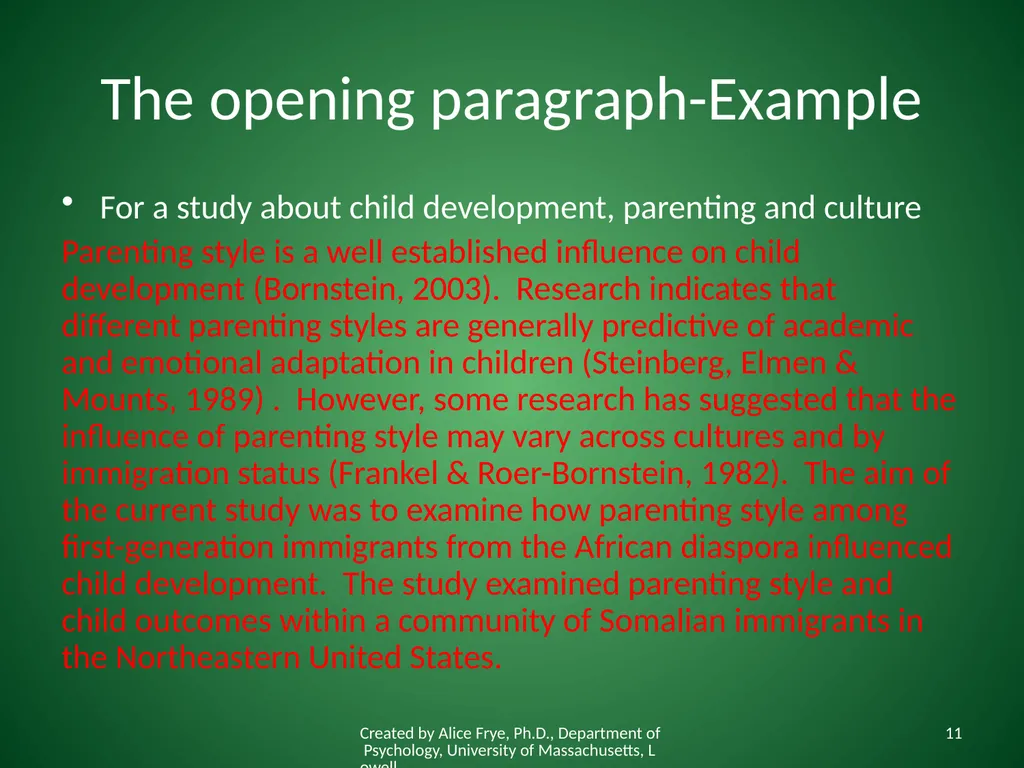
The opening paragraph-Example For a study about child development, parenting and culture
Parenting style is a well established influence on child development (Bornstein, 2003). Research indicates that different parenting styles are generally predictive of academic and emotional adaptation in children (Steinberg, Elmen & Mounts, 1989) . However, some research has suggested that the influence of parenting style may vary across cultures and by immigration status (Frankel & Roer-Bornstein, 1982). The aim of the current study was to examine how parenting style among first-generation immigrants from the African diaspora influenced child development. The study examined parenting style and child outcomes within a community of Somalian immigrants in the Northeastern United States. Created by Alice Frye, Ph.D., Department of Psychology, University of Massachusetts, Lowell 11<br>
12
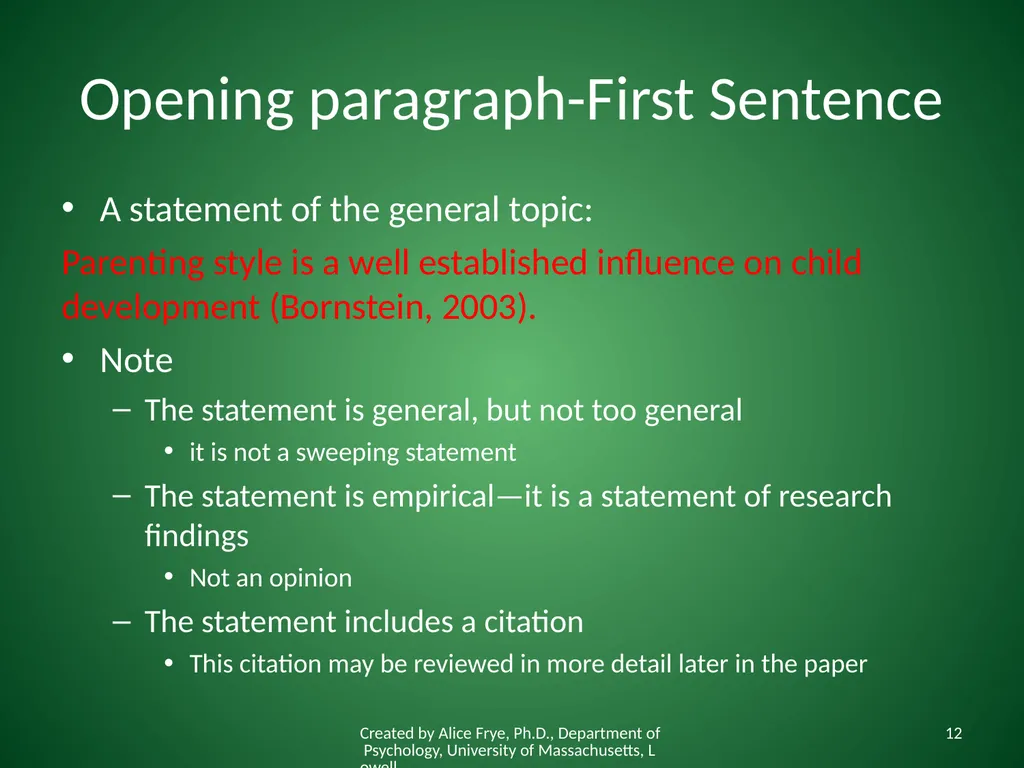
Opening paragraph-First Sentence A statement of the general topic:
Parenting style is a well established influence on child development (Bornstein, 2003).
Note
The statement is general, but not too general
it is not a sweeping statement
The statement is empirical—it is a statement of research findings
Not an opinion
The statement includes a citation
This citation may be reviewed in more detail later in the paper Created by Alice Frye, Ph.D., Department of Psychology, University of Massachusetts, Lowell 12<br>
13
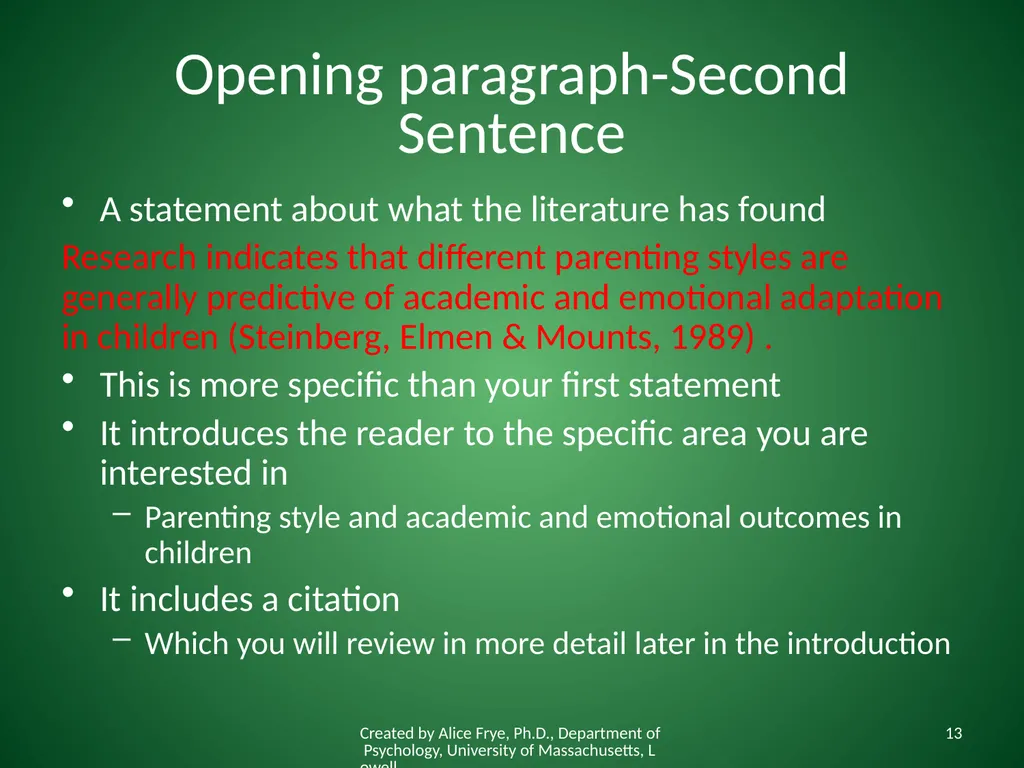
Opening paragraph-Second Sentence A statement about what the literature has found
Research indicates that different parenting styles are generally predictive of academic and emotional adaptation in children (Steinberg, Elmen & Mounts, 1989) .
This is more specific than your first statement
It introduces the reader to the specific area you are interested in
Parenting style and academic and emotional outcomes in children
It includes a citation
Which you will review in more detail later in the introduction Created by Alice Frye, Ph.D., Department of Psychology, University of Massachusetts, Lowell 13<br>
14
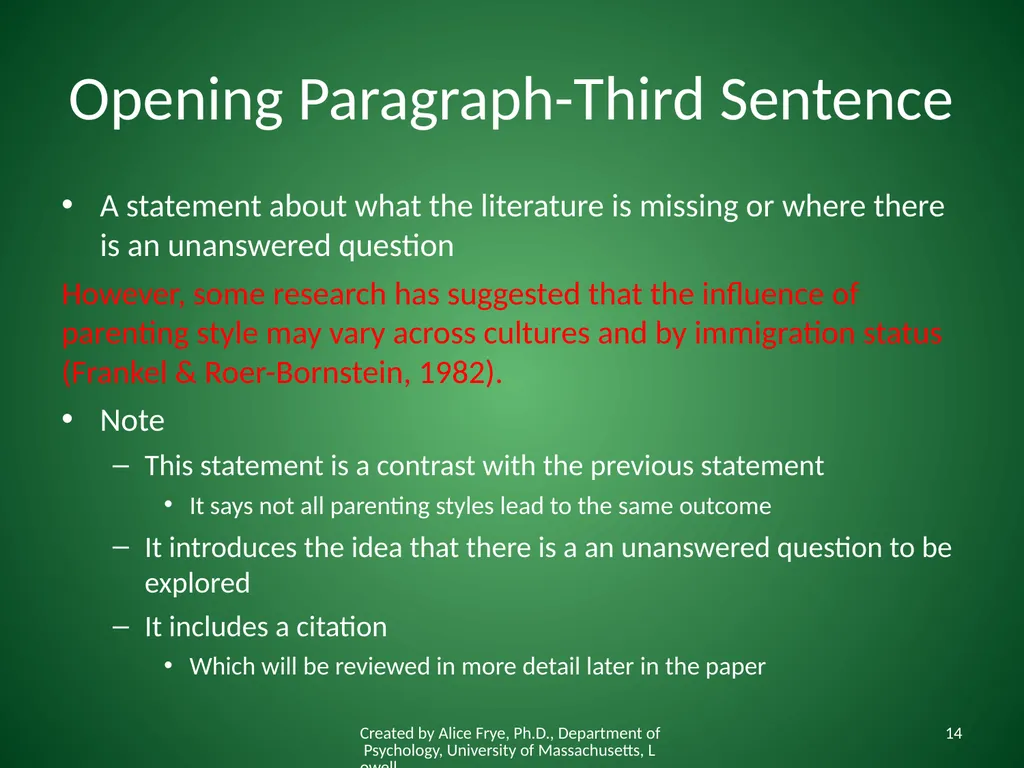
Opening Paragraph-Third Sentence A statement about what the literature is missing or where there is an unanswered question
However, some research has suggested that the influence of parenting style may vary across cultures and by immigration status (Frankel & Roer-Bornstein, 1982).
Note
This statement is a contrast with the previous statement
It says not all parenting styles lead to the same outcome
It introduces the idea that there is a an unanswered question to be explored
It includes a citation
Which will be reviewed in more detail later in the paper Created by Alice Frye, Ph.D., Department of Psychology, University of Massachusetts, Lowell 14<br>
15
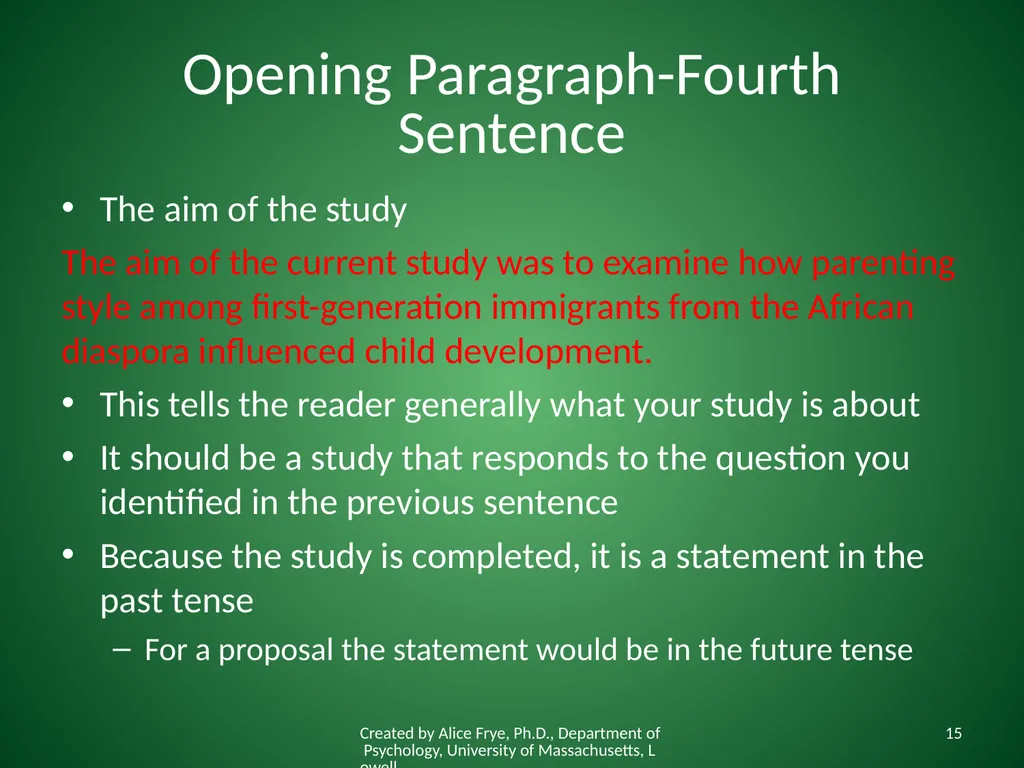
Opening Paragraph-Fourth Sentence The aim of the study
The aim of the current study was to examine how parenting style among first-generation immigrants from the African diaspora influenced child development.
This tells the reader generally what your study is about
It should be a study that responds to the question you identified in the previous sentence
Because the study is completed, it is a statement in the past tense
For a proposal the statement would be in the future tense Created by Alice Frye, Ph.D., Department of Psychology, University of Massachusetts, Lowell 15<br>
16
Opening Paragraph-Fifth Sentence A general statement of the study approach
The study examined parenting style and child outcomes within a community of Somalian immigrants in the Northeastern United States.
This tells the reader just a little about your sample and method
Not too much
Enough so that the reader understands why you review certain types of articles Created by Alice Frye, Ph.D., Department of Psychology, University of Massachusetts, Lowell 16<br>
17
Summary This tutorial presented the definition and purpose of an introduction for an empirical paper or proposal
It presented one format for writing an introduction
It focused on writing the very first paragraph of an introduction
It gave a detailed step by step account of how to write the first paragraph of an introduction Created by Alice Frye, Ph.D., Department of Psychology, University of Massachusetts, Lowell 17<br>