
http://www.acra-ratings.com/ 191; 191; 191 153;
LS
Published · 17 slides · 0 views

1 / 1
Description
http:www.acra-ratings.com 191; 191; 191 153; 38; 115 128; 128; 128 89; 89; 89 38; 38; 38 255; 241; 183 102; 102; 153 166; 166; 166 113; 59; 83 242; 204; 230 Non-Financial Factors Influence on Credit Ratings Analytical Credit Rating
Related Topics
Share
Embed code
Download this presentation From Below
"http://www.acra-ratings.com/ 191; 191; 191 153;" is the property of its rightful owner. Permission is granted to download and print the materials on this website for personal, non-commercial use only, and to display it on your personal computer provided you do not modify the materials and that you retain all copyright notices contained in the materials. By downloading content from our website, you accept the terms of this agreement.
Presentation Transcript
01
http://www.acra-ratings.com/ 191; 191; 191 153; 38; 115 128; 128; 128 89; 89; 89 38; 38; 38 255; 241; 183 102; 102; 153 166; 166; 166 113; 59; 83 242; 204; 230 Non-Financial Factors Influence on Credit Ratings Analytical Credit Rating Agency (ACRA) Symposium “Corporate transparency of Russian companies:
current state and prospects of digitalization”
December 5, Moscow Maxim Khudalov
Senior Director –
Head of the Sustainable Development
Risk Assessment Group<br>
current state and prospects of digitalization”
December 5, Moscow Maxim Khudalov
Senior Director –
Head of the Sustainable Development
Risk Assessment Group<br>
02
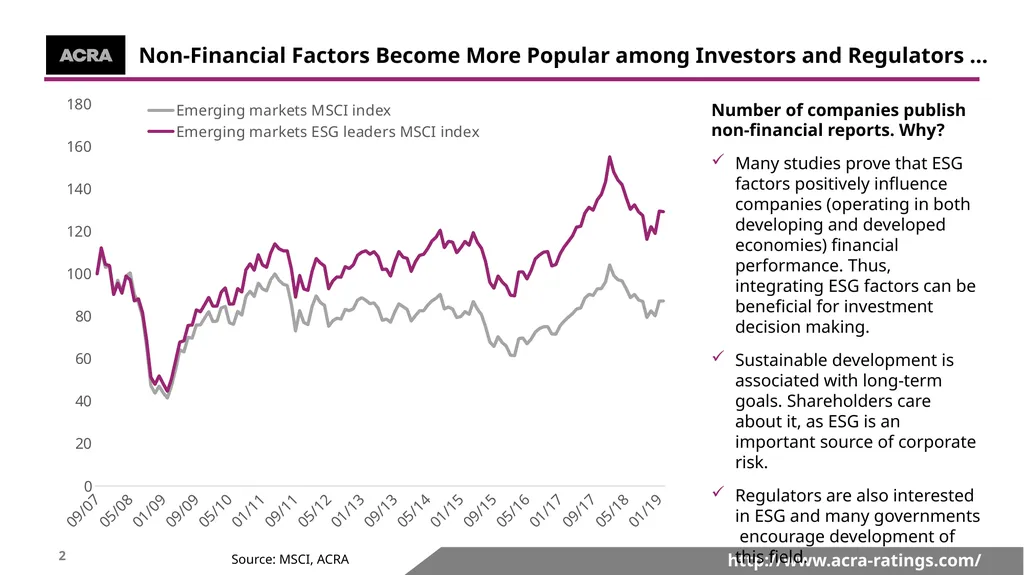
1 http://www.acra-ratings.com/ Non-Financial Factors Become More Popular among Investors and Regulators … Number of companies publish non-financial reports. Why?
Many studies prove that ESG factors positively influence companies (operating in both developing and developed economies) financial performance. Thus, integrating ESG factors can be beneficial for investment decision making.
Sustainable development is associated with long-term goals. Shareholders care about it, as ESG is an important source of corporate risk.
Regulators are also interested in ESG and many governments encourage development of this field. Source: MSCI, ACRA<br>
Many studies prove that ESG factors positively influence companies (operating in both developing and developed economies) financial performance. Thus, integrating ESG factors can be beneficial for investment decision making.
Sustainable development is associated with long-term goals. Shareholders care about it, as ESG is an important source of corporate risk.
Regulators are also interested in ESG and many governments encourage development of this field. Source: MSCI, ACRA<br>
03
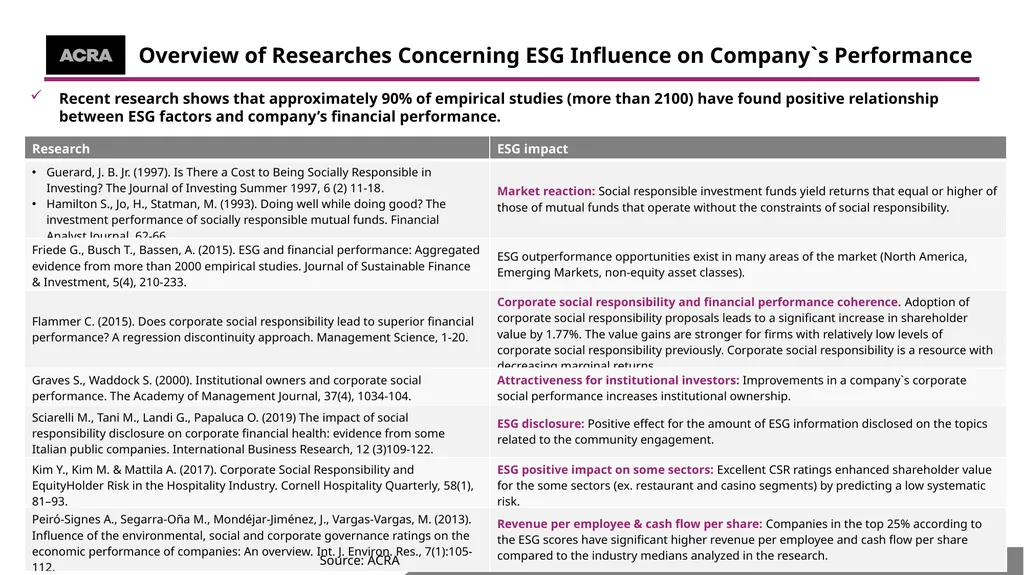
2 http://www.acra-ratings.com/ Overview of Researches Concerning ESG Influence on Company`s Performance Recent research shows that approximately 90% of empirical studies (more than 2100) have found positive relationship between ESG factors and company’s financial performance. Source: ACRA<br>
04
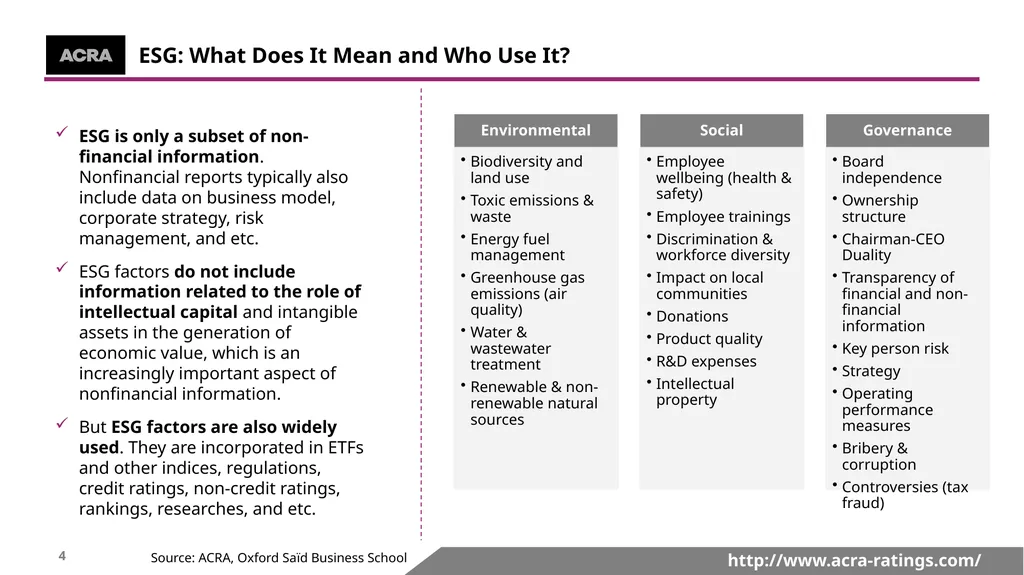
3 http://www.acra-ratings.com/ ESG: What Does It Mean and Who Use It? ESG is only a subset of non-financial information. Nonfinancial reports typically also include data on business model, corporate strategy, risk management, and etc.
ESG factors do not include information related to the role of intellectual capital and intangible assets in the generation of economic value, which is an increasingly important aspect of nonfinancial information.
But ESG factors are also widely used. They are incorporated in ETFs and other indices, regulations, credit ratings, non-credit ratings, rankings, researches, and etc. Source: ACRA, Oxford Saїd Business School<br>
ESG factors do not include information related to the role of intellectual capital and intangible assets in the generation of economic value, which is an increasingly important aspect of nonfinancial information.
But ESG factors are also widely used. They are incorporated in ETFs and other indices, regulations, credit ratings, non-credit ratings, rankings, researches, and etc. Source: ACRA, Oxford Saїd Business School<br>
05
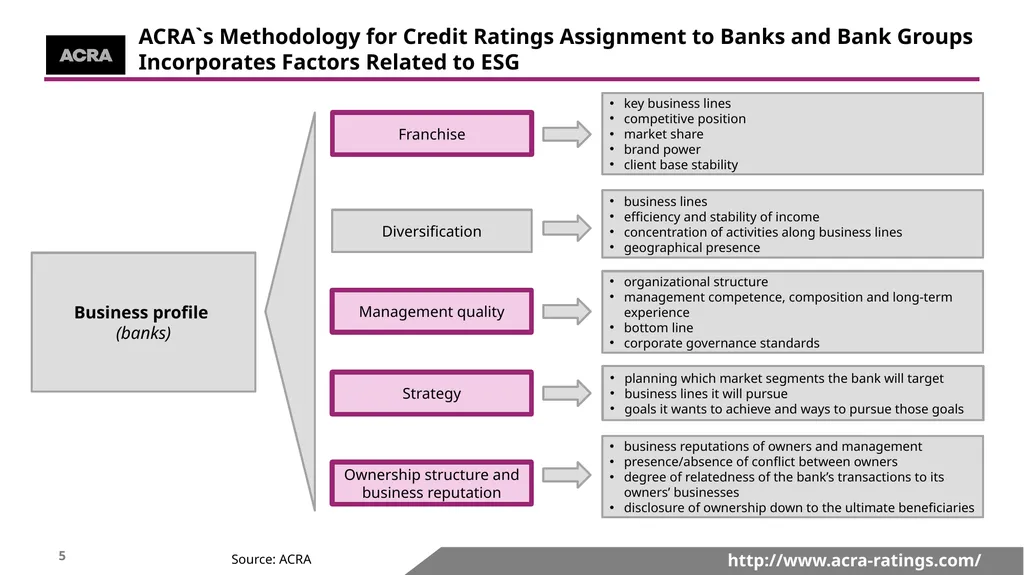
4 http://www.acra-ratings.com/ ACRA`s Methodology for Credit Ratings Assignment to Banks and Bank Groups Incorporates Factors Related to ESG Business profile
(banks) Franchise Diversification Management quality Strategy Ownership structure and business reputation key business lines
competitive position
market share
brand power
client base stability business lines
efficiency and stability of income
concentration of activities along business lines
geographical presence organizational structure
management competence, composition and long-term experience
bottom line
corporate governance standards planning which market segments the bank will target
business lines it will pursue
goals it wants to achieve and ways to pursue those goals business reputations of owners and management
presence/absence of conflict between owners
degree of relatedness of the bank’s transactions to its owners’ businesses
disclosure of ownership down to the ultimate beneficiaries Source: ACRA<br>
(banks) Franchise Diversification Management quality Strategy Ownership structure and business reputation key business lines
competitive position
market share
brand power
client base stability business lines
efficiency and stability of income
concentration of activities along business lines
geographical presence organizational structure
management competence, composition and long-term experience
bottom line
corporate governance standards planning which market segments the bank will target
business lines it will pursue
goals it wants to achieve and ways to pursue those goals business reputations of owners and management
presence/absence of conflict between owners
degree of relatedness of the bank’s transactions to its owners’ businesses
disclosure of ownership down to the ultimate beneficiaries Source: ACRA<br>
06
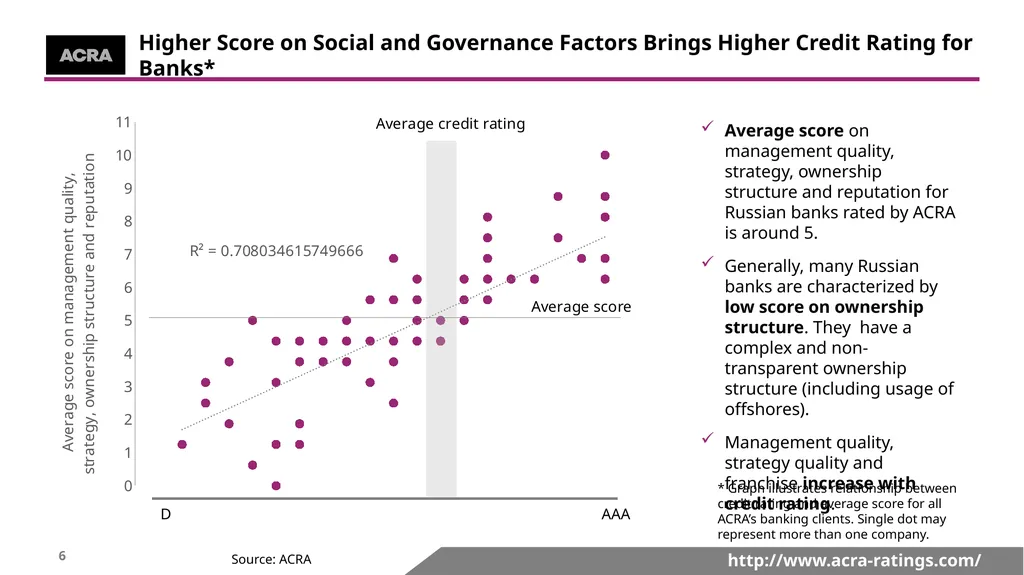
5 http://www.acra-ratings.com/ Higher Score on Social and Governance Factors Brings Higher Credit Rating for Banks* Average credit rating Source: ACRA Average score on management quality, strategy, ownership structure and reputation for Russian banks rated by ACRA is around 5.
Generally, many Russian banks are characterized by low score on ownership structure. They have a complex and non-transparent ownership structure (including usage of offshores).
Management quality, strategy quality and franchise increase with credit rating. * Graph illustrates relationship between credit rating and average score for all ACRA’s banking clients. Single dot may represent more than one company.<br>
Generally, many Russian banks are characterized by low score on ownership structure. They have a complex and non-transparent ownership structure (including usage of offshores).
Management quality, strategy quality and franchise increase with credit rating. * Graph illustrates relationship between credit rating and average score for all ACRA’s banking clients. Single dot may represent more than one company.<br>
07
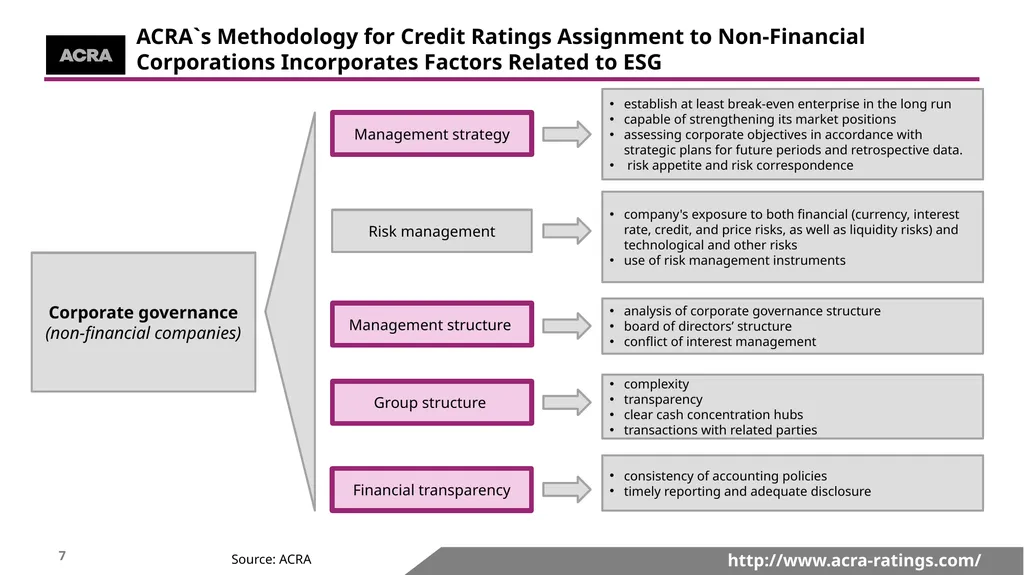
6 http://www.acra-ratings.com/ ACRA`s Methodology for Credit Ratings Assignment to Non-Financial Corporations Incorporates Factors Related to ESG Corporate governance
(non-financial companies) Management strategy Risk management Management structure Group structure Financial transparency establish at least break-even enterprise in the long run
capable of strengthening its market positions
assessing corporate objectives in accordance with strategic plans for future periods and retrospective data.
risk appetite and risk correspondence company's exposure to both financial (currency, interest rate, credit, and price risks, as well as liquidity risks) and technological and other risks
use of risk management instruments analysis of corporate governance structure
board of directors’ structure
conflict of interest management complexity
transparency
clear cash concentration hubs
transactions with related parties consistency of accounting policies
timely reporting and adequate disclosure Source: ACRA<br>
(non-financial companies) Management strategy Risk management Management structure Group structure Financial transparency establish at least break-even enterprise in the long run
capable of strengthening its market positions
assessing corporate objectives in accordance with strategic plans for future periods and retrospective data.
risk appetite and risk correspondence company's exposure to both financial (currency, interest rate, credit, and price risks, as well as liquidity risks) and technological and other risks
use of risk management instruments analysis of corporate governance structure
board of directors’ structure
conflict of interest management complexity
transparency
clear cash concentration hubs
transactions with related parties consistency of accounting policies
timely reporting and adequate disclosure Source: ACRA<br>
08
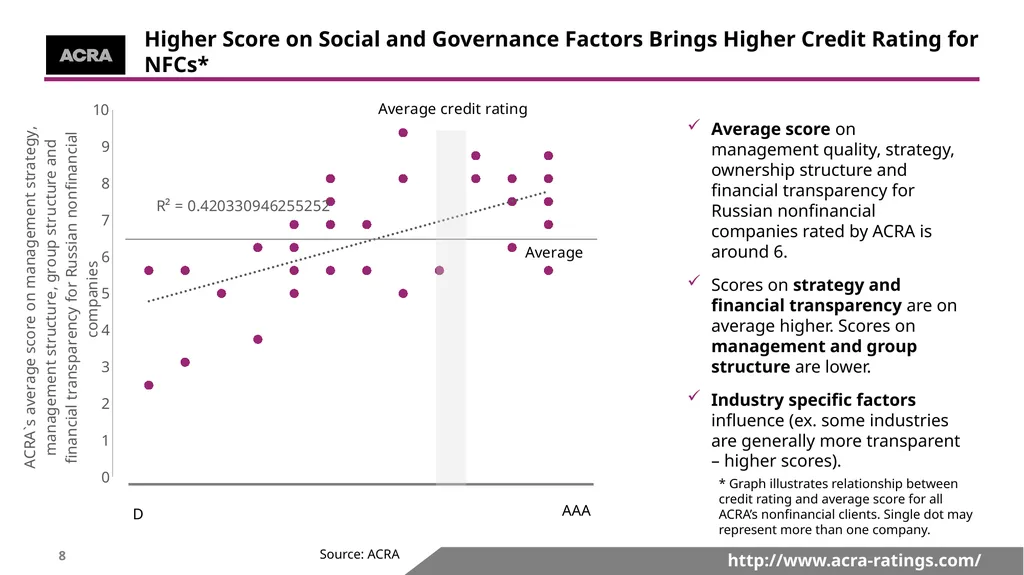
7 http://www.acra-ratings.com/ Higher Score on Social and Governance Factors Brings Higher Credit Rating for NFCs* Source: ACRA D Average score on management quality, strategy, ownership structure and financial transparency for Russian nonfinancial companies rated by ACRA is around 6.
Scores on strategy and financial transparency are on average higher. Scores on management and group structure are lower.
Industry specific factors influence (ex. some industries are generally more transparent – higher scores). * Graph illustrates relationship between credit rating and average score for all ACRA’s nonfinancial clients. Single dot may represent more than one company.<br>
Scores on strategy and financial transparency are on average higher. Scores on management and group structure are lower.
Industry specific factors influence (ex. some industries are generally more transparent – higher scores). * Graph illustrates relationship between credit rating and average score for all ACRA’s nonfinancial clients. Single dot may represent more than one company.<br>
09
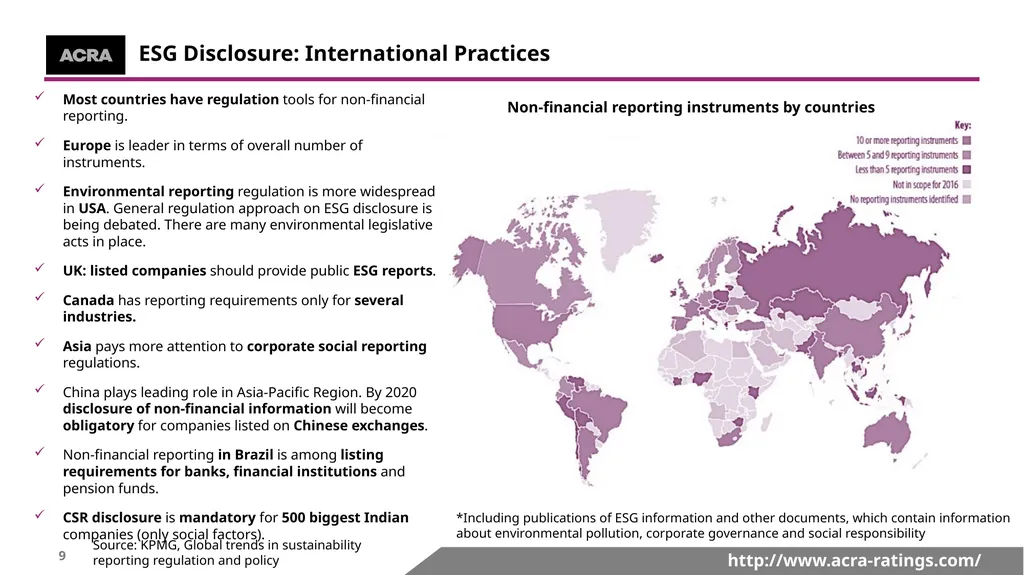
8 http://www.acra-ratings.com/ ESG Disclosure: International Practices Source: KPMG, Global trends in sustainability reporting regulation and policy Non-financial reporting instruments by countries Most countries have regulation tools for non-financial reporting.
Europe is leader in terms of overall number of instruments.
Environmental reporting regulation is more widespread in USA. General regulation approach on ESG disclosure is being debated. There are many environmental legislative acts in place.
UK: listed companies should provide public ESG reports.
Canada has reporting requirements only for several industries.
Asia pays more attention to corporate social reporting regulations.
China plays leading role in Asia-Pacific Region. By 2020 disclosure of non-financial information will become obligatory for companies listed on Chinese exchanges.
Non-financial reporting in Brazil is among listing requirements for banks, financial institutions and pension funds.
CSR disclosure is mandatory for 500 biggest Indian companies (only social factors). *Including publications of ESG information and other documents, which contain information about environmental pollution, corporate governance and social responsibility<br>
Europe is leader in terms of overall number of instruments.
Environmental reporting regulation is more widespread in USA. General regulation approach on ESG disclosure is being debated. There are many environmental legislative acts in place.
UK: listed companies should provide public ESG reports.
Canada has reporting requirements only for several industries.
Asia pays more attention to corporate social reporting regulations.
China plays leading role in Asia-Pacific Region. By 2020 disclosure of non-financial information will become obligatory for companies listed on Chinese exchanges.
Non-financial reporting in Brazil is among listing requirements for banks, financial institutions and pension funds.
CSR disclosure is mandatory for 500 biggest Indian companies (only social factors). *Including publications of ESG information and other documents, which contain information about environmental pollution, corporate governance and social responsibility<br>
10
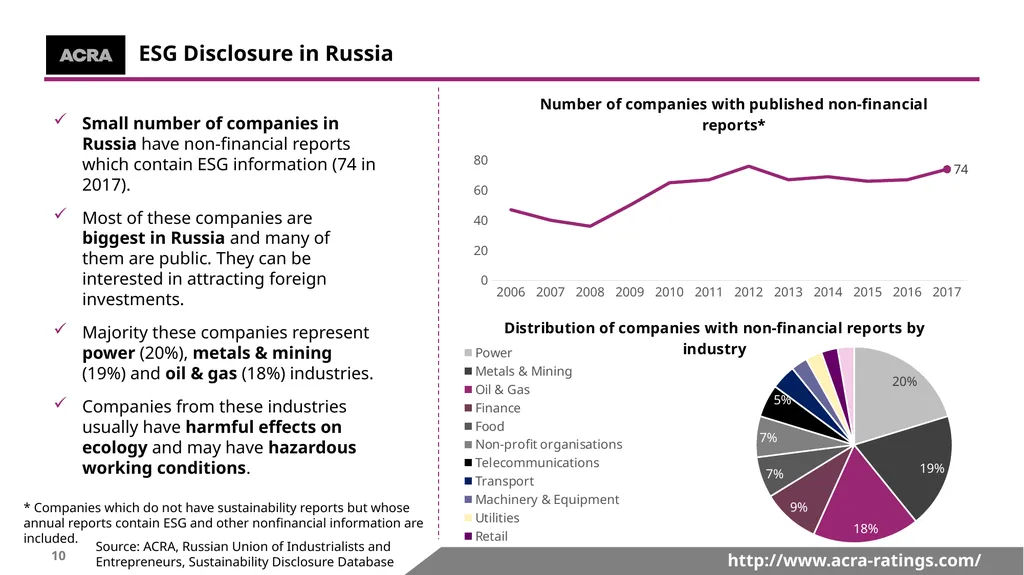
9 http://www.acra-ratings.com/ ESG Disclosure in Russia Source: ACRA, Russian Union of Industrialists and Entrepreneurs, Sustainability Disclosure Database * Companies which do not have sustainability reports but whose annual reports contain ESG and other nonfinancial information are included. Small number of companies in Russia have non-financial reports which contain ESG information (74 in 2017).
Most of these companies are biggest in Russia and many of them are public. They can be interested in attracting foreign investments.
Majority these companies represent power (20%), metals & mining (19%) and oil & gas (18%) industries.
Companies from these industries usually have harmful effects on ecology and may have hazardous working conditions.<br>
Most of these companies are biggest in Russia and many of them are public. They can be interested in attracting foreign investments.
Majority these companies represent power (20%), metals & mining (19%) and oil & gas (18%) industries.
Companies from these industries usually have harmful effects on ecology and may have hazardous working conditions.<br>
11
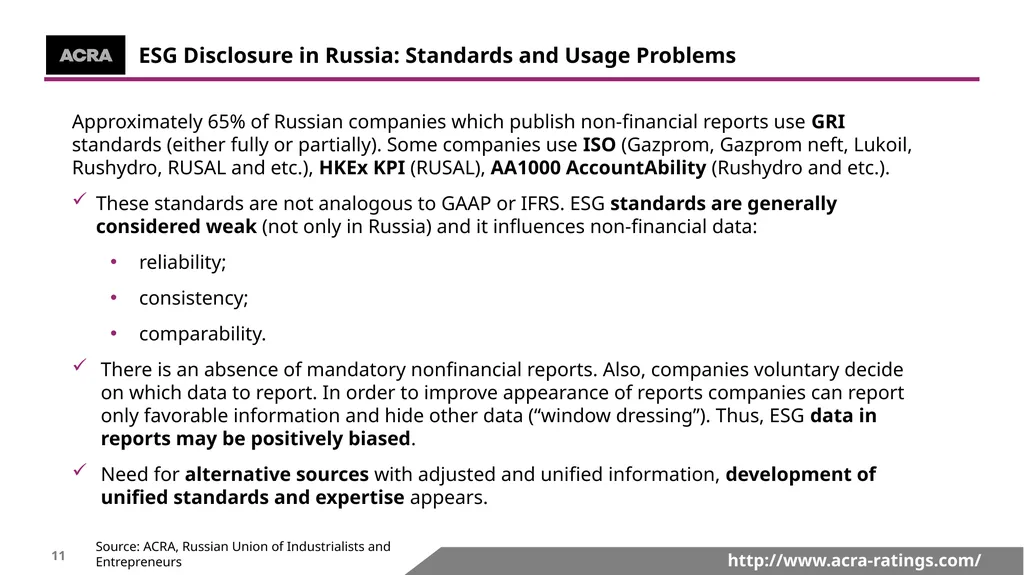
10 http://www.acra-ratings.com/ ESG Disclosure in Russia: Standards and Usage Problems Approximately 65% of Russian companies which publish non-financial reports use GRI standards (either fully or partially). Some companies use ISO (Gazprom, Gazprom neft, Lukoil, Rushydro, RUSAL and etc.), HKEx KPI (RUSAL), AA1000 AccountAbility (Rushydro and etc.).
These standards are not analogous to GAAP or IFRS. ESG standards are generally considered weak (not only in Russia) and it influences non-financial data:
reliability;
consistency;
comparability.
There is an absence of mandatory nonfinancial reports. Also, companies voluntary decide on which data to report. In order to improve appearance of reports companies can report only favorable information and hide other data (“window dressing”). Thus, ESG data in reports may be positively biased.
Need for alternative sources with adjusted and unified information, development of unified standards and expertise appears. Source: ACRA, Russian Union of Industrialists and Entrepreneurs<br>
These standards are not analogous to GAAP or IFRS. ESG standards are generally considered weak (not only in Russia) and it influences non-financial data:
reliability;
consistency;
comparability.
There is an absence of mandatory nonfinancial reports. Also, companies voluntary decide on which data to report. In order to improve appearance of reports companies can report only favorable information and hide other data (“window dressing”). Thus, ESG data in reports may be positively biased.
Need for alternative sources with adjusted and unified information, development of unified standards and expertise appears. Source: ACRA, Russian Union of Industrialists and Entrepreneurs<br>
12
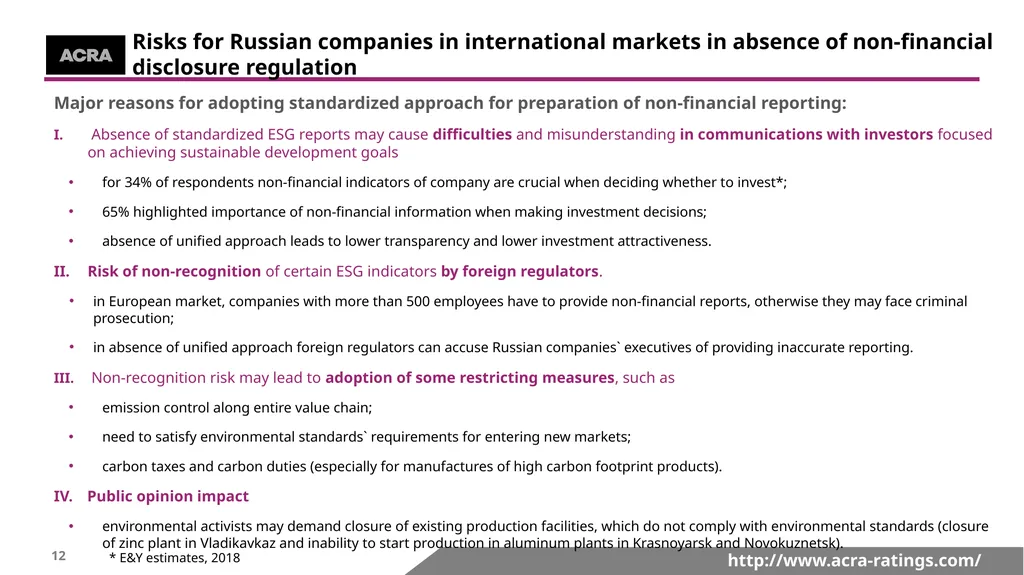
11 http://www.acra-ratings.com/ Risks for Russian companies in international markets in absence of non-financial disclosure regulation * E&Y estimates, 2018 Major reasons for adopting standardized approach for preparation of non-financial reporting:
.Absence of standardized ESG reports may cause difficulties and misunderstanding in communications with investors focused on achieving sustainable development goals
for 34% of respondents non-financial indicators of company are crucial when deciding whether to invest*;
65% highlighted importance of non-financial information when making investment decisions;
absence of unified approach leads to lower transparency and lower investment attractiveness.
Risk of non-recognition of certain ESG indicators by foreign regulators.
in European market, companies with more than 500 employees have to provide non-financial reports, otherwise they may face criminal prosecution;
in absence of unified approach foreign regulators can accuse Russian companies` executives of providing inaccurate reporting.
.Non-recognition risk may lead to adoption of some restricting measures, such as
emission control along entire value chain;
need to satisfy environmental standards` requirements for entering new markets;
carbon taxes and carbon duties (especially for manufactures of high carbon footprint products).
Public opinion impact
environmental activists may demand closure of existing production facilities, which do not comply with environmental standards (closure of zinc plant in Vladikavkaz and inability to start production in aluminum plants in Krasnoyarsk and Novokuznetsk).<br>
.Absence of standardized ESG reports may cause difficulties and misunderstanding in communications with investors focused on achieving sustainable development goals
for 34% of respondents non-financial indicators of company are crucial when deciding whether to invest*;
65% highlighted importance of non-financial information when making investment decisions;
absence of unified approach leads to lower transparency and lower investment attractiveness.
Risk of non-recognition of certain ESG indicators by foreign regulators.
in European market, companies with more than 500 employees have to provide non-financial reports, otherwise they may face criminal prosecution;
in absence of unified approach foreign regulators can accuse Russian companies` executives of providing inaccurate reporting.
.Non-recognition risk may lead to adoption of some restricting measures, such as
emission control along entire value chain;
need to satisfy environmental standards` requirements for entering new markets;
carbon taxes and carbon duties (especially for manufactures of high carbon footprint products).
Public opinion impact
environmental activists may demand closure of existing production facilities, which do not comply with environmental standards (closure of zinc plant in Vladikavkaz and inability to start production in aluminum plants in Krasnoyarsk and Novokuznetsk).<br>
13
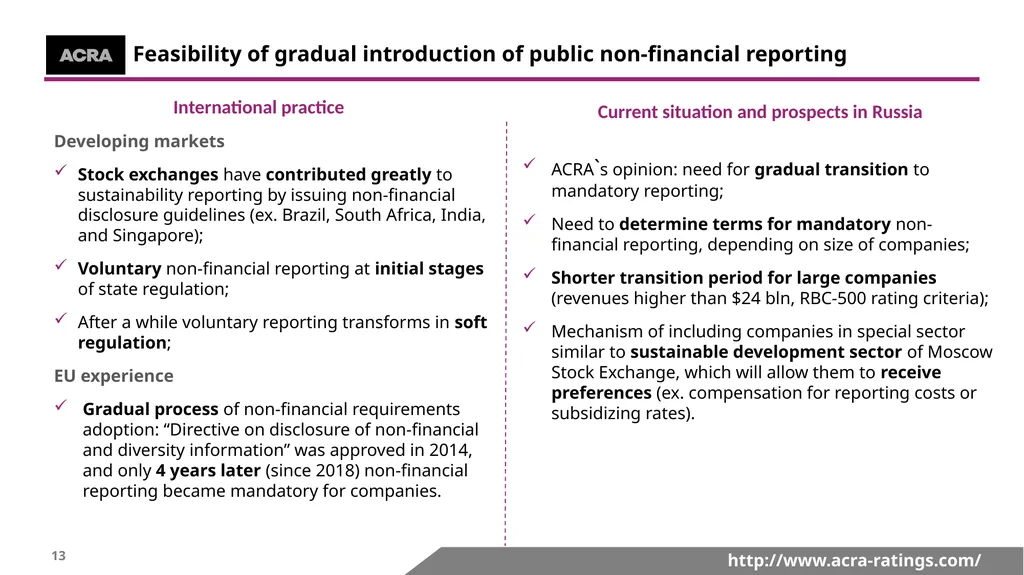
12 http://www.acra-ratings.com/ Feasibility of gradual introduction of public non-financial reporting Developing markets
Stock exchanges have contributed greatly to sustainability reporting by issuing non-financial disclosure guidelines (ex. Brazil, South Africa, India, and Singapore);
Voluntary non-financial reporting at initial stages of state regulation;
After a while voluntary reporting transforms in soft regulation;
EU experience
Gradual process of non-financial requirements adoption: “Directive on disclosure of non-financial and diversity information” was approved in 2014, and only 4 years later (since 2018) non-financial reporting became mandatory for companies. International practice Current situation and prospects in Russia ACRA`s opinion: need for gradual transition to mandatory reporting;
Need to determine terms for mandatory non-financial reporting, depending on size of companies;
Shorter transition period for large companies (revenues higher than $24 bln, RBC-500 rating criteria);
Mechanism of including companies in special sector similar to sustainable development sector of Moscow Stock Exchange, which will allow them to receive preferences (ex. compensation for reporting costs or subsidizing rates).<br>
Stock exchanges have contributed greatly to sustainability reporting by issuing non-financial disclosure guidelines (ex. Brazil, South Africa, India, and Singapore);
Voluntary non-financial reporting at initial stages of state regulation;
After a while voluntary reporting transforms in soft regulation;
EU experience
Gradual process of non-financial requirements adoption: “Directive on disclosure of non-financial and diversity information” was approved in 2014, and only 4 years later (since 2018) non-financial reporting became mandatory for companies. International practice Current situation and prospects in Russia ACRA`s opinion: need for gradual transition to mandatory reporting;
Need to determine terms for mandatory non-financial reporting, depending on size of companies;
Shorter transition period for large companies (revenues higher than $24 bln, RBC-500 rating criteria);
Mechanism of including companies in special sector similar to sustainable development sector of Moscow Stock Exchange, which will allow them to receive preferences (ex. compensation for reporting costs or subsidizing rates).<br>
14
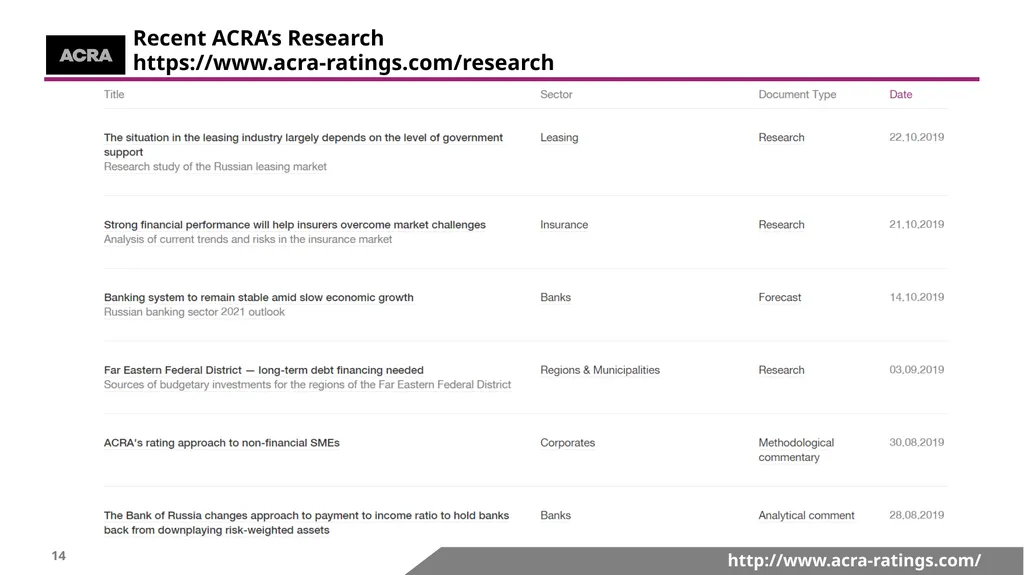
13 http://www.acra-ratings.com/ Recent ACRA’s Research
https://www.acra-ratings.com/research<br>
https://www.acra-ratings.com/research<br>
15
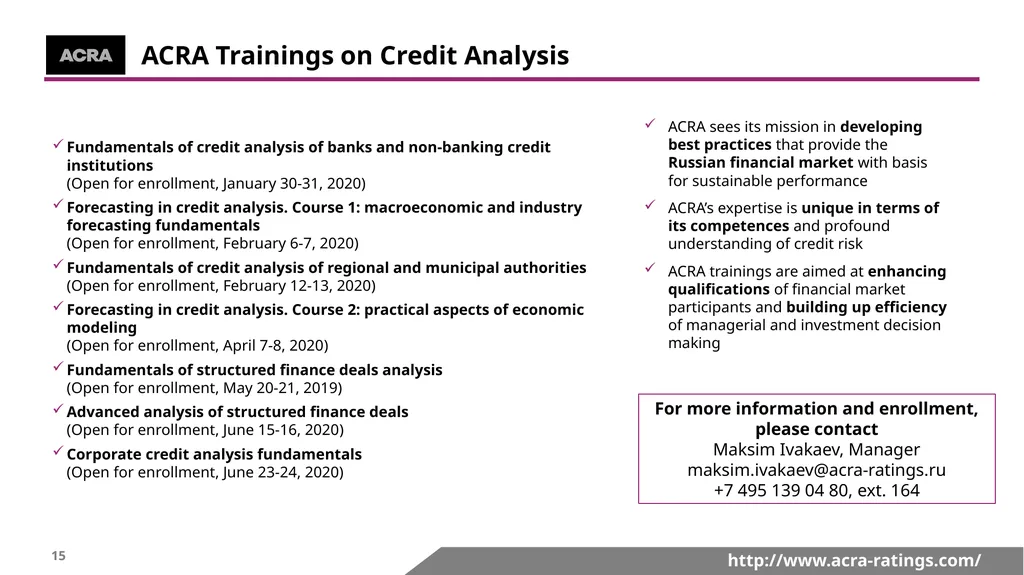
14 http://www.acra-ratings.com/ ACRA sees its mission in developing best practices that provide the Russian financial market with basis for sustainable performance
ACRA’s expertise is unique in terms of its competences and profound understanding of credit risk
ACRA trainings are aimed at enhancing qualifications of financial market participants and building up efficiency of managerial and investment decision making For more information and enrollment, please contact
Maksim Ivakaev, Manager
maksim.ivakaev@acra-ratings.ru +7 495 139 04 80, ext. 164 ACRA Trainings on Credit Analysis Fundamentals of credit analysis of banks and non-banking credit institutions (Open for enrollment, January 30-31, 2020)
Forecasting in credit analysis. Course 1: macroeconomic and industry forecasting fundamentals (Open for enrollment, February 6-7, 2020)
Fundamentals of credit analysis of regional and municipal authorities (Open for enrollment, February 12-13, 2020)
Forecasting in credit analysis. Course 2: practical aspects of economic modeling (Open for enrollment, April 7-8, 2020)
Fundamentals of structured finance deals analysis (Open for enrollment, May 20-21, 2019)
Advanced analysis of structured finance deals (Open for enrollment, June 15-16, 2020)
Corporate credit analysis fundamentals (Open for enrollment, June 23-24, 2020)<br>
ACRA’s expertise is unique in terms of its competences and profound understanding of credit risk
ACRA trainings are aimed at enhancing qualifications of financial market participants and building up efficiency of managerial and investment decision making For more information and enrollment, please contact
Maksim Ivakaev, Manager
maksim.ivakaev@acra-ratings.ru +7 495 139 04 80, ext. 164 ACRA Trainings on Credit Analysis Fundamentals of credit analysis of banks and non-banking credit institutions (Open for enrollment, January 30-31, 2020)
Forecasting in credit analysis. Course 1: macroeconomic and industry forecasting fundamentals (Open for enrollment, February 6-7, 2020)
Fundamentals of credit analysis of regional and municipal authorities (Open for enrollment, February 12-13, 2020)
Forecasting in credit analysis. Course 2: practical aspects of economic modeling (Open for enrollment, April 7-8, 2020)
Fundamentals of structured finance deals analysis (Open for enrollment, May 20-21, 2019)
Advanced analysis of structured finance deals (Open for enrollment, June 15-16, 2020)
Corporate credit analysis fundamentals (Open for enrollment, June 23-24, 2020)<br>
16
15 Russian website: www.acra-ratings.ru
English website: www.acra-ratings.com
General Contacts: On Cooperation Issues:
info@acra-ratings.ru Head of the Business Development Directorate
+7 495 139 04 80 Natalia Suslennikova
Sadovnicheskaya emb., 75 natalia.suslennikova@acra-ratings.ru
Moscow, 115035, Russia +7 495 139 04 80, ext. 148
Regulatory Affairs & Compliance: Credit Ratings Methodology:
Head of Compliance and Internal Control Director – Head of Methodology
Alexander Kuzmin Vladimir Snorkin
alexander.kuzmin@acra-ratings.ru vladimir.snorkin@acra-ratings.ru
+7 495 139 04 80, ext. 137 +7 (495) 139 04 80, ext. 184 Contact Details http://www.acra-ratings.com/<br>
English website: www.acra-ratings.com
General Contacts: On Cooperation Issues:
info@acra-ratings.ru Head of the Business Development Directorate
+7 495 139 04 80 Natalia Suslennikova
Sadovnicheskaya emb., 75 natalia.suslennikova@acra-ratings.ru
Moscow, 115035, Russia +7 495 139 04 80, ext. 148
Regulatory Affairs & Compliance: Credit Ratings Methodology:
Head of Compliance and Internal Control Director – Head of Methodology
Alexander Kuzmin Vladimir Snorkin
alexander.kuzmin@acra-ratings.ru vladimir.snorkin@acra-ratings.ru
+7 495 139 04 80, ext. 137 +7 (495) 139 04 80, ext. 184 Contact Details http://www.acra-ratings.com/<br>
17
16 191; 191; 191 153; 38; 115 128; 128; 128 89; 89; 89 38; 38; 38 255; 241; 183 102; 102; 153 166; 166; 166 113; 59; 83 242; 204; 230 (С) 2019
Analytical Credit Rating Agency (Joint-Stock Company), ACRA (JSC)
75, Sadovnicheskaya embankment, Moscow, Russia
www.acra-ratings.com
The Analytical Credit Rating Agency (ACRA) was founded in 2015, with its 27 shareholders representing major Russian corporate and financial institutions and its authorized capital exceeding RUB 3 bln. ACRA’s main objective is to provide the Russian financial market with high-quality rating products. Methodologies and internal documents of ACRA are developed in compliance with Russian legislation and with regard to global rating industry best practices.
The provided information, including, without limitation, credit and non-credit ratings, rating assessment factors, detailed credit analysis results, methodologies, models, forecasts, analytical reviews and materials, as well as other information placed on the ACRA website (further referred to as Information), coupled with the ACRA website software and other applications, are intended for information purposes only. Information must not be modified, reproduced or distributed by any means, in any way or form, either in whole, or in part, in marketing materials, as part of public relations events, in news bulletins, in commercial materials or reports without prior written consent from, and reference to, ACRA. Any use of Information in violation of these requirements or the law is prohibited.
ACRA credit ratings reflect ACRA’s opinion about the ability of a rated entity to meet its financial obligations or about the credit risk of individual financial obligations and instruments of a rated entity at the time of publication of the relevant Information.
Non-credit ratings reflect ACRA’s opinion about certain non-credit risks assumed by interested parties interacting with a rated entity.
The assigned credit and non-credit ratings reflect all material information pertaining to a rated entity and known by ACRA (including the information received from third parties), the quality and reliability of which ACRA considers appropriate. ACRA shall not be responsible for the accuracy of information provided by clients or relevant third parties. ACRA does not audit or otherwise verify the provided data and shall not be held responsible for their accuracy and completeness. ACRA conducts rating analysis of information provided by customers using its own methodologies, with the texts thereof available on ACRA’s website – www.acra-ratings.com/criteria.
The only source that reflects the latest Information, including the one about credit and non-credit ratings assigned by ACRA, is ACRA’s official website – www.acra-ratings.com. Information is provided on an "as is" basis.
Information shall be considered by users exclusively as ACRA’s statement of opinion and must not be regarded as advice, recommendation or suggestion to buy, hold or sell securities or other financial instruments of any kind, nor shall it be viewed as an offer or advertisement.
Neither ACRA, nor its employees and persons affiliated with ACRA (further referred to as the ACRA Parties) provide any direct or implied guarantee expressed in any form or by any means regarding the accuracy, timeliness, completeness or applicability of Information for making investment and other decisions. ACRA does not act as a fiduciary, auditor, investment or financial advisor. Information must be regarded solely as one of the factors affecting an investment decision or any other business decision made by any person who uses ACRA’s information. It is essential that each of such persons conduct their own research and evaluation of a financial market participant, as well as an issuer and its debt obligations that may be regarded as an object of purchase, sale or possession. Users of Information shall make decisions on their own, involving their own independent advisors, if they deem it necessary.
ACRA Parties shall not be responsible for any action taken by users based on Information provided by ACRA. ACRA Parties shall under no circumstances be responsible for any direct, indirect or consequential damages or losses resulting from interpretations, conclusions, recommendations and other actions taken by third parties and directly or indirectly connected with such information.
Information provided by ACRA is valid only as of the date of preparation and publication of materials and may be amended by ACRA in the future. ACRA shall not be obliged to update, modify or supplement Information or inform anyone about such actions, unless the latter was recorded separately in a written agreement or is required by legislation of the Russian Federation.
ACRA does not provide advisory services. ACRA may provide additional services, if this does not create a conflict of interest with rating activities.
ACRA and its employees take all reasonable measures to protect all confidential and/or material non-public information in their possession from fraud, theft, unlawful use or inadvertent disclosure. ACRA provides protection of confidential information obtained in the course of its business activities as required by legislation of the Russian Federation. Disclaimer<br>
Analytical Credit Rating Agency (Joint-Stock Company), ACRA (JSC)
75, Sadovnicheskaya embankment, Moscow, Russia
www.acra-ratings.com
The Analytical Credit Rating Agency (ACRA) was founded in 2015, with its 27 shareholders representing major Russian corporate and financial institutions and its authorized capital exceeding RUB 3 bln. ACRA’s main objective is to provide the Russian financial market with high-quality rating products. Methodologies and internal documents of ACRA are developed in compliance with Russian legislation and with regard to global rating industry best practices.
The provided information, including, without limitation, credit and non-credit ratings, rating assessment factors, detailed credit analysis results, methodologies, models, forecasts, analytical reviews and materials, as well as other information placed on the ACRA website (further referred to as Information), coupled with the ACRA website software and other applications, are intended for information purposes only. Information must not be modified, reproduced or distributed by any means, in any way or form, either in whole, or in part, in marketing materials, as part of public relations events, in news bulletins, in commercial materials or reports without prior written consent from, and reference to, ACRA. Any use of Information in violation of these requirements or the law is prohibited.
ACRA credit ratings reflect ACRA’s opinion about the ability of a rated entity to meet its financial obligations or about the credit risk of individual financial obligations and instruments of a rated entity at the time of publication of the relevant Information.
Non-credit ratings reflect ACRA’s opinion about certain non-credit risks assumed by interested parties interacting with a rated entity.
The assigned credit and non-credit ratings reflect all material information pertaining to a rated entity and known by ACRA (including the information received from third parties), the quality and reliability of which ACRA considers appropriate. ACRA shall not be responsible for the accuracy of information provided by clients or relevant third parties. ACRA does not audit or otherwise verify the provided data and shall not be held responsible for their accuracy and completeness. ACRA conducts rating analysis of information provided by customers using its own methodologies, with the texts thereof available on ACRA’s website – www.acra-ratings.com/criteria.
The only source that reflects the latest Information, including the one about credit and non-credit ratings assigned by ACRA, is ACRA’s official website – www.acra-ratings.com. Information is provided on an "as is" basis.
Information shall be considered by users exclusively as ACRA’s statement of opinion and must not be regarded as advice, recommendation or suggestion to buy, hold or sell securities or other financial instruments of any kind, nor shall it be viewed as an offer or advertisement.
Neither ACRA, nor its employees and persons affiliated with ACRA (further referred to as the ACRA Parties) provide any direct or implied guarantee expressed in any form or by any means regarding the accuracy, timeliness, completeness or applicability of Information for making investment and other decisions. ACRA does not act as a fiduciary, auditor, investment or financial advisor. Information must be regarded solely as one of the factors affecting an investment decision or any other business decision made by any person who uses ACRA’s information. It is essential that each of such persons conduct their own research and evaluation of a financial market participant, as well as an issuer and its debt obligations that may be regarded as an object of purchase, sale or possession. Users of Information shall make decisions on their own, involving their own independent advisors, if they deem it necessary.
ACRA Parties shall not be responsible for any action taken by users based on Information provided by ACRA. ACRA Parties shall under no circumstances be responsible for any direct, indirect or consequential damages or losses resulting from interpretations, conclusions, recommendations and other actions taken by third parties and directly or indirectly connected with such information.
Information provided by ACRA is valid only as of the date of preparation and publication of materials and may be amended by ACRA in the future. ACRA shall not be obliged to update, modify or supplement Information or inform anyone about such actions, unless the latter was recorded separately in a written agreement or is required by legislation of the Russian Federation.
ACRA does not provide advisory services. ACRA may provide additional services, if this does not create a conflict of interest with rating activities.
ACRA and its employees take all reasonable measures to protect all confidential and/or material non-public information in their possession from fraud, theft, unlawful use or inadvertent disclosure. ACRA provides protection of confidential information obtained in the course of its business activities as required by legislation of the Russian Federation. Disclaimer<br>