
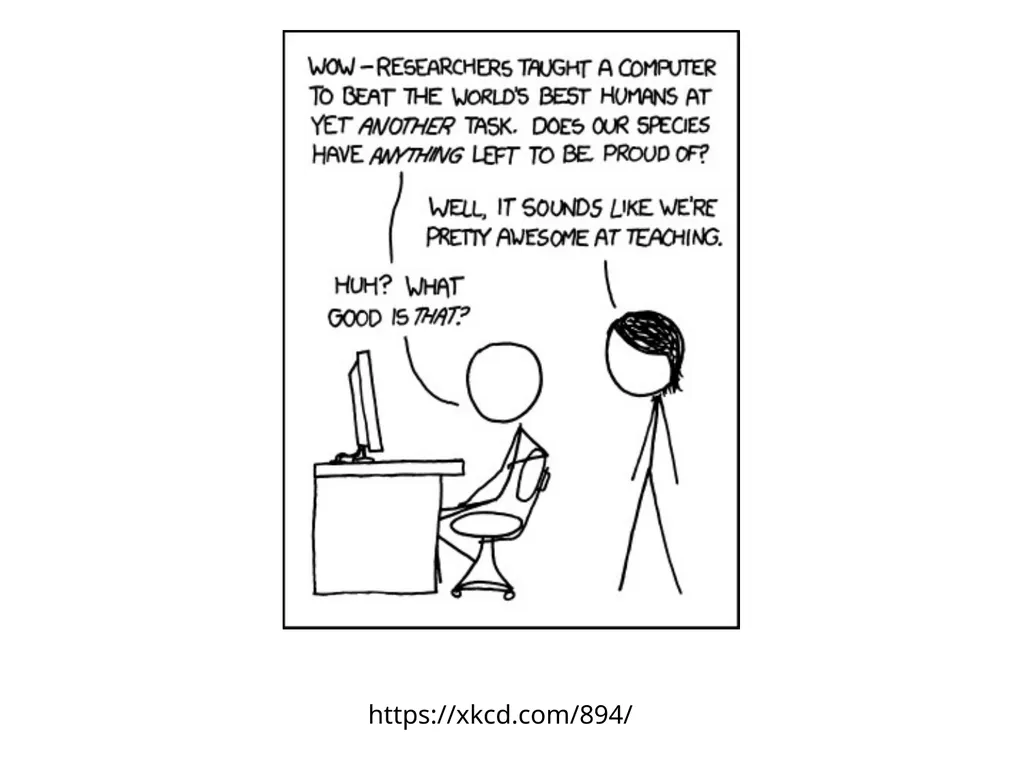
https://xkcd.com/894/ Introduction to Machine
Description: https:xkcd.com894 Introduction to Machine Learning David Kauchak CS 158 Fall 2016 Why are you here? What is Machine Learning? Why are you taking this course? What topics would you like to see covered? Machine Learning is Machine
Related Topics
Download Presentation
"https://xkcd.com/894/ Introduction to Machine" is the property of its rightful owner. Permission is granted to download and print the materials on this website for personal, non-commercial use only, and to display it on your personal computer provided you do not modify the materials and that you retain all copyright notices contained in the materials. By downloading content from our website, you accept the terms of this agreement.
Presentation Transcript
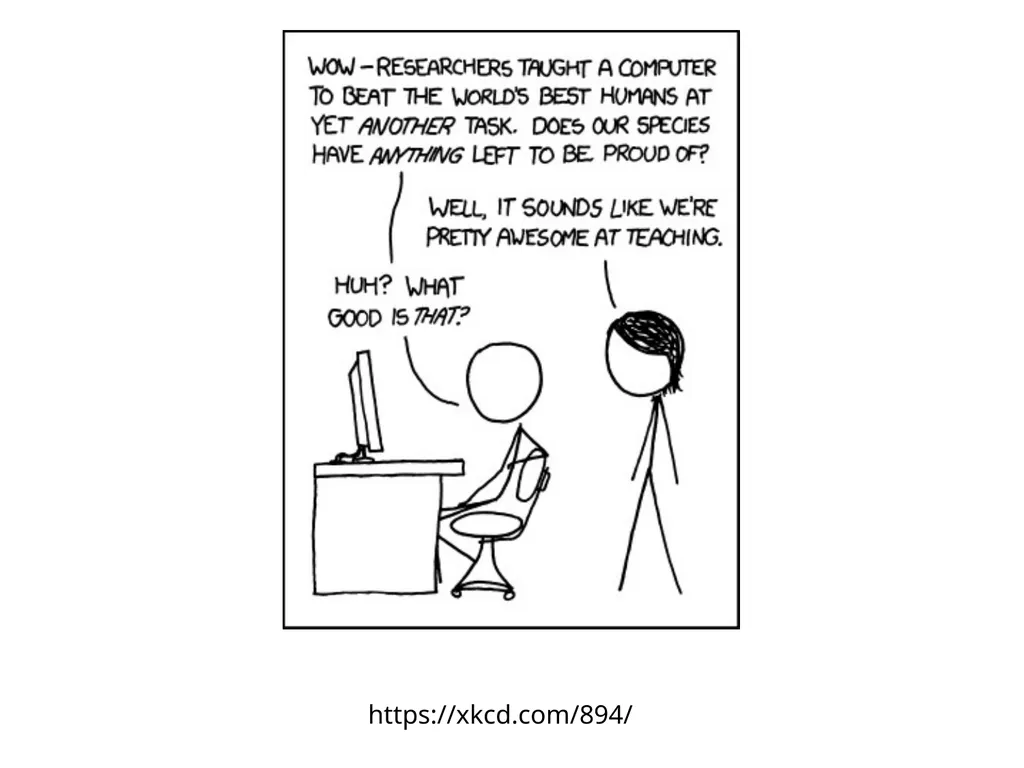
slide1. https://xkcd.com/894/<br>
slide2. Introduction to Machine Learning David Kauchak CS 158 – Fall 2016<br>
slide3. Why are you here? What is Machine Learning?
Why are you taking this course?
What topics would you like to see covered?<br>
slide4. Machine Learning is… Machine learning is a subfield of computer science that evolved from the study of pattern recognition and computational learning theory in artificial intelligence.<br>
slide5. Machine Learning is… Machine learning is programming computers to optimize a performance criterion using example data or past experience.
-- Ethem Alpaydin
The goal of machine learning is to develop methods that can automatically detect patterns in data, and then to use the uncovered patterns to predict future data or other outcomes of interest.
-- Kevin P. Murphy
The field of pattern recognition is concerned with the automatic discovery of regularities in data through the use of computer algorithms and with the use of these regularities to take actions.
-- Christopher M. Bishop<br>
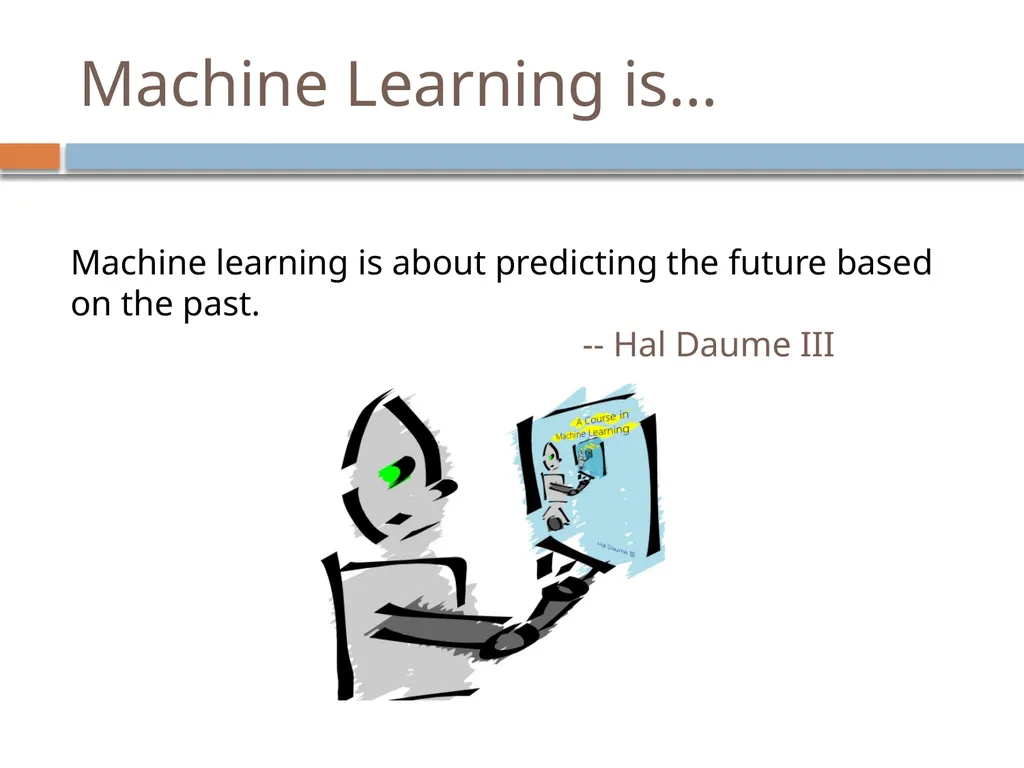
slide6. Machine Learning is… Machine learning is about predicting the future based on the past.
-- Hal Daume III<br>
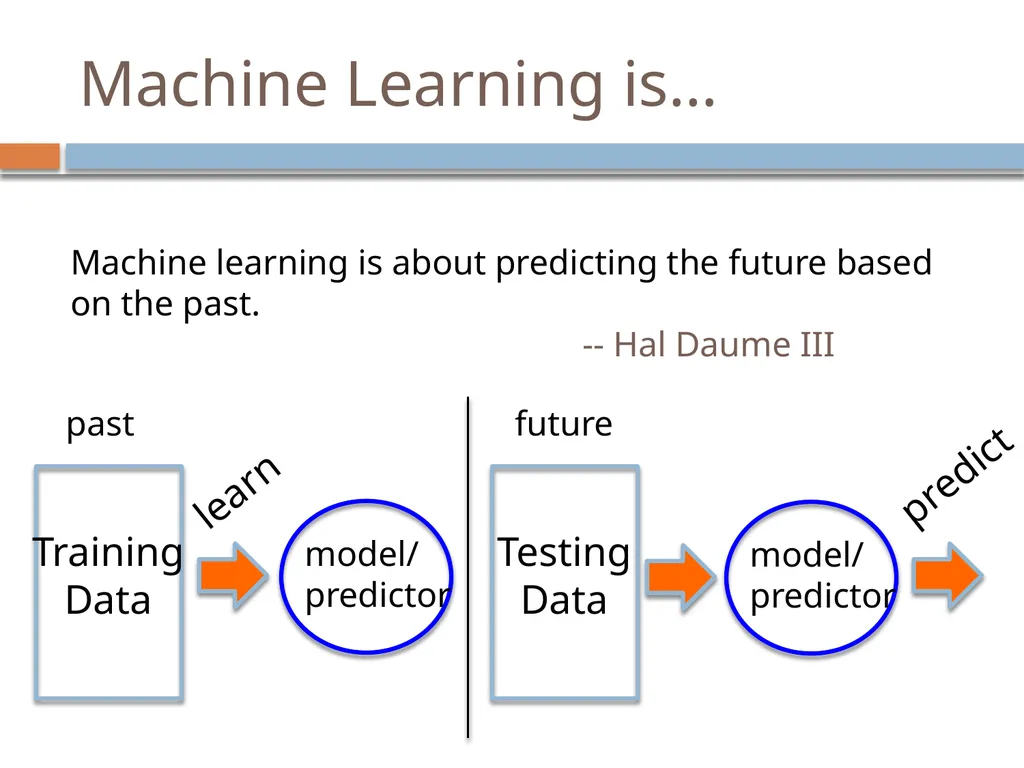
slide7. Machine Learning is… Machine learning is about predicting the future based on the past.
-- Hal Daume III Training
Data learn model/
predictor past predict model/
predictor future Testing
Data<br>
slide8. Machine Learning, aka data mining: data analysis, not prediction, though often involves some shared techniques
inference and/or estimation in statistics
pattern recognition in engineering
signal processing in electrical engineering
induction
optimization<br>
slide9. Goals of the course: learn about… Different machine learning problems
Common techniques/tools used
theoretical understanding
practical implementation
Proper experimentation and evaluation
Dealing with large (huge) data sets
Parallelization frameworks
Programming tools<br>
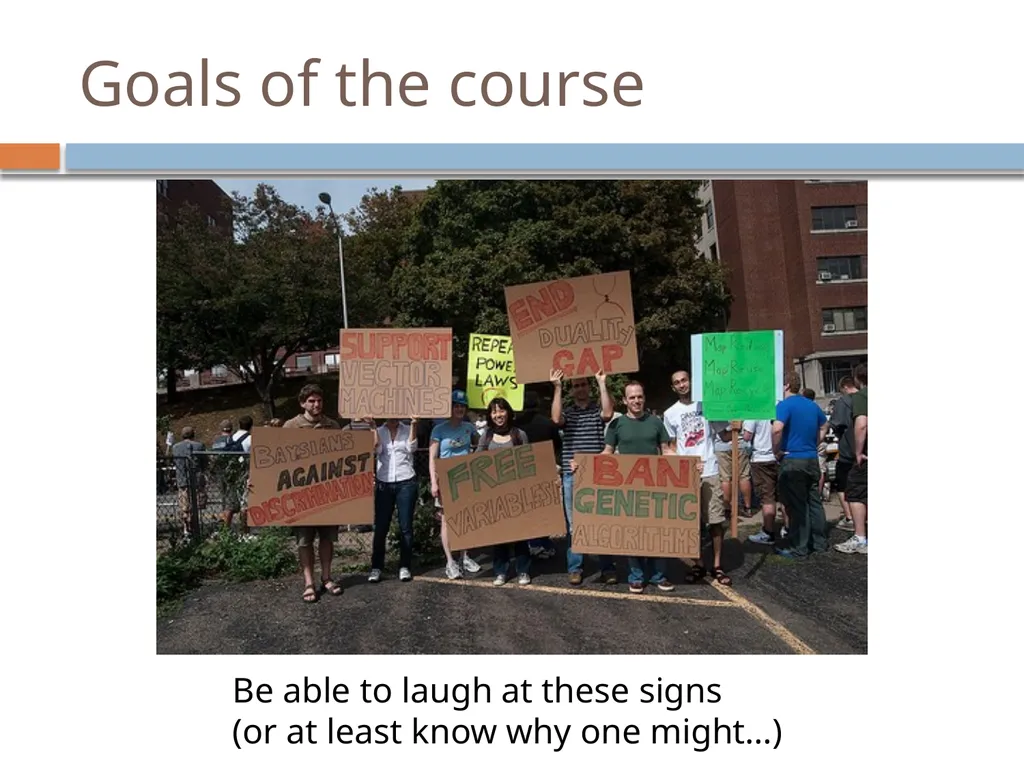
slide10. Goals of the course Be able to laugh at these signs
(or at least know why one might…)<br>
slide11. Administrative Course page:
http://www.cs.pomona.edu/~dkauchak/classes/cs158/
Assignments
Weekly
Mostly programming (Java, mostly)
Some written/write-up
Generally due Sunday evenings
Two “midterm” exams and one final
Late Policy
Collaboration<br>
slide12. Course expectations Plan to stay busy!
Applied class, so lots of programming
Machine learning involves math<br>
slide13. Other things to note Videos before class
Lots of class participation!
Read the book (it’s good)<br>
slide14. Machine learning problems What high-level machine learning problems have you seen or heard of before?<br>
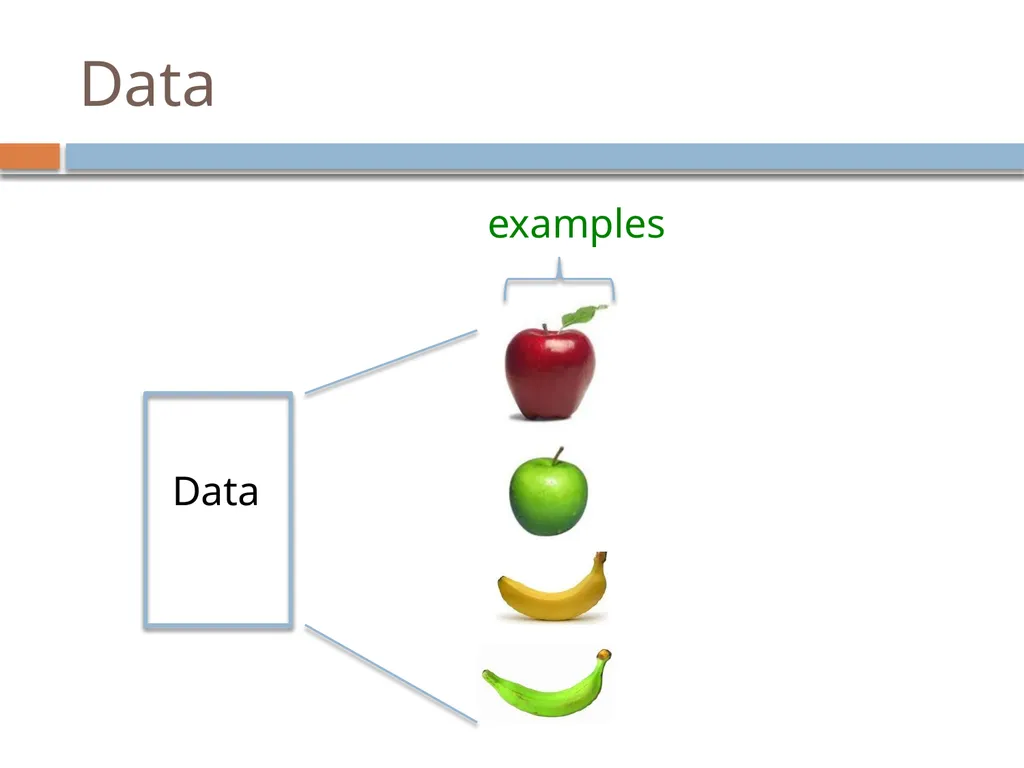
slide15. Data examples Data<br>
slide16. Data examples Data<br>
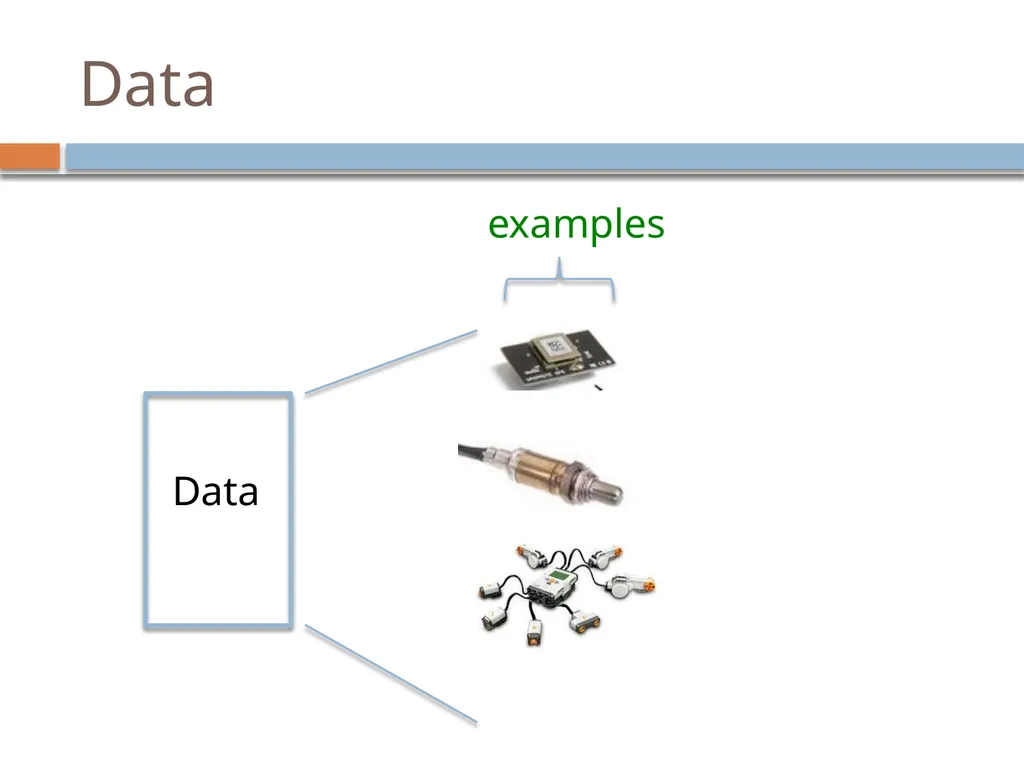
slide17. Data examples Data<br>
slide18. Data examples Data<br>
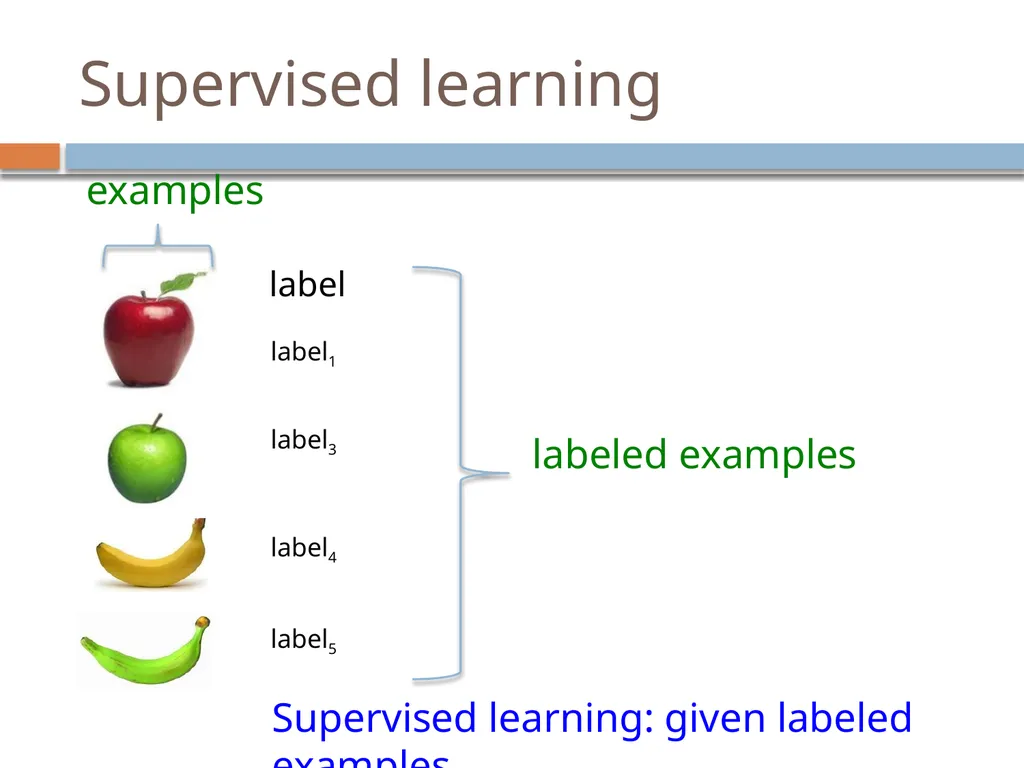
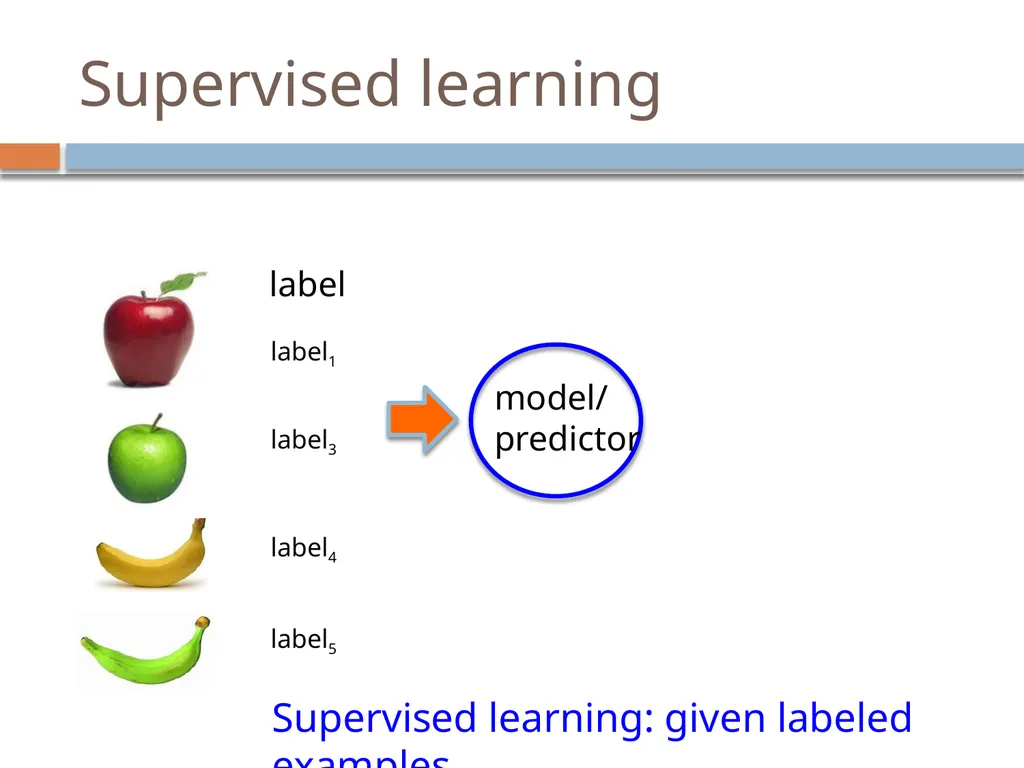
slide19. Supervised learning Supervised learning: given labeled examples label label1 label3 label4 label5 labeled examples examples<br>
slide20. Supervised learning Supervised learning: given labeled examples model/
predictor label label1 label3 label4 label5<br>
slide21. Supervised learning model/
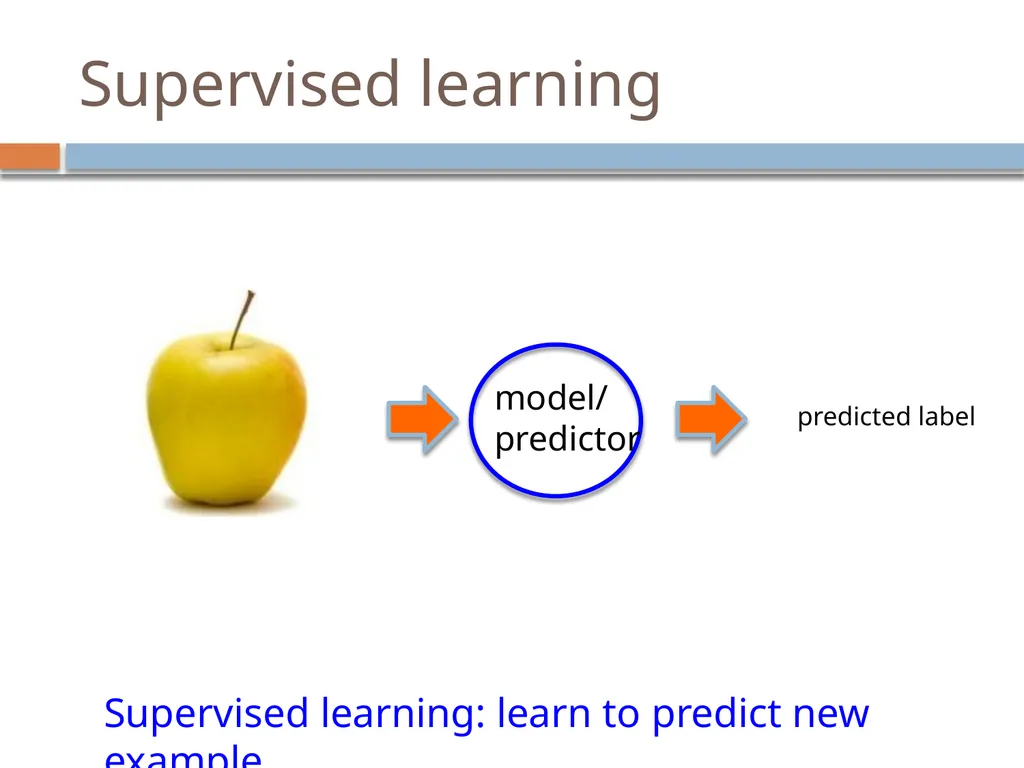
predictor Supervised learning: learn to predict new example predicted label<br>
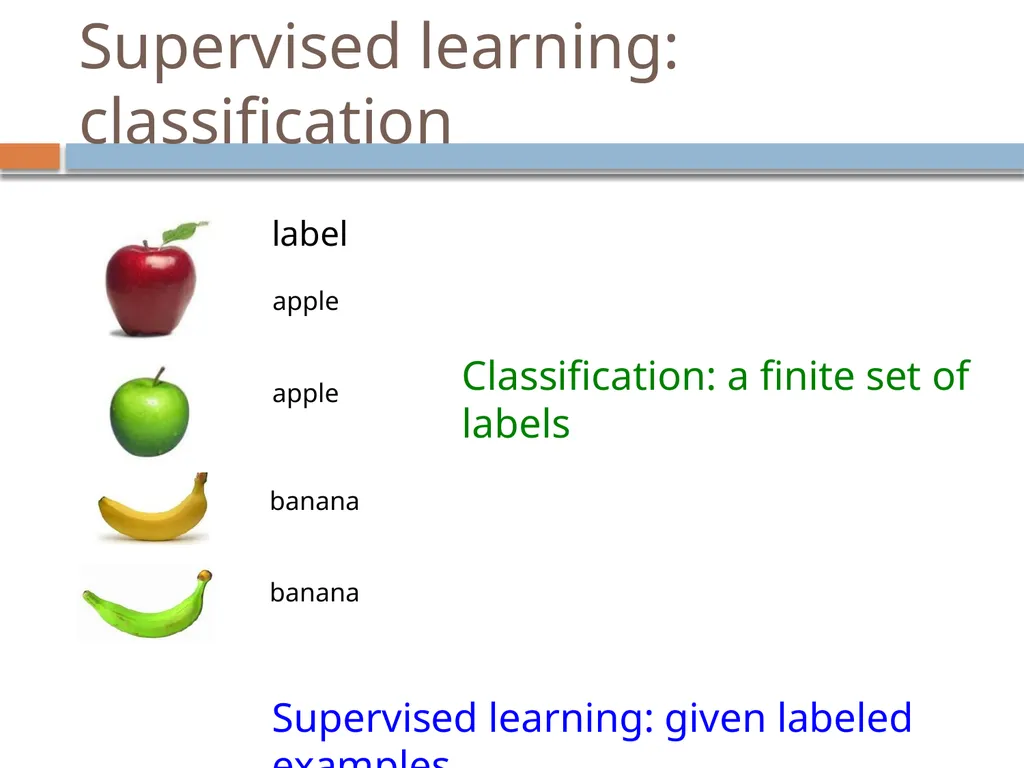
slide22. Supervised learning: classification Supervised learning: given labeled examples label apple apple banana banana Classification: a finite set of labels<br>
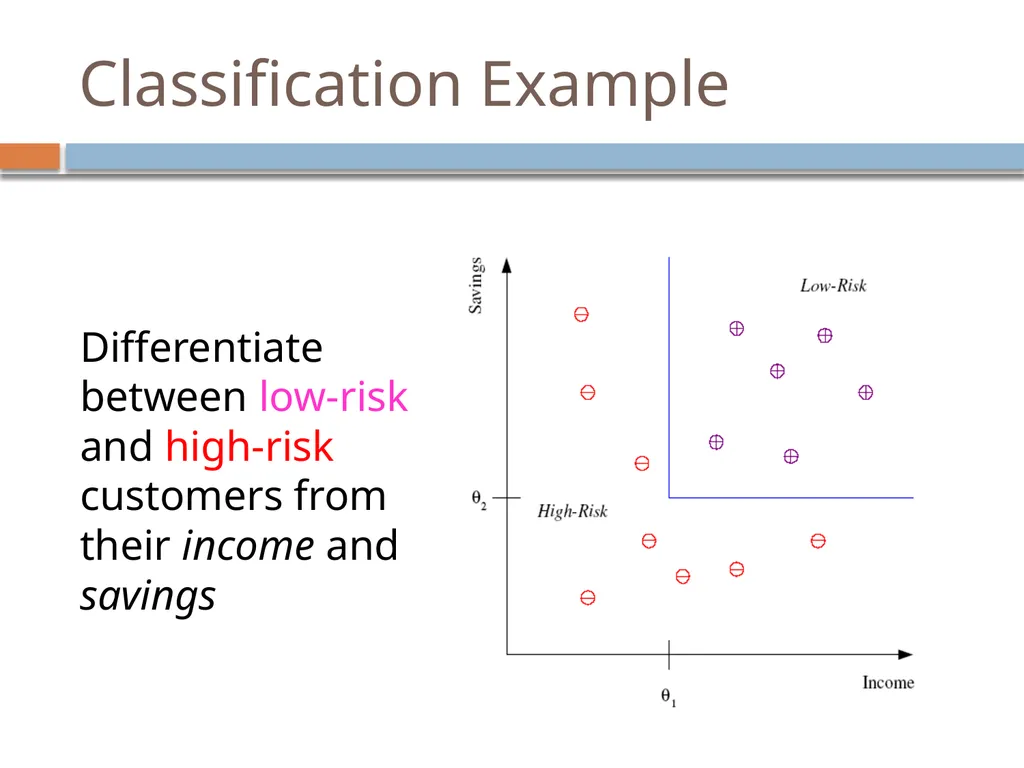
slide23. Classification Example Differentiate between low-risk and high-risk customers from their income and savings<br>
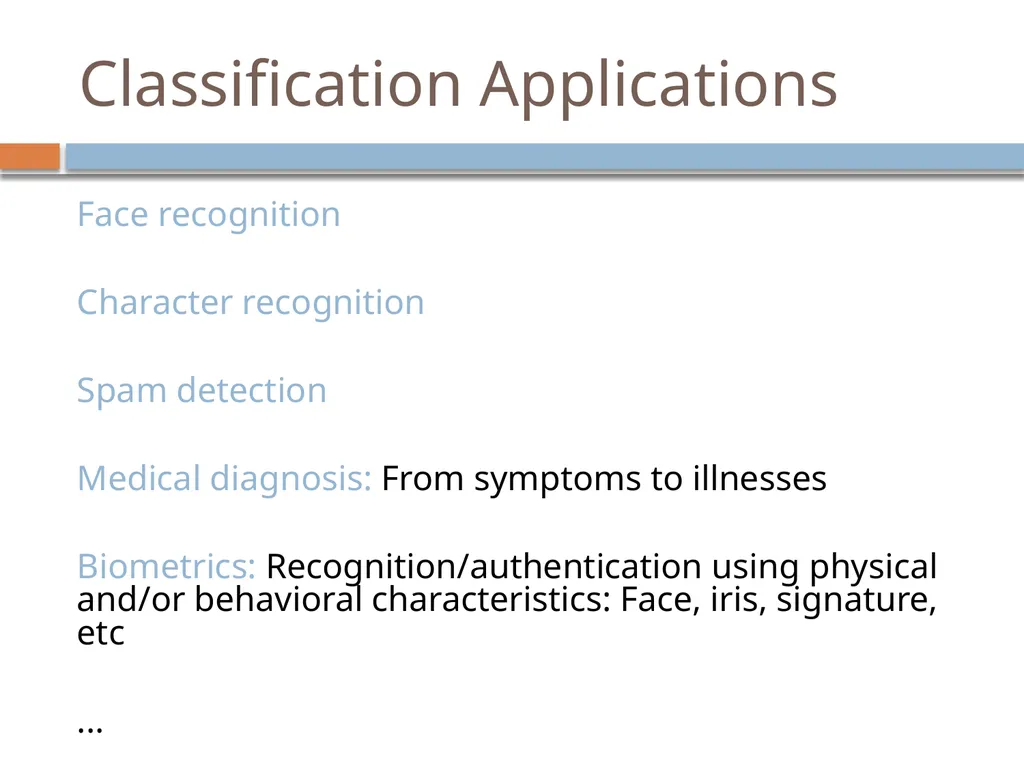
slide24. Classification Applications Face recognition
Character recognition
Spam detection
Medical diagnosis: From symptoms to illnesses
Biometrics: Recognition/authentication using physical and/or behavioral characteristics: Face, iris, signature, etc
...<br>
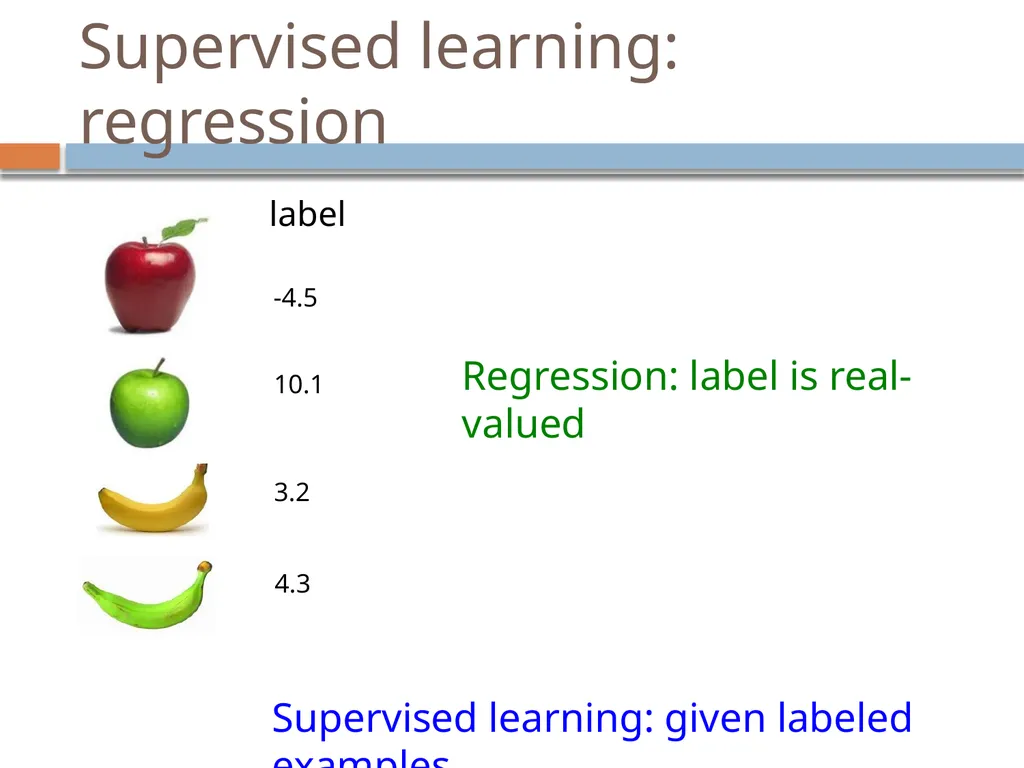
slide25. Supervised learning: regression Supervised learning: given labeled examples label -4.5 10.1 3.2 4.3 Regression: label is real-valued<br>
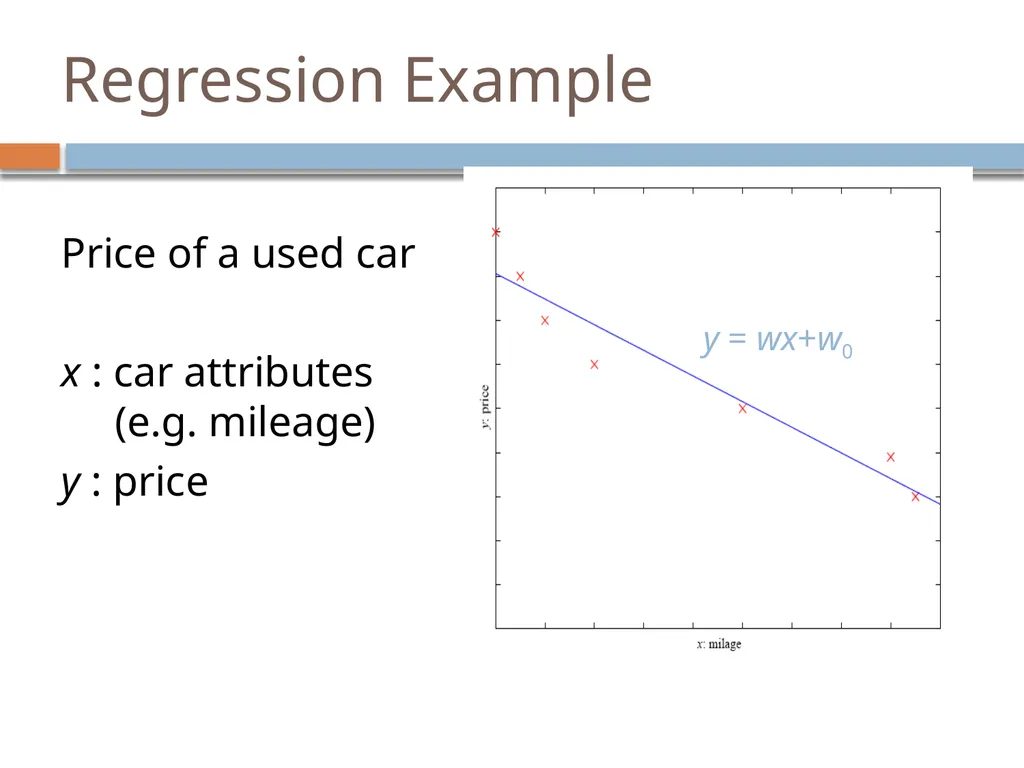
slide26. Regression Example Price of a used car
x : car attributes (e.g. mileage)
y : price y = wx+w0 26<br>
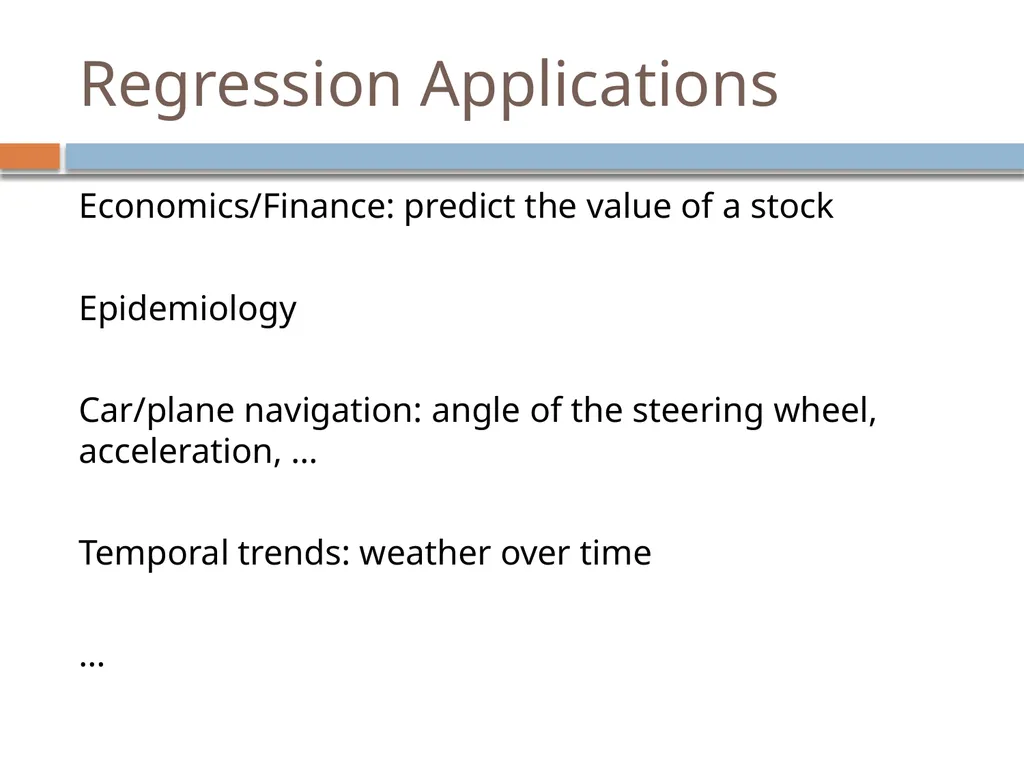
slide27. Regression Applications Economics/Finance: predict the value of a stock
Epidemiology
Car/plane navigation: angle of the steering wheel, acceleration, …
Temporal trends: weather over time
…<br>
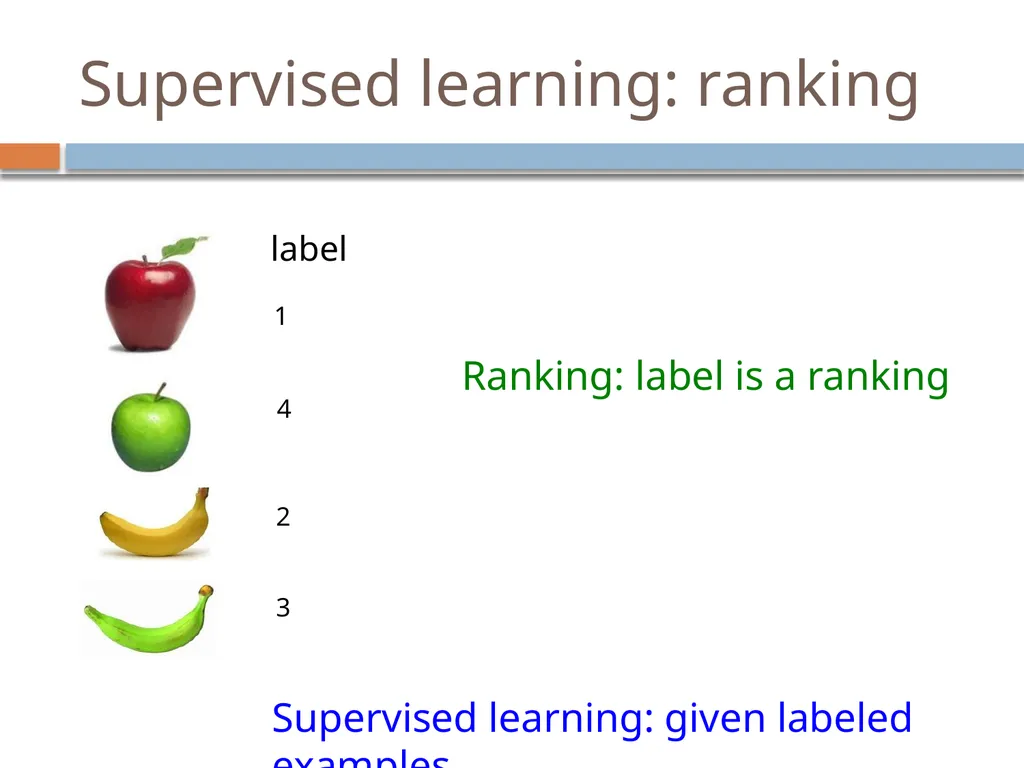
slide28. Supervised learning: ranking Supervised learning: given labeled examples label 1 4 2 3 Ranking: label is a ranking<br>
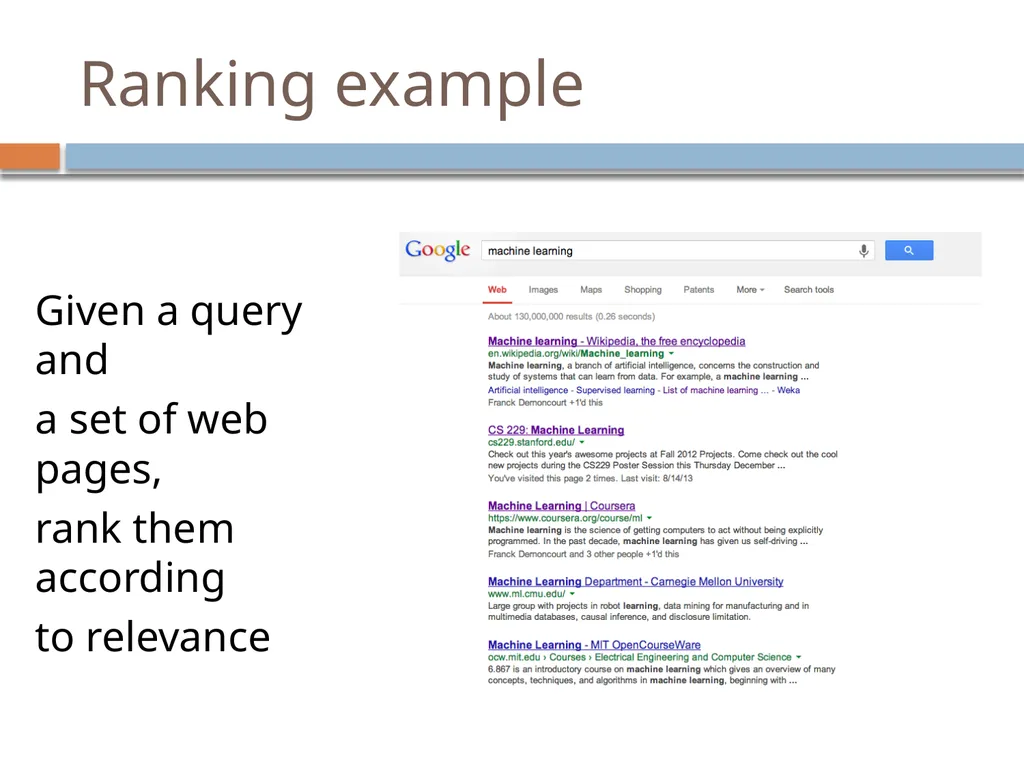
slide29. Ranking example Given a query and
a set of web pages,
rank them according
to relevance<br>
slide30. Ranking Applications User preference, e.g. Netflix “My List” -- movie queue ranking
iTunes
flight search (search in general)
reranking N-best output lists
…<br>
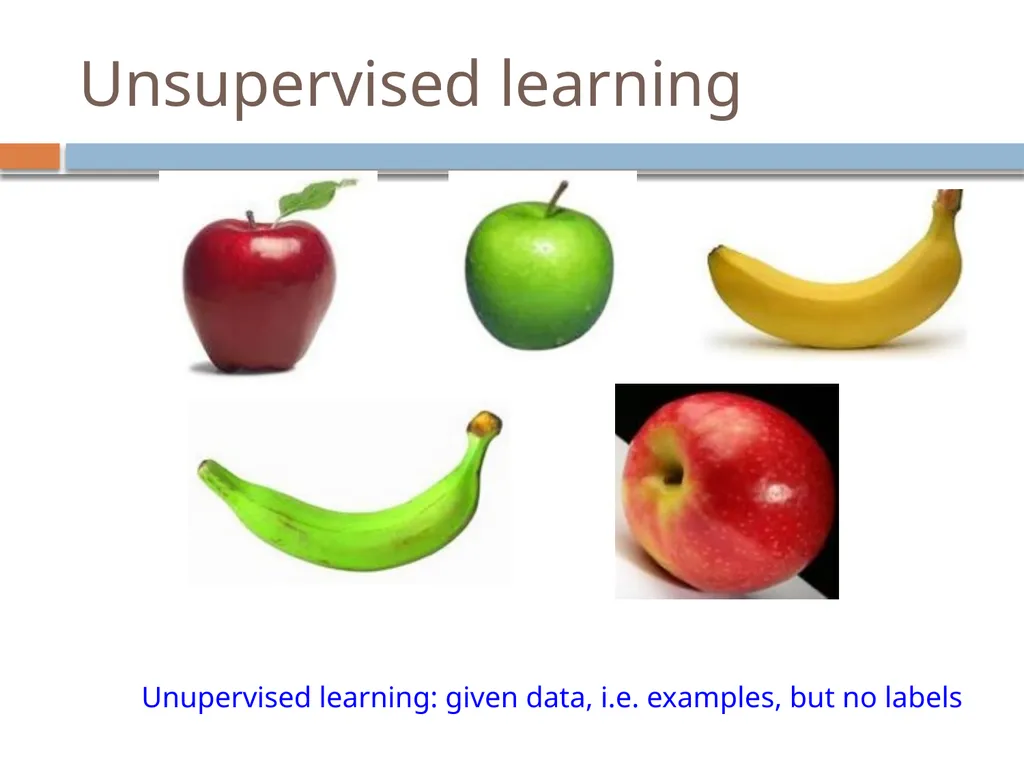
slide31. Unsupervised learning Unupervised learning: given data, i.e. examples, but no labels<br>
slide32. Unsupervised learning applications learn clusters/groups without any label
customer segmentation (i.e. grouping)
image compression
bioinformatics: learn motifs
…<br>
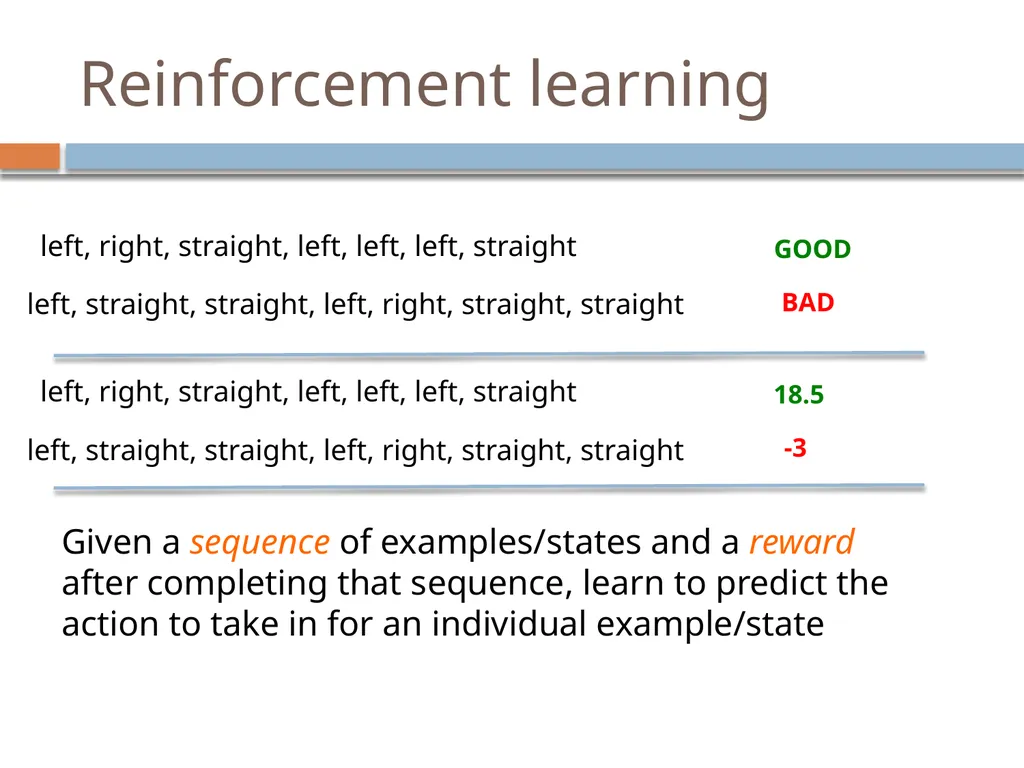
slide33. Reinforcement learning left, right, straight, left, left, left, straight left, straight, straight, left, right, straight, straight GOOD BAD left, right, straight, left, left, left, straight left, straight, straight, left, right, straight, straight 18.5 -3 Given a sequence of examples/states and a reward after completing that sequence, learn to predict the action to take in for an individual example/state<br>
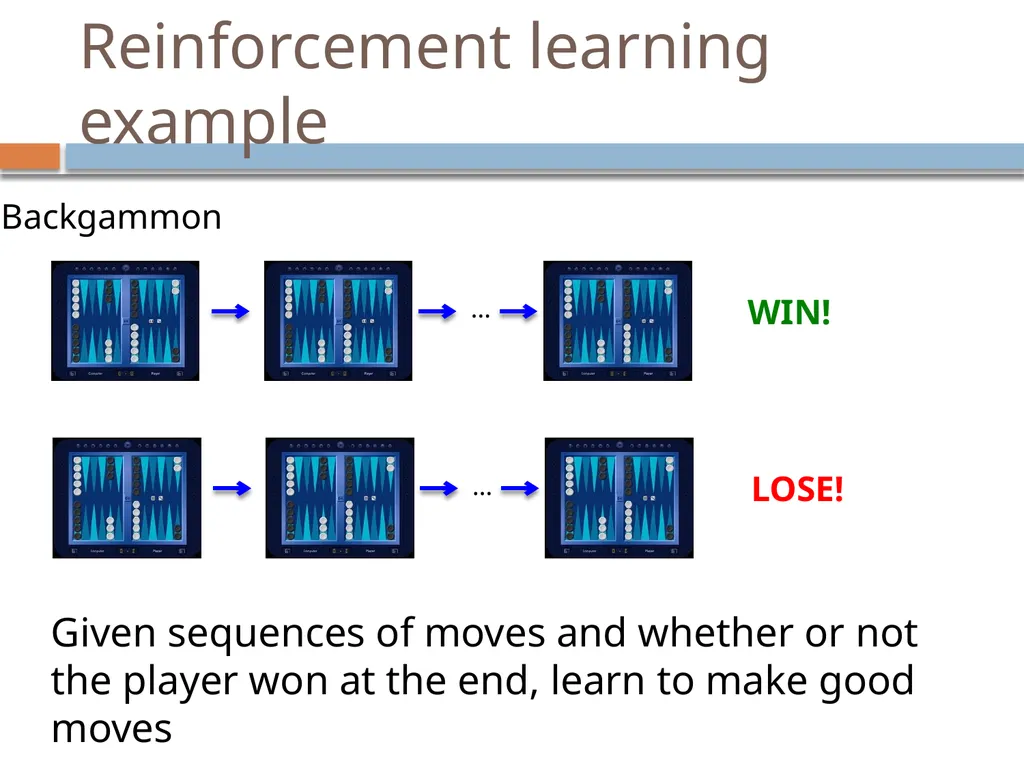
slide34. Reinforcement learning example … WIN! … LOSE! Backgammon Given sequences of moves and whether or not the player won at the end, learn to make good moves<br>
slide35. Reinforcement learning example http://www.youtube.com/watch?v=VCdxqn0fcnE<br>
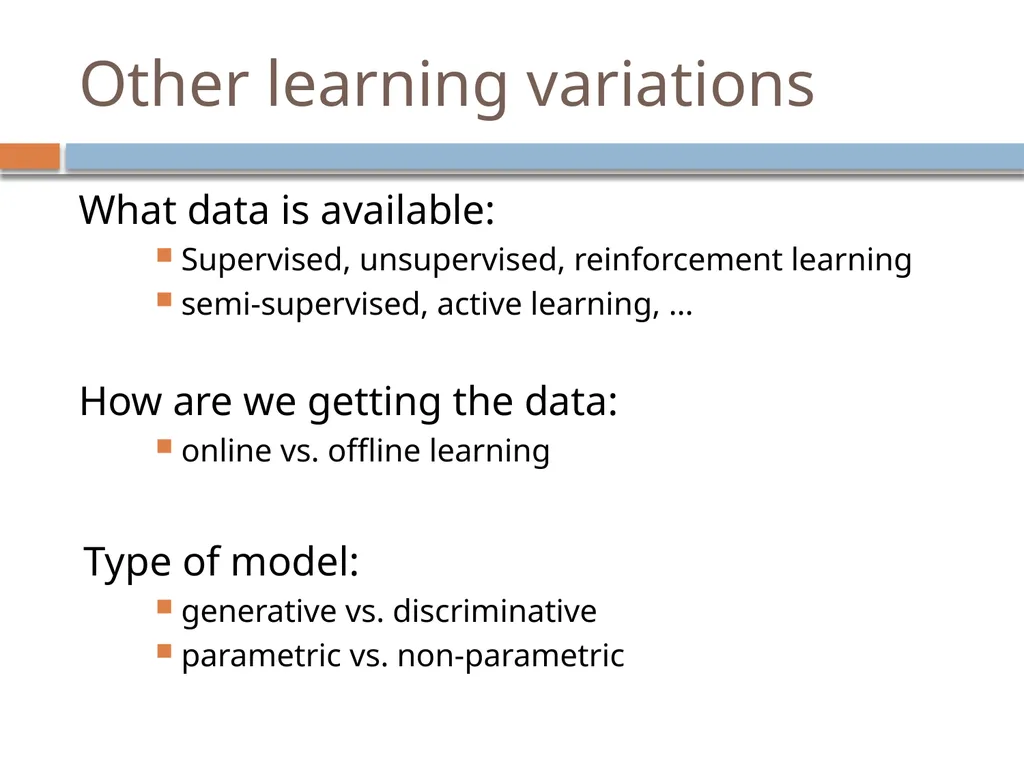
slide36. Other learning variations What data is available:
Supervised, unsupervised, reinforcement learning
semi-supervised, active learning, …
How are we getting the data:
online vs. offline learning
Type of model:
generative vs. discriminative
parametric vs. non-parametric<br>
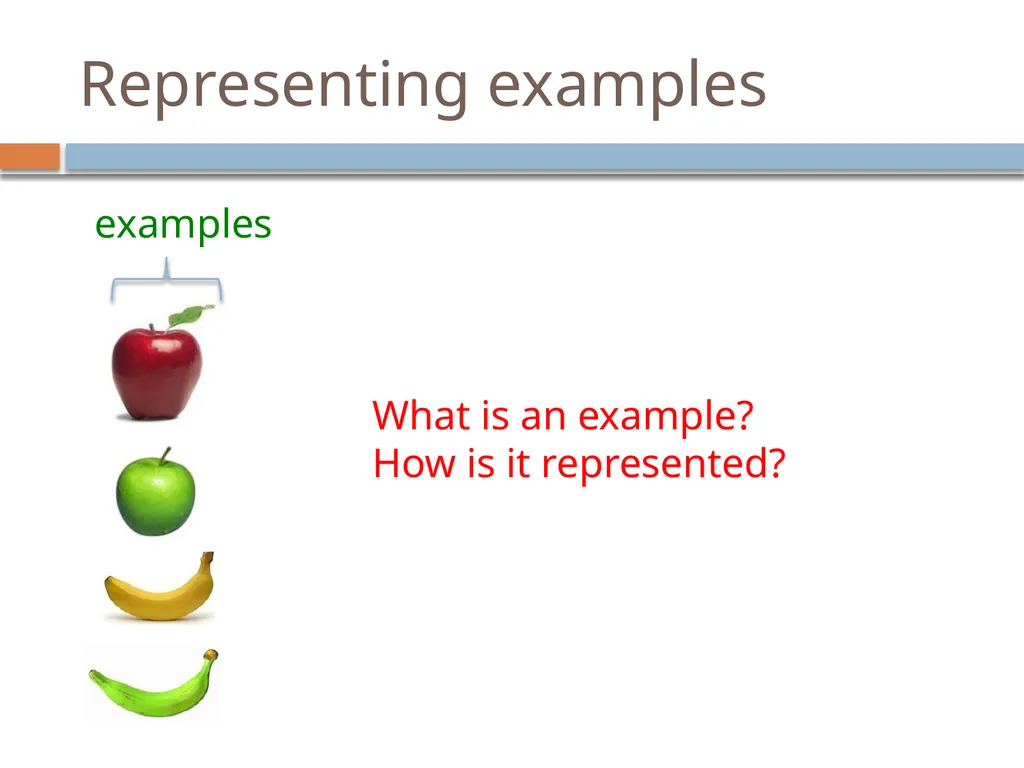
slide37. Representing examples examples What is an example?
How is it represented?<br>
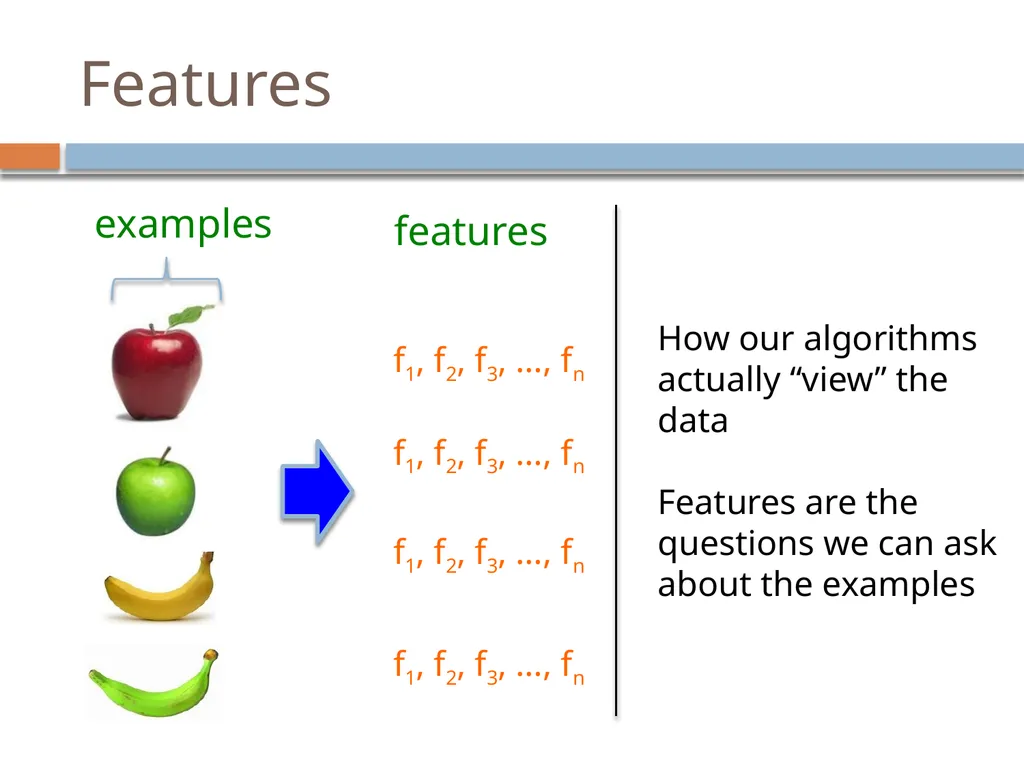
slide38. Features examples f1, f2, f3, …, fn features f1, f2, f3, …, fn f1, f2, f3, …, fn f1, f2, f3, …, fn How our algorithms actually “view” the data
Features are the questions we can ask about the examples<br>
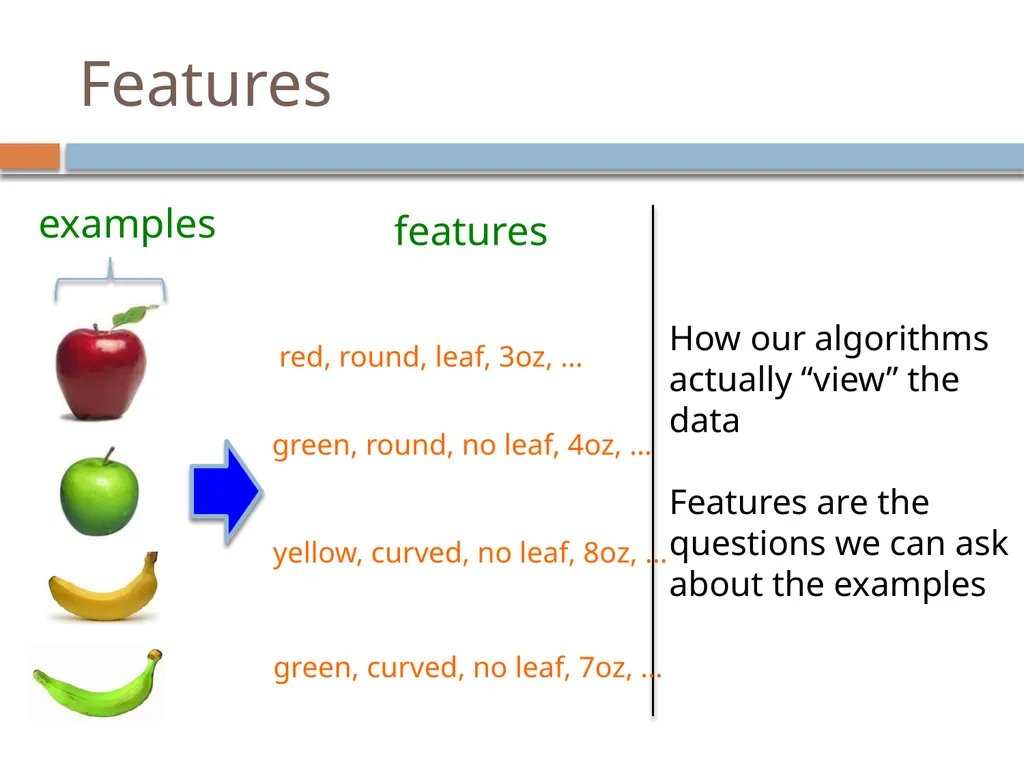
slide39. Features examples red, round, leaf, 3oz, … features How our algorithms actually “view” the data
Features are the questions we can ask about the examples green, round, no leaf, 4oz, … yellow, curved, no leaf, 8oz, … green, curved, no leaf, 7oz, …<br>
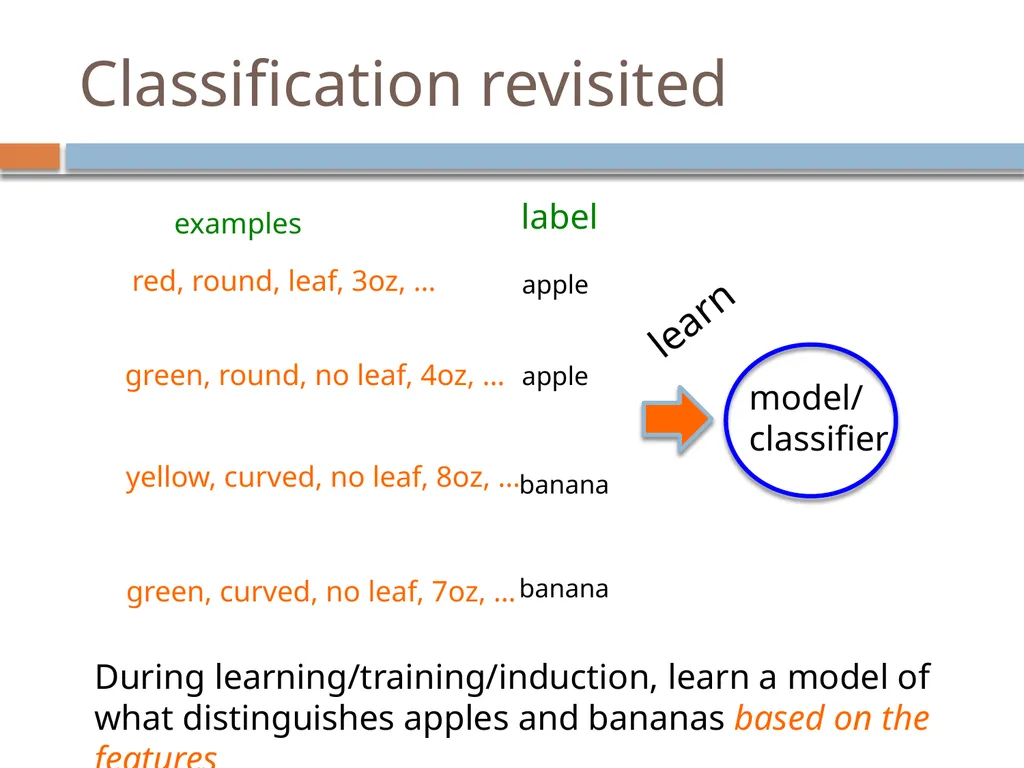
slide40. Classification revisited red, round, leaf, 3oz, … green, round, no leaf, 4oz, … yellow, curved, no leaf, 8oz, … green, curved, no leaf, 7oz, … label apple apple banana banana examples model/
classifier learn During learning/training/induction, learn a model of what distinguishes apples and bananas based on the features<br>
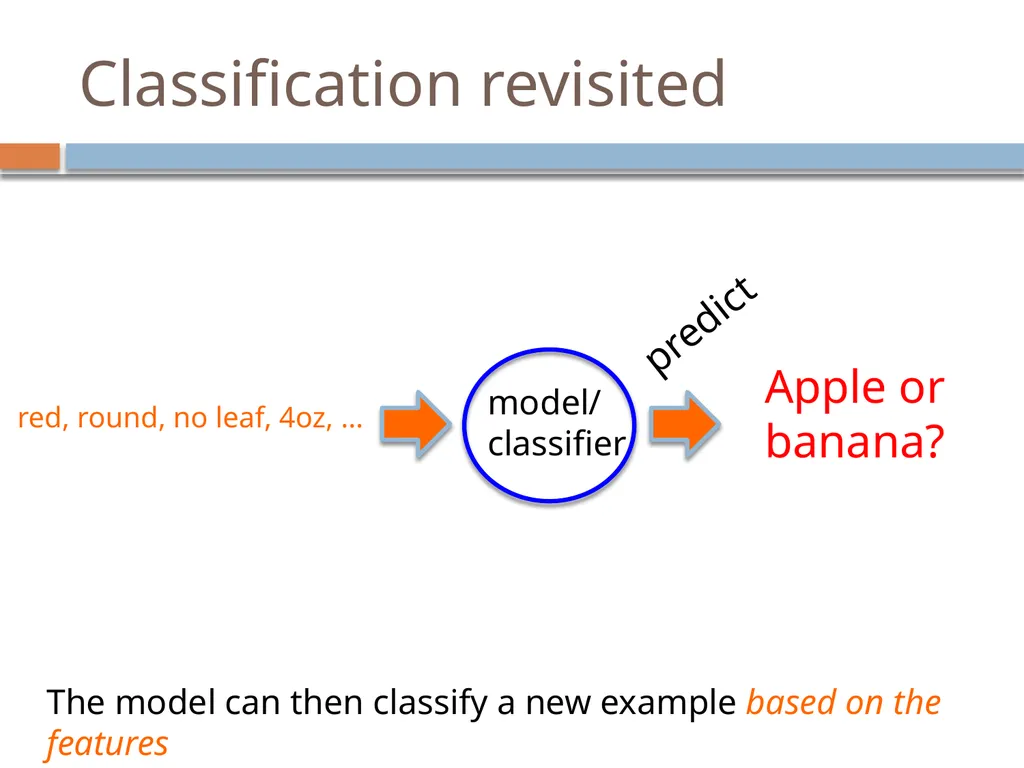
slide41. Classification revisited red, round, no leaf, 4oz, … model/
classifier The model can then classify a new example based on the features predict Apple or banana?<br>
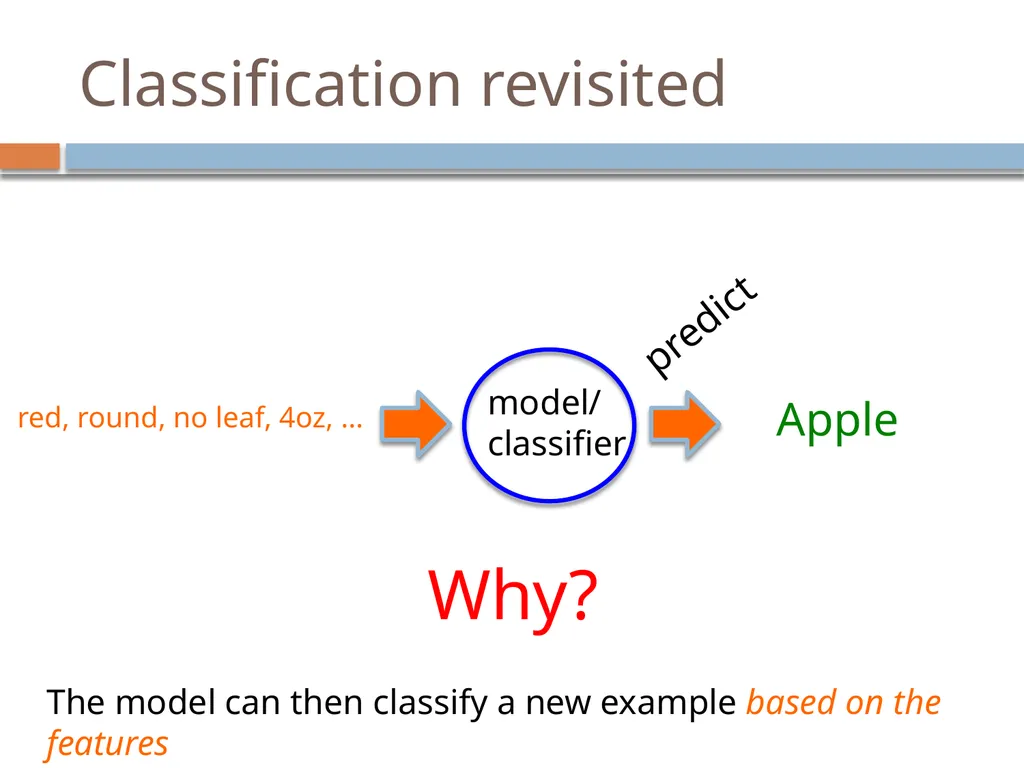
slide42. Classification revisited red, round, no leaf, 4oz, … model/
classifier The model can then classify a new example based on the features predict Apple Why?<br>
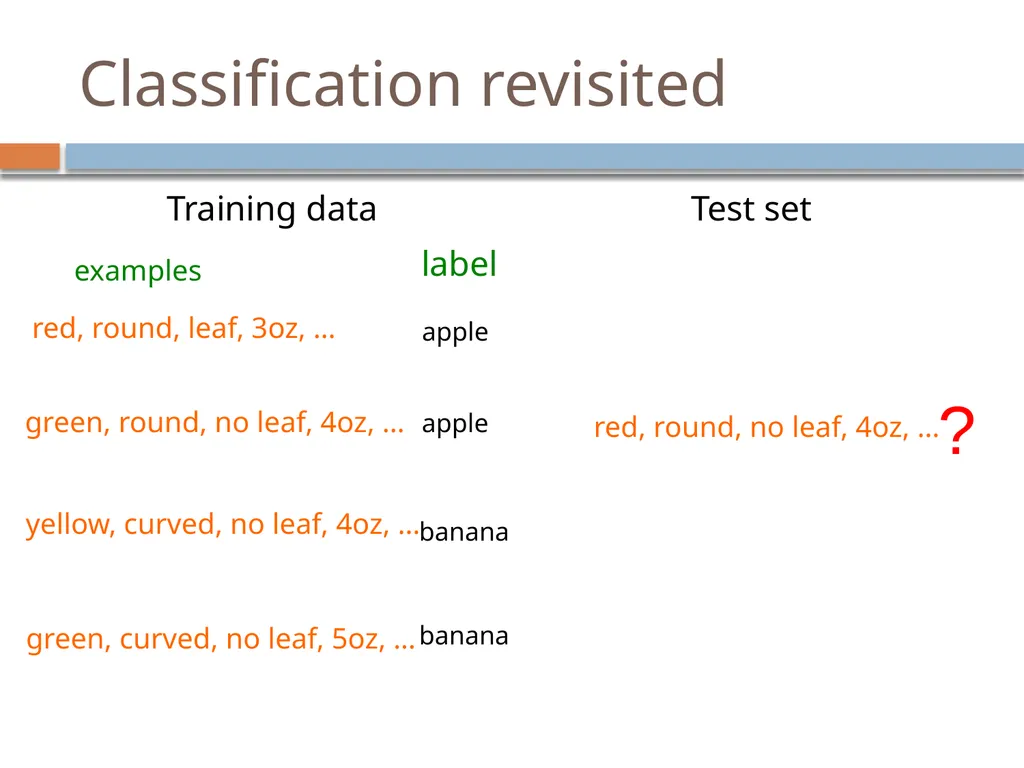
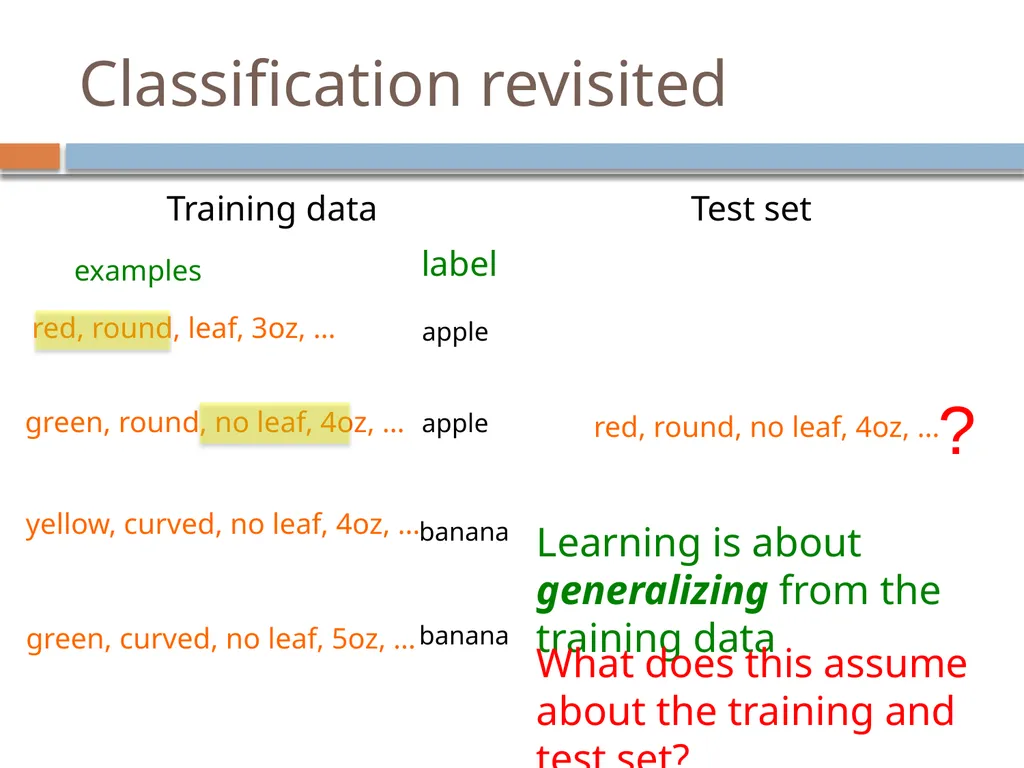
slide43. Classification revisited red, round, leaf, 3oz, … green, round, no leaf, 4oz, … yellow, curved, no leaf, 4oz, … green, curved, no leaf, 5oz, … label apple apple banana banana examples Training data red, round, no leaf, 4oz, … ? Test set<br>
slide44. Classification revisited red, round, leaf, 3oz, … green, round, no leaf, 4oz, … yellow, curved, no leaf, 4oz, … green, curved, no leaf, 5oz, … label apple apple banana banana examples Training data red, round, no leaf, 4oz, … ? Learning is about generalizing from the training data Test set What does this assume about the training and test set?<br>
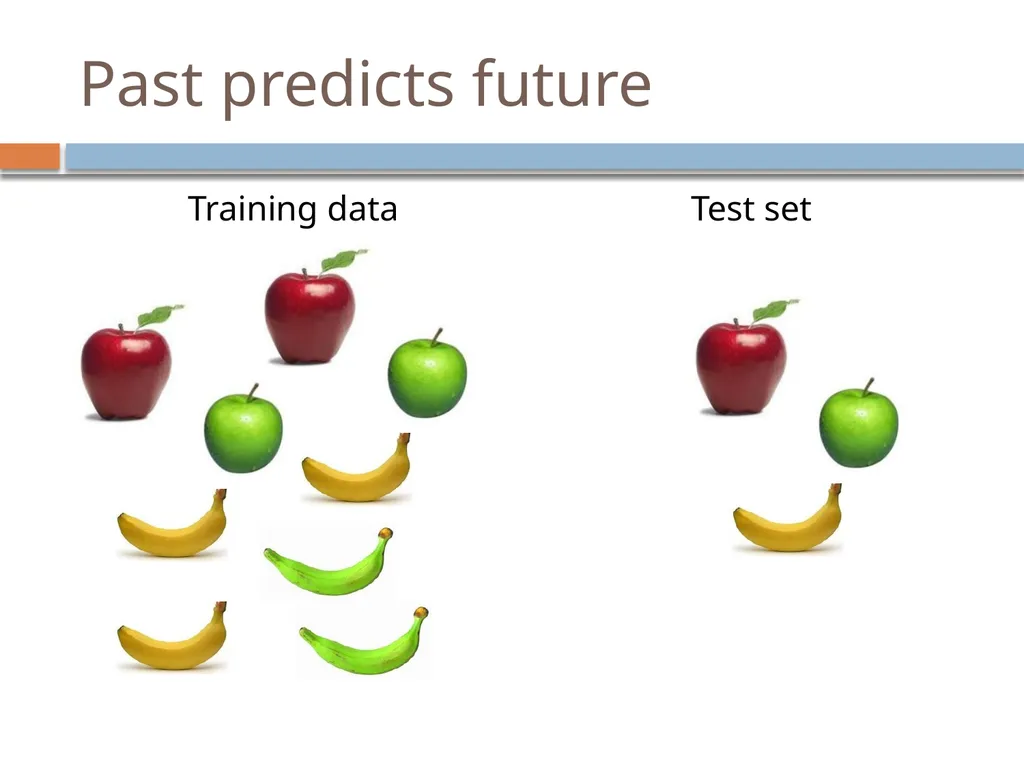
slide45. Past predicts future Training data Test set<br>
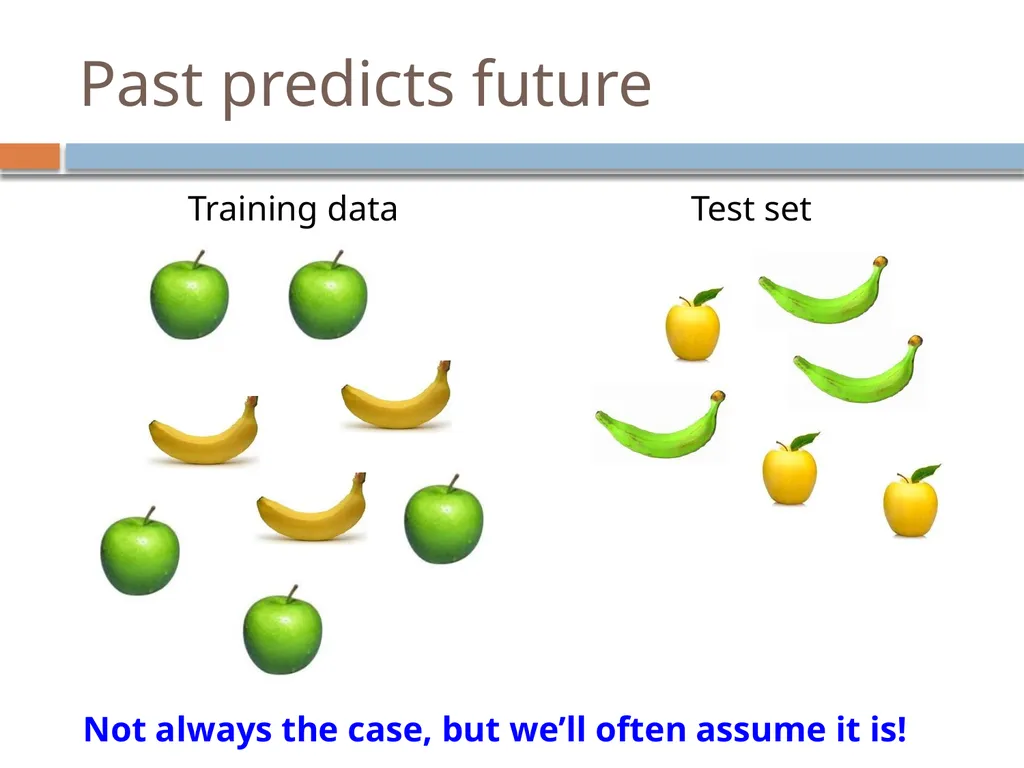
slide46. Past predicts future Training data Test set Not always the case, but we’ll often assume it is!<br>
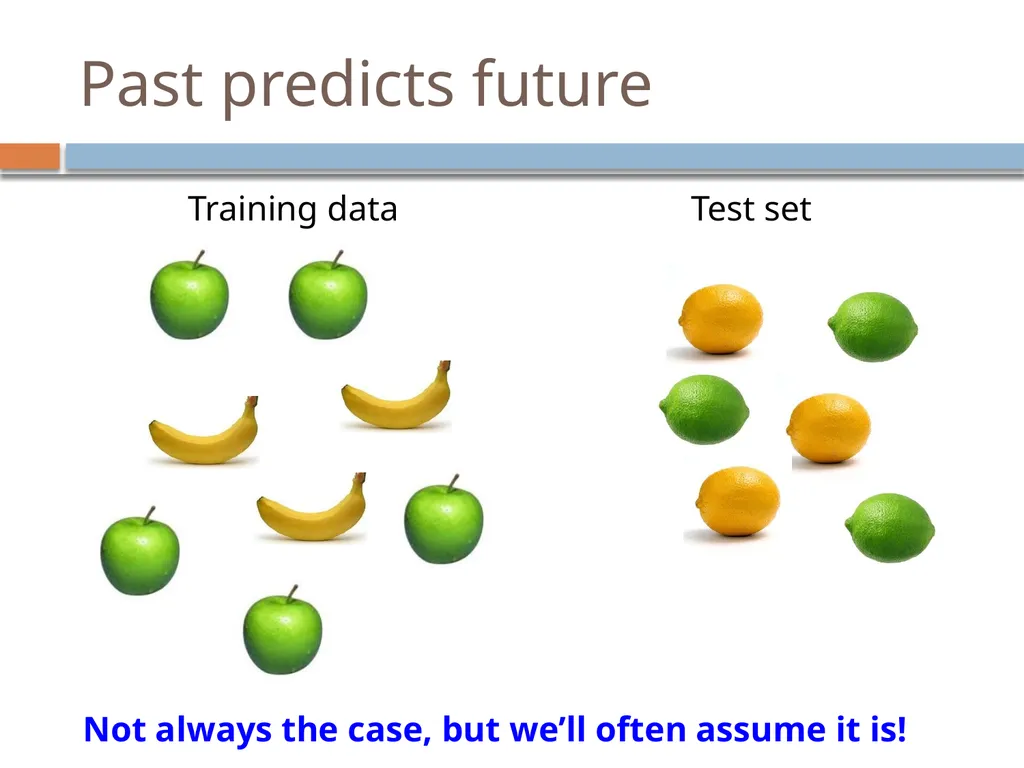
slide47. Past predicts future Training data Test set Not always the case, but we’ll often assume it is!<br>
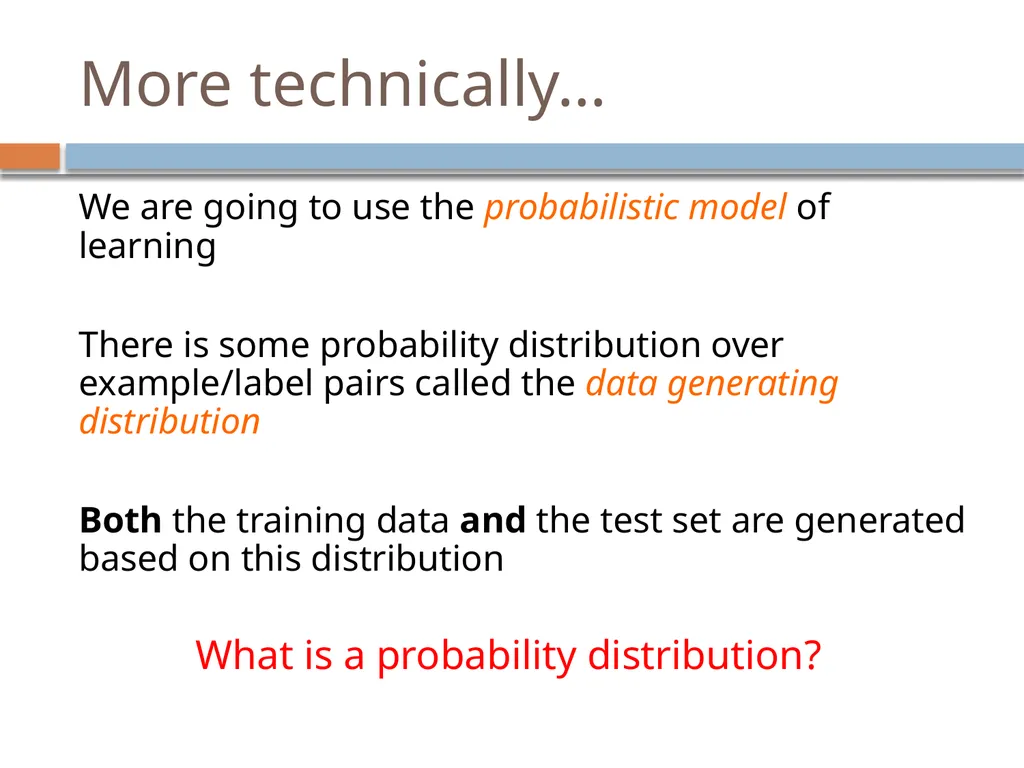
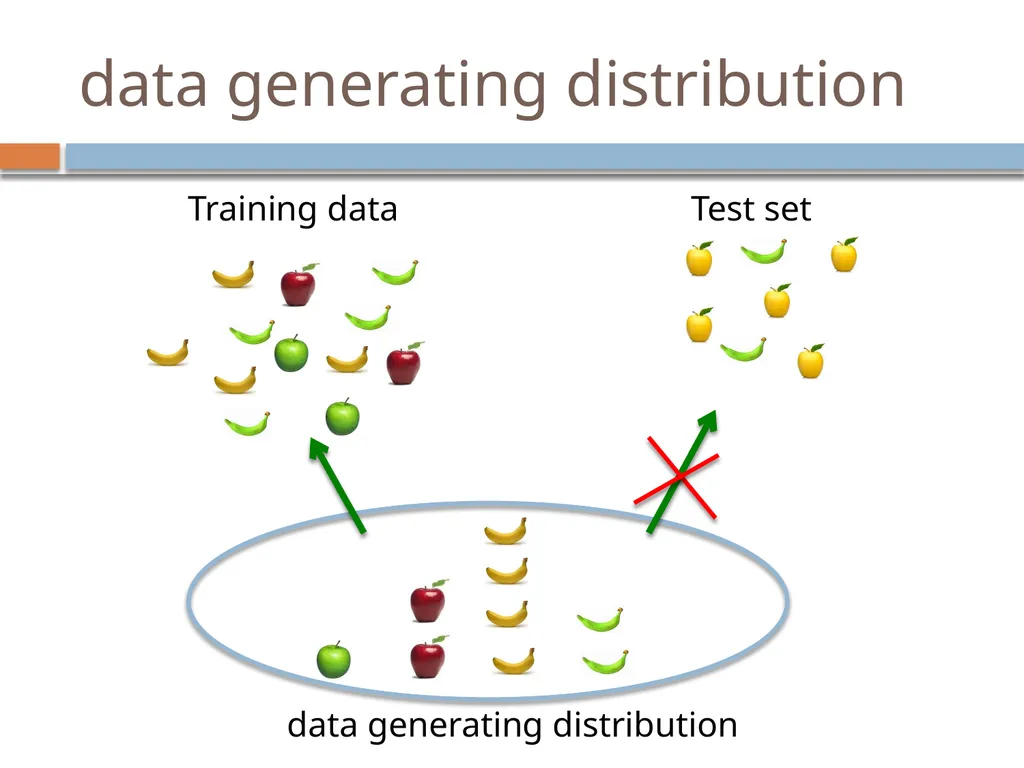
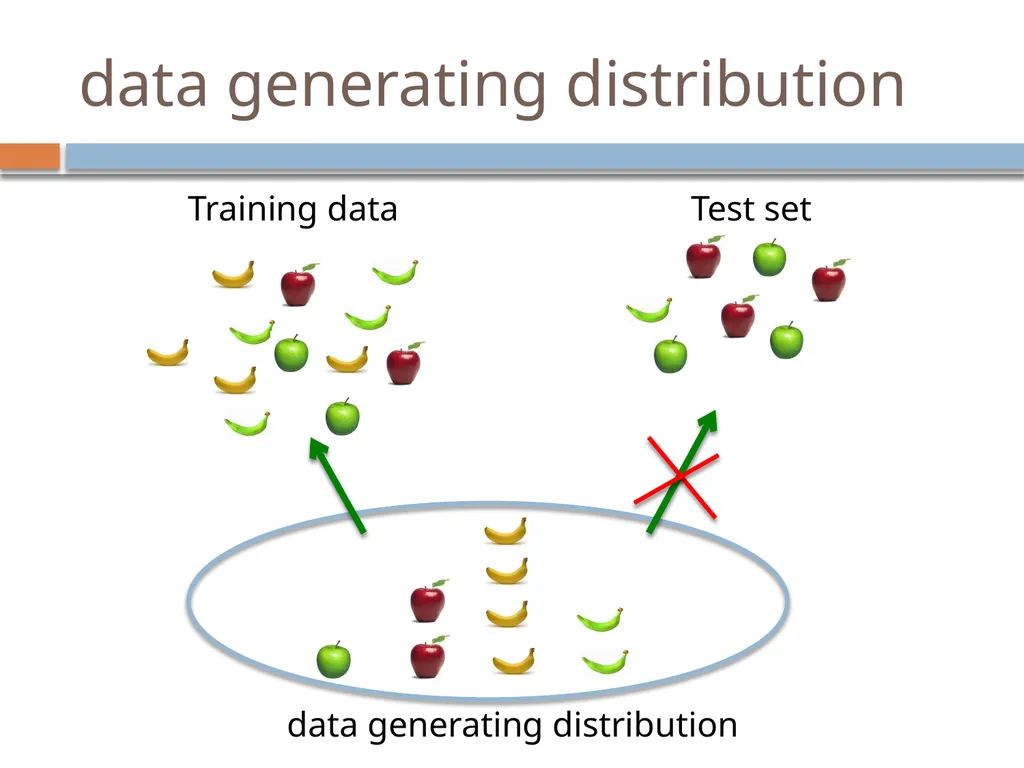
slide48. More technically… We are going to use the probabilistic model of learning
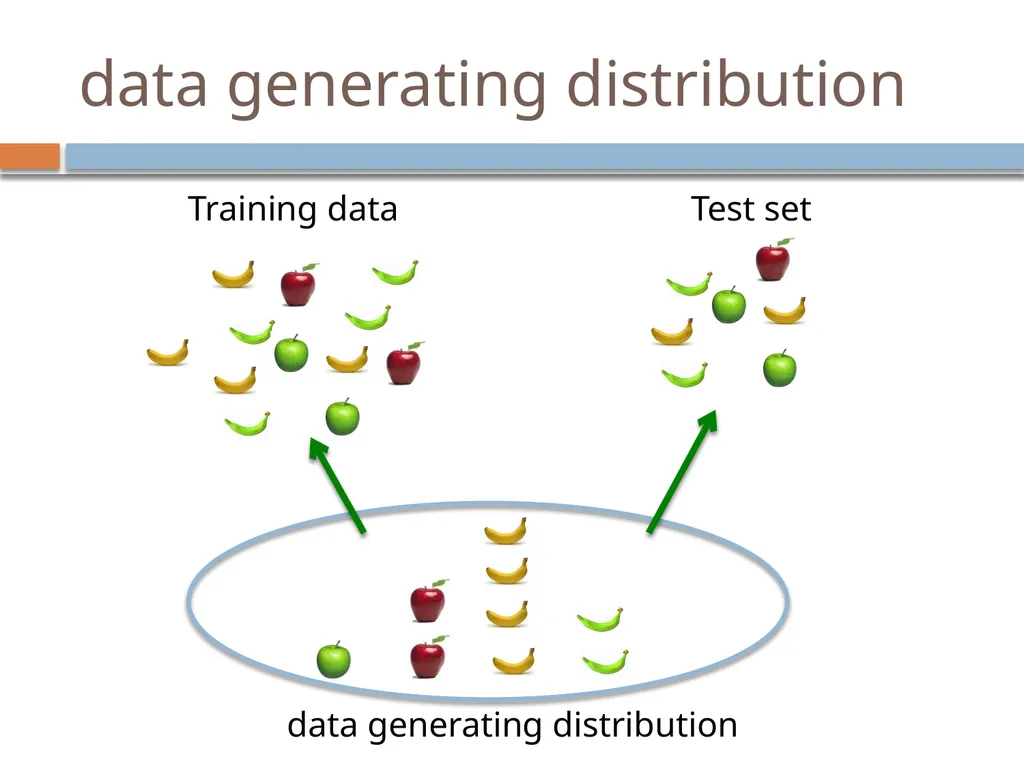
There is some probability distribution over example/label pairs called the data generating distribution
Both the training data and the test set are generated based on this distribution What is a probability distribution?<br>
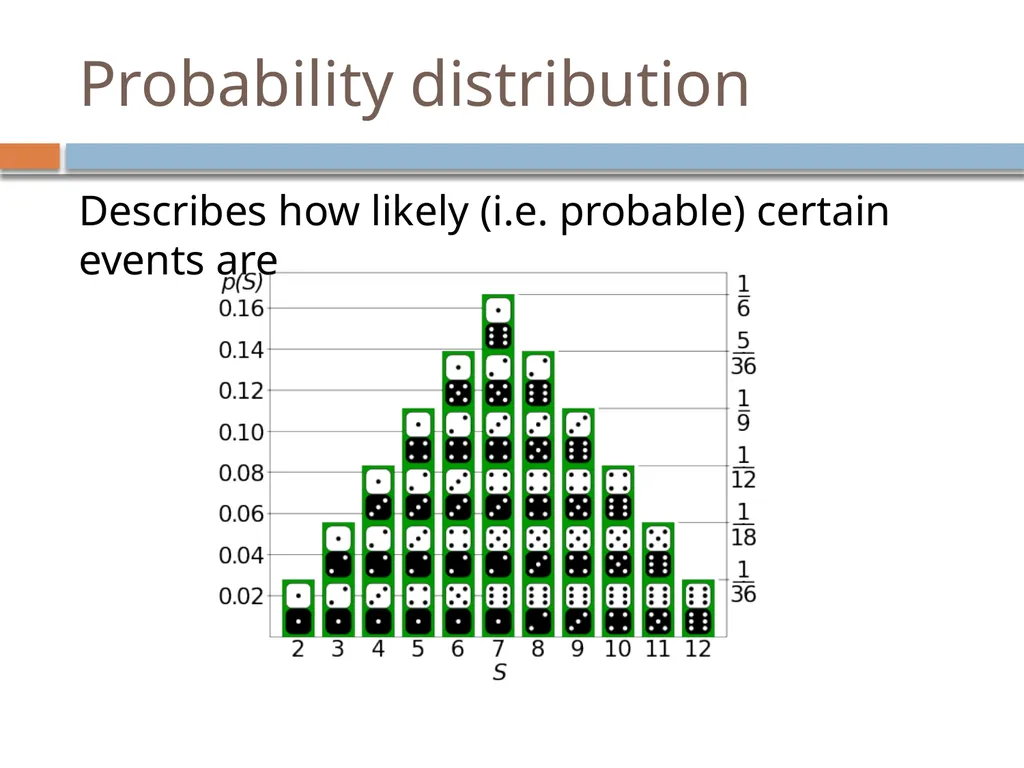
slide49. Probability distribution Describes how likely (i.e. probable) certain events are<br>
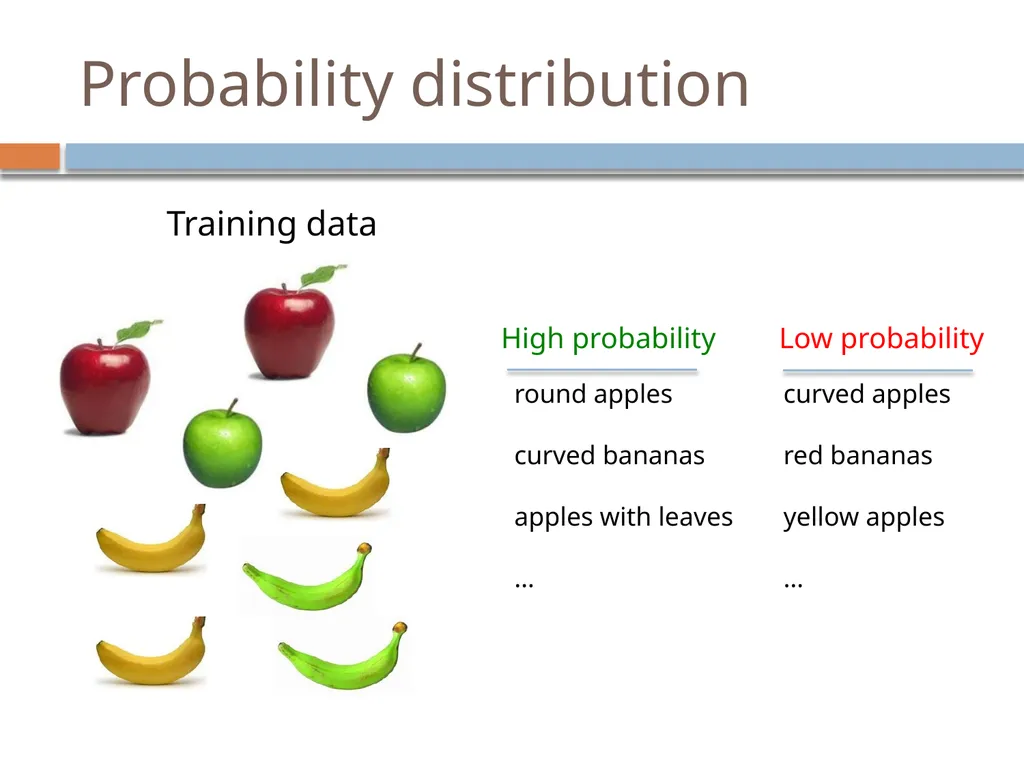
slide50. Probability distribution Training data round apples
curved bananas
apples with leaves
… High probability Low probability curved apples
red bananas
yellow apples
…<br>
slide51. data generating distribution Training data Test set data generating distribution<br>
slide52. data generating distribution Training data Test set data generating distribution<br>
slide53. data generating distribution Training data Test set data generating distribution<br>
slide2. Introduction to Machine Learning David Kauchak CS 158 – Fall 2016<br>
slide3. Why are you here? What is Machine Learning?
Why are you taking this course?
What topics would you like to see covered?<br>
slide4. Machine Learning is… Machine learning is a subfield of computer science that evolved from the study of pattern recognition and computational learning theory in artificial intelligence.<br>
slide5. Machine Learning is… Machine learning is programming computers to optimize a performance criterion using example data or past experience.
-- Ethem Alpaydin
The goal of machine learning is to develop methods that can automatically detect patterns in data, and then to use the uncovered patterns to predict future data or other outcomes of interest.
-- Kevin P. Murphy
The field of pattern recognition is concerned with the automatic discovery of regularities in data through the use of computer algorithms and with the use of these regularities to take actions.
-- Christopher M. Bishop<br>
slide6. Machine Learning is… Machine learning is about predicting the future based on the past.
-- Hal Daume III<br>
slide7. Machine Learning is… Machine learning is about predicting the future based on the past.
-- Hal Daume III Training
Data learn model/
predictor past predict model/
predictor future Testing
Data<br>
slide8. Machine Learning, aka data mining: data analysis, not prediction, though often involves some shared techniques
inference and/or estimation in statistics
pattern recognition in engineering
signal processing in electrical engineering
induction
optimization<br>
slide9. Goals of the course: learn about… Different machine learning problems
Common techniques/tools used
theoretical understanding
practical implementation
Proper experimentation and evaluation
Dealing with large (huge) data sets
Parallelization frameworks
Programming tools<br>
slide10. Goals of the course Be able to laugh at these signs
(or at least know why one might…)<br>
slide11. Administrative Course page:
http://www.cs.pomona.edu/~dkauchak/classes/cs158/
Assignments
Weekly
Mostly programming (Java, mostly)
Some written/write-up
Generally due Sunday evenings
Two “midterm” exams and one final
Late Policy
Collaboration<br>
slide12. Course expectations Plan to stay busy!
Applied class, so lots of programming
Machine learning involves math<br>
slide13. Other things to note Videos before class
Lots of class participation!
Read the book (it’s good)<br>
slide14. Machine learning problems What high-level machine learning problems have you seen or heard of before?<br>
slide15. Data examples Data<br>
slide16. Data examples Data<br>
slide17. Data examples Data<br>
slide18. Data examples Data<br>
slide19. Supervised learning Supervised learning: given labeled examples label label1 label3 label4 label5 labeled examples examples<br>
slide20. Supervised learning Supervised learning: given labeled examples model/
predictor label label1 label3 label4 label5<br>
slide21. Supervised learning model/
predictor Supervised learning: learn to predict new example predicted label<br>
slide22. Supervised learning: classification Supervised learning: given labeled examples label apple apple banana banana Classification: a finite set of labels<br>
slide23. Classification Example Differentiate between low-risk and high-risk customers from their income and savings<br>
slide24. Classification Applications Face recognition
Character recognition
Spam detection
Medical diagnosis: From symptoms to illnesses
Biometrics: Recognition/authentication using physical and/or behavioral characteristics: Face, iris, signature, etc
...<br>
slide25. Supervised learning: regression Supervised learning: given labeled examples label -4.5 10.1 3.2 4.3 Regression: label is real-valued<br>
slide26. Regression Example Price of a used car
x : car attributes (e.g. mileage)
y : price y = wx+w0 26<br>
slide27. Regression Applications Economics/Finance: predict the value of a stock
Epidemiology
Car/plane navigation: angle of the steering wheel, acceleration, …
Temporal trends: weather over time
…<br>
slide28. Supervised learning: ranking Supervised learning: given labeled examples label 1 4 2 3 Ranking: label is a ranking<br>
slide29. Ranking example Given a query and
a set of web pages,
rank them according
to relevance<br>
slide30. Ranking Applications User preference, e.g. Netflix “My List” -- movie queue ranking
iTunes
flight search (search in general)
reranking N-best output lists
…<br>
slide31. Unsupervised learning Unupervised learning: given data, i.e. examples, but no labels<br>
slide32. Unsupervised learning applications learn clusters/groups without any label
customer segmentation (i.e. grouping)
image compression
bioinformatics: learn motifs
…<br>
slide33. Reinforcement learning left, right, straight, left, left, left, straight left, straight, straight, left, right, straight, straight GOOD BAD left, right, straight, left, left, left, straight left, straight, straight, left, right, straight, straight 18.5 -3 Given a sequence of examples/states and a reward after completing that sequence, learn to predict the action to take in for an individual example/state<br>
slide34. Reinforcement learning example … WIN! … LOSE! Backgammon Given sequences of moves and whether or not the player won at the end, learn to make good moves<br>
slide35. Reinforcement learning example http://www.youtube.com/watch?v=VCdxqn0fcnE<br>
slide36. Other learning variations What data is available:
Supervised, unsupervised, reinforcement learning
semi-supervised, active learning, …
How are we getting the data:
online vs. offline learning
Type of model:
generative vs. discriminative
parametric vs. non-parametric<br>
slide37. Representing examples examples What is an example?
How is it represented?<br>
slide38. Features examples f1, f2, f3, …, fn features f1, f2, f3, …, fn f1, f2, f3, …, fn f1, f2, f3, …, fn How our algorithms actually “view” the data
Features are the questions we can ask about the examples<br>
slide39. Features examples red, round, leaf, 3oz, … features How our algorithms actually “view” the data
Features are the questions we can ask about the examples green, round, no leaf, 4oz, … yellow, curved, no leaf, 8oz, … green, curved, no leaf, 7oz, …<br>
slide40. Classification revisited red, round, leaf, 3oz, … green, round, no leaf, 4oz, … yellow, curved, no leaf, 8oz, … green, curved, no leaf, 7oz, … label apple apple banana banana examples model/
classifier learn During learning/training/induction, learn a model of what distinguishes apples and bananas based on the features<br>
slide41. Classification revisited red, round, no leaf, 4oz, … model/
classifier The model can then classify a new example based on the features predict Apple or banana?<br>
slide42. Classification revisited red, round, no leaf, 4oz, … model/
classifier The model can then classify a new example based on the features predict Apple Why?<br>
slide43. Classification revisited red, round, leaf, 3oz, … green, round, no leaf, 4oz, … yellow, curved, no leaf, 4oz, … green, curved, no leaf, 5oz, … label apple apple banana banana examples Training data red, round, no leaf, 4oz, … ? Test set<br>
slide44. Classification revisited red, round, leaf, 3oz, … green, round, no leaf, 4oz, … yellow, curved, no leaf, 4oz, … green, curved, no leaf, 5oz, … label apple apple banana banana examples Training data red, round, no leaf, 4oz, … ? Learning is about generalizing from the training data Test set What does this assume about the training and test set?<br>
slide45. Past predicts future Training data Test set<br>
slide46. Past predicts future Training data Test set Not always the case, but we’ll often assume it is!<br>
slide47. Past predicts future Training data Test set Not always the case, but we’ll often assume it is!<br>
slide48. More technically… We are going to use the probabilistic model of learning
There is some probability distribution over example/label pairs called the data generating distribution
Both the training data and the test set are generated based on this distribution What is a probability distribution?<br>
slide49. Probability distribution Describes how likely (i.e. probable) certain events are<br>
slide50. Probability distribution Training data round apples
curved bananas
apples with leaves
… High probability Low probability curved apples
red bananas
yellow apples
…<br>
slide51. data generating distribution Training data Test set data generating distribution<br>
slide52. data generating distribution Training data Test set data generating distribution<br>
slide53. data generating distribution Training data Test set data generating distribution<br>