
Ideal CSTR Design Eq with XA: Review: Design Eq &

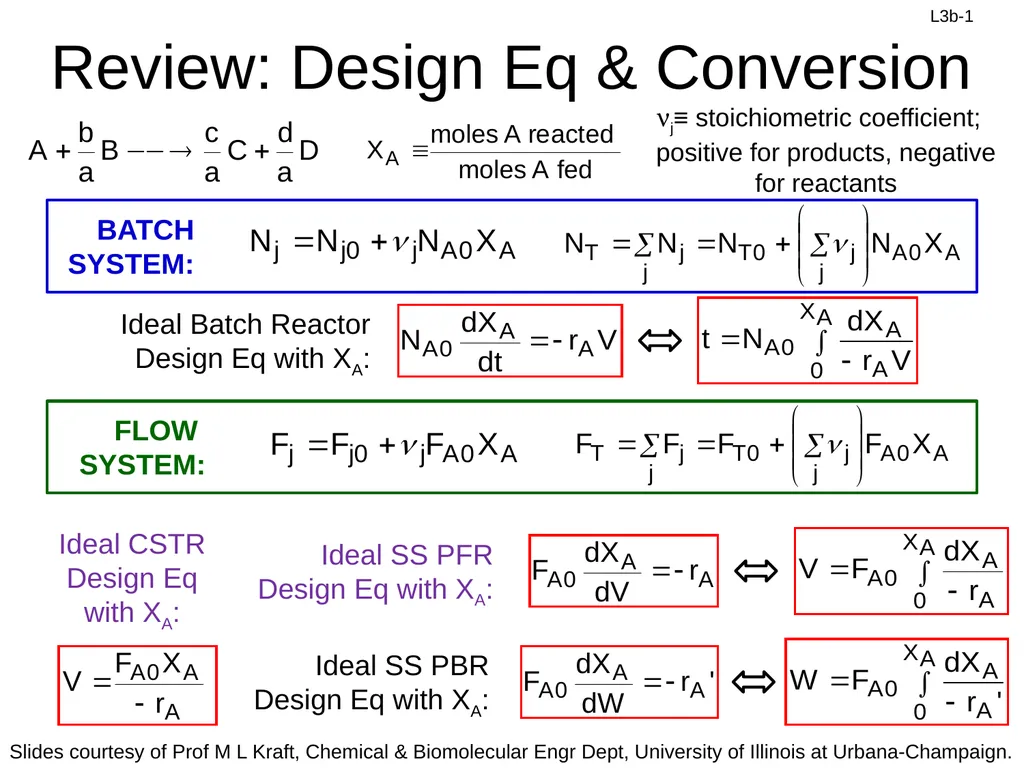


Description: Ideal CSTR Design Eq with XA: Review: Design Eq Conversion nj stoichiometric coefficient; positive for products, negative for reactants Review: Sizing CSTRs We can determine the volume of the CSTR required to achieve a specific
Related Topics
Download Presentation
"Ideal CSTR Design Eq with XA: Review: Design Eq &" is the property of its rightful owner. Permission is granted to download and print the materials on this website for personal, non-commercial use only, and to display it on your personal computer provided you do not modify the materials and that you retain all copyright notices contained in the materials. By downloading content from our website, you accept the terms of this agreement.
Presentation Transcript
slide1. Ideal CSTR Design Eq with XA: Review: Design Eq & Conversion nj≡ stoichiometric coefficient; positive for products, negative for reactants<br>
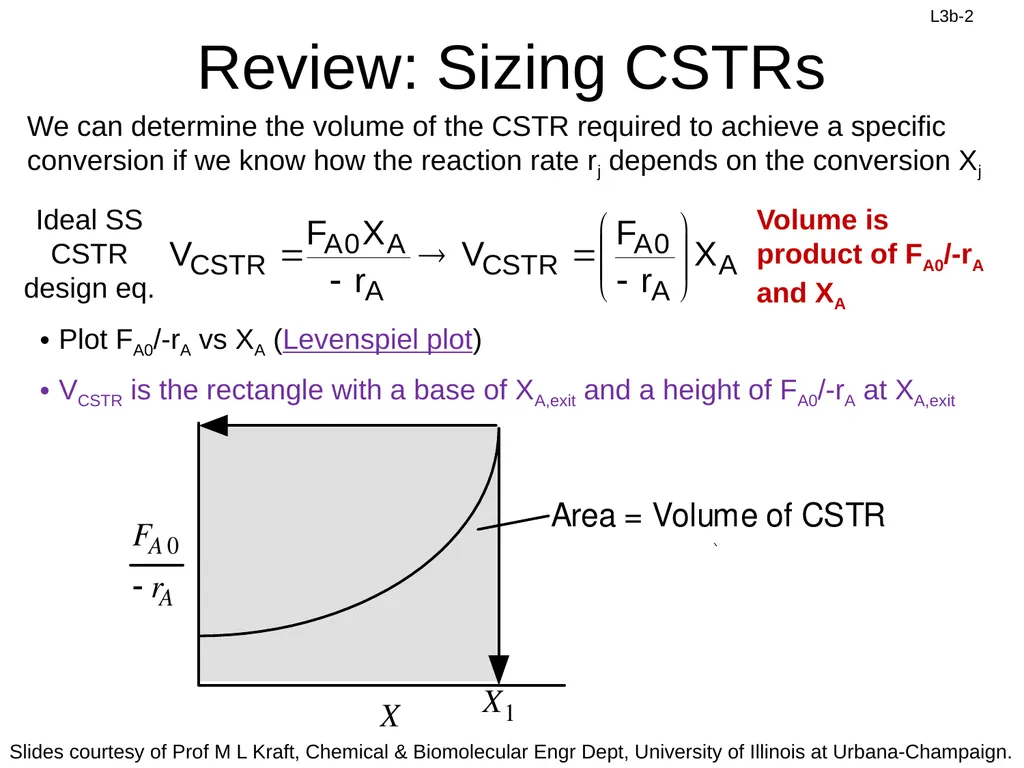
slide2. Review: Sizing CSTRs We can determine the volume of the CSTR required to achieve a specific conversion if we know how the reaction rate rj depends on the conversion Xj Ideal SS CSTR design eq. Volume is product of FA0/-rA and XA Plot FA0/-rA vs XA (Levenspiel plot)
VCSTR is the rectangle with a base of XA,exit and a height of FA0/-rA at XA,exit<br>
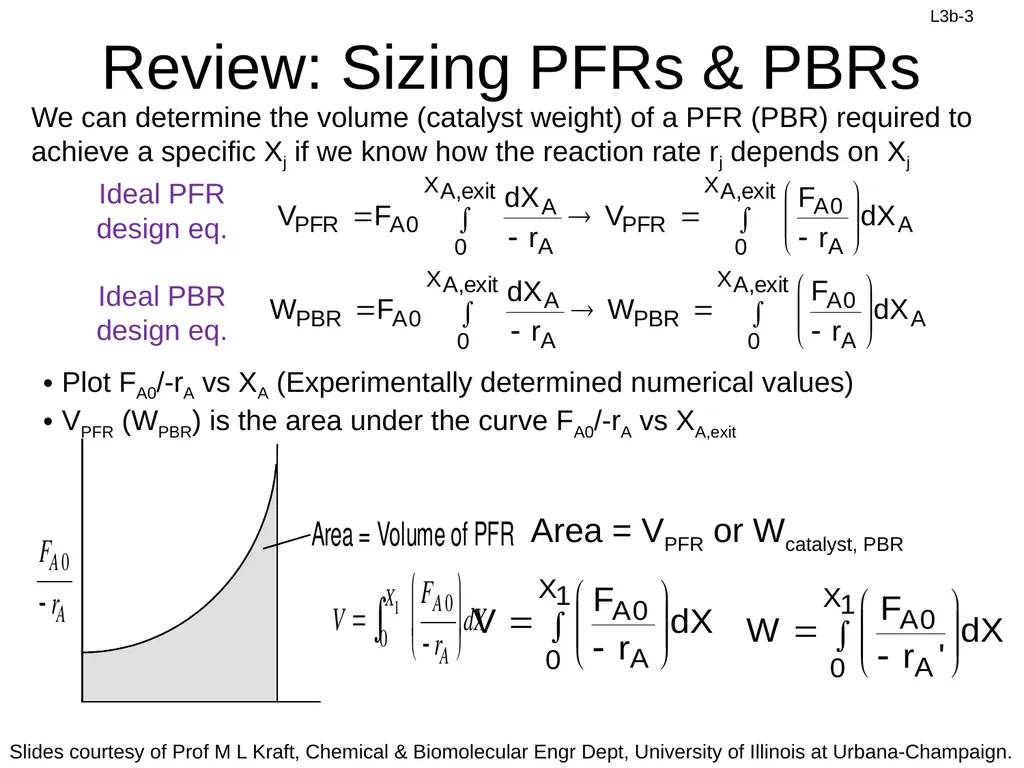
slide3. Area = VPFR or Wcatalyst, PBR Review: Sizing PFRs & PBRs We can determine the volume (catalyst weight) of a PFR (PBR) required to achieve a specific Xj if we know how the reaction rate rj depends on Xj Ideal PFR design eq. Plot FA0/-rA vs XA (Experimentally determined numerical values)
VPFR (WPBR) is the area under the curve FA0/-rA vs XA,exit Ideal PBR design eq.<br>
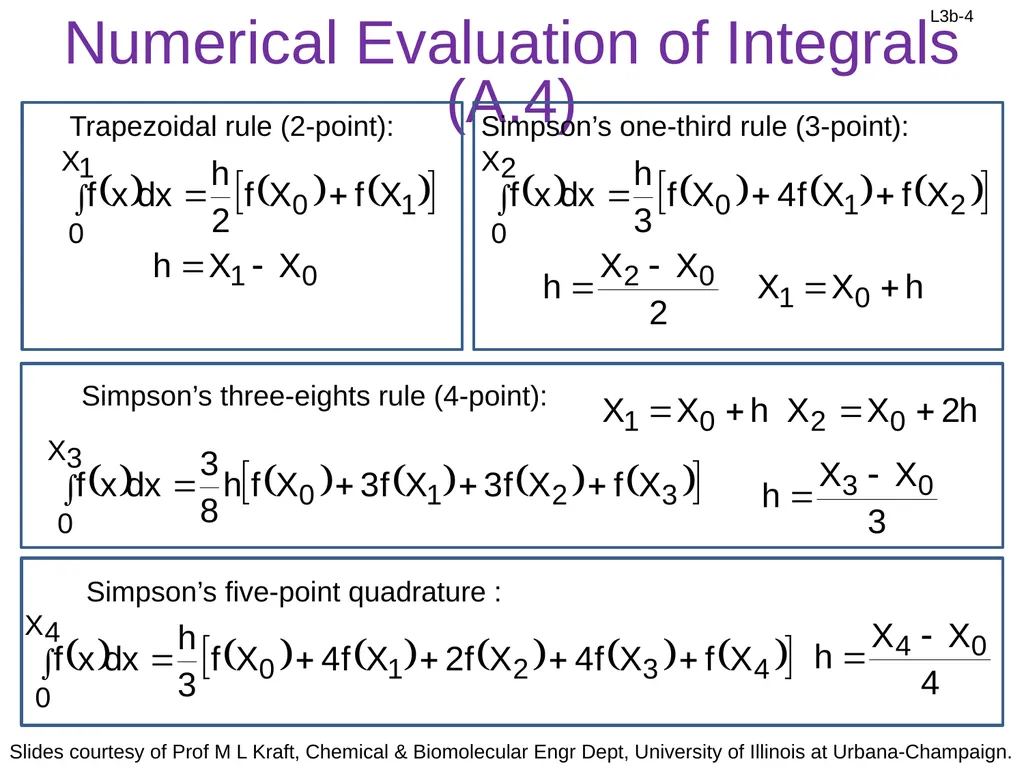
slide4. Numerical Evaluation of Integrals (A.4) Simpson’s one-third rule (3-point): Trapezoidal rule (2-point): Simpson’s three-eights rule (4-point): Simpson’s five-point quadrature :<br>
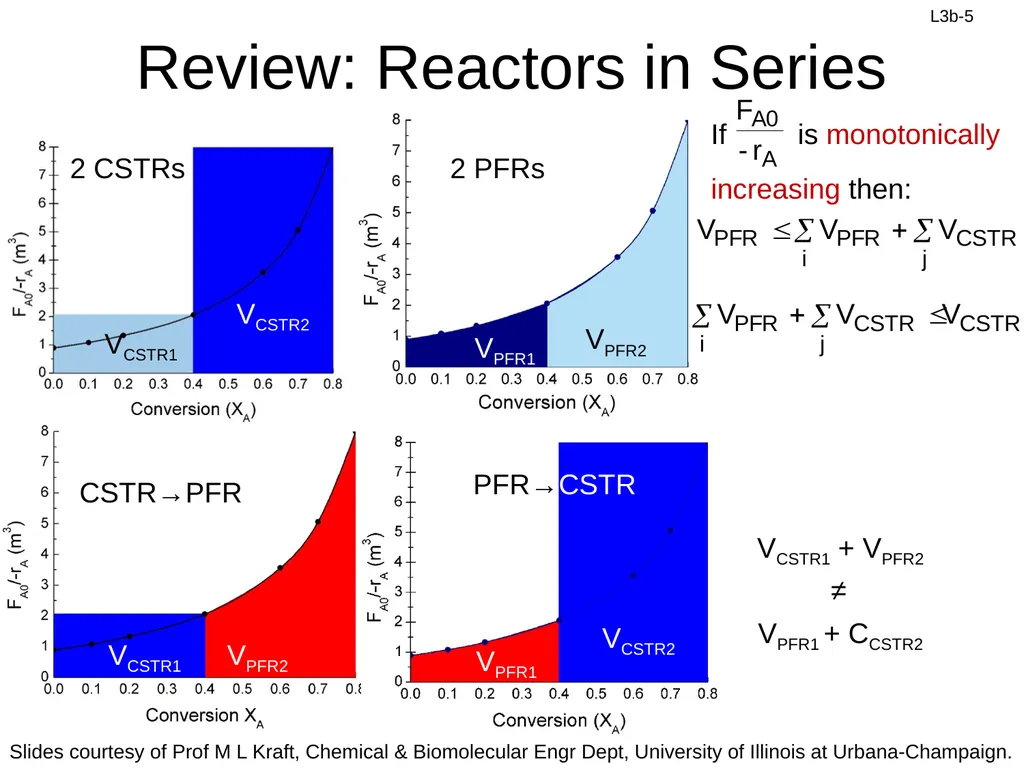
slide5. Review: Reactors in Series 2 CSTRs 2 PFRs CSTR→PFR VCSTR1 VPFR2 VPFR2 VCSTR1 VCSTR2 VPFR1 VPFR1 VCSTR2 VCSTR1 + VPFR2
≠
VPFR1 + CCSTR2 PFR→CSTR If is monotonically
increasing then:<br>
slide6. Chapter 2 Examples<br>
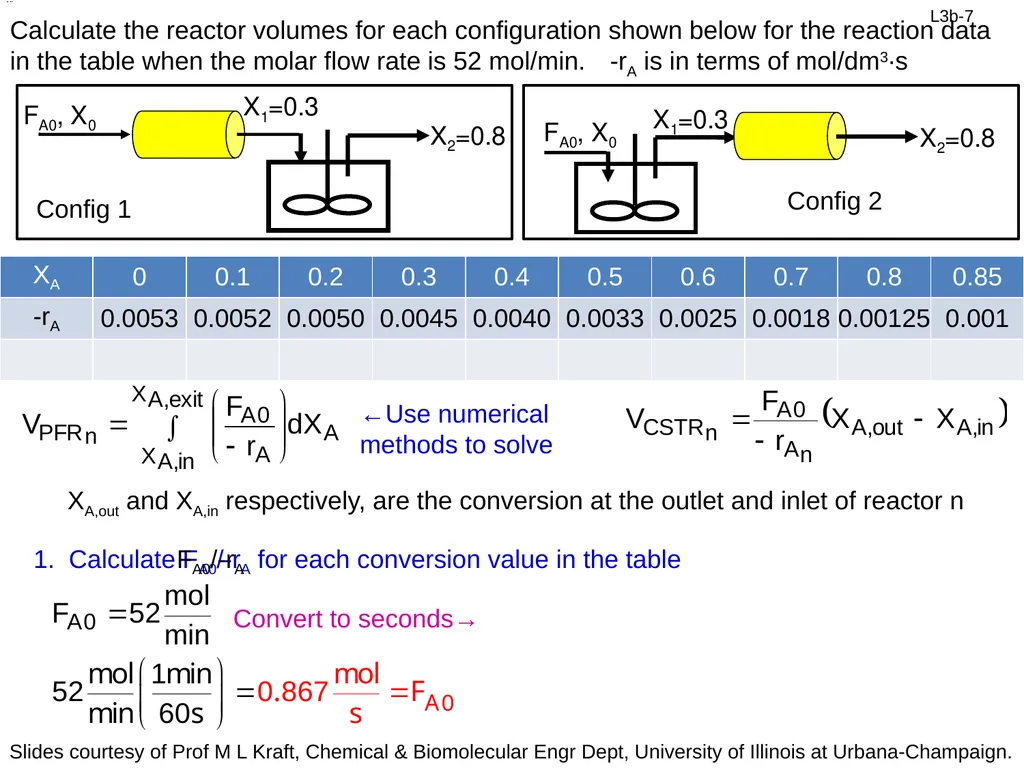
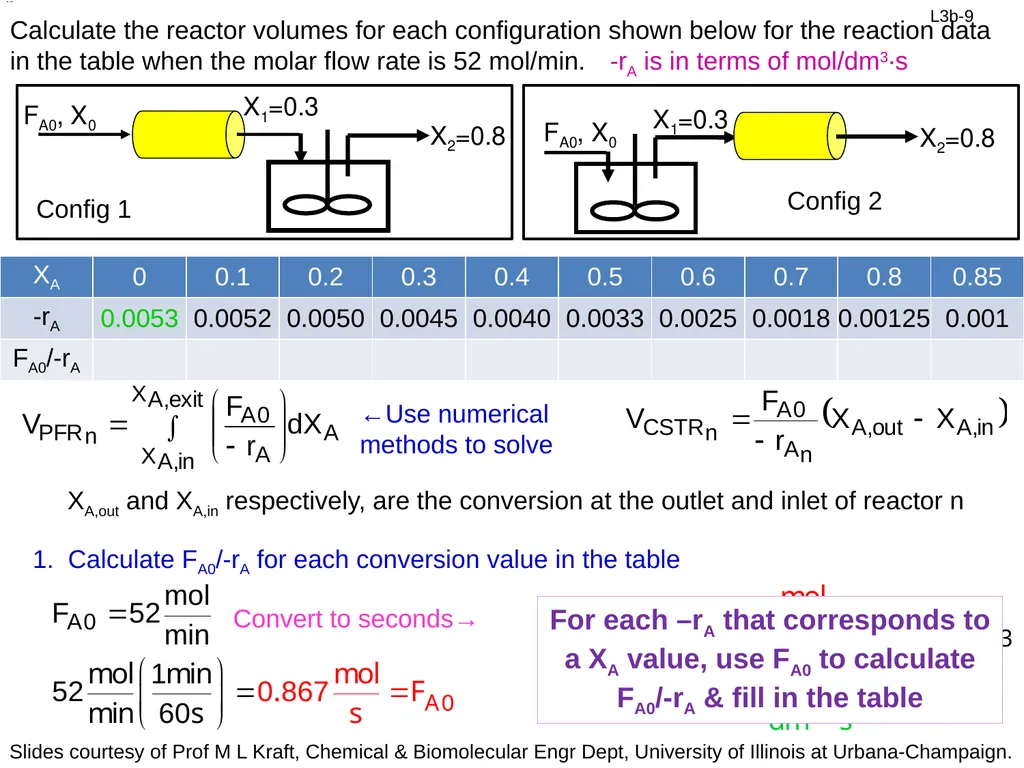
slide7. 1. Calculate FA0/-rA for each conversion value in the table FA0/-rA Calculate the reactor volumes for each configuration shown below for the reaction data in the table when the molar flow rate is 52 mol/min. X1=0.3 FA0, X0 X2=0.8 Config 2 ←Use numerical methods to solve XA,out and XA,in respectively, are the conversion at the outlet and inlet of reactor n Convert to seconds→ -rA is in terms of mol/dm3∙s<br>
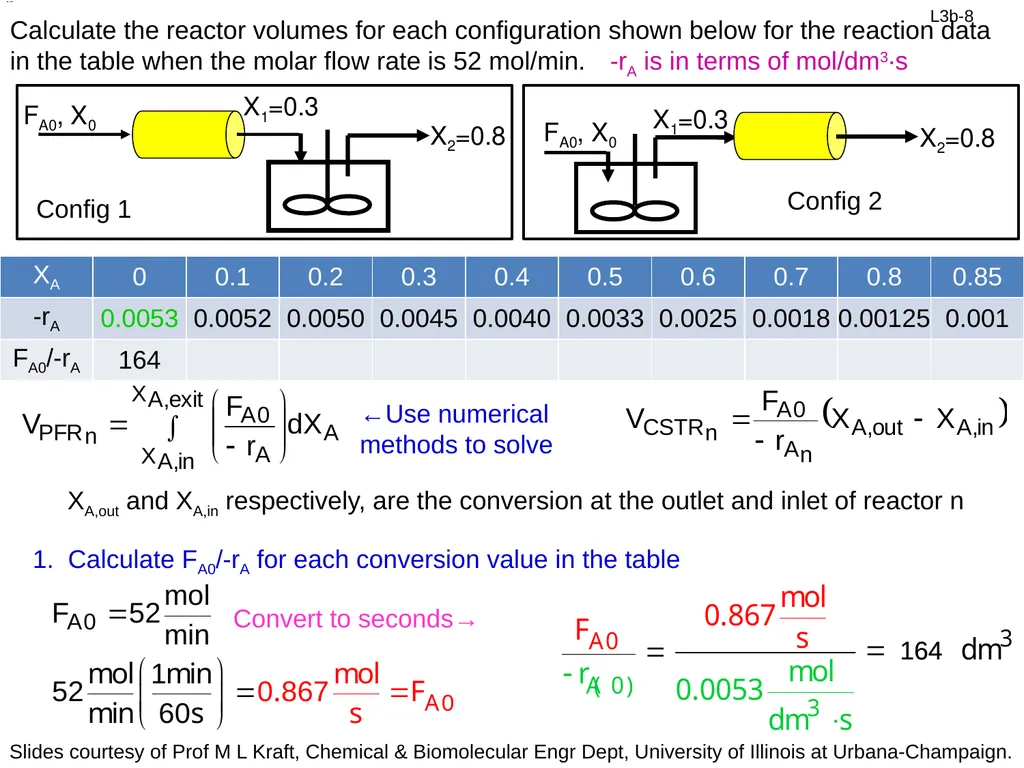
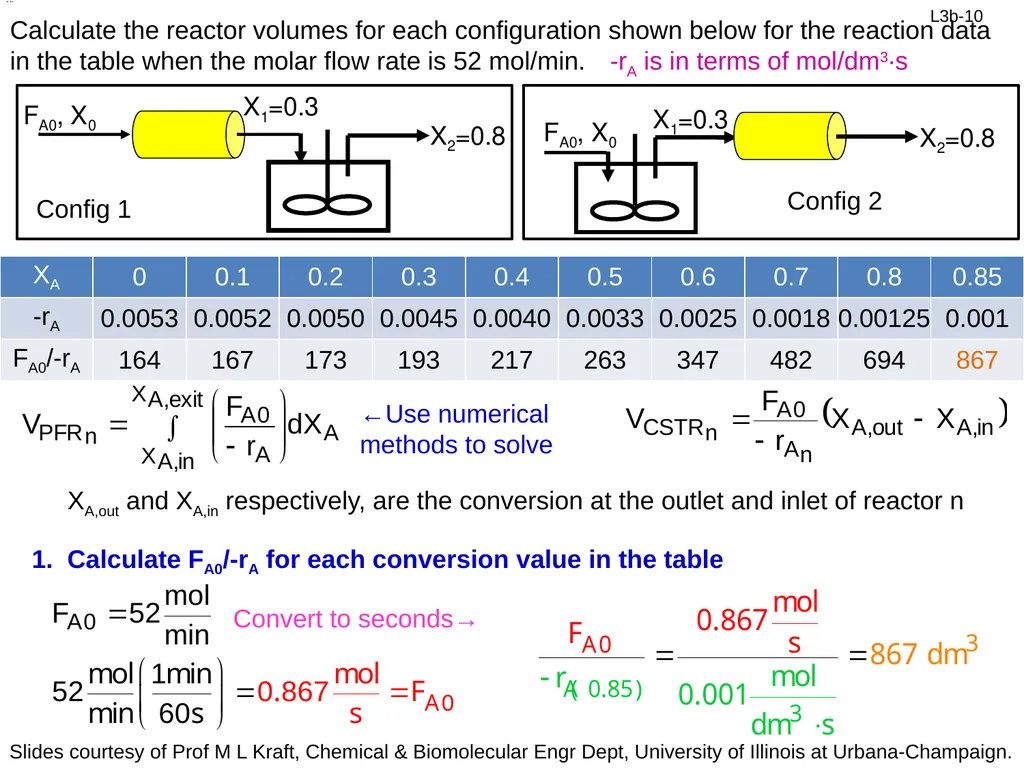
slide8. 164 1. Calculate FA0/-rA for each conversion value in the table Calculate the reactor volumes for each configuration shown below for the reaction data in the table when the molar flow rate is 52 mol/min. X1=0.3 FA0, X0 X2=0.8 Config 2 ←Use numerical methods to solve -rA is in terms of mol/dm3∙s 164 XA,out and XA,in respectively, are the conversion at the outlet and inlet of reactor n Convert to seconds→<br>
slide9. 164 1. Calculate FA0/-rA for each conversion value in the table Calculate the reactor volumes for each configuration shown below for the reaction data in the table when the molar flow rate is 52 mol/min. X1=0.3 FA0, X0 X2=0.8 Config 2 ←Use numerical methods to solve -rA is in terms of mol/dm3∙s 164 XA,out and XA,in respectively, are the conversion at the outlet and inlet of reactor n Convert to seconds→ For each –rA that corresponds to a XA value, use FA0 to calculate FA0/-rA & fill in the table<br>
slide10. X1=0.3 FA0, X0 1. Calculate FA0/-rA for each conversion value in the table Calculate the reactor volumes for each configuration shown below for the reaction data in the table when the molar flow rate is 52 mol/min. X2=0.8 Config 2 ←Use numerical methods to solve Convert to seconds→ -rA is in terms of mol/dm3∙s XA,out and XA,in respectively, are the conversion at the outlet and inlet of reactor n<br>
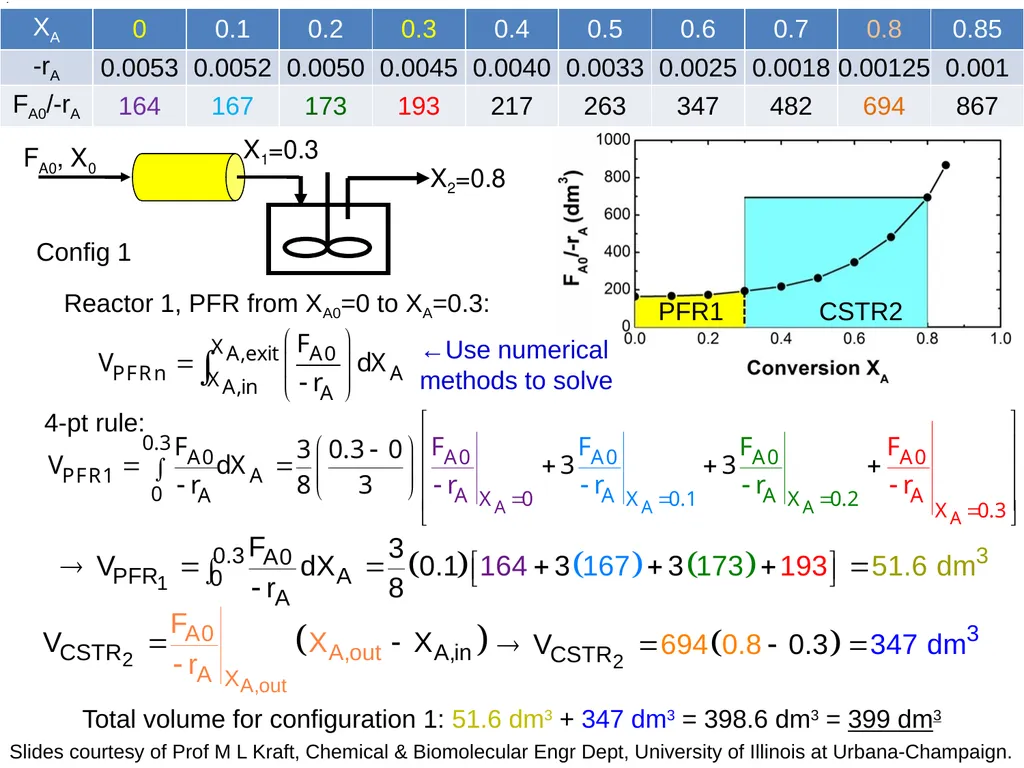
slide11. Reactor 1, PFR from XA0=0 to XA=0.3: 4-pt rule: Total volume for configuration 1: 51.6 dm3 + 347 dm3 = 398.6 dm3 = 399 dm3 ←Use numerical methods to solve<br>
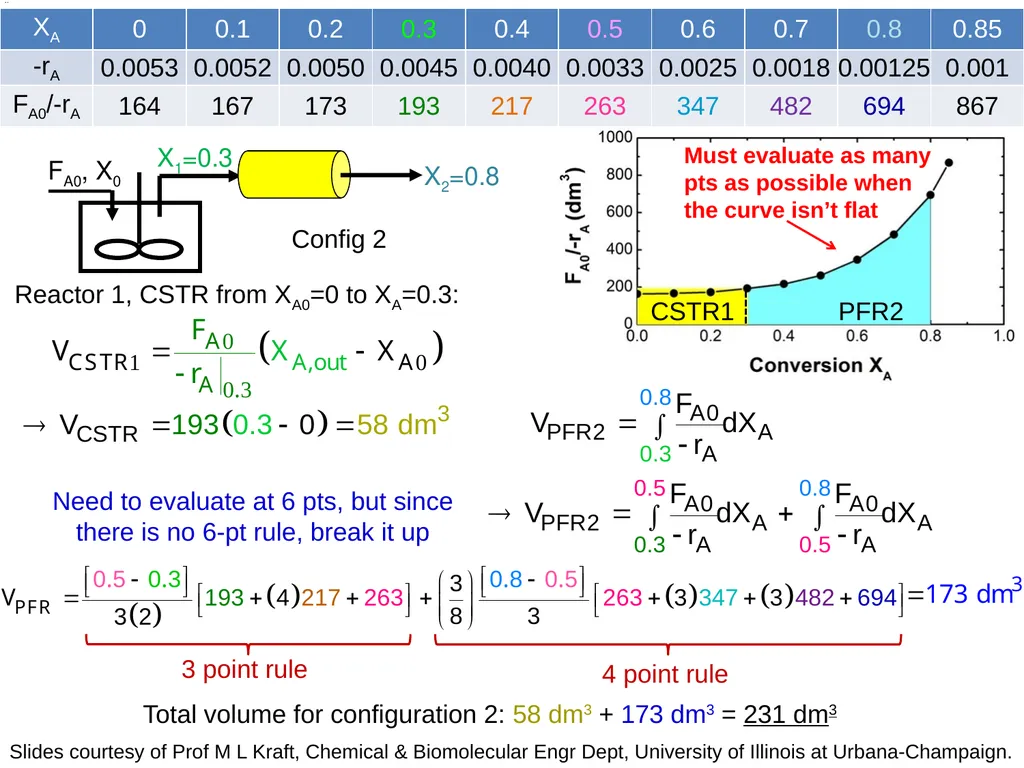
slide12. Reactor 1, CSTR from XA0=0 to XA=0.3: Need to evaluate at 6 pts, but since there is no 6-pt rule, break it up Total volume for configuration 2: 58 dm3 + 173 dm3 = 231 dm3 3 point rule 4 point rule Must evaluate as many pts as possible when the curve isn’t flat<br>
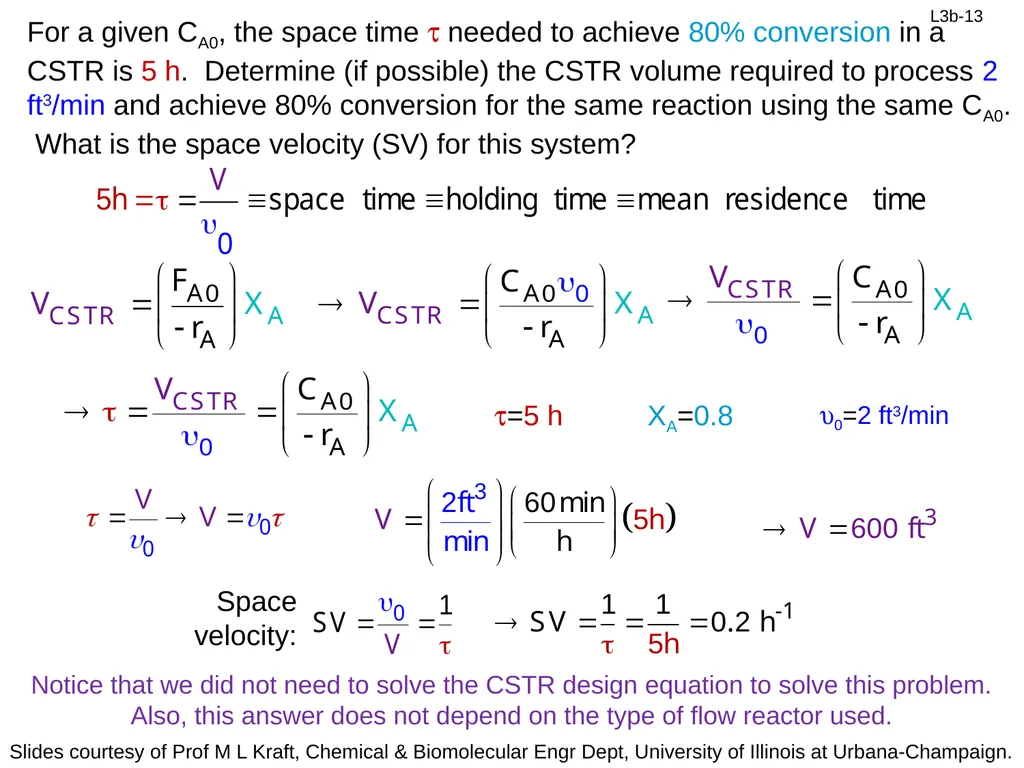
slide13. For a given CA0, the space time t needed to achieve 80% conversion in a CSTR is 5 h. Determine (if possible) the CSTR volume required to process 2 ft3/min and achieve 80% conversion for the same reaction using the same CA0. What is the space velocity (SV) for this system? t=5 h u0=2 ft3/min Space velocity: Notice that we did not need to solve the CSTR design equation to solve this problem.
Also, this answer does not depend on the type of flow reactor used. XA=0.8<br>
slide14. A product is produced by a nonisothermal, nonelementary, multiple-reaction mechanism. Assume the volumetric flow rate is constant & the same in both reactors. Data for this reaction is shown in the graph below. Use this graph to determine which of the 2 configurations that follow give the smaller total reactor volume. Since u0 is the same in both reactors, we can use this graph to compare the 2 configurations
PFR- volume is u0 multiplied by the area under the curve between XA,in & XA,out
CSTR- volume is u0 multiplied by the product of CA0/-rA,outlet times (XA,out - XA,in)<br>
slide15. A product is produced by a nonisothermal, nonelementary, multiple-reaction mechanism. Assume the volumetric flow rate is constant & the same in both reactors. Data for this reaction is shown in the graph below. Use this graph to determine which of the 2 configurations that follow give the smaller total reactor volume. PFR- V is u0 multiplied by the area under the curve between XA,in & XA,out
CSTR- V is u0 multiplied by the product of CA0/-rA,outlet times (XA,out - XA,in) Config 1 Config 2 Less shaded area Config 2 (PFRXA,out=0.3 first, and CSTRXA,out=0.7 second) has the smaller VTotal XA = 0.3 XA = 0.7 XA = 0.3 XA = 0.7<br>
slide2. Review: Sizing CSTRs We can determine the volume of the CSTR required to achieve a specific conversion if we know how the reaction rate rj depends on the conversion Xj Ideal SS CSTR design eq. Volume is product of FA0/-rA and XA Plot FA0/-rA vs XA (Levenspiel plot)
VCSTR is the rectangle with a base of XA,exit and a height of FA0/-rA at XA,exit<br>
slide3. Area = VPFR or Wcatalyst, PBR Review: Sizing PFRs & PBRs We can determine the volume (catalyst weight) of a PFR (PBR) required to achieve a specific Xj if we know how the reaction rate rj depends on Xj Ideal PFR design eq. Plot FA0/-rA vs XA (Experimentally determined numerical values)
VPFR (WPBR) is the area under the curve FA0/-rA vs XA,exit Ideal PBR design eq.<br>
slide4. Numerical Evaluation of Integrals (A.4) Simpson’s one-third rule (3-point): Trapezoidal rule (2-point): Simpson’s three-eights rule (4-point): Simpson’s five-point quadrature :<br>
slide5. Review: Reactors in Series 2 CSTRs 2 PFRs CSTR→PFR VCSTR1 VPFR2 VPFR2 VCSTR1 VCSTR2 VPFR1 VPFR1 VCSTR2 VCSTR1 + VPFR2
≠
VPFR1 + CCSTR2 PFR→CSTR If is monotonically
increasing then:<br>
slide6. Chapter 2 Examples<br>
slide7. 1. Calculate FA0/-rA for each conversion value in the table FA0/-rA Calculate the reactor volumes for each configuration shown below for the reaction data in the table when the molar flow rate is 52 mol/min. X1=0.3 FA0, X0 X2=0.8 Config 2 ←Use numerical methods to solve XA,out and XA,in respectively, are the conversion at the outlet and inlet of reactor n Convert to seconds→ -rA is in terms of mol/dm3∙s<br>
slide8. 164 1. Calculate FA0/-rA for each conversion value in the table Calculate the reactor volumes for each configuration shown below for the reaction data in the table when the molar flow rate is 52 mol/min. X1=0.3 FA0, X0 X2=0.8 Config 2 ←Use numerical methods to solve -rA is in terms of mol/dm3∙s 164 XA,out and XA,in respectively, are the conversion at the outlet and inlet of reactor n Convert to seconds→<br>
slide9. 164 1. Calculate FA0/-rA for each conversion value in the table Calculate the reactor volumes for each configuration shown below for the reaction data in the table when the molar flow rate is 52 mol/min. X1=0.3 FA0, X0 X2=0.8 Config 2 ←Use numerical methods to solve -rA is in terms of mol/dm3∙s 164 XA,out and XA,in respectively, are the conversion at the outlet and inlet of reactor n Convert to seconds→ For each –rA that corresponds to a XA value, use FA0 to calculate FA0/-rA & fill in the table<br>
slide10. X1=0.3 FA0, X0 1. Calculate FA0/-rA for each conversion value in the table Calculate the reactor volumes for each configuration shown below for the reaction data in the table when the molar flow rate is 52 mol/min. X2=0.8 Config 2 ←Use numerical methods to solve Convert to seconds→ -rA is in terms of mol/dm3∙s XA,out and XA,in respectively, are the conversion at the outlet and inlet of reactor n<br>
slide11. Reactor 1, PFR from XA0=0 to XA=0.3: 4-pt rule: Total volume for configuration 1: 51.6 dm3 + 347 dm3 = 398.6 dm3 = 399 dm3 ←Use numerical methods to solve<br>
slide12. Reactor 1, CSTR from XA0=0 to XA=0.3: Need to evaluate at 6 pts, but since there is no 6-pt rule, break it up Total volume for configuration 2: 58 dm3 + 173 dm3 = 231 dm3 3 point rule 4 point rule Must evaluate as many pts as possible when the curve isn’t flat<br>
slide13. For a given CA0, the space time t needed to achieve 80% conversion in a CSTR is 5 h. Determine (if possible) the CSTR volume required to process 2 ft3/min and achieve 80% conversion for the same reaction using the same CA0. What is the space velocity (SV) for this system? t=5 h u0=2 ft3/min Space velocity: Notice that we did not need to solve the CSTR design equation to solve this problem.
Also, this answer does not depend on the type of flow reactor used. XA=0.8<br>
slide14. A product is produced by a nonisothermal, nonelementary, multiple-reaction mechanism. Assume the volumetric flow rate is constant & the same in both reactors. Data for this reaction is shown in the graph below. Use this graph to determine which of the 2 configurations that follow give the smaller total reactor volume. Since u0 is the same in both reactors, we can use this graph to compare the 2 configurations
PFR- volume is u0 multiplied by the area under the curve between XA,in & XA,out
CSTR- volume is u0 multiplied by the product of CA0/-rA,outlet times (XA,out - XA,in)<br>
slide15. A product is produced by a nonisothermal, nonelementary, multiple-reaction mechanism. Assume the volumetric flow rate is constant & the same in both reactors. Data for this reaction is shown in the graph below. Use this graph to determine which of the 2 configurations that follow give the smaller total reactor volume. PFR- V is u0 multiplied by the area under the curve between XA,in & XA,out
CSTR- V is u0 multiplied by the product of CA0/-rA,outlet times (XA,out - XA,in) Config 1 Config 2 Less shaded area Config 2 (PFRXA,out=0.3 first, and CSTRXA,out=0.7 second) has the smaller VTotal XA = 0.3 XA = 0.7 XA = 0.3 XA = 0.7<br>