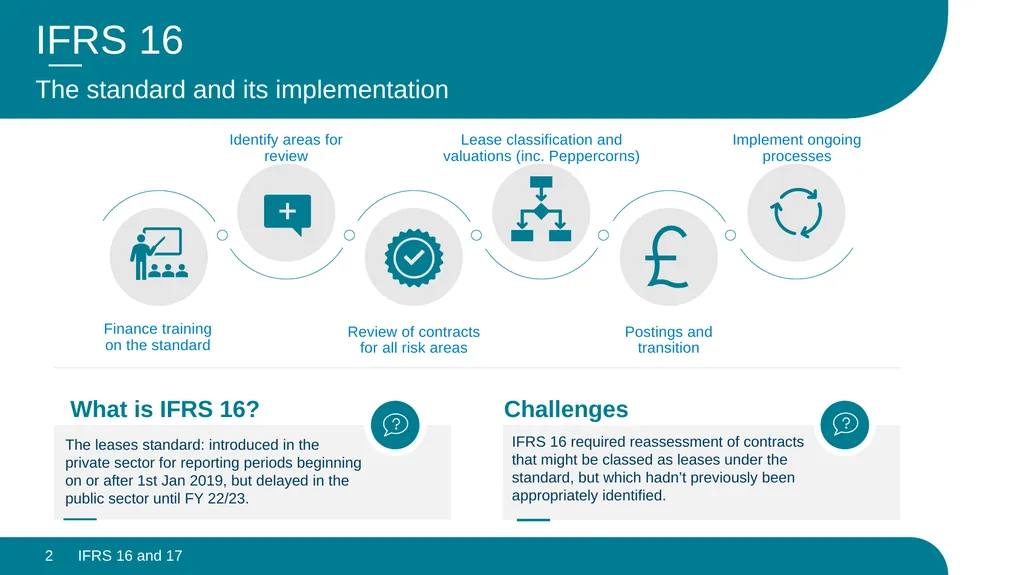
IFRS 16 and IFRS 17 Looking Back, Looking Forwards IFRS 16 IFRS 16 and 17 2 What is IFRS 16? Challenges The leases standard: introduced in the private sector for reporting periods beginning on or after 1st Jan 2019, but delayed in the
"IFRS 16 and IFRS 17 – Looking Back, Looking" is the property of its rightful owner. Permission is granted to
download and print the materials on this website for personal, non-commercial use only, and to display it
on your personal computer provided you do not modify the materials and that you retain all copyright
notices contained in the materials. By downloading content from our website, you accept the terms of this
agreement.
Presentation Transcript
01
IFRS 16 and IFRS 17 – Looking Back, Looking Forwards<br>
02
IFRS 16 IFRS 16 and 17 2 What is IFRS 16? Challenges The leases standard: introduced in the private sector for reporting periods beginning on or after 1st Jan 2019, but delayed in the public sector until FY 22/23. IFRS 16 required reassessment of contracts that might be classed as leases under the standard, but which hadn’t previously been appropriately identified. The standard and its implementation<br>
03
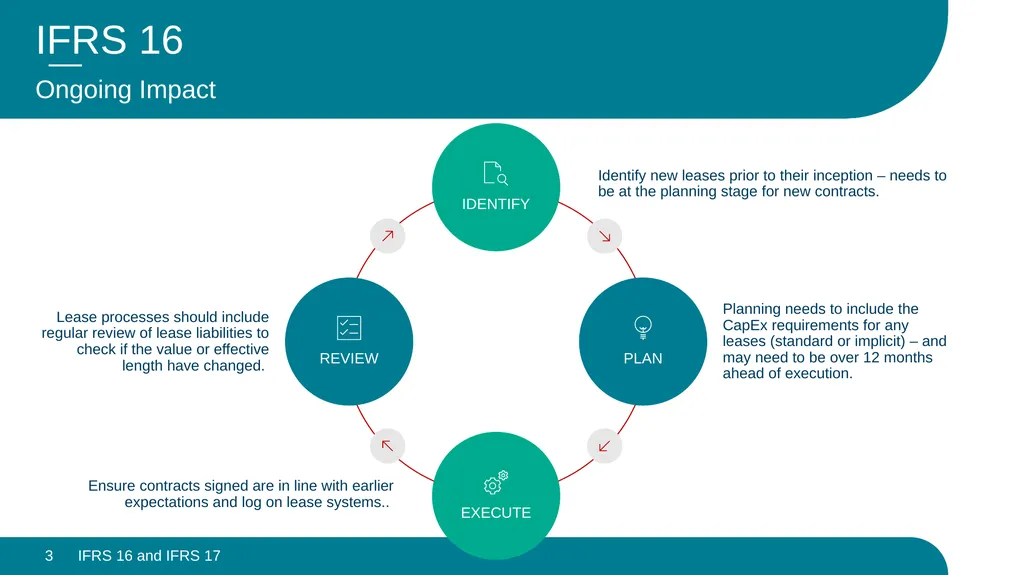
IFRS 16 IFRS 16 and IFRS 17 3 IDENTIFY EXECUTE REVIEW PLAN Identify new leases prior to their inception – needs to be at the planning stage for new contracts. Ensure contracts signed are in line with earlier expectations and log on lease systems.. Planning needs to include the CapEx requirements for any leases (standard or implicit) – and may need to be over 12 months ahead of execution. Lease processes should include regular review of lease liabilities to check if the value or effective length have changed. Ongoing Impact<br>
04
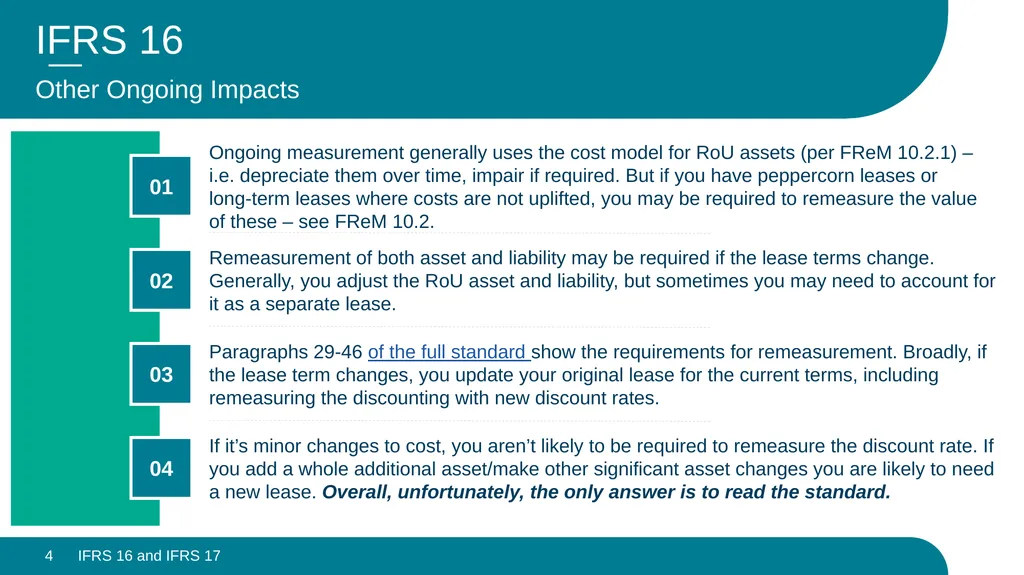
IFRS 16 IFRS 16 and IFRS 17 4 Other Ongoing Impacts Ongoing measurement generally uses the cost model for RoU assets (per FReM 10.2.1) – i.e. depreciate them over time, impair if required. But if you have peppercorn leases or long-term leases where costs are not uplifted, you may be required to remeasure the value of these – see FReM 10.2. 01 Remeasurement of both asset and liability may be required if the lease terms change. Generally, you adjust the RoU asset and liability, but sometimes you may need to account for it as a separate lease. 02 Paragraphs 29-46 of the full standard show the requirements for remeasurement. Broadly, if the lease term changes, you update your original lease for the current terms, including remeasuring the discounting with new discount rates. 03 If it’s minor changes to cost, you aren’t likely to be required to remeasure the discount rate. If you add a whole additional asset/make other significant asset changes you are likely to need a new lease. Overall, unfortunately, the only answer is to read the standard. 04<br>
05
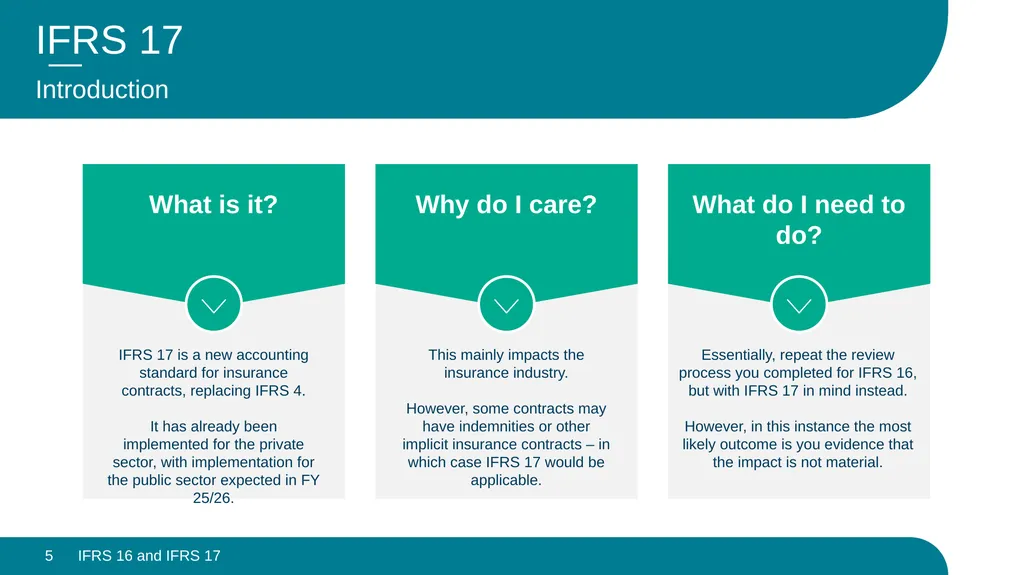
IFRS 17 IFRS 16 and IFRS 17 5 What is it? IFRS 17 is a new accounting standard for insurance contracts, replacing IFRS 4.
It has already been implemented for the private sector, with implementation for the public sector expected in FY 25/26. Why do I care? This mainly impacts the insurance industry.
However, some contracts may have indemnities or other implicit insurance contracts – in which case IFRS 17 would be applicable. What do I need to do? Essentially, repeat the review process you completed for IFRS 16, but with IFRS 17 in mind instead.
However, in this instance the most likely outcome is you evidence that the impact is not material. Introduction<br>
06
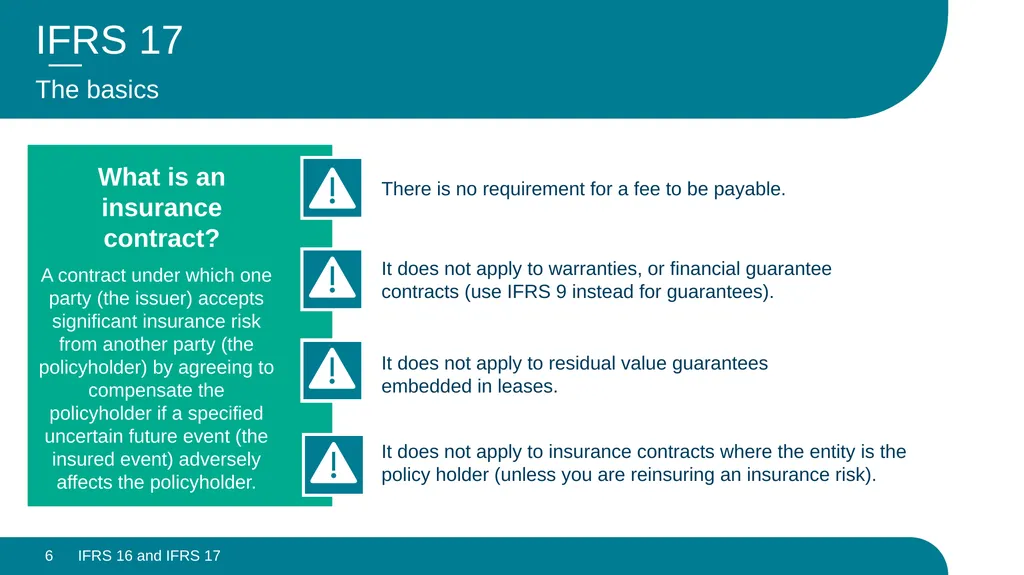
IFRS 17 IFRS 16 and IFRS 17 6 What is an insurance contract? A contract under which one party (the issuer) accepts significant insurance risk from another party (the policyholder) by agreeing to compensate the policyholder if a specified uncertain future event (the insured event) adversely affects the policyholder. There is no requirement for a fee to be payable. It does not apply to warranties, or financial guarantee contracts (use IFRS 9 instead for guarantees). It does not apply to residual value guarantees embedded in leases. It does not apply to insurance contracts where the entity is the policy holder (unless you are reinsuring an insurance risk). The basics<br>
07
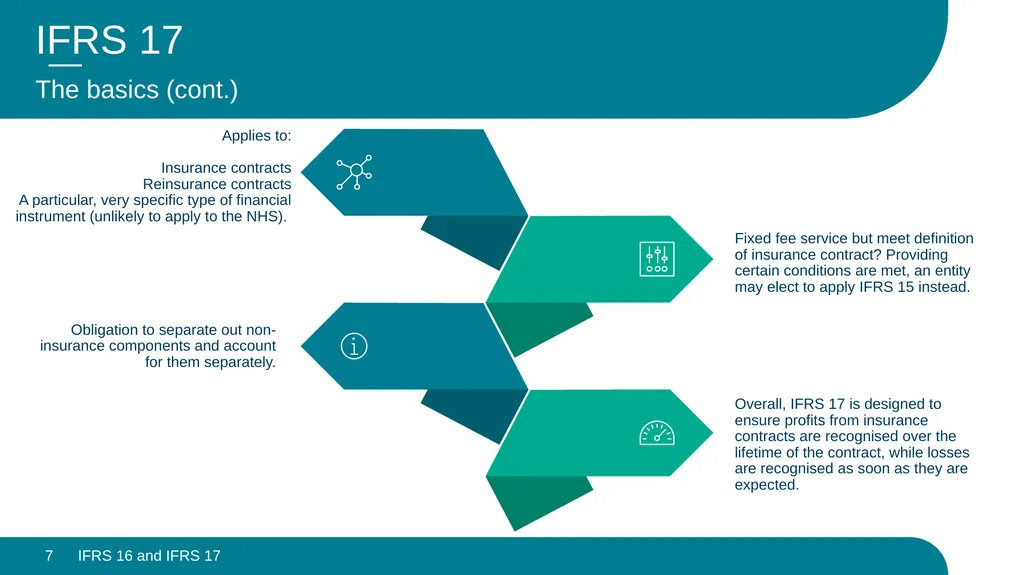
IFRS 17 IFRS 16 and IFRS 17 7 Applies to:
Insurance contracts
Reinsurance contracts
A particular, very specific type of financial instrument (unlikely to apply to the NHS). Obligation to separate out non-insurance components and account for them separately. Fixed fee service but meet definition of insurance contract? Providing certain conditions are met, an entity may elect to apply IFRS 15 instead. Overall, IFRS 17 is designed to ensure profits from insurance contracts are recognised over the lifetime of the contract, while losses are recognised as soon as they are expected. The basics (cont.)<br>
08
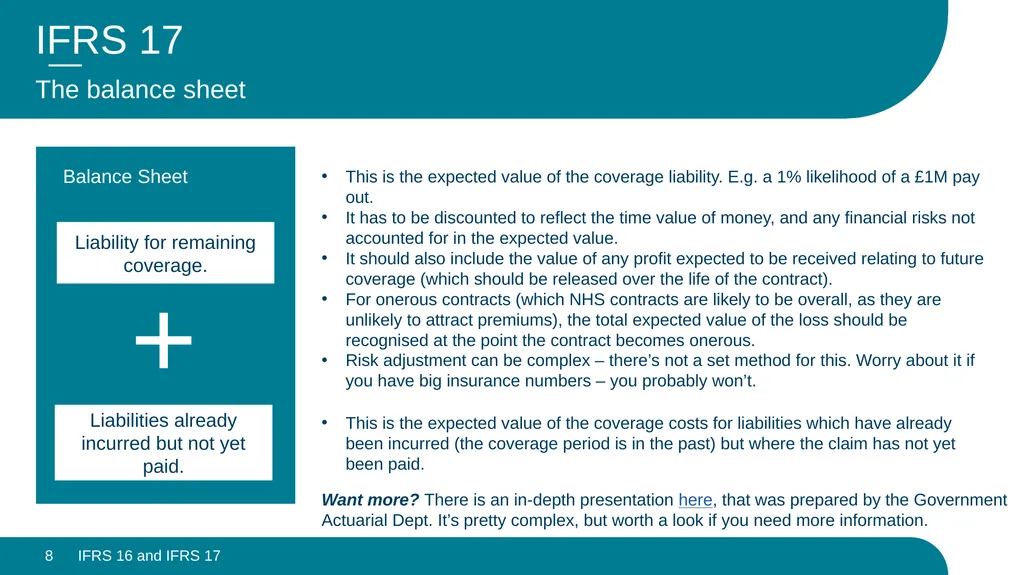
IFRS 17 IFRS 16 and IFRS 17 8 Liability for remaining coverage. Liabilities already incurred but not yet paid. This is the expected value of the coverage liability. E.g. a 1% likelihood of a £1M pay out.
It has to be discounted to reflect the time value of money, and any financial risks not accounted for in the expected value.
It should also include the value of any profit expected to be received relating to future coverage (which should be released over the life of the contract).
For onerous contracts (which NHS contracts are likely to be overall, as they are unlikely to attract premiums), the total expected value of the loss should be recognised at the point the contract becomes onerous.
Risk adjustment can be complex – there’s not a set method for this. Worry about it if you have big insurance numbers – you probably won’t. This is the expected value of the coverage costs for liabilities which have already been incurred (the coverage period is in the past) but where the claim has not yet been paid. Want more? There is an in-depth presentation here, that was prepared by the Government Actuarial Dept. It’s pretty complex, but worth a look if you need more information. Balance Sheet The balance sheet<br>
09
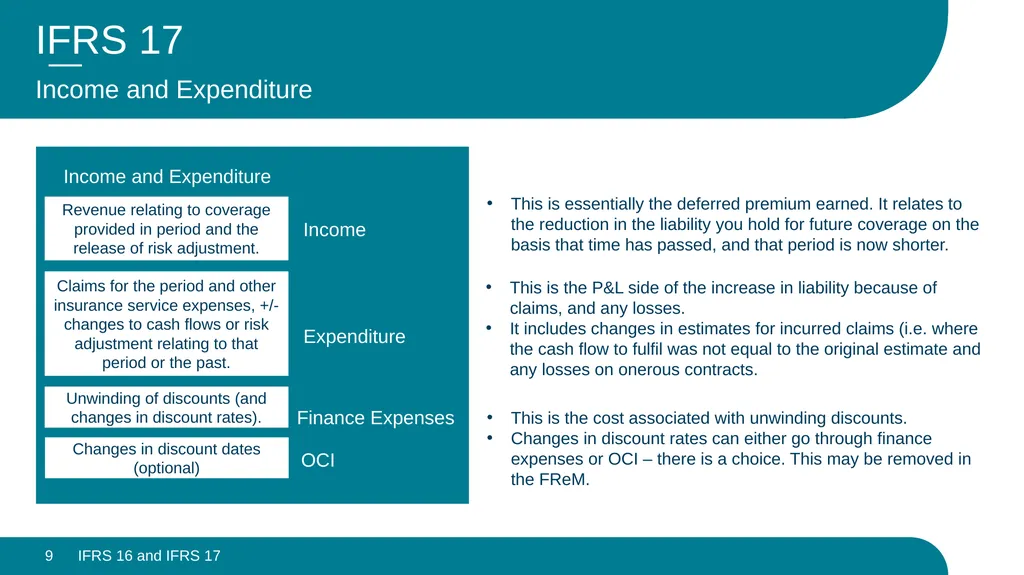
IFRS 17 IFRS 16 and IFRS 17 9 Revenue relating to coverage provided in period and the release of risk adjustment. Claims for the period and other insurance service expenses, +/- changes to cash flows or risk adjustment relating to that period or the past. This is essentially the deferred premium earned. It relates to the reduction in the liability you hold for future coverage on the basis that time has passed, and that period is now shorter. This is the cost associated with unwinding discounts.
Changes in discount rates can either go through finance expenses or OCI – there is a choice. This may be removed in the FReM. Income and Expenditure Unwinding of discounts (and changes in discount rates). Income and Expenditure This is the P&L side of the increase in liability because of claims, and any losses.
It includes changes in estimates for incurred claims (i.e. where the cash flow to fulfil was not equal to the original estimate and any losses on onerous contracts. Income Expenditure Finance Expenses Changes in discount dates (optional) OCI<br>
10
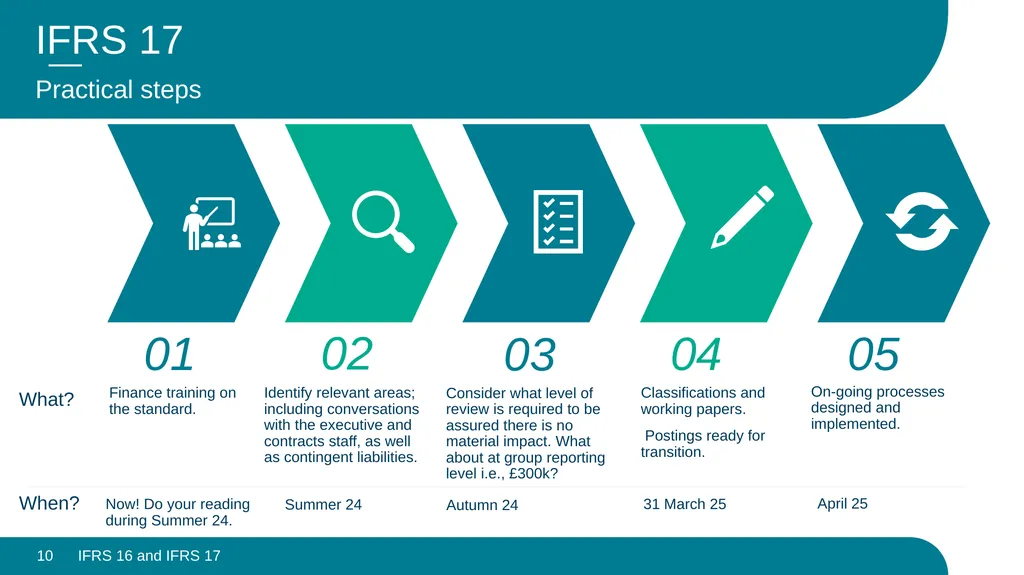
IFRS 17 IFRS 16 and IFRS 17 10 Finance training on the standard. Identify relevant areas; including conversations with the executive and contracts staff, as well as contingent liabilities. Consider what level of review is required to be assured there is no material impact. What about at group reporting level i.e., £300k? Classifications and working papers.
Postings ready for transition. On-going processes designed and implemented. 01 03 05 02 04 Practical steps What? When? Now! Do your reading during Summer 24. Summer 24 Autumn 24 31 March 25 April 25<br>