"Image source: Google image Mites (II) Mk- vthr" is the property of its rightful owner. Permission is granted to
download and print the materials on this website for personal, non-commercial use only, and to display it
on your personal computer provided you do not modify the materials and that you retain all copyright
notices contained in the materials. By downloading content from our website, you accept the terms of this
agreement.
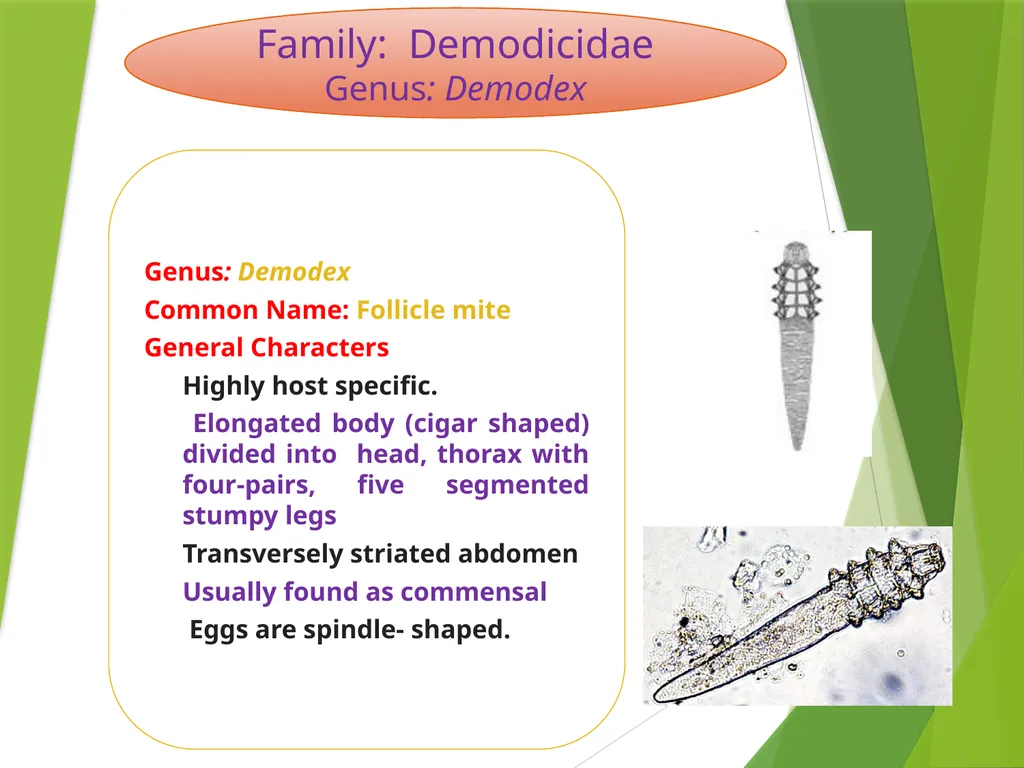
Genus: Demodex
Common Name: Follicle mite
General Characters
Highly host specific.
Elongated body (cigar shaped) divided into head, thorax with four-pairs, five segmented stumpy legs
Transversely striated abdomen
Usually found as commensal
Eggs are spindle- shaped. Family: Demodicidae
Genus: Demodex<br>
04
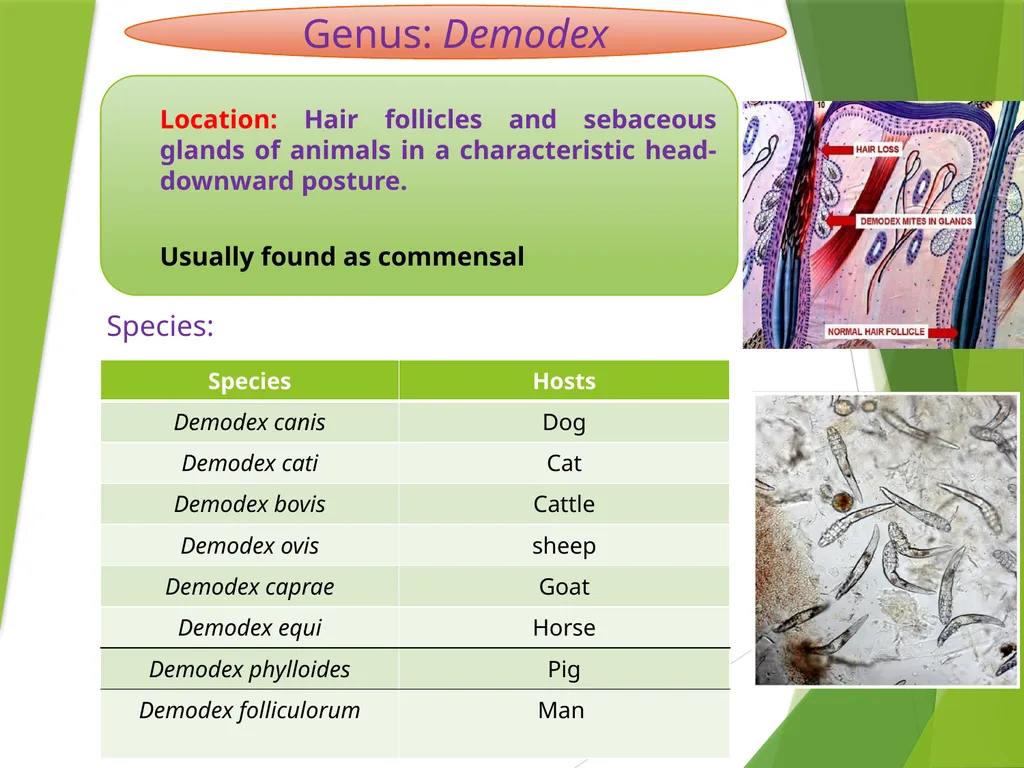
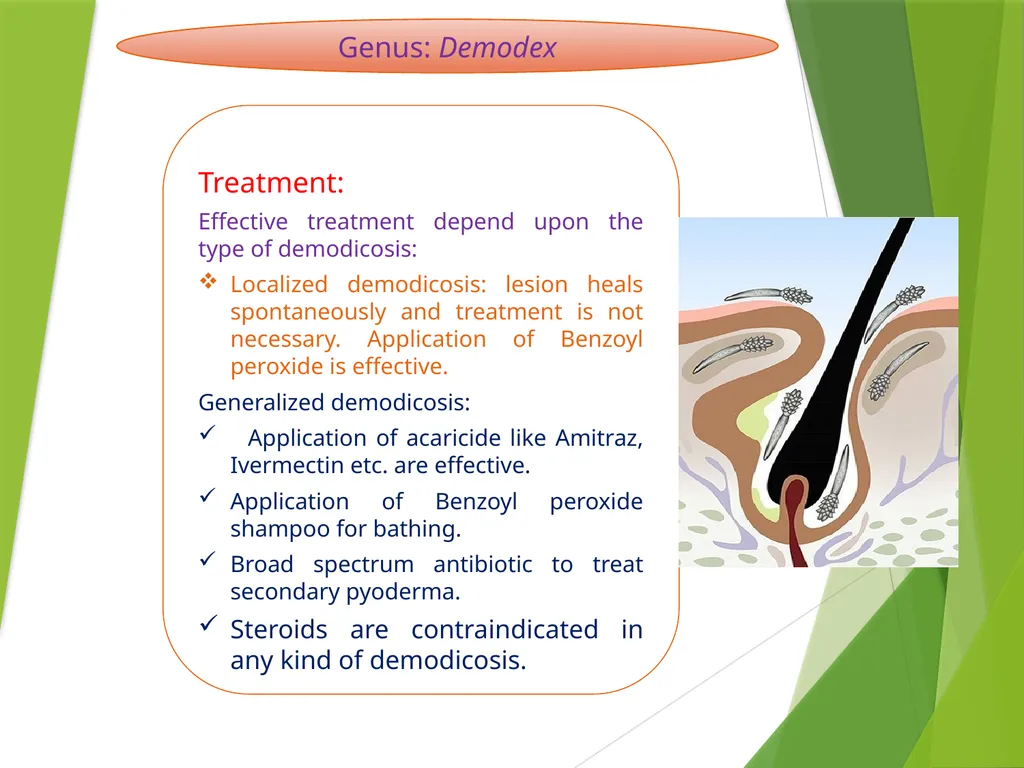
Species: Location: Hair follicles and sebaceous glands of animals in a characteristic head-downward posture.
Usually found as commensal Genus: Demodex<br>
05
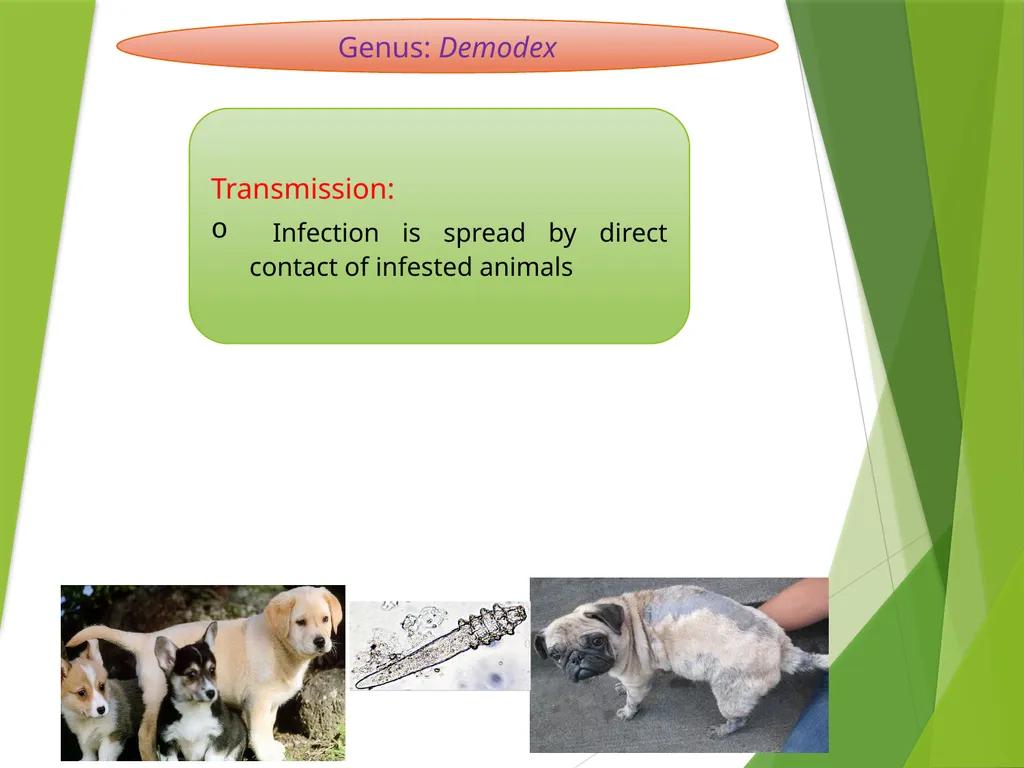
Transmission:
Infection is spread by direct contact of infested animals Genus: Demodex<br>
Pathogenesis:
Demodex species live as commensals in the hair follicles and sebaceous glands of most mammals and may erupt in dogs when immunosuppressants are given.
Two forms of canine demodicosis:
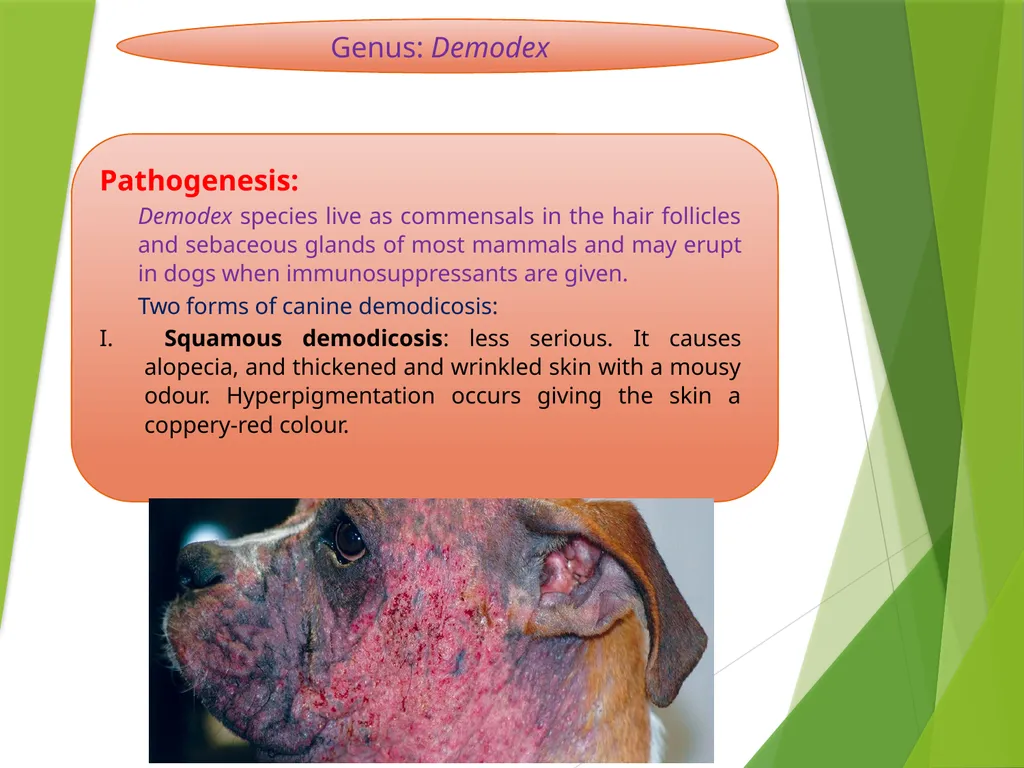
Squamous demodicosis: less serious. It causes alopecia, and thickened and wrinkled skin with a mousy odour. Hyperpigmentation occurs giving the skin a coppery-red colour. Genus: Demodex<br>
09
Pathogenesis:
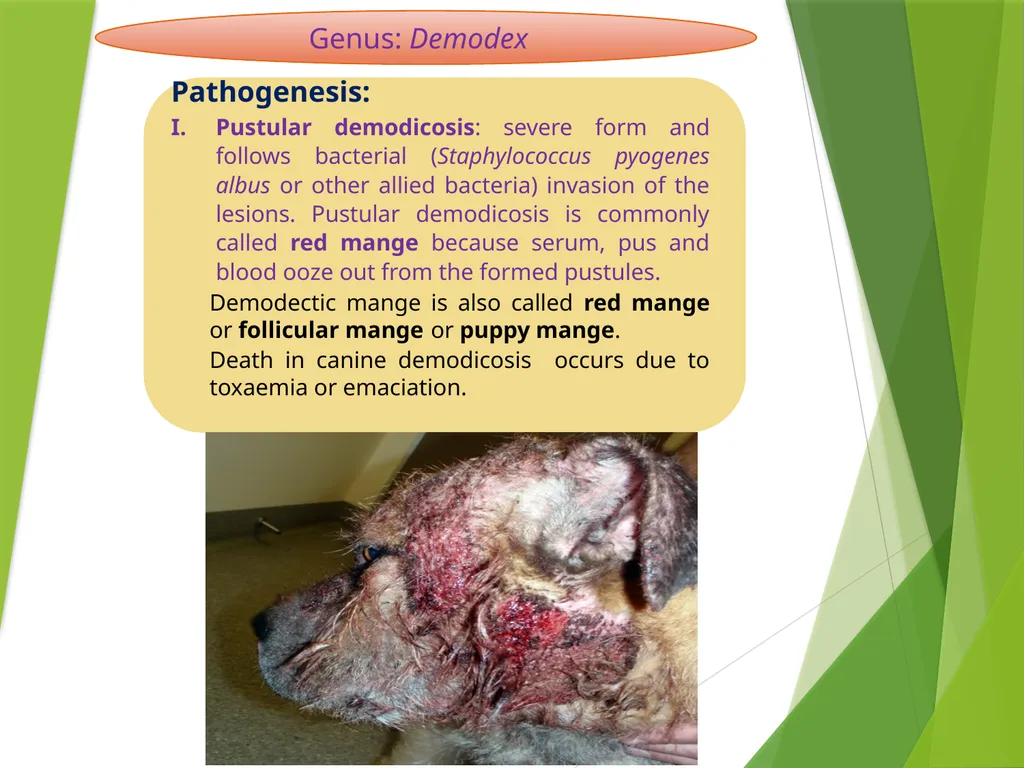
Pustular demodicosis: severe form and follows bacterial (Staphylococcus pyogenes albus or other allied bacteria) invasion of the lesions. Pustular demodicosis is commonly called red mange because serum, pus and blood ooze out from the formed pustules.
Demodectic mange is also called red mange or follicular mange or puppy mange.
Death in canine demodicosis occurs due to toxaemia or emaciation. Genus: Demodex<br>
10
Pathogenesis:
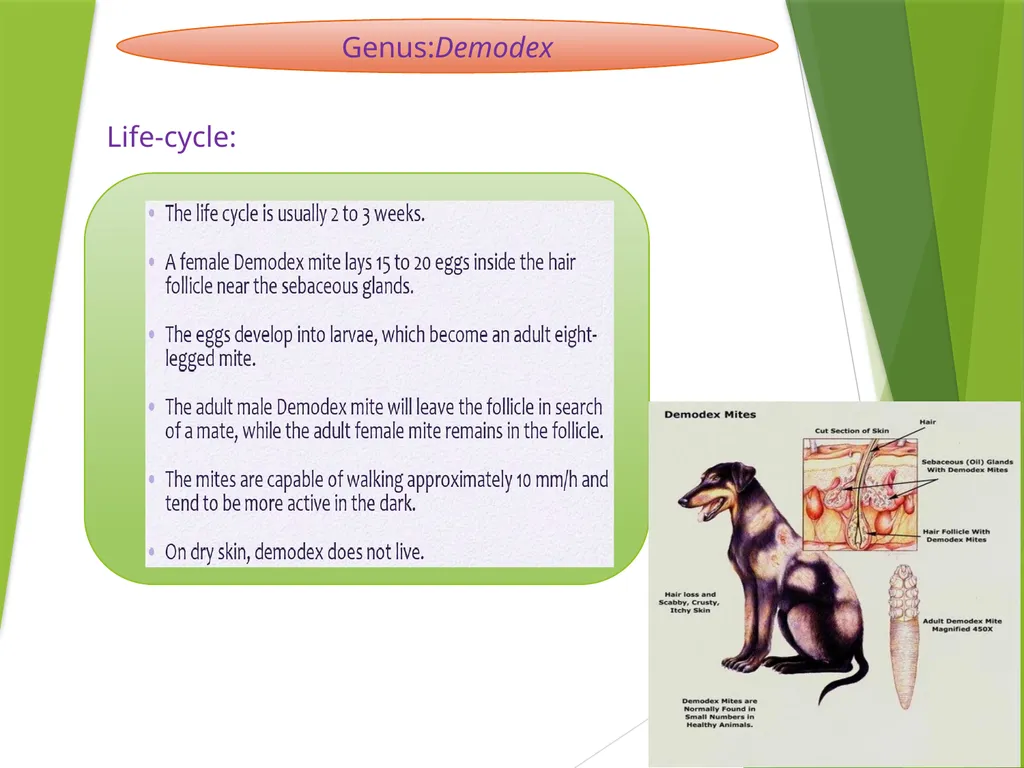
Absence of pruritis in the demodectic mange infection.
Canine demodicosis generally occurs at the age of 3-9 months of age.
Demodex itself is thought to cause a cell mediated immunodeficiency which suppress the Normal T-lymphocyte response Genus: Demodex<br>
11
Pathogenesis:
Cat
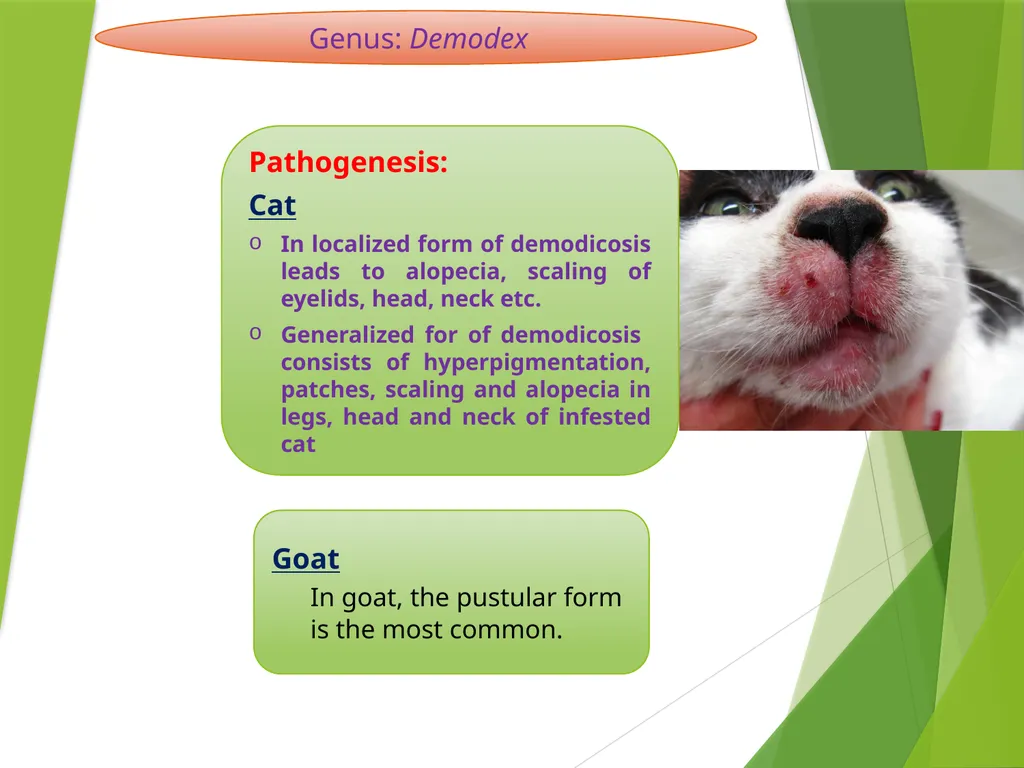
In localized form of demodicosis leads to alopecia, scaling of eyelids, head, neck etc.
Generalized for of demodicosis consists of hyperpigmentation, patches, scaling and alopecia in legs, head and neck of infested cat Genus: Demodex Goat
In goat, the pustular form is the most common.<br>
12
Diagnosis :
Skin scraping examination :
Skin should be squeezed before the scarping to push the mites out of the hair follicles.
Skin should be scraped deeply. Genus: Demodex<br>
13
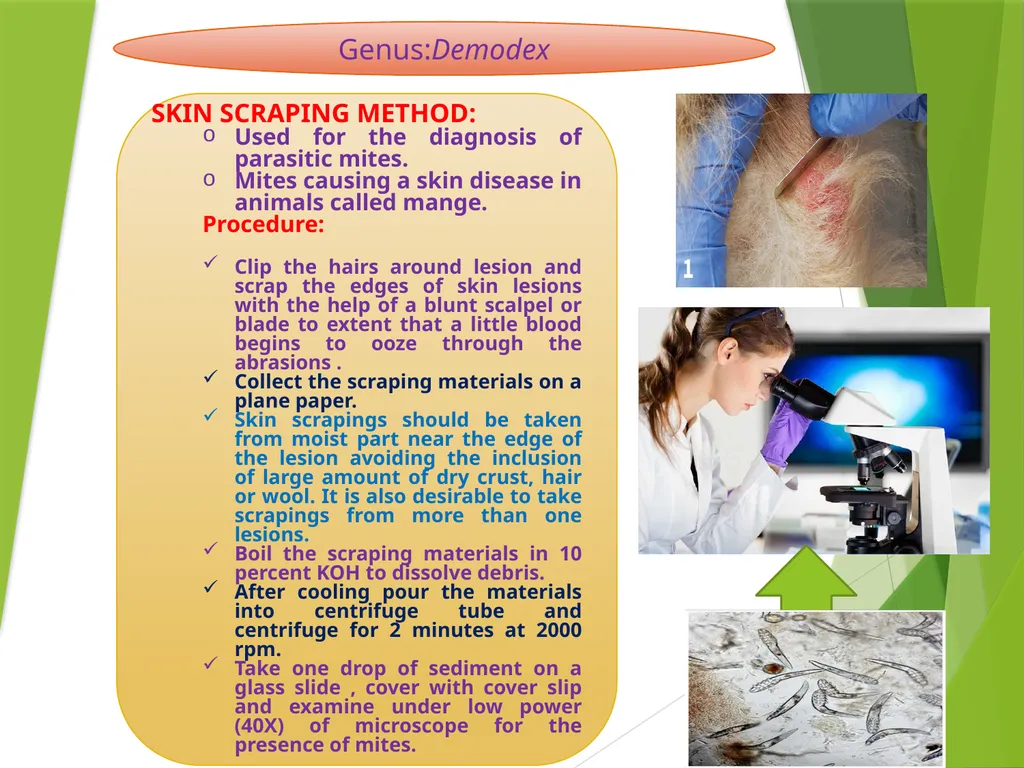
SKIN SCRAPING METHOD:
Used for the diagnosis of parasitic mites.
Mites causing a skin disease in animals called mange.
Procedure:
Clip the hairs around lesion and scrap the edges of skin lesions with the help of a blunt scalpel or blade to extent that a little blood begins to ooze through the abrasions .
Collect the scraping materials on a plane paper.
Skin scrapings should be taken from moist part near the edge of the lesion avoiding the inclusion of large amount of dry crust, hair or wool. It is also desirable to take scrapings from more than one lesions.
Boil the scraping materials in 10 percent KOH to dissolve debris.
After cooling pour the materials into centrifuge tube and centrifuge for 2 minutes at 2000 rpm.
Take one drop of sediment on a glass slide , cover with cover slip and examine under low power (40X) of microscope for the presence of mites. Genus:Demodex<br>
14
Treatment:
Effective treatment depend upon the type of demodicosis:
Localized demodicosis: lesion heals spontaneously and treatment is not necessary. Application of Benzoyl peroxide is effective.
Generalized demodicosis:
Application of acaricide like Amitraz, Ivermectin etc. are effective.
Application of Benzoyl peroxide shampoo for bathing.
Broad spectrum antibiotic to treat secondary pyoderma.
Steroids are contraindicated in any kind of demodicosis. Genus: Demodex<br>
15
Control:
Isolation of infested animals.
Treatment of infested animals by using acaricides
Providing of proper level of nutrition. Genus:Demodex<br>
16
General Characters
Stigmata or spiracles are present at the middle of the body.
Commonly called gamasid mites.
Visible to naked eye Sub-order: Mesostigmata/Gamasida<br>
Family: Trombiculidae General Characters
Commonly called chigger mites or harvest mites or velvet mites.
Only larvae are parasitic.
Larva has three pairs of legs with claws.
Scutum on the dorsal surface of the body .<br>
19
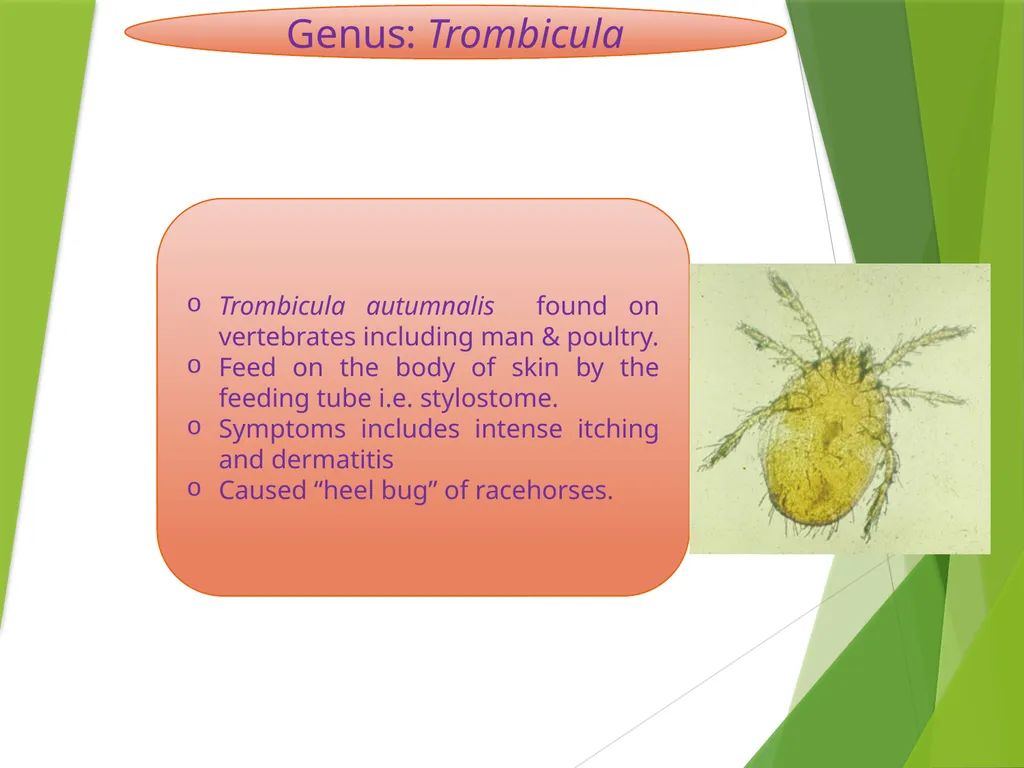
Genus: Trombicula Trombicula autumnalis found on vertebrates including man & poultry.
Feed on the body of skin by the feeding tube i.e. stylostome.
Symptoms includes intense itching and dermatitis
Caused “heel bug” of racehorses.<br>