IMC tools Public Relations Public relations consists of all forms of planned communication, outwards and inwards, between an organisation and its public for the purpose of achieving specific objectives concerning mutual understanding. -
Related Topics
Share
Embed code
Download this presentation From Below
"IMC tools Public Relations “ Public relations" is the property of its rightful owner. Permission is granted to
download and print the materials on this website for personal, non-commercial use only, and to display it
on your personal computer provided you do not modify the materials and that you retain all copyright
notices contained in the materials. By downloading content from our website, you accept the terms of this
agreement.
Presentation Transcript
01
IMC tools<br>
02
Public Relations “ Public relations consists of all forms of planned communication, outwards and inwards, between an organisation and its public for the purpose of achieving specific objectives concerning mutual understanding.”
- Frank Jefkins
“Public relations means building good relations with the company’s various publics by obtaining favourable publicity, building up a good corporate image, and handling or heading off unfavourable rumours, stories and events.”
- Philip Kotler and Gary Armstrong.<br>
03
Need for PR Develop favorable image
Develop business
Create public awareness about organisational programmes
Making consumer base
Educating various audiences about the enterprise
Resolve issues
Develop goodwill<br>
04
Corporate advertising Advertising done to promote the corporate as a whole instead of individual products.
Objectives
Build positive image
Communicate views on social, business and environmental issues
Boost morale and smooth labour relations
Attract new employees
Report company’s accomplishments
Reflect change in corporate personality<br>
05
Types of corporate advertising Image advertising
General image and positioning ads
Sponsorships
Recruiting
Generating financial support
Event sponsorships
Advocacy advertising
Cause related advertising<br>
06
PR tools News
Speeches
Special event
Publications
Advertorials
Audio visual materials
Blogs
Corporate identity materials
Contribution
Web site
Press releases
Press kits
Employee/ Community/ Financial relations programmes<br>
07
Sales promotion “Sales promotion consists of a diverse collection of incentive tools, mostly short-term, designed to stimulate quicker and/or greater purchase of particular products/services by consumers or traders.”
- Philip Kotler<br>
08
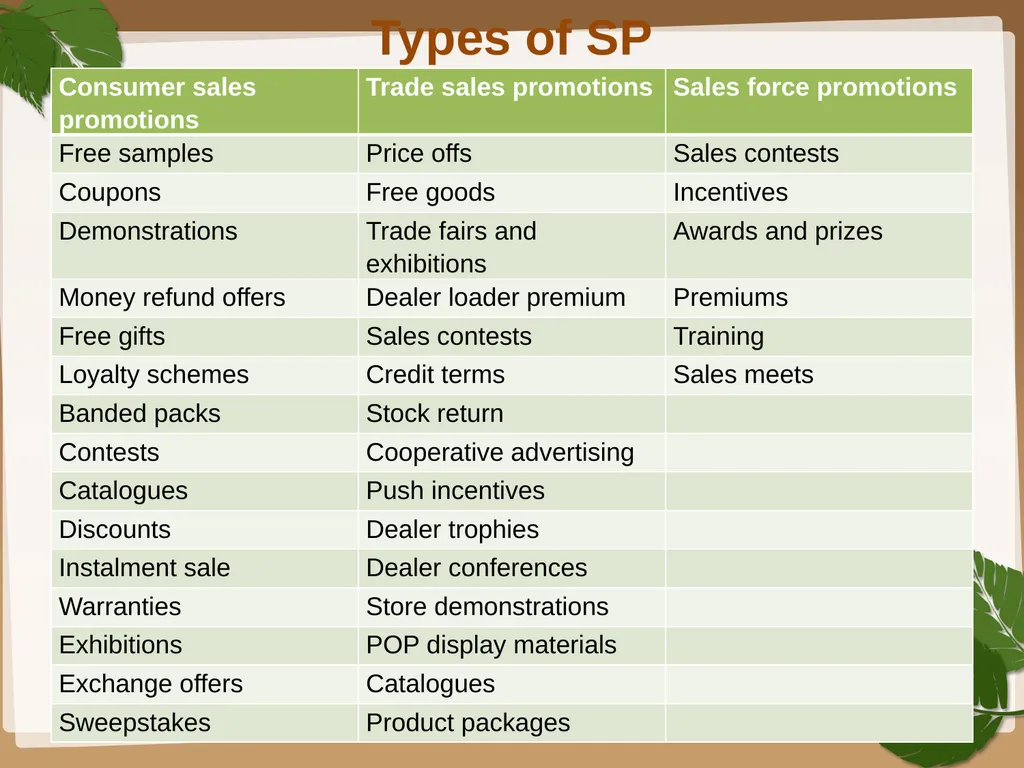
Types of SP<br>
09
Importance of sales promotion Introducing new products and services
Weapon to face competition
Unload cumulative inventory
Overcome seasonal decrease in sales
Regain lost consumers
Make advertising more effective, support it
Support and compliment sales force effectiveness<br>
10
Reasons for growth in SP Increasing competition
Price sensitive customers
Positive sales impact
Standardised products available
Consumer acceptance
Expectations of price decrease
Expensive and less effective advertising
Powerful traders – trade SP
Importance of Sales volumes
Increase impulse buying
Declining brand loyalty
Excess stocks<br>
11
Internet Using internet for marketing of products is increase.
Means of reaching a large no of customers in a short span of time
Can act as an effective tool for marketing different type of products.
Internet is a multi-faceted promotional tool
Has the greatest impact on marketing<br>
12
Importance of Internet Advertising on Internet
Sales promotion on internet
Personal selling on internet
Public relations on internet
Direct marketing on internet<br>
13
Advantages of internet Target marketing
Message tailoring
Interactive capabilities
Information access
High sales potential
Exposure
Speed
Cost effective
Complement to other IMC tools<br>
14
Disadvantages of internet Annoyance
Clutter
Privacy
Poor reach
Irritation
Lack of trust<br>
15
Direct Marketing “an interactive marketing system that uses one or more advertising media to effect a measurable response and/or transaction at any location.”
Attributes of DM
Focus : Well defined target audience
Measurability : Counts no. of responses vis a vis communication
Personalisation : Direct communication addressing by name
Immediacy : Generates immediate response<br>
16
Role of DM Combining DM with advertising
Combining DM and PR
DM and personal selling
DM and sales promotion
DM with support media<br>
17
Objectives of direct marketing Raise brand awareness
Improve CRM
Sales/ lead generation
Provide measurable ROI<br>
18
Components of successful direct marketing Deliver a Compelling Sales Message. ...
Follow-up Leads Promptly to Attract and Engage Your Prospect's Attention. ...
Promote Your Brand. ...
Nurture the New Customer Relationship. ...
Integrate and Synchronize Online and Off-line Direct Marketing.<br>
19
DM tools Direct mail
Television
Radio
Newspapers and magazines
Yellow pages
Face to face marketing
Tele marketing
Online shopping
Catalogue marketing
Kiosk marketing
Automated vending machines
Database marketing<br>
20
Advantages of DM Selective reach
Segmentation capabilities
Frequency
Flexibility
Timing
Personalisation
Costs
Measures of effectiveness<br>
21
Personal selling “Oral presentation is a conversation with one or more prospective purchasers for the purpose of making sales.”
“Personal selling is contacting prospective buyers of product personally.”<br>
22
Importance of personal selling Helpful in selling
Product demonstration
Removes doubts and customer confusions
Face to face communication
Important during product launch
Maintains and creates customers
Source of feedback
Important for technical products<br>
23
Advantages of Personal selling Two way interaction
Tailoring of message
Lack of distraction
Involvement in decision process
Source of research information<br>
24
Relationship marketing “Relationship marketing is marketing with the conscious aim to develop and manage long term and/ or trusting relationship with customers, distributors, suppliers or other parties in the marketing environment”
-American Marketing Association<br>
25
Steps in relationship marketing Identifying key customers
Assigning relationship managers
Preparing detailed job descriptions for RMs
Developing annual and long range customer relationship plans and programmes
Maintaining continuous contact with customers<br>
26
Importance of relationship marketing Helps to reduce marketing costs
Helps to generate new product ideas
Helps to retain customers
Cost effective
Helps to gain competitive advantage
Reduces switching
Helps in Word of mouth
Helps to improve corporate image<br>
27
E- commerce Doing business via electronic medium
Major source is internet
“e-commerce can be defined as a modern business technology that addresses the needs of organisations, merchants and customers in cutting costs while improving the quality of goods and services and increasing the speed of delivery, by using the internet.”<br>
28
Advantages of e- commerce Saves operating costs
24X7 service
Easy shopping
Fast and flexible execution
Higher degree of personalisation
Door step delivery
Convenient and customer friendly<br>