Impact Lasse Heje Pedersen Impact: overview of talk What is impact? Abstract definition, concrete examples, impact measures Why is impact important? How to get impact? As a researcher (micro) and as a university (macro) What is impact?
"Impact Lasse Heje Pedersen Impact: overview of" is the property of its rightful owner. Permission is granted to
download and print the materials on this website for personal, non-commercial use only, and to display it
on your personal computer provided you do not modify the materials and that you retain all copyright
notices contained in the materials. By downloading content from our website, you accept the terms of this
agreement.
Presentation Transcript
01
Impact Lasse Heje Pedersen<br>
02
Impact: overview of talk What is impact?
Abstract definition, concrete examples, impact measures
Why is impact important?
How to get impact?
As a researcher (micro) and as a university (macro)<br>
03
What is impact? Abstract definition One definition of impact (that I made up):
Impact = (innovation) * (#number of people using it)
Wrong measures of impact:
Impact = (#number of people using it)
E.g., “clickbait” with no content
Paper cited for being wrong
Academic often in the news saying nonsense
Impact = (innovation)
E.g., a “nice” result that no one uses
Difficult to measure accurately
Refined measures:
People/papers weighted by their impact (fixed point)
Short-term vs. long-term impact
Deeper results: less short-term, more lasting impact
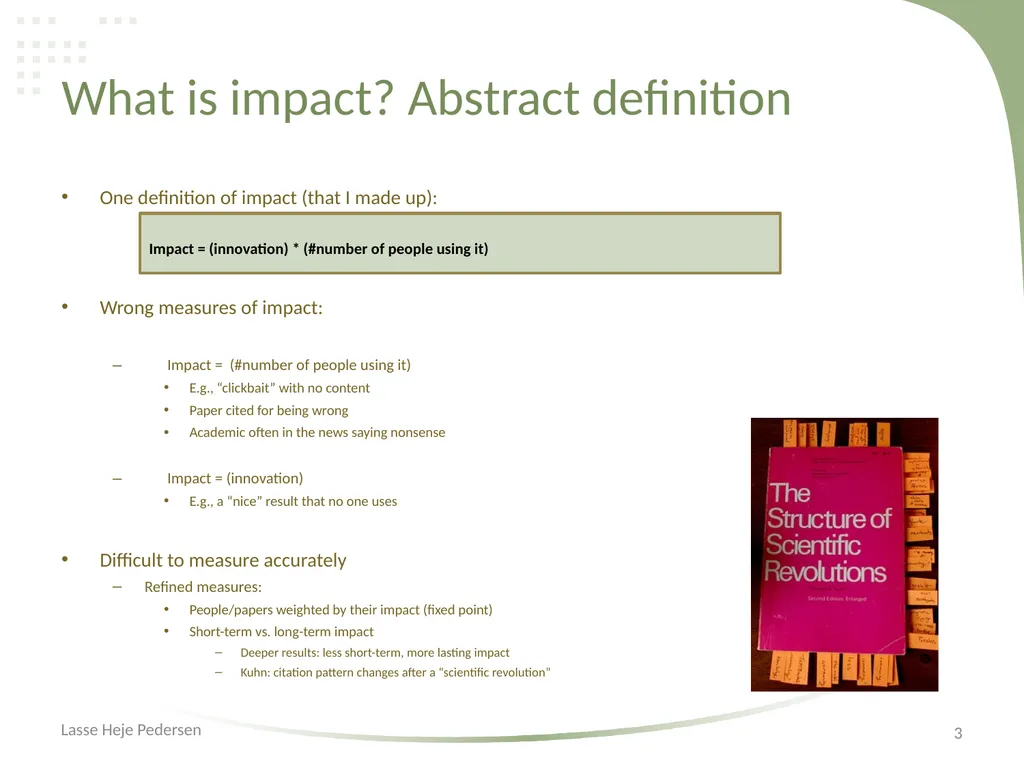
Kuhn: citation pattern changes after a “scientific revolution” 3 Lasse Heje Pedersen<br>
04
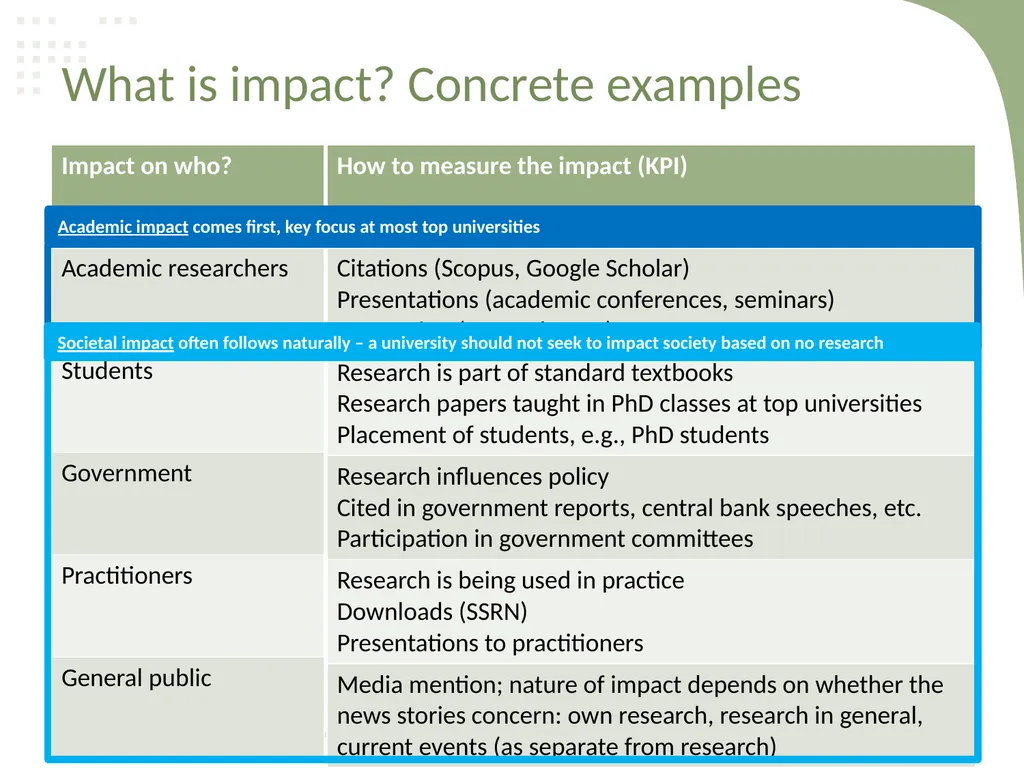
What is impact? Concrete examples 4 Lasse Heje Pedersen Academic impact comes first, key focus at most top universities Societal impact often follows naturally – a university should not seek to impact society based on no research<br>
05
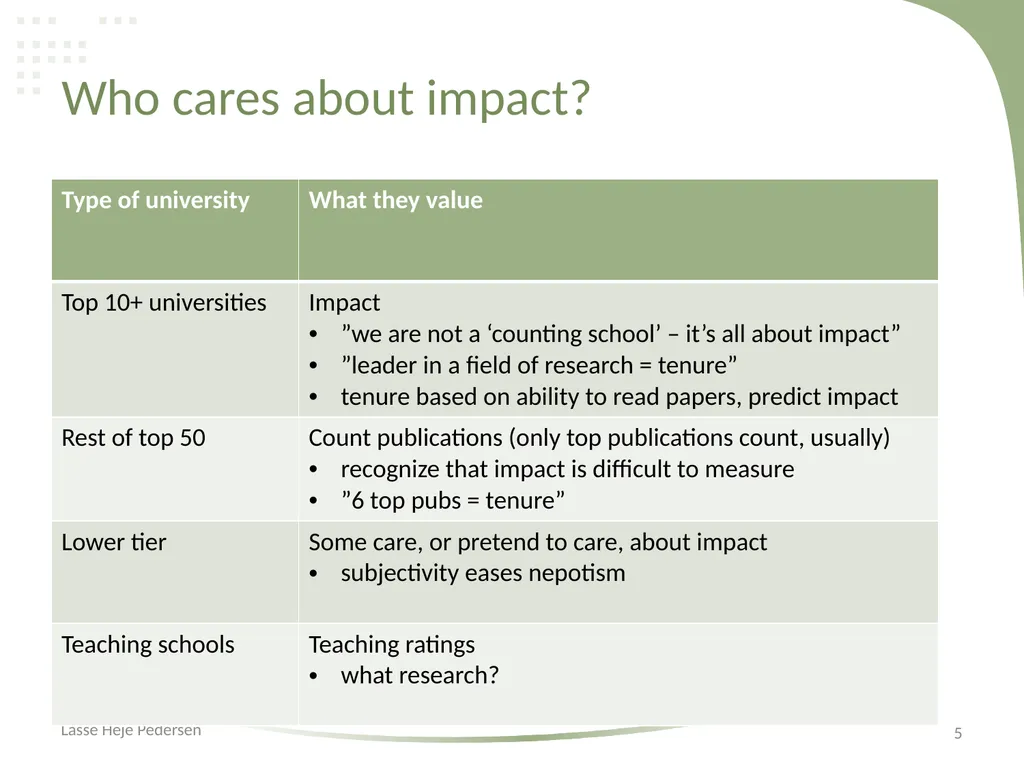
Who cares about impact? 5 Lasse Heje Pedersen<br>
06
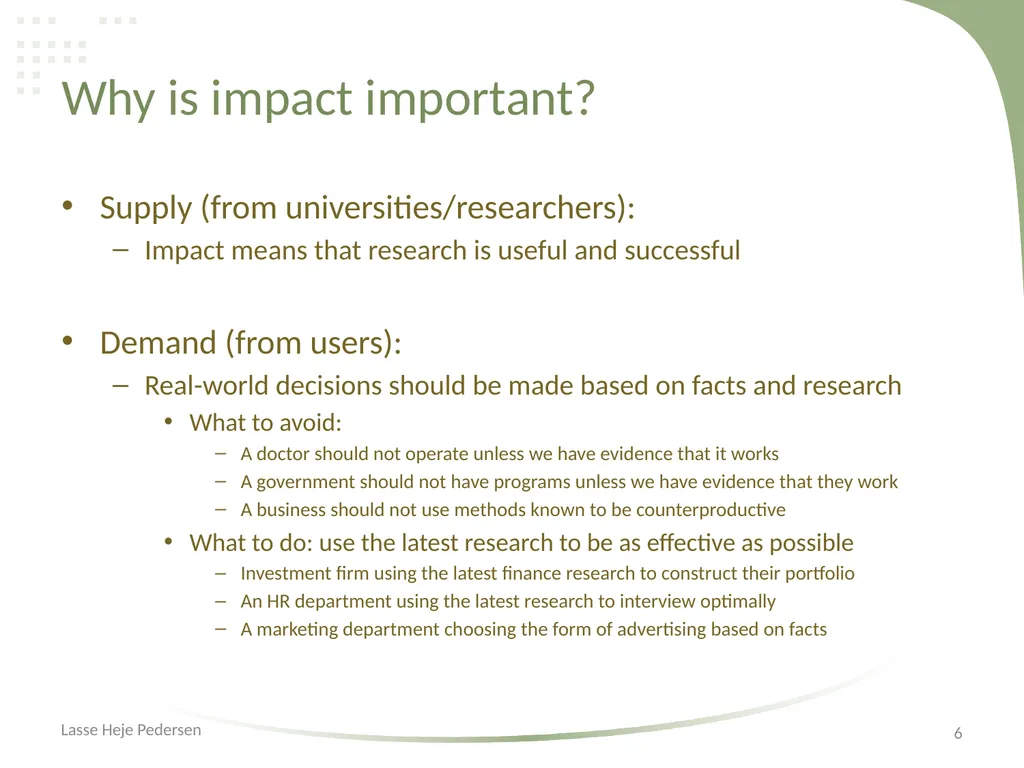
Why is impact important? Supply (from universities/researchers):
Impact means that research is useful and successful
Demand (from users):
Real-world decisions should be made based on facts and research
What to avoid:
A doctor should not operate unless we have evidence that it works
A government should not have programs unless we have evidence that they work
A business should not use methods known to be counterproductive
What to do: use the latest research to be as effective as possible
Investment firm using the latest finance research to construct their portfolio
An HR department using the latest research to interview optimally
A marketing department choosing the form of advertising based on facts 6 Lasse Heje Pedersen<br>
07
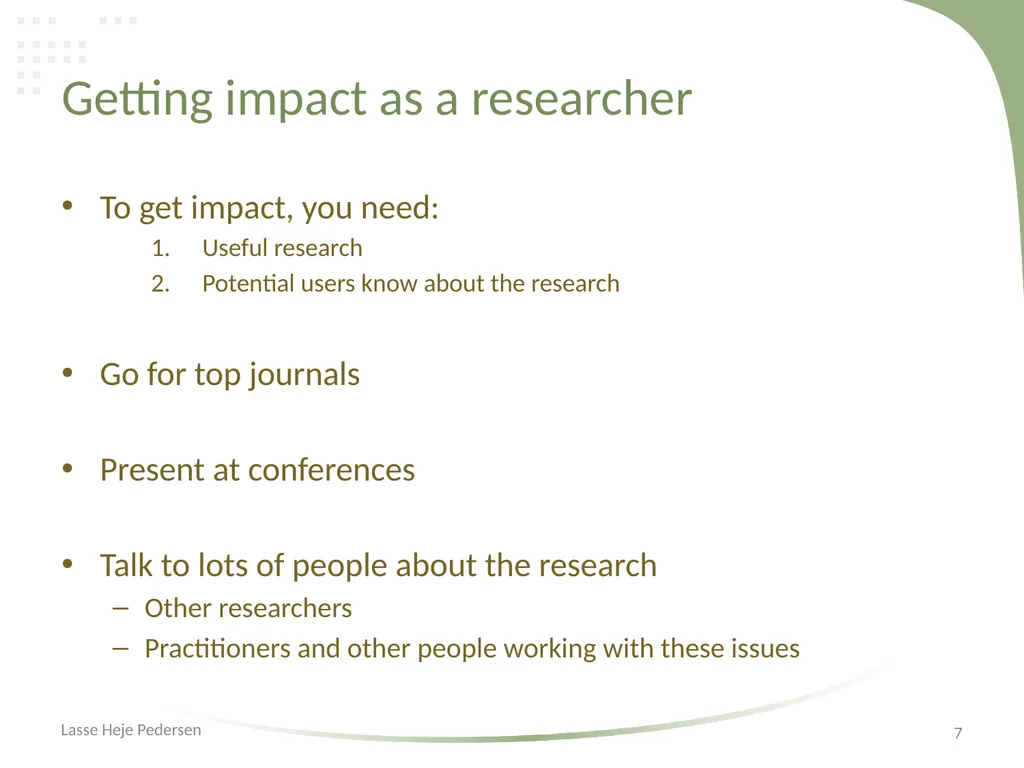
Getting impact as a researcher To get impact, you need:
Useful research
Potential users know about the research
Go for top journals
Present at conferences
Talk to lots of people about the research
Other researchers
Practitioners and other people working with these issues Lasse Heje Pedersen 7<br>
08
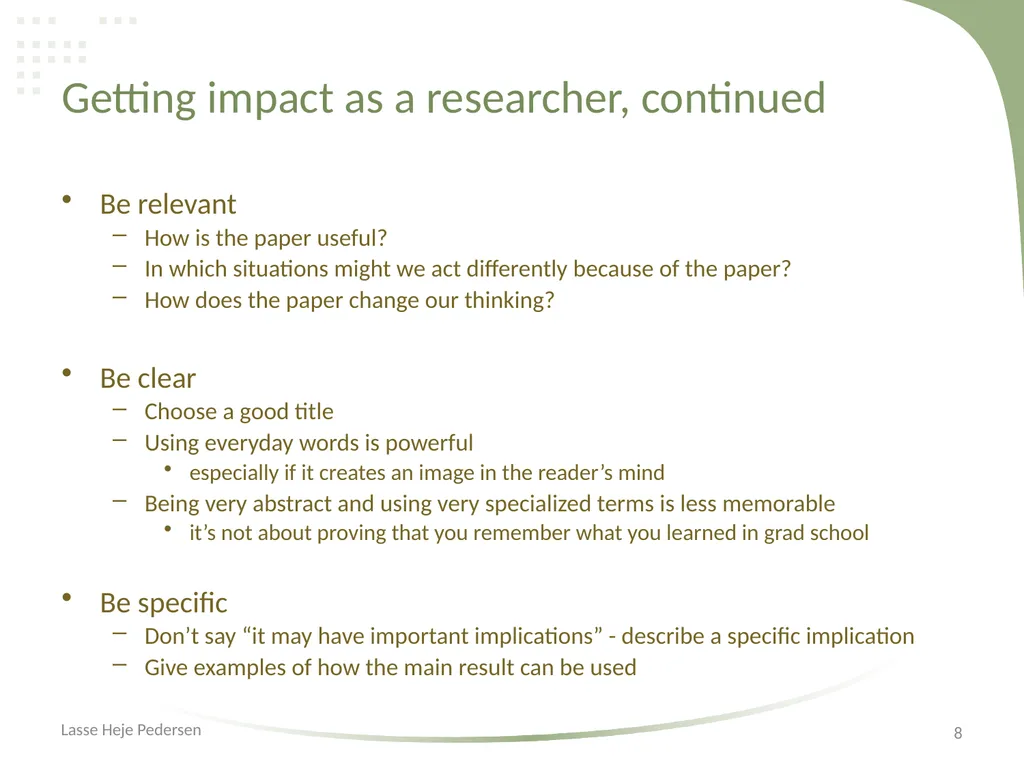
Getting impact as a researcher, continued Be relevant
How is the paper useful?
In which situations might we act differently because of the paper?
How does the paper change our thinking?
Be clear
Choose a good title
Using everyday words is powerful
especially if it creates an image in the reader’s mind
Being very abstract and using very specialized terms is less memorable
it’s not about proving that you remember what you learned in grad school
Be specific
Don’t say “it may have important implications” - describe a specific implication
Give examples of how the main result can be used Lasse Heje Pedersen 8<br>
09
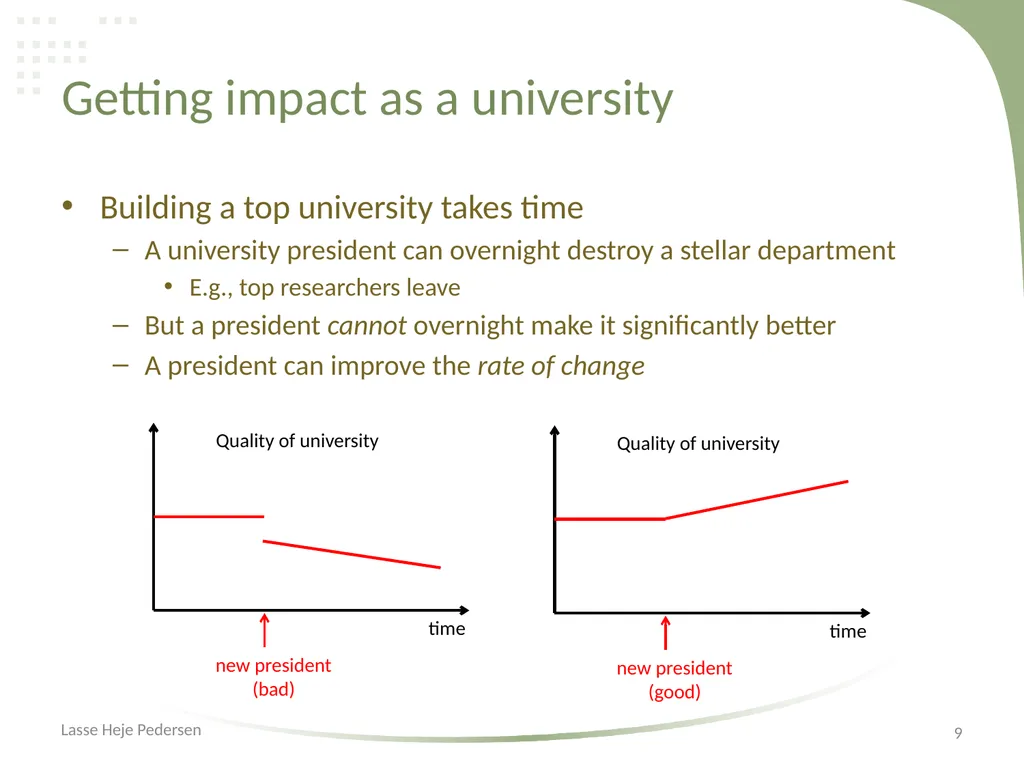
Getting impact as a university Building a top university takes time
A university president can overnight destroy a stellar department
E.g., top researchers leave
But a president cannot overnight make it significantly better
A president can improve the rate of change Lasse Heje Pedersen 9 time Quality of university new president
(bad) time Quality of university new president
(good)<br>
10
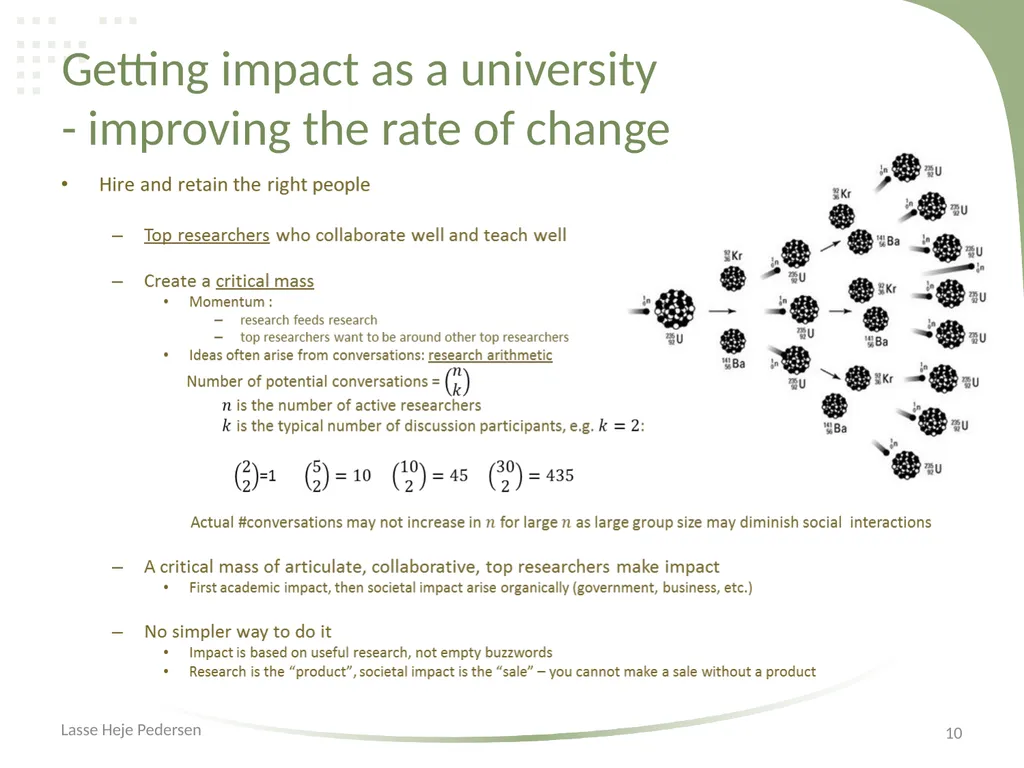
Getting impact as a university - improving the rate of change Lasse Heje Pedersen 10<br>
11
Getting impact as a university - improving the rate of change, continued Provide the right incentives
Incentivize top-level research
Reward impact
Make good priorities
Build on successful departments
having some stellar departments may be better than uniform mediocrity
especially because of critical mass and virtuous cycles
Think in terms of levels, not just changes
What is a reasonable size of each department?
Not just: what is a reasonable allocation of new slots to each department?
The latter method sometimes leads a marginal department to become much larger than a key one
Departments with high standards find it more difficult to hire
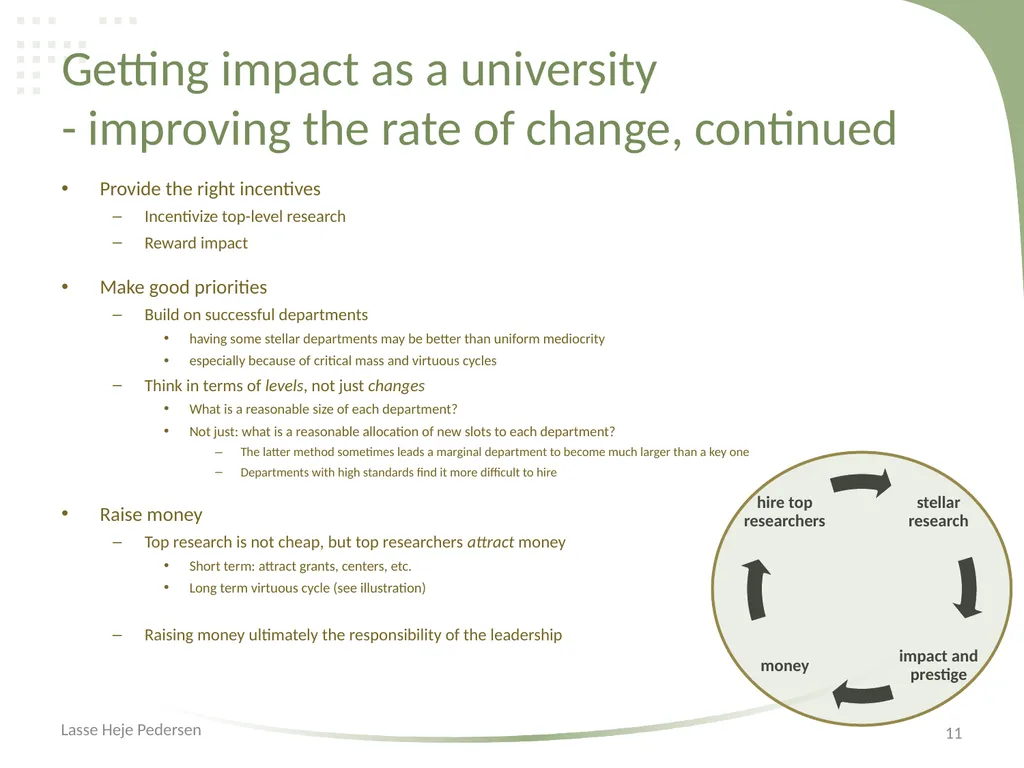
Raise money
Top research is not cheap, but top researchers attract money
Short term: attract grants, centers, etc.
Long term virtuous cycle (see illustration)
Raising money ultimately the responsibility of the leadership Lasse Heje Pedersen 11<br>
12
Impact: conclusion Why measure academic impact?
Ultimate measure of academic success
but beware of pitfalls
Getting impact as researcher
Be relevant, clear, and specific
Getting impact as a university
Hire top researchers, incentives, priorities
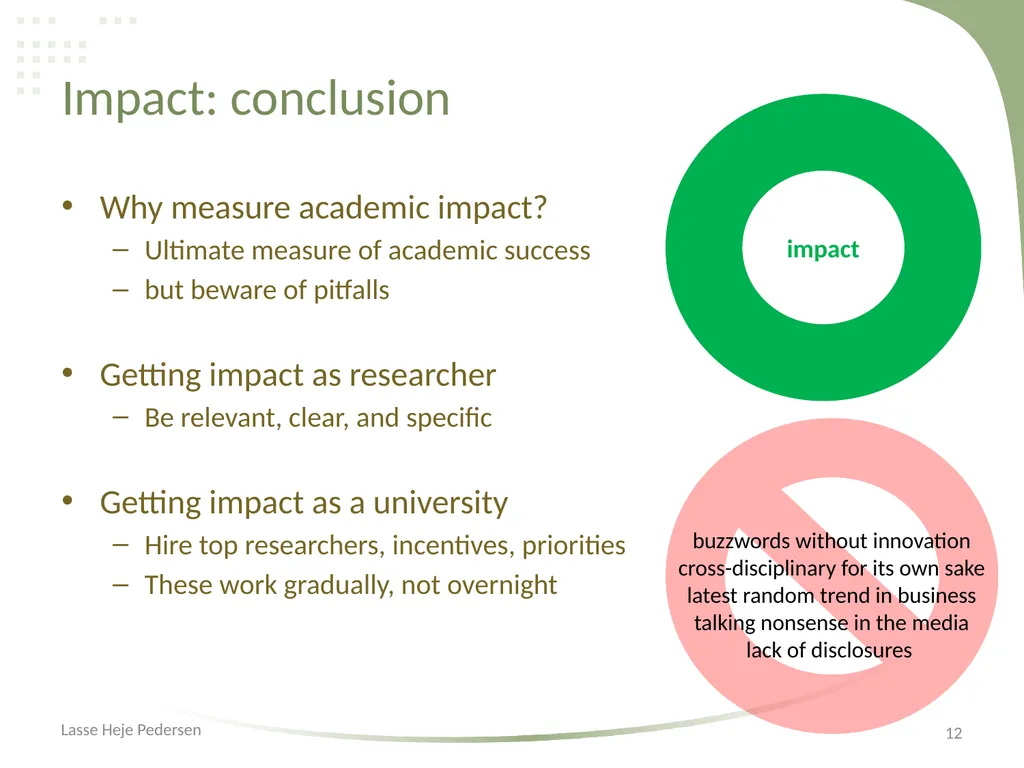
These work gradually, not overnight Lasse Heje Pedersen 12 impact buzzwords without innovation
cross-disciplinary for its own sake
latest random trend in business
talking nonsense in the media
lack of disclosures<br>