"Implementation Experience: Roadmap and Challenges" is the property of its rightful owner. Permission is granted to
download and print the materials on this website for personal, non-commercial use only, and to display it
on your personal computer provided you do not modify the materials and that you retain all copyright
notices contained in the materials. By downloading content from our website, you accept the terms of this
agreement.
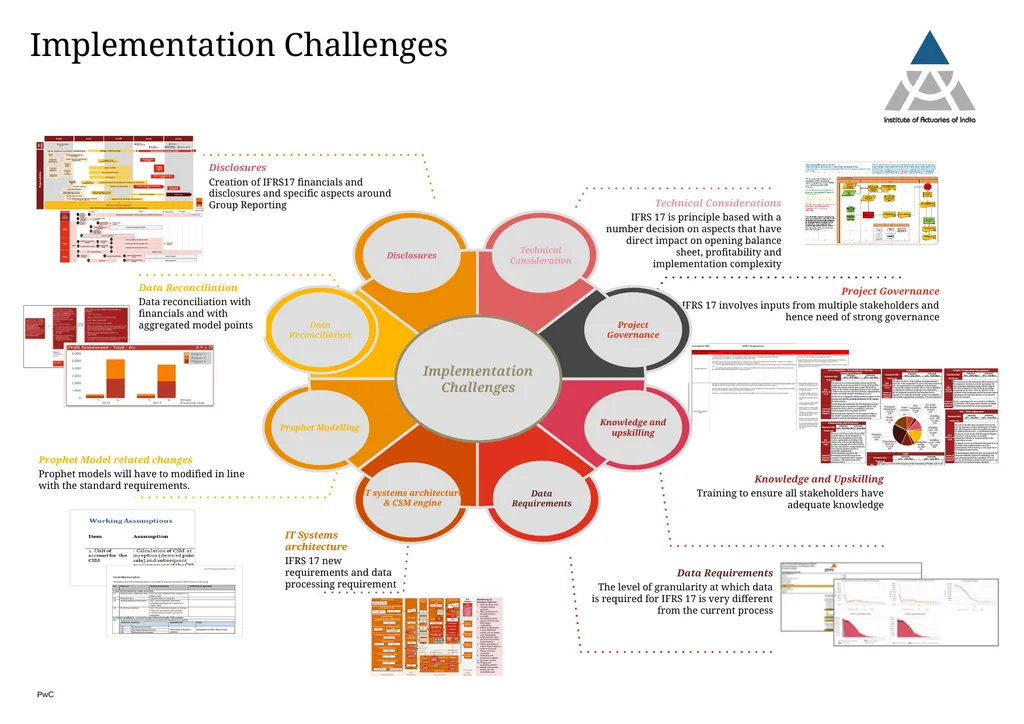
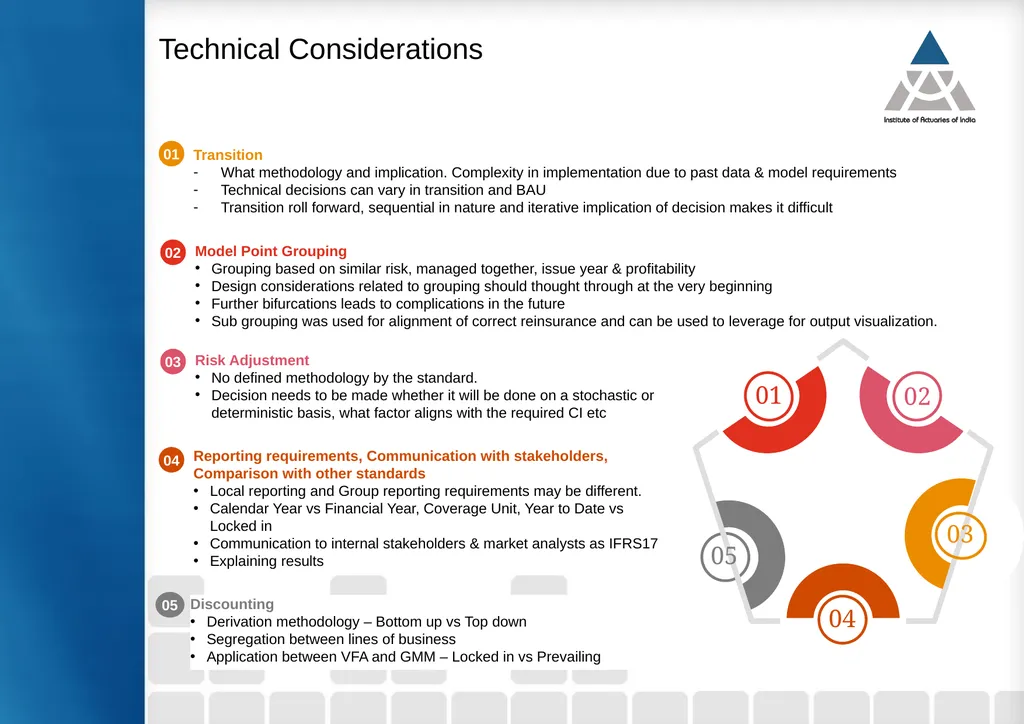
Technical Considerations Model Point Grouping
Grouping based on similar risk, managed together, issue year & profitability
Design considerations related to grouping should thought through at the very beginning
Further bifurcations leads to complications in the future
Sub grouping was used for alignment of correct reinsurance and can be used to leverage for output visualization. Risk Adjustment
No defined methodology by the standard.
Decision needs to be made whether it will be done on a stochastic or deterministic basis, what factor aligns with the required CI etc Reporting requirements, Communication with stakeholders, Comparison with other standards
Local reporting and Group reporting requirements may be different.
Calendar Year vs Financial Year, Coverage Unit, Year to Date vs Locked in
Communication to internal stakeholders & market analysts as IFRS17
Explaining results Discounting
Derivation methodology – Bottom up vs Top down
Segregation between lines of business
Application between VFA and GMM – Locked in vs Prevailing 02 03 04 05 Transition
What methodology and implication. Complexity in implementation due to past data & model requirements
Technical decisions can vary in transition and BAU
Transition roll forward, sequential in nature and iterative implication of decision makes it difficult 01<br>
05
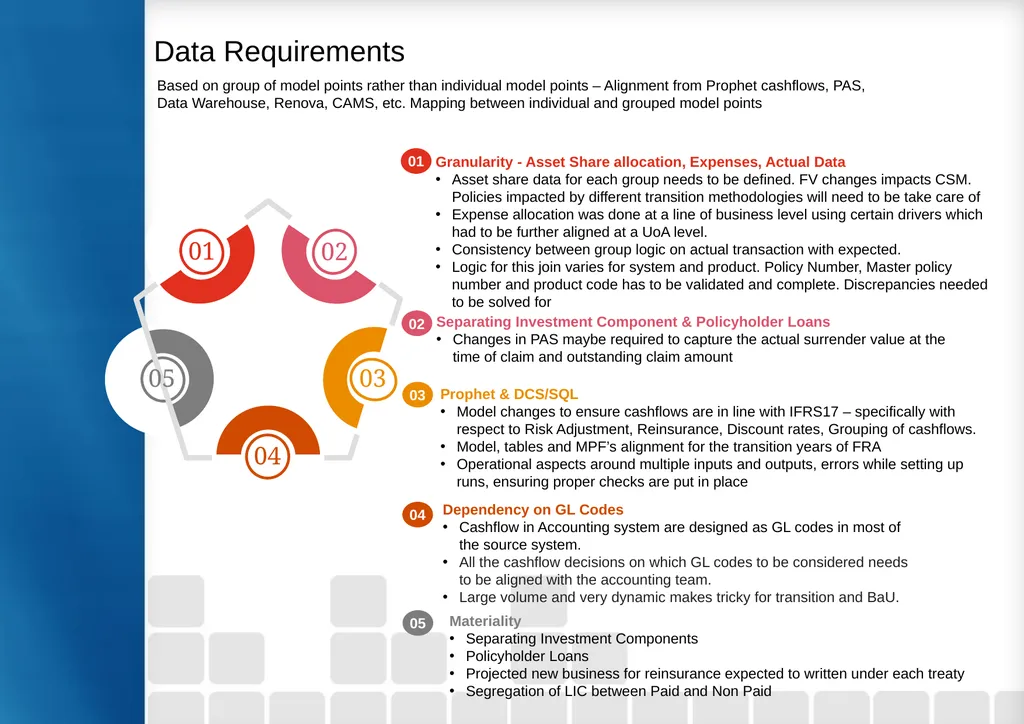
Data Requirements Granularity - Asset Share allocation, Expenses, Actual Data
Asset share data for each group needs to be defined. FV changes impacts CSM. Policies impacted by different transition methodologies will need to be take care of
Expense allocation was done at a line of business level using certain drivers which had to be further aligned at a UoA level.
Consistency between group logic on actual transaction with expected.
Logic for this join varies for system and product. Policy Number, Master policy number and product code has to be validated and complete. Discrepancies needed to be solved for Separating Investment Component & Policyholder Loans
Changes in PAS maybe required to capture the actual surrender value at the time of claim and outstanding claim amount Prophet & DCS/SQL
Model changes to ensure cashflows are in line with IFRS17 – specifically with respect to Risk Adjustment, Reinsurance, Discount rates, Grouping of cashflows.
Model, tables and MPF’s alignment for the transition years of FRA
Operational aspects around multiple inputs and outputs, errors while setting up runs, ensuring proper checks are put in place 01 02 03 04 Based on group of model points rather than individual model points – Alignment from Prophet cashflows, PAS, Data Warehouse, Renova, CAMS, etc. Mapping between individual and grouped model points Materiality
Separating Investment Components
Policyholder Loans
Projected new business for reinsurance expected to written under each treaty
Segregation of LIC between Paid and Non Paid 05 Dependency on GL Codes
Cashflow in Accounting system are designed as GL codes in most of the source system.
All the cashflow decisions on which GL codes to be considered needs to be aligned with the accounting team.
Large volume and very dynamic makes tricky for transition and BaU.<br>