
Implementation of a Risk-Based Process Safety
AM
Published · 22 slides · 0 views
1 / 1

Description
Implementation of a Risk-Based Process Safety Management System A Resource for AGA Members AGA Process Safety Sub-Committee Process Safety Framework Initiative December, 2016 CCPS, Guidelines for Risk-Based Process Safety Copyright 2007
Related Topics
Share
Embed code
Download this presentation From Below
"Implementation of a Risk-Based Process Safety" is the property of its rightful owner. Permission is granted to download and print the materials on this website for personal, non-commercial use only, and to display it on your personal computer provided you do not modify the materials and that you retain all copyright notices contained in the materials. By downloading content from our website, you accept the terms of this agreement.
Presentation Transcript
01
Implementation of a Risk-Based
Process Safety Management System
A Resource for AGA Members AGA Process Safety Sub-Committee
Process Safety Framework Initiative
December, 2016 CCPS, Guidelines for Risk-Based Process Safety
Copyright © 2007 AIChE and used with permission
PSM implementation at PG&E and used with permission<br>
Process Safety Framework Initiative
December, 2016 CCPS, Guidelines for Risk-Based Process Safety
Copyright © 2007 AIChE and used with permission
PSM implementation at PG&E and used with permission<br>
02
Notice In issuing and making this publication available, AGA is not undertaking to render professional or other services for or on behalf of any person or entity. Nor is AGA undertaking to perform any duty owed by any person or entity to someone else. Anyone using this document should rely on his or her own independent judgment or, as appropriate, seek the advice of a competent professional in determining the exercise of reasonable care in any given circumstances. The statements in this publication are for general information and represent an unaudited compilation of statistical information that could contain coding or processing errors. AGA makes no warranties, express or implied, nor representations about the accuracy of the information in the publication or its appropriateness for any given purpose or situation.
This publication shall not be construed as including, advice, guidance, or recommendations to take, or not to take, any actions or decisions in relation to any matter. Should you take any such action or decision; you do so at your own risk. Information on the topics covered by this publication may be available from other sources, which the user may wish to consult for additional views or information not covered by this publication.
Copyright © 2016 American Gas Association. All rights reserved. www.aga.org<br>
This publication shall not be construed as including, advice, guidance, or recommendations to take, or not to take, any actions or decisions in relation to any matter. Should you take any such action or decision; you do so at your own risk. Information on the topics covered by this publication may be available from other sources, which the user may wish to consult for additional views or information not covered by this publication.
Copyright © 2016 American Gas Association. All rights reserved. www.aga.org<br>
03
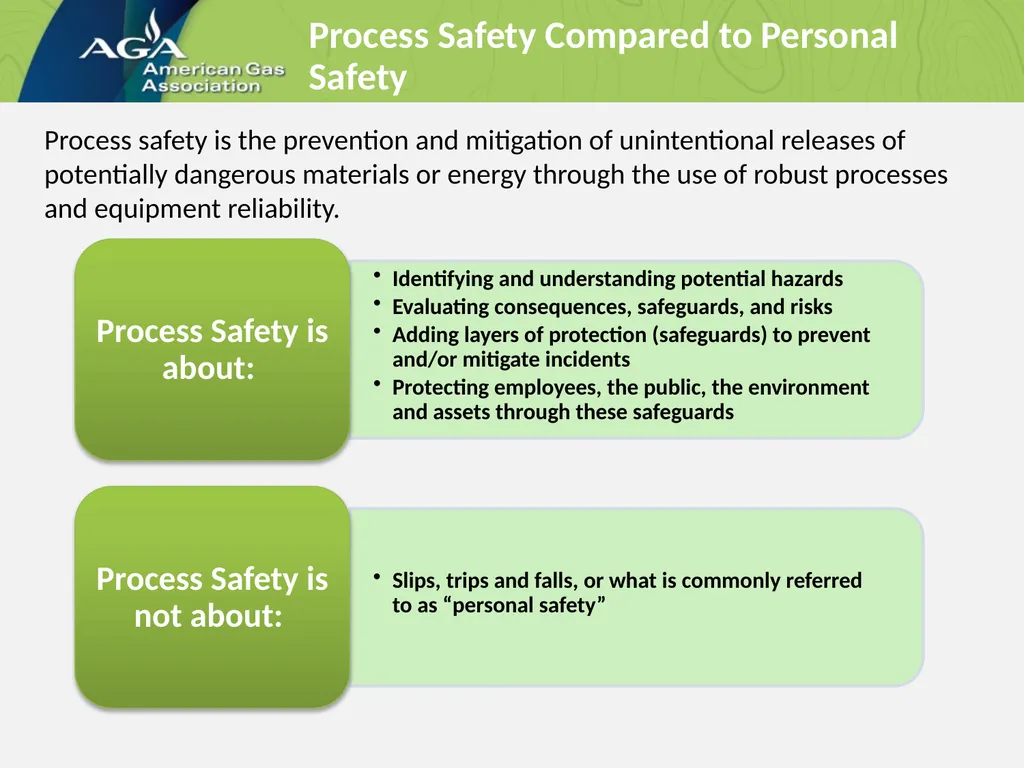
Process Safety Compared to Personal Safety Process safety is the prevention and mitigation of unintentional releases of potentially dangerous materials or energy through the use of robust processes and equipment reliability.<br>
04
Process Safety Framework Objective The objective of this resource is to help a company develop a comprehensive framework which captures industry best practices in Process Safety Management.
The framework is intended to be simple so that it can easily be understood and applied.
The framework focuses on defining what good Process Safety looks like.
The framework is not a ‘one size fits all’ model but rather a set of requirements that can be customized to meet the needs of individual companies based on their safety culture and safety maturity.<br>
The framework is intended to be simple so that it can easily be understood and applied.
The framework focuses on defining what good Process Safety looks like.
The framework is not a ‘one size fits all’ model but rather a set of requirements that can be customized to meet the needs of individual companies based on their safety culture and safety maturity.<br>
05
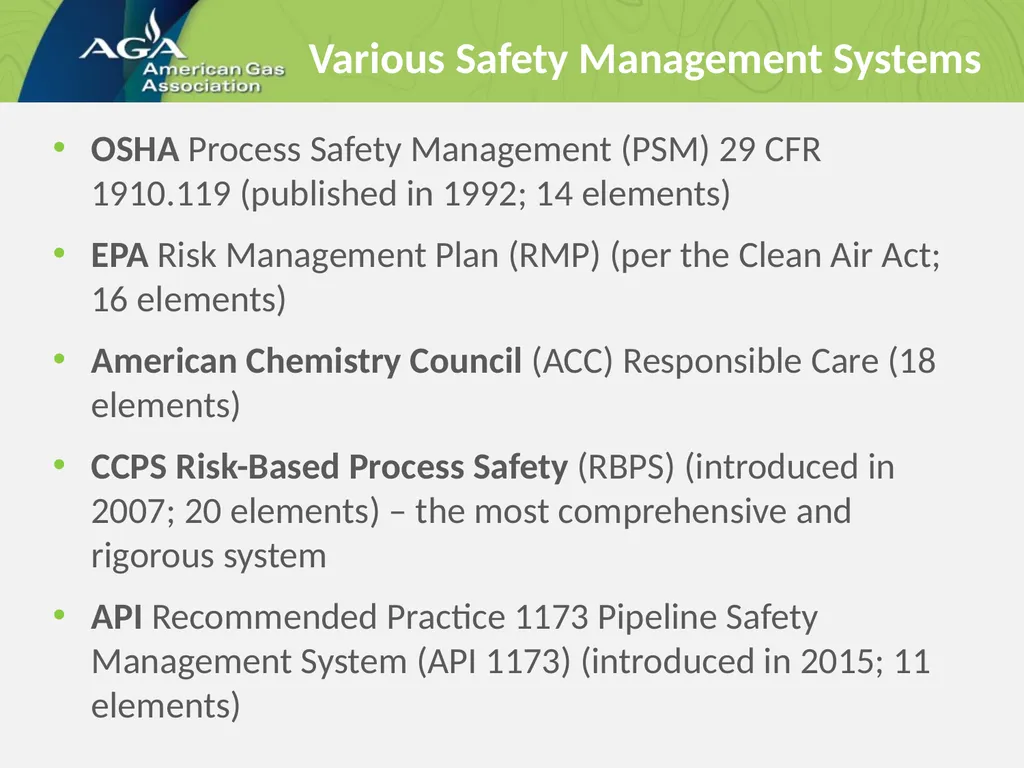
Various Safety Management Systems OSHA Process Safety Management (PSM) 29 CFR 1910.119 (published in 1992; 14 elements)
EPA Risk Management Plan (RMP) (per the Clean Air Act; 16 elements)
American Chemistry Council (ACC) Responsible Care (18 elements)
CCPS Risk-Based Process Safety (RBPS) (introduced in 2007; 20 elements) – the most comprehensive and rigorous system
API Recommended Practice 1173 Pipeline Safety Management System (API 1173) (introduced in 2015; 11 elements)<br>
EPA Risk Management Plan (RMP) (per the Clean Air Act; 16 elements)
American Chemistry Council (ACC) Responsible Care (18 elements)
CCPS Risk-Based Process Safety (RBPS) (introduced in 2007; 20 elements) – the most comprehensive and rigorous system
API Recommended Practice 1173 Pipeline Safety Management System (API 1173) (introduced in 2015; 11 elements)<br>
06
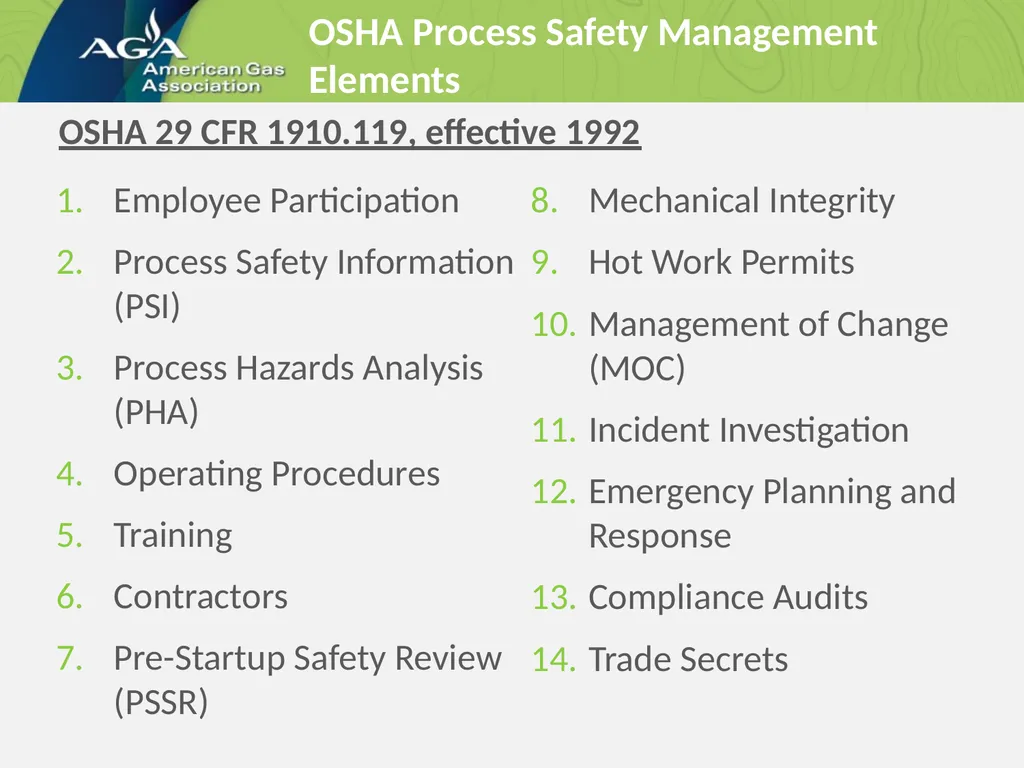
Employee Participation
Process Safety Information (PSI)
Process Hazards Analysis (PHA)
Operating Procedures
Training
Contractors
Pre-Startup Safety Review (PSSR) Mechanical Integrity
Hot Work Permits
Management of Change (MOC)
Incident Investigation
Emergency Planning and Response
Compliance Audits
Trade Secrets OSHA 29 CFR 1910.119, effective 1992 OSHA Process Safety Management Elements<br>
Process Safety Information (PSI)
Process Hazards Analysis (PHA)
Operating Procedures
Training
Contractors
Pre-Startup Safety Review (PSSR) Mechanical Integrity
Hot Work Permits
Management of Change (MOC)
Incident Investigation
Emergency Planning and Response
Compliance Audits
Trade Secrets OSHA 29 CFR 1910.119, effective 1992 OSHA Process Safety Management Elements<br>
07
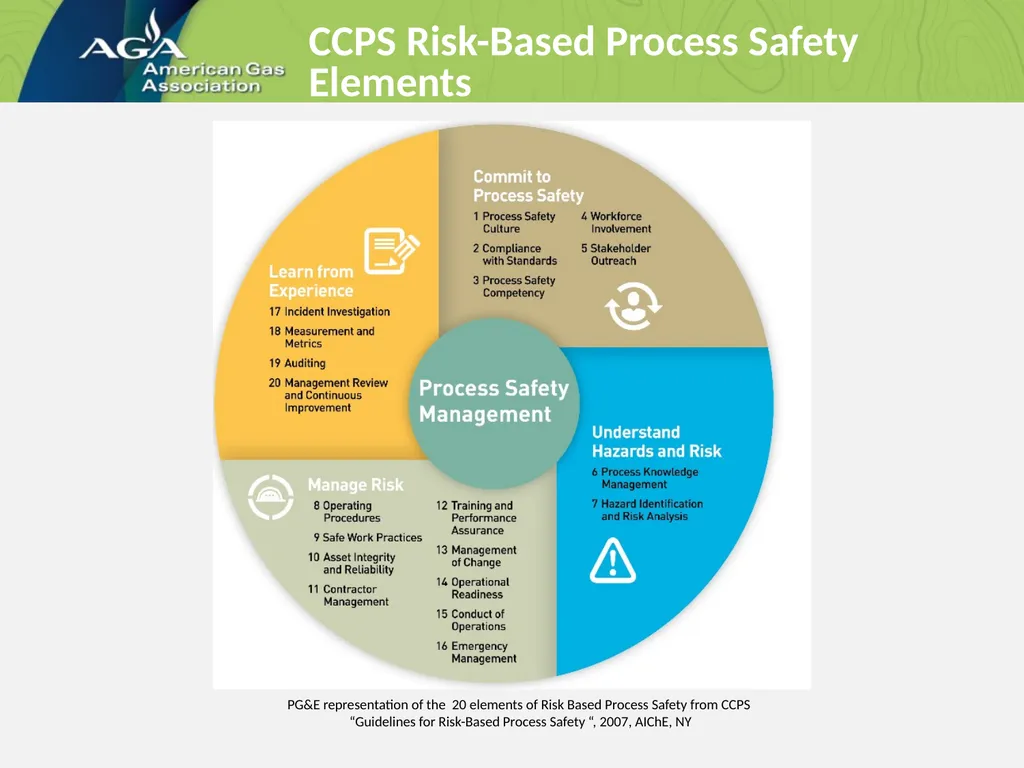
CCPS Risk-Based Process Safety Elements PG&E representation of the 20 elements of Risk Based Process Safety from CCPS
“Guidelines for Risk-Based Process Safety “, 2007, AIChE, NY<br>
“Guidelines for Risk-Based Process Safety “, 2007, AIChE, NY<br>
08
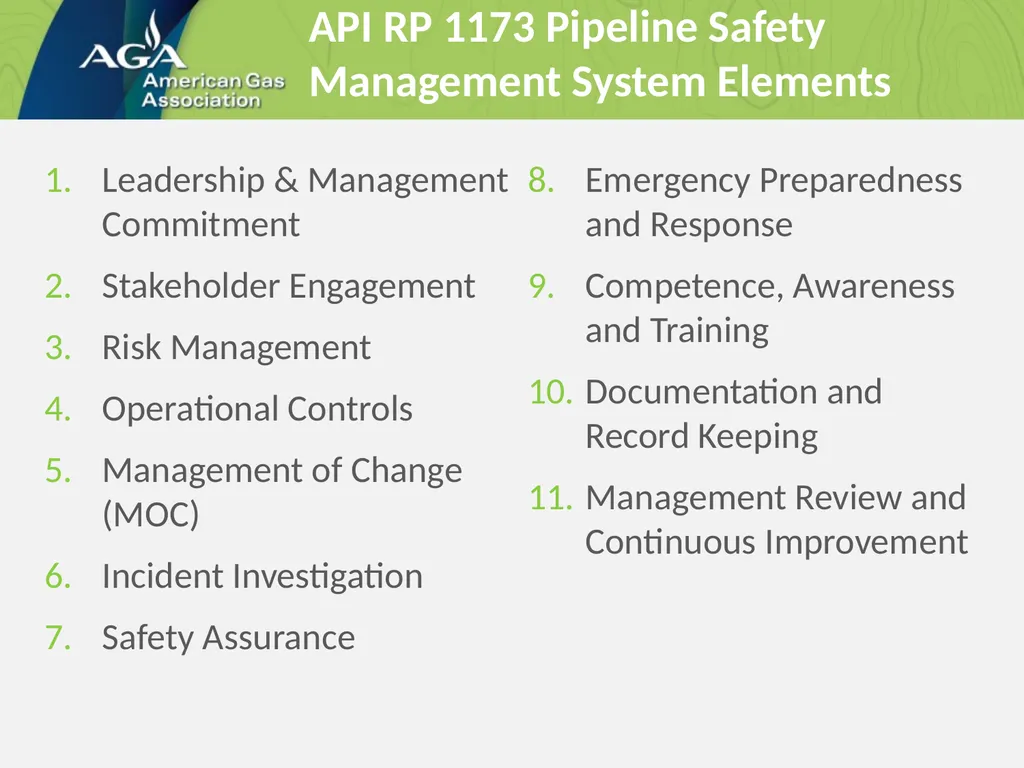
Leadership & Management Commitment
Stakeholder Engagement
Risk Management
Operational Controls
Management of Change (MOC)
Incident Investigation
Safety Assurance Emergency Preparedness and Response
Competence, Awareness and Training
Documentation and Record Keeping
Management Review and Continuous Improvement API RP 1173 Pipeline Safety Management System Elements<br>
Stakeholder Engagement
Risk Management
Operational Controls
Management of Change (MOC)
Incident Investigation
Safety Assurance Emergency Preparedness and Response
Competence, Awareness and Training
Documentation and Record Keeping
Management Review and Continuous Improvement API RP 1173 Pipeline Safety Management System Elements<br>
09
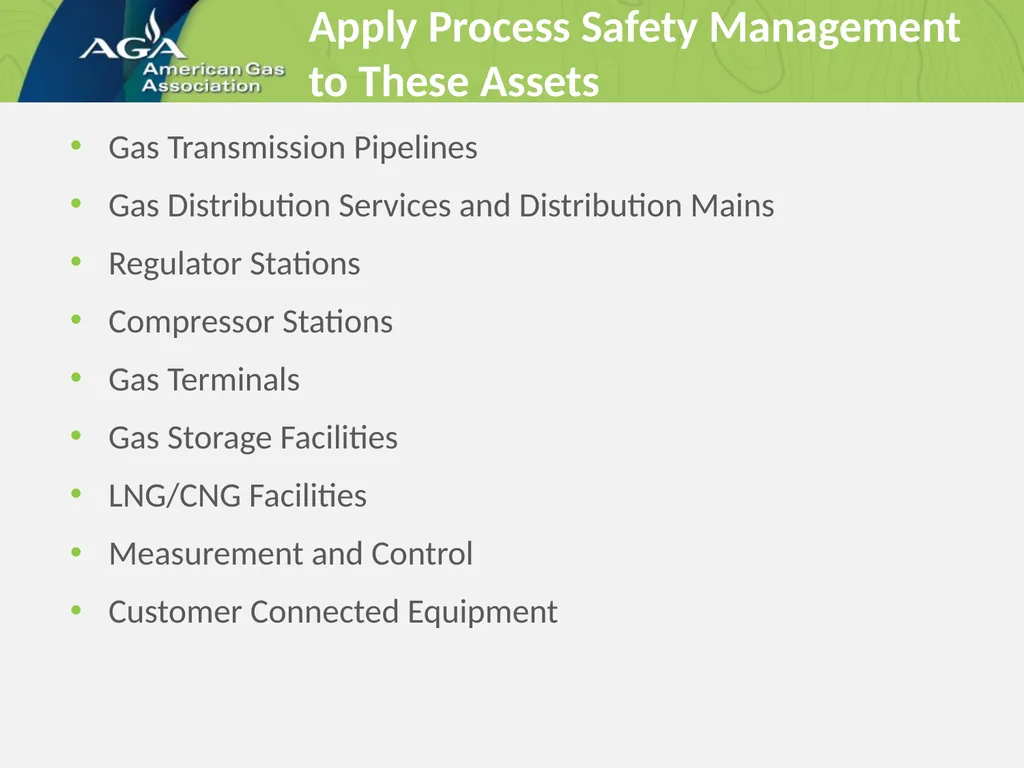
Gas Transmission Pipelines
Gas Distribution Services and Distribution Mains
Regulator Stations
Compressor Stations
Gas Terminals
Gas Storage Facilities
LNG/CNG Facilities
Measurement and Control
Customer Connected Equipment Apply Process Safety Management to These Assets<br>
Gas Distribution Services and Distribution Mains
Regulator Stations
Compressor Stations
Gas Terminals
Gas Storage Facilities
LNG/CNG Facilities
Measurement and Control
Customer Connected Equipment Apply Process Safety Management to These Assets<br>
10
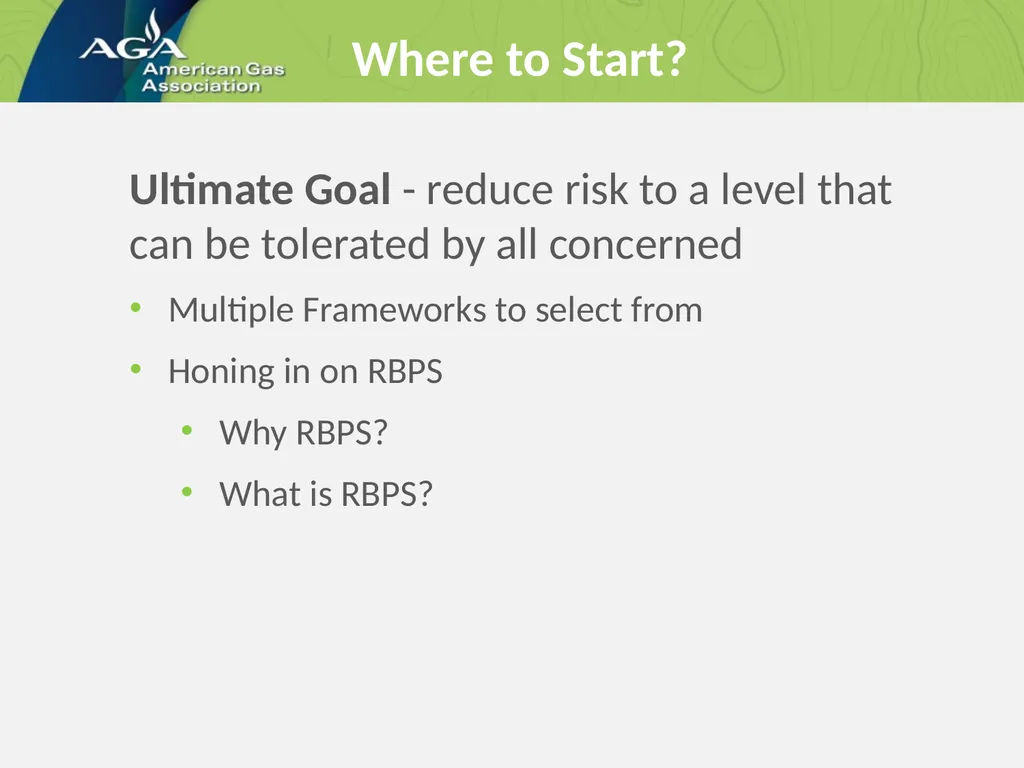
Where to Start? Ultimate Goal - reduce risk to a level that can be tolerated by all concerned
Multiple Frameworks to select from
Honing in on RBPS
Why RBPS?
What is RBPS?<br>
Multiple Frameworks to select from
Honing in on RBPS
Why RBPS?
What is RBPS?<br>
11
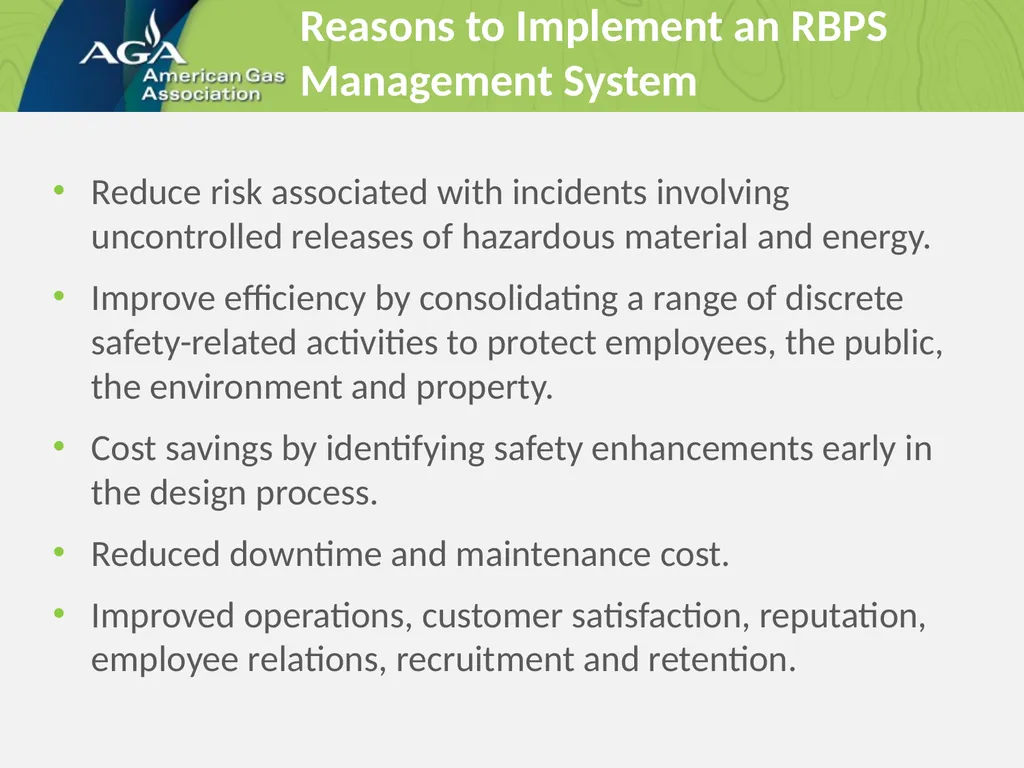
Reduce risk associated with incidents involving uncontrolled releases of hazardous material and energy.
Improve efficiency by consolidating a range of discrete safety-related activities to protect employees, the public, the environment and property.
Cost savings by identifying safety enhancements early in the design process.
Reduced downtime and maintenance cost.
Improved operations, customer satisfaction, reputation, employee relations, recruitment and retention. Reasons to Implement an RBPS Management System<br>
Improve efficiency by consolidating a range of discrete safety-related activities to protect employees, the public, the environment and property.
Cost savings by identifying safety enhancements early in the design process.
Reduced downtime and maintenance cost.
Improved operations, customer satisfaction, reputation, employee relations, recruitment and retention. Reasons to Implement an RBPS Management System<br>
12
Incorporates state-of-the-art and experience-tested features in a holistic process safety management system.
Includes novel elements such as culture, outreach, conduct of operations, metrics and management review addressing gaps in process safety management widely observed over 15 years.
Holistic application will tend to minimize aggregate risk.
Intensity of work activities for each element will be better tuned to the residual risk they are designed to manage.
Optimizes the use of resources.
Description of each element includes lists of several ideas for improving effectiveness either through efficiency improvements (make do with less) or performance improvements (maximize benefits from existing efforts).
Provides a management system that is better tuned to hazards and risks.
Help decide whether the level of effort applied to work activities for each element is inadequate, excessive, or optimal.
Scope of the work activities at a required level of reliability helps focusing the effort and promote risk management practices. Attributes of an RBPS Management System<br>
Includes novel elements such as culture, outreach, conduct of operations, metrics and management review addressing gaps in process safety management widely observed over 15 years.
Holistic application will tend to minimize aggregate risk.
Intensity of work activities for each element will be better tuned to the residual risk they are designed to manage.
Optimizes the use of resources.
Description of each element includes lists of several ideas for improving effectiveness either through efficiency improvements (make do with less) or performance improvements (maximize benefits from existing efforts).
Provides a management system that is better tuned to hazards and risks.
Help decide whether the level of effort applied to work activities for each element is inadequate, excessive, or optimal.
Scope of the work activities at a required level of reliability helps focusing the effort and promote risk management practices. Attributes of an RBPS Management System<br>
13
To be implemented at a risk-appropriate level of rigor.
Commit to process safety — the cornerstone of process safety excellence
Understand hazards and evaluate risks — the foundation of a risk-based approach
Manage risk — the ongoing execution of RBPS tasks
Learn from experience — the opportunities for improvement RBPS: Four Accident Prevention Pillars<br>
Commit to process safety — the cornerstone of process safety excellence
Understand hazards and evaluate risks — the foundation of a risk-based approach
Manage risk — the ongoing execution of RBPS tasks
Learn from experience — the opportunities for improvement RBPS: Four Accident Prevention Pillars<br>
14
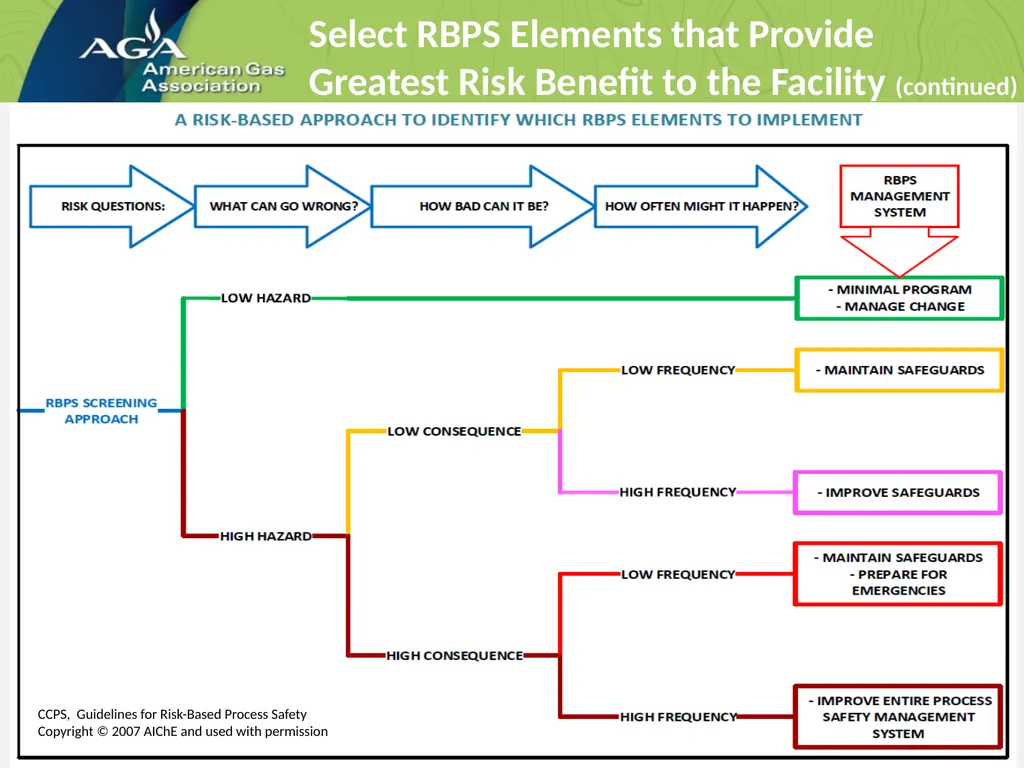
The RBPS approach recognizes that all hazards and risks are not equal.
It focuses more resources on greater hazards and higher risks.
It puts just enough energy into each activity to meet the anticipated needs for that activity.
Limited company resources can be optimally apportioned to improve both facility safety performance and overall business performance. The RBPS Approach<br>
It focuses more resources on greater hazards and higher risks.
It puts just enough energy into each activity to meet the anticipated needs for that activity.
Limited company resources can be optimally apportioned to improve both facility safety performance and overall business performance. The RBPS Approach<br>
15
Obtain management commitment and support.
Solicit assistance.
Ensure adequate resource allocation.
Define scope and objectives.
Define roles and responsibilities.
Manage expectations.
Communicate.
Advance in discrete, manageable and well defined steps.
Keep it simple.
Obtain widespread commitment.
Provide adequate training.
Field-test the system prior to official implementation.
Develop tools to streamline future implementation activities.
Apply proven project management tools and methods.
Be flexible and be aware.
Continually reinforce the commitment. First Steps - Implementation of an RBPS Management System<br>
Solicit assistance.
Ensure adequate resource allocation.
Define scope and objectives.
Define roles and responsibilities.
Manage expectations.
Communicate.
Advance in discrete, manageable and well defined steps.
Keep it simple.
Obtain widespread commitment.
Provide adequate training.
Field-test the system prior to official implementation.
Develop tools to streamline future implementation activities.
Apply proven project management tools and methods.
Be flexible and be aware.
Continually reinforce the commitment. First Steps - Implementation of an RBPS Management System<br>
16
Three RBPS criteria should be considered for improving a PSM system:
Understanding of the hazards and risks of the facilities and operations.
Understanding of the demand for (and resources used in) process safety activities.
Understanding of how process safety activities are influenced by the process safety culture within the organization. Select RBPS Elements that Provide Greatest Risk Benefit to the Facility<br>
Understanding of the hazards and risks of the facilities and operations.
Understanding of the demand for (and resources used in) process safety activities.
Understanding of how process safety activities are influenced by the process safety culture within the organization. Select RBPS Elements that Provide Greatest Risk Benefit to the Facility<br>
17
CCPS, Guidelines for Risk-Based Process Safety
Copyright © 2007 AIChE and used with permission Select RBPS Elements that Provide Greatest Risk Benefit to the Facility (continued)<br>
Copyright © 2007 AIChE and used with permission Select RBPS Elements that Provide Greatest Risk Benefit to the Facility (continued)<br>
18
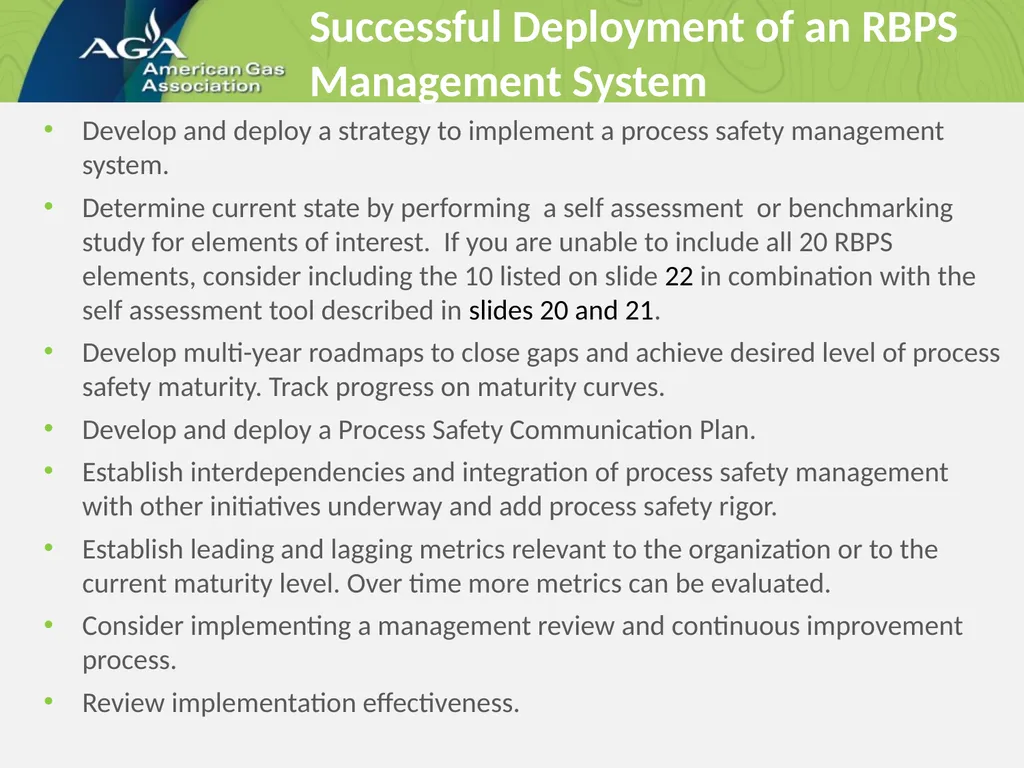
Develop and deploy a strategy to implement a process safety management system.
Determine current state by performing a self assessment or benchmarking study for elements of interest. If you are unable to include all 20 RBPS elements, consider including the 10 listed on slide 22 in combination with the self assessment tool described in slides 20 and 21.
Develop multi-year roadmaps to close gaps and achieve desired level of process safety maturity. Track progress on maturity curves.
Develop and deploy a Process Safety Communication Plan.
Establish interdependencies and integration of process safety management with other initiatives underway and add process safety rigor.
Establish leading and lagging metrics relevant to the organization or to the current maturity level. Over time more metrics can be evaluated.
Consider implementing a management review and continuous improvement process.
Review implementation effectiveness. Successful Deployment of an RBPS Management System<br>
Determine current state by performing a self assessment or benchmarking study for elements of interest. If you are unable to include all 20 RBPS elements, consider including the 10 listed on slide 22 in combination with the self assessment tool described in slides 20 and 21.
Develop multi-year roadmaps to close gaps and achieve desired level of process safety maturity. Track progress on maturity curves.
Develop and deploy a Process Safety Communication Plan.
Establish interdependencies and integration of process safety management with other initiatives underway and add process safety rigor.
Establish leading and lagging metrics relevant to the organization or to the current maturity level. Over time more metrics can be evaluated.
Consider implementing a management review and continuous improvement process.
Review implementation effectiveness. Successful Deployment of an RBPS Management System<br>
19
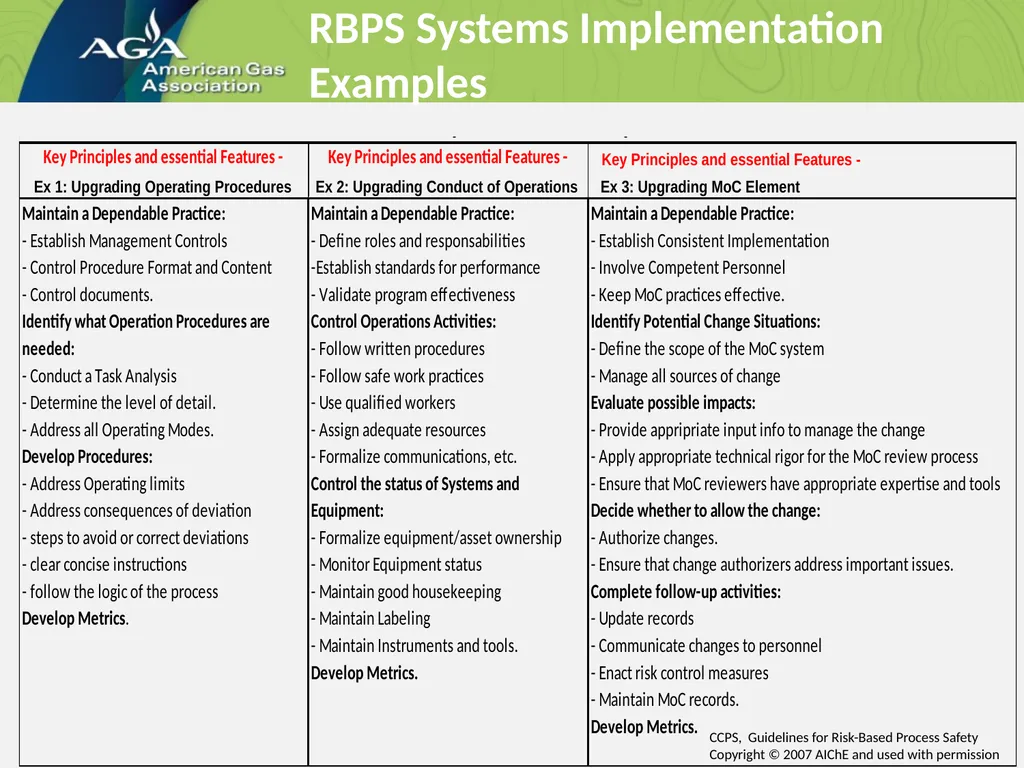
RBPS Systems Implementation Examples CCPS, Guidelines for Risk-Based Process Safety
Copyright © 2007 AIChE and used with permission Ex 1: Upgrading Operating Procedures Ex 2: Upgrading Conduct of Operations Ex 3: Upgrading MoC Element Key Principles and essential Features -<br>
Copyright © 2007 AIChE and used with permission Ex 1: Upgrading Operating Procedures Ex 2: Upgrading Conduct of Operations Ex 3: Upgrading MoC Element Key Principles and essential Features -<br>
20
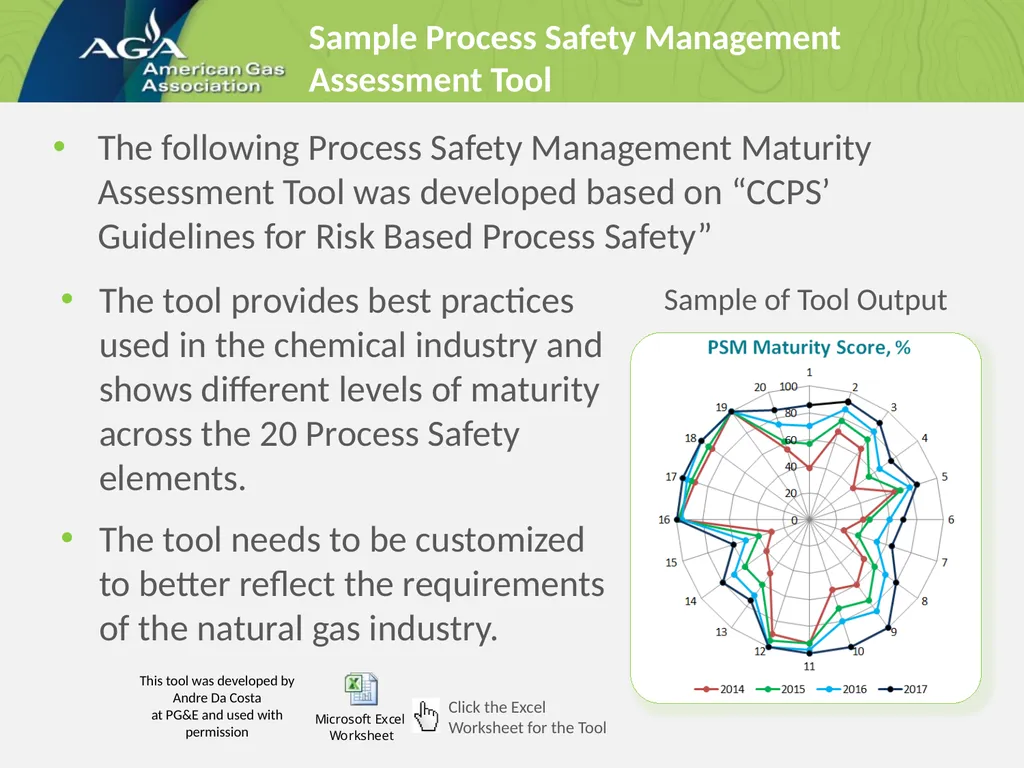
Sample Process Safety Management Assessment Tool The following Process Safety Management Maturity Assessment Tool was developed based on “CCPS’ Guidelines for Risk Based Process Safety” The tool provides best practices used in the chemical industry and shows different levels of maturity across the 20 Process Safety elements.
The tool needs to be customized to better reflect the requirements of the natural gas industry. Click the Excel Worksheet for the Tool Sample of Tool Output This tool was developed by Andre Da Costa
at PG&E and used with permission<br>
The tool needs to be customized to better reflect the requirements of the natural gas industry. Click the Excel Worksheet for the Tool Sample of Tool Output This tool was developed by Andre Da Costa
at PG&E and used with permission<br>
21
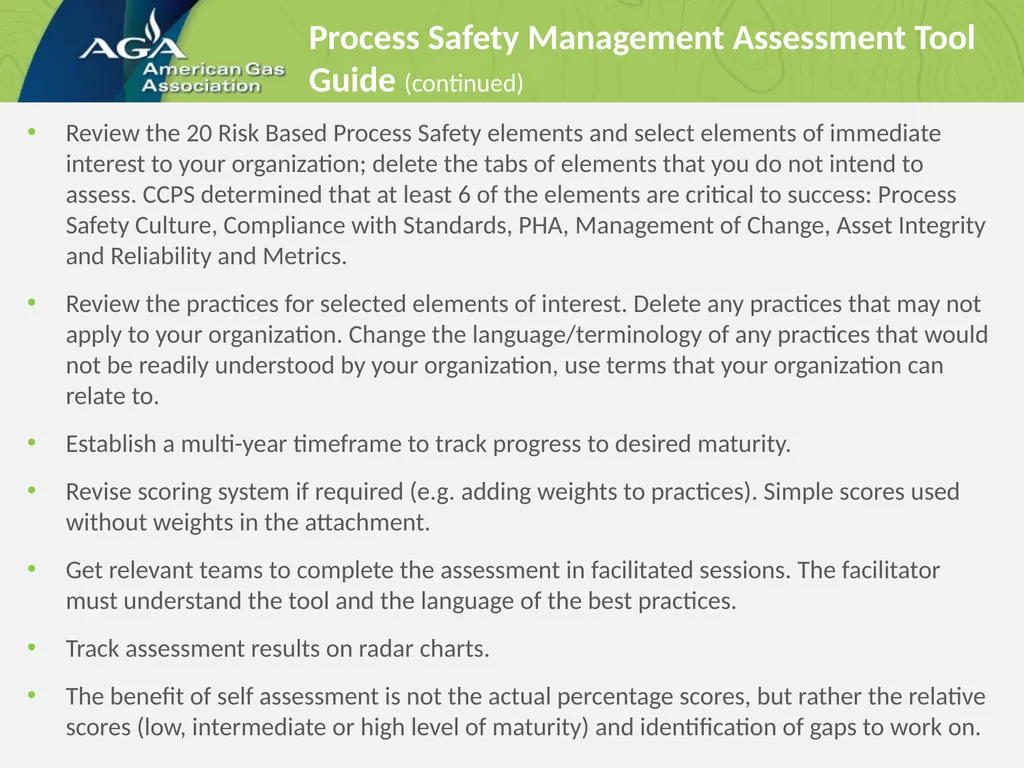
Process Safety Management Assessment Tool Guide (continued) Review the 20 Risk Based Process Safety elements and select elements of immediate interest to your organization; delete the tabs of elements that you do not intend to assess. CCPS determined that at least 6 of the elements are critical to success: Process Safety Culture, Compliance with Standards, PHA, Management of Change, Asset Integrity and Reliability and Metrics.
Review the practices for selected elements of interest. Delete any practices that may not apply to your organization. Change the language/terminology of any practices that would not be readily understood by your organization, use terms that your organization can relate to.
Establish a multi-year timeframe to track progress to desired maturity.
Revise scoring system if required (e.g. adding weights to practices). Simple scores used without weights in the attachment.
Get relevant teams to complete the assessment in facilitated sessions. The facilitator must understand the tool and the language of the best practices.
Track assessment results on radar charts.
The benefit of self assessment is not the actual percentage scores, but rather the relative scores (low, intermediate or high level of maturity) and identification of gaps to work on.<br>
Review the practices for selected elements of interest. Delete any practices that may not apply to your organization. Change the language/terminology of any practices that would not be readily understood by your organization, use terms that your organization can relate to.
Establish a multi-year timeframe to track progress to desired maturity.
Revise scoring system if required (e.g. adding weights to practices). Simple scores used without weights in the attachment.
Get relevant teams to complete the assessment in facilitated sessions. The facilitator must understand the tool and the language of the best practices.
Track assessment results on radar charts.
The benefit of self assessment is not the actual percentage scores, but rather the relative scores (low, intermediate or high level of maturity) and identification of gaps to work on.<br>
22
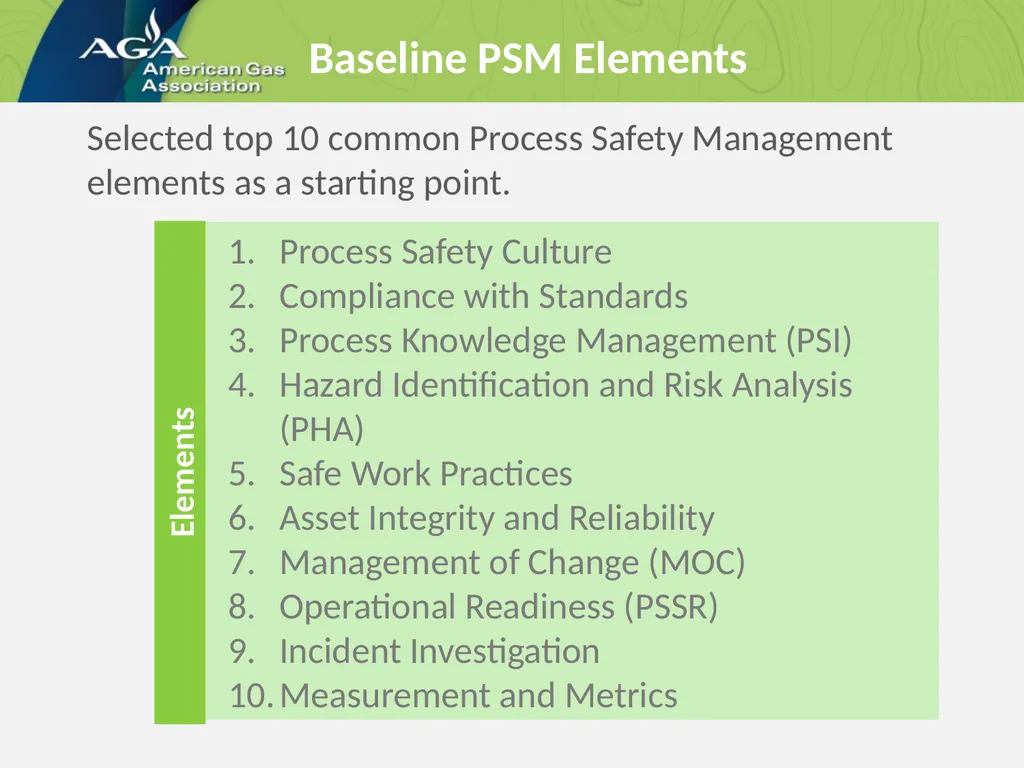
Baseline PSM Elements Selected top 10 common Process Safety Management elements as a starting point. Process Safety Culture
Compliance with Standards
Process Knowledge Management (PSI)
Hazard Identification and Risk Analysis (PHA)
Safe Work Practices
Asset Integrity and Reliability
Management of Change (MOC)
Operational Readiness (PSSR)
Incident Investigation
Measurement and Metrics Elements<br>
Compliance with Standards
Process Knowledge Management (PSI)
Hazard Identification and Risk Analysis (PHA)
Safe Work Practices
Asset Integrity and Reliability
Management of Change (MOC)
Operational Readiness (PSSR)
Incident Investigation
Measurement and Metrics Elements<br>