03
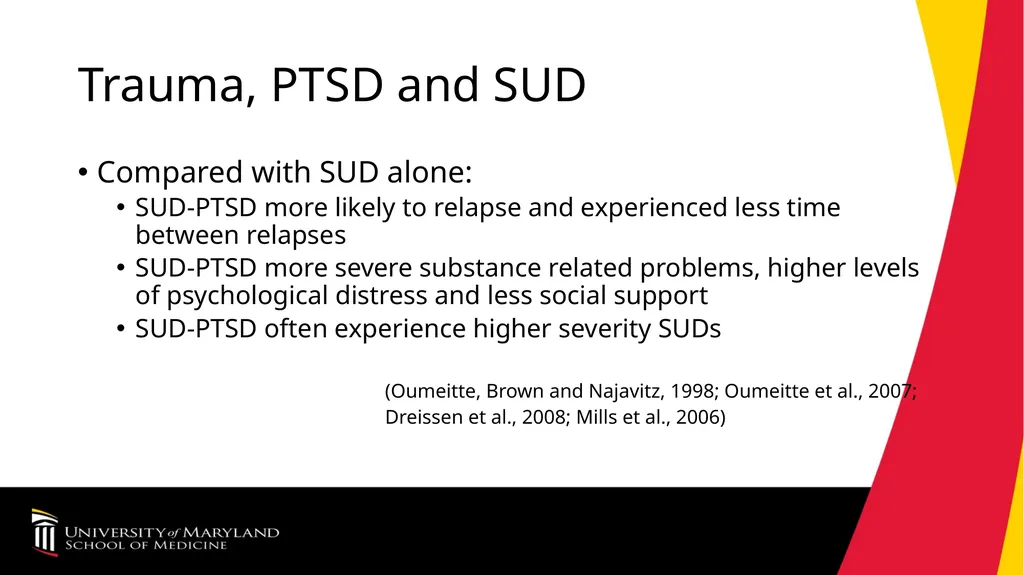
Trauma, PTSD and SUD Compared with SUD alone:
SUD-PTSD more likely to relapse and experienced less time between relapses
SUD-PTSD more severe substance related problems, higher levels of psychological distress and less social support
SUD-PTSD often experience higher severity SUDs
(Oumeitte, Brown and Najavitz, 1998; Oumeitte et al., 2007;
Dreissen et al., 2008; Mills et al., 2006)<br>
04
Objective Implement universal screening for PTSD for all new patients at the University of Maryland Addiction Treatment Center
Part of a larger quality improvement project focused on trauma informed healthcare<br>
05
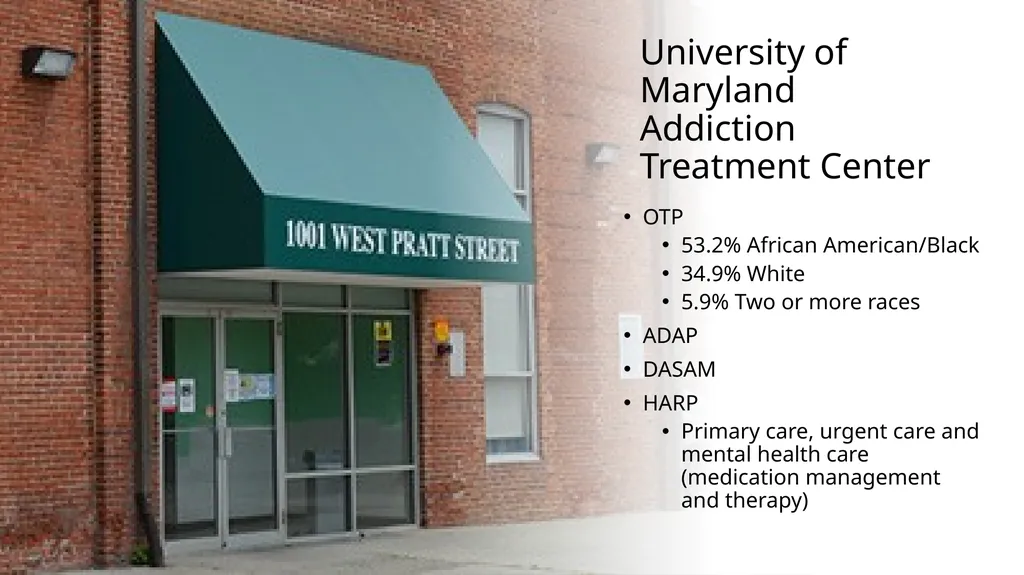
University of Maryland Addiction Treatment Center OTP
53.2% African American/Black
34.9% White
5.9% Two or more races
ADAP
DASAM
HARP
Primary care, urgent care and mental health care (medication management and therapy)<br>
06
Methods Primary Care Screen for PTSD for DSM-5 (PC-PTSD-5) during intake and annual treatment plan updates
Counselors received a 1 hr training, a screening guide and a PTSD information sheet they could utilize to provide psychoeducation<br>
07
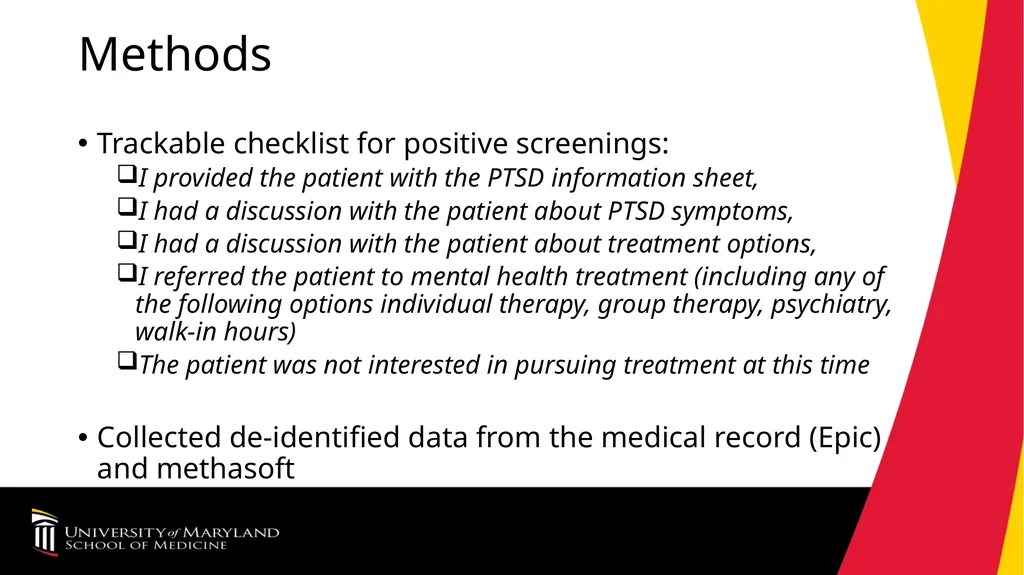
Methods Trackable checklist for positive screenings:
I provided the patient with the PTSD information sheet,
I had a discussion with the patient about PTSD symptoms,
I had a discussion with the patient about treatment options,
I referred the patient to mental health treatment (including any of the following options individual therapy, group therapy, psychiatry, walk-in hours)
The patient was not interested in pursuing treatment at this time
Collected de-identified data from the medical record (Epic) and methasoft<br>
08
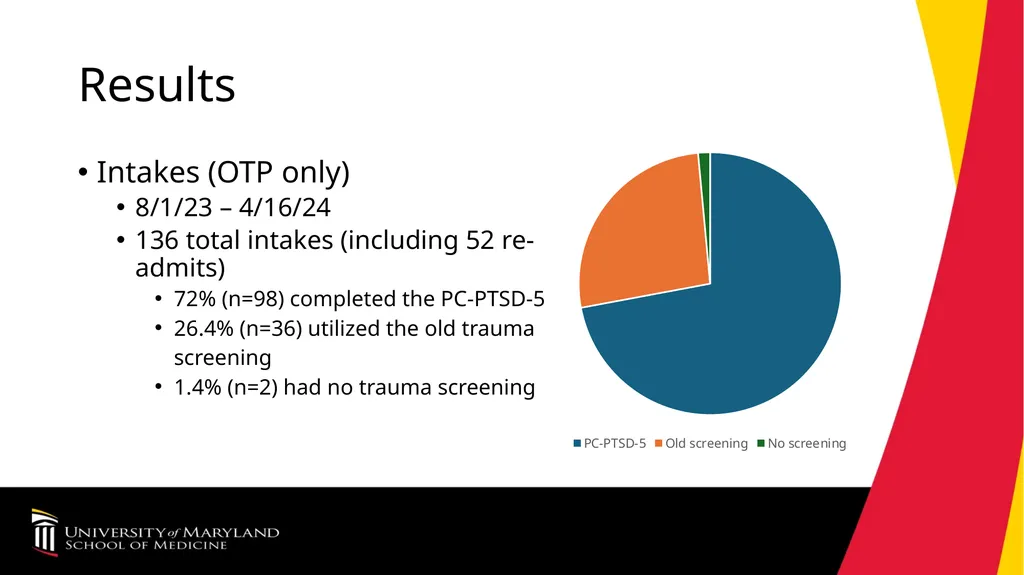
Results Intakes (OTP only)
8/1/23 – 4/16/24
136 total intakes (including 52 re-admits)
72% (n=98) completed the PC-PTSD-5
26.4% (n=36) utilized the old trauma screening
1.4% (n=2) had no trauma screening<br>
09
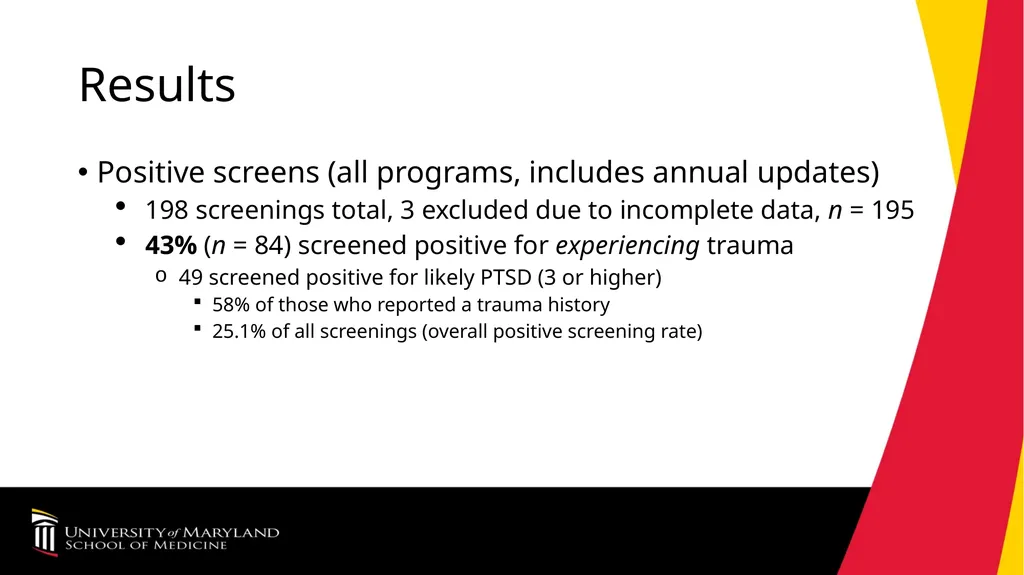
Results Positive screens (all programs, includes annual updates)
198 screenings total, 3 excluded due to incomplete data, n = 195
43% (n = 84) screened positive for experiencing trauma
49 screened positive for likely PTSD (3 or higher)
58% of those who reported a trauma history
25.1% of all screenings (overall positive screening rate)<br>
10
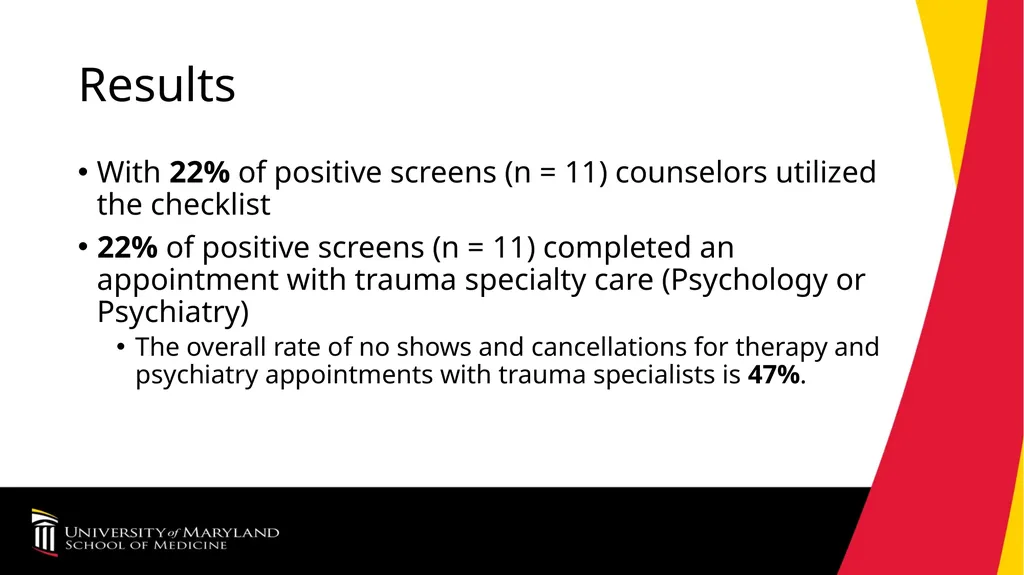
Results With 22% of positive screens (n = 11) counselors utilized the checklist
22% of positive screens (n = 11) completed an appointment with trauma specialty care (Psychology or Psychiatry)
The overall rate of no shows and cancellations for therapy and psychiatry appointments with trauma specialists is 47%.<br>
11
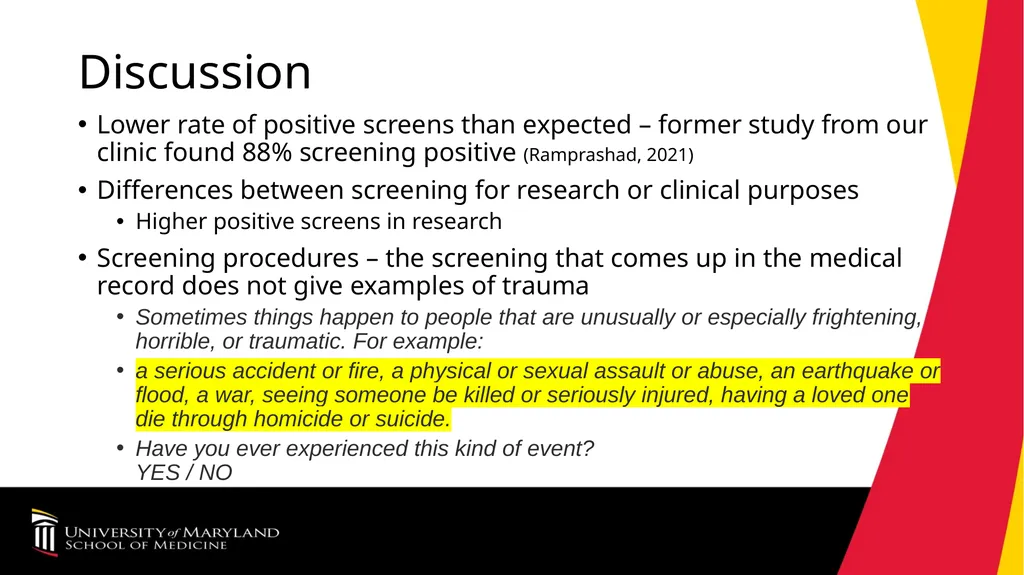
Discussion Lower rate of positive screens than expected – former study from our clinic found 88% screening positive (Ramprashad, 2021)
Differences between screening for research or clinical purposes
Higher positive screens in research
Screening procedures – the screening that comes up in the medical record does not give examples of trauma
Sometimes things happen to people that are unusually or especially frightening, horrible, or traumatic. For example:
a serious accident or fire, a physical or sexual assault or abuse, an earthquake or flood, a war, seeing someone be killed or seriously injured, having a loved one die through homicide or suicide.
Have you ever experienced this kind of event?�YES / NO<br>
12
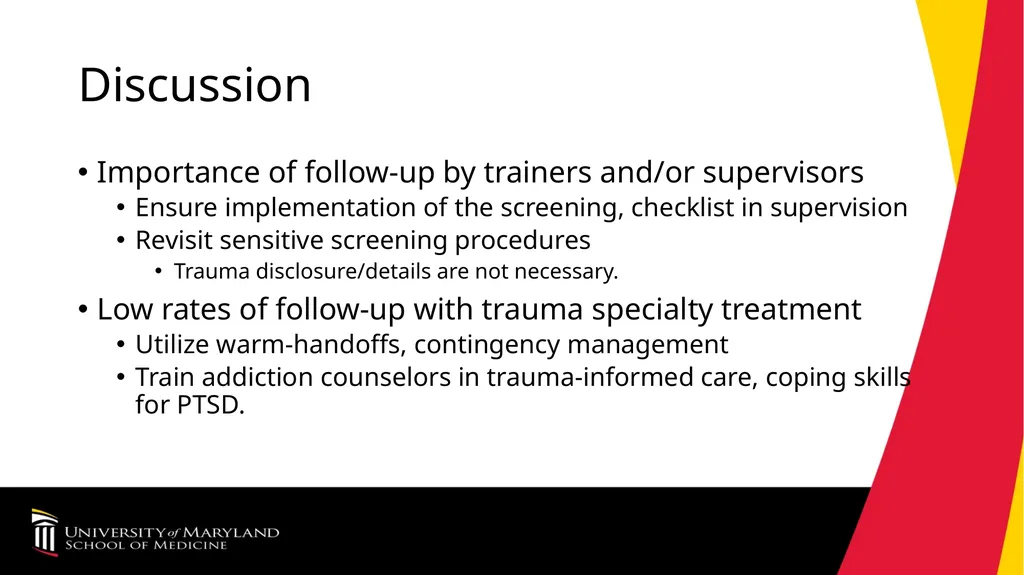
Discussion Importance of follow-up by trainers and/or supervisors
Ensure implementation of the screening, checklist in supervision
Revisit sensitive screening procedures
Trauma disclosure/details are not necessary.
Low rates of follow-up with trauma specialty treatment
Utilize warm-handoffs, contingency management
Train addiction counselors in trauma-informed care, coping skills for PTSD.<br>
13
Acknowledgments Thanks to Jewell Benford, LCSW-C and Vigfus Vigfusson for their assistance with pulling/organizing data
Thanks to counseling supervisors – Raymond Velencia, LCPC, Gail Chapman Robinson, LCADC, Mark Connelly LCSW-C and Laura Dreany-Pyles, LCSW-C, CAC-AD<br>
14
References Centers for Disease Control. Behavioral Risk Factor Surveillance System. Published online 2015.
Driessen M, Schulte S, Luedecke C, et al. Trauma and PTSD in patients with alcohol, drug, or dual dependence: a multi-center study. Alcohol Clin Exp Res. 2008;32(3):481-488. doi:10.1111/j.1530-0277.2007.00591.x
Gielen N, Havermans R, Tekelenburg M, Jansen A. Prevalence of post-traumatic stress disorder among patients with substance use disorder: it is higher than clinicians think it is. Eur J Psychotraumatology. 2012;3(1):17734. doi:10.3402/ejpt.v3i0.17734
Jacobsen LK, Southwick SM, Kosten TR. Substance use disorders in patients with posttraumatic stress disorder: A review of the literature. Am J Psychiatry. 2001;158(8):1184-1190. doi:10.1176/appi.ajp.158.8.1184
Mills KL, Teesson M, Ross J, Peters L. Trauma, PTSD, and Substance Use Disorders: Findings From the Australian National Survey of Mental Health and Well-Being. Am J Psychiatry. 2006;163(4):652-658. doi:10.1176/ajp.2006.163.4.652
Ouimette PC, Brown PJ, Najavits LM. Course and treatment of patients with both substance use and posttraumatic stress disorders. Addict Behav. 1998;23(6):785-795. doi:10.1016/s0306-4603(98)00064-1<br>
15
References Ouimette P, Coolhart D, Funderburk JS, Wade M, Brown PJ. Precipitants of first substance use in recently abstinent substance use disorder patients with PTSD. Addict Behav. 2007;32(8):1719-1727. doi:10.1016/j.addbeh.2006.11.020
Prins, A., Bovin, M. J., Kimerling, R., Kaloupek, D. G., Marx, B. P., Pless Kaiser, A., & Schnurr, P. P. (2015). The Primary Care PTSD Screen for DSM-5 (PC-PTSD-5).
Ramprashad A, Cole T, Massey E, Bennett M, Belcher A. The impact of comorbid psychiatric symptoms on treatment retention in methadone maintenance treatment. Poster presented at University of Maryland School of Medicine, Department of Psychiatry Research Day. May, 2021.
US Substance Abuse and Mental Health Services Administration. TIP 57: Trauma-Informed Care in Behavioral Health Services | SAMHSA Publications and Digital Products. Accessed April 28, 2023. https://store.samhsa.gov/product/TIP-57-Trauma-Informed-Care-in-Behavioral-Health-Services/SMA14-4816<br>
16
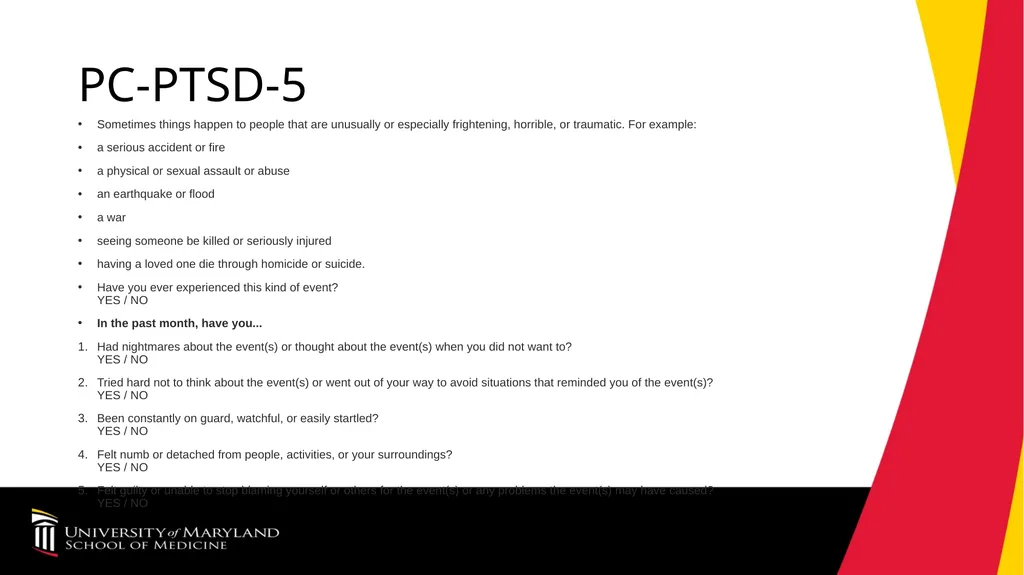
PC-PTSD-5 Sometimes things happen to people that are unusually or especially frightening, horrible, or traumatic. For example:
a serious accident or fire
a physical or sexual assault or abuse
an earthquake or flood
a war
seeing someone be killed or seriously injured
having a loved one die through homicide or suicide.
Have you ever experienced this kind of event?�YES / NO
In the past month, have you...
Had nightmares about the event(s) or thought about the event(s) when you did not want to?�YES / NO
Tried hard not to think about the event(s) or went out of your way to avoid situations that reminded you of the event(s)?�YES / NO
Been constantly on guard, watchful, or easily startled?�YES / NO
Felt numb or detached from people, activities, or your surroundings?�YES / NO
Felt guilty or unable to stop blaming yourself or others for the event(s) or any problems the event(s) may have caused?�YES / NO<br>