
Implementing the PRSB Wound Care Record
JO
Published · 27 slides · 0 views
1 / 1












Description
Implementing the PRSB Wound Care Record Information Standard Example kick off slide deck Kick off slide deck: How to use What are these slides for? These slides provide an outline to help you brief staff on the project, the rationale for
Related Topics
Share
Embed code
Download this presentation From Below
"Implementing the PRSB Wound Care Record" is the property of its rightful owner. Permission is granted to download and print the materials on this website for personal, non-commercial use only, and to display it on your personal computer provided you do not modify the materials and that you retain all copyright notices contained in the materials. By downloading content from our website, you accept the terms of this agreement.
Presentation Transcript
01
Implementing the PRSB Wound Care Record Information Standard Example kick off slide deck<br>
02
Kick off slide deck: How to use What are these slides for?
These slides provide an outline to help you brief staff on the project, the rationale for doing it and how they will be involved. You can adapt them to reflect the specifics of your local situation.
Editing them for your organisation
There are placeholders throughout the slide deck (marked in yellow) where you should add your own organisation specific content.<br>
These slides provide an outline to help you brief staff on the project, the rationale for doing it and how they will be involved. You can adapt them to reflect the specifics of your local situation.
Editing them for your organisation
There are placeholders throughout the slide deck (marked in yellow) where you should add your own organisation specific content.<br>
03
Wound Care Record Information Standard Implementation Programme:
Example Agenda Background to your local wound care strategy?
Why implement the new standard?
Aims of the National Wound Care Strategy Programme
Who are PRSB and what is the wound care record Information Standard?
Benefits to patients and health and care professionals
Betty’s story
Implementing the information standard
Implementation overview
Getting to grips with the standard -
Getting people on board – roles and responsibilities
Taking stock and planning for the future – systems, governance
Putting the standard into practice.<br>
Example Agenda Background to your local wound care strategy?
Why implement the new standard?
Aims of the National Wound Care Strategy Programme
Who are PRSB and what is the wound care record Information Standard?
Benefits to patients and health and care professionals
Betty’s story
Implementing the information standard
Implementation overview
Getting to grips with the standard -
Getting people on board – roles and responsibilities
Taking stock and planning for the future – systems, governance
Putting the standard into practice.<br>
04
Discuss
(Please add your content into the bullet points below)
How wound care information is currently captured and shared across health and care settings
Add example organisational data flow maps to show how wound care information is currently recorded and shared
Areas identified as in need of improvement
Any current / new wound care information sharing platforms.
What are the known current issues that implementing the standard will resolve?
Data collated to support the change programme Introduce the local background and vision<br>
How wound care information is currently captured and shared across health and care settings
Add example organisational data flow maps to show how wound care information is currently recorded and shared
Areas identified as in need of improvement
Any current / new wound care information sharing platforms.
What are the known current issues that implementing the standard will resolve?
Data collated to support the change programme Introduce the local background and vision<br>
05
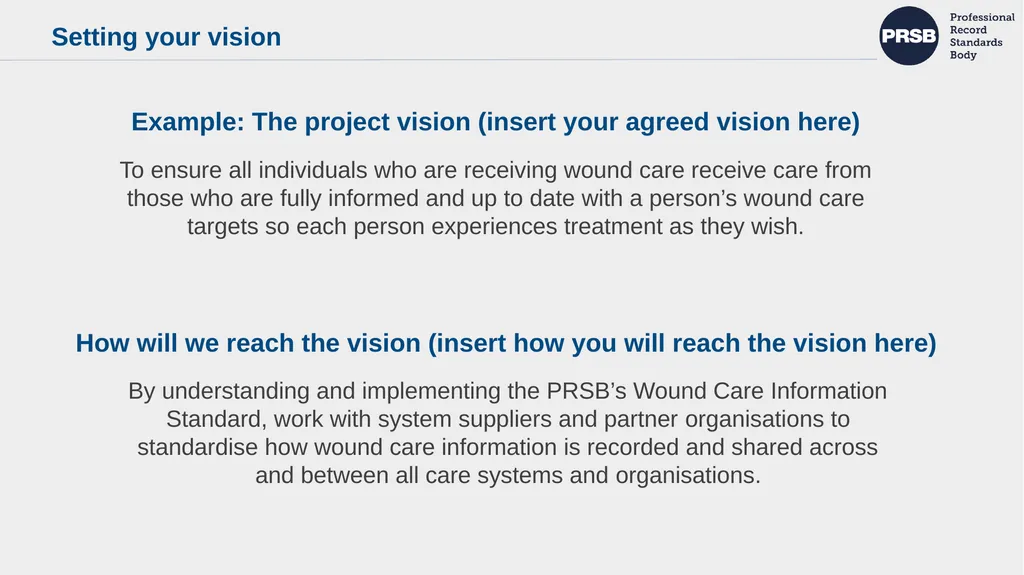
Setting your vision By understanding and implementing the PRSB’s Wound Care Information Standard, work with system suppliers and partner organisations to standardise how wound care information is recorded and shared across and between all care systems and organisations. How will we reach the vision (insert how you will reach the vision here) To ensure all individuals who are receiving wound care receive care from those who are fully informed and up to date with a person’s wound care targets so each person experiences treatment as they wish. Example: The project vision (insert your agreed vision here)<br>
06
Why implement the wound care record information standard? Examples below:
To better support health and care professionals to make informed decisions when caring for a person with with wounds
To improve the experience of a person in receipt of wound care
To standardise the wound care information recorded so it can be better shared between organisations and systems
The updated wound care information standard includes personalised care and support plans, engaging patient in their goals and aims
Improve interoperability between systems by ensuring systems can 'talk' to each other
Support system wide reporting dashboards to evidence benefits and change.<br>
To better support health and care professionals to make informed decisions when caring for a person with with wounds
To improve the experience of a person in receipt of wound care
To standardise the wound care information recorded so it can be better shared between organisations and systems
The updated wound care information standard includes personalised care and support plans, engaging patient in their goals and aims
Improve interoperability between systems by ensuring systems can 'talk' to each other
Support system wide reporting dashboards to evidence benefits and change.<br>
07
Standards Explained For information to flow between systems, it needs to be organised and recorded in the same way every time
Agreed national standards and
definitions must be used so that any computer can reproduce it with the same meaning
When information standards are implemented by care providers and their computer system suppliers, information will be recorded consistently across different settings.<br>
Agreed national standards and
definitions must be used so that any computer can reproduce it with the same meaning
When information standards are implemented by care providers and their computer system suppliers, information will be recorded consistently across different settings.<br>
08
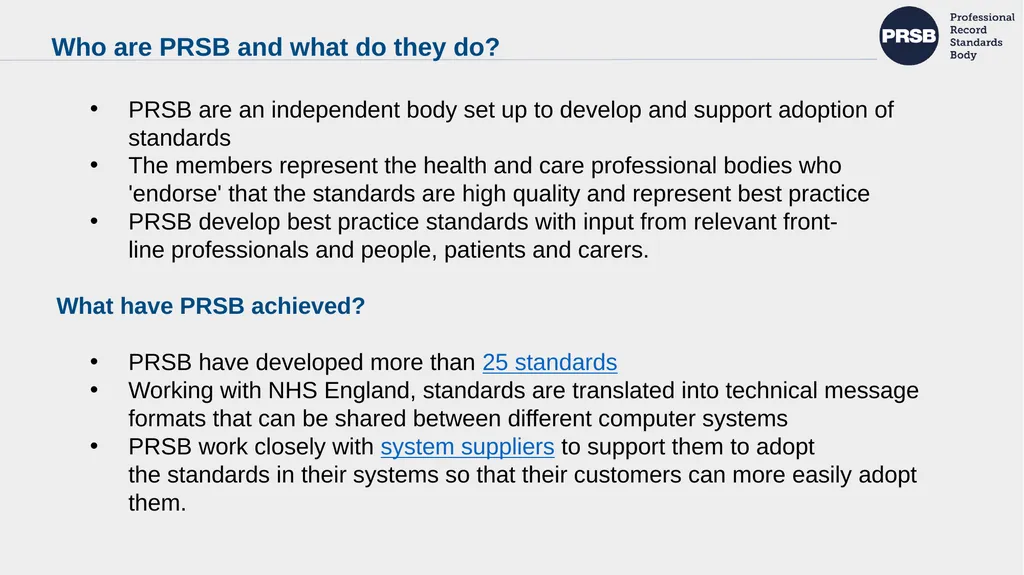
Who are PRSB and what do they do? PRSB are an independent body set up to develop and support adoption of standards
The members represent the health and care professional bodies who 'endorse' that the standards are high quality and represent best practice
PRSB develop best practice standards with input from relevant front-line professionals and people, patients and carers.
What have PRSB achieved?
PRSB have developed more than 25 standards
Working with NHS England, standards are translated into technical message formats that can be shared between different computer systems
PRSB work closely with system suppliers to support them to adopt the standards in their systems so that their customers can more easily adopt them.<br>
The members represent the health and care professional bodies who 'endorse' that the standards are high quality and represent best practice
PRSB develop best practice standards with input from relevant front-line professionals and people, patients and carers.
What have PRSB achieved?
PRSB have developed more than 25 standards
Working with NHS England, standards are translated into technical message formats that can be shared between different computer systems
PRSB work closely with system suppliers to support them to adopt the standards in their systems so that their customers can more easily adopt them.<br>
09
How was the wound care information standard developed? Evidence gathering and research.
Production of an initial draft standard
Consultation with People in receipt of wound care (and their carers) and with care professionals delivering wound care.
Refinement of the draft standard
Development of hazard log and safety case
Simulation to test the standard.
Second stage consultation with stakeholders including system suppliers.<br>
Production of an initial draft standard
Consultation with People in receipt of wound care (and their carers) and with care professionals delivering wound care.
Refinement of the draft standard
Development of hazard log and safety case
Simulation to test the standard.
Second stage consultation with stakeholders including system suppliers.<br>
10
Benefits of implementing the wound care information standard<br>
11
Regulatory Drivers England National wound care strategy programme (NWCSP)
Scotland tbc
Wales tbc
Northern Ireland tbc Information Standards Notices (ISN) PRSB wound care record information standard NHS England approve and publish ISN’s on their website. The PRSB’s wound care record information standard is in the process of gaining ISN Approval<br>
Scotland tbc
Wales tbc
Northern Ireland tbc Information Standards Notices (ISN) PRSB wound care record information standard NHS England approve and publish ISN’s on their website. The PRSB’s wound care record information standard is in the process of gaining ISN Approval<br>
12
Betty’s story and the wound care record information standard<br>
13
Betty is a 74-year-old woman with a BMI of 30, suffering from a leg ulcer after she grazed her ankle whilst rambling. She self-managed for a few days until consulting the local pharmacist who refers to the lower leg wound pathway. Betty is a retired shop assistant and has a good social network in the village. After eight weeks Betty’s leg is healed. Her personalised care and support plan focuses on maintaining her social life in the village and improving her strength and mobility. She is advised to continue with self-care procedures to prevent recurrence and wears compression stockings as a preventative measure. An escalation plan is created in the event that there is a change in her condition and her pain medication is reduced. She is sent to vascular re-referral for review. It is safe for Betty to have strong compression treatment with additional leg elevation, low impact exercises and emollient on the surrounding lower limb. Betty is reassured that pain relief has been carefully planned and she will not become dependent upon the medication. Betty is taught to self-manage successfully so that she keeps the bandages on and everyone can see improvement. She is motivated to stick to the regime. Social life Exercise plan Self-care Betty’s story
Monitoring, assessing and treating a leg ulcer in an adult The general practice nurses and district nursing team assess her wound. After 4 days, Betty is referred to the leg ulcer pathway for a full holistic and leg ulcer assessment. Measurements, wound bed tissue type, condition of surrounding skin, exudate levels, pain levels and any signs of infection are recorded in the IT system and shared between the
practice nurses, District Nurse team and accessible to the pharmacist. An ABPI confirms there is no significant arterial disease.<br>
Monitoring, assessing and treating a leg ulcer in an adult The general practice nurses and district nursing team assess her wound. After 4 days, Betty is referred to the leg ulcer pathway for a full holistic and leg ulcer assessment. Measurements, wound bed tissue type, condition of surrounding skin, exudate levels, pain levels and any signs of infection are recorded in the IT system and shared between the
practice nurses, District Nurse team and accessible to the pharmacist. An ABPI confirms there is no significant arterial disease.<br>
14
How Betty’s wound care information is captured against the standard Personal Details
Personal details
Person demographics
Person Name
Person full name: Betty
Sex: Female
Date of birth: 1949
Ethnicity: White British
General health information and Relevant history
General health information and Relevant history
Problem list
Problem list record entry
Problem
Coded value: 95344007 | Ulcer of lower extremity (disorder) |
Problem list
Problem list record entry
Problem
Coded value: 162864005 | Body mass index 30+ - obesity (finding) |<br>
Personal details
Person demographics
Person Name
Person full name: Betty
Sex: Female
Date of birth: 1949
Ethnicity: White British
General health information and Relevant history
General health information and Relevant history
Problem list
Problem list record entry
Problem
Coded value: 95344007 | Ulcer of lower extremity (disorder) |
Problem list
Problem list record entry
Problem
Coded value: 162864005 | Body mass index 30+ - obesity (finding) |<br>
15
Betty’s timeline of events<br>
16
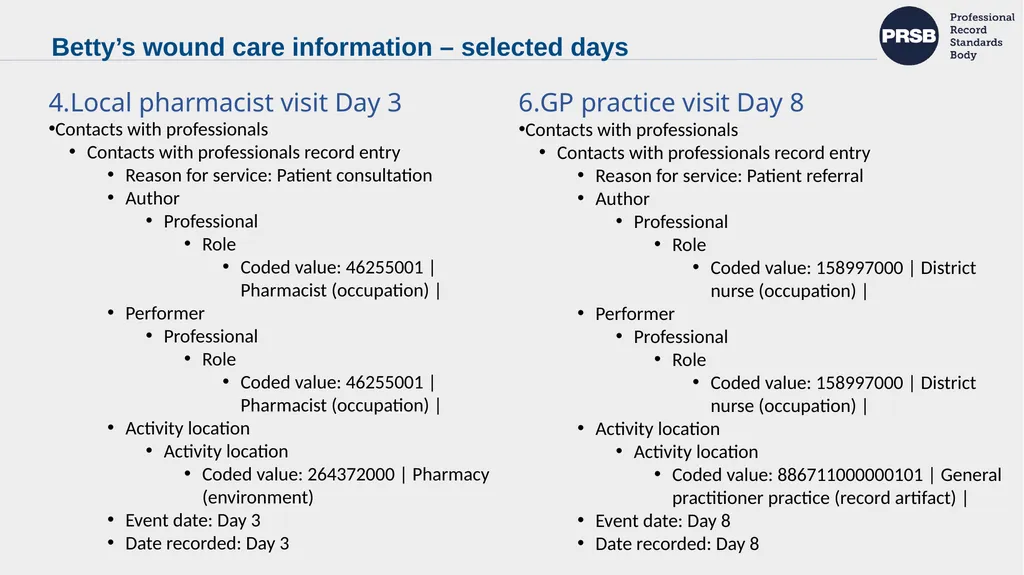
Betty’s wound care information – selected days Local pharmacist visit Day 3
Contacts with professionals
Contacts with professionals record entry
Reason for service: Patient consultation
Author
Professional
Role
Coded value: 46255001 | Pharmacist (occupation) |
Performer
Professional
Role
Coded value: 46255001 | Pharmacist (occupation) |
Activity location
Activity location
Coded value: 264372000 | Pharmacy (environment)
Event date: Day 3
Date recorded: Day 3 GP practice visit Day 8
Contacts with professionals
Contacts with professionals record entry
Reason for service: Patient referral
Author
Professional
Role
Coded value: 158997000 | District nurse (occupation) |
Performer
Professional
Role
Coded value: 158997000 | District nurse (occupation) |
Activity location
Activity location
Coded value: 886711000000101 | General practitioner practice (record artifact) |
Event date: Day 8
Date recorded: Day 8<br>
Contacts with professionals
Contacts with professionals record entry
Reason for service: Patient consultation
Author
Professional
Role
Coded value: 46255001 | Pharmacist (occupation) |
Performer
Professional
Role
Coded value: 46255001 | Pharmacist (occupation) |
Activity location
Activity location
Coded value: 264372000 | Pharmacy (environment)
Event date: Day 3
Date recorded: Day 3 GP practice visit Day 8
Contacts with professionals
Contacts with professionals record entry
Reason for service: Patient referral
Author
Professional
Role
Coded value: 158997000 | District nurse (occupation) |
Performer
Professional
Role
Coded value: 158997000 | District nurse (occupation) |
Activity location
Activity location
Coded value: 886711000000101 | General practitioner practice (record artifact) |
Event date: Day 8
Date recorded: Day 8<br>
17
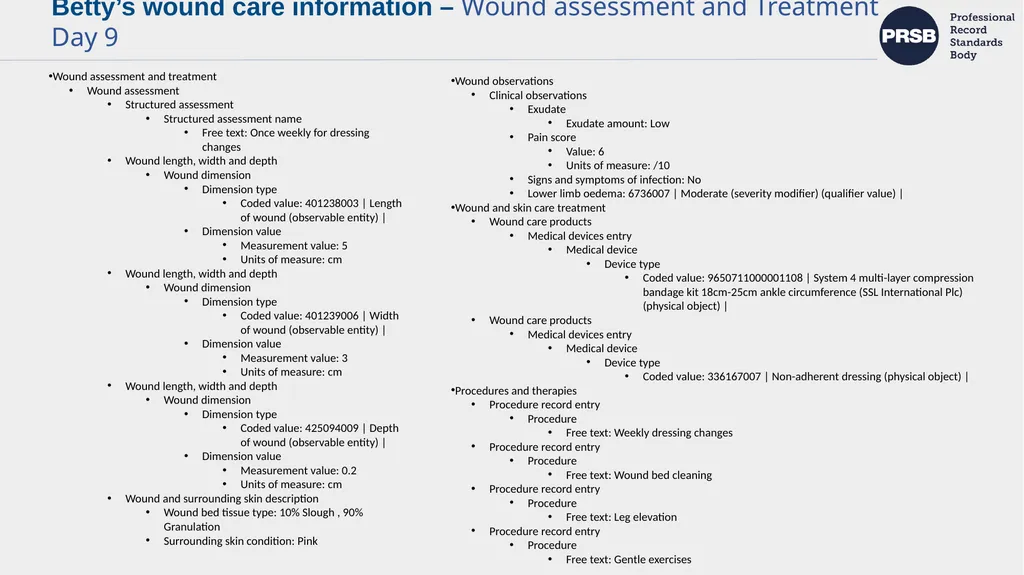
Betty’s wound care information – Wound assessment and Treatment Day 9 Wound assessment and treatment
Wound assessment
Structured assessment
Structured assessment name
Free text: Once weekly for dressing changes
Wound length, width and depth
Wound dimension
Dimension type
Coded value: 401238003 | Length of wound (observable entity) |
Dimension value
Measurement value: 5
Units of measure: cm
Wound length, width and depth
Wound dimension
Dimension type
Coded value: 401239006 | Width of wound (observable entity) |
Dimension value
Measurement value: 3
Units of measure: cm
Wound length, width and depth
Wound dimension
Dimension type
Coded value: 425094009 | Depth of wound (observable entity) |
Dimension value
Measurement value: 0.2
Units of measure: cm
Wound and surrounding skin description
Wound bed tissue type: 10% Slough , 90% Granulation
Surrounding skin condition: Pink Wound observations
Clinical observations
Exudate
Exudate amount: Low
Pain score
Value: 6
Units of measure: /10
Signs and symptoms of infection: No
Lower limb oedema: 6736007 | Moderate (severity modifier) (qualifier value) |
Wound and skin care treatment
Wound care products
Medical devices entry
Medical device
Device type
Coded value: 9650711000001108 | System 4 multi-layer compression bandage kit 18cm-25cm ankle circumference (SSL International Plc) (physical object) |
Wound care products
Medical devices entry
Medical device
Device type
Coded value: 336167007 | Non-adherent dressing (physical object) |
Procedures and therapies
Procedure record entry
Procedure
Free text: Weekly dressing changes
Procedure record entry
Procedure
Free text: Wound bed cleaning
Procedure record entry
Procedure
Free text: Leg elevation
Procedure record entry
Procedure
Free text: Gentle exercises<br>
Wound assessment
Structured assessment
Structured assessment name
Free text: Once weekly for dressing changes
Wound length, width and depth
Wound dimension
Dimension type
Coded value: 401238003 | Length of wound (observable entity) |
Dimension value
Measurement value: 5
Units of measure: cm
Wound length, width and depth
Wound dimension
Dimension type
Coded value: 401239006 | Width of wound (observable entity) |
Dimension value
Measurement value: 3
Units of measure: cm
Wound length, width and depth
Wound dimension
Dimension type
Coded value: 425094009 | Depth of wound (observable entity) |
Dimension value
Measurement value: 0.2
Units of measure: cm
Wound and surrounding skin description
Wound bed tissue type: 10% Slough , 90% Granulation
Surrounding skin condition: Pink Wound observations
Clinical observations
Exudate
Exudate amount: Low
Pain score
Value: 6
Units of measure: /10
Signs and symptoms of infection: No
Lower limb oedema: 6736007 | Moderate (severity modifier) (qualifier value) |
Wound and skin care treatment
Wound care products
Medical devices entry
Medical device
Device type
Coded value: 9650711000001108 | System 4 multi-layer compression bandage kit 18cm-25cm ankle circumference (SSL International Plc) (physical object) |
Wound care products
Medical devices entry
Medical device
Device type
Coded value: 336167007 | Non-adherent dressing (physical object) |
Procedures and therapies
Procedure record entry
Procedure
Free text: Weekly dressing changes
Procedure record entry
Procedure
Free text: Wound bed cleaning
Procedure record entry
Procedure
Free text: Leg elevation
Procedure record entry
Procedure
Free text: Gentle exercises<br>
18
Examples of data flow Wound care record information standard completed by individual organisations into Electronic Patient Record systems. The person and/or carer updates ‘About Me’ information via their Personal Health Record Wound care information accessible to all involved in the person’s care Population Health Management to monitor improvements to care and outcomes Data automatically feeds into digital care plans and Shared Care Records patient records Ambulance Community/Social care services Out of hours/
NHS 111 GP surgery Hospital/Hospice and care homes An example of how Betty’s data can flow from the source through to other mediums and uses (capture, sharing and reporting).<br>
19
Implementing the standard Stakeholder involvement, running an implementation and the change programme<br>
20
Planning your implementation project Who to involve
Stakeholders (Clinical leadership is a MUST)
Project team
Communications
Kick off meeting
What you need to do
Assess organisational readiness / baselining
Get to grips with the wound care information standard
Carry out a review of clinical system suppliers and conformance to the standard
Identify resources and develop a project plan
Key enablers
National and local strategy
Information governance and clinical safety
Programme management team
Available shared records (EPR, shared care records, digital care plans)
How to measure progress
National and local wound care metrics
Local project dashboards<br>
Stakeholders (Clinical leadership is a MUST)
Project team
Communications
Kick off meeting
What you need to do
Assess organisational readiness / baselining
Get to grips with the wound care information standard
Carry out a review of clinical system suppliers and conformance to the standard
Identify resources and develop a project plan
Key enablers
National and local strategy
Information governance and clinical safety
Programme management team
Available shared records (EPR, shared care records, digital care plans)
How to measure progress
National and local wound care metrics
Local project dashboards<br>
21
Creating your project team and identifying stakeholder groups Project Team
Wound care working group
System suppliers
Organisational CCIO,.CNIO, CDIO
Clinical safety team
ICS* programme management office
ICS shared care record programme Lead
ICS / local communication team
ICS / local information governance team
ICS / local training team
Health Watch/patient group Data sharing partner organisations
Ambulance service
Out of hours /
NHS 111
Specialist wound care teams
Primary care
Community teams: community nurses and matrons
Hospitals
Care homes
Hospices
Social care
Voluntary sector
Carers Identify your stakeholders, including the primary care and social care.
Think about the roles of local community and voluntary sector organisations,
Recognise the role of care homes in local provision, and the expertise their staff can share. Engage with community pharmacy given the role of medicines and pain-relief.
Use the experiences and views of carers groups, patients and families to shape your view of what good looks like for your area. *ICS – Integrated Care System Add your stakeholders<br>
Wound care working group
System suppliers
Organisational CCIO,.CNIO, CDIO
Clinical safety team
ICS* programme management office
ICS shared care record programme Lead
ICS / local communication team
ICS / local information governance team
ICS / local training team
Health Watch/patient group Data sharing partner organisations
Ambulance service
Out of hours /
NHS 111
Specialist wound care teams
Primary care
Community teams: community nurses and matrons
Hospitals
Care homes
Hospices
Social care
Voluntary sector
Carers Identify your stakeholders, including the primary care and social care.
Think about the roles of local community and voluntary sector organisations,
Recognise the role of care homes in local provision, and the expertise their staff can share. Engage with community pharmacy given the role of medicines and pain-relief.
Use the experiences and views of carers groups, patients and families to shape your view of what good looks like for your area. *ICS – Integrated Care System Add your stakeholders<br>
22
Project Roles and Responsibilities Add your project roles and responsibilities<br>
23
Project Planning Add your project timelines<br>
24
Project Roles and Responsibilities Identify your project outputs & requirements<br>
25
Taking Stock At the start of our project we need to ‘take stock’ of our current situation (how and where we capture wound care information) Work to complete at the start of our project:
Write a Project Initiation Document (PID)
Review of each organisations process and existing tools for recording wound care information (AS is process)
Capture all of the Electronic Patient Record Systems in use across all organisations, consider solutions for sharing information
Find out if the Electronic Patient Record systems are conformant with the PRSB wound care record information standard – If not, invite them to join the working group
Work with clinical safety team and information governance (IG) to discuss what is clinically safe to do and is in line with information governance (safety case and hazard log)
Update information sharing agreements if required
Write and have a Data Protection Impact Assessment approved by all stakeholders
Prepare communications strategy
Create training plan and material
What will success look like? Monitor Gather information about the systems suppliers, contracts, governance, compliance and conformance.<br>
Write a Project Initiation Document (PID)
Review of each organisations process and existing tools for recording wound care information (AS is process)
Capture all of the Electronic Patient Record Systems in use across all organisations, consider solutions for sharing information
Find out if the Electronic Patient Record systems are conformant with the PRSB wound care record information standard – If not, invite them to join the working group
Work with clinical safety team and information governance (IG) to discuss what is clinically safe to do and is in line with information governance (safety case and hazard log)
Update information sharing agreements if required
Write and have a Data Protection Impact Assessment approved by all stakeholders
Prepare communications strategy
Create training plan and material
What will success look like? Monitor Gather information about the systems suppliers, contracts, governance, compliance and conformance.<br>
26
Making Change Work to complete at the end of our project:
Update Project Initiation Document (PID) / write a business case
Review of each organisations ‘new’ process for recording wound care information (To be processes)
Agree pilot group for launch and testing of the standard
Confirm if Electronic Patient Record systems are conformant – agree pilot system / org
Confirm data sharing platform and data extraction process
Ensure information governance (IG) and clinical safety are all in place
Carry out user testing
Review of capture, sharing and reporting of wound care information
Communicate with all stakeholders
Wider launch to all system-wide organisations
Training & awareness. Carry out 'to be' process maps, system supplier readiness, pilot testing, communications, training and awareness Towards the end of your project, there are considerations in order to launch the wound care information standard.<br>
Update Project Initiation Document (PID) / write a business case
Review of each organisations ‘new’ process for recording wound care information (To be processes)
Agree pilot group for launch and testing of the standard
Confirm if Electronic Patient Record systems are conformant – agree pilot system / org
Confirm data sharing platform and data extraction process
Ensure information governance (IG) and clinical safety are all in place
Carry out user testing
Review of capture, sharing and reporting of wound care information
Communicate with all stakeholders
Wider launch to all system-wide organisations
Training & awareness. Carry out 'to be' process maps, system supplier readiness, pilot testing, communications, training and awareness Towards the end of your project, there are considerations in order to launch the wound care information standard.<br>
27
Lessons learned and developing a case study The PRSB website hosts a wound care record information standard toolkit which you can use to support you through the implementation process.
As part of the support for other implementors, PRSB are gathering lessons learned and implementation case studies. Please contact us at info@prsb.org to find out how to upload your lessons learned, case studies or feedback on the toolkit.<br>
As part of the support for other implementors, PRSB are gathering lessons learned and implementation case studies. Please contact us at info@prsb.org to find out how to upload your lessons learned, case studies or feedback on the toolkit.<br>