
Implementing the Requirements of Section 1512 of
TF
Published · 60 slides · 0 views

1 / 1
Description
Implementing the Requirements of Section 1512 of the American Recovery and Reinvestment Act FTA Webinar for First-Time Reporters April 2011 Reporting Cycle 2 2 This Presentation Will Cover: The objectives of the Section 1512 reporting
Related Topics
Share
Embed code
Download this presentation From Below
"Implementing the Requirements of Section 1512 of" is the property of its rightful owner. Permission is granted to download and print the materials on this website for personal, non-commercial use only, and to display it on your personal computer provided you do not modify the materials and that you retain all copyright notices contained in the materials. By downloading content from our website, you accept the terms of this agreement.
Presentation Transcript
01
Implementing the Requirements of Section 1512
of the American Recovery and Reinvestment Act
FTA Webinar for First-Time Reporters
April 2011 Reporting Cycle<br>
02
2 2 This Presentation Will Cover: The objectives of the Section 1512 reporting requirements.
Guidance issued by OMB
Who must submit a 1512 Report.
When information must be submitted.
What information FTA grantees should submit.
How information should be submitted.
Where to find additional technical assistance.<br>
Guidance issued by OMB
Who must submit a 1512 Report.
When information must be submitted.
What information FTA grantees should submit.
How information should be submitted.
Where to find additional technical assistance.<br>
03
3 Technical Assistance Documents This presentation should be viewed in conjunction with the FTA 1512 Reporting Technical Assistance documents:
1512 Reporting Definitions and Examples
Tips on Section 1512 reporting
(Available on the FTA ARRA Website under ARRA Reporting at http://www.fta.dot.gov/index_9440_10542.html )<br>
1512 Reporting Definitions and Examples
Tips on Section 1512 reporting
(Available on the FTA ARRA Website under ARRA Reporting at http://www.fta.dot.gov/index_9440_10542.html )<br>
04
4 4 New Reporting Guidance from OMB Recipients can submit their report to their awarding agency outside of www.federalreporting.gov (i.e., by email or fax) if they are unable to report electronically.
Recipients can mark their report as “final” if the project status is complete, no additional jobs will be reported, all or nearly all funds from the award have been expended, and all or nearly all funds from the award have been received.<br>
Recipients can mark their report as “final” if the project status is complete, no additional jobs will be reported, all or nearly all funds from the award have been expended, and all or nearly all funds from the award have been received.<br>
05
5 5 New Reporting Guidance from OMB If not all of the funds in the award will be expended, the recipient must provide a comment in the “Quarterly Activities/Project Description” field explaining why the final amount of expenditures does not = the award amount and confirming no more funds will be expended.<br>
06
6 6 New Reporting Guidance from OMB Recipients can make an adjustment to a report submitted in a prior reporting period (i.e., a report submitted in January, 2011). Grantees should contact FTA with information on the correction and FTA will submit the correction to OMB.<br>
07
7 7 New Reporting Guidance from OMB Provide sufficient clarity and detail in narrative descriptions.
Taken in conjunction, entries in the “award description,” and “Quarterly Activities/Project Description for Prime and Subrecipients” fields must provide clear and complete information on the award’s purpose, scope and nature of activities, outcomes, and status of activities.
The information in the “Quarterly Activities/Project Description” field should include information on the accomplishments of the projects funded by the grant.<br>
Taken in conjunction, entries in the “award description,” and “Quarterly Activities/Project Description for Prime and Subrecipients” fields must provide clear and complete information on the award’s purpose, scope and nature of activities, outcomes, and status of activities.
The information in the “Quarterly Activities/Project Description” field should include information on the accomplishments of the projects funded by the grant.<br>
08
8 8 New Reporting Guidance from OMB When reporting payments to subrecipients exceeding $25,000 aggregate multiple payments made to the same subrecipient.
Note that if multiple payments under $25,000 awarded to the same subrecipients exceed $25,000, then this information should be reported in the subrecipient section of the report.<br>
Note that if multiple payments under $25,000 awarded to the same subrecipients exceed $25,000, then this information should be reported in the subrecipient section of the report.<br>
09
9 9 New Reporting Guidance from OMB For more information on this guidance, go to M-10-34, “Updated Guidance on the American Recovery and Reinvestment Act.”<br>
10
10 The 1512 Reporting Framework Prime Recipients (Direct Recipients) must report.
Prime recipients may choose to delegate certain reporting requirements to sub-recipients—we will cover in more detail later in this presentation.
Any recipient that has been awarded an ARRA grant through March 31, 2011 must report.
Report on a grant-by-grant basis.
Direct Federal contractors must also report as prime recipients for each contract or task order funded with ARRA.
Submit reports through FederalReporting.gov<br>
Prime recipients may choose to delegate certain reporting requirements to sub-recipients—we will cover in more detail later in this presentation.
Any recipient that has been awarded an ARRA grant through March 31, 2011 must report.
Report on a grant-by-grant basis.
Direct Federal contractors must also report as prime recipients for each contract or task order funded with ARRA.
Submit reports through FederalReporting.gov<br>
11
11 The 1512 Reporting Framework FTA
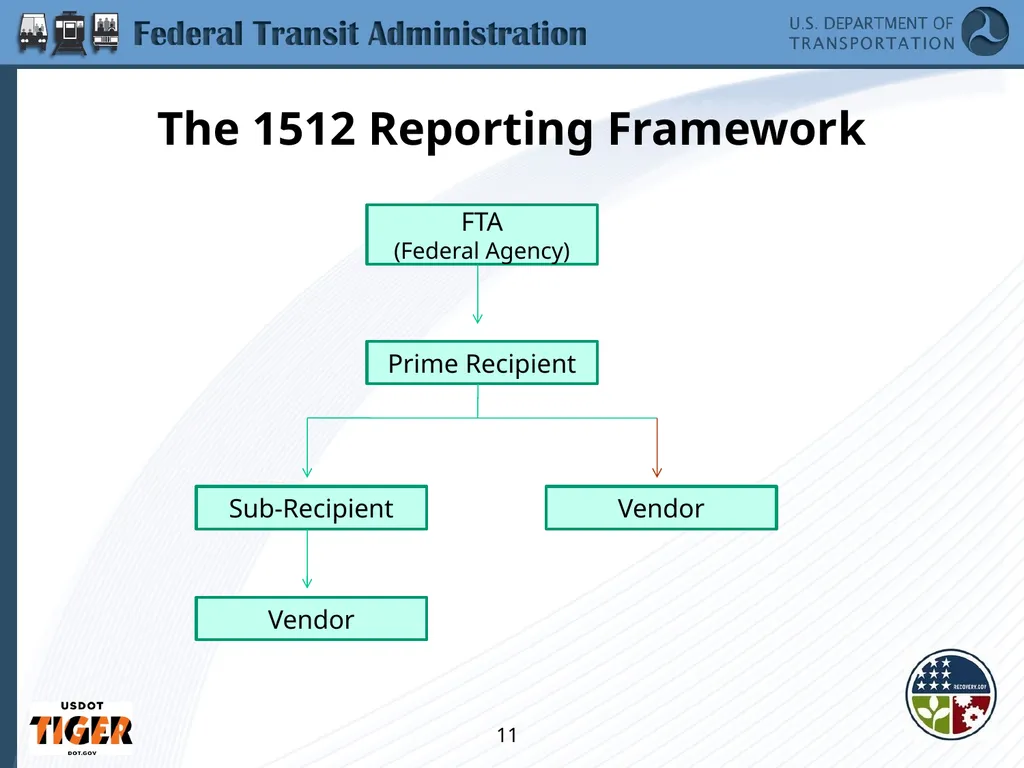
(Federal Agency) Prime Recipient Sub-Recipient Vendor Vendor<br>
(Federal Agency) Prime Recipient Sub-Recipient Vendor Vendor<br>
12
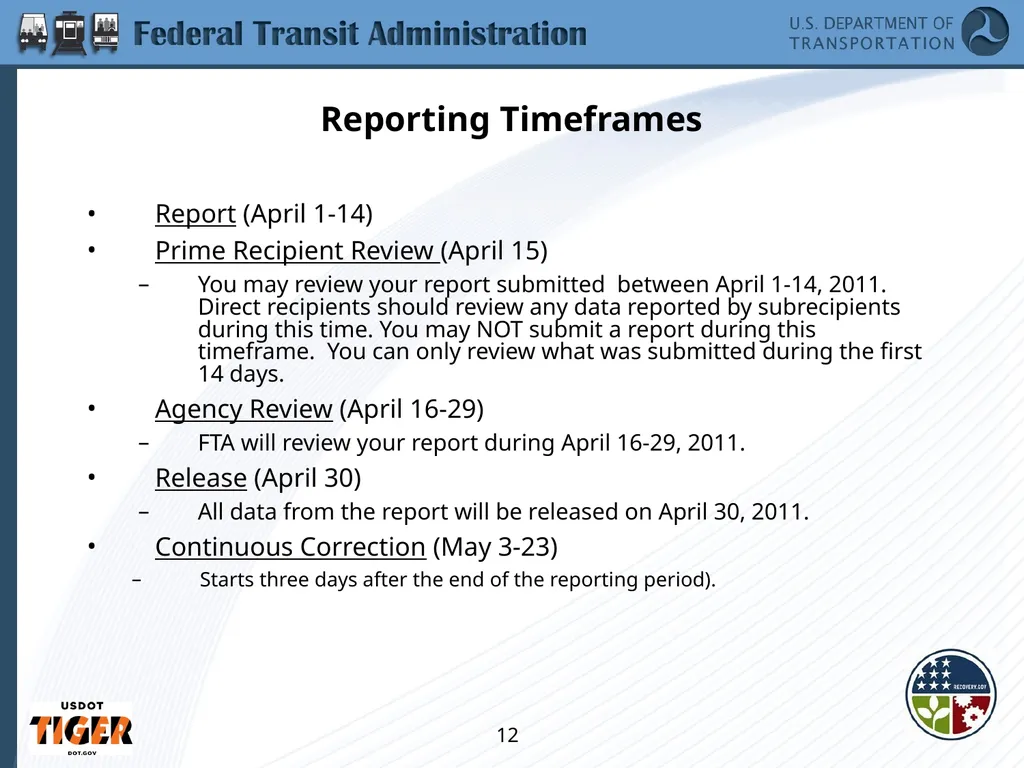
12 Reporting Timeframes Report (April 1-14)
Prime Recipient Review (April 15)
You may review your report submitted between April 1-14, 2011. Direct recipients should review any data reported by subrecipients during this time. You may NOT submit a report during this timeframe. You can only review what was submitted during the first 14 days.
Agency Review (April 16-29)
FTA will review your report during April 16-29, 2011.
Release (April 30)
All data from the report will be released on April 30, 2011.
Continuous Correction (May 3-23)
Starts three days after the end of the reporting period).<br>
Prime Recipient Review (April 15)
You may review your report submitted between April 1-14, 2011. Direct recipients should review any data reported by subrecipients during this time. You may NOT submit a report during this timeframe. You can only review what was submitted during the first 14 days.
Agency Review (April 16-29)
FTA will review your report during April 16-29, 2011.
Release (April 30)
All data from the report will be released on April 30, 2011.
Continuous Correction (May 3-23)
Starts three days after the end of the reporting period).<br>
13
Your report will be made available to the public See www.recovery.gov for how report information is displayed.
FTA has also posted its grantees’ reports at (http://www.fta.dot.gov/index_9440_10542.html) 13<br>
FTA has also posted its grantees’ reports at (http://www.fta.dot.gov/index_9440_10542.html) 13<br>
14
Before you report you need to… Obtain a user ID and password on www.federalreporting.gov
Make sure your organization is registered on the Central Contractor Registration, www.ccr.gov
Obtain a Federal Reporting PIN on www.federalreporting.gov 14<br>
Make sure your organization is registered on the Central Contractor Registration, www.ccr.gov
Obtain a Federal Reporting PIN on www.federalreporting.gov 14<br>
15
15 What you will need to report Prime Recipient
Federal Funding Agency Code
Federal Funding Agency Name
Awarding Agency Code
Awarding Agency Name
Program Source (TAS)
Award Number
Recipient D-U-N-S Number
Parent D-U-N-S Number
Recipient Type
CFDA Number
Recipient Name/Address/City/State/Zip Code/County
Recipient Congressional District
Recipient Account Number
Award Type, Date, Description Project name or project/program title
Quarterly Activities/Project Description
Project Status<br>
Federal Funding Agency Code
Federal Funding Agency Name
Awarding Agency Code
Awarding Agency Name
Program Source (TAS)
Award Number
Recipient D-U-N-S Number
Parent D-U-N-S Number
Recipient Type
CFDA Number
Recipient Name/Address/City/State/Zip Code/County
Recipient Congressional District
Recipient Account Number
Award Type, Date, Description Project name or project/program title
Quarterly Activities/Project Description
Project Status<br>
16
16 What you will need to report Prime Recipient (cont.)
Activity Code
Activity Description
Number of Jobs
Description of Jobs Created
Amount of Award
Amount of ARRA Funds Received
Amount of Expenditure
Amount of Infrastructure Expenditure
Infrastructure Purpose and Rationale
Infrastructure Contact Information
Place of Performance Information
Recipient Officer Names and Compensation (Top 5)
Number and Amount of Payments to Vendors less than $25,000/award
Number and Amount of Sub-awards less than $25,000/award<br>
Activity Code
Activity Description
Number of Jobs
Description of Jobs Created
Amount of Award
Amount of ARRA Funds Received
Amount of Expenditure
Amount of Infrastructure Expenditure
Infrastructure Purpose and Rationale
Infrastructure Contact Information
Place of Performance Information
Recipient Officer Names and Compensation (Top 5)
Number and Amount of Payments to Vendors less than $25,000/award
Number and Amount of Sub-awards less than $25,000/award<br>
17
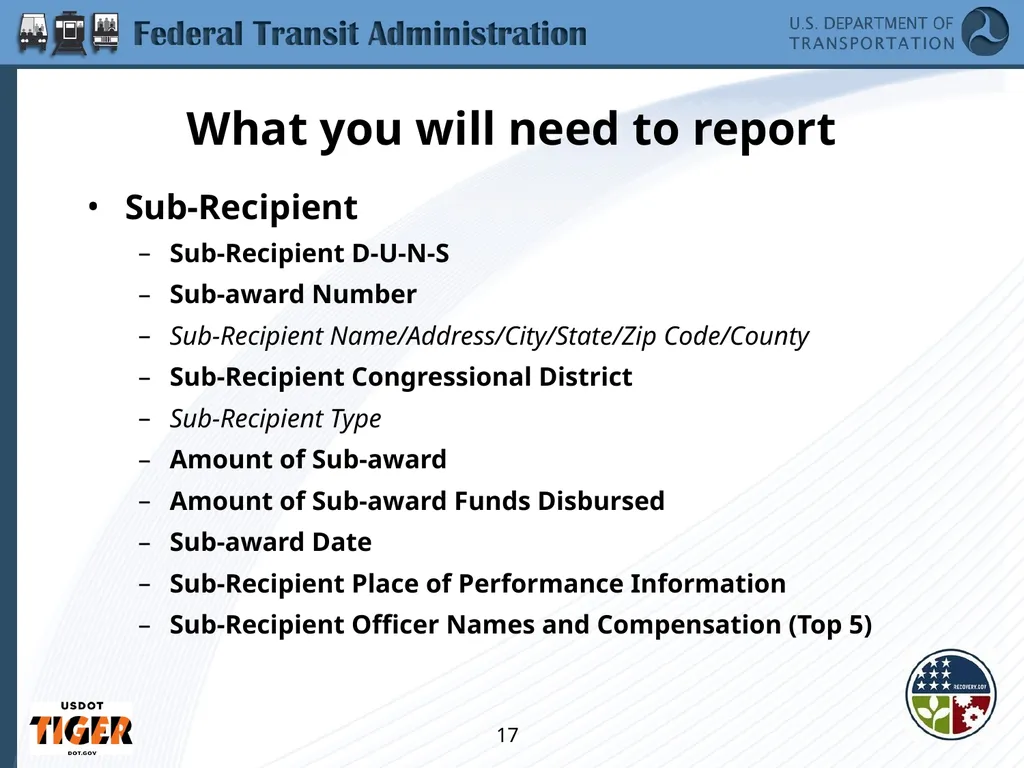
17 What you will need to report Sub-Recipient
Sub-Recipient D-U-N-S
Sub-award Number
Sub-Recipient Name/Address/City/State/Zip Code/County
Sub-Recipient Congressional District
Sub-Recipient Type
Amount of Sub-award
Amount of Sub-award Funds Disbursed
Sub-award Date
Sub-Recipient Place of Performance Information
Sub-Recipient Officer Names and Compensation (Top 5)<br>
Sub-Recipient D-U-N-S
Sub-award Number
Sub-Recipient Name/Address/City/State/Zip Code/County
Sub-Recipient Congressional District
Sub-Recipient Type
Amount of Sub-award
Amount of Sub-award Funds Disbursed
Sub-award Date
Sub-Recipient Place of Performance Information
Sub-Recipient Officer Names and Compensation (Top 5)<br>
18
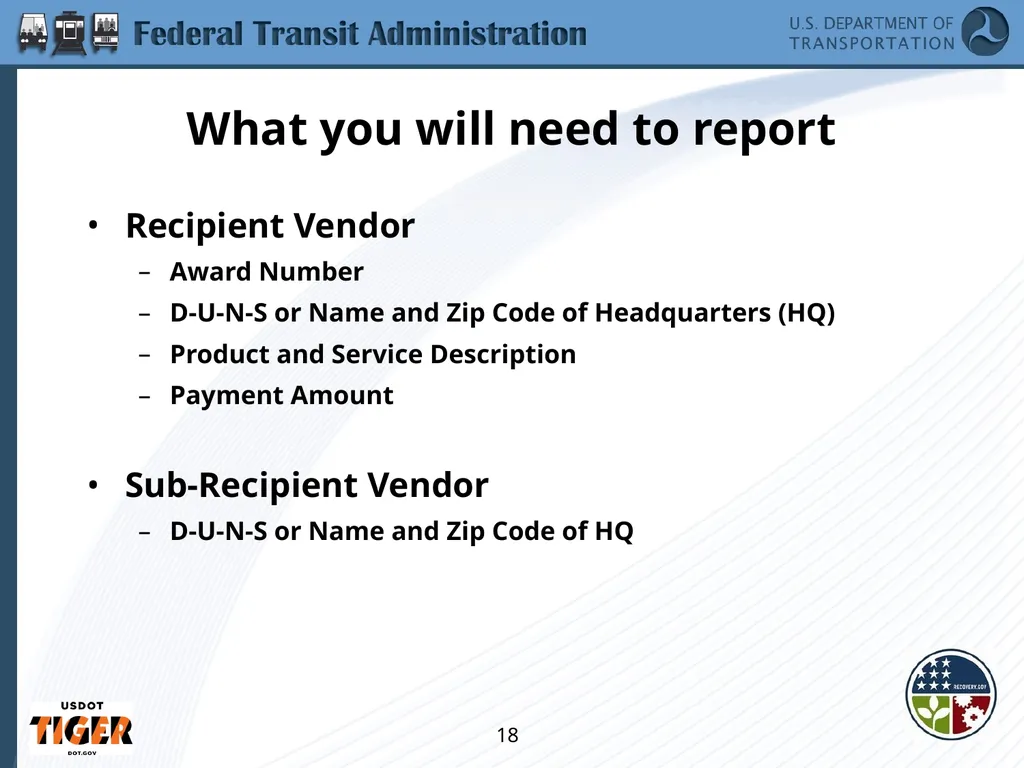
18 What you will need to report Recipient Vendor
Award Number
D-U-N-S or Name and Zip Code of Headquarters (HQ)
Product and Service Description
Payment Amount
Sub-Recipient Vendor
D-U-N-S or Name and Zip Code of HQ<br>
Award Number
D-U-N-S or Name and Zip Code of Headquarters (HQ)
Product and Service Description
Payment Amount
Sub-Recipient Vendor
D-U-N-S or Name and Zip Code of HQ<br>
19
19 What you will need to report The next slides discuss the individual data elements required to be reported for Grants Prime Recipients, Sub-Recipients and Vendors.
(Note: Direct Federal contractors report on fewer data elements)
Please refer to the “1512 Reporting Definitions & Examples” technical assistance document for more detailed information on these data elements.
(Available at: http://www.fta.dot.gov/index_9440_10542.html#1512)<br>
(Note: Direct Federal contractors report on fewer data elements)
Please refer to the “1512 Reporting Definitions & Examples” technical assistance document for more detailed information on these data elements.
(Available at: http://www.fta.dot.gov/index_9440_10542.html#1512)<br>
20
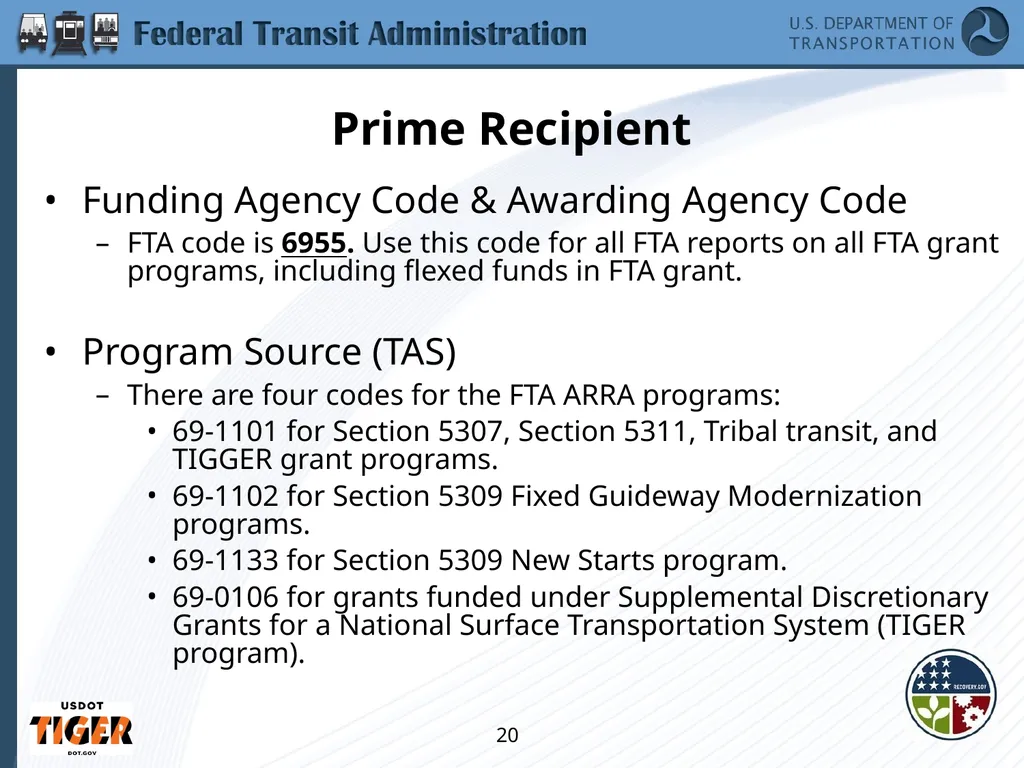
20 Prime Recipient Funding Agency Code & Awarding Agency Code
FTA code is 6955. Use this code for all FTA reports on all FTA grant programs, including flexed funds in FTA grant.
Program Source (TAS)
There are four codes for the FTA ARRA programs:
69-1101 for Section 5307, Section 5311, Tribal transit, and TIGGER grant programs.
69-1102 for Section 5309 Fixed Guideway Modernization programs.
69-1133 for Section 5309 New Starts program.
69-0106 for grants funded under Supplemental Discretionary Grants for a National Surface Transportation System (TIGER program).<br>
FTA code is 6955. Use this code for all FTA reports on all FTA grant programs, including flexed funds in FTA grant.
Program Source (TAS)
There are four codes for the FTA ARRA programs:
69-1101 for Section 5307, Section 5311, Tribal transit, and TIGGER grant programs.
69-1102 for Section 5309 Fixed Guideway Modernization programs.
69-1133 for Section 5309 New Starts program.
69-0106 for grants funded under Supplemental Discretionary Grants for a National Surface Transportation System (TIGER program).<br>
21
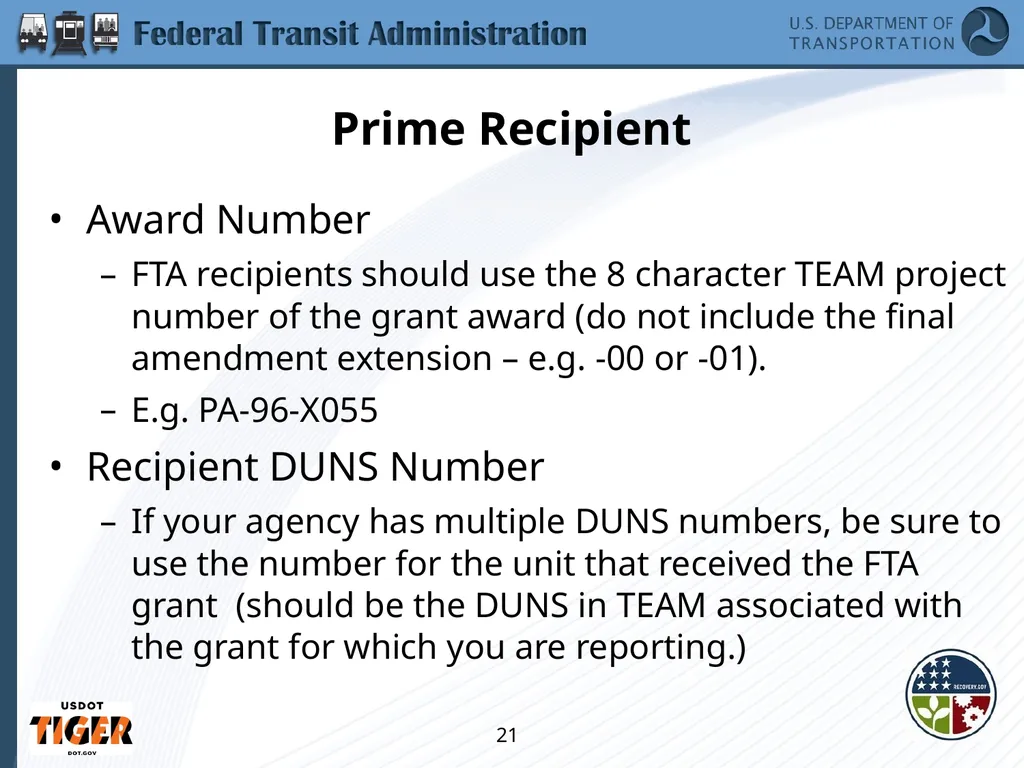
21 Prime Recipient Award Number
FTA recipients should use the 8 character TEAM project number of the grant award (do not include the final amendment extension – e.g. -00 or -01).
E.g. PA-96-X055
Recipient DUNS Number
If your agency has multiple DUNS numbers, be sure to use the number for the unit that received the FTA grant (should be the DUNS in TEAM associated with the grant for which you are reporting.)<br>
FTA recipients should use the 8 character TEAM project number of the grant award (do not include the final amendment extension – e.g. -00 or -01).
E.g. PA-96-X055
Recipient DUNS Number
If your agency has multiple DUNS numbers, be sure to use the number for the unit that received the FTA grant (should be the DUNS in TEAM associated with the grant for which you are reporting.)<br>
22
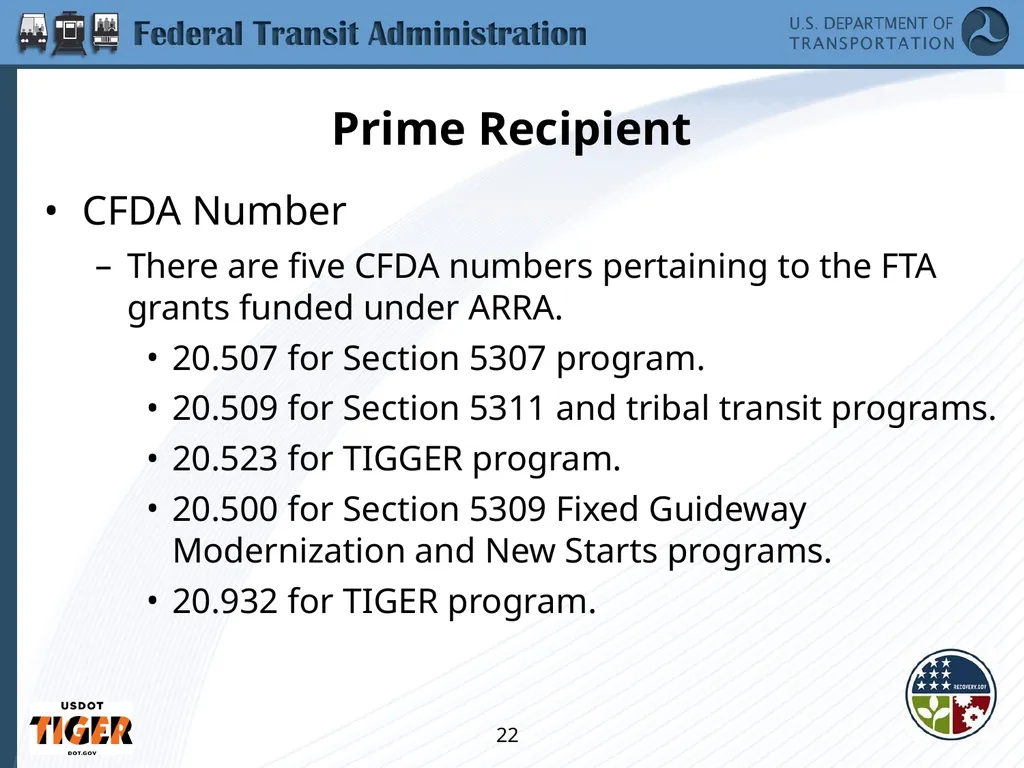
22 Prime Recipient CFDA Number
There are five CFDA numbers pertaining to the FTA grants funded under ARRA.
20.507 for Section 5307 program.
20.509 for Section 5311 and tribal transit programs.
20.523 for TIGGER program.
20.500 for Section 5309 Fixed Guideway Modernization and New Starts programs.
20.932 for TIGER program.<br>
There are five CFDA numbers pertaining to the FTA grants funded under ARRA.
20.507 for Section 5307 program.
20.509 for Section 5311 and tribal transit programs.
20.523 for TIGGER program.
20.500 for Section 5309 Fixed Guideway Modernization and New Starts programs.
20.932 for TIGER program.<br>
23
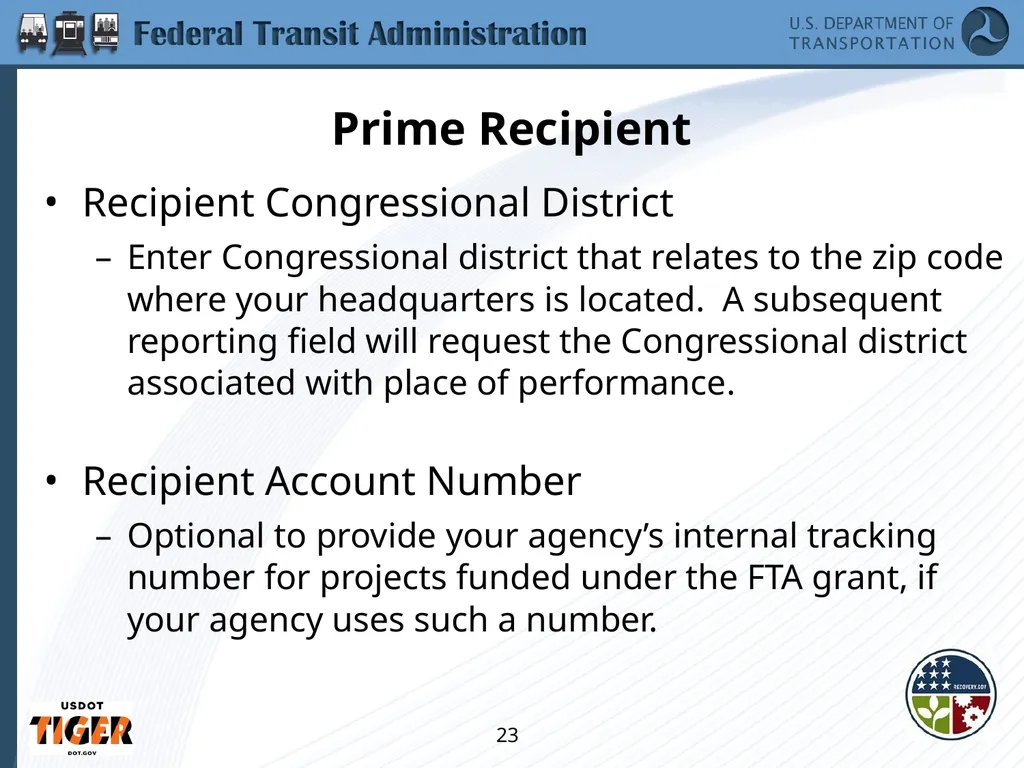
23 Prime Recipient Recipient Congressional District
Enter Congressional district that relates to the zip code where your headquarters is located. A subsequent reporting field will request the Congressional district associated with place of performance.
Recipient Account Number
Optional to provide your agency’s internal tracking number for projects funded under the FTA grant, if your agency uses such a number.<br>
Enter Congressional district that relates to the zip code where your headquarters is located. A subsequent reporting field will request the Congressional district associated with place of performance.
Recipient Account Number
Optional to provide your agency’s internal tracking number for projects funded under the FTA grant, if your agency uses such a number.<br>
24
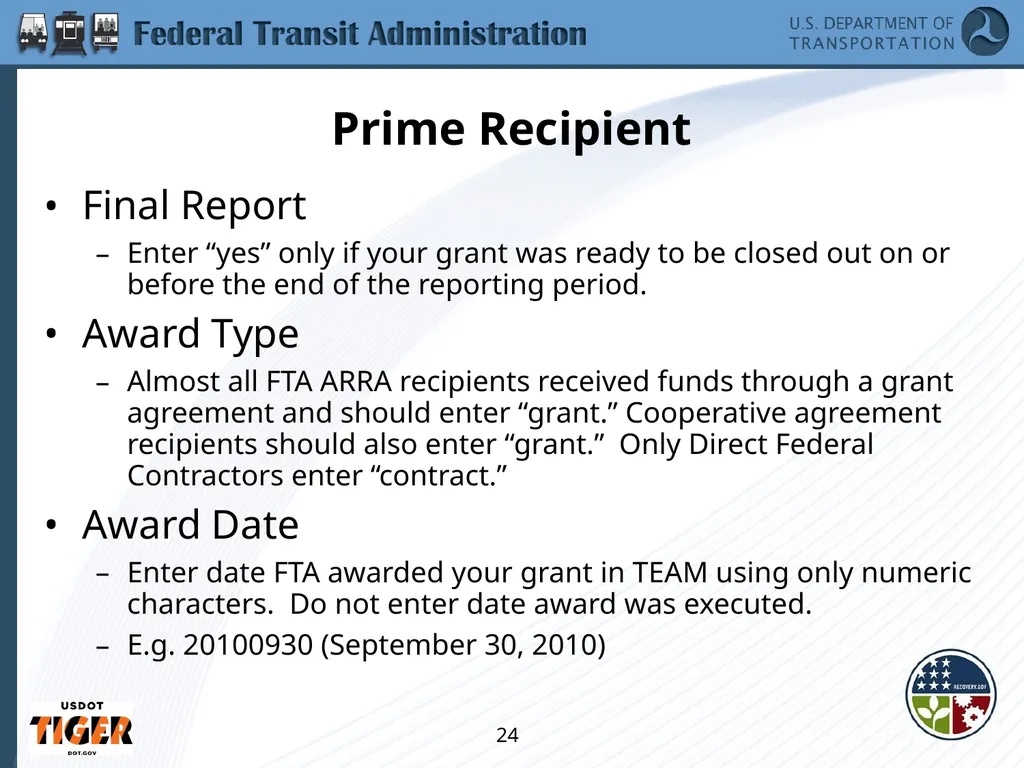
24 Prime Recipient Final Report
Enter “yes” only if your grant was ready to be closed out on or before the end of the reporting period.
Award Type
Almost all FTA ARRA recipients received funds through a grant agreement and should enter “grant.” Cooperative agreement recipients should also enter “grant.” Only Direct Federal Contractors enter “contract.”
Award Date
Enter date FTA awarded your grant in TEAM using only numeric characters. Do not enter date award was executed.
E.g. 20100930 (September 30, 2010)<br>
Enter “yes” only if your grant was ready to be closed out on or before the end of the reporting period.
Award Type
Almost all FTA ARRA recipients received funds through a grant agreement and should enter “grant.” Cooperative agreement recipients should also enter “grant.” Only Direct Federal Contractors enter “contract.”
Award Date
Enter date FTA awarded your grant in TEAM using only numeric characters. Do not enter date award was executed.
E.g. 20100930 (September 30, 2010)<br>
25
25 Prime Recipient Award Description
All FTA grant recipients should enter: “invest in public transportation” to capture the overall purpose of funds awarded and then briefly describe each activity funded by the grant.
Write in plain language for the public and do not include acronyms or jargon.
Make sure that your narrative descriptions provide clear and complete information on the award’s purpose, scope, location, cost, nature of activities, outcomes, and status of work.<br>
All FTA grant recipients should enter: “invest in public transportation” to capture the overall purpose of funds awarded and then briefly describe each activity funded by the grant.
Write in plain language for the public and do not include acronyms or jargon.
Make sure that your narrative descriptions provide clear and complete information on the award’s purpose, scope, location, cost, nature of activities, outcomes, and status of work.<br>
26
26 Prime Recipient Project Name or Project/Program Title
Provide project description used in TEAM project details screen.
E.g. “Purchase of six replacement buses.”
Quarterly Activities/Project Description
Describe specific outputs and outcomes that will result from grant. Include quantitative information about activities conducted and items purchased. Also report significant activities during the quarter.
E.g. “This grant allowed the transit agency to purchase six low-floor, hybrid-electric buses, modernize and expand two of its three bus depots, conduct preventive maintenance on 40 existing buses, and install automatic stop announcement systems on 50 buses. As a result of these investments, the transit agency will be able to offer public transportation service that is safer, more reliable, more environmentally friendly, and more accessible for people with disabilities. We developed specifications and issued a st request for bids this quarter. “<br>
Provide project description used in TEAM project details screen.
E.g. “Purchase of six replacement buses.”
Quarterly Activities/Project Description
Describe specific outputs and outcomes that will result from grant. Include quantitative information about activities conducted and items purchased. Also report significant activities during the quarter.
E.g. “This grant allowed the transit agency to purchase six low-floor, hybrid-electric buses, modernize and expand two of its three bus depots, conduct preventive maintenance on 40 existing buses, and install automatic stop announcement systems on 50 buses. As a result of these investments, the transit agency will be able to offer public transportation service that is safer, more reliable, more environmentally friendly, and more accessible for people with disabilities. We developed specifications and issued a st request for bids this quarter. “<br>
27
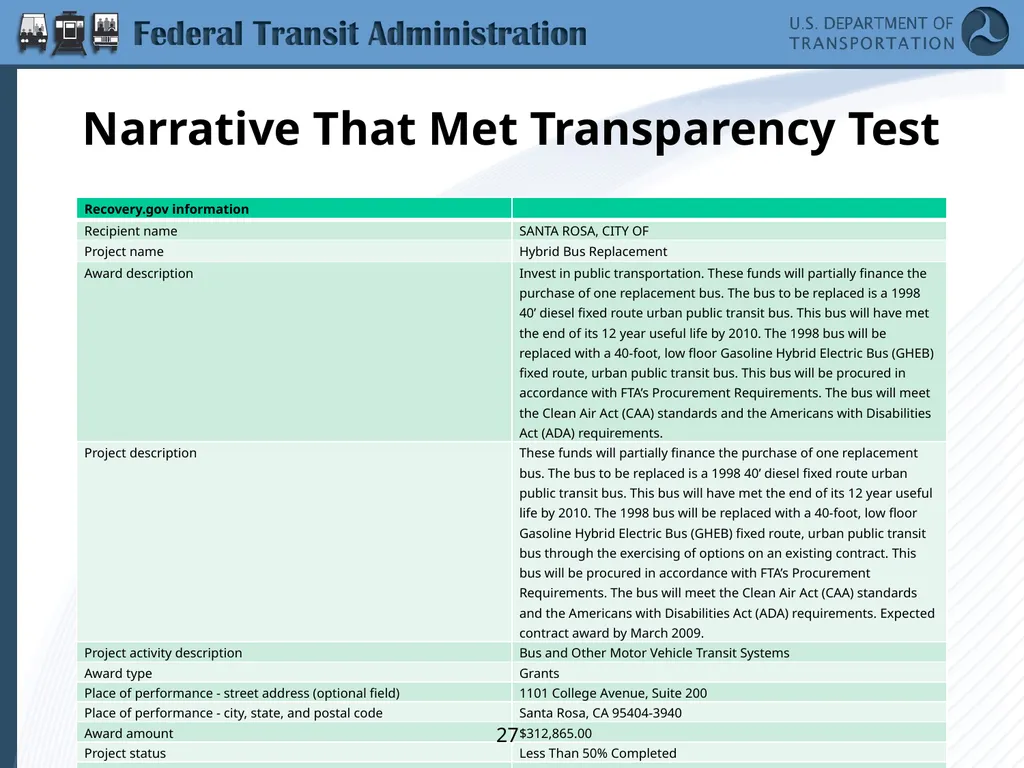
Narrative That Met Transparency Test 27<br>
28
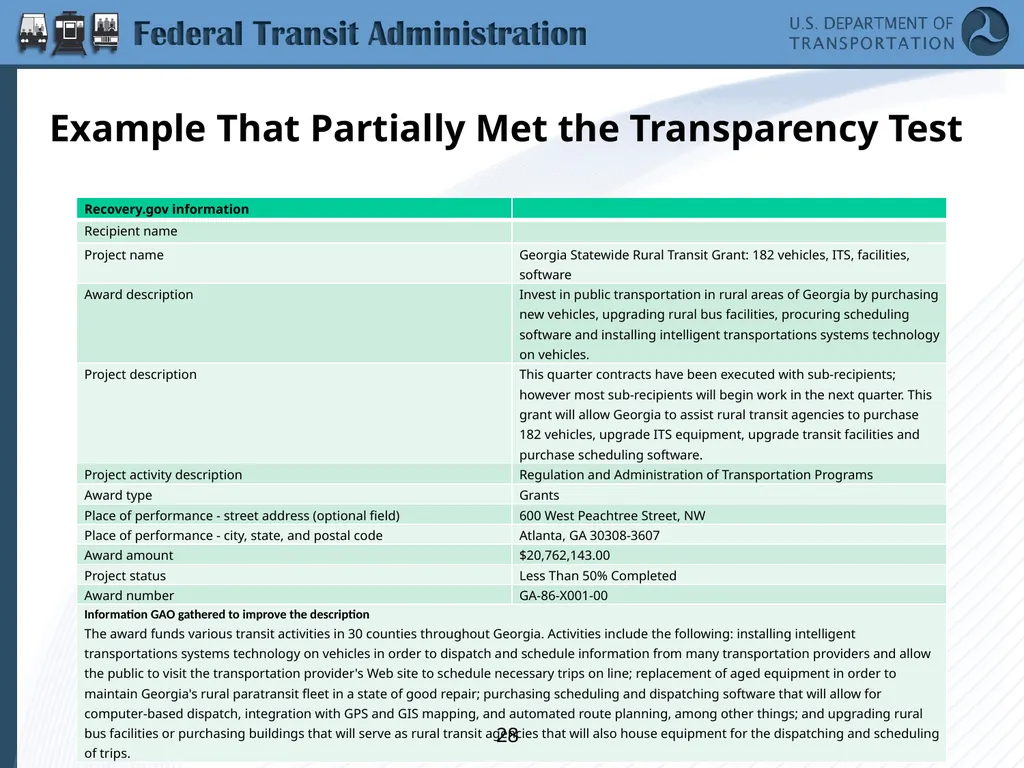
Example That Partially Met the Transparency Test 28<br>
29
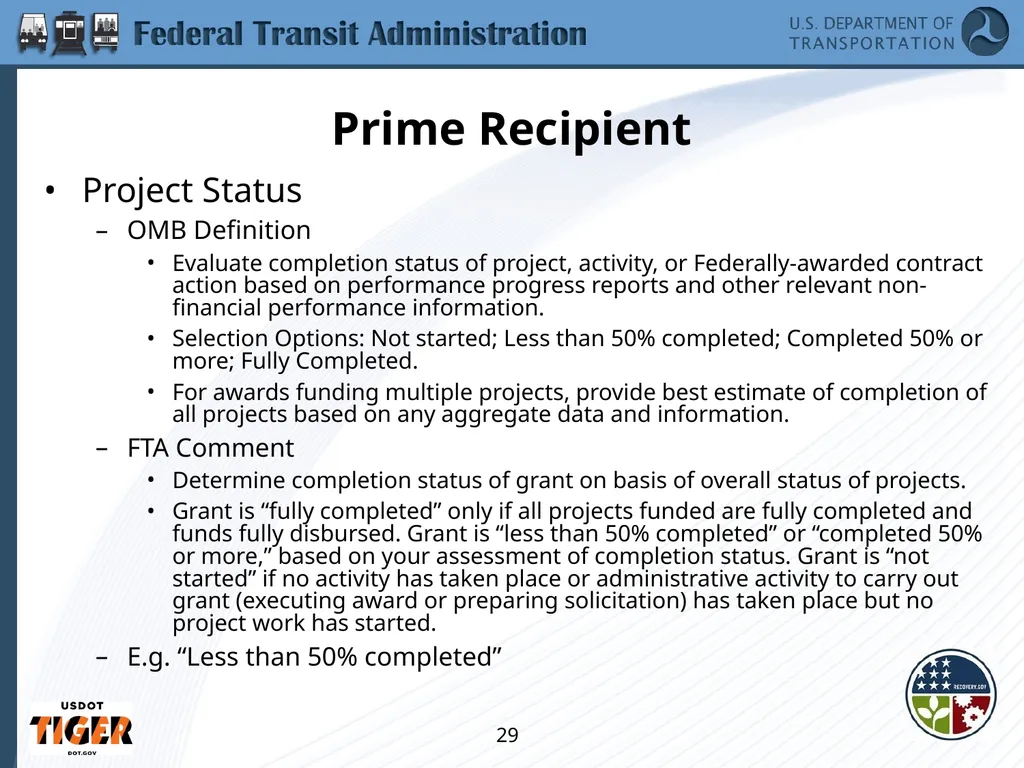
29 Prime Recipient Project Status
OMB Definition
Evaluate completion status of project, activity, or Federally-awarded contract action based on performance progress reports and other relevant non-financial performance information.
Selection Options: Not started; Less than 50% completed; Completed 50% or more; Fully Completed.
For awards funding multiple projects, provide best estimate of completion of all projects based on any aggregate data and information.
FTA Comment
Determine completion status of grant on basis of overall status of projects.
Grant is “fully completed” only if all projects funded are fully completed and funds fully disbursed. Grant is “less than 50% completed” or “completed 50% or more,” based on your assessment of completion status. Grant is “not started” if no activity has taken place or administrative activity to carry out grant (executing award or preparing solicitation) has taken place but no project work has started.
E.g. “Less than 50% completed”<br>
OMB Definition
Evaluate completion status of project, activity, or Federally-awarded contract action based on performance progress reports and other relevant non-financial performance information.
Selection Options: Not started; Less than 50% completed; Completed 50% or more; Fully Completed.
For awards funding multiple projects, provide best estimate of completion of all projects based on any aggregate data and information.
FTA Comment
Determine completion status of grant on basis of overall status of projects.
Grant is “fully completed” only if all projects funded are fully completed and funds fully disbursed. Grant is “less than 50% completed” or “completed 50% or more,” based on your assessment of completion status. Grant is “not started” if no activity has taken place or administrative activity to carry out grant (executing award or preparing solicitation) has taken place but no project work has started.
E.g. “Less than 50% completed”<br>
30
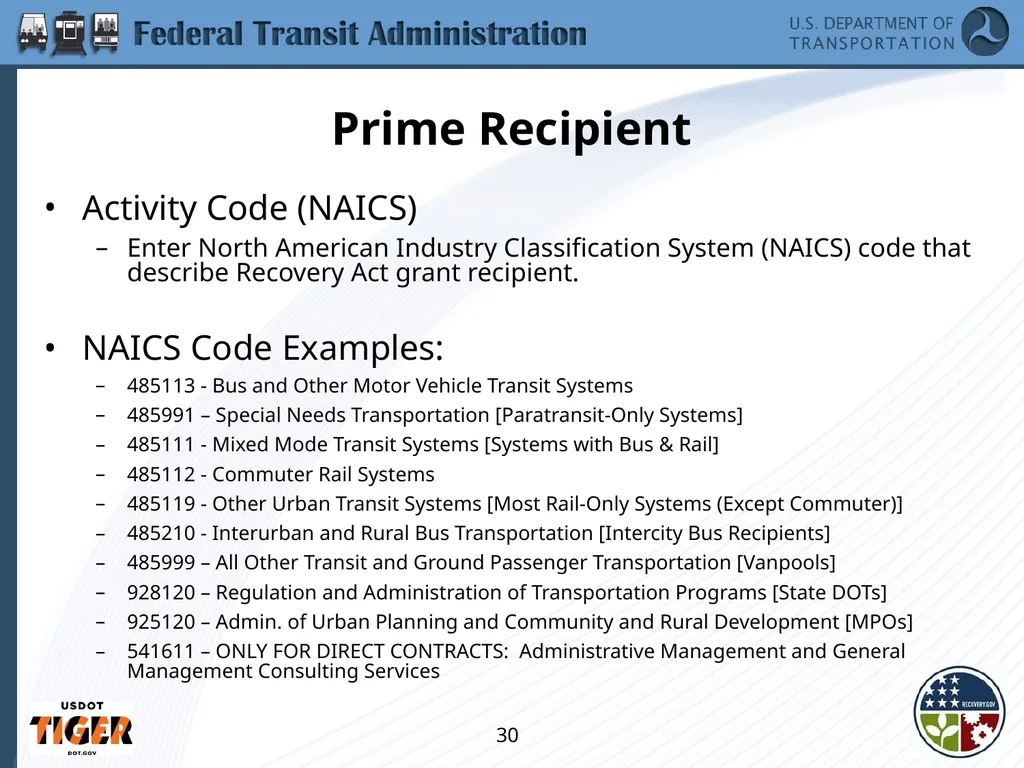
30 Prime Recipient Activity Code (NAICS)
Enter North American Industry Classification System (NAICS) code that describe Recovery Act grant recipient.
NAICS Code Examples:
485113 - Bus and Other Motor Vehicle Transit Systems
485991 – Special Needs Transportation [Paratransit-Only Systems]
485111 - Mixed Mode Transit Systems [Systems with Bus & Rail]
485112 - Commuter Rail Systems
485119 - Other Urban Transit Systems [Most Rail-Only Systems (Except Commuter)]
485210 - Interurban and Rural Bus Transportation [Intercity Bus Recipients]
485999 – All Other Transit and Ground Passenger Transportation [Vanpools]
928120 – Regulation and Administration of Transportation Programs [State DOTs]
925120 – Admin. of Urban Planning and Community and Rural Development [MPOs]
541611 – ONLY FOR DIRECT CONTRACTS: Administrative Management and General Management Consulting Services<br>
Enter North American Industry Classification System (NAICS) code that describe Recovery Act grant recipient.
NAICS Code Examples:
485113 - Bus and Other Motor Vehicle Transit Systems
485991 – Special Needs Transportation [Paratransit-Only Systems]
485111 - Mixed Mode Transit Systems [Systems with Bus & Rail]
485112 - Commuter Rail Systems
485119 - Other Urban Transit Systems [Most Rail-Only Systems (Except Commuter)]
485210 - Interurban and Rural Bus Transportation [Intercity Bus Recipients]
485999 – All Other Transit and Ground Passenger Transportation [Vanpools]
928120 – Regulation and Administration of Transportation Programs [State DOTs]
925120 – Admin. of Urban Planning and Community and Rural Development [MPOs]
541611 – ONLY FOR DIRECT CONTRACTS: Administrative Management and General Management Consulting Services<br>
31
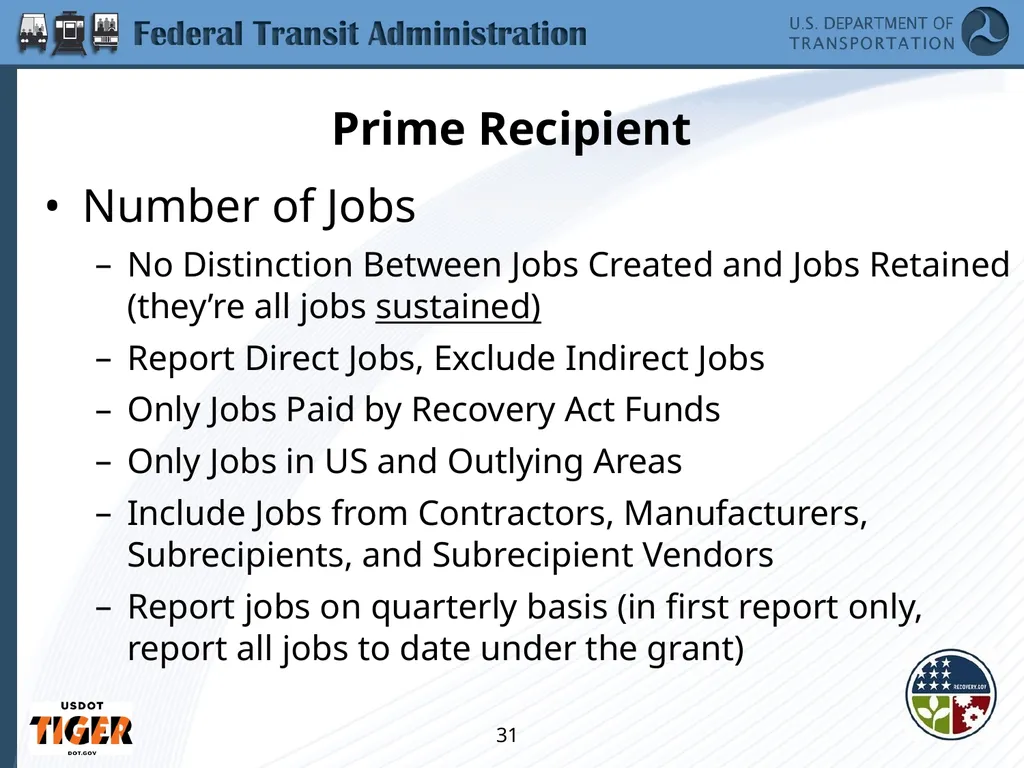
31 Prime Recipient Number of Jobs
No Distinction Between Jobs Created and Jobs Retained (they’re all jobs sustained)
Report Direct Jobs, Exclude Indirect Jobs
Only Jobs Paid by Recovery Act Funds
Only Jobs in US and Outlying Areas
Include Jobs from Contractors, Manufacturers, Subrecipients, and Subrecipient Vendors
Report jobs on quarterly basis (in first report only, report all jobs to date under the grant)<br>
No Distinction Between Jobs Created and Jobs Retained (they’re all jobs sustained)
Report Direct Jobs, Exclude Indirect Jobs
Only Jobs Paid by Recovery Act Funds
Only Jobs in US and Outlying Areas
Include Jobs from Contractors, Manufacturers, Subrecipients, and Subrecipient Vendors
Report jobs on quarterly basis (in first report only, report all jobs to date under the grant)<br>
32
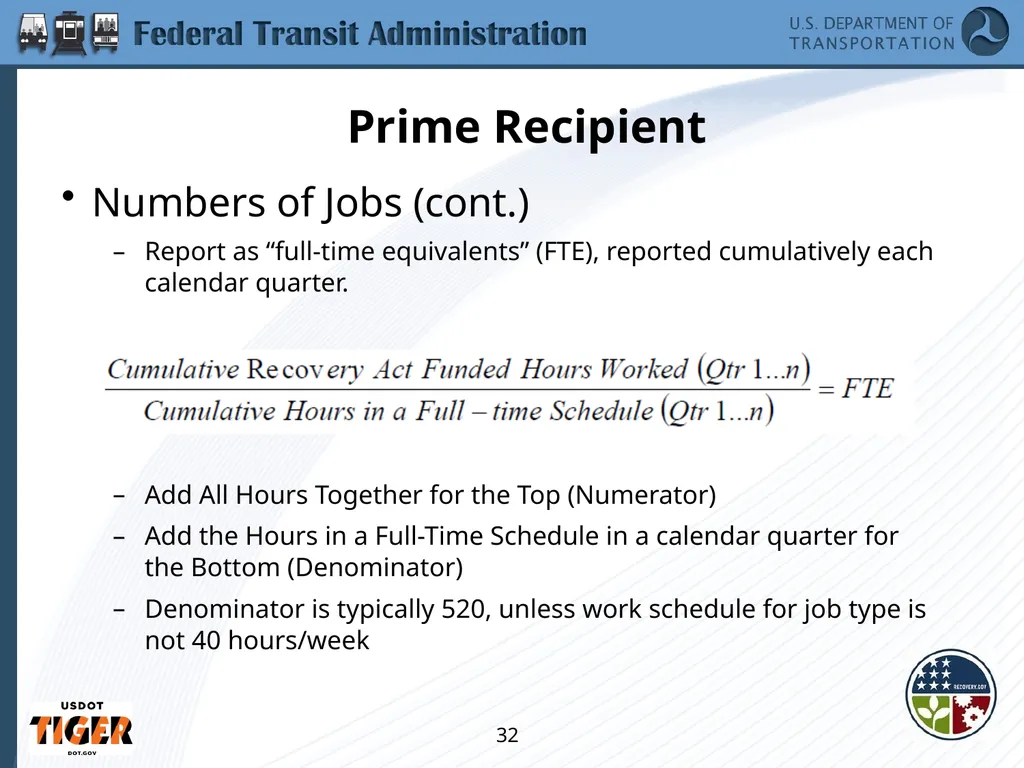
32 Numbers of Jobs (cont.)
Report as “full-time equivalents” (FTE), reported cumulatively each calendar quarter.
Add All Hours Together for the Top (Numerator)
Add the Hours in a Full-Time Schedule in a calendar quarter for the Bottom (Denominator)
Denominator is typically 520, unless work schedule for job type is not 40 hours/week Prime Recipient<br>
Report as “full-time equivalents” (FTE), reported cumulatively each calendar quarter.
Add All Hours Together for the Top (Numerator)
Add the Hours in a Full-Time Schedule in a calendar quarter for the Bottom (Denominator)
Denominator is typically 520, unless work schedule for job type is not 40 hours/week Prime Recipient<br>
33
33 Prime Recipient Number of Jobs (cont.)
Direct job hours include:
Hours worked by staff paid with ARRA funds
Direct Administration expenses paid with ARRA funds
Hours paid by ARRA funds for preventive maintenance
Hours paid by ARRA funds for operating assistance
Hours worked on-site (at facilities or primary construction location) by contractors or sub-contractors paid with ARRA funds
Hours worked offsite, but directly on ARRA projects, by contractors or sub-contractors paid with ARRA funds
Hours worked by manufacturers of vehicles and equipment – when ordered directly from manufacturer.
Report vehicle manufacturing jobs in quarter during which vehicles are delivered – obtain hours from manufacturer.<br>
Direct job hours include:
Hours worked by staff paid with ARRA funds
Direct Administration expenses paid with ARRA funds
Hours paid by ARRA funds for preventive maintenance
Hours paid by ARRA funds for operating assistance
Hours worked on-site (at facilities or primary construction location) by contractors or sub-contractors paid with ARRA funds
Hours worked offsite, but directly on ARRA projects, by contractors or sub-contractors paid with ARRA funds
Hours worked by manufacturers of vehicles and equipment – when ordered directly from manufacturer.
Report vehicle manufacturing jobs in quarter during which vehicles are delivered – obtain hours from manufacturer.<br>
34
34 Prime Recipient Number of Jobs (cont.)
Direct Job Hours Exclude:
Hours worked in manufacturing vehicles and equipment purchased from retail establishments or out of pre-existing inventory (e.g. off a dealer’s lot)
Hours worked by suppliers to manufacturers (i.e. do not use multipliers of direct hours worked – report only the direct hours)
Hours worked by suppliers to construction projects
Hours worked by operators of buses purchased for fleet expansion – when not paid with an ARRA operating assistance grant
Hours worked in administration and oversight of ARRA grants – when not paid by the ARRA grant or when charged only as indirect costs (overhead)<br>
Direct Job Hours Exclude:
Hours worked in manufacturing vehicles and equipment purchased from retail establishments or out of pre-existing inventory (e.g. off a dealer’s lot)
Hours worked by suppliers to manufacturers (i.e. do not use multipliers of direct hours worked – report only the direct hours)
Hours worked by suppliers to construction projects
Hours worked by operators of buses purchased for fleet expansion – when not paid with an ARRA operating assistance grant
Hours worked in administration and oversight of ARRA grants – when not paid by the ARRA grant or when charged only as indirect costs (overhead)<br>
35
35 Prime Recipient Description of Jobs Created
Highlight the number of jobs worked on the grant
Describe the types of jobs worked, e.g.: mechanics, administrative support personnel, laborers, construction workers, vehicle operators, and engineers.
E.g. “This grant funded rehabilitation of the transit agency’s bus facility and additional preventive maintenance on its vehicle fleet. As a result of these funds, the agency’s contractor performing the facility rehabilitation was able to continue to employ 10 carpenters and 10 electricians. In addition, the agency was able to hire an additional 10 mechanics to perform vehicle maintenance.”
Describe the calculation of FTEs – hours worked during quarter and denominator used (usually 520) and note number of jobs reported in previous quarters (if any)<br>
Highlight the number of jobs worked on the grant
Describe the types of jobs worked, e.g.: mechanics, administrative support personnel, laborers, construction workers, vehicle operators, and engineers.
E.g. “This grant funded rehabilitation of the transit agency’s bus facility and additional preventive maintenance on its vehicle fleet. As a result of these funds, the agency’s contractor performing the facility rehabilitation was able to continue to employ 10 carpenters and 10 electricians. In addition, the agency was able to hire an additional 10 mechanics to perform vehicle maintenance.”
Describe the calculation of FTEs – hours worked during quarter and denominator used (usually 520) and note number of jobs reported in previous quarters (if any)<br>
36
36 Prime Recipient Amount of Award
Enter amount of the FTA award. If grant was amended, enter total amount of the award.
Total Federal Amount ARRA Funds Received/Invoiced
Enter cumulative amount of FTA funds received through ECHO as of the end of the reporting period. Do not report funds associated with ECHO requests submitted but not yet paid by the end of the reporting period.
Note: Direct contractors report payments received through MarkView/Prism, not ECHO<br>
Enter amount of the FTA award. If grant was amended, enter total amount of the award.
Total Federal Amount ARRA Funds Received/Invoiced
Enter cumulative amount of FTA funds received through ECHO as of the end of the reporting period. Do not report funds associated with ECHO requests submitted but not yet paid by the end of the reporting period.
Note: Direct contractors report payments received through MarkView/Prism, not ECHO<br>
37
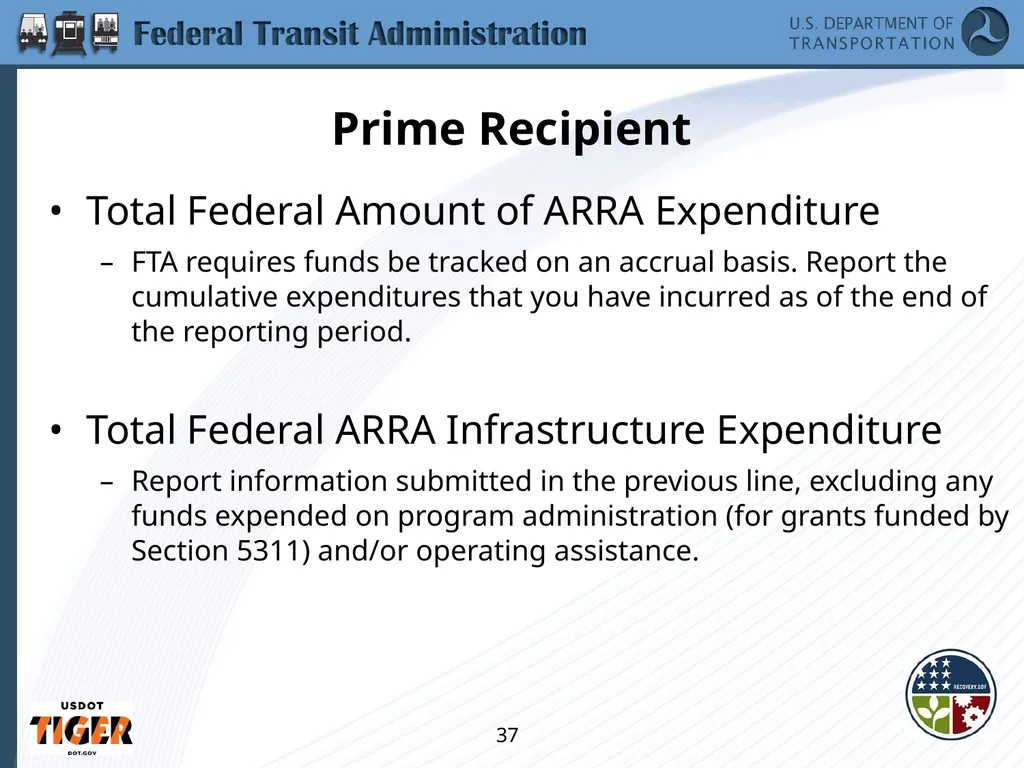
37 Prime Recipient Total Federal Amount of ARRA Expenditure
FTA requires funds be tracked on an accrual basis. Report the cumulative expenditures that you have incurred as of the end of the reporting period.
Total Federal ARRA Infrastructure Expenditure
Report information submitted in the previous line, excluding any funds expended on program administration (for grants funded by Section 5311) and/or operating assistance.<br>
FTA requires funds be tracked on an accrual basis. Report the cumulative expenditures that you have incurred as of the end of the reporting period.
Total Federal ARRA Infrastructure Expenditure
Report information submitted in the previous line, excluding any funds expended on program administration (for grants funded by Section 5311) and/or operating assistance.<br>
38
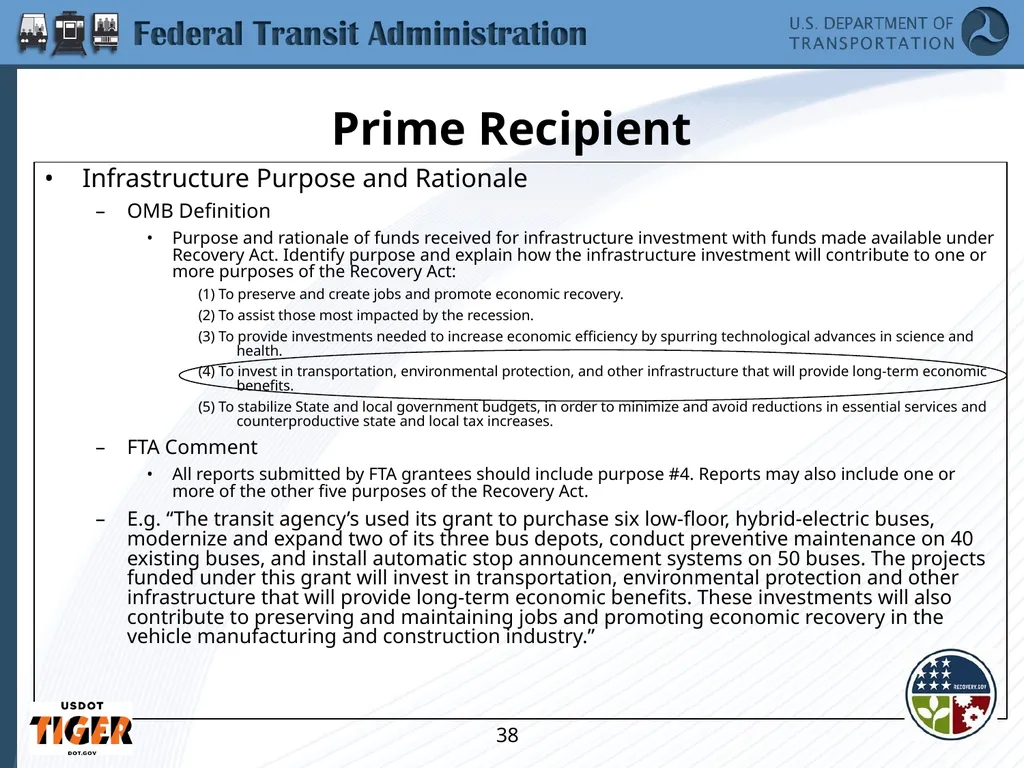
38 Prime Recipient Infrastructure Purpose and Rationale
OMB Definition
Purpose and rationale of funds received for infrastructure investment with funds made available under Recovery Act. Identify purpose and explain how the infrastructure investment will contribute to one or more purposes of the Recovery Act:
(1) To preserve and create jobs and promote economic recovery.
(2) To assist those most impacted by the recession.
(3) To provide investments needed to increase economic efficiency by spurring technological advances in science and health.
(4) To invest in transportation, environmental protection, and other infrastructure that will provide long-term economic benefits.
(5) To stabilize State and local government budgets, in order to minimize and avoid reductions in essential services and counterproductive state and local tax increases.
FTA Comment
All reports submitted by FTA grantees should include purpose #4. Reports may also include one or more of the other five purposes of the Recovery Act.
E.g. “The transit agency’s used its grant to purchase six low-floor, hybrid-electric buses, modernize and expand two of its three bus depots, conduct preventive maintenance on 40 existing buses, and install automatic stop announcement systems on 50 buses. The projects funded under this grant will invest in transportation, environmental protection and other infrastructure that will provide long-term economic benefits. These investments will also contribute to preserving and maintaining jobs and promoting economic recovery in the vehicle manufacturing and construction industry.”<br>
OMB Definition
Purpose and rationale of funds received for infrastructure investment with funds made available under Recovery Act. Identify purpose and explain how the infrastructure investment will contribute to one or more purposes of the Recovery Act:
(1) To preserve and create jobs and promote economic recovery.
(2) To assist those most impacted by the recession.
(3) To provide investments needed to increase economic efficiency by spurring technological advances in science and health.
(4) To invest in transportation, environmental protection, and other infrastructure that will provide long-term economic benefits.
(5) To stabilize State and local government budgets, in order to minimize and avoid reductions in essential services and counterproductive state and local tax increases.
FTA Comment
All reports submitted by FTA grantees should include purpose #4. Reports may also include one or more of the other five purposes of the Recovery Act.
E.g. “The transit agency’s used its grant to purchase six low-floor, hybrid-electric buses, modernize and expand two of its three bus depots, conduct preventive maintenance on 40 existing buses, and install automatic stop announcement systems on 50 buses. The projects funded under this grant will invest in transportation, environmental protection and other infrastructure that will provide long-term economic benefits. These investments will also contribute to preserving and maintaining jobs and promoting economic recovery in the vehicle manufacturing and construction industry.”<br>
39
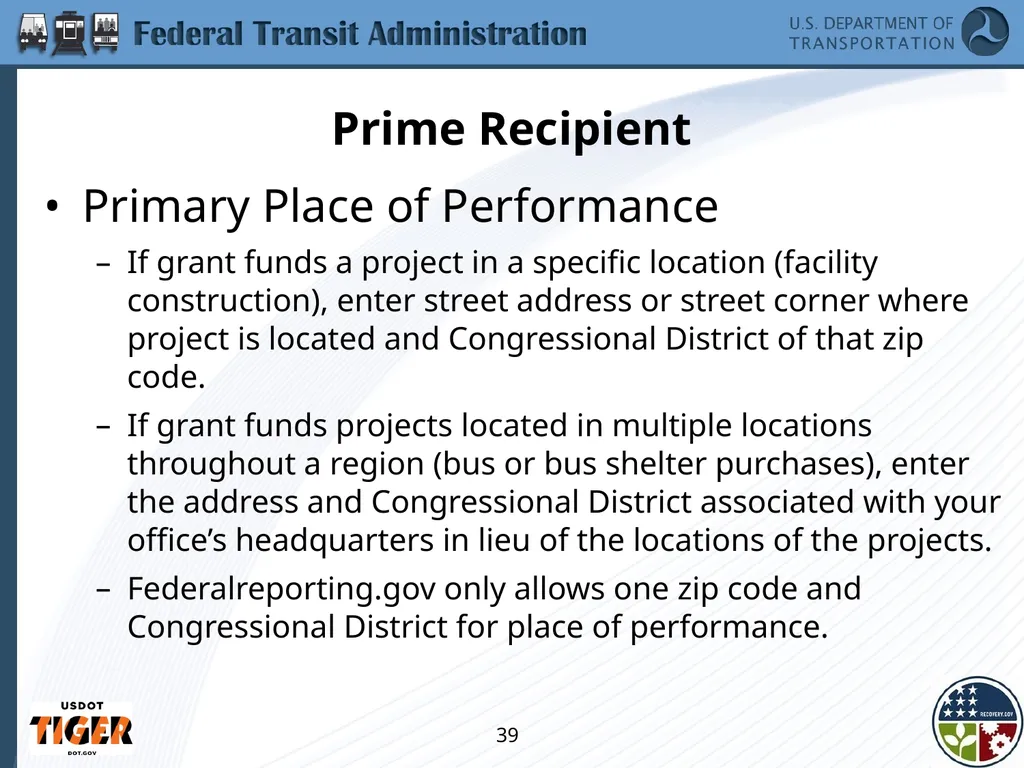
39 Prime Recipient Primary Place of Performance
If grant funds a project in a specific location (facility construction), enter street address or street corner where project is located and Congressional District of that zip code.
If grant funds projects located in multiple locations throughout a region (bus or bus shelter purchases), enter the address and Congressional District associated with your office’s headquarters in lieu of the locations of the projects.
Federalreporting.gov only allows one zip code and Congressional District for place of performance.<br>
If grant funds a project in a specific location (facility construction), enter street address or street corner where project is located and Congressional District of that zip code.
If grant funds projects located in multiple locations throughout a region (bus or bus shelter purchases), enter the address and Congressional District associated with your office’s headquarters in lieu of the locations of the projects.
Federalreporting.gov only allows one zip code and Congressional District for place of performance.<br>
40
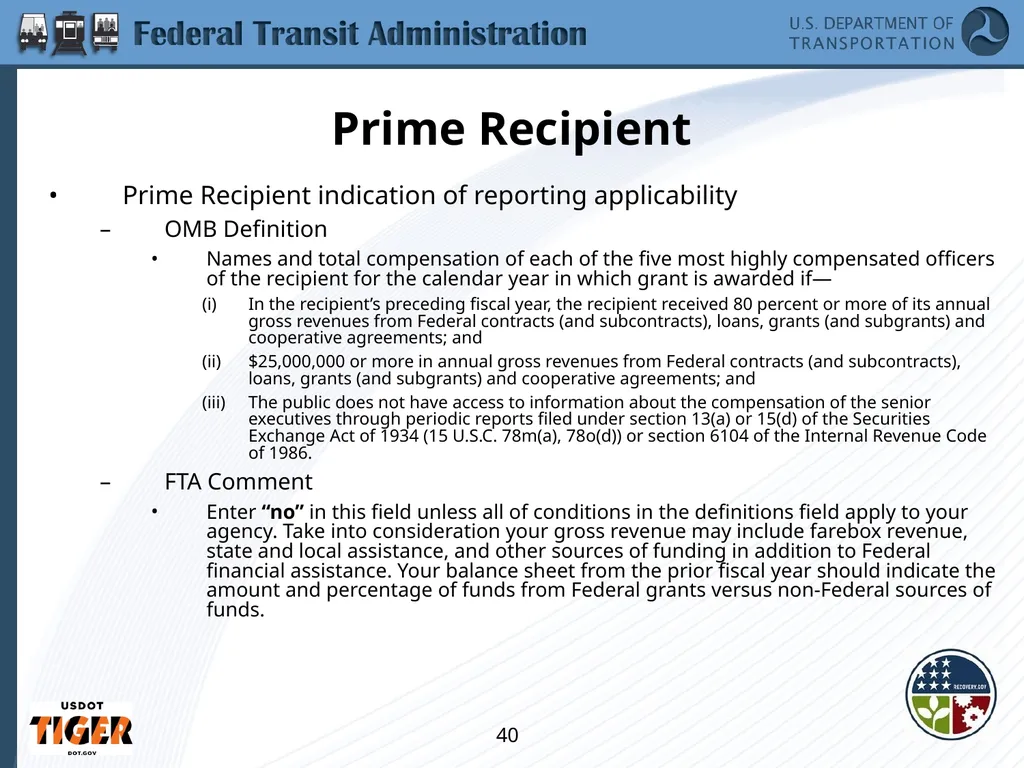
40 Prime Recipient Prime Recipient indication of reporting applicability
OMB Definition
Names and total compensation of each of the five most highly compensated officers of the recipient for the calendar year in which grant is awarded if—
In the recipient’s preceding fiscal year, the recipient received 80 percent or more of its annual gross revenues from Federal contracts (and subcontracts), loans, grants (and subgrants) and cooperative agreements; and
$25,000,000 or more in annual gross revenues from Federal contracts (and subcontracts), loans, grants (and subgrants) and cooperative agreements; and
The public does not have access to information about the compensation of the senior executives through periodic reports filed under section 13(a) or 15(d) of the Securities Exchange Act of 1934 (15 U.S.C. 78m(a), 78o(d)) or section 6104 of the Internal Revenue Code of 1986.
FTA Comment
Enter “no” in this field unless all of conditions in the definitions field apply to your agency. Take into consideration your gross revenue may include farebox revenue, state and local assistance, and other sources of funding in addition to Federal financial assistance. Your balance sheet from the prior fiscal year should indicate the amount and percentage of funds from Federal grants versus non-Federal sources of funds.<br>
OMB Definition
Names and total compensation of each of the five most highly compensated officers of the recipient for the calendar year in which grant is awarded if—
In the recipient’s preceding fiscal year, the recipient received 80 percent or more of its annual gross revenues from Federal contracts (and subcontracts), loans, grants (and subgrants) and cooperative agreements; and
$25,000,000 or more in annual gross revenues from Federal contracts (and subcontracts), loans, grants (and subgrants) and cooperative agreements; and
The public does not have access to information about the compensation of the senior executives through periodic reports filed under section 13(a) or 15(d) of the Securities Exchange Act of 1934 (15 U.S.C. 78m(a), 78o(d)) or section 6104 of the Internal Revenue Code of 1986.
FTA Comment
Enter “no” in this field unless all of conditions in the definitions field apply to your agency. Take into consideration your gross revenue may include farebox revenue, state and local assistance, and other sources of funding in addition to Federal financial assistance. Your balance sheet from the prior fiscal year should indicate the amount and percentage of funds from Federal grants versus non-Federal sources of funds.<br>
41
41 Prime Recipient Total Number of payments to vendors less than $25,000/award
Report number of off-the-shelf purchases and individual payments to contractors totaling less than $25,000. Ex: if a transit agency made three purchases of energy efficient light bulbs at $20,000 per purchase, report three purchases.
Total Amount of payments to vendors less than $25,000
Report dollar amount associated with off-the-shelf purchases and dollar amount of payments made to vendors totaling less than $25,000. Ex: if a transit agency made three purchases of energy efficient light bulbs at $20,000 per purchase, report $60,000.<br>
Report number of off-the-shelf purchases and individual payments to contractors totaling less than $25,000. Ex: if a transit agency made three purchases of energy efficient light bulbs at $20,000 per purchase, report three purchases.
Total Amount of payments to vendors less than $25,000
Report dollar amount associated with off-the-shelf purchases and dollar amount of payments made to vendors totaling less than $25,000. Ex: if a transit agency made three purchases of energy efficient light bulbs at $20,000 per purchase, report $60,000.<br>
42
42 Prime Recipient Total Number of Sub-Awards less than $25,000/award
Report the total number of sub-awards less than $25,000 per award.
Total Amount of Sub-Awards less than $25,000/award
Report the aggregate amount of sub-awards less than $25,000 per award.<br>
Report the total number of sub-awards less than $25,000 per award.
Total Amount of Sub-Awards less than $25,000/award
Report the aggregate amount of sub-awards less than $25,000 per award.<br>
43
43 The 1512 Reporting Framework Prime recipients will report sub-recipient information (unless they delegate the responsibility to sub-recipients) and vendor information.
Within each report, there is a separate tab for prime recipient information, sub-recipient information, and vendor information.
Note: Direct Federal Contractors report sub-contractors on a sub-recipient tab. Contract report form does not include a vendor tab.<br>
Within each report, there is a separate tab for prime recipient information, sub-recipient information, and vendor information.
Note: Direct Federal Contractors report sub-contractors on a sub-recipient tab. Contract report form does not include a vendor tab.<br>
44
44 Sub-Recipient Sub-recipient DUNS Number
Direct recipients must collect sub-recipient DUNS numbers. Fill out a sub-recipient form for each sub-recipient receiving over $25,000. Do not report sub-recipient information for funds spent by prime recipient on statewide projects such as a statewide vehicle procurement.
Sub-award Number
Enter sub-award number the direct recipient assigns to track its grant to the sub-recipient. If direct recipient typically does not assign a sub-award number, it should do so for the purposes of complying with this report.<br>
Direct recipients must collect sub-recipient DUNS numbers. Fill out a sub-recipient form for each sub-recipient receiving over $25,000. Do not report sub-recipient information for funds spent by prime recipient on statewide projects such as a statewide vehicle procurement.
Sub-award Number
Enter sub-award number the direct recipient assigns to track its grant to the sub-recipient. If direct recipient typically does not assign a sub-award number, it should do so for the purposes of complying with this report.<br>
45
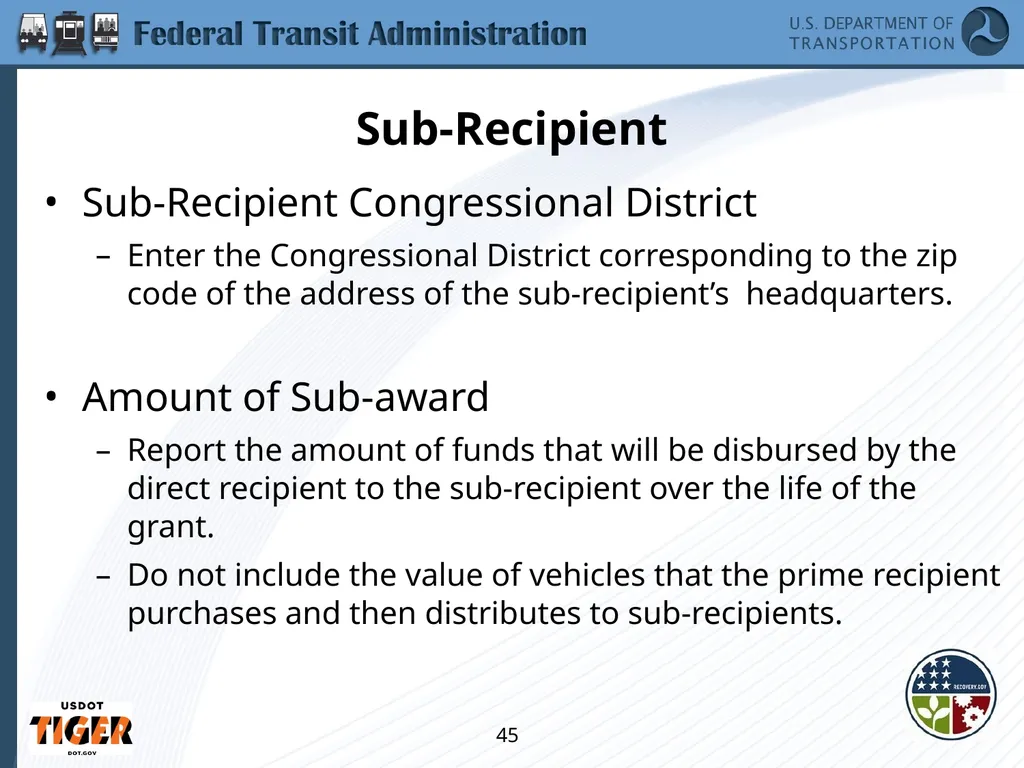
45 Sub-Recipient Sub-Recipient Congressional District
Enter the Congressional District corresponding to the zip code of the address of the sub-recipient’s headquarters.
Amount of Sub-award
Report the amount of funds that will be disbursed by the direct recipient to the sub-recipient over the life of the grant.
Do not include the value of vehicles that the prime recipient purchases and then distributes to sub-recipients.<br>
Enter the Congressional District corresponding to the zip code of the address of the sub-recipient’s headquarters.
Amount of Sub-award
Report the amount of funds that will be disbursed by the direct recipient to the sub-recipient over the life of the grant.
Do not include the value of vehicles that the prime recipient purchases and then distributes to sub-recipients.<br>
46
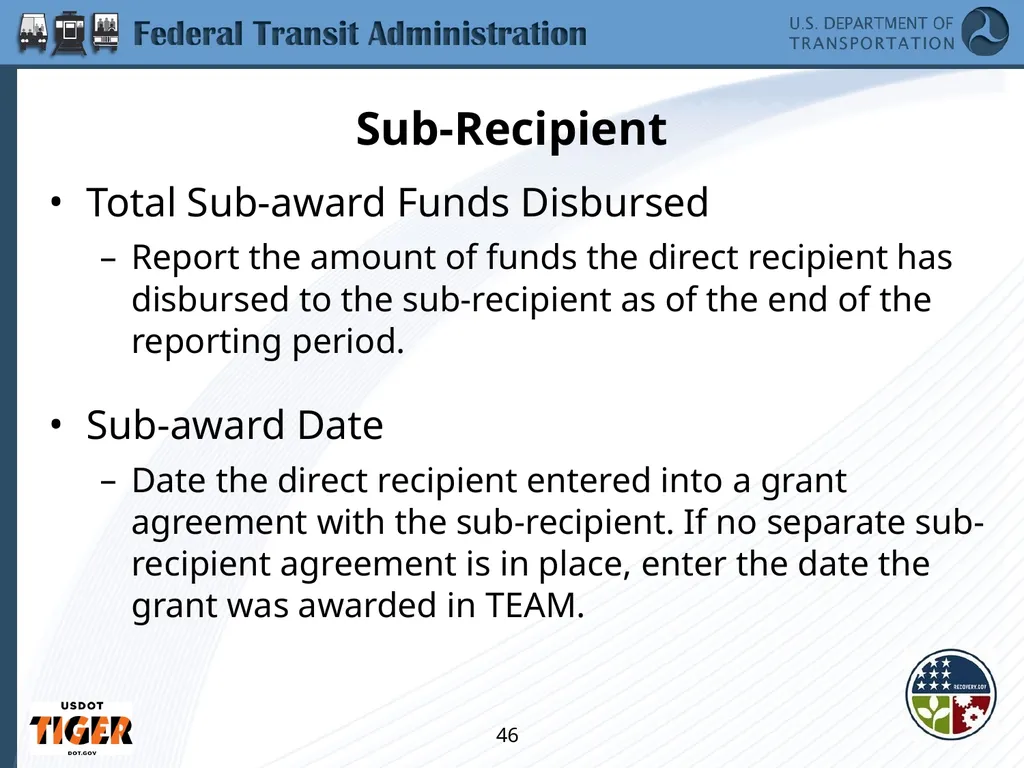
46 Sub-Recipient Total Sub-award Funds Disbursed
Report the amount of funds the direct recipient has disbursed to the sub-recipient as of the end of the reporting period.
Sub-award Date
Date the direct recipient entered into a grant agreement with the sub-recipient. If no separate sub-recipient agreement is in place, enter the date the grant was awarded in TEAM.<br>
Report the amount of funds the direct recipient has disbursed to the sub-recipient as of the end of the reporting period.
Sub-award Date
Date the direct recipient entered into a grant agreement with the sub-recipient. If no separate sub-recipient agreement is in place, enter the date the grant was awarded in TEAM.<br>
47
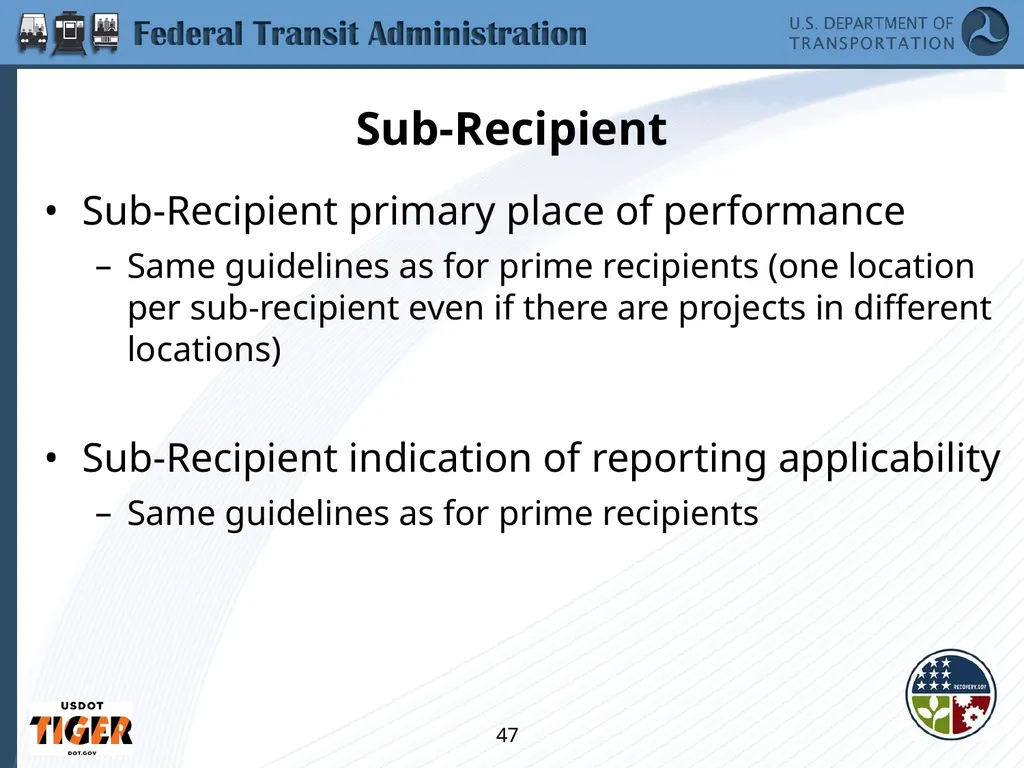
47 Sub-Recipient Sub-Recipient primary place of performance
Same guidelines as for prime recipients (one location per sub-recipient even if there are projects in different locations)
Sub-Recipient indication of reporting applicability
Same guidelines as for prime recipients<br>
Same guidelines as for prime recipients (one location per sub-recipient even if there are projects in different locations)
Sub-Recipient indication of reporting applicability
Same guidelines as for prime recipients<br>
48
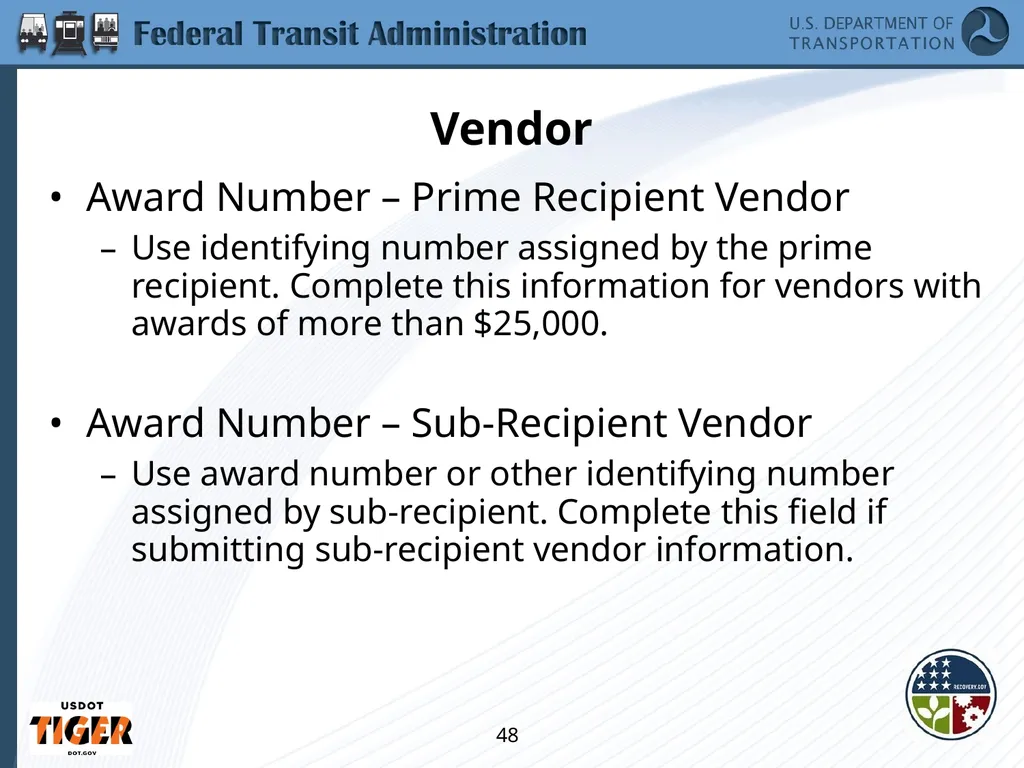
48 Vendor Award Number – Prime Recipient Vendor
Use identifying number assigned by the prime recipient. Complete this information for vendors with awards of more than $25,000.
Award Number – Sub-Recipient Vendor
Use award number or other identifying number assigned by sub-recipient. Complete this field if submitting sub-recipient vendor information.<br>
Use identifying number assigned by the prime recipient. Complete this information for vendors with awards of more than $25,000.
Award Number – Sub-Recipient Vendor
Use award number or other identifying number assigned by sub-recipient. Complete this field if submitting sub-recipient vendor information.<br>
49
49 Vendor Vendor DUNS Number
Use vendor DUNS number if available. If not, must enter vendor zip code and vendor name.
E.g. 12346789 or 20890-1234 “Acme Manufacturing.”
Product and Service Description
Provide a short description of product and/or service provided by vendor.
E.g. “Vehicle manufacturing,” “vehicle maintenance,” “facility electrical work,” “facility design” or “clerical support.”
Payment Amount
Provide total amount invoiced (paid) to vendor to date that will be reimbursed with ARRA funds.<br>
Use vendor DUNS number if available. If not, must enter vendor zip code and vendor name.
E.g. 12346789 or 20890-1234 “Acme Manufacturing.”
Product and Service Description
Provide a short description of product and/or service provided by vendor.
E.g. “Vehicle manufacturing,” “vehicle maintenance,” “facility electrical work,” “facility design” or “clerical support.”
Payment Amount
Provide total amount invoiced (paid) to vendor to date that will be reimbursed with ARRA funds.<br>
50
What not to report Number of awards to individuals
Amount of awards to individuals
*Note: Awards to individuals are not an eligible
activity under FTA’s grant programs. This line is
for other Federal programs that provide
assistance to individuals like scholarships, or
unemployment compensation. 50<br>
Amount of awards to individuals
*Note: Awards to individuals are not an eligible
activity under FTA’s grant programs. This line is
for other Federal programs that provide
assistance to individuals like scholarships, or
unemployment compensation. 50<br>
51
Edit Checks Federalreporting.gov has built in edit checks to improve data quality.
Hard edit checks block the report from being submitted.
Soft edit checks prompt the reporter to review certain information before submitting the report. 51<br>
Hard edit checks block the report from being submitted.
Soft edit checks prompt the reporter to review certain information before submitting the report. 51<br>
52
52 How information should be submitted Reports are submitted through a centralized system at www.FederalReporting.gov
There are 3 methods for reporting:
Online data entry in the Web browser
Excel spreadsheet
Custom software system extract in XML<br>
There are 3 methods for reporting:
Online data entry in the Web browser
Excel spreadsheet
Custom software system extract in XML<br>
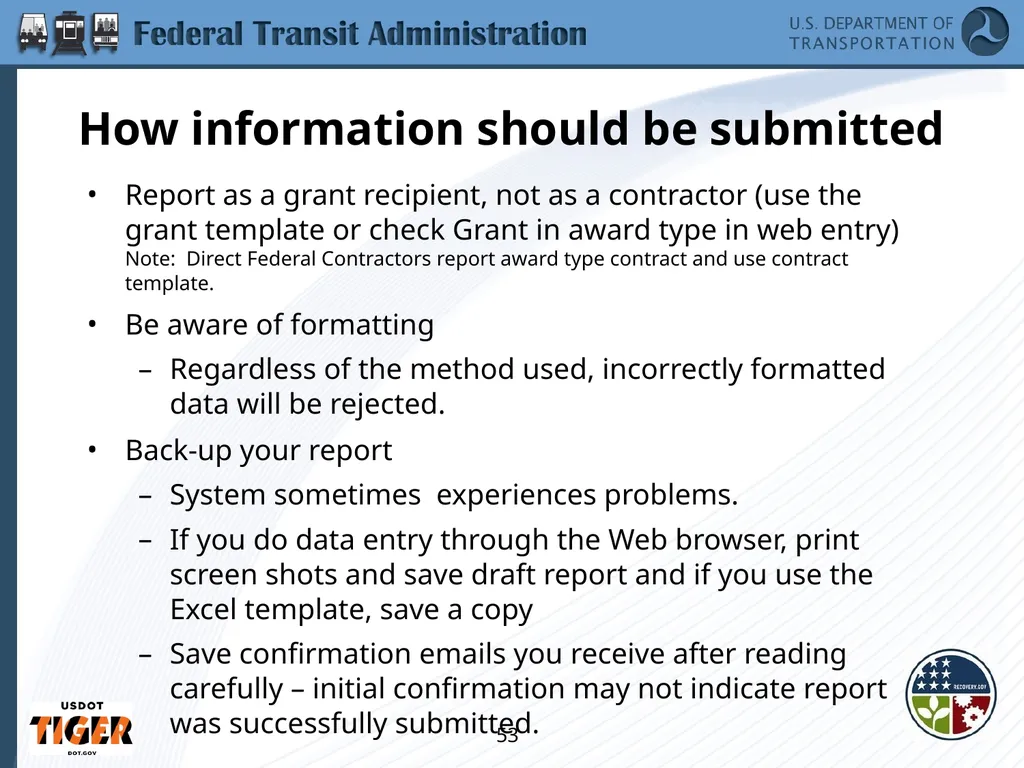
53
53 How information should be submitted Report as a grant recipient, not as a contractor (use the grant template or check Grant in award type in web entry) Note: Direct Federal Contractors report award type contract and use contract template.
Be aware of formatting
Regardless of the method used, incorrectly formatted data will be rejected.
Back-up your report
System sometimes experiences problems.
If you do data entry through the Web browser, print screen shots and save draft report and if you use the Excel template, save a copy
Save confirmation emails you receive after reading carefully – initial confirmation may not indicate report was successfully submitted.<br>
Be aware of formatting
Regardless of the method used, incorrectly formatted data will be rejected.
Back-up your report
System sometimes experiences problems.
If you do data entry through the Web browser, print screen shots and save draft report and if you use the Excel template, save a copy
Save confirmation emails you receive after reading carefully – initial confirmation may not indicate report was successfully submitted.<br>
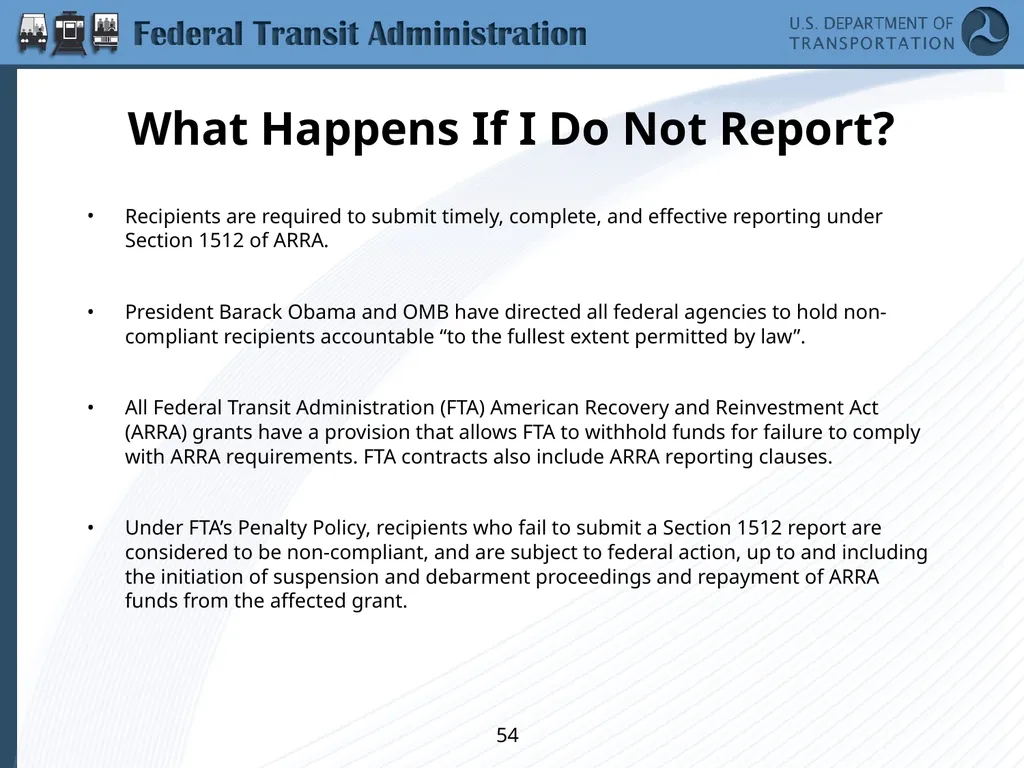
54
What Happens If I Do Not Report? Recipients are required to submit timely, complete, and effective reporting under Section 1512 of ARRA.
President Barack Obama and OMB have directed all federal agencies to hold non-compliant recipients accountable “to the fullest extent permitted by law”.
All Federal Transit Administration (FTA) American Recovery and Reinvestment Act (ARRA) grants have a provision that allows FTA to withhold funds for failure to comply with ARRA requirements. FTA contracts also include ARRA reporting clauses.
Under FTA’s Penalty Policy, recipients who fail to submit a Section 1512 report are considered to be non-compliant, and are subject to federal action, up to and including the initiation of suspension and debarment proceedings and repayment of ARRA funds from the affected grant. 54<br>
President Barack Obama and OMB have directed all federal agencies to hold non-compliant recipients accountable “to the fullest extent permitted by law”.
All Federal Transit Administration (FTA) American Recovery and Reinvestment Act (ARRA) grants have a provision that allows FTA to withhold funds for failure to comply with ARRA requirements. FTA contracts also include ARRA reporting clauses.
Under FTA’s Penalty Policy, recipients who fail to submit a Section 1512 report are considered to be non-compliant, and are subject to federal action, up to and including the initiation of suspension and debarment proceedings and repayment of ARRA funds from the affected grant. 54<br>
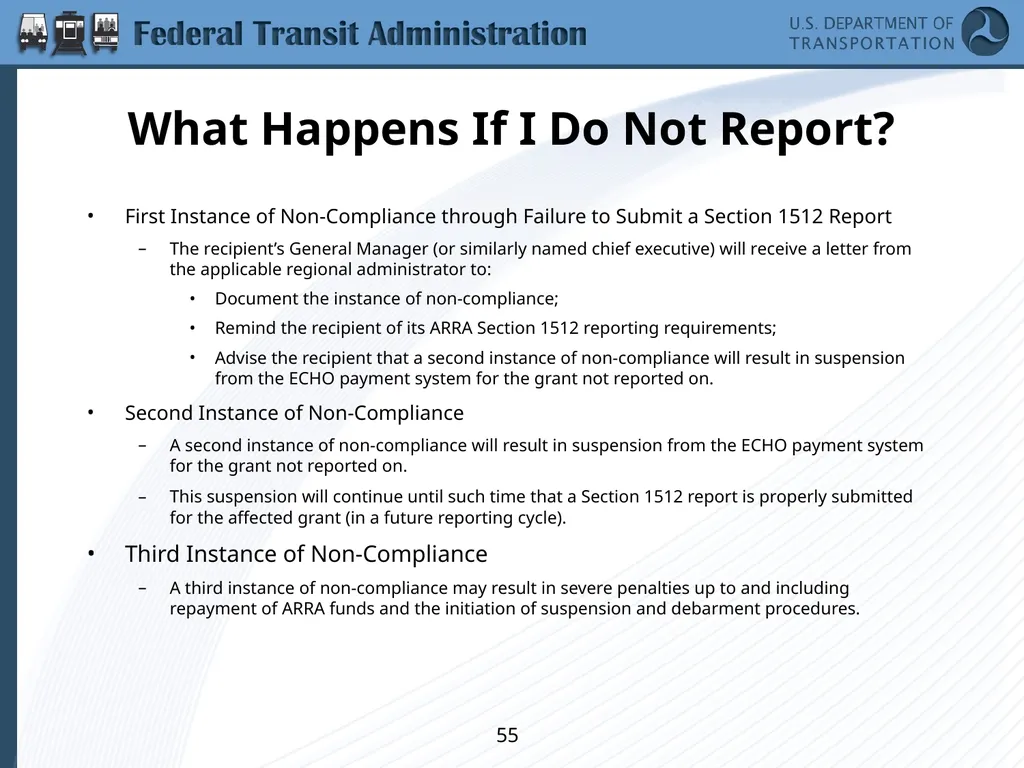
55
What Happens If I Do Not Report? First Instance of Non-Compliance through Failure to Submit a Section 1512 Report
The recipient’s General Manager (or similarly named chief executive) will receive a letter from the applicable regional administrator to:
Document the instance of non-compliance;
Remind the recipient of its ARRA Section 1512 reporting requirements;
Advise the recipient that a second instance of non-compliance will result in suspension from the ECHO payment system for the grant not reported on.
Second Instance of Non-Compliance
A second instance of non-compliance will result in suspension from the ECHO payment system for the grant not reported on.
This suspension will continue until such time that a Section 1512 report is properly submitted for the affected grant (in a future reporting cycle).
Third Instance of Non-Compliance
A third instance of non-compliance may result in severe penalties up to and including repayment of ARRA funds and the initiation of suspension and debarment procedures. 55<br>
The recipient’s General Manager (or similarly named chief executive) will receive a letter from the applicable regional administrator to:
Document the instance of non-compliance;
Remind the recipient of its ARRA Section 1512 reporting requirements;
Advise the recipient that a second instance of non-compliance will result in suspension from the ECHO payment system for the grant not reported on.
Second Instance of Non-Compliance
A second instance of non-compliance will result in suspension from the ECHO payment system for the grant not reported on.
This suspension will continue until such time that a Section 1512 report is properly submitted for the affected grant (in a future reporting cycle).
Third Instance of Non-Compliance
A third instance of non-compliance may result in severe penalties up to and including repayment of ARRA funds and the initiation of suspension and debarment procedures. 55<br>
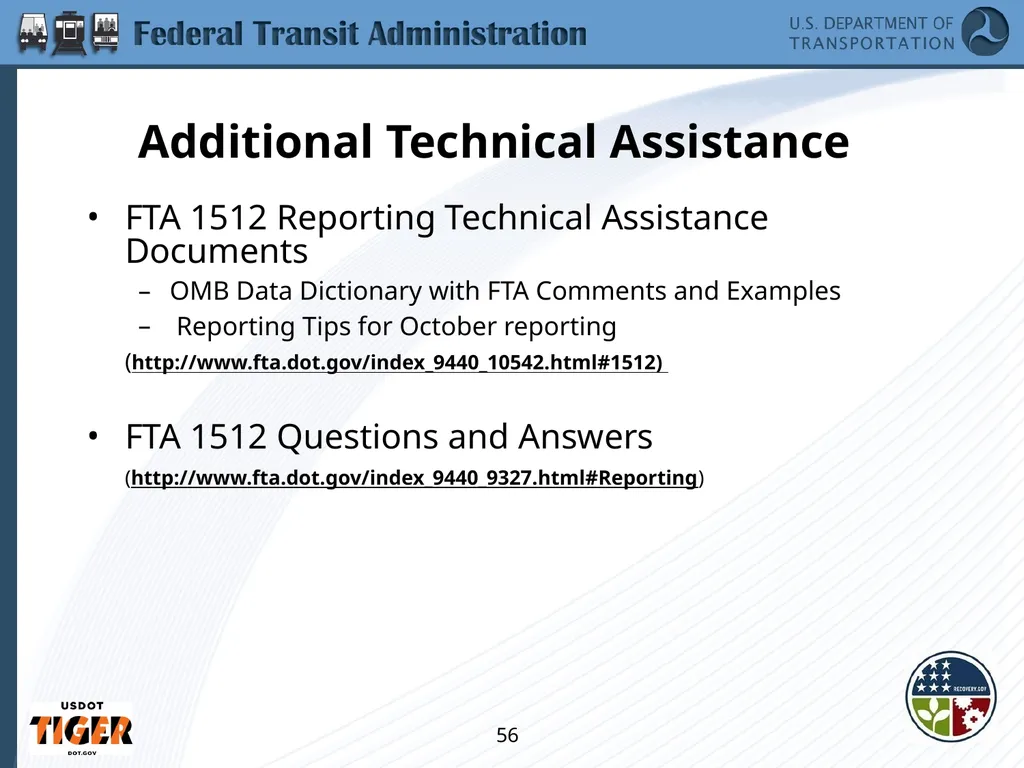
56
56 Additional Technical Assistance FTA 1512 Reporting Technical Assistance Documents
OMB Data Dictionary with FTA Comments and Examples
Reporting Tips for October reporting
(http://www.fta.dot.gov/index_9440_10542.html#1512)
FTA 1512 Questions and Answers
(http://www.fta.dot.gov/index_9440_9327.html#Reporting)<br>
OMB Data Dictionary with FTA Comments and Examples
Reporting Tips for October reporting
(http://www.fta.dot.gov/index_9440_10542.html#1512)
FTA 1512 Questions and Answers
(http://www.fta.dot.gov/index_9440_9327.html#Reporting)<br>
57
Additional Technical Assistance FederalReporting.gov Frequently Asked Questions
https://www.federalreporting.gov/federalreporting/faq.do
Recovery.gov Recipient Reporting Information
http://www.recovery.gov/FAQ/Pages/RecipientReporting.aspx
OMB Frequently Asked Questions http://www.whitehouse.gov/omb/recovery_faqs/ 57<br>
https://www.federalreporting.gov/federalreporting/faq.do
Recovery.gov Recipient Reporting Information
http://www.recovery.gov/FAQ/Pages/RecipientReporting.aspx
OMB Frequently Asked Questions http://www.whitehouse.gov/omb/recovery_faqs/ 57<br>
58
Additional Technical Assistance During the reporting period, FTA operates a dedicated hotline and email box to answer your specific questions
1-800-884-9190
FTA1512@dot.gov 58<br>
1-800-884-9190
FTA1512@dot.gov 58<br>
59
59 59 Contact Information For further information contact:
FederalReporting.gov Service Desk
(https://www.federalreporting.gov/federalreporting/help.do)
FTA Regional Points of Contact
Region 1: Sean Sullivan 617-494-2484
Region 2: Anthony Carr (212) 668-2170
Region 3: Elaine Burick (215) 656-7100 and Devendra Soni (215) 656-7257
Region 4: Margarita Sandberg (404) 865-5612
Region 5: Mary Campbell (312) 353-1646 and Rotimi Ogunsuyi (312) 353-4070
Region 6: Phyllis DeGarmo and Terry Showalter (817) 978-0550
Region 7: Daniel Nguyen (816)329-3938 and William Kalt (816) 329-3927
Region 8: Ryan Hammon (720) 963-3336
Region 9: Pak Chu (415) 744-0141 and Karineh Gregorian (213) 202-3958.
Region 10: Elaine Wine (206) 220-7536 and Ken Feldman (206) 220-7521
FTA Headquarters Point of Contact
Aaron Meyers (202) 366-2373<br>
FederalReporting.gov Service Desk
(https://www.federalreporting.gov/federalreporting/help.do)
FTA Regional Points of Contact
Region 1: Sean Sullivan 617-494-2484
Region 2: Anthony Carr (212) 668-2170
Region 3: Elaine Burick (215) 656-7100 and Devendra Soni (215) 656-7257
Region 4: Margarita Sandberg (404) 865-5612
Region 5: Mary Campbell (312) 353-1646 and Rotimi Ogunsuyi (312) 353-4070
Region 6: Phyllis DeGarmo and Terry Showalter (817) 978-0550
Region 7: Daniel Nguyen (816)329-3938 and William Kalt (816) 329-3927
Region 8: Ryan Hammon (720) 963-3336
Region 9: Pak Chu (415) 744-0141 and Karineh Gregorian (213) 202-3958.
Region 10: Elaine Wine (206) 220-7536 and Ken Feldman (206) 220-7521
FTA Headquarters Point of Contact
Aaron Meyers (202) 366-2373<br>
60
60 Questions
or
Concerns?<br>
or
Concerns?<br>