
Important Judicial Pronouncements in GST CA
PT
Published · 132 slides · 0 views

1 / 1

































Description
Important Judicial Pronouncements in GST CA V.Raghuraman, Advocate Challenge to levy provisions rules notification Levy of GST Compensation cess UOI vs. Mohit Mineral Pvt. Ltd. 2018-TIOL-05-SC-GST Validity of GST (Compensation to
Related Topics
Share
Embed code
Download this presentation From Below
"Important Judicial Pronouncements in GST CA" is the property of its rightful owner. Permission is granted to download and print the materials on this website for personal, non-commercial use only, and to display it on your personal computer provided you do not modify the materials and that you retain all copyright notices contained in the materials. By downloading content from our website, you accept the terms of this agreement.
Presentation Transcript
01
Important Judicial Pronouncements in GST CA V.Raghuraman,
Advocate<br>
Advocate<br>
02
Challenge to levy/ provisions/ rules/ notification …<br>
03
Levy of GST Compensation cess
UOI vs. Mohit Mineral Pvt. Ltd. 2018-TIOL-05-SC-GST Validity of GST (Compensation to States) Act, 2017 and GST Compensation Cess Rules, 2017 was challenged.
The Court held that Constitution provision empowers the Parliament to provide for Compensation to the States for loss of revenue by law, the expression ‘law’ is of very wide import which includes levy of any cess. Parliament has legislative competence to enact the Compensation to States Act, 2017.
It was observed that ‘compensation cess’ is ‘with respect to’ goods and services tax and it is a tax.
Held that impugned act does not violate Constitution (One hundred and First Amendment) Act, 2016 nor is against objective of the said Act.<br>
The Court held that Constitution provision empowers the Parliament to provide for Compensation to the States for loss of revenue by law, the expression ‘law’ is of very wide import which includes levy of any cess. Parliament has legislative competence to enact the Compensation to States Act, 2017.
It was observed that ‘compensation cess’ is ‘with respect to’ goods and services tax and it is a tax.
Held that impugned act does not violate Constitution (One hundred and First Amendment) Act, 2016 nor is against objective of the said Act.<br>
04
Levy of GST Compensation cess
UOI vs. Mohit Mineral Pvt. Ltd. 2018-TIOL-05-SC-GST Also held that GST imposed under 2017 Acts and levy of cess on supply of goods or services or both are two separate imposts in law and are not prohibited by any law so as to declare it invalid.
Regarding the petitioner’s contention to off-set clean energy cess paid upto 30.06.2017 against compensation cess, it was held that both these cesses were collected for different purposes and petitioner contention cannot be accepted. Giving credit or set-off in payment is legislative policy which had to be reflected in the legislative scheme.<br>
Regarding the petitioner’s contention to off-set clean energy cess paid upto 30.06.2017 against compensation cess, it was held that both these cesses were collected for different purposes and petitioner contention cannot be accepted. Giving credit or set-off in payment is legislative policy which had to be reflected in the legislative scheme.<br>
05
GST on Duty Free Shops
Atin Krishna Vs UOI 2019-TIOL-1136-HC-All-GST The Duty Free Shops are located in the Custom area as per Section 2(11) of the Customs Act 1962
Supply of imported goods to & from the duty free shops do not cross the Customs frontier & hence such supplies classify as inter-State supply u/s 7(2) of the IGST Act.
Hence the same cannot attract CGST and SGST u/s 9 of either Act: HC
The supply of warehoused goods by the duty free shops at the departure terminal is made to departing international passengers who are destined for some foreign location –
Hence the goods supplied are never cleared for home consumption & the warehoused goods are exported - Hence no Customs or IGST is leviable - IGST is not payable on the supply either to or from the DFS located at the arrival or at departure terminal<br>
Supply of imported goods to & from the duty free shops do not cross the Customs frontier & hence such supplies classify as inter-State supply u/s 7(2) of the IGST Act.
Hence the same cannot attract CGST and SGST u/s 9 of either Act: HC
The supply of warehoused goods by the duty free shops at the departure terminal is made to departing international passengers who are destined for some foreign location –
Hence the goods supplied are never cleared for home consumption & the warehoused goods are exported - Hence no Customs or IGST is leviable - IGST is not payable on the supply either to or from the DFS located at the arrival or at departure terminal<br>
06
GST on Duty Free Shops
Sandeep Patil Vs UOI 2019-TIOL-2348-HC-MUM-GST Whether the duty free shops (‘DFS’, the petitioner) at Mumbai International Airport Ltd (MIAL) can be saddled with burden of taxes on amounts paid towards the minimum guaranteed fees/ concession fees for grant of rights and use of licensed premises in the departure or arrival area of international airport?
Held:
Supply by DFS of petitioner at international Airport to outbound passenger constitutes ‘exports’ by DFS u/s 2(5) IGST Act. Consequently, in terms of section 16(1) of IGST Act, 2017, it becomes a zero rate supply. Reliance was placed on Atin Krishna Vs UOI 2019-TIOL-1136-HC-ALL-GST and A-1 Cuisines Pvt Ltd Vs UOI 2018-TIOL-2916-HC-MUM-GST.
Further, as per article 286 of the Constitution of India, supply made in course of import into India or in course of export out of India, can not be subjected to any tax.
If the duty free shop, which caters to the outgoing or incoming international passengers, is subjected to local taxes by the State, the tax burden will increase and the price of the goods, which are supposed to be free of taxes and duties, will go up, and the same would prevent the duty free shops in India from competing with DFSs at international airports elsewhere in the world. This will also hamper and prejudicially affect foreign trade, and augmentation and conservation of foreign exchange and will also negate the intent and purpose of article 286 of the Constitution of India.<br>
Held:
Supply by DFS of petitioner at international Airport to outbound passenger constitutes ‘exports’ by DFS u/s 2(5) IGST Act. Consequently, in terms of section 16(1) of IGST Act, 2017, it becomes a zero rate supply. Reliance was placed on Atin Krishna Vs UOI 2019-TIOL-1136-HC-ALL-GST and A-1 Cuisines Pvt Ltd Vs UOI 2018-TIOL-2916-HC-MUM-GST.
Further, as per article 286 of the Constitution of India, supply made in course of import into India or in course of export out of India, can not be subjected to any tax.
If the duty free shop, which caters to the outgoing or incoming international passengers, is subjected to local taxes by the State, the tax burden will increase and the price of the goods, which are supposed to be free of taxes and duties, will go up, and the same would prevent the duty free shops in India from competing with DFSs at international airports elsewhere in the world. This will also hamper and prejudicially affect foreign trade, and augmentation and conservation of foreign exchange and will also negate the intent and purpose of article 286 of the Constitution of India.<br>
07
GST on Ocean Freight
Mohit Minerals Pvt Ltd & Others Vs. Union of India & Others 2020-TIOL-164-HC-AHM-GST Issues involved: Challenge to levy of IGST on ocean freight. Petitioner also challenged the vires of Notification No. 8/2017-IGST Dt.. 28.06.2017 and Notification No. 10/2017- IGST Dt.. 28.06.21017
High Court held that petitioner being an importer of non-cooking coal challenging vires of aforesaid notifications on the ground that once having paid IGST on full value of imported goods inclusive of freight element, charging GST again on ocean freight not permissible. Further, both service provider and recipient being located abroad in case of CIF contracts, levy under RCM not permissible and that in case of High Sea Sales, importer not being recipient of service cannot be charged with GST.<br>
High Court held that petitioner being an importer of non-cooking coal challenging vires of aforesaid notifications on the ground that once having paid IGST on full value of imported goods inclusive of freight element, charging GST again on ocean freight not permissible. Further, both service provider and recipient being located abroad in case of CIF contracts, levy under RCM not permissible and that in case of High Sea Sales, importer not being recipient of service cannot be charged with GST.<br>
08
Whether ‘Fees’ charged by Receiver is liable to GST?
Bai Mamubai Trust Vs Suchitra 2019-TIOL-2158-HC-MUM-GST Facts: Defendant was alleged as occupying a property illegally and the plaintiff had filed suit in Bombay High Court. The High Court appointed Court Receiver to take 'formal possession' of the property under the provisions of the Civil Procedure Code, while allowing the defendant to remain in actual possession of the property. Court further ordered payment of a particular sum per month to the Receiver towards royalty / compensation.
Held:
Receiver is a department of the Court. Fees received by Receiver would fall under Entry 2 of Schedule III of CGST Act which covers. Therefore, no GST is liable to be paid.
Payment of royalty is not ‘consideration’ for supply. Royalty paid was towards damages or compensation for violation of plaintiff's legal right in the suit premises. The defendant was permitted to remain in possession despite having no right to be in occupation of the premises subject to payment of such amount. Therefore, basis of this payment is the alleged illegal occupation or trespass by the defendant.
It cannot be said that royalty is, in substance, rent and the receiver acts as an agent of the plaintiff who is in the business of renting of property and therefore, the same is liable to tax.
Where no reciprocal relationship exists, and the plaintiff alleges violation of a legal right and seeks damages or compensation from a court to make good the said violation (in closes possible monetary terms) it cannot be said that a supply has taken place.<br>
Held:
Receiver is a department of the Court. Fees received by Receiver would fall under Entry 2 of Schedule III of CGST Act which covers. Therefore, no GST is liable to be paid.
Payment of royalty is not ‘consideration’ for supply. Royalty paid was towards damages or compensation for violation of plaintiff's legal right in the suit premises. The defendant was permitted to remain in possession despite having no right to be in occupation of the premises subject to payment of such amount. Therefore, basis of this payment is the alleged illegal occupation or trespass by the defendant.
It cannot be said that royalty is, in substance, rent and the receiver acts as an agent of the plaintiff who is in the business of renting of property and therefore, the same is liable to tax.
Where no reciprocal relationship exists, and the plaintiff alleges violation of a legal right and seeks damages or compensation from a court to make good the said violation (in closes possible monetary terms) it cannot be said that a supply has taken place.<br>
09
Advance Authorisation – ‘Pre-import’ and ‘Physical exports’ conditions struck down
Maxim Tubes Company Pvt Ltd Vs UOI 2019-TIOL-459-HC-AHM-CUS Issue involved: The conditions of ‘physical exports’ and ‘pre-import condition’ under Notification No. 18/2015-Cus as amended by Notification No. 79/2017-Cus dated 13.10.2017 were challenged.
High Court held that the condition of physical export and pre-import put forth by the DRI, it is more or less impossible to make any exports under an Advance Authorisation without violating the condition of pre-import.
High Court held that the impugned conditions do not meet with the test of reasonableness and are also not in consonance with the scheme of Advance Authorisation. Accordingly, High Court struck down the "pre-import condition" contained in paragraph 4.14 of FTP 2015-2020 inserted vide Notification No.33/2015-2020 dated 13.10.2017 and inserted vide clause (xii) in Notification No.18/2015-Cus vide Notification No.79/2017-Cus dated 13.10.2017, as being ultra vires the Advance Authorisation Scheme of FTP, 2015-2020.<br>
High Court held that the condition of physical export and pre-import put forth by the DRI, it is more or less impossible to make any exports under an Advance Authorisation without violating the condition of pre-import.
High Court held that the impugned conditions do not meet with the test of reasonableness and are also not in consonance with the scheme of Advance Authorisation. Accordingly, High Court struck down the "pre-import condition" contained in paragraph 4.14 of FTP 2015-2020 inserted vide Notification No.33/2015-2020 dated 13.10.2017 and inserted vide clause (xii) in Notification No.18/2015-Cus vide Notification No.79/2017-Cus dated 13.10.2017, as being ultra vires the Advance Authorisation Scheme of FTP, 2015-2020.<br>
10
Nirman Estate Developers Pvt Ltd Vs UOI 2018-TIOL-195-HC-MUM-GST The petitioner contests the constitutional validity of Notification No No.4 of 2018-Central Tax (Rate) and Notification No.4 of 2018-ST (Rate), both dated Jan 25, 2018.
Petitioner claimed that both notifications seek to tax an activity which is neither service nor supply of service & so is ultra vires of the CGST Act 2017.
Bombay High Court ordered issue notice to respondents.<br>
Petitioner claimed that both notifications seek to tax an activity which is neither service nor supply of service & so is ultra vires of the CGST Act 2017.
Bombay High Court ordered issue notice to respondents.<br>
11
GSTAT – Setting up of Appellate Tribunal under GST regime Revenue Bar Association Vs UOI 2019-TIOL-2188-HC-MAD-GST: The Madras High Court inter alia struck down Section 109(3) and 109(9) of the Central Goods and Services Act, 2017 on the basis that the composition of the GSTAT to include one Judicial Member and two Technical Members is unconstitutional.
Allahabad High Court in Oudh Bar Association Vs UOI 2019 (25) GSTL 374 (All) held that the seat where the Tribunal is to be established is an issue which is within the domain of the Executive in terms of Section 109 of CGST Act ordinarily and is not justiciable in view of the decision of the Supreme Court in the case of Lalit Kumar (supra). Further, while directing the government to fill up vacancies and unfilled posts in tribunals, it was observed that on account of non-functioning of the tribunal, the litigants are rushing to the High Court adding to the existing pendency.
GST Appellate Tribunal (‘GSTAT’) vide Notification No. S.O. 3009(E) [No. 1/2019 (F. No. A. 50050/99/2018 - AD.1C (CESTAT)] dated 21.08.2019<br>
Allahabad High Court in Oudh Bar Association Vs UOI 2019 (25) GSTL 374 (All) held that the seat where the Tribunal is to be established is an issue which is within the domain of the Executive in terms of Section 109 of CGST Act ordinarily and is not justiciable in view of the decision of the Supreme Court in the case of Lalit Kumar (supra). Further, while directing the government to fill up vacancies and unfilled posts in tribunals, it was observed that on account of non-functioning of the tribunal, the litigants are rushing to the High Court adding to the existing pendency.
GST Appellate Tribunal (‘GSTAT’) vide Notification No. S.O. 3009(E) [No. 1/2019 (F. No. A. 50050/99/2018 - AD.1C (CESTAT)] dated 21.08.2019<br>
12
Validity of constitution of AAR - with only departmental persons JVS Foods Pvt Ltd Vs UoI, 2020-TIOL-946-HC-RAJ-GST
Validity of Section 96(2) Rajasthan GST Act, 2017 is challenged
On the ground that constitution of AAR without a judicial member is unconstitutional.
Notice issued by the High Court<br>
Validity of Section 96(2) Rajasthan GST Act, 2017 is challenged
On the ground that constitution of AAR without a judicial member is unconstitutional.
Notice issued by the High Court<br>
13
M/s. Ideal Movers Pvt Ltd vs The State Tax Officer 2020-TIOL-199-HC-MAD-GST Issue:
The petitioner is a transporter and had been engaged to transport a consignment from Kancheepuram District to the consignee situated at Krishnagiri District. An e-way bill had been generated on 12.01.2020 at 7:23 p.m., valid till 16.01.2020. However, the lorry had broken down on 13.01.2020 with major repair near Vellore and was thus lying in Vellore at one Lawrence Automotive Private Limited.
After repair, the lorry proceeded to deliver the goods to the destination, however, accompanied by the e-way bill that had expired/lapsed on 16.01.2020 itself. The lorry was intercepted at Vellore and detained for non-possession of valid e-way bill. Thus, the petitioner was issued notice in terms of s.129(3) of the CGST Act on 17.01.2020.
Held:
Section 129 is a complete code for the purpose of addressing all violations committed in transit leading to detention, seizure and release of goods and brings within its sweep all such contraventions, irrespective of the gravity of the violation itself.
Since clauses (a) and (b) of sub-section (1) commence with the phrase on payment, it is not sufficient for the consignor to merely make an offer or undertake to remit the tax as in the present case, but actually remit the payment..<br>
The petitioner is a transporter and had been engaged to transport a consignment from Kancheepuram District to the consignee situated at Krishnagiri District. An e-way bill had been generated on 12.01.2020 at 7:23 p.m., valid till 16.01.2020. However, the lorry had broken down on 13.01.2020 with major repair near Vellore and was thus lying in Vellore at one Lawrence Automotive Private Limited.
After repair, the lorry proceeded to deliver the goods to the destination, however, accompanied by the e-way bill that had expired/lapsed on 16.01.2020 itself. The lorry was intercepted at Vellore and detained for non-possession of valid e-way bill. Thus, the petitioner was issued notice in terms of s.129(3) of the CGST Act on 17.01.2020.
Held:
Section 129 is a complete code for the purpose of addressing all violations committed in transit leading to detention, seizure and release of goods and brings within its sweep all such contraventions, irrespective of the gravity of the violation itself.
Since clauses (a) and (b) of sub-section (1) commence with the phrase on payment, it is not sufficient for the consignor to merely make an offer or undertake to remit the tax as in the present case, but actually remit the payment..<br>
14
M/s. Ideal Movers Pvt Ltd vs The State Tax Officer 2020-TIOL-199-HC-MAD-GST Section 129(1)(b) deals with a situation where the owner of the goods has not come forward to pay the tax and penalty, thus necessitating the transporter to pay applicable tax, in addition to penalty equal to 50% of the value of the goods, reduced by the tax paid.
Second proviso under Rule 138(10) permits a transporter to extend the validity of the expired e-way after updating the details in the relevant Form and this benefit would be available in a case such as the present.
In fine, tax amount must be remitted in terms of Section 129(1)(b). As for penalty, the petitioner enjoys the benefit of Circular no.10 of 2019 dated 31.05.2019 where at para 10, the Commissioner reduces the penalty payable in certain circumstances to Rs.5000. Thus, upon remittance of the taxes and penalty of Rs.5000 the consignment shall be released forthwith.<br>
Second proviso under Rule 138(10) permits a transporter to extend the validity of the expired e-way after updating the details in the relevant Form and this benefit would be available in a case such as the present.
In fine, tax amount must be remitted in terms of Section 129(1)(b). As for penalty, the petitioner enjoys the benefit of Circular no.10 of 2019 dated 31.05.2019 where at para 10, the Commissioner reduces the penalty payable in certain circumstances to Rs.5000. Thus, upon remittance of the taxes and penalty of Rs.5000 the consignment shall be released forthwith.<br>
15
MATERIAL RECYCLING ASSOCIATION OF INDIA Vs UOI 2020-TIOL-1274-HC-AHM-GST Facts:
Petitioner is an association comprising of recycling industry engaged in manufacture of metals and casting etc. They also provide business promotion and marketing services for principals located outside India.
Question:
Petitioner has challenged the constitutional validity of section 13(8)(b) of the IGST Act and to hold the same as ultra vires the Articles 14, 19, 265 and 286 of the Constitution of India with a direction to the respondent to refund IGST paid on services provided by the members of the petitioner association and to their clients located outside India<br>
Petitioner is an association comprising of recycling industry engaged in manufacture of metals and casting etc. They also provide business promotion and marketing services for principals located outside India.
Question:
Petitioner has challenged the constitutional validity of section 13(8)(b) of the IGST Act and to hold the same as ultra vires the Articles 14, 19, 265 and 286 of the Constitution of India with a direction to the respondent to refund IGST paid on services provided by the members of the petitioner association and to their clients located outside India<br>
16
MATERIAL RECYCLING ASSOCIATION OF INDIA Vs UOI 2020-TIOL-1274-HC-AHM-GST Contention:
Petitioner submits that members of the petitioner association receives only the commission upon receipt of sale proceeds by its foreign client in convertible foreign exchange and thus the transaction entered into by the members is one of export of service from India; that, therefore, IGST cannot be levied on the members who are engaged in the transaction of export of services as the same is covered u/s 16(1) of the IGST Act, 2017 which provides for ‘zero-rated supply’.
Observations and Decision:
Parliament has exclusive power under Article 246A to frame laws for inter State supply of goods or services. The basic underlying change brought in by the GST regime is to shift the base of levy of tax.
Section 8 of section 13 refers to place of supply of the services in case of banking company, intermediary services and services consisting of hiring of means of transport.
Upon a conjoint reading of section 2(6) and 2(13) which defines 'export of service' and 'intermediary service' respectively, the person who is intermediary cannot be considered as exporter of services because he is only a broker who arranges and facilitates the supply of goods and services or both. In such circumstances, the respondent has issued Notification no. 20/2019-IT(R) where exemption is granted in IGST rates from payment of IGST vide Entry no. 12AA in respect of services provided by intermediary in case the goods are supplied in India.<br>
Petitioner submits that members of the petitioner association receives only the commission upon receipt of sale proceeds by its foreign client in convertible foreign exchange and thus the transaction entered into by the members is one of export of service from India; that, therefore, IGST cannot be levied on the members who are engaged in the transaction of export of services as the same is covered u/s 16(1) of the IGST Act, 2017 which provides for ‘zero-rated supply’.
Observations and Decision:
Parliament has exclusive power under Article 246A to frame laws for inter State supply of goods or services. The basic underlying change brought in by the GST regime is to shift the base of levy of tax.
Section 8 of section 13 refers to place of supply of the services in case of banking company, intermediary services and services consisting of hiring of means of transport.
Upon a conjoint reading of section 2(6) and 2(13) which defines 'export of service' and 'intermediary service' respectively, the person who is intermediary cannot be considered as exporter of services because he is only a broker who arranges and facilitates the supply of goods and services or both. In such circumstances, the respondent has issued Notification no. 20/2019-IT(R) where exemption is granted in IGST rates from payment of IGST vide Entry no. 12AA in respect of services provided by intermediary in case the goods are supplied in India.<br>
17
MATERIAL RECYCLING ASSOCIATION OF INDIA Vs UOI 2020-TIOL-1274-HC-AHM-GST Observations and Decision:
It therefore, appears that the basic logic or inception of section 13(8)(b) of the IGST Act, 2017 considering the place of supply in case of intermediary to be the location of supply of service is in order to levy CGST and SGST and such intermediary service, would be out of the purview of IGST.
There is no distinction between the intermediary services provided by a person in India or outside India. Only because the invoices are raised on the person outside India with regard to the commission and foreign exchange is received in India, it would not qualify to be export of services, more particularly when the legislature has thought it fit to consider the place of supply of services as place of person who provides such service in India.
There is a stipulation by the Act legislated by the Parliament to consider the location of the service provider of the intermediary to be place of supply. Similar situation was existing in service tax regime w.e.f 1st October 2014 and as such same situation is continued in GST regime also. This being the consistent stand of the respondents to tax the service provided by intermediary in India, the same cannot be treated as ‘export of services' under IGST Act, 2017 and, therefore, rightly included in section 13(8)(b) of the IGST Act to consider the location of supplier of service as place of supply so as to attract CGST and SGST.<br>
It therefore, appears that the basic logic or inception of section 13(8)(b) of the IGST Act, 2017 considering the place of supply in case of intermediary to be the location of supply of service is in order to levy CGST and SGST and such intermediary service, would be out of the purview of IGST.
There is no distinction between the intermediary services provided by a person in India or outside India. Only because the invoices are raised on the person outside India with regard to the commission and foreign exchange is received in India, it would not qualify to be export of services, more particularly when the legislature has thought it fit to consider the place of supply of services as place of person who provides such service in India.
There is a stipulation by the Act legislated by the Parliament to consider the location of the service provider of the intermediary to be place of supply. Similar situation was existing in service tax regime w.e.f 1st October 2014 and as such same situation is continued in GST regime also. This being the consistent stand of the respondents to tax the service provided by intermediary in India, the same cannot be treated as ‘export of services' under IGST Act, 2017 and, therefore, rightly included in section 13(8)(b) of the IGST Act to consider the location of supplier of service as place of supply so as to attract CGST and SGST.<br>
18
Observations and Decision:
Contention of the petitioner that it would amount to double taxation is also not tenable in eyes of law because the services provided by the petitioner as intermediary would not be taxable in the hands of recipient of such service, but on the contrary a commission paid by the recipient of service outside India would be entitled to get deduction of such payment of commission by way of expenses and, therefore, it would not be a case of double taxation. If the services provided by intermediary is not taxed in India, which is a location of supply of service, then, providing such service by the intermediary located in India would be without payment of any tax and such services would not be liable to tax anywhere.
Further, there is an exemption from payment of IGST for service provided by an intermediary when location of both supplier and recipient of goods is outside the taxable territory i.e. India vide Notification no. 20/2019-IT(R).
Accordingly, it cannot be said that the provision of section 13(8)(b) read with section 2(13) of the IGST Act are ultra vires or unconstitutional in any manner. MATERIAL RECYCLING ASSOCIATION OF INDIA Vs UOI 2020-TIOL-1274-HC-AHM-GST<br>
Contention of the petitioner that it would amount to double taxation is also not tenable in eyes of law because the services provided by the petitioner as intermediary would not be taxable in the hands of recipient of such service, but on the contrary a commission paid by the recipient of service outside India would be entitled to get deduction of such payment of commission by way of expenses and, therefore, it would not be a case of double taxation. If the services provided by intermediary is not taxed in India, which is a location of supply of service, then, providing such service by the intermediary located in India would be without payment of any tax and such services would not be liable to tax anywhere.
Further, there is an exemption from payment of IGST for service provided by an intermediary when location of both supplier and recipient of goods is outside the taxable territory i.e. India vide Notification no. 20/2019-IT(R).
Accordingly, it cannot be said that the provision of section 13(8)(b) read with section 2(13) of the IGST Act are ultra vires or unconstitutional in any manner. MATERIAL RECYCLING ASSOCIATION OF INDIA Vs UOI 2020-TIOL-1274-HC-AHM-GST<br>
19
Mahavir Enterprise vs Assistant Commnr of State Tax [2020] 117 taxmann.com 471 (Gujarat) Issue:
The WP was filed by the petitioner challenging the vires of Rule 142(1)(a) of the CGST Rules, 2017 as ultra-vires and beyond the scope of section 122 of the CGST Act, 2017 as a result of excessive delegation of power.
Contentions:
The petitioner contended that Rule 142(1)(a) of the CGST Rules, 2017, contemplates for issuance of summary notice electronically along with the notice issued under section 52 or Section 73 or Section 74 or Section 76 or Section 122 or Section 123 or Section 124 or Section 125 or Section 127 or Section 129 or Section 130 of the GST Act, 2017.
However, Section 122 of the Act, 2017 does not contemplate issue of any show cause notice and therefore, Rule 142(1)(a) travels beyond the provisions of the section 122 Act.<br>
The WP was filed by the petitioner challenging the vires of Rule 142(1)(a) of the CGST Rules, 2017 as ultra-vires and beyond the scope of section 122 of the CGST Act, 2017 as a result of excessive delegation of power.
Contentions:
The petitioner contended that Rule 142(1)(a) of the CGST Rules, 2017, contemplates for issuance of summary notice electronically along with the notice issued under section 52 or Section 73 or Section 74 or Section 76 or Section 122 or Section 123 or Section 124 or Section 125 or Section 127 or Section 129 or Section 130 of the GST Act, 2017.
However, Section 122 of the Act, 2017 does not contemplate issue of any show cause notice and therefore, Rule 142(1)(a) travels beyond the provisions of the section 122 Act.<br>
20
Mahavir Enterprise vs Assistant Commnr of State Tax [2020] 117 taxmann.com 471 (Gujarat) Held:
It was held that Rule 142 is specifically with respect to "notice and order for demand of amounts payable under the Act” and cannot be held to be invalid in any manner.
Further, it was held that Section 164 of the Act confers power on the Central Government to frame the rules. Under Section 164 of the Act, the Central Government has the power to make rules generally to carry out all or any of the purposes of the Act.
Therefore, that the Rule 142(1)(a) of the Rules, 2017 is valid and is no manner conflict with any of the provisions of the Act.<br>
It was held that Rule 142 is specifically with respect to "notice and order for demand of amounts payable under the Act” and cannot be held to be invalid in any manner.
Further, it was held that Section 164 of the Act confers power on the Central Government to frame the rules. Under Section 164 of the Act, the Central Government has the power to make rules generally to carry out all or any of the purposes of the Act.
Therefore, that the Rule 142(1)(a) of the Rules, 2017 is valid and is no manner conflict with any of the provisions of the Act.<br>
21
Issues relating to
Repeal and Savings<br>
22
Reliance Industries Ltd Vs State of Gujarat 2020-TIOL-837-HC-AHM-VAT Facts:
There was a pending dispute with respect to eligibility of ITC under VAT Act with respect to consignment of branch transfers under one Section 13(3)(b) of the VAT Act.
Initially it was held that reduction of ITC u/s 11(3)(b) would not exceed 4% as limitation of availing of the tax credit as provided under Section 11(3)(b) could be applied only once irrespective of the fact as to whether particular commodity purchased falls in more than one sub-clauses of Section 11(3)(b) of the VAT Act.
However, later, in another case, while considering the availment of sales tax incentive limit, it was held that the tax paid on the purchase of goods used in the manufacture of taxable goods exported outside the country is required to be considered.
Thereafter a notice proposing revision u/s 75 of the VAT Act was issued to the assessee, for reducing the sales tax incentive limit after considering the tax paid on purchases of the goods used in manufacture of taxable goods, exported outside the country.<br>
There was a pending dispute with respect to eligibility of ITC under VAT Act with respect to consignment of branch transfers under one Section 13(3)(b) of the VAT Act.
Initially it was held that reduction of ITC u/s 11(3)(b) would not exceed 4% as limitation of availing of the tax credit as provided under Section 11(3)(b) could be applied only once irrespective of the fact as to whether particular commodity purchased falls in more than one sub-clauses of Section 11(3)(b) of the VAT Act.
However, later, in another case, while considering the availment of sales tax incentive limit, it was held that the tax paid on the purchase of goods used in the manufacture of taxable goods exported outside the country is required to be considered.
Thereafter a notice proposing revision u/s 75 of the VAT Act was issued to the assessee, for reducing the sales tax incentive limit after considering the tax paid on purchases of the goods used in manufacture of taxable goods, exported outside the country.<br>
23
Reliance Industries Ltd Vs State of Gujarat 2020-TIOL-837-HC-AHM-VAT Facts:
Constitution (101st Amendment) Act, 2016, the GVAT Act was amended, with many of the provisions of VAT Act being substituted or deleted.
The first case, on appeal to Supreme Court, High Court's judgment and held that the ITC is to be reduced twice to the extent of total 8%, under sub clauses (ii) and (iii) of Section 11(3)(b) of the VAT Act , in such a way that the reduction should not exceed the amount of the Input Tax credit claimed.
In pursuance thereof, another revision notice was issued u/s 75 of the Act for reducing ITC to the extent of 8% under provisions of Section 11(3)(b)(ii) and 11(3)(b)(iii). Such revision notice was set aside by the High Court on grounds that it was issued beyond limitation as prescribed u/s 75 of the Act.<br>
Constitution (101st Amendment) Act, 2016, the GVAT Act was amended, with many of the provisions of VAT Act being substituted or deleted.
The first case, on appeal to Supreme Court, High Court's judgment and held that the ITC is to be reduced twice to the extent of total 8%, under sub clauses (ii) and (iii) of Section 11(3)(b) of the VAT Act , in such a way that the reduction should not exceed the amount of the Input Tax credit claimed.
In pursuance thereof, another revision notice was issued u/s 75 of the Act for reducing ITC to the extent of 8% under provisions of Section 11(3)(b)(ii) and 11(3)(b)(iii). Such revision notice was set aside by the High Court on grounds that it was issued beyond limitation as prescribed u/s 75 of the Act.<br>
24
Reliance Industries Ltd Vs State of Gujarat 2020-TIOL-837-HC-AHM-VAT Facts:
Subsequently, Section 84A was added to the GVAT Act with retrospective effect. It provided for exclusion of the period spent between the date of the decision of the appellate tribunal and that of the High Court as well as the Supreme Court in computing the period of limitation u/s 75 of the Act.
Hence fresh notice for revision was issued for revising assessment for the FY 2008-09 for reducing the ITC to the extent of 8% u/s 11(3)(b)(ii) and 11(3)(b)(iii) of the GVAT Act.
The original limitation u/s 75 for issuing notice is 3 years from date of assessment order & by virtue of Section 84A, the period from 18.01.2013 till 22.09.2017 was sought to be excluded in computing such three-year period.
Writ assails the constitutional validity of Section 84A and the revision notice.<br>
Subsequently, Section 84A was added to the GVAT Act with retrospective effect. It provided for exclusion of the period spent between the date of the decision of the appellate tribunal and that of the High Court as well as the Supreme Court in computing the period of limitation u/s 75 of the Act.
Hence fresh notice for revision was issued for revising assessment for the FY 2008-09 for reducing the ITC to the extent of 8% u/s 11(3)(b)(ii) and 11(3)(b)(iii) of the GVAT Act.
The original limitation u/s 75 for issuing notice is 3 years from date of assessment order & by virtue of Section 84A, the period from 18.01.2013 till 22.09.2017 was sought to be excluded in computing such three-year period.
Writ assails the constitutional validity of Section 84A and the revision notice.<br>
25
Reliance Industries Ltd Vs State of Gujarat 2020-TIOL-837-HC-AHM-VAT Held:
Article 246A of the Constitution of India does not save Section 84A of the VAT Act from being declared invalid or ultra vires.
Thus the entire scheme of the Constitution Amendment Act recognizes imposition of only “goods and services tax” under Article 246A of the Constitution of India.
“Supply” cannot be fragmented into different components by the State legislature and assume power to impose independent tax on the sale of goods without reference to the Goods and Services Tax Council. Such interpretation would be contrary to the entire scheme as well as the object and purpose of the Constitution Amendment Act.
In fact the provision providing for compensation to the States for the loss of revenue due to the goods and services tax would also be irrelevant if the State legislatures are independently empowered to enact sales tax/value added tax legislations by taking recourse to Article 246A of the Constitution of India.<br>
Article 246A of the Constitution of India does not save Section 84A of the VAT Act from being declared invalid or ultra vires.
Thus the entire scheme of the Constitution Amendment Act recognizes imposition of only “goods and services tax” under Article 246A of the Constitution of India.
“Supply” cannot be fragmented into different components by the State legislature and assume power to impose independent tax on the sale of goods without reference to the Goods and Services Tax Council. Such interpretation would be contrary to the entire scheme as well as the object and purpose of the Constitution Amendment Act.
In fact the provision providing for compensation to the States for the loss of revenue due to the goods and services tax would also be irrelevant if the State legislatures are independently empowered to enact sales tax/value added tax legislations by taking recourse to Article 246A of the Constitution of India.<br>
26
Reliance Industries Ltd Vs State of Gujarat 2020-TIOL-837-HC-AHM-VAT Held:
The very fact that Entry 54 of List II of the Seventh Schedule was retained in so far as the six products are concerned indicates that the sales tax/value added tax enactment is not permissible under Article 246A of the Constitution of India.
A law enacted by a legislature without having legislative competence would be void ab initio and the same cannot be revived or revitalized even if the legislative competence is conferred on that legislature subsequently.
Therefore, Section 84A of the Gujarat Value Added Tax (Amendment) Act, 2018 is invalid on the ground that the same is beyond the legislative competence of the State Legislature.
If unlimited time period is available to the Revenue for assessment/reassessment/ revision in any case based on a decision rendered in the case of any other dealer the same would lead to an irreparable situation and, in such circumstances, it renders Section 84A manifestly arbitrary and unreasonable. Hence it is held that Section 84A of the VAT Act is liable to be struck down even on the ground of being manifestly arbitrary, excessive, oppressive and unreasonable.<br>
The very fact that Entry 54 of List II of the Seventh Schedule was retained in so far as the six products are concerned indicates that the sales tax/value added tax enactment is not permissible under Article 246A of the Constitution of India.
A law enacted by a legislature without having legislative competence would be void ab initio and the same cannot be revived or revitalized even if the legislative competence is conferred on that legislature subsequently.
Therefore, Section 84A of the Gujarat Value Added Tax (Amendment) Act, 2018 is invalid on the ground that the same is beyond the legislative competence of the State Legislature.
If unlimited time period is available to the Revenue for assessment/reassessment/ revision in any case based on a decision rendered in the case of any other dealer the same would lead to an irreparable situation and, in such circumstances, it renders Section 84A manifestly arbitrary and unreasonable. Hence it is held that Section 84A of the VAT Act is liable to be struck down even on the ground of being manifestly arbitrary, excessive, oppressive and unreasonable.<br>
27
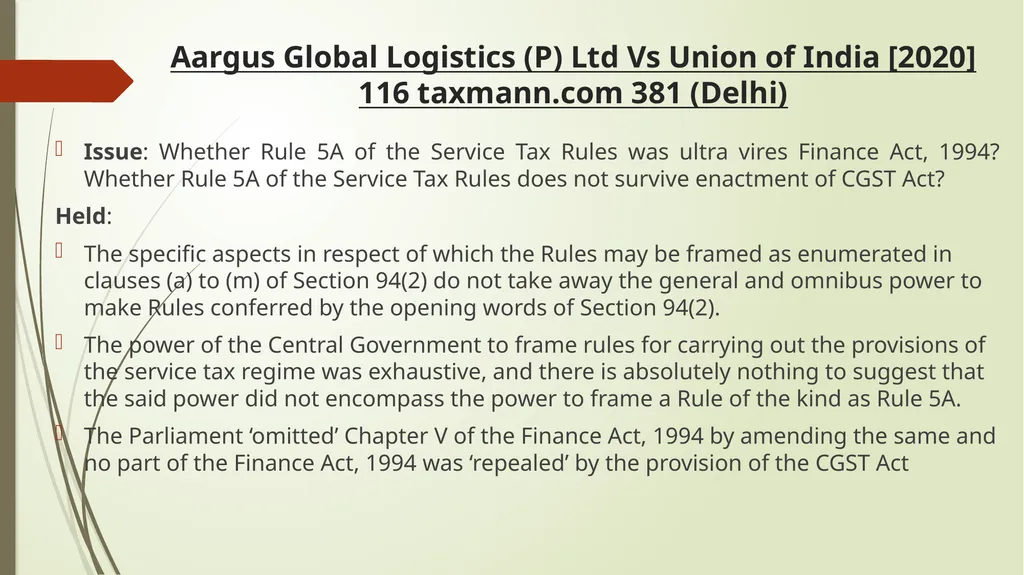
Aargus Global Logistics (P) Ltd Vs Union of India [2020] 116 taxmann.com 381 (Delhi) Issue: Whether Rule 5A of the Service Tax Rules was ultra vires Finance Act, 1994? Whether Rule 5A of the Service Tax Rules does not survive enactment of CGST Act?
Held:
The specific aspects in respect of which the Rules may be framed as enumerated in clauses (a) to (m) of Section 94(2) do not take away the general and omnibus power to make Rules conferred by the opening words of Section 94(2).
The power of the Central Government to frame rules for carrying out the provisions of the service tax regime was exhaustive, and there is absolutely nothing to suggest that the said power did not encompass the power to frame a Rule of the kind as Rule 5A.
The Parliament ‘omitted’ Chapter V of the Finance Act, 1994 by amending the same and no part of the Finance Act, 1994 was ‘repealed’ by the provision of the CGST Act<br>
Held:
The specific aspects in respect of which the Rules may be framed as enumerated in clauses (a) to (m) of Section 94(2) do not take away the general and omnibus power to make Rules conferred by the opening words of Section 94(2).
The power of the Central Government to frame rules for carrying out the provisions of the service tax regime was exhaustive, and there is absolutely nothing to suggest that the said power did not encompass the power to frame a Rule of the kind as Rule 5A.
The Parliament ‘omitted’ Chapter V of the Finance Act, 1994 by amending the same and no part of the Finance Act, 1994 was ‘repealed’ by the provision of the CGST Act<br>
28
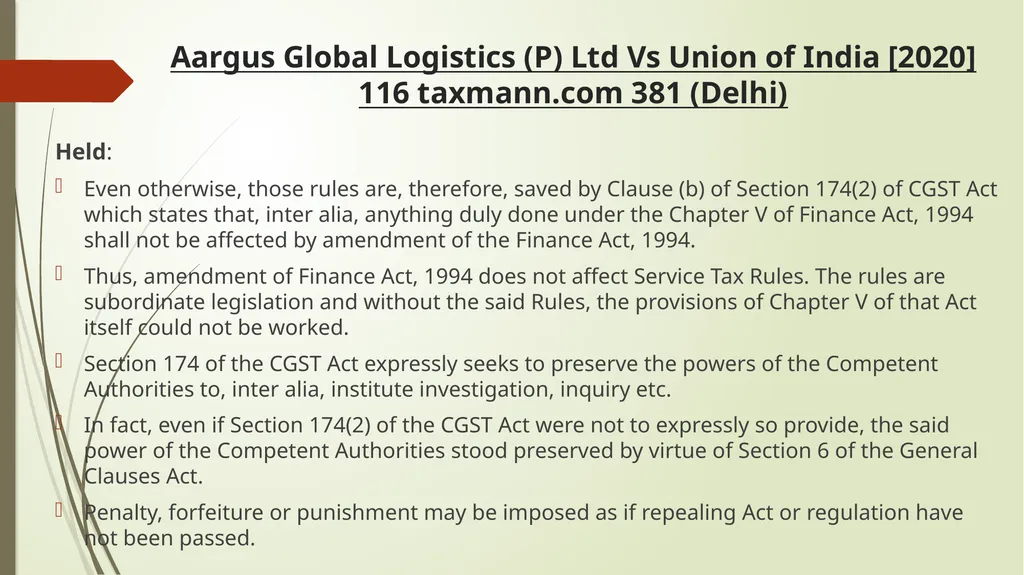
Aargus Global Logistics (P) Ltd Vs Union of India [2020] 116 taxmann.com 381 (Delhi) Held:
Even otherwise, those rules are, therefore, saved by Clause (b) of Section 174(2) of CGST Act which states that, inter alia, anything duly done under the Chapter V of Finance Act, 1994 shall not be affected by amendment of the Finance Act, 1994.
Thus, amendment of Finance Act, 1994 does not affect Service Tax Rules. The rules are subordinate legislation and without the said Rules, the provisions of Chapter V of that Act itself could not be worked.
Section 174 of the CGST Act expressly seeks to preserve the powers of the Competent Authorities to, inter alia, institute investigation, inquiry etc.
In fact, even if Section 174(2) of the CGST Act were not to expressly so provide, the said power of the Competent Authorities stood preserved by virtue of Section 6 of the General Clauses Act.
Penalty, forfeiture or punishment may be imposed as if repealing Act or regulation have not been passed.<br>
Even otherwise, those rules are, therefore, saved by Clause (b) of Section 174(2) of CGST Act which states that, inter alia, anything duly done under the Chapter V of Finance Act, 1994 shall not be affected by amendment of the Finance Act, 1994.
Thus, amendment of Finance Act, 1994 does not affect Service Tax Rules. The rules are subordinate legislation and without the said Rules, the provisions of Chapter V of that Act itself could not be worked.
Section 174 of the CGST Act expressly seeks to preserve the powers of the Competent Authorities to, inter alia, institute investigation, inquiry etc.
In fact, even if Section 174(2) of the CGST Act were not to expressly so provide, the said power of the Competent Authorities stood preserved by virtue of Section 6 of the General Clauses Act.
Penalty, forfeiture or punishment may be imposed as if repealing Act or regulation have not been passed.<br>
29
Whether service tax demand by issuing SCN under Finance Act, 1994 is valid after 1.7.2017 – S. 174 of CGST Act No service tax proceedings is valid consequent to 101st Amendment to Constitution dated 16.9.2016 as Article 246A overrides Article 246 & 248.
Section 173 of CGST Act omits the provisions of Finance Act, 1994 - Rayala Corporation (P) Ltd Vs. Directorate of Enforcement reported in 1969 (2) SCC 412
Section 174 itself is beyond the constitutional mandate – Since as per Section 19 of 101st Constitution Amendment, there is only power to repeal or amend that has been provided and no power to save such deletion or omission
Kerala High Court in Sheen Golden Jewels India 2019 (23) G.S.T.L. 4 (Ker.) held that Section 174 enacted by Kerala State Legislature relating to repeal and saving of provisions of Kerala Value Added Tax Act, 2003 not unconstitutional in view of amended Entry 54 of List II of Seventh Schedule to Constitution of India w.e.f. 16-9-2016 on the basis of finding that Section 19 of Constitution (One Hundred and First Amendment) Act, 2016 is transitional and not a saving clause though it may have been a repealing clause simplicitor - Job of saving is done by Section 174 of Kerala Goods and Services Tax Act, 2017.<br>
Section 173 of CGST Act omits the provisions of Finance Act, 1994 - Rayala Corporation (P) Ltd Vs. Directorate of Enforcement reported in 1969 (2) SCC 412
Section 174 itself is beyond the constitutional mandate – Since as per Section 19 of 101st Constitution Amendment, there is only power to repeal or amend that has been provided and no power to save such deletion or omission
Kerala High Court in Sheen Golden Jewels India 2019 (23) G.S.T.L. 4 (Ker.) held that Section 174 enacted by Kerala State Legislature relating to repeal and saving of provisions of Kerala Value Added Tax Act, 2003 not unconstitutional in view of amended Entry 54 of List II of Seventh Schedule to Constitution of India w.e.f. 16-9-2016 on the basis of finding that Section 19 of Constitution (One Hundred and First Amendment) Act, 2016 is transitional and not a saving clause though it may have been a repealing clause simplicitor - Job of saving is done by Section 174 of Kerala Goods and Services Tax Act, 2017.<br>
30
Lapsing of exemption- promissory estoppel<br>
31
UOI vs V.V.F. Ltd [2020] 2020-TIOL-83-SC-CX-LB Facts:
The Government of India vide Exemption Notification No. 39/2001-CE dt. 31.7.2001, had announced an incentive Scheme for setting up New Industries in certain areas. Pursuant to which exemption from payment of certain amount of duty of excise was granted. The incentives was given in the form of refund of duty paid on finished goods.
Later, aforesaid notification dated 31.07.2001 was amended vide notification no. 65/2003-CE and notification No. 16/2008-CE, which inter-alia, provided that the benefit of refund of excise duty would be granted with reference to the value addition, which was notionally fixed @34% for the commodity manufactured. The notification also provided for determination of a special rate by the Commissioner, in a situation where the actual value addition was more than the deemed value addition as specified.
The contention of the petitioner-assessee was that because of the said amendment, the inventive available to the assessee stood reduced from the refund of the entire of the duty paid in cash/PLA to 34% of the total duty paid. The said amendment resulted in reduction of refund from nearly 100% of the duty paid to only 34% of such duty amount.<br>
The Government of India vide Exemption Notification No. 39/2001-CE dt. 31.7.2001, had announced an incentive Scheme for setting up New Industries in certain areas. Pursuant to which exemption from payment of certain amount of duty of excise was granted. The incentives was given in the form of refund of duty paid on finished goods.
Later, aforesaid notification dated 31.07.2001 was amended vide notification no. 65/2003-CE and notification No. 16/2008-CE, which inter-alia, provided that the benefit of refund of excise duty would be granted with reference to the value addition, which was notionally fixed @34% for the commodity manufactured. The notification also provided for determination of a special rate by the Commissioner, in a situation where the actual value addition was more than the deemed value addition as specified.
The contention of the petitioner-assessee was that because of the said amendment, the inventive available to the assessee stood reduced from the refund of the entire of the duty paid in cash/PLA to 34% of the total duty paid. The said amendment resulted in reduction of refund from nearly 100% of the duty paid to only 34% of such duty amount.<br>
32
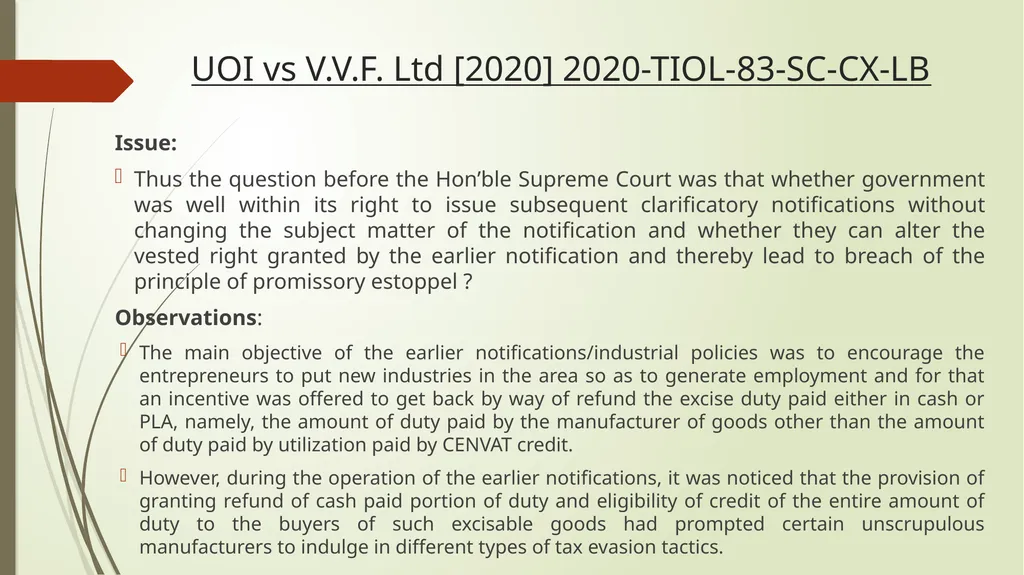
UOI vs V.V.F. Ltd [2020] 2020-TIOL-83-SC-CX-LB Issue:
Thus the question before the Hon’ble Supreme Court was that whether government was well within its right to issue subsequent clarificatory notifications without changing the subject matter of the notification and whether they can alter the vested right granted by the earlier notification and thereby lead to breach of the principle of promissory estoppel ?
Observations:
The main objective of the earlier notifications/industrial policies was to encourage the entrepreneurs to put new industries in the area so as to generate employment and for that an incentive was offered to get back by way of refund the excise duty paid either in cash or PLA, namely, the amount of duty paid by the manufacturer of goods other than the amount of duty paid by utilization paid by CENVAT credit.
However, during the operation of the earlier notifications, it was noticed that the provision of granting refund of cash paid portion of duty and eligibility of credit of the entire amount of duty to the buyers of such excisable goods had prompted certain unscrupulous manufacturers to indulge in different types of tax evasion tactics.<br>
Thus the question before the Hon’ble Supreme Court was that whether government was well within its right to issue subsequent clarificatory notifications without changing the subject matter of the notification and whether they can alter the vested right granted by the earlier notification and thereby lead to breach of the principle of promissory estoppel ?
Observations:
The main objective of the earlier notifications/industrial policies was to encourage the entrepreneurs to put new industries in the area so as to generate employment and for that an incentive was offered to get back by way of refund the excise duty paid either in cash or PLA, namely, the amount of duty paid by the manufacturer of goods other than the amount of duty paid by utilization paid by CENVAT credit.
However, during the operation of the earlier notifications, it was noticed that the provision of granting refund of cash paid portion of duty and eligibility of credit of the entire amount of duty to the buyers of such excisable goods had prompted certain unscrupulous manufacturers to indulge in different types of tax evasion tactics.<br>
33
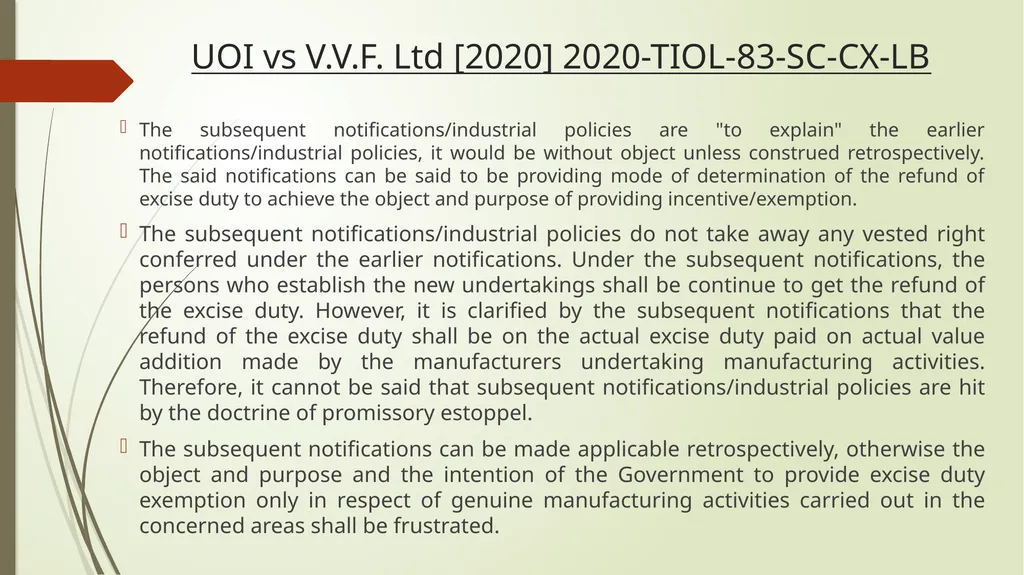
The subsequent notifications/industrial policies are "to explain" the earlier notifications/industrial policies, it would be without object unless construed retrospectively. The said notifications can be said to be providing mode of determination of the refund of excise duty to achieve the object and purpose of providing incentive/exemption.
The subsequent notifications/industrial policies do not take away any vested right conferred under the earlier notifications. Under the subsequent notifications, the persons who establish the new undertakings shall be continue to get the refund of the excise duty. However, it is clarified by the subsequent notifications that the refund of the excise duty shall be on the actual excise duty paid on actual value addition made by the manufacturers undertaking manufacturing activities. Therefore, it cannot be said that subsequent notifications/industrial policies are hit by the doctrine of promissory estoppel.
The subsequent notifications can be made applicable retrospectively, otherwise the object and purpose and the intention of the Government to provide excise duty exemption only in respect of genuine manufacturing activities carried out in the concerned areas shall be frustrated. UOI vs V.V.F. Ltd [2020] 2020-TIOL-83-SC-CX-LB<br>
The subsequent notifications/industrial policies do not take away any vested right conferred under the earlier notifications. Under the subsequent notifications, the persons who establish the new undertakings shall be continue to get the refund of the excise duty. However, it is clarified by the subsequent notifications that the refund of the excise duty shall be on the actual excise duty paid on actual value addition made by the manufacturers undertaking manufacturing activities. Therefore, it cannot be said that subsequent notifications/industrial policies are hit by the doctrine of promissory estoppel.
The subsequent notifications can be made applicable retrospectively, otherwise the object and purpose and the intention of the Government to provide excise duty exemption only in respect of genuine manufacturing activities carried out in the concerned areas shall be frustrated. UOI vs V.V.F. Ltd [2020] 2020-TIOL-83-SC-CX-LB<br>
34
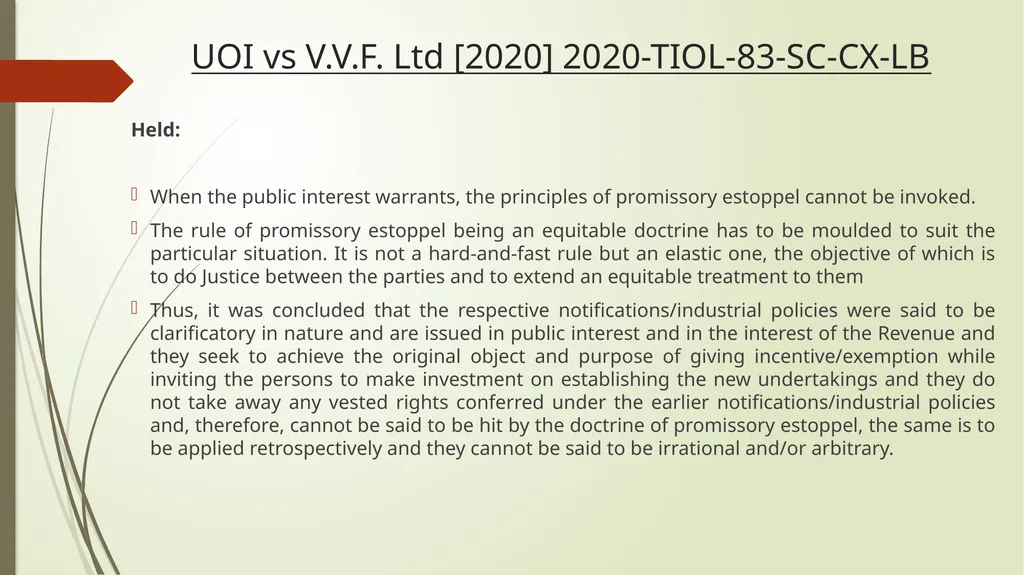
UOI vs V.V.F. Ltd [2020] 2020-TIOL-83-SC-CX-LB Held:
When the public interest warrants, the principles of promissory estoppel cannot be invoked.
The rule of promissory estoppel being an equitable doctrine has to be moulded to suit the particular situation. It is not a hard-and-fast rule but an elastic one, the objective of which is to do Justice between the parties and to extend an equitable treatment to them
Thus, it was concluded that the respective notifications/industrial policies were said to be clarificatory in nature and are issued in public interest and in the interest of the Revenue and they seek to achieve the original object and purpose of giving incentive/exemption while inviting the persons to make investment on establishing the new undertakings and they do not take away any vested rights conferred under the earlier notifications/industrial policies and, therefore, cannot be said to be hit by the doctrine of promissory estoppel, the same is to be applied retrospectively and they cannot be said to be irrational and/or arbitrary.<br>
When the public interest warrants, the principles of promissory estoppel cannot be invoked.
The rule of promissory estoppel being an equitable doctrine has to be moulded to suit the particular situation. It is not a hard-and-fast rule but an elastic one, the objective of which is to do Justice between the parties and to extend an equitable treatment to them
Thus, it was concluded that the respective notifications/industrial policies were said to be clarificatory in nature and are issued in public interest and in the interest of the Revenue and they seek to achieve the original object and purpose of giving incentive/exemption while inviting the persons to make investment on establishing the new undertakings and they do not take away any vested rights conferred under the earlier notifications/industrial policies and, therefore, cannot be said to be hit by the doctrine of promissory estoppel, the same is to be applied retrospectively and they cannot be said to be irrational and/or arbitrary.<br>
35
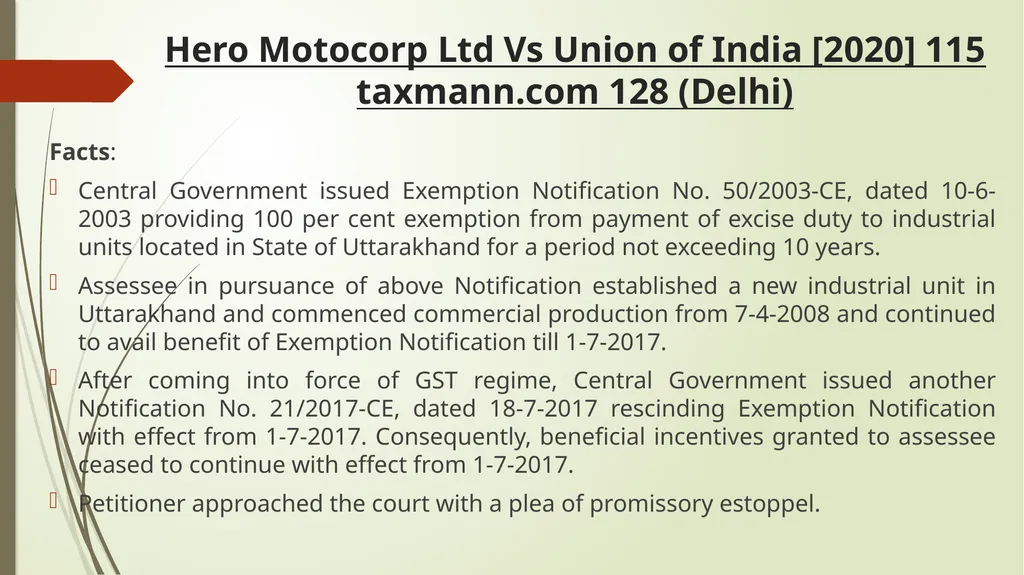
Hero Motocorp Ltd Vs Union of India [2020] 115 taxmann.com 128 (Delhi) Facts:
Central Government issued Exemption Notification No. 50/2003-CE, dated 10-6-2003 providing 100 per cent exemption from payment of excise duty to industrial units located in State of Uttarakhand for a period not exceeding 10 years.
Assessee in pursuance of above Notification established a new industrial unit in Uttarakhand and commenced commercial production from 7-4-2008 and continued to avail benefit of Exemption Notification till 1-7-2017.
After coming into force of GST regime, Central Government issued another Notification No. 21/2017-CE, dated 18-7-2017 rescinding Exemption Notification with effect from 1-7-2017. Consequently, beneficial incentives granted to assessee ceased to continue with effect from 1-7-2017.
Petitioner approached the court with a plea of promissory estoppel.<br>
Central Government issued Exemption Notification No. 50/2003-CE, dated 10-6-2003 providing 100 per cent exemption from payment of excise duty to industrial units located in State of Uttarakhand for a period not exceeding 10 years.
Assessee in pursuance of above Notification established a new industrial unit in Uttarakhand and commenced commercial production from 7-4-2008 and continued to avail benefit of Exemption Notification till 1-7-2017.
After coming into force of GST regime, Central Government issued another Notification No. 21/2017-CE, dated 18-7-2017 rescinding Exemption Notification with effect from 1-7-2017. Consequently, beneficial incentives granted to assessee ceased to continue with effect from 1-7-2017.
Petitioner approached the court with a plea of promissory estoppel.<br>
36
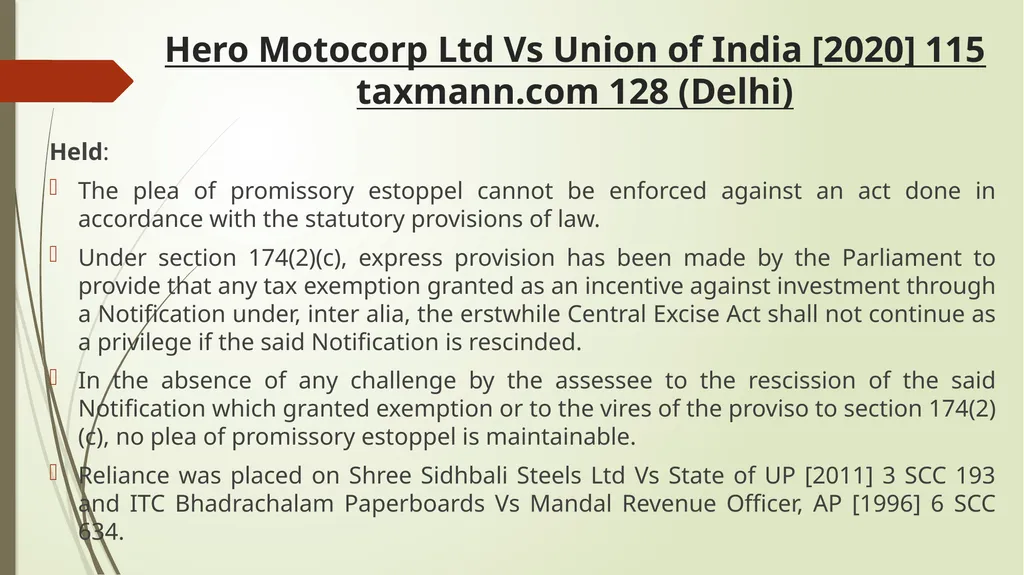
Hero Motocorp Ltd Vs Union of India [2020] 115 taxmann.com 128 (Delhi) Held:
The plea of promissory estoppel cannot be enforced against an act done in accordance with the statutory provisions of law.
Under section 174(2)(c), express provision has been made by the Parliament to provide that any tax exemption granted as an incentive against investment through a Notification under, inter alia, the erstwhile Central Excise Act shall not continue as a privilege if the said Notification is rescinded.
In the absence of any challenge by the assessee to the rescission of the said Notification which granted exemption or to the vires of the proviso to section 174(2)(c), no plea of promissory estoppel is maintainable.
Reliance was placed on Shree Sidhbali Steels Ltd Vs State of UP [2011] 3 SCC 193 and ITC Bhadrachalam Paperboards Vs Mandal Revenue Officer, AP [1996] 6 SCC 634.<br>
The plea of promissory estoppel cannot be enforced against an act done in accordance with the statutory provisions of law.
Under section 174(2)(c), express provision has been made by the Parliament to provide that any tax exemption granted as an incentive against investment through a Notification under, inter alia, the erstwhile Central Excise Act shall not continue as a privilege if the said Notification is rescinded.
In the absence of any challenge by the assessee to the rescission of the said Notification which granted exemption or to the vires of the proviso to section 174(2)(c), no plea of promissory estoppel is maintainable.
Reliance was placed on Shree Sidhbali Steels Ltd Vs State of UP [2011] 3 SCC 193 and ITC Bhadrachalam Paperboards Vs Mandal Revenue Officer, AP [1996] 6 SCC 634.<br>
37
Works Contracts Services<br>
38
MIOT Hospitals Ltd. Vs State of Tamil Nadu [2020] 117 taxmann.com 46 (Madras) Issue:
Whether in the course of provision of medical services, the hospitals are liable to pay Value Added Tax (VAT) under the provisions of the Tamil Nadu Value Added Tax Act, 2006 on the stents, valves, medicines, x-ray and other goods used while treating their in house patients?
Facts:
The assessee running hospitals and are providing Medical/Health services to their
inpatients. In the course of provision of such services, they have implanted implants such as Ortho Implants, Plates, Stents, Valves, Pace Makers, intraaortic balloon pump etc, (collectively referred to as Prosthetics) in the body of the patients for treatment by surgery and provided such other ancillary services such as MRI Scan Films, X-Ray Films and others.<br>
Whether in the course of provision of medical services, the hospitals are liable to pay Value Added Tax (VAT) under the provisions of the Tamil Nadu Value Added Tax Act, 2006 on the stents, valves, medicines, x-ray and other goods used while treating their in house patients?
Facts:
The assessee running hospitals and are providing Medical/Health services to their
inpatients. In the course of provision of such services, they have implanted implants such as Ortho Implants, Plates, Stents, Valves, Pace Makers, intraaortic balloon pump etc, (collectively referred to as Prosthetics) in the body of the patients for treatment by surgery and provided such other ancillary services such as MRI Scan Films, X-Ray Films and others.<br>
39
Facts:
This has been proposed to be taxed as “works contract” by the department within a meaning of Section 2(43) of the TNVAT Act, 2006 to propose tax from the petitioner.
Contentions:
The department contention was that the implanted prosthetics in the body of the patients for treatment by surgery is a “sale” within the extended meaning of the definition of “sale” under Section 2(33) read with 2(43) of the TNVAT Act, 2006 and Article 366, 29(A) clause (b) of the Constitution of India.
The assessee by referring to the decision of the Hon’ble Supreme Court in case of BSNL Vs UOI (2006) 3 SCC 1 in para 44,it was observed that there was not sale of papers for the Sales Tax Authorities to tax the transaction as that of sale when the doctors write prescription to their clients or patients and in this case it was contented that the Medical/Health Service is not recognized as a sale or purchase under Art 366 (29A) of the Constitution of India. MIOT Hospitals Ltd. Vs State of Tamil Nadu [2020] 117 taxmann.com 46 (Madras)<br>
This has been proposed to be taxed as “works contract” by the department within a meaning of Section 2(43) of the TNVAT Act, 2006 to propose tax from the petitioner.
Contentions:
The department contention was that the implanted prosthetics in the body of the patients for treatment by surgery is a “sale” within the extended meaning of the definition of “sale” under Section 2(33) read with 2(43) of the TNVAT Act, 2006 and Article 366, 29(A) clause (b) of the Constitution of India.
The assessee by referring to the decision of the Hon’ble Supreme Court in case of BSNL Vs UOI (2006) 3 SCC 1 in para 44,it was observed that there was not sale of papers for the Sales Tax Authorities to tax the transaction as that of sale when the doctors write prescription to their clients or patients and in this case it was contented that the Medical/Health Service is not recognized as a sale or purchase under Art 366 (29A) of the Constitution of India. MIOT Hospitals Ltd. Vs State of Tamil Nadu [2020] 117 taxmann.com 46 (Madras)<br>
40
MIOT Hospitals Ltd. Vs State of Tamil Nadu [2020] 117 taxmann.com 46 (Madras) Contentions:
It was submitted that a living human body even if infected or is challenged is not a “property” and therefore it would be absurd to even hazard a thought that there could be a “works contract” on the body of a living human being.
Held:
The expression “works contract” cannot be given a restricted meaning merely because “works contract” as a concept was originally confined to contracts relating to immoveable properties alone as was noted in the definition of “works contract”.
The decision of the BSNL vs UOI was distinguished on the ground that the Hon’ble Supreme Court laid down the test as to what constitute a “transfer of right to use” for the purpose of Article 366(29A)(d) of the Constitution, which is another specie of sale and different from “works contract.<br>
It was submitted that a living human body even if infected or is challenged is not a “property” and therefore it would be absurd to even hazard a thought that there could be a “works contract” on the body of a living human being.
Held:
The expression “works contract” cannot be given a restricted meaning merely because “works contract” as a concept was originally confined to contracts relating to immoveable properties alone as was noted in the definition of “works contract”.
The decision of the BSNL vs UOI was distinguished on the ground that the Hon’ble Supreme Court laid down the test as to what constitute a “transfer of right to use” for the purpose of Article 366(29A)(d) of the Constitution, which is another specie of sale and different from “works contract.<br>
41
MIOT Hospitals Ltd. Vs State of Tamil Nadu [2020] 117 taxmann.com 46 (Madras) There is not only transfer of possession of prosthetics into the physiology of the patient but also the ownership of such prosthetics to the patient for consideration in the course of the provision of medical/health service.
Similarly, in the course of taking x-ray, scan, MRI/CT Scan for such in-patient, cost of which get included into the package are taxable as such activity can be termed as the processing of moveable property.<br>
Similarly, in the course of taking x-ray, scan, MRI/CT Scan for such in-patient, cost of which get included into the package are taxable as such activity can be termed as the processing of moveable property.<br>
42
Transitional issues under GST
TRAN-1 Issues<br>
43
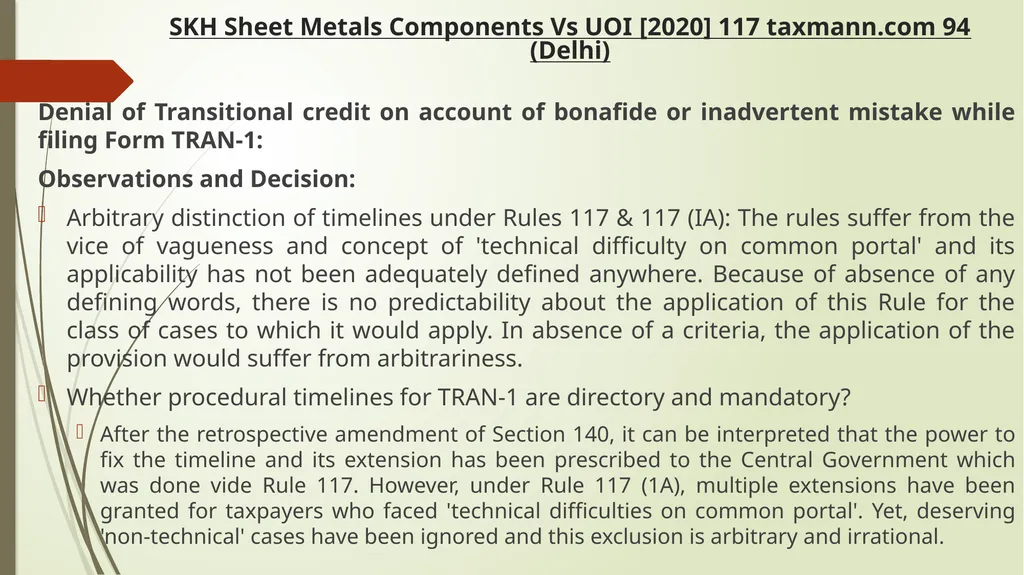
Brand Equity Treaties Ltd Vs Union of India [2020] 116 taxmann.com 415 (Delhi). This decision has been appealed to Supreme Court as reported in UOI vs Brand Equity Treaties Ltd [2020] 117 taxmann.com 225 (SC).
Held:
Time-limit for filing TRAN-1 form for transition of Cenvat credit from pre-GST laws to GST as provided in Rule 117 is directory and the time-limit will be three years as per Limitation Act.
TRAN-1 form can be filed by 30th June, 2020, i.e, three years from 1st July, 2017 would be the maximum period for availing credit.
Also Observed:
Several taxpayers could not meet the deadline due to several factors and the predominant factor was inadequacies in the GST portal.
In certain cases, not vigilant of the timelines or have been victims of confusion prevalent when GST was introduced. Petitioners may not have concrete evidence to show that they had faced technical issue in the GST portal while uploading TRAN-1 form.<br>
Held:
Time-limit for filing TRAN-1 form for transition of Cenvat credit from pre-GST laws to GST as provided in Rule 117 is directory and the time-limit will be three years as per Limitation Act.
TRAN-1 form can be filed by 30th June, 2020, i.e, three years from 1st July, 2017 would be the maximum period for availing credit.
Also Observed:
Several taxpayers could not meet the deadline due to several factors and the predominant factor was inadequacies in the GST portal.
In certain cases, not vigilant of the timelines or have been victims of confusion prevalent when GST was introduced. Petitioners may not have concrete evidence to show that they had faced technical issue in the GST portal while uploading TRAN-1 form.<br>
44
Brand Equity Treaties Ltd Vs Union of India [2020] 116 taxmann.com 415 (Delhi) Also Observed:
Credit stood accumulated, acquired and vested on the date of introduction of GST as it was reflected in Cenvat credit register in the previous regime. It is a constitutional right under Article 300A of the Constitution and the same cannot be taken away merely by rules without provision in the CGST Act.
On enactment of GST, no mechanism of refund of such credit was provided but the only method was utilization of credit by migrating it to GST regime by filing TRAN-1 form.
Time-limit provided in Rule 117 was not sacrosanct and the CGST Act does not restrict completely, transition of Cenvat credit to GST regime.
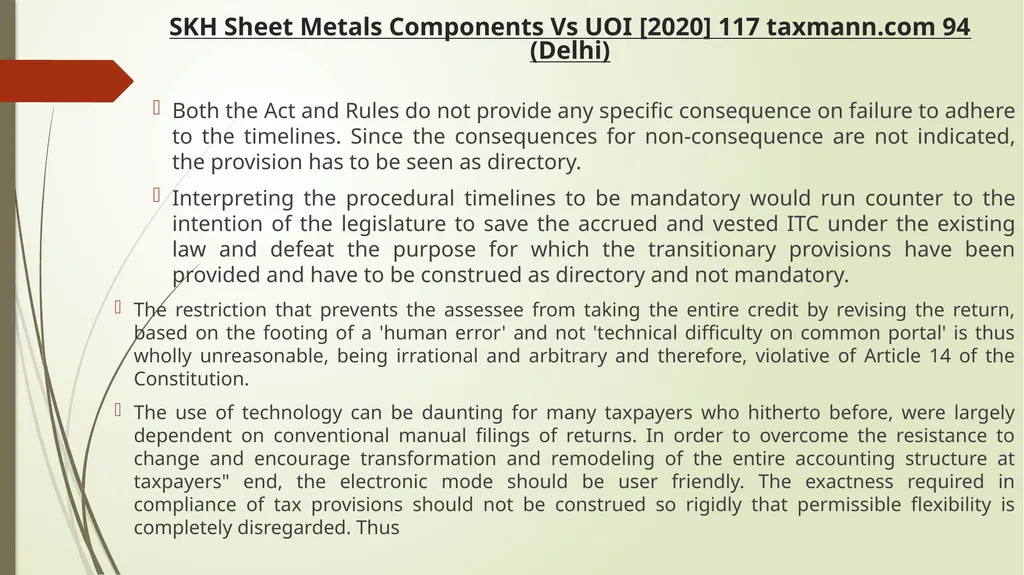
Restricting the benefit of extended time-limit to only those covered by "technical difficulties on common portal" as an arbitrary classification. Expecting taxpayers to be fully prepared for the new system on day one when the department was ill-prepared was not fair.
To be Noted:
Amendments made by Finance Act, 2020 to Section 140(1) of CGST Act, the words "within such time and" were inserted after the words "existing law" with retrospective effect from 1 July, 2017. This amendment was also notified vide Notification No. 43/2020-CT dated 16.05.2020.
May have the effect of overruling the judgment.<br>
Credit stood accumulated, acquired and vested on the date of introduction of GST as it was reflected in Cenvat credit register in the previous regime. It is a constitutional right under Article 300A of the Constitution and the same cannot be taken away merely by rules without provision in the CGST Act.
On enactment of GST, no mechanism of refund of such credit was provided but the only method was utilization of credit by migrating it to GST regime by filing TRAN-1 form.
Time-limit provided in Rule 117 was not sacrosanct and the CGST Act does not restrict completely, transition of Cenvat credit to GST regime.
Restricting the benefit of extended time-limit to only those covered by "technical difficulties on common portal" as an arbitrary classification. Expecting taxpayers to be fully prepared for the new system on day one when the department was ill-prepared was not fair.
To be Noted:
Amendments made by Finance Act, 2020 to Section 140(1) of CGST Act, the words "within such time and" were inserted after the words "existing law" with retrospective effect from 1 July, 2017. This amendment was also notified vide Notification No. 43/2020-CT dated 16.05.2020.
May have the effect of overruling the judgment.<br>
45
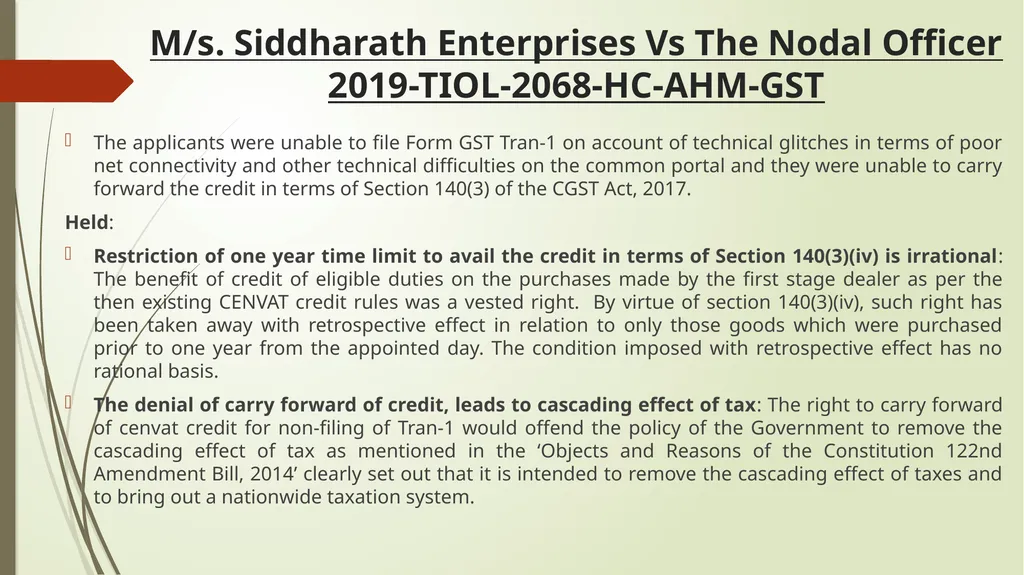
M/s. Siddharath Enterprises Vs The Nodal Officer 2019-TIOL-2068-HC-AHM-GST The applicants were unable to file Form GST Tran-1 on account of technical glitches in terms of poor net connectivity and other technical difficulties on the common portal and they were unable to carry forward the credit in terms of Section 140(3) of the CGST Act, 2017.
Held:
Restriction of one year time limit to avail the credit in terms of Section 140(3)(iv) is irrational: The benefit of credit of eligible duties on the purchases made by the first stage dealer as per the then existing CENVAT credit rules was a vested right. By virtue of section 140(3)(iv), such right has been taken away with retrospective effect in relation to only those goods which were purchased prior to one year from the appointed day. The condition imposed with retrospective effect has no rational basis.
The denial of carry forward of credit, leads to cascading effect of tax: The right to carry forward of cenvat credit for non-filing of Tran-1 would offend the policy of the Government to remove the cascading effect of tax as mentioned in the ‘Objects and Reasons of the Constitution 122nd Amendment Bill, 2014’ clearly set out that it is intended to remove the cascading effect of taxes and to bring out a nationwide taxation system.<br>
Held:
Restriction of one year time limit to avail the credit in terms of Section 140(3)(iv) is irrational: The benefit of credit of eligible duties on the purchases made by the first stage dealer as per the then existing CENVAT credit rules was a vested right. By virtue of section 140(3)(iv), such right has been taken away with retrospective effect in relation to only those goods which were purchased prior to one year from the appointed day. The condition imposed with retrospective effect has no rational basis.
The denial of carry forward of credit, leads to cascading effect of tax: The right to carry forward of cenvat credit for non-filing of Tran-1 would offend the policy of the Government to remove the cascading effect of tax as mentioned in the ‘Objects and Reasons of the Constitution 122nd Amendment Bill, 2014’ clearly set out that it is intended to remove the cascading effect of taxes and to bring out a nationwide taxation system.<br>
46
M/s. Siddharath Enterprises Vs The Nodal Officer 2019-TIOL-2068-HC-AHM-GST (Cont.) Held:
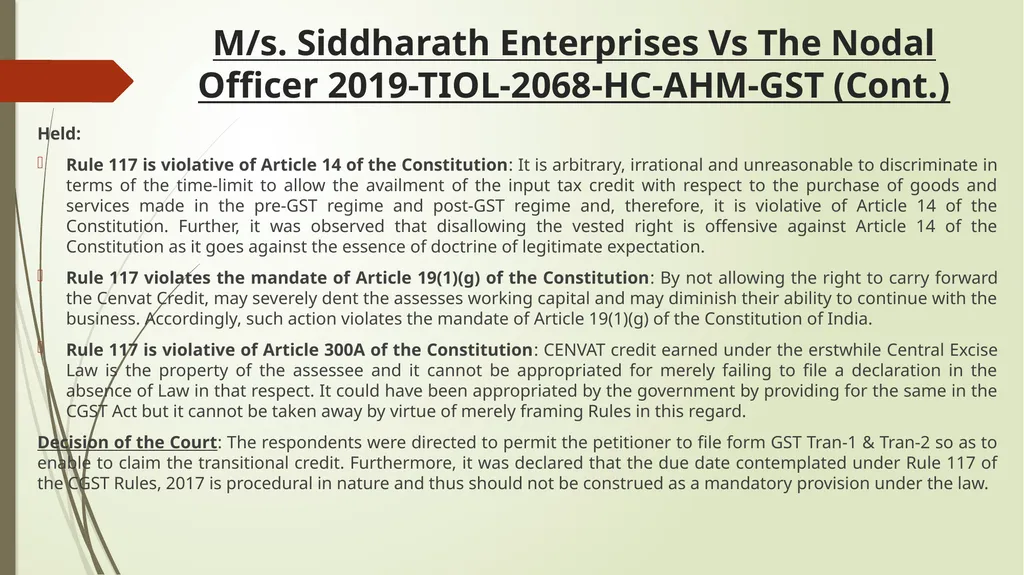
Rule 117 is violative of Article 14 of the Constitution: It is arbitrary, irrational and unreasonable to discriminate in terms of the time-limit to allow the availment of the input tax credit with respect to the purchase of goods and services made in the pre-GST regime and post-GST regime and, therefore, it is violative of Article 14 of the Constitution. Further, it was observed that disallowing the vested right is offensive against Article 14 of the Constitution as it goes against the essence of doctrine of legitimate expectation.
Rule 117 violates the mandate of Article 19(1)(g) of the Constitution: By not allowing the right to carry forward the Cenvat Credit, may severely dent the assesses working capital and may diminish their ability to continue with the business. Accordingly, such action violates the mandate of Article 19(1)(g) of the Constitution of India.
Rule 117 is violative of Article 300A of the Constitution: CENVAT credit earned under the erstwhile Central Excise Law is the property of the assessee and it cannot be appropriated for merely failing to file a declaration in the absence of Law in that respect. It could have been appropriated by the government by providing for the same in the CGST Act but it cannot be taken away by virtue of merely framing Rules in this regard.
Decision of the Court: The respondents were directed to permit the petitioner to file form GST Tran-1 & Tran-2 so as to enable to claim the transitional credit. Furthermore, it was declared that the due date contemplated under Rule 117 of the CGST Rules, 2017 is procedural in nature and thus should not be construed as a mandatory provision under the law.<br>
Rule 117 is violative of Article 14 of the Constitution: It is arbitrary, irrational and unreasonable to discriminate in terms of the time-limit to allow the availment of the input tax credit with respect to the purchase of goods and services made in the pre-GST regime and post-GST regime and, therefore, it is violative of Article 14 of the Constitution. Further, it was observed that disallowing the vested right is offensive against Article 14 of the Constitution as it goes against the essence of doctrine of legitimate expectation.
Rule 117 violates the mandate of Article 19(1)(g) of the Constitution: By not allowing the right to carry forward the Cenvat Credit, may severely dent the assesses working capital and may diminish their ability to continue with the business. Accordingly, such action violates the mandate of Article 19(1)(g) of the Constitution of India.
Rule 117 is violative of Article 300A of the Constitution: CENVAT credit earned under the erstwhile Central Excise Law is the property of the assessee and it cannot be appropriated for merely failing to file a declaration in the absence of Law in that respect. It could have been appropriated by the government by providing for the same in the CGST Act but it cannot be taken away by virtue of merely framing Rules in this regard.
Decision of the Court: The respondents were directed to permit the petitioner to file form GST Tran-1 & Tran-2 so as to enable to claim the transitional credit. Furthermore, it was declared that the due date contemplated under Rule 117 of the CGST Rules, 2017 is procedural in nature and thus should not be construed as a mandatory provision under the law.<br>
47
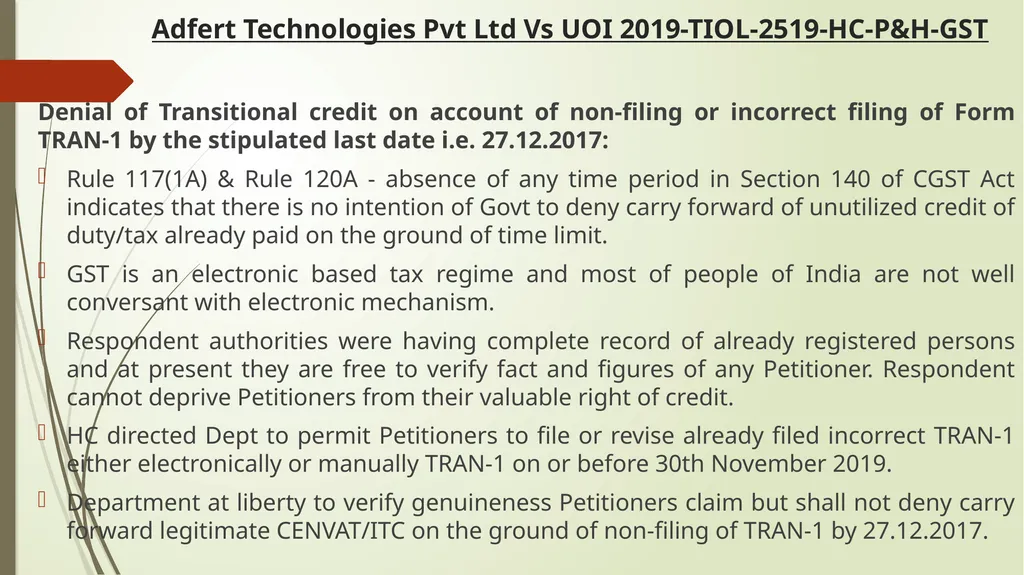
Adfert Technologies Pvt Ltd Vs UOI 2019-TIOL-2519-HC-P&H-GST Denial of Transitional credit on account of non-filing or incorrect filing of Form TRAN-1 by the stipulated last date i.e. 27.12.2017:
Rule 117(1A) & Rule 120A - absence of any time period in Section 140 of CGST Act indicates that there is no intention of Govt to deny carry forward of unutilized credit of duty/tax already paid on the ground of time limit.
GST is an electronic based tax regime and most of people of India are not well conversant with electronic mechanism.
Respondent authorities were having complete record of already registered persons and at present they are free to verify fact and figures of any Petitioner. Respondent cannot deprive Petitioners from their valuable right of credit.
HC directed Dept to permit Petitioners to file or revise already filed incorrect TRAN-1 either electronically or manually TRAN-1 on or before 30th November 2019.
Department at liberty to verify genuineness Petitioners claim but shall not deny carry forward legitimate CENVAT/ITC on the ground of non-filing of TRAN-1 by 27.12.2017.<br>
Rule 117(1A) & Rule 120A - absence of any time period in Section 140 of CGST Act indicates that there is no intention of Govt to deny carry forward of unutilized credit of duty/tax already paid on the ground of time limit.
GST is an electronic based tax regime and most of people of India are not well conversant with electronic mechanism.
Respondent authorities were having complete record of already registered persons and at present they are free to verify fact and figures of any Petitioner. Respondent cannot deprive Petitioners from their valuable right of credit.
HC directed Dept to permit Petitioners to file or revise already filed incorrect TRAN-1 either electronically or manually TRAN-1 on or before 30th November 2019.
Department at liberty to verify genuineness Petitioners claim but shall not deny carry forward legitimate CENVAT/ITC on the ground of non-filing of TRAN-1 by 27.12.2017.<br>
48
SKH Sheet Metals Components Vs UOI [2020] 117 taxmann.com 94 (Delhi) Denial of Transitional credit on account of bonafide or inadvertent mistake while filing Form TRAN-1:
Observations and Decision:
Arbitrary distinction of timelines under Rules 117 & 117 (IA): The rules suffer from the vice of vagueness and concept of 'technical difficulty on common portal' and its applicability has not been adequately defined anywhere. Because of absence of any defining words, there is no predictability about the application of this Rule for the class of cases to which it would apply. In absence of a criteria, the application of the provision would suffer from arbitrariness.
Whether procedural timelines for TRAN-1 are directory and mandatory?
After the retrospective amendment of Section 140, it can be interpreted that the power to fix the timeline and its extension has been prescribed to the Central Government which was done vide Rule 117. However, under Rule 117 (1A), multiple extensions have been granted for taxpayers who faced 'technical difficulties on common portal'. Yet, deserving 'non-technical' cases have been ignored and this exclusion is arbitrary and irrational.<br>
Observations and Decision:
Arbitrary distinction of timelines under Rules 117 & 117 (IA): The rules suffer from the vice of vagueness and concept of 'technical difficulty on common portal' and its applicability has not been adequately defined anywhere. Because of absence of any defining words, there is no predictability about the application of this Rule for the class of cases to which it would apply. In absence of a criteria, the application of the provision would suffer from arbitrariness.
Whether procedural timelines for TRAN-1 are directory and mandatory?
After the retrospective amendment of Section 140, it can be interpreted that the power to fix the timeline and its extension has been prescribed to the Central Government which was done vide Rule 117. However, under Rule 117 (1A), multiple extensions have been granted for taxpayers who faced 'technical difficulties on common portal'. Yet, deserving 'non-technical' cases have been ignored and this exclusion is arbitrary and irrational.<br>
49
SKH Sheet Metals Components Vs UOI [2020] 117 taxmann.com 94 (Delhi) Both the Act and Rules do not provide any specific consequence on failure to adhere to the timelines. Since the consequences for non-consequence are not indicated, the provision has to be seen as directory.
Interpreting the procedural timelines to be mandatory would run counter to the intention of the legislature to save the accrued and vested ITC under the existing law and defeat the purpose for which the transitionary provisions have been provided and have to be construed as directory and not mandatory.
The restriction that prevents the assessee from taking the entire credit by revising the return, based on the footing of a 'human error' and not 'technical difficulty on common portal' is thus wholly unreasonable, being irrational and arbitrary and therefore, violative of Article 14 of the Constitution.
The use of technology can be daunting for many taxpayers who hitherto before, were largely dependent on conventional manual filings of returns. In order to overcome the resistance to change and encourage transformation and remodeling of the entire accounting structure at taxpayers" end, the electronic mode should be user friendly. The exactness required in compliance of tax provisions should not be construed so rigidly that permissible flexibility is completely disregarded. Thus<br>
Interpreting the procedural timelines to be mandatory would run counter to the intention of the legislature to save the accrued and vested ITC under the existing law and defeat the purpose for which the transitionary provisions have been provided and have to be construed as directory and not mandatory.
The restriction that prevents the assessee from taking the entire credit by revising the return, based on the footing of a 'human error' and not 'technical difficulty on common portal' is thus wholly unreasonable, being irrational and arbitrary and therefore, violative of Article 14 of the Constitution.
The use of technology can be daunting for many taxpayers who hitherto before, were largely dependent on conventional manual filings of returns. In order to overcome the resistance to change and encourage transformation and remodeling of the entire accounting structure at taxpayers" end, the electronic mode should be user friendly. The exactness required in compliance of tax provisions should not be construed so rigidly that permissible flexibility is completely disregarded. Thus<br>
50
Transitional issues under GST
carry forwarding credit of cess<br>
51
Sutherland Global Services Pvt Ltd Vs AC GST & CE 2019-TIOL-2516-HC-MAD-GST Question: Whether accumulated credit pertaining to E-Cess, SHE-Cess and KK-Cess could be carried forward to GST regime u/s 140(1) CGST Act?
Held:
Such credit continues to be available till such time it is expressly stated to have lapsed. In the present case, there is no notification/circular/instruction that has expressly provided that the credit accumulated would lapse.
CBEC circular dated 07.12.2015 reveal a policy decision not to allow utilization of accumulated credit of E-Cess and SHE-Cess but nowhere states that the credit has lapsed.
Accumulated credit cannot be said to have been wiped out unless there is a specific order under which it lapses.
After 2018 amendment to CGST Act, only cenvat credit of “eligible duties” were allowed to be carried forward u/s 140(1). Whereas, “eligible duties” was defined in the explanation to Section 140. Even if E-Cess and SHE-Cess could not be carried forward u/s 140(1), it can still be carried forward u/s 140(8) which was untouched by the amendment.<br>
Held:
Such credit continues to be available till such time it is expressly stated to have lapsed. In the present case, there is no notification/circular/instruction that has expressly provided that the credit accumulated would lapse.
CBEC circular dated 07.12.2015 reveal a policy decision not to allow utilization of accumulated credit of E-Cess and SHE-Cess but nowhere states that the credit has lapsed.
Accumulated credit cannot be said to have been wiped out unless there is a specific order under which it lapses.
After 2018 amendment to CGST Act, only cenvat credit of “eligible duties” were allowed to be carried forward u/s 140(1). Whereas, “eligible duties” was defined in the explanation to Section 140. Even if E-Cess and SHE-Cess could not be carried forward u/s 140(1), it can still be carried forward u/s 140(8) which was untouched by the amendment.<br>
52
Transitional issues under GST
credit on stocks beyond 1 year<br>
53
Filco Trade Centre Pvt. Ltd. Vs. UOI- 2018(17) GSTL 3 (Guj) Issues involved: Challenge to vires of the condition as Cl.(iv) of S.140(3) prescribing the validity period of ‘12 months’ for the invoices for input in stock/WIP to claim ITC in terms of S. 140(3) of the CGST Act.
Gujarat High Court held that the no such restriction existed in prior regime and the said condition does impose burden with retrospective effect without any justification. Hence, the condition in Clause (iv) of Section 140(3) of Central Goods and Services Tax Act, 2017 is held to be unconstitutional and to be struck down.
Note: Department has filed an appeal before Supreme Court, wherein notice has been issued and Stay granted - 2019 (21) GSTL J120 (Supreme Court).
However, Bombay High Court in JCB India Ltd. Vs. UOI- 2018(15) GSTL 145(Bom.) held that condition in in Clause (iv) of Section 140(3) of CGST Act is constitutionally valid.<br>
Gujarat High Court held that the no such restriction existed in prior regime and the said condition does impose burden with retrospective effect without any justification. Hence, the condition in Clause (iv) of Section 140(3) of Central Goods and Services Tax Act, 2017 is held to be unconstitutional and to be struck down.
Note: Department has filed an appeal before Supreme Court, wherein notice has been issued and Stay granted - 2019 (21) GSTL J120 (Supreme Court).
However, Bombay High Court in JCB India Ltd. Vs. UOI- 2018(15) GSTL 145(Bom.) held that condition in in Clause (iv) of Section 140(3) of CGST Act is constitutionally valid.<br>
54
Transitional issues under GST
credit on capital goods in transit<br>
55
RSPL Ltd Vs UOI 2018-TIOL-946-HC-AHM-GST Issues involved: Admissibility of Credit on the capital goods in transit as on 01.07.2017 under S. 140(5) of the CGST Act.
Gujarat High Court held that this demarcation between capital goods and inputs was not artificial, arbitrary or discriminatory, and there was no violation of Article 14 or Article 19(1)(g) of Constitution of India.
High Court noted that capital goods and inputs used in manufacturing process have always been treated differently by earlier statutes - Since inputs and capital goods form distinct and different classes, the question of sub-classification or artificial demarcation would not arise.<br>
Gujarat High Court held that this demarcation between capital goods and inputs was not artificial, arbitrary or discriminatory, and there was no violation of Article 14 or Article 19(1)(g) of Constitution of India.
High Court noted that capital goods and inputs used in manufacturing process have always been treated differently by earlier statutes - Since inputs and capital goods form distinct and different classes, the question of sub-classification or artificial demarcation would not arise.<br>
56
GST Returns<br>
57
Bharti Airtel Ltd Vs Union of India [2020] 116 taxmann.com 416 (Delhi) Issue: Constitutional validity of CBIC Circular No. 26/26/2017-GST dated 29.12.2017 which prevents correcting its monthly GST returns, and consequently seeking refund of excess of taxes paid. It only allowed adjustments to be made while filing returns in a subsequent month in which error was noticed.
Held:
Impugned circular had restricted mechanism of rectification of GST returns to same tax period, in which they were noticed and sought to be rectified.
There is no cogent reasoning behind logic for restricting rectification only in period in which error is noticed and corrected, and not in period to which it relates.
The constraint introduced by impugned circular, is arbitrary and contrary to provisions of CGST Act. There is no provision in the Act which would restrict such rectification. Restriction, if any, that can be introduced by way of a Circular has to be in conformity with the scheme of the Act and the provisions contained therein.<br>
Held:
Impugned circular had restricted mechanism of rectification of GST returns to same tax period, in which they were noticed and sought to be rectified.
There is no cogent reasoning behind logic for restricting rectification only in period in which error is noticed and corrected, and not in period to which it relates.
The constraint introduced by impugned circular, is arbitrary and contrary to provisions of CGST Act. There is no provision in the Act which would restrict such rectification. Restriction, if any, that can be introduced by way of a Circular has to be in conformity with the scheme of the Act and the provisions contained therein.<br>
58
Bharti Airtel Ltd Vs Union of India [2020] 116 taxmann.com 416 (Delhi) Held:
Since the respondents could not operationalize the statutory forms envisaged under the Act resulting in depriving the petitioner to accurately reconcile its input tax credit, the respondent cannot today deprive the petitioner of the benefits that would have accrued in favour of the petitioner if, such forms would have been enforced. Petitioners cannot be denied the benefit due to the fault of the respondents.
Refund of excess cash balance in terms of s.49(6) r/w s.54 does not effectively redress petitioner's grievance. The only remedy that can enable the petitioner to enjoy the benefit of seamless utilization of the input tax credit is by way of rectification of its return GSTR-3B.
Correction mechanism is critical to sustaining successful implementation of GST.
Consequently, petitioner is permitted to rectify Form GSTR-3B for period to which error relates.<br>
Since the respondents could not operationalize the statutory forms envisaged under the Act resulting in depriving the petitioner to accurately reconcile its input tax credit, the respondent cannot today deprive the petitioner of the benefits that would have accrued in favour of the petitioner if, such forms would have been enforced. Petitioners cannot be denied the benefit due to the fault of the respondents.
Refund of excess cash balance in terms of s.49(6) r/w s.54 does not effectively redress petitioner's grievance. The only remedy that can enable the petitioner to enjoy the benefit of seamless utilization of the input tax credit is by way of rectification of its return GSTR-3B.
Correction mechanism is critical to sustaining successful implementation of GST.
Consequently, petitioner is permitted to rectify Form GSTR-3B for period to which error relates.<br>
59
Whether GSTR-3B is return u/s 39 of CGST Act?
AAP & Co Vs UOI 2019-TIOL-1422-HC-AHM-GST Facts: The writ petition was filed seeking to quash and set aside the press release dated 18.10.2018, to the extent that para 3 of the press release, purports to clarify that the last date for availing input tax credit relating to the invoices issued during the period from July, 2017 to March, 2018 is the last date for the filing of return in Form GSTR-3B, as it is contrary to the provisions of Section 16(4) of the CGST Act, 2017 read with Section 39(1) of the CGST Act along with Rule 61 of the CGST Rules/GGST Rules.
Press release dated 18.10.2018: Taxpayers self-assessing and availing ITC through return in FORM GSTR-3B, the last date for availing ITC in relation to the invoices issued during the period from July 2017 to March, 2018 by the supplier, is the last date for the filing of such return for the month of September, 2018 i.e. 20th October, 2018.
Question: In terms of Section 16(4) of the CGST Act, 2017, the last date for availing input tax credit in respect of any invoice or the debit note is the due date of furnishing return under section 39 or the date of annual return, whichever is earlier. Therefore, the moot question to decide was that whether the return in Form GSTR-3B is a return required to be filed under Section 39 of the CGST Act/GGST Act?<br>
Press release dated 18.10.2018: Taxpayers self-assessing and availing ITC through return in FORM GSTR-3B, the last date for availing ITC in relation to the invoices issued during the period from July 2017 to March, 2018 by the supplier, is the last date for the filing of such return for the month of September, 2018 i.e. 20th October, 2018.
Question: In terms of Section 16(4) of the CGST Act, 2017, the last date for availing input tax credit in respect of any invoice or the debit note is the due date of furnishing return under section 39 or the date of annual return, whichever is earlier. Therefore, the moot question to decide was that whether the return in Form GSTR-3B is a return required to be filed under Section 39 of the CGST Act/GGST Act?<br>
60
AAP & Co Vs UOI 2019-TIOL-1422-HC-AHM-GST Held:
Is Form GSTR-3B is a valid return under section 39 of the CGST Act?: Initially, it was decided to have three returns i.e. return for outward supplies in GSTR-1, return for inward supplies in GSTR-2 and a combined return in Form GSTR-3. However, due to the technical difficulties in the portal and the difficulty faced by the taxpayer, the return in form GSTR-2 & 3 are in abeyance. Accordingly, in order to ease the burden of taxpayer, shorter return in form GSTR-3B was introduced but it was not in lieu of Form GSTR-3.
Therefore, it was observed that the return in Form GSTR-3B is only a temporary stop gap arrangement till due date of filing the return in Form GSTR-3 is notified. However, notifications were issued from time to time extending due date for filing Form GSTR-3 and which shall be subsequently notified in the Official Gazette.<br>
Is Form GSTR-3B is a valid return under section 39 of the CGST Act?: Initially, it was decided to have three returns i.e. return for outward supplies in GSTR-1, return for inward supplies in GSTR-2 and a combined return in Form GSTR-3. However, due to the technical difficulties in the portal and the difficulty faced by the taxpayer, the return in form GSTR-2 & 3 are in abeyance. Accordingly, in order to ease the burden of taxpayer, shorter return in form GSTR-3B was introduced but it was not in lieu of Form GSTR-3.
Therefore, it was observed that the return in Form GSTR-3B is only a temporary stop gap arrangement till due date of filing the return in Form GSTR-3 is notified. However, notifications were issued from time to time extending due date for filing Form GSTR-3 and which shall be subsequently notified in the Official Gazette.<br>
61
AAP & Co Vs UOI 2019-TIOL-1422-HC-AHM-GST Decision of the Court: The press release dated 18.10.2018, was declared as illegal and said to be contrary to the provisions of Section 16(4) of the CGST Act/GGST Act read with Section 39(1) of the CGST Act read with Rule 61 of the CGST Rules.
Based on the observation of the Court it can be said that the last date for availing input tax credit for the period June 2017 to March 2018, would the date of filing annual return i.e. in Form GSTR -9 or 9A or 9B or 9C as the case may be.
Consequences of the decision: Pursuant to the discussions in the 37th Council Meeting, Notification No. 49/2019 – CT dated 9th October, 2019 was issued which amended Rule 61(5) of the CGST Rules providing that GSTR 3B shall be a return u/s 39 of CGST Act, 2017 and such rule is amended retrospectively with effect from 1st July, 2017.<br>
Based on the observation of the Court it can be said that the last date for availing input tax credit for the period June 2017 to March 2018, would the date of filing annual return i.e. in Form GSTR -9 or 9A or 9B or 9C as the case may be.
Consequences of the decision: Pursuant to the discussions in the 37th Council Meeting, Notification No. 49/2019 – CT dated 9th October, 2019 was issued which amended Rule 61(5) of the CGST Rules providing that GSTR 3B shall be a return u/s 39 of CGST Act, 2017 and such rule is amended retrospectively with effect from 1st July, 2017.<br>
62
GST - Input Tax Credit issues<br>
63
VKC FOOTSTEPS INDIA PVT LTD Vs UNION OF INDIA 2020-TIOL-1273-HC-AHM-GST Facts:
Petitioner is engaged in the business of manufacture and supply of footwear which attracts GST @5% and the majority of the inputs and input services procured by them attract GST @12% or 18%. Inspite of utilization of credit for payment of GST on outward supply, there is accumulation of unutilized credit in electronic credit ledger. Respondents allowed refund of accumulated credit of tax paid on inputs such as synthetic leather, PU polyol etc. but refund of accumulated credit of tax paid on procurement of ‘input services' is being denied on the ground that Rule 89(5) of the CGST Rules does not allow refund of input tax credit relatable to ‘Input services’.
Question:
Constitutional validity of Rule 89(5) of the CGST Rules which defines “Net Input Tax Credit”.<br>
Petitioner is engaged in the business of manufacture and supply of footwear which attracts GST @5% and the majority of the inputs and input services procured by them attract GST @12% or 18%. Inspite of utilization of credit for payment of GST on outward supply, there is accumulation of unutilized credit in electronic credit ledger. Respondents allowed refund of accumulated credit of tax paid on inputs such as synthetic leather, PU polyol etc. but refund of accumulated credit of tax paid on procurement of ‘input services' is being denied on the ground that Rule 89(5) of the CGST Rules does not allow refund of input tax credit relatable to ‘Input services’.
Question:
Constitutional validity of Rule 89(5) of the CGST Rules which defines “Net Input Tax Credit”.<br>
64
Observations:
Net Input Tax Credit shall mean “input tax credit” availed on “inputs” during the relevant period other than the “input tax credit” availed for which refund is claimed under sub-rule (4A) or (4B) or both. only the “inputs” is referred to in Explanation (a) to sub-rule (5) of Rule 89 of the CGST Rules, 2017 and, therefore, “Input Tax Credit” on “Input services” are not eligible for calculation of the amount of refund by applying rule 89(5). Sub-section 3 of Section 54 of the CGST Act, 2017 which entitles any registered person to claim refund of “any” unutilized input tax credit.
Section 7 of the Act provides that “scope of supply” includes all forms of supply of goods or services. Therefore, for the purpose of calculation of refund of accumulated “input tax credit” of “input services” and “capital goods” arising on account of inverted duty structure is included but not “inputs”. Even Circular 79/53/2018-GST dated 31.12.2018 stated that the intent of law is not to allow refund of tax paid on “input services” as part of unutilized “input tax credit”.
From the conjoint reading of the provisions of Act and Rules, it appears that by prescribing the formula in sub-rule 5 of Rule 89 of the CGST Rules, 2017, to exclude refund of tax paid on “input services” as part of the refund of unutilised input tax credit is contrary to the provisions of sub-section 3 of section 54 of the Act which provides for claim of refund of “any unutilised input tax credit” VKC FOOTSTEPS INDIA PVT LTD Vs UNION OF INDIA 2020-TIOL-1273-HC-AHM-GST<br>
Net Input Tax Credit shall mean “input tax credit” availed on “inputs” during the relevant period other than the “input tax credit” availed for which refund is claimed under sub-rule (4A) or (4B) or both. only the “inputs” is referred to in Explanation (a) to sub-rule (5) of Rule 89 of the CGST Rules, 2017 and, therefore, “Input Tax Credit” on “Input services” are not eligible for calculation of the amount of refund by applying rule 89(5). Sub-section 3 of Section 54 of the CGST Act, 2017 which entitles any registered person to claim refund of “any” unutilized input tax credit.
Section 7 of the Act provides that “scope of supply” includes all forms of supply of goods or services. Therefore, for the purpose of calculation of refund of accumulated “input tax credit” of “input services” and “capital goods” arising on account of inverted duty structure is included but not “inputs”. Even Circular 79/53/2018-GST dated 31.12.2018 stated that the intent of law is not to allow refund of tax paid on “input services” as part of unutilized “input tax credit”.
From the conjoint reading of the provisions of Act and Rules, it appears that by prescribing the formula in sub-rule 5 of Rule 89 of the CGST Rules, 2017, to exclude refund of tax paid on “input services” as part of the refund of unutilised input tax credit is contrary to the provisions of sub-section 3 of section 54 of the Act which provides for claim of refund of “any unutilised input tax credit” VKC FOOTSTEPS INDIA PVT LTD Vs UNION OF INDIA 2020-TIOL-1273-HC-AHM-GST<br>
65
VKC FOOTSTEPS INDIA PVT LTD Vs UNION OF INDIA 2020-TIOL-1273-HC-AHM-GST Observations:
The word “Input Tax credit” is defined in section 2(63) of the Act meaning the credit of Input tax. ‘Input tax' is defined in section 2(62) as the central tax, state tax, integrated tax or union territory tax charged on any supply of goods or services or both made to a registered person. “Input” is defined in section 2(59) means any goods other than capital goods. “Input service” as per section 2(60) means any service used or intended to be used by a supplier.
Thus “input” and “input service” are both part of the “input tax” and “input tax credit”, therefore, as per the provisions of sub-section 3 of section 54 of the Act, 2017, the legislature has provided that registered person may claim refund of “any unutilized input tax”. Therefore, by way of rule 89(5) of the Rules, such claim of the refund cannot be restricted only to “input” excluding the “input services” from the purview of “input tax credit”.
Moreover, clause (ii) of proviso to sub-section 3 of section 54 also refers to both supply of goods or services and not only supply of goods as per amended rule 89(5) of the CGST Rules, 2017.<br>
The word “Input Tax credit” is defined in section 2(63) of the Act meaning the credit of Input tax. ‘Input tax' is defined in section 2(62) as the central tax, state tax, integrated tax or union territory tax charged on any supply of goods or services or both made to a registered person. “Input” is defined in section 2(59) means any goods other than capital goods. “Input service” as per section 2(60) means any service used or intended to be used by a supplier.
Thus “input” and “input service” are both part of the “input tax” and “input tax credit”, therefore, as per the provisions of sub-section 3 of section 54 of the Act, 2017, the legislature has provided that registered person may claim refund of “any unutilized input tax”. Therefore, by way of rule 89(5) of the Rules, such claim of the refund cannot be restricted only to “input” excluding the “input services” from the purview of “input tax credit”.
Moreover, clause (ii) of proviso to sub-section 3 of section 54 also refers to both supply of goods or services and not only supply of goods as per amended rule 89(5) of the CGST Rules, 2017.<br>
66
VKC FOOTSTEPS INDIA PVT LTD Vs UNION OF INDIA 2020-TIOL-1273-HC-AHM-GST Held:
Keeping in mind the scheme and the object of the CGST Act, 2017, the intent of the government by framing the rule restricting the statutory provision cannot be the intent of law to deny the registered person refund of tax paid on “input services” as part of refund of unutilised input tax credit.
Explanation (a) to rule 89(5) which denies refund of “unutilized input tax” paid on “input services” as part of the “input tax credit” accumulated on account of inverted duty structure is ultra vires the provisions of section 54(3) of the Act.
The respondent department are directed to allow the claim of the refund made by the petitioners considering the unutilized input tax credit of “input services” as part of the “net input tax credit” (Net ITC) for the purpose of calculation of the refund of the claim as per rule 89(5) of the Rules for claiming refund under sub-section 3 of section 54 of the Act.<br>
Keeping in mind the scheme and the object of the CGST Act, 2017, the intent of the government by framing the rule restricting the statutory provision cannot be the intent of law to deny the registered person refund of tax paid on “input services” as part of refund of unutilised input tax credit.
Explanation (a) to rule 89(5) which denies refund of “unutilized input tax” paid on “input services” as part of the “input tax credit” accumulated on account of inverted duty structure is ultra vires the provisions of section 54(3) of the Act.
The respondent department are directed to allow the claim of the refund made by the petitioners considering the unutilized input tax credit of “input services” as part of the “net input tax credit” (Net ITC) for the purpose of calculation of the refund of the claim as per rule 89(5) of the Rules for claiming refund under sub-section 3 of section 54 of the Act.<br>
67
Shabnam Petrofils Pvt Ltd VS UOI 2019-TIOL-1656-HC-AHM-GST Challenge: Validity of Notification No 20/2018-CT(R) dated 26.07.2018.
Provisions referred to:
Section 53(3) of the CGST Act provides for refund of unutilized ITC at the end of the year. However, the first proviso thereto states that such refunds does not enure inter alia when tax paid on inputs is higher than tax paid on outputs (i.e, inverted rates).
But even in such cases, refund would be available to supplies of specified goods. Accordingly, Notification No 5/2017-CT(R) specified the goods where refund would enure even in cases of inverted rate structure. The said Notification was amended vide the impugned Notification No 20/2018-CT(R) dated 26.07.2018 which inserted the following two clauses:
Refund on ITC accumulated upto 31st July 2018: Accumulated ITC in respect of certain inward supplies lying unutilized after payment of tax for and upto July 31st, 2018 would lapse after such date.
Refund on ITC accumulated from/after 1st August 2018: Refund would not enure to ITC accumulated on certain supplies received on or after 1st August 2018.<br>
Provisions referred to:
Section 53(3) of the CGST Act provides for refund of unutilized ITC at the end of the year. However, the first proviso thereto states that such refunds does not enure inter alia when tax paid on inputs is higher than tax paid on outputs (i.e, inverted rates).
But even in such cases, refund would be available to supplies of specified goods. Accordingly, Notification No 5/2017-CT(R) specified the goods where refund would enure even in cases of inverted rate structure. The said Notification was amended vide the impugned Notification No 20/2018-CT(R) dated 26.07.2018 which inserted the following two clauses:
Refund on ITC accumulated upto 31st July 2018: Accumulated ITC in respect of certain inward supplies lying unutilized after payment of tax for and upto July 31st, 2018 would lapse after such date.
Refund on ITC accumulated from/after 1st August 2018: Refund would not enure to ITC accumulated on certain supplies received on or after 1st August 2018.<br>
68
Shabnam Petrofils Pvt Ltd VS UOI 2019-TIOL-1656-HC-AHM-GST Question: Whether the central government could make a notification providing for lapse of accumulated ITC u/s 54(3)?
Observation and Findings:
Credit must enure as soon as duty is paid on inputs and input services and used for making outward supplies: Relying on the case of Dai Ichi Karkaria Ltd 1999 (112) ELT 353 (SC) and Eicher Motors Ltd Vs UOI 1999 (106) ELT 3 (SC) held that when credit has been validly taken, it is available to manufacturer without any time limit. The credit is indefeasible.
Section 54(3) does not provide for lapsing of accumulated ITC: The only power conferred u/s 54(3) is to notify the goods and services not entitled for refund of ITC accumulated on account of inverted rates. It does not provide for lapsing of accumulated credit.
Notification No 20/2018-CT(R) suffers from the vice of excessive delegation: The impugned Notification being made thereunder providing for lapsing of accumulated ITC would be ultra vires Section 54(3).
Special provisions in Sections 17(4) and 18(4) are made for lapsing: Section 17(4) provides for opting of taking 50% of credit in case of a banking company or an NBFC and rest would lapse. Section 18(4) provides for lapsing of credit in case of composition scheme.
Therefore, High Court held that Notification No 20/2018-CT(R) dt 26.07.2018 is ex-facie invalid and liable to be struck down.<br>
Observation and Findings:
Credit must enure as soon as duty is paid on inputs and input services and used for making outward supplies: Relying on the case of Dai Ichi Karkaria Ltd 1999 (112) ELT 353 (SC) and Eicher Motors Ltd Vs UOI 1999 (106) ELT 3 (SC) held that when credit has been validly taken, it is available to manufacturer without any time limit. The credit is indefeasible.
Section 54(3) does not provide for lapsing of accumulated ITC: The only power conferred u/s 54(3) is to notify the goods and services not entitled for refund of ITC accumulated on account of inverted rates. It does not provide for lapsing of accumulated credit.
Notification No 20/2018-CT(R) suffers from the vice of excessive delegation: The impugned Notification being made thereunder providing for lapsing of accumulated ITC would be ultra vires Section 54(3).
Special provisions in Sections 17(4) and 18(4) are made for lapsing: Section 17(4) provides for opting of taking 50% of credit in case of a banking company or an NBFC and rest would lapse. Section 18(4) provides for lapsing of credit in case of composition scheme.
Therefore, High Court held that Notification No 20/2018-CT(R) dt 26.07.2018 is ex-facie invalid and liable to be struck down.<br>
69
Safari Retreats Pvt Ltd Vs Chief Commissioner of CGST [2019] 25 GSTL 341 (Orissa) Question: Whether GST paid on inputs (i.e, goods or services) purchased for the purpose of construction of immovable property can be taken to set off GST obligations in respect of renting of immovable property and the same is not hit by Section 17(1)(d) of the CGST Act?
Arguments of the petitioner:
Section 17(5)(d) must apply only in cases of constructions where tax chain is broken. Its purport must be restricted to cases where the intention to construct a building, is to sell it after issuance of completion certificate.
The sale of a property after issuing of a completion certificate is not taxable in the GST regime as per entry 5 of III Schedule to CGST Act. Therefore, the chain of taxation gets broken and restricting ITC in such cases would be completely valid.
However, in the instant case the tax chain continues as the mall which has been constructed generates rental income which is liable to GST. Hence, the taxation which starts when the petitioner buys goods and services for the construction of the mall, continues till the taxation of rental income arising out of the same construction.
Further, under section 16 of the CGST Act, GST registered persons are entitled to take credit of input tax charged on any supply of goods or services to him which are used or intended to be used in the course or furtherance of his business. It contemplates availment and utilization of ITC by persons who have a uniform tax chain in their transactions from input till output.<br>
Arguments of the petitioner:
Section 17(5)(d) must apply only in cases of constructions where tax chain is broken. Its purport must be restricted to cases where the intention to construct a building, is to sell it after issuance of completion certificate.
The sale of a property after issuing of a completion certificate is not taxable in the GST regime as per entry 5 of III Schedule to CGST Act. Therefore, the chain of taxation gets broken and restricting ITC in such cases would be completely valid.
However, in the instant case the tax chain continues as the mall which has been constructed generates rental income which is liable to GST. Hence, the taxation which starts when the petitioner buys goods and services for the construction of the mall, continues till the taxation of rental income arising out of the same construction.
Further, under section 16 of the CGST Act, GST registered persons are entitled to take credit of input tax charged on any supply of goods or services to him which are used or intended to be used in the course or furtherance of his business. It contemplates availment and utilization of ITC by persons who have a uniform tax chain in their transactions from input till output.<br>
70
Safari Retreats Pvt Ltd Vs Chief Commissioner of CGST [2019] 25 GSTL 341 (Orissa) Held:
The very purpose of the CGST Act is to make uniform provisions for levy and collection of tax and to prevent multi-taxation.
Input tax credit accumulated on account of inputs purchased/used for construction of immovable property against renting of immovable property is that supply of input goods for construction of a shopping mall and the same being used for renting out units in the mall constitute a single supply chain and benefit of ITC should be available to the assessee.
Section 17(5)(d) of the CGST Act was read down by allowing use of ITC on goods and services consumed in construction of shopping mall against paying GST on rentals received from tenants in shopping mall as the very purpose of credit is to give benefit to the assessee.<br>
The very purpose of the CGST Act is to make uniform provisions for levy and collection of tax and to prevent multi-taxation.
Input tax credit accumulated on account of inputs purchased/used for construction of immovable property against renting of immovable property is that supply of input goods for construction of a shopping mall and the same being used for renting out units in the mall constitute a single supply chain and benefit of ITC should be available to the assessee.
Section 17(5)(d) of the CGST Act was read down by allowing use of ITC on goods and services consumed in construction of shopping mall against paying GST on rentals received from tenants in shopping mall as the very purpose of credit is to give benefit to the assessee.<br>
71
D. Pauls Travels & Tours Ltd Vs UOI 2018 (11) GSTL 255 (Del) Issues involved: Assessee in business of booking tours and hotel packages for customers charge Integrated Goods and Services Tax (IGST) from customers for bookings in hotels located outside Delhi - Assessee unable to avail Input Tax Credit on State Goods and Services Tax (SGST) charged by hotels located outside Delhi as it was not registered in that State.
Whether assessees would have to be registered in all States and Union Territories to avail input credit of SGST?
High Court held that different provisions applicable in case of online bookings through web travel portals and assessee able to avail credit, issued direction to Government to examine assertions and inform Tribunal on treatment accorded on sale of manufactured goods and other services provided by an assessee across country - Government also directed to examine and consider whether matter should be placed before GST Council.<br>
Whether assessees would have to be registered in all States and Union Territories to avail input credit of SGST?
High Court held that different provisions applicable in case of online bookings through web travel portals and assessee able to avail credit, issued direction to Government to examine assertions and inform Tribunal on treatment accorded on sale of manufactured goods and other services provided by an assessee across country - Government also directed to examine and consider whether matter should be placed before GST Council.<br>
72
GST – Refund issues<br>
73
Suretex Prophylactics India (P.) Ltd vs CCE [2020] 116 taxmann.com 566 (Karnataka) Issue:
Whether the time limit of one year as prescribed under section 11B of the Central Excise Act, 1944, would be applicable for claiming refund being the accumulated CENVAT credit?
Held:
The High Court based on the following observations held that the time limit as prescribed under sec. 11B would be applicable:
Supreme Court in the case of Mafatlal Industries Ltd. v. Union of India [(1997) 5 SCC 536, observed that all claims for rebate/refund have to be made only under section 11-B with one exception that where a statute is struck down as unconstitutional.
Supreme Court in the case of UOI vs Uttam Steels Limited, [2015] 13 SCC 209, held that the limitation period prescribed under section 11B of the CE Act, 1944 should be strictly applied to refund claims made under subordinate legislations and it would not be open to subordinate legislation to dispense with the requirements of section 11-B.<br>
Whether the time limit of one year as prescribed under section 11B of the Central Excise Act, 1944, would be applicable for claiming refund being the accumulated CENVAT credit?
Held:
The High Court based on the following observations held that the time limit as prescribed under sec. 11B would be applicable:
Supreme Court in the case of Mafatlal Industries Ltd. v. Union of India [(1997) 5 SCC 536, observed that all claims for rebate/refund have to be made only under section 11-B with one exception that where a statute is struck down as unconstitutional.
Supreme Court in the case of UOI vs Uttam Steels Limited, [2015] 13 SCC 209, held that the limitation period prescribed under section 11B of the CE Act, 1944 should be strictly applied to refund claims made under subordinate legislations and it would not be open to subordinate legislation to dispense with the requirements of section 11-B.<br>
74
Suretex Prophylactics India (P.) Ltd vs CCE [2020] 116 taxmann.com 566 (Karnataka) Rule 5 of CENVAT Credit Rules itself clearly specify that the refund claims would be subject to "such safeguards, conditions and limitations as may be specified, by the Central Government, by notification". Notifications issued under the said rule clearly specify that the time limit as prescribed under section 11B is applicable.
The Court further observed that the relevant date for computation of the time limit for applications filed for claiming refund under rule 5 of CCR on account of export of services shall be the end of the quarter in which FICRs are received.
The Court further observed that the relevant date for computation of the time limit for applications filed for claiming refund under rule 5 of CCR on account of export of services shall be the end of the quarter in which FICRs are received.<br>
The Court further observed that the relevant date for computation of the time limit for applications filed for claiming refund under rule 5 of CCR on account of export of services shall be the end of the quarter in which FICRs are received.
The Court further observed that the relevant date for computation of the time limit for applications filed for claiming refund under rule 5 of CCR on account of export of services shall be the end of the quarter in which FICRs are received.<br>
75
RED COIN PAPER PRODUCT Vs. DEPUTY COMMISSIONER OF STATE TAX [2019-TIOL-1353-HC-AHM-GST ] Refund claim on account of exports were not paid fully but partly allowed.
However, the credit which was reversed on claiming refund was not credited back to the electronic credit ledger to the extent of rejection.
High Court directed the respondent to re-credit.<br>
However, the credit which was reversed on claiming refund was not credited back to the electronic credit ledger to the extent of rejection.
High Court directed the respondent to re-credit.<br>
76
M/s AMIT COTTON INDUSTRIES Vs Pr. CC [2019-TIOL-1443-HC-AHM-GST ] Refund claim on account of exports were withheld on the ground that the assessee has claimed 1% rebate [period of export-July 2017]
Before the Court the respondents contended that in terms of circular No. 37/2018-Customs dt. 9.10.2018, the refund cannot be granted where the rebate is claimed.
The Court interpreting the provisions of Section 54 of CGST ACT, 2017 read with Rule 96 of CGST Rules, (as applicable during the said period) held that there is no provision to withheld the refund and the circular is not applicable to the present case.
The Court ordered refund of the amount due along with interest of 7% from the date of shipping bill.<br>
Before the Court the respondents contended that in terms of circular No. 37/2018-Customs dt. 9.10.2018, the refund cannot be granted where the rebate is claimed.
The Court interpreting the provisions of Section 54 of CGST ACT, 2017 read with Rule 96 of CGST Rules, (as applicable during the said period) held that there is no provision to withheld the refund and the circular is not applicable to the present case.
The Court ordered refund of the amount due along with interest of 7% from the date of shipping bill.<br>
77
Inverted duty structure – challenge to Rule 89(5) Raymond Uco Denim Pvt Ltd Vs UOI 2019-TIOL-1900-HC-MUM-GST
Petitioner challenged the vires of Rule 89 (5) of CGST Rules as being contrary to Section 54 (3) of the Act, 2017.
It was contended that Rule 89(5) gives the formula for computation of refund of input tax credit and explanation (a)therein excludes input tax service credit from the definition of Net ITC, though it is shown under the turnover of inverted rated supply of goods.
Hon’ble High Court issued ‘Notice’ to the respondents-department for final disposal of the matter.
Similar challenge to Rule 89(5) in High Courts:
The Quarry Owners Association Vs UIO [2019-TIOL-1726-HC-AHM-GST]
Adani Wilmar ltd Vs UIO [2019-TIOL-1891-HC-AHM-GST]<br>
Petitioner challenged the vires of Rule 89 (5) of CGST Rules as being contrary to Section 54 (3) of the Act, 2017.
It was contended that Rule 89(5) gives the formula for computation of refund of input tax credit and explanation (a)therein excludes input tax service credit from the definition of Net ITC, though it is shown under the turnover of inverted rated supply of goods.
Hon’ble High Court issued ‘Notice’ to the respondents-department for final disposal of the matter.
Similar challenge to Rule 89(5) in High Courts:
The Quarry Owners Association Vs UIO [2019-TIOL-1726-HC-AHM-GST]
Adani Wilmar ltd Vs UIO [2019-TIOL-1891-HC-AHM-GST]<br>
78
G Nxt Power Corp. Vs UOI (2019) 109 taxmann.com 305(Kerala) Facts: The petitioner is an exporter, claimed refund of IGST as per the provisions of section 16 of IGST paid in cash on the Zero rated supply. The respondent department denied to grant the IGST, as the petitioner has already availed the benefit of Higher rate of duty draw back. Hence, the petitioner was directed to repay the amount of duty drawback with interest availed by them to get the refund of IGST paid in cash.
Held:
Once the IGST paid in cash by the assessee / petitioner, it may on the account of erroneous or voluntarily, the authority has the obligation to refund of the amount of IGST paid in cash.
The court directed to the respondents that they have full liberty to adjust the amount already availed by the petitioner on account of higher rate of duty drawback and to pay the balance of IGST payable. (i.e. IGST minus higher rate of duty drawback) within period of 6 weeks from the date of receipt of the order.
If the respondents failed to comply with the directions given by the court within the timeline fixed by the court. Then, they have the obligations to pay the interest on the refundable amount from the dated of receipt of the refund application.<br>
Held:
Once the IGST paid in cash by the assessee / petitioner, it may on the account of erroneous or voluntarily, the authority has the obligation to refund of the amount of IGST paid in cash.
The court directed to the respondents that they have full liberty to adjust the amount already availed by the petitioner on account of higher rate of duty drawback and to pay the balance of IGST payable. (i.e. IGST minus higher rate of duty drawback) within period of 6 weeks from the date of receipt of the order.
If the respondents failed to comply with the directions given by the court within the timeline fixed by the court. Then, they have the obligations to pay the interest on the refundable amount from the dated of receipt of the refund application.<br>
79
Adjudication, Penalties & Prosecution under GST<br>
80
Amazonite Steel (P) Ltd Vs Union of India [2020] 116 taxmann.com 153 (Calcutta) Facts: ADGGI passed an Order dated 05.06.2018 to provisionally attach the current account of the petitioner u/s 83. Again, on 31.10.2019, PDDGI passed a fresh provisional order directing the said bank to provisionally attach the said current account of the petitioner. The question was whether both PDDGI and ADGGI are competent to pass orders under Section 83.
Held:
Section 3 equates the “Principal Commissioner of Central Tax” as the PDDGI and the “Commissioner of Central Tax” as the ADGGI.
Furthermore, the fresh orders of provisional attachment has been passed by PDDGI who is the superior officer and therefore, as per Section 5(2) of the CGST Act, 2017, PDDGI possesses the power to pass the provisional attachment orders under Section 83.
Thus, both the officers that have passed the orders under Section 83 are competent to pass the same.<br>
Held:
Section 3 equates the “Principal Commissioner of Central Tax” as the PDDGI and the “Commissioner of Central Tax” as the ADGGI.
Furthermore, the fresh orders of provisional attachment has been passed by PDDGI who is the superior officer and therefore, as per Section 5(2) of the CGST Act, 2017, PDDGI possesses the power to pass the provisional attachment orders under Section 83.
Thus, both the officers that have passed the orders under Section 83 are competent to pass the same.<br>
81
Amazonite Steel (P) Ltd Vs Union of India [2020] 116 taxmann.com 153 (Calcutta) Held:
The actions of the respondent authorities in continuing with the provisional attachment beyond the period of one year and without informing the bank that the provisional attachment seizes to operate after a period of one year is an act that is reprehensible and absolutely contrary to law.
Powers conferred under Section 83 are drastic and extraordinary in nature. The powers under this section should not be invoked routinely and must be exercised with due caution, circumspection and deliberation.
Section 83 does not have a provision for extension of an order for provisional attachment. However, upon completion of the prescribed period, a fresh order can be issued. The fresh order must be personally served upon the petitioner in terms of Rule 159 of the CGST Rules.<br>
The actions of the respondent authorities in continuing with the provisional attachment beyond the period of one year and without informing the bank that the provisional attachment seizes to operate after a period of one year is an act that is reprehensible and absolutely contrary to law.
Powers conferred under Section 83 are drastic and extraordinary in nature. The powers under this section should not be invoked routinely and must be exercised with due caution, circumspection and deliberation.
Section 83 does not have a provision for extension of an order for provisional attachment. However, upon completion of the prescribed period, a fresh order can be issued. The fresh order must be personally served upon the petitioner in terms of Rule 159 of the CGST Rules.<br>
82
Dadhichi Iron and Steel (P) Ltd Vs Chhattisgarh GST [2020] 116 taxmann.com 334 (Chhattisgarh) Facts:
Competent Authority (of state GST) issued on assessee a show cause notice proposing tax demand for allegedly dealing with fake dealers and using of fake invoices.
Subsequently DGGST Intelligence wing conducted a raid on assessee and having found on investigation that magnitude of offence committed by assessee was grave and serious and assessee had been making false and bogus transactions and had illegally availed ineligible input tax credit of Rs. 60 crores arrested one of directors.
Further, the transactions were made in more than one state.
Grounds taken by Assessee: Show cause notice proceeding for demand of tax evaded was pending before Competent Authority, DGGST Intelligence Wing could not have issued or initiated another investigation or proceeding in respect of same subject matter, which otherwise was not permissible under provisions of section 6(2)(b) of the CGST Act.
Held: There was a clear distinction between a proceeding drawn for demand of tax evaded by assessee and raid conducted by DGGST Intelligence Wings in respect of offence committed by assessee u/s 132 of the CGST Act, especially when it was a cognizable offence u/s 132(5).<br>
Competent Authority (of state GST) issued on assessee a show cause notice proposing tax demand for allegedly dealing with fake dealers and using of fake invoices.
Subsequently DGGST Intelligence wing conducted a raid on assessee and having found on investigation that magnitude of offence committed by assessee was grave and serious and assessee had been making false and bogus transactions and had illegally availed ineligible input tax credit of Rs. 60 crores arrested one of directors.
Further, the transactions were made in more than one state.
Grounds taken by Assessee: Show cause notice proceeding for demand of tax evaded was pending before Competent Authority, DGGST Intelligence Wing could not have issued or initiated another investigation or proceeding in respect of same subject matter, which otherwise was not permissible under provisions of section 6(2)(b) of the CGST Act.
Held: There was a clear distinction between a proceeding drawn for demand of tax evaded by assessee and raid conducted by DGGST Intelligence Wings in respect of offence committed by assessee u/s 132 of the CGST Act, especially when it was a cognizable offence u/s 132(5).<br>
83
Interest on delayed payment of tax<br>
84
Union of India Vs LC Infra Projects (P) Ltd [2020] 116 taxmann.com 205 (Karnataka) Facts: Competent Authority without issuing show cause notice as contemplated under section 73 determined interest payable under section 50 and attached bank account of assessee.
Question: Whether issuance of show cause notice is sine qua non to proceed with recovery of interest payable in accordance with sub-section (1) of section 50.
Held:
Issuance of show cause notice is sine qua non to proceed with recovery of interest payable in accordance with sub-section (1) of section 50.
Before penalizing the assessee by making him pay interest, the principles of natural justice ought to be complied with before making a demand for interest under sub section (1) of Section 50 of the GST Act. Consequence of demanding interest and non-payment thereof is very drastic.<br>
Question: Whether issuance of show cause notice is sine qua non to proceed with recovery of interest payable in accordance with sub-section (1) of section 50.
Held:
Issuance of show cause notice is sine qua non to proceed with recovery of interest payable in accordance with sub-section (1) of section 50.
Before penalizing the assessee by making him pay interest, the principles of natural justice ought to be complied with before making a demand for interest under sub section (1) of Section 50 of the GST Act. Consequence of demanding interest and non-payment thereof is very drastic.<br>
85
Mahadeo Construction Co. v. Union of India [2020] 116 taxmann.com 262 (Jharkhand)
&
Daejung Moparts Pvt. Ltd. [2020] 116 taxmann.com 372 (Madras) Issues:
Whether interest liability u/s 50 of the Act can be determined without initiating any adjudication process either u/s 73 or 74 in the event of an assessee raising dispute towards liability of interest?
Whether recovery proceedings u/s 79 can be initiated for recovery of interest without initiation and completion of adjudication proceedings?<br>
Whether interest liability u/s 50 of the Act can be determined without initiating any adjudication process either u/s 73 or 74 in the event of an assessee raising dispute towards liability of interest?
Whether recovery proceedings u/s 79 can be initiated for recovery of interest without initiation and completion of adjudication proceedings?<br>
86
Mahadeo Construction Co. v. Union of India [2020] 116 taxmann.com 262 (Jharkhand)
&
Daejung Moparts Pvt. Ltd. [2020] 116 taxmann.com 372 (Madras) Held:
As per Section 73(1), if there is a short payment of tax or non-payment of tax, a notice is required to be issued even for recovery of interest u/s 50 of the Act.
If a tax has not been paid within the prescribed period, the same would fall within the expression ‘tax not paid' as mentioned u/s 73 of the Act; that natural corollary is that if an assessee has allegedly delayed in filing his return, but discharges the liability of only tax on his own ascertainment and does not discharge the liability of interest, the only recourse available to the proper officer would be to initiate proceedings u/s 73(1) of the Act for recovery of the amount of ‘short paid' or ‘not paid' interest on the tax amount. [Relied on: Godavari Commodities Ltd 2019-TIOL-2818-HC-JHARKHAND-GST].<br>
As per Section 73(1), if there is a short payment of tax or non-payment of tax, a notice is required to be issued even for recovery of interest u/s 50 of the Act.
If a tax has not been paid within the prescribed period, the same would fall within the expression ‘tax not paid' as mentioned u/s 73 of the Act; that natural corollary is that if an assessee has allegedly delayed in filing his return, but discharges the liability of only tax on his own ascertainment and does not discharge the liability of interest, the only recourse available to the proper officer would be to initiate proceedings u/s 73(1) of the Act for recovery of the amount of ‘short paid' or ‘not paid' interest on the tax amount. [Relied on: Godavari Commodities Ltd 2019-TIOL-2818-HC-JHARKHAND-GST].<br>
87
Mahadeo Construction Co. v. Union of India [2020] 116 taxmann.com 262 (Jharkhand)
&
Daejung Moparts Pvt. Ltd. [2020] 116 taxmann.com 372 (Madras) Held:
It is not true that liability of interest u/s 50 of the CGST Act is automatic but the said amount of interest is required to be calculated and intimated to the assessee.
Liability to pay interest under Section 50 is an automatic liability, still the quantification of such liability, certainly, cannot be by way of an unilateral action, more particularly, when the assessee disputes with regard to the period for which the tax alleged to have not been paid or quantum of tax allegedly remains unpaid.
If an assessee disputes the liability of interest i.e. either disputes its calculation or even the leviability of interest, then the only option left for the assessing officer is to initiate proceedings either u/s 73 or u/s 74 of the Act for adjudication of the liability of interest.<br>
It is not true that liability of interest u/s 50 of the CGST Act is automatic but the said amount of interest is required to be calculated and intimated to the assessee.
Liability to pay interest under Section 50 is an automatic liability, still the quantification of such liability, certainly, cannot be by way of an unilateral action, more particularly, when the assessee disputes with regard to the period for which the tax alleged to have not been paid or quantum of tax allegedly remains unpaid.
If an assessee disputes the liability of interest i.e. either disputes its calculation or even the leviability of interest, then the only option left for the assessing officer is to initiate proceedings either u/s 73 or u/s 74 of the Act for adjudication of the liability of interest.<br>
88
Mahadeo Construction Co. v. Union of India [2020] 116 taxmann.com 262 (Jharkhand)
&
Daejung Moparts Pvt. Ltd. [2020] 116 taxmann.com 372 (Madras) Held:
Though the liability fastened on the assessee to pay interest is an automatic liability, quantification of such liability certainly needs an arithmetic exercise after considering the objections if any, raised by the assessee
Though the liability of interest is automatic but the same is required to be adjudicated in the event an assessee disputes the computation or very leviability of interest, by initiation of adjudication proceedings u/s 73 or u/s 74 of the Act.<br>
Though the liability fastened on the assessee to pay interest is an automatic liability, quantification of such liability certainly needs an arithmetic exercise after considering the objections if any, raised by the assessee
Though the liability of interest is automatic but the same is required to be adjudicated in the event an assessee disputes the computation or very leviability of interest, by initiation of adjudication proceedings u/s 73 or u/s 74 of the Act.<br>
89
Mahadeo Construction Co. v. Union of India [2020] 116 taxmann.com 262 (Jharkhand)
&
Daejung Moparts Pvt. Ltd. [2020] 116 taxmann.com 372 (Madras) Held:
Till such adjudication is completed by the proper officer, the amount of interest cannot be termed as an amount payable under the Act.
Therefore, without initiation of any adjudication proceedings, no recovery proceeding u/s 79 of the Act can be initiated for recovery of the interest amount.
Disagreed with Telangana HC in Megha Engineering and Infrastructures Ltd Vs Commissioner of Central Tax 2019-TIOL-893-HC-TELANGANA-GST.<br>
Till such adjudication is completed by the proper officer, the amount of interest cannot be termed as an amount payable under the Act.
Therefore, without initiation of any adjudication proceedings, no recovery proceeding u/s 79 of the Act can be initiated for recovery of the interest amount.
Disagreed with Telangana HC in Megha Engineering and Infrastructures Ltd Vs Commissioner of Central Tax 2019-TIOL-893-HC-TELANGANA-GST.<br>
90
Classification and exemption entries<br>
91
CCE Vs UNI Products India Ltd 2020-TIOL-91-SC-CX Issue:
Classification of car matting- whether as carpets or as parts or accessories of car
Issue before the Court was whether car matting (textile mats used in car) are to be classified as ‘Carpets and other textile floor coverings' covered under chapter heading 5703 or as parts or accessories of vehicles covered under the heading 8708?
Facts:
The respondent-assessee want their goods to be placed under Chapter heading 5703.90 i.e. under heading “Carpets and Other Textile Floor Coverings”. Effective rate of excise duty on goods under this entry was 8% and education cess.
On contrary, the department requires the goods to be classified under Chapter heading 8708 i.e. under heading “Parts and accessories of the motor vehicles of headings 8701 to 8705”. The effective rate of excise duty would have been16% apart from education cess.<br>
Classification of car matting- whether as carpets or as parts or accessories of car
Issue before the Court was whether car matting (textile mats used in car) are to be classified as ‘Carpets and other textile floor coverings' covered under chapter heading 5703 or as parts or accessories of vehicles covered under the heading 8708?
Facts:
The respondent-assessee want their goods to be placed under Chapter heading 5703.90 i.e. under heading “Carpets and Other Textile Floor Coverings”. Effective rate of excise duty on goods under this entry was 8% and education cess.
On contrary, the department requires the goods to be classified under Chapter heading 8708 i.e. under heading “Parts and accessories of the motor vehicles of headings 8701 to 8705”. The effective rate of excise duty would have been16% apart from education cess.<br>
92
CCE Vs UNI Products India Ltd 2020-TIOL-91-SC-CX Observation:
"The common parlance test", "marketability test", "popular meaning test" are all tools for interpretation to arrive at a decision on proper classification of a tariff entry. These tests, however, would be required to be applied if a tariff entry is capable of being classified in more than one heads.
The note 1 of Chapter 57, stipulates that carpets and other floor coverings would mean floor coverings in which textile materials serve as the exposed surface of the Article when in use. This feature of the car mats has not really been rejected by the revenue authorities .
Chapter 87 does not contain car mats as an independent tariff entry. The various parts and accessories referred in tariff entry 8708 are all mechanical components and the HSN Explanatory Notes dealing with interpretation of the rules specifically exclude "tufted textile carpets, identifiable for use in motor cars" from 87.08 and place them under heading 57.03.<br>
"The common parlance test", "marketability test", "popular meaning test" are all tools for interpretation to arrive at a decision on proper classification of a tariff entry. These tests, however, would be required to be applied if a tariff entry is capable of being classified in more than one heads.
The note 1 of Chapter 57, stipulates that carpets and other floor coverings would mean floor coverings in which textile materials serve as the exposed surface of the Article when in use. This feature of the car mats has not really been rejected by the revenue authorities .
Chapter 87 does not contain car mats as an independent tariff entry. The various parts and accessories referred in tariff entry 8708 are all mechanical components and the HSN Explanatory Notes dealing with interpretation of the rules specifically exclude "tufted textile carpets, identifiable for use in motor cars" from 87.08 and place them under heading 57.03.<br>
93
CCE Vs UNI Products India Ltd 2020-TIOL-91-SC-CX Observation:
Further, it was observed that if the argument of the revenue that the car mats are made specifically for cars and are used also in cars; they should be identified as parts and accessories of motor vehicles then, the textile carpets could not have been excluded from Parts and Accessories.
Held:
Once the subject goods are found to come within the ambit of that sub-heading, for the sole reason that they are exclusively made for cars and not for "home use" (in broad terms), those goods cannot be transplanted to the residual entry against the heading 8708.
The Court after taking into account the HSN Explanatory Notes which specifically exclude "tufted textile carpets, identifiable for use in motor cars" from 87.08, held that the goods are classifiable under the heading 5703 and not under 87.08.<br>
Further, it was observed that if the argument of the revenue that the car mats are made specifically for cars and are used also in cars; they should be identified as parts and accessories of motor vehicles then, the textile carpets could not have been excluded from Parts and Accessories.
Held:
Once the subject goods are found to come within the ambit of that sub-heading, for the sole reason that they are exclusively made for cars and not for "home use" (in broad terms), those goods cannot be transplanted to the residual entry against the heading 8708.
The Court after taking into account the HSN Explanatory Notes which specifically exclude "tufted textile carpets, identifiable for use in motor cars" from 87.08, held that the goods are classifiable under the heading 5703 and not under 87.08.<br>
94
Gujarat Cooperative Milk Marketing Federation Ltd Vs UoI, 2020-TIOL-456-HC-AHM-GST Issue:
Whether the activity of chilling of raw milk, eligible for exemption from GST.
Entry 24 of Notification No.11/2017-CTR dated 28th June 2017, exempts "support services to agriculture, forestry, fishing, animal husbandry“. Issue before the Court was whether the services of ‘chilling and packing of the raw milk’ would get covered under the above entry.
Facts:
The contention of the petitioner-assessee was that milk is an agricultural produce for the purpose of Notification Mo.11/2017, inasmuch as milk is a produce out of rearing of animals like cows and buffalos. Further, packing as well as storage of agricultural produce is considered to be support service to agriculture for the purpose of this notification, chilling and packing of agricultural produce like milk are support services to agriculture, and hence chargeable to nil rate of tax.<br>
Whether the activity of chilling of raw milk, eligible for exemption from GST.
Entry 24 of Notification No.11/2017-CTR dated 28th June 2017, exempts "support services to agriculture, forestry, fishing, animal husbandry“. Issue before the Court was whether the services of ‘chilling and packing of the raw milk’ would get covered under the above entry.
Facts:
The contention of the petitioner-assessee was that milk is an agricultural produce for the purpose of Notification Mo.11/2017, inasmuch as milk is a produce out of rearing of animals like cows and buffalos. Further, packing as well as storage of agricultural produce is considered to be support service to agriculture for the purpose of this notification, chilling and packing of agricultural produce like milk are support services to agriculture, and hence chargeable to nil rate of tax.<br>
95
Gujarat Cooperative Milk Marketing Federation Ltd Vs UoI, 2020-TIOL-456-HC-AHM-GST Facts:
The argument of the respondent department was that chilling of milk is usually not done by a cultivator or producer of milk nor is it carried out for making it marketable in the primary market. Chilling takes place in chilling plants and is carried out as part of the process for making milk ready for sale in the secondary and tertiary market. Thus, chilled milk is not an agricultural produce therefore, packing of chilled milk cannot be called as packing of agricultural produce.
In Circular F.No. 354/292/2018-TRU dated 9.8.2018, it has been clarified that chilling and packing of milk is not exempted from GST. It is also clarified that services by way of job work in relation to all food and food products falling under chapters 1 to 22 attract GST at the rate of 5% and accordingly, the activity of chilling and packing of milk by the job workers attract GST at the rate of 5%.<br>
The argument of the respondent department was that chilling of milk is usually not done by a cultivator or producer of milk nor is it carried out for making it marketable in the primary market. Chilling takes place in chilling plants and is carried out as part of the process for making milk ready for sale in the secondary and tertiary market. Thus, chilled milk is not an agricultural produce therefore, packing of chilled milk cannot be called as packing of agricultural produce.
In Circular F.No. 354/292/2018-TRU dated 9.8.2018, it has been clarified that chilling and packing of milk is not exempted from GST. It is also clarified that services by way of job work in relation to all food and food products falling under chapters 1 to 22 attract GST at the rate of 5% and accordingly, the activity of chilling and packing of milk by the job workers attract GST at the rate of 5%.<br>
96
Held:
The agricultural produce in respect of which support services are availed is raw unprocessed milk. Milk cannot be stored without chilling as otherwise it would get spoiled. Therefore, storage of milk would include chilling of milk. Chilling of milk does not alter any of its essential characteristics and it still remains raw milk, and it is this raw milk which is thereafter packed.
The clarification in circular F. No.354/292/2018-TRU dated 9.8.2018 is not in consonance with entry no. 24 of Notification No.11/2017, as levy of 5% GST on job work on food and food products falling under Chapters 1 to 22 would be attracted if the services provided are not "support services“ as contemplated in the said notification and therefore, the said circular is liable to be quashed and set aside. Gujarat Cooperative Milk Marketing Federation Ltd Vs UoI, 2020-TIOL-456-HC-AHM-GST<br>
The agricultural produce in respect of which support services are availed is raw unprocessed milk. Milk cannot be stored without chilling as otherwise it would get spoiled. Therefore, storage of milk would include chilling of milk. Chilling of milk does not alter any of its essential characteristics and it still remains raw milk, and it is this raw milk which is thereafter packed.
The clarification in circular F. No.354/292/2018-TRU dated 9.8.2018 is not in consonance with entry no. 24 of Notification No.11/2017, as levy of 5% GST on job work on food and food products falling under Chapters 1 to 22 would be attracted if the services provided are not "support services“ as contemplated in the said notification and therefore, the said circular is liable to be quashed and set aside. Gujarat Cooperative Milk Marketing Federation Ltd Vs UoI, 2020-TIOL-456-HC-AHM-GST<br>
97
Power of High Court under Article 226, while condoning the delay in filing statutory appeals by the assessee<br>
98
AC (CT) vs Glaxo Smith Kline Consumer Health Care Ltd [2020] 116 taxmann.com 417 (SC) Facts:
The petitioner assessee herein was a dealer registered under Andhra Pradesh VAT Act, 2005. For the assessment year 2013-14, an assessment order dt. 21.06.2017 was passed against the petitioner-assessee, demanding Rs.76,73,197/-. The petitioner-assessee against the assessment order failed to file an appeal within the statutory period. Instead, paid an amount equivalent to 12.5% of the demand.
On a later date, petitioner -assessee filed an appeal before the Deputy Commissioner of Commercial Taxes and which was rejected as barred by limitation.
The petitioner-assesee was then advised to file a Writ-petition and which was filed before the High Court of Andhra Pradesh, challenging the assessment order dt. 21.06.2017 was challenged on various grounds. - The Divisions Bench of the High Court allowed the petition and the assessment order was set-aside on various grounds.<br>
The petitioner assessee herein was a dealer registered under Andhra Pradesh VAT Act, 2005. For the assessment year 2013-14, an assessment order dt. 21.06.2017 was passed against the petitioner-assessee, demanding Rs.76,73,197/-. The petitioner-assessee against the assessment order failed to file an appeal within the statutory period. Instead, paid an amount equivalent to 12.5% of the demand.
On a later date, petitioner -assessee filed an appeal before the Deputy Commissioner of Commercial Taxes and which was rejected as barred by limitation.
The petitioner-assesee was then advised to file a Writ-petition and which was filed before the High Court of Andhra Pradesh, challenging the assessment order dt. 21.06.2017 was challenged on various grounds. - The Divisions Bench of the High Court allowed the petition and the assessment order was set-aside on various grounds.<br>
99
AC (CT) vs Glaxo Smith Kline Consumer Health Care Ltd [2020] 116 taxmann.com 417 (SC) Issue:
The question that arose before the Hon’ble Supreme Court was whether the High Court in exercise of its writ jurisdiction under Article 226 of the Constitution of India ought to entertain a challenge to the assessment order on the sole ground that the statutory remedy of appeal against that order stood foreclosed by the law of limitation?
Observations and Decision:
It was observed that the powers of the High Court under Article 226 of the Constitution are wide, but certainly not wider than the plenary powers bestowed on the Supreme Court under Article 142 of the Constitution. Article 142 is a conglomeration and repository of the entire judicial powers under the Constitution, to do complete justice to the parties. Even while exercising that power, this Court is required to bear in mind the legislative intent and not to render the statutory provision otiose.
It was held that we have no hesitation in taking the view that what this Court cannot do in exercise of its plenary powers under Article 142 of the Constitution, it is unfathomable as to how the High Court can take a different approach in the matter in reference to Article 226 of the Constitution.<br>
The question that arose before the Hon’ble Supreme Court was whether the High Court in exercise of its writ jurisdiction under Article 226 of the Constitution of India ought to entertain a challenge to the assessment order on the sole ground that the statutory remedy of appeal against that order stood foreclosed by the law of limitation?
Observations and Decision:
It was observed that the powers of the High Court under Article 226 of the Constitution are wide, but certainly not wider than the plenary powers bestowed on the Supreme Court under Article 142 of the Constitution. Article 142 is a conglomeration and repository of the entire judicial powers under the Constitution, to do complete justice to the parties. Even while exercising that power, this Court is required to bear in mind the legislative intent and not to render the statutory provision otiose.
It was held that we have no hesitation in taking the view that what this Court cannot do in exercise of its plenary powers under Article 142 of the Constitution, it is unfathomable as to how the High Court can take a different approach in the matter in reference to Article 226 of the Constitution.<br>
100
AC (CT) vs Glaxo Smith Kline Consumer Health Care Ltd [2020] 116 taxmann.com 417 (SC) Observations and Decision:
The principle underlying the rejection of such argument by this Court would apply on all fours to the exercise of power by the High Court under Article 226 of the Constitution.
Further, it was held that the assessee may approach the High Court before the statutory period of appeal expires to challenge the assessment order by way of writ petition. The High Court may accede to such a challenge and can also non-suit the petitioner on the ground that alternative efficacious remedy is available and that be invoked by the writ petitioner.
However, if the writ petitioner choses to approach the High Court after expiry of the maximum limitation period prescribes under the statutory provision, the High Court cannot disregard the statutory period for redressal of the grievance and entertain the writ petition of such a party as a matter of course.<br>
The principle underlying the rejection of such argument by this Court would apply on all fours to the exercise of power by the High Court under Article 226 of the Constitution.
Further, it was held that the assessee may approach the High Court before the statutory period of appeal expires to challenge the assessment order by way of writ petition. The High Court may accede to such a challenge and can also non-suit the petitioner on the ground that alternative efficacious remedy is available and that be invoked by the writ petitioner.
However, if the writ petitioner choses to approach the High Court after expiry of the maximum limitation period prescribes under the statutory provision, the High Court cannot disregard the statutory period for redressal of the grievance and entertain the writ petition of such a party as a matter of course.<br>
101
AAR related<br>
102
Sutherland Mortgage Services Inc Vs Pr. CIT [2020] 115 taxmann.com 82 (Ker) Facts: The petitioner-assessee had filed an application before the AAR on question as to certain supplies made by it would be treated as “export of services”. However, the said application was rejected by the AAR by stating that such question substantially involves determination of place of supply and the same is not covered by any of the provisions contained in Section 97(2) of the CGST Act.
Held
Even though the subject matter, determination of place of supply is not specifically covered under any of the clauses of section 97(2), it is covered within the ambit of larger of issue of "determination of liability to pay tax on any goods or services or both" as envisaged in clause (e) of Section 97(2) of the CGST Act.
It has been in the consistent policies of the various Governments, both at the Union level and at the levels of the States concerned, that foreign investments, apart from domestic investments, are highly needed for our economy, subject to the regulatory framework projected by laws and accordingly, the executive authorities concerned including the taxation authorities will have to take the correct perspective with legistaltive policy framed as per the wisdom of the parliament.<br>
Held
Even though the subject matter, determination of place of supply is not specifically covered under any of the clauses of section 97(2), it is covered within the ambit of larger of issue of "determination of liability to pay tax on any goods or services or both" as envisaged in clause (e) of Section 97(2) of the CGST Act.
It has been in the consistent policies of the various Governments, both at the Union level and at the levels of the States concerned, that foreign investments, apart from domestic investments, are highly needed for our economy, subject to the regulatory framework projected by laws and accordingly, the executive authorities concerned including the taxation authorities will have to take the correct perspective with legistaltive policy framed as per the wisdom of the parliament.<br>
103
JSW Energy Vs UOI [2019] 108 taxmann.com 27 (Bombay) Issue: Power of judicial review over the ruling of advance authority.
Held
though the provisions of the CGST Act, 2017 have provided no further appeal against the decision of the Appellate Authority, the validity or otherwise of the order of the AAR will have to examined by applying the principles of judicial review and not principles which apply in case of appeal.
Principle of judicial review normally do not concern themselves with the decision itself but are mostly confined to the decision making process. Such proceedings are not an appeal against the decision in question, but a review of the manner in which such decision may have been made.
Power of the High Court being a supervisory in nature, in exercise of such power, a finding/conclusion can be interfered with if, the High Court comes to the conclusion that in arriving at the conclusion the Tribunal has failed to consider some relevant materials or has considered some extraneous and irrelevant materials or that the finding is based on no evidence or the finding is such that no reasonable man can come to such a conclusion on the basis of which the finding has been arrived at. [Relied on Appropriate Authority Vs Smt Sudha Patil [1999] 235 ITR 118 (SC)].<br>
Held
though the provisions of the CGST Act, 2017 have provided no further appeal against the decision of the Appellate Authority, the validity or otherwise of the order of the AAR will have to examined by applying the principles of judicial review and not principles which apply in case of appeal.
Principle of judicial review normally do not concern themselves with the decision itself but are mostly confined to the decision making process. Such proceedings are not an appeal against the decision in question, but a review of the manner in which such decision may have been made.
Power of the High Court being a supervisory in nature, in exercise of such power, a finding/conclusion can be interfered with if, the High Court comes to the conclusion that in arriving at the conclusion the Tribunal has failed to consider some relevant materials or has considered some extraneous and irrelevant materials or that the finding is based on no evidence or the finding is such that no reasonable man can come to such a conclusion on the basis of which the finding has been arrived at. [Relied on Appropriate Authority Vs Smt Sudha Patil [1999] 235 ITR 118 (SC)].<br>
104
JSW Energy Vs UOI [2019] 108 taxmann.com 27 (Bombay) Held
In exercise of powers of judicial review, the Court is mainly concerned with issues like:
the decision making authority exceeding its jurisdictional limits,
committing errors of law,
acting in breach of principles of natural justice or
arriving at a decision which is exfacie unreasonable or vitiated by perversity.<br>
In exercise of powers of judicial review, the Court is mainly concerned with issues like:
the decision making authority exceeding its jurisdictional limits,
committing errors of law,
acting in breach of principles of natural justice or
arriving at a decision which is exfacie unreasonable or vitiated by perversity.<br>
105
Detention of goods or vehicle<br>
106
VESTAS WIND TECHNOLOGY INDIA (P) LTD VS CTO [2020] 116 TAXMANN.COM 863 (MADRAS) Facts:
The petitioner had purchased a wind energy gearbox from M/s. Siemens Limited from their factory at Sriperumbadur Taluk, Tamil Nadu and had directly consigned to a site office from where the wind energy gearbox was to be installed for a customer of theirs along with the goods equipment.
While the consignment was in transit it was intercepted and detained at the Paranoor Check Post, near Chengalpet District on the ground that on verification of the document produced at the time of detention, it was found that the goods were to be delivered at an unregistered place and an enquiry through phone, the dealer was not clear regarding the registration of the place of unloading. Hence, the goods along with the vehicle were detained at the Commercial Tax Office premises at Greams Road Chennai 6 for verification of particulars of the transaction
Contention:
The power to levy compounding fee under section 72 of the Tamil Nadu Value Added Tax Act 2006 by a Check Post officer at the Check Post was without the authority of law and therefore the compounding fee paid by the petitioner was without the authority of law and therefore prayed for refund.<br>
The petitioner had purchased a wind energy gearbox from M/s. Siemens Limited from their factory at Sriperumbadur Taluk, Tamil Nadu and had directly consigned to a site office from where the wind energy gearbox was to be installed for a customer of theirs along with the goods equipment.
While the consignment was in transit it was intercepted and detained at the Paranoor Check Post, near Chengalpet District on the ground that on verification of the document produced at the time of detention, it was found that the goods were to be delivered at an unregistered place and an enquiry through phone, the dealer was not clear regarding the registration of the place of unloading. Hence, the goods along with the vehicle were detained at the Commercial Tax Office premises at Greams Road Chennai 6 for verification of particulars of the transaction
Contention:
The power to levy compounding fee under section 72 of the Tamil Nadu Value Added Tax Act 2006 by a Check Post officer at the Check Post was without the authority of law and therefore the compounding fee paid by the petitioner was without the authority of law and therefore prayed for refund.<br>
107
VESTAS WIND TECHNOLOGY INDIA (P) LTD VS CTO [2020] 116 TAXMANN.COM 863 (MADRAS) Held:
The petitioner had not effected any sale of the goods when the goods was detained by the 1st respondent at the Paranoor Check Post near Chengalpet. It is at a later stage; a sale would have taken place by the petitioner to its customer.
Therefore, the detention of the goods on the assumption that the petitioner had already effected sale and that no tax was paid when the goods were in transit was is purely based on the assumption, presumption and conjecture. As and when the petitioner effects sale, the petitioner would be liable to pay tax.
Further, in this era, there was scope for availing of input tax credit on the incidence of tax, it can hardly be assumed that the petitioner would not be paying tax as and when sale takes place.
There was an error in assumption of jurisdiction by the 1st respondent Commercial Tax Officer namely, the check post officer on the ground that the goods had not suffered tax as the manufacturer had indeed charged tax in the invoice raised on the petitioner. The 1st respondent not only erred in demanding tax at the Check Post from the petitioner after wrongly detaining the goods but also erred in asking the petitioner to opt for compounding of the alleged offence under section 72(1)(a) of the Tamil Nadu Value Added Tax Act, 2006. No case was made for detaining the goods in transit on the assumption that no tax was paid.<br>
The petitioner had not effected any sale of the goods when the goods was detained by the 1st respondent at the Paranoor Check Post near Chengalpet. It is at a later stage; a sale would have taken place by the petitioner to its customer.
Therefore, the detention of the goods on the assumption that the petitioner had already effected sale and that no tax was paid when the goods were in transit was is purely based on the assumption, presumption and conjecture. As and when the petitioner effects sale, the petitioner would be liable to pay tax.
Further, in this era, there was scope for availing of input tax credit on the incidence of tax, it can hardly be assumed that the petitioner would not be paying tax as and when sale takes place.
There was an error in assumption of jurisdiction by the 1st respondent Commercial Tax Officer namely, the check post officer on the ground that the goods had not suffered tax as the manufacturer had indeed charged tax in the invoice raised on the petitioner. The 1st respondent not only erred in demanding tax at the Check Post from the petitioner after wrongly detaining the goods but also erred in asking the petitioner to opt for compounding of the alleged offence under section 72(1)(a) of the Tamil Nadu Value Added Tax Act, 2006. No case was made for detaining the goods in transit on the assumption that no tax was paid.<br>
108
Release of seized goods – whether HC can entertain Writ?
State Of Uttar Pradesh Vs Kay Pan Fragrance Pvt Ltd 2019-TIOL-517-SC-GST Facts: SLP was filed by the State of UP questioning the interim order passed by the High Court directing the State to release the seized goods, subject to deposit of security other than cash or bank guarantee or an indemnity bond.
Issue: When a complete mechanism for release (including provisional release) and disposal of seized goods, is prescribed in the Act and the Rules, then, whether High Court could entertain the Writ Petition questioning the seizure and release of goods?
Held:
The recourse must be taken to the mechanism already provided for in the Act and the Rules for release, on a provisional basis, upon execution of a bond and furnishing of a security, in such manner and of such quantum (even upto the total value of goods involved), respectively, as may be prescribed.
The High Court has erroneously extricated the assessees concerned from paying the applicable tax amount in cash, which is contrary to the provisions of section 68 and the Rules prescribed thereof.
Any order passed by the High Court which is contrary to the provisions of law need not be given effect.
Instead, relief was given to the assesse to approach the authorities and the said authorities shall process the claims of the concerned assessee afresh as per the express stipulations in Section 67 of the Act read with the relevant rules in that regard.<br>
Issue: When a complete mechanism for release (including provisional release) and disposal of seized goods, is prescribed in the Act and the Rules, then, whether High Court could entertain the Writ Petition questioning the seizure and release of goods?
Held:
The recourse must be taken to the mechanism already provided for in the Act and the Rules for release, on a provisional basis, upon execution of a bond and furnishing of a security, in such manner and of such quantum (even upto the total value of goods involved), respectively, as may be prescribed.
The High Court has erroneously extricated the assessees concerned from paying the applicable tax amount in cash, which is contrary to the provisions of section 68 and the Rules prescribed thereof.
Any order passed by the High Court which is contrary to the provisions of law need not be given effect.
Instead, relief was given to the assesse to approach the authorities and the said authorities shall process the claims of the concerned assessee afresh as per the express stipulations in Section 67 of the Act read with the relevant rules in that regard.<br>
109
Synergy Fertichem (P) Ltd Vs State of Gujarat [2019] 103 taxmann.com 426 Facts: Writ petitions were filed seeking release of goods and the vehicle ferrying them, which had been detained by the Revenue in exercise of powers u/s 129 and 130 of the CGST Act for being entirely arbitrary, confiscatory and not involving application of mind.
Held:
Section 129 of the Act talks about detention, seizure and release of goods and conveyances in transit. On the other hand, Section 130 talks about confiscation of goods or conveyance and levy of tax, penalty and fine thereof.
Although both Section 129 and Section 130 begin with a non obstante clause, yet a harmonious reading of both, keeping in mind the object and purpose behind their enactment, indicates that they are independent of each other.
Section 139 and 130 are mutually exclusive.
Section 130 requires an intent to evade the payment of tax. It is not mere failure to pay tax.
To evade means to defeat the provisions of law.<br>
Held:
Section 129 of the Act talks about detention, seizure and release of goods and conveyances in transit. On the other hand, Section 130 talks about confiscation of goods or conveyance and levy of tax, penalty and fine thereof.
Although both Section 129 and Section 130 begin with a non obstante clause, yet a harmonious reading of both, keeping in mind the object and purpose behind their enactment, indicates that they are independent of each other.
Section 139 and 130 are mutually exclusive.
Section 130 requires an intent to evade the payment of tax. It is not mere failure to pay tax.
To evade means to defeat the provisions of law.<br>
110
Synergy Fertichem (P) Ltd Vs State of Gujarat [2019] 103 taxmann.com 426 Held:
However, the element of mens rea cannot be read into Section 130.
The action of the revenue should be in good faith and not a mere pretence. Revenue has to make a very strong case and mere suspicion is not enough to invoke Section 130.
Even if the goods or conveyance is released on payment of tax and penalty u/s 129, later if the authorities find something incriminating against the owner of the goods in the course of the inquiry, if any, then it is permissible to initiate the confiscation proceedings u/s 130 of the Act.
If the tax and penalty as determined u/s 129 is not deposited within the statutory time period, then the goods and conveyance would be liable to be auctioned.<br>
However, the element of mens rea cannot be read into Section 130.
The action of the revenue should be in good faith and not a mere pretence. Revenue has to make a very strong case and mere suspicion is not enough to invoke Section 130.
Even if the goods or conveyance is released on payment of tax and penalty u/s 129, later if the authorities find something incriminating against the owner of the goods in the course of the inquiry, if any, then it is permissible to initiate the confiscation proceedings u/s 130 of the Act.
If the tax and penalty as determined u/s 129 is not deposited within the statutory time period, then the goods and conveyance would be liable to be auctioned.<br>
111
Synergy Fertichem (P) Ltd Vs State of Gujarat [2019] 103 taxmann.com 426 Held:
The provisions of Section 129 of the Act deal with situation where the evasion of tax/contravention of the Act/Rules is detected during transit itself, requiring the adoption of summary like proceedings. It operates on a different footing as compared to adjudication proceedings u/s 73 or 74.
Golden rule of construction: If two constructions are possible upon the language of the statute, the court must choose the one which is consistent with good sense and fairness and avoid the other which makes its operation unduly oppressive, unjust or unreasonable or which would lead to strange or inconsistent results or induce an element of bewildering uncertainty and practical inconvenience in the working of the statute.<br>
The provisions of Section 129 of the Act deal with situation where the evasion of tax/contravention of the Act/Rules is detected during transit itself, requiring the adoption of summary like proceedings. It operates on a different footing as compared to adjudication proceedings u/s 73 or 74.
Golden rule of construction: If two constructions are possible upon the language of the statute, the court must choose the one which is consistent with good sense and fairness and avoid the other which makes its operation unduly oppressive, unjust or unreasonable or which would lead to strange or inconsistent results or induce an element of bewildering uncertainty and practical inconvenience in the working of the statute.<br>
112
Detention of goods- Meripo Adiyya Vs State Of Andhra Pradesh, 2020-TIOL-899-HC-AP-GST
Consignment of goods were carried from Karnataka to Hyderabad, in a vehicle with all documents as required (invoice/e-way bill).
The vehicle was detained and notice u/s129(3) was issued alleging ‘wrong destination’. Tax, interest and penalty was demanded and was also paid.
High Court held that When the vehicle is being driven from Karnataka by a local driver of Karnataka it is perfectly possible for the driver to lose his way on account of being unfamiliar with the roads in the city of Hyderabad
When the IGST was already paid and goods are accompanied with the required documents, the goods cannot be treated as having escaped tax and fresh tax and penalty cannot be imposed on petitioner.<br>
Consignment of goods were carried from Karnataka to Hyderabad, in a vehicle with all documents as required (invoice/e-way bill).
The vehicle was detained and notice u/s129(3) was issued alleging ‘wrong destination’. Tax, interest and penalty was demanded and was also paid.
High Court held that When the vehicle is being driven from Karnataka by a local driver of Karnataka it is perfectly possible for the driver to lose his way on account of being unfamiliar with the roads in the city of Hyderabad
When the IGST was already paid and goods are accompanied with the required documents, the goods cannot be treated as having escaped tax and fresh tax and penalty cannot be imposed on petitioner.<br>
113
Arrest, Bail and Prosecution<br>
114
PV Ramana Reddy Vs UOI 2019-TIOL-873-HC-TELANGANA-GST Issue involved: Petitioner challenged the summons issued u/s 70 of CGST Act, 2017 and the invocation of penal provisions under Section 69 of the Act. The Directors of a few Private Limited Companies, a Chief Financial Officer of a company and the Partner of a Partnership Firm have come up with the writ petitions.
What the petitioners seek in these cases is a direction to the respondents not to arrest them in exercise of the power conferred by Section 69(1) of the CGST Act, 2017.
High Court noted that this in essence, is akin to a prayer for anticipatory bail.<br>
What the petitioners seek in these cases is a direction to the respondents not to arrest them in exercise of the power conferred by Section 69(1) of the CGST Act, 2017.
High Court noted that this in essence, is akin to a prayer for anticipatory bail.<br>
115
PV Ramana Reddy Vs UOI 2019-TIOL-873-HC-TELANGANA-GST The main allegation against the petitioners is that they are guilty of circular trading by claiming input tax credit on materials never purchased and passing on such input tax credit to companies to whom they never sold any goods.
High Court rejected the contention of petitioner that prosecution can be launched only after the completion of assessment as being contrary to Section 132 of the CGST Act, 2017. Issue of invoices or bills without supply of goods and the availing of ITC by using such invoices or bills, are made offences under clauses (b) and (c) of sub-Section (1) of Section 132 of CGST Act.
The prosecutions for these offences do not depend upon the completion of assessment, High Court rejected that the argument that there cannot be an arrest even before adjudication or assessment.<br>
High Court rejected the contention of petitioner that prosecution can be launched only after the completion of assessment as being contrary to Section 132 of the CGST Act, 2017. Issue of invoices or bills without supply of goods and the availing of ITC by using such invoices or bills, are made offences under clauses (b) and (c) of sub-Section (1) of Section 132 of CGST Act.
The prosecutions for these offences do not depend upon the completion of assessment, High Court rejected that the argument that there cannot be an arrest even before adjudication or assessment.<br>
116
PV Ramana Reddy Vs UOI 2019-TIOL-873-HC-TELANGANA-GST Accordingly, High Court dismissed the Writ Petitions and refused to grant relief to the petitioner against arrest, in view of the special circumstances and allegations of the present case.
High Court refused to grant relief, despite the finding that the writ petitions are maintainable and despite finding that the protection under Sections 41 and 41-A of Cr.P.C., may be available to persons said to have committed cognizable and non-bailable offences under this Act and despite the finding that there are incongruities within Section 69 and between Sections 69 and 132 of the CGST Act, 2017.<br>
High Court refused to grant relief, despite the finding that the writ petitions are maintainable and despite finding that the protection under Sections 41 and 41-A of Cr.P.C., may be available to persons said to have committed cognizable and non-bailable offences under this Act and despite the finding that there are incongruities within Section 69 and between Sections 69 and 132 of the CGST Act, 2017.<br>
117
PV Ramana Reddy Vs UOI 2019-TIOL-873-HC-TELANGANA-GST Question: Whether Arrest/Prosecution can Precede Assessment?
To say that a prosecution can be launched only after the completion of assessment, goes contrary to Section 132.
Offences mentioned in Section 132 have no co-relation to and do not depend on any assessment and adjudication.
Arrest can be made even when offence is compoundable.
Article 226 can be used as a substitute to section 438 CrPC to obtain anticipatory bail.
Same view was taken in Bharath Raj Punj Vs CCGST 2019-TIOL-678-HC-RAJ-GST;<br>
To say that a prosecution can be launched only after the completion of assessment, goes contrary to Section 132.
Offences mentioned in Section 132 have no co-relation to and do not depend on any assessment and adjudication.
Arrest can be made even when offence is compoundable.
Article 226 can be used as a substitute to section 438 CrPC to obtain anticipatory bail.
Same view was taken in Bharath Raj Punj Vs CCGST 2019-TIOL-678-HC-RAJ-GST;<br>
118
Jayachandran Alloys Vs Superintendent of GST 2019-TIOL-1021-HC-MAD-GST Issue involved: Petitioner’s premises were subjected to Search proceedings during the relevant period for several days, whereupon voluminous amount of documents were seized and Statements of various persons, including Managing Director of petitioner, were recorded. However, when petitioner-assessee sought copies of the statements recorded as well as of other material seized, there was response from the Revenue.
Hence, assessee filed the writ petition seeking that directions be issued to the Revenue to provide the material sought for by the assessee. Further, another Miscellaneous Petition was also filed by the assessee seeking that interim injunction be granted, restraining the Revenue from taking coercive steps against the assessee such as arrest u/s 69 of the Act, pending disposal of the writ.<br>
Hence, assessee filed the writ petition seeking that directions be issued to the Revenue to provide the material sought for by the assessee. Further, another Miscellaneous Petition was also filed by the assessee seeking that interim injunction be granted, restraining the Revenue from taking coercive steps against the assessee such as arrest u/s 69 of the Act, pending disposal of the writ.<br>
119
Jayachandran Alloys Vs Superintendent of GST 2019-TIOL-1021-HC-MAD-GST Madras High Court held that while the Revenue's interests are paramount & must be protected, the actions of the Revenue draw their power only from a holistic interpretation of the legal provisions. Any excess in this regard vitiates the legitimacy of the exercise.
Section 132 of Act imposes punishment on an assessee who commits an offence, the term commits clarifies that the act of committal of the offence is to be fixed first before punishment is imposed.
The Revenue's allegation is that the assessee contravened provisions of Section 16(2) of the Act by availing excess ITC without movement of goods & existence of bogus transactions, hence determination of excess credit as per procedure u/s 73 or 74 is prerequisite for recovery thereof.<br>
Section 132 of Act imposes punishment on an assessee who commits an offence, the term commits clarifies that the act of committal of the offence is to be fixed first before punishment is imposed.
The Revenue's allegation is that the assessee contravened provisions of Section 16(2) of the Act by availing excess ITC without movement of goods & existence of bogus transactions, hence determination of excess credit as per procedure u/s 73 or 74 is prerequisite for recovery thereof.<br>
120
Jayachandran Alloys Vs Superintendent of GST 2019-TIOL-1021-HC-MAD-GST High Court held that when recovery is made subject to determination in an assessment, the Revenue's argument that punishment for the offence alleged can be imposed even prior to such assessment, is clearly incorrect and amounts to putting the cart before the horse.
The exceptions to this rule of assessment are only those cases where the assessee is a habitual offender penalized for violating legal provisions. Only then is the Revenue justified by pre-empting assessment to initiate action u/s 132.
There is no allegation that the assessee is an offender, leave alone a habitual one. The Revenue attempted to intimidate the assessee with the possibility of punishment u/s 132 & such action is contrary to the scheme of the CGST Act.
Hence the power to punish is triggered only after establishing that an assessee committed an offence that has to necessarily be post-determination of the demand due from an assessee, that itself has to necessarily follow the process of an assessment.<br>
The exceptions to this rule of assessment are only those cases where the assessee is a habitual offender penalized for violating legal provisions. Only then is the Revenue justified by pre-empting assessment to initiate action u/s 132.
There is no allegation that the assessee is an offender, leave alone a habitual one. The Revenue attempted to intimidate the assessee with the possibility of punishment u/s 132 & such action is contrary to the scheme of the CGST Act.
Hence the power to punish is triggered only after establishing that an assessee committed an offence that has to necessarily be post-determination of the demand due from an assessee, that itself has to necessarily follow the process of an assessment.<br>
121
Jayachandran Alloys Vs Superintendent of GST 2019-TIOL-1021-HC-MAD-GST Question: Whether Arrest/Prosecution can Precede Assessment?
The term ‘commits’ clarifies that the act of committal of the offence is to be fixed first before punishment is imposed. When recovery is made subject to determination in an assessment, the Revenue's argument that punishment for the offence alleged can be imposed even prior to such assessment, is clearly incorrect and amounts to putting the cart before the horse.
There must be determination that a person is "liable to a penalty“. Till that point of time, the entire case proceeds on the basis that there must be an apprehended evasion of tax by the assessee.
Reliance was placed on UOI Vs Makemytrip India Pvt Ltd 2019-TIOL-65-SC-ST where it was held that the Revenue cannot bypass Section 73A of the Finance Act, 1994 before going ahead with arrest u/s 90, 91 (arrest) of FA, 1994.
Similar view was taken in case of Vimal Yashwantgiri Goswami Vs State of Gujarat 2019-TIOL-1746-HC-AHM-GST
UoI Vs Sapna Jain 2019-TIOL-217-SC-GST – Matters are referred to larger bench of the SC<br>
The term ‘commits’ clarifies that the act of committal of the offence is to be fixed first before punishment is imposed. When recovery is made subject to determination in an assessment, the Revenue's argument that punishment for the offence alleged can be imposed even prior to such assessment, is clearly incorrect and amounts to putting the cart before the horse.
There must be determination that a person is "liable to a penalty“. Till that point of time, the entire case proceeds on the basis that there must be an apprehended evasion of tax by the assessee.
Reliance was placed on UOI Vs Makemytrip India Pvt Ltd 2019-TIOL-65-SC-ST where it was held that the Revenue cannot bypass Section 73A of the Finance Act, 1994 before going ahead with arrest u/s 90, 91 (arrest) of FA, 1994.
Similar view was taken in case of Vimal Yashwantgiri Goswami Vs State of Gujarat 2019-TIOL-1746-HC-AHM-GST
UoI Vs Sapna Jain 2019-TIOL-217-SC-GST – Matters are referred to larger bench of the SC<br>
122
C Pradeep Vs C. GST & CE, SELAM & Anr 2019-TIOL-339-SC-GST The petitioner contended that penal provisions of Section 132 of the CGST Act could not have been invoked in his case, where assessment proceedings for the relevant period had not been completed.
The petitioner further expressed willingness to pre-deposit 10% of the disputed duty demand, so as to exercise option of filing appeal after the assessment order is passed.
Supreme Court issued an interim order granting stay and ordered that no coercive action be taken against the petitioner in connection with the alleged offence and the interim protection will continue subject to payment of pre-deposit of 10% of tax demand until the disposal of this Special Leave Petition.<br>
The petitioner further expressed willingness to pre-deposit 10% of the disputed duty demand, so as to exercise option of filing appeal after the assessment order is passed.
Supreme Court issued an interim order granting stay and ordered that no coercive action be taken against the petitioner in connection with the alleged offence and the interim protection will continue subject to payment of pre-deposit of 10% of tax demand until the disposal of this Special Leave Petition.<br>
123
Akhil Krishan Maggu Vs Deputy Director, DGGSTI 2019-TIOL-2615-HC-P&H-GST It was alleged that certain exporters were dummy owners and had availed huge amount of refund of IGST. Search was conducted, FIRs were registered and statements of the exporters were recorded. On naming certain names including that of the petitioner, a practicing lawyer, he was arrested on the ground of obstruction in performance of official duty. He was asked to appear before DGGI to give statements against dummy exporters. Writ petition was filed apprehending further coercive action.
Held:
Power of arrest should not be exercised at whims and caprices of any officer or for sake of recovery or terrorizing any businessman or create an atmosphere of fear, whereas it should be exercised in exceptional circumstances during investigation.
Persons against whom there is no documentary or otherwise concrete evidences to establish direct involvement in evasion of huge amounts of tax, should not be arrested prior to determination of liability and imposition of penalty.
Arrest of Chartered Accountant or Advocates who had filed returns or otherwise assisted in business but are not beneficiary or part of fraud merely on basis of statement without any corroborative evidence linking professional with alleged offence should be avoided.
Arrest deprives any person from his right of liberty enshrined under Article 21 of the Constitution. Provisions of CrPC [Section 41 and 41A] would be applicable.<br>
Held:
Power of arrest should not be exercised at whims and caprices of any officer or for sake of recovery or terrorizing any businessman or create an atmosphere of fear, whereas it should be exercised in exceptional circumstances during investigation.
Persons against whom there is no documentary or otherwise concrete evidences to establish direct involvement in evasion of huge amounts of tax, should not be arrested prior to determination of liability and imposition of penalty.
Arrest of Chartered Accountant or Advocates who had filed returns or otherwise assisted in business but are not beneficiary or part of fraud merely on basis of statement without any corroborative evidence linking professional with alleged offence should be avoided.
Arrest deprives any person from his right of liberty enshrined under Article 21 of the Constitution. Provisions of CrPC [Section 41 and 41A] would be applicable.<br>
124
GOVIND ENTERPRISES Vs St. of UP - 2019-TIOL-1170-HC-ALL-GST Petitioner sought quashing of first information report (FIR) dated 30.11.2018 lodged by Assistant Commissioner, Commercial Tax at police station under Sections 420, 467, 468, 471, 34, 120-B IPC – on the allegations of bogus purchases without actual receipt of goods
The Court while dismissing the petition held that:
Sections 69, 134, and 135 of the U.P. Act are applicable in respect of offences punishable under the U.P. Act - They have no application on offences punishable under the Penal Code.
Further, there is no provision in the U.P. Act which may suggest that the provisions of the U.P. Act overrides or expressly or impliedly repeals the provisions of the Penal Code.
With exception for offences specified in sub-section (5) of section 132, sub-section (4) of section 132 of the U.P. Act renders all offences under the U.P. Act non cognizable, therefore no FIR can be lodged, is not acceptable, because sub-section (4) speaks of offences under the U.P. Act and not in respect of offences under the Penal Code<br>
The Court while dismissing the petition held that:
Sections 69, 134, and 135 of the U.P. Act are applicable in respect of offences punishable under the U.P. Act - They have no application on offences punishable under the Penal Code.
Further, there is no provision in the U.P. Act which may suggest that the provisions of the U.P. Act overrides or expressly or impliedly repeals the provisions of the Penal Code.
With exception for offences specified in sub-section (5) of section 132, sub-section (4) of section 132 of the U.P. Act renders all offences under the U.P. Act non cognizable, therefore no FIR can be lodged, is not acceptable, because sub-section (4) speaks of offences under the U.P. Act and not in respect of offences under the Penal Code<br>
125
Recovery of tax under GST<br>
126
Subhash Joshi VS DGGSTI [2020] 117 TAXMANN.COM 730 (MADHYA PRADESH) Facts:
Petitioner has challenged the notice dated 20th June, 2020 whereby the premises of the petitioner has been sealed under the provisions of the CGST Act, 2017. Petitioner submits that though the action relating to search and seizure under section 67 of the GST Act has been taken, but the requisite procedure has not been followed. Petitioner apprehends that the search and seizure may not be carried out in a fair manner and the confession of the petitioner may be recorded under pressure, therefore, a direction be issued for carrying out the search in the presence of an Advocate; that the respondents want to carry out the search by keeping their own pocket witnesses.<br>
Petitioner has challenged the notice dated 20th June, 2020 whereby the premises of the petitioner has been sealed under the provisions of the CGST Act, 2017. Petitioner submits that though the action relating to search and seizure under section 67 of the GST Act has been taken, but the requisite procedure has not been followed. Petitioner apprehends that the search and seizure may not be carried out in a fair manner and the confession of the petitioner may be recorded under pressure, therefore, a direction be issued for carrying out the search in the presence of an Advocate; that the respondents want to carry out the search by keeping their own pocket witnesses.<br>
127
Subhash Joshi VS DGGSTI [2020] 117 TAXMANN.COM 730 (MADHYA PRADESH) Held:
In terms of the sub-section 10 of Sec.67 of the CGST Act, 2017, the provisions of search and seizure as contained in Cr.P.C are applicable.
Inasmuch as in terms of sub-section (4) of Sec.100 Cr.P.C, presence of two or more independent and respectable inhabitants of the locality is necessary as witness to the search.
Petitioner has failed to point out any statutory provision or any such legal right in favour of the petitioner to buttress their contention that that the search should be carried out in the presence of the Advocate, therefore, such a request cannot be accepted. [Relied on Poolpandi Vs Superintendent, Central Excise (1992) 3 SCC 259 and Sudhir Kumar Aggarwal Vs Directorate General of GST Intelligence 2019 SCC OnLine Del 11101].
The search is yet to take place in the present case and the counsel for respondents has duly assured this Court that the aforesaid provision will be complied with.
Therefore, no direction in this regard at this stage is required.<br>
In terms of the sub-section 10 of Sec.67 of the CGST Act, 2017, the provisions of search and seizure as contained in Cr.P.C are applicable.
Inasmuch as in terms of sub-section (4) of Sec.100 Cr.P.C, presence of two or more independent and respectable inhabitants of the locality is necessary as witness to the search.
Petitioner has failed to point out any statutory provision or any such legal right in favour of the petitioner to buttress their contention that that the search should be carried out in the presence of the Advocate, therefore, such a request cannot be accepted. [Relied on Poolpandi Vs Superintendent, Central Excise (1992) 3 SCC 259 and Sudhir Kumar Aggarwal Vs Directorate General of GST Intelligence 2019 SCC OnLine Del 11101].
The search is yet to take place in the present case and the counsel for respondents has duly assured this Court that the aforesaid provision will be complied with.
Therefore, no direction in this regard at this stage is required.<br>
128
Patran Steel Rolling Mill Vs Asst Commr of Sales Tax - 2018-TIOL-197-HC-AHM-GST Issues involved: Petitioner challenged the maintainability of the attachment of Bank accounts ordered u/s. 83 of the CGST Act and seizure of goods.
Impugned orders of Commissioner for attachment of bank accounts and seizure of goods are quashed and set aside by High Court by holding that in absence of any proceedings undertaken and penalty imposed, Authorities are not justified in resorting to such a drastic coercive measure of attachment of bank accounts and seizure of goods, which results in bringing assessee’s business halt.
High Court also passed strictures to Departmental Authorities holding that the powers regarding provisional attachment of goods including bank accounts, to be exercised not as matter of course but only after due application of mind to relevant factors.<br>
Impugned orders of Commissioner for attachment of bank accounts and seizure of goods are quashed and set aside by High Court by holding that in absence of any proceedings undertaken and penalty imposed, Authorities are not justified in resorting to such a drastic coercive measure of attachment of bank accounts and seizure of goods, which results in bringing assessee’s business halt.
High Court also passed strictures to Departmental Authorities holding that the powers regarding provisional attachment of goods including bank accounts, to be exercised not as matter of course but only after due application of mind to relevant factors.<br>
129
Valerius Industries Vs UOI 2019-TIOL-2094-HC-AHM-GST Facts: Dept had ordered provisional attachment of the stock of goods amounting to Rs.1.60 crores along with bank accounts of the petitioner.
Held:
Power conferred upon authority u/s 83 for provisional attachment is very drastic and far-reaching power; such power to be used sparingly and only on substantive weighty grounds and reasons.
Order of attachment is justified only if authority is of the opinion that it is to protect the interest of revenue.
Power u/s 83 should neither be used as a tool to harass the assessee nor should it be used in a manner which may have an irreversible detrimental effect on the business of the assessee.
The following factors must be taken into consideration:
whether it is a revenue neutral situation;
The statement of "output liability or input credit“, having regard to the amount paid by reversing the input tax credit, if the interest of the revenue is sufficiently secured
Gujarat High Court in Pranit Hem Desai Vs Addl. Director Gen. [2019] 30 GSTL 396 (Guj)<br>
Held:
Power conferred upon authority u/s 83 for provisional attachment is very drastic and far-reaching power; such power to be used sparingly and only on substantive weighty grounds and reasons.
Order of attachment is justified only if authority is of the opinion that it is to protect the interest of revenue.
Power u/s 83 should neither be used as a tool to harass the assessee nor should it be used in a manner which may have an irreversible detrimental effect on the business of the assessee.
The following factors must be taken into consideration:
whether it is a revenue neutral situation;
The statement of "output liability or input credit“, having regard to the amount paid by reversing the input tax credit, if the interest of the revenue is sufficiently secured
Gujarat High Court in Pranit Hem Desai Vs Addl. Director Gen. [2019] 30 GSTL 396 (Guj)<br>
130
M/s CENGRES TILES LIMITED Vs. St. Of Guj [2019 ACR 309 High Court Gujarat – Spl Civil Application No. 19180 of 2018] The writ applicant challenged the provisional attachment orders dated 26/11/2018 directing the attachment of the Bank Account of the writ applicant.
Hon’ble High Court held that the action of Respondent for attachment of Bank account under sec. 83 of CGST Act,2017 is not in accordance with law in as much as the provisional attachment u/s 83 cannot be invoked unless notice under section 46 is issued and assessment under section 62 is undertaken<br>
Hon’ble High Court held that the action of Respondent for attachment of Bank account under sec. 83 of CGST Act,2017 is not in accordance with law in as much as the provisional attachment u/s 83 cannot be invoked unless notice under section 46 is issued and assessment under section 62 is undertaken<br>
131
What happens if Assessee pays IGST instead of CGST+SGST? Option 1: Once again pay the taxes under CGST+SGST and claim refund of IGST under S.77 of CGST Act.
Option 2: To get direction from jurisdictional High Court to transfer taxes already paid (IGST) to the heading CGST + SGST relying upon Kerala High Court decision in Saji S & Others Vs. Commissioner of State GST 2018-TIOL-2902-HC-KERALA-GST, wherein in the context of ‘inter-state supply’, High Court directed the Department that the taxes remitted under the 'SGST' is transferred to the head 'IGST’.<br>
Option 2: To get direction from jurisdictional High Court to transfer taxes already paid (IGST) to the heading CGST + SGST relying upon Kerala High Court decision in Saji S & Others Vs. Commissioner of State GST 2018-TIOL-2902-HC-KERALA-GST, wherein in the context of ‘inter-state supply’, High Court directed the Department that the taxes remitted under the 'SGST' is transferred to the head 'IGST’.<br>
132
THANK YOU
V.RAGHURAMAN, B.Com., FCA, ACS, Grad.CWA LLB,
Email: vraghuraman@vraghuraman.in<br>