
Important Note This information is provided to




Description: Important Note This information is provided to help inform you about tax preparation. It is not meant to replace having your taxes prepared by an expert or through a tax preparation program. The SIU VITA program can help prepare taxes for
Related Topics
Download Presentation
"Important Note This information is provided to" is the property of its rightful owner. Permission is granted to download and print the materials on this website for personal, non-commercial use only, and to display it on your personal computer provided you do not modify the materials and that you retain all copyright notices contained in the materials. By downloading content from our website, you accept the terms of this agreement.
Presentation Transcript
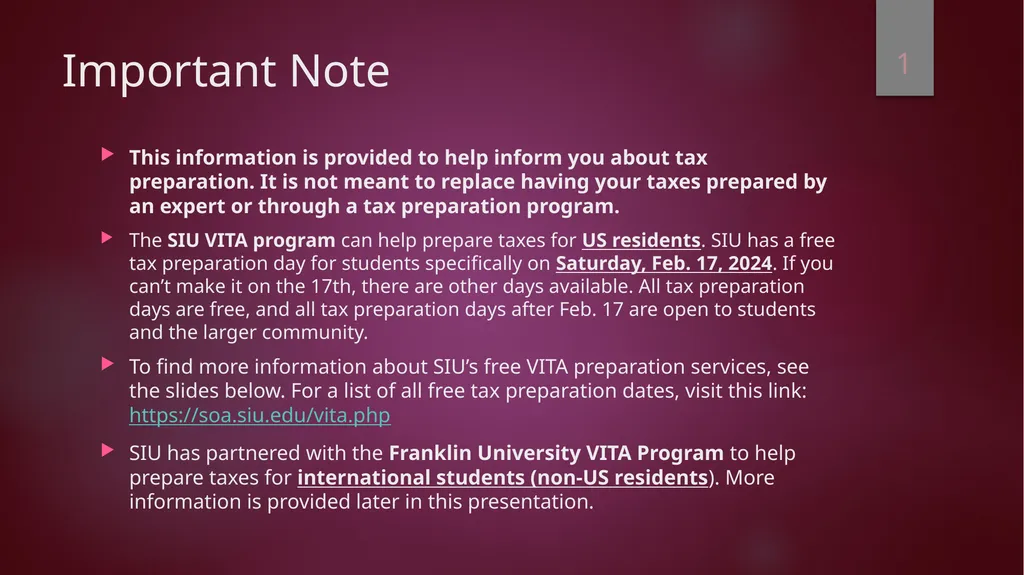
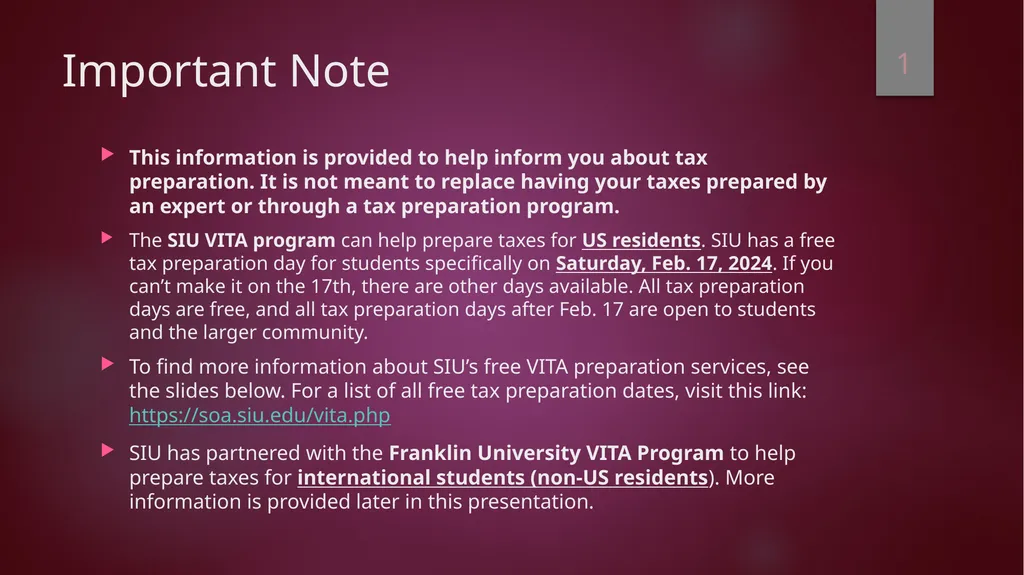
slide1. Important Note This information is provided to help inform you about tax preparation. It is not meant to replace having your taxes prepared by an expert or through a tax preparation program.
The SIU VITA program can help prepare taxes for US residents. SIU has a free tax preparation day for students specifically on Saturday, Feb. 17, 2024. If you can’t make it on the 17th, there are other days available. All tax preparation days are free, and all tax preparation days after Feb. 17 are open to students and the larger community.
To find more information about SIU’s free VITA preparation services, see the slides below. For a list of all free tax preparation dates, visit this link: https://soa.siu.edu/vita.php
SIU has partnered with the Franklin University VITA Program to help prepare taxes for international students (non-US residents). More information is provided later in this presentation. 1<br>
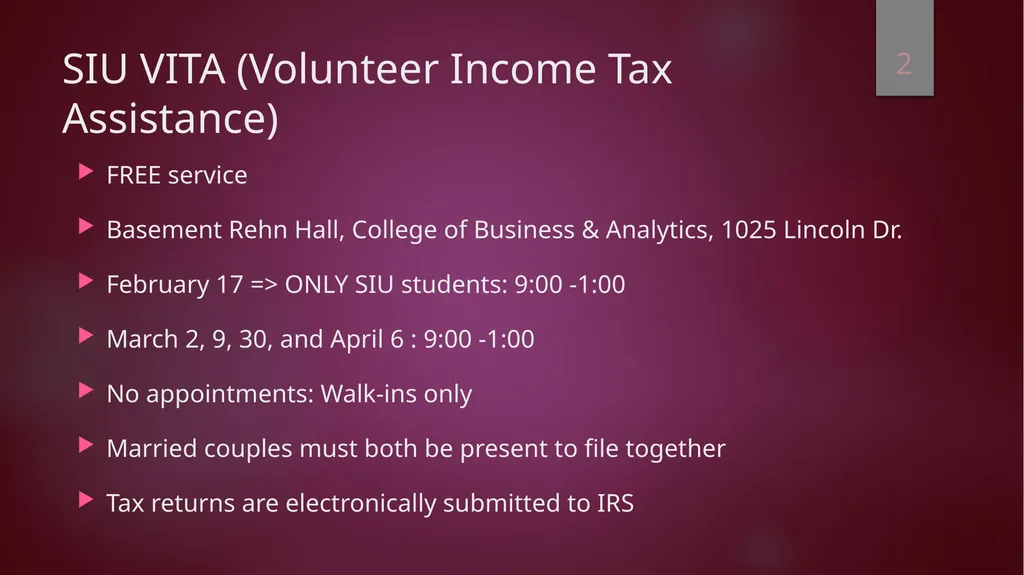
slide2. SIU VITA (Volunteer Income Tax Assistance) FREE service
Basement Rehn Hall, College of Business & Analytics, 1025 Lincoln Dr.
February 17 => ONLY SIU students: 9:00 -1:00
March 2, 9, 30, and April 6 : 9:00 -1:00
No appointments: Walk-ins only
Married couples must both be present to file together
Tax returns are electronically submitted to IRS 2<br>
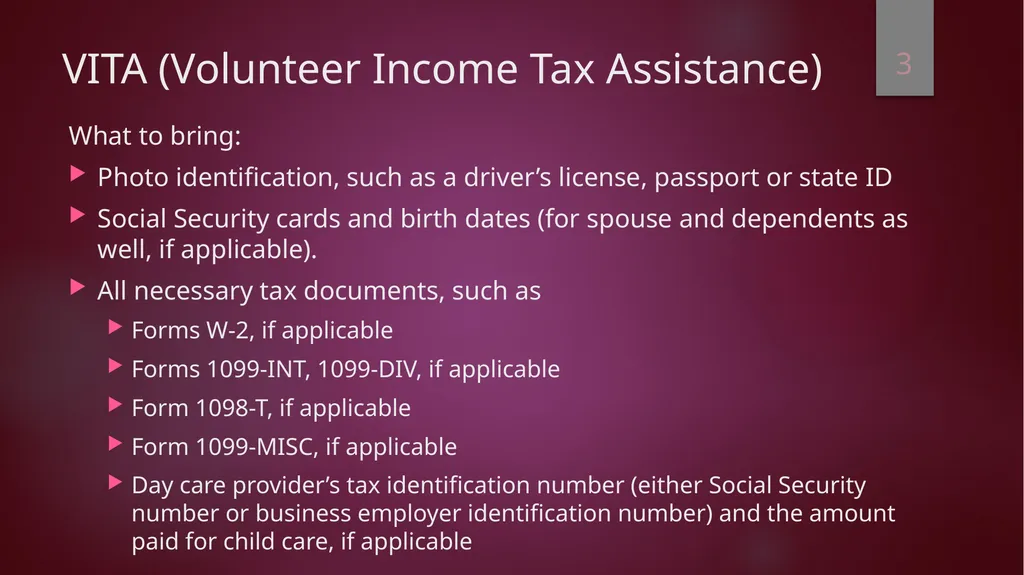
slide3. VITA (Volunteer Income Tax Assistance) What to bring:
Photo identification, such as a driver’s license, passport or state ID
Social Security cards and birth dates (for spouse and dependents as well, if applicable).
All necessary tax documents, such as
Forms W-2, if applicable
Forms 1099-INT, 1099-DIV, if applicable
Form 1098-T, if applicable
Form 1099-MISC, if applicable
Day care provider’s tax identification number (either Social Security number or business employer identification number) and the amount paid for child care, if applicable 3<br>
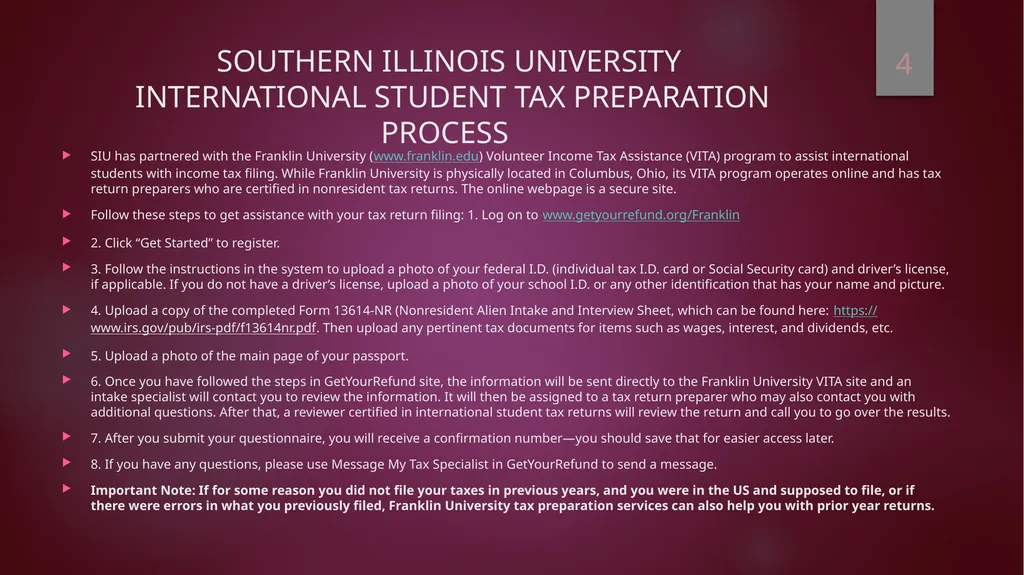
slide4. SOUTHERN ILLINOIS UNIVERSITY INTERNATIONAL STUDENT TAX PREPARATION PROCESS SIU has partnered with the Franklin University (www.franklin.edu) Volunteer Income Tax Assistance (VITA) program to assist international students with income tax filing. While Franklin University is physically located in Columbus, Ohio, its VITA program operates online and has tax return preparers who are certified in nonresident tax returns. The online webpage is a secure site.
Follow these steps to get assistance with your tax return filing: 1. Log on to www.getyourrefund.org/Franklin
2. Click “Get Started” to register.
3. Follow the instructions in the system to upload a photo of your federal I.D. (individual tax I.D. card or Social Security card) and driver’s license, if applicable. If you do not have a driver’s license, upload a photo of your school I.D. or any other identification that has your name and picture.
4. Upload a copy of the completed Form 13614-NR (Nonresident Alien Intake and Interview Sheet, which can be found here: https://www.irs.gov/pub/irs-pdf/f13614nr.pdf. Then upload any pertinent tax documents for items such as wages, interest, and dividends, etc.
5. Upload a photo of the main page of your passport.
6. Once you have followed the steps in GetYourRefund site, the information will be sent directly to the Franklin University VITA site and an intake specialist will contact you to review the information. It will then be assigned to a tax return preparer who may also contact you with additional questions. After that, a reviewer certified in international student tax returns will review the return and call you to go over the results.
7. After you submit your questionnaire, you will receive a confirmation number—you should save that for easier access later.
8. If you have any questions, please use Message My Tax Specialist in GetYourRefund to send a message.
Important Note: If for some reason you did not file your taxes in previous years, and you were in the US and supposed to file, or if there were errors in what you previously filed, Franklin University tax preparation services can also help you with prior year returns. 4<br>
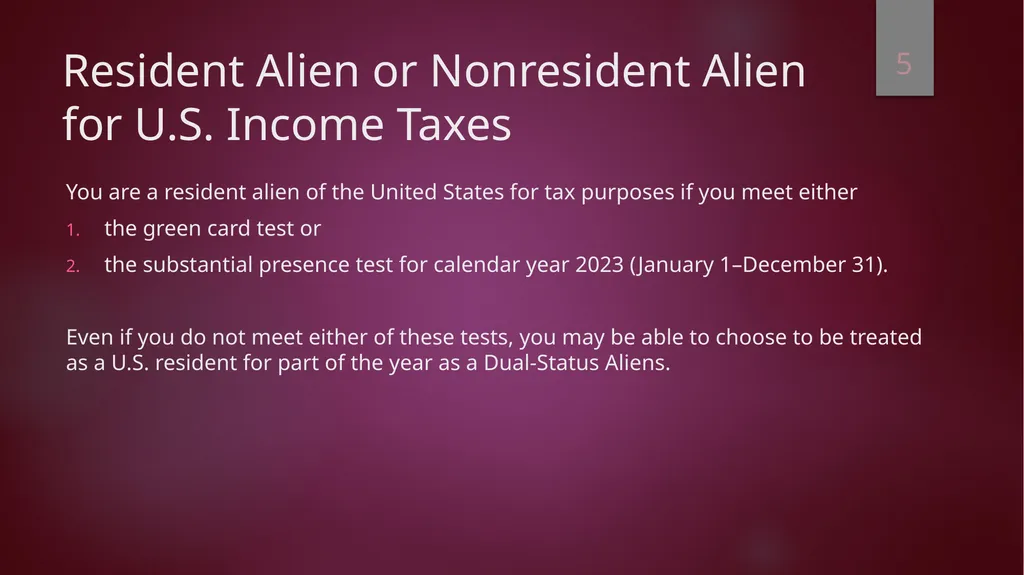
slide5. Resident Alien or Nonresident Alien for U.S. Income Taxes You are a resident alien of the United States for tax purposes if you meet either
the green card test or
the substantial presence test for calendar year 2023 (January 1–December 31).
Even if you do not meet either of these tests, you may be able to choose to be treated as a U.S. resident for part of the year as a Dual-Status Aliens. 5<br>
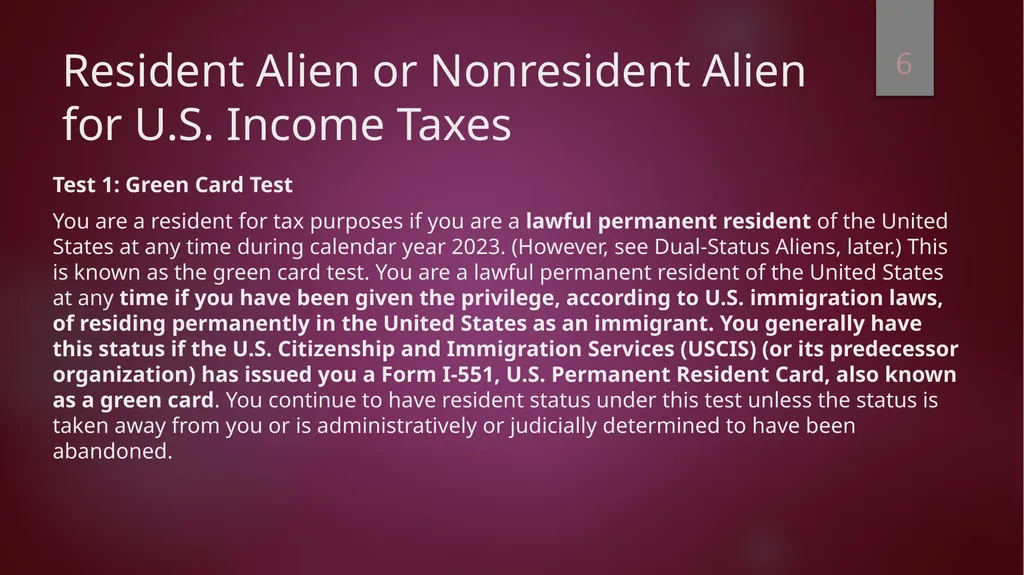
slide6. Resident Alien or Nonresident Alien for U.S. Income Taxes Test 1: Green Card Test
You are a resident for tax purposes if you are a lawful permanent resident of the United States at any time during calendar year 2023. (However, see Dual-Status Aliens, later.) This is known as the green card test. You are a lawful permanent resident of the United States at any time if you have been given the privilege, according to U.S. immigration laws, of residing permanently in the United States as an immigrant. You generally have this status if the U.S. Citizenship and Immigration Services (USCIS) (or its predecessor organization) has issued you a Form I-551, U.S. Permanent Resident Card, also known as a green card. You continue to have resident status under this test unless the status is taken away from you or is administratively or judicially determined to have been abandoned. 6<br>
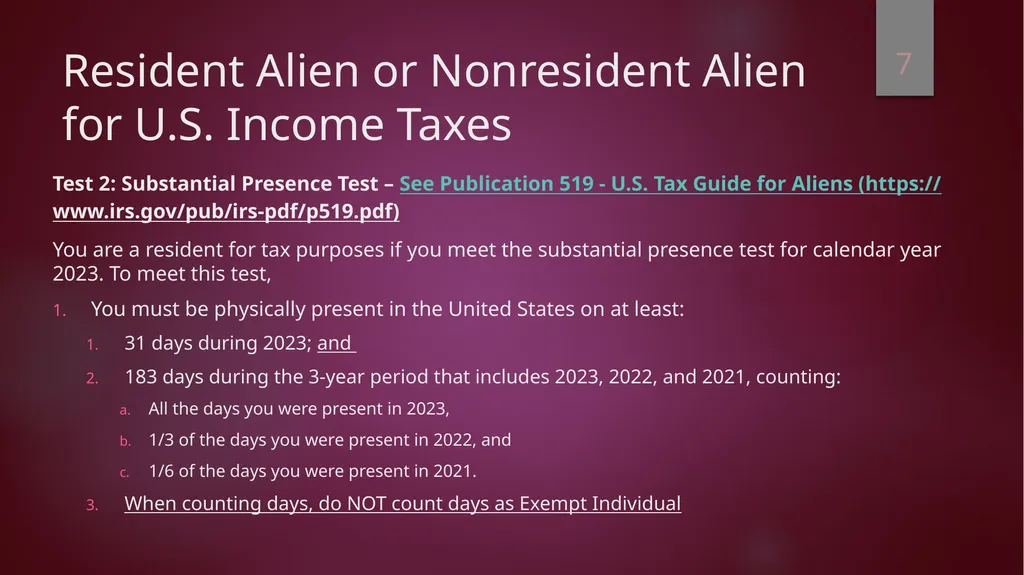
slide7. Resident Alien or Nonresident Alien for U.S. Income Taxes Test 2: Substantial Presence Test – See Publication 519 - U.S. Tax Guide for Aliens (https://www.irs.gov/pub/irs-pdf/p519.pdf)
You are a resident for tax purposes if you meet the substantial presence test for calendar year 2023. To meet this test,
You must be physically present in the United States on at least:
31 days during 2023; and
183 days during the 3-year period that includes 2023, 2022, and 2021, counting:
All the days you were present in 2023,
1/3 of the days you were present in 2022, and
1/6 of the days you were present in 2021.
When counting days, do NOT count days as Exempt Individual 7<br>
slide8. Resident Alien or Nonresident Alien for U.S. Income Taxes Test 2: Substantial Presence Test - Days of Presence in the United States
You are treated as present in the United States on any day you are physically present in the country at any time during the day. However, there are exceptions to this rule. Do not count the following as days of presence in the United States for the substantial presence test.
• Days you commute to work in the United States from a residence in Canada or Mexico if you regularly commute from Canada or Mexico.
• Days you are in the United States for less than 24 hours when you are in transit between two places outside the United States.
• Days you are in the United States as a crew member of a foreign vessel.
• Days you are unable to leave the United States because of a medical condition that arose while you are in the United States.
• Days you are in the United States under a NATO visa as a member of a force or civilian component to NATO. However, this exception does not apply to an immediate family member who is present in the United States under a NATO visa. A dependent family member must count every day of presence for purposes of the substantial presence test.
• Days you are an exempt individual. 8<br>
slide9. Resident Alien or Nonresident Alien for U.S. Income Taxes Test 2: Substantial Presence Test - Days of Presence in the United States
You are treated as present in the United States on any day you are physically present in the country at any time during the day. However, there are exceptions to this rule. Do not count the following as days of presence in the United States for the substantial presence test.
• Days you commute to work in the United States from a residence in Canada or Mexico if you regularly commute from Canada or Mexico.
• Days you are in the United States for less than 24 hours when you are in transit between two places outside the United States.
• Days you are in the United States as a crew member of a foreign vessel.
• Days you are unable to leave the United States because of a medical condition that arose while you are in the United States.
• Days you are in the United States under a NATO visa as a member of a force or civilian component to NATO. However, this exception does not apply to an immediate family member who is present in the United States under a NATO visa. A dependent family member must count every day of presence for purposes of the substantial presence test.
• Days you are an exempt individual. 9<br>
slide10. Resident Alien or Nonresident Alien for U.S. Income Taxes Test 2: Substantial Presence Test - Days of Presence - Exempt individual
Do not count days for which you are an exempt individual. The term “exempt individual” does not refer to someone exempt from U.S. tax, but instead refers to anyone in the following categories.
• An individual temporarily present in the United States as a foreign government-related individual under an “A” or “G” visa other than individuals holding “A-3” or “G-5” class visas.
• A teacher or trainee temporarily present in the United States under a “J” or “Q” visa who substantially complies with the requirements of the visa.
• A student temporarily present in the United States under an “F,” “J,” “M,” or “Q” visa who substantially complies with the requirements of the visa.
• A professional athlete temporarily present in the United States to compete in a charitable sports event.
The specific rules for each of these four categories (including any rules on the length of time you will be an exempt individual). 10<br>
slide11. Resident Alien or Nonresident Alien for U.S. Income Taxes Substantial Presence Test - Days of Presence - Exempt individual
Do not count days for which you are an exempt individual. The term “exempt individual” does not refer to someone exempt from U.S. tax, but instead refers to anyone in the following categories.
• An individual temporarily present in the United States as a foreign government-related individual under an “A” or “G” visa other than individuals holding “A-3” or “G-5” class visas.
• A teacher or trainee temporarily present in the United States under a “J” or “Q” visa who substantially complies with the requirements of the visa.
• A student temporarily present in the United States under an “F,” “J,” “M,” or “Q” visa who substantially complies with the requirements of the visa.
• A professional athlete temporarily present in the United States to compete in a charitable sports event.
The specific rules for each of these four categories (including any rules on the length of time you will be an exempt individual). 11<br>
slide12. Individuals report taxable income to the IRS.
Reported on Form 1040
Filing deadline is April 15 Filing Compliance 12<br>
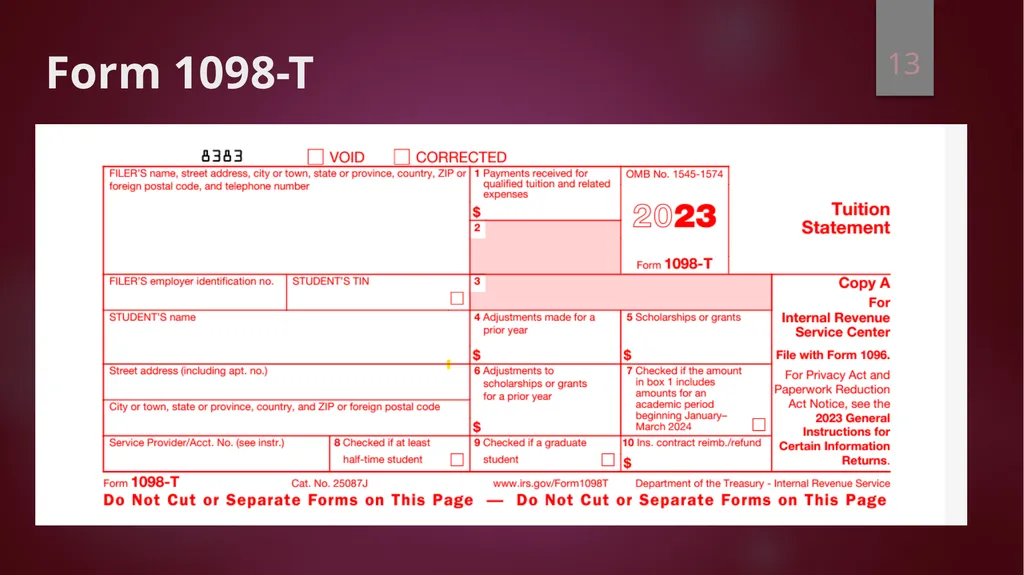
slide13. Form 1098-T 13<br>
slide14. AOTC)is a credit for qualified education expenses paid for an eligible student for the first four years of higher education. You can get a maximum annual credit of $2,500 per eligible student. If the credit brings the amount of tax you owe to zero, you can have 40 percent of any remaining amount of the credit (up to $1,000) refunded to you.
The amount of the credit is 100 percent of the first $2,000 of qualified education expenses you paid for each eligible student and 25 percent of the next $2,000 of qualified education expenses you paid for that student.
Qualified Expenses: See IRS Publication 170, https://www.irs.gov/pub/irs-pdf/p970.pdf American Opportunity Tax Credit 14<br>
slide15. Who is an eligible student for AOTC? The student must
Be pursuing a degree or other recognized education credential
Be enrolled at least half time for at least one academic period* beginning in the tax year
Not have finished the first four years of higher education at the beginning of the tax year
Not have claimed the AOTC or the former Hope credit for more than four tax years
Not have a felony drug conviction at the end of the tax year
You may not claim the AOTC unless you, your spouse (if you are filing a joint return) and the qualifying student have a valid taxpayer identification number (TIN) issued or applied for on or before the due date of the return (including extensions). A TIN is a Social Security number, an individual taxpayer identification number (ITIN) or an adoption taxpayer identification number (ATIN).
*Academic Period can be semesters, trimesters, quarters or any other period of study such as a summer school session. The schools determine the academic periods. For schools that use clock or credit hours and do not have academic terms, the payment period may be treated as an academic period. American Opportunity Tax Credit 15<br>
slide16. The LLC is for qualified tuition and related expenses paid for eligible students enrolled in an eligible educational institution. This credit can help pay for undergraduate, graduate and professional degree courses — including courses to acquire or improve job skills. There is no limit on the number of years you can claim the credit. It is worth up to $2,000 per tax return.
What is the LLC worth?
The amount of the credit is 20 percent of the first $10,000 of qualified education expenses or a maximum of $2,000 per return. The LLC is not refundable. So, you can use the credit to pay any tax you owe but you won’t receive any of the credit back as a refund. Lifetime Learning Credit 16<br>
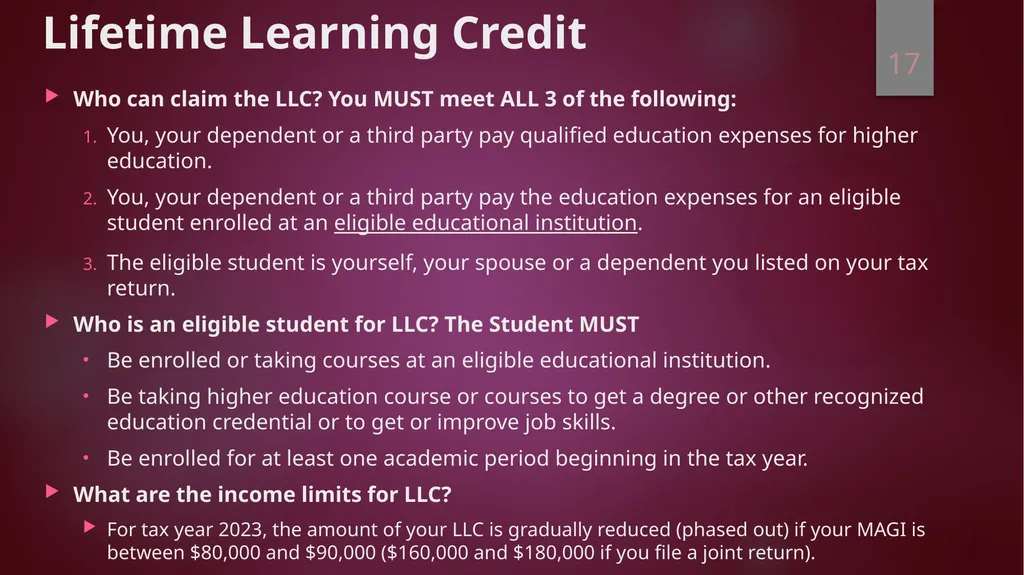
slide17. Who can claim the LLC? You MUST meet ALL 3 of the following:
You, your dependent or a third party pay qualified education expenses for higher education.
You, your dependent or a third party pay the education expenses for an eligible student enrolled at an eligible educational institution.
The eligible student is yourself, your spouse or a dependent you listed on your tax return.
Who is an eligible student for LLC? The Student MUST
Be enrolled or taking courses at an eligible educational institution.
Be taking higher education course or courses to get a degree or other recognized education credential or to get or improve job skills.
Be enrolled for at least one academic period beginning in the tax year.
What are the income limits for LLC?
For tax year 2023, the amount of your LLC is gradually reduced (phased out) if your MAGI is between $80,000 and $90,000 ($160,000 and $180,000 if you file a joint return).
You can’t claim the credit if your MAGI is $90,000 or more ($180,000 or more if you file a joint return). Lifetime Learning Credit 17<br>
slide18. Tax credits
Reduce tax liability dollar for dollar
Child tax credit rules
$2,000 credit for qualifying children under age 17 at year-end.
$500 credit for qualifying dependents who don’t meet the requirements for higher credit amount. Child and Dependent Tax Credit 18<br>
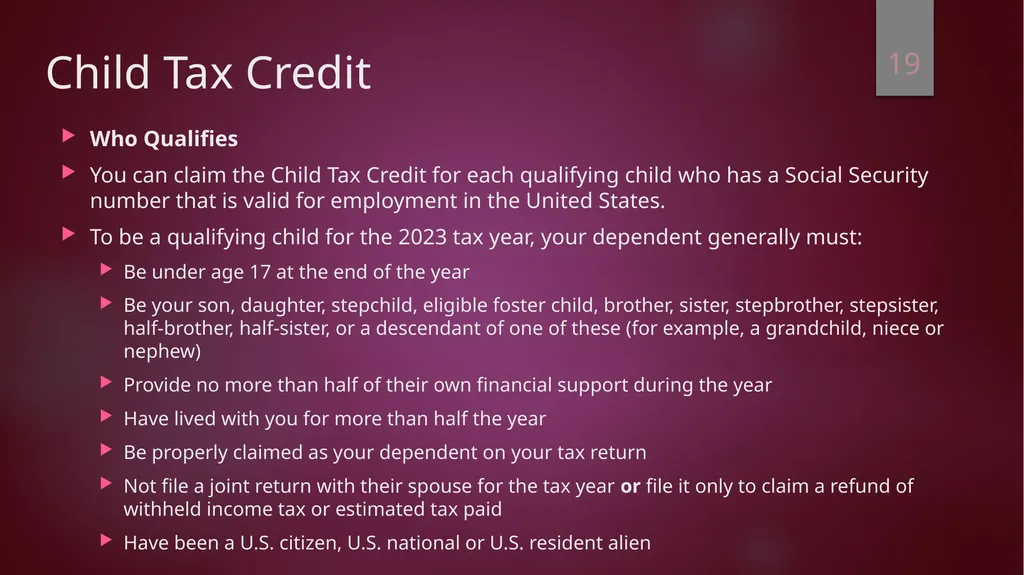
slide19. Who Qualifies
You can claim the Child Tax Credit for each qualifying child who has a Social Security number that is valid for employment in the United States.
To be a qualifying child for the 2023 tax year, your dependent generally must:
Be under age 17 at the end of the year
Be your son, daughter, stepchild, eligible foster child, brother, sister, stepbrother, stepsister, half-brother, half-sister, or a descendant of one of these (for example, a grandchild, niece or nephew)
Provide no more than half of their own financial support during the year
Have lived with you for more than half the year
Be properly claimed as your dependent on your tax return
Not file a joint return with their spouse for the tax year or file it only to claim a refund of withheld income tax or estimated tax paid
Have been a U.S. citizen, U.S. national or U.S. resident alien Child Tax Credit 19<br>
slide20. Who Qualifies
To be a qualifying child for the 2023 tax year, your dependent generally must:
You qualify for the full amount of the 2023 Child Tax Credit for each qualifying child if you meet all eligibility factors and your annual income is not more than $200,000 ($400,000 if filing a joint return).
Parents and guardians with higher incomes may be eligible to claim a partial credit. Child Tax Credit 20<br>
slide21. Five different filing statuses
Married filing jointly
Married filing separately
Qualifying surviving spouse
Single
Head of household Filing Status 21<br>
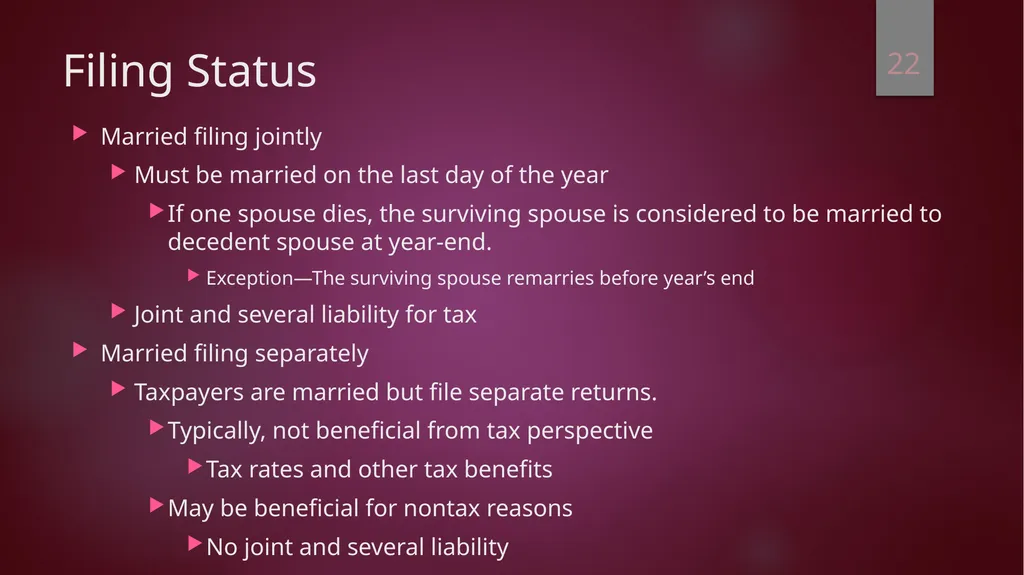
slide22. Married filing jointly
Must be married on the last day of the year
If one spouse dies, the surviving spouse is considered to be married to decedent spouse at year-end.
Exception—The surviving spouse remarries before year’s end
Joint and several liability for tax
Married filing separately
Taxpayers are married but file separate returns.
Typically, not beneficial from tax perspective
Tax rates and other tax benefits
May be beneficial for nontax reasons
No joint and several liability Filing Status 22<br>
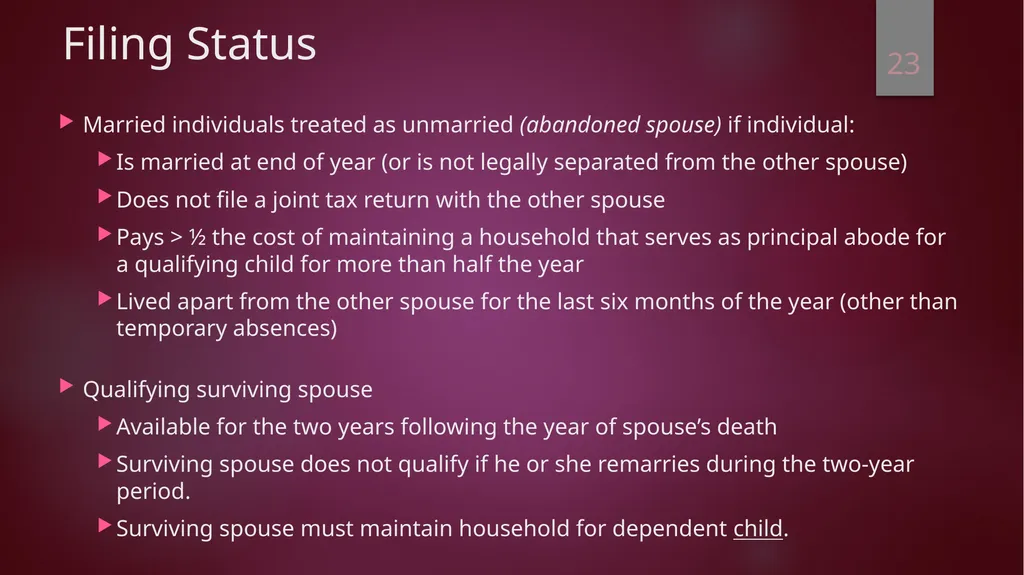
slide23. Married individuals treated as unmarried (abandoned spouse) if individual:
Is married at end of year (or is not legally separated from the other spouse)
Does not file a joint tax return with the other spouse
Pays > ½ the cost of maintaining a household that serves as principal abode for a qualifying child for more than half the year
Lived apart from the other spouse for the last six months of the year (other than temporary absences)
Qualifying surviving spouse
Available for the two years following the year of spouse’s death
Surviving spouse does not qualify if he or she remarries during the two-year period.
Surviving spouse must maintain household for dependent child. Filing Status 23<br>
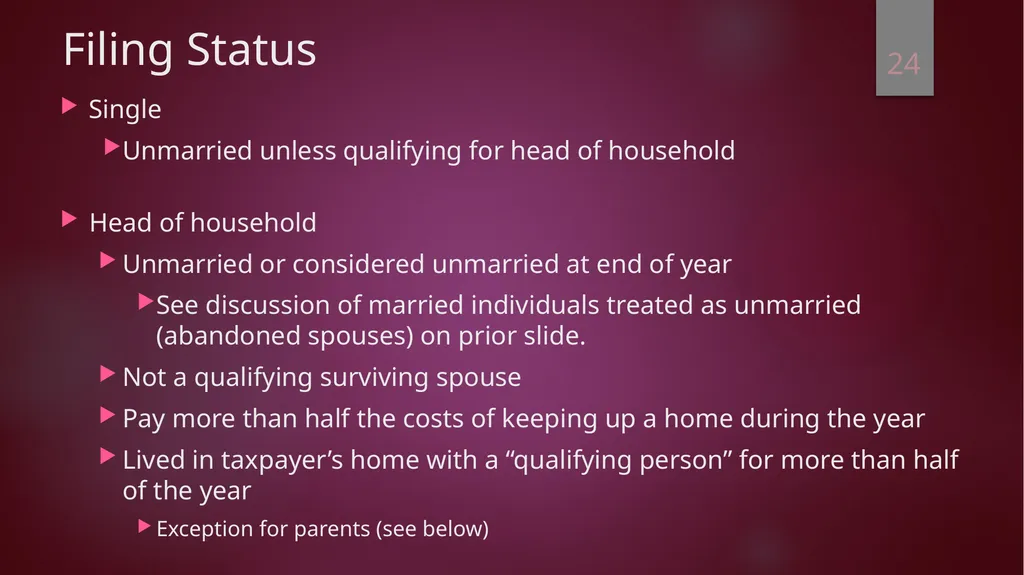
slide24. Single
Unmarried unless qualifying for head of household
Head of household
Unmarried or considered unmarried at end of year
See discussion of married individuals treated as unmarried (abandoned spouses) on prior slide.
Not a qualifying surviving spouse
Pay more than half the costs of keeping up a home during the year
Lived in taxpayer’s home with a “qualifying person” for more than half of the year
Exception for parents (see below) Filing Status 24<br>
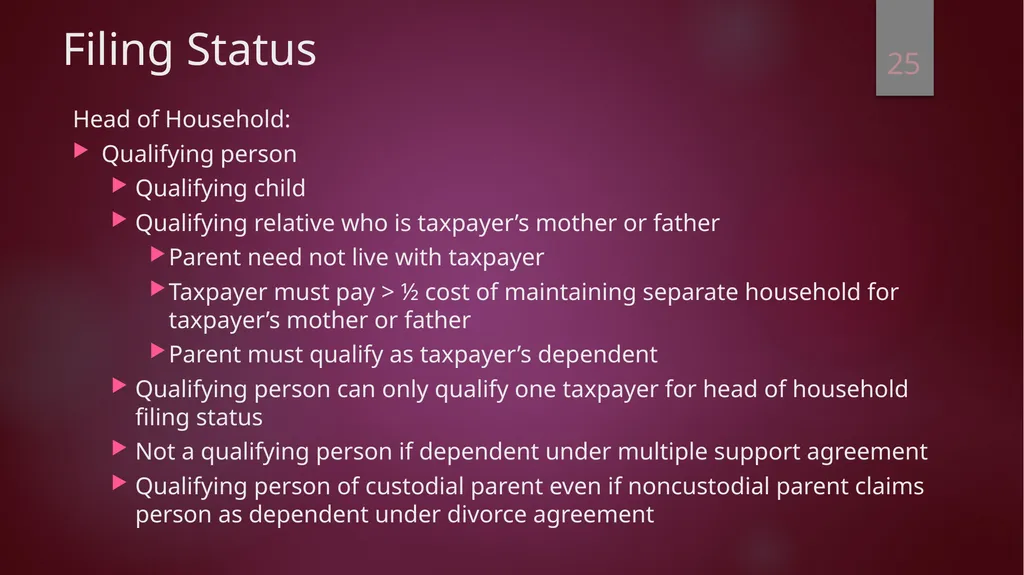
slide25. Head of Household:
Qualifying person
Qualifying child
Qualifying relative who is taxpayer’s mother or father
Parent need not live with taxpayer
Taxpayer must pay > ½ cost of maintaining separate household for taxpayer’s mother or father
Parent must qualify as taxpayer’s dependent
Qualifying person can only qualify one taxpayer for head of household filing status
Not a qualifying person if dependent under multiple support agreement
Qualifying person of custodial parent even if noncustodial parent claims person as dependent under divorce agreement Filing Status 25<br>
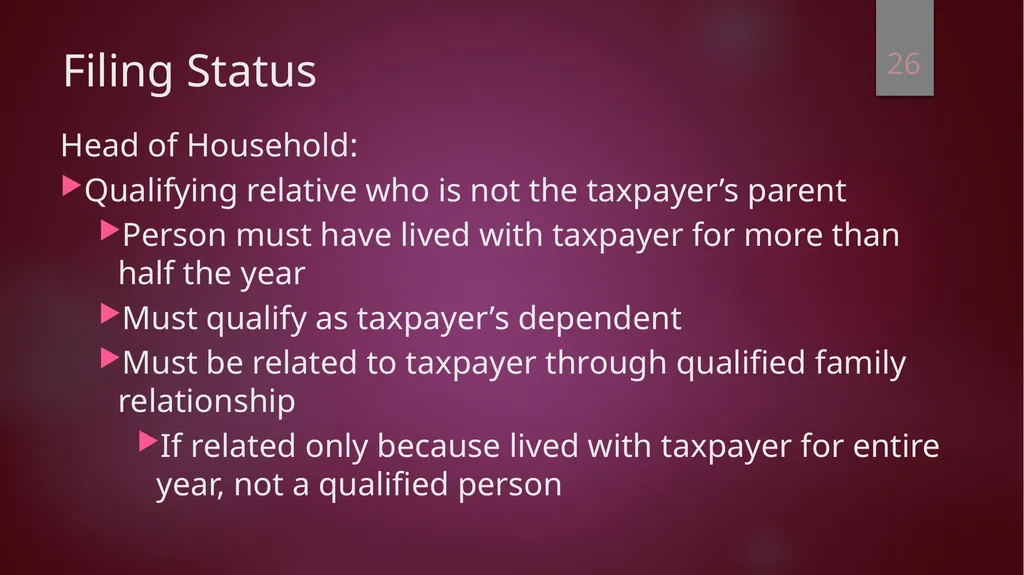
slide26. Head of Household:
Qualifying relative who is not the taxpayer’s parent
Person must have lived with taxpayer for more than half the year
Must qualify as taxpayer’s dependent
Must be related to taxpayer through qualified family relationship
If related only because lived with taxpayer for entire year, not a qualified person Filing Status 26<br>
slide27. Determining who qualifies as a taxpayer’s dependent is relevant for determining:
Filing status
Eligibility for tax benefits such as the child tax credit and the American opportunity credit Who Qualifies as Taxpayer’s Dependent 27<br>
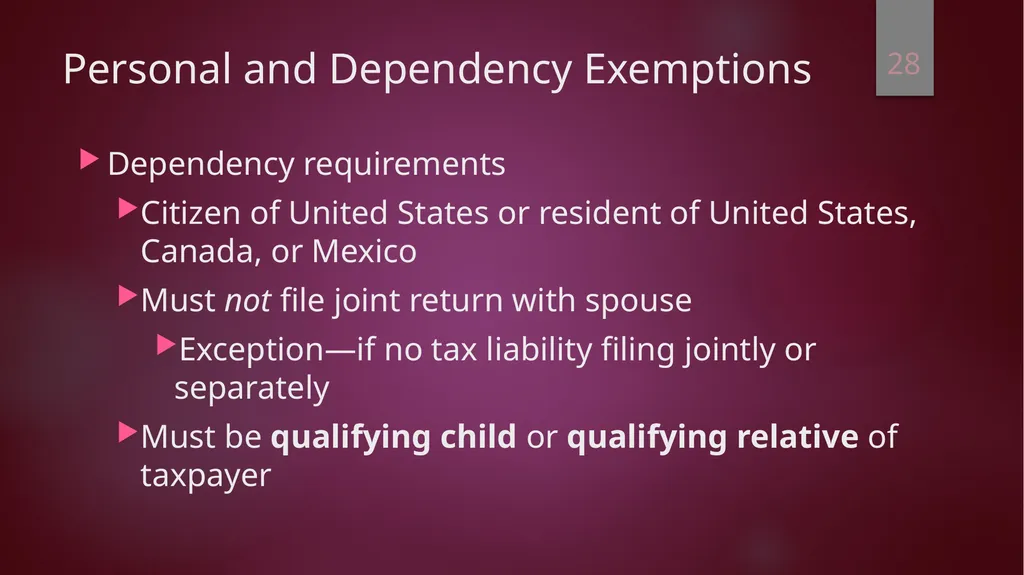
slide28. Dependency requirements
Citizen of United States or resident of United States, Canada, or Mexico
Must not file joint return with spouse
Exception—if no tax liability filing jointly or separately
Must be qualifying child or qualifying relative of taxpayer Personal and Dependency Exemptions 28<br>
slide29. Qualifying child
Relationship test
Age test
Residence test
Support test Personal and Dependency Exemptions - Qualifying Child 29<br>
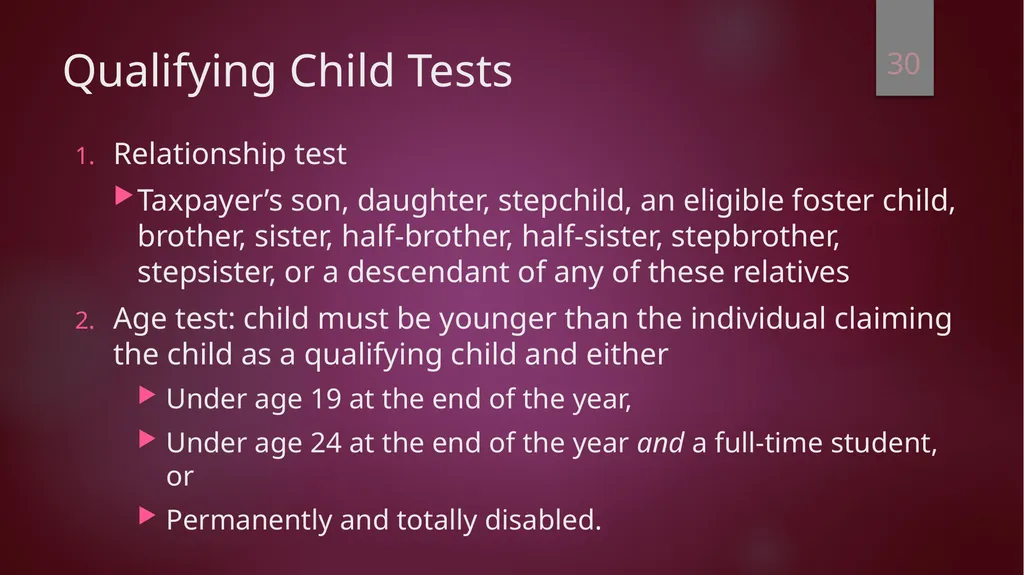
slide30. Relationship test
Taxpayer’s son, daughter, stepchild, an eligible foster child, brother, sister, half-brother, half-sister, stepbrother, stepsister, or a descendant of any of these relatives
Age test: child must be younger than the individual claiming the child as a qualifying child and either
Under age 19 at the end of the year,
Under age 24 at the end of the year and a full-time student, or
Permanently and totally disabled. Qualifying Child Tests 30<br>
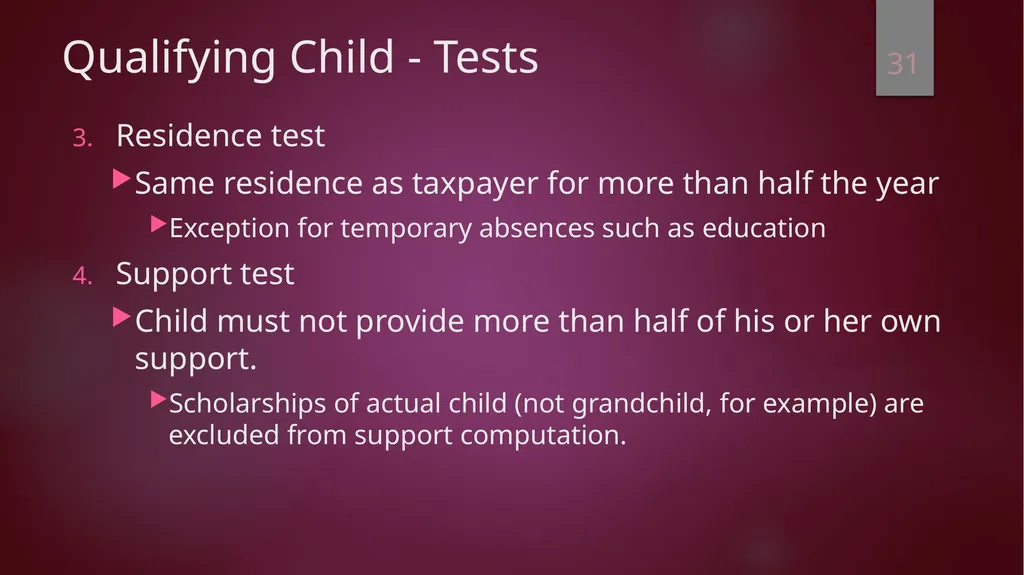
slide31. Residence test
Same residence as taxpayer for more than half the year
Exception for temporary absences such as education
Support test
Child must not provide more than half of his or her own support.
Scholarships of actual child (not grandchild, for example) are excluded from support computation. Qualifying Child - Tests 31<br>
slide32. Tiebreaking rules
Parent before nonparent
If both parents, tiebreaker is based on who child resided with the most during the year
If same, parent with higher AGI
If nonparents, highest AGI gets exemption Qualifying Child 32<br>
slide33. Qualifying relative
Relationship test
Support test
Gross income test Personal and Dependency Exemptions – Qualifying Relative 33<br>
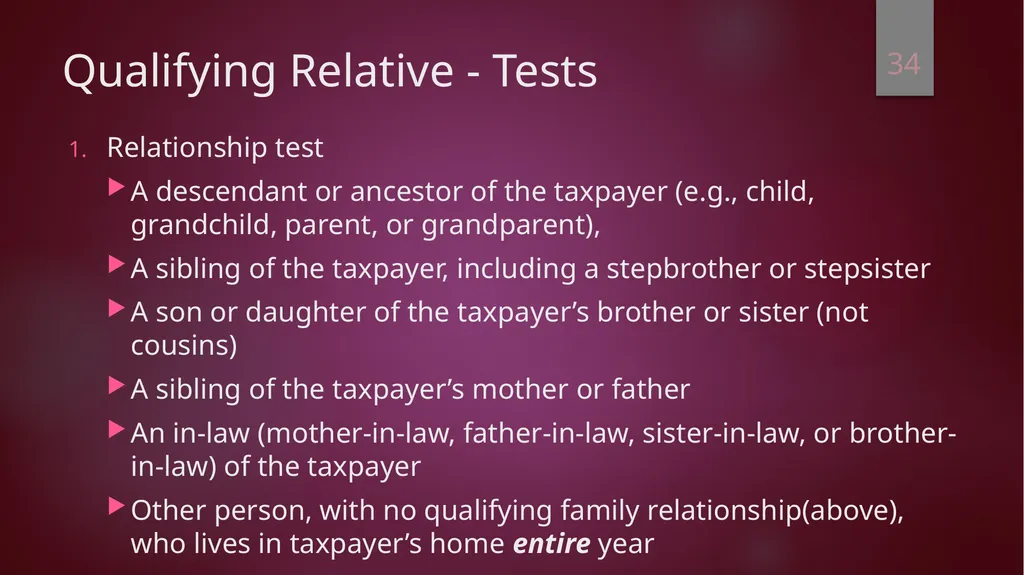
slide34. Relationship test
A descendant or ancestor of the taxpayer (e.g., child, grandchild, parent, or grandparent),
A sibling of the taxpayer, including a stepbrother or stepsister
A son or daughter of the taxpayer’s brother or sister (not cousins)
A sibling of the taxpayer’s mother or father
An in-law (mother-in-law, father-in-law, sister-in-law, or brother-in-law) of the taxpayer
Other person, with no qualifying family relationship(above), who lives in taxpayer’s home entire year Qualifying Relative - Tests 34<br>
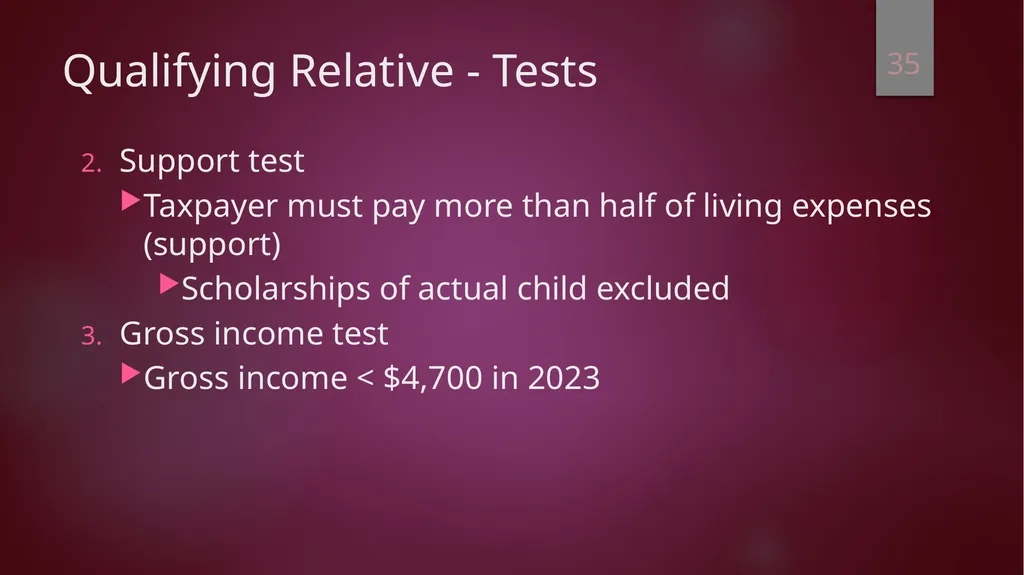
slide35. Support test
Taxpayer must pay more than half of living expenses (support)
Scholarships of actual child excluded
Gross income test
Gross income < $4,700 in 2023 Qualifying Relative - Tests 35<br>
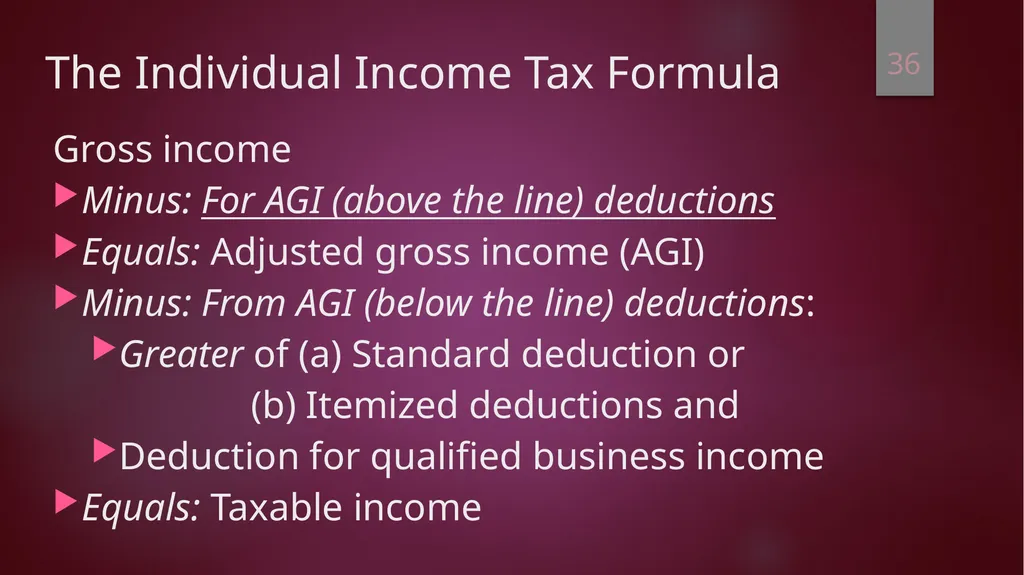
slide36. Gross income
Minus: For AGI (above the line) deductions
Equals: Adjusted gross income (AGI)
Minus: From AGI (below the line) deductions:
Greater of (a) Standard deduction or
(b) Itemized deductions and
Deduction for qualified business income
Equals: Taxable income The Individual Income Tax Formula 36<br>
slide37. Taxable income
Times: Tax rates
Equals: Income tax liability
Plus: Other taxes
Equals: Total tax
Minus: Credits
Minus: Prepayments
Equals: Taxes due or (refund) The Individual Income Tax Formula 37<br>
The SIU VITA program can help prepare taxes for US residents. SIU has a free tax preparation day for students specifically on Saturday, Feb. 17, 2024. If you can’t make it on the 17th, there are other days available. All tax preparation days are free, and all tax preparation days after Feb. 17 are open to students and the larger community.
To find more information about SIU’s free VITA preparation services, see the slides below. For a list of all free tax preparation dates, visit this link: https://soa.siu.edu/vita.php
SIU has partnered with the Franklin University VITA Program to help prepare taxes for international students (non-US residents). More information is provided later in this presentation. 1<br>
slide2. SIU VITA (Volunteer Income Tax Assistance) FREE service
Basement Rehn Hall, College of Business & Analytics, 1025 Lincoln Dr.
February 17 => ONLY SIU students: 9:00 -1:00
March 2, 9, 30, and April 6 : 9:00 -1:00
No appointments: Walk-ins only
Married couples must both be present to file together
Tax returns are electronically submitted to IRS 2<br>
slide3. VITA (Volunteer Income Tax Assistance) What to bring:
Photo identification, such as a driver’s license, passport or state ID
Social Security cards and birth dates (for spouse and dependents as well, if applicable).
All necessary tax documents, such as
Forms W-2, if applicable
Forms 1099-INT, 1099-DIV, if applicable
Form 1098-T, if applicable
Form 1099-MISC, if applicable
Day care provider’s tax identification number (either Social Security number or business employer identification number) and the amount paid for child care, if applicable 3<br>
slide4. SOUTHERN ILLINOIS UNIVERSITY INTERNATIONAL STUDENT TAX PREPARATION PROCESS SIU has partnered with the Franklin University (www.franklin.edu) Volunteer Income Tax Assistance (VITA) program to assist international students with income tax filing. While Franklin University is physically located in Columbus, Ohio, its VITA program operates online and has tax return preparers who are certified in nonresident tax returns. The online webpage is a secure site.
Follow these steps to get assistance with your tax return filing: 1. Log on to www.getyourrefund.org/Franklin
2. Click “Get Started” to register.
3. Follow the instructions in the system to upload a photo of your federal I.D. (individual tax I.D. card or Social Security card) and driver’s license, if applicable. If you do not have a driver’s license, upload a photo of your school I.D. or any other identification that has your name and picture.
4. Upload a copy of the completed Form 13614-NR (Nonresident Alien Intake and Interview Sheet, which can be found here: https://www.irs.gov/pub/irs-pdf/f13614nr.pdf. Then upload any pertinent tax documents for items such as wages, interest, and dividends, etc.
5. Upload a photo of the main page of your passport.
6. Once you have followed the steps in GetYourRefund site, the information will be sent directly to the Franklin University VITA site and an intake specialist will contact you to review the information. It will then be assigned to a tax return preparer who may also contact you with additional questions. After that, a reviewer certified in international student tax returns will review the return and call you to go over the results.
7. After you submit your questionnaire, you will receive a confirmation number—you should save that for easier access later.
8. If you have any questions, please use Message My Tax Specialist in GetYourRefund to send a message.
Important Note: If for some reason you did not file your taxes in previous years, and you were in the US and supposed to file, or if there were errors in what you previously filed, Franklin University tax preparation services can also help you with prior year returns. 4<br>
slide5. Resident Alien or Nonresident Alien for U.S. Income Taxes You are a resident alien of the United States for tax purposes if you meet either
the green card test or
the substantial presence test for calendar year 2023 (January 1–December 31).
Even if you do not meet either of these tests, you may be able to choose to be treated as a U.S. resident for part of the year as a Dual-Status Aliens. 5<br>
slide6. Resident Alien or Nonresident Alien for U.S. Income Taxes Test 1: Green Card Test
You are a resident for tax purposes if you are a lawful permanent resident of the United States at any time during calendar year 2023. (However, see Dual-Status Aliens, later.) This is known as the green card test. You are a lawful permanent resident of the United States at any time if you have been given the privilege, according to U.S. immigration laws, of residing permanently in the United States as an immigrant. You generally have this status if the U.S. Citizenship and Immigration Services (USCIS) (or its predecessor organization) has issued you a Form I-551, U.S. Permanent Resident Card, also known as a green card. You continue to have resident status under this test unless the status is taken away from you or is administratively or judicially determined to have been abandoned. 6<br>
slide7. Resident Alien or Nonresident Alien for U.S. Income Taxes Test 2: Substantial Presence Test – See Publication 519 - U.S. Tax Guide for Aliens (https://www.irs.gov/pub/irs-pdf/p519.pdf)
You are a resident for tax purposes if you meet the substantial presence test for calendar year 2023. To meet this test,
You must be physically present in the United States on at least:
31 days during 2023; and
183 days during the 3-year period that includes 2023, 2022, and 2021, counting:
All the days you were present in 2023,
1/3 of the days you were present in 2022, and
1/6 of the days you were present in 2021.
When counting days, do NOT count days as Exempt Individual 7<br>
slide8. Resident Alien or Nonresident Alien for U.S. Income Taxes Test 2: Substantial Presence Test - Days of Presence in the United States
You are treated as present in the United States on any day you are physically present in the country at any time during the day. However, there are exceptions to this rule. Do not count the following as days of presence in the United States for the substantial presence test.
• Days you commute to work in the United States from a residence in Canada or Mexico if you regularly commute from Canada or Mexico.
• Days you are in the United States for less than 24 hours when you are in transit between two places outside the United States.
• Days you are in the United States as a crew member of a foreign vessel.
• Days you are unable to leave the United States because of a medical condition that arose while you are in the United States.
• Days you are in the United States under a NATO visa as a member of a force or civilian component to NATO. However, this exception does not apply to an immediate family member who is present in the United States under a NATO visa. A dependent family member must count every day of presence for purposes of the substantial presence test.
• Days you are an exempt individual. 8<br>
slide9. Resident Alien or Nonresident Alien for U.S. Income Taxes Test 2: Substantial Presence Test - Days of Presence in the United States
You are treated as present in the United States on any day you are physically present in the country at any time during the day. However, there are exceptions to this rule. Do not count the following as days of presence in the United States for the substantial presence test.
• Days you commute to work in the United States from a residence in Canada or Mexico if you regularly commute from Canada or Mexico.
• Days you are in the United States for less than 24 hours when you are in transit between two places outside the United States.
• Days you are in the United States as a crew member of a foreign vessel.
• Days you are unable to leave the United States because of a medical condition that arose while you are in the United States.
• Days you are in the United States under a NATO visa as a member of a force or civilian component to NATO. However, this exception does not apply to an immediate family member who is present in the United States under a NATO visa. A dependent family member must count every day of presence for purposes of the substantial presence test.
• Days you are an exempt individual. 9<br>
slide10. Resident Alien or Nonresident Alien for U.S. Income Taxes Test 2: Substantial Presence Test - Days of Presence - Exempt individual
Do not count days for which you are an exempt individual. The term “exempt individual” does not refer to someone exempt from U.S. tax, but instead refers to anyone in the following categories.
• An individual temporarily present in the United States as a foreign government-related individual under an “A” or “G” visa other than individuals holding “A-3” or “G-5” class visas.
• A teacher or trainee temporarily present in the United States under a “J” or “Q” visa who substantially complies with the requirements of the visa.
• A student temporarily present in the United States under an “F,” “J,” “M,” or “Q” visa who substantially complies with the requirements of the visa.
• A professional athlete temporarily present in the United States to compete in a charitable sports event.
The specific rules for each of these four categories (including any rules on the length of time you will be an exempt individual). 10<br>
slide11. Resident Alien or Nonresident Alien for U.S. Income Taxes Substantial Presence Test - Days of Presence - Exempt individual
Do not count days for which you are an exempt individual. The term “exempt individual” does not refer to someone exempt from U.S. tax, but instead refers to anyone in the following categories.
• An individual temporarily present in the United States as a foreign government-related individual under an “A” or “G” visa other than individuals holding “A-3” or “G-5” class visas.
• A teacher or trainee temporarily present in the United States under a “J” or “Q” visa who substantially complies with the requirements of the visa.
• A student temporarily present in the United States under an “F,” “J,” “M,” or “Q” visa who substantially complies with the requirements of the visa.
• A professional athlete temporarily present in the United States to compete in a charitable sports event.
The specific rules for each of these four categories (including any rules on the length of time you will be an exempt individual). 11<br>
slide12. Individuals report taxable income to the IRS.
Reported on Form 1040
Filing deadline is April 15 Filing Compliance 12<br>
slide13. Form 1098-T 13<br>
slide14. AOTC)is a credit for qualified education expenses paid for an eligible student for the first four years of higher education. You can get a maximum annual credit of $2,500 per eligible student. If the credit brings the amount of tax you owe to zero, you can have 40 percent of any remaining amount of the credit (up to $1,000) refunded to you.
The amount of the credit is 100 percent of the first $2,000 of qualified education expenses you paid for each eligible student and 25 percent of the next $2,000 of qualified education expenses you paid for that student.
Qualified Expenses: See IRS Publication 170, https://www.irs.gov/pub/irs-pdf/p970.pdf American Opportunity Tax Credit 14<br>
slide15. Who is an eligible student for AOTC? The student must
Be pursuing a degree or other recognized education credential
Be enrolled at least half time for at least one academic period* beginning in the tax year
Not have finished the first four years of higher education at the beginning of the tax year
Not have claimed the AOTC or the former Hope credit for more than four tax years
Not have a felony drug conviction at the end of the tax year
You may not claim the AOTC unless you, your spouse (if you are filing a joint return) and the qualifying student have a valid taxpayer identification number (TIN) issued or applied for on or before the due date of the return (including extensions). A TIN is a Social Security number, an individual taxpayer identification number (ITIN) or an adoption taxpayer identification number (ATIN).
*Academic Period can be semesters, trimesters, quarters or any other period of study such as a summer school session. The schools determine the academic periods. For schools that use clock or credit hours and do not have academic terms, the payment period may be treated as an academic period. American Opportunity Tax Credit 15<br>
slide16. The LLC is for qualified tuition and related expenses paid for eligible students enrolled in an eligible educational institution. This credit can help pay for undergraduate, graduate and professional degree courses — including courses to acquire or improve job skills. There is no limit on the number of years you can claim the credit. It is worth up to $2,000 per tax return.
What is the LLC worth?
The amount of the credit is 20 percent of the first $10,000 of qualified education expenses or a maximum of $2,000 per return. The LLC is not refundable. So, you can use the credit to pay any tax you owe but you won’t receive any of the credit back as a refund. Lifetime Learning Credit 16<br>
slide17. Who can claim the LLC? You MUST meet ALL 3 of the following:
You, your dependent or a third party pay qualified education expenses for higher education.
You, your dependent or a third party pay the education expenses for an eligible student enrolled at an eligible educational institution.
The eligible student is yourself, your spouse or a dependent you listed on your tax return.
Who is an eligible student for LLC? The Student MUST
Be enrolled or taking courses at an eligible educational institution.
Be taking higher education course or courses to get a degree or other recognized education credential or to get or improve job skills.
Be enrolled for at least one academic period beginning in the tax year.
What are the income limits for LLC?
For tax year 2023, the amount of your LLC is gradually reduced (phased out) if your MAGI is between $80,000 and $90,000 ($160,000 and $180,000 if you file a joint return).
You can’t claim the credit if your MAGI is $90,000 or more ($180,000 or more if you file a joint return). Lifetime Learning Credit 17<br>
slide18. Tax credits
Reduce tax liability dollar for dollar
Child tax credit rules
$2,000 credit for qualifying children under age 17 at year-end.
$500 credit for qualifying dependents who don’t meet the requirements for higher credit amount. Child and Dependent Tax Credit 18<br>
slide19. Who Qualifies
You can claim the Child Tax Credit for each qualifying child who has a Social Security number that is valid for employment in the United States.
To be a qualifying child for the 2023 tax year, your dependent generally must:
Be under age 17 at the end of the year
Be your son, daughter, stepchild, eligible foster child, brother, sister, stepbrother, stepsister, half-brother, half-sister, or a descendant of one of these (for example, a grandchild, niece or nephew)
Provide no more than half of their own financial support during the year
Have lived with you for more than half the year
Be properly claimed as your dependent on your tax return
Not file a joint return with their spouse for the tax year or file it only to claim a refund of withheld income tax or estimated tax paid
Have been a U.S. citizen, U.S. national or U.S. resident alien Child Tax Credit 19<br>
slide20. Who Qualifies
To be a qualifying child for the 2023 tax year, your dependent generally must:
You qualify for the full amount of the 2023 Child Tax Credit for each qualifying child if you meet all eligibility factors and your annual income is not more than $200,000 ($400,000 if filing a joint return).
Parents and guardians with higher incomes may be eligible to claim a partial credit. Child Tax Credit 20<br>
slide21. Five different filing statuses
Married filing jointly
Married filing separately
Qualifying surviving spouse
Single
Head of household Filing Status 21<br>
slide22. Married filing jointly
Must be married on the last day of the year
If one spouse dies, the surviving spouse is considered to be married to decedent spouse at year-end.
Exception—The surviving spouse remarries before year’s end
Joint and several liability for tax
Married filing separately
Taxpayers are married but file separate returns.
Typically, not beneficial from tax perspective
Tax rates and other tax benefits
May be beneficial for nontax reasons
No joint and several liability Filing Status 22<br>
slide23. Married individuals treated as unmarried (abandoned spouse) if individual:
Is married at end of year (or is not legally separated from the other spouse)
Does not file a joint tax return with the other spouse
Pays > ½ the cost of maintaining a household that serves as principal abode for a qualifying child for more than half the year
Lived apart from the other spouse for the last six months of the year (other than temporary absences)
Qualifying surviving spouse
Available for the two years following the year of spouse’s death
Surviving spouse does not qualify if he or she remarries during the two-year period.
Surviving spouse must maintain household for dependent child. Filing Status 23<br>
slide24. Single
Unmarried unless qualifying for head of household
Head of household
Unmarried or considered unmarried at end of year
See discussion of married individuals treated as unmarried (abandoned spouses) on prior slide.
Not a qualifying surviving spouse
Pay more than half the costs of keeping up a home during the year
Lived in taxpayer’s home with a “qualifying person” for more than half of the year
Exception for parents (see below) Filing Status 24<br>
slide25. Head of Household:
Qualifying person
Qualifying child
Qualifying relative who is taxpayer’s mother or father
Parent need not live with taxpayer
Taxpayer must pay > ½ cost of maintaining separate household for taxpayer’s mother or father
Parent must qualify as taxpayer’s dependent
Qualifying person can only qualify one taxpayer for head of household filing status
Not a qualifying person if dependent under multiple support agreement
Qualifying person of custodial parent even if noncustodial parent claims person as dependent under divorce agreement Filing Status 25<br>
slide26. Head of Household:
Qualifying relative who is not the taxpayer’s parent
Person must have lived with taxpayer for more than half the year
Must qualify as taxpayer’s dependent
Must be related to taxpayer through qualified family relationship
If related only because lived with taxpayer for entire year, not a qualified person Filing Status 26<br>
slide27. Determining who qualifies as a taxpayer’s dependent is relevant for determining:
Filing status
Eligibility for tax benefits such as the child tax credit and the American opportunity credit Who Qualifies as Taxpayer’s Dependent 27<br>
slide28. Dependency requirements
Citizen of United States or resident of United States, Canada, or Mexico
Must not file joint return with spouse
Exception—if no tax liability filing jointly or separately
Must be qualifying child or qualifying relative of taxpayer Personal and Dependency Exemptions 28<br>
slide29. Qualifying child
Relationship test
Age test
Residence test
Support test Personal and Dependency Exemptions - Qualifying Child 29<br>
slide30. Relationship test
Taxpayer’s son, daughter, stepchild, an eligible foster child, brother, sister, half-brother, half-sister, stepbrother, stepsister, or a descendant of any of these relatives
Age test: child must be younger than the individual claiming the child as a qualifying child and either
Under age 19 at the end of the year,
Under age 24 at the end of the year and a full-time student, or
Permanently and totally disabled. Qualifying Child Tests 30<br>
slide31. Residence test
Same residence as taxpayer for more than half the year
Exception for temporary absences such as education
Support test
Child must not provide more than half of his or her own support.
Scholarships of actual child (not grandchild, for example) are excluded from support computation. Qualifying Child - Tests 31<br>
slide32. Tiebreaking rules
Parent before nonparent
If both parents, tiebreaker is based on who child resided with the most during the year
If same, parent with higher AGI
If nonparents, highest AGI gets exemption Qualifying Child 32<br>
slide33. Qualifying relative
Relationship test
Support test
Gross income test Personal and Dependency Exemptions – Qualifying Relative 33<br>
slide34. Relationship test
A descendant or ancestor of the taxpayer (e.g., child, grandchild, parent, or grandparent),
A sibling of the taxpayer, including a stepbrother or stepsister
A son or daughter of the taxpayer’s brother or sister (not cousins)
A sibling of the taxpayer’s mother or father
An in-law (mother-in-law, father-in-law, sister-in-law, or brother-in-law) of the taxpayer
Other person, with no qualifying family relationship(above), who lives in taxpayer’s home entire year Qualifying Relative - Tests 34<br>
slide35. Support test
Taxpayer must pay more than half of living expenses (support)
Scholarships of actual child excluded
Gross income test
Gross income < $4,700 in 2023 Qualifying Relative - Tests 35<br>
slide36. Gross income
Minus: For AGI (above the line) deductions
Equals: Adjusted gross income (AGI)
Minus: From AGI (below the line) deductions:
Greater of (a) Standard deduction or
(b) Itemized deductions and
Deduction for qualified business income
Equals: Taxable income The Individual Income Tax Formula 36<br>
slide37. Taxable income
Times: Tax rates
Equals: Income tax liability
Plus: Other taxes
Equals: Total tax
Minus: Credits
Minus: Prepayments
Equals: Taxes due or (refund) The Individual Income Tax Formula 37<br>