01
Improving “Domain-Relevant Metadata Requirements” for Supporting Open-Source Science Initiative Sean Leavor1,2, Michael Shook1 (michael.shook@nasa.gov), Morgan Silverman1,2, Matthew Tisdale1, Megan Buzanowicz1,2, Gao Chen1
1NASA Langley Research Center, 2Science Systems and Applications, Inc. IN32C-0398 Implementation of the NASA Open-Source Science Initiative (OSSI) requires sharing of all relevant information to ensure “open reproducible science” [1]. However, there are several challenges in applying the OSSI to airborne field campaigns focused on atmospheric composition, which often involve a wide variety of in-situ measurements for trace gases, aerosol and cloud properties, meteorological parameters, and radiation fields.
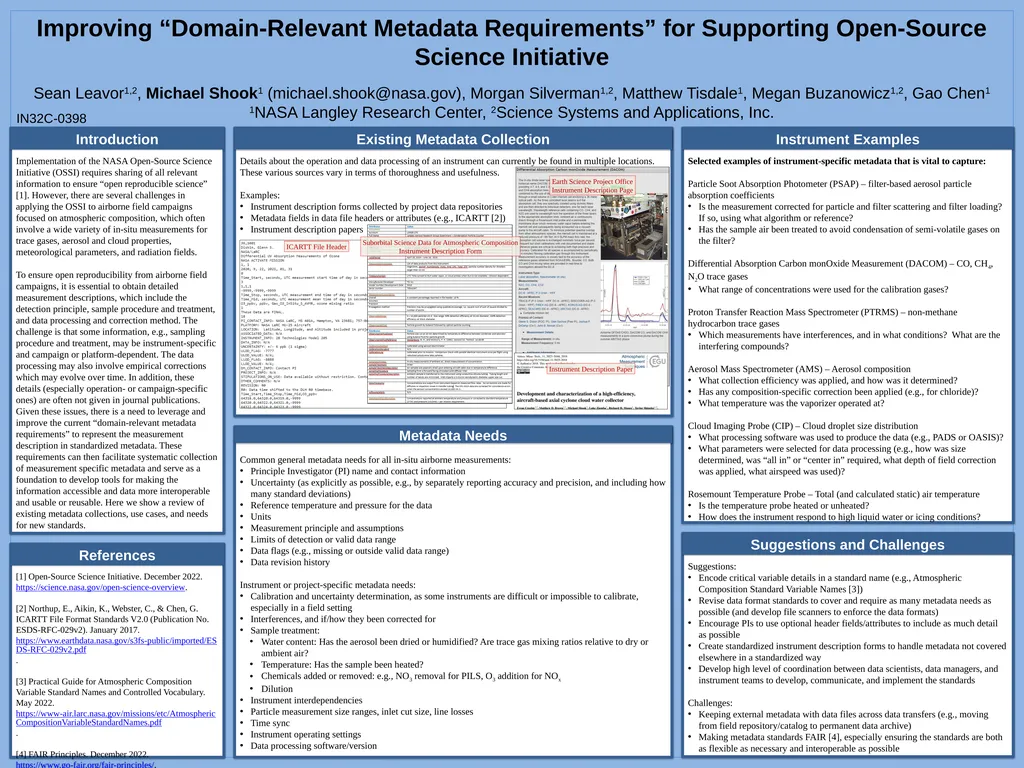
To ensure open reproducibility from airborne field campaigns, it is essential to obtain detailed measurement descriptions, which include the detection principle, sample procedure and treatment, and data processing and correction method. The challenge is that some information, e.g., sampling procedure and treatment, may be instrument-specific and campaign or platform-dependent. The data processing may also involve empirical corrections which may evolve over time. In addition, these details (especially operation- or campaign-specific ones) are often not given in journal publications. Given these issues, there is a need to leverage and improve the current “domain-relevant metadata requirements” to represent the measurement description in standardized metadata. These requirements can then facilitate systematic collection of measurement specific metadata and serve as a foundation to develop tools for making the information accessible and data more interoperable and usable or reusable. Here we show a review of existing metadata collections, use cases, and needs for new standards. Introduction Details about the operation and data processing of an instrument can currently be found in multiple locations. These various sources vary in terms of thoroughness and usefulness.
Examples:
Instrument description forms collected by project data repositories
Metadata fields in data file headers or attributes (e.g., ICARTT [2])
Instrument description papers Existing Metadata Collection Common general metadata needs for all in-situ airborne measurements:
Principle Investigator (PI) name and contact information
Uncertainty (as explicitly as possible, e.g., by separately reporting accuracy and precision, and including how many standard deviations)
Reference temperature and pressure for the data
Units
Measurement principle and assumptions
Limits of detection or valid data range
Data flags (e.g., missing or outside valid data range)
Data revision history
Instrument or project-specific metadata needs:
Calibration and uncertainty determination, as some instruments are difficult or impossible to calibrate, especially in a field setting
Interferences, and if/how they been corrected for
Sample treatment:
Water content: Has the aerosol been dried or humidified? Are trace gas mixing ratios relative to dry or ambient air?
Temperature: Has the sample been heated?
Chemicals added or removed: e.g., NO3 removal for PILS, O3 addition for NOx
Dilution
Instrument interdependencies
Particle measurement size ranges, inlet cut size, line losses
Time sync
Instrument operating settings
Data processing software/version Metadata Needs Selected examples of instrument-specific metadata that is vital to capture:
Particle Soot Absorption Photometer (PSAP) – filter-based aerosol particle absorption coefficients
Is the measurement corrected for particle and filter scattering and filter loading? If so, using what algorithm or reference?
Has the sample air been treated to avoid condensation of semi-volatile gases on the filter?
Differential Absorption Carbon monOxide Measurement (DACOM) – CO, CH4, N2O trace gases
What range of concentrations were used for the calibration gases?
Proton Transfer Reaction Mass Spectrometer (PTRMS) – non-methane hydrocarbon trace gases
Which measurements have interferences, and in what conditions? What are the interfering compounds?
Aerosol Mass Spectrometer (AMS) – Aerosol composition
What collection efficiency was applied, and how was it determined?
Has any composition-specific correction been applied (e.g., for chloride)?
What temperature was the vaporizer operated at?
Cloud Imaging Probe (CIP) – Cloud droplet size distribution
What processing software was used to produce the data (e.g., PADS or OASIS)?
What parameters were selected for data processing (e.g., how was size determined, was “all in” or “center in” required, what depth of field correction was applied, what airspeed was used)?
Rosemount Temperature Probe – Total (and calculated static) air temperature
Is the temperature probe heated or unheated?
How does the instrument respond to high liquid water or icing conditions? Instrument Examples Suggestions:
Encode critical variable details in a standard name (e.g., Atmospheric Composition Standard Variable Names [3])
Revise data format standards to cover and require as many metadata needs as possible (and develop file scanners to enforce the data formats)
Encourage PIs to use optional header fields/attributes to include as much detail as possible
Create standardized instrument description forms to handle metadata not covered elsewhere in a standardized way
Develop high level of coordination between data scientists, data managers, and instrument teams to develop, communicate, and implement the standards
Challenges:
Keeping external metadata with data files across data transfers (e.g., moving from field repository/catalog to permanent data archive)
Making metadata standards FAIR [4], especially ensuring the standards are both as flexible as necessary and interoperable as possible Suggestions and Challenges [1] Open-Source Science Initiative. December 2022. https://science.nasa.gov/open-science-overview.
[2] Northup, E., Aikin, K., Webster, C., & Chen, G. ICARTT File Format Standards V2.0 (Publication No. ESDS-RFC-029v2). January 2017. https://www.earthdata.nasa.gov/s3fs-public/imported/ESDS-RFC-029v2.pdf.
[3] Practical Guide for Atmospheric Composition Variable Standard Names and Controlled Vocabulary. May 2022. https://www-air.larc.nasa.gov/missions/etc/AtmosphericCompositionVariableStandardNames.pdf.
[4] FAIR Principles. December 2022. https://www.go-fair.org/fair-principles/. References ICARTT File Header Suborbital Science Data for Atmospheric Composition�Instrument Description Form Earth Science Project Office
Instrument Description Page Instrument Description Paper<br>