
Improving Practice Ruislip Stars Training -
GB
Published · 34 slides · 0 views
1 / 1


Description
Improving Practice Ruislip Stars Training - October 2024 SEND Awareness Session facilitated and delivered by Shahin Khan What is SEND? Special educational needs and disability (SEND) A child or young person has special educational needs and
Related Topics
Share
Embed code
Download this presentation From Below
"Improving Practice Ruislip Stars Training -" is the property of its rightful owner. Permission is granted to download and print the materials on this website for personal, non-commercial use only, and to display it on your personal computer provided you do not modify the materials and that you retain all copyright notices contained in the materials. By downloading content from our website, you accept the terms of this agreement.
Presentation Transcript
01
Improving Practice Ruislip Stars Training - October 2024
SEND Awareness
Session facilitated and delivered by Shahin Khan<br>
SEND Awareness
Session facilitated and delivered by Shahin Khan<br>
02
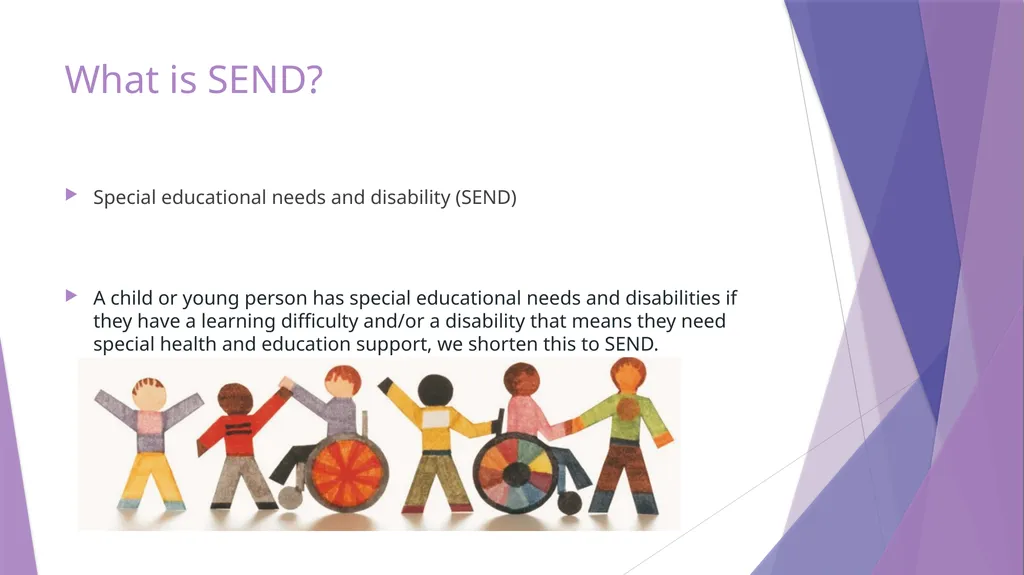
What is SEND? Special educational needs and disability (SEND)
A child or young person has special educational needs and disabilities if they have a learning difficulty and/or a disability that means they need special health and education support, we shorten this to SEND.<br>
A child or young person has special educational needs and disabilities if they have a learning difficulty and/or a disability that means they need special health and education support, we shorten this to SEND.<br>
03
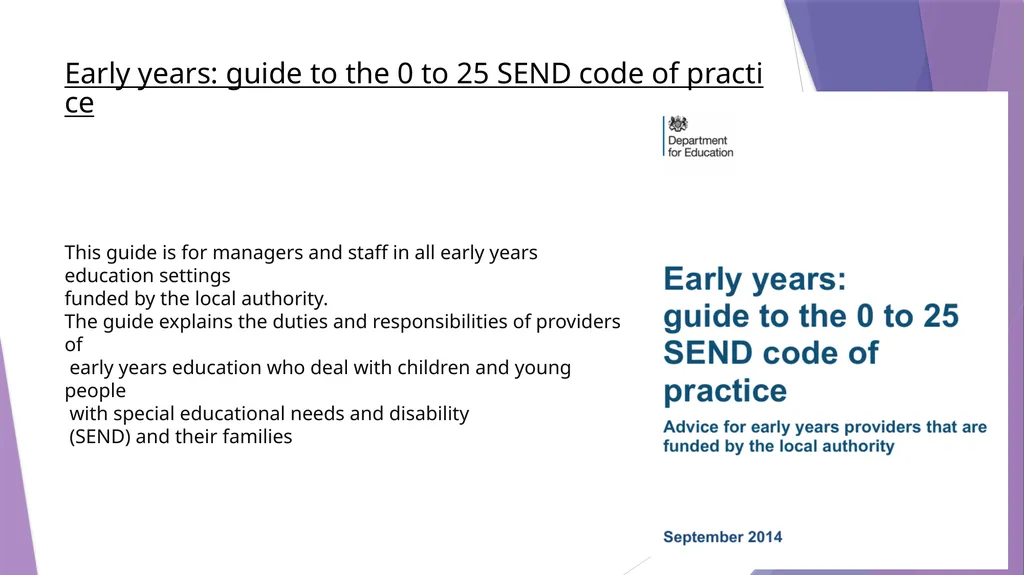
Early years: guide to the 0 to 25 SEND code of practice This guide is for managers and staff in all early years education settings
funded by the local authority.
The guide explains the duties and responsibilities of providers of
early years education who deal with children and young people
with special educational needs and disability
(SEND) and their families<br>
funded by the local authority.
The guide explains the duties and responsibilities of providers of
early years education who deal with children and young people
with special educational needs and disability
(SEND) and their families<br>
04
Principles underlying the Code
The SEND Code of Practice describes the principles that should be observed by all
professionals working with children and young people who have SEN or disabilities. These include:
• taking into account the views of children, young people and their families
• enabling children, young people and their parents to participate in decision-making
• collaborating with partners in education, health and social care to provide support
• identifying the needs of children and young people
• making high quality provision to meet the needs of children and young people
• focusing on inclusive practices and removing barriers to learning
• helping children and young people to prepare for adulthood<br>
• taking into account the views of children, young people and their families
• enabling children, young people and their parents to participate in decision-making
• collaborating with partners in education, health and social care to provide support
• identifying the needs of children and young people
• making high quality provision to meet the needs of children and young people
• focusing on inclusive practices and removing barriers to learning
• helping children and young people to prepare for adulthood<br>
05
Group work In your groups discuss and identify possible signs which you think may be SEND indicators
10 mins - signs / Potential SEND Area<br>
10 mins - signs / Potential SEND Area<br>
06
Signs and indicators of SEND<br>
07
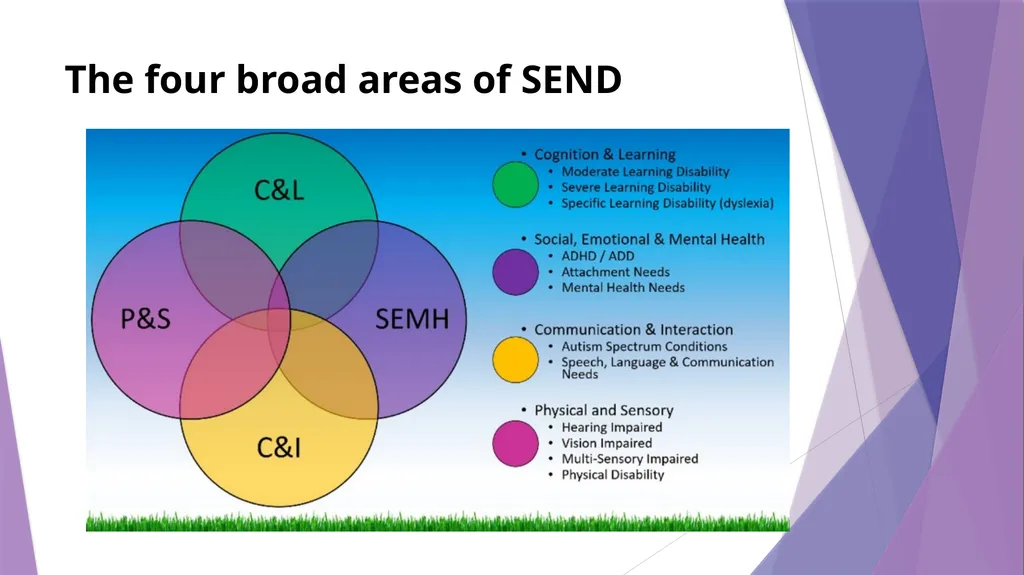
The four broad areas of SEND<br>
08
Identifying SEND – it’s simple a child is making a lot slower progress than other children of the same age.
a child is not matching or improving on their previous progress.
the gap in progress between a child and other children the same age is getting wider<br>
a child is not matching or improving on their previous progress.
the gap in progress between a child and other children the same age is getting wider<br>
09
Key person review meetings So what it it that you talk about at these meetings:
Surely not just going over established facts…. Age, family, ethnicity
What element of your conversation is about development and concern
Are any action plan’s agreed?<br>
Surely not just going over established facts…. Age, family, ethnicity
What element of your conversation is about development and concern
Are any action plan’s agreed?<br>
10
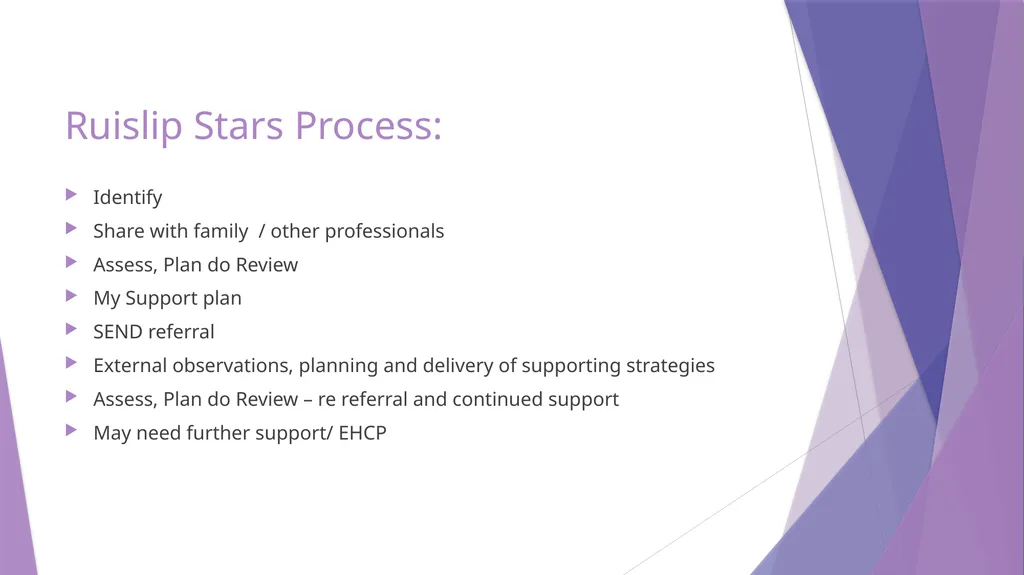
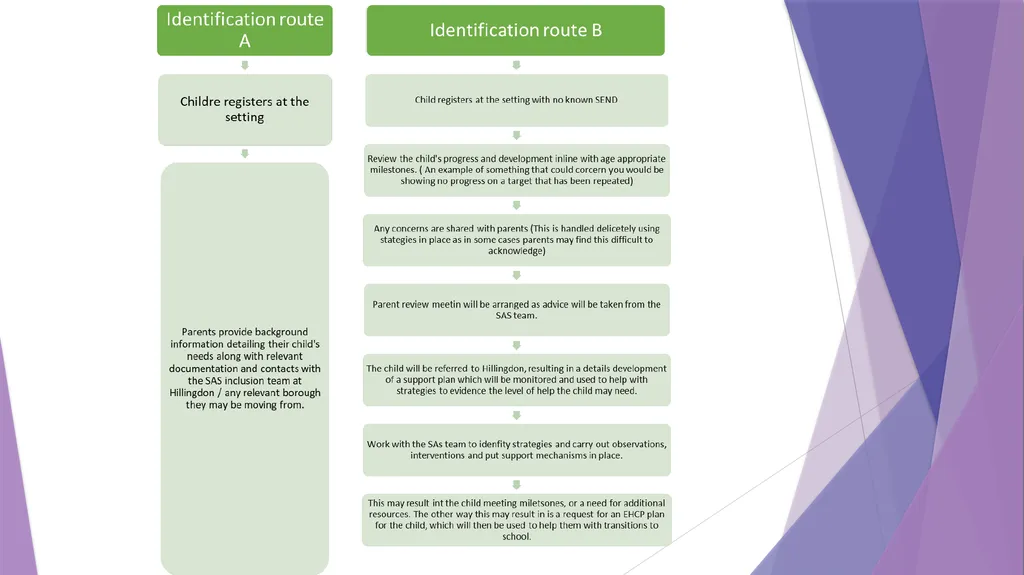
Ruislip Stars Process: Identify
Share with family / other professionals
Assess, Plan do Review
My Support plan
SEND referral
External observations, planning and delivery of supporting strategies
Assess, Plan do Review – re referral and continued support
May need further support/ EHCP<br>
Share with family / other professionals
Assess, Plan do Review
My Support plan
SEND referral
External observations, planning and delivery of supporting strategies
Assess, Plan do Review – re referral and continued support
May need further support/ EHCP<br>
11
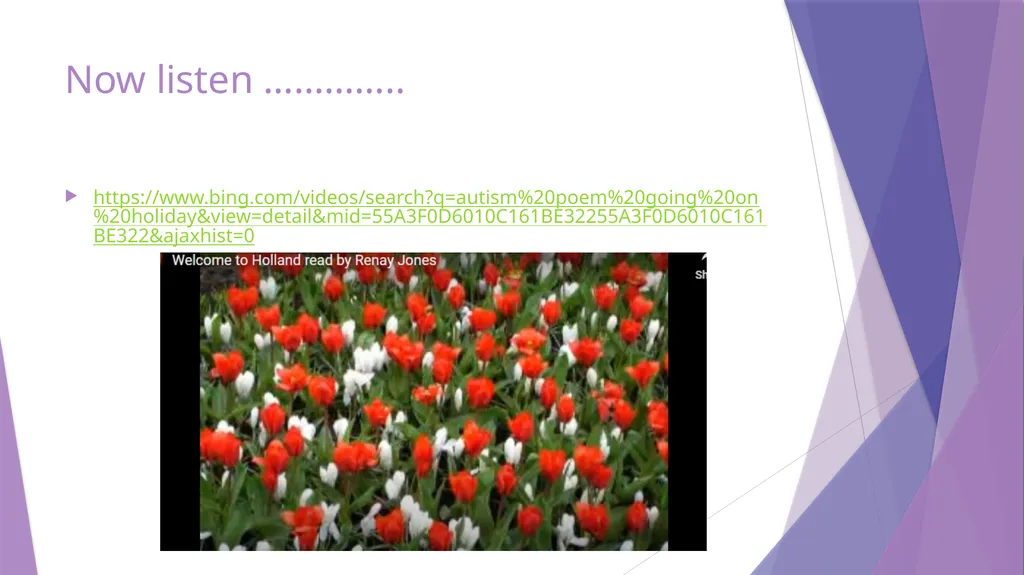
Now listen ………….. https://www.bing.com/videos/search?q=autism%20poem%20going%20on%20holiday&view=detail&mid=55A3F0D6010C161BE32255A3F0D6010C161BE322&ajaxhist=0<br>
12
Development is a continuous process which is influenced by many factors. Emotional Health and Wellbeing – Early relationships strongly influence how children develop, and having close, secure attachment to their carers is important for their healthy development.
Physical Health and Wellbeing - Being physically healthy includes having nutritious food, a clean and safe environment, appropriate clothes; healthcare; mental stimulation; movement and activity; rest and sleep; access to the outdoors and loving relationships.<br>
Physical Health and Wellbeing - Being physically healthy includes having nutritious food, a clean and safe environment, appropriate clothes; healthcare; mental stimulation; movement and activity; rest and sleep; access to the outdoors and loving relationships.<br>
13
Development is a continuous process which is influenced by many factors. Individual Pathways - Children develop in different ways and rates of development vary from child to child, and from time to time. Each child’s unique history is important as the starting point for supporting their development and learning.
Child as an Active Learner - Children are innately driven to become more competent, and they find and embrace the next stages in their development and learning, meeting challenges and practising to develop their skills and independence.
The emotional and physical environment should enable and encourage children to feel able to take risks and try things out, build their competence and confidence through repetition, and feel satisfaction at their own achievements, as well as accepting what doesn’t work.<br>
Child as an Active Learner - Children are innately driven to become more competent, and they find and embrace the next stages in their development and learning, meeting challenges and practising to develop their skills and independence.
The emotional and physical environment should enable and encourage children to feel able to take risks and try things out, build their competence and confidence through repetition, and feel satisfaction at their own achievements, as well as accepting what doesn’t work.<br>
14
Development is a continuous process which is influenced by many factors. Interactions-
Sensitive and skilful adults play a key role in supporting development and learning, through observing children and deciding when to step back and when to offer support, encouragement and stimulation for children’s own efforts.
Children’s language is enriched and enhanced by back-and-forth exchanges with practitioners who respect and respond to children’s conversation.
The adult’s role as co-regulator is critical in a child’s development of self-regulation. As they observe and interact with their peers and adults, children gradually move from the experience of being supported in managing their feelings, thoughts and behaviour, to developing the ability to regulate these more independently.<br>
Sensitive and skilful adults play a key role in supporting development and learning, through observing children and deciding when to step back and when to offer support, encouragement and stimulation for children’s own efforts.
Children’s language is enriched and enhanced by back-and-forth exchanges with practitioners who respect and respond to children’s conversation.
The adult’s role as co-regulator is critical in a child’s development of self-regulation. As they observe and interact with their peers and adults, children gradually move from the experience of being supported in managing their feelings, thoughts and behaviour, to developing the ability to regulate these more independently.<br>
15
Development is a continuous process which is influenced by many factors. Experiences - Children build on their experiences; the wider and deeper their exposure, the further potential they have for secure development.
Children need opportunities to practise what they know, to consolidate and apply learning from one context to another, and to develop new knowledge and skills. Children will build on experiences in the natural, built and virtual worlds.<br>
Children need opportunities to practise what they know, to consolidate and apply learning from one context to another, and to develop new knowledge and skills. Children will build on experiences in the natural, built and virtual worlds.<br>
16
Development is a continuous process which is influenced by many factors. Culture and Community Development and learning are enhanced when there are connections and relationships between early childhood settings, home and other places and spaces in children’s lives.
Connections across environments support children to bring their interests and ‘funds of knowledge’ that may provide an anchor for them and an impetus for their learning.
Children and families need to feel secure, accepted and that they belong – both within and beyond a setting. Diversity of communities must be respected and celebrated, widening each child’s sense of belonging and sense of place in the community, while the uniqueness of each family, regardless of differences, is acknowledged and honoured.<br>
Connections across environments support children to bring their interests and ‘funds of knowledge’ that may provide an anchor for them and an impetus for their learning.
Children and families need to feel secure, accepted and that they belong – both within and beyond a setting. Diversity of communities must be respected and celebrated, widening each child’s sense of belonging and sense of place in the community, while the uniqueness of each family, regardless of differences, is acknowledged and honoured.<br>
17
Early Years Development Journal Current children on our SEND register
Prime Areas – review at home and nursery against development progress<br>
Prime Areas – review at home and nursery against development progress<br>
18
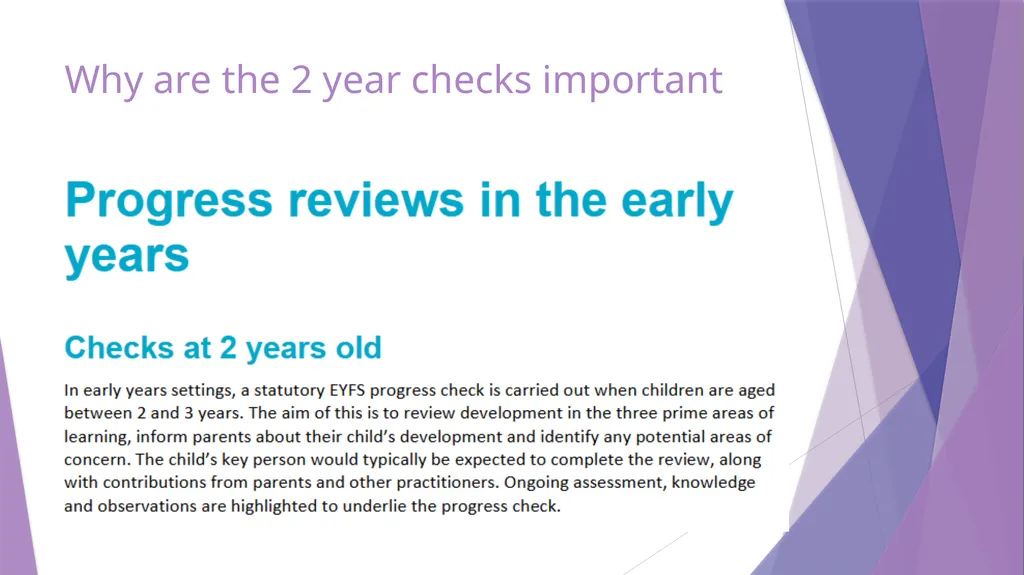
Why are the 2 year checks important<br>
19
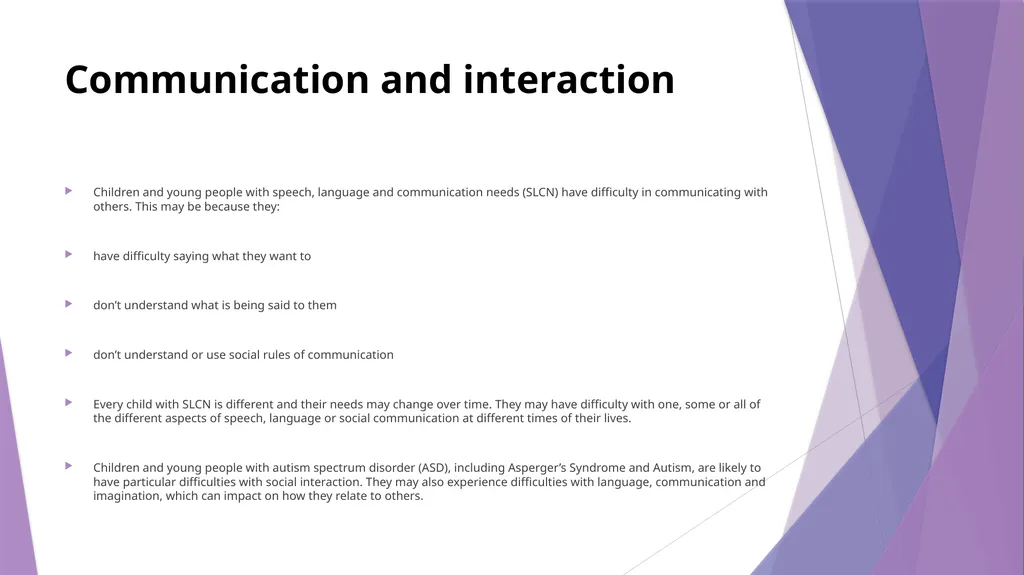
Communication and interaction Children and young people with speech, language and communication needs (SLCN) have difficulty in communicating with others. This may be because they:
have difficulty saying what they want to
don’t understand what is being said to them
don’t understand or use social rules of communication
Every child with SLCN is different and their needs may change over time. They may have difficulty with one, some or all of the different aspects of speech, language or social communication at different times of their lives.
Children and young people with autism spectrum disorder (ASD), including Asperger’s Syndrome and Autism, are likely to have particular difficulties with social interaction. They may also experience difficulties with language, communication and imagination, which can impact on how they relate to others.<br>
have difficulty saying what they want to
don’t understand what is being said to them
don’t understand or use social rules of communication
Every child with SLCN is different and their needs may change over time. They may have difficulty with one, some or all of the different aspects of speech, language or social communication at different times of their lives.
Children and young people with autism spectrum disorder (ASD), including Asperger’s Syndrome and Autism, are likely to have particular difficulties with social interaction. They may also experience difficulties with language, communication and imagination, which can impact on how they relate to others.<br>
20
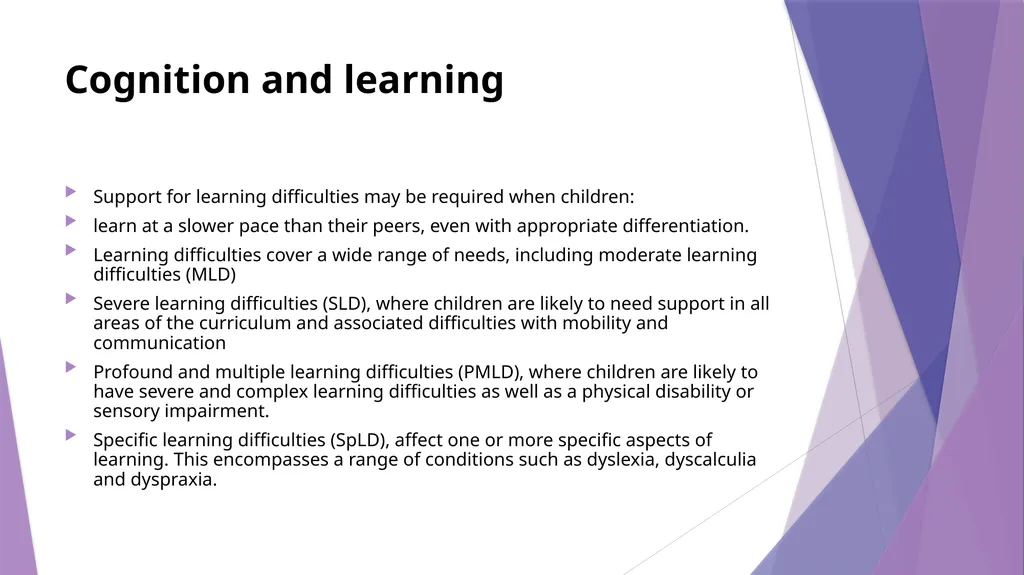
Cognition and learning Support for learning difficulties may be required when children:
learn at a slower pace than their peers, even with appropriate differentiation.
Learning difficulties cover a wide range of needs, including moderate learning difficulties (MLD)
Severe learning difficulties (SLD), where children are likely to need support in all areas of the curriculum and associated difficulties with mobility and communication
Profound and multiple learning difficulties (PMLD), where children are likely to have severe and complex learning difficulties as well as a physical disability or sensory impairment.
Specific learning difficulties (SpLD), affect one or more specific aspects of learning. This encompasses a range of conditions such as dyslexia, dyscalculia and dyspraxia.<br>
learn at a slower pace than their peers, even with appropriate differentiation.
Learning difficulties cover a wide range of needs, including moderate learning difficulties (MLD)
Severe learning difficulties (SLD), where children are likely to need support in all areas of the curriculum and associated difficulties with mobility and communication
Profound and multiple learning difficulties (PMLD), where children are likely to have severe and complex learning difficulties as well as a physical disability or sensory impairment.
Specific learning difficulties (SpLD), affect one or more specific aspects of learning. This encompasses a range of conditions such as dyslexia, dyscalculia and dyspraxia.<br>
21
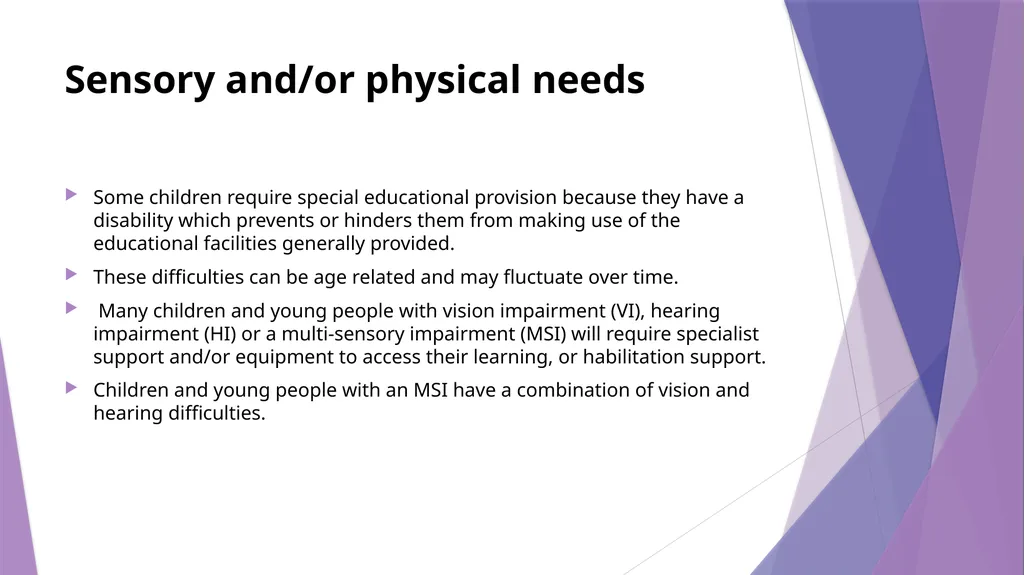
Sensory and/or physical needs Some children require special educational provision because they have a disability which prevents or hinders them from making use of the educational facilities generally provided.
These difficulties can be age related and may fluctuate over time.
Many children and young people with vision impairment (VI), hearing impairment (HI) or a multi-sensory impairment (MSI) will require specialist support and/or equipment to access their learning, or habilitation support.
Children and young people with an MSI have a combination of vision and hearing difficulties.<br>
These difficulties can be age related and may fluctuate over time.
Many children and young people with vision impairment (VI), hearing impairment (HI) or a multi-sensory impairment (MSI) will require specialist support and/or equipment to access their learning, or habilitation support.
Children and young people with an MSI have a combination of vision and hearing difficulties.<br>
22
Social, emotional and mental health difficulties Children and young people may experience a wide range of social and emotional difficulties which manifest themselves in many ways.
These may include becoming withdrawn or isolated, as well as displaying challenging, disruptive or disturbing behaviour.
These behaviours may reflect underlying mental health difficulties such as anxiety or depression, self-harming, substance misuse, eating disorders or physical symptoms that are medically unexplained.
Other children may have disorders such as attention deficit disorder, attention deficit hyperactive disorder or attachment disorder.
What is our process here at the setting?<br>
These may include becoming withdrawn or isolated, as well as displaying challenging, disruptive or disturbing behaviour.
These behaviours may reflect underlying mental health difficulties such as anxiety or depression, self-harming, substance misuse, eating disorders or physical symptoms that are medically unexplained.
Other children may have disorders such as attention deficit disorder, attention deficit hyperactive disorder or attachment disorder.
What is our process here at the setting?<br>
23
What things affect development In your groups think of at least 3 children and the things that impact their development at the setting<br>
24
Transitions High quality transitions recognise the importance of feeling ‘known’.
Transitions within the same setting or moving to a more structured part of the day such as lunchtime.
It is vital that children’s emotional, physical, social and educational needs are sensitively addressed at all these points of transition and transfer so that children can thrive and flourish in situations that are unfamiliar to them.
Moving from a place or situation in which children feel ‘known’ into one in which they feel ‘unknown’ can raise insecurities about having their needs met.
While some children have the resilience to cope with change, others are more vulnerable to uncertainty.
Some children are particularly vulnerable at times of transition. Children who lack confidence or have low self-esteem, those who are too young yet to have skills of self-regulation, or those who have simply had to cope with too much change or loss in their young lives may all be vulnerable at times of transition<br>
Transitions within the same setting or moving to a more structured part of the day such as lunchtime.
It is vital that children’s emotional, physical, social and educational needs are sensitively addressed at all these points of transition and transfer so that children can thrive and flourish in situations that are unfamiliar to them.
Moving from a place or situation in which children feel ‘known’ into one in which they feel ‘unknown’ can raise insecurities about having their needs met.
While some children have the resilience to cope with change, others are more vulnerable to uncertainty.
Some children are particularly vulnerable at times of transition. Children who lack confidence or have low self-esteem, those who are too young yet to have skills of self-regulation, or those who have simply had to cope with too much change or loss in their young lives may all be vulnerable at times of transition<br>
25
Transitions Many children become anxious about making new relationships, whether those are with other children or with the adults with whom they will spend their time. The support of friends and friendship groups helps protect children from the potentially negative impact of transitions.<br>
26
Transitions are opportunities for professional dialogue. Points of transition can provide excellent opportunities for professional dialogue
It is the responsibility of all early years practitioners to ensure that children feel welcomed, gain a sense of belonging and are helped to settle happily so that they can thrive and develop a sense of wellbeing and belonging within their new setting.
Practitioners will spend time observing the children as they settle in the setting, which will promote further professional dialogue with colleagues and support practitioners’ understanding of each child.<br>
It is the responsibility of all early years practitioners to ensure that children feel welcomed, gain a sense of belonging and are helped to settle happily so that they can thrive and develop a sense of wellbeing and belonging within their new setting.
Practitioners will spend time observing the children as they settle in the setting, which will promote further professional dialogue with colleagues and support practitioners’ understanding of each child.<br>
27
Transition is a process not an event! It is important to remember that any effective transition is a process rather than an event, and should be planned as such.
Practitioners demonstrate this by enabling children and their families to become as familiar as possible with where children are going and with whom they will be building relationships, before any move actually takes place.<br>
Practitioners demonstrate this by enabling children and their families to become as familiar as possible with where children are going and with whom they will be building relationships, before any move actually takes place.<br>
28
Impact on Safeguarding for children with SEND understand why children with SEND can be more vulnerable to abuse
acknowledge that children with SEND can be abused and know how to act on any concerns
create a safe culture
communicate creatively with children and young people
empower children and young people to express their views, needs and opinions
be responsive to children and young people’s views, needs and opinions
work with parents and other agencies.<br>
acknowledge that children with SEND can be abused and know how to act on any concerns
create a safe culture
communicate creatively with children and young people
empower children and young people to express their views, needs and opinions
be responsive to children and young people’s views, needs and opinions
work with parents and other agencies.<br>
29
Let’s watch for a moment https://www.bing.com/videos/search?q=autistic%20child%20perspective&view=detail&mid=692A050B7DC8F5A1A26E692A050B7DC8F5A1A26E&ajaxhist=0<br>
30
Not one person knows it all
As a team, a collective we can work together to give all our children the best start
There may be a special way of writing a report / referral, - and perhaps experience, but overall - keep it simple
It’s always about the child
Keep talking, about the child!<br>
As a team, a collective we can work together to give all our children the best start
There may be a special way of writing a report / referral, - and perhaps experience, but overall - keep it simple
It’s always about the child
Keep talking, about the child!<br>
31
To make sure we reach out to all our children How can we embed these areas in to our curriculum and delivery?
1. Create a positive and supportive environment for all children without exception
2. Building a graduated approach for the children and their needs
3. Ensure all children have access to high quality teaching
4. Complement high quality teaching with carefully selected small-group and one-to-one interventions
5. Work effectively as a team!<br>
1. Create a positive and supportive environment for all children without exception
2. Building a graduated approach for the children and their needs
3. Ensure all children have access to high quality teaching
4. Complement high quality teaching with carefully selected small-group and one-to-one interventions
5. Work effectively as a team!<br>
32
Help for early years providers : Using the assessment tools<br>