
Indian Gas Example: Arm’s-Length Dedicated


Description: Indian Gas Example: Arms-Length Dedicated Contract in an Index Zone Processed Gas Reporting using Actual Dual Accounting Presented by: Jodie Peterson and Cindy Gothberg Housekeeping All participants are automatically muted. To ask a
Related Topics
Download Presentation
"Indian Gas Example: Arm’s-Length Dedicated" is the property of its rightful owner. Permission is granted to download and print the materials on this website for personal, non-commercial use only, and to display it on your personal computer provided you do not modify the materials and that you retain all copyright notices contained in the materials. By downloading content from our website, you accept the terms of this agreement.
Presentation Transcript
slide1. Indian Gas Example: Arm’s-Length Dedicated Contract in an Index Zone
Processed Gas Reporting using Actual Dual Accounting Presented by: Jodie Peterson and Cindy Gothberg<br>
slide2. Housekeeping All participants are automatically muted. To ask a question, raise your hand, and we’ll call on you to unmute yourself.
We are also monitoring the chat!
If you need assistance with the captioning, please drop that in the chat as well!<br>
slide3. Disclaimer This training does not provide legal advice and should not be construed as stating ONRR’s legal interpretation or position. Rather, this communication serves as guidance for determining value for royalties and is not an appealable decision or order under 30 CFR Part 1290, Subpart B. This guidance is based solely on the information provided and should only be used for the particular issue or question presented at the time of this communication. While this training is not appealable, ONRR may use this guidance in conducting audits and as a basis for demanding additional royalties.<br>
slide4. Scope Check This example is as all-encompassing as we can be without overcomplicating it.
If you have questions specific to your situation, you can always email us at royaltyvaluation@onrr.gov!
RV deals with the valuation aspects of reporting.
Specific 2014 filing questions (backing and re-reporting lines, overrides, upfront edits, etc.) will be most accurately answered by your reporting contact: https://www.onrr.gov/ReportPay/royalty-reporting.htm#contacts
Royalty relief questions can be answered by BLM or BSEE depending on your lease location. 4<br>
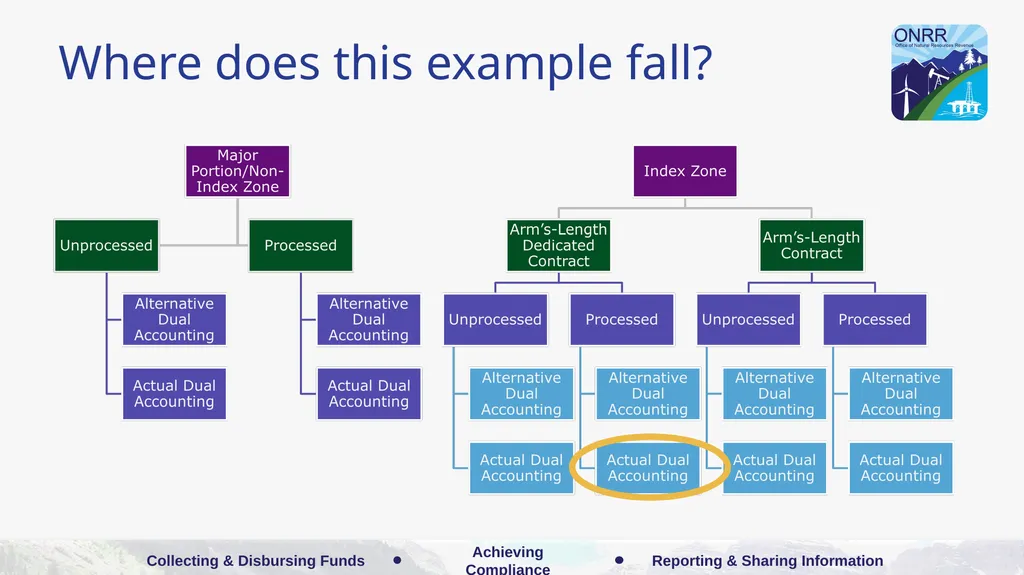
slide5. Where does this example fall?<br>
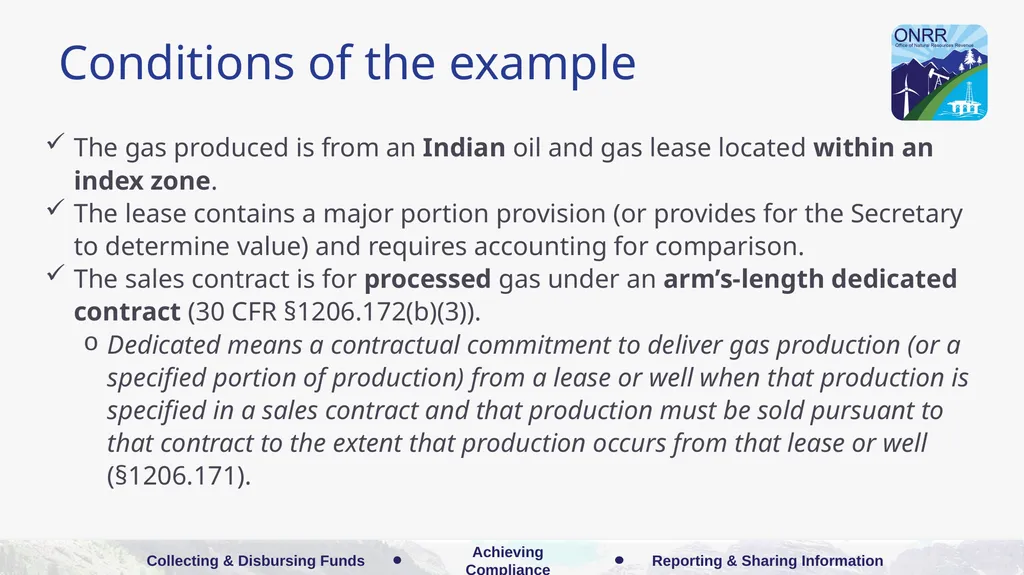
slide6. Conditions of the example The gas produced is from an Indian oil and gas lease located within an index zone.
The lease contains a major portion provision (or provides for the Secretary to determine value) and requires accounting for comparison.
The sales contract is for processed gas under an arm’s-length dedicated contract (30 CFR §1206.172(b)(3)).
Dedicated means a contractual commitment to deliver gas production (or a specified portion of production) from a lease or well when that production is specified in a sales contract and that production must be sold pursuant to that contract to the extent that production occurs from that lease or well (§1206.171).<br>
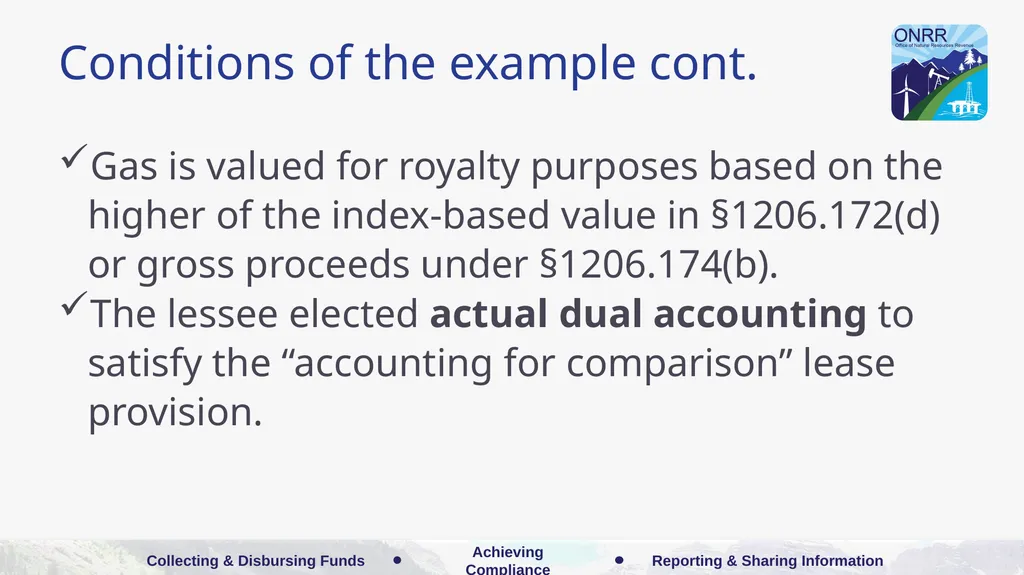
slide7. Conditions of the example cont. Gas is valued for royalty purposes based on the higher of the index-based value in §1206.172(d) or gross proceeds under §1206.174(b).
The lessee elected actual dual accounting to satisfy the “accounting for comparison” lease provision.<br>
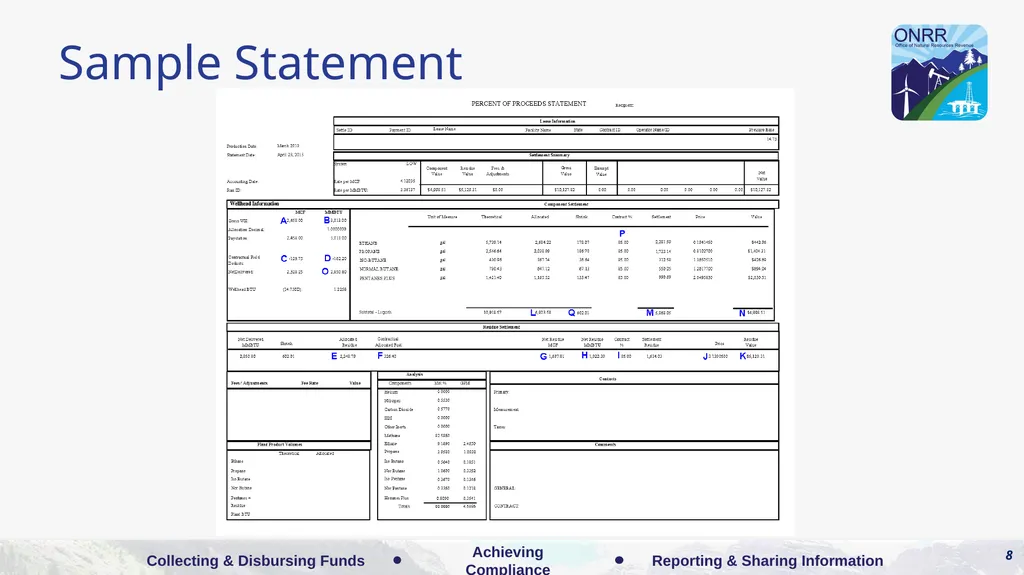
slide8. Sample Statement 8<br>
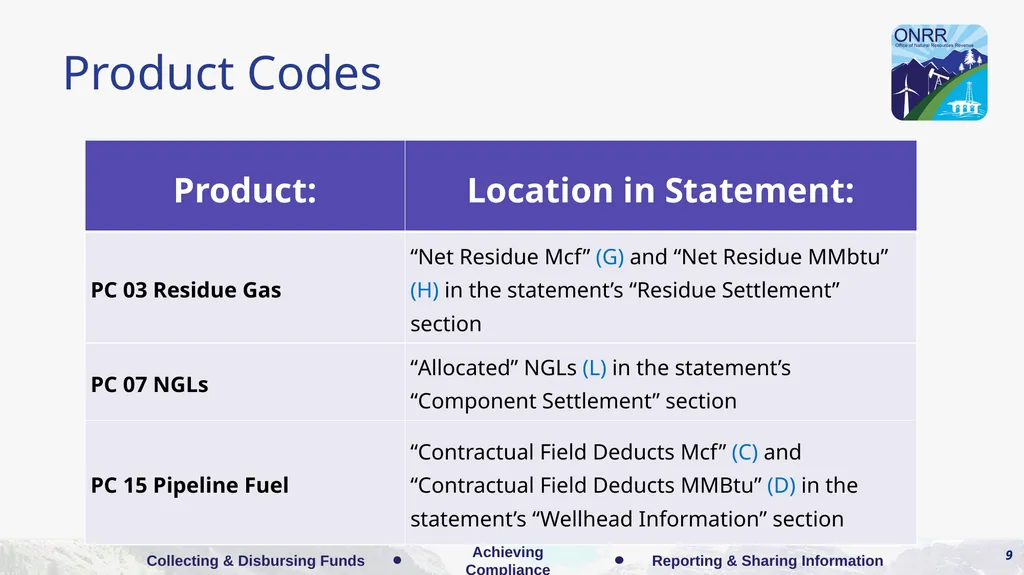
slide9. Product Codes 9<br>
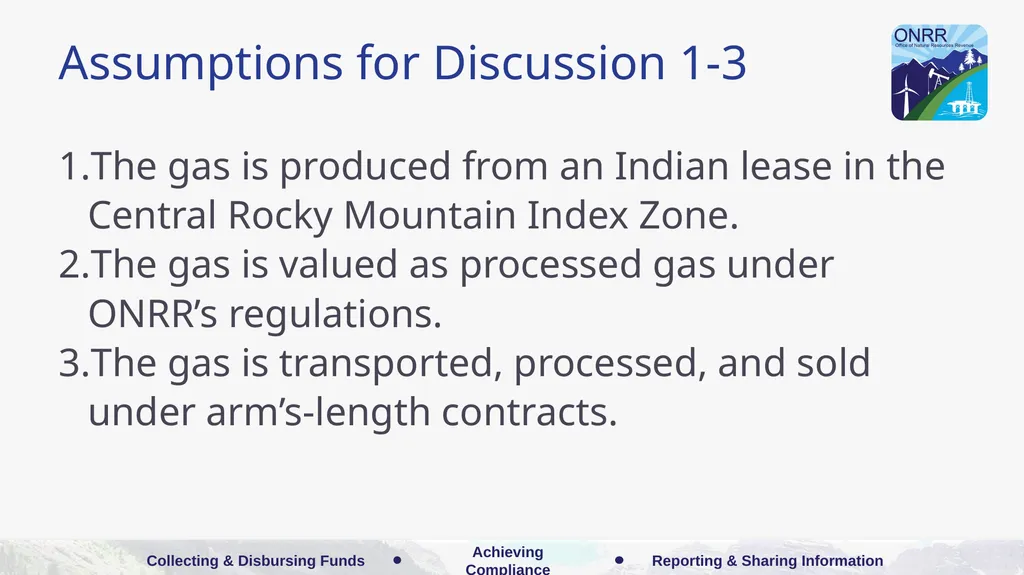
slide10. Assumptions for Discussion 1-3 The gas is produced from an Indian lease in the Central Rocky Mountain Index Zone.
The gas is valued as processed gas under ONRR’s regulations.
The gas is transported, processed, and sold under arm’s-length contracts.<br>
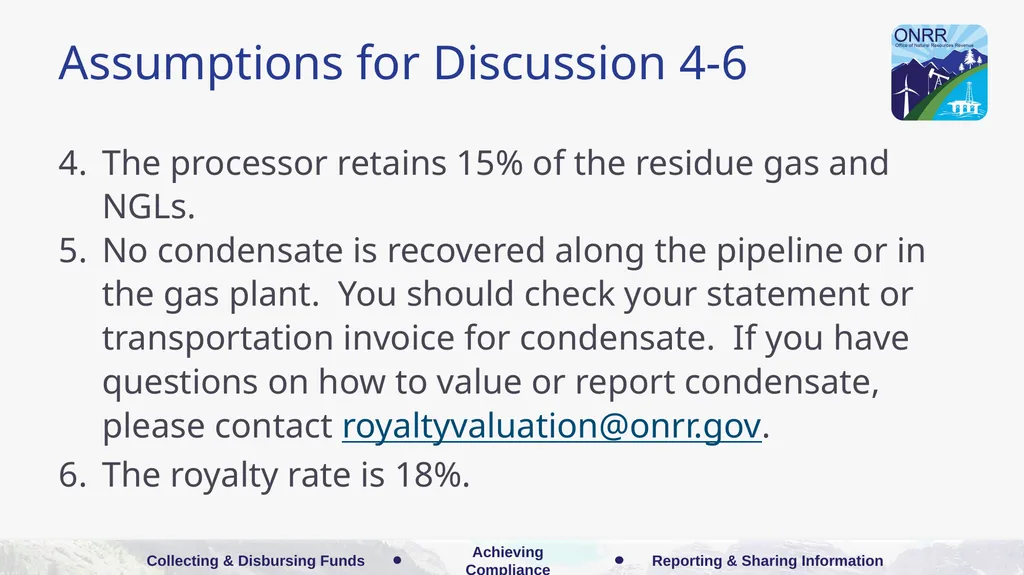
slide11. Assumptions for Discussion 4-6 The processor retains 15% of the residue gas and NGLs.
No condensate is recovered along the pipeline or in the gas plant. You should check your statement or transportation invoice for condensate. If you have questions on how to value or report condensate, please contact royaltyvaluation@onrr.gov.
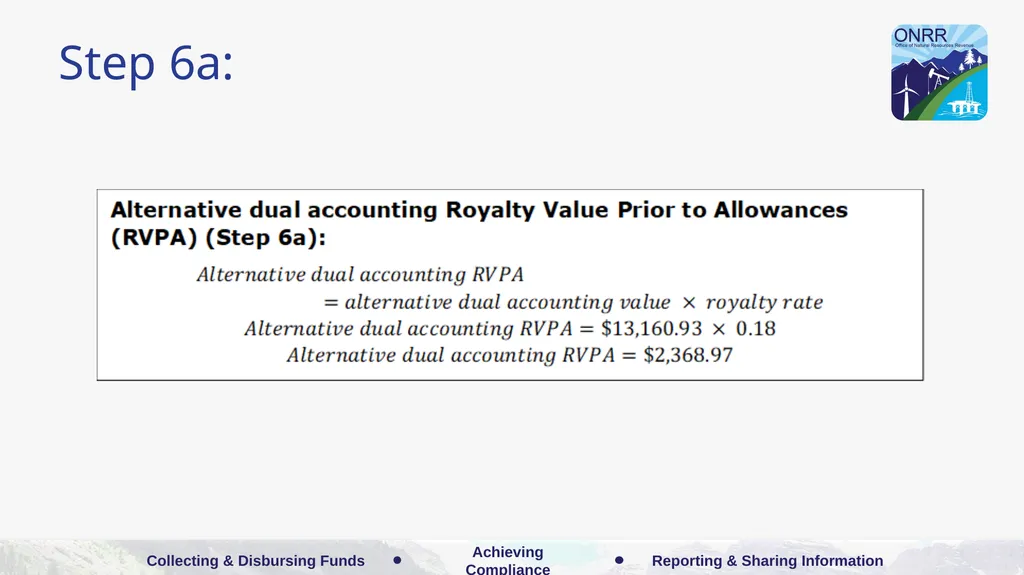
The royalty rate is 18%.<br>
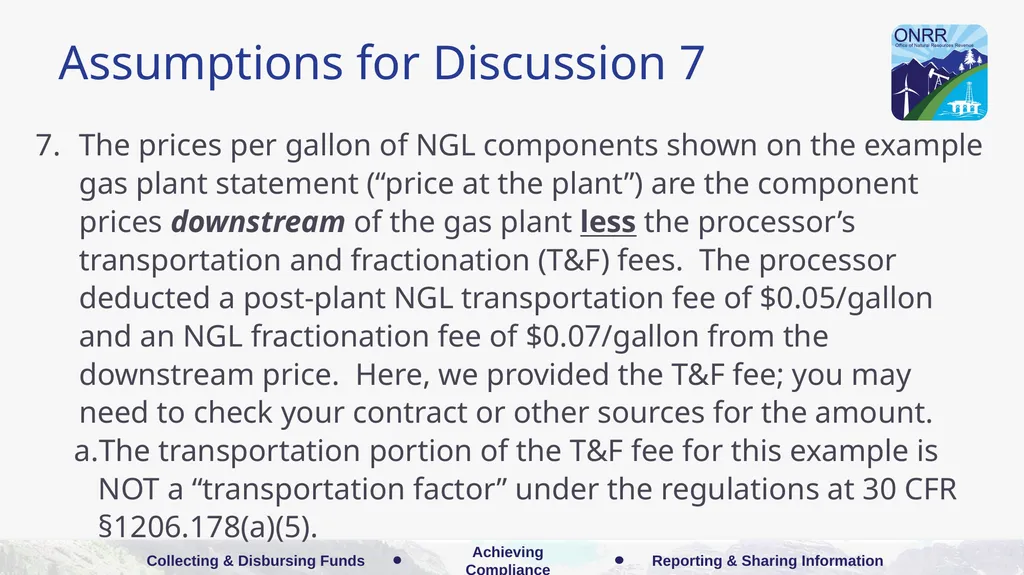
slide12. Assumptions for Discussion 7 The prices per gallon of NGL components shown on the example gas plant statement (“price at the plant”) are the component prices downstream of the gas plant less the processor’s transportation and fractionation (T&F) fees. The processor deducted a post-plant NGL transportation fee of $0.05/gallon and an NGL fractionation fee of $0.07/gallon from the downstream price. Here, we provided the T&F fee; you may need to check your contract or other sources for the amount.
The transportation portion of the T&F fee for this example is NOT a “transportation factor” under the regulations at 30 CFR §1206.178(a)(5).<br>
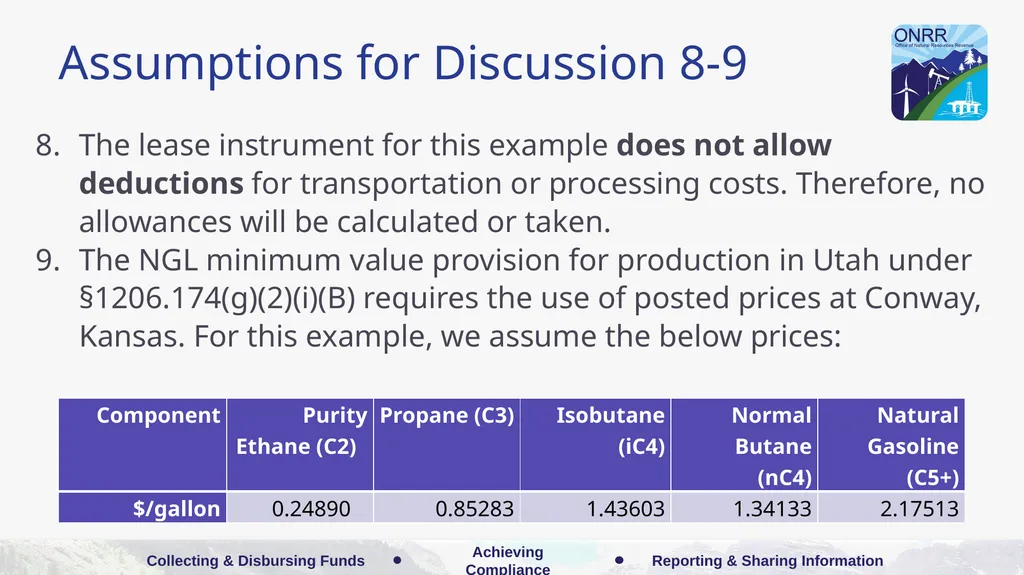
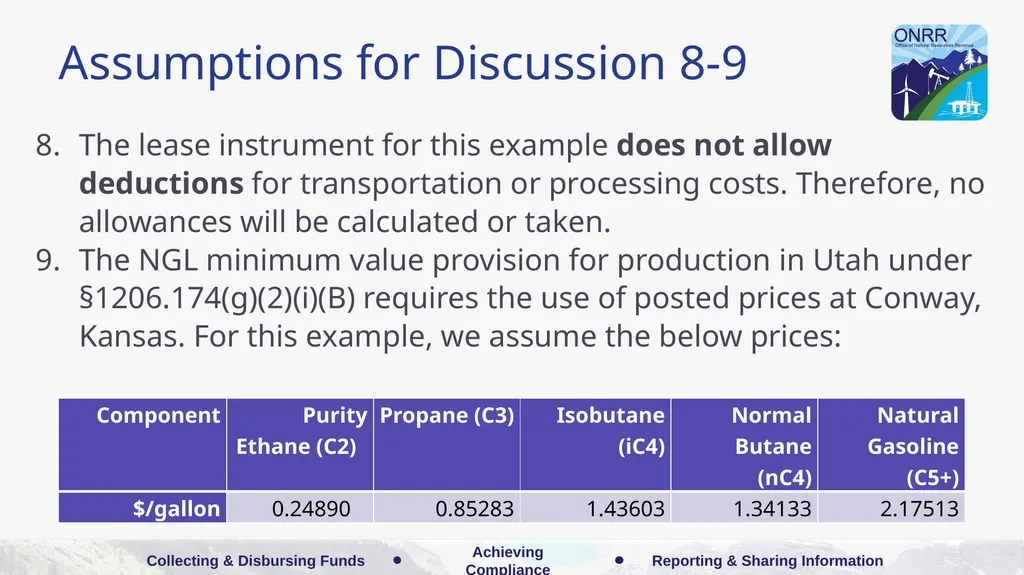
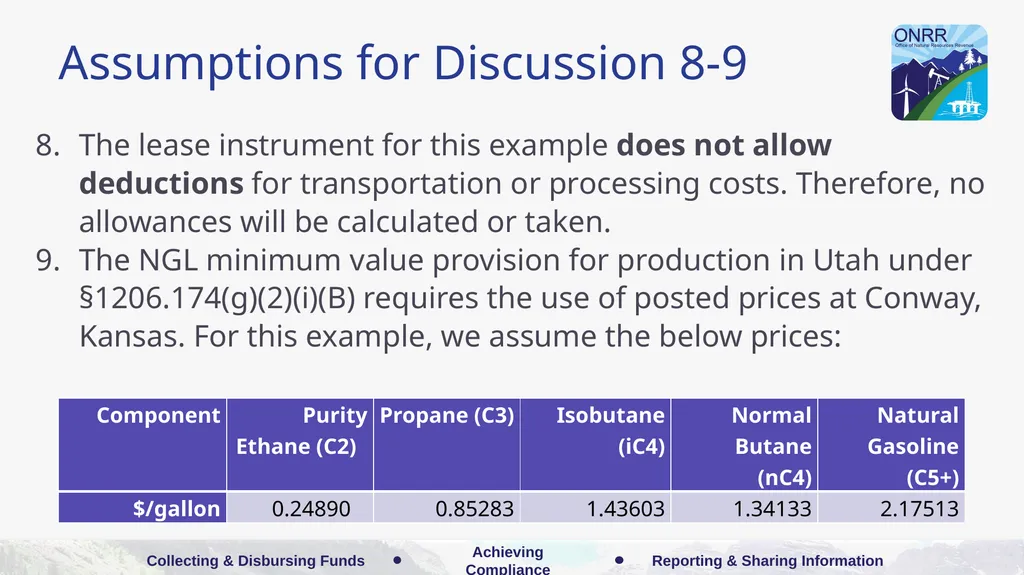
slide13. Assumptions for Discussion 8-9 The lease instrument for this example does not allow deductions for transportation or processing costs. Therefore, no allowances will be calculated or taken.
The NGL minimum value provision for production in Utah under §1206.174(g)(2)(i)(B) requires the use of posted prices at Conway, Kansas. For this example, we assume the below prices:<br>
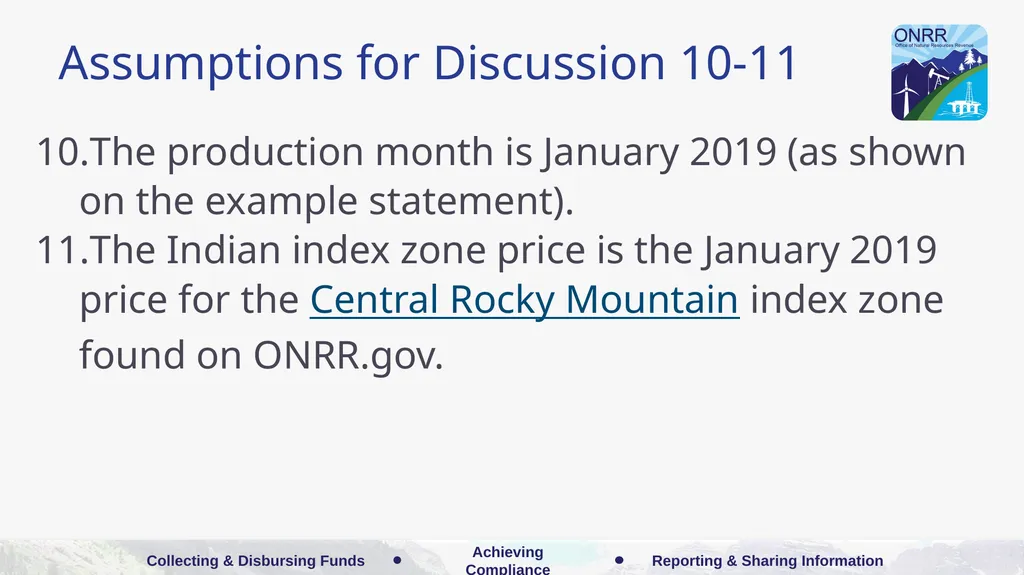
slide14. Assumptions for Discussion 10-11 The production month is January 2019 (as shown on the example statement).
The Indian index zone price is the January 2019 price for the Central Rocky Mountain index zone found on ONRR.gov.<br>
slide15. Locating the Indian Index Zone Price Each month ONRR publishes natural gas prices for six Indian Index Zones as referenced in §1206.172. You can find the prices on the Indian Gas Index Zone Prices web page.<br>
slide16. Determining Dual Accounting Many Indian leases require accounting for comparison, or “dual accounting” (ONRR added emphasis):
“… and that royalty will be computed on the value of gas or casinghead gas, or on the products thereof (such as residue gas, natural gasoline, propane, butane, etc.), whichever is the greater.”<br>
slide17. Three step calculation process: Calculate the gross proceeds received for the gas sale under §1206.174.
Calculate the actual dual accounting value.
Compare the values determined in steps 1 and 2 and report and pay on the higher value.<br>
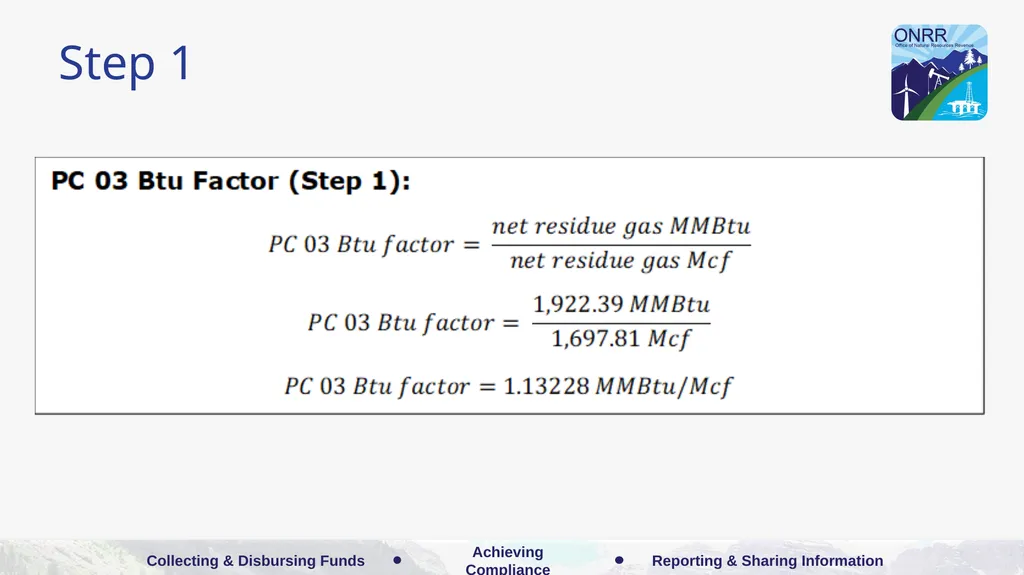
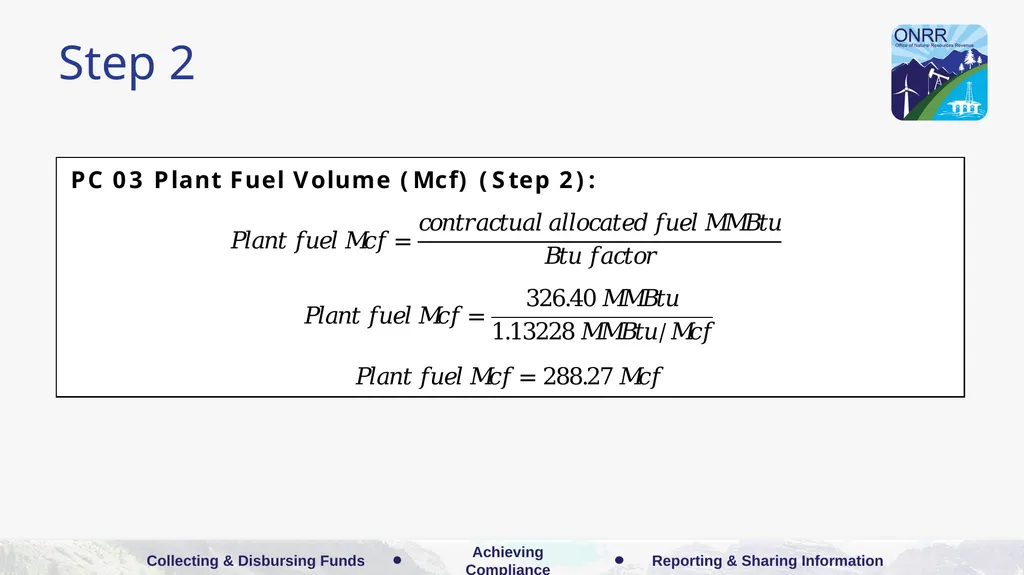
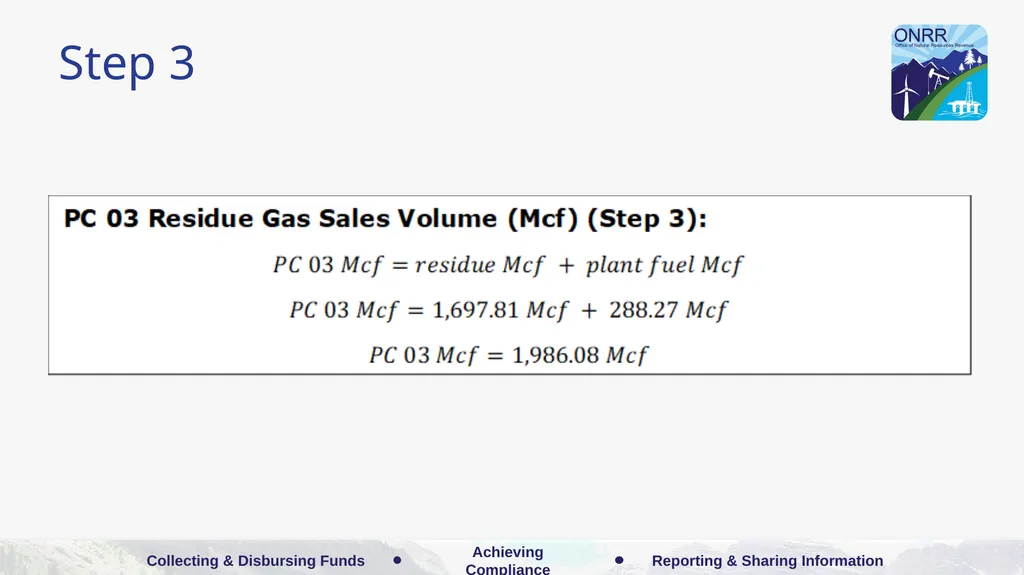
slide18. Part A – Calculate the Gross Proceeds PC 03 Residue Gas<br>
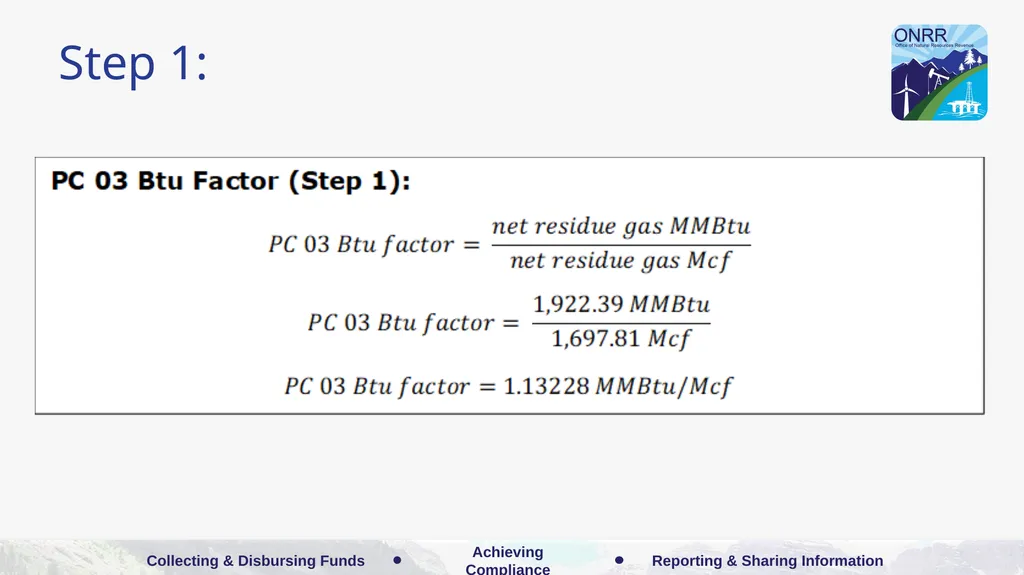
slide19. Step 1:<br>
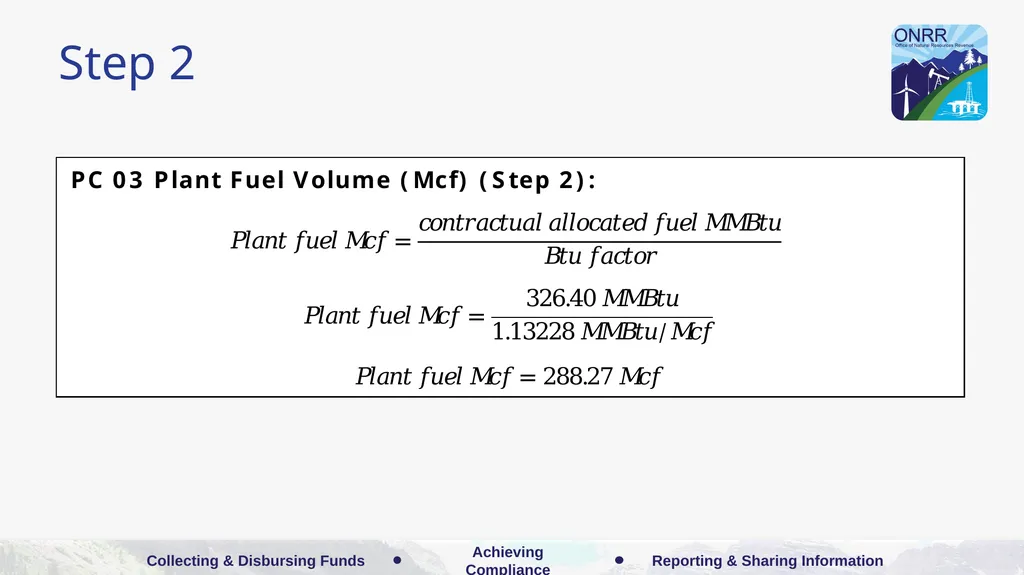
slide20. Step 2<br>
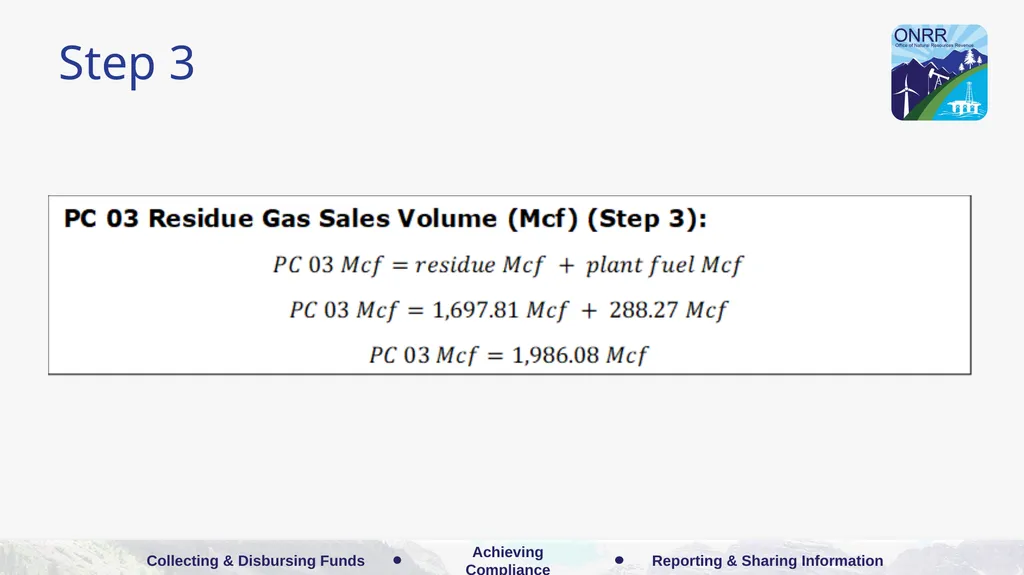
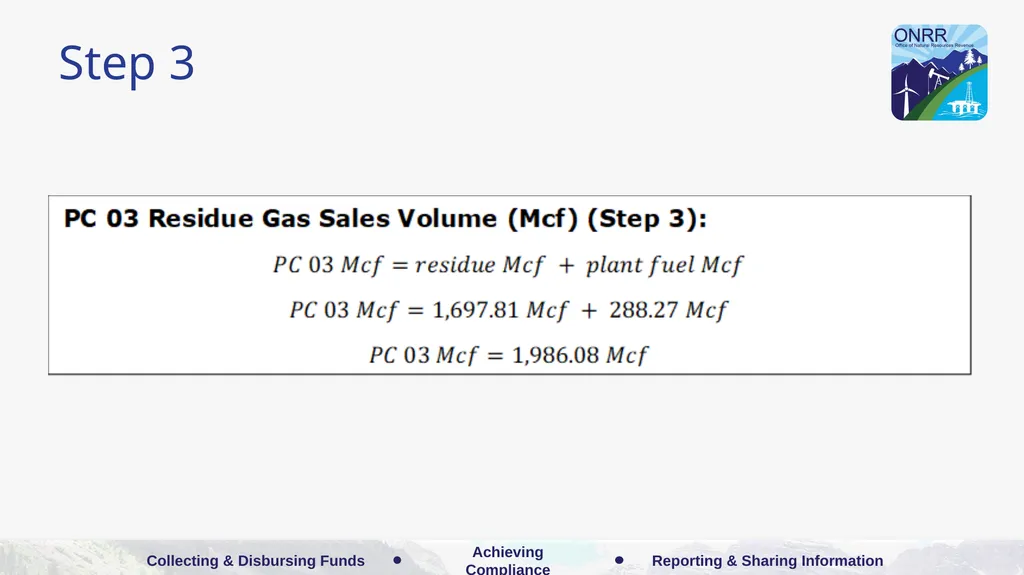
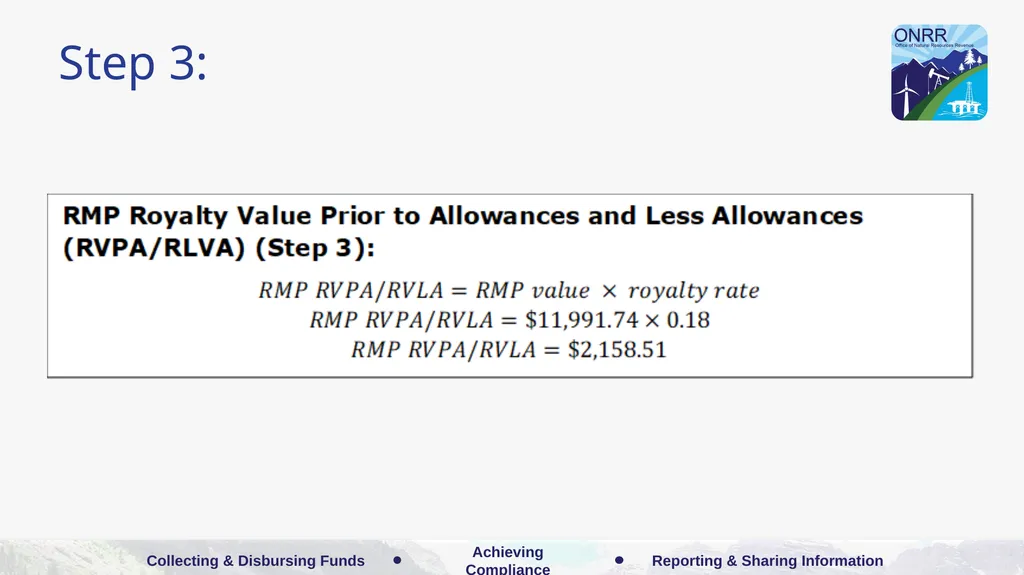
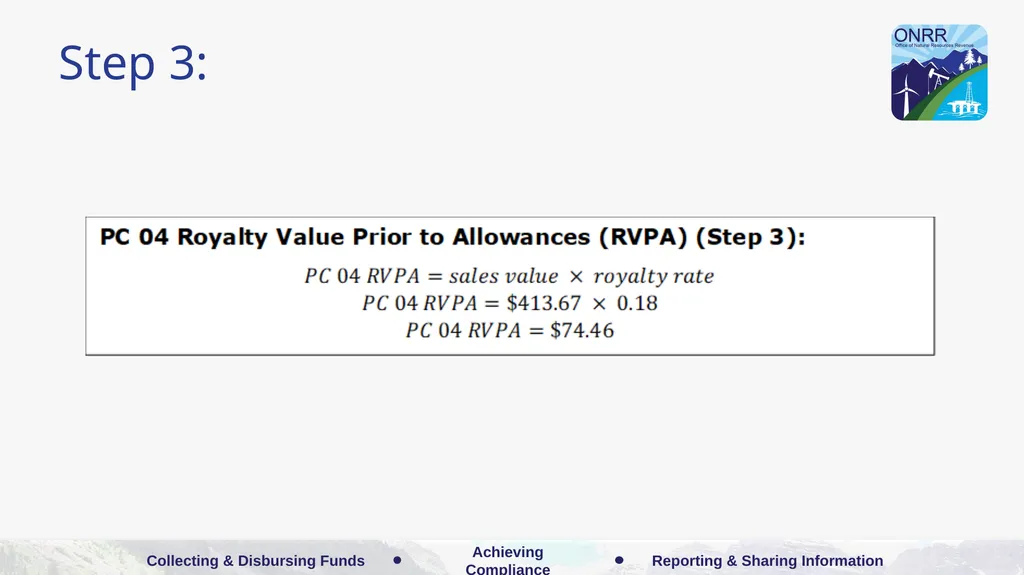
slide21. Step 3<br>
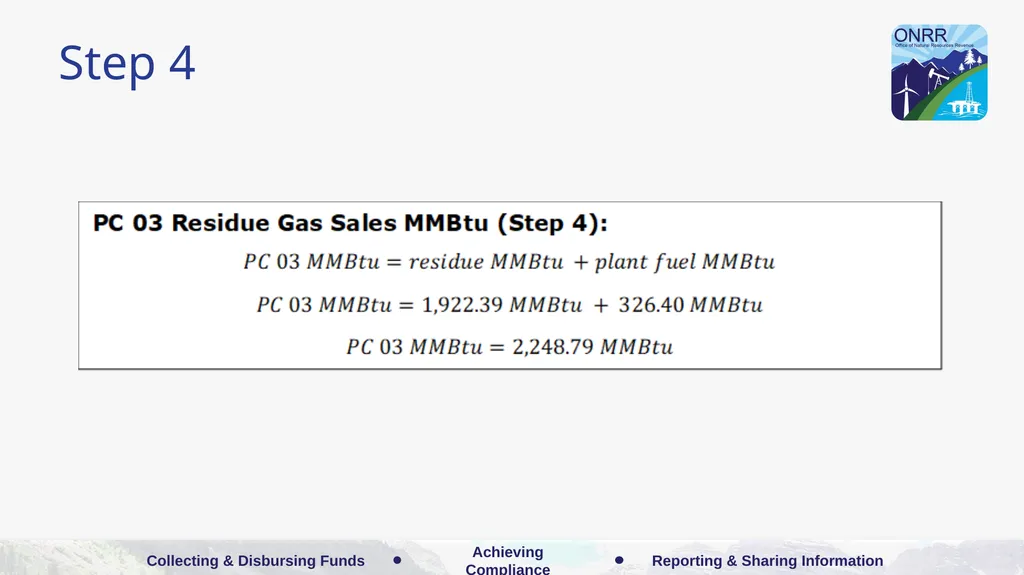
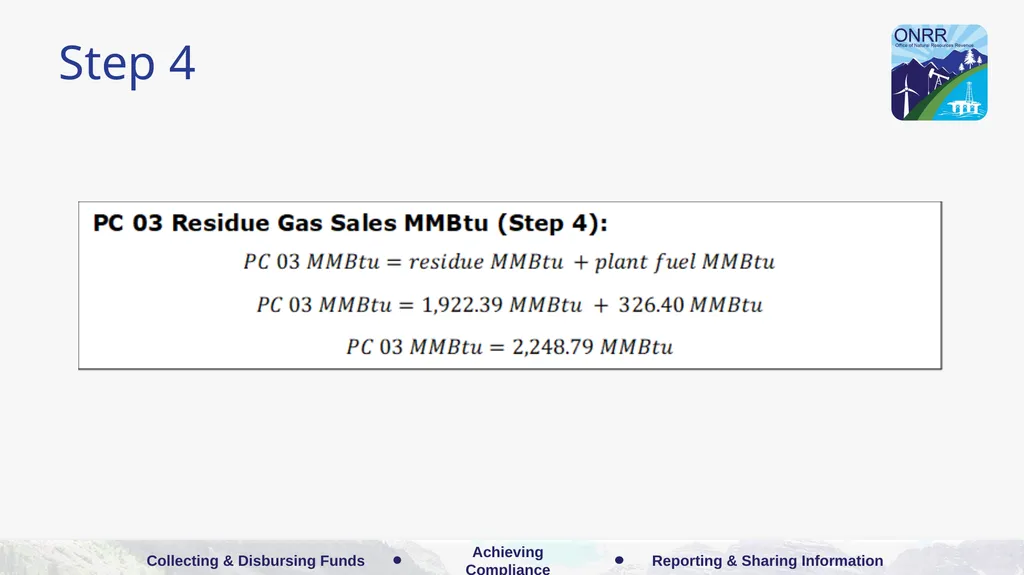
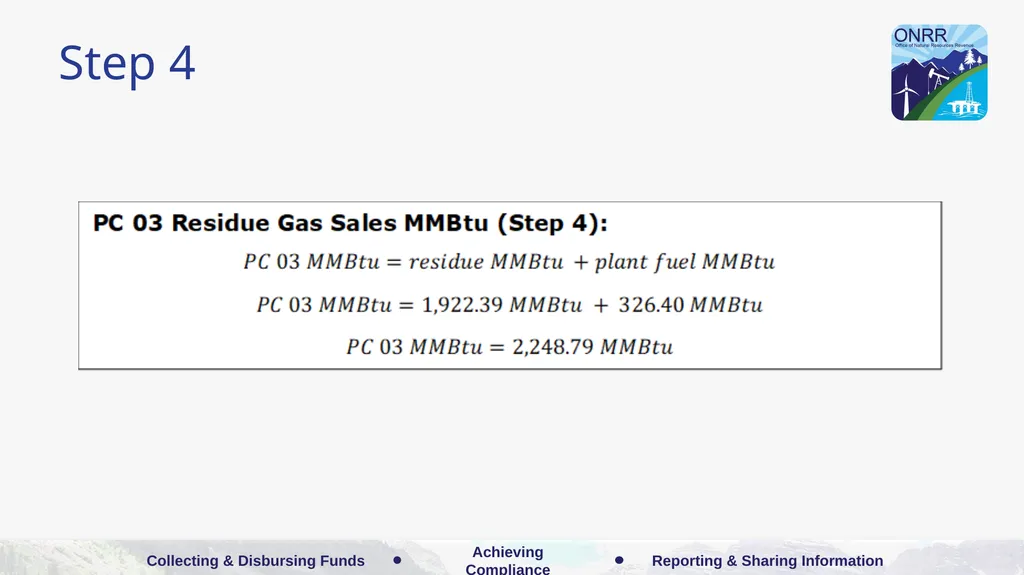
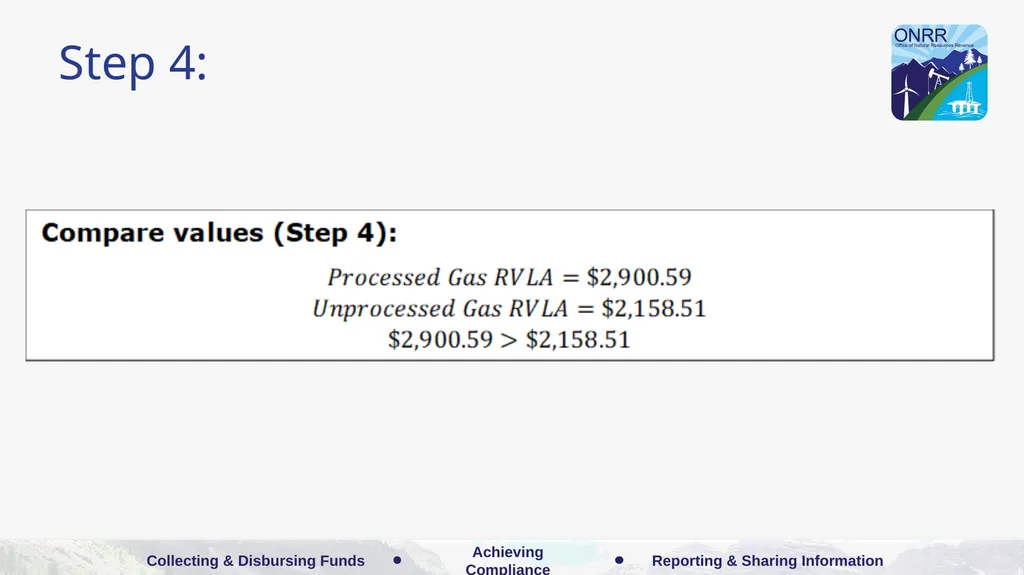
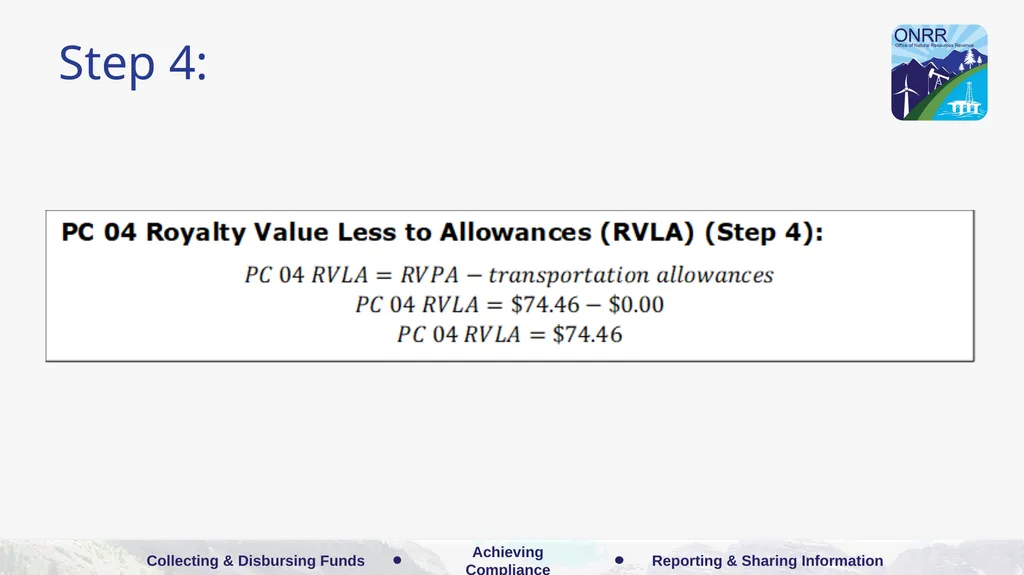
slide22. Step 4<br>
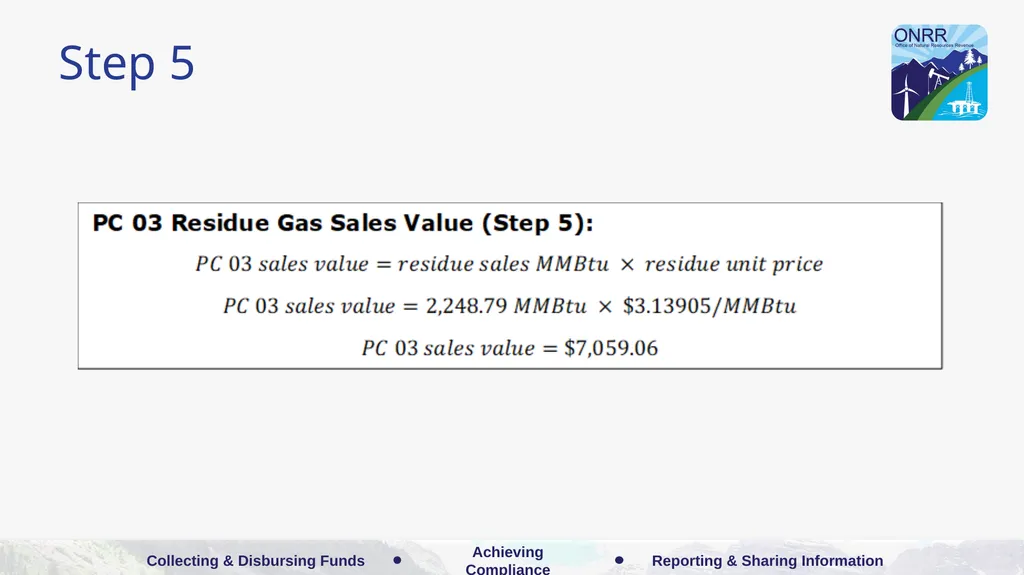
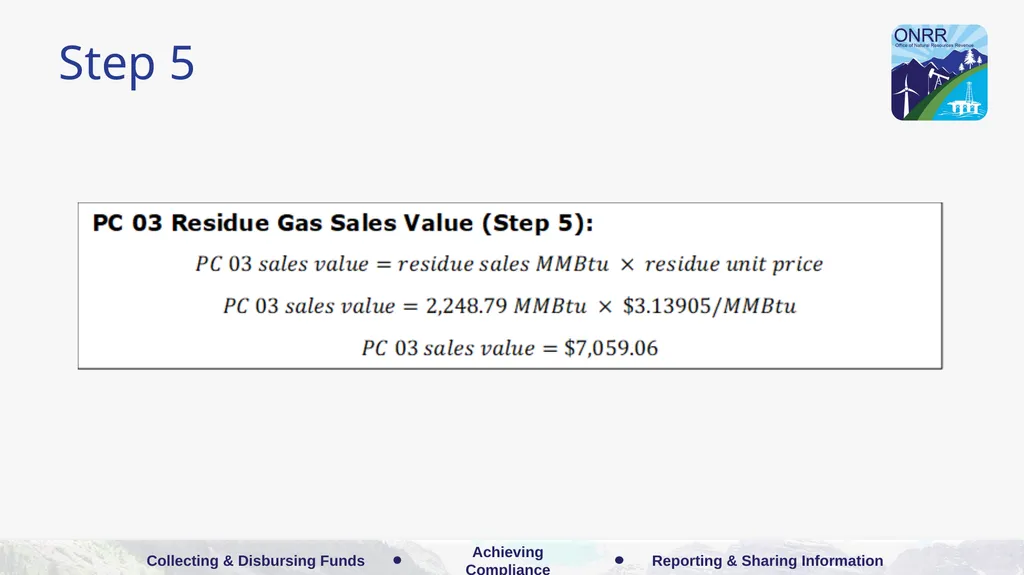
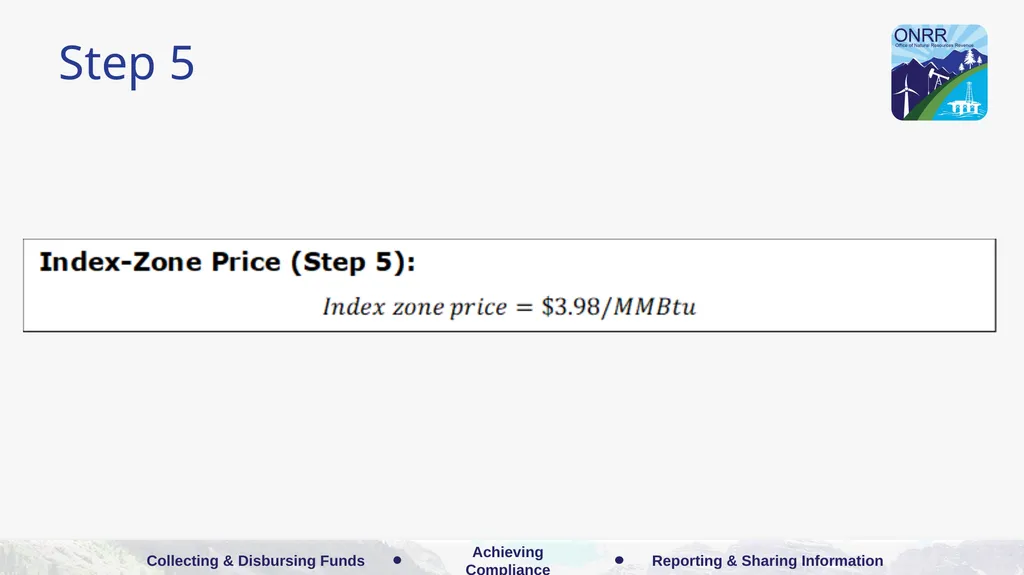
slide23. Step 5<br>
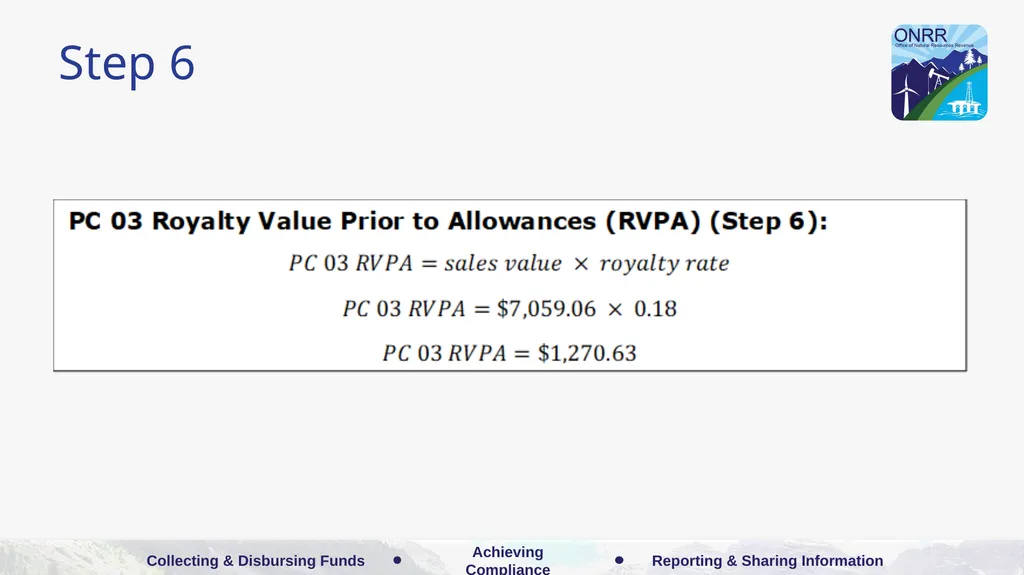
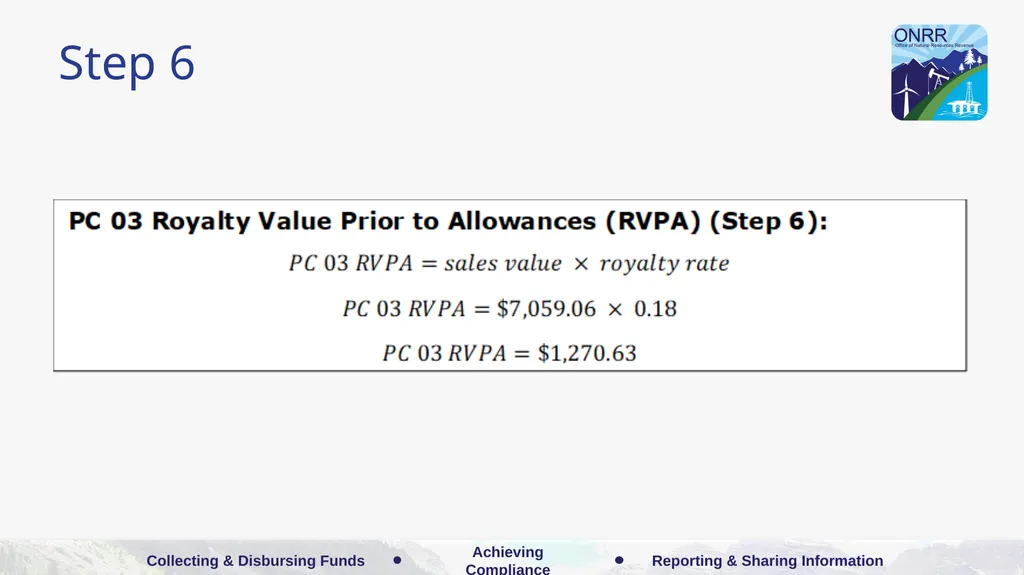
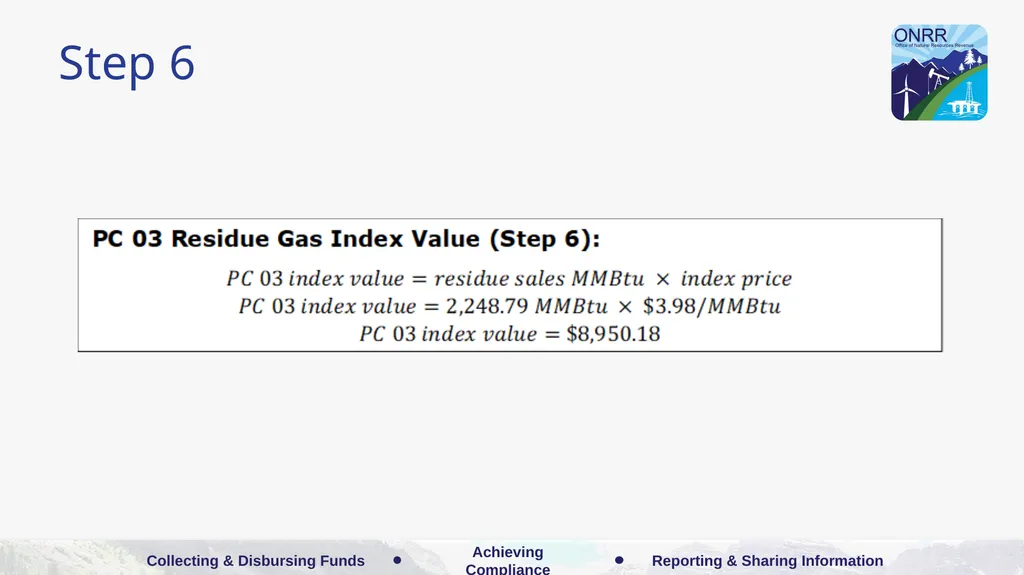
slide24. Step 6<br>
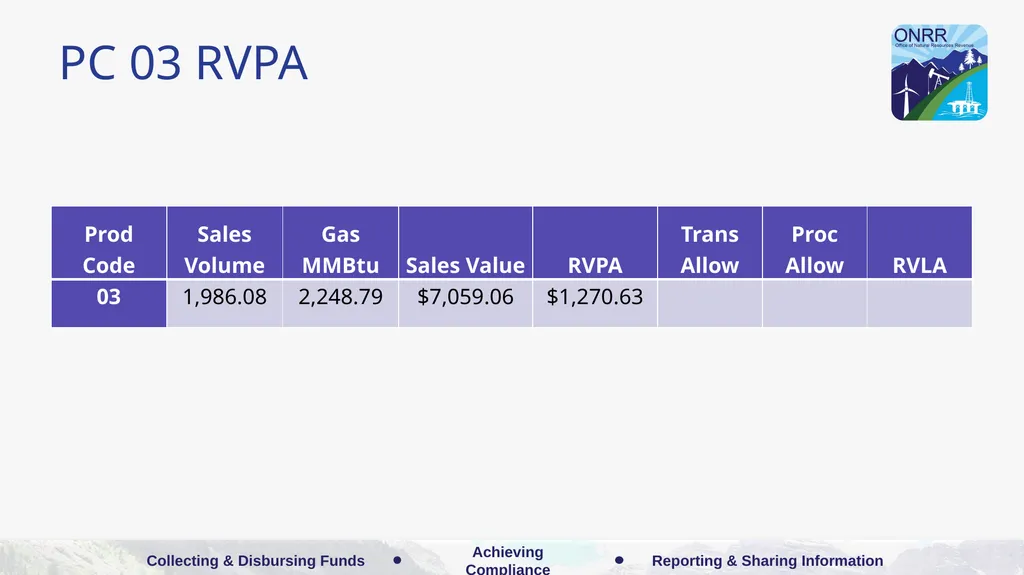
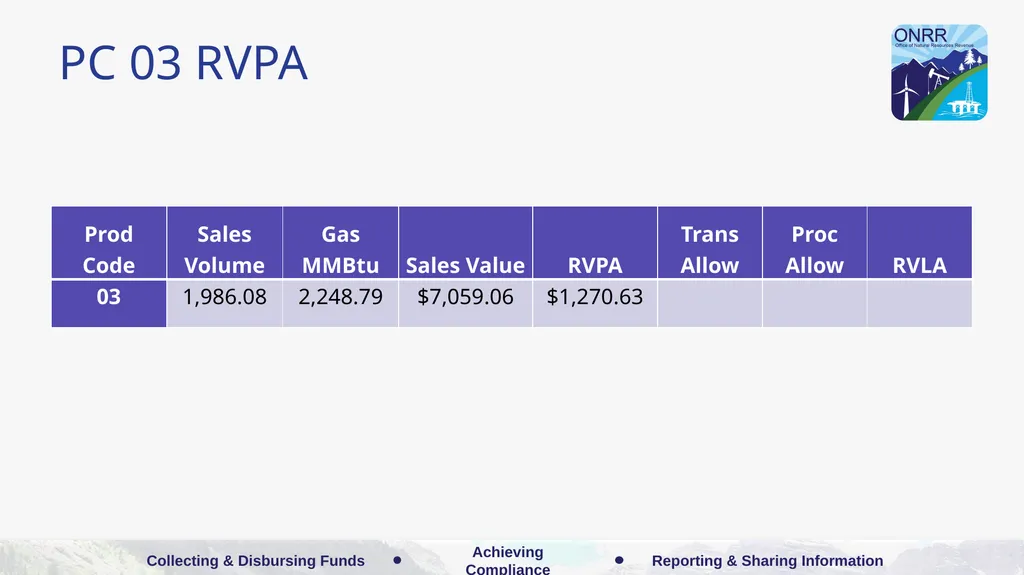
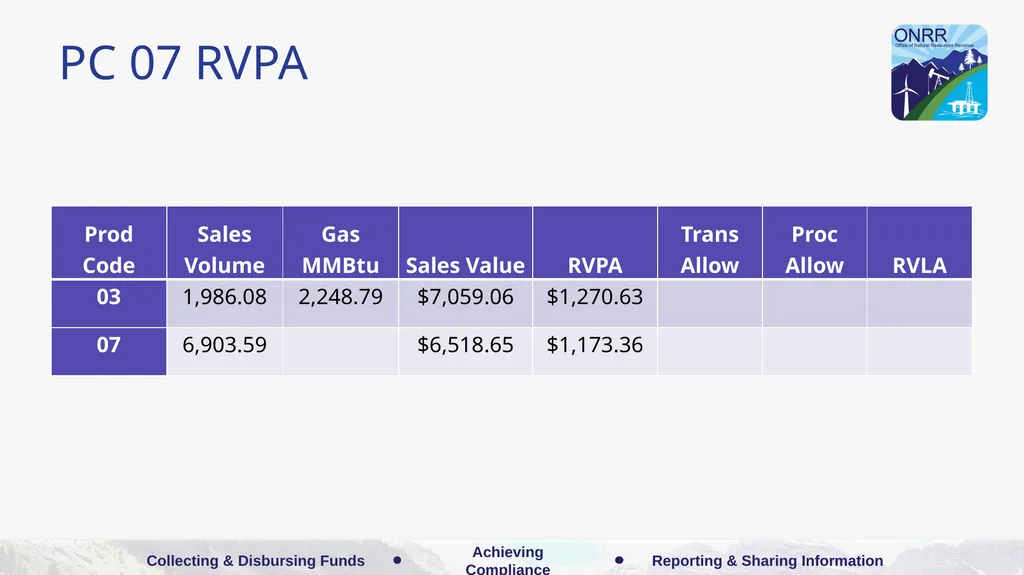
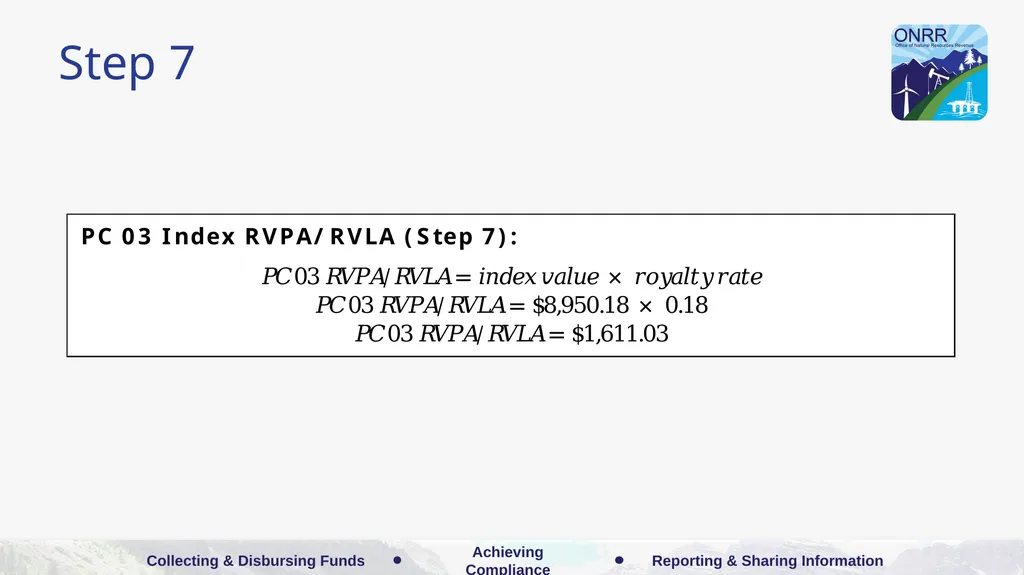
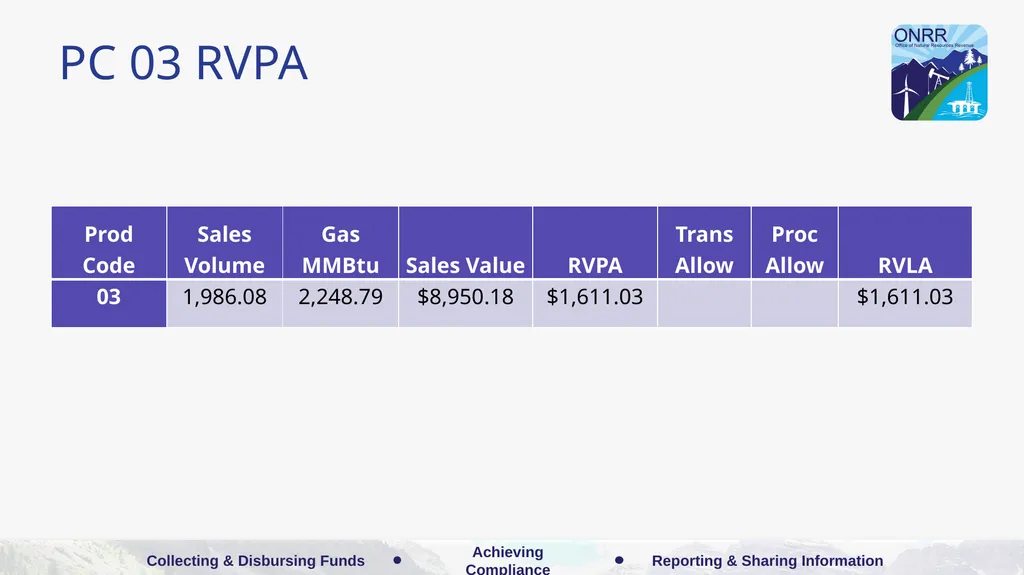
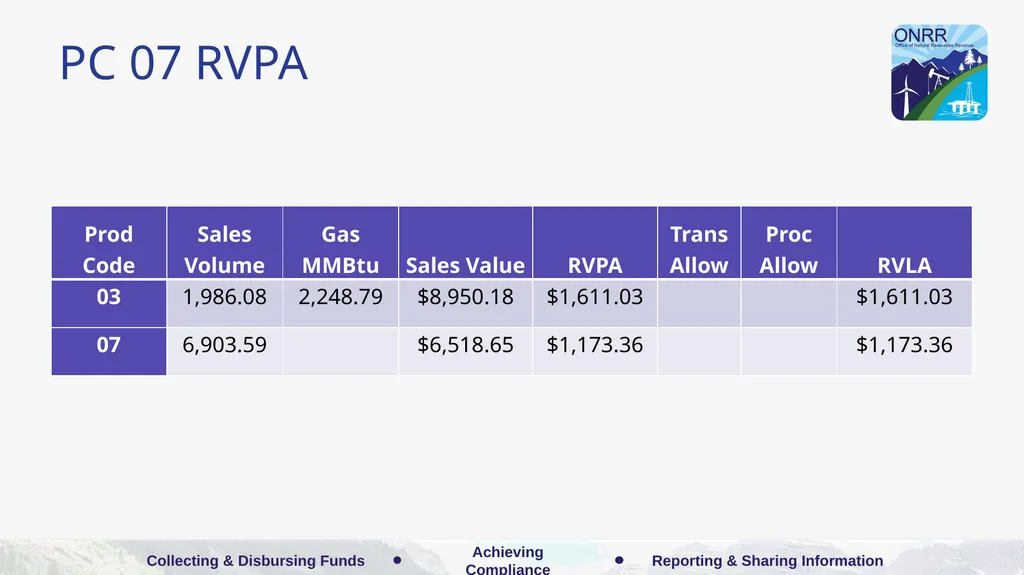
slide25. PC 03 RVPA<br>
slide26. Part A – Calculate the Gross Proceeds PC 07 NGLs<br>
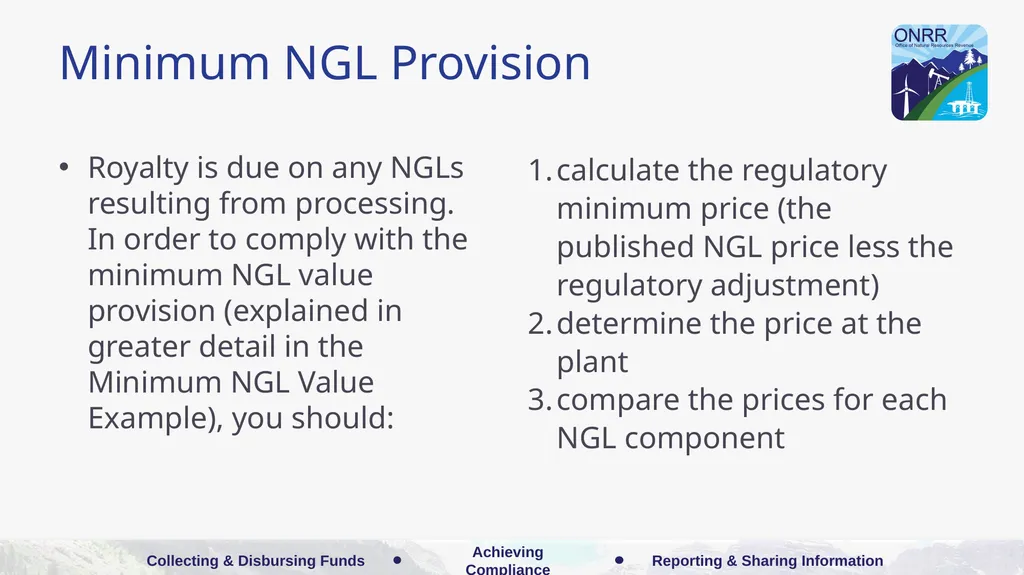
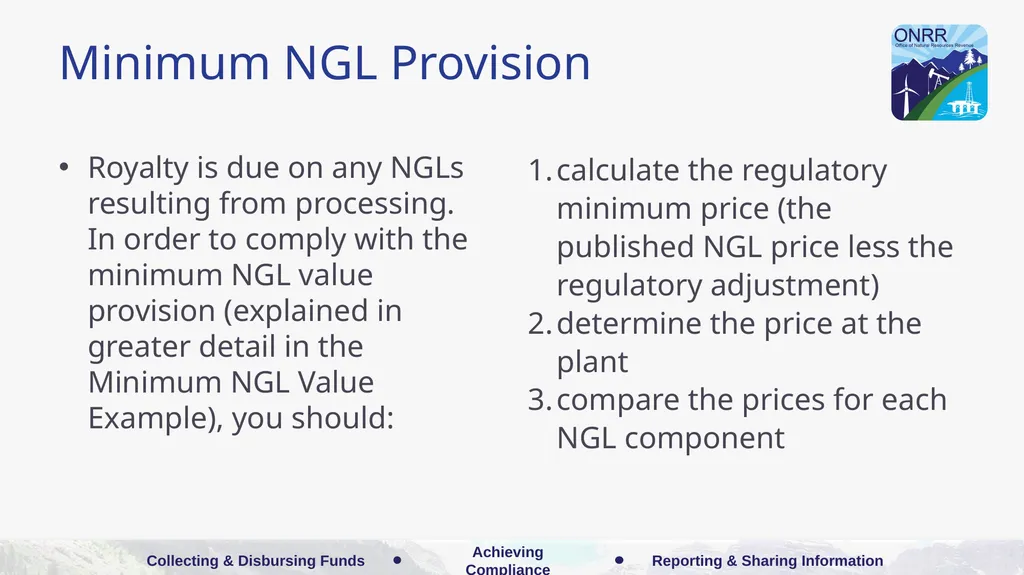
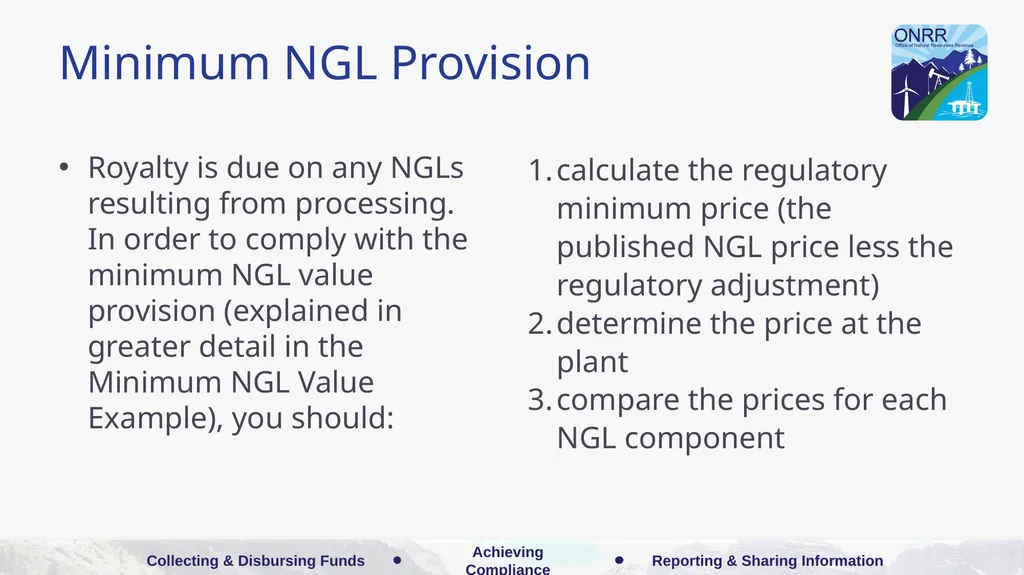
slide27. Minimum NGL Provision Royalty is due on any NGLs resulting from processing. In order to comply with the minimum NGL value provision (explained in greater detail in the Minimum NGL Value Example), you should: calculate the regulatory minimum price (the published NGL price less the regulatory adjustment)
determine the price at the plant
compare the prices for each NGL component<br>
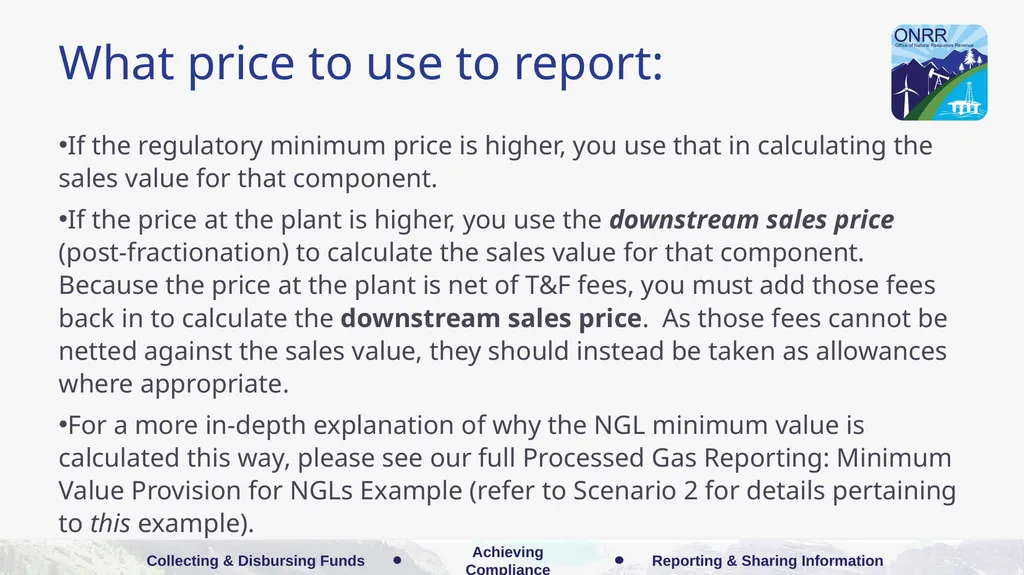
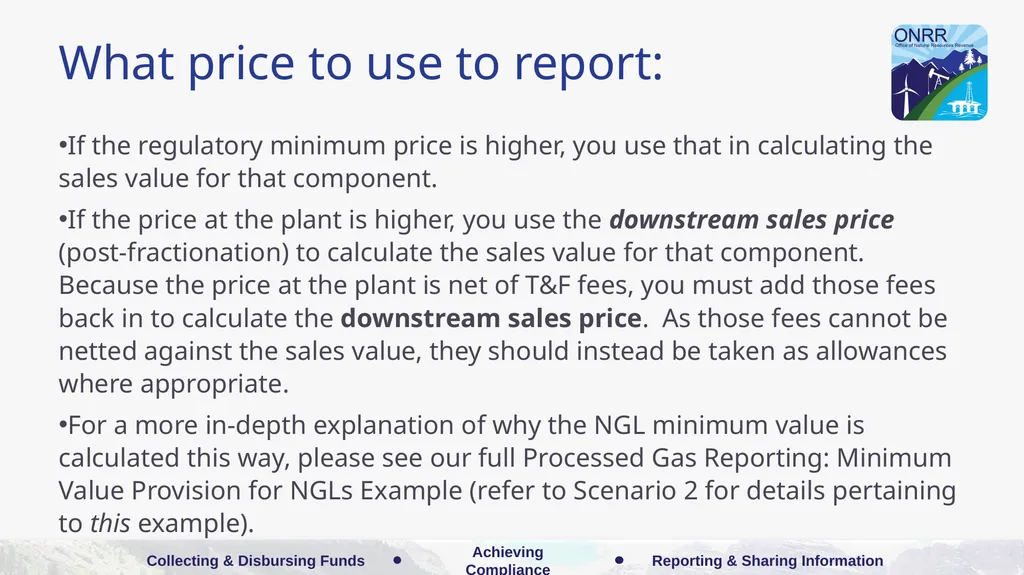
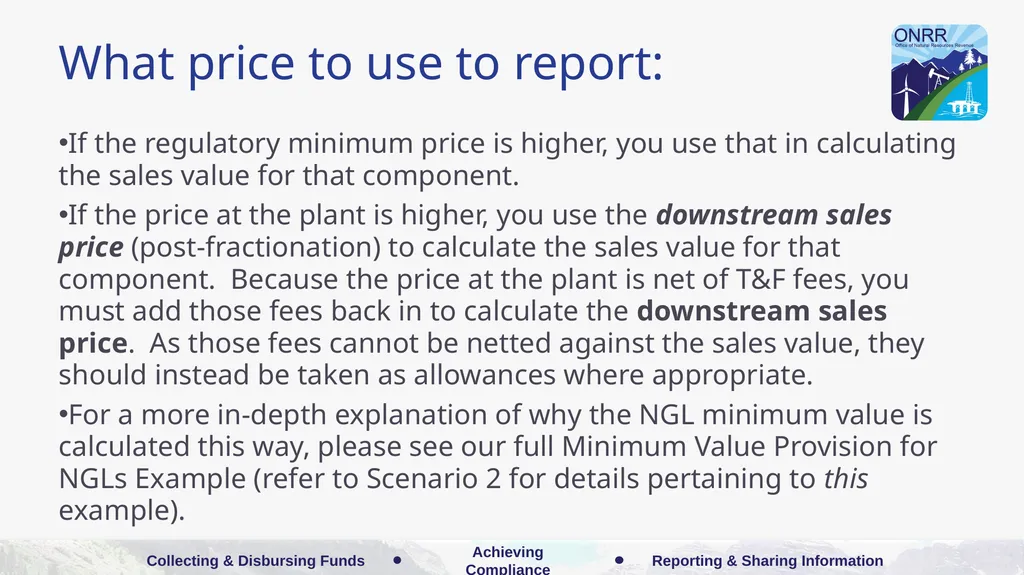
slide28. What price to use to report: If the regulatory minimum price is higher, you use that in calculating the sales value for that component.
If the price at the plant is higher, you use the downstream sales price (post-fractionation) to calculate the sales value for that component. Because the price at the plant is net of T&F fees, you must add those fees back in to calculate the downstream sales price. As those fees cannot be netted against the sales value, they should instead be taken as allowances where appropriate.
For a more in-depth explanation of why the NGL minimum value is calculated this way, please see our full Processed Gas Reporting: Minimum Value Provision for NGLs Example (refer to Scenario 2 for details pertaining to this example).<br>
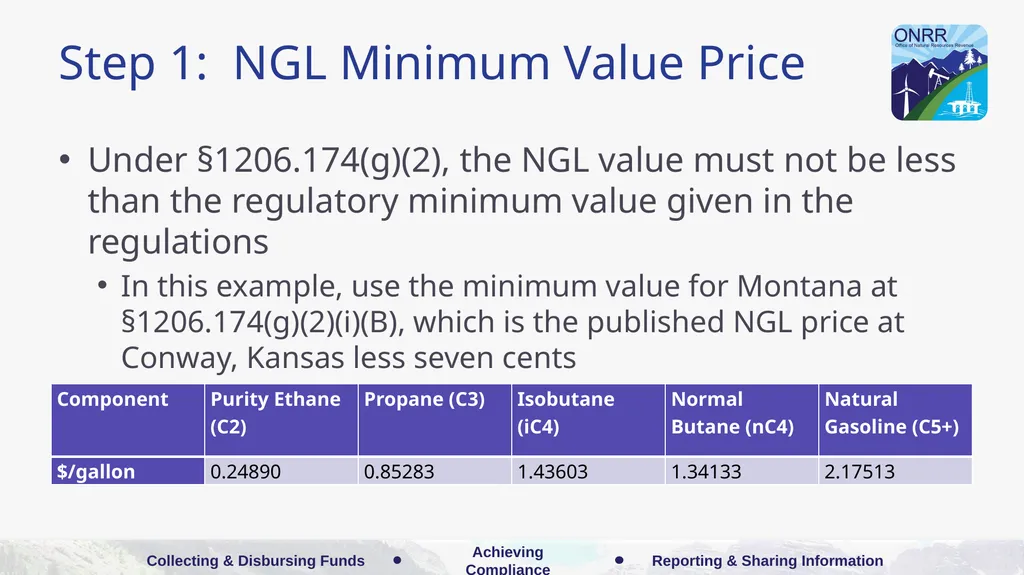
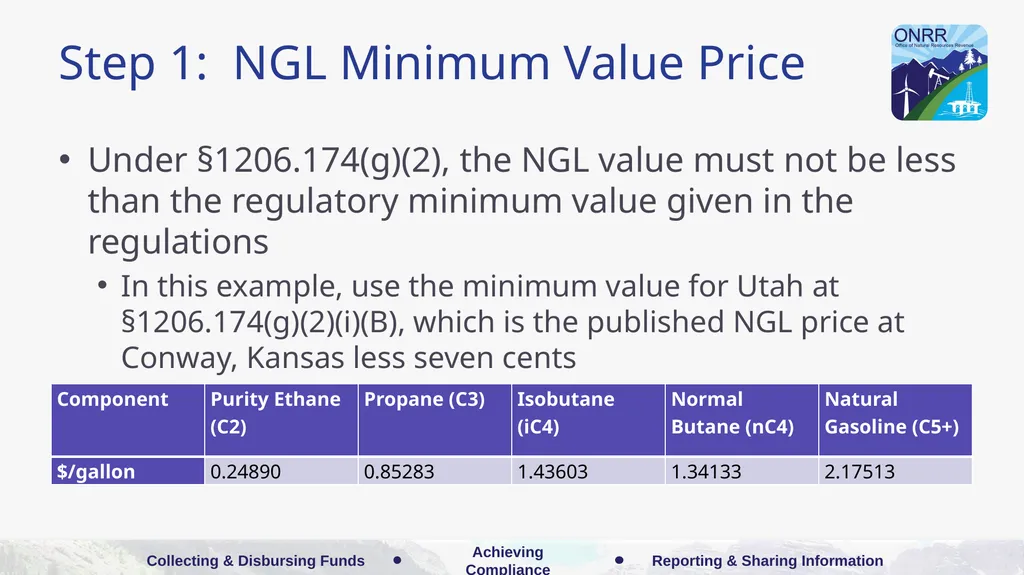
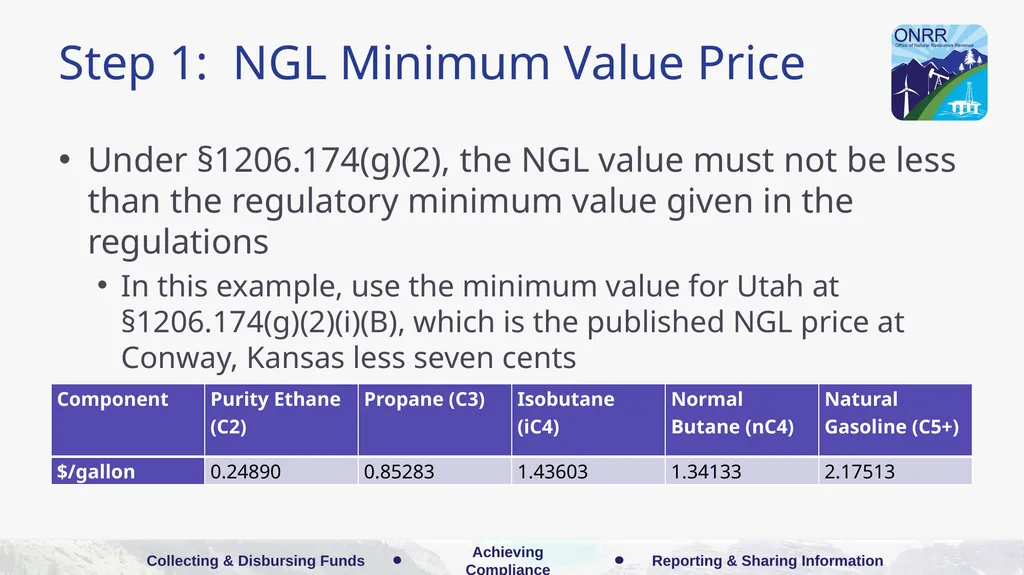
slide29. Step 1: NGL Minimum Value Price Under §1206.174(g)(2), the NGL value must not be less than the regulatory minimum value given in the regulations
In this example, use the minimum value for Montana at §1206.174(g)(2)(i)(B), which is the published NGL price at Conway, Kansas less seven cents<br>
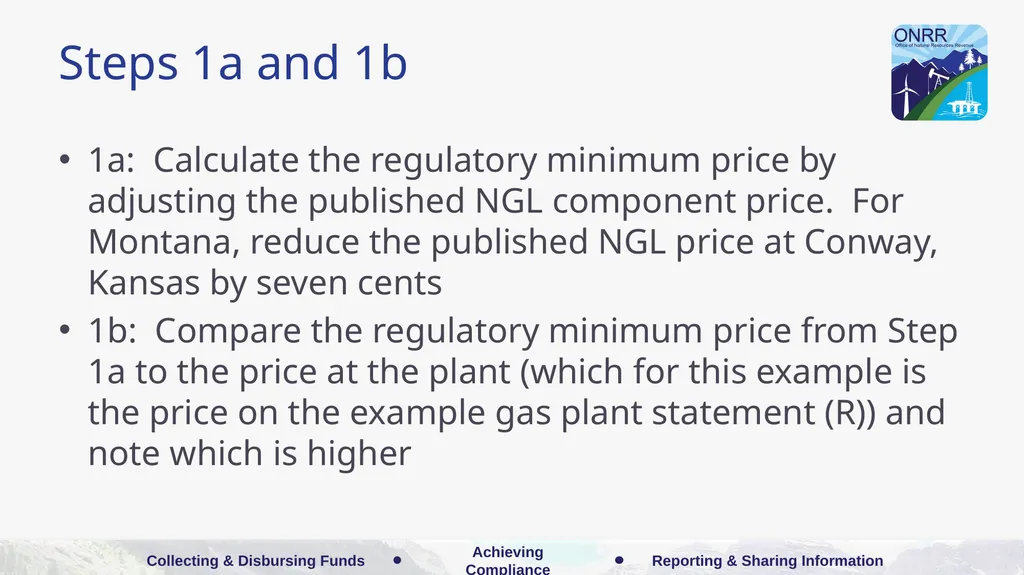
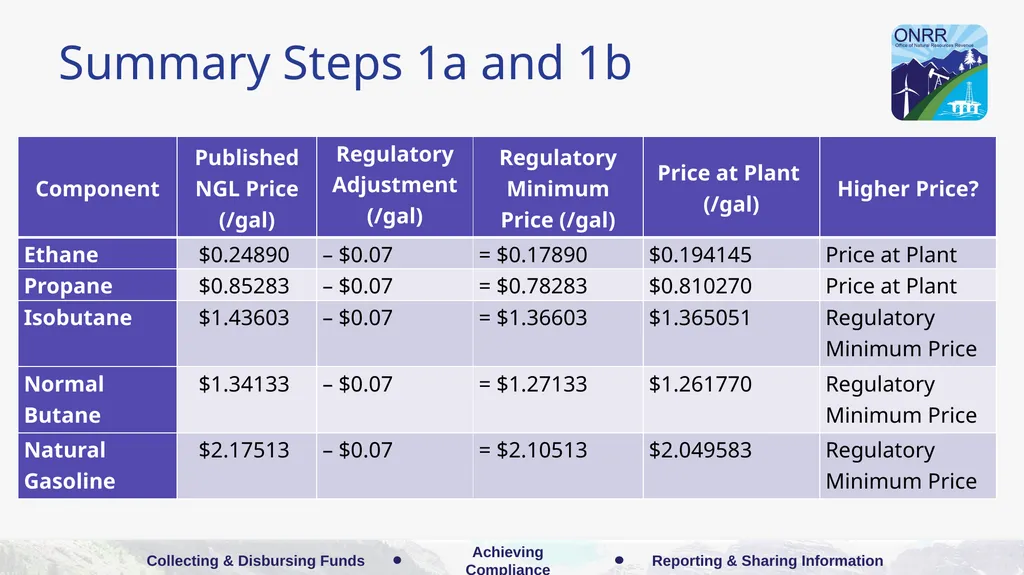
slide30. Steps 1a and 1b 1a: Calculate the regulatory minimum price by adjusting the published NGL component price. For Montana, reduce the published NGL price at Conway, Kansas by seven cents
1b: Compare the regulatory minimum price from Step 1a to the price at the plant (which for this example is the price on the example gas plant statement (R)) and note which is higher<br>
slide31. Summary Steps 1a and 1b<br>
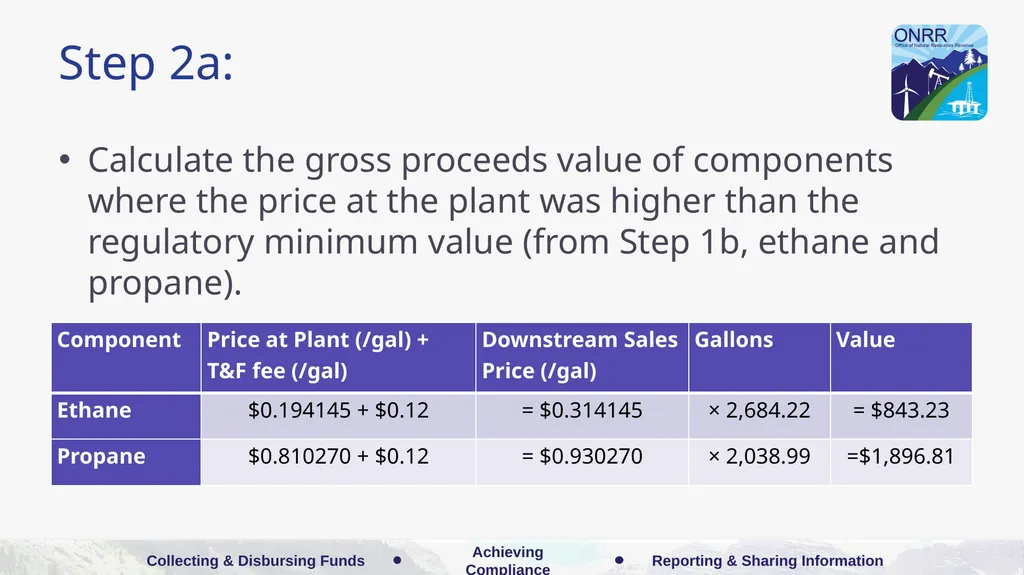
slide32. Step 2a: Calculate the gross proceeds value of components where the price at the plant was higher than the regulatory minimum value (from Step 1b, ethane and propane).<br>
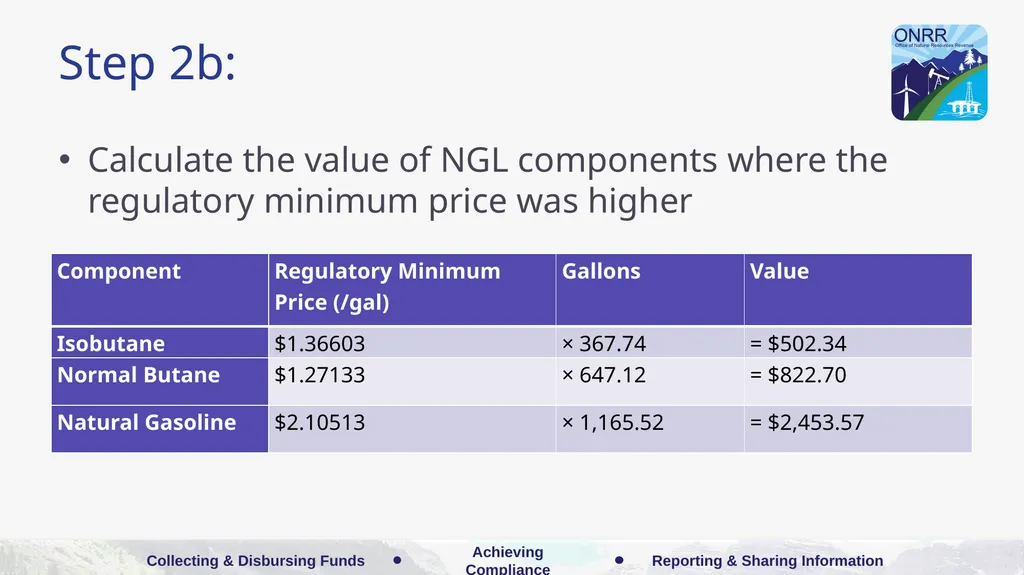
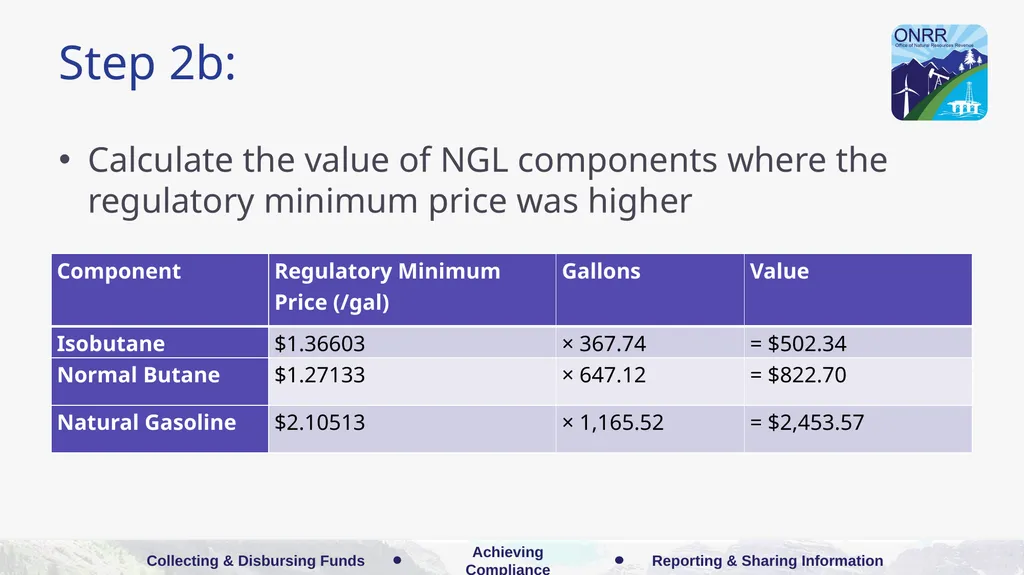
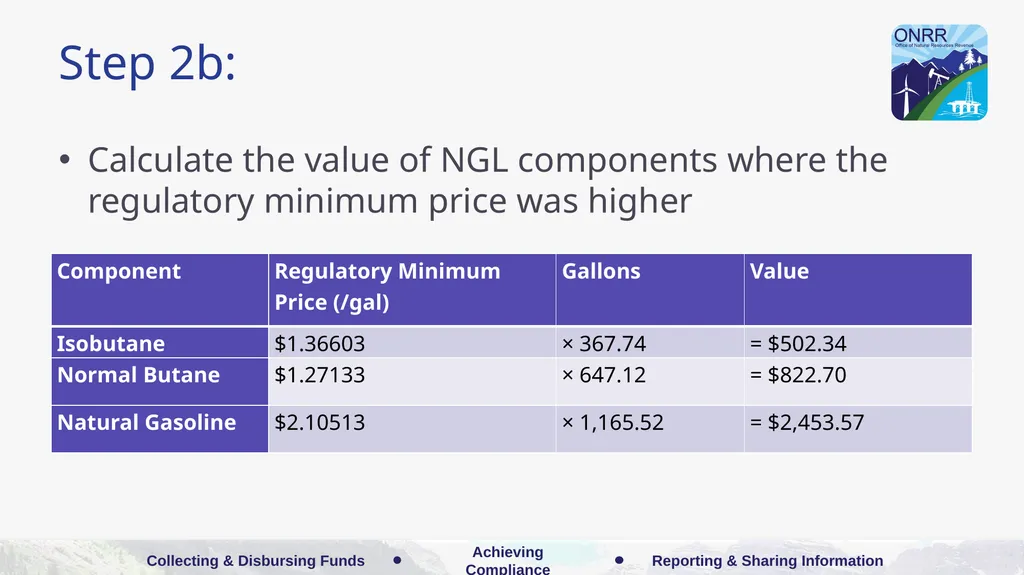
slide33. Step 2b: Calculate the value of NGL components where the regulatory minimum price was higher<br>
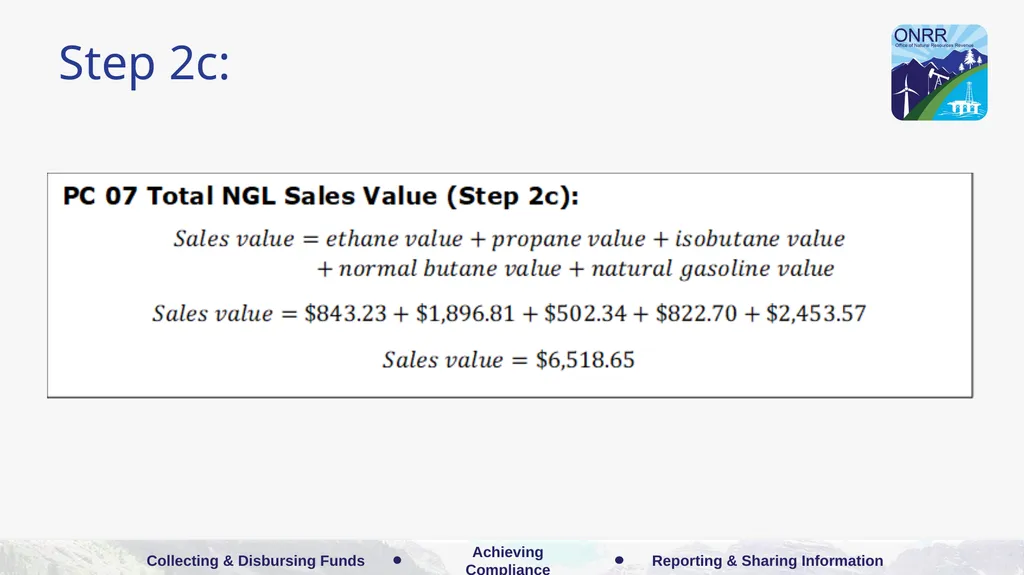
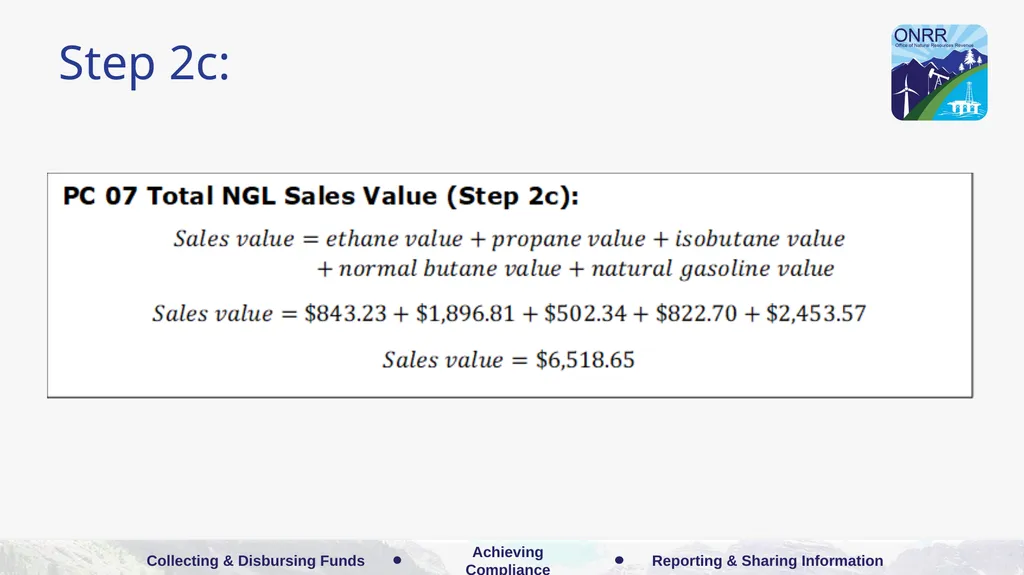
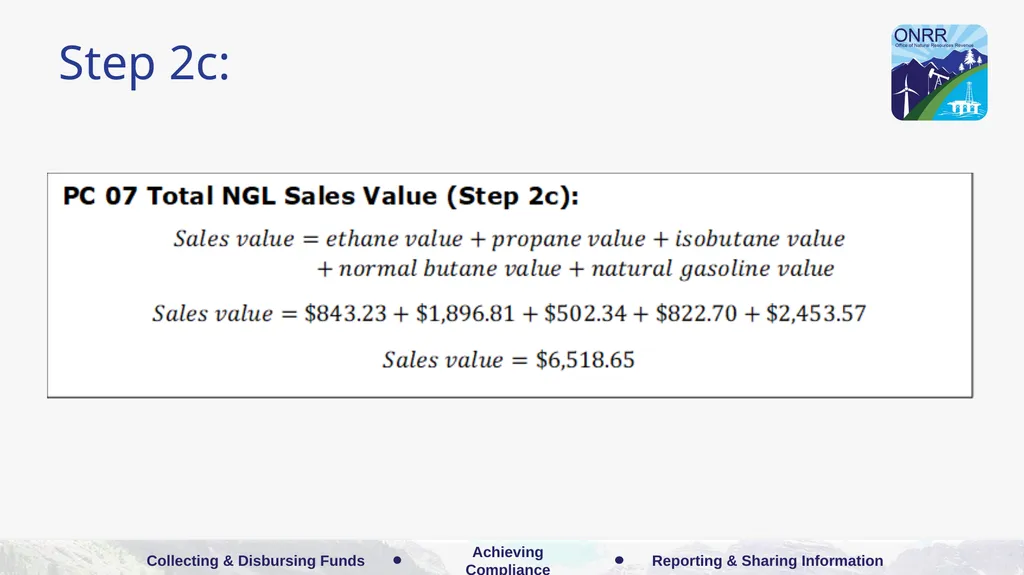
slide34. Step 2c:<br>
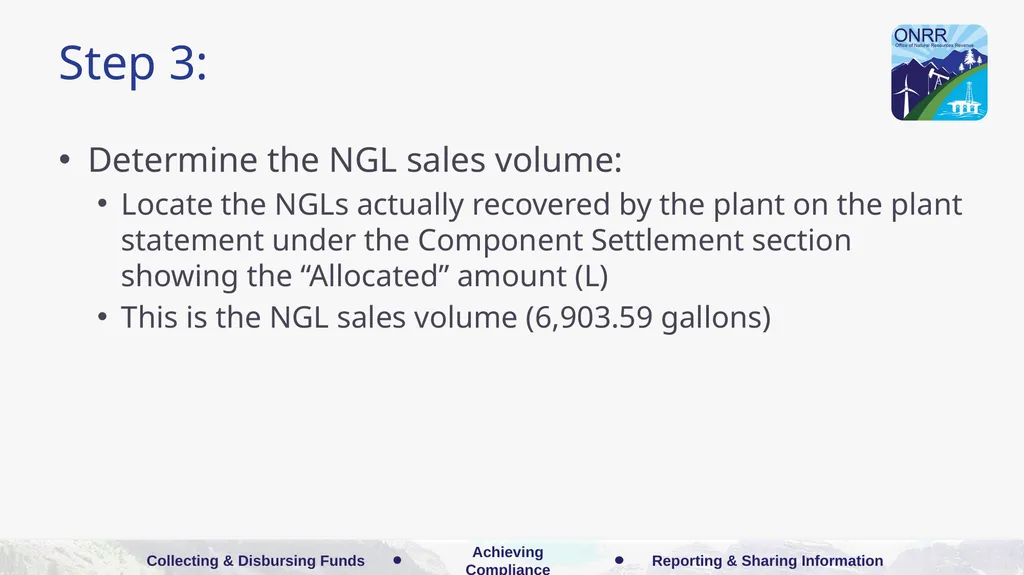
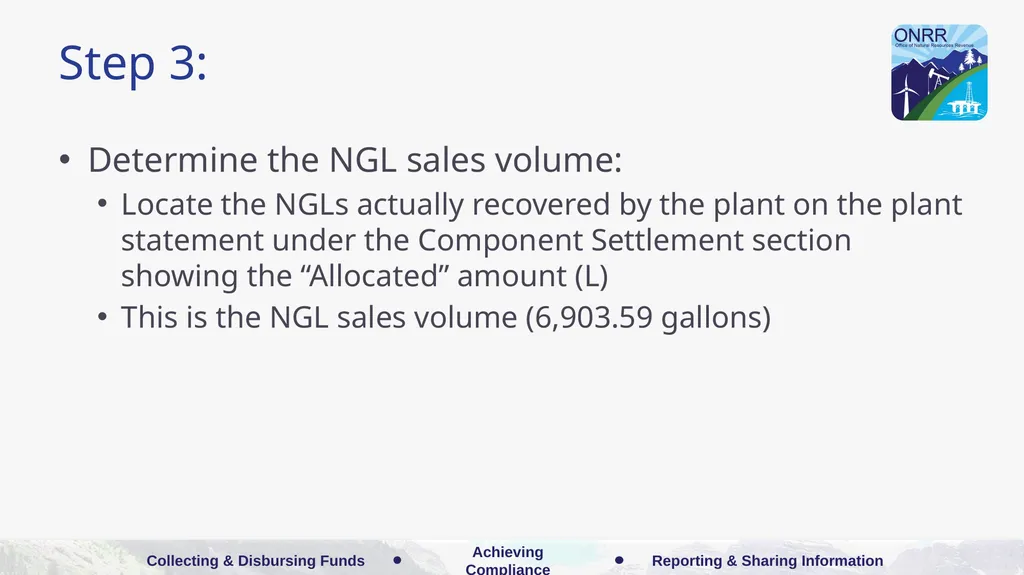
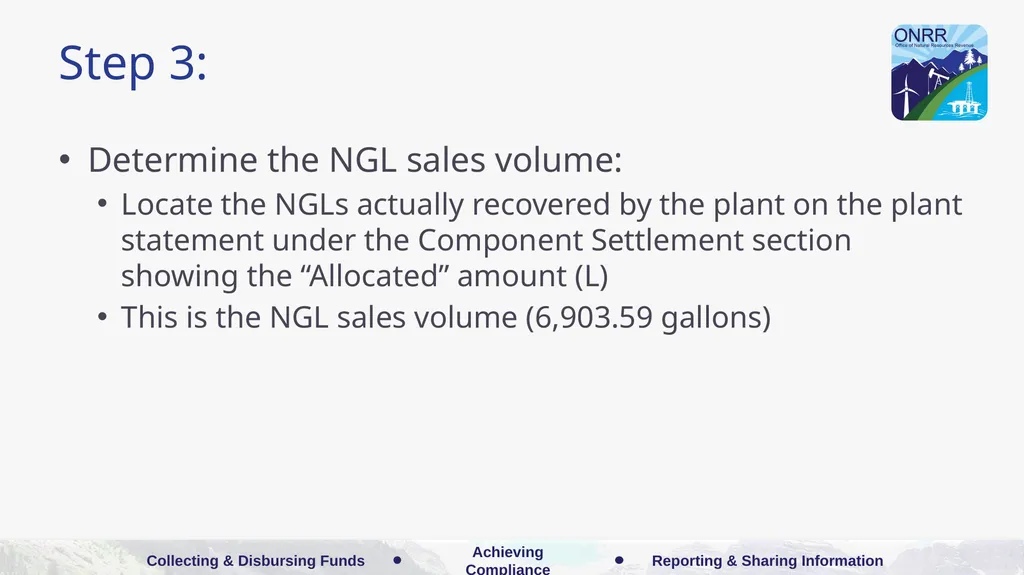
slide35. Step 3: Determine the NGL sales volume:
Locate the NGLs actually recovered by the plant on the plant statement under the Component Settlement section showing the “Allocated” amount (L)
This is the NGL sales volume (6,903.59 gallons)<br>
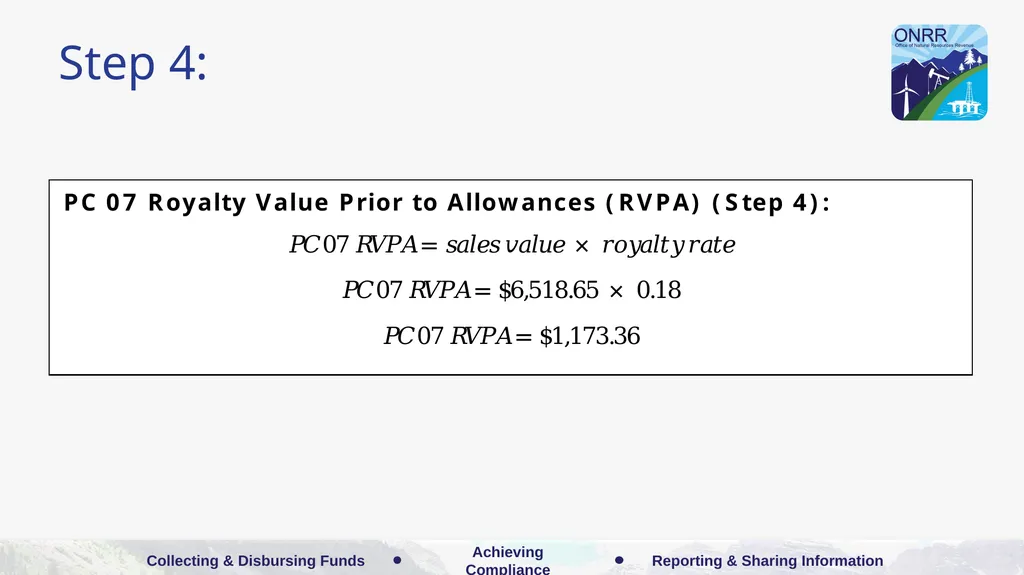
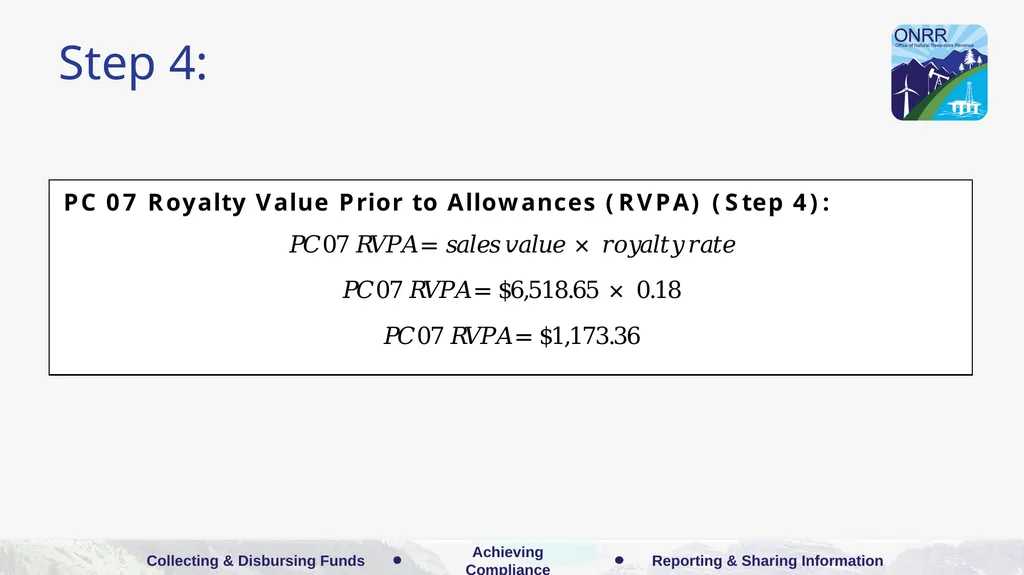
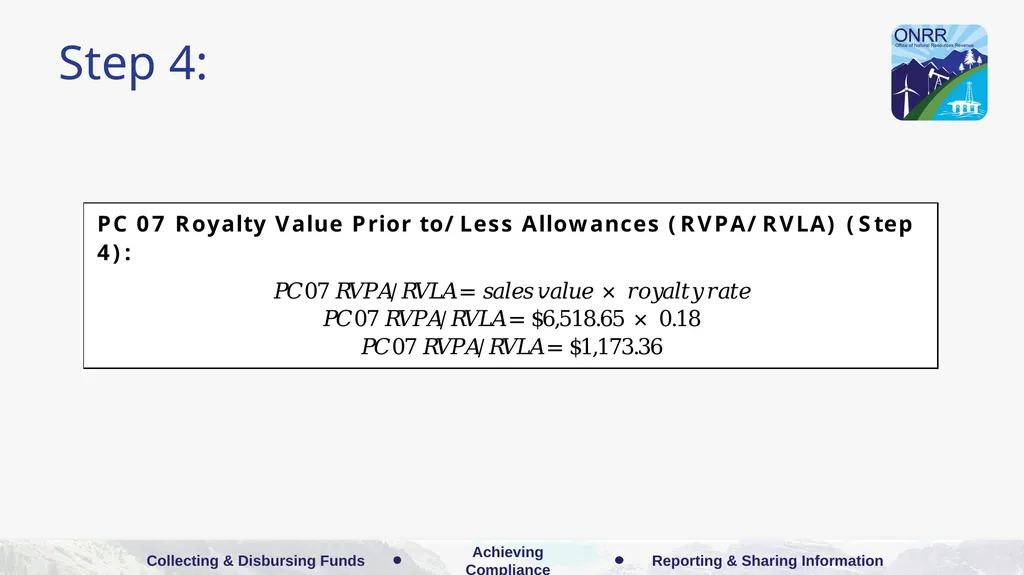
slide36. Step 4:<br>
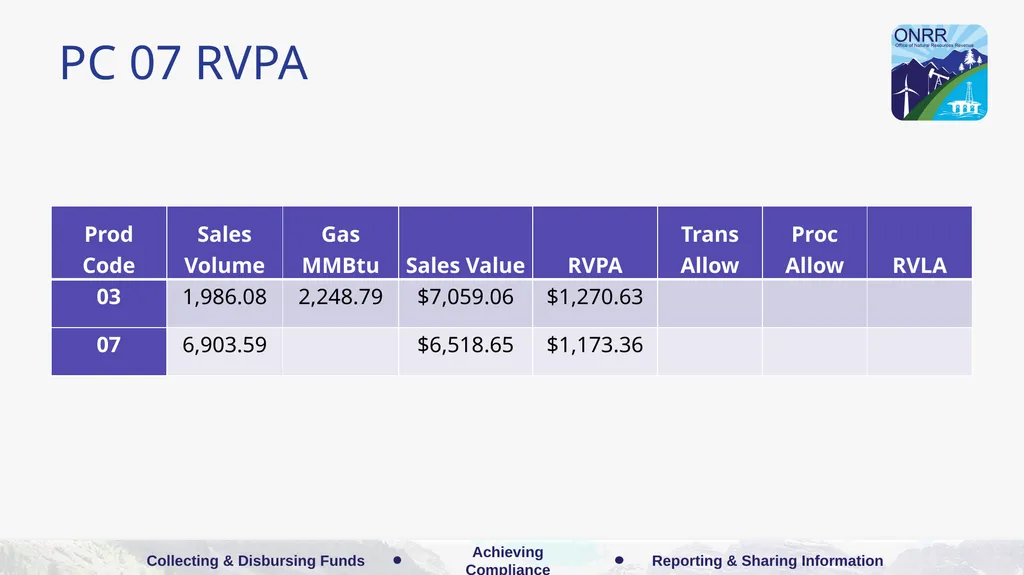
slide37. PC 07 RVPA<br>
slide38. Part A – Calculate the Gross Proceeds PC 15 - Pipeline Fuel<br>
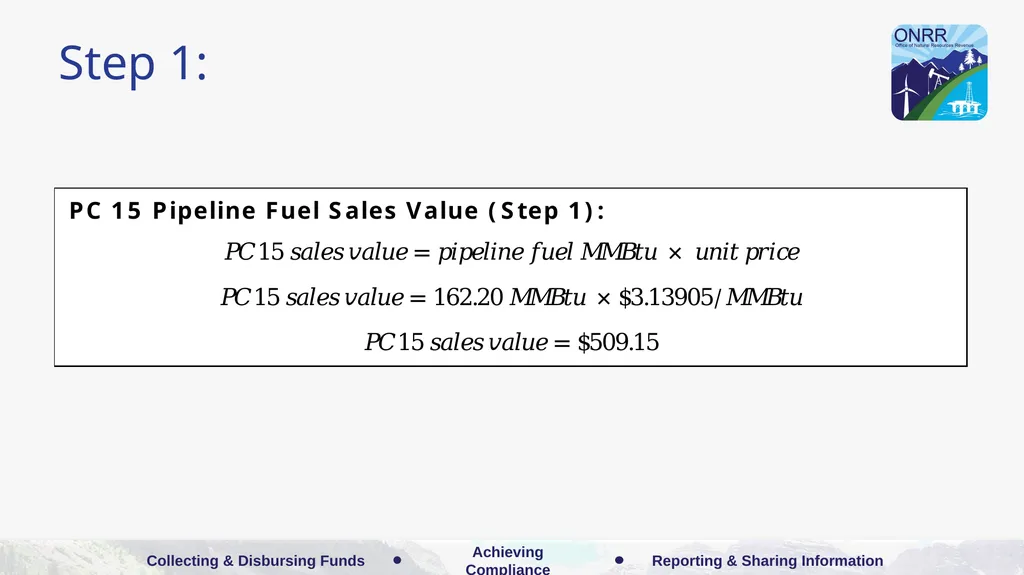
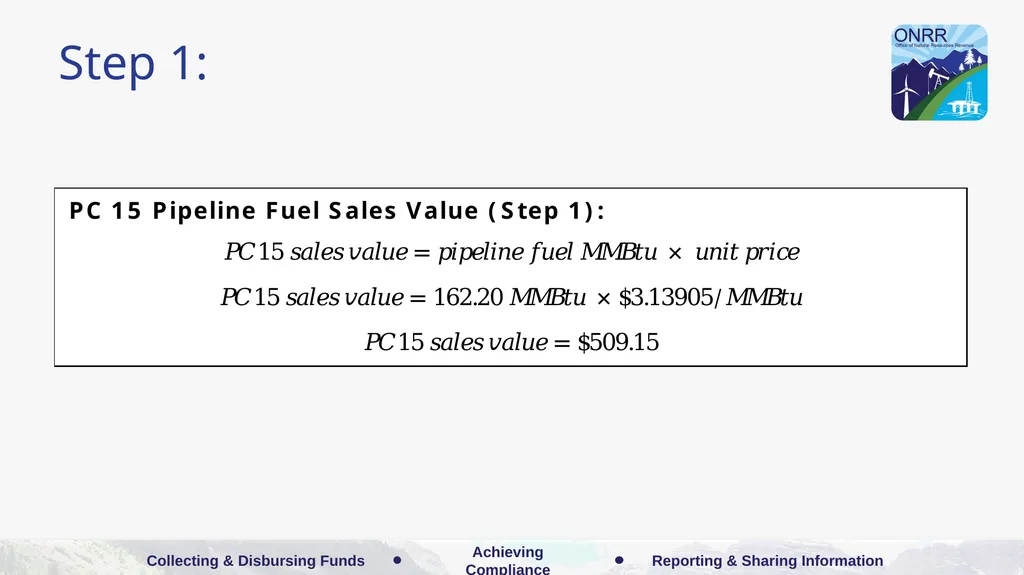
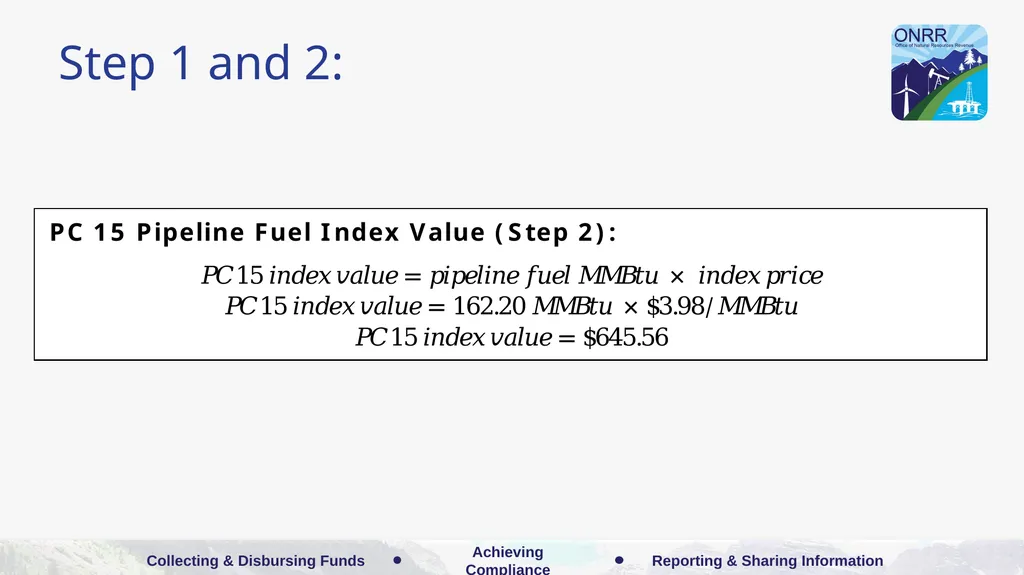
slide39. Step 1:<br>
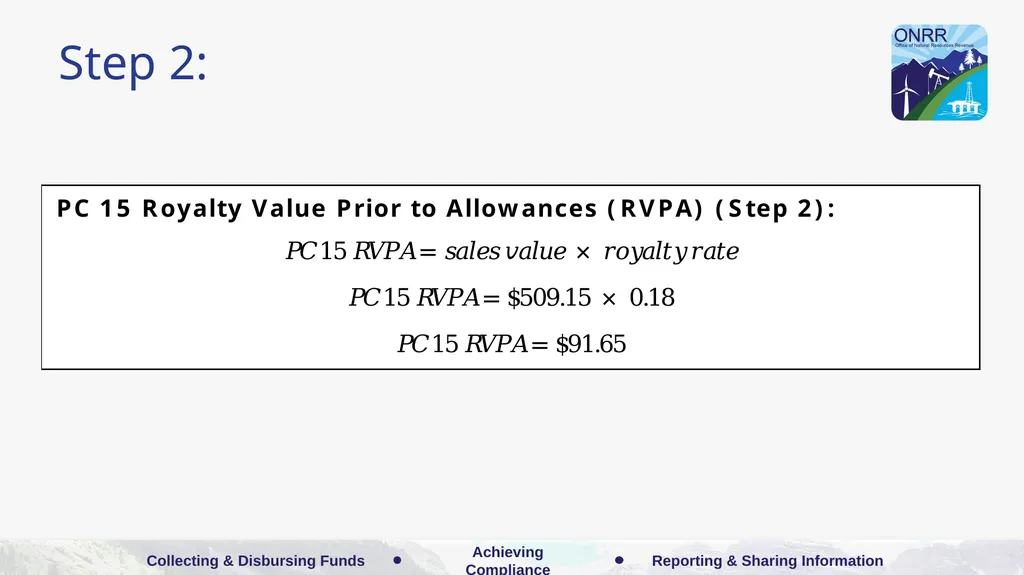
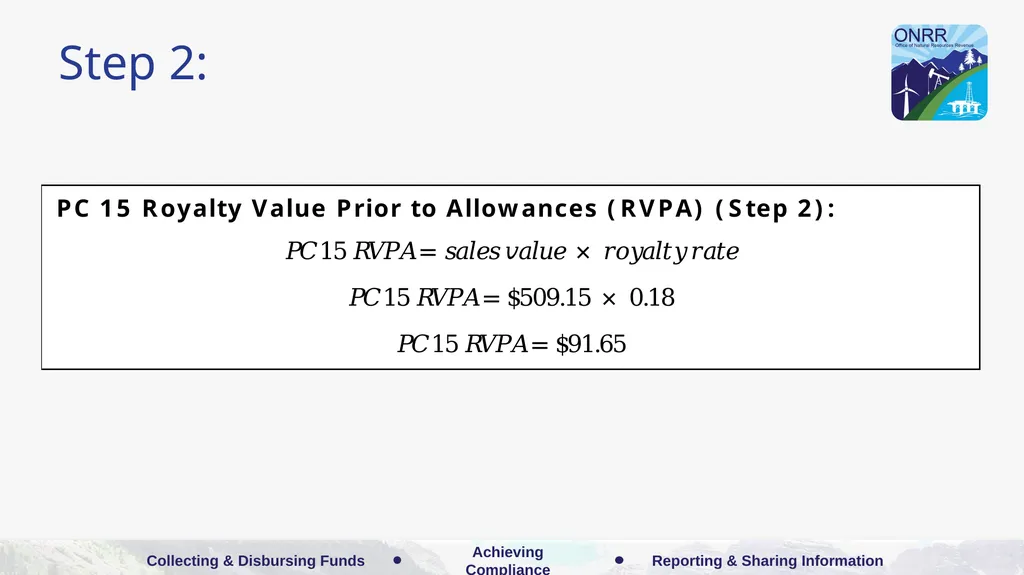
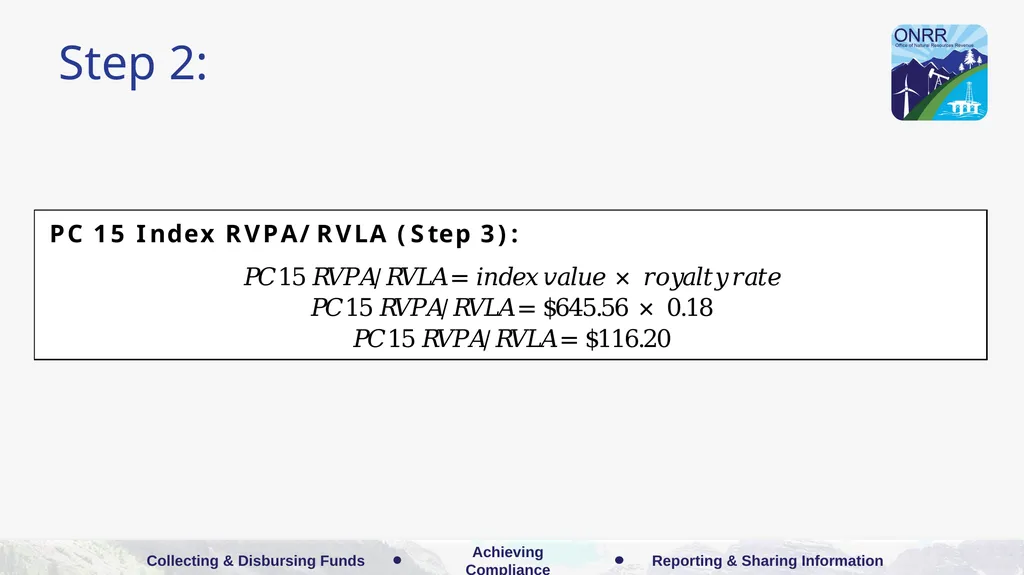
slide40. Step 2:<br>
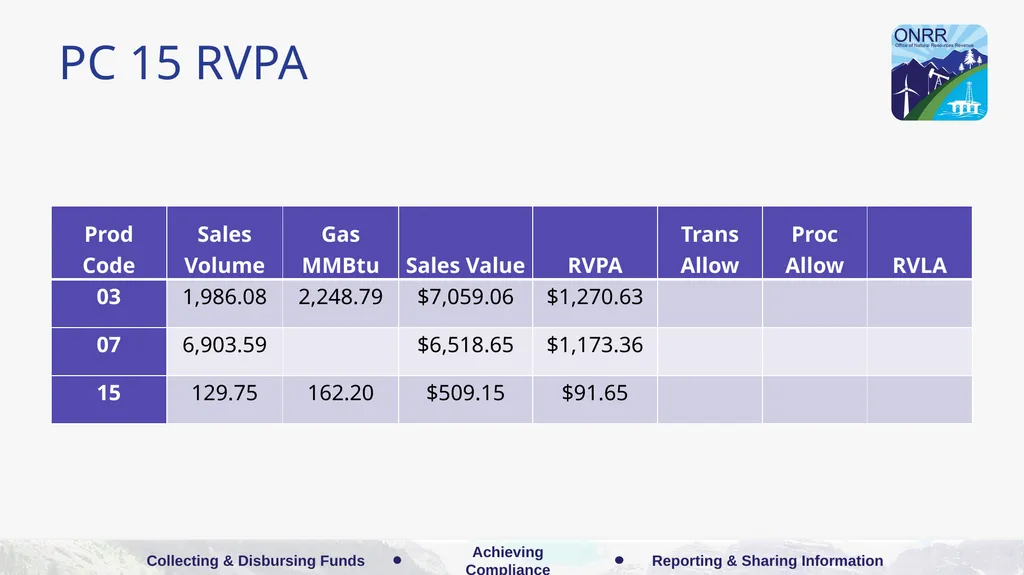
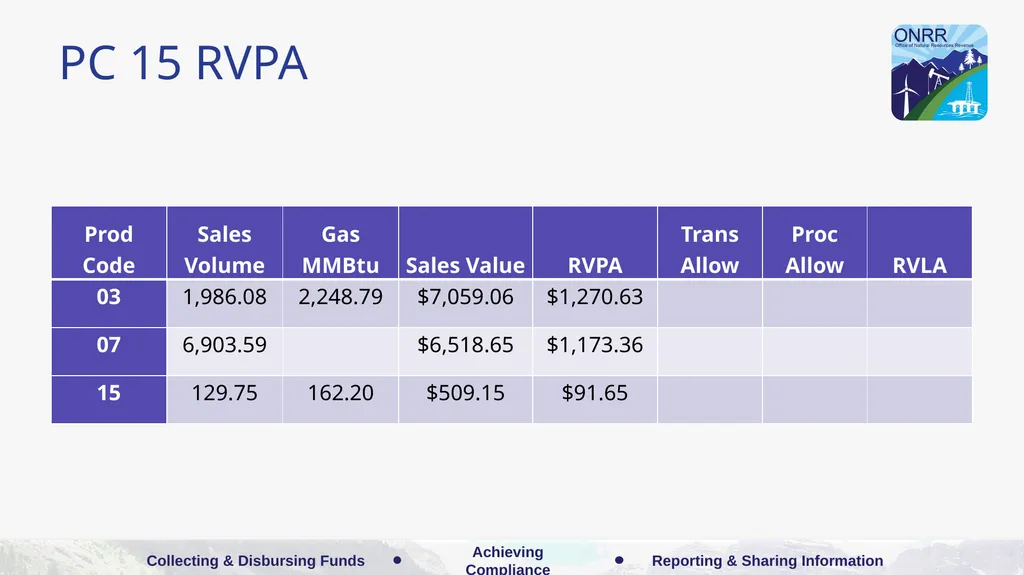
slide41. PC 15 RVPA<br>
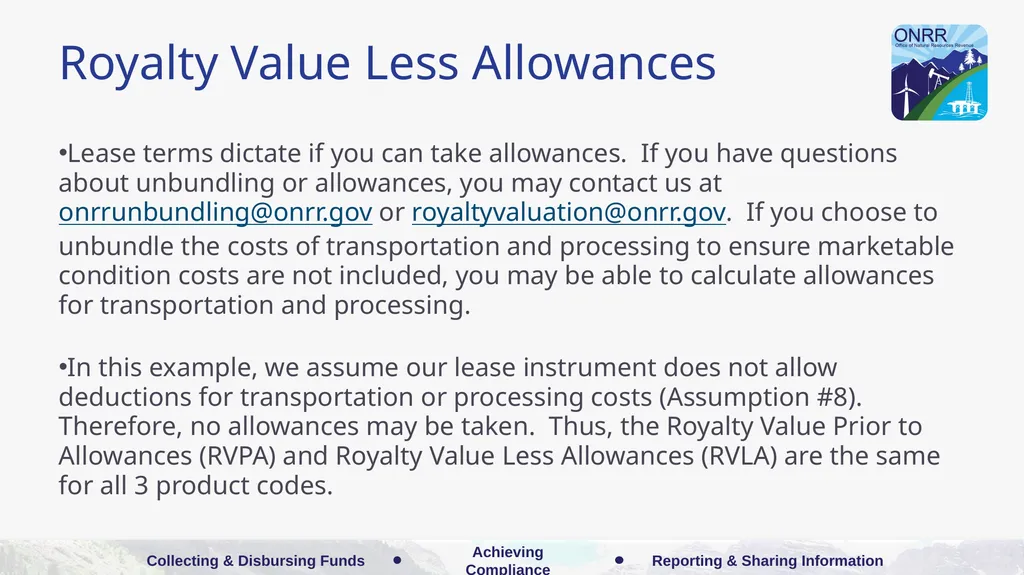
slide42. Royalty Value Less Allowances Lease terms dictate if you can take allowances. If you have questions about unbundling or allowances, you may contact us at onrrunbundling@onrr.gov or royaltyvaluation@onrr.gov. If you choose to unbundle the costs of transportation and processing to ensure marketable condition costs are not included, you may be able to calculate allowances for transportation and processing.
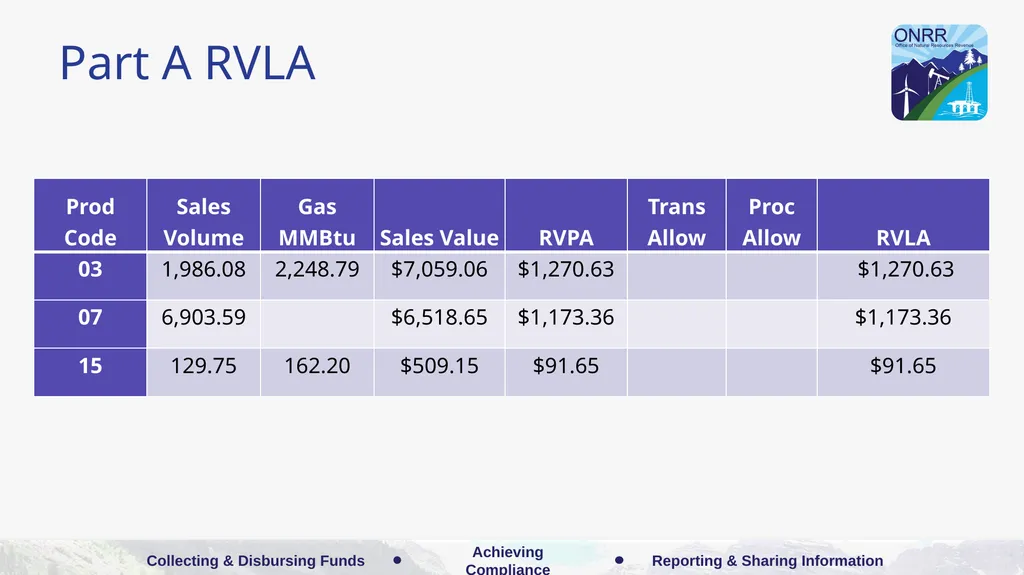
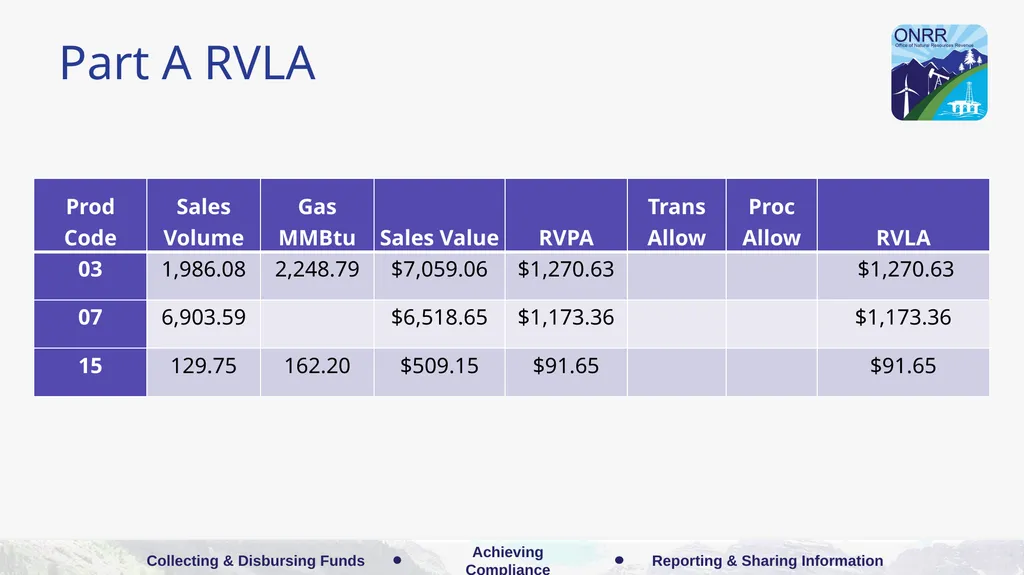
In this example, we assume our lease instrument does not allow deductions for transportation or processing costs (Assumption #8). Therefore, no allowances may be taken. Thus, the Royalty Value Prior to Allowances (RVPA) and Royalty Value Less Allowances (RVLA) are the same for all 3 product codes.<br>
slide43. Part A RVLA<br>
slide44. Part B – Actual Dual Accounting Index Zone Calculations<br>
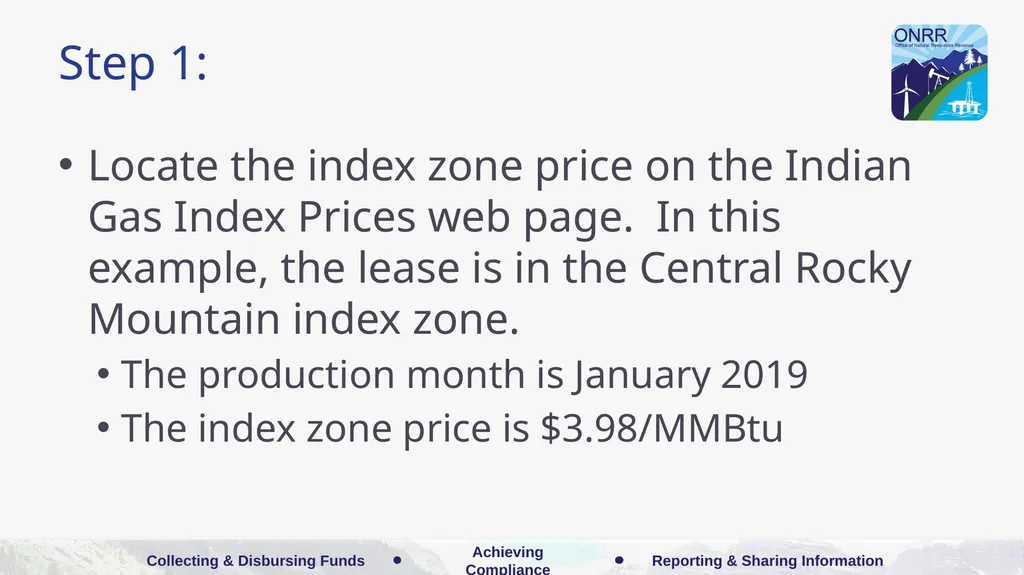
slide45. Step 1: Locate the index zone price on the Indian Gas Index Prices web page. In this example, the lease is in the Central Rocky Mountain index zone.
The production month is January 2019
The index zone price is $3.98/MMBtu<br>
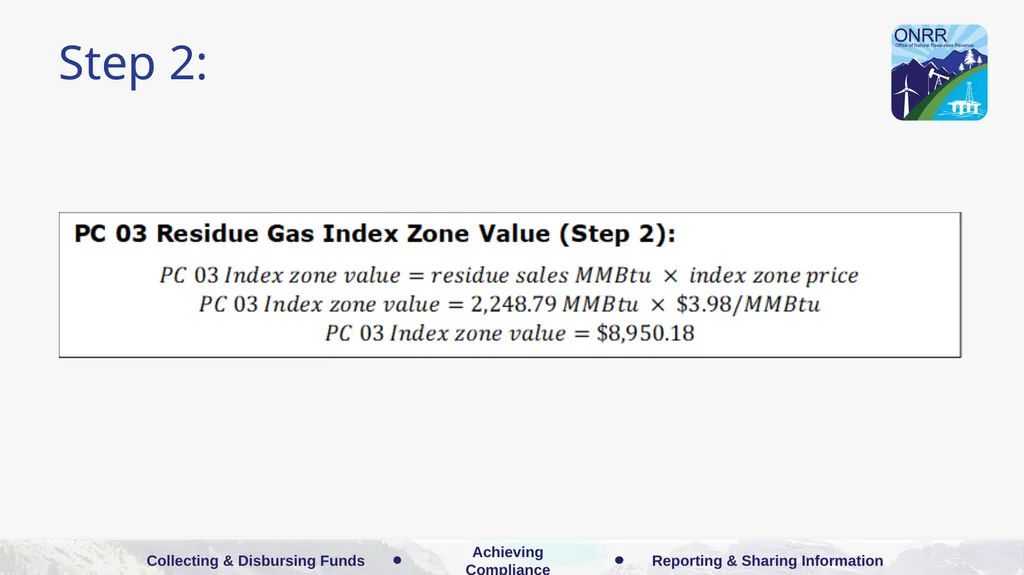
slide46. Step 2:<br>
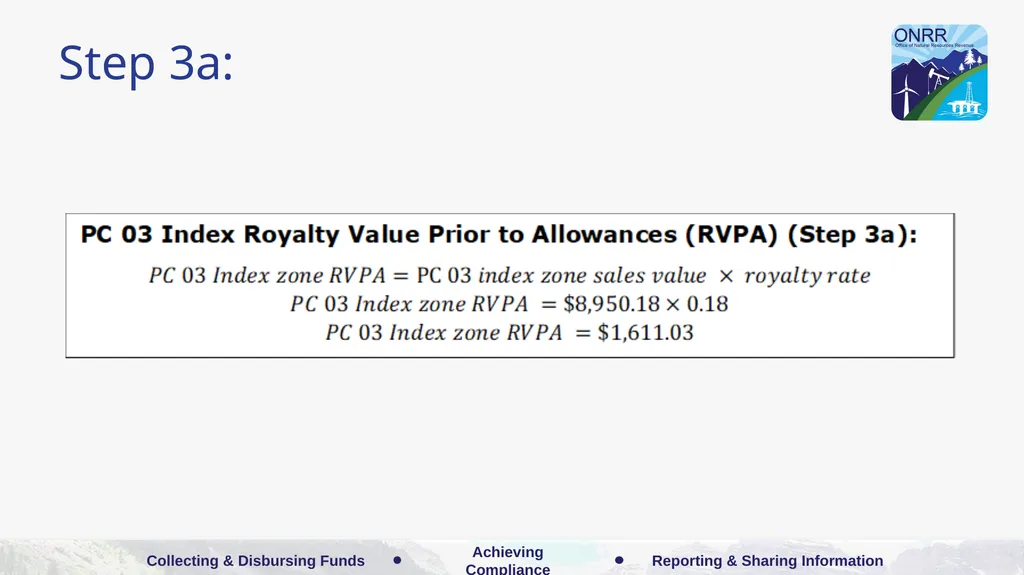
slide47. Step 3a:<br>
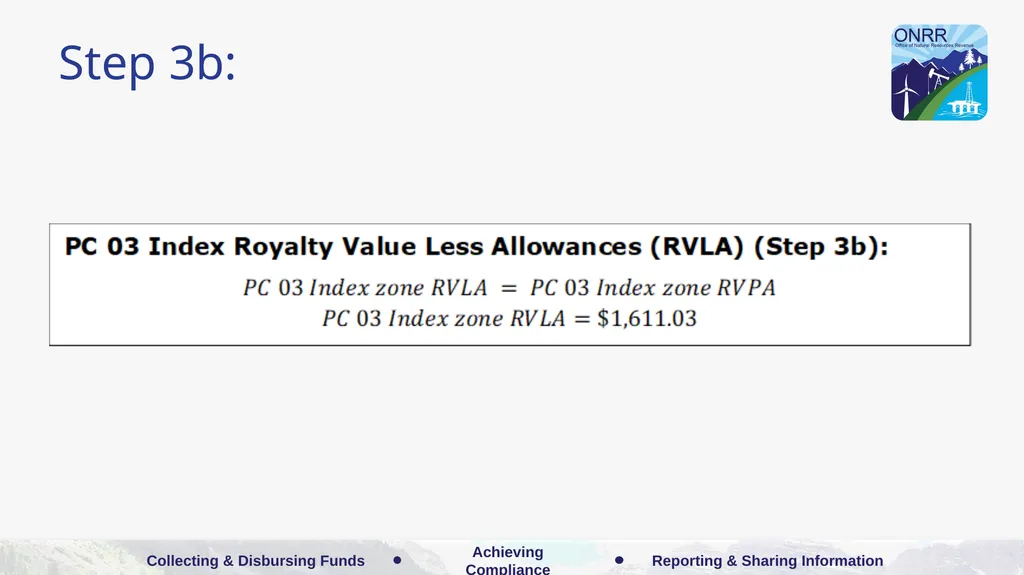
slide48. Step 3b:<br>
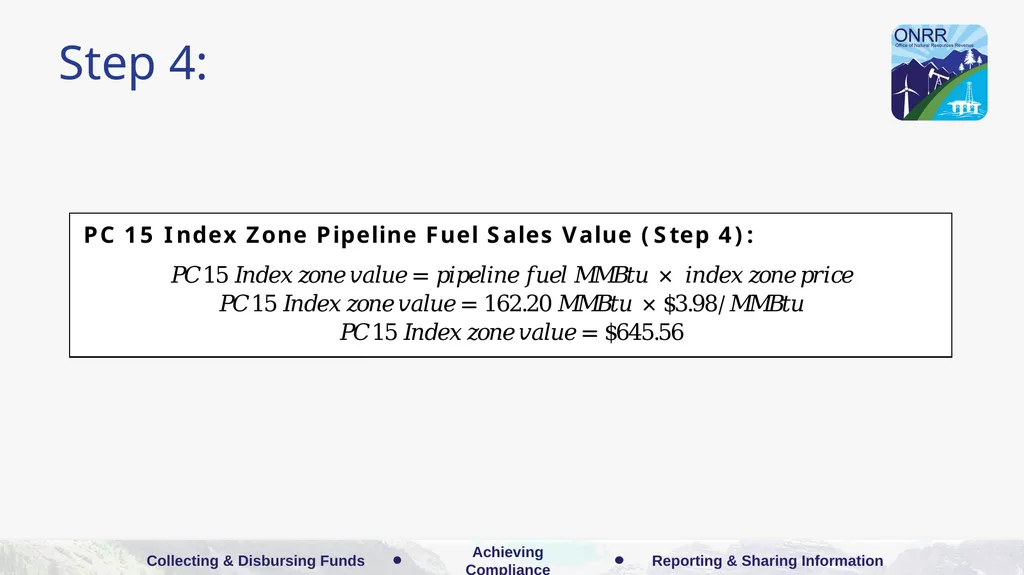
slide49. Step 4:<br>
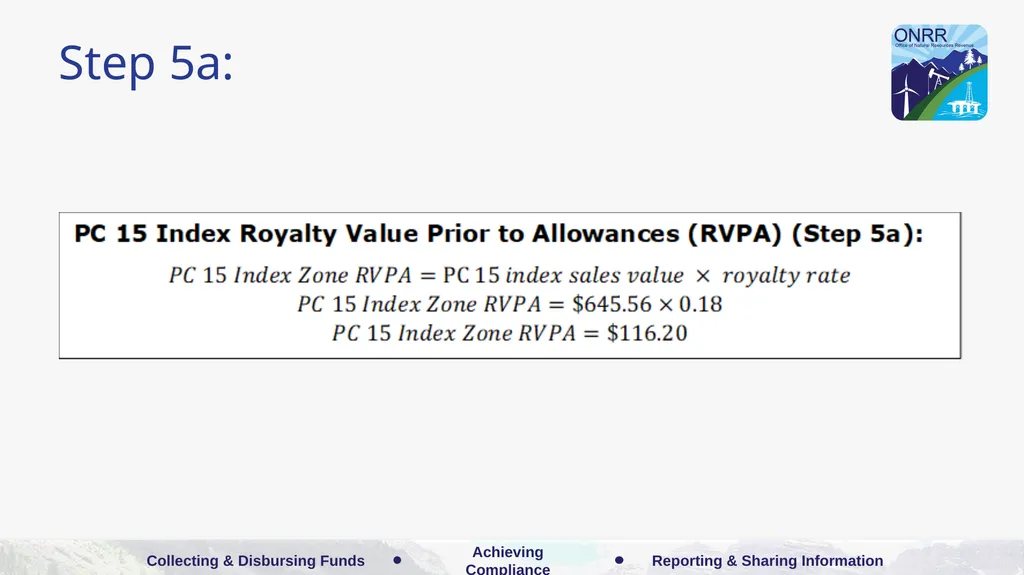
slide50. Step 5a:<br>
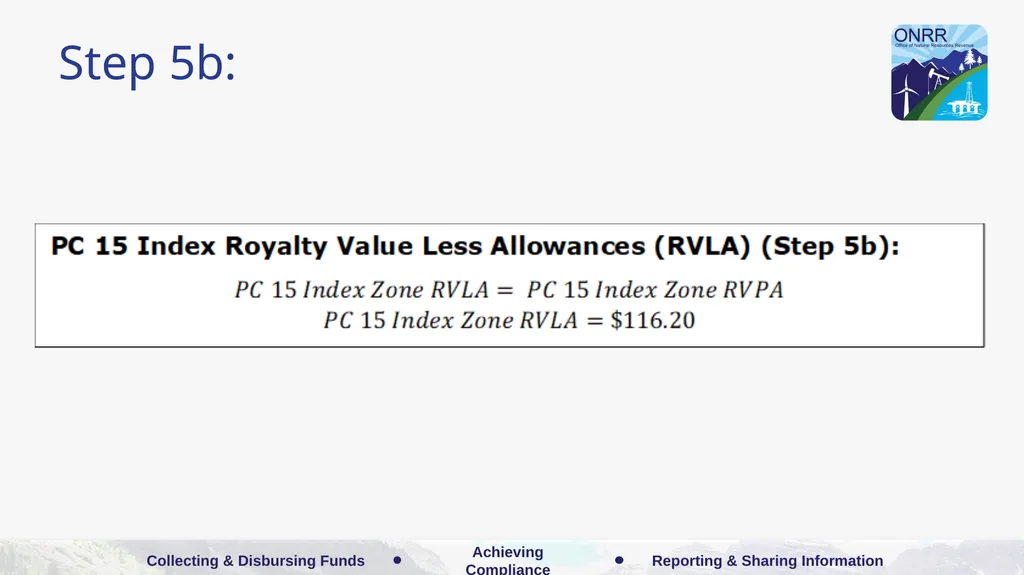
slide51. Step 5b:<br>
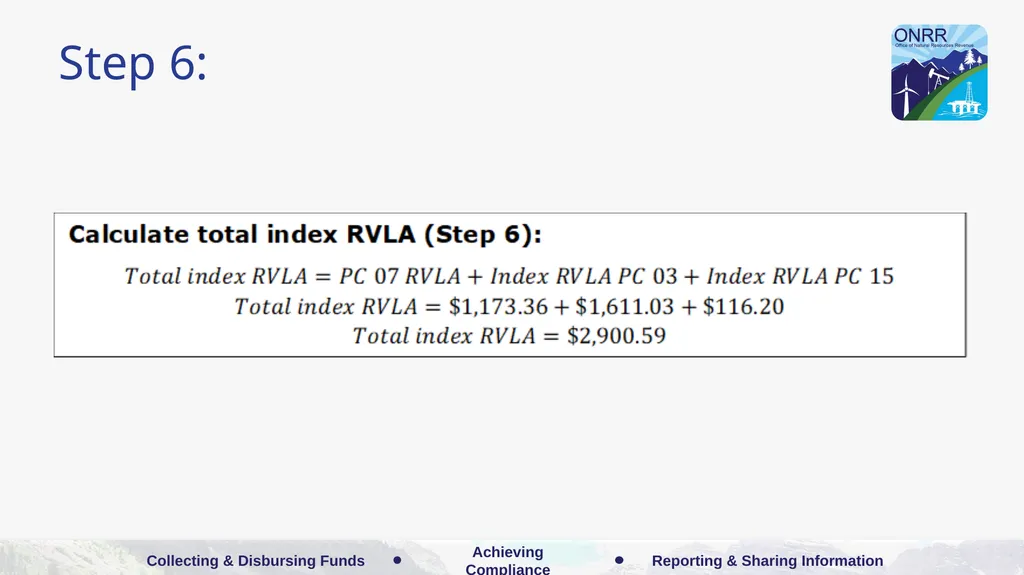
slide52. Step 6:<br>
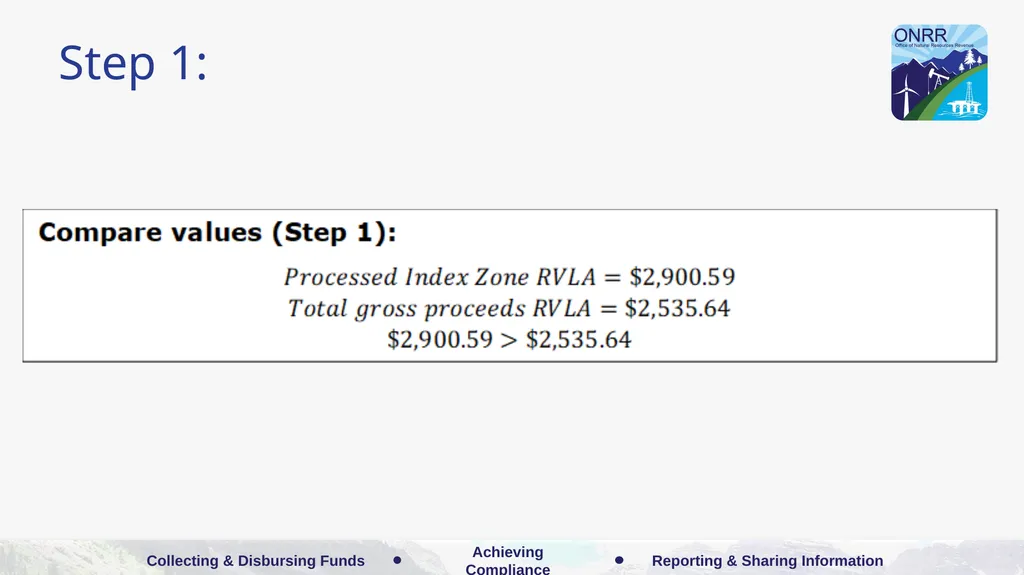
slide53. Step 1:<br>
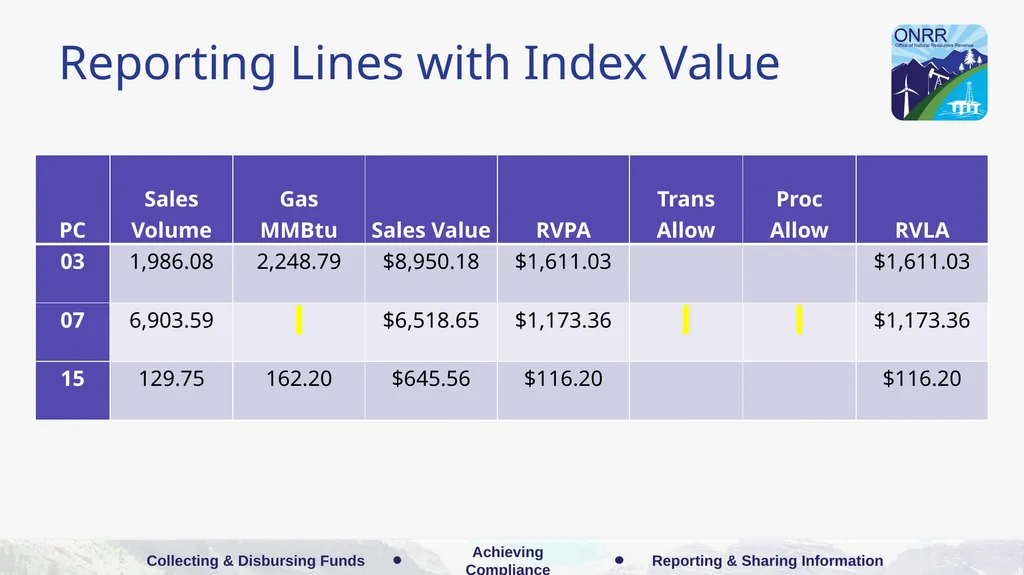
slide54. Reporting Lines with Index Value<br>
slide55. Part C – Comparing the Values Determined in Parts A and B<br>
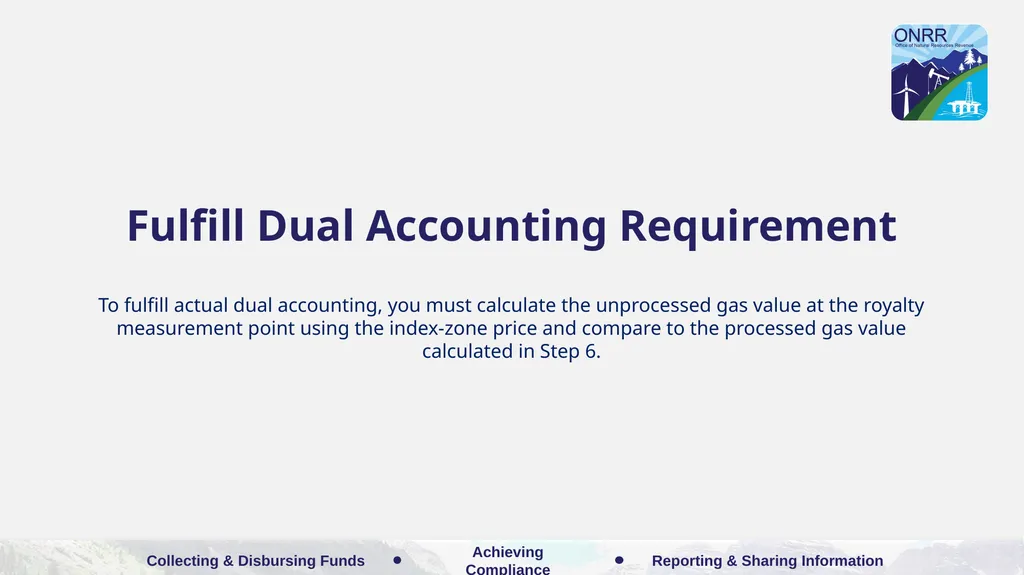
slide56. Fulfill Dual Accounting Requirement To fulfill actual dual accounting, you must calculate the unprocessed gas value at the royalty measurement point using the index-zone price and compare to the processed gas value calculated in Step 6.<br>
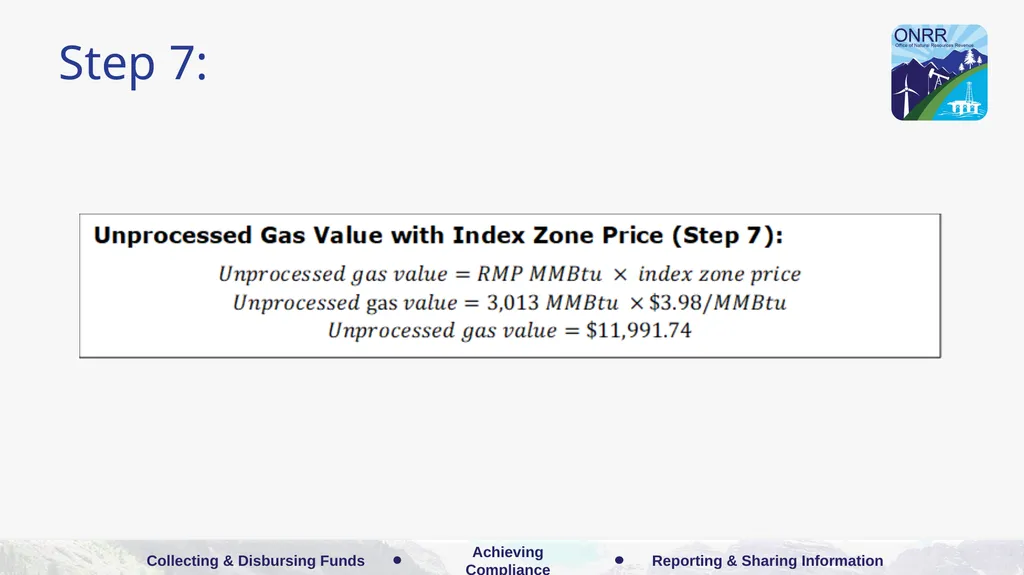
slide57. Step 7:<br>
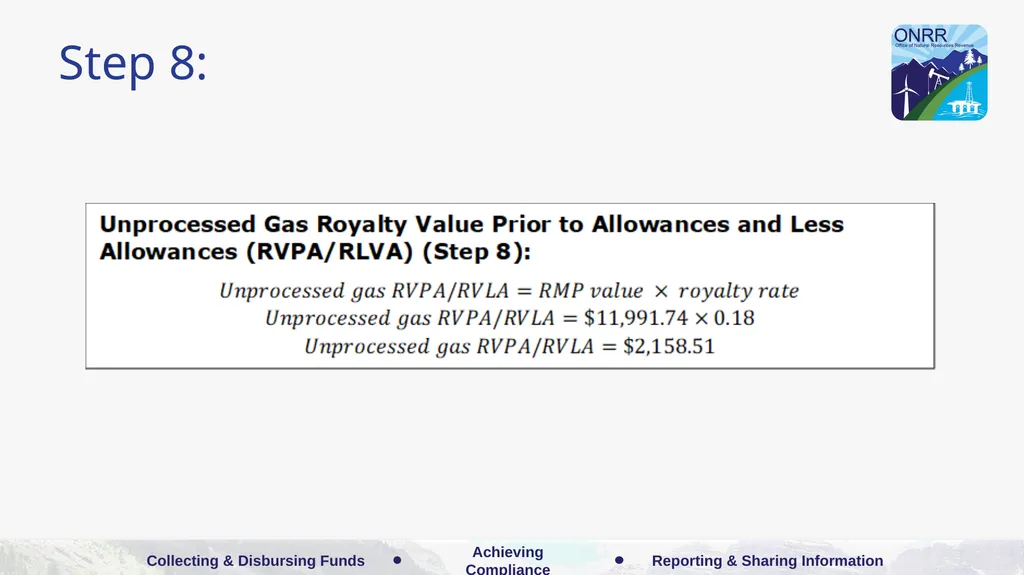
slide58. Step 8:<br>
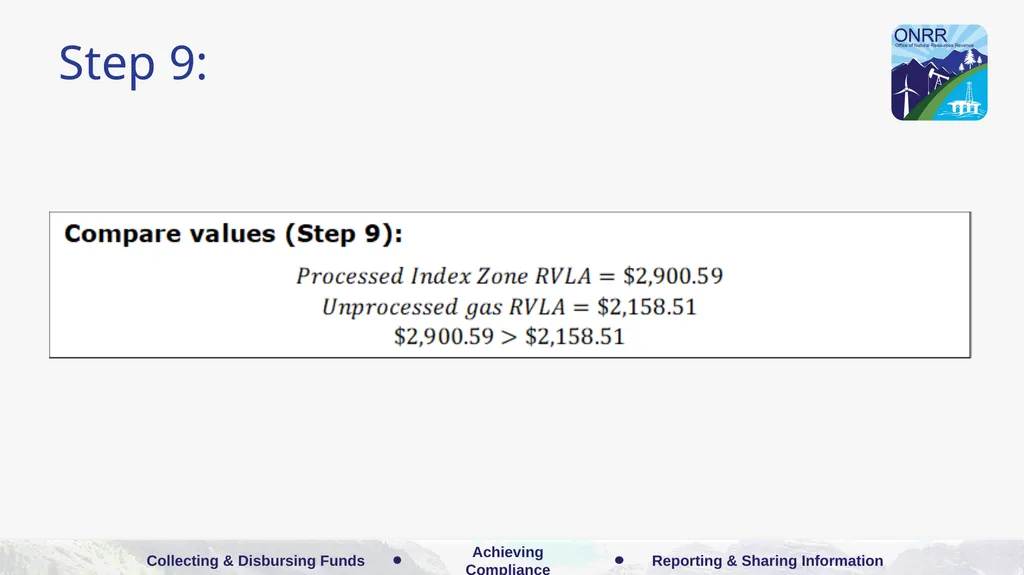
slide59. Step 9:<br>
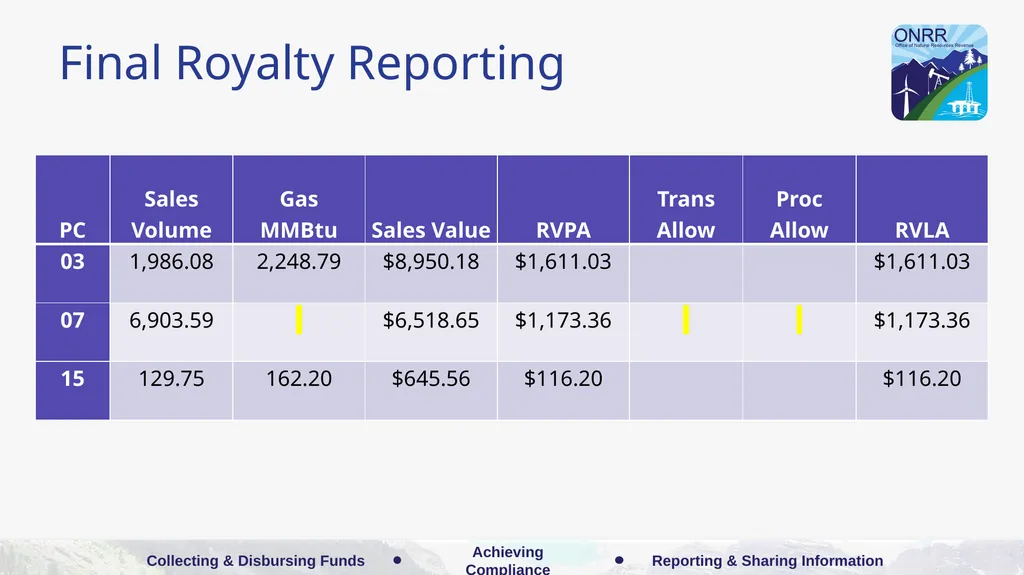
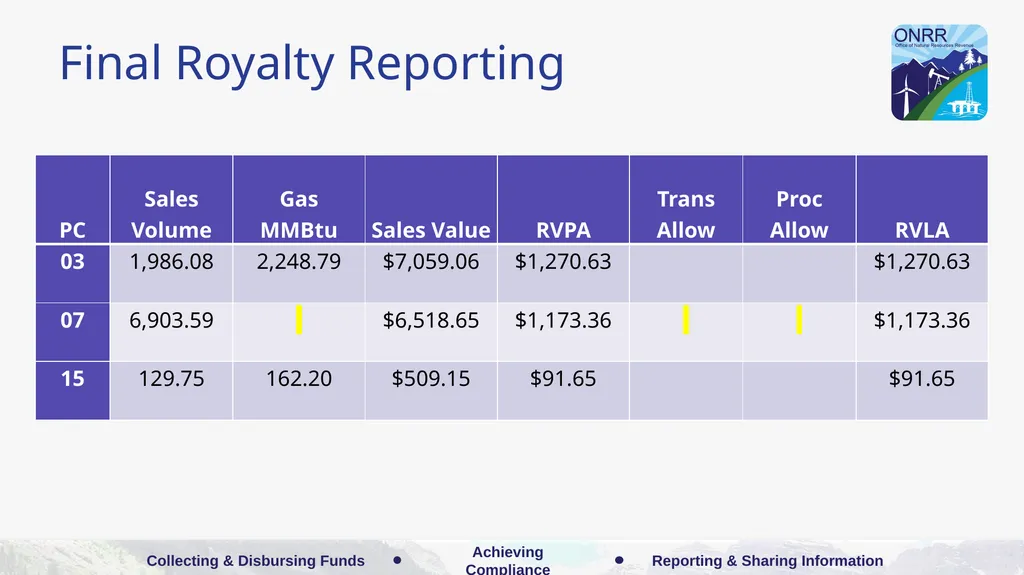
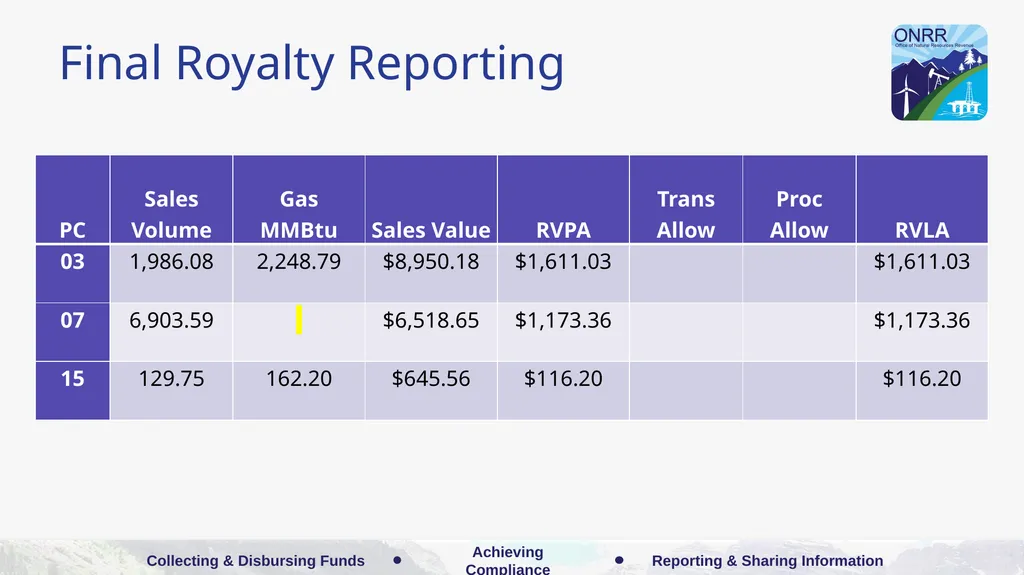
slide60. Final Royalty Reporting<br>
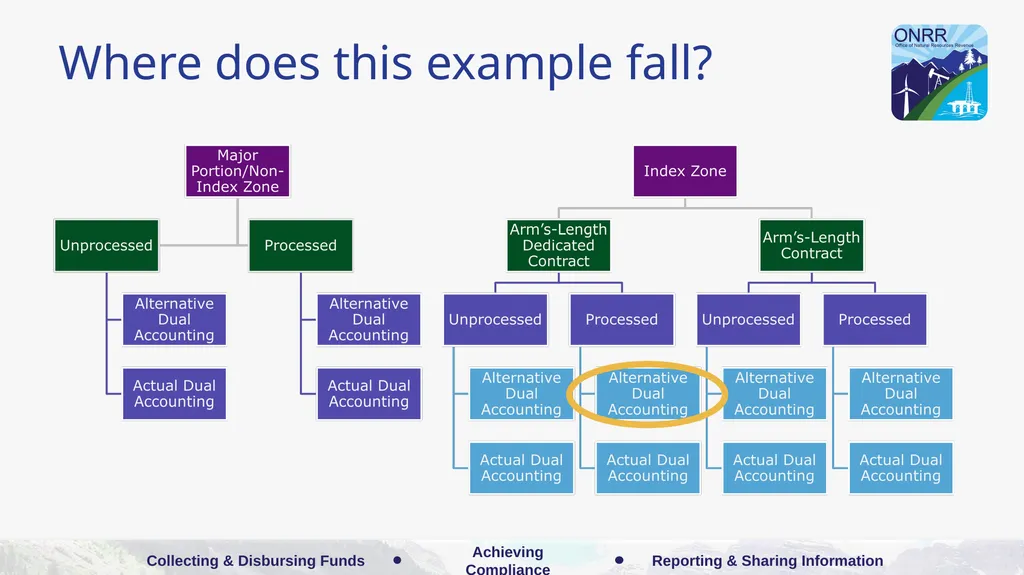
slide61. Indian Gas Example: Index Zone Arm’s-Length Dedicated Contract Processed Gas Reporting using Alternative Dual Accounting<br>
slide62. Where does this example fall?<br>
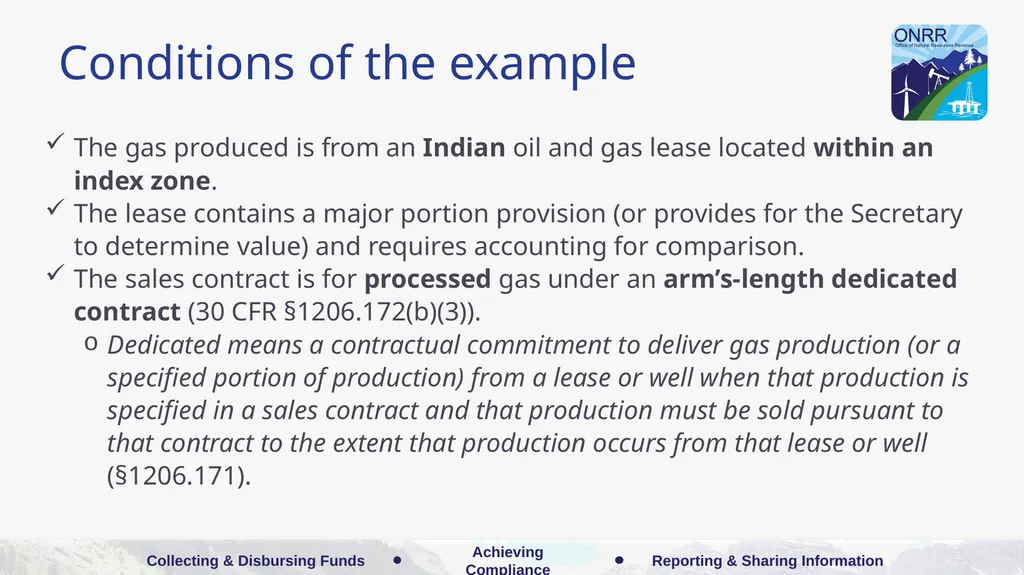
slide63. Conditions of the example The gas produced is from an Indian oil and gas lease located within an index zone.
The lease contains a major portion provision (or provides for the Secretary to determine value) and requires accounting for comparison.
The sales contract is for processed gas under an arm’s-length dedicated contract (30 CFR §1206.172(b)(3)).
Dedicated means a contractual commitment to deliver gas production (or a specified portion of production) from a lease or well when that production is specified in a sales contract and that production must be sold pursuant to that contract to the extent that production occurs from that lease or well (§1206.171).<br>
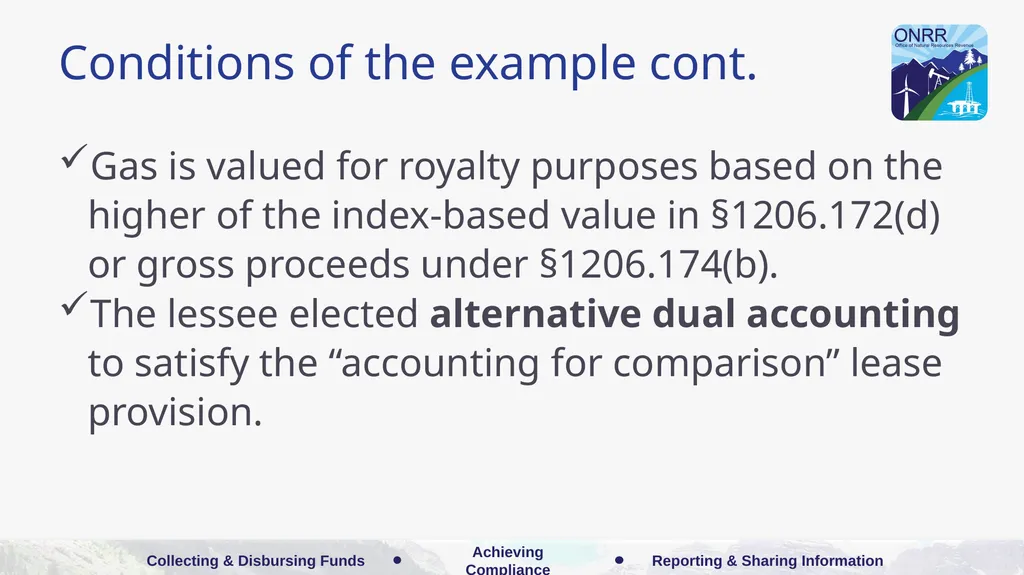
slide64. Conditions of the example cont. Gas is valued for royalty purposes based on the higher of the index-based value in §1206.172(d) or gross proceeds under §1206.174(b).
The lessee elected alternative dual accounting to satisfy the “accounting for comparison” lease provision.<br>
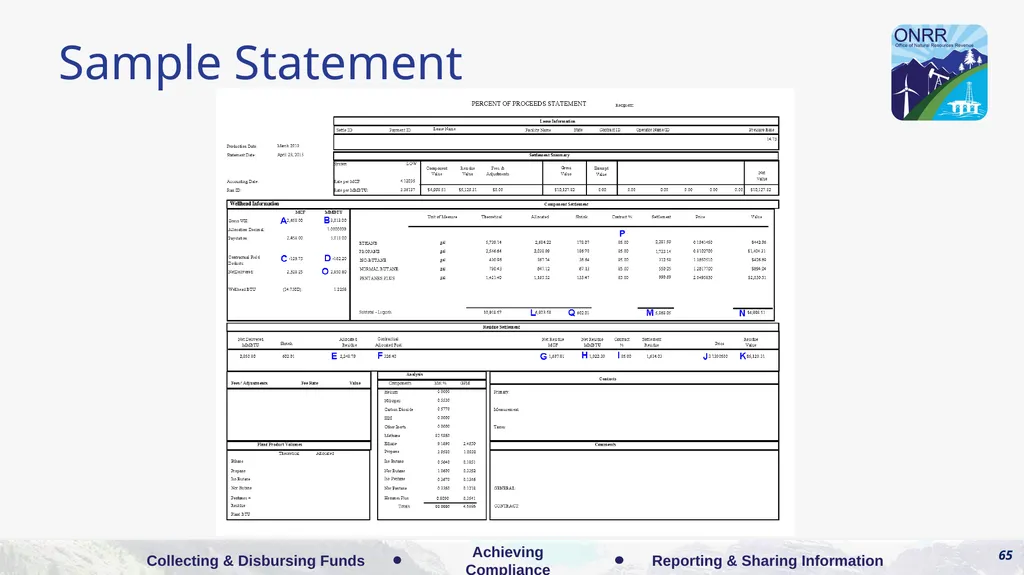
slide65. Sample Statement 65<br>
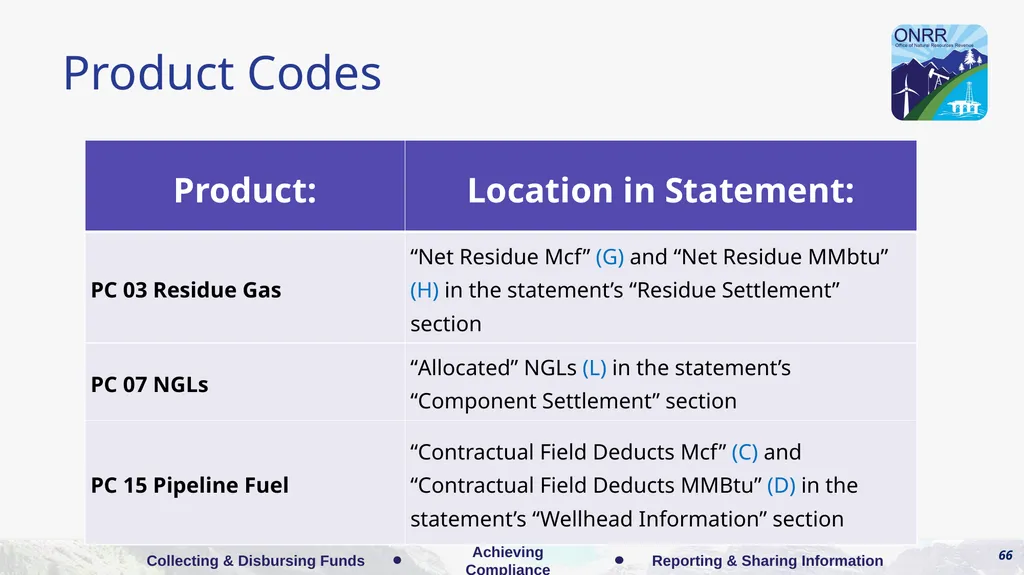
slide66. Product Codes 66<br>
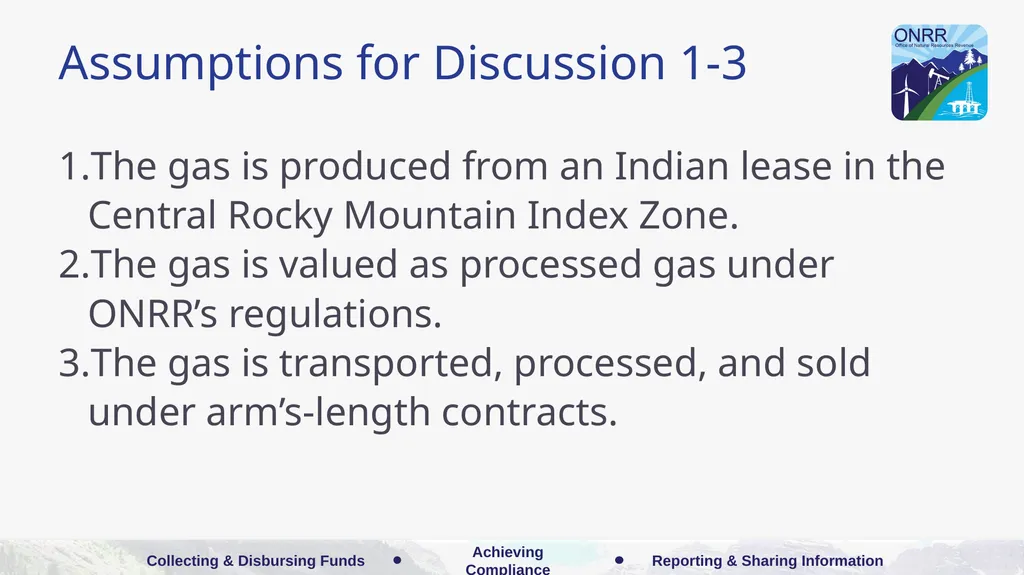
slide67. Assumptions for Discussion 1-3 The gas is produced from an Indian lease in the Central Rocky Mountain Index Zone.
The gas is valued as processed gas under ONRR’s regulations.
The gas is transported, processed, and sold under arm’s-length contracts.<br>
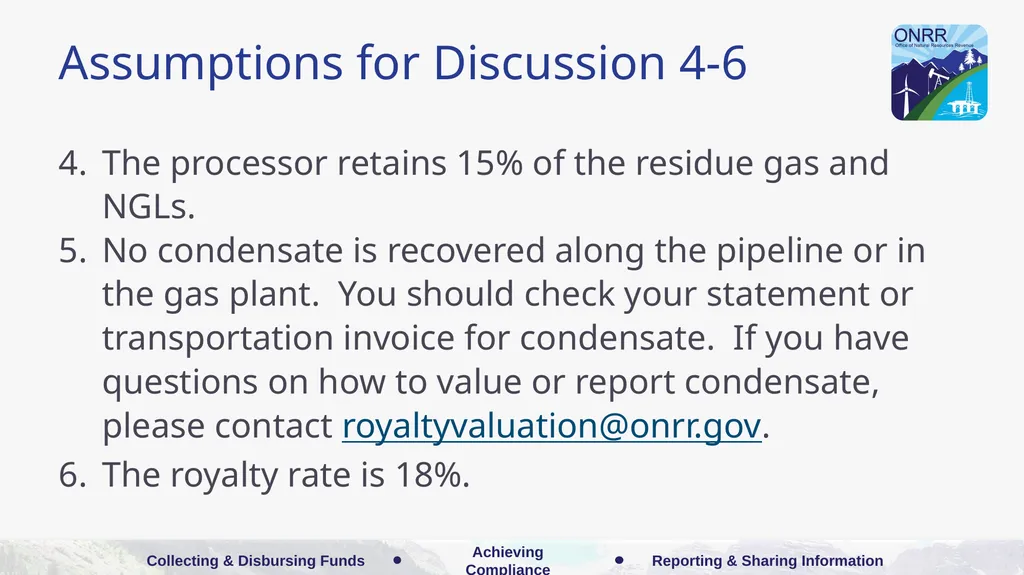
slide68. Assumptions for Discussion 4-6 The processor retains 15% of the residue gas and NGLs.
No condensate is recovered along the pipeline or in the gas plant. You should check your statement or transportation invoice for condensate. If you have questions on how to value or report condensate, please contact royaltyvaluation@onrr.gov.
The royalty rate is 18%.<br>
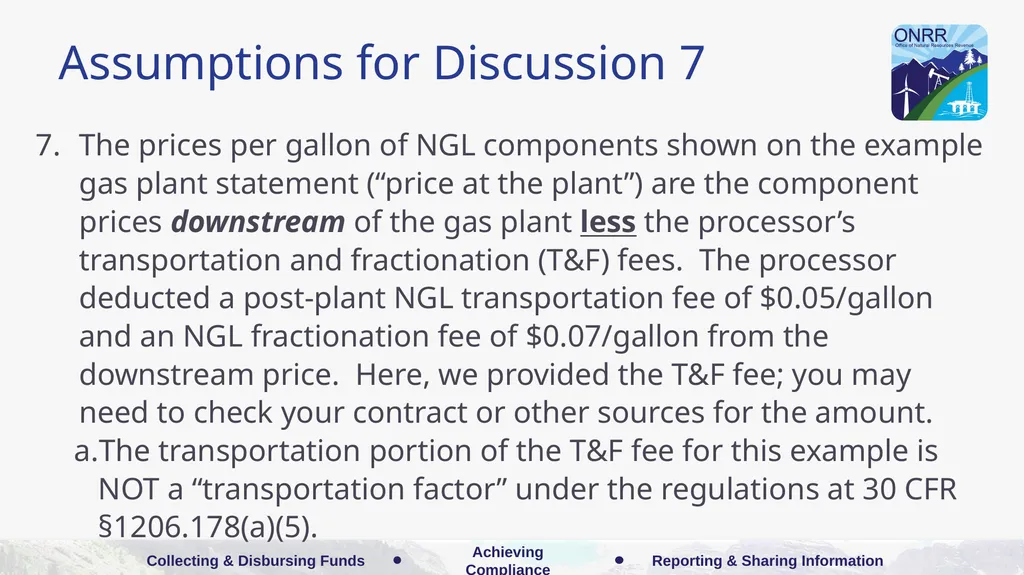
slide69. Assumptions for Discussion 7 The prices per gallon of NGL components shown on the example gas plant statement (“price at the plant”) are the component prices downstream of the gas plant less the processor’s transportation and fractionation (T&F) fees. The processor deducted a post-plant NGL transportation fee of $0.05/gallon and an NGL fractionation fee of $0.07/gallon from the downstream price. Here, we provided the T&F fee; you may need to check your contract or other sources for the amount.
The transportation portion of the T&F fee for this example is NOT a “transportation factor” under the regulations at 30 CFR §1206.178(a)(5).<br>
slide70. Assumptions for Discussion 8-9 The lease instrument for this example does not allow deductions for transportation or processing costs. Therefore, no allowances will be calculated or taken.
The NGL minimum value provision for production in Utah under §1206.174(g)(2)(i)(B) requires the use of posted prices at Conway, Kansas. For this example, we assume the below prices:<br>
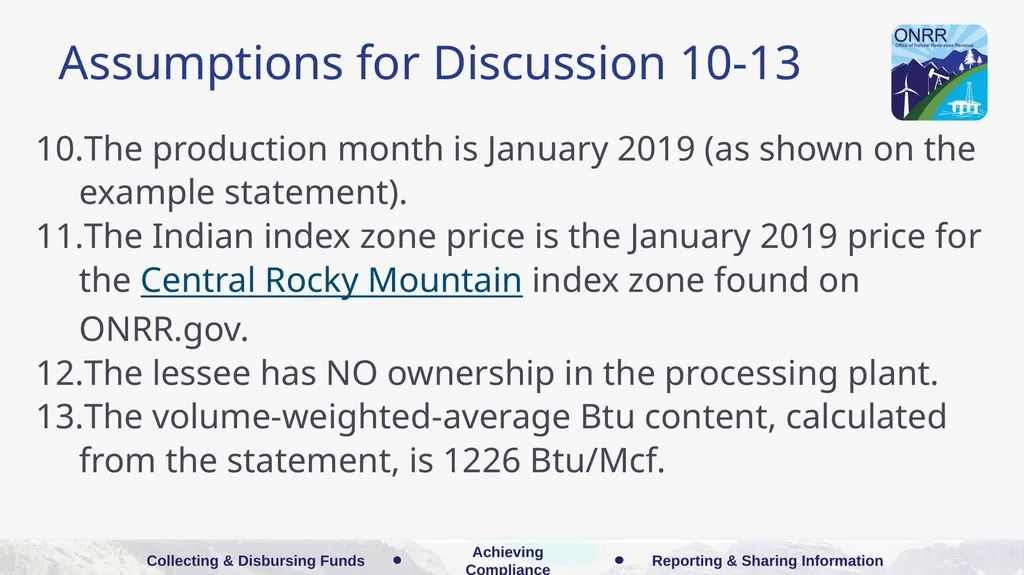
slide71. Assumptions for Discussion 10-13 The production month is January 2019 (as shown on the example statement).
The Indian index zone price is the January 2019 price for the Central Rocky Mountain index zone found on ONRR.gov.
The lessee has NO ownership in the processing plant.
The volume-weighted-average Btu content, calculated from the statement, is 1226 Btu/Mcf.<br>
slide72. Locating the Indian Index Zone Price Each month ONRR publishes natural gas prices for six Indian Index Zones as referenced in §1206.172. You can find the prices on the Indian Gas Index Zone Prices web page.<br>
slide73. Determining Dual Accounting Many Indian leases require accounting for comparison, or “dual accounting” (ONRR added emphasis):
“… and that royalty will be computed on the value of gas or casinghead gas, or on the products thereof (such as residue gas, natural gasoline, propane, butane, etc.), whichever is the greater.”<br>
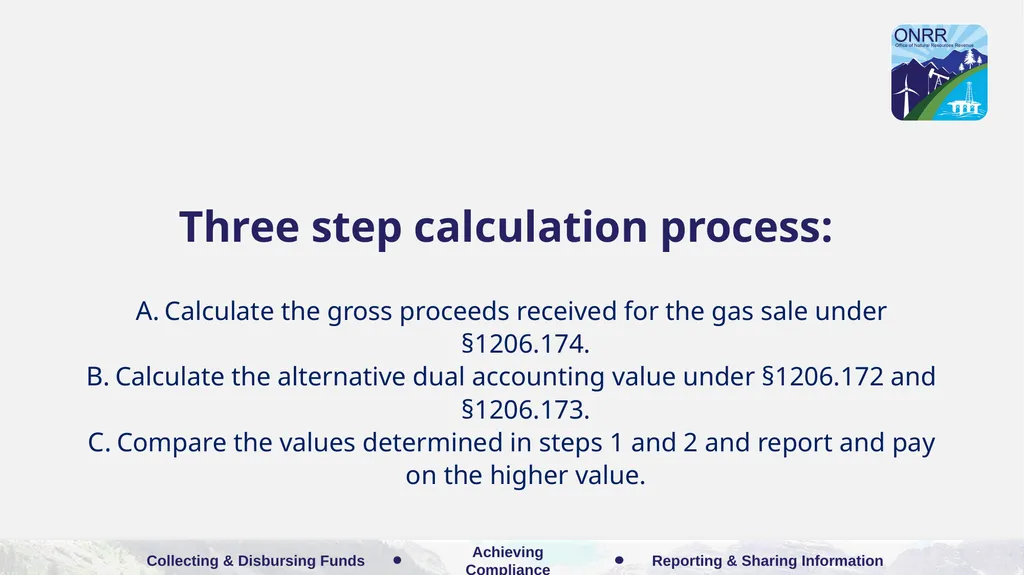
slide74. Three step calculation process: Calculate the gross proceeds received for the gas sale under §1206.174.
Calculate the alternative dual accounting value under §1206.172 and §1206.173.
Compare the values determined in steps 1 and 2 and report and pay on the higher value.<br>
slide75. Part A – Calculate the Gross Proceeds PC 03 Residue Gas<br>
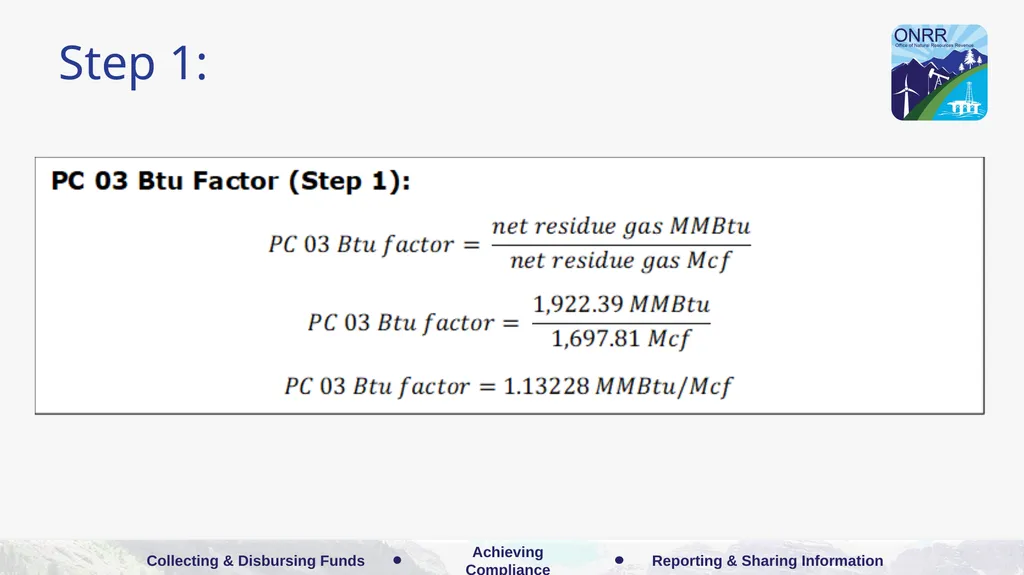
slide76. Step 1:<br>
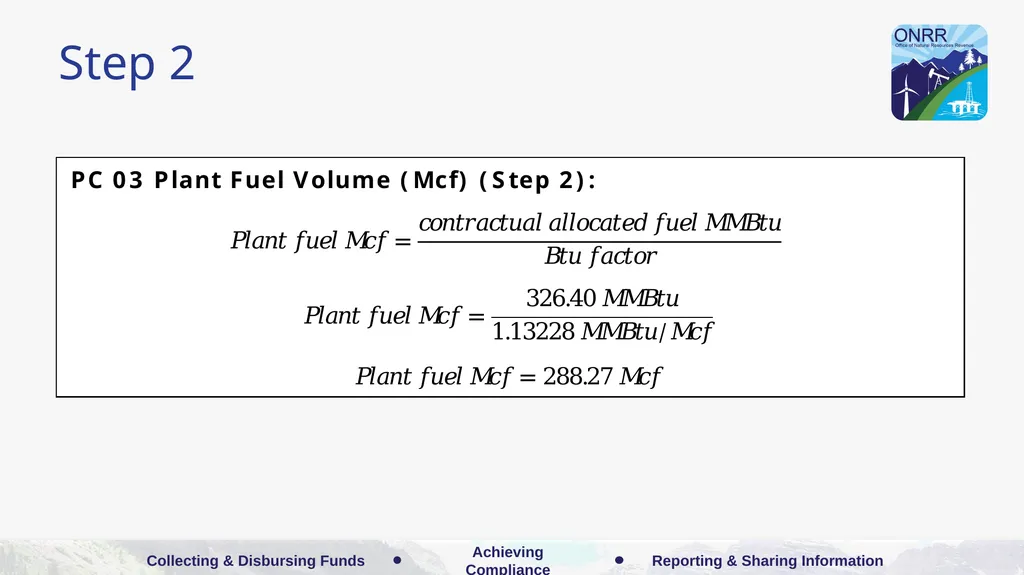
slide77. Step 2<br>
slide78. Step 3<br>
slide79. Step 4<br>
slide80. Step 5<br>
slide81. Step 6<br>
slide82. PC 03 RVPA<br>
slide83. Part A – Calculate the Gross Proceeds PC 07 NGLs<br>
slide84. Minimum NGL Provision Royalty is due on any NGLs resulting from processing. In order to comply with the minimum NGL value provision (explained in greater detail in the Minimum NGL Value Example), you should: calculate the regulatory minimum price (the published NGL price less the regulatory adjustment)
determine the price at the plant
compare the prices for each NGL component<br>
slide85. What price to use to report: If the regulatory minimum price is higher, you use that in calculating the sales value for that component.
If the price at the plant is higher, you use the downstream sales price (post-fractionation) to calculate the sales value for that component. Because the price at the plant is net of T&F fees, you must add those fees back in to calculate the downstream sales price. As those fees cannot be netted against the sales value, they should instead be taken as allowances where appropriate.
For a more in-depth explanation of why the NGL minimum value is calculated this way, please see our full Processed Gas Reporting: Minimum Value Provision for NGLs Example (refer to Scenario 2 for details pertaining to this example).<br>
slide86. Step 1: NGL Minimum Value Price Under §1206.174(g)(2), the NGL value must not be less than the regulatory minimum value given in the regulations
In this example, use the minimum value for Utah at §1206.174(g)(2)(i)(B), which is the published NGL price at Conway, Kansas less seven cents<br>
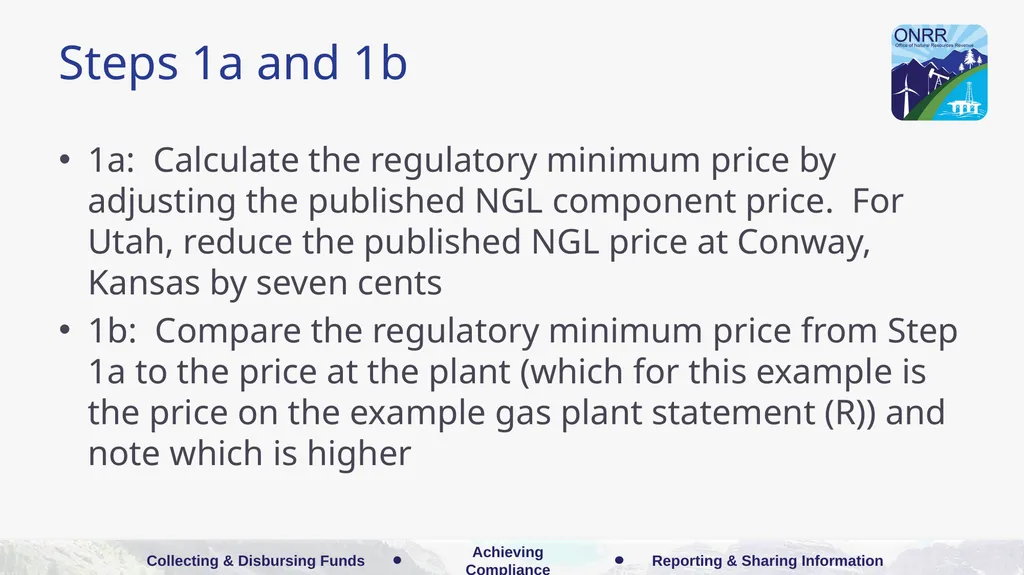
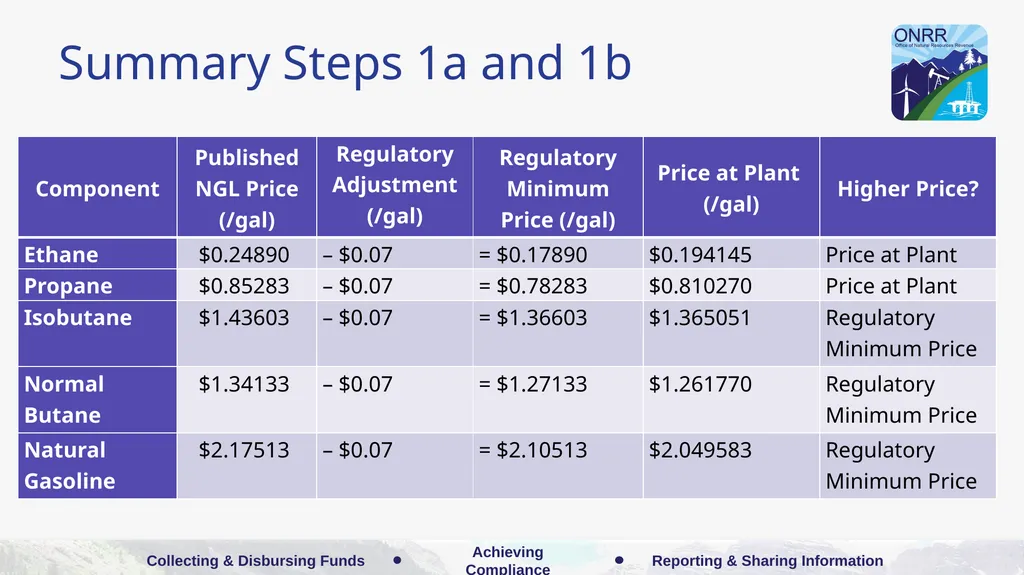
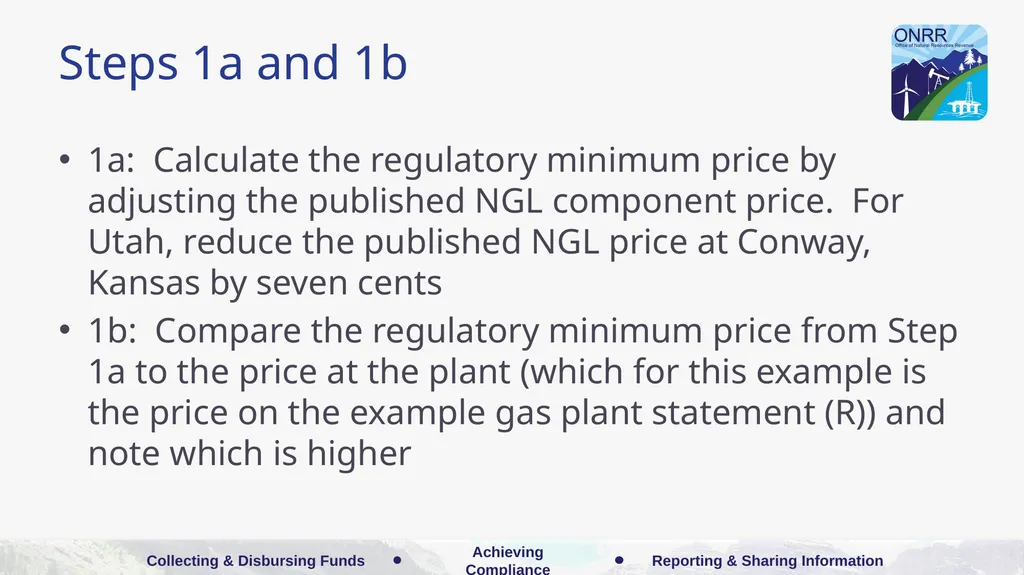
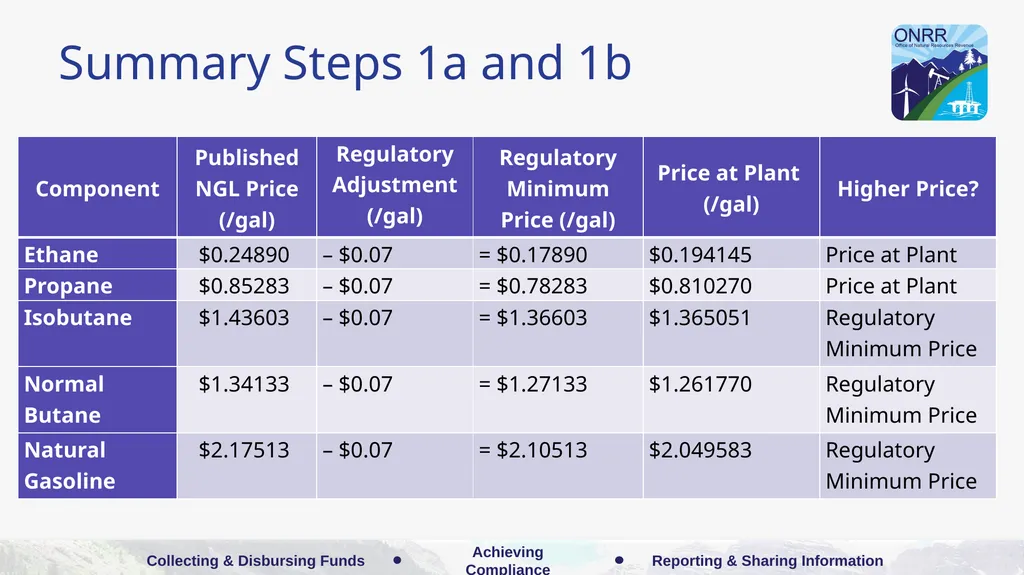
slide87. Steps 1a and 1b 1a: Calculate the regulatory minimum price by adjusting the published NGL component price. For Utah, reduce the published NGL price at Conway, Kansas by seven cents
1b: Compare the regulatory minimum price from Step 1a to the price at the plant (which for this example is the price on the example gas plant statement (R)) and note which is higher<br>
slide88. Summary Steps 1a and 1b<br>
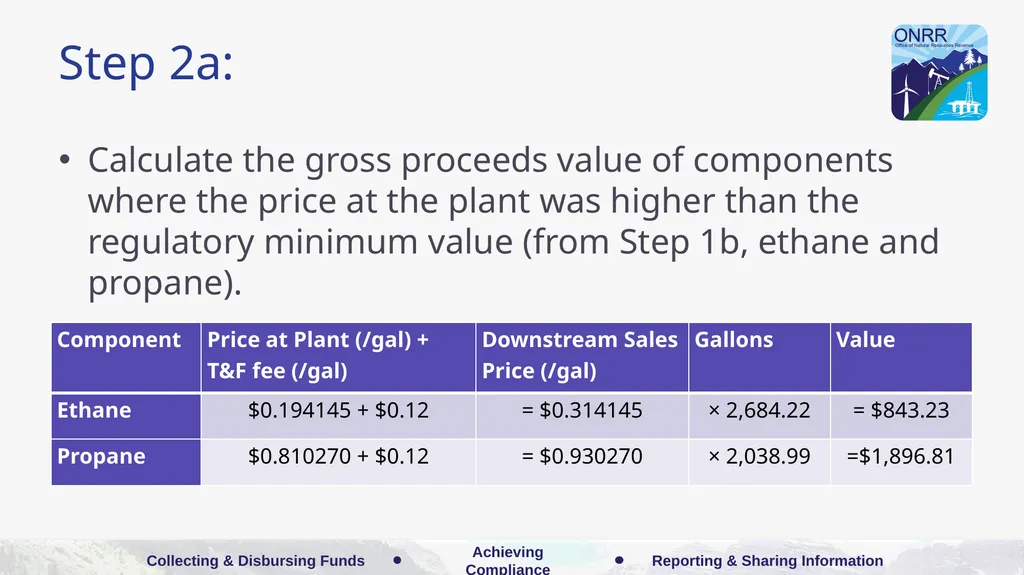
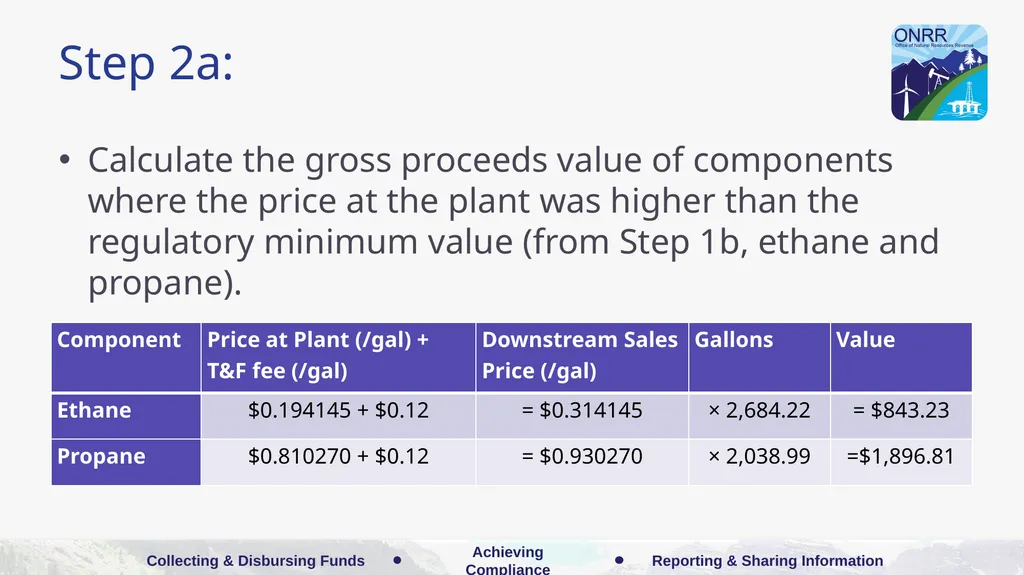
slide89. Step 2a: Calculate the gross proceeds value of components where the price at the plant was higher than the regulatory minimum value (from Step 1b, ethane and propane).<br>
slide90. Step 2b: Calculate the value of NGL components where the regulatory minimum price was higher<br>
slide91. Step 2c:<br>
slide92. Step 3: Determine the NGL sales volume:
Locate the NGLs actually recovered by the plant on the plant statement under the Component Settlement section showing the “Allocated” amount (L)
This is the NGL sales volume (6,903.59 gallons)<br>
slide93. Step 4:<br>
slide94. PC 07 RVPA<br>
slide95. Part A – Calculate the Gross Proceeds PC 15 - Pipeline Fuel<br>
slide96. Step 1:<br>
slide97. Step 2:<br>
slide98. PC 15 RVPA<br>
slide99. Royalty Value Less Allowances Lease terms dictate if you can take allowances. If you have questions about unbundling or allowances, you may contact us at onrrunbundling@onrr.gov or royaltyvaluation@onrr.gov. If you choose to unbundle the costs of transportation and processing to ensure marketable condition costs are not included, you may be able to calculate allowances for transportation and processing.
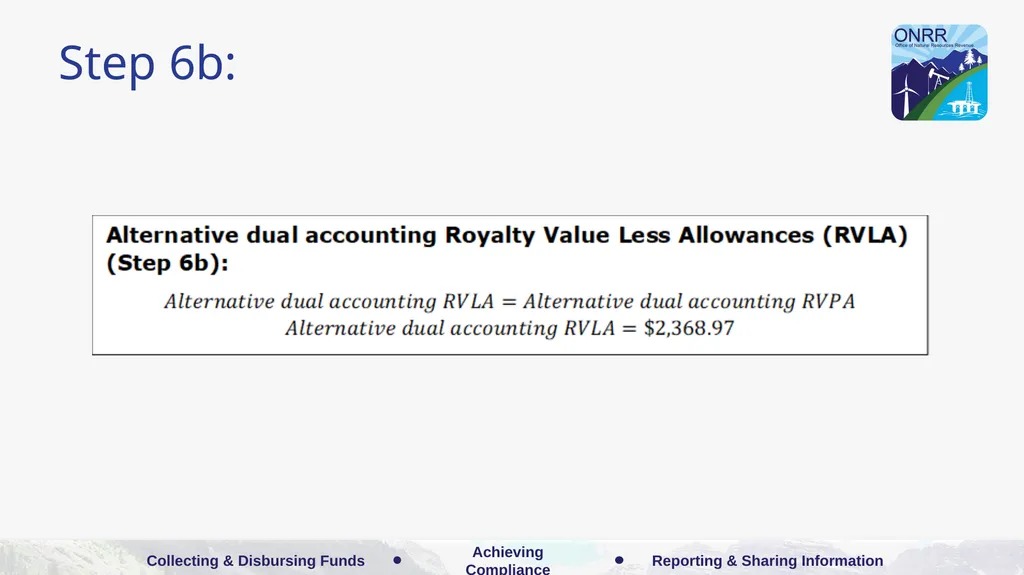
In this example, we assume our lease instrument does not allow deductions for transportation or processing costs (Assumption #8). Therefore, no allowances may be taken. Thus, the Royalty Value Prior to Allowances (RVPA) and Royalty Value Less Allowances (RVLA) are the same for all 3 product codes.<br>
slide100. Part A RVLA<br>
slide101. Part B – Alternative Dual Accounting Index Zone Calculations<br>
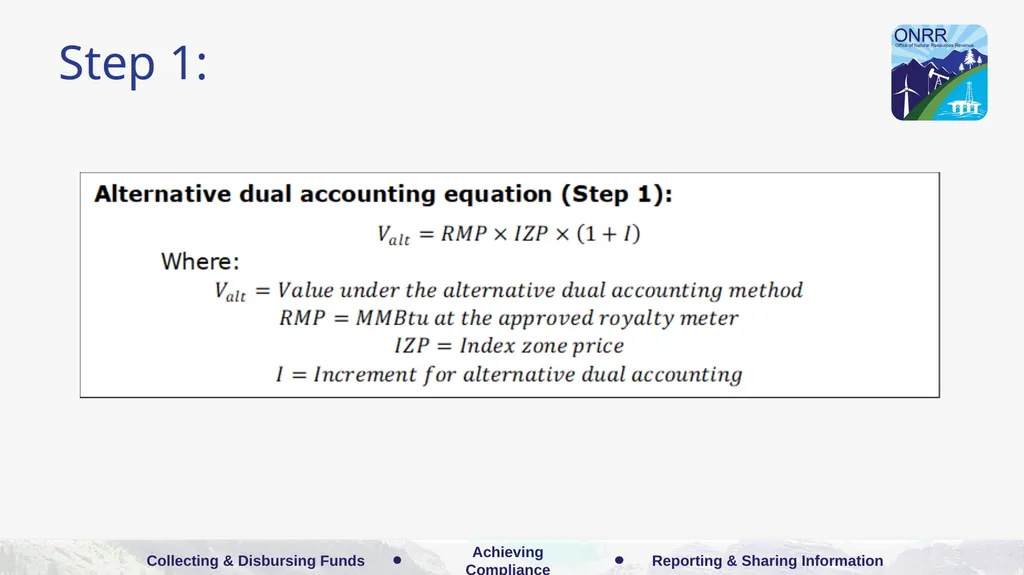
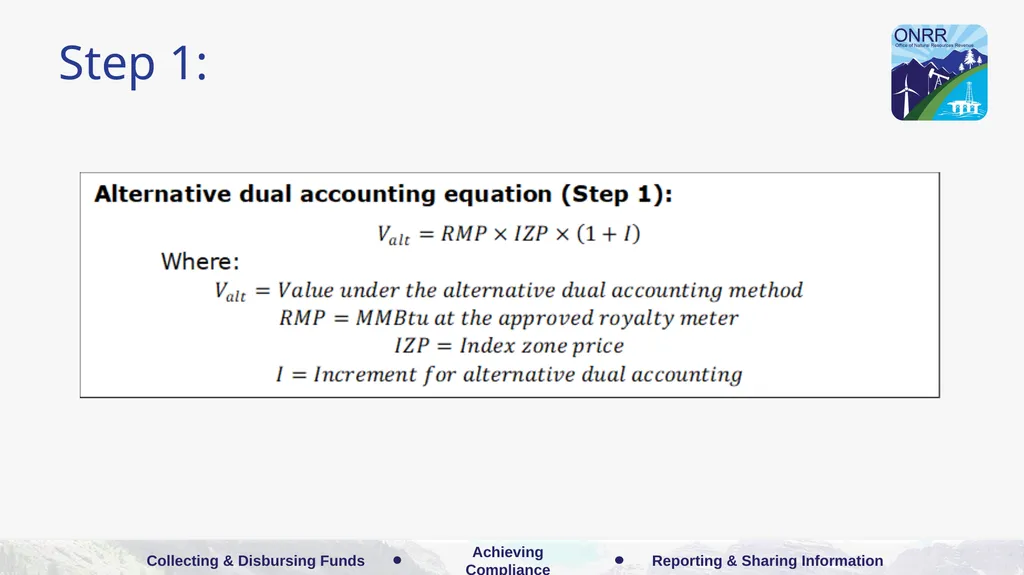
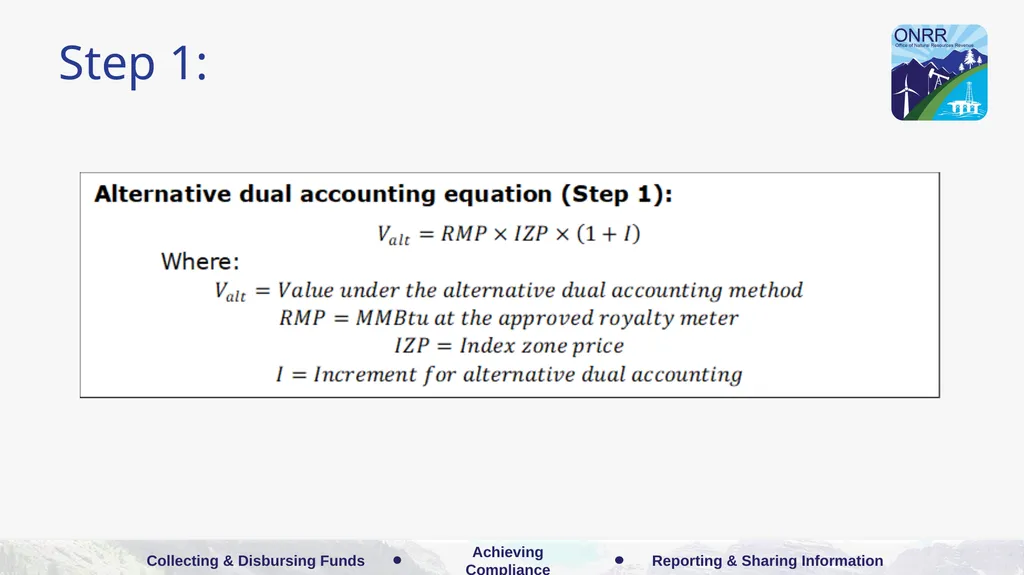
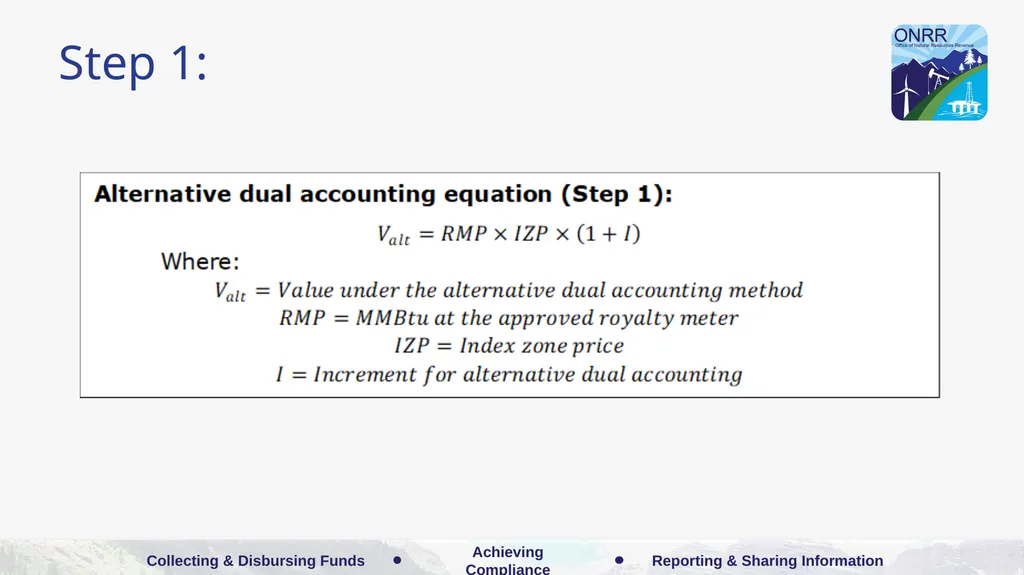
slide102. Step 1:<br>
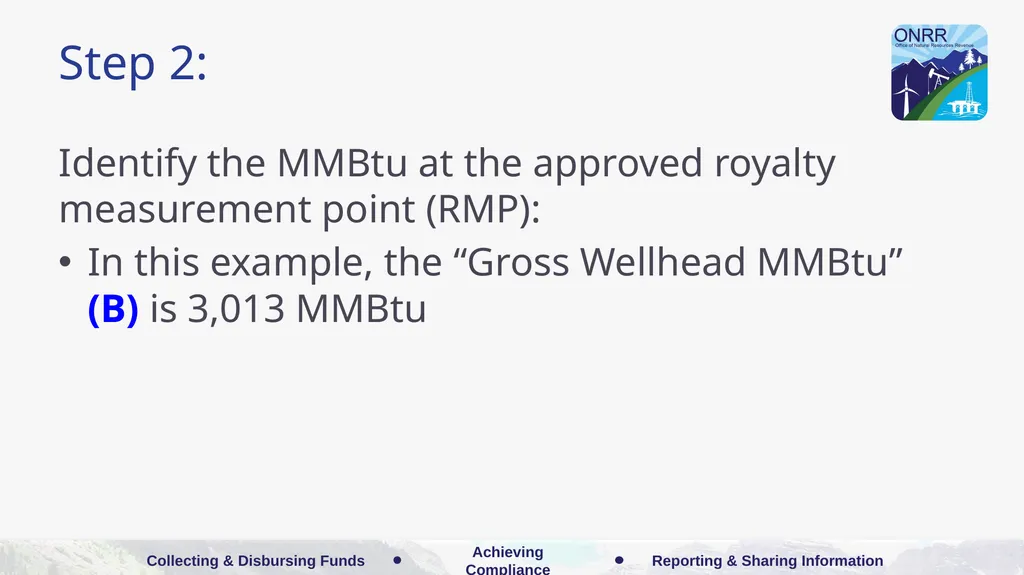
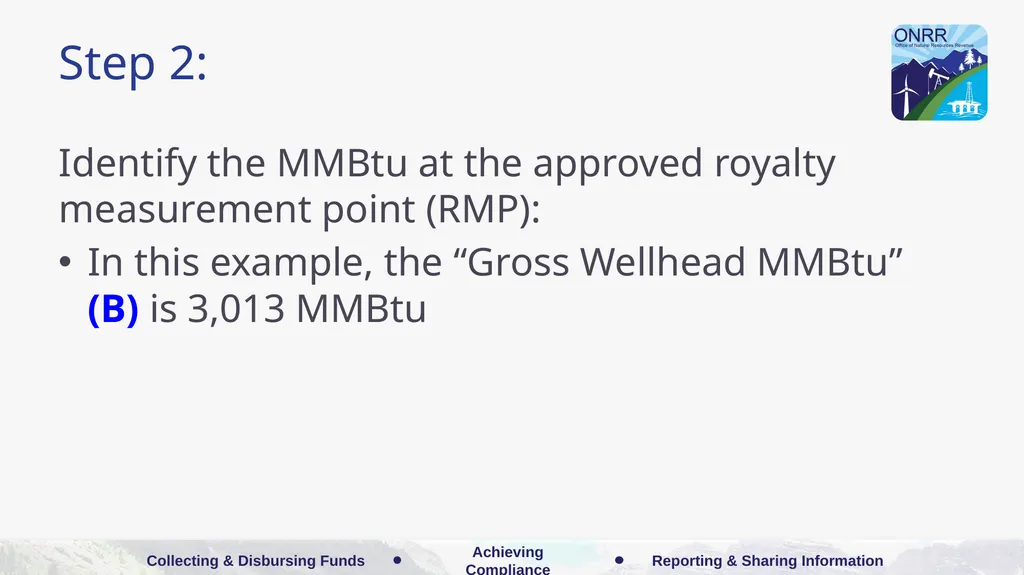
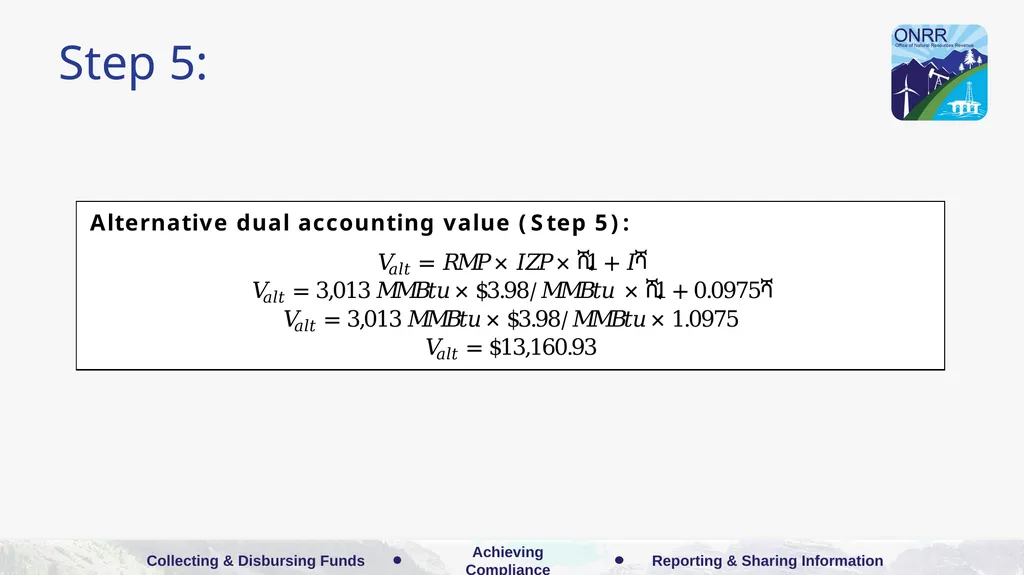
slide103. Step 2: Identify the MMBtu at the approved royalty measurement point (RMP):
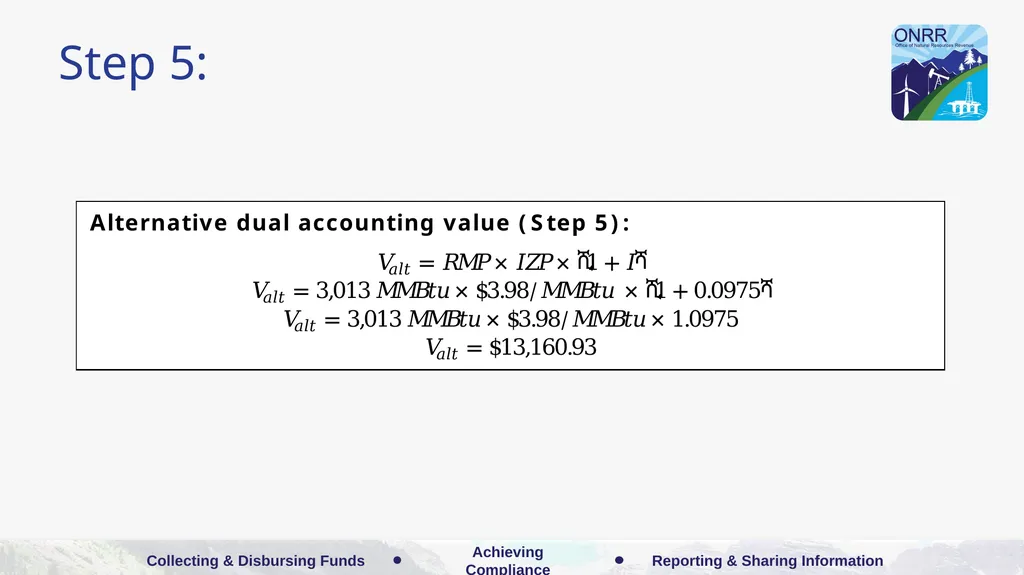
In this example, the “Gross Wellhead MMBtu” (B) is 3,013 MMBtu<br>
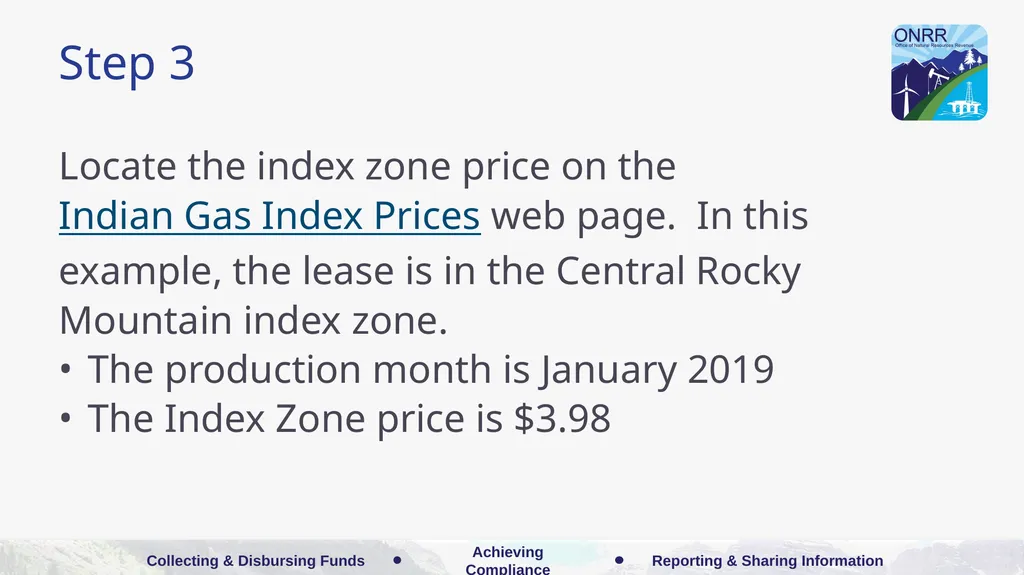
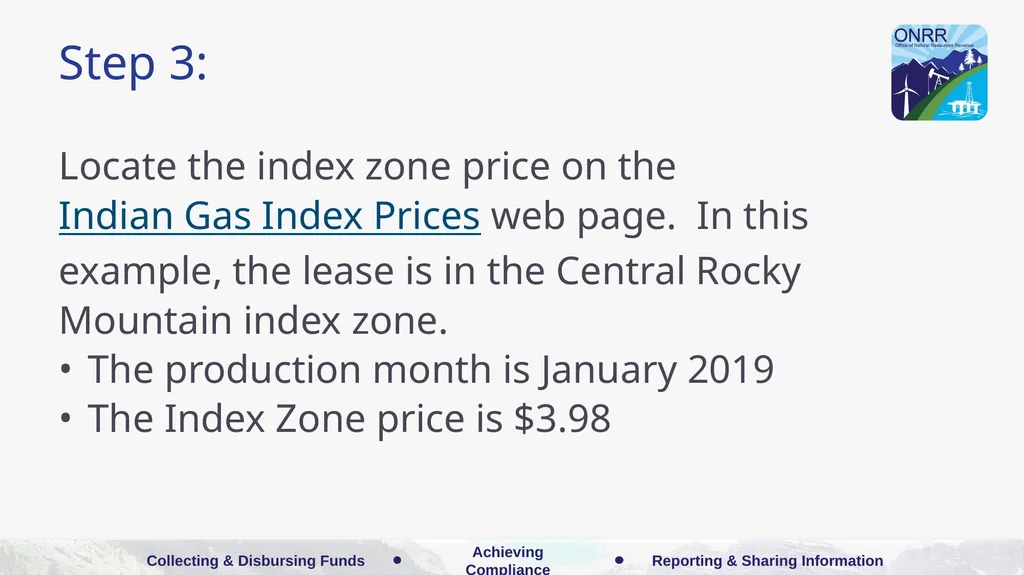
slide104. Step 3 Locate the index zone price on the Indian Gas Index Prices web page. In this example, the lease is in the Central Rocky Mountain index zone.
The production month is January 2019
The Index Zone price is $3.98<br>
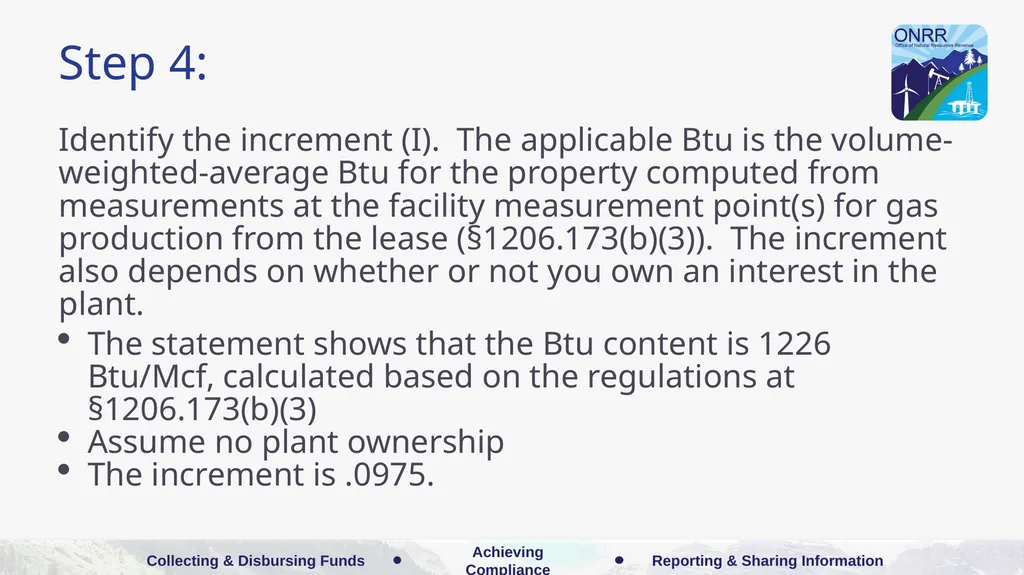
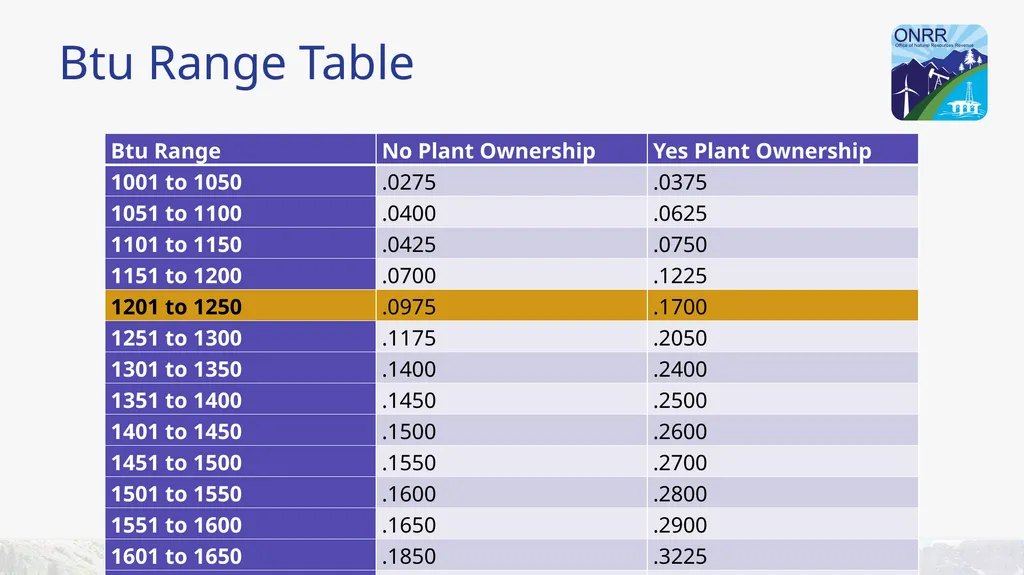
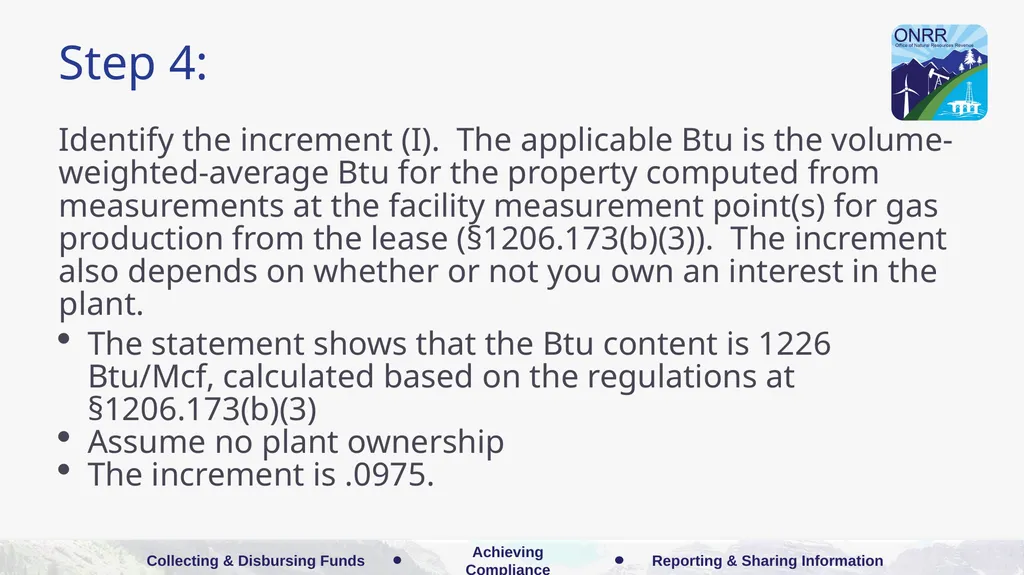
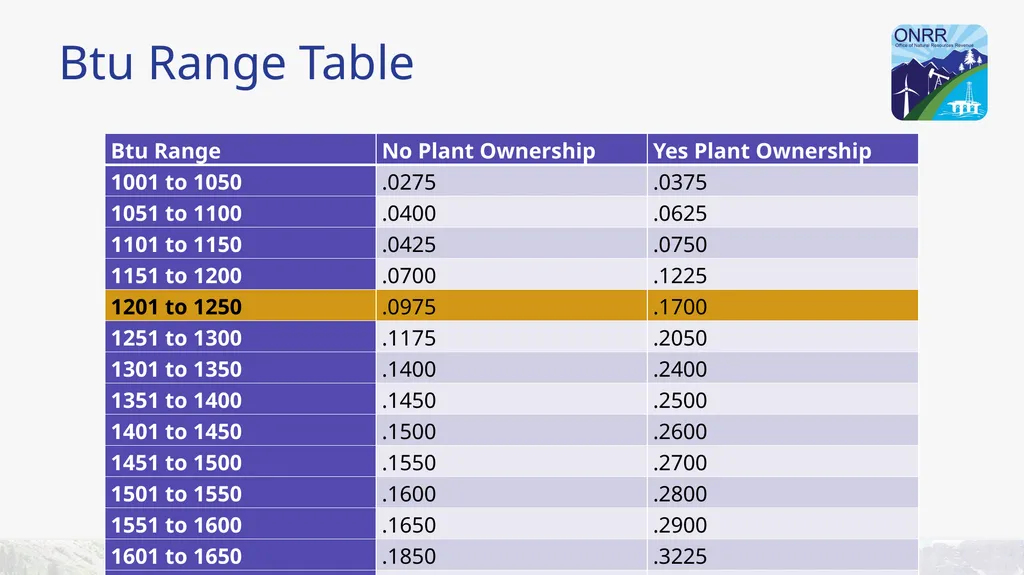
slide105. Step 4: Identify the increment (I). The applicable Btu is the volume-weighted-average Btu for the property computed from measurements at the facility measurement point(s) for gas production from the lease (§1206.173(b)(3)). The increment also depends on whether or not you own an interest in the plant.
The statement shows that the Btu content is 1226 Btu/Mcf, calculated based on the regulations at §1206.173(b)(3)
Assume no plant ownership
The increment is .0975.<br>
slide106. Btu Range Table<br>
slide107. Step 5:<br>
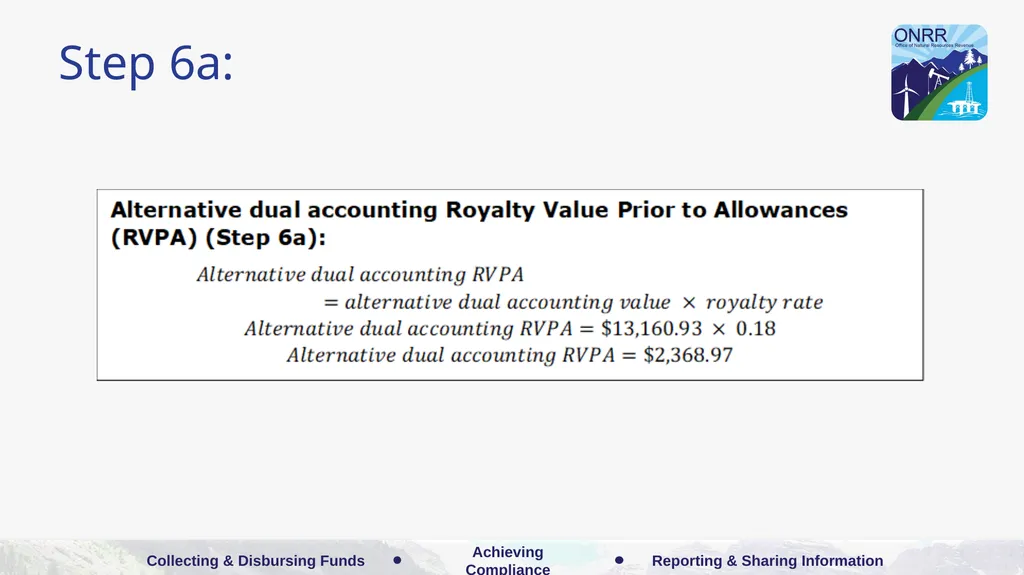
slide108. Step 6a:<br>
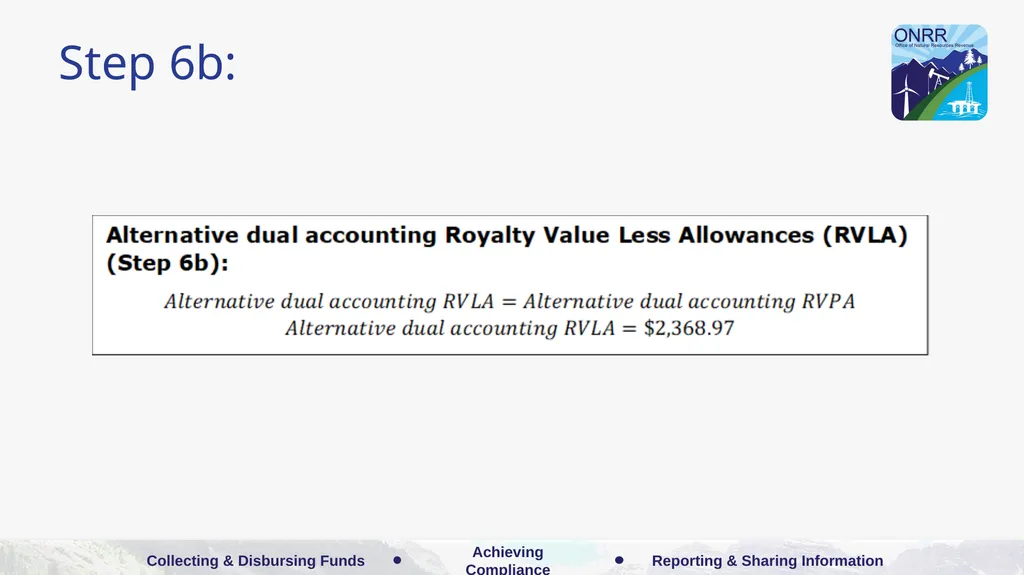
slide109. Step 6b:<br>
slide110. Part C – Comparing the Values Determined in Parts A and B<br>
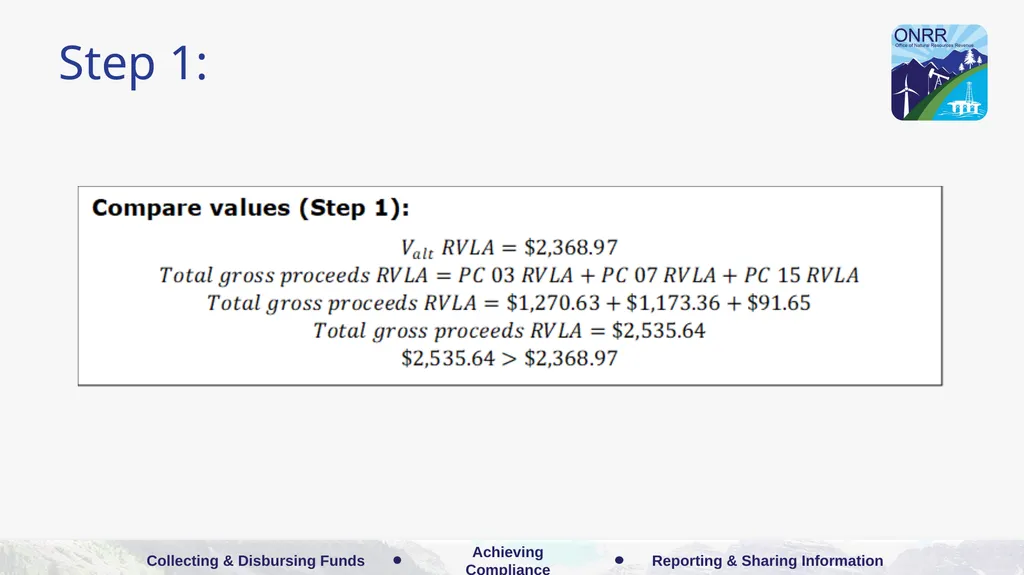
slide111. Step 1:<br>
slide112. Final Royalty Reporting<br>
slide113. Indian Gas Example: Arm’s-Length Non-Dedicated Contract in an Index Zone Processed Gas Reporting using Actual Dual Accounting<br>
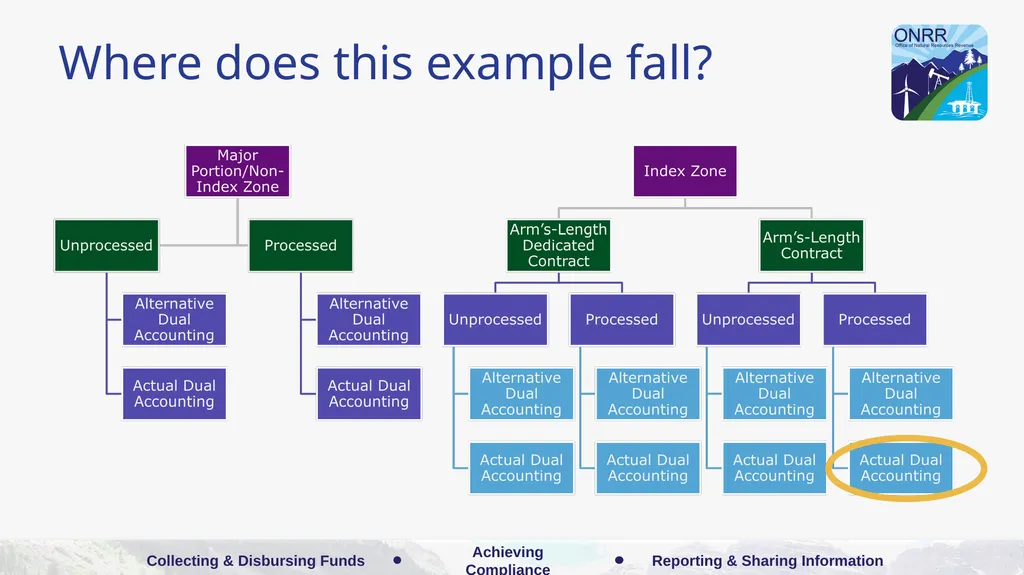
slide114. Where does this example fall?<br>
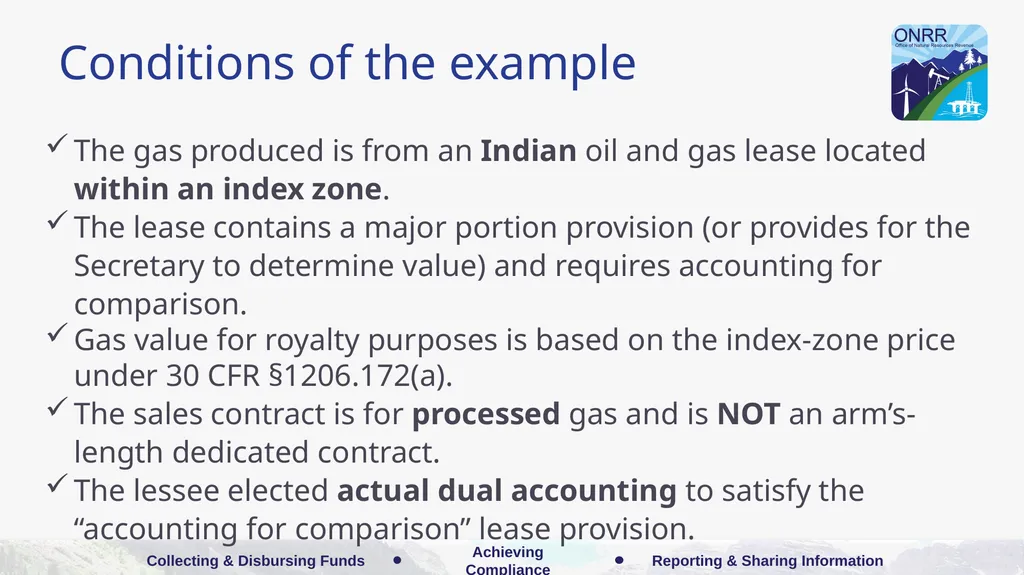
slide115. Conditions of the example The gas produced is from an Indian oil and gas lease located within an index zone.
The lease contains a major portion provision (or provides for the Secretary to determine value) and requires accounting for comparison.
Gas value for royalty purposes is based on the index-zone price under 30 CFR §1206.172(a).
The sales contract is for processed gas and is NOT an arm’s-length dedicated contract.
The lessee elected actual dual accounting to satisfy the “accounting for comparison” lease provision.<br>
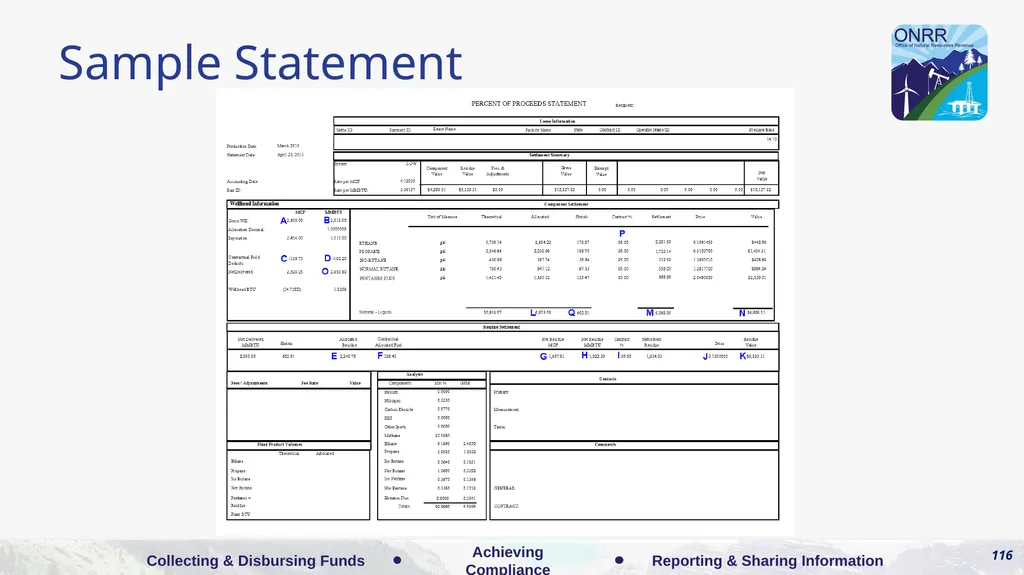
slide116. Sample Statement 116<br>
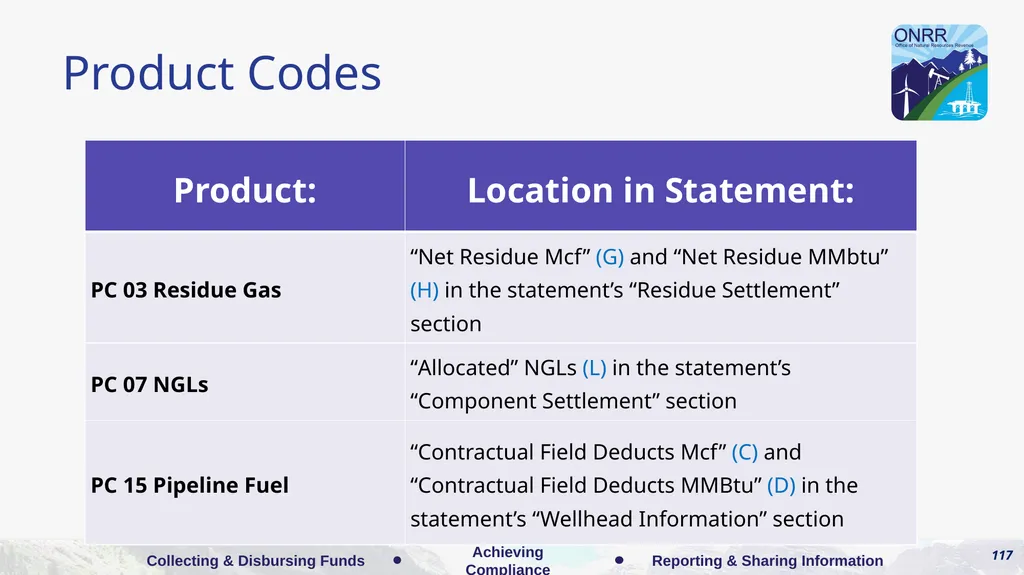
slide117. Product Codes 117<br>
slide118. Assumptions for Discussion 1-3 The gas is produced from an Indian lease in the Central Rocky Mountain Index Zone.
The gas is valued as processed gas under ONRR’s regulations.
The gas is transported, processed, and sold under arm’s-length contracts.<br>
slide119. Assumptions for Discussion 4-6 The processor retains 15% of the residue gas and NGLs.
No condensate is recovered along the pipeline or in the gas plant. You should check your statement or transportation invoice for condensate. If you have questions on how to value or report condensate, please contact royaltyvaluation@onrr.gov.
The royalty rate is 18%.<br>
slide120. Assumptions for Discussion 7 The prices per gallon of NGL components shown on the example gas plant statement (“price at the plant”) are the component prices downstream of the gas plant less the processor’s transportation and fractionation (T&F) fees. The processor deducted a post-plant NGL transportation fee of $0.05/gallon and an NGL fractionation fee of $0.07/gallon from the downstream price. Here, we provided the T&F fee; you may need to check your contract or other sources for the amount.
The transportation portion of the T&F fee for this example is NOT a “transportation factor” under the regulations at 30 CFR §1206.178(a)(5).<br>
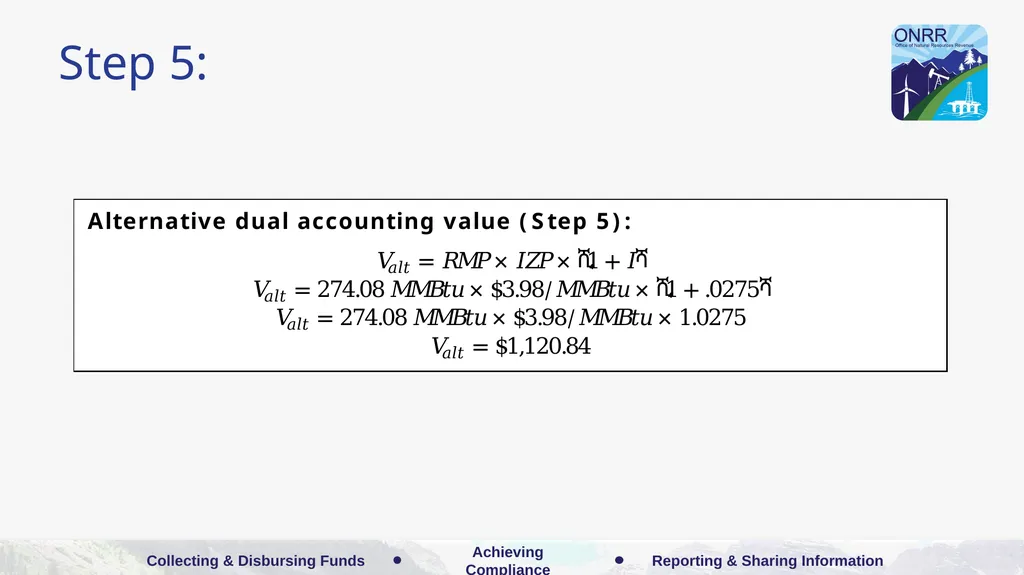
slide121. Assumptions for Discussion 8-9 The lease instrument for this example does not allow deductions for transportation or processing costs. Therefore, no allowances will be calculated or taken.
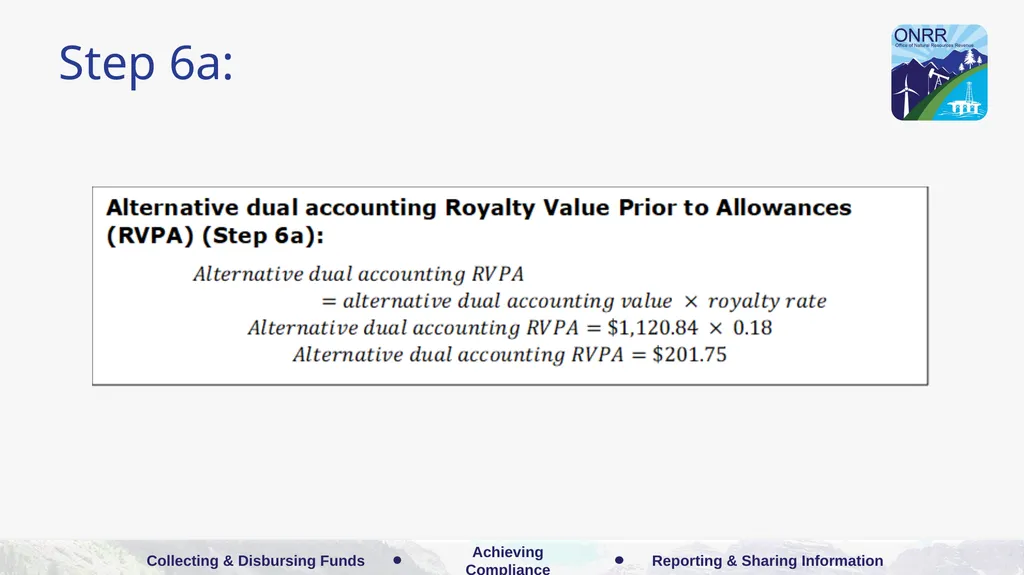
The NGL minimum value provision for production in Utah under §1206.174(g)(2)(i)(B) requires the use of posted prices at Conway, Kansas. For this example, we assume the below prices:<br>
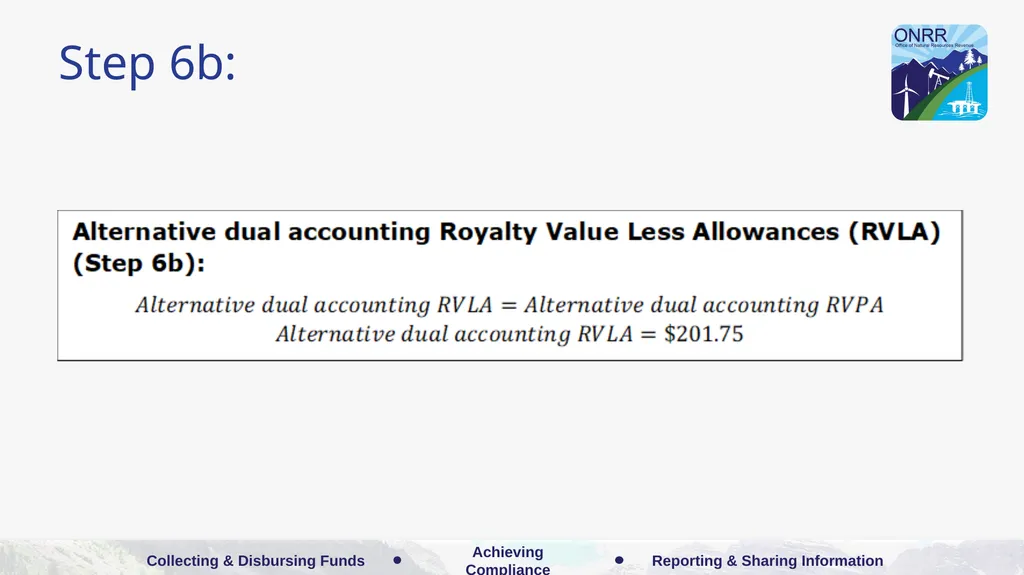
slide122. Assumptions for Discussion 10-11 The production month is January 2019 (as shown on the example statement).
The Indian index zone price is the January 2019 price for the Central Rocky Mountain index zone found on ONRR.gov.<br>
slide123. Locating the Indian Index Zone Price Each month ONRR publishes natural gas prices for six Indian Index Zones as referenced in §1206.172. You can find the prices on the Indian Gas Index Zone Prices web page.<br>
slide124. Determining Dual Accounting Many Indian leases require accounting for comparison, or “dual accounting” (ONRR added emphasis):
“… and that royalty will be computed on the value of gas or casinghead gas, or on the products thereof (such as residue gas, natural gasoline, propane, butane, etc.), whichever is the greater.”<br>
slide125. Actual Dual Accounting Index Zone Calculations Actual dual accounting for reporting in an index zone requires you to determine which is higher: the royalty value of the processed gas or the royalty value of the unprocessed gas.<br>
slide126. PC 03 – Residue Gas<br>
slide127. Step 1<br>
slide128. Step 2<br>
slide129. Step 3<br>
slide130. Step 4<br>
slide131. Step 5<br>
slide132. Step 6<br>
slide133. Step 7<br>
slide134. PC 03 RVPA<br>
slide135. PC 07 – NGLs<br>
slide136. Minimum NGL Provision Royalty is due on any NGLs resulting from processing. In order to comply with the minimum NGL value provision (explained in greater detail in the Minimum NGL Value Example), you should: calculate the regulatory minimum price (the published NGL price less the regulatory adjustment)
determine the price at the plant
compare the prices for each NGL component<br>
slide137. What price to use to report: If the regulatory minimum price is higher, you use that in calculating the sales value for that component.
If the price at the plant is higher, you use the downstream sales price (post-fractionation) to calculate the sales value for that component. Because the price at the plant is net of T&F fees, you must add those fees back in to calculate the downstream sales price. As those fees cannot be netted against the sales value, they should instead be taken as allowances where appropriate.
For a more in-depth explanation of why the NGL minimum value is calculated this way, please see our full Minimum Value Provision for NGLs Example (refer to Scenario 2 for details pertaining to this example).<br>
slide138. Step 1: NGL Minimum Value Price Under §1206.174(g)(2), the NGL value must not be less than the regulatory minimum value given in the regulations
In this example, use the minimum value for Utah at §1206.174(g)(2)(i)(B), which is the published NGL price at Conway, Kansas less seven cents<br>
slide139. Steps 1a and 1b 1a: Calculate the regulatory minimum price by adjusting the published NGL component price. For Utah, reduce the published NGL price at Conway, Kansas by seven cents
1b: Compare the regulatory minimum price from Step 1a to the price at the plant (which for this example is the price on the example gas plant statement (R)) and note which is higher<br>
slide140. Summary Steps 1a and 1b<br>
slide141. Step 2a: Calculate the gross proceeds value of components where the price at the plant was higher than the regulatory minimum value (from Step 1b, ethane and propane).<br>
slide142. Step 2b: Calculate the value of NGL components where the regulatory minimum price was higher<br>
slide143. Step 2c:<br>
slide144. Step 3: Determine the NGL sales volume:
Locate the NGLs actually recovered by the plant on the plant statement under the Component Settlement section showing the “Allocated” amount (L)
This is the NGL sales volume (6,903.59 gallons)<br>
slide145. Step 4:<br>
slide146. PC 07 RVPA<br>
slide147. PC 15 – Pipeline Fuel<br>
slide148. Step 1 and 2:<br>
slide149. Step 2:<br>
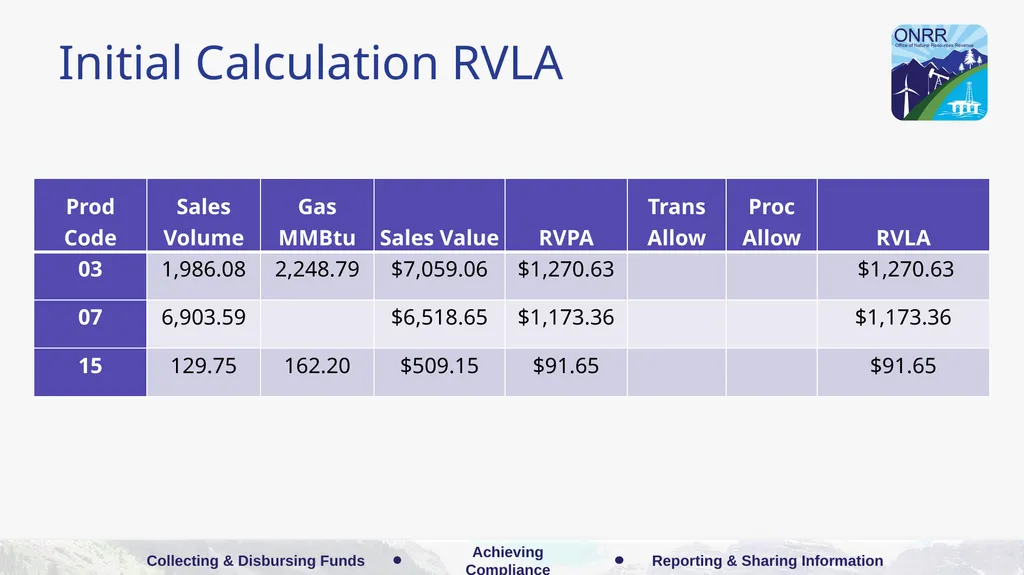
slide150. Initial Calculation RVLA<br>
slide151. Actual Dual Accounting Fulfillment<br>
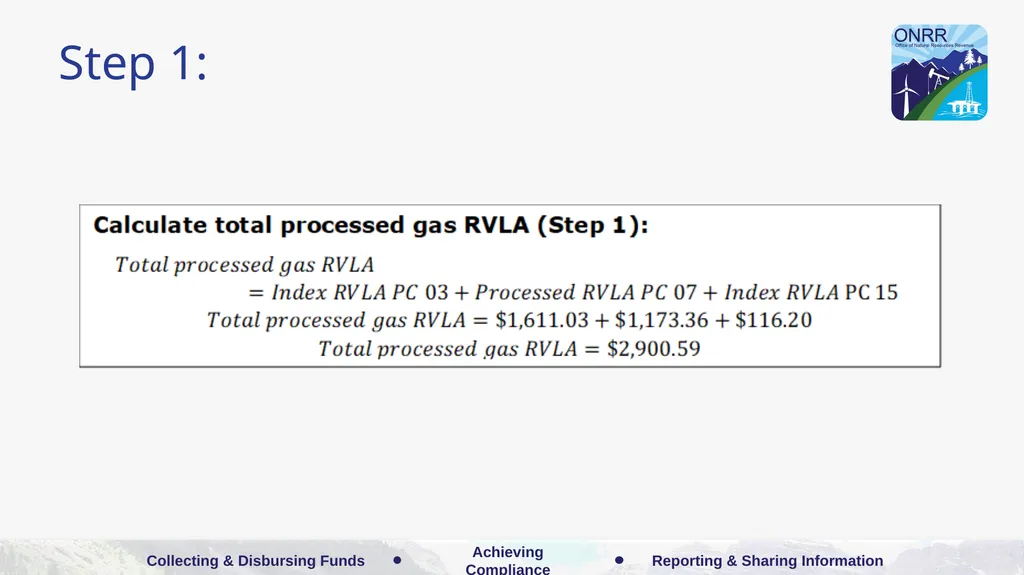
slide152. Step 1:<br>
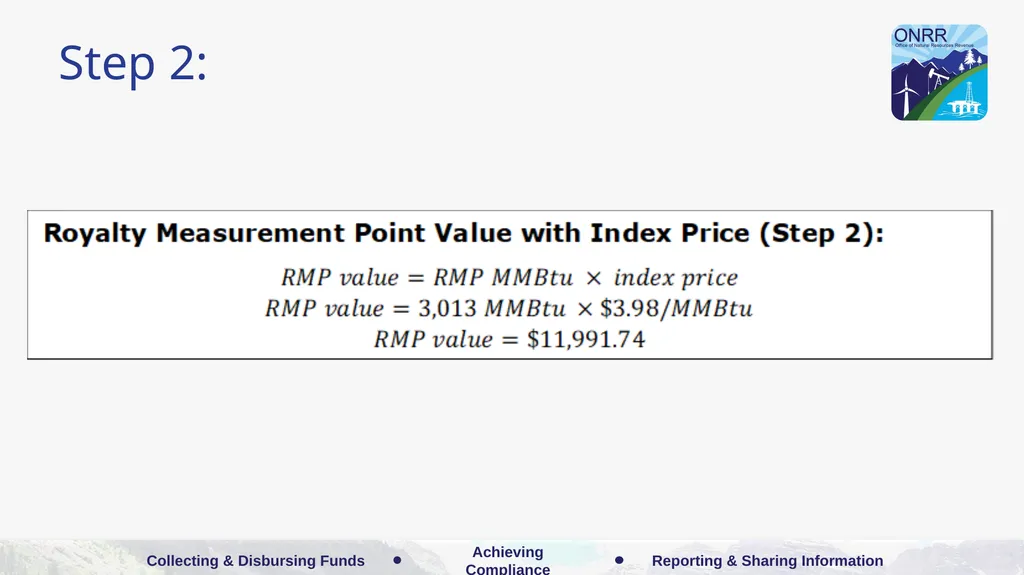
slide153. Step 2:<br>
slide154. Step 3:<br>
slide155. Step 4:<br>
slide156. Final Royalty Reporting<br>
slide157. Indian Gas Example: Index Zone Arm’s-Length Non-Dedicated Contract Processed Gas Reporting using Alternative Dual Accounting<br>
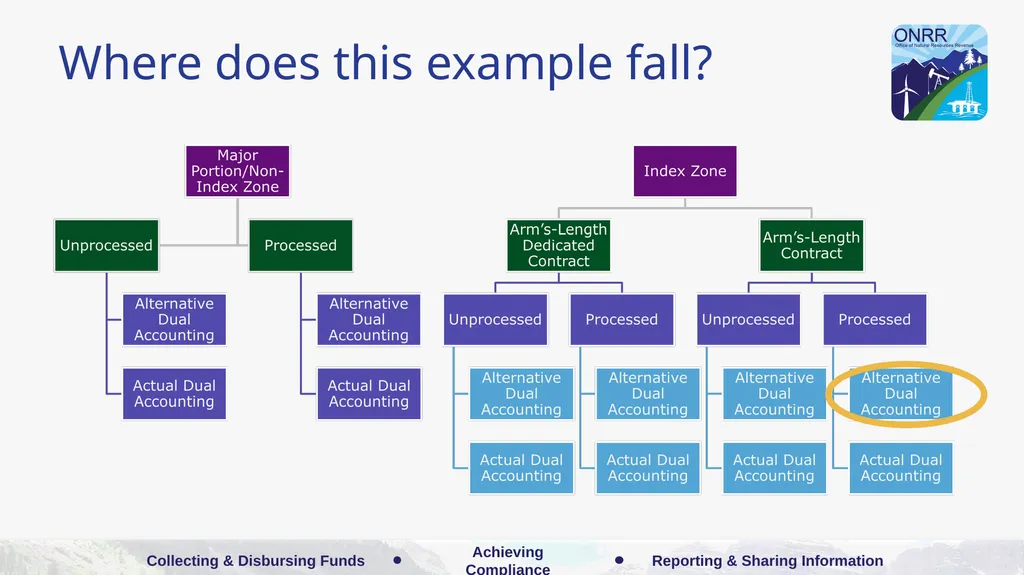
slide158. Where does this example fall?<br>
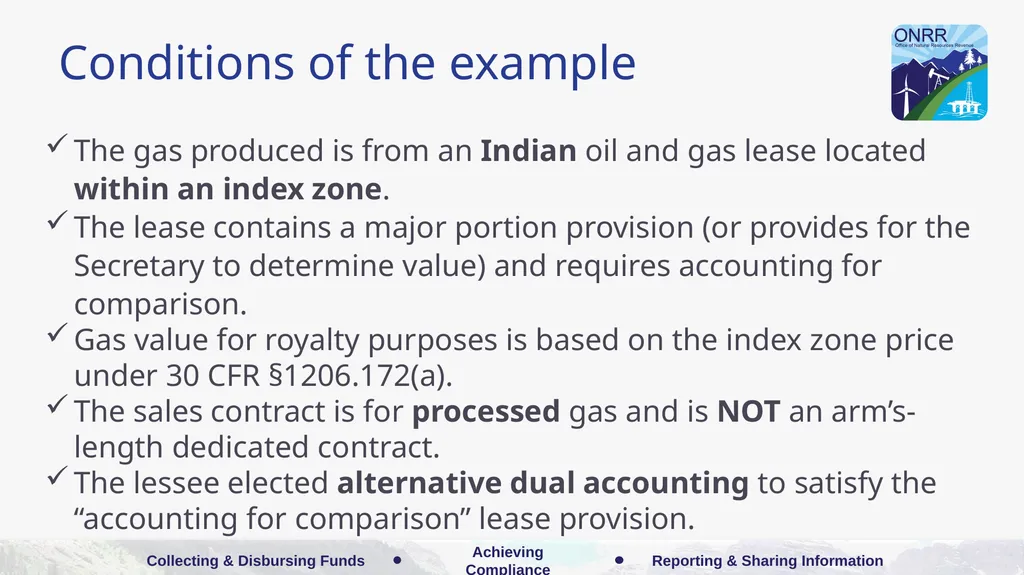
slide159. Conditions of the example The gas produced is from an Indian oil and gas lease located within an index zone.
The lease contains a major portion provision (or provides for the Secretary to determine value) and requires accounting for comparison.
Gas value for royalty purposes is based on the index zone price under 30 CFR §1206.172(a).
The sales contract is for processed gas and is NOT an arm’s-length dedicated contract.
The lessee elected alternative dual accounting to satisfy the “accounting for comparison” lease provision.<br>
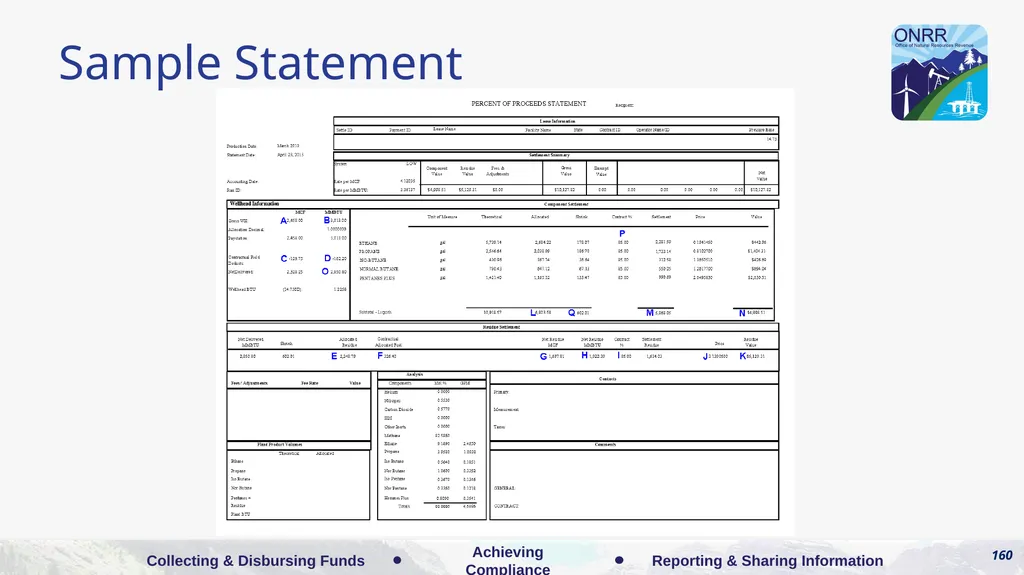
slide160. Sample Statement 160<br>
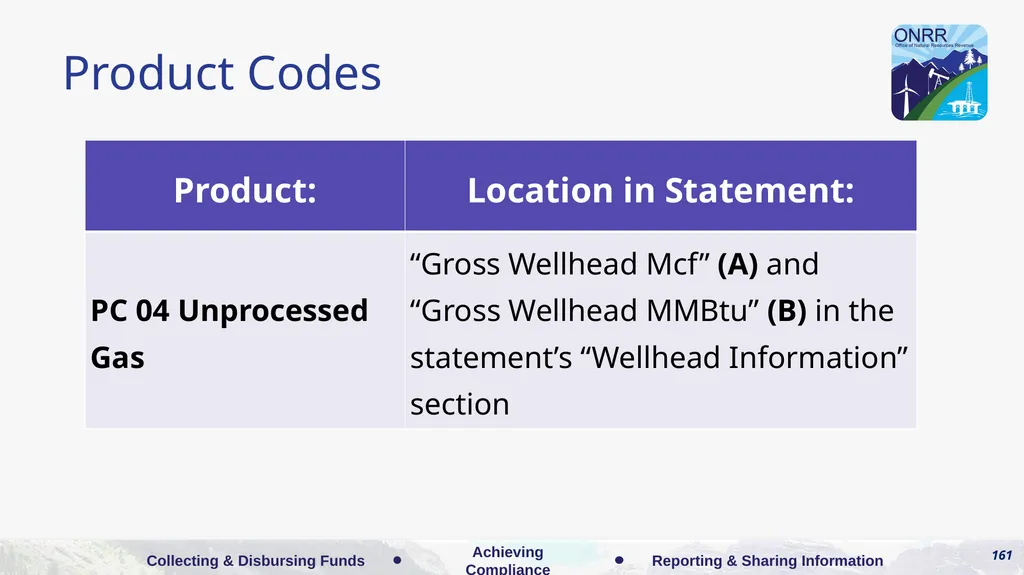
slide161. Product Codes 161<br>
slide162. Assumptions for Discussion 1-4 The gas is produced from an Indian lease in the Central Rocky Mountain Index Zone.
The gas is valued as processed gas under ONRR’s regulations.
The gas is transported, processed, and sold under arm’s-length contracts.
The royalty rate is 18%.<br>
slide163. Assumptions for Discussion 5-8 The production month is January 2019 (as shown on the example statement).
The Indian index zone price is the January 2019 price for the Central Rocky Mountain index zone found on ONRR.gov.
The lessee has NO ownership in the processing plant.
The volume-weighted-average Btu content, calculated from the statement, is 1226 Btu/Mcf.<br>
slide164. Locating the Indian Index Zone Price Each month ONRR publishes natural gas prices for six Indian Index Zones as referenced in §1206.172. You can find the prices on the Indian Gas Index Zone Prices web page.<br>
slide165. Determining Dual Accounting Many Indian leases require accounting for comparison, or “dual accounting” (ONRR added emphasis):
“… and that royalty will be computed on the value of gas or casinghead gas, or on the products thereof (such as residue gas, natural gasoline, propane, butane, etc.), whichever is the greater.”<br>
slide166. Alternative Dual Accounting Index Zone Calculations<br>
slide167. Step 1:<br>
slide168. Step 2: Identify the MMBtu at the approved royalty measurement point (RMP):
In this example, the “Gross Wellhead MMBtu” (B) is 3,013 MMBtu<br>
slide169. Step 3: Locate the index zone price on the Indian Gas Index Prices web page. In this example, the lease is in the Central Rocky Mountain index zone.
The production month is January 2019
The Index Zone price is $3.98<br>
slide170. Step 4: Identify the increment (I). The applicable Btu is the volume-weighted-average Btu for the property computed from measurements at the facility measurement point(s) for gas production from the lease (§1206.173(b)(3)). The increment also depends on whether or not you own an interest in the plant.
The statement shows that the Btu content is 1226 Btu/Mcf, calculated based on the regulations at §1206.173(b)(3)
Assume no plant ownership
The increment is .0975.<br>
slide171. Btu Range Table<br>
slide172. Step 5:<br>
slide173. Step 6a:<br>
slide174. Step 6b:<br>
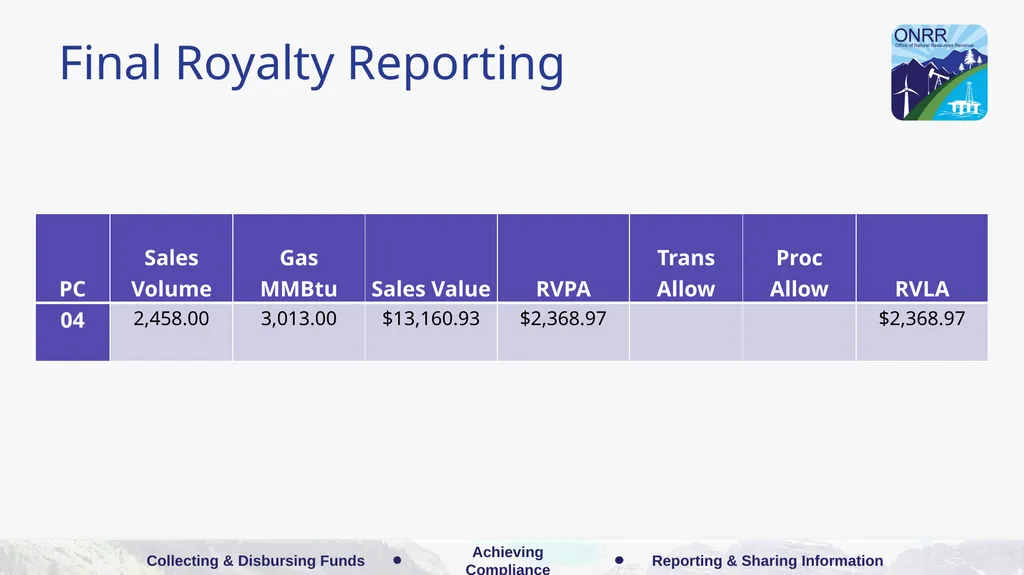
slide175. Final Royalty Reporting<br>
slide176. Indian Gas Example: Index Zone Arm’s-Length Dedicated Contract Unprocessed Gas Reporting using Alternative Dual Accounting<br>
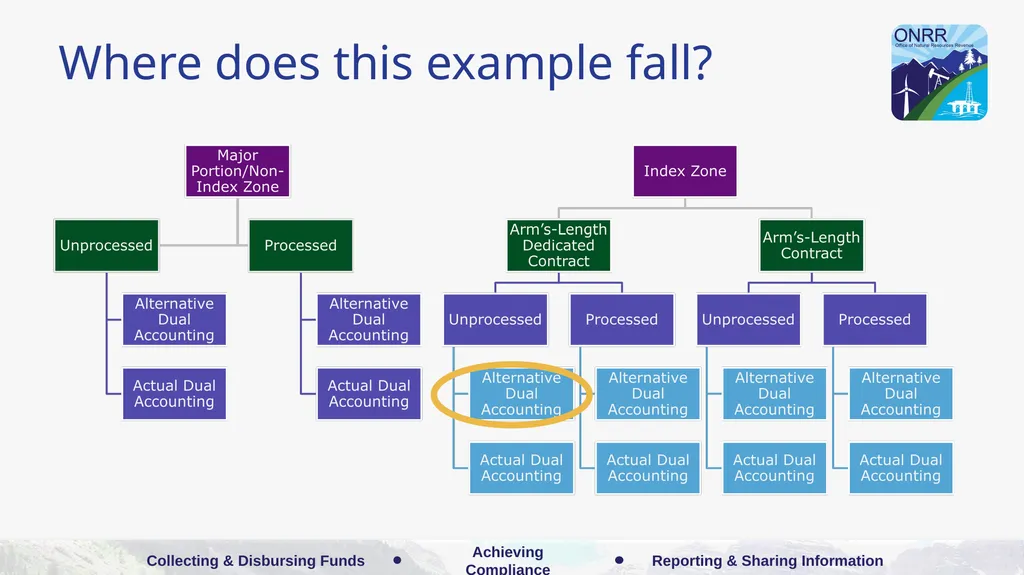
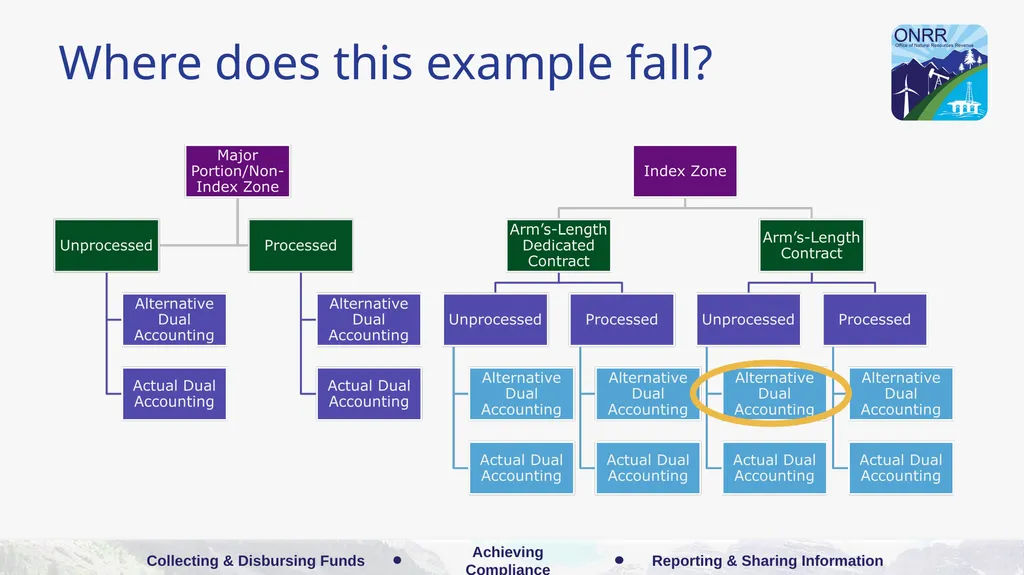
slide177. Where does this example fall?<br>
slide178. Conditions of the example The gas produced is from an Indian oil and gas lease located within an index zone.
The lease contains a major portion provision (or provides for the Secretary to determine value) and requires accounting for comparison.
Gas value for royalty purposes is based on the higher of the index-based value in 30 CFR §1206.172(d) or gross proceeds under §1206.174(b) for unprocessed gas sold under an arm’s-length dedicated contract (§1206.172(b)(3)).
Dedicated means a contractual commitment to deliver gas production (or a specified portion of production) from a lease or well when that production is specified in a sales contract and that production must be sold pursuant to that contract to the extent that production occurs from that lease or well (§1206.171).
The lessee elected alternative dual accounting to satisfy the “accounting for comparison” lease provision.<br>
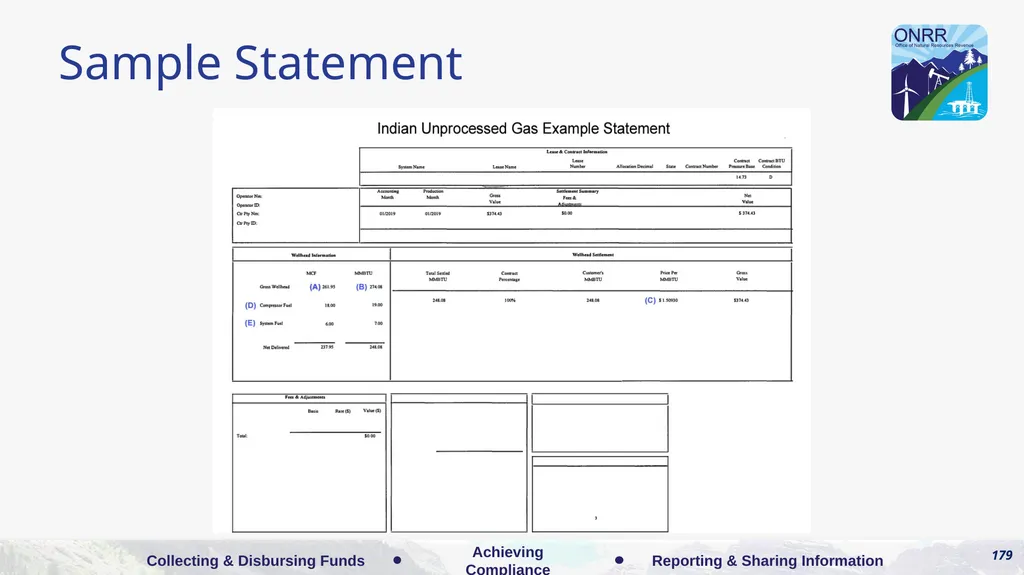
slide179. Sample Statement 179<br>
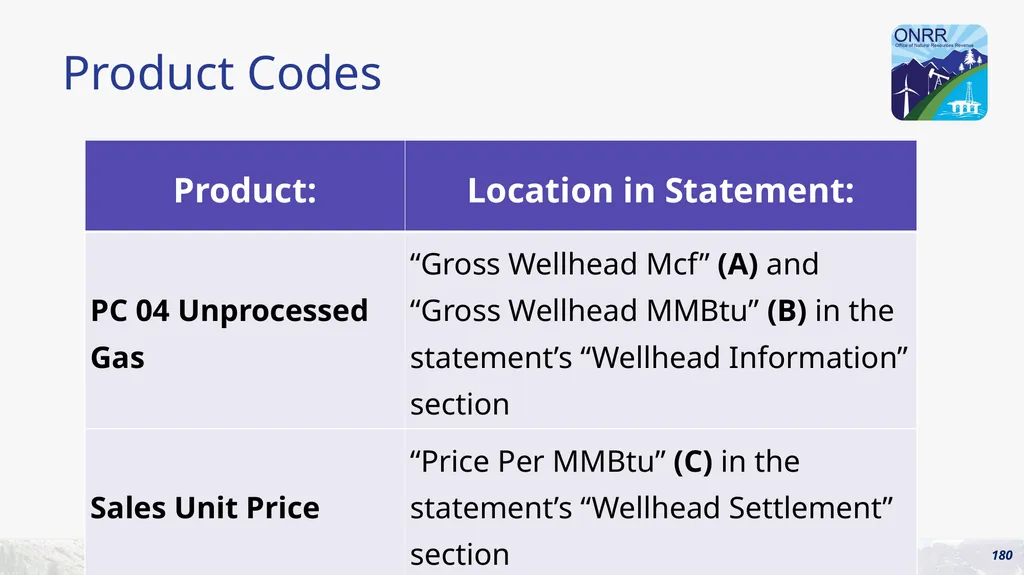
slide180. Product Codes 180<br>
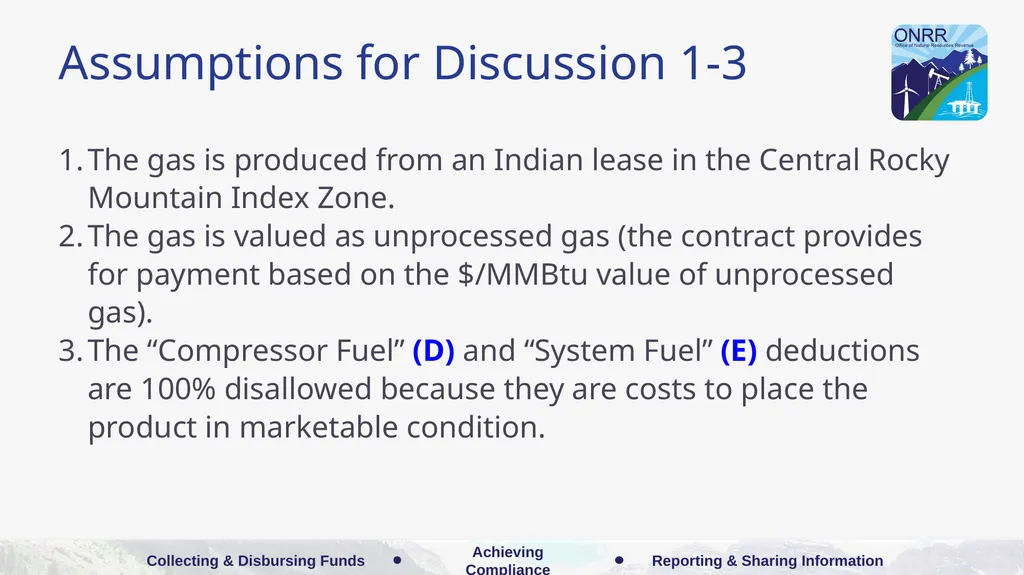
slide181. Assumptions for Discussion 1-3 The gas is produced from an Indian lease in the Central Rocky Mountain Index Zone.
The gas is valued as unprocessed gas (the contract provides for payment based on the $/MMBtu value of unprocessed gas).
The “Compressor Fuel” (D) and “System Fuel” (E) deductions are 100% disallowed because they are costs to place the product in marketable condition.<br>
slide182. Assumptions for Discussion 4-8 The price per MMBtu shown on the statement is the actual contract price. The statement price does not include any deductions or netted fees from the purchaser to place gas into marketable condition on the lessee's behalf.
The gas is sold under an arm’s-length dedicated contract.
The gas is eventually processed downstream.
The royalty rate is 18%.
The production month is January 2019 (as shown on the example statement).<br>
slide183. Assumptions for Discussion 9-11 The index zone price is the January 2019 price for Central Rocky Mountain found on ONRR.gov.
The lessee has NO ownership in the processing plant.
The volume-weighted-average Btu content, calculated from the statement, is 1046 Btu/Mcf.<br>
slide184. Locating the Indian Index Zone Price Each month ONRR publishes natural gas prices for six Indian Index Zones as referenced in §1206.172. You can find the prices on the Indian Gas Index Zone Prices web page.<br>
slide185. Determining Dual Accounting Many Indian leases require accounting for comparison, or “dual accounting” (ONRR added emphasis):
“… and that royalty will be computed on the value of gas or casinghead gas, or on the products thereof (such as residue gas, natural gasoline, propane, butane, etc.), whichever is the greater.”<br>
slide186. Actual Dual Accounting Caveat If you elected actual dual accounting for your unprocessed gas, you must use §1206.181 to establish processing costs when neither you nor someone acting on your behalf processes the gas. Under §1206.181, you must use the first applicable of the four given methods to establish processing costs for dual accounting purposes. Please also be mindful of the additional regulatory requirements in this section (§§1206.176, 179, 180). Collectively, all of these obligations must be satisfied in order to use actual dual accounting. For assistance in ensuring you meet all these obligations, please contact royaltyvaluation@onrr.gov.<br>
slide187. Part A – Calculate Gross Proceeds PC 04 – Unprocessed Gas<br>
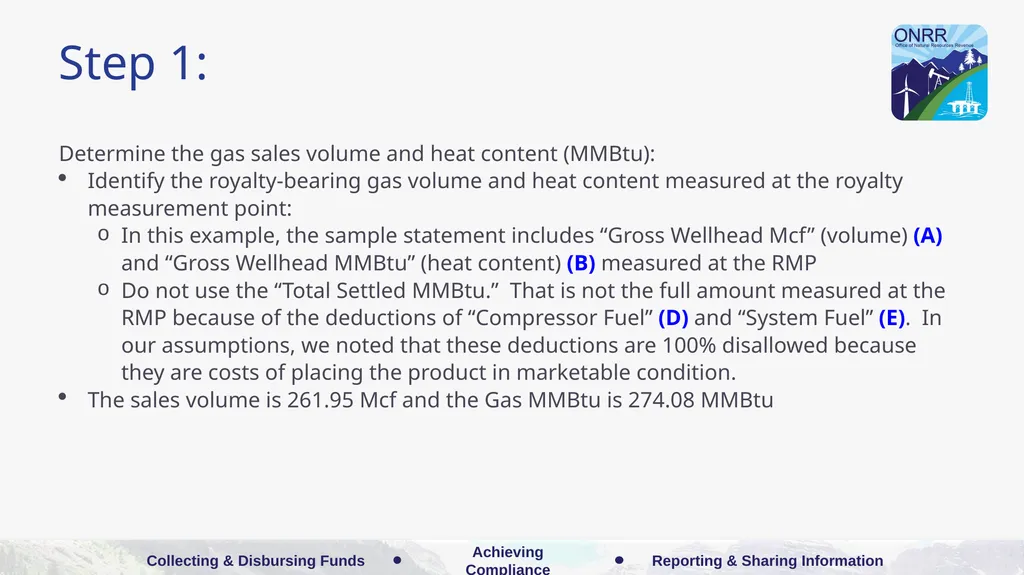
slide188. Step 1: Determine the gas sales volume and heat content (MMBtu):
Identify the royalty-bearing gas volume and heat content measured at the royalty measurement point:
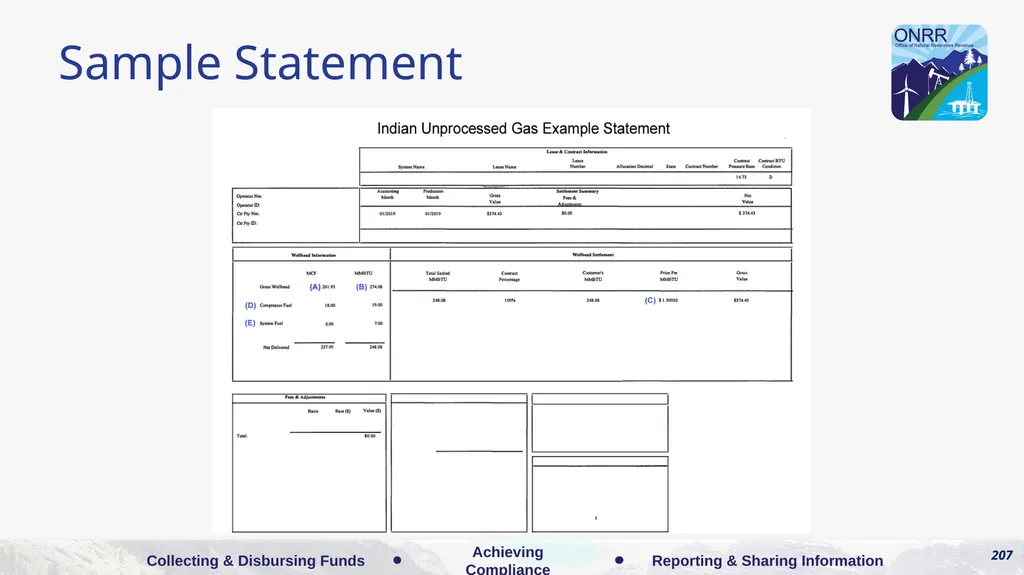
In this example, the sample statement includes “Gross Wellhead Mcf” (volume) (A) and “Gross Wellhead MMBtu” (heat content) (B) measured at the RMP
Do not use the “Total Settled MMBtu.” That is not the full amount measured at the RMP because of the deductions of “Compressor Fuel” (D) and “System Fuel” (E). In our assumptions, we noted that these deductions are 100% disallowed because they are costs of placing the product in marketable condition.
The sales volume is 261.95 Mcf and the Gas MMBtu is 274.08 MMBtu<br>
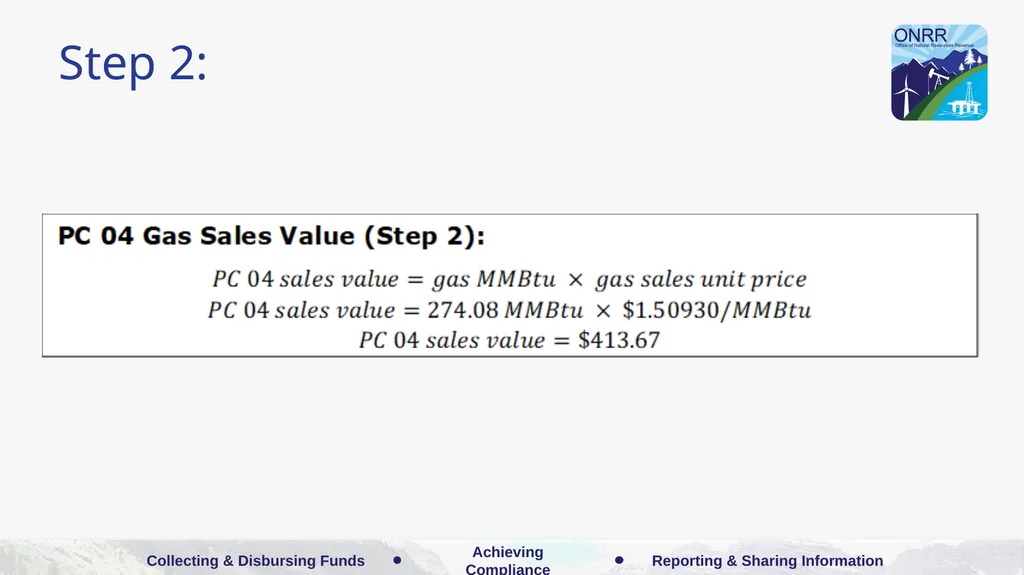
slide189. Step 2:<br>
slide190. Step 3:<br>
slide191. Step 4:<br>
slide192. Part B – Alternative Dual Accounting Index Zone Calculations<br>
slide193. Step 1:<br>
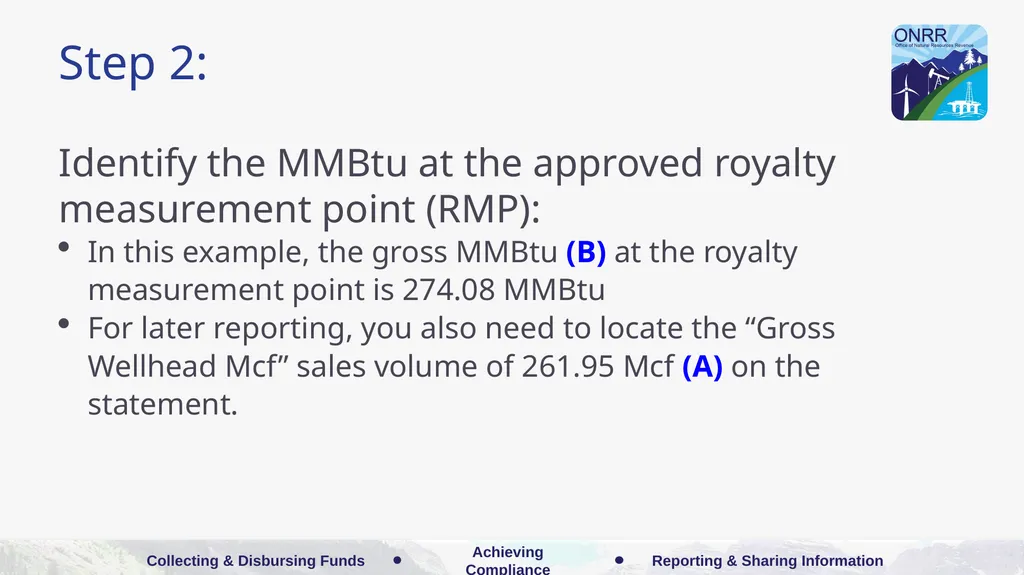
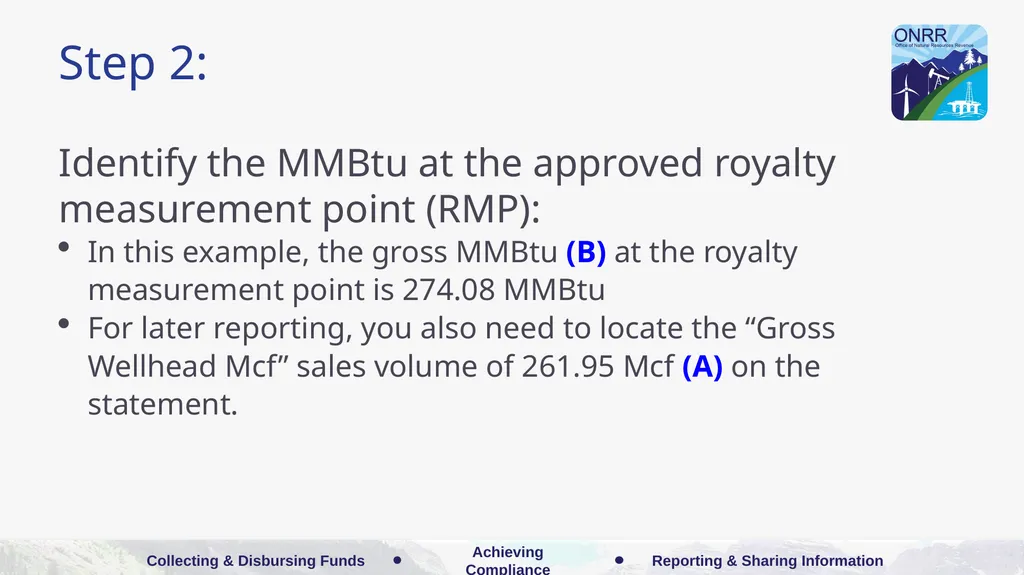
slide194. Step 2: Identify the MMBtu at the approved royalty measurement point (RMP):
In this example, the gross MMBtu (B) at the royalty measurement point is 274.08 MMBtu
For later reporting, you also need to locate the “Gross Wellhead Mcf” sales volume of 261.95 Mcf (A) on the statement.<br>
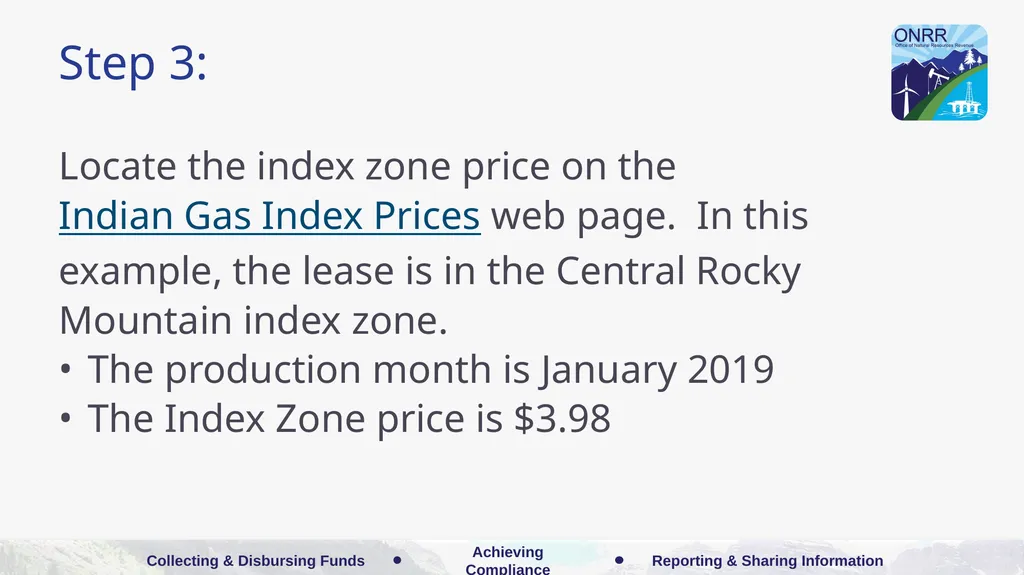
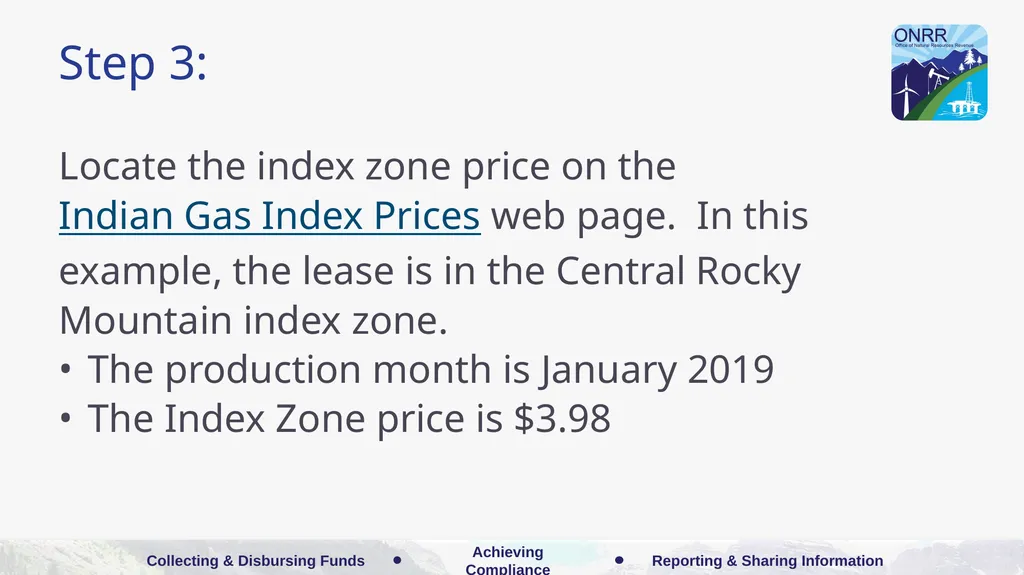
slide195. Step 3: Locate the index zone price on the Indian Gas Index Prices web page. In this example, the lease is in the Central Rocky Mountain index zone.
The production month is January 2019
The Index Zone price is $3.98<br>
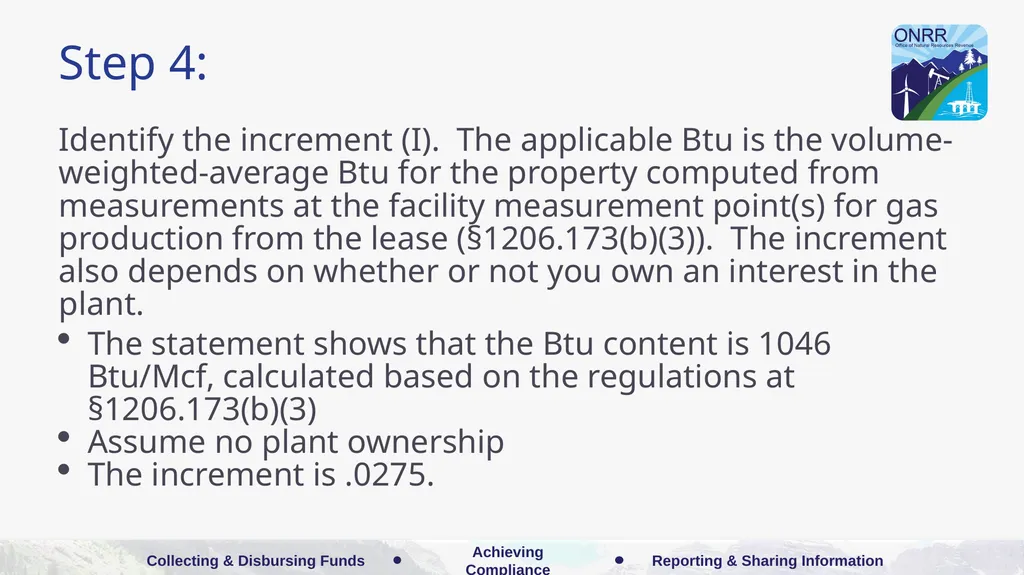
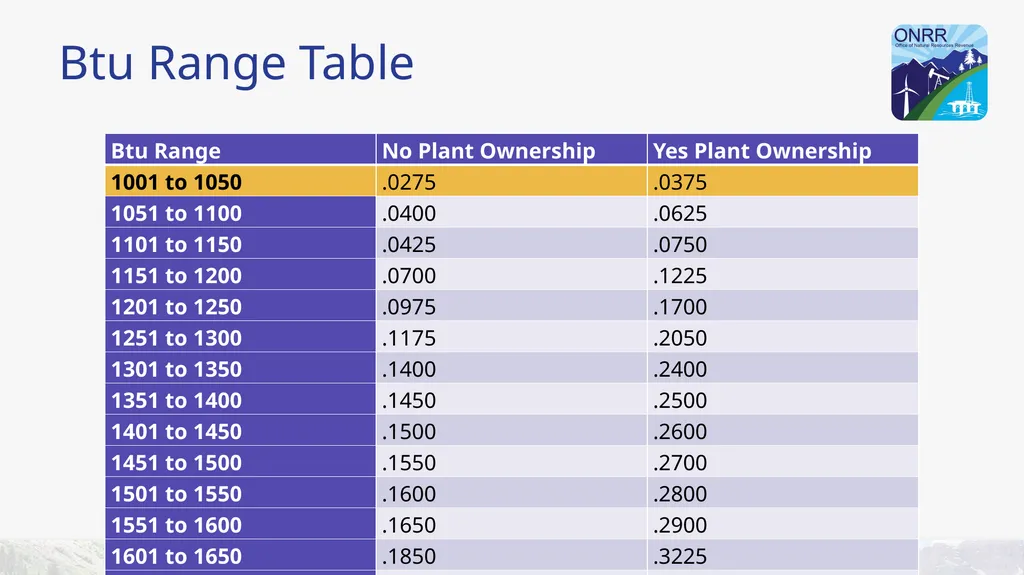
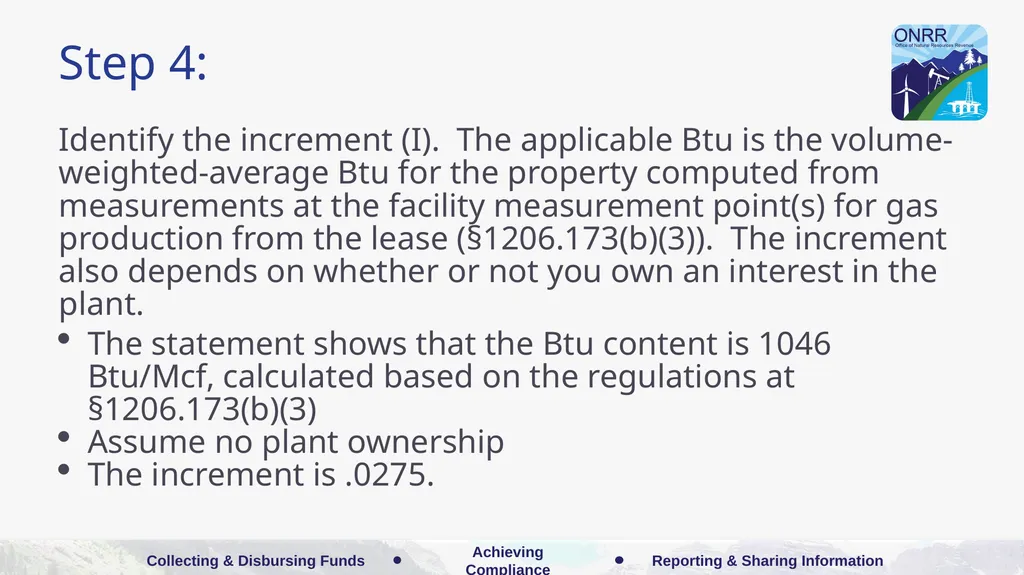
slide196. Step 4: Identify the increment (I). The applicable Btu is the volume-weighted-average Btu for the property computed from measurements at the facility measurement point(s) for gas production from the lease (§1206.173(b)(3)). The increment also depends on whether or not you own an interest in the plant.
The statement shows that the Btu content is 1046 Btu/Mcf, calculated based on the regulations at §1206.173(b)(3)
Assume no plant ownership
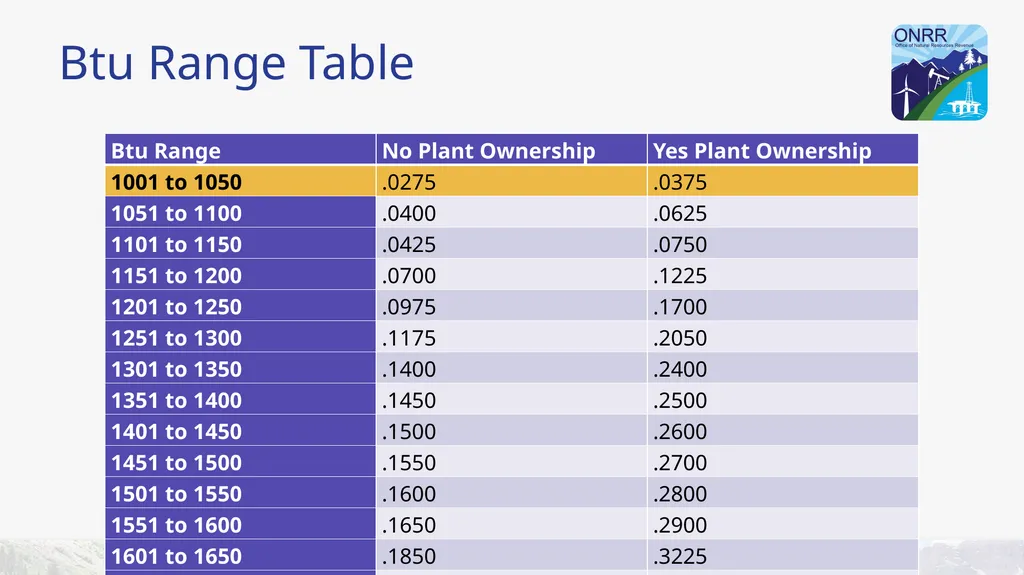
The increment is .0275.<br>
slide197. Btu Range Table<br>
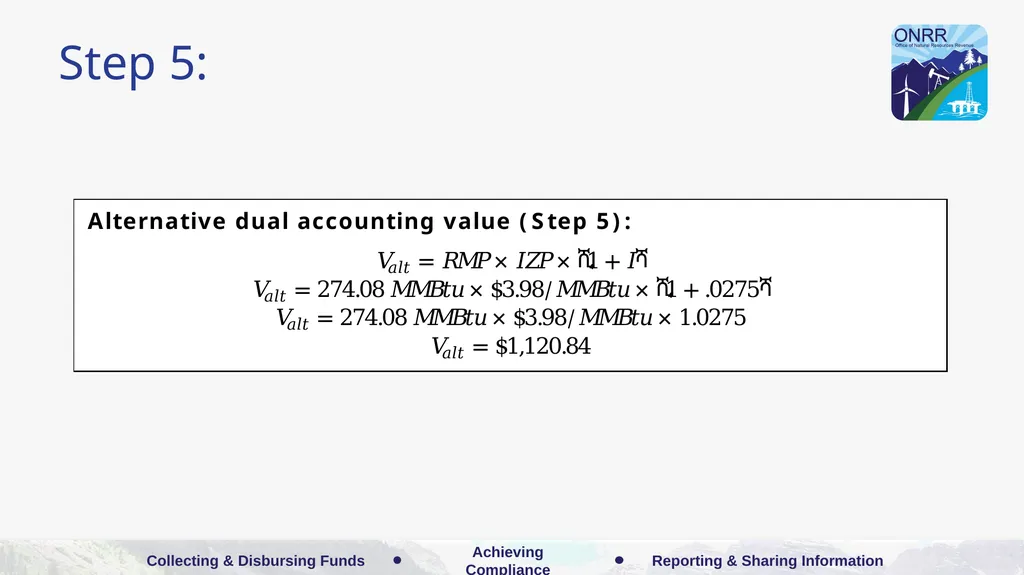
slide198. Step 5:<br>
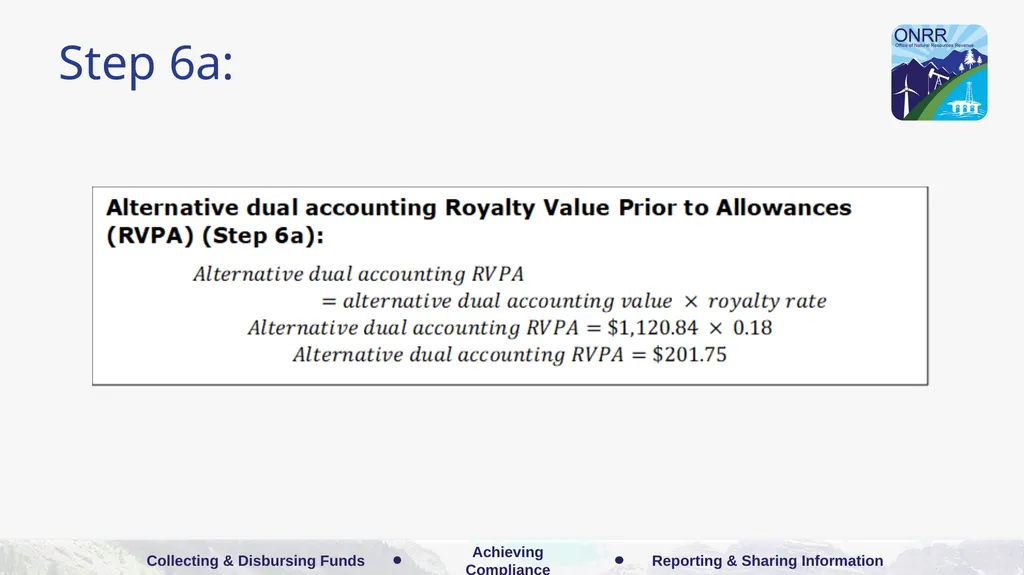
slide199. Step 6a:<br>
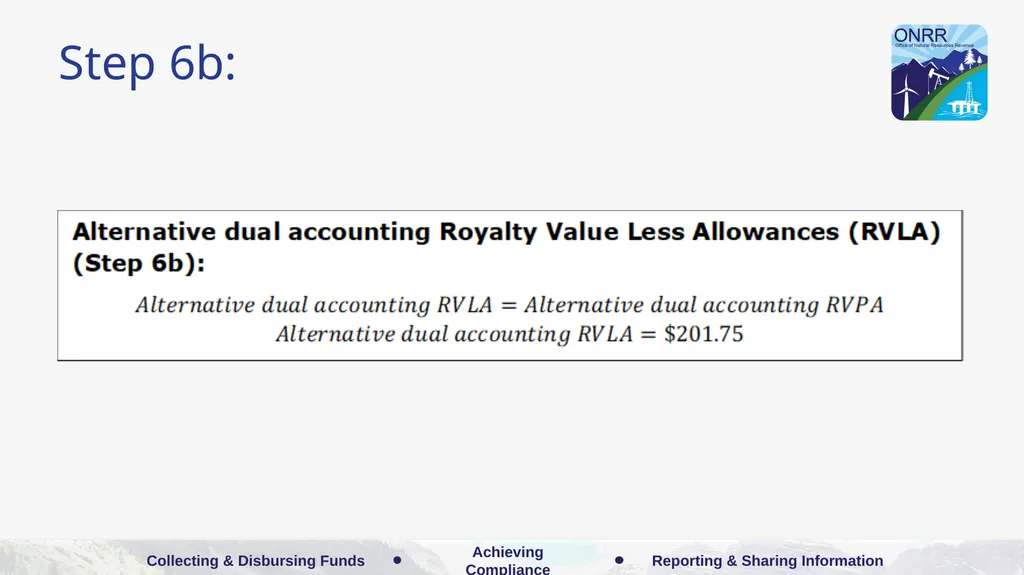
slide200. Step 6b:<br>
slide201. Part C – Comparing the Values Determined in Parts A and B<br>
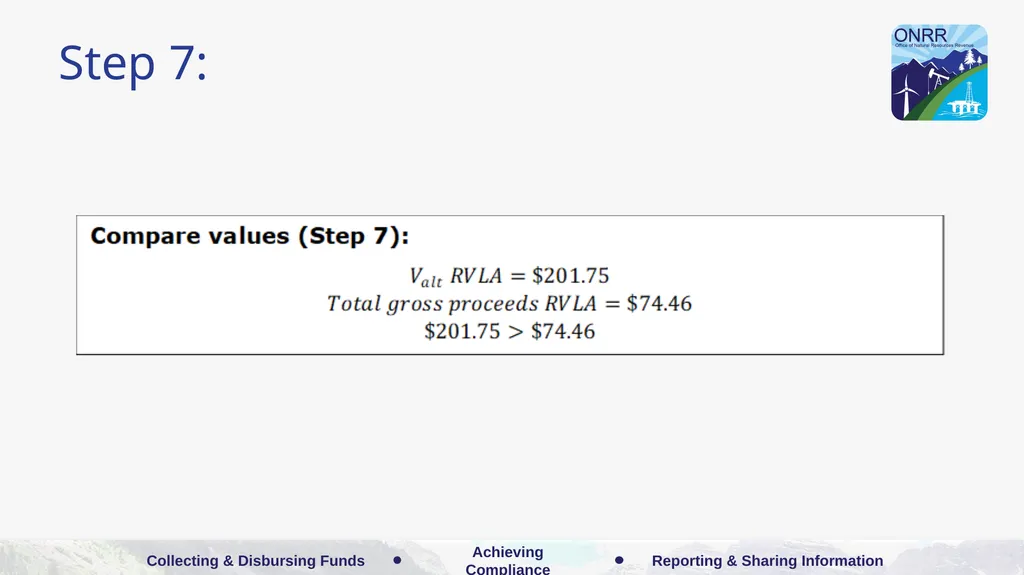
slide202. Step 7:<br>
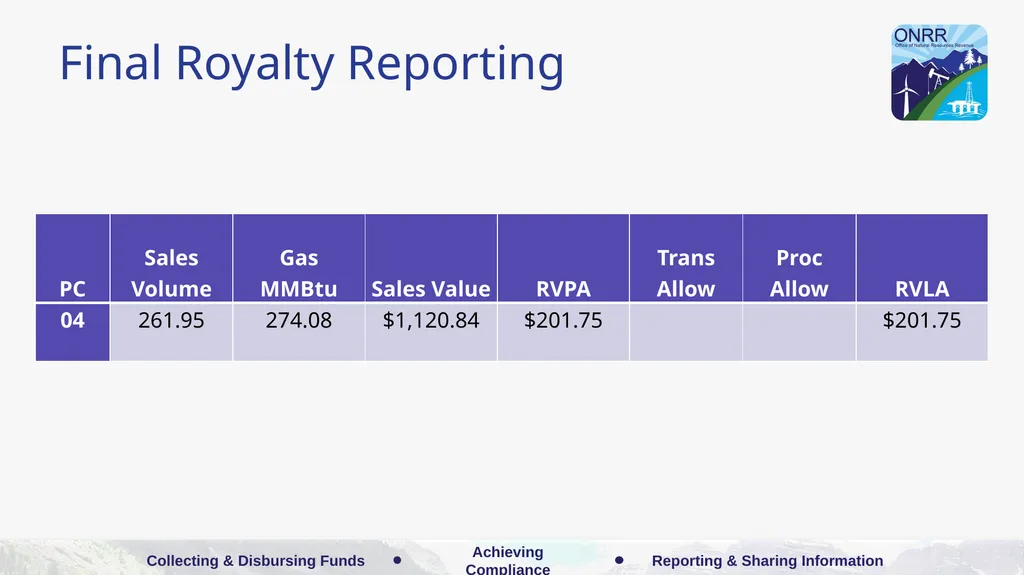
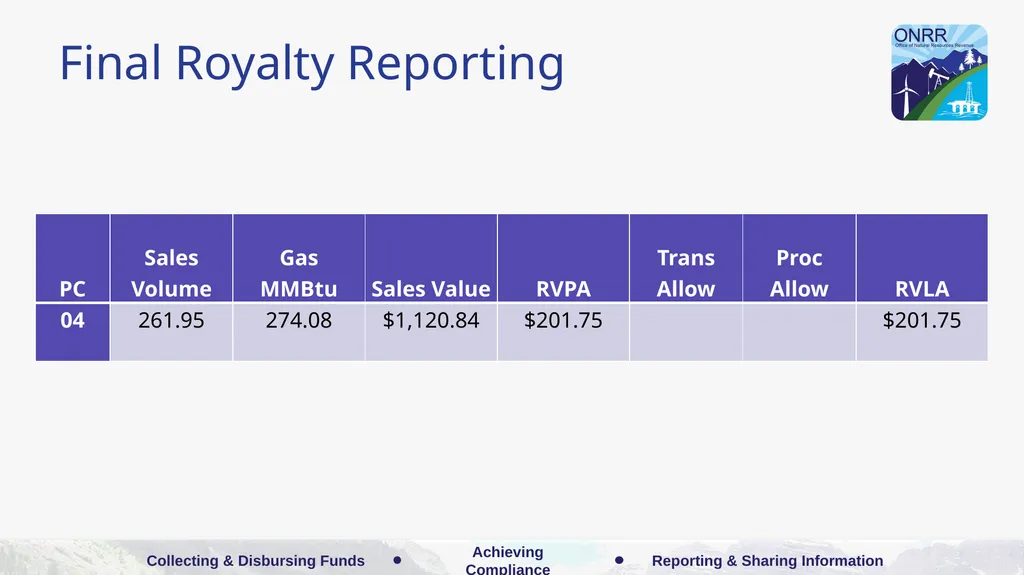
slide203. Final Royalty Reporting<br>
slide204. Indian Gas Example: Index Zone Arm’s-Length Non-Dedicated Contract Unprocessed Gas Reporting using Alternative Dual Accounting Presented by: Jodie Peterson and Cindy Gothberg<br>
slide205. Where does this example fall?<br>
slide206. Conditions of the example The gas produced is from an Indian oil and gas lease located within an index zone.
The lease contains a major portion provision (or provides for the Secretary to determine value) and requires accounting for comparison.
Gas value for royalty purposes is based on the index zone price under 30 CFR §1206.172(a).
The sales contract is for unprocessed gas and is NOT an arm’s-length dedicated contract.
The lessee elected alternative dual accounting to satisfy the “accounting for comparison” lease provision.<br>
slide207. Sample Statement 207<br>
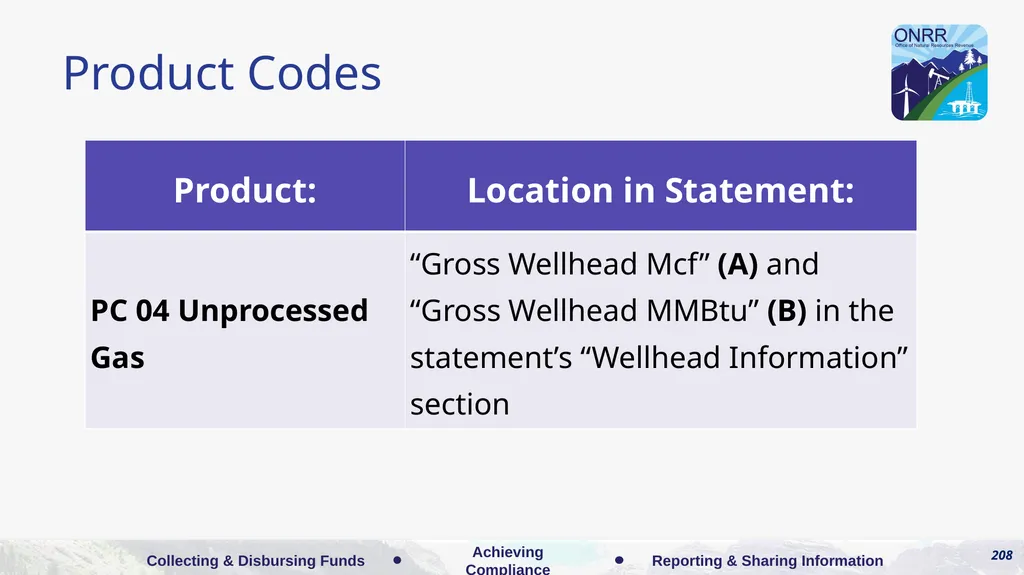
slide208. Product Codes 208<br>
slide209. Assumptions for Discussion 1-4 The gas is produced from an Indian lease in the Central Rocky Mountain Index Zone.
The gas is valued as unprocessed gas (the contract provides for payment based on the $/MMBtu value of unprocessed gas).
The gas is eventually processed downstream before it enters a pipeline with an index point. NOTE: Gas that is never processed does not require dual accounting. See §1206.176(c).
The royalty rate is 18%.<br>
slide210. Assumptions for Discussion 5-8 The production month is January 2019 (as shown on the example statement).
The Indian index zone price is the January 2019 price for the Central Rocky Mountain index zone found on ONRR.gov.
The lessee has NO ownership in the processing plant.
The volume-weighted-average Btu content, calculated from the statement, is 1046 Btu/Mcf.<br>
slide211. Locating the Indian Index Zone Price Each month ONRR publishes natural gas prices for six Indian Index Zones as referenced in §1206.172. You can find the prices on the Indian Gas Index Zone Prices web page.<br>
slide212. Determining Dual Accounting Many Indian leases require accounting for comparison, or “dual accounting” (ONRR added emphasis):
“… and that royalty will be computed on the value of gas or casinghead gas, or on the products thereof (such as residue gas, natural gasoline, propane, butane, etc.), whichever is the greater.”<br>
slide213. Actual Dual Accounting Caveat If you elected actual dual accounting for your unprocessed gas, you must use §1206.181 to establish processing costs when neither you nor someone acting on your behalf processes the gas. Under §1206.181, you must use the first applicable of the four given methods to establish processing costs for dual accounting purposes. Please also be mindful of the additional regulatory requirements in this section (§§1206.176, 179, 180). Collectively, all of these obligations must be satisfied in order to use actual dual accounting. For assistance in ensuring you meet all these obligations, please contact royaltyvaluation@onrr.gov.<br>
slide214. Alternative Dual Accounting Index Zone Calculations Under §1206.175(a), “[f]or unprocessed gas, you must pay royalties on the quantity and quality at the facility measurement point that BLM either allowed or approved.” Under §1206.171, ONRR defines the point of royalty measurement as the facility measurement point. In this example, we will use “RMP” to represent the approved royalty measurement point.<br>
slide215. Step 1:<br>
slide216. Step 2: Identify the MMBtu at the approved royalty measurement point (RMP):
In this example, the gross MMBtu (B) at the royalty measurement point is 274.08 MMBtu
For later reporting, you also need to locate the “Gross Wellhead Mcf” sales volume of 261.95 Mcf (A) on the statement.<br>
slide217. Step 3: Locate the index zone price on the Indian Gas Index Prices web page. In this example, the lease is in the Central Rocky Mountain index zone.
The production month is January 2019
The Index Zone price is $3.98<br>
slide218. Step 4: Identify the increment (I). The applicable Btu is the volume-weighted-average Btu for the property computed from measurements at the facility measurement point(s) for gas production from the lease (§1206.173(b)(3)). The increment also depends on whether or not you own an interest in the plant.
The statement shows that the Btu content is 1046 Btu/Mcf, calculated based on the regulations at §1206.173(b)(3)
Assume no plant ownership
The increment is .0275.<br>
slide219. Btu Range Table<br>
slide220. Step 5:<br>
slide221. Step 6a:<br>
slide222. Step 6b:<br>
slide223. Final Royalty Reporting<br>
slide2. Housekeeping All participants are automatically muted. To ask a question, raise your hand, and we’ll call on you to unmute yourself.
We are also monitoring the chat!
If you need assistance with the captioning, please drop that in the chat as well!<br>
slide3. Disclaimer This training does not provide legal advice and should not be construed as stating ONRR’s legal interpretation or position. Rather, this communication serves as guidance for determining value for royalties and is not an appealable decision or order under 30 CFR Part 1290, Subpart B. This guidance is based solely on the information provided and should only be used for the particular issue or question presented at the time of this communication. While this training is not appealable, ONRR may use this guidance in conducting audits and as a basis for demanding additional royalties.<br>
slide4. Scope Check This example is as all-encompassing as we can be without overcomplicating it.
If you have questions specific to your situation, you can always email us at royaltyvaluation@onrr.gov!
RV deals with the valuation aspects of reporting.
Specific 2014 filing questions (backing and re-reporting lines, overrides, upfront edits, etc.) will be most accurately answered by your reporting contact: https://www.onrr.gov/ReportPay/royalty-reporting.htm#contacts
Royalty relief questions can be answered by BLM or BSEE depending on your lease location. 4<br>
slide5. Where does this example fall?<br>
slide6. Conditions of the example The gas produced is from an Indian oil and gas lease located within an index zone.
The lease contains a major portion provision (or provides for the Secretary to determine value) and requires accounting for comparison.
The sales contract is for processed gas under an arm’s-length dedicated contract (30 CFR §1206.172(b)(3)).
Dedicated means a contractual commitment to deliver gas production (or a specified portion of production) from a lease or well when that production is specified in a sales contract and that production must be sold pursuant to that contract to the extent that production occurs from that lease or well (§1206.171).<br>
slide7. Conditions of the example cont. Gas is valued for royalty purposes based on the higher of the index-based value in §1206.172(d) or gross proceeds under §1206.174(b).
The lessee elected actual dual accounting to satisfy the “accounting for comparison” lease provision.<br>
slide8. Sample Statement 8<br>
slide9. Product Codes 9<br>
slide10. Assumptions for Discussion 1-3 The gas is produced from an Indian lease in the Central Rocky Mountain Index Zone.
The gas is valued as processed gas under ONRR’s regulations.
The gas is transported, processed, and sold under arm’s-length contracts.<br>
slide11. Assumptions for Discussion 4-6 The processor retains 15% of the residue gas and NGLs.
No condensate is recovered along the pipeline or in the gas plant. You should check your statement or transportation invoice for condensate. If you have questions on how to value or report condensate, please contact royaltyvaluation@onrr.gov.
The royalty rate is 18%.<br>
slide12. Assumptions for Discussion 7 The prices per gallon of NGL components shown on the example gas plant statement (“price at the plant”) are the component prices downstream of the gas plant less the processor’s transportation and fractionation (T&F) fees. The processor deducted a post-plant NGL transportation fee of $0.05/gallon and an NGL fractionation fee of $0.07/gallon from the downstream price. Here, we provided the T&F fee; you may need to check your contract or other sources for the amount.
The transportation portion of the T&F fee for this example is NOT a “transportation factor” under the regulations at 30 CFR §1206.178(a)(5).<br>
slide13. Assumptions for Discussion 8-9 The lease instrument for this example does not allow deductions for transportation or processing costs. Therefore, no allowances will be calculated or taken.
The NGL minimum value provision for production in Utah under §1206.174(g)(2)(i)(B) requires the use of posted prices at Conway, Kansas. For this example, we assume the below prices:<br>
slide14. Assumptions for Discussion 10-11 The production month is January 2019 (as shown on the example statement).
The Indian index zone price is the January 2019 price for the Central Rocky Mountain index zone found on ONRR.gov.<br>
slide15. Locating the Indian Index Zone Price Each month ONRR publishes natural gas prices for six Indian Index Zones as referenced in §1206.172. You can find the prices on the Indian Gas Index Zone Prices web page.<br>
slide16. Determining Dual Accounting Many Indian leases require accounting for comparison, or “dual accounting” (ONRR added emphasis):
“… and that royalty will be computed on the value of gas or casinghead gas, or on the products thereof (such as residue gas, natural gasoline, propane, butane, etc.), whichever is the greater.”<br>
slide17. Three step calculation process: Calculate the gross proceeds received for the gas sale under §1206.174.
Calculate the actual dual accounting value.
Compare the values determined in steps 1 and 2 and report and pay on the higher value.<br>
slide18. Part A – Calculate the Gross Proceeds PC 03 Residue Gas<br>
slide19. Step 1:<br>
slide20. Step 2<br>
slide21. Step 3<br>
slide22. Step 4<br>
slide23. Step 5<br>
slide24. Step 6<br>
slide25. PC 03 RVPA<br>
slide26. Part A – Calculate the Gross Proceeds PC 07 NGLs<br>
slide27. Minimum NGL Provision Royalty is due on any NGLs resulting from processing. In order to comply with the minimum NGL value provision (explained in greater detail in the Minimum NGL Value Example), you should: calculate the regulatory minimum price (the published NGL price less the regulatory adjustment)
determine the price at the plant
compare the prices for each NGL component<br>
slide28. What price to use to report: If the regulatory minimum price is higher, you use that in calculating the sales value for that component.
If the price at the plant is higher, you use the downstream sales price (post-fractionation) to calculate the sales value for that component. Because the price at the plant is net of T&F fees, you must add those fees back in to calculate the downstream sales price. As those fees cannot be netted against the sales value, they should instead be taken as allowances where appropriate.
For a more in-depth explanation of why the NGL minimum value is calculated this way, please see our full Processed Gas Reporting: Minimum Value Provision for NGLs Example (refer to Scenario 2 for details pertaining to this example).<br>
slide29. Step 1: NGL Minimum Value Price Under §1206.174(g)(2), the NGL value must not be less than the regulatory minimum value given in the regulations
In this example, use the minimum value for Montana at §1206.174(g)(2)(i)(B), which is the published NGL price at Conway, Kansas less seven cents<br>
slide30. Steps 1a and 1b 1a: Calculate the regulatory minimum price by adjusting the published NGL component price. For Montana, reduce the published NGL price at Conway, Kansas by seven cents
1b: Compare the regulatory minimum price from Step 1a to the price at the plant (which for this example is the price on the example gas plant statement (R)) and note which is higher<br>
slide31. Summary Steps 1a and 1b<br>
slide32. Step 2a: Calculate the gross proceeds value of components where the price at the plant was higher than the regulatory minimum value (from Step 1b, ethane and propane).<br>
slide33. Step 2b: Calculate the value of NGL components where the regulatory minimum price was higher<br>
slide34. Step 2c:<br>
slide35. Step 3: Determine the NGL sales volume:
Locate the NGLs actually recovered by the plant on the plant statement under the Component Settlement section showing the “Allocated” amount (L)
This is the NGL sales volume (6,903.59 gallons)<br>
slide36. Step 4:<br>
slide37. PC 07 RVPA<br>
slide38. Part A – Calculate the Gross Proceeds PC 15 - Pipeline Fuel<br>
slide39. Step 1:<br>
slide40. Step 2:<br>
slide41. PC 15 RVPA<br>
slide42. Royalty Value Less Allowances Lease terms dictate if you can take allowances. If you have questions about unbundling or allowances, you may contact us at onrrunbundling@onrr.gov or royaltyvaluation@onrr.gov. If you choose to unbundle the costs of transportation and processing to ensure marketable condition costs are not included, you may be able to calculate allowances for transportation and processing.
In this example, we assume our lease instrument does not allow deductions for transportation or processing costs (Assumption #8). Therefore, no allowances may be taken. Thus, the Royalty Value Prior to Allowances (RVPA) and Royalty Value Less Allowances (RVLA) are the same for all 3 product codes.<br>
slide43. Part A RVLA<br>
slide44. Part B – Actual Dual Accounting Index Zone Calculations<br>
slide45. Step 1: Locate the index zone price on the Indian Gas Index Prices web page. In this example, the lease is in the Central Rocky Mountain index zone.
The production month is January 2019
The index zone price is $3.98/MMBtu<br>
slide46. Step 2:<br>
slide47. Step 3a:<br>
slide48. Step 3b:<br>
slide49. Step 4:<br>
slide50. Step 5a:<br>
slide51. Step 5b:<br>
slide52. Step 6:<br>
slide53. Step 1:<br>
slide54. Reporting Lines with Index Value<br>
slide55. Part C – Comparing the Values Determined in Parts A and B<br>
slide56. Fulfill Dual Accounting Requirement To fulfill actual dual accounting, you must calculate the unprocessed gas value at the royalty measurement point using the index-zone price and compare to the processed gas value calculated in Step 6.<br>
slide57. Step 7:<br>
slide58. Step 8:<br>
slide59. Step 9:<br>
slide60. Final Royalty Reporting<br>
slide61. Indian Gas Example: Index Zone Arm’s-Length Dedicated Contract Processed Gas Reporting using Alternative Dual Accounting<br>
slide62. Where does this example fall?<br>
slide63. Conditions of the example The gas produced is from an Indian oil and gas lease located within an index zone.
The lease contains a major portion provision (or provides for the Secretary to determine value) and requires accounting for comparison.
The sales contract is for processed gas under an arm’s-length dedicated contract (30 CFR §1206.172(b)(3)).
Dedicated means a contractual commitment to deliver gas production (or a specified portion of production) from a lease or well when that production is specified in a sales contract and that production must be sold pursuant to that contract to the extent that production occurs from that lease or well (§1206.171).<br>
slide64. Conditions of the example cont. Gas is valued for royalty purposes based on the higher of the index-based value in §1206.172(d) or gross proceeds under §1206.174(b).
The lessee elected alternative dual accounting to satisfy the “accounting for comparison” lease provision.<br>
slide65. Sample Statement 65<br>
slide66. Product Codes 66<br>
slide67. Assumptions for Discussion 1-3 The gas is produced from an Indian lease in the Central Rocky Mountain Index Zone.
The gas is valued as processed gas under ONRR’s regulations.
The gas is transported, processed, and sold under arm’s-length contracts.<br>
slide68. Assumptions for Discussion 4-6 The processor retains 15% of the residue gas and NGLs.
No condensate is recovered along the pipeline or in the gas plant. You should check your statement or transportation invoice for condensate. If you have questions on how to value or report condensate, please contact royaltyvaluation@onrr.gov.
The royalty rate is 18%.<br>
slide69. Assumptions for Discussion 7 The prices per gallon of NGL components shown on the example gas plant statement (“price at the plant”) are the component prices downstream of the gas plant less the processor’s transportation and fractionation (T&F) fees. The processor deducted a post-plant NGL transportation fee of $0.05/gallon and an NGL fractionation fee of $0.07/gallon from the downstream price. Here, we provided the T&F fee; you may need to check your contract or other sources for the amount.
The transportation portion of the T&F fee for this example is NOT a “transportation factor” under the regulations at 30 CFR §1206.178(a)(5).<br>
slide70. Assumptions for Discussion 8-9 The lease instrument for this example does not allow deductions for transportation or processing costs. Therefore, no allowances will be calculated or taken.
The NGL minimum value provision for production in Utah under §1206.174(g)(2)(i)(B) requires the use of posted prices at Conway, Kansas. For this example, we assume the below prices:<br>
slide71. Assumptions for Discussion 10-13 The production month is January 2019 (as shown on the example statement).
The Indian index zone price is the January 2019 price for the Central Rocky Mountain index zone found on ONRR.gov.
The lessee has NO ownership in the processing plant.
The volume-weighted-average Btu content, calculated from the statement, is 1226 Btu/Mcf.<br>
slide72. Locating the Indian Index Zone Price Each month ONRR publishes natural gas prices for six Indian Index Zones as referenced in §1206.172. You can find the prices on the Indian Gas Index Zone Prices web page.<br>
slide73. Determining Dual Accounting Many Indian leases require accounting for comparison, or “dual accounting” (ONRR added emphasis):
“… and that royalty will be computed on the value of gas or casinghead gas, or on the products thereof (such as residue gas, natural gasoline, propane, butane, etc.), whichever is the greater.”<br>
slide74. Three step calculation process: Calculate the gross proceeds received for the gas sale under §1206.174.
Calculate the alternative dual accounting value under §1206.172 and §1206.173.
Compare the values determined in steps 1 and 2 and report and pay on the higher value.<br>
slide75. Part A – Calculate the Gross Proceeds PC 03 Residue Gas<br>
slide76. Step 1:<br>
slide77. Step 2<br>
slide78. Step 3<br>
slide79. Step 4<br>
slide80. Step 5<br>
slide81. Step 6<br>
slide82. PC 03 RVPA<br>
slide83. Part A – Calculate the Gross Proceeds PC 07 NGLs<br>
slide84. Minimum NGL Provision Royalty is due on any NGLs resulting from processing. In order to comply with the minimum NGL value provision (explained in greater detail in the Minimum NGL Value Example), you should: calculate the regulatory minimum price (the published NGL price less the regulatory adjustment)
determine the price at the plant
compare the prices for each NGL component<br>
slide85. What price to use to report: If the regulatory minimum price is higher, you use that in calculating the sales value for that component.
If the price at the plant is higher, you use the downstream sales price (post-fractionation) to calculate the sales value for that component. Because the price at the plant is net of T&F fees, you must add those fees back in to calculate the downstream sales price. As those fees cannot be netted against the sales value, they should instead be taken as allowances where appropriate.
For a more in-depth explanation of why the NGL minimum value is calculated this way, please see our full Processed Gas Reporting: Minimum Value Provision for NGLs Example (refer to Scenario 2 for details pertaining to this example).<br>
slide86. Step 1: NGL Minimum Value Price Under §1206.174(g)(2), the NGL value must not be less than the regulatory minimum value given in the regulations
In this example, use the minimum value for Utah at §1206.174(g)(2)(i)(B), which is the published NGL price at Conway, Kansas less seven cents<br>
slide87. Steps 1a and 1b 1a: Calculate the regulatory minimum price by adjusting the published NGL component price. For Utah, reduce the published NGL price at Conway, Kansas by seven cents
1b: Compare the regulatory minimum price from Step 1a to the price at the plant (which for this example is the price on the example gas plant statement (R)) and note which is higher<br>
slide88. Summary Steps 1a and 1b<br>
slide89. Step 2a: Calculate the gross proceeds value of components where the price at the plant was higher than the regulatory minimum value (from Step 1b, ethane and propane).<br>
slide90. Step 2b: Calculate the value of NGL components where the regulatory minimum price was higher<br>
slide91. Step 2c:<br>
slide92. Step 3: Determine the NGL sales volume:
Locate the NGLs actually recovered by the plant on the plant statement under the Component Settlement section showing the “Allocated” amount (L)
This is the NGL sales volume (6,903.59 gallons)<br>
slide93. Step 4:<br>
slide94. PC 07 RVPA<br>
slide95. Part A – Calculate the Gross Proceeds PC 15 - Pipeline Fuel<br>
slide96. Step 1:<br>
slide97. Step 2:<br>
slide98. PC 15 RVPA<br>
slide99. Royalty Value Less Allowances Lease terms dictate if you can take allowances. If you have questions about unbundling or allowances, you may contact us at onrrunbundling@onrr.gov or royaltyvaluation@onrr.gov. If you choose to unbundle the costs of transportation and processing to ensure marketable condition costs are not included, you may be able to calculate allowances for transportation and processing.
In this example, we assume our lease instrument does not allow deductions for transportation or processing costs (Assumption #8). Therefore, no allowances may be taken. Thus, the Royalty Value Prior to Allowances (RVPA) and Royalty Value Less Allowances (RVLA) are the same for all 3 product codes.<br>
slide100. Part A RVLA<br>
slide101. Part B – Alternative Dual Accounting Index Zone Calculations<br>
slide102. Step 1:<br>
slide103. Step 2: Identify the MMBtu at the approved royalty measurement point (RMP):
In this example, the “Gross Wellhead MMBtu” (B) is 3,013 MMBtu<br>
slide104. Step 3 Locate the index zone price on the Indian Gas Index Prices web page. In this example, the lease is in the Central Rocky Mountain index zone.
The production month is January 2019
The Index Zone price is $3.98<br>
slide105. Step 4: Identify the increment (I). The applicable Btu is the volume-weighted-average Btu for the property computed from measurements at the facility measurement point(s) for gas production from the lease (§1206.173(b)(3)). The increment also depends on whether or not you own an interest in the plant.
The statement shows that the Btu content is 1226 Btu/Mcf, calculated based on the regulations at §1206.173(b)(3)
Assume no plant ownership
The increment is .0975.<br>
slide106. Btu Range Table<br>
slide107. Step 5:<br>
slide108. Step 6a:<br>
slide109. Step 6b:<br>
slide110. Part C – Comparing the Values Determined in Parts A and B<br>
slide111. Step 1:<br>
slide112. Final Royalty Reporting<br>
slide113. Indian Gas Example: Arm’s-Length Non-Dedicated Contract in an Index Zone Processed Gas Reporting using Actual Dual Accounting<br>
slide114. Where does this example fall?<br>
slide115. Conditions of the example The gas produced is from an Indian oil and gas lease located within an index zone.
The lease contains a major portion provision (or provides for the Secretary to determine value) and requires accounting for comparison.
Gas value for royalty purposes is based on the index-zone price under 30 CFR §1206.172(a).
The sales contract is for processed gas and is NOT an arm’s-length dedicated contract.
The lessee elected actual dual accounting to satisfy the “accounting for comparison” lease provision.<br>
slide116. Sample Statement 116<br>
slide117. Product Codes 117<br>
slide118. Assumptions for Discussion 1-3 The gas is produced from an Indian lease in the Central Rocky Mountain Index Zone.
The gas is valued as processed gas under ONRR’s regulations.
The gas is transported, processed, and sold under arm’s-length contracts.<br>
slide119. Assumptions for Discussion 4-6 The processor retains 15% of the residue gas and NGLs.
No condensate is recovered along the pipeline or in the gas plant. You should check your statement or transportation invoice for condensate. If you have questions on how to value or report condensate, please contact royaltyvaluation@onrr.gov.
The royalty rate is 18%.<br>
slide120. Assumptions for Discussion 7 The prices per gallon of NGL components shown on the example gas plant statement (“price at the plant”) are the component prices downstream of the gas plant less the processor’s transportation and fractionation (T&F) fees. The processor deducted a post-plant NGL transportation fee of $0.05/gallon and an NGL fractionation fee of $0.07/gallon from the downstream price. Here, we provided the T&F fee; you may need to check your contract or other sources for the amount.
The transportation portion of the T&F fee for this example is NOT a “transportation factor” under the regulations at 30 CFR §1206.178(a)(5).<br>
slide121. Assumptions for Discussion 8-9 The lease instrument for this example does not allow deductions for transportation or processing costs. Therefore, no allowances will be calculated or taken.
The NGL minimum value provision for production in Utah under §1206.174(g)(2)(i)(B) requires the use of posted prices at Conway, Kansas. For this example, we assume the below prices:<br>
slide122. Assumptions for Discussion 10-11 The production month is January 2019 (as shown on the example statement).
The Indian index zone price is the January 2019 price for the Central Rocky Mountain index zone found on ONRR.gov.<br>
slide123. Locating the Indian Index Zone Price Each month ONRR publishes natural gas prices for six Indian Index Zones as referenced in §1206.172. You can find the prices on the Indian Gas Index Zone Prices web page.<br>
slide124. Determining Dual Accounting Many Indian leases require accounting for comparison, or “dual accounting” (ONRR added emphasis):
“… and that royalty will be computed on the value of gas or casinghead gas, or on the products thereof (such as residue gas, natural gasoline, propane, butane, etc.), whichever is the greater.”<br>
slide125. Actual Dual Accounting Index Zone Calculations Actual dual accounting for reporting in an index zone requires you to determine which is higher: the royalty value of the processed gas or the royalty value of the unprocessed gas.<br>
slide126. PC 03 – Residue Gas<br>
slide127. Step 1<br>
slide128. Step 2<br>
slide129. Step 3<br>
slide130. Step 4<br>
slide131. Step 5<br>
slide132. Step 6<br>
slide133. Step 7<br>
slide134. PC 03 RVPA<br>
slide135. PC 07 – NGLs<br>
slide136. Minimum NGL Provision Royalty is due on any NGLs resulting from processing. In order to comply with the minimum NGL value provision (explained in greater detail in the Minimum NGL Value Example), you should: calculate the regulatory minimum price (the published NGL price less the regulatory adjustment)
determine the price at the plant
compare the prices for each NGL component<br>
slide137. What price to use to report: If the regulatory minimum price is higher, you use that in calculating the sales value for that component.
If the price at the plant is higher, you use the downstream sales price (post-fractionation) to calculate the sales value for that component. Because the price at the plant is net of T&F fees, you must add those fees back in to calculate the downstream sales price. As those fees cannot be netted against the sales value, they should instead be taken as allowances where appropriate.
For a more in-depth explanation of why the NGL minimum value is calculated this way, please see our full Minimum Value Provision for NGLs Example (refer to Scenario 2 for details pertaining to this example).<br>
slide138. Step 1: NGL Minimum Value Price Under §1206.174(g)(2), the NGL value must not be less than the regulatory minimum value given in the regulations
In this example, use the minimum value for Utah at §1206.174(g)(2)(i)(B), which is the published NGL price at Conway, Kansas less seven cents<br>
slide139. Steps 1a and 1b 1a: Calculate the regulatory minimum price by adjusting the published NGL component price. For Utah, reduce the published NGL price at Conway, Kansas by seven cents
1b: Compare the regulatory minimum price from Step 1a to the price at the plant (which for this example is the price on the example gas plant statement (R)) and note which is higher<br>
slide140. Summary Steps 1a and 1b<br>
slide141. Step 2a: Calculate the gross proceeds value of components where the price at the plant was higher than the regulatory minimum value (from Step 1b, ethane and propane).<br>
slide142. Step 2b: Calculate the value of NGL components where the regulatory minimum price was higher<br>
slide143. Step 2c:<br>
slide144. Step 3: Determine the NGL sales volume:
Locate the NGLs actually recovered by the plant on the plant statement under the Component Settlement section showing the “Allocated” amount (L)
This is the NGL sales volume (6,903.59 gallons)<br>
slide145. Step 4:<br>
slide146. PC 07 RVPA<br>
slide147. PC 15 – Pipeline Fuel<br>
slide148. Step 1 and 2:<br>
slide149. Step 2:<br>
slide150. Initial Calculation RVLA<br>
slide151. Actual Dual Accounting Fulfillment<br>
slide152. Step 1:<br>
slide153. Step 2:<br>
slide154. Step 3:<br>
slide155. Step 4:<br>
slide156. Final Royalty Reporting<br>
slide157. Indian Gas Example: Index Zone Arm’s-Length Non-Dedicated Contract Processed Gas Reporting using Alternative Dual Accounting<br>
slide158. Where does this example fall?<br>
slide159. Conditions of the example The gas produced is from an Indian oil and gas lease located within an index zone.
The lease contains a major portion provision (or provides for the Secretary to determine value) and requires accounting for comparison.
Gas value for royalty purposes is based on the index zone price under 30 CFR §1206.172(a).
The sales contract is for processed gas and is NOT an arm’s-length dedicated contract.
The lessee elected alternative dual accounting to satisfy the “accounting for comparison” lease provision.<br>
slide160. Sample Statement 160<br>
slide161. Product Codes 161<br>
slide162. Assumptions for Discussion 1-4 The gas is produced from an Indian lease in the Central Rocky Mountain Index Zone.
The gas is valued as processed gas under ONRR’s regulations.
The gas is transported, processed, and sold under arm’s-length contracts.
The royalty rate is 18%.<br>
slide163. Assumptions for Discussion 5-8 The production month is January 2019 (as shown on the example statement).
The Indian index zone price is the January 2019 price for the Central Rocky Mountain index zone found on ONRR.gov.
The lessee has NO ownership in the processing plant.
The volume-weighted-average Btu content, calculated from the statement, is 1226 Btu/Mcf.<br>
slide164. Locating the Indian Index Zone Price Each month ONRR publishes natural gas prices for six Indian Index Zones as referenced in §1206.172. You can find the prices on the Indian Gas Index Zone Prices web page.<br>
slide165. Determining Dual Accounting Many Indian leases require accounting for comparison, or “dual accounting” (ONRR added emphasis):
“… and that royalty will be computed on the value of gas or casinghead gas, or on the products thereof (such as residue gas, natural gasoline, propane, butane, etc.), whichever is the greater.”<br>
slide166. Alternative Dual Accounting Index Zone Calculations<br>
slide167. Step 1:<br>
slide168. Step 2: Identify the MMBtu at the approved royalty measurement point (RMP):
In this example, the “Gross Wellhead MMBtu” (B) is 3,013 MMBtu<br>
slide169. Step 3: Locate the index zone price on the Indian Gas Index Prices web page. In this example, the lease is in the Central Rocky Mountain index zone.
The production month is January 2019
The Index Zone price is $3.98<br>
slide170. Step 4: Identify the increment (I). The applicable Btu is the volume-weighted-average Btu for the property computed from measurements at the facility measurement point(s) for gas production from the lease (§1206.173(b)(3)). The increment also depends on whether or not you own an interest in the plant.
The statement shows that the Btu content is 1226 Btu/Mcf, calculated based on the regulations at §1206.173(b)(3)
Assume no plant ownership
The increment is .0975.<br>
slide171. Btu Range Table<br>
slide172. Step 5:<br>
slide173. Step 6a:<br>
slide174. Step 6b:<br>
slide175. Final Royalty Reporting<br>
slide176. Indian Gas Example: Index Zone Arm’s-Length Dedicated Contract Unprocessed Gas Reporting using Alternative Dual Accounting<br>
slide177. Where does this example fall?<br>
slide178. Conditions of the example The gas produced is from an Indian oil and gas lease located within an index zone.
The lease contains a major portion provision (or provides for the Secretary to determine value) and requires accounting for comparison.
Gas value for royalty purposes is based on the higher of the index-based value in 30 CFR §1206.172(d) or gross proceeds under §1206.174(b) for unprocessed gas sold under an arm’s-length dedicated contract (§1206.172(b)(3)).
Dedicated means a contractual commitment to deliver gas production (or a specified portion of production) from a lease or well when that production is specified in a sales contract and that production must be sold pursuant to that contract to the extent that production occurs from that lease or well (§1206.171).
The lessee elected alternative dual accounting to satisfy the “accounting for comparison” lease provision.<br>
slide179. Sample Statement 179<br>
slide180. Product Codes 180<br>
slide181. Assumptions for Discussion 1-3 The gas is produced from an Indian lease in the Central Rocky Mountain Index Zone.
The gas is valued as unprocessed gas (the contract provides for payment based on the $/MMBtu value of unprocessed gas).
The “Compressor Fuel” (D) and “System Fuel” (E) deductions are 100% disallowed because they are costs to place the product in marketable condition.<br>
slide182. Assumptions for Discussion 4-8 The price per MMBtu shown on the statement is the actual contract price. The statement price does not include any deductions or netted fees from the purchaser to place gas into marketable condition on the lessee's behalf.
The gas is sold under an arm’s-length dedicated contract.
The gas is eventually processed downstream.
The royalty rate is 18%.
The production month is January 2019 (as shown on the example statement).<br>
slide183. Assumptions for Discussion 9-11 The index zone price is the January 2019 price for Central Rocky Mountain found on ONRR.gov.
The lessee has NO ownership in the processing plant.
The volume-weighted-average Btu content, calculated from the statement, is 1046 Btu/Mcf.<br>
slide184. Locating the Indian Index Zone Price Each month ONRR publishes natural gas prices for six Indian Index Zones as referenced in §1206.172. You can find the prices on the Indian Gas Index Zone Prices web page.<br>
slide185. Determining Dual Accounting Many Indian leases require accounting for comparison, or “dual accounting” (ONRR added emphasis):
“… and that royalty will be computed on the value of gas or casinghead gas, or on the products thereof (such as residue gas, natural gasoline, propane, butane, etc.), whichever is the greater.”<br>
slide186. Actual Dual Accounting Caveat If you elected actual dual accounting for your unprocessed gas, you must use §1206.181 to establish processing costs when neither you nor someone acting on your behalf processes the gas. Under §1206.181, you must use the first applicable of the four given methods to establish processing costs for dual accounting purposes. Please also be mindful of the additional regulatory requirements in this section (§§1206.176, 179, 180). Collectively, all of these obligations must be satisfied in order to use actual dual accounting. For assistance in ensuring you meet all these obligations, please contact royaltyvaluation@onrr.gov.<br>
slide187. Part A – Calculate Gross Proceeds PC 04 – Unprocessed Gas<br>
slide188. Step 1: Determine the gas sales volume and heat content (MMBtu):
Identify the royalty-bearing gas volume and heat content measured at the royalty measurement point:
In this example, the sample statement includes “Gross Wellhead Mcf” (volume) (A) and “Gross Wellhead MMBtu” (heat content) (B) measured at the RMP
Do not use the “Total Settled MMBtu.” That is not the full amount measured at the RMP because of the deductions of “Compressor Fuel” (D) and “System Fuel” (E). In our assumptions, we noted that these deductions are 100% disallowed because they are costs of placing the product in marketable condition.
The sales volume is 261.95 Mcf and the Gas MMBtu is 274.08 MMBtu<br>
slide189. Step 2:<br>
slide190. Step 3:<br>
slide191. Step 4:<br>
slide192. Part B – Alternative Dual Accounting Index Zone Calculations<br>
slide193. Step 1:<br>
slide194. Step 2: Identify the MMBtu at the approved royalty measurement point (RMP):
In this example, the gross MMBtu (B) at the royalty measurement point is 274.08 MMBtu
For later reporting, you also need to locate the “Gross Wellhead Mcf” sales volume of 261.95 Mcf (A) on the statement.<br>
slide195. Step 3: Locate the index zone price on the Indian Gas Index Prices web page. In this example, the lease is in the Central Rocky Mountain index zone.
The production month is January 2019
The Index Zone price is $3.98<br>
slide196. Step 4: Identify the increment (I). The applicable Btu is the volume-weighted-average Btu for the property computed from measurements at the facility measurement point(s) for gas production from the lease (§1206.173(b)(3)). The increment also depends on whether or not you own an interest in the plant.
The statement shows that the Btu content is 1046 Btu/Mcf, calculated based on the regulations at §1206.173(b)(3)
Assume no plant ownership
The increment is .0275.<br>
slide197. Btu Range Table<br>
slide198. Step 5:<br>
slide199. Step 6a:<br>
slide200. Step 6b:<br>
slide201. Part C – Comparing the Values Determined in Parts A and B<br>
slide202. Step 7:<br>
slide203. Final Royalty Reporting<br>
slide204. Indian Gas Example: Index Zone Arm’s-Length Non-Dedicated Contract Unprocessed Gas Reporting using Alternative Dual Accounting Presented by: Jodie Peterson and Cindy Gothberg<br>
slide205. Where does this example fall?<br>
slide206. Conditions of the example The gas produced is from an Indian oil and gas lease located within an index zone.
The lease contains a major portion provision (or provides for the Secretary to determine value) and requires accounting for comparison.
Gas value for royalty purposes is based on the index zone price under 30 CFR §1206.172(a).
The sales contract is for unprocessed gas and is NOT an arm’s-length dedicated contract.
The lessee elected alternative dual accounting to satisfy the “accounting for comparison” lease provision.<br>
slide207. Sample Statement 207<br>
slide208. Product Codes 208<br>
slide209. Assumptions for Discussion 1-4 The gas is produced from an Indian lease in the Central Rocky Mountain Index Zone.
The gas is valued as unprocessed gas (the contract provides for payment based on the $/MMBtu value of unprocessed gas).
The gas is eventually processed downstream before it enters a pipeline with an index point. NOTE: Gas that is never processed does not require dual accounting. See §1206.176(c).
The royalty rate is 18%.<br>
slide210. Assumptions for Discussion 5-8 The production month is January 2019 (as shown on the example statement).
The Indian index zone price is the January 2019 price for the Central Rocky Mountain index zone found on ONRR.gov.
The lessee has NO ownership in the processing plant.
The volume-weighted-average Btu content, calculated from the statement, is 1046 Btu/Mcf.<br>
slide211. Locating the Indian Index Zone Price Each month ONRR publishes natural gas prices for six Indian Index Zones as referenced in §1206.172. You can find the prices on the Indian Gas Index Zone Prices web page.<br>
slide212. Determining Dual Accounting Many Indian leases require accounting for comparison, or “dual accounting” (ONRR added emphasis):
“… and that royalty will be computed on the value of gas or casinghead gas, or on the products thereof (such as residue gas, natural gasoline, propane, butane, etc.), whichever is the greater.”<br>
slide213. Actual Dual Accounting Caveat If you elected actual dual accounting for your unprocessed gas, you must use §1206.181 to establish processing costs when neither you nor someone acting on your behalf processes the gas. Under §1206.181, you must use the first applicable of the four given methods to establish processing costs for dual accounting purposes. Please also be mindful of the additional regulatory requirements in this section (§§1206.176, 179, 180). Collectively, all of these obligations must be satisfied in order to use actual dual accounting. For assistance in ensuring you meet all these obligations, please contact royaltyvaluation@onrr.gov.<br>
slide214. Alternative Dual Accounting Index Zone Calculations Under §1206.175(a), “[f]or unprocessed gas, you must pay royalties on the quantity and quality at the facility measurement point that BLM either allowed or approved.” Under §1206.171, ONRR defines the point of royalty measurement as the facility measurement point. In this example, we will use “RMP” to represent the approved royalty measurement point.<br>
slide215. Step 1:<br>
slide216. Step 2: Identify the MMBtu at the approved royalty measurement point (RMP):
In this example, the gross MMBtu (B) at the royalty measurement point is 274.08 MMBtu
For later reporting, you also need to locate the “Gross Wellhead Mcf” sales volume of 261.95 Mcf (A) on the statement.<br>
slide217. Step 3: Locate the index zone price on the Indian Gas Index Prices web page. In this example, the lease is in the Central Rocky Mountain index zone.
The production month is January 2019
The Index Zone price is $3.98<br>
slide218. Step 4: Identify the increment (I). The applicable Btu is the volume-weighted-average Btu for the property computed from measurements at the facility measurement point(s) for gas production from the lease (§1206.173(b)(3)). The increment also depends on whether or not you own an interest in the plant.
The statement shows that the Btu content is 1046 Btu/Mcf, calculated based on the regulations at §1206.173(b)(3)
Assume no plant ownership
The increment is .0275.<br>
slide219. Btu Range Table<br>
slide220. Step 5:<br>
slide221. Step 6a:<br>
slide222. Step 6b:<br>
slide223. Final Royalty Reporting<br>