
IndustriALL Pay Equity Training Modules Dr. Jane
MJ
Published · 95 slides · 0 views
1 / 1






Description
IndustriALL Pay Equity Training Modules Dr. Jane Pillinger Day 1 Overview of the Pay Equity training Learning objectives Understanding of pay equity and trade union roles. Tools to ensure that workers receive fair pay by equally valuing the
Related Topics
Share
Embed code
Download this presentation From Below
"IndustriALL Pay Equity Training Modules Dr. Jane" is the property of its rightful owner. Permission is granted to download and print the materials on this website for personal, non-commercial use only, and to display it on your personal computer provided you do not modify the materials and that you retain all copyright notices contained in the materials. By downloading content from our website, you accept the terms of this agreement.
Presentation Transcript
01
IndustriALL Pay Equity Training Modules Dr. Jane Pillinger<br>
02
Day 1<br>
03
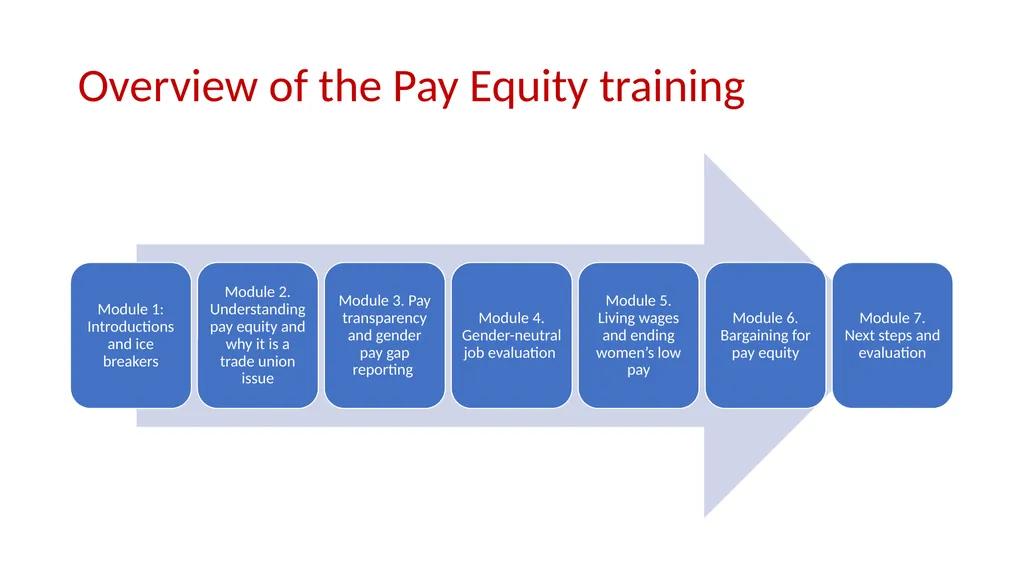
Overview of the Pay Equity training<br>
04
Learning objectives Understanding of pay equity and trade union roles.
Tools to ensure that workers receive fair pay by equally valuing the work carried out by women and men in non-discriminatory ways.
Support pay equity strategies related to pay transparency, closing the gender pay gap, equal pay for work of equal value, and living wages.<br>
Tools to ensure that workers receive fair pay by equally valuing the work carried out by women and men in non-discriminatory ways.
Support pay equity strategies related to pay transparency, closing the gender pay gap, equal pay for work of equal value, and living wages.<br>
05
Module 1: Introductions and ice breakers<br>
06
Activity 1.1: Introductions and expectations 6<br>
07
Activity 1.2:
Let’s do a power walk 7<br>
08
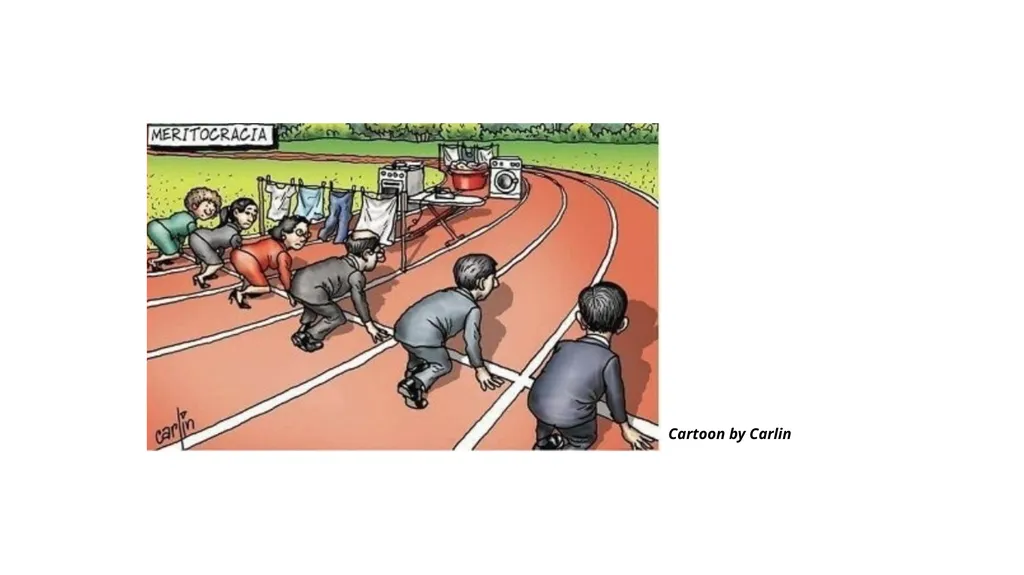
Cartoon by Carlin<br>
09
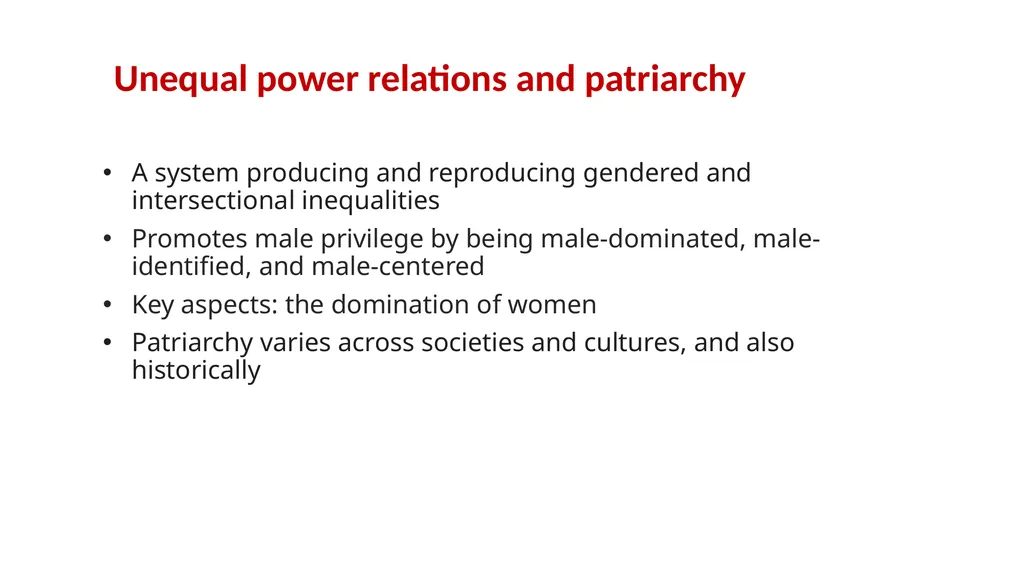
Unequal power relations and patriarchy A system producing and reproducing gendered and intersectional inequalities
Promotes male privilege by being male-dominated, male-identified, and male-centered
Key aspects: the domination of women
Patriarchy varies across societies and cultures, and also historically<br>
Promotes male privilege by being male-dominated, male-identified, and male-centered
Key aspects: the domination of women
Patriarchy varies across societies and cultures, and also historically<br>
10
Equal visibility, empowerment and participation to women, men and gender diverse people in all spheres of public life, the workplace and the family.
Gender equality implies that the interests, needs and priorities of women, men and gender diverse people are taken into consideration, recognizing the diversity of different groups of women and men. Gender equality<br>
Gender equality implies that the interests, needs and priorities of women, men and gender diverse people are taken into consideration, recognizing the diversity of different groups of women and men. Gender equality<br>
11
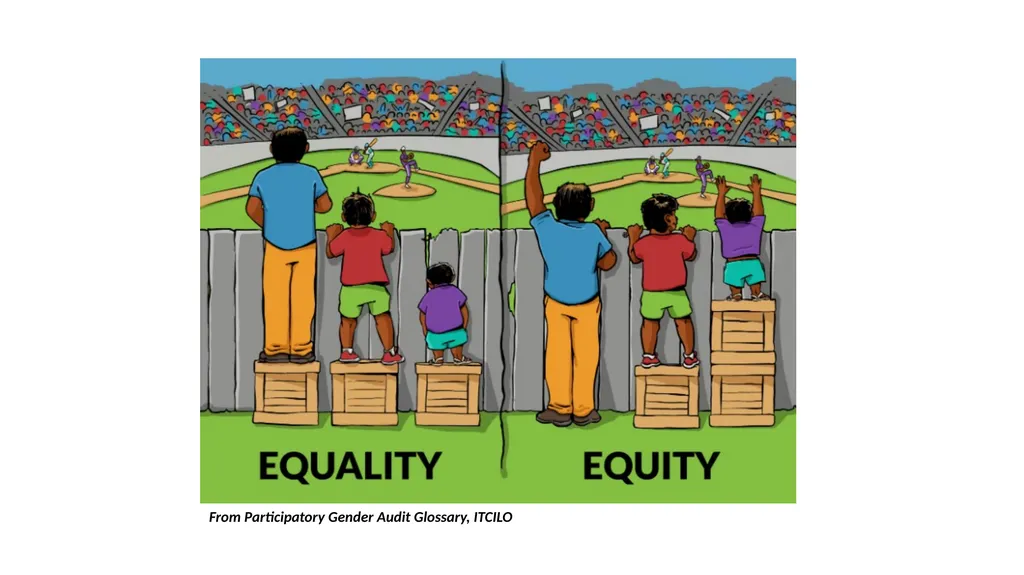
From Participatory Gender Audit Glossary, ITCILO<br>
12
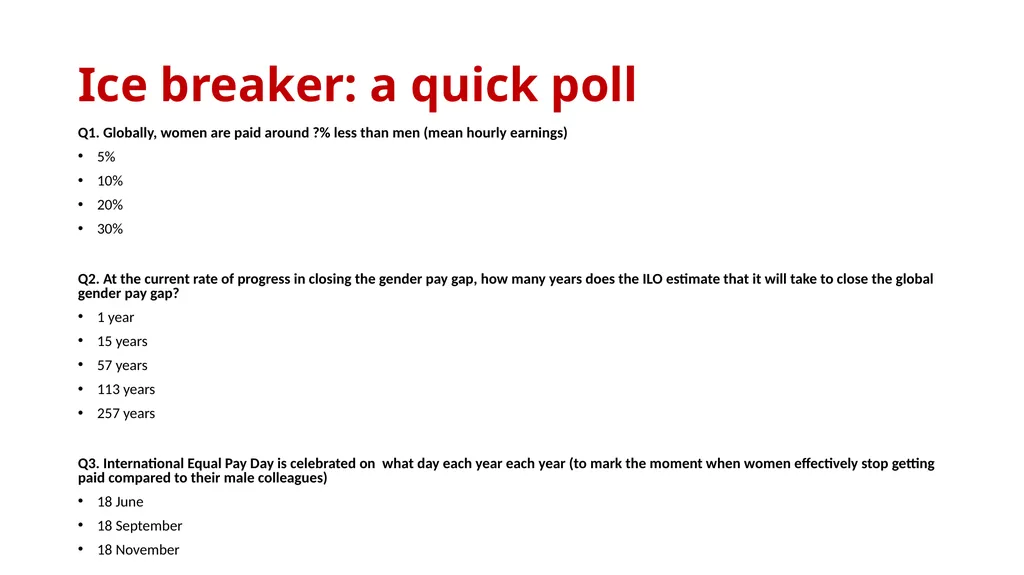
Ice breaker: a quick poll Q1. Globally, women are paid around ?% less than men (mean hourly earnings)
5%
10%
20%
30%
Q2. At the current rate of progress in closing the gender pay gap, how many years does the ILO estimate that it will take to close the global gender pay gap?
1 year
15 years
57 years
113 years
257 years
Q3. International Equal Pay Day is celebrated on what day each year each year (to mark the moment when women effectively stop getting paid compared to their male colleagues)
18 June
18 September
18 November<br>
5%
10%
20%
30%
Q2. At the current rate of progress in closing the gender pay gap, how many years does the ILO estimate that it will take to close the global gender pay gap?
1 year
15 years
57 years
113 years
257 years
Q3. International Equal Pay Day is celebrated on what day each year each year (to mark the moment when women effectively stop getting paid compared to their male colleagues)
18 June
18 September
18 November<br>
13
Activity 1.3: Where do we stand on unequal pay between women and men? 13<br>
14
Module 2: What is pay equity and why it is a trade union issue<br>
15
Why is pay equity an important priority for IndustriALL IndustriALL is committed to ending inequalities between women and men through a transformational approach.
This means addressing the structural and root causes of inequalities.
Pay equity addresses the undervaluation of women’s work, which contributes to the gender wage gap.
Jobs commonly held by women tend to be paid less than jobs commonly held by men—even when the work is comparable in value based on skill, effort, responsibility, and working conditions.
The gender wage gap is a persistent problem.<br>
This means addressing the structural and root causes of inequalities.
Pay equity addresses the undervaluation of women’s work, which contributes to the gender wage gap.
Jobs commonly held by women tend to be paid less than jobs commonly held by men—even when the work is comparable in value based on skill, effort, responsibility, and working conditions.
The gender wage gap is a persistent problem.<br>
16
Problems in achieving pay equity (1): Undervaluing of women’s work Women’s skills are often regarded as ‘natural’ female characteristics rather than acquired skills e.g. undervaluing of care work
Gender bias in assessing women’s work
Difficulties related to measuring productivity in women’s work, e.g. care work
Gender stereotypes impacts on how we value women’s work and skills<br>
Gender bias in assessing women’s work
Difficulties related to measuring productivity in women’s work, e.g. care work
Gender stereotypes impacts on how we value women’s work and skills<br>
17
Problems in achieving pay equity (2): Lack of data on wages / transparent pay systems Without data on wages , it is difficult to establish if there is gender bias in pay setting and job classification systems
Pay and grading systems sometimes separate out women’s work and men’s work into separate pay bands
Non-basic pay, performance and bonus payments more likely to benefit men’s jobs<br>
Pay and grading systems sometimes separate out women’s work and men’s work into separate pay bands
Non-basic pay, performance and bonus payments more likely to benefit men’s jobs<br>
18
Problems in achieving pay equity (3): Women are under-represented in positions of power Women are under-represented in social dialogue / collective bargaining teams
Equal pay is generally low on the agendas in collective bargaining<br>
Equal pay is generally low on the agendas in collective bargaining<br>
19
However, the presence of trade unions has a positive effect overall Overall, research from the OECD and ILO confirms that trade unions have a positive effect on reducing the gender pay gap.
According to H&M commissioned research on living wages in the garment sector:
When suppliers participate in workplace social dialogue programmes and factory-level wage management, real wages increase by an average of 2.8%.
When combined with a wage grid that classifies jobs by skill level, the wage effect is amplified by 5% (on average).
The presence of trade unions at the factory level is estimated to add another average of 5.5% to wages.<br>
According to H&M commissioned research on living wages in the garment sector:
When suppliers participate in workplace social dialogue programmes and factory-level wage management, real wages increase by an average of 2.8%.
When combined with a wage grid that classifies jobs by skill level, the wage effect is amplified by 5% (on average).
The presence of trade unions at the factory level is estimated to add another average of 5.5% to wages.<br>
20
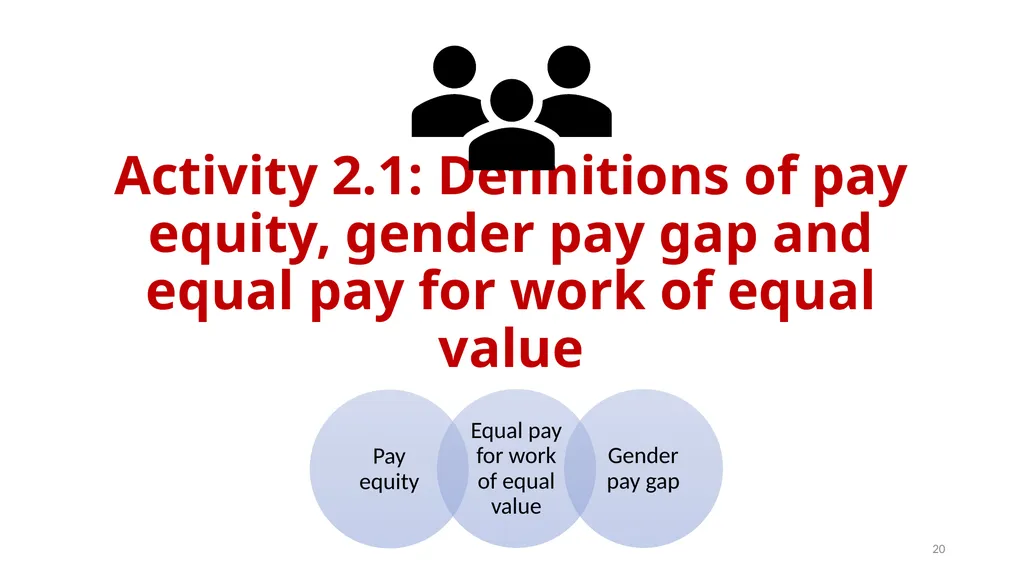
Activity 2.1: Definitions of pay equity, gender pay gap and equal pay for work of equal value 20<br>
21
Pay equity is about equal pay for work of equal value Equal pay for work of equal value means that:
two different jobs that contribute equal value to an employer’s operations means that workers in those jobs should receive equal pay
It is like comparing apples to oranges – they are different, but equally nutritious – for example:
Comparing the value of a truck mechanic job (commonly held by men) to that of an account technician job (commonly held by women).
Pay equity is internationally recognized as a fundamental human right<br>
two different jobs that contribute equal value to an employer’s operations means that workers in those jobs should receive equal pay
It is like comparing apples to oranges – they are different, but equally nutritious – for example:
Comparing the value of a truck mechanic job (commonly held by men) to that of an account technician job (commonly held by women).
Pay equity is internationally recognized as a fundamental human right<br>
22
Continued… Pay equity is goal for all workers, regardless of their employment or contractual status and whether or not they work in the formal or informal economy.
Encompasses strategies to address the structural causes of pay inequalities such as occupational segregation, women’s burden of care responsibilities, power inequalities in the workplace and gendered stereotypes that result in the undervaluing of women’s work and skills.<br>
Encompasses strategies to address the structural causes of pay inequalities such as occupational segregation, women’s burden of care responsibilities, power inequalities in the workplace and gendered stereotypes that result in the undervaluing of women’s work and skills.<br>
23
International standards ILO Convention No. 100: implements the principle of equal pay for work of equal value.
Has C100 been ratified and implemented in your country?
SDG Target 8.5: By 2030, achieve full and productive employment and decent work for all women and men, including for young people and persons with disabilities, and equal pay for work of equal value.<br>
Has C100 been ratified and implemented in your country?
SDG Target 8.5: By 2030, achieve full and productive employment and decent work for all women and men, including for young people and persons with disabilities, and equal pay for work of equal value.<br>
24
What are the causes of the gender pay gap? We need to understand the causes of the gender pay gap if we are to build effective strategies to end inequalities between women’s and men’s pay.
In your experience, what are the main causes of the gender pay gap?
Let’s go on now to look at how the gender pay gap is explained.<br>
In your experience, what are the main causes of the gender pay gap?
Let’s go on now to look at how the gender pay gap is explained.<br>
25
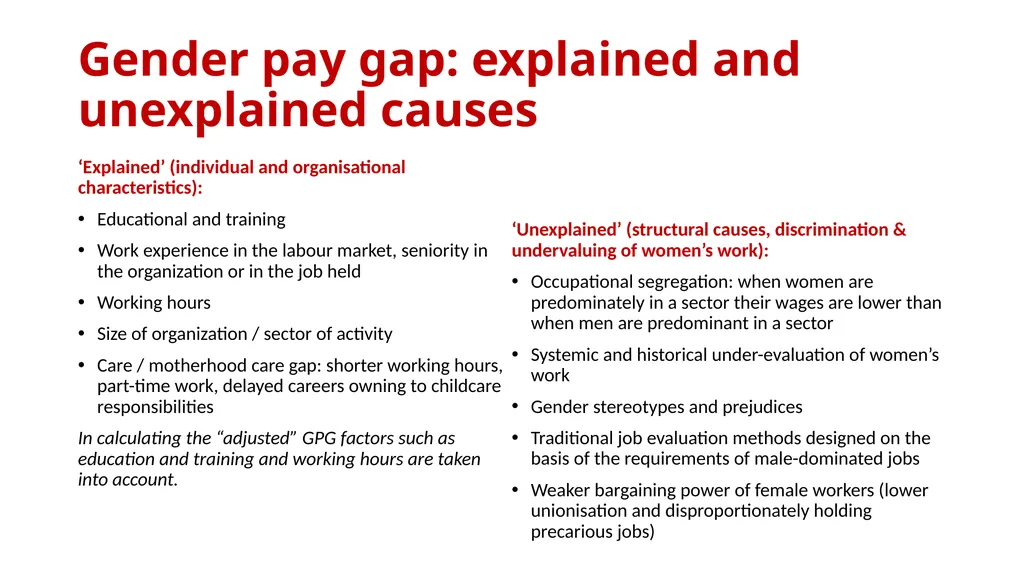
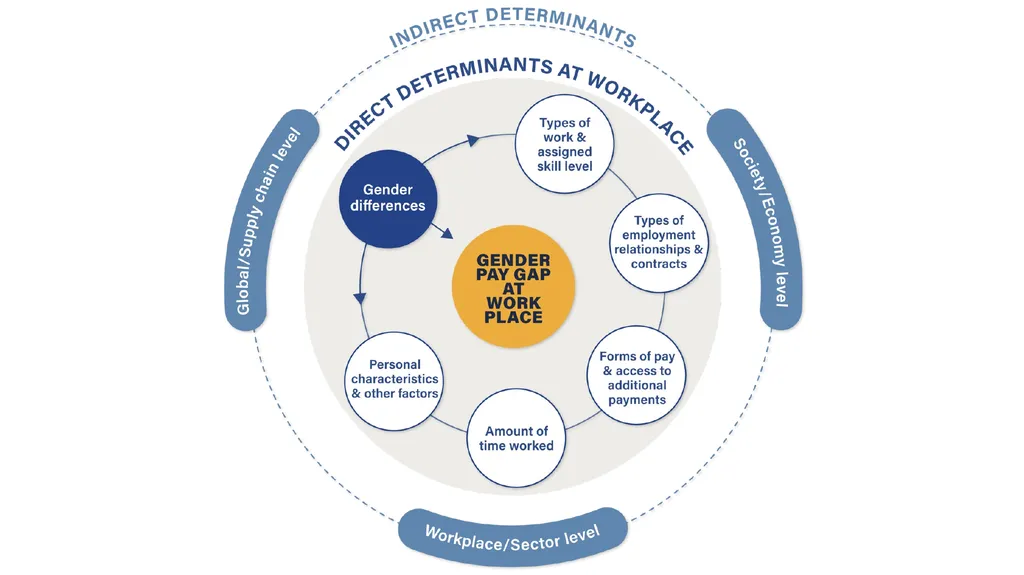
Gender pay gap: explained and unexplained causes ‘Explained’ (individual and organisational characteristics):
Educational and training
Work experience in the labour market, seniority in the organization or in the job held
Working hours
Size of organization / sector of activity
Care / motherhood care gap: shorter working hours, part-time work, delayed careers owning to childcare responsibilities
In calculating the “adjusted” GPG factors such as education and training and working hours are taken into account.
‘Unexplained’ (structural causes, discrimination & undervaluing of women’s work):
Occupational segregation: when women are predominately in a sector their wages are lower than when men are predominant in a sector
Systemic and historical under-evaluation of women’s work
Gender stereotypes and prejudices
Traditional job evaluation methods designed on the basis of the requirements of male-dominated jobs
Weaker bargaining power of female workers (lower unionisation and disproportionately holding precarious jobs)<br>
Educational and training
Work experience in the labour market, seniority in the organization or in the job held
Working hours
Size of organization / sector of activity
Care / motherhood care gap: shorter working hours, part-time work, delayed careers owning to childcare responsibilities
In calculating the “adjusted” GPG factors such as education and training and working hours are taken into account.
‘Unexplained’ (structural causes, discrimination & undervaluing of women’s work):
Occupational segregation: when women are predominately in a sector their wages are lower than when men are predominant in a sector
Systemic and historical under-evaluation of women’s work
Gender stereotypes and prejudices
Traditional job evaluation methods designed on the basis of the requirements of male-dominated jobs
Weaker bargaining power of female workers (lower unionisation and disproportionately holding precarious jobs)<br>
26
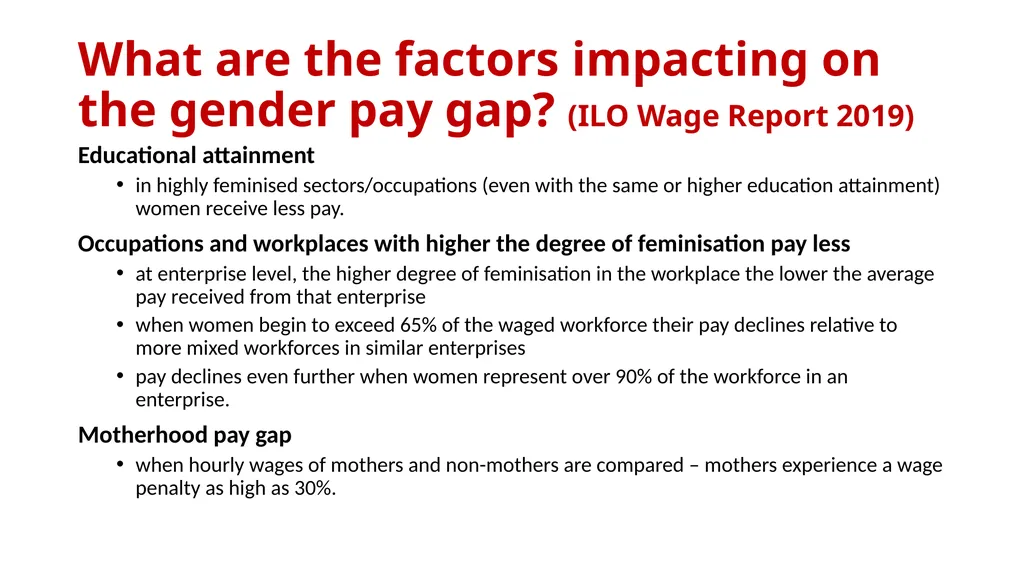
What are the factors impacting on the gender pay gap? (ILO Wage Report 2019) Educational attainment
in highly feminised sectors/occupations (even with the same or higher education attainment) women receive less pay.
Occupations and workplaces with higher the degree of feminisation pay less
at enterprise level, the higher degree of feminisation in the workplace the lower the average pay received from that enterprise
when women begin to exceed 65% of the waged workforce their pay declines relative to more mixed workforces in similar enterprises
pay declines even further when women represent over 90% of the workforce in an enterprise.
Motherhood pay gap
when hourly wages of mothers and non-mothers are compared – mothers experience a wage penalty as high as 30%.<br>
in highly feminised sectors/occupations (even with the same or higher education attainment) women receive less pay.
Occupations and workplaces with higher the degree of feminisation pay less
at enterprise level, the higher degree of feminisation in the workplace the lower the average pay received from that enterprise
when women begin to exceed 65% of the waged workforce their pay declines relative to more mixed workforces in similar enterprises
pay declines even further when women represent over 90% of the workforce in an enterprise.
Motherhood pay gap
when hourly wages of mothers and non-mothers are compared – mothers experience a wage penalty as high as 30%.<br>
27
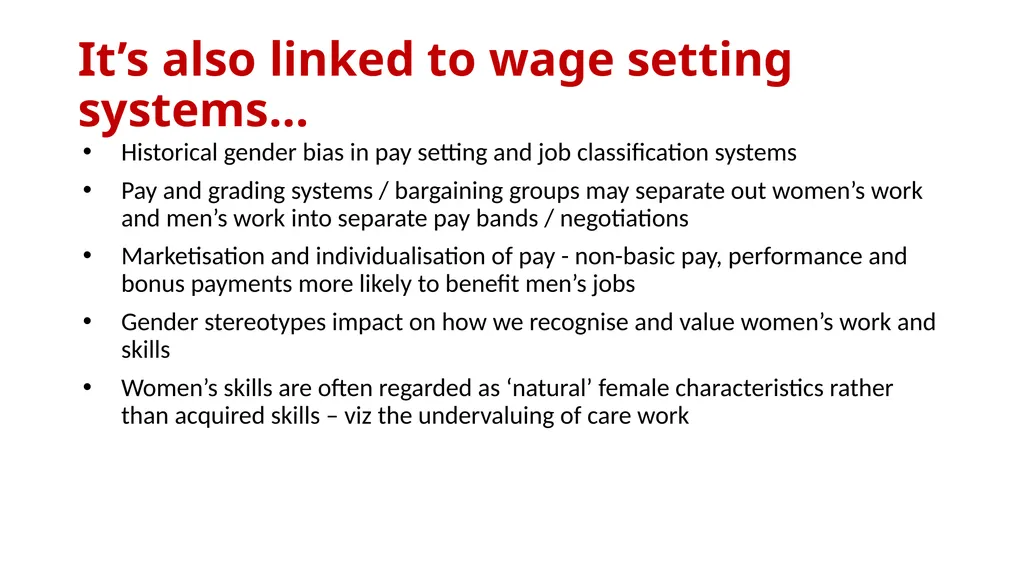
It’s also linked to wage setting systems… Historical gender bias in pay setting and job classification systems
Pay and grading systems / bargaining groups may separate out women’s work and men’s work into separate pay bands / negotiations
Marketisation and individualisation of pay - non-basic pay, performance and bonus payments more likely to benefit men’s jobs
Gender stereotypes impact on how we recognise and value women’s work and skills
Women’s skills are often regarded as ‘natural’ female characteristics rather than acquired skills – viz the undervaluing of care work<br>
Pay and grading systems / bargaining groups may separate out women’s work and men’s work into separate pay bands / negotiations
Marketisation and individualisation of pay - non-basic pay, performance and bonus payments more likely to benefit men’s jobs
Gender stereotypes impact on how we recognise and value women’s work and skills
Women’s skills are often regarded as ‘natural’ female characteristics rather than acquired skills – viz the undervaluing of care work<br>
28
Discussion What actions have already been taken by your union on pay equity? (including actions to close the gender pay gap and achieve equal pay for work of equal value)
What challenges do you face?
What specific strategies do you think can be implemented to overcome these challenges?<br>
What challenges do you face?
What specific strategies do you think can be implemented to overcome these challenges?<br>
29
In summary… Jobs requiring similar skills, qualifications or experience tend to be poorly paid and undervalued when they are dominated by women rather than by men.
When women enter an industry or particular field in greater numbers, pay declines for the very same jobs that more men were doing before.
Gendered valuations are deeply embedded in formal wage determination processes
Decisions about these roles contribute to the unconscious bias at work in how we perceive value and worth of a particular job.<br>
When women enter an industry or particular field in greater numbers, pay declines for the very same jobs that more men were doing before.
Gendered valuations are deeply embedded in formal wage determination processes
Decisions about these roles contribute to the unconscious bias at work in how we perceive value and worth of a particular job.<br>
30
Module 3: Pay transparency and gender pay gap reporting<br>
31
What is gender pay gap reporting? The GPG is the gap between women’s and men’s pay – the figure varies depending on which measurement is used:
Mean GPG or median GPG?
Hourly, monthly or yearly earnings?
In practice, most gender pay gap reporting covers mean and median GPG based on hourly earnings.<br>
Mean GPG or median GPG?
Hourly, monthly or yearly earnings?
In practice, most gender pay gap reporting covers mean and median GPG based on hourly earnings.<br>
32
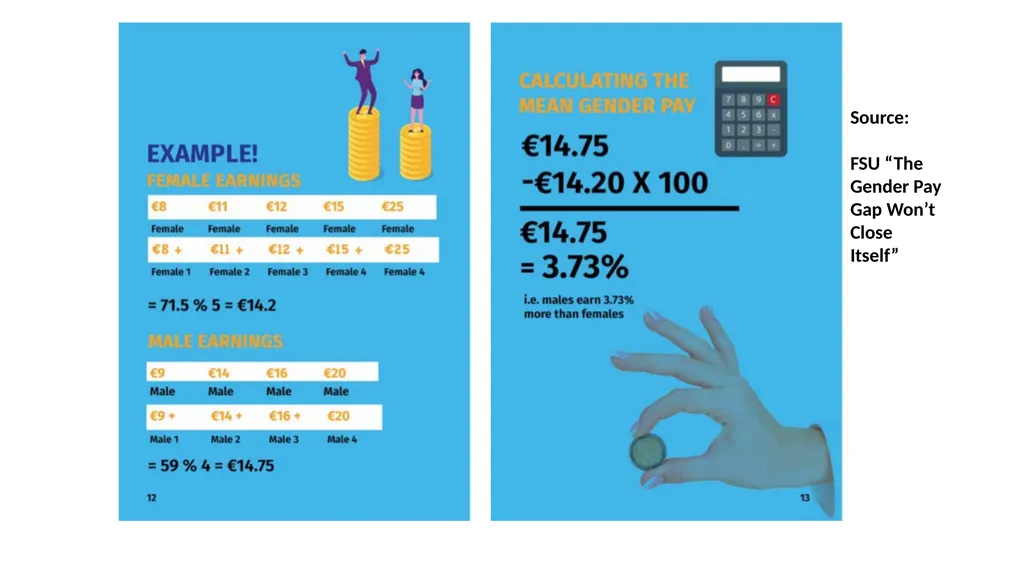
Definitions: mean or median Mean – the average wage among all wage employees / the average of all the values covered
compares average of women’s pay to average of men’s pay in the wage distribution
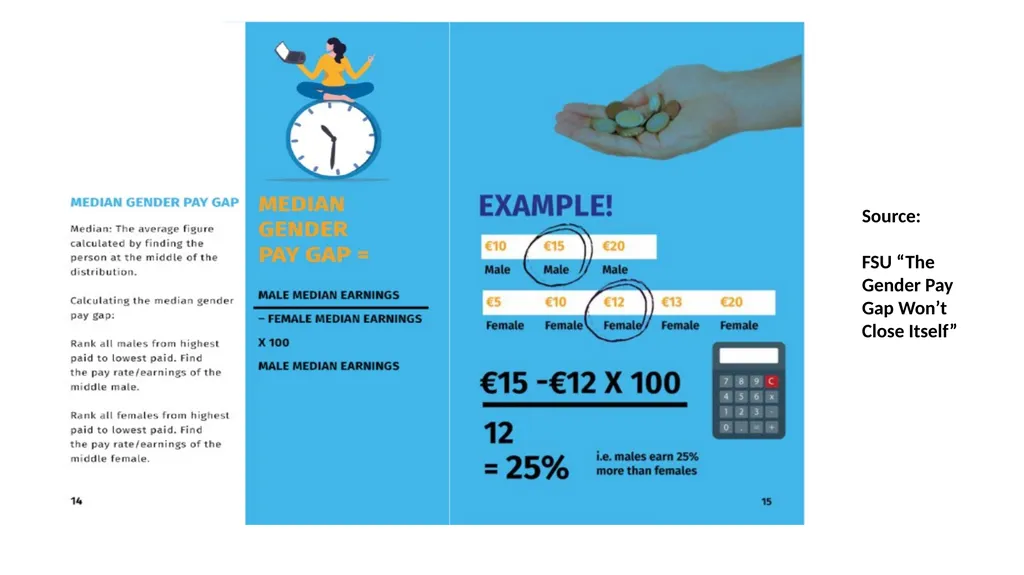
Median – the middle wage earner / located in the middle of the wage distribution
compares the value located in the middle of the female / and male wage distribution; half earn more than the median salary, half earn less
Mean and median can often produced different and contradictory results.
Global estimates range from 16% pay gap (mean hourly wages) to 22% (median monthly wages)<br>
compares average of women’s pay to average of men’s pay in the wage distribution
Median – the middle wage earner / located in the middle of the wage distribution
compares the value located in the middle of the female / and male wage distribution; half earn more than the median salary, half earn less
Mean and median can often produced different and contradictory results.
Global estimates range from 16% pay gap (mean hourly wages) to 22% (median monthly wages)<br>
33
Source:
FSU “The Gender Pay Gap Won’t Close Itself”<br>
FSU “The Gender Pay Gap Won’t Close Itself”<br>
34
Source:
FSU “The Gender Pay Gap Won’t Close Itself”<br>
FSU “The Gender Pay Gap Won’t Close Itself”<br>
35
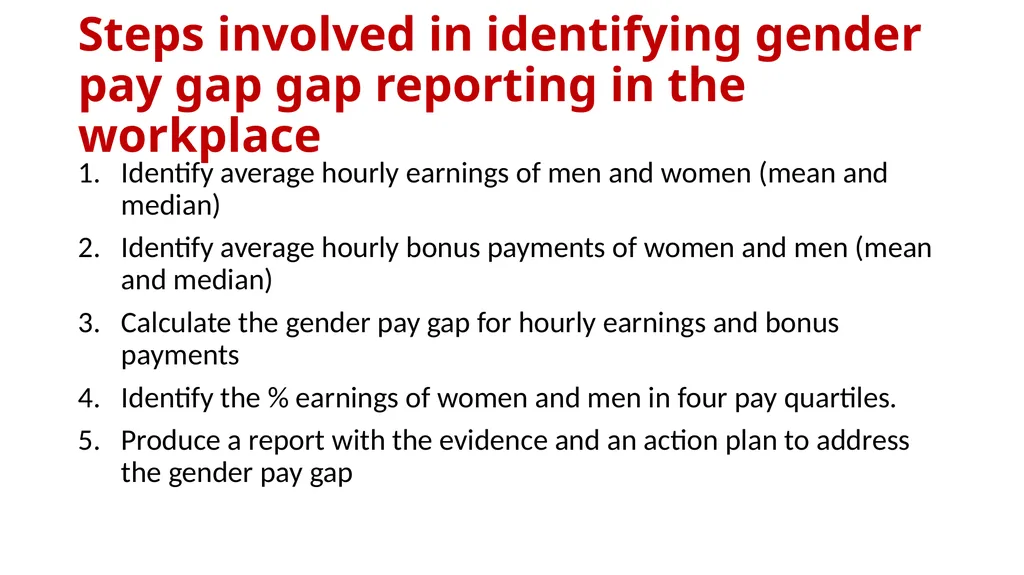
Steps involved in identifying gender pay gap gap reporting in the workplace Identify average hourly earnings of men and women (mean and median)
Identify average hourly bonus payments of women and men (mean and median)
Calculate the gender pay gap for hourly earnings and bonus payments
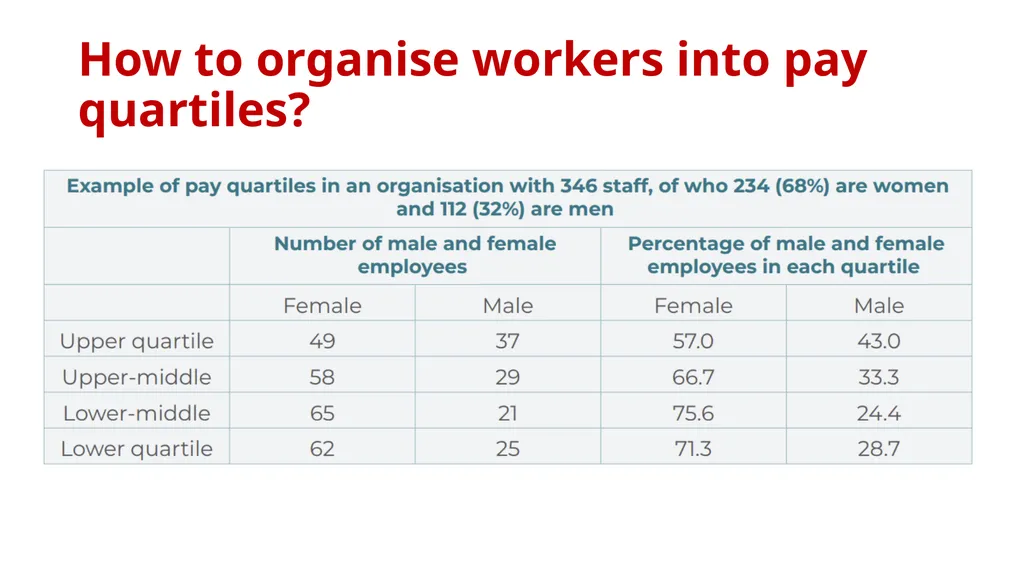
Identify the % earnings of women and men in four pay quartiles.
Produce a report with the evidence and an action plan to address the gender pay gap<br>
Identify average hourly bonus payments of women and men (mean and median)
Calculate the gender pay gap for hourly earnings and bonus payments
Identify the % earnings of women and men in four pay quartiles.
Produce a report with the evidence and an action plan to address the gender pay gap<br>
36
How to organise workers into pay quartiles?<br>
37
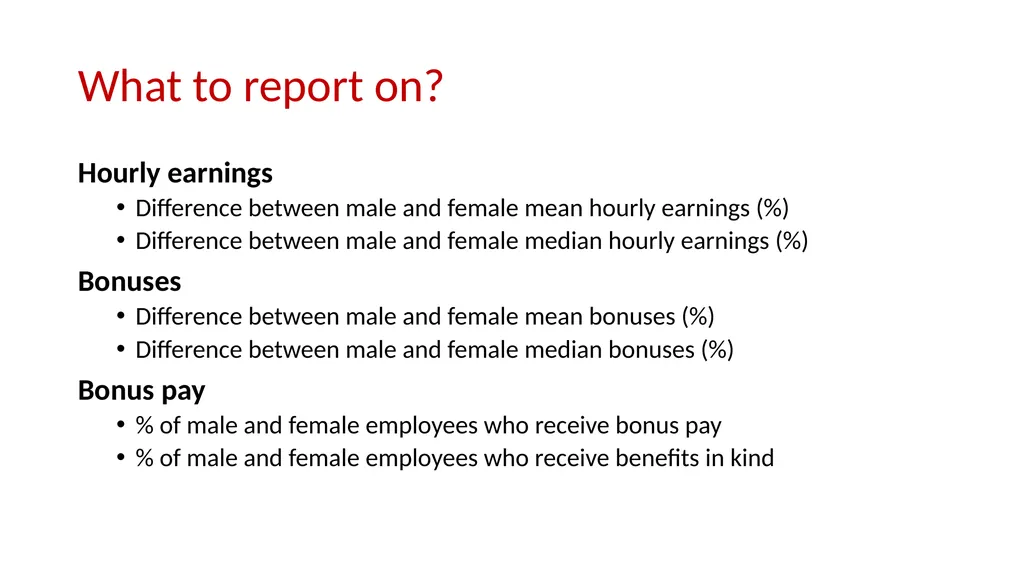
What to report on? Hourly earnings
Difference between male and female mean hourly earnings (%)
Difference between male and female median hourly earnings (%)
Bonuses
Difference between male and female mean bonuses (%)
Difference between male and female median bonuses (%)
Bonus pay
% of male and female employees who receive bonus pay
% of male and female employees who receive benefits in kind<br>
Difference between male and female mean hourly earnings (%)
Difference between male and female median hourly earnings (%)
Bonuses
Difference between male and female mean bonuses (%)
Difference between male and female median bonuses (%)
Bonus pay
% of male and female employees who receive bonus pay
% of male and female employees who receive benefits in kind<br>
38
What is pay for the purposes of gender pay gap reporting? What is included in hourly earnings?
Allowances e.g. recruitment and retention allowances and car allowances
Pay for piecework
Leave pay e.g. annual leave, maternity leave
Shift premium pay
Performance related pay
What is not included?
Overtime pay
Redundancy or termination pay
Pay in lieu of leave
Benefits in kind
Childcare services and health plans
What makes up bonus pay?
Money, vouchers, securities, security options, interests in securities
Payment linked to profit sharing, productivity bonus, PRP, incentive or commission pay<br>
Allowances e.g. recruitment and retention allowances and car allowances
Pay for piecework
Leave pay e.g. annual leave, maternity leave
Shift premium pay
Performance related pay
What is not included?
Overtime pay
Redundancy or termination pay
Pay in lieu of leave
Benefits in kind
Childcare services and health plans
What makes up bonus pay?
Money, vouchers, securities, security options, interests in securities
Payment linked to profit sharing, productivity bonus, PRP, incentive or commission pay<br>
39
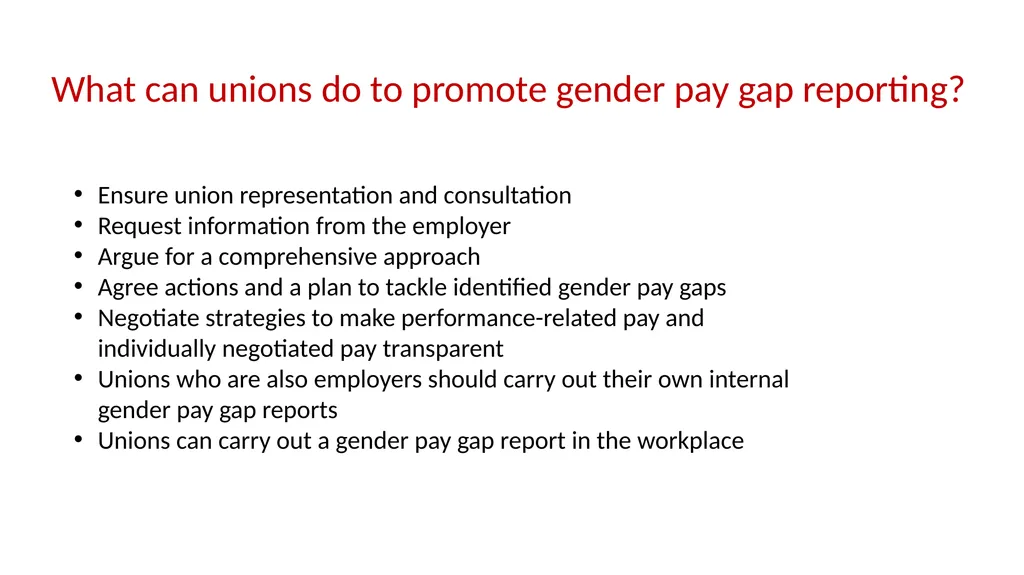
Ensure union representation and consultation
Request information from the employer
Argue for a comprehensive approach
Agree actions and a plan to tackle identified gender pay gaps
Negotiate strategies to make performance-related pay and individually negotiated pay transparent
Unions who are also employers should carry out their own internal gender pay gap reports
Unions can carry out a gender pay gap report in the workplace What can unions do to promote gender pay gap reporting?<br>
Request information from the employer
Argue for a comprehensive approach
Agree actions and a plan to tackle identified gender pay gaps
Negotiate strategies to make performance-related pay and individually negotiated pay transparent
Unions who are also employers should carry out their own internal gender pay gap reports
Unions can carry out a gender pay gap report in the workplace What can unions do to promote gender pay gap reporting?<br>
40
Activity 3.1: Identifying the gender pay gap 41<br>
41
Activity 3.2: Next steps in preparing for gender pay gap reporting 42<br>
42
Day 2<br>
43
Module 4: Gender-neutral job evaluation<br>
44
Group activity 4.1: What do you understand by gender-neutral job evaluation? 45<br>
45
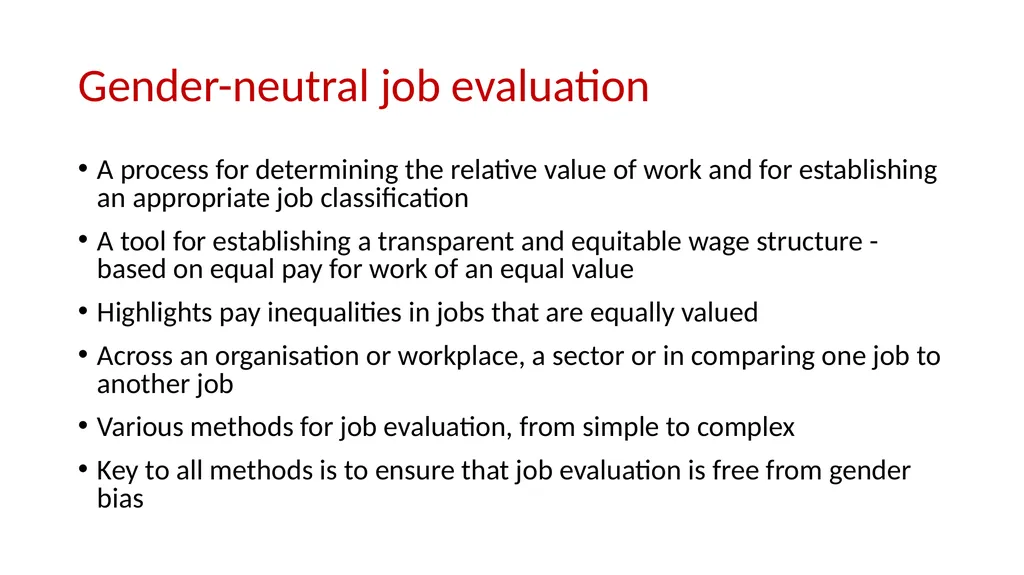
Gender-neutral job evaluation A process for determining the relative value of work and for establishing an appropriate job classification
A tool for establishing a transparent and equitable wage structure - based on equal pay for work of an equal value
Highlights pay inequalities in jobs that are equally valued
Across an organisation or workplace, a sector or in comparing one job to another job
Various methods for job evaluation, from simple to complex
Key to all methods is to ensure that job evaluation is free from gender bias<br>
A tool for establishing a transparent and equitable wage structure - based on equal pay for work of an equal value
Highlights pay inequalities in jobs that are equally valued
Across an organisation or workplace, a sector or in comparing one job to another job
Various methods for job evaluation, from simple to complex
Key to all methods is to ensure that job evaluation is free from gender bias<br>
46
Why is it important? Women’s jobs tend to be lower valued, particularly when clustered in ‘typical’ female jobs or if they are part-time
Undervaluing women’s work and talent is a lost resource for companies, the labour market and society
Making best use of women’s skills is good for motivation, productivity and competitiveness
Companies can recruit and retain the best employees if employees know that their work is rewarded fairly
Gives greater chance for women to be economically independent across the lifecourse
Increasing women’s earnings reduces the risk of poverty in retirement<br>
Undervaluing women’s work and talent is a lost resource for companies, the labour market and society
Making best use of women’s skills is good for motivation, productivity and competitiveness
Companies can recruit and retain the best employees if employees know that their work is rewarded fairly
Gives greater chance for women to be economically independent across the lifecourse
Increasing women’s earnings reduces the risk of poverty in retirement<br>
47
Examples Domestics (who are all women) wash floors, work a 39-hour week and earn 30% less than wall washers who are all men and who work a 37-hour week
A nurse with a degree level qualification, five years experience and supervises 15 staff earns 33% less than a craft supervisor who has three years job experience and supervises two people
Men carrying out manual work on the same grade as women receive a bonus, whereas women do not.<br>
A nurse with a degree level qualification, five years experience and supervises 15 staff earns 33% less than a craft supervisor who has three years job experience and supervises two people
Men carrying out manual work on the same grade as women receive a bonus, whereas women do not.<br>
48
Benefits of gender-neutral job evaluation An objective and analytical method – jobs are analysed for their content, not the individual characteristics of a worker
The relative value of new jobs created can be established
Helps in drawing up job descriptions, job specifications, competencies and performance appraisal systems
Jobs can be analysed that have changed over time
Takes account of the need for increasing levels of specialisms and complexity in organisations
Basis for good trade union/employee – employer relationships in the workplace<br>
The relative value of new jobs created can be established
Helps in drawing up job descriptions, job specifications, competencies and performance appraisal systems
Jobs can be analysed that have changed over time
Takes account of the need for increasing levels of specialisms and complexity in organisations
Basis for good trade union/employee – employer relationships in the workplace<br>
49
Benefits (2) Transparency in determining pay and the pay structure
Upgrades the value of women’s work and reduces incidence of low paid work
Creates a positive work environment and confidence of employees
Reduces individual or union grievances about unfair pay
Enables employees to identify skills and competency gaps
Remedies can be developed to address skills gaps, career development, under-representation of women in senior positions etc.<br>
Upgrades the value of women’s work and reduces incidence of low paid work
Creates a positive work environment and confidence of employees
Reduces individual or union grievances about unfair pay
Enables employees to identify skills and competency gaps
Remedies can be developed to address skills gaps, career development, under-representation of women in senior positions etc.<br>
50
Carrying out job evaluation Pay is determined by scoring points for factors or sub-factors or ranking jobs
Job analysis enables the relative value of jobs to be established in an objective and analytical way
Can be complex in large and diverse organisations
Important to have a clear job description/job content setting out the tasks, duties and responsibilities for each job being evaluated<br>
Job analysis enables the relative value of jobs to be established in an objective and analytical way
Can be complex in large and diverse organisations
Important to have a clear job description/job content setting out the tasks, duties and responsibilities for each job being evaluated<br>
51
Steps involved in job evaluation Step 1: Identify jobs for comparison
Examine pay data and differences in pay between jobs predominantly carrid out by men and women
Step 2: Job descriptions
Collate job descriptions / write job descriptions
Check job content with job holder and line manager
Step 3: Select factors and sub-factors for comparison (skills, effort, responsibility, working conditions)
Step 4: Make equal value assessment
Compare factor by factor
Make overall assessment<br>
Examine pay data and differences in pay between jobs predominantly carrid out by men and women
Step 2: Job descriptions
Collate job descriptions / write job descriptions
Check job content with job holder and line manager
Step 3: Select factors and sub-factors for comparison (skills, effort, responsibility, working conditions)
Step 4: Make equal value assessment
Compare factor by factor
Make overall assessment<br>
52
Pay equity example from Canada This video from Canada gives the example of the warehouse person (predominantly masculine) and administrative assistant (predominantly women). It shows how gender neutral job evaluation can show the undervaluing of women’s jobs and a basis for equal pay for work of equal value.
https://www.equalpayinternationalcoalition.org/en/equal-pay<br>
https://www.equalpayinternationalcoalition.org/en/equal-pay<br>
53
Activity 4.2: Understanding gender bias in how we evaluate jobs 54<br>
54
Do we undervalue or overlook skills held by women? Q. Are there aspects of the work generally performed by women that are overlooked or undervalued?
Q. Can you give some examples of aspects of the jobs held by women that are undervalued or overlooked?
Identify if they are related to:
Skill
Effort
Responsibility
Working conditions<br>
Q. Can you give some examples of aspects of the jobs held by women that are undervalued or overlooked?
Identify if they are related to:
Skill
Effort
Responsibility
Working conditions<br>
55
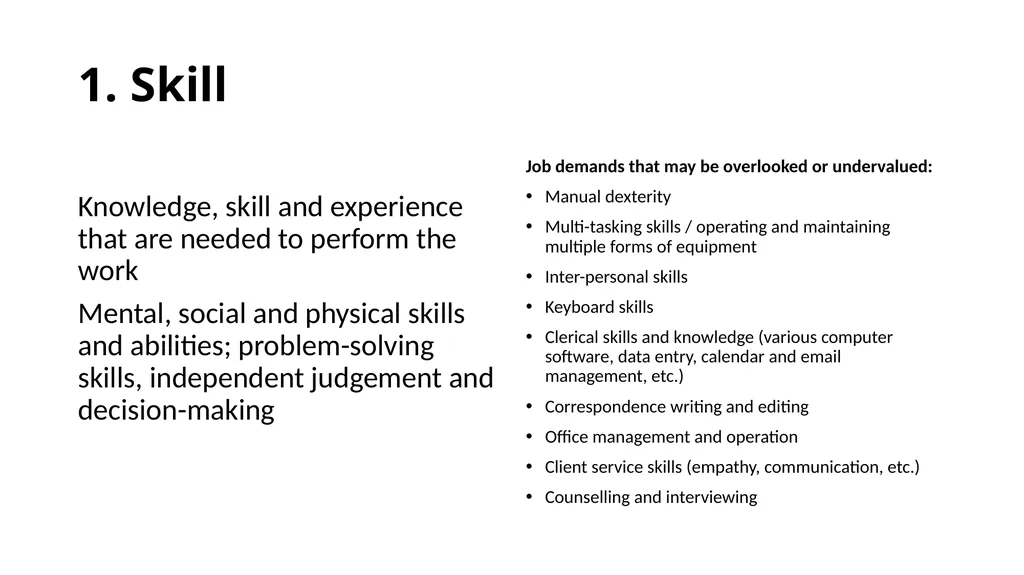
1. Skill Knowledge, skill and experience that are needed to perform the work
Mental, social and physical skills and abilities; problem-solving skills, independent judgement and decision-making Job demands that may be overlooked or undervalued:
Manual dexterity
Multi-tasking skills / operating and maintaining multiple forms of equipment
Inter-personal skills
Keyboard skills
Clerical skills and knowledge (various computer software, data entry, calendar and email management, etc.)
Correspondence writing and editing
Office management and operation
Client service skills (empathy, communication, etc.)
Counselling and interviewing<br>
Mental, social and physical skills and abilities; problem-solving skills, independent judgement and decision-making Job demands that may be overlooked or undervalued:
Manual dexterity
Multi-tasking skills / operating and maintaining multiple forms of equipment
Inter-personal skills
Keyboard skills
Clerical skills and knowledge (various computer software, data entry, calendar and email management, etc.)
Correspondence writing and editing
Office management and operation
Client service skills (empathy, communication, etc.)
Counselling and interviewing<br>
56
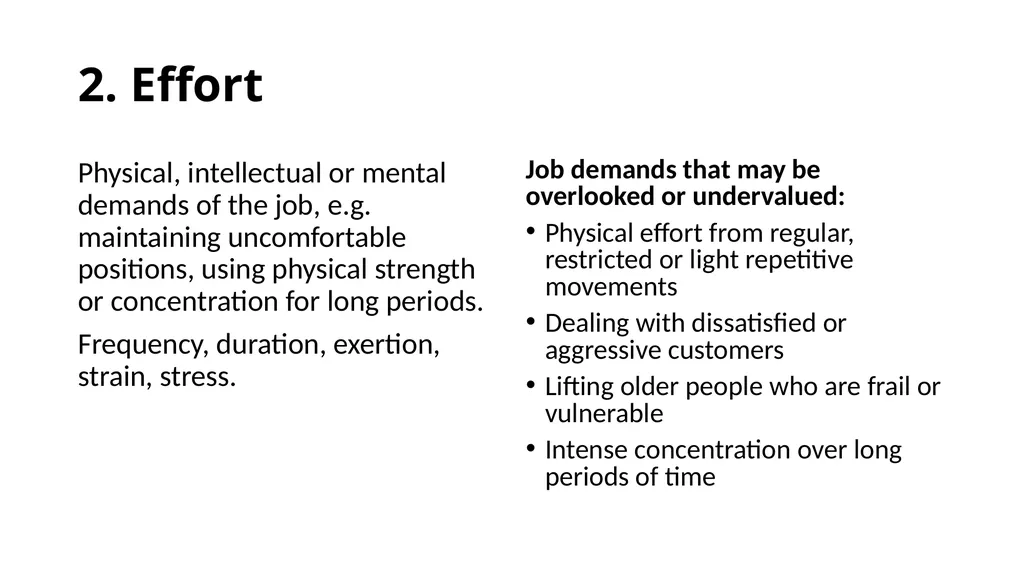
2. Effort Physical, intellectual or mental demands of the job, e.g. maintaining uncomfortable positions, using physical strength or concentration for long periods.
Frequency, duration, exertion, strain, stress. Job demands that may be overlooked or undervalued:
Physical effort from regular, restricted or light repetitive movements
Dealing with dissatisfied or aggressive customers
Lifting older people who are frail or vulnerable
Intense concentration over long periods of time<br>
Frequency, duration, exertion, strain, stress. Job demands that may be overlooked or undervalued:
Physical effort from regular, restricted or light repetitive movements
Dealing with dissatisfied or aggressive customers
Lifting older people who are frail or vulnerable
Intense concentration over long periods of time<br>
57
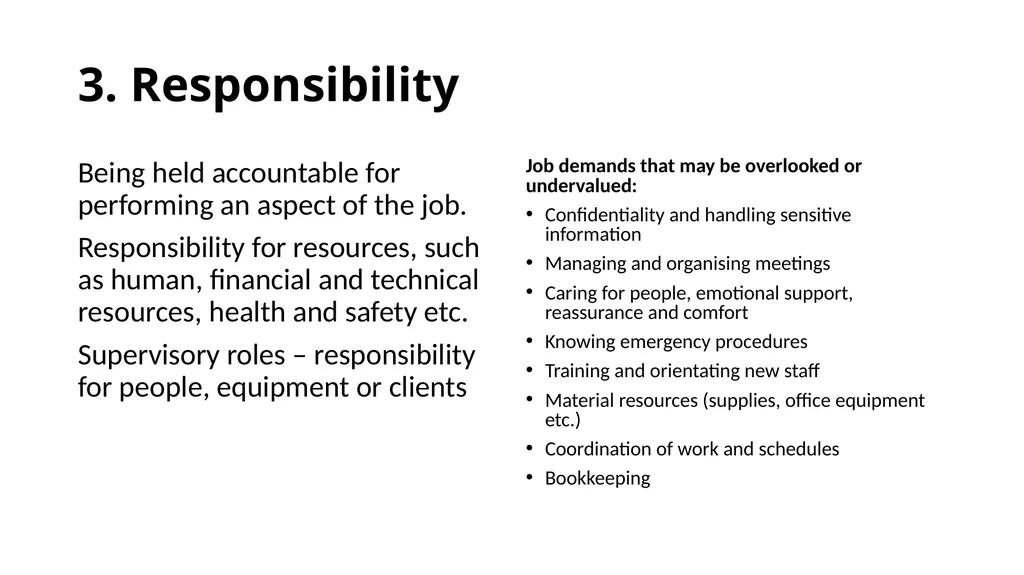
3. Responsibility Being held accountable for performing an aspect of the job.
Responsibility for resources, such as human, financial and technical resources, health and safety etc.
Supervisory roles – responsibility for people, equipment or clients Job demands that may be overlooked or undervalued:
Confidentiality and handling sensitive information
Managing and organising meetings
Caring for people, emotional support, reassurance and comfort
Knowing emergency procedures
Training and orientating new staff
Material resources (supplies, office equipment etc.)
Coordination of work and schedules
Bookkeeping<br>
Responsibility for resources, such as human, financial and technical resources, health and safety etc.
Supervisory roles – responsibility for people, equipment or clients Job demands that may be overlooked or undervalued:
Confidentiality and handling sensitive information
Managing and organising meetings
Caring for people, emotional support, reassurance and comfort
Knowing emergency procedures
Training and orientating new staff
Material resources (supplies, office equipment etc.)
Coordination of work and schedules
Bookkeeping<br>
58
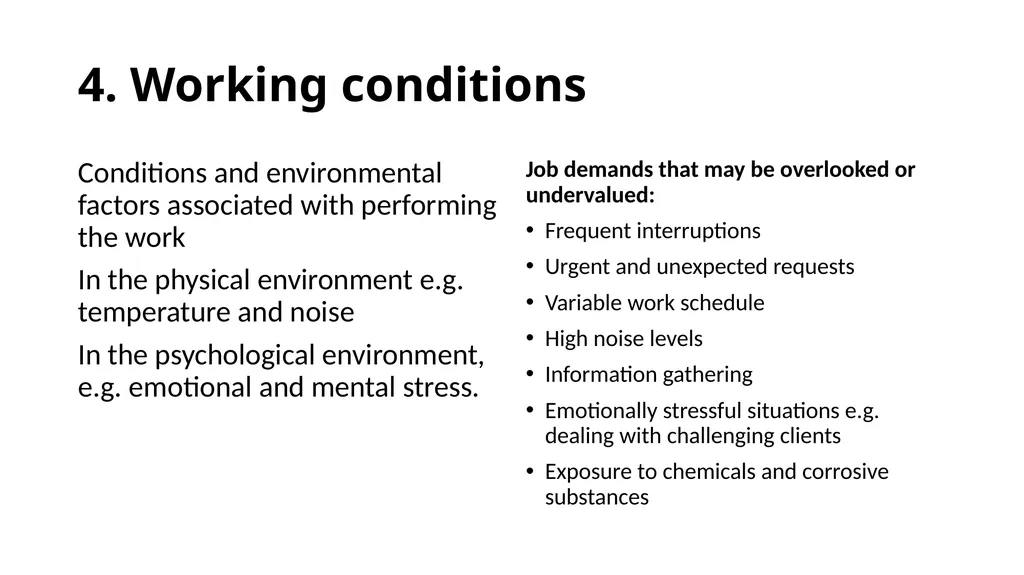
4. Working conditions Conditions and environmental factors associated with performing the work
In the physical environment e.g. temperature and noise
In the psychological environment, e.g. emotional and mental stress. Job demands that may be overlooked or undervalued:
Frequent interruptions
Urgent and unexpected requests
Variable work schedule
High noise levels
Information gathering
Emotionally stressful situations e.g. dealing with challenging clients
Exposure to chemicals and corrosive substances<br>
In the physical environment e.g. temperature and noise
In the psychological environment, e.g. emotional and mental stress. Job demands that may be overlooked or undervalued:
Frequent interruptions
Urgent and unexpected requests
Variable work schedule
High noise levels
Information gathering
Emotionally stressful situations e.g. dealing with challenging clients
Exposure to chemicals and corrosive substances<br>
59
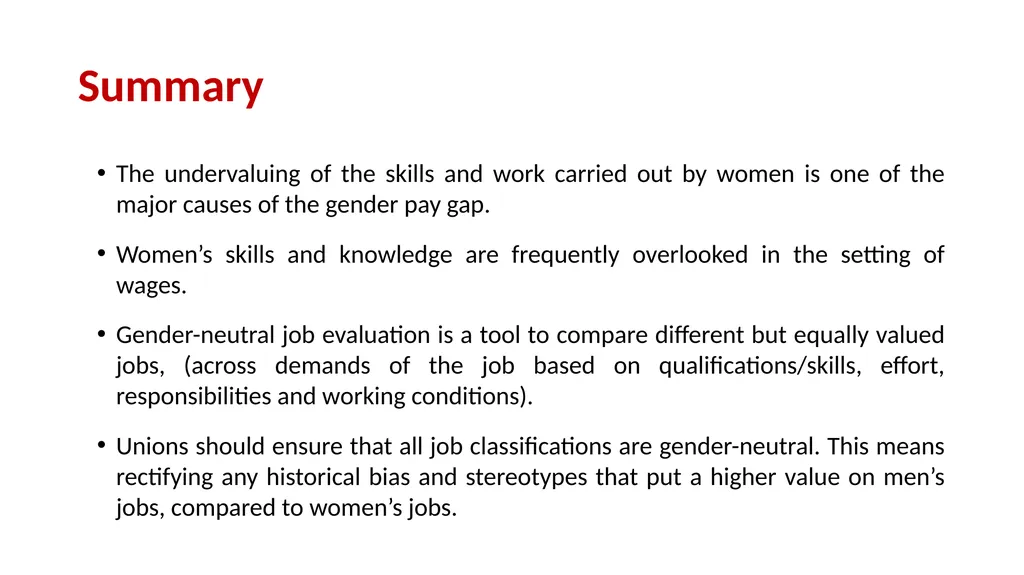
Summary The undervaluing of the skills and work carried out by women is one of the major causes of the gender pay gap.
Women’s skills and knowledge are frequently overlooked in the setting of wages.
Gender-neutral job evaluation is a tool to compare different but equally valued jobs, (across demands of the job based on qualifications/skills, effort, responsibilities and working conditions).
Unions should ensure that all job classifications are gender-neutral. This means rectifying any historical bias and stereotypes that put a higher value on men’s jobs, compared to women’s jobs.<br>
Women’s skills and knowledge are frequently overlooked in the setting of wages.
Gender-neutral job evaluation is a tool to compare different but equally valued jobs, (across demands of the job based on qualifications/skills, effort, responsibilities and working conditions).
Unions should ensure that all job classifications are gender-neutral. This means rectifying any historical bias and stereotypes that put a higher value on men’s jobs, compared to women’s jobs.<br>
60
Activity 4.3: Comparing the value of two jobs (administrative assistant and maintenance assistant) 61<br>
61
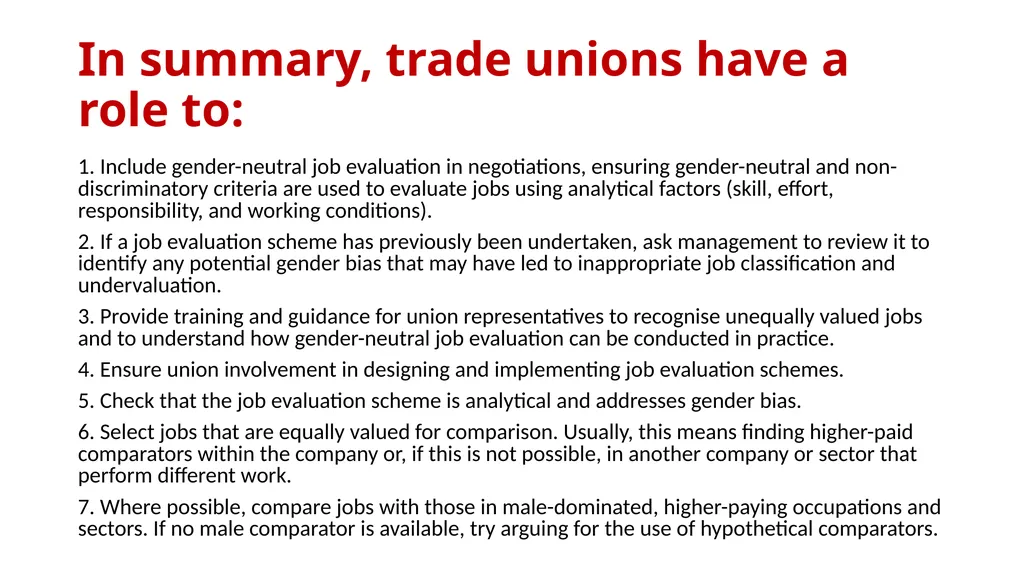
In summary, trade unions have a role to: 1. Include gender-neutral job evaluation in negotiations, ensuring gender-neutral and non-discriminatory criteria are used to evaluate jobs using analytical factors (skill, effort, responsibility, and working conditions).
2. If a job evaluation scheme has previously been undertaken, ask management to review it to identify any potential gender bias that may have led to inappropriate job classification and undervaluation.
3. Provide training and guidance for union representatives to recognise unequally valued jobs and to understand how gender-neutral job evaluation can be conducted in practice.
4. Ensure union involvement in designing and implementing job evaluation schemes.
5. Check that the job evaluation scheme is analytical and addresses gender bias.
6. Select jobs that are equally valued for comparison. Usually, this means finding higher-paid comparators within the company or, if this is not possible, in another company or sector that perform different work.
7. Where possible, compare jobs with those in male-dominated, higher-paying occupations and sectors. If no male comparator is available, try arguing for the use of hypothetical comparators.<br>
2. If a job evaluation scheme has previously been undertaken, ask management to review it to identify any potential gender bias that may have led to inappropriate job classification and undervaluation.
3. Provide training and guidance for union representatives to recognise unequally valued jobs and to understand how gender-neutral job evaluation can be conducted in practice.
4. Ensure union involvement in designing and implementing job evaluation schemes.
5. Check that the job evaluation scheme is analytical and addresses gender bias.
6. Select jobs that are equally valued for comparison. Usually, this means finding higher-paid comparators within the company or, if this is not possible, in another company or sector that perform different work.
7. Where possible, compare jobs with those in male-dominated, higher-paying occupations and sectors. If no male comparator is available, try arguing for the use of hypothetical comparators.<br>
62
Detailed overview of steps in carrying out job evaluation
Additional slides for participants involved in collective bargaining<br>
Additional slides for participants involved in collective bargaining<br>
63
Step 1: Identify jobs for comparison Slide for a deeper understanding: for members of collective bargaining teams 1) Draw up a list of the jobs in the enterprise or identified department of the enterprise
2) Determine whether these jobs are male- or female-dominated
3) Ensure that the criteria used to determine predominance are rigorous
4) Ensure that there is no gender bias
5) In the absence of male comparators, consider hypothetical jobs
The purpose is to evaluate and compare jobs in order to identify discrimination in pay and to determine unequal pay between predominantly female and predominantly male jobs. The jobs may be similar or different, but they may be of equal value.
Remember that the comparisons aim to show that two jobs are of equal value and, therefore, should receive equal pay.
When selecting jobs to compare, make sure that they are jobs that may be equally valued, e.g. a nurse v electrician, a cleaner v maintenance worker.<br>
2) Determine whether these jobs are male- or female-dominated
3) Ensure that the criteria used to determine predominance are rigorous
4) Ensure that there is no gender bias
5) In the absence of male comparators, consider hypothetical jobs
The purpose is to evaluate and compare jobs in order to identify discrimination in pay and to determine unequal pay between predominantly female and predominantly male jobs. The jobs may be similar or different, but they may be of equal value.
Remember that the comparisons aim to show that two jobs are of equal value and, therefore, should receive equal pay.
When selecting jobs to compare, make sure that they are jobs that may be equally valued, e.g. a nurse v electrician, a cleaner v maintenance worker.<br>
64
Step 2: Job descriptions Collect job descriptions of all jobs to be evaluated.
Consult with workers (holding the jobs to be evaluated) and their supervisors e.g. through group meetings and one-to-one interviews, and ensure that the job descriptions are:
up to date
fully reflect the skills, training, effort etc. for the job
that there is no gender bias in the way that the job is described
If job descriptions need updating, unions can support workers e.g. by keeping a diary for one or two weeks to set out their work tasks. Slide for a deeper understanding: for members of collective bargaining teams<br>
Consult with workers (holding the jobs to be evaluated) and their supervisors e.g. through group meetings and one-to-one interviews, and ensure that the job descriptions are:
up to date
fully reflect the skills, training, effort etc. for the job
that there is no gender bias in the way that the job is described
If job descriptions need updating, unions can support workers e.g. by keeping a diary for one or two weeks to set out their work tasks. Slide for a deeper understanding: for members of collective bargaining teams<br>
65
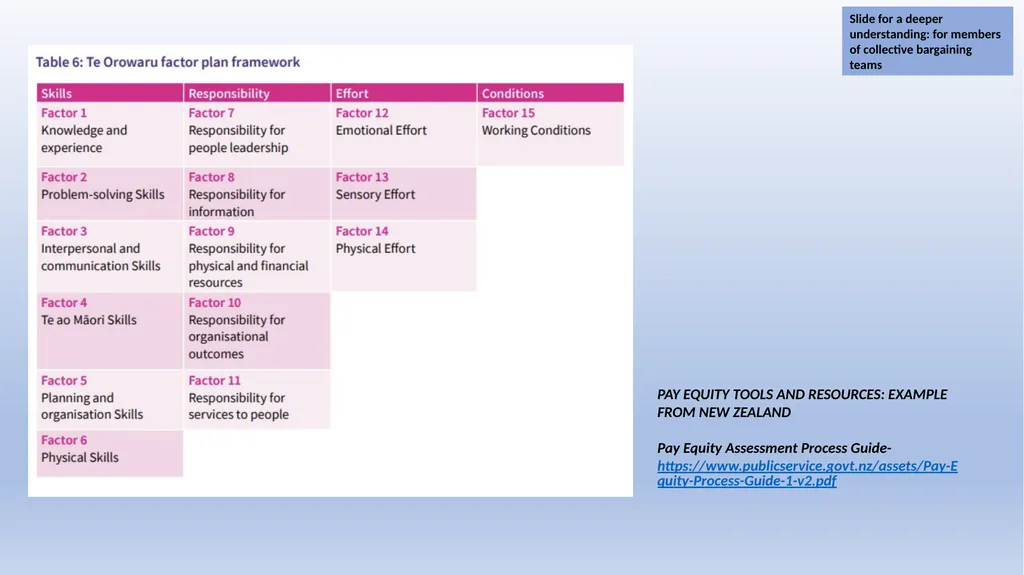
Step 3: Select factors and sub-factors for comparison Slide for a deeper understanding: for members of collective bargaining teams The four basic factors should be broken down into sub-factors
Between 10 and 16 sub-factors in total
Take into account the more detailed and varied characteristics of the different types of jobs in each enterprise
Examples of subfactors under Qualifications, skills and knowledge
work-related knowledge
manual dexterity
interpersonal skills<br>
Between 10 and 16 sub-factors in total
Take into account the more detailed and varied characteristics of the different types of jobs in each enterprise
Examples of subfactors under Qualifications, skills and knowledge
work-related knowledge
manual dexterity
interpersonal skills<br>
66
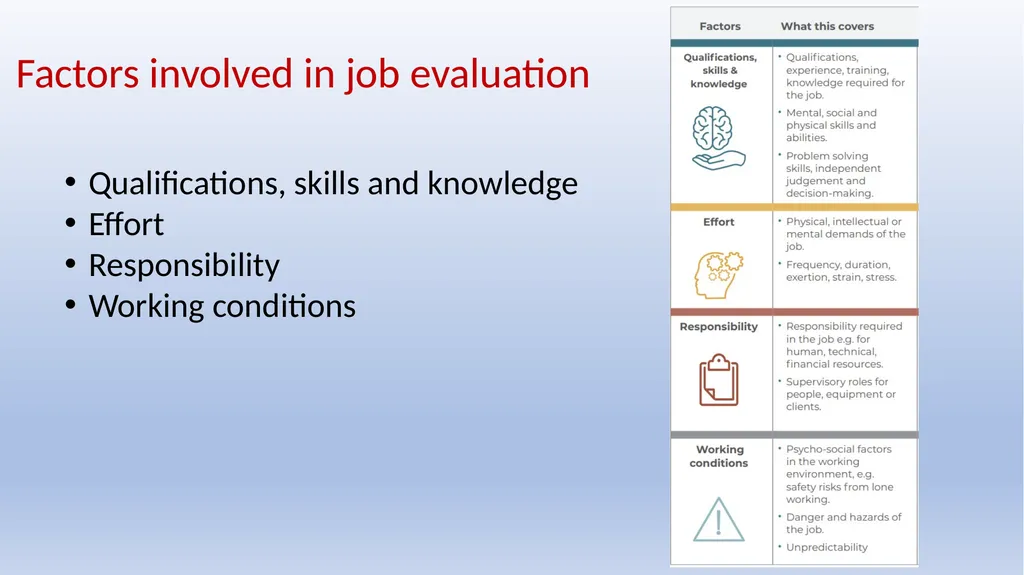
Factors involved in job evaluation Qualifications, skills and knowledge
Effort
Responsibility
Working conditions<br>
Effort
Responsibility
Working conditions<br>
67
PAY EQUITY TOOLS AND RESOURCES: EXAMPLE FROM NEW ZEALAND
Pay Equity Assessment Process Guide- https://www.publicservice.govt.nz/assets/Pay-Equity-Process-Guide-1-v2.pdf Slide for a deeper understanding: for members of collective bargaining teams<br>
Pay Equity Assessment Process Guide- https://www.publicservice.govt.nz/assets/Pay-Equity-Process-Guide-1-v2.pdf Slide for a deeper understanding: for members of collective bargaining teams<br>
68
Group activity 4.4: Identifying factors and sub-factors of a job 69<br>
69
In the garment & textiles sector, workers carry out machine work to produce garments on time on a production line. She is required to have manual dexterity to complete detailed machine work. She may have to work long hours in difficult conditions, sitting over a machine for long hours, resulting in musculoskeletal problems. Further health risks arise from constant close visual attention, exposure to dust and chemicals emitted from fabrics and strain from repetitive movements. Many garment workers lose their jobs by the age of 35 years because of the long-term impact of these physical problems. Most garment workers earn very low wages and have to resort to working long hours and overtime to meet their daily living needs. Qualifications, skills and knowledge
Effort
Responsibility
Working conditions Under each factors, identify sub-factors factors against which you could evaluate the job of worker producing garment<br>
Effort
Responsibility
Working conditions Under each factors, identify sub-factors factors against which you could evaluate the job of worker producing garment<br>
70
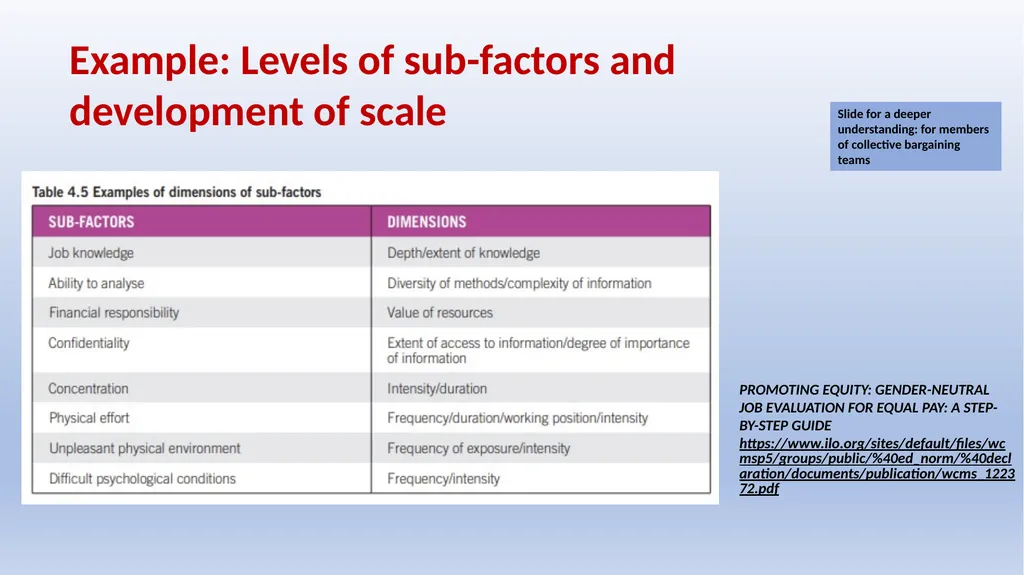
Example: Levels of sub-factors and development of scale Slide for a deeper understanding: for members of collective bargaining teams PROMOTING EQUITY: GENDER-NEUTRAL JOB EVALUATION FOR EQUAL PAY: A STEP-BY-STEP GUIDE
https://www.ilo.org/sites/default/files/wcmsp5/groups/public/%40ed_norm/%40declaration/documents/publication/wcms_122372.pdf<br>
https://www.ilo.org/sites/default/files/wcmsp5/groups/public/%40ed_norm/%40declaration/documents/publication/wcms_122372.pdf<br>
71
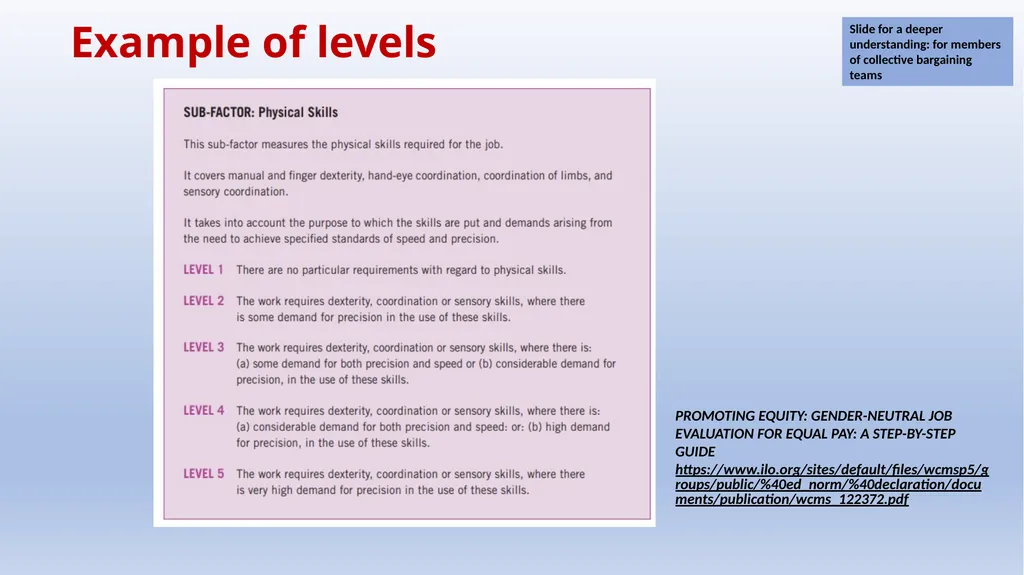
Example of levels Slide for a deeper understanding: for members of collective bargaining teams PROMOTING EQUITY: GENDER-NEUTRAL JOB EVALUATION FOR EQUAL PAY: A STEP-BY-STEP GUIDE
https://www.ilo.org/sites/default/files/wcmsp5/groups/public/%40ed_norm/%40declaration/documents/publication/wcms_122372.pdf<br>
https://www.ilo.org/sites/default/files/wcmsp5/groups/public/%40ed_norm/%40declaration/documents/publication/wcms_122372.pdf<br>
72
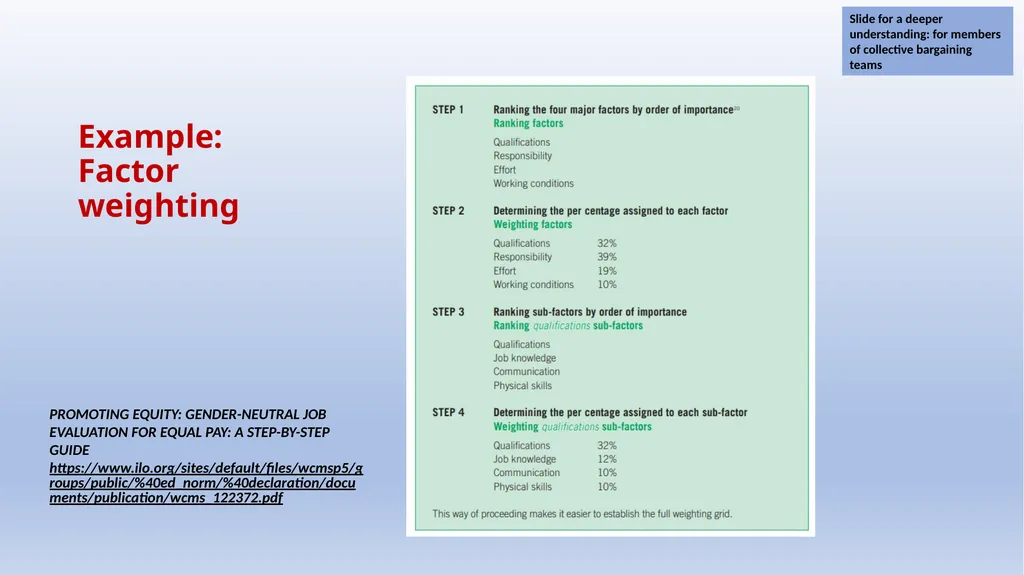
Example: Factor weighting Slide for a deeper understanding: for members of collective bargaining teams PROMOTING EQUITY: GENDER-NEUTRAL JOB EVALUATION FOR EQUAL PAY: A STEP-BY-STEP GUIDE
https://www.ilo.org/sites/default/files/wcmsp5/groups/public/%40ed_norm/%40declaration/documents/publication/wcms_122372.pdf<br>
https://www.ilo.org/sites/default/files/wcmsp5/groups/public/%40ed_norm/%40declaration/documents/publication/wcms_122372.pdf<br>
73
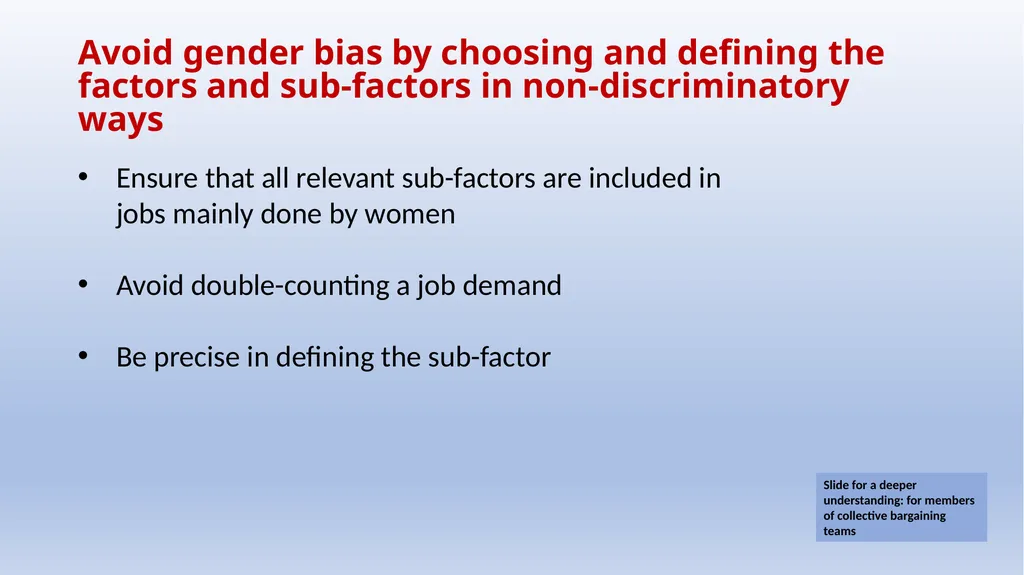
Avoid gender bias by choosing and defining the factors and sub-factors in non-discriminatory ways Ensure that all relevant sub-factors are included in jobs mainly done by women
Avoid double-counting a job demand
Be precise in defining the sub-factor Slide for a deeper understanding: for members of collective bargaining teams<br>
Avoid double-counting a job demand
Be precise in defining the sub-factor Slide for a deeper understanding: for members of collective bargaining teams<br>
74
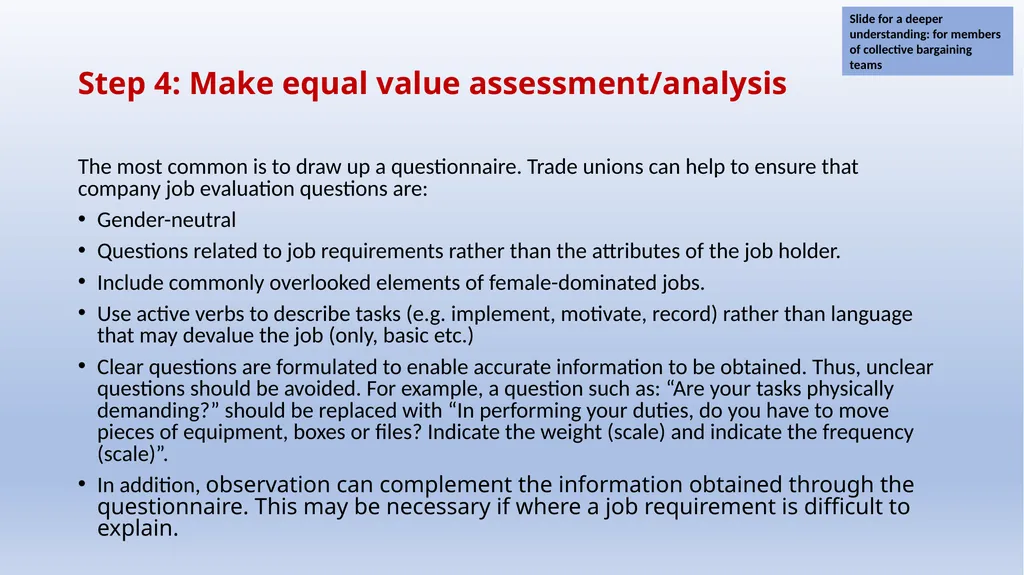
Step 4: Make equal value assessment/analysis The most common is to draw up a questionnaire. Trade unions can help to ensure that company job evaluation questions are:
Gender-neutral
Questions related to job requirements rather than the attributes of the job holder.
Include commonly overlooked elements of female-dominated jobs.
Use active verbs to describe tasks (e.g. implement, motivate, record) rather than language that may devalue the job (only, basic etc.)
Clear questions are formulated to enable accurate information to be obtained. Thus, unclear questions should be avoided. For example, a question such as: “Are your tasks physically demanding?” should be replaced with “In performing your duties, do you have to move pieces of equipment, boxes or files? Indicate the weight (scale) and indicate the frequency (scale)”.
In addition, observation can complement the information obtained through the questionnaire. This may be necessary if where a job requirement is difficult to explain. Slide for a deeper understanding: for members of collective bargaining teams<br>
Gender-neutral
Questions related to job requirements rather than the attributes of the job holder.
Include commonly overlooked elements of female-dominated jobs.
Use active verbs to describe tasks (e.g. implement, motivate, record) rather than language that may devalue the job (only, basic etc.)
Clear questions are formulated to enable accurate information to be obtained. Thus, unclear questions should be avoided. For example, a question such as: “Are your tasks physically demanding?” should be replaced with “In performing your duties, do you have to move pieces of equipment, boxes or files? Indicate the weight (scale) and indicate the frequency (scale)”.
In addition, observation can complement the information obtained through the questionnaire. This may be necessary if where a job requirement is difficult to explain. Slide for a deeper understanding: for members of collective bargaining teams<br>
75
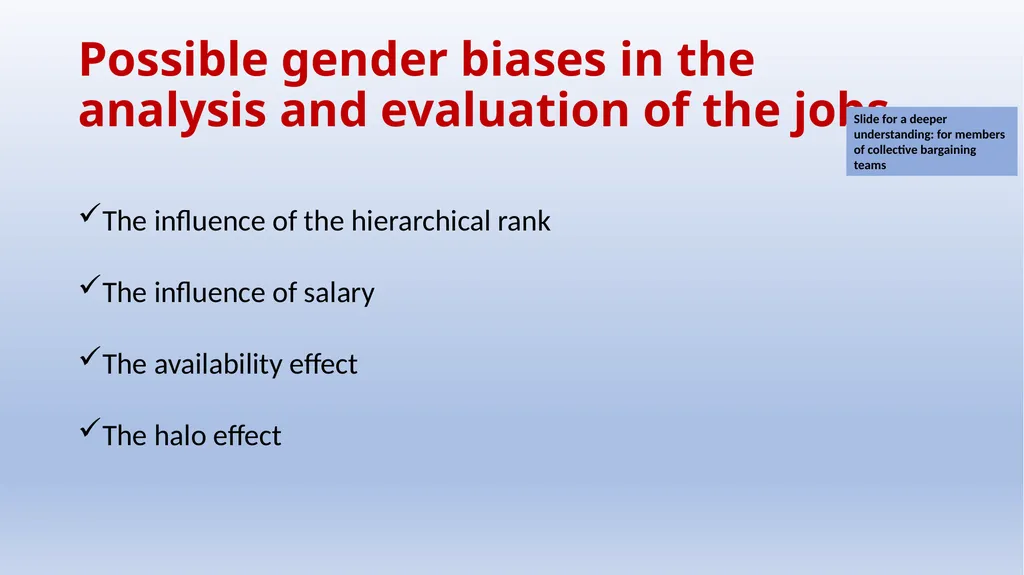
Possible gender biases in the analysis and evaluation of the jobs The influence of the hierarchical rank
The influence of salary
The availability effect
The halo effect Slide for a deeper understanding: for members of collective bargaining teams<br>
The influence of salary
The availability effect
The halo effect Slide for a deeper understanding: for members of collective bargaining teams<br>
76
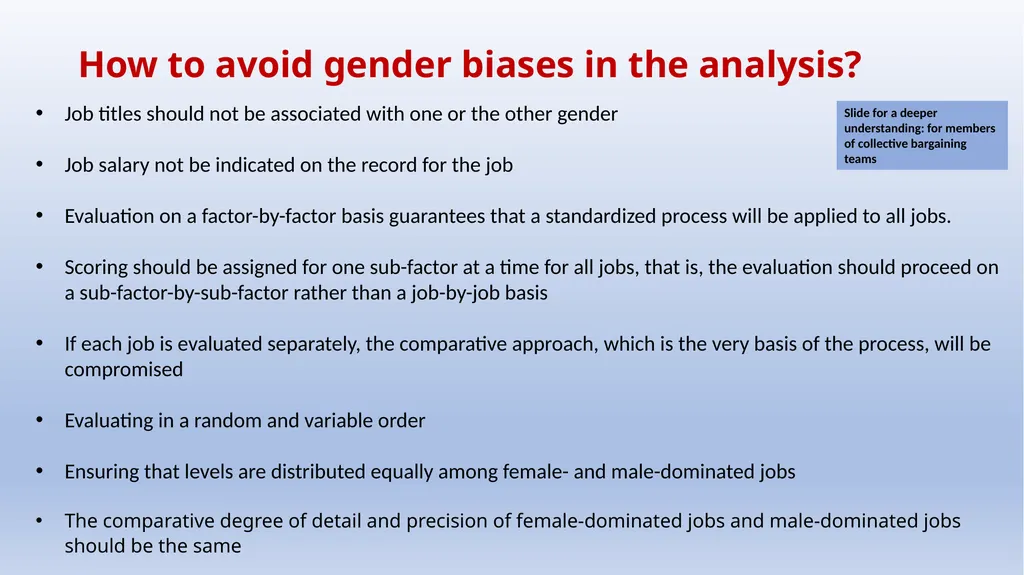
Job titles should not be associated with one or the other gender
Job salary not be indicated on the record for the job
Evaluation on a factor-by-factor basis guarantees that a standardized process will be applied to all jobs.
Scoring should be assigned for one sub-factor at a time for all jobs, that is, the evaluation should proceed on a sub-factor-by-sub-factor rather than a job-by-job basis
If each job is evaluated separately, the comparative approach, which is the very basis of the process, will be compromised
Evaluating in a random and variable order
Ensuring that levels are distributed equally among female- and male-dominated jobs
The comparative degree of detail and precision of female-dominated jobs and male-dominated jobs should be the same How to avoid gender biases in the analysis? Slide for a deeper understanding: for members of collective bargaining teams<br>
Job salary not be indicated on the record for the job
Evaluation on a factor-by-factor basis guarantees that a standardized process will be applied to all jobs.
Scoring should be assigned for one sub-factor at a time for all jobs, that is, the evaluation should proceed on a sub-factor-by-sub-factor rather than a job-by-job basis
If each job is evaluated separately, the comparative approach, which is the very basis of the process, will be compromised
Evaluating in a random and variable order
Ensuring that levels are distributed equally among female- and male-dominated jobs
The comparative degree of detail and precision of female-dominated jobs and male-dominated jobs should be the same How to avoid gender biases in the analysis? Slide for a deeper understanding: for members of collective bargaining teams<br>
77
Day 3<br>
78
Module 5: Campaigning for living wages and the ending of low pay<br>
79
Living wages Campaigns for living wages are important in “raising the floor” and increasing wages for low-wage earners.
However, they do not address the causes of the low wages, such as occupational segregation and the undervaluing of women’s work.
Pay equity strategies should ensure, that as a starting point, all women workers have access to minimum wage protection, and where possible to advocate for this to be at levels that provide for living wages.
Research by the Anker Foundation shows that there is a gender gap in living wages: women are less likely to have living wages, compared to men.
Living minimum wages are essential for workers in the informal economy.<br>
However, they do not address the causes of the low wages, such as occupational segregation and the undervaluing of women’s work.
Pay equity strategies should ensure, that as a starting point, all women workers have access to minimum wage protection, and where possible to advocate for this to be at levels that provide for living wages.
Research by the Anker Foundation shows that there is a gender gap in living wages: women are less likely to have living wages, compared to men.
Living minimum wages are essential for workers in the informal economy.<br>
80
Examples of action taken by unions and informal workers’ organisations An increasing number of unions are forging cooperation and signing MOUs with informal workers organisations.
In Zimbabwe is an MOU between the informal workers organisation ZCIEA and the national trade union ZCTU signed on 13 August 2004.
In India, the trade union SEWA (self-Employed Women’s Association) has advocated for a range of strategies by building the collective strength of informal workers through cooperatives and associations, enhancing skills, opportunities, sustainable livelihoods, income security and social protection.
HomeNet Thailand successfully campaigned for legal protection for homeworkers, which provides for fair wages and equal pay for workers doing the same work, workers have to be issued with contracts of employment and provided with occupational safety and health protection.
IndustriALL affiliate: the Amalgamated Union of Kenya Metal Workers (AUKMW) has organised informal workers and addressing the vulnerabilities faced by women in the mechanical sector, where women work as own-account workers frequently on piece rates without a formal contract.
Do you have any other examples? Does your union recognise and represent workers in the informal economy? Are informal workers organisations able to affiliate to your union?<br>
In Zimbabwe is an MOU between the informal workers organisation ZCIEA and the national trade union ZCTU signed on 13 August 2004.
In India, the trade union SEWA (self-Employed Women’s Association) has advocated for a range of strategies by building the collective strength of informal workers through cooperatives and associations, enhancing skills, opportunities, sustainable livelihoods, income security and social protection.
HomeNet Thailand successfully campaigned for legal protection for homeworkers, which provides for fair wages and equal pay for workers doing the same work, workers have to be issued with contracts of employment and provided with occupational safety and health protection.
IndustriALL affiliate: the Amalgamated Union of Kenya Metal Workers (AUKMW) has organised informal workers and addressing the vulnerabilities faced by women in the mechanical sector, where women work as own-account workers frequently on piece rates without a formal contract.
Do you have any other examples? Does your union recognise and represent workers in the informal economy? Are informal workers organisations able to affiliate to your union?<br>
81
Activity 5.1: Campaigning and bargaining for living wages and ending women’s low pay 82<br>
82
Module 6: Tools for workplace negotiations and collective bargaining<br>
83
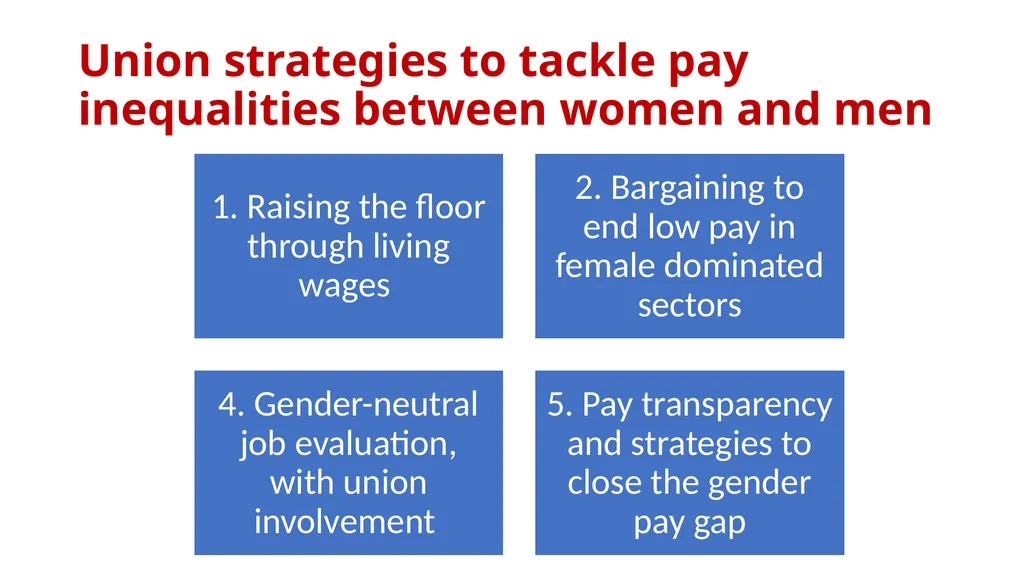
Union strategies to tackle pay inequalities between women and men<br>
84
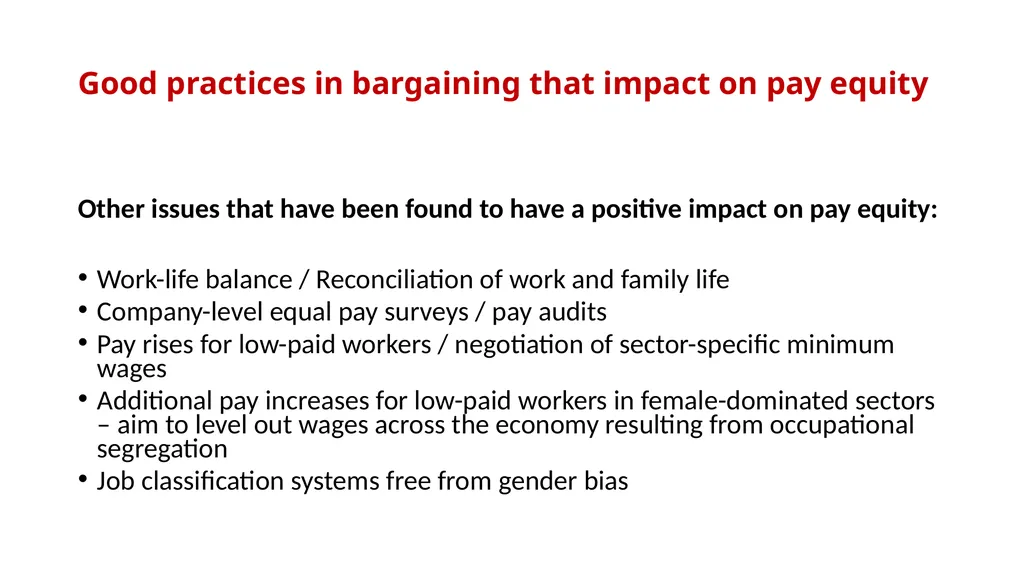
Good practices in bargaining that impact on pay equity Other issues that have been found to have a positive impact on pay equity:
Work-life balance / Reconciliation of work and family life
Company-level equal pay surveys / pay audits
Pay rises for low-paid workers / negotiation of sector-specific minimum wages
Additional pay increases for low-paid workers in female-dominated sectors – aim to level out wages across the economy resulting from occupational segregation
Job classification systems free from gender bias<br>
Work-life balance / Reconciliation of work and family life
Company-level equal pay surveys / pay audits
Pay rises for low-paid workers / negotiation of sector-specific minimum wages
Additional pay increases for low-paid workers in female-dominated sectors – aim to level out wages across the economy resulting from occupational segregation
Job classification systems free from gender bias<br>
85
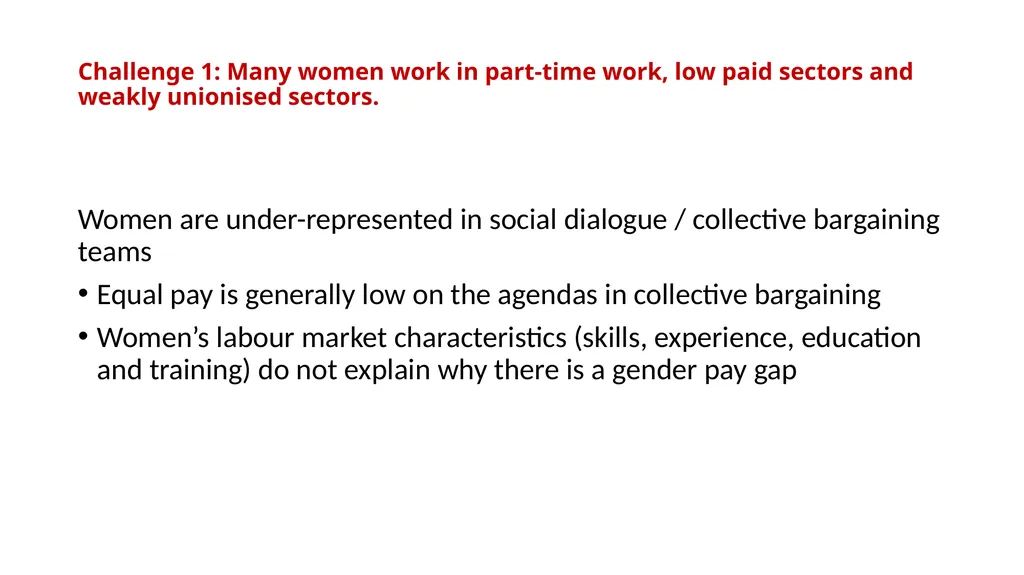
Challenge 1: Many women work in part-time work, low paid sectors and weakly unionised sectors. Women are under-represented in social dialogue / collective bargaining teams
Equal pay is generally low on the agendas in collective bargaining
Women’s labour market characteristics (skills, experience, education and training) do not explain why there is a gender pay gap<br>
Equal pay is generally low on the agendas in collective bargaining
Women’s labour market characteristics (skills, experience, education and training) do not explain why there is a gender pay gap<br>
86
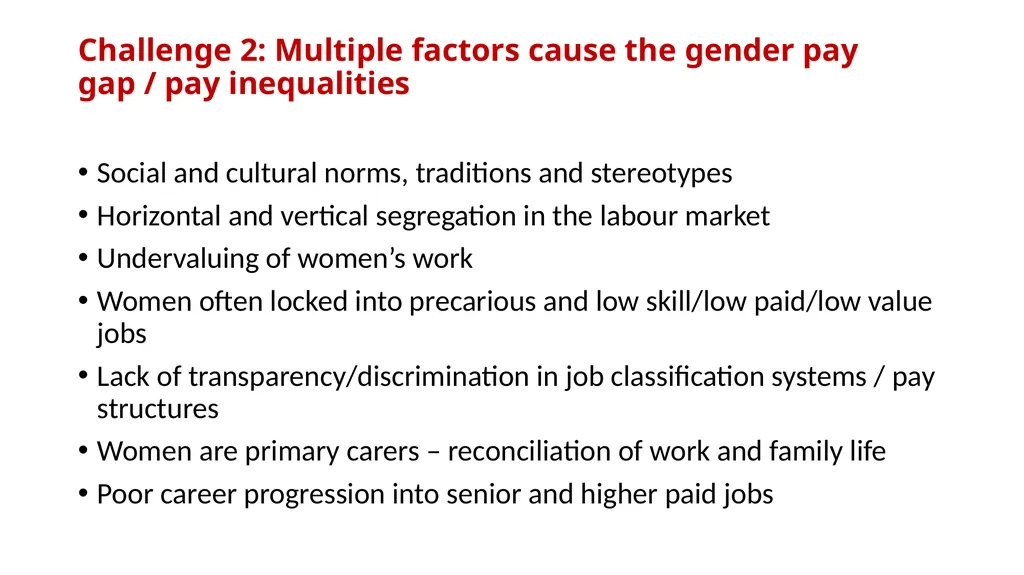
Challenge 2: Multiple factors cause the gender pay gap / pay inequalities Social and cultural norms, traditions and stereotypes
Horizontal and vertical segregation in the labour market
Undervaluing of women’s work
Women often locked into precarious and low skill/low paid/low value jobs
Lack of transparency/discrimination in job classification systems / pay structures
Women are primary carers – reconciliation of work and family life
Poor career progression into senior and higher paid jobs<br>
Horizontal and vertical segregation in the labour market
Undervaluing of women’s work
Women often locked into precarious and low skill/low paid/low value jobs
Lack of transparency/discrimination in job classification systems / pay structures
Women are primary carers – reconciliation of work and family life
Poor career progression into senior and higher paid jobs<br>
87
Activity 6.1: Advocating for pay equity in your union 88<br>
88
Activity 6.2: Preparing for collective bargaining 89<br>
89
Activity 6.3: Role play – negotiating for pay equity 90<br>
90
Module 7: Next steps and evaluation<br>
91
Activity 7.1: Planning your next steps 92<br>
92
Identify one thing you will do immediately after the training
Consider how you can commit to implementing pay equity, such as:
-Find out if unequal pay / gender pay gap has already been identified as a problem in the workplace
- Plan a programme of training to raise awareness about pay equity
- Establish a committee with a view to drawing up a plan to implement pay equity
- Other 93 Activity 7.2:
Next steps after
the training<br>
Next steps after
the training<br>
93
Evaluation 94<br>
94
Thank you!<br>