Industry Technology Hub: Supporting Satellite Stakeholders January 2025 P 1 Astronomy Concerns with Satellite Constellations Low-orbiting satellite constellation projects are proliferating, with hundreds of thousands of satellites
"Industry & Technology Hub: Supporting Satellite" is the property of its rightful owner. Permission is granted to
download and print the materials on this website for personal, non-commercial use only, and to display it
on your personal computer provided you do not modify the materials and that you retain all copyright
notices contained in the materials. By downloading content from our website, you accept the terms of this
agreement.
Presentation Transcript
01
Industry & Technology Hub: Supporting Satellite Stakeholders January 2025 P 1<br>
02
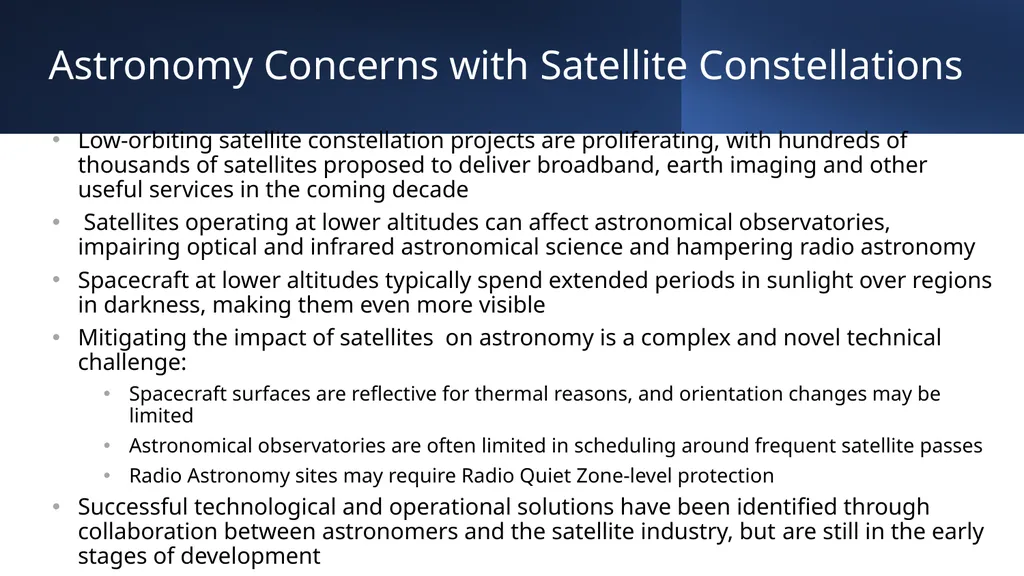
Astronomy Concerns with Satellite Constellations Low-orbiting satellite constellation projects are proliferating, with hundreds of thousands of satellites proposed to deliver broadband, earth imaging and other useful services in the coming decade
Satellites operating at lower altitudes can affect astronomical observatories, impairing optical and infrared astronomical science and hampering radio astronomy
Spacecraft at lower altitudes typically spend extended periods in sunlight over regions in darkness, making them even more visible
Mitigating the impact of satellites on astronomy is a complex and novel technical challenge:
Spacecraft surfaces are reflective for thermal reasons, and orientation changes may be limited
Astronomical observatories are often limited in scheduling around frequent satellite passes
Radio Astronomy sites may require Radio Quiet Zone-level protection
Successful technological and operational solutions have been identified through collaboration between astronomers and the satellite industry, but are still in the early stages of development<br>
03
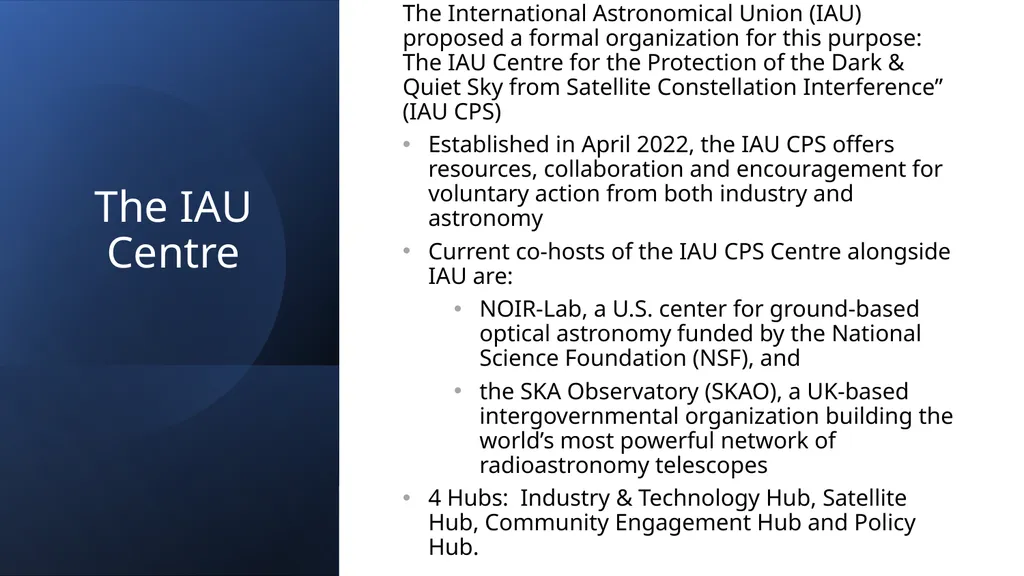
The IAU Centre The International Astronomical Union (IAU) proposed a formal organization for this purpose: The IAU Centre for the Protection of the Dark & Quiet Sky from Satellite Constellation Interference” (IAU CPS)
Established in April 2022, the IAU CPS offers resources, collaboration and encouragement for voluntary action from both industry and astronomy
Current co-hosts of the IAU CPS Centre alongside IAU are:
NOIR-Lab, a U.S. center for ground-based optical astronomy funded by the National Science Foundation (NSF), and
the SKA Observatory (SKAO), a UK-based intergovernmental organization building the world’s most powerful network of radioastronomy telescopes
4 Hubs: Industry & Technology Hub, Satellite Hub, Community Engagement Hub and Policy Hub.<br>
04
Industry & Technology Hub IAU Centre for the Protection of the Dark & Quiet Sky from Satellite Constellation Interference The “Industry & Technology Hub” of the IAU CPS is meant to engage the technical insights of both satellite stakeholders and astronomers to build the tools and resources to spur voluntary adoption of mitigations.
The I&T Hub’s aims to build satellite industry awareness of their potential to impact astronomy, and to spur development and adoption of accessible, affordable and effective mitigations of the effects of satellite constellations on astronomical science.<br>
05
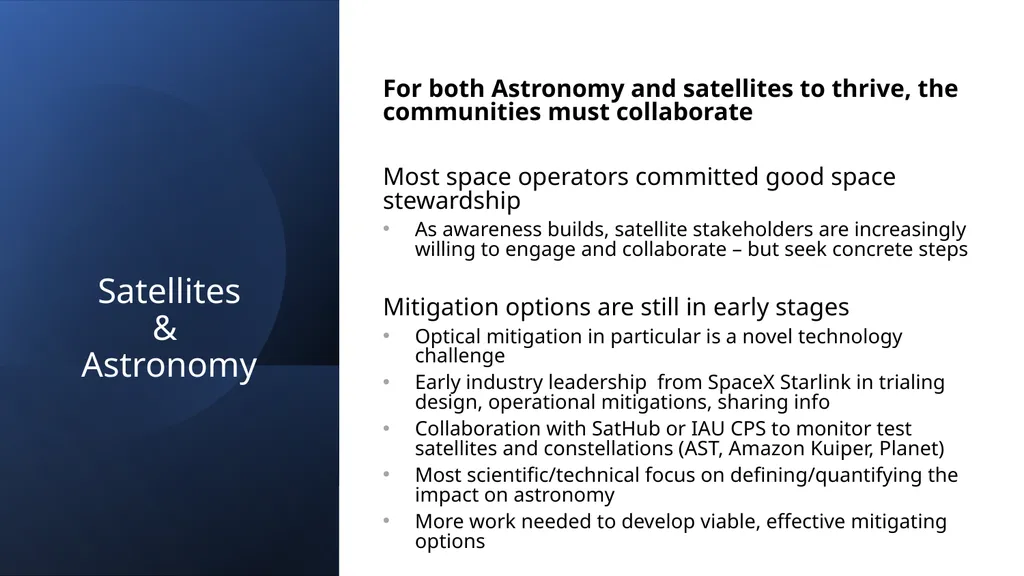
Satellites & Astronomy For both Astronomy and satellites to thrive, the communities must collaborate
Most space operators committed good space stewardship
As awareness builds, satellite stakeholders are increasingly willing to engage and collaborate – but seek concrete steps
Mitigation options are still in early stages
Optical mitigation in particular is a novel technology challenge
Early industry leadership from SpaceX Starlink in trialing design, operational mitigations, sharing info
Collaboration with SatHub or IAU CPS to monitor test satellites and constellations (AST, Amazon Kuiper, Planet)
Most scientific/technical focus on defining/quantifying the impact on astronomy
More work needed to develop viable, effective mitigating options<br>
06
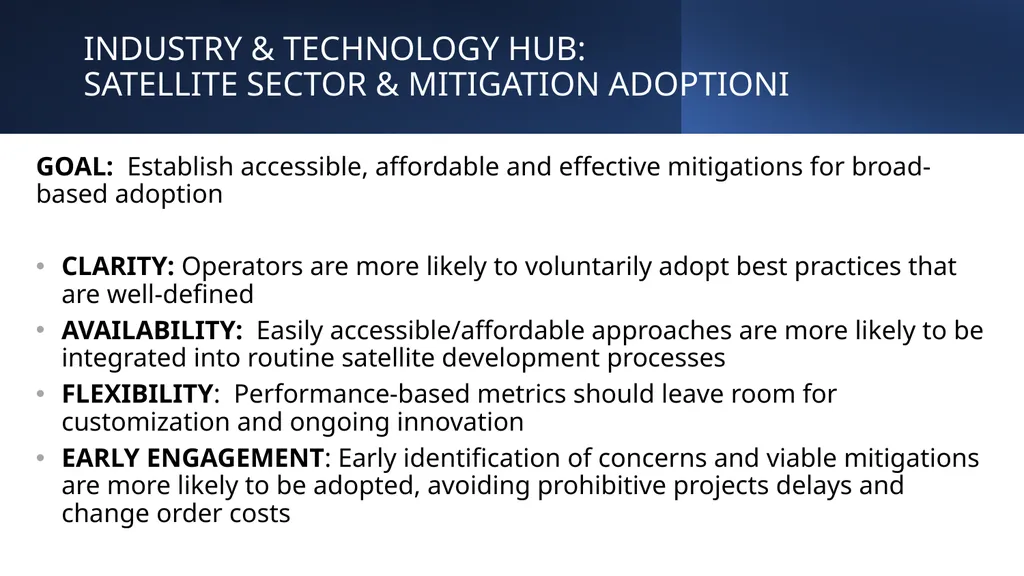
INDUSTRY & TECHNOLOGY HUB: SATELLITE SECTOR & MITIGATION ADOPTIONI GOAL: Establish accessible, affordable and effective mitigations for broad-based adoption
CLARITY: Operators are more likely to voluntarily adopt best practices that are well-defined
AVAILABILITY: Easily accessible/affordable approaches are more likely to be integrated into routine satellite development processes
FLEXIBILITY: Performance-based metrics should leave room for customization and ongoing innovation
EARLY ENGAGEMENT: Early identification of concerns and viable mitigations are more likely to be adopted, avoiding prohibitive projects delays and change order costs<br>
07
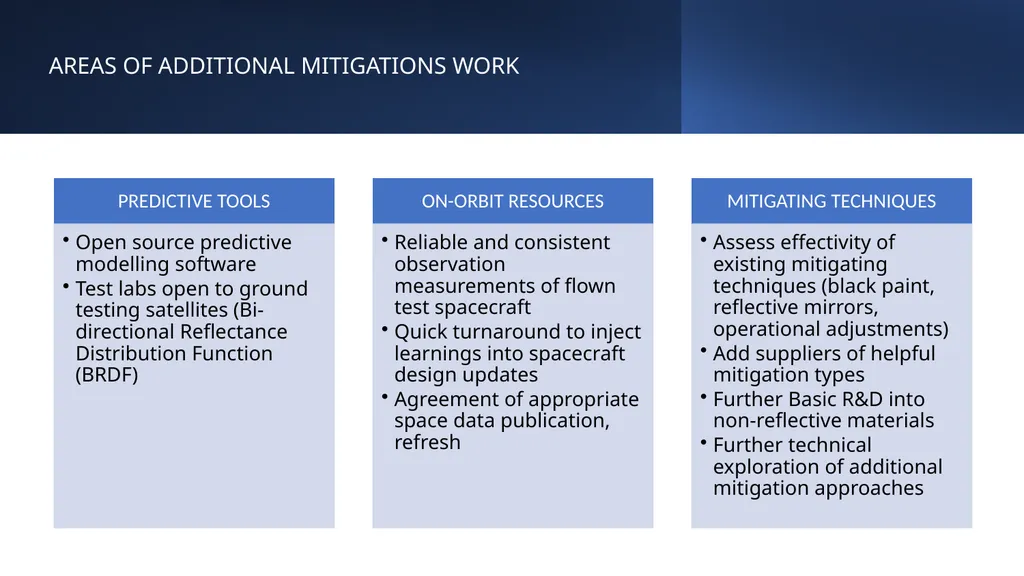
AREAS OF ADDITIONAL MITIGATIONS WORK<br>
08
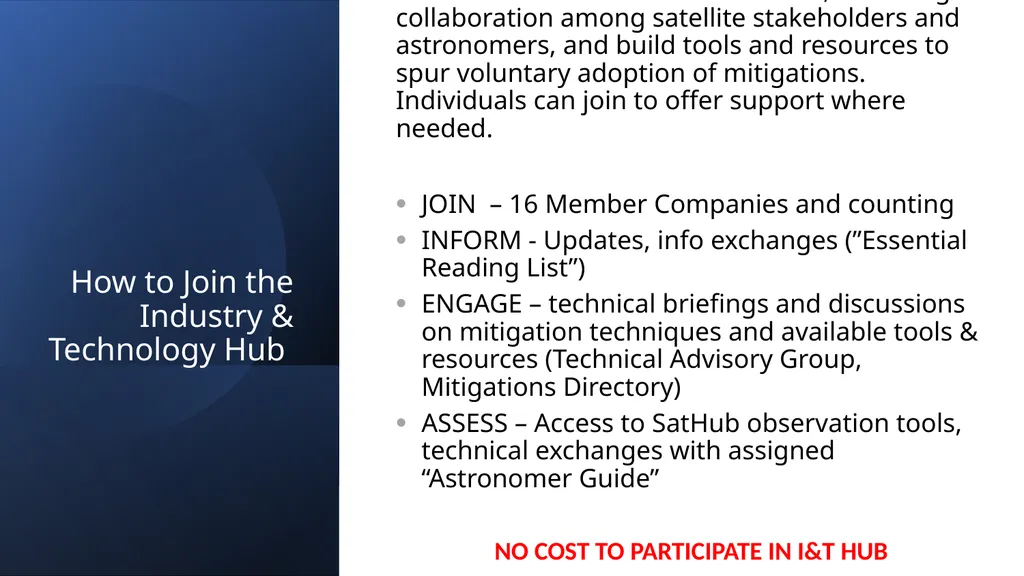
How to Join the Industry & Technology Hub I&T Hub created to build awareness, encourage collaboration among satellite stakeholders and astronomers, and build tools and resources to spur voluntary adoption of mitigations. Individuals can join to offer support where needed.
JOIN – 16 Member Companies and counting
INFORM - Updates, info exchanges (”Essential Reading List”)
ENGAGE – technical briefings and discussions on mitigation techniques and available tools & resources (Technical Advisory Group, Mitigations Directory)
ASSESS – Access to SatHub observation tools, technical exchanges with assigned “Astronomer Guide”
NO COST TO PARTICIPATE IN I&T HUB
Contact us at: industry-tech@cps.iau.org<br>