Information Hiding: Covert Channels Amir
Description: Information Hiding: Covert Channels Amir Houmansadr CS660: Advanced Information Assurance Spring 2015 Content may be borrowed from other resources. See the last slide for acknowledgements! Classes of Information Hiding Digital watermarking
Related Topics
Download Presentation
"Information Hiding: Covert Channels Amir" is the property of its rightful owner. Permission is granted to download and print the materials on this website for personal, non-commercial use only, and to display it on your personal computer provided you do not modify the materials and that you retain all copyright notices contained in the materials. By downloading content from our website, you accept the terms of this agreement.
Presentation Transcript
slide1. Information Hiding:Covert Channels Amir Houmansadr
CS660: Advanced Information Assurance
Spring 2015 Content may be borrowed from other resources.
See the last slide for acknowledgements!<br>
slide2. Classes of Information Hiding Digital watermarking
Steganography
Covert channels
Anonymous communication
Protocol obfuscation CS660 - Advanced Information Assurance - UMassAmherst 2<br>
slide3. Covert Channels Definition: Communicate information between two computer processes that are not allowed to communicate, by hiding information into shared resources
Steganography: hiding information into digital media CS660 - Advanced Information Assurance - UMassAmherst 3<br>
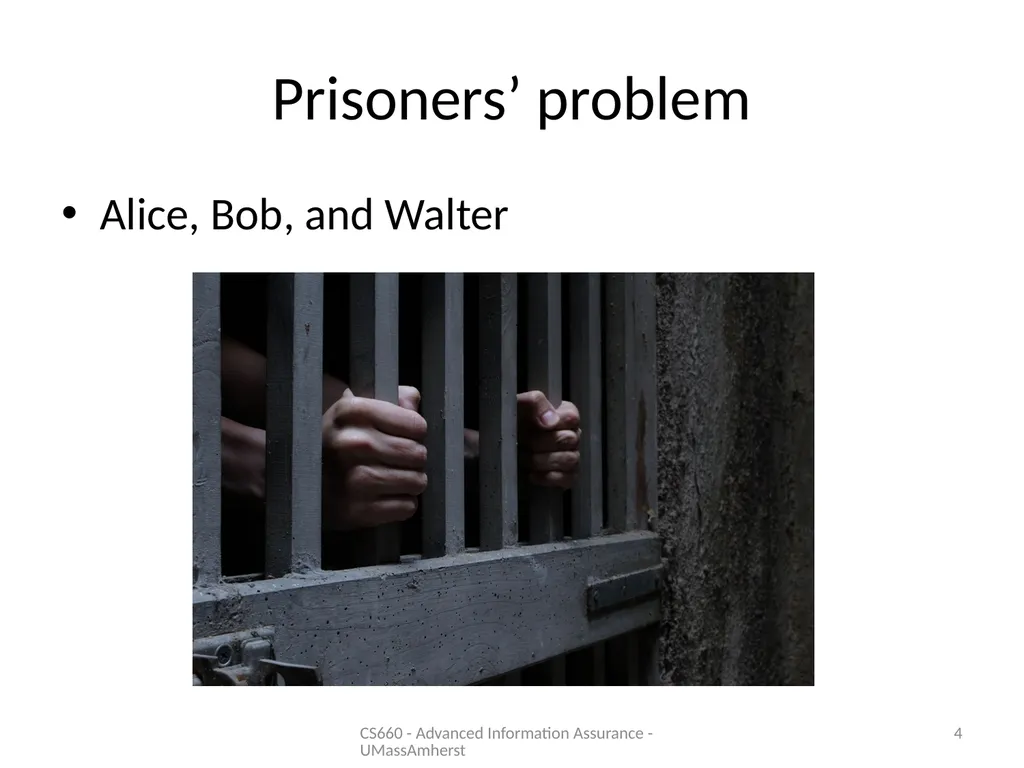
slide4. Prisoners’ problem Alice, Bob, and Walter CS660 - Advanced Information Assurance - UMassAmherst 4<br>
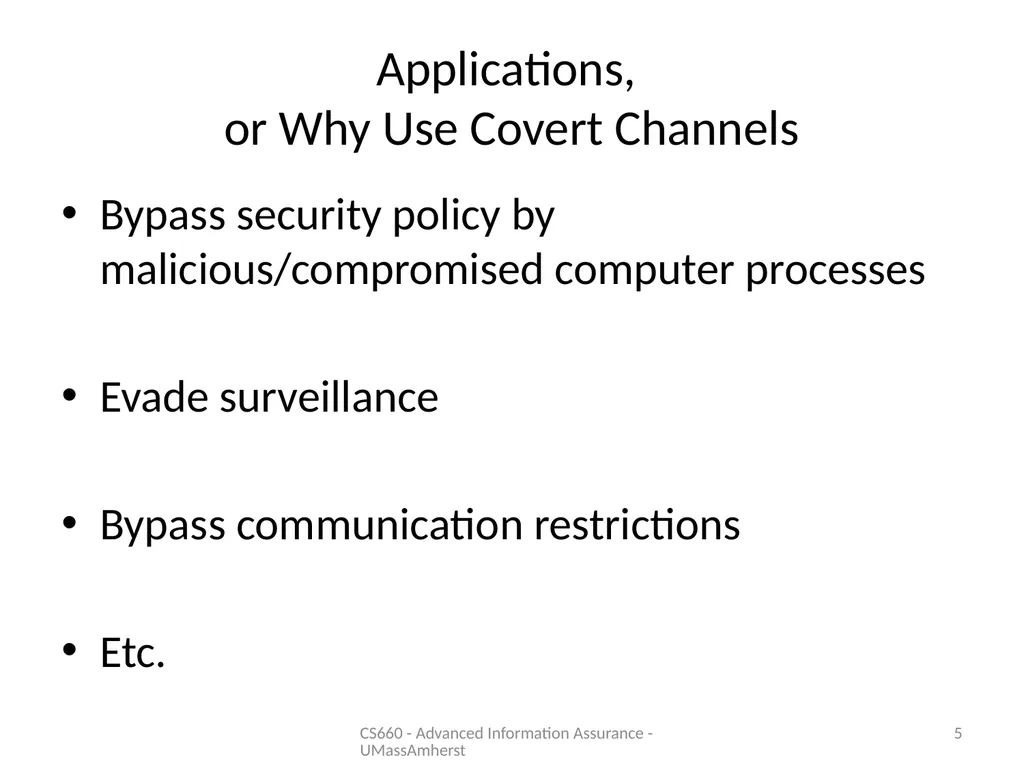
slide5. Applications, or Why Use Covert Channels Bypass security policy by malicious/compromised computer processes
Evade surveillance
Bypass communication restrictions
Etc. CS660 - Advanced Information Assurance - UMassAmherst 5<br>
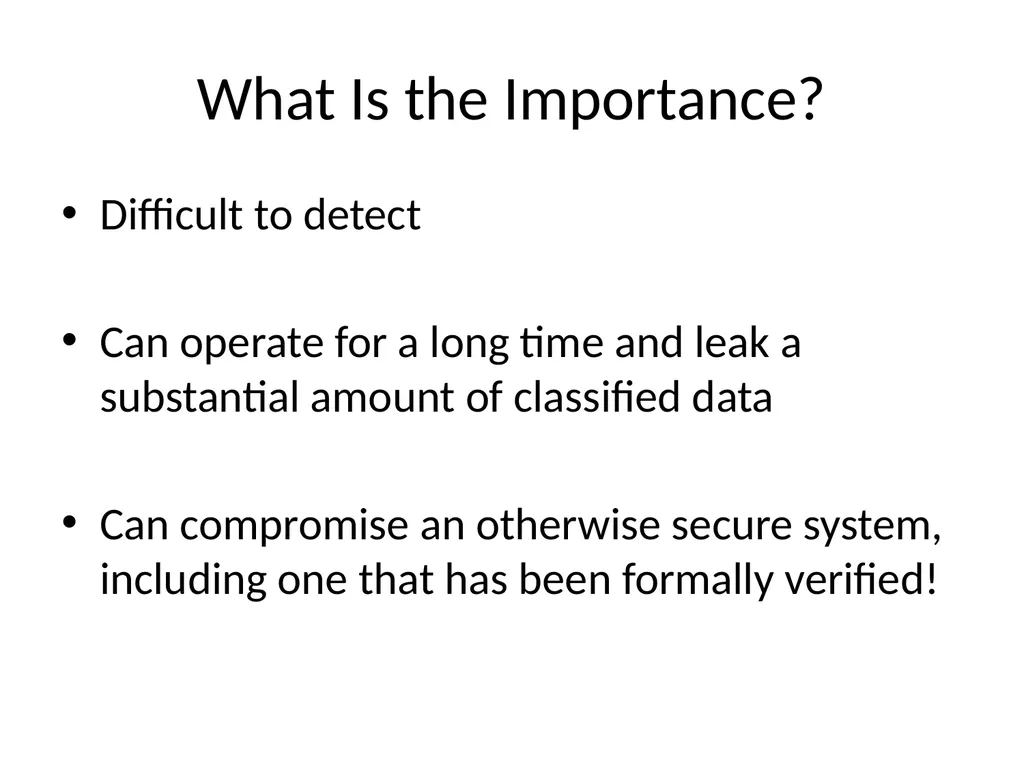
slide6. What Is the Importance? Difficult to detect
Can operate for a long time and leak a substantial amount of classified data
Can compromise an otherwise secure system, including one that has been formally verified!<br>
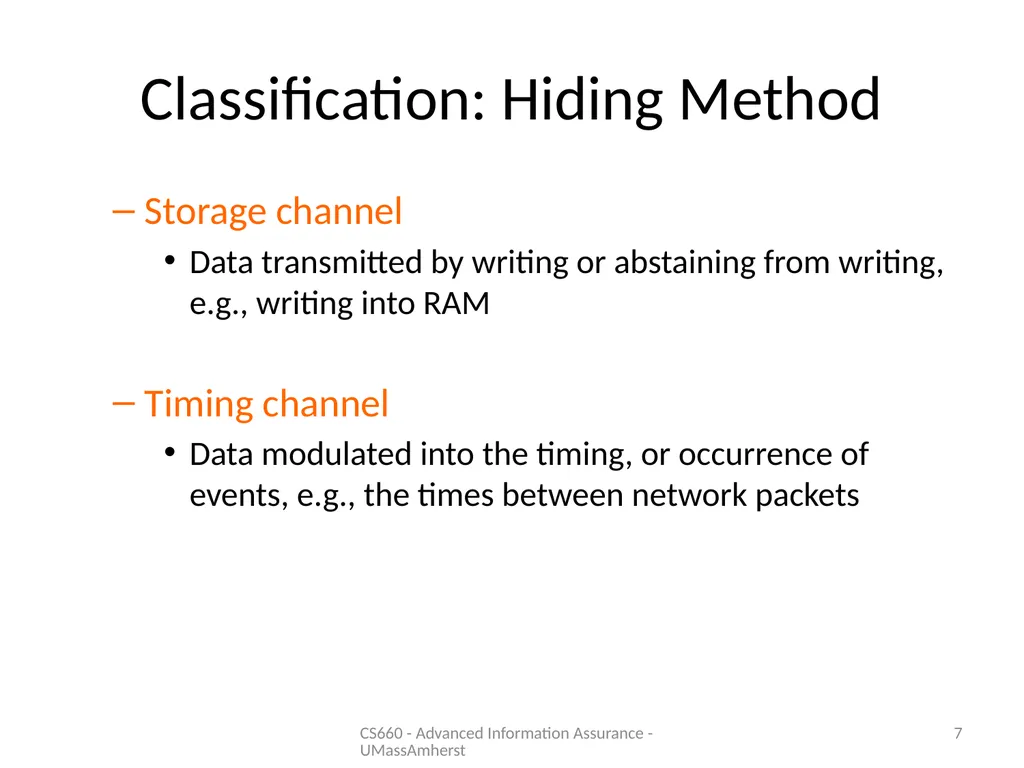
slide7. Classification: Hiding Method Storage channel
Data transmitted by writing or abstaining from writing, e.g., writing into RAM
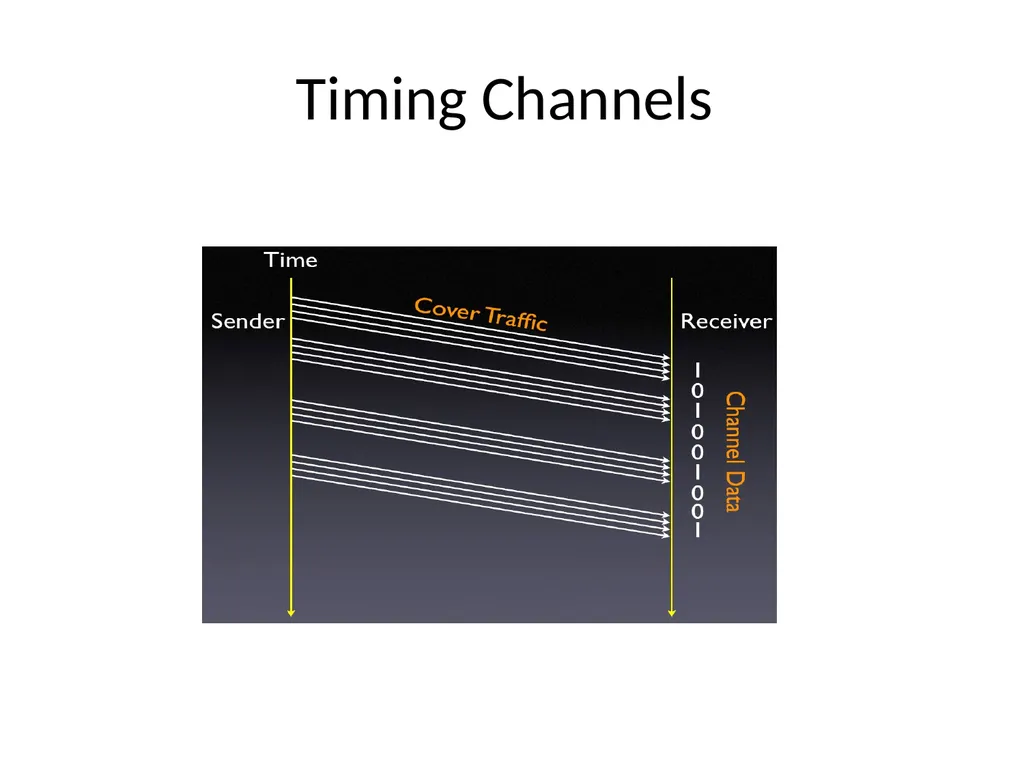
Timing channel
Data modulated into the timing, or occurrence of events, e.g., the times between network packets CS660 - Advanced Information Assurance - UMassAmherst 7<br>
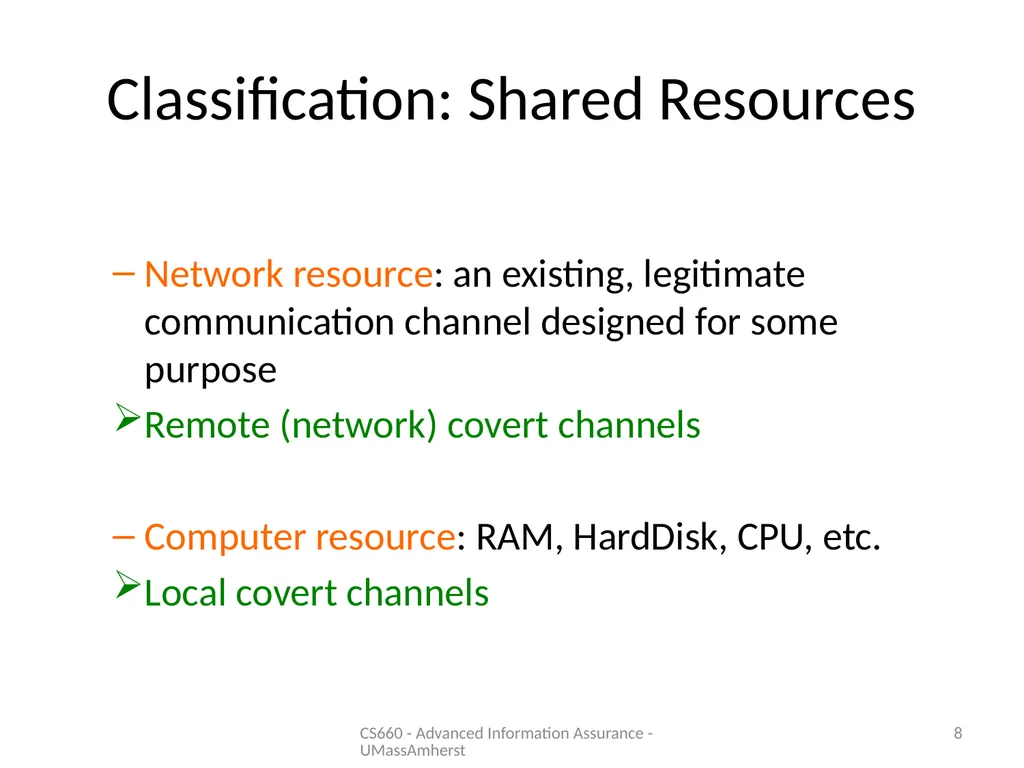
slide8. Classification: Shared Resources Network resource: an existing, legitimate communication channel designed for some purpose
Remote (network) covert channels
Computer resource: RAM, HardDisk, CPU, etc.
Local covert channels CS660 - Advanced Information Assurance - UMassAmherst 8<br>
slide9. Local Channels CS660 - Advanced Information Assurance - UMassAmherst 9<br>
slide10. Virtual Machines Shared resources:
CPU
RAM
Disk
Network
Examples? CS660 - Advanced Information Assurance - UMassAmherst 10<br>
slide11. Smartphones Shared resources:
CPU
RAM
Disk
Network
Microphone/speaker
Battery
Examples? CS660 - Advanced Information Assurance - UMassAmherst 11<br>
slide12. Remote (Network) Channels CS660 - Advanced Information Assurance - UMassAmherst 12<br>
slide13. What is the shared resource here? CS660 - Advanced Information Assurance - UMassAmherst 13<br>
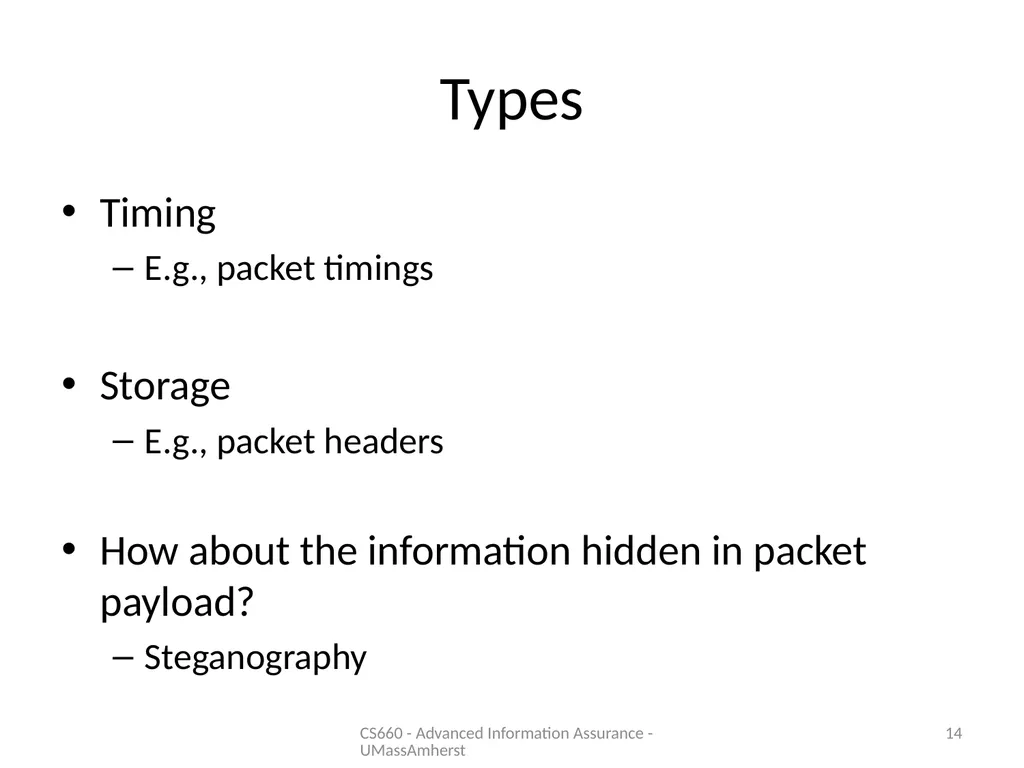
slide14. Types Timing
E.g., packet timings
Storage
E.g., packet headers
How about the information hidden in packet payload?
Steganography CS660 - Advanced Information Assurance - UMassAmherst 14<br>
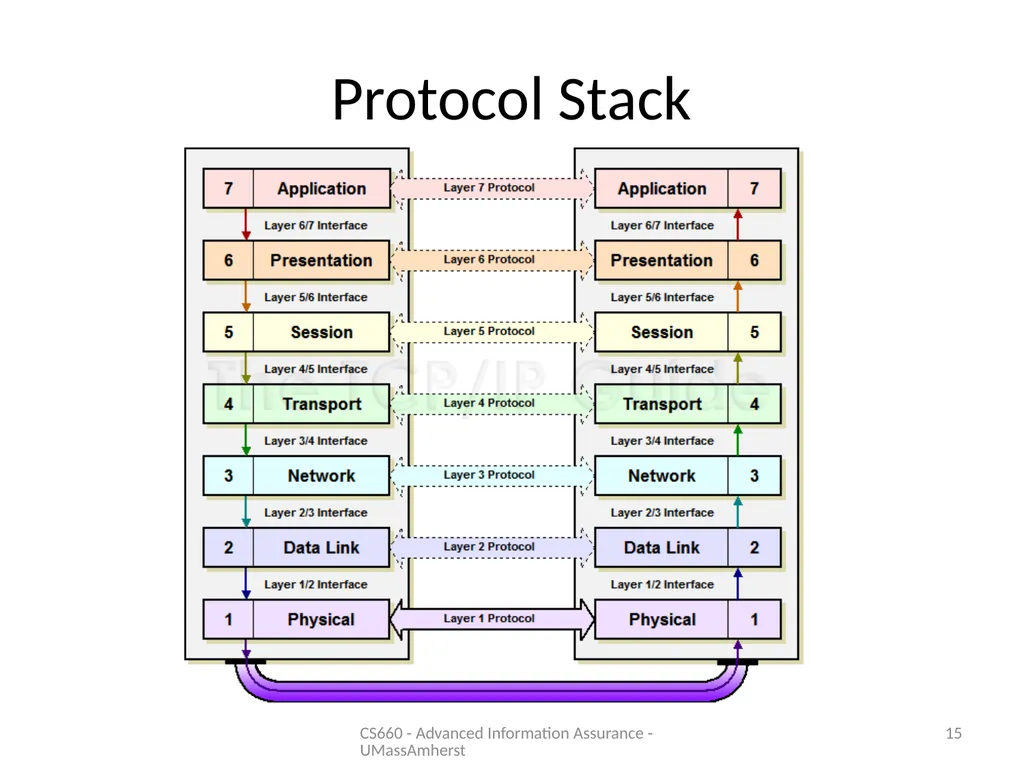
slide15. Protocol Stack CS660 - Advanced Information Assurance - UMassAmherst 15<br>
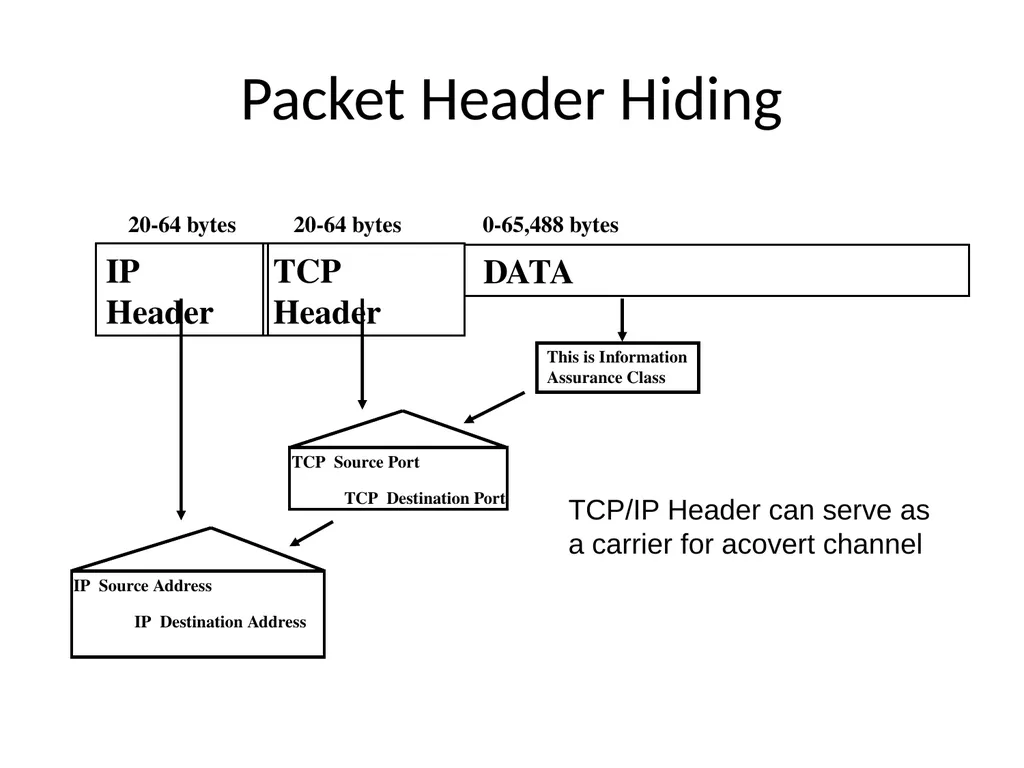
slide16. Packet Header Hiding<br>
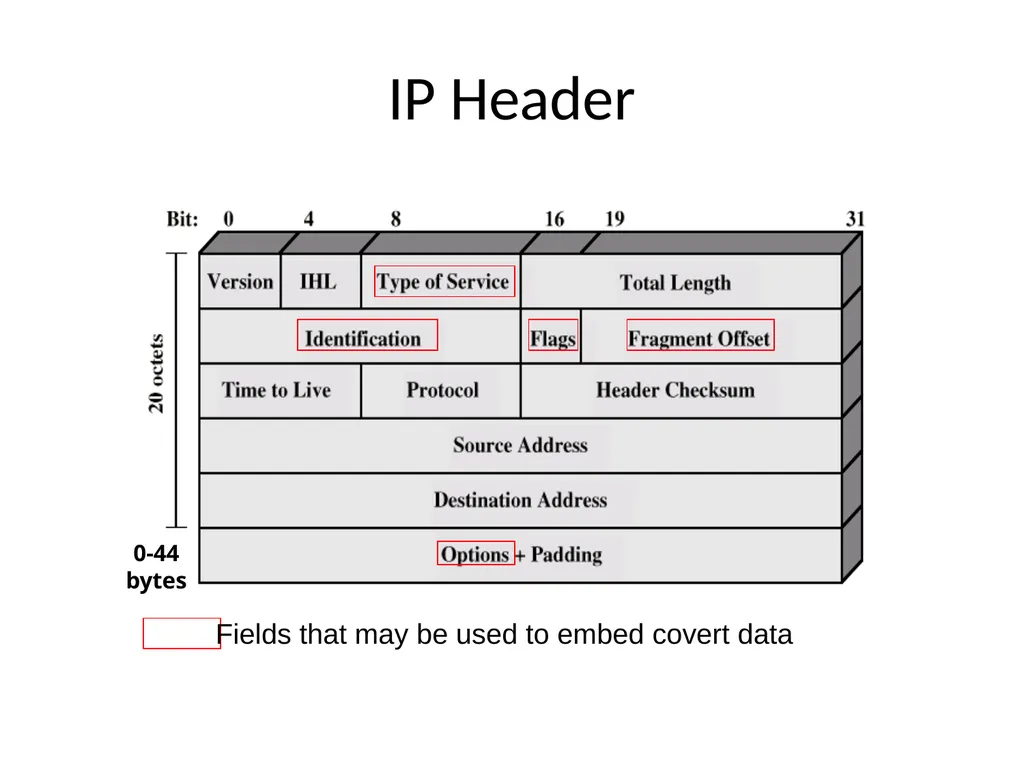
slide17. IP Header<br>
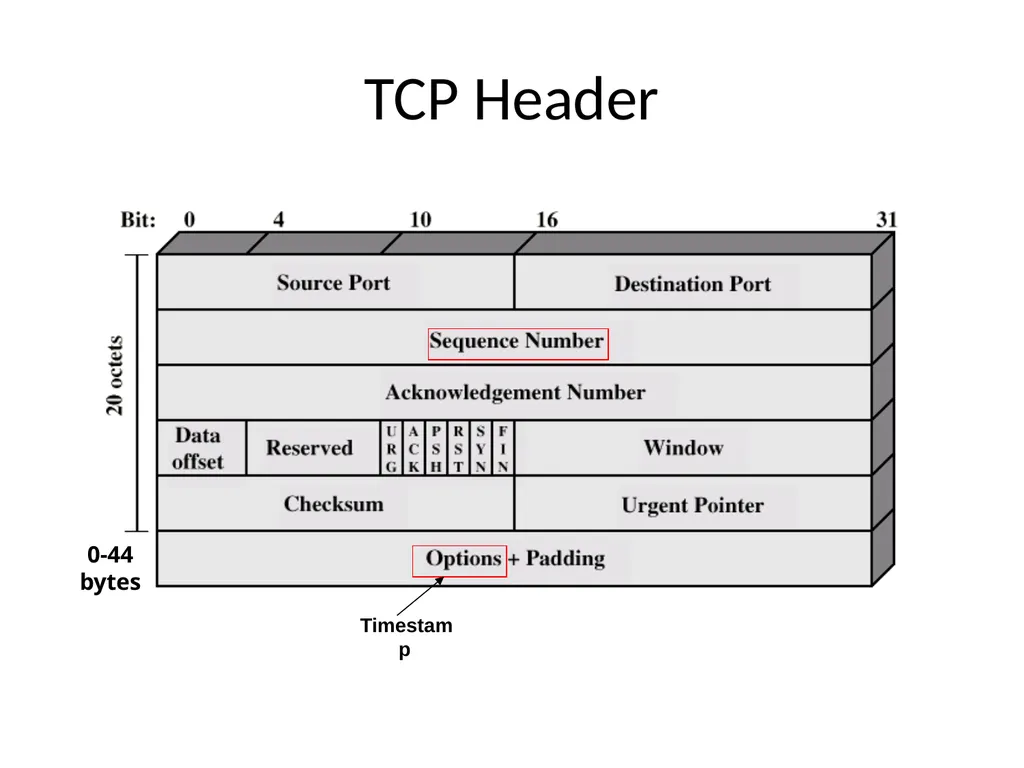
slide18. TCP Header<br>
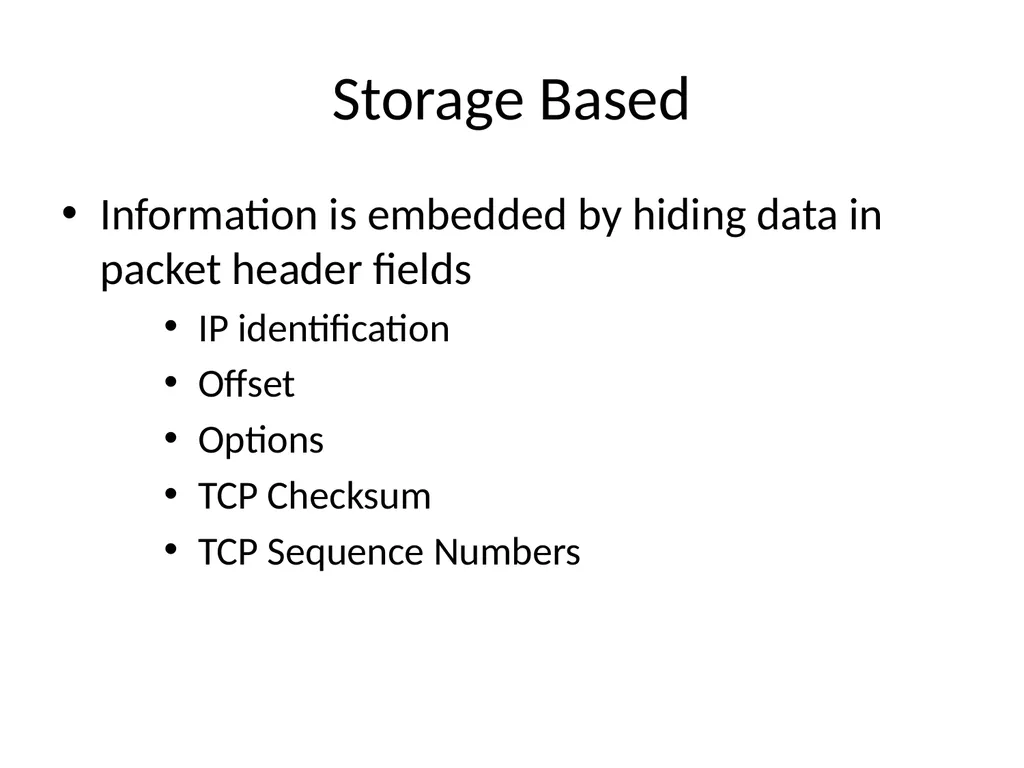
slide19. Storage Based Information is embedded by hiding data in packet header fields
IP identification
Offset
Options
TCP Checksum
TCP Sequence Numbers<br>
slide20. Timing Channels Information is hidden by triggering or delaying events at specific time intervals<br>
slide21. Timing Channels<br>
slide22. Detection Mechanisms Storage-based
Data analysis
Timing-based
Timing analysis CS660 - Advanced Information Assurance - UMassAmherst 22<br>
slide23. Threat Model Passive Warden Threat Model
Detect, then remove
Active Warden Threat Model
Modify traffic regardless of suspicion
Constraint?<br>
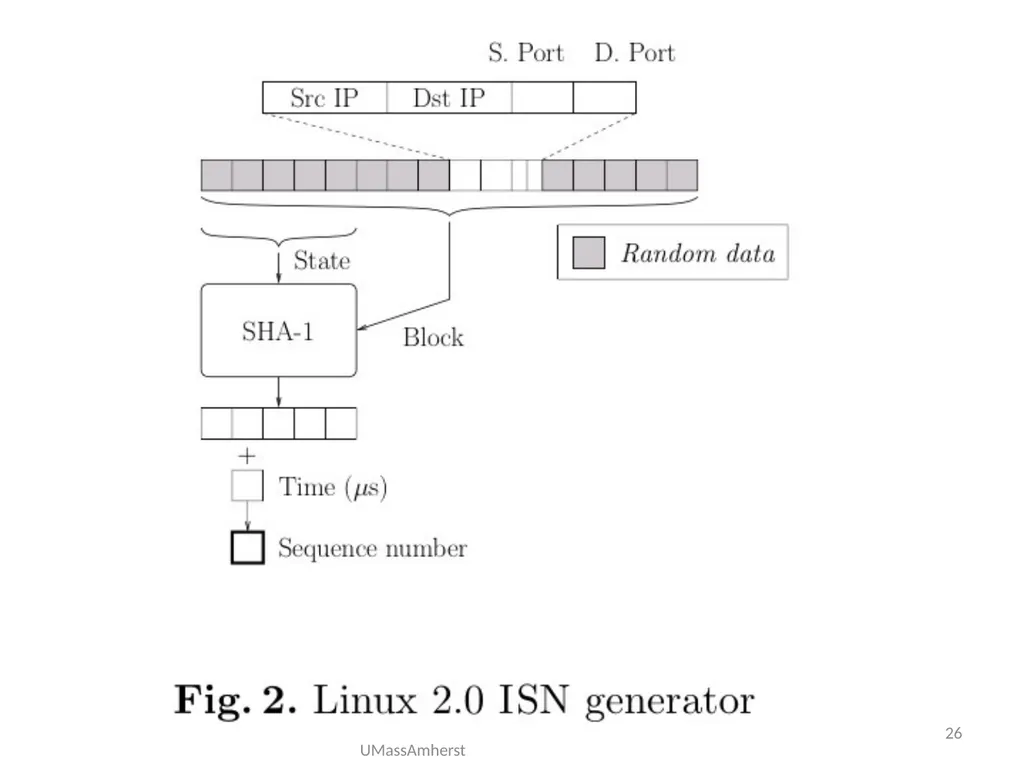
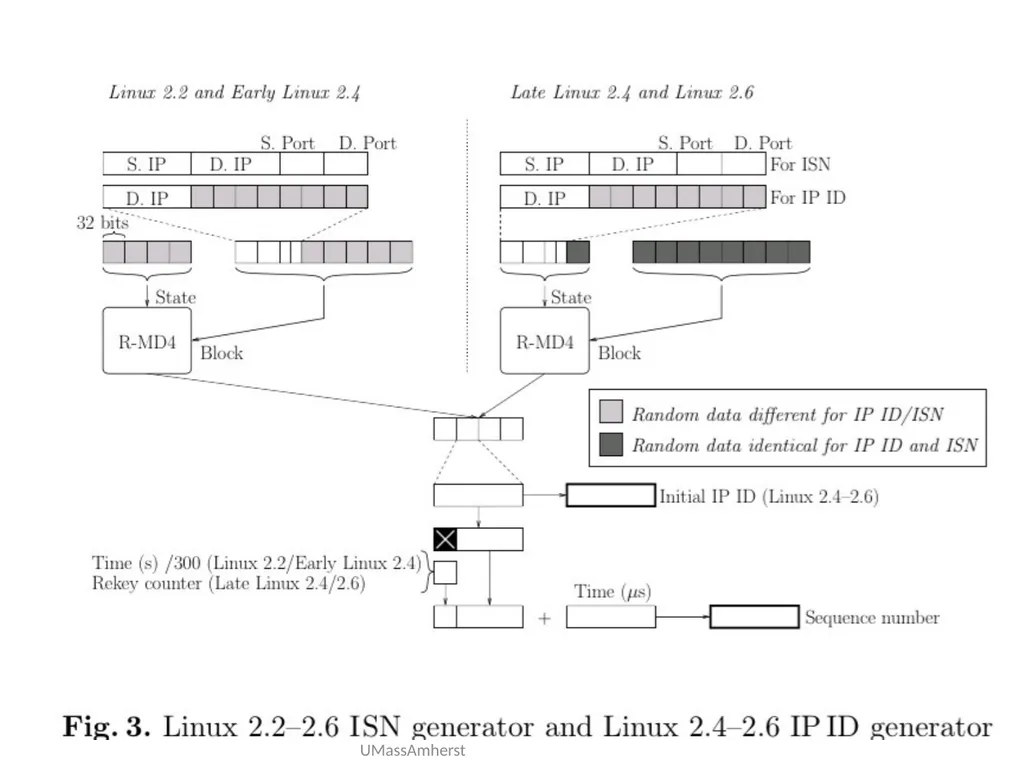
slide24. IP ID and TCP ISN Implementation Two fields which are commonly used to embed covert data are the IP ID and TCP ISN
Due to their construction, these fields contain some structure
Partially unpredictable<br>
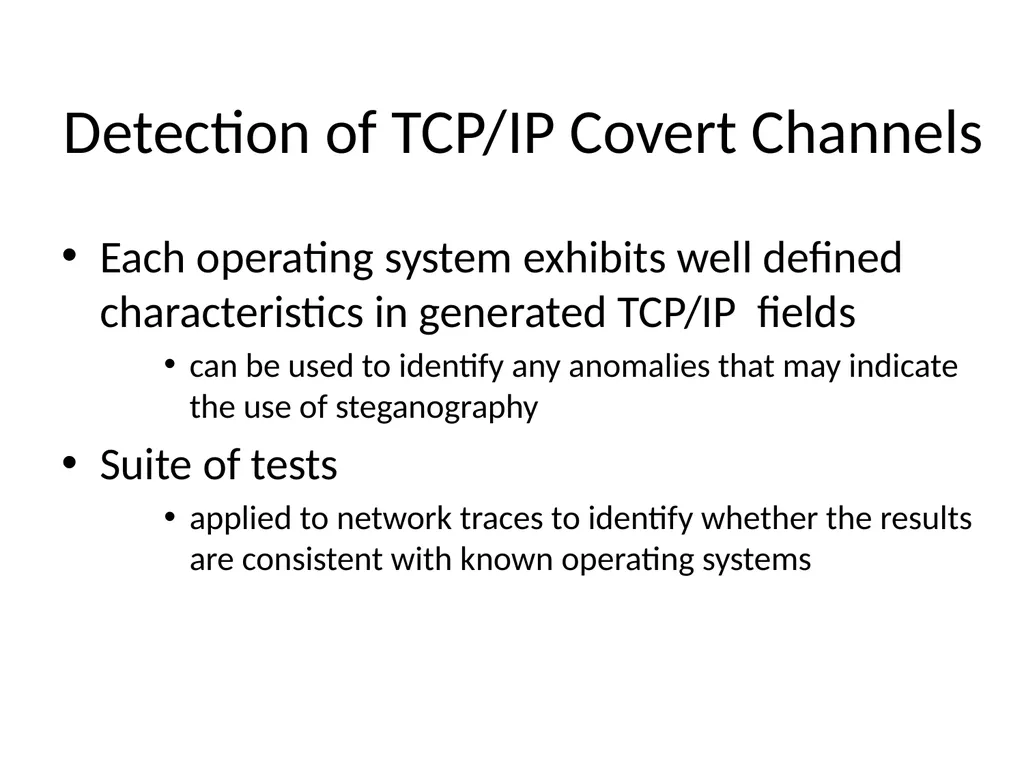
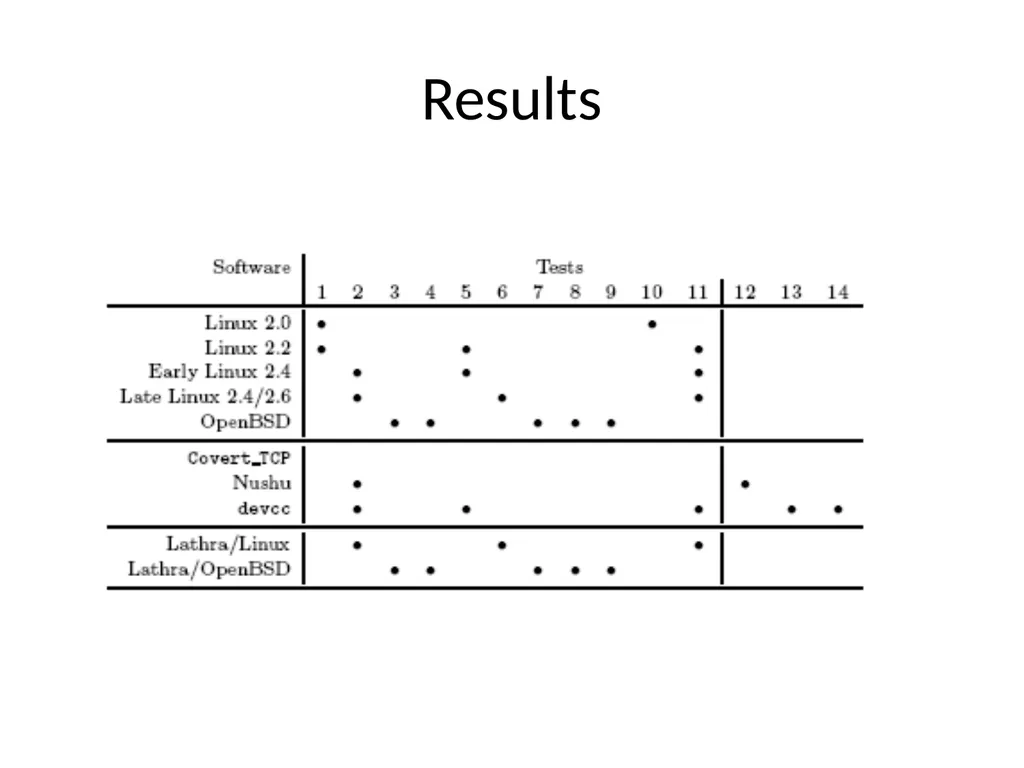
slide25. Detection of TCP/IP Covert Channels Each operating system exhibits well defined characteristics in generated TCP/IP fields
can be used to identify any anomalies that may indicate the use of steganography
Suite of tests
applied to network traces to identify whether the results are consistent with known operating systems<br>
slide26. CS660 - Advanced Information Assurance - UMassAmherst 26<br>
slide27. CS660 - Advanced Information Assurance - UMassAmherst 27<br>
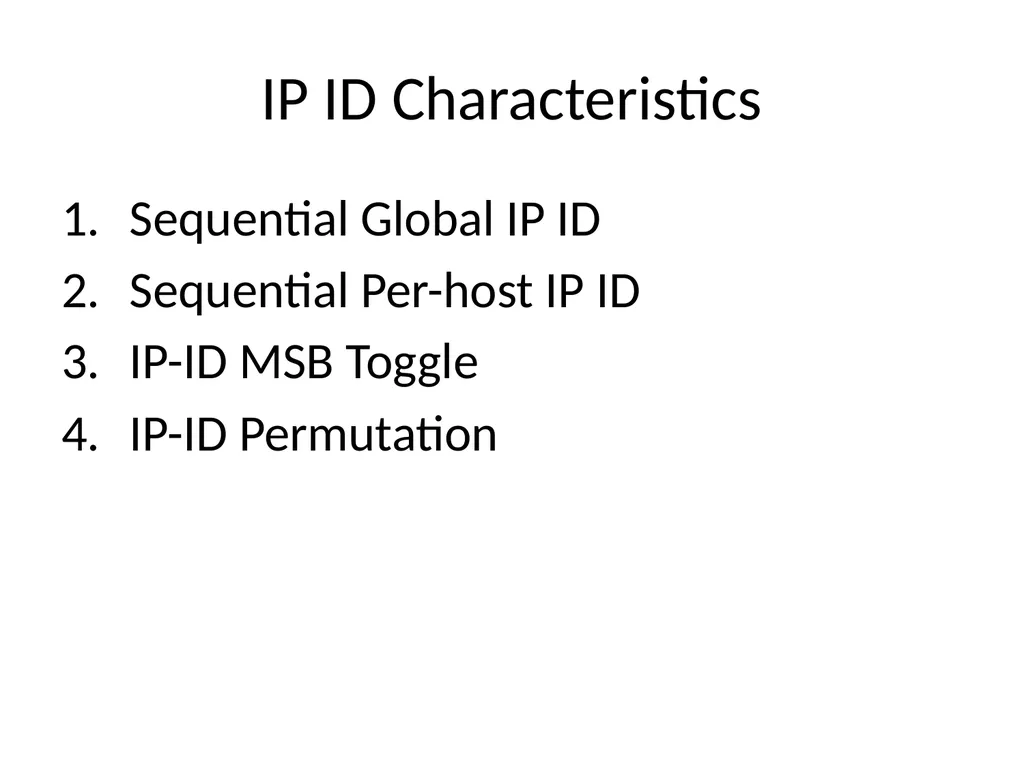
slide28. IP ID Characteristics Sequential Global IP ID
Sequential Per-host IP ID
IP-ID MSB Toggle
IP-ID Permutation<br>
slide29. TCP ISN Characteristics Rekey Timer
Rekey Counter
ISN MSB Toggle
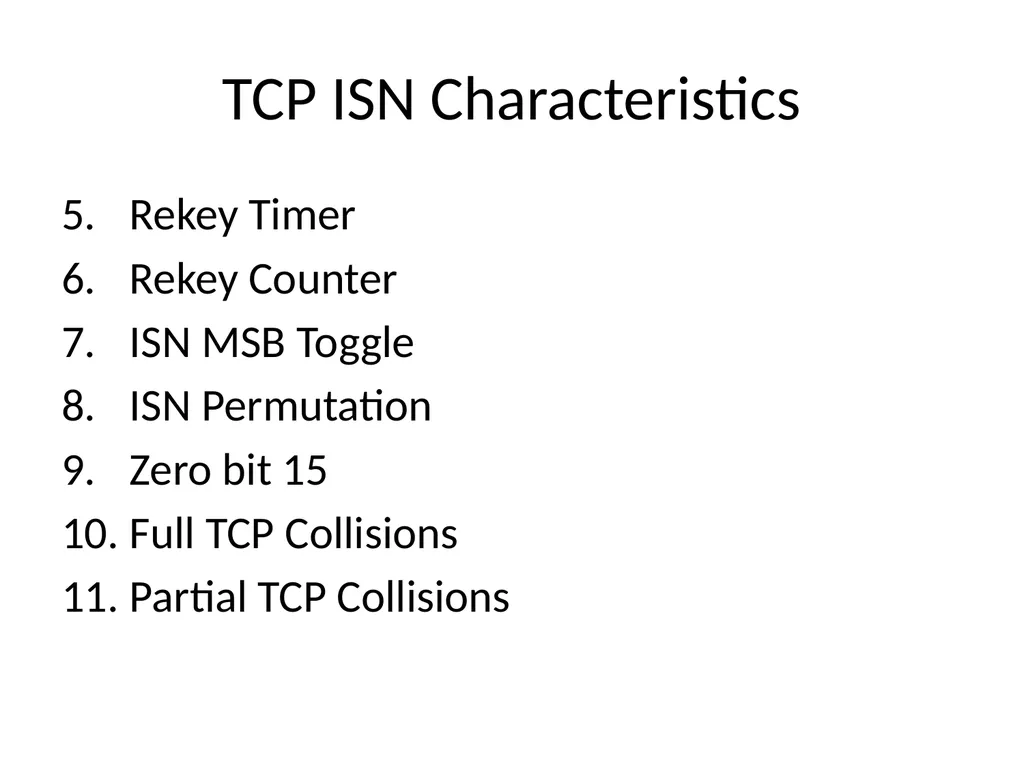
ISN Permutation
Zero bit 15
Full TCP Collisions
Partial TCP Collisions<br>
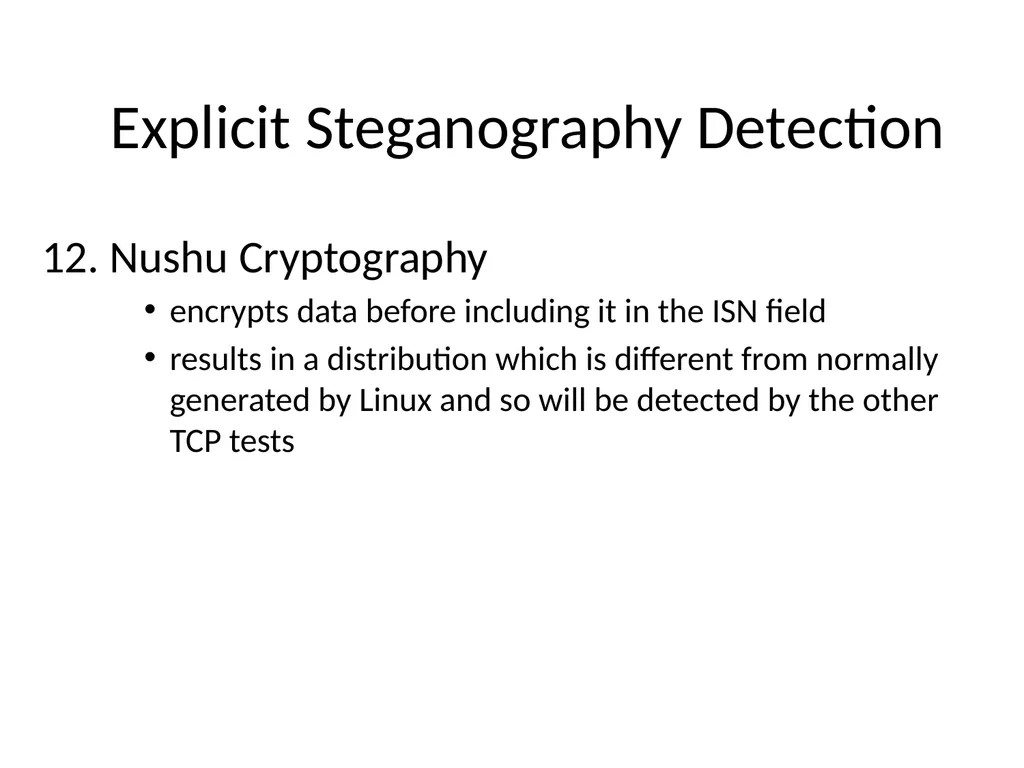
slide30. Explicit Steganography Detection 12. Nushu Cryptography
encrypts data before including it in the ISN field
results in a distribution which is different from normally generated by Linux and so will be detected by the other TCP tests<br>
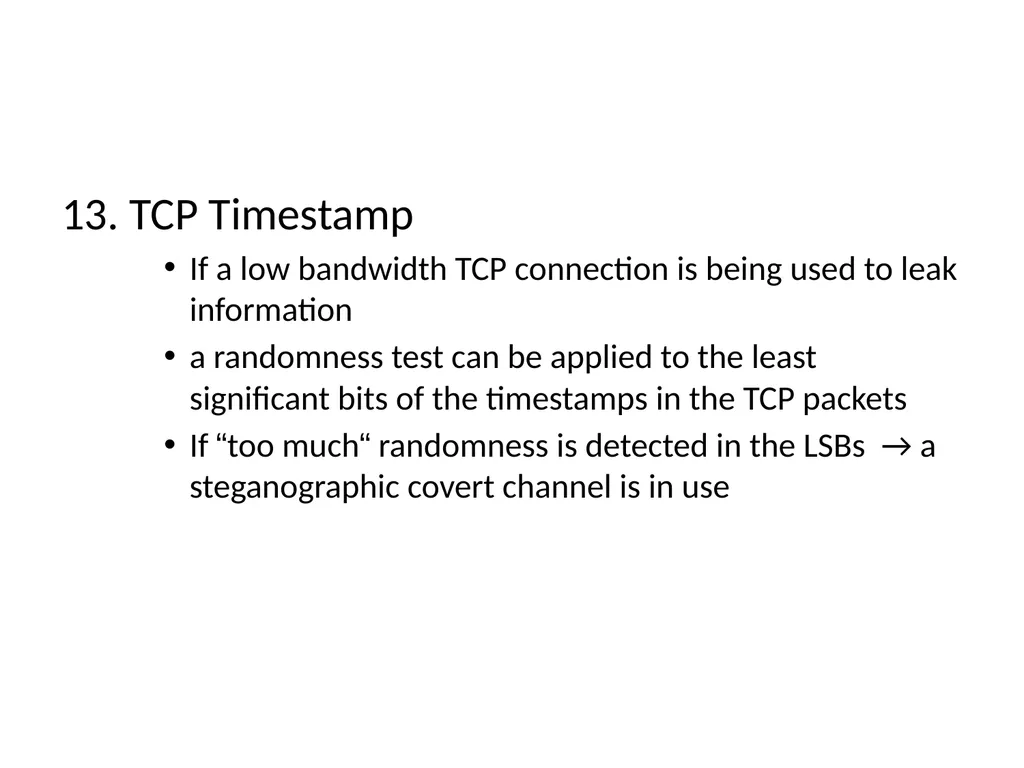
slide31. 13. TCP Timestamp
If a low bandwidth TCP connection is being used to leak information
a randomness test can be applied to the least significant bits of the timestamps in the TCP packets
If “too much“ randomness is detected in the LSBs → a steganographic covert channel is in use<br>
slide32. 14. Other Anomalies
unusual flags (e.g. DF when not expected, ToS set)
excessive fragmentation
use of IP options
non-zero padding
unexpected TCP options (e.g. timestamps from operating systems which do not generate them)
excessive re-ordering<br>
slide33. Results<br>
slide34. Accuracy No false negatives
Possible false positives
The accuracy depends on the size of observation CS660 - Advanced Information Assurance - UMassAmherst 34<br>
slide35. Detection-Resistant Schemes Lathra - Robust scheme, using the TCP ISNs generated by OpenBSD and Linux as a steganographic carrier
Simply encoding data within the least significant 24 bits of the ISN could be detected by the warden<br>
slide36. Other Network Channels CS660 - Advanced Information Assurance - UMassAmherst 36<br>
slide37. ICMP Channels ICMP echo request/reply can tunnel arbitrary user data
Payload capacity depends on path MTU (this feature often used to measure PMTU) www.erg.abdn.ac.uk/users/gorry Sohn, Noh, Moon 2003, “Support Vector Machine Based ICMP Covert Channel Attack Detection”<br>
slide38. HTTP Channels Fields in the header
Infranet
StegoTorus<br>
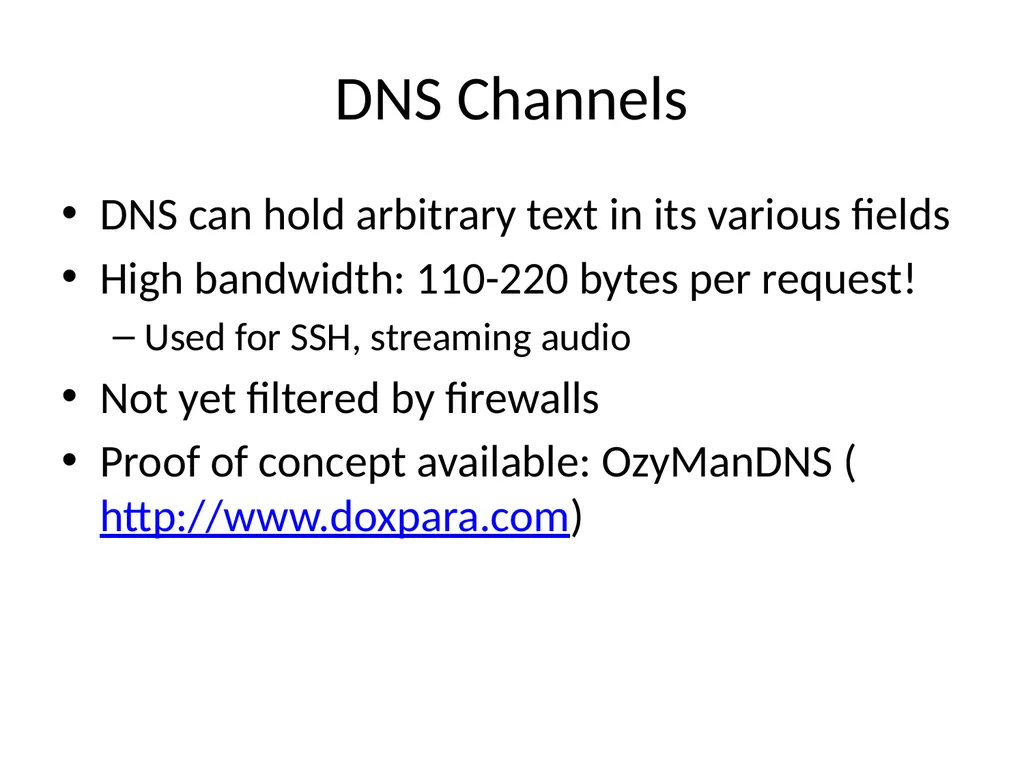
slide39. DNS Channels DNS can hold arbitrary text in its various fields
High bandwidth: 110-220 bytes per request!
Used for SSH, streaming audio
Not yet filtered by firewalls
Proof of concept available: OzyManDNS (http://www.doxpara.com)<br>
slide40. Channel Detection and Analysis<br>
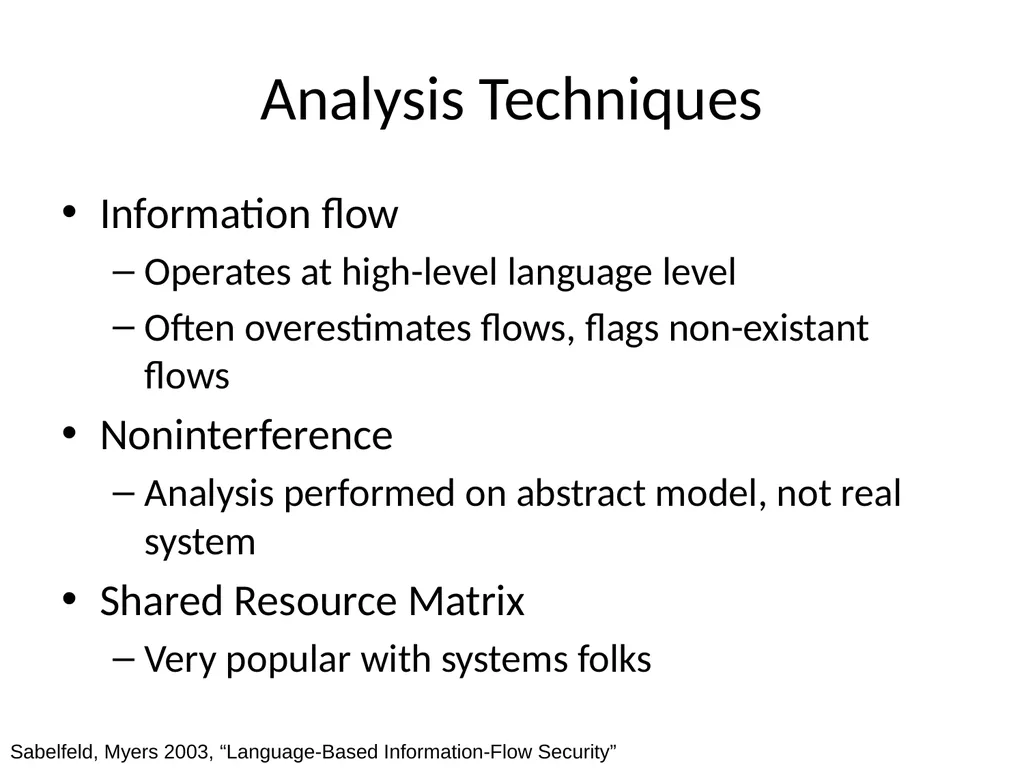
slide41. Analysis Techniques Information flow
Operates at high-level language level
Often overestimates flows, flags non-existant flows
Noninterference
Analysis performed on abstract model, not real system
Shared Resource Matrix
Very popular with systems folks Sabelfeld, Myers 2003, “Language-Based Information-Flow Security”<br>
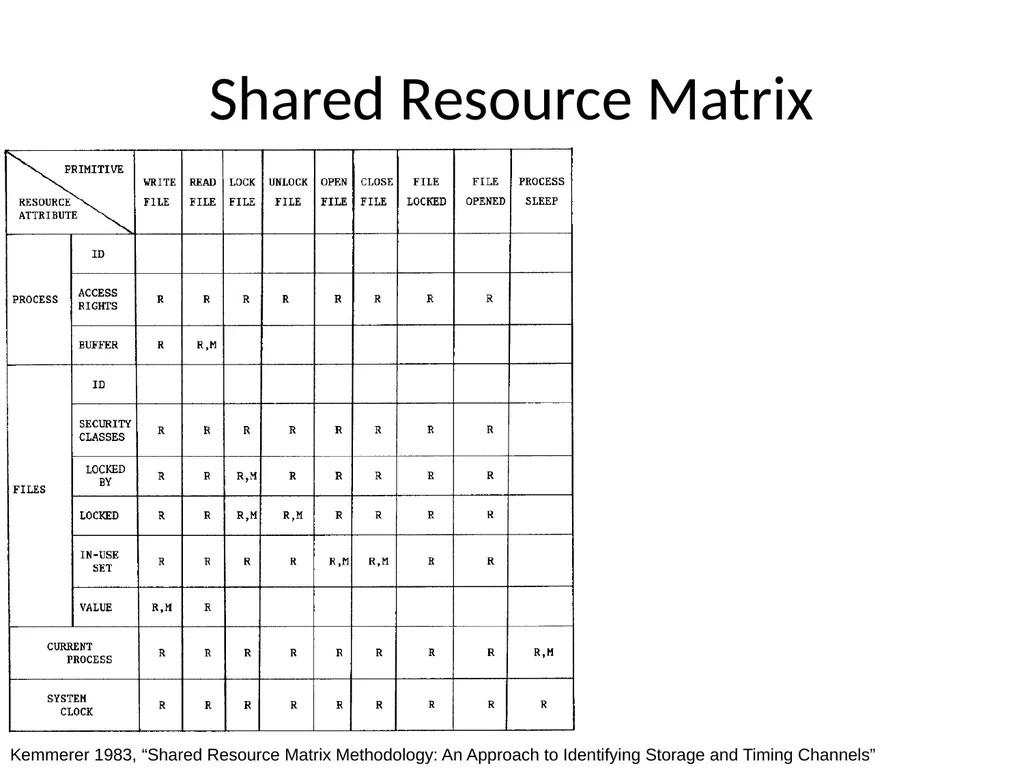
slide42. Shared Resource Matrix Kemmerer 1983, “Shared Resource Matrix Methodology: An Approach to Identifying Storage and Timing Channels”<br>
slide43. Active Channel Mitigation<br>
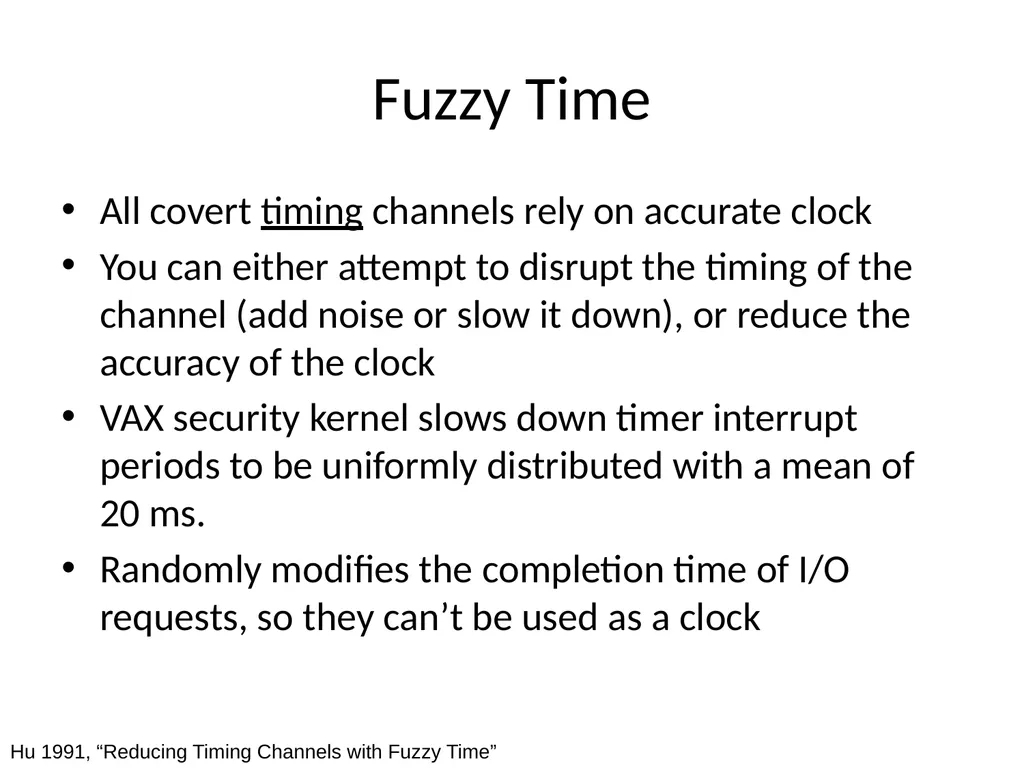
slide44. Fuzzy Time All covert timing channels rely on accurate clock
You can either attempt to disrupt the timing of the channel (add noise or slow it down), or reduce the accuracy of the clock
VAX security kernel slows down timer interrupt periods to be uniformly distributed with a mean of 20 ms.
Randomly modifies the completion time of I/O requests, so they can’t be used as a clock Hu 1991, “Reducing Timing Channels with Fuzzy Time”<br>
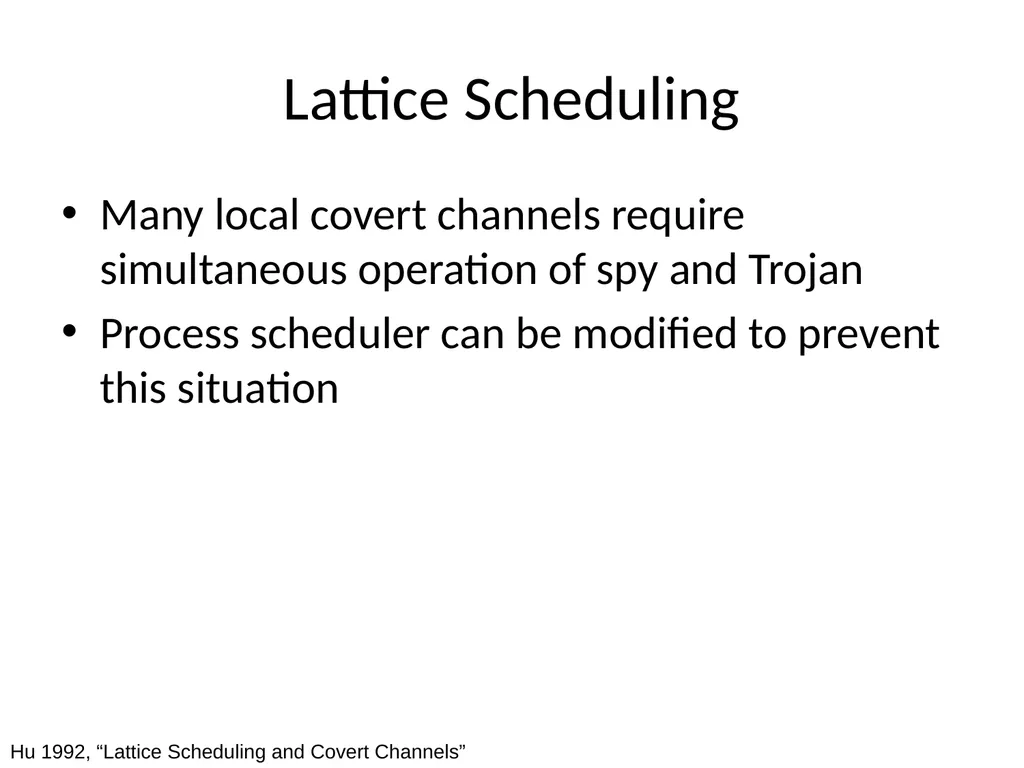
slide45. Lattice Scheduling Many local covert channels require simultaneous operation of spy and Trojan
Process scheduler can be modified to prevent this situation Hu 1992, “Lattice Scheduling and Covert Channels”<br>
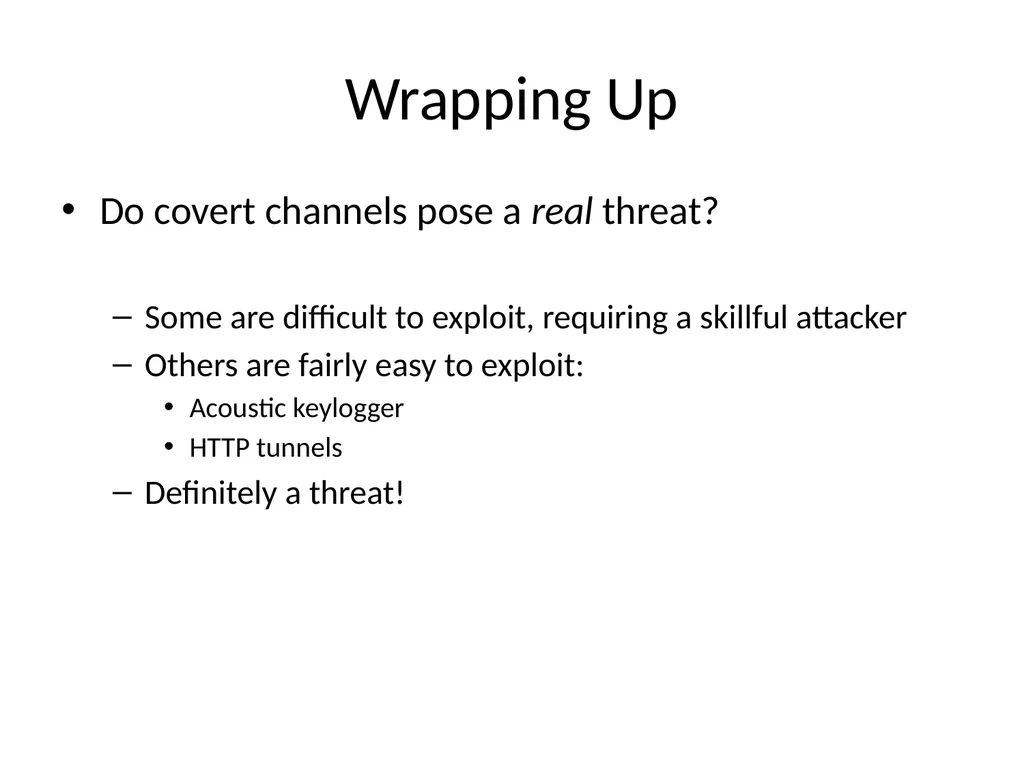
slide46. Wrapping Up Do covert channels pose a real threat?
Some are difficult to exploit, requiring a skillful attacker
Others are fairly easy to exploit:
Acoustic keylogger
HTTP tunnels
Definitely a threat!<br>
slide47. Classes of Information Hiding Digital watermarking
Steganography
Covert channels
Anonymous communication
Protocol obfuscation CS660 - Advanced Information Assurance - UMassAmherst 47<br>
slide48. Side Channels Similar to covert channels, but information is leaked unintentionally
Examples? CS660 - Advanced Information Assurance - UMassAmherst 48<br>
slide49. Acknowledgement Some of the slides, content, or pictures are borrowed from the following resources, and some pictures are obtained through Google search without being referenced below:
TCP/IP covert channels -UMBC
Covert Channels, by Michael LeMay @UIUC 49<br>

CS660: Advanced Information Assurance
Spring 2015 Content may be borrowed from other resources.
See the last slide for acknowledgements!<br>
slide2. Classes of Information Hiding Digital watermarking
Steganography
Covert channels
Anonymous communication
Protocol obfuscation CS660 - Advanced Information Assurance - UMassAmherst 2<br>
slide3. Covert Channels Definition: Communicate information between two computer processes that are not allowed to communicate, by hiding information into shared resources
Steganography: hiding information into digital media CS660 - Advanced Information Assurance - UMassAmherst 3<br>
slide4. Prisoners’ problem Alice, Bob, and Walter CS660 - Advanced Information Assurance - UMassAmherst 4<br>
slide5. Applications, or Why Use Covert Channels Bypass security policy by malicious/compromised computer processes
Evade surveillance
Bypass communication restrictions
Etc. CS660 - Advanced Information Assurance - UMassAmherst 5<br>
slide6. What Is the Importance? Difficult to detect
Can operate for a long time and leak a substantial amount of classified data
Can compromise an otherwise secure system, including one that has been formally verified!<br>
slide7. Classification: Hiding Method Storage channel
Data transmitted by writing or abstaining from writing, e.g., writing into RAM
Timing channel
Data modulated into the timing, or occurrence of events, e.g., the times between network packets CS660 - Advanced Information Assurance - UMassAmherst 7<br>
slide8. Classification: Shared Resources Network resource: an existing, legitimate communication channel designed for some purpose
Remote (network) covert channels
Computer resource: RAM, HardDisk, CPU, etc.
Local covert channels CS660 - Advanced Information Assurance - UMassAmherst 8<br>
slide9. Local Channels CS660 - Advanced Information Assurance - UMassAmherst 9<br>
slide10. Virtual Machines Shared resources:
CPU
RAM
Disk
Network
Examples? CS660 - Advanced Information Assurance - UMassAmherst 10<br>
slide11. Smartphones Shared resources:
CPU
RAM
Disk
Network
Microphone/speaker
Battery
Examples? CS660 - Advanced Information Assurance - UMassAmherst 11<br>
slide12. Remote (Network) Channels CS660 - Advanced Information Assurance - UMassAmherst 12<br>
slide13. What is the shared resource here? CS660 - Advanced Information Assurance - UMassAmherst 13<br>
slide14. Types Timing
E.g., packet timings
Storage
E.g., packet headers
How about the information hidden in packet payload?
Steganography CS660 - Advanced Information Assurance - UMassAmherst 14<br>
slide15. Protocol Stack CS660 - Advanced Information Assurance - UMassAmherst 15<br>
slide16. Packet Header Hiding<br>
slide17. IP Header<br>
slide18. TCP Header<br>
slide19. Storage Based Information is embedded by hiding data in packet header fields
IP identification
Offset
Options
TCP Checksum
TCP Sequence Numbers<br>
slide20. Timing Channels Information is hidden by triggering or delaying events at specific time intervals<br>
slide21. Timing Channels<br>
slide22. Detection Mechanisms Storage-based
Data analysis
Timing-based
Timing analysis CS660 - Advanced Information Assurance - UMassAmherst 22<br>
slide23. Threat Model Passive Warden Threat Model
Detect, then remove
Active Warden Threat Model
Modify traffic regardless of suspicion
Constraint?<br>
slide24. IP ID and TCP ISN Implementation Two fields which are commonly used to embed covert data are the IP ID and TCP ISN
Due to their construction, these fields contain some structure
Partially unpredictable<br>
slide25. Detection of TCP/IP Covert Channels Each operating system exhibits well defined characteristics in generated TCP/IP fields
can be used to identify any anomalies that may indicate the use of steganography
Suite of tests
applied to network traces to identify whether the results are consistent with known operating systems<br>
slide26. CS660 - Advanced Information Assurance - UMassAmherst 26<br>
slide27. CS660 - Advanced Information Assurance - UMassAmherst 27<br>
slide28. IP ID Characteristics Sequential Global IP ID
Sequential Per-host IP ID
IP-ID MSB Toggle
IP-ID Permutation<br>
slide29. TCP ISN Characteristics Rekey Timer
Rekey Counter
ISN MSB Toggle
ISN Permutation
Zero bit 15
Full TCP Collisions
Partial TCP Collisions<br>
slide30. Explicit Steganography Detection 12. Nushu Cryptography
encrypts data before including it in the ISN field
results in a distribution which is different from normally generated by Linux and so will be detected by the other TCP tests<br>
slide31. 13. TCP Timestamp
If a low bandwidth TCP connection is being used to leak information
a randomness test can be applied to the least significant bits of the timestamps in the TCP packets
If “too much“ randomness is detected in the LSBs → a steganographic covert channel is in use<br>
slide32. 14. Other Anomalies
unusual flags (e.g. DF when not expected, ToS set)
excessive fragmentation
use of IP options
non-zero padding
unexpected TCP options (e.g. timestamps from operating systems which do not generate them)
excessive re-ordering<br>
slide33. Results<br>
slide34. Accuracy No false negatives
Possible false positives
The accuracy depends on the size of observation CS660 - Advanced Information Assurance - UMassAmherst 34<br>
slide35. Detection-Resistant Schemes Lathra - Robust scheme, using the TCP ISNs generated by OpenBSD and Linux as a steganographic carrier
Simply encoding data within the least significant 24 bits of the ISN could be detected by the warden<br>
slide36. Other Network Channels CS660 - Advanced Information Assurance - UMassAmherst 36<br>
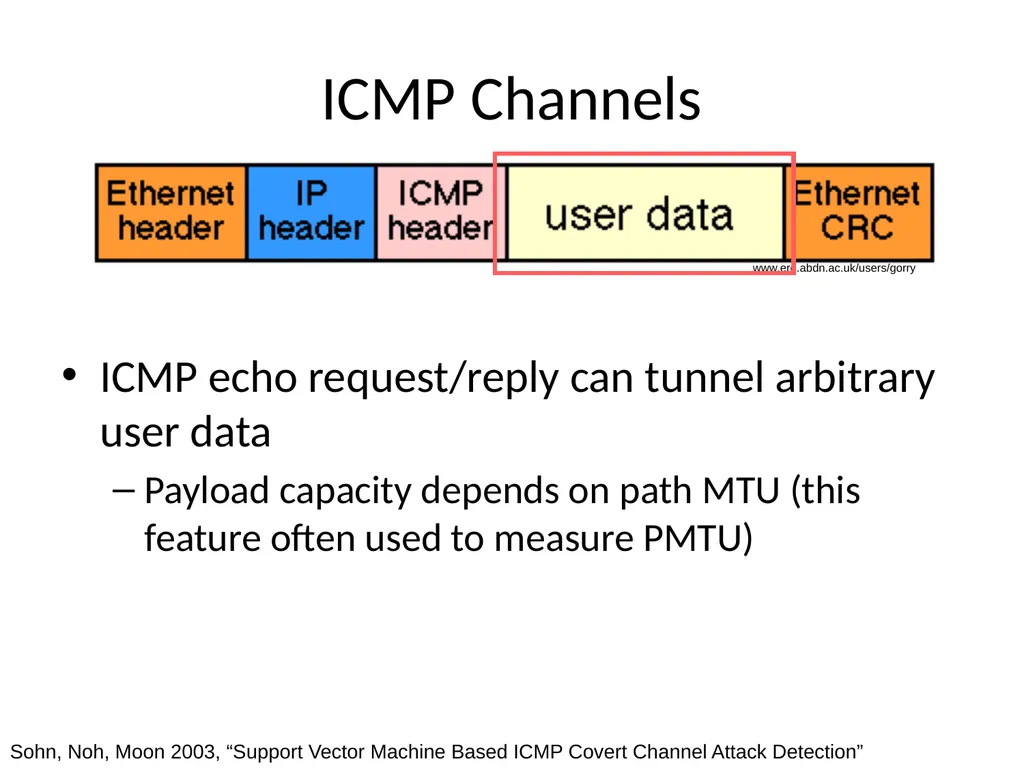
slide37. ICMP Channels ICMP echo request/reply can tunnel arbitrary user data
Payload capacity depends on path MTU (this feature often used to measure PMTU) www.erg.abdn.ac.uk/users/gorry Sohn, Noh, Moon 2003, “Support Vector Machine Based ICMP Covert Channel Attack Detection”<br>
slide38. HTTP Channels Fields in the header
Infranet
StegoTorus<br>
slide39. DNS Channels DNS can hold arbitrary text in its various fields
High bandwidth: 110-220 bytes per request!
Used for SSH, streaming audio
Not yet filtered by firewalls
Proof of concept available: OzyManDNS (http://www.doxpara.com)<br>
slide40. Channel Detection and Analysis<br>
slide41. Analysis Techniques Information flow
Operates at high-level language level
Often overestimates flows, flags non-existant flows
Noninterference
Analysis performed on abstract model, not real system
Shared Resource Matrix
Very popular with systems folks Sabelfeld, Myers 2003, “Language-Based Information-Flow Security”<br>
slide42. Shared Resource Matrix Kemmerer 1983, “Shared Resource Matrix Methodology: An Approach to Identifying Storage and Timing Channels”<br>
slide43. Active Channel Mitigation<br>
slide44. Fuzzy Time All covert timing channels rely on accurate clock
You can either attempt to disrupt the timing of the channel (add noise or slow it down), or reduce the accuracy of the clock
VAX security kernel slows down timer interrupt periods to be uniformly distributed with a mean of 20 ms.
Randomly modifies the completion time of I/O requests, so they can’t be used as a clock Hu 1991, “Reducing Timing Channels with Fuzzy Time”<br>
slide45. Lattice Scheduling Many local covert channels require simultaneous operation of spy and Trojan
Process scheduler can be modified to prevent this situation Hu 1992, “Lattice Scheduling and Covert Channels”<br>
slide46. Wrapping Up Do covert channels pose a real threat?
Some are difficult to exploit, requiring a skillful attacker
Others are fairly easy to exploit:
Acoustic keylogger
HTTP tunnels
Definitely a threat!<br>
slide47. Classes of Information Hiding Digital watermarking
Steganography
Covert channels
Anonymous communication
Protocol obfuscation CS660 - Advanced Information Assurance - UMassAmherst 47<br>
slide48. Side Channels Similar to covert channels, but information is leaked unintentionally
Examples? CS660 - Advanced Information Assurance - UMassAmherst 48<br>
slide49. Acknowledgement Some of the slides, content, or pictures are borrowed from the following resources, and some pictures are obtained through Google search without being referenced below:
TCP/IP covert channels -UMBC
Covert Channels, by Michael LeMay @UIUC 49<br>