
Information Privacy and Other Legislation
YM
Published · 30 slides · 0 views

1 / 1

Description
Information Privacy and Other Legislation Amendment Act 2023 (IPOLA) Stage 2 Build Knowledge training Queensland Privacy Principles and other privacy reforms 1 The Office of the Information Commissioner acknowledges the Traditional Owners
Related Topics
Share
Embed code
Download this presentation From Below
"Information Privacy and Other Legislation" is the property of its rightful owner. Permission is granted to download and print the materials on this website for personal, non-commercial use only, and to display it on your personal computer provided you do not modify the materials and that you retain all copyright notices contained in the materials. By downloading content from our website, you accept the terms of this agreement.
Presentation Transcript
01
Information Privacy and Other Legislation Amendment Act 2023 (IPOLA)
Stage 2 – Build Knowledge training
Queensland Privacy Principles
and other privacy reforms 1<br>
Stage 2 – Build Knowledge training
Queensland Privacy Principles
and other privacy reforms 1<br>
02
The Office of the Information Commissioner acknowledges the Traditional Owners of country throughout Australia,
and their connection to land and community.
We pay our respects to all Traditional Owners, and Elders
past and present. 2<br>
and their connection to land and community.
We pay our respects to all Traditional Owners, and Elders
past and present. 2<br>
03
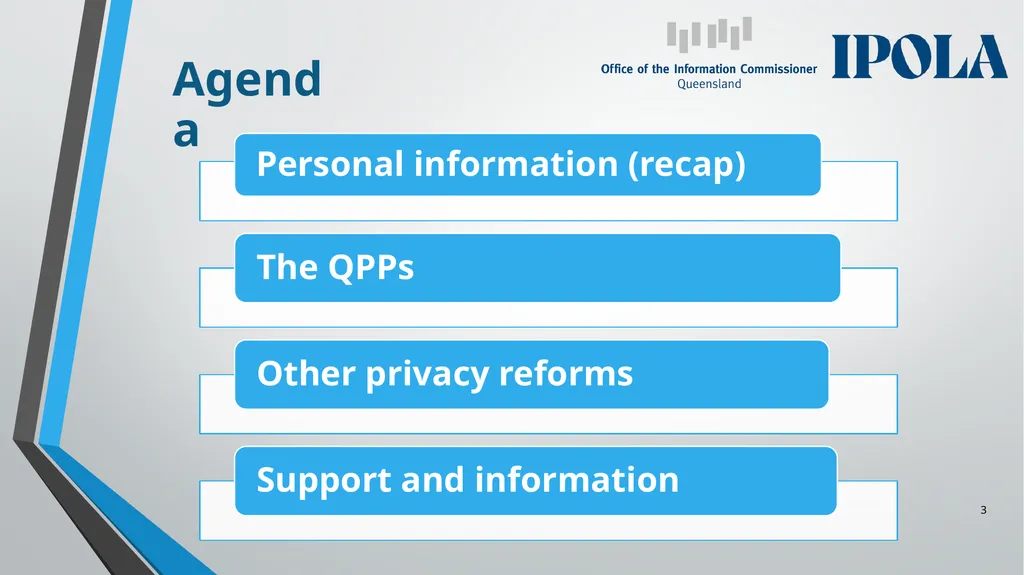
Agenda 3<br>
04
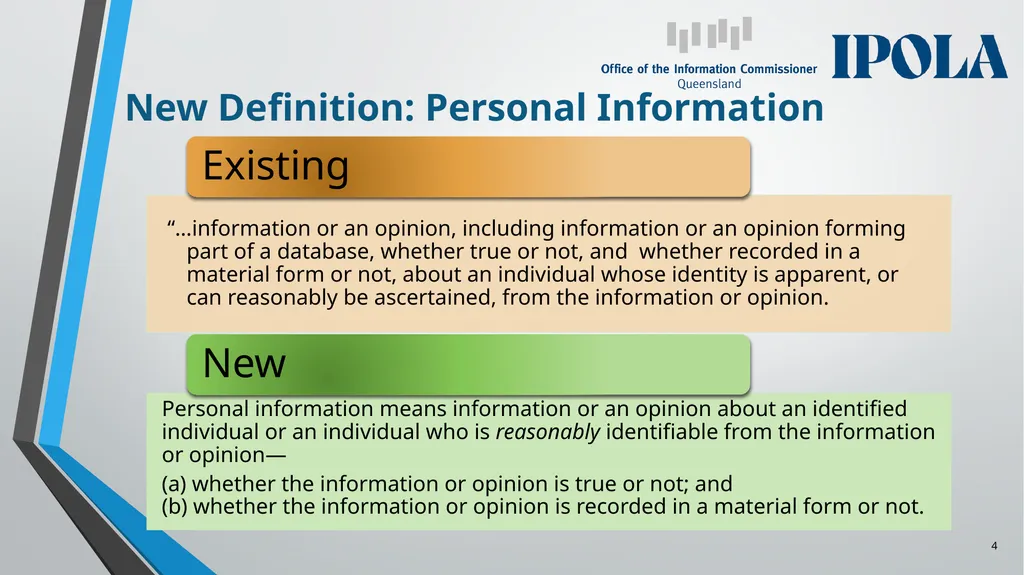
New Definition: Personal Information 4<br>
05
5<br>
06
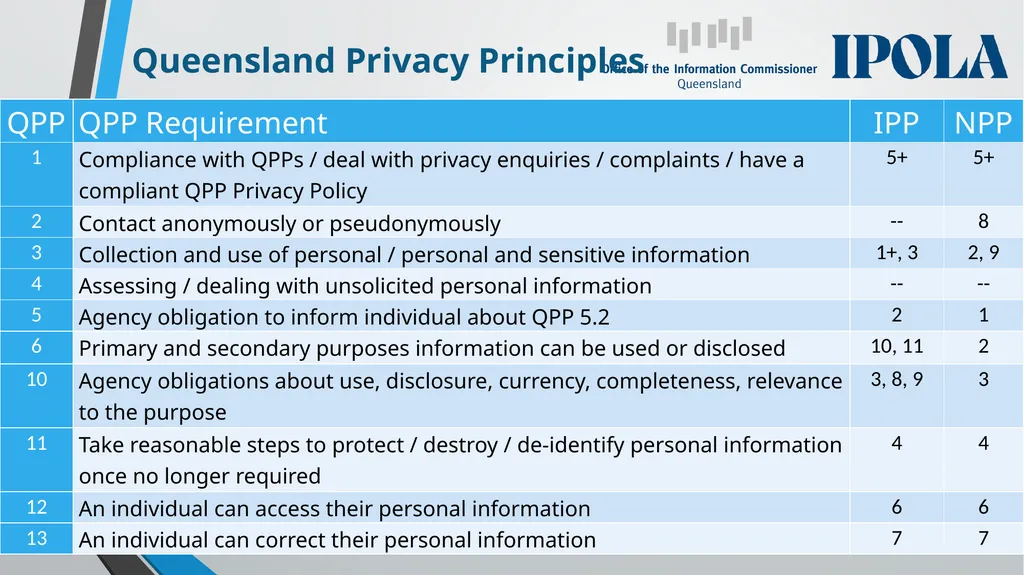
Queensland Privacy Principles<br>
07
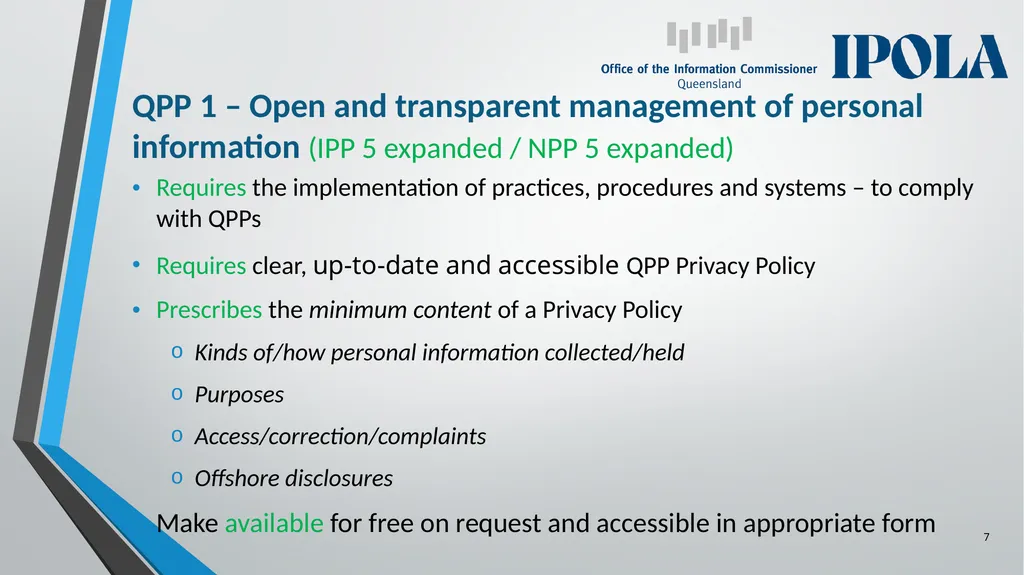
QPP 1 – Open and transparent management of personal information (IPP 5 expanded / NPP 5 expanded) Requires the implementation of practices, procedures and systems – to comply with QPPs
Requires clear, up-to-date and accessible QPP Privacy Policy
Prescribes the minimum content of a Privacy Policy
Kinds of/how personal information collected/held
Purposes
Access/correction/complaints
Offshore disclosures
Make available for free on request and accessible in appropriate form 7<br>
Requires clear, up-to-date and accessible QPP Privacy Policy
Prescribes the minimum content of a Privacy Policy
Kinds of/how personal information collected/held
Purposes
Access/correction/complaints
Offshore disclosures
Make available for free on request and accessible in appropriate form 7<br>
08
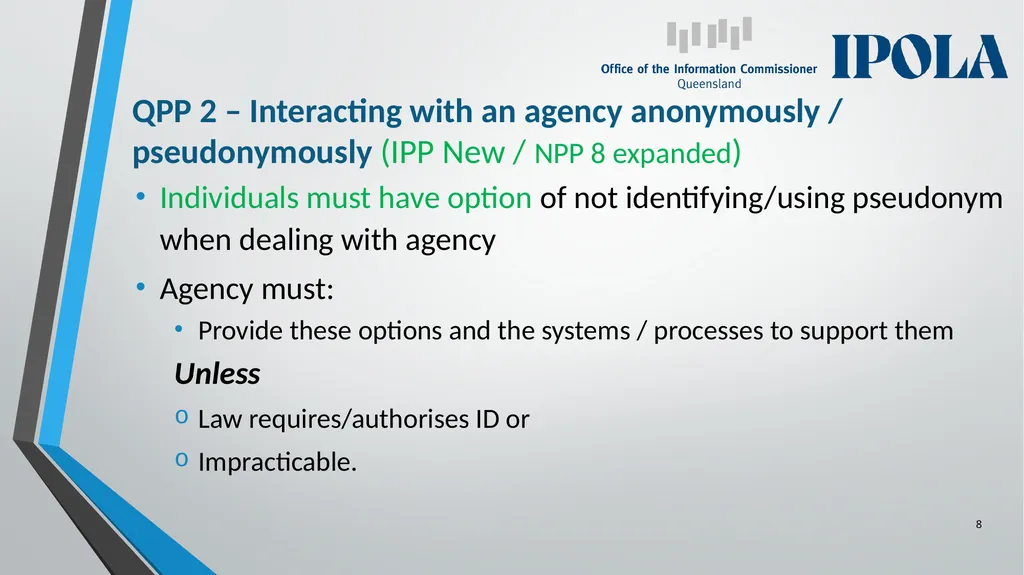
QPP 2 – Interacting with an agency anonymously / pseudonymously (IPP New / NPP 8 expanded) Individuals must have option of not identifying/using pseudonym when dealing with agency
Agency must:
Provide these options and the systems / processes to support them
Unless
Law requires/authorises ID or
Impracticable. 8<br>
Agency must:
Provide these options and the systems / processes to support them
Unless
Law requires/authorises ID or
Impracticable. 8<br>
09
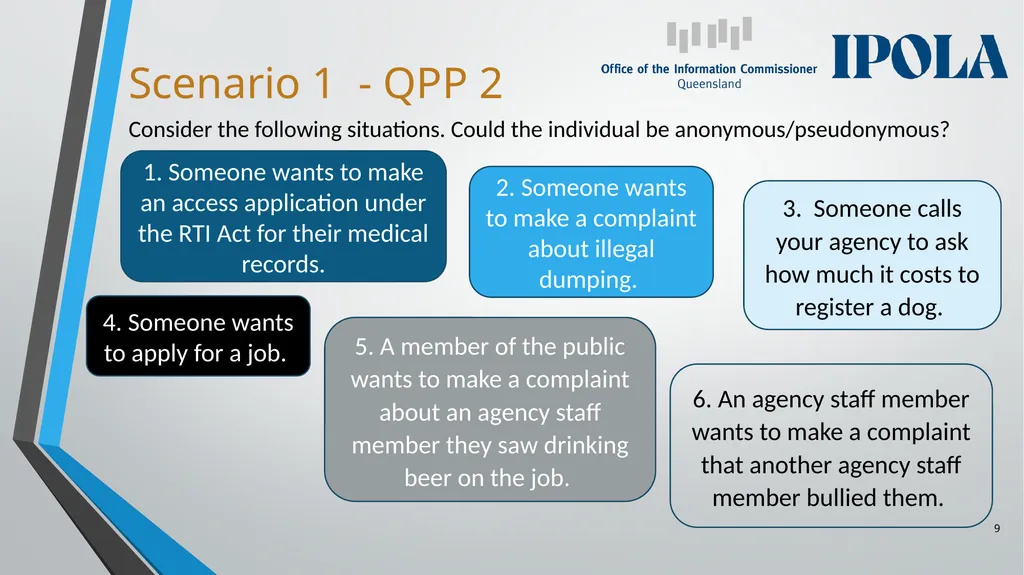
Scenario 1 - QPP 2 Consider the following situations. Could the individual be anonymous/pseudonymous? 9 1. Someone wants to make an access application under the RTI Act for their medical records. 2. Someone wants to make a complaint about illegal dumping. 3. Someone calls your agency to ask how much it costs to register a dog. 4. Someone wants to apply for a job. 5. A member of the public wants to make a complaint about an agency staff member they saw drinking beer on the job. 6. An agency staff member wants to make a complaint that another agency staff member bullied them.<br>
10
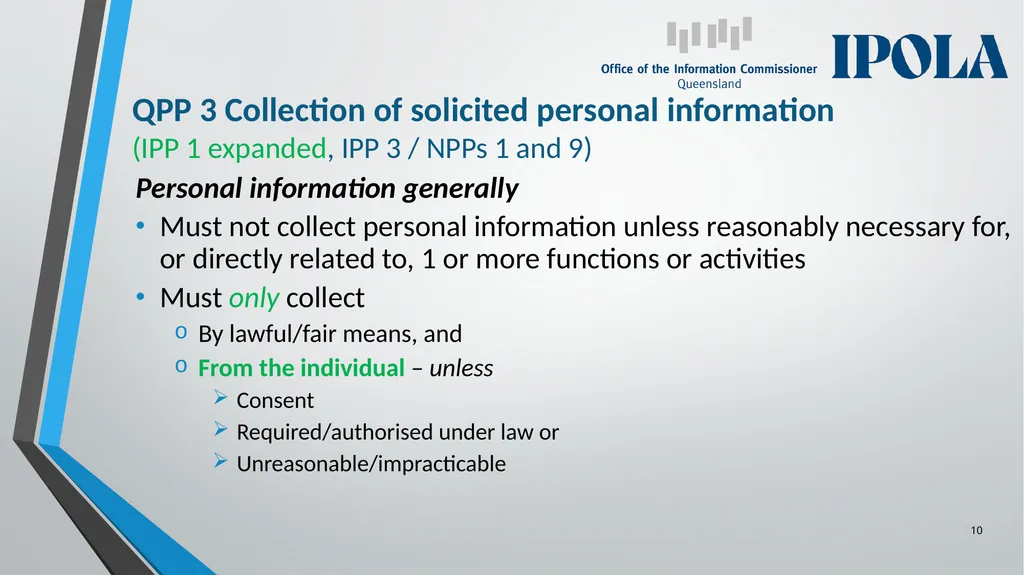
QPP 3 Collection of solicited personal information
(IPP 1 expanded, IPP 3 / NPPs 1 and 9) Personal information generally
Must not collect personal information unless reasonably necessary for, or directly related to, 1 or more functions or activities
Must only collect
By lawful/fair means, and
From the individual – unless
Consent
Required/authorised under law or
Unreasonable/impracticable 10<br>
Must not collect personal information unless reasonably necessary for, or directly related to, 1 or more functions or activities
Must only collect
By lawful/fair means, and
From the individual – unless
Consent
Required/authorised under law or
Unreasonable/impracticable 10<br>
11
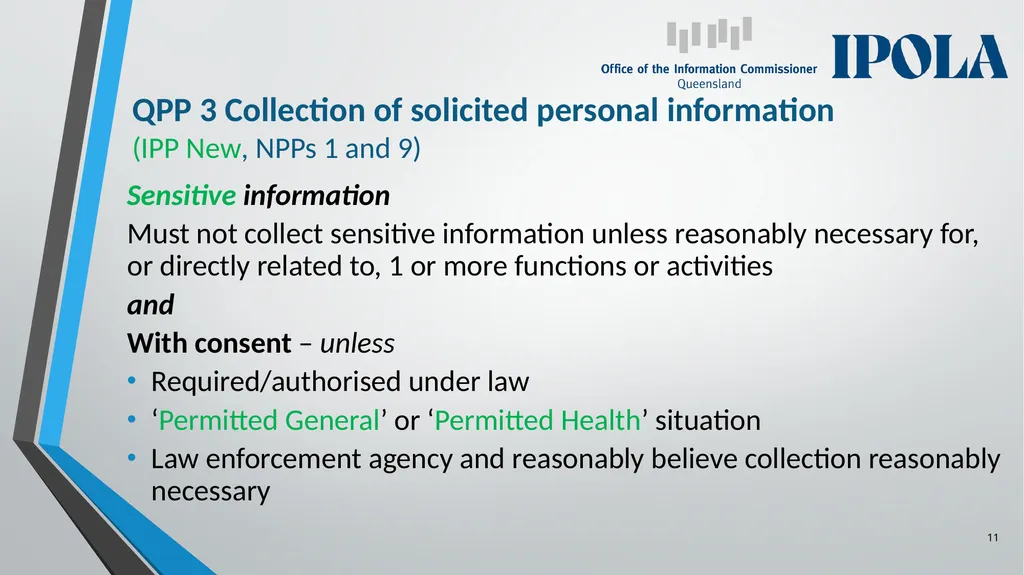
QPP 3 Collection of solicited personal information
(IPP New, NPPs 1 and 9) Sensitive information
Must not collect sensitive information unless reasonably necessary for, or directly related to, 1 or more functions or activities
and
With consent – unless
Required/authorised under law
‘Permitted General’ or ‘Permitted Health’ situation
Law enforcement agency and reasonably believe collection reasonably necessary 11<br>
Must not collect sensitive information unless reasonably necessary for, or directly related to, 1 or more functions or activities
and
With consent – unless
Required/authorised under law
‘Permitted General’ or ‘Permitted Health’ situation
Law enforcement agency and reasonably believe collection reasonably necessary 11<br>
12
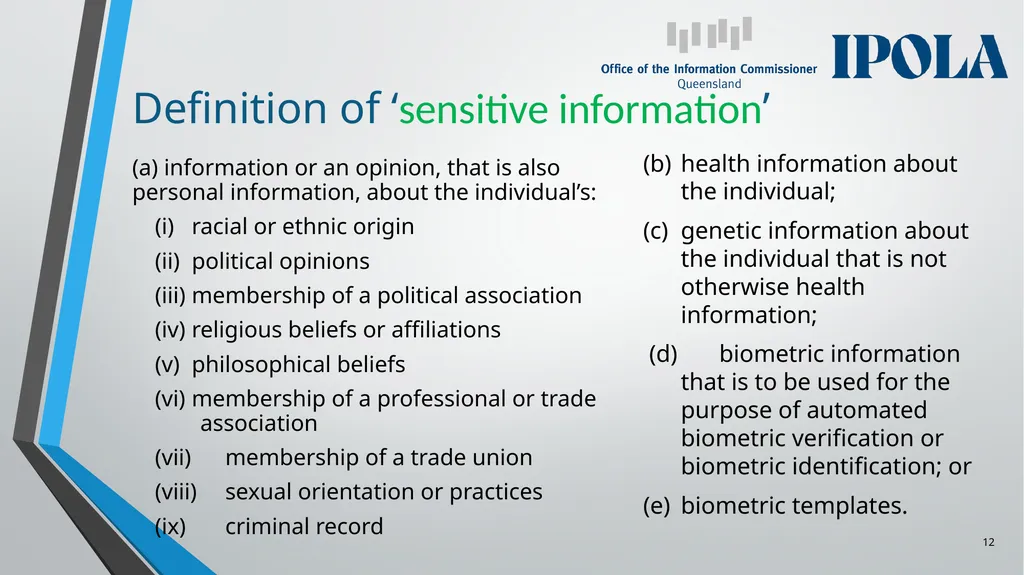
Definition of ‘sensitive information’ (a) information or an opinion, that is also personal information, about the individual’s:
(i) racial or ethnic origin
(ii) political opinions
(iii) membership of a political association
(iv) religious beliefs or affiliations
(v) philosophical beliefs
(vi) membership of a professional or trade association
(vii) membership of a trade union
(viii) sexual orientation or practices
(ix) criminal record (b) health information about the individual;
(c) genetic information about the individual that is not otherwise health information;
(d) biometric information that is to be used for the purpose of automated biometric verification or biometric identification; or
(e) biometric templates. 12<br>
(i) racial or ethnic origin
(ii) political opinions
(iii) membership of a political association
(iv) religious beliefs or affiliations
(v) philosophical beliefs
(vi) membership of a professional or trade association
(vii) membership of a trade union
(viii) sexual orientation or practices
(ix) criminal record (b) health information about the individual;
(c) genetic information about the individual that is not otherwise health information;
(d) biometric information that is to be used for the purpose of automated biometric verification or biometric identification; or
(e) biometric templates. 12<br>
13
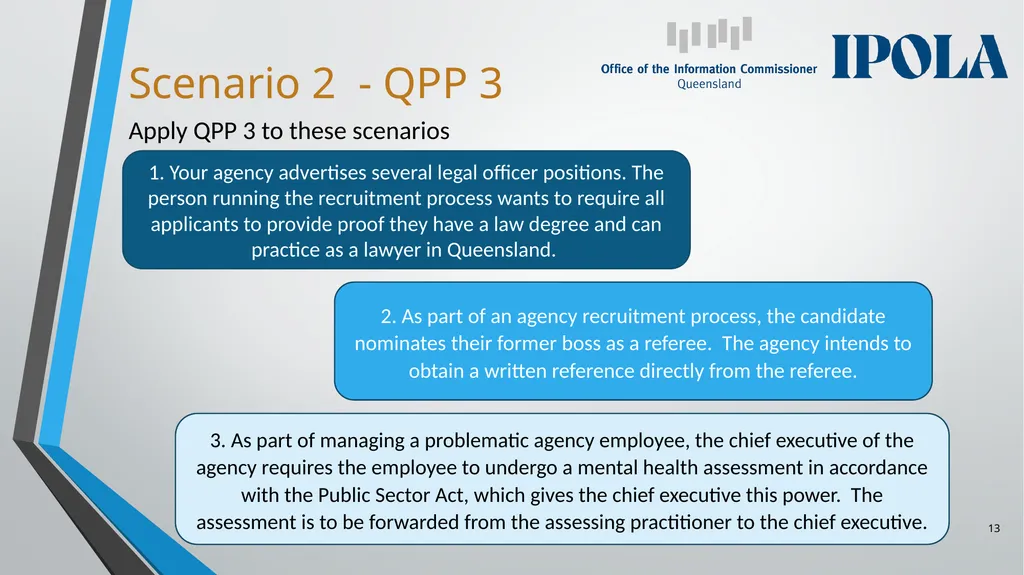
Scenario 2 - QPP 3 Apply QPP 3 to these scenarios 13 1. Your agency advertises several legal officer positions. The person running the recruitment process wants to require all applicants to provide proof they have a law degree and can practice as a lawyer in Queensland. 2. As part of an agency recruitment process, the candidate nominates their former boss as a referee. The agency intends to obtain a written reference directly from the referee. 3. As part of managing a problematic agency employee, the chief executive of the agency requires the employee to undergo a mental health assessment in accordance with the Public Sector Act, which gives the chief executive this power. The assessment is to be forwarded from the assessing practitioner to the chief executive.<br>
14
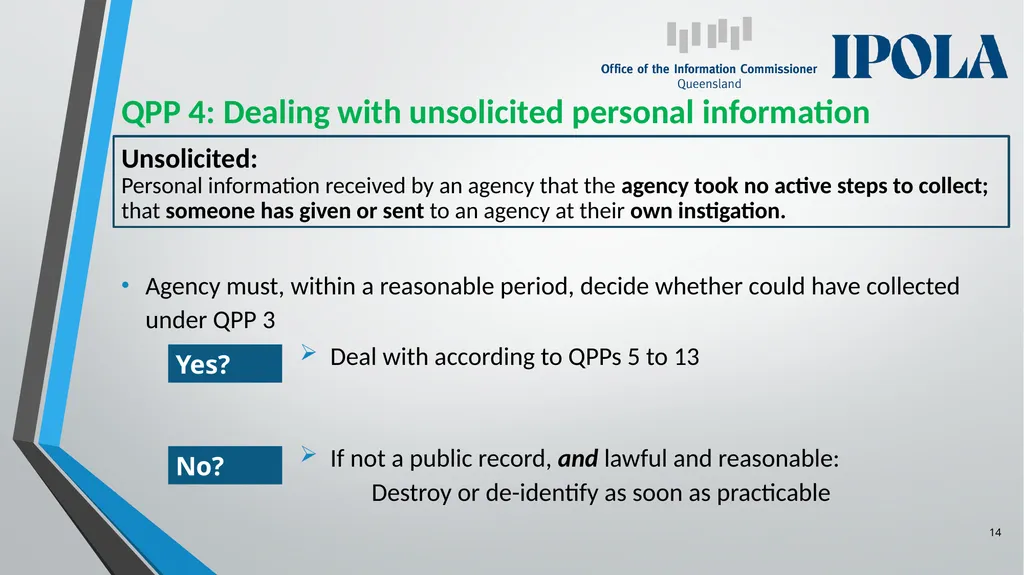
QPP 4: Dealing with unsolicited personal information Agency must, within a reasonable period, decide whether could have collected under QPP 3
Deal with according to QPPs 5 to 13
If not a public record, and lawful and reasonable:
Destroy or de-identify as soon as practicable Unsolicited:
Personal information received by an agency that the agency took no active steps to collect; that someone has given or sent to an agency at their own instigation. 14 Yes? No?<br>
Deal with according to QPPs 5 to 13
If not a public record, and lawful and reasonable:
Destroy or de-identify as soon as practicable Unsolicited:
Personal information received by an agency that the agency took no active steps to collect; that someone has given or sent to an agency at their own instigation. 14 Yes? No?<br>
15
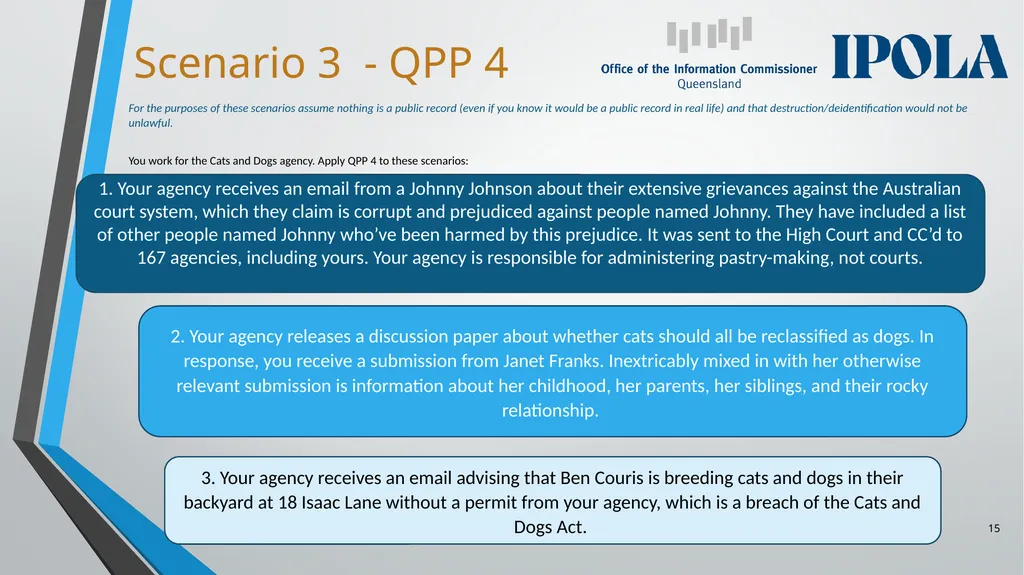
Scenario 3 - QPP 4 For the purposes of these scenarios assume nothing is a public record (even if you know it would be a public record in real life) and that destruction/deidentification would not be unlawful.
You work for the Cats and Dogs agency. Apply QPP 4 to these scenarios: 15 1. Your agency receives an email from a Johnny Johnson about their extensive grievances against the Australian court system, which they claim is corrupt and prejudiced against people named Johnny. They have included a list of other people named Johnny who’ve been harmed by this prejudice. It was sent to the High Court and CC’d to 167 agencies, including yours. Your agency is responsible for administering pastry-making, not courts. 2. Your agency releases a discussion paper about whether cats should all be reclassified as dogs. In response, you receive a submission from Janet Franks. Inextricably mixed in with her otherwise relevant submission is information about her childhood, her parents, her siblings, and their rocky relationship. 3. Your agency receives an email advising that Ben Couris is breeding cats and dogs in their backyard at 18 Isaac Lane without a permit from your agency, which is a breach of the Cats and Dogs Act.<br>
You work for the Cats and Dogs agency. Apply QPP 4 to these scenarios: 15 1. Your agency receives an email from a Johnny Johnson about their extensive grievances against the Australian court system, which they claim is corrupt and prejudiced against people named Johnny. They have included a list of other people named Johnny who’ve been harmed by this prejudice. It was sent to the High Court and CC’d to 167 agencies, including yours. Your agency is responsible for administering pastry-making, not courts. 2. Your agency releases a discussion paper about whether cats should all be reclassified as dogs. In response, you receive a submission from Janet Franks. Inextricably mixed in with her otherwise relevant submission is information about her childhood, her parents, her siblings, and their rocky relationship. 3. Your agency receives an email advising that Ben Couris is breeding cats and dogs in their backyard at 18 Isaac Lane without a permit from your agency, which is a breach of the Cats and Dogs Act.<br>
16
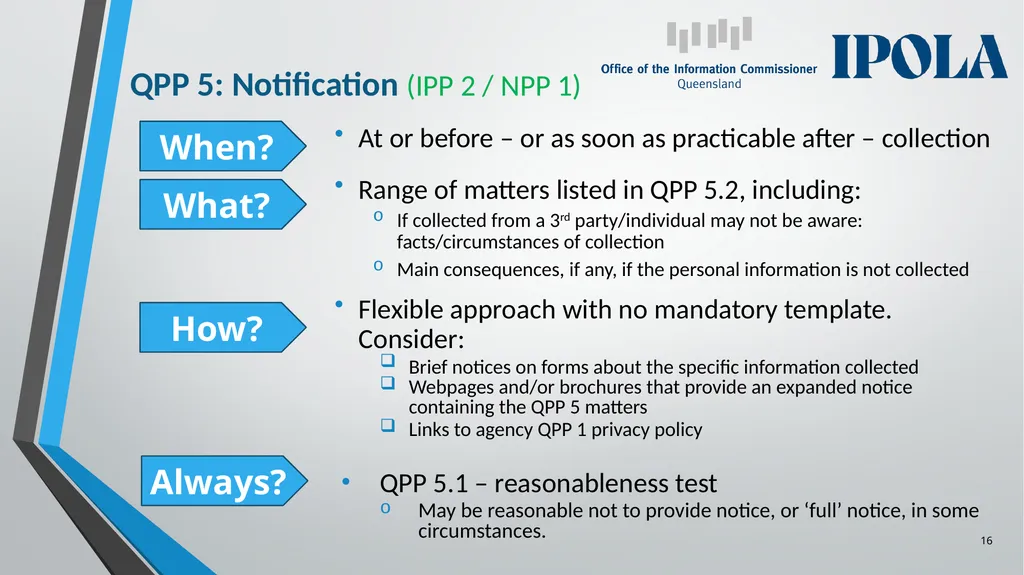
QPP 5: Notification (IPP 2 / NPP 1) At or before – or as soon as practicable after – collection
Range of matters listed in QPP 5.2, including:
If collected from a 3rd party/individual may not be aware: facts/circumstances of collection
Main consequences, if any, if the personal information is not collected
Flexible approach with no mandatory template. Consider:
Brief notices on forms about the specific information collected
Webpages and/or brochures that provide an expanded notice containing the QPP 5 matters
Links to agency QPP 1 privacy policy
QPP 5.1 – reasonableness test
May be reasonable not to provide notice, or ‘full’ notice, in some circumstances. 16 When? What? How? Always?<br>
Range of matters listed in QPP 5.2, including:
If collected from a 3rd party/individual may not be aware: facts/circumstances of collection
Main consequences, if any, if the personal information is not collected
Flexible approach with no mandatory template. Consider:
Brief notices on forms about the specific information collected
Webpages and/or brochures that provide an expanded notice containing the QPP 5 matters
Links to agency QPP 1 privacy policy
QPP 5.1 – reasonableness test
May be reasonable not to provide notice, or ‘full’ notice, in some circumstances. 16 When? What? How? Always?<br>
17
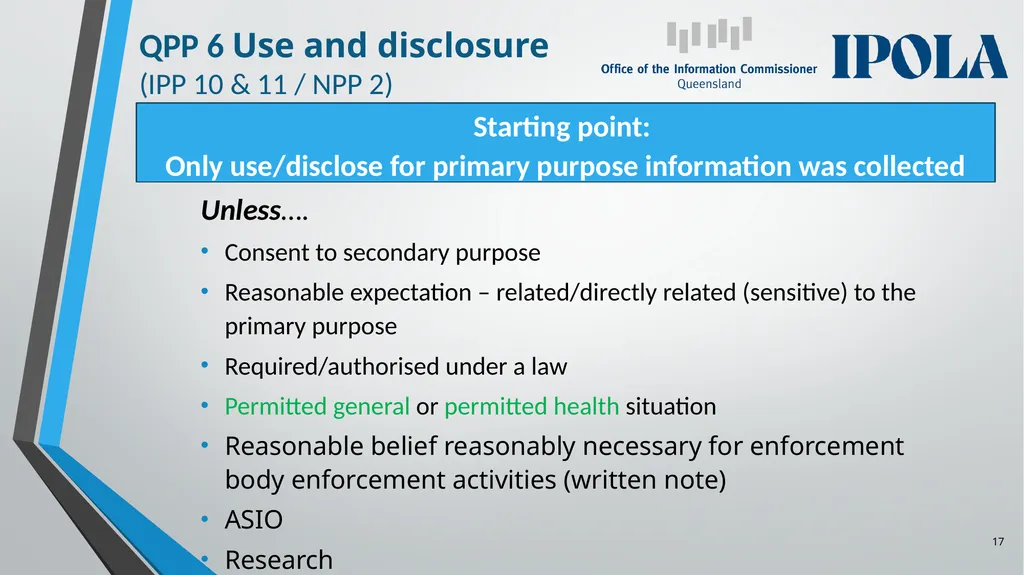
QPP 6 Use and disclosure
(IPP 10 & 11 / NPP 2) Unless….
Consent to secondary purpose
Reasonable expectation – related/directly related (sensitive) to the primary purpose
Required/authorised under a law
Permitted general or permitted health situation
Reasonable belief reasonably necessary for enforcement body enforcement activities (written note)
ASIO
Research 17 Starting point:
Only use/disclose for primary purpose information was collected<br>
Consent to secondary purpose
Reasonable expectation – related/directly related (sensitive) to the primary purpose
Required/authorised under a law
Permitted general or permitted health situation
Reasonable belief reasonably necessary for enforcement body enforcement activities (written note)
ASIO
Research 17 Starting point:
Only use/disclose for primary purpose information was collected<br>
18
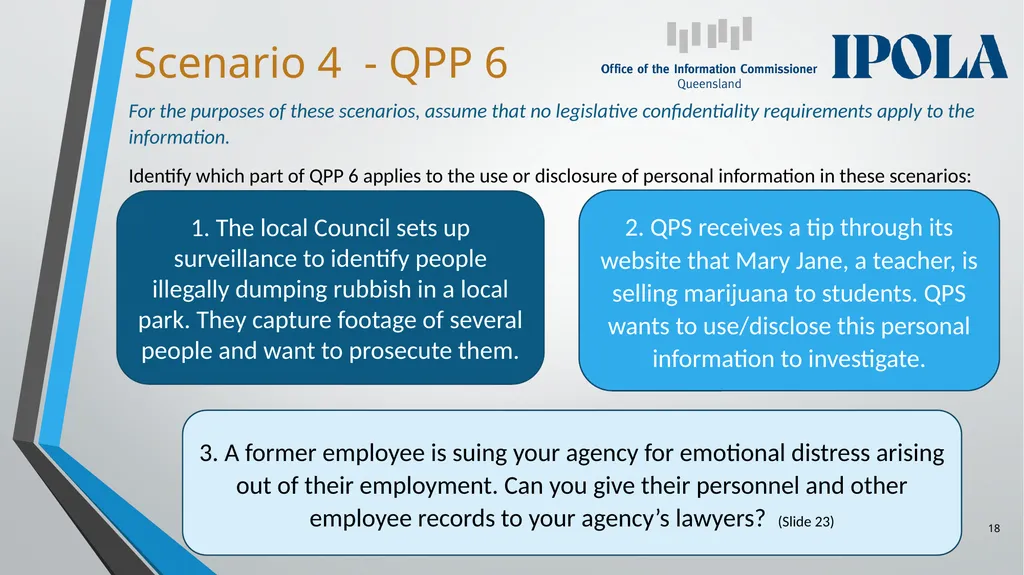
Scenario 4 - QPP 6 For the purposes of these scenarios, assume that no legislative confidentiality requirements apply to the information.
Identify which part of QPP 6 applies to the use or disclosure of personal information in these scenarios: 18 1. The local Council sets up surveillance to identify people illegally dumping rubbish in a local park. They capture footage of several people and want to prosecute them. 2. QPS receives a tip through its website that Mary Jane, a teacher, is selling marijuana to students. QPS wants to use/disclose this personal information to investigate. 3. A former employee is suing your agency for emotional distress arising out of their employment. Can you give their personnel and other employee records to your agency’s lawyers? (Slide 23)<br>
Identify which part of QPP 6 applies to the use or disclosure of personal information in these scenarios: 18 1. The local Council sets up surveillance to identify people illegally dumping rubbish in a local park. They capture footage of several people and want to prosecute them. 2. QPS receives a tip through its website that Mary Jane, a teacher, is selling marijuana to students. QPS wants to use/disclose this personal information to investigate. 3. A former employee is suing your agency for emotional distress arising out of their employment. Can you give their personnel and other employee records to your agency’s lawyers? (Slide 23)<br>
19
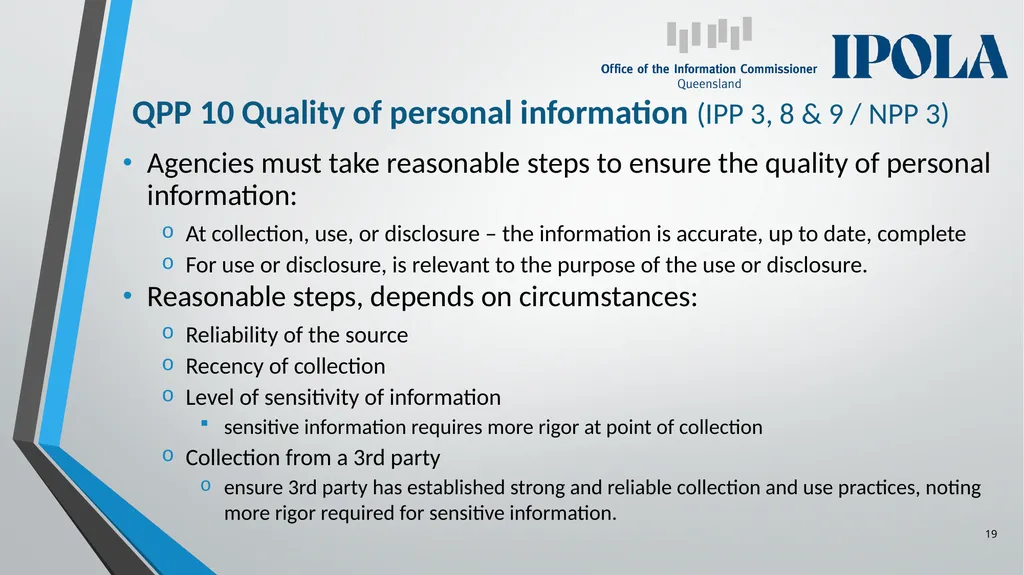
QPP 10 Quality of personal information (IPP 3, 8 & 9 / NPP 3) Agencies must take reasonable steps to ensure the quality of personal information:
At collection, use, or disclosure – the information is accurate, up to date, complete
For use or disclosure, is relevant to the purpose of the use or disclosure.
Reasonable steps, depends on circumstances:
Reliability of the source
Recency of collection
Level of sensitivity of information
sensitive information requires more rigor at point of collection
Collection from a 3rd party
ensure 3rd party has established strong and reliable collection and use practices, noting more rigor required for sensitive information. 19<br>
At collection, use, or disclosure – the information is accurate, up to date, complete
For use or disclosure, is relevant to the purpose of the use or disclosure.
Reasonable steps, depends on circumstances:
Reliability of the source
Recency of collection
Level of sensitivity of information
sensitive information requires more rigor at point of collection
Collection from a 3rd party
ensure 3rd party has established strong and reliable collection and use practices, noting more rigor required for sensitive information. 19<br>
20
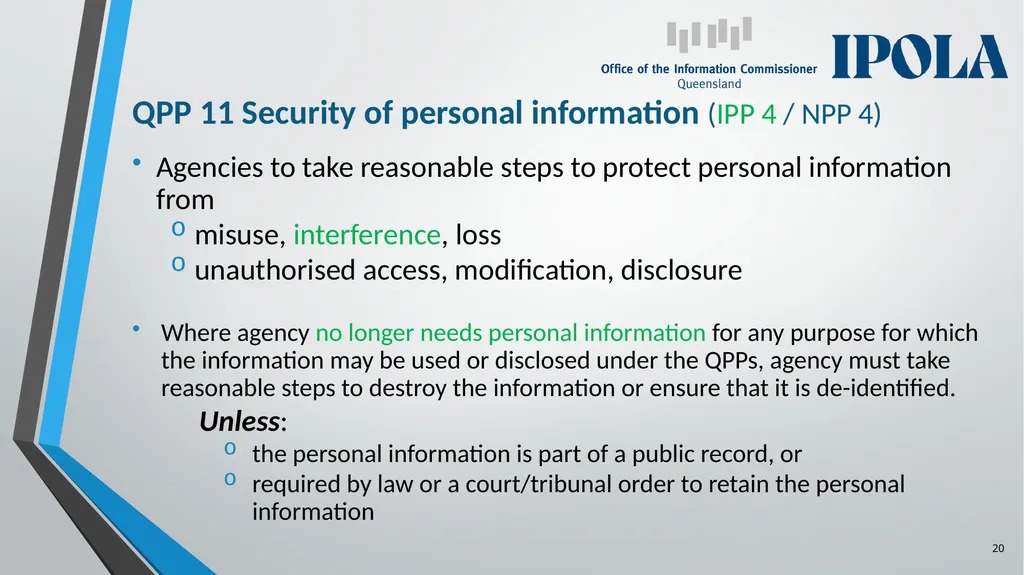
QPP 11 Security of personal information (IPP 4 / NPP 4) Agencies to take reasonable steps to protect personal information from
misuse, interference, loss
unauthorised access, modification, disclosure
Where agency no longer needs personal information for any purpose for which the information may be used or disclosed under the QPPs, agency must take reasonable steps to destroy the information or ensure that it is de-identified.
Unless:
the personal information is part of a public record, or
required by law or a court/tribunal order to retain the personal information 20<br>
misuse, interference, loss
unauthorised access, modification, disclosure
Where agency no longer needs personal information for any purpose for which the information may be used or disclosed under the QPPs, agency must take reasonable steps to destroy the information or ensure that it is de-identified.
Unless:
the personal information is part of a public record, or
required by law or a court/tribunal order to retain the personal information 20<br>
21
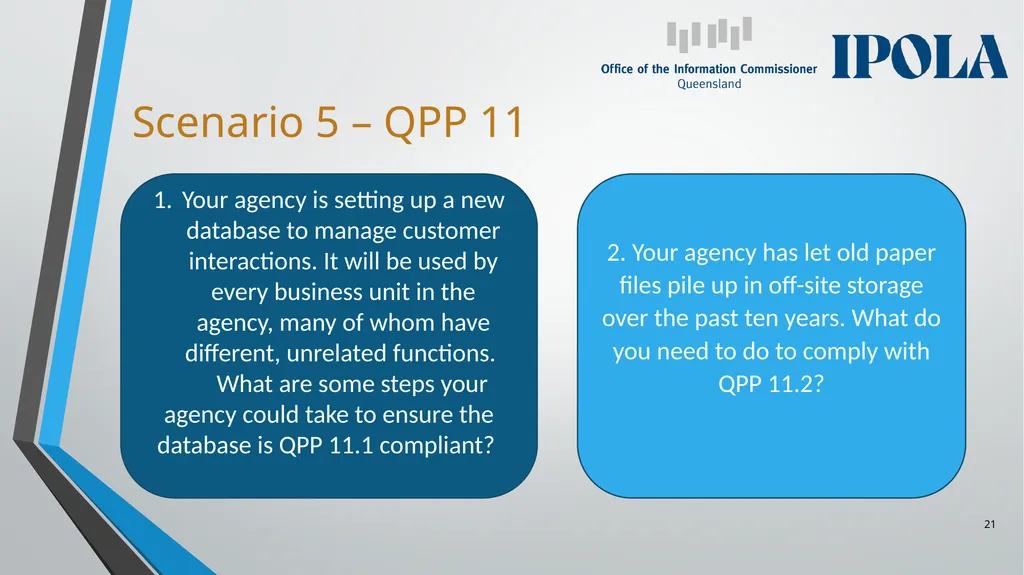
Scenario 5 – QPP 11 21 Your agency is setting up a new database to manage customer interactions. It will be used by every business unit in the agency, many of whom have different, unrelated functions.
What are some steps your agency could take to ensure the database is QPP 11.1 compliant? 2. Your agency has let old paper files pile up in off-site storage over the past ten years. What do you need to do to comply with QPP 11.2?<br>
What are some steps your agency could take to ensure the database is QPP 11.1 compliant? 2. Your agency has let old paper files pile up in off-site storage over the past ten years. What do you need to do to comply with QPP 11.2?<br>
22
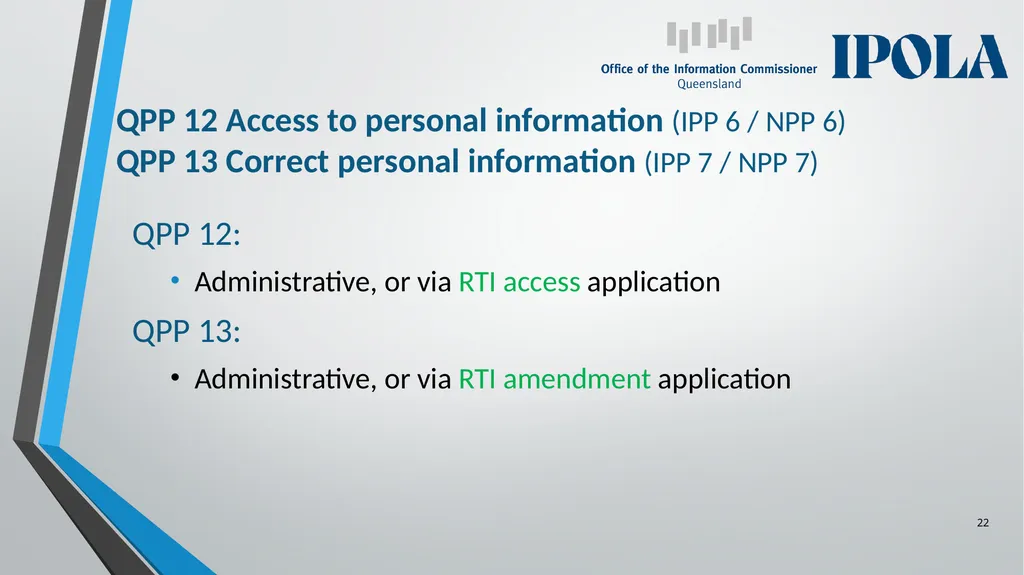
QPP 12 Access to personal information (IPP 6 / NPP 6)
QPP 13 Correct personal information (IPP 7 / NPP 7) QPP 12:
Administrative, or via RTI access application
QPP 13:
Administrative, or via RTI amendment application 22<br>
Administrative, or via RTI access application
QPP 13:
Administrative, or via RTI amendment application 22<br>
23
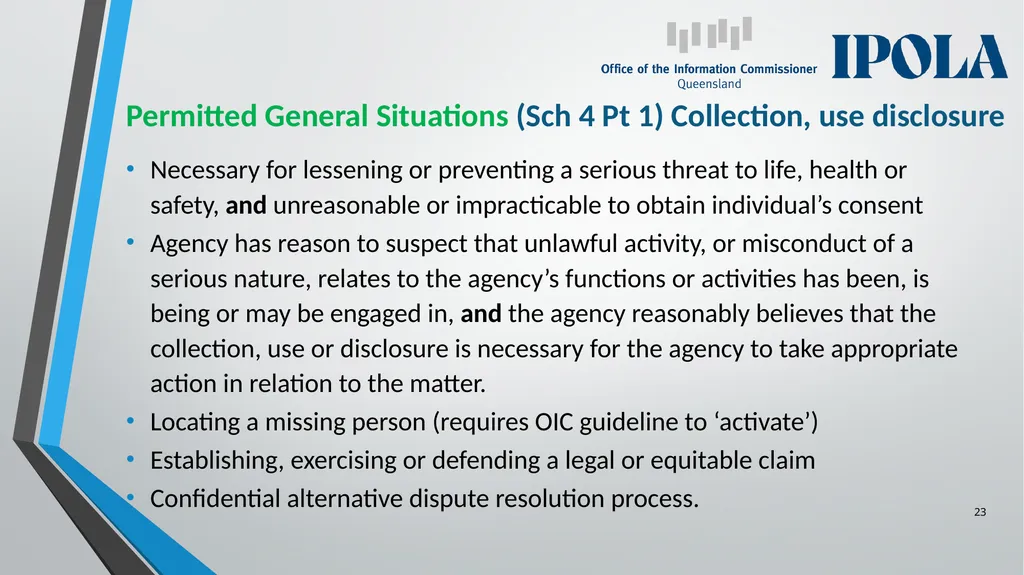
Permitted General Situations (Sch 4 Pt 1) Collection, use disclosure Necessary for lessening or preventing a serious threat to life, health or safety, and unreasonable or impracticable to obtain individual’s consent
Agency has reason to suspect that unlawful activity, or misconduct of a serious nature, relates to the agency’s functions or activities has been, is being or may be engaged in, and the agency reasonably believes that the collection, use or disclosure is necessary for the agency to take appropriate action in relation to the matter.
Locating a missing person (requires OIC guideline to ‘activate’)
Establishing, exercising or defending a legal or equitable claim
Confidential alternative dispute resolution process. 23<br>
Agency has reason to suspect that unlawful activity, or misconduct of a serious nature, relates to the agency’s functions or activities has been, is being or may be engaged in, and the agency reasonably believes that the collection, use or disclosure is necessary for the agency to take appropriate action in relation to the matter.
Locating a missing person (requires OIC guideline to ‘activate’)
Establishing, exercising or defending a legal or equitable claim
Confidential alternative dispute resolution process. 23<br>
24
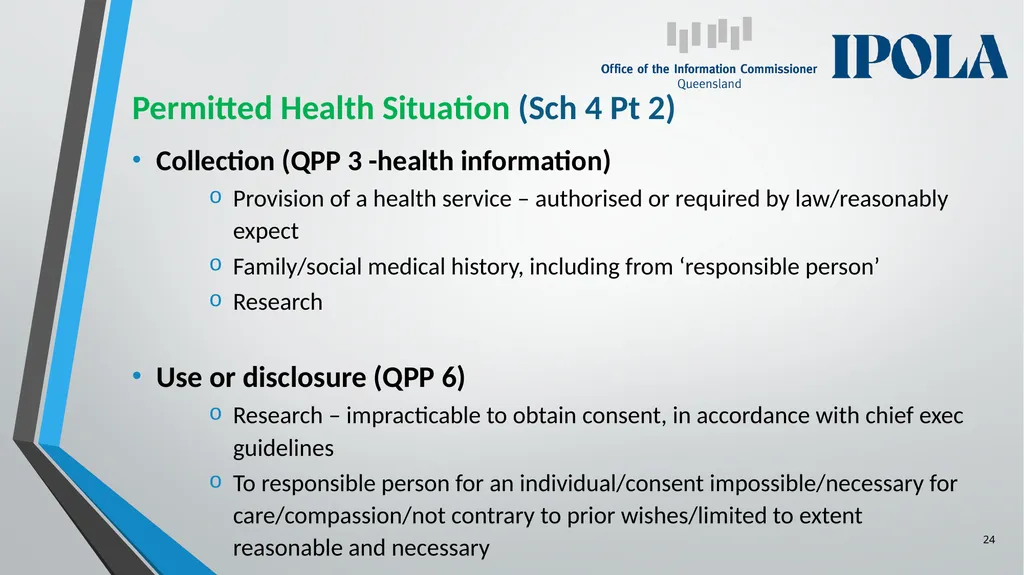
Permitted Health Situation (Sch 4 Pt 2) Collection (QPP 3 -health information)
Provision of a health service – authorised or required by law/reasonably expect
Family/social medical history, including from ‘responsible person’
Research
Use or disclosure (QPP 6)
Research – impracticable to obtain consent, in accordance with chief exec guidelines
To responsible person for an individual/consent impossible/necessary for care/compassion/not contrary to prior wishes/limited to extent reasonable and necessary 24<br>
Provision of a health service – authorised or required by law/reasonably expect
Family/social medical history, including from ‘responsible person’
Research
Use or disclosure (QPP 6)
Research – impracticable to obtain consent, in accordance with chief exec guidelines
To responsible person for an individual/consent impossible/necessary for care/compassion/not contrary to prior wishes/limited to extent reasonable and necessary 24<br>
25
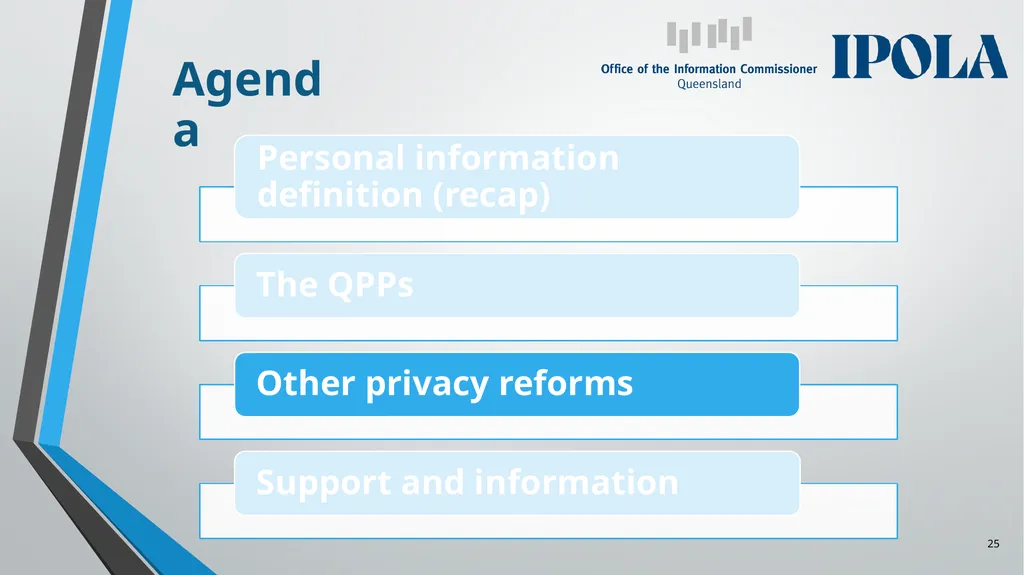
Agenda 25<br>
26
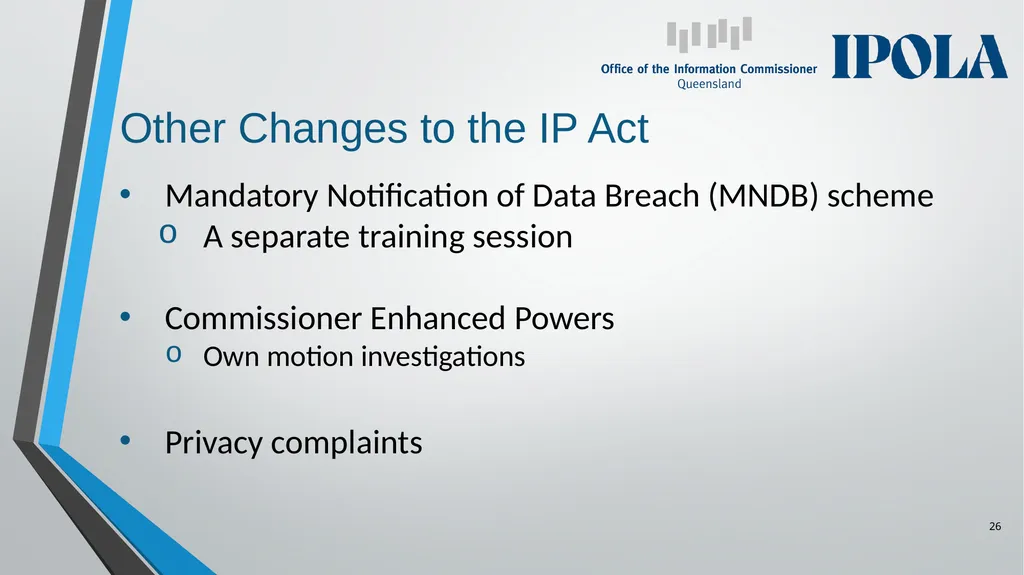
Other Changes to the IP Act Mandatory Notification of Data Breach (MNDB) scheme
A separate training session
Commissioner Enhanced Powers
Own motion investigations
Privacy complaints 26<br>
A separate training session
Commissioner Enhanced Powers
Own motion investigations
Privacy complaints 26<br>
27
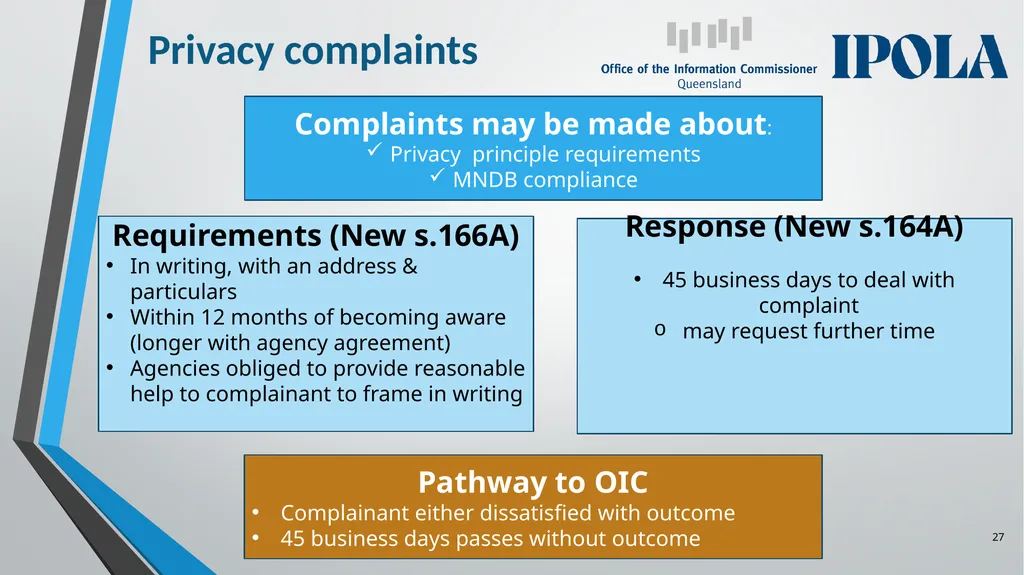
Privacy complaints Complaints may be made about:
Privacy principle requirements
MNDB compliance Requirements (New s.166A)
In writing, with an address & particulars
Within 12 months of becoming aware (longer with agency agreement)
Agencies obliged to provide reasonable help to complainant to frame in writing Response (New s.164A)
45 business days to deal with complaint
may request further time Pathway to OIC
Complainant either dissatisfied with outcome
45 business days passes without outcome 27<br>
Privacy principle requirements
MNDB compliance Requirements (New s.166A)
In writing, with an address & particulars
Within 12 months of becoming aware (longer with agency agreement)
Agencies obliged to provide reasonable help to complainant to frame in writing Response (New s.164A)
45 business days to deal with complaint
may request further time Pathway to OIC
Complainant either dissatisfied with outcome
45 business days passes without outcome 27<br>
28
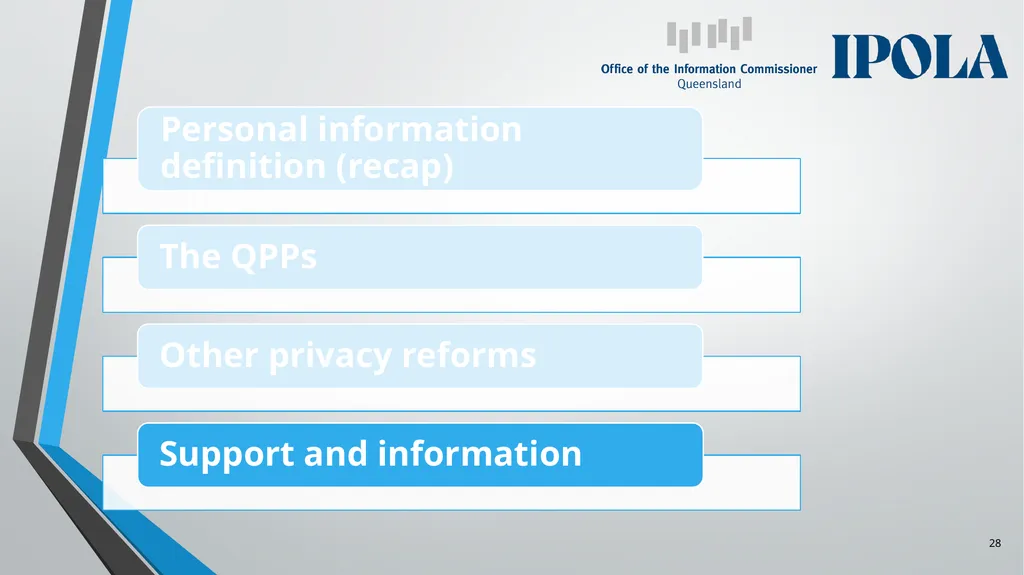
28<br>
29
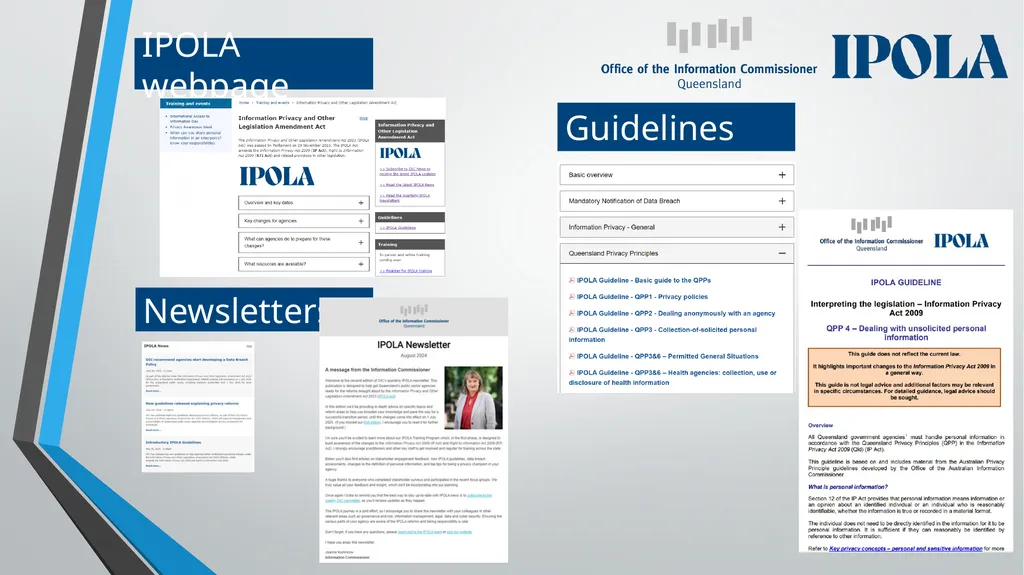
IPOLA webpage Guidelines Newsletters 29<br>
30
We are available to answer questions and provide advice Email: IPOLA.Project@oic.qld.gov.au
Enquiry Service: 07 3234 7373 30<br>
Enquiry Service: 07 3234 7373 30<br>