
Information technology in India From Wikipedia,
KB
Published · 6 slides · 0 views
1 / 1



Description
Information technology in India From Wikipedia, the free encyclopedia Infosys Media Centre in Bangalore, India. Infosys is one of the largest Indian IT companies. Tidel Park in Chennai was the largest IT park in Asia when it was opened in
Related Topics
Share
Embed code
Download this presentation From Below
"Information technology in India From Wikipedia," is the property of its rightful owner. Permission is granted to download and print the materials on this website for personal, non-commercial use only, and to display it on your personal computer provided you do not modify the materials and that you retain all copyright notices contained in the materials. By downloading content from our website, you accept the terms of this agreement.
Presentation Transcript
01
Information technology in India
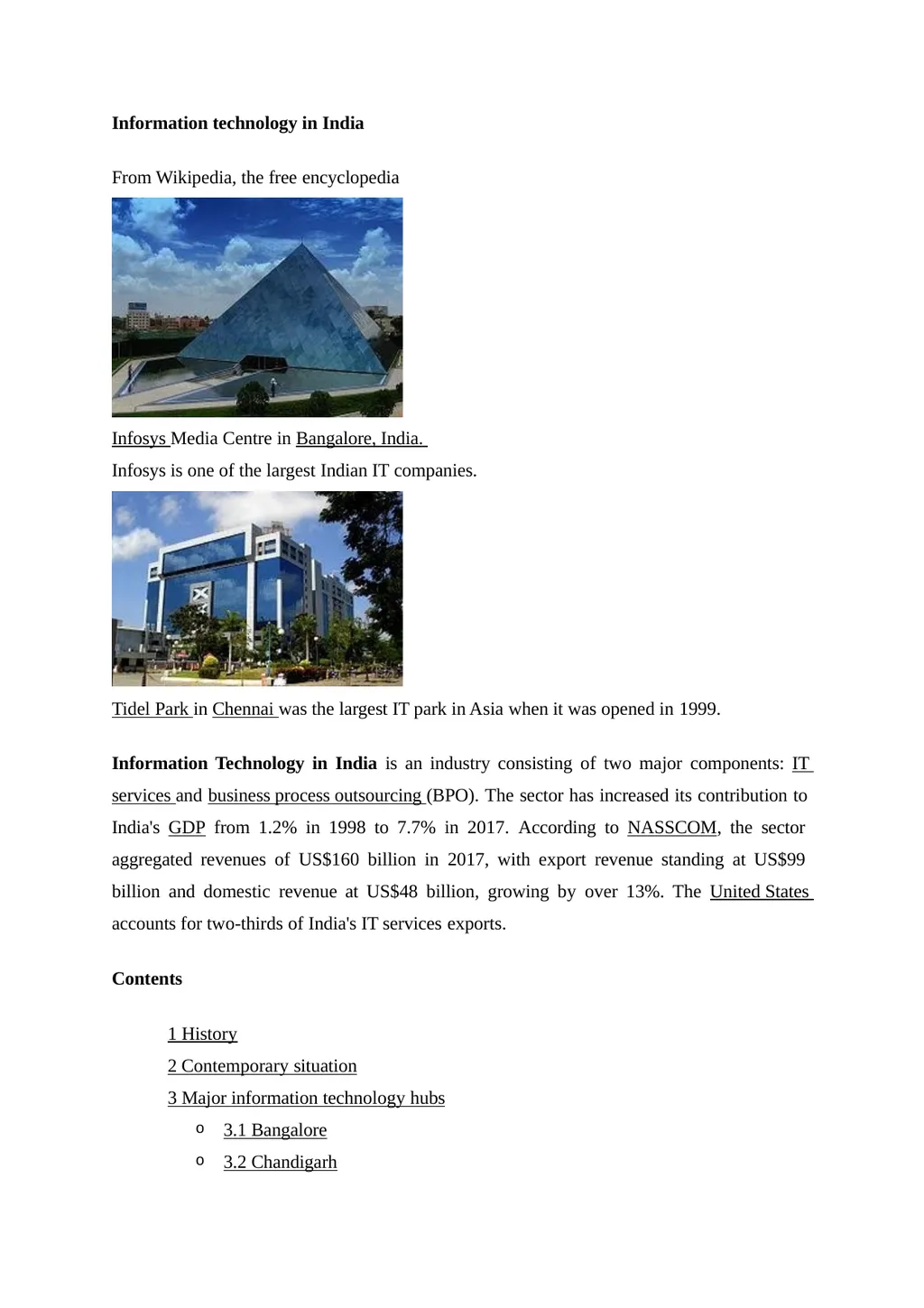
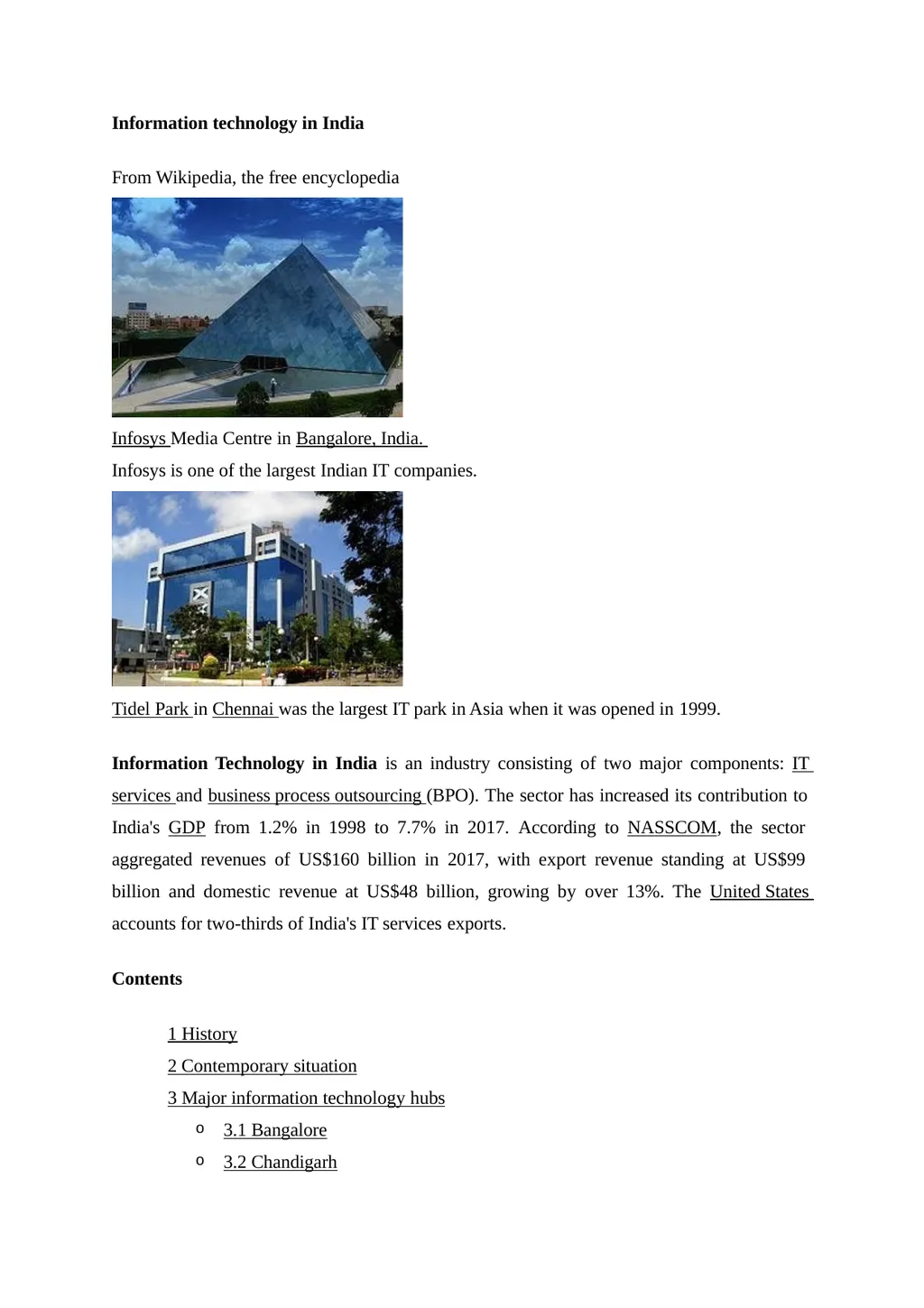
From Wikipedia, the free encyclopedia Infosys Media Centre in Bangalore, India. Infosys is one of the largest Indian IT companies. Tidel Park in Chennai was the largest IT park in Asia when it was opened in 1999.
Information Technology in India is an industry consisting of two major components: IT services and business process outsourcing (BPO). The sector has increased its contribution to India's GDP from 1.2% in 1998 to 7.7% in 2017. According to NASSCOM, the sector aggregated revenues of US$160 billion in 2017, with export revenue standing at US$99 billion and domestic revenue at US$48 billion, growing by over 13%. The United States accounts for two-thirds of India's IT services exports.
Contents
1 History
2 Contemporary situation
3 Major information technology hubs
3.1 Bangalore
3.2 Chandigarh<br>
02
3.3 Chennai
3.4 Hyderabad
3.5 Kochi
3.6 Pune
4 Employment generation
5 See also
6 References
o 6.1 Sources History
India's IT Services industry was born in Mumbai in 1967 with the establishment of the Tata Group in partnership with Burroughs. The first software export zone, SEEPZ – the precursor to the modern-day IT park – was established in Mumbai in 1973. More than 80 percent of the country's software exports were from SEEPZ in the 1980s.
The Indian economy underwent major economic reforms in 1991, leading to a new era of globalization and international economic integration, and annual economic growth of over 6% from 1993–2002. The new administration under Sri Atal Bihari Vajpayee (Posthumus) (who was Prime Minister from 1998–2004) placed the development of Information Technology among its top five priorities and formed the Indian National Task Force on Information Technology and Software Development.
Wolcott & Goodman (2003) report on the role of the Indian National Task Force on Information Technology and Software Development:
Within 90 days of its establishment, the Task Force produced an extensive background report on the state of technology in India and an IT Action Plan with 108 recommendations. The Task Force could act quickly because it built upon the experience and frustrations of state governments, central government agencies, universities, and the software industry. Much of what it proposed was also consistent with the thinking and recommendations of international bodies like the World Trade Organization (WTO), International Telecommunications Union (ITU), and World Bank. In addition, the Task Force incorporated the experiences of<br>
03
Singapore and other nations, which implemented similar programs. It was less a task of invention than of sparking action on a consensus that had already evolved within the networking community and government.
Regulated VSAT links became visible in 1994. Desai (2006) describes the steps taken to relax regulations on linking in 1991:
In 1991 the Department of Electronics broke this impasse, creating a corporation called Software Technology Parks of India (STPI) that, being owned by the government, could provide VSAT communications without breaching its monopoly. STPI set up software technology parks in different cities, each of which provided satellite links to be used by firms; the local link was a wireless radio link. In 1993 the government began to allow individual companies their own dedicated links, which allowed work done in India to be transmitted abroad directly. Indian firms soon convinced their American customers that a satellite link was as reliable as a team of programmers working in the clients’ office.
Videsh Sanchar Nigam Limited (VSNL) introduced Gateway Electronic Mail Service in 1991, the 64 kbit/s leased line service in 1992, and commercial Internet access on a visible scale in 1992. Election results were displayed via National Informatics Centre's NICNET.
"The New Telecommunications Policy, 1999" (NTP 1999) helped further liberalize India's telecommunications sector. The Information Technology Act, 2000 created legal procedures for electronic transactions and e-commerce.
A joint EU-India group of scholars was formed on 23 November 2001 to further promote joint research and development. On 25 June 2002, India and the European Union agreed to bilateral cooperation in the field of science and technology. India holds observer status at CERN, while a joint India-EU Software Education and Development Center will be located in Bangalore.[9]
Contemporary situation
In the contemporary world economy, India is the largest exporter of IT. Exports dominate the Indian IT industry and constitute about 79% of the industry's total revenue. However, the domestic market is also significant, with robust revenue growth. The industry’s share of total Indian exports (merchandise plus services) increased from less than 4% in FY1998 to about<br>
04
25% in FY2012. The technologically-inclined services sector in India accounts for 40% of the country's GDP and 30% of export earnings as of 2006, while employing only 25% of its workforce, according to Sharma (2006). According to Gartner, the "Top Five Indian IT Services Providers" are Tata Consultancy Services, Infosys, Wipro, and HCL Technologies.[10]
Major information technology hubs Bangalore
Bangaluru is known as the Silicon Valley of India. [11][12] Notable tech park are Electronics City Phase I & II, ITPL, Bagmane Tech Park, Embassy Golf Links, Manyata Tech Park, Global Village Tech Park, Embassy TechVillage.
Chandigarh
Chandigarh is also one of the growing international IT services and outsourcing exporters. The next upcoming tech park will be a world trade center.
Chennai
As of 2012, Chennai is India's second-largest exporter of information technology (IT) and business process outsourcing (BPO) services. Tidel Park in Chennai was billed as Asia's largest IT park when it was built. Major software companies have their offices set up here, with some of them making Chennai their largest base.
Hyderabad
Hyderabad – known for the HITEC City or Cyberabad – is a major global information technology hub and the largest bioinformatics hub in India.[yderabad has emerged as the second-largest city in the country for software exports pipping competitors Chennai and Pune. Notable tech and pharma parks are HITEC City, Genome Valley, and Hyderabad Pharma City<br>
05
Kochi
Infopark, Kochi or Cochin is an information technology park situated in the city of Kochi, Kerala, India. Established in 2004 by the Government of Kerala, the park is spread over 260 acres (105.2 ha) of campus across two phases, housing 392 companies that employ more than 42,000 professionals as of 2018. The park is built on the 'Hub and Spoke model' for the development of the Information Technology industry in Kerala. InfoPark Kochi acts as the hub to the spokes located at Thrissur and Cherthala. Considering the requests of various IT companies and developers for space and land, Infopark Kochi is expanding its activities in Infopark Phase II. This campus is at a distance of around 2 km from Phase I campus and is on the side of Kadamprayar river. The new park lies in an extent of 160 acres in the neighboring Kunnathunad- Puthencruz villages of Kunnathunad Taluk, Ernakulam District. The Board of Approvals (BoA) of the Union Ministry of Commerce has granted SEZ status to the 98 acres in Infopark phase II. As per the latest data reported, total IT exports from Kochi stands at 6200 crore
Pune
The Rajiv Gandhi Infotech Park in Hinjawadi is a ₹600-billion (US$ 8.9 billion) project by the Maharashtra Industrial Development Corporation (MIDC).[The IT Park encompasses an area of about 2,800 acres (11 km2) and is home to over 800 IT companies of all sizes. Besides Hinjawadi, IT companies are also located at Magarpatta, Kharadi and several other parts of the city. As of 2017, the IT sector employs more than 300,000 people
Employment generation
India's growing stature in the Information Age enabled it to form close ties with both the United States and the European Union. However, the recent global financial crises have deeply impacted Indian IT companies as well as global companies. As a result, hiring has dropped sharply, and employees are looking at different sectors like financial services, telecommunications, and manufacturing, which have been growing phenomenally over the last few years.
With fundamental structural changes visible everywhere in the IT services due to Cloud computing, a proliferation of Social media, Big data, Analytics all leading to digital services<br>
06
and digital economy, many of the leading companies in India's IT sector reported lower headcounts in their financial results.<br>