04
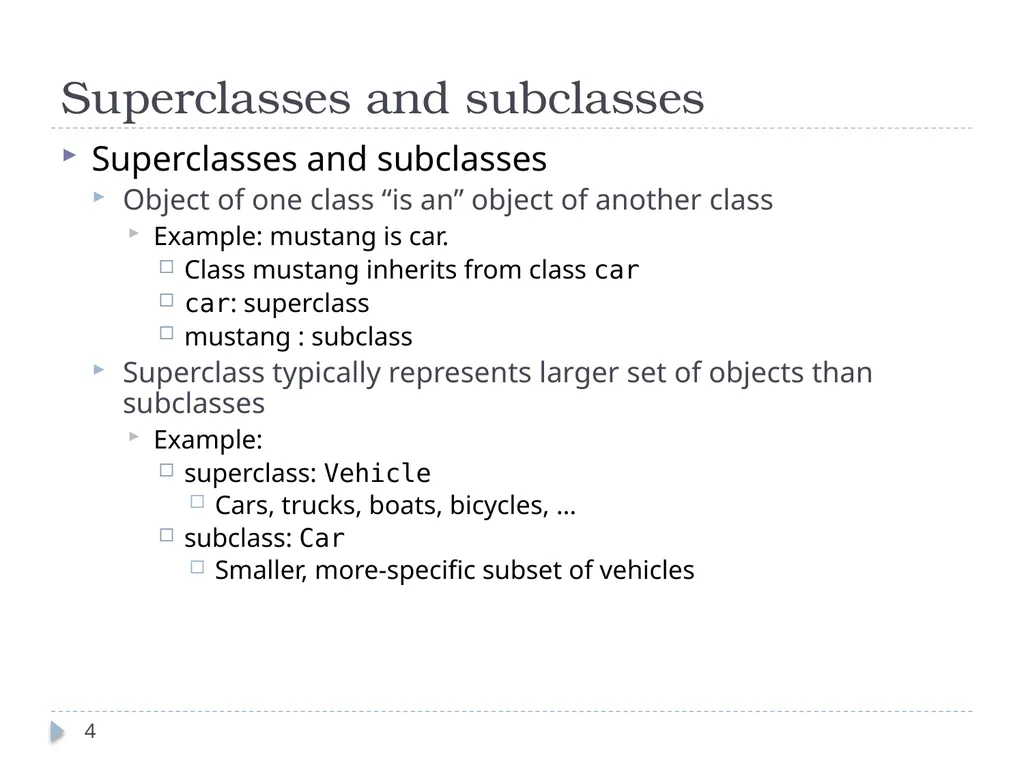
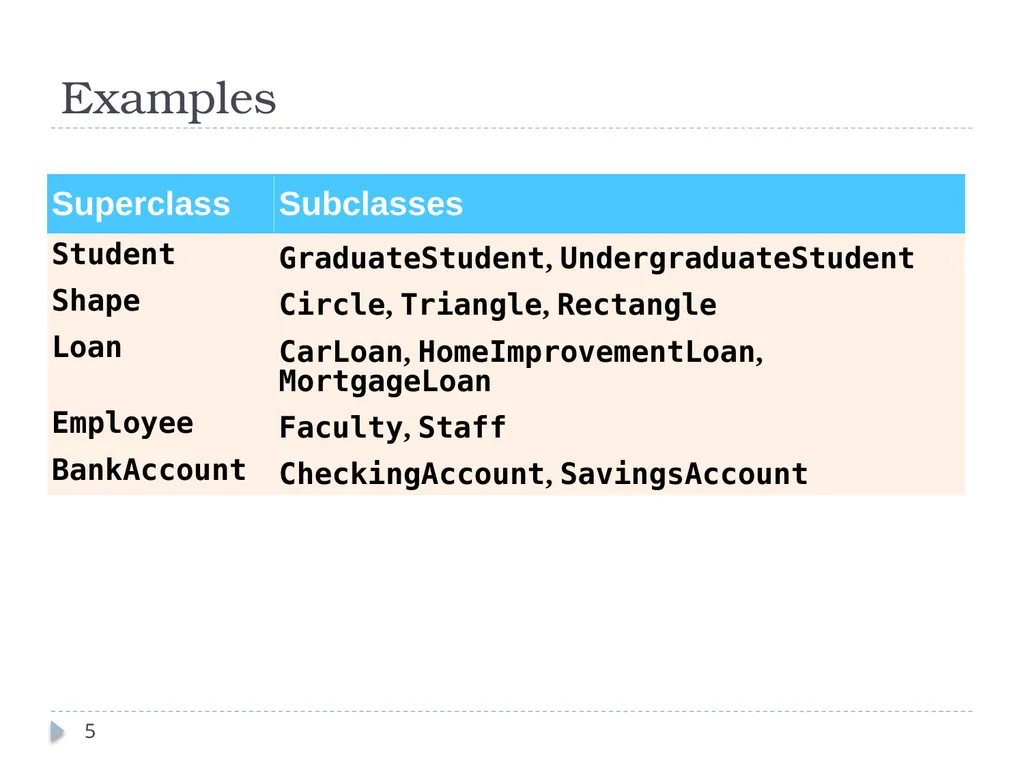
Superclasses and subclasses 4 Superclasses and subclasses
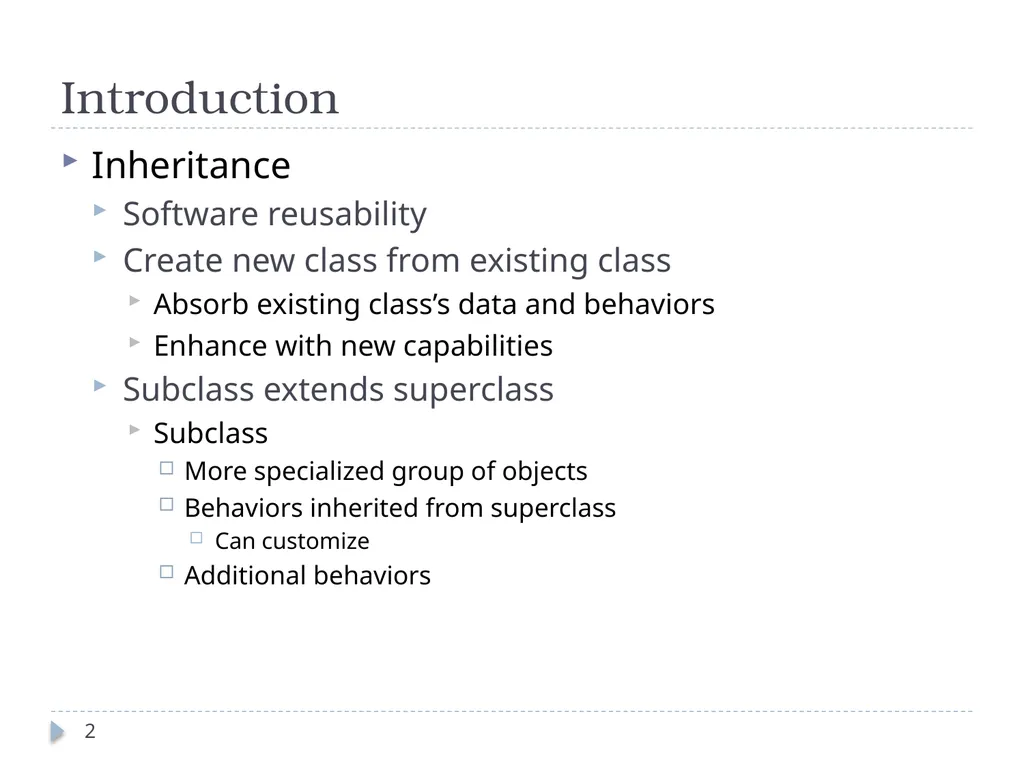
Object of one class “is an” object of another class
Example: mustang is car.
Class mustang inherits from class car
car: superclass
mustang : subclass
Superclass typically represents larger set of objects than subclasses
Example:
superclass: Vehicle
Cars, trucks, boats, bicycles, …
subclass: Car
Smaller, more-specific subset of vehicles<br>
06
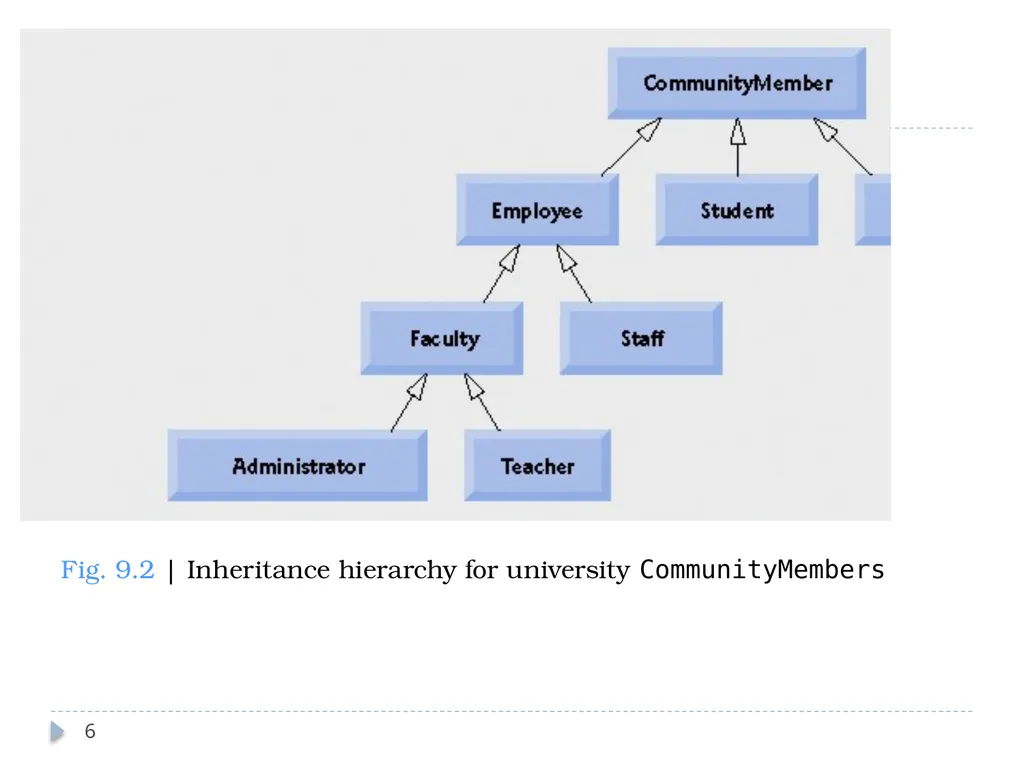
Fig. 9.2 | Inheritance hierarchy for university CommunityMembers 6<br>
07
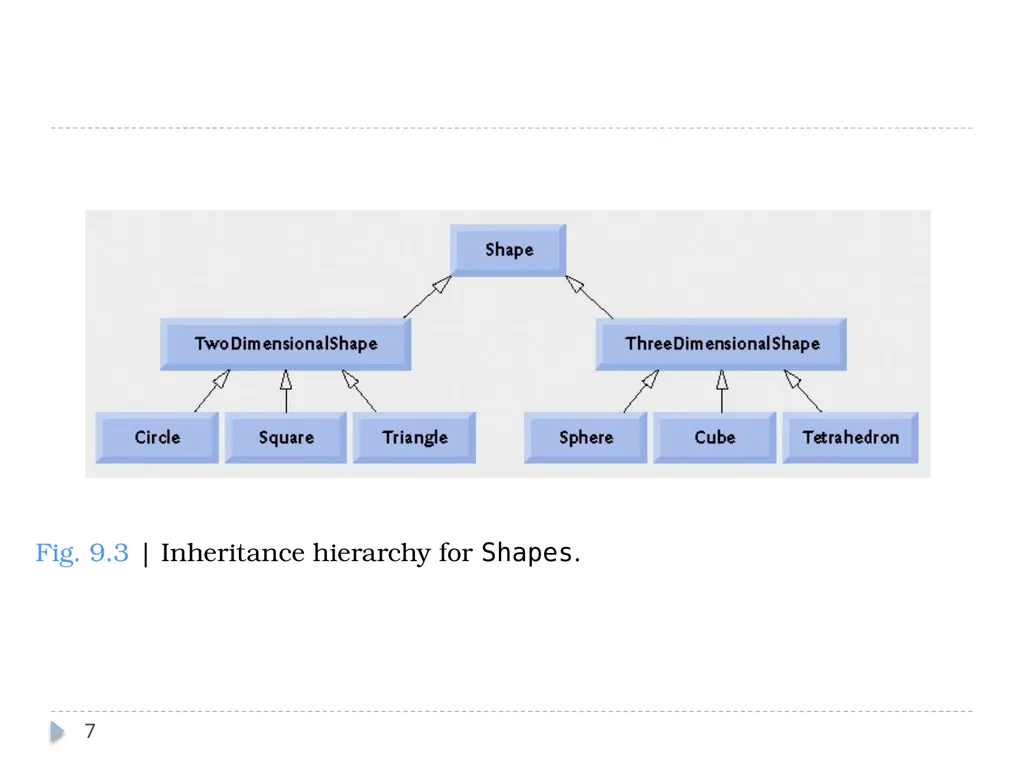
Fig. 9.3 | Inheritance hierarchy for Shapes. 7<br>
08
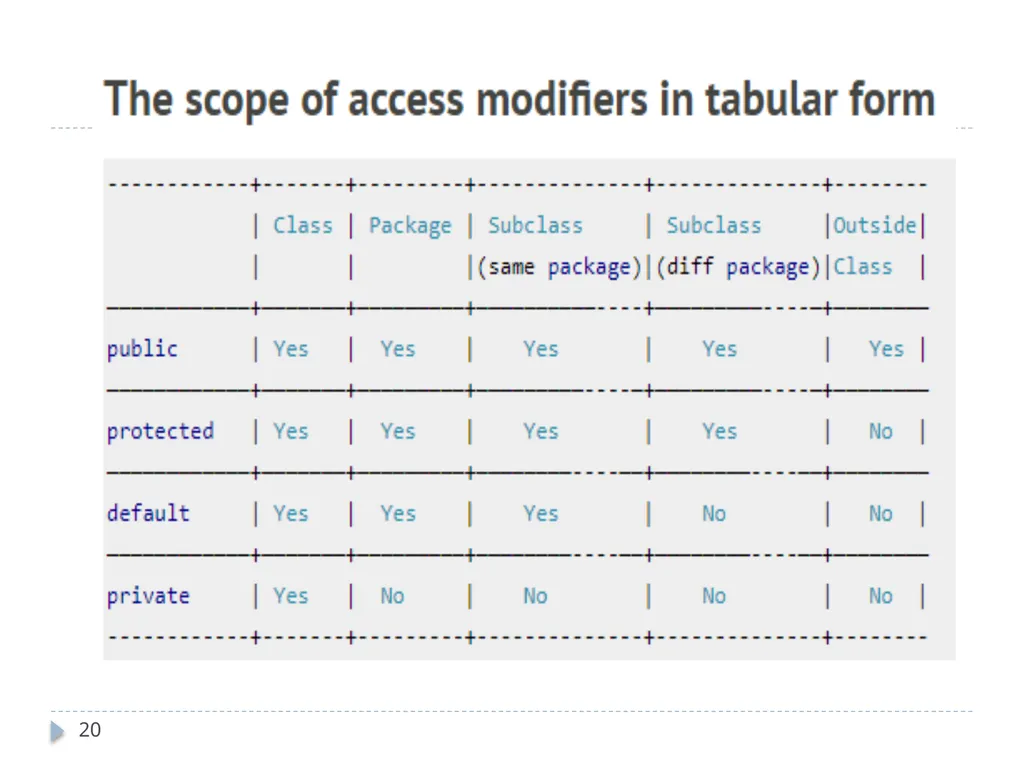
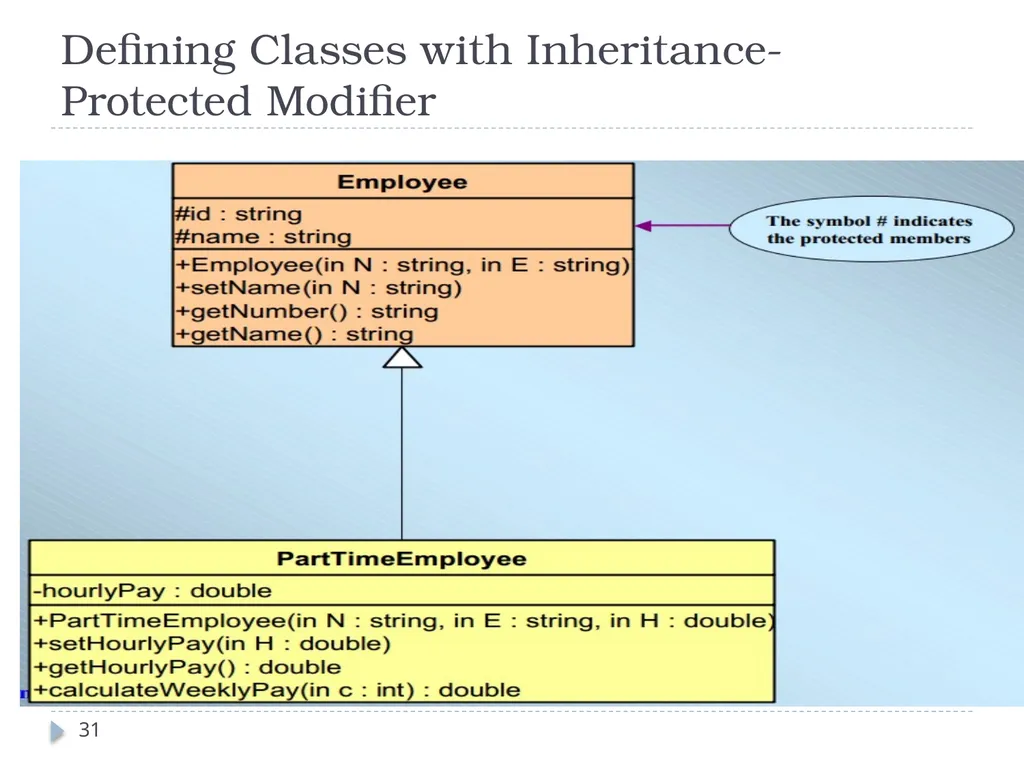
Modifiers in inheritance 8 Protected (#) makes a data member or method visible and accessible to the instances of the class and the descendant classes (subclasses).
Public (+) data members and methods are accessible to everyone.
Private(-) data members and methods are accessible only to instances of the class.<br>
09
9 The derived class inherits all the members and methods that are declared as public or protected. If the members or methods of super class are declared as private then the derived class cannot use them directly. The private members can be accessed only in its own class. Such private members can only be accessed using public or protected getter and setter methods of super class as shown in the example below.<br>
10
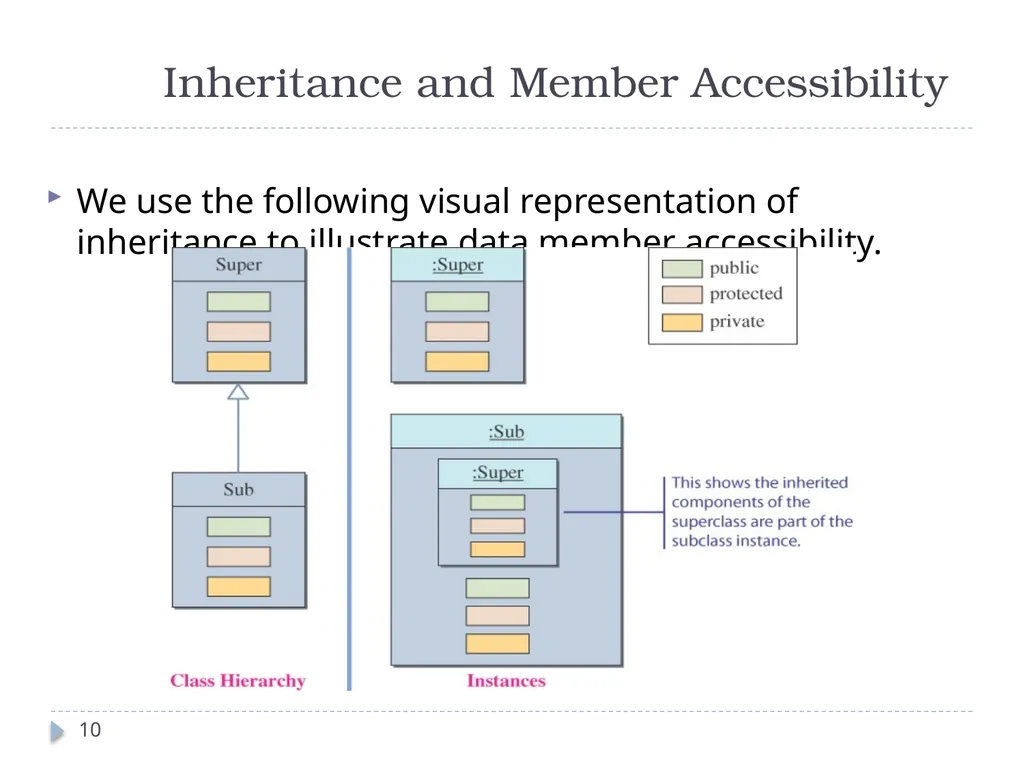
Inheritance and Member Accessibility 10 We use the following visual representation of inheritance to illustrate data member accessibility.<br>
11
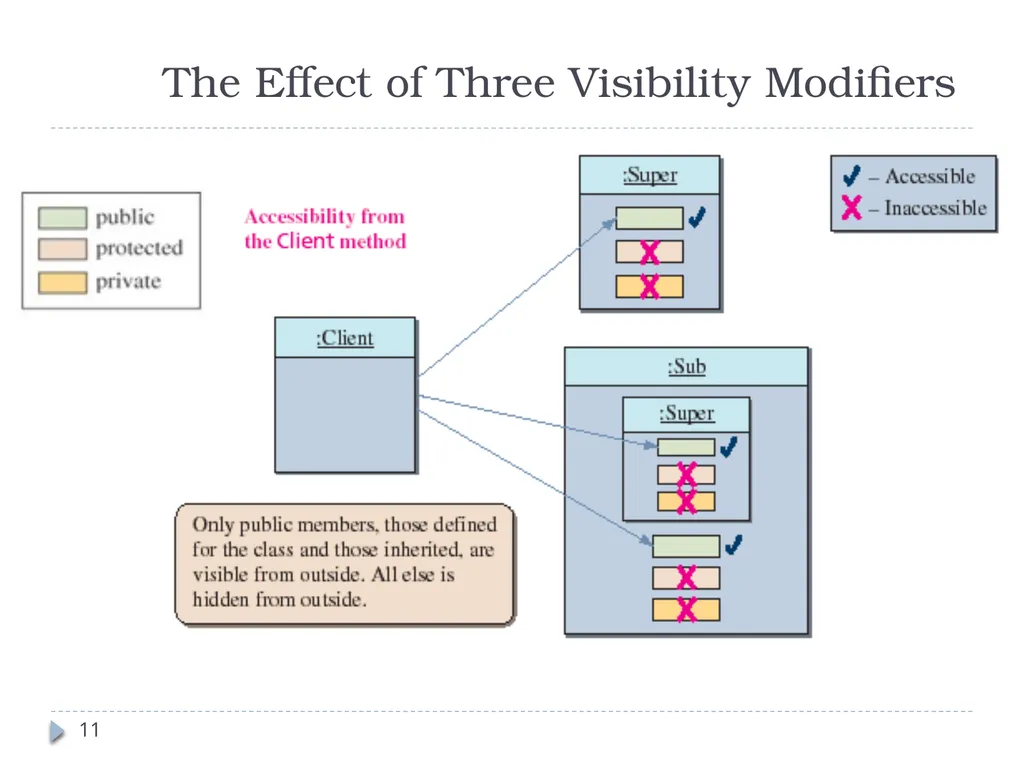
The Effect of Three Visibility Modifiers 11<br>
12
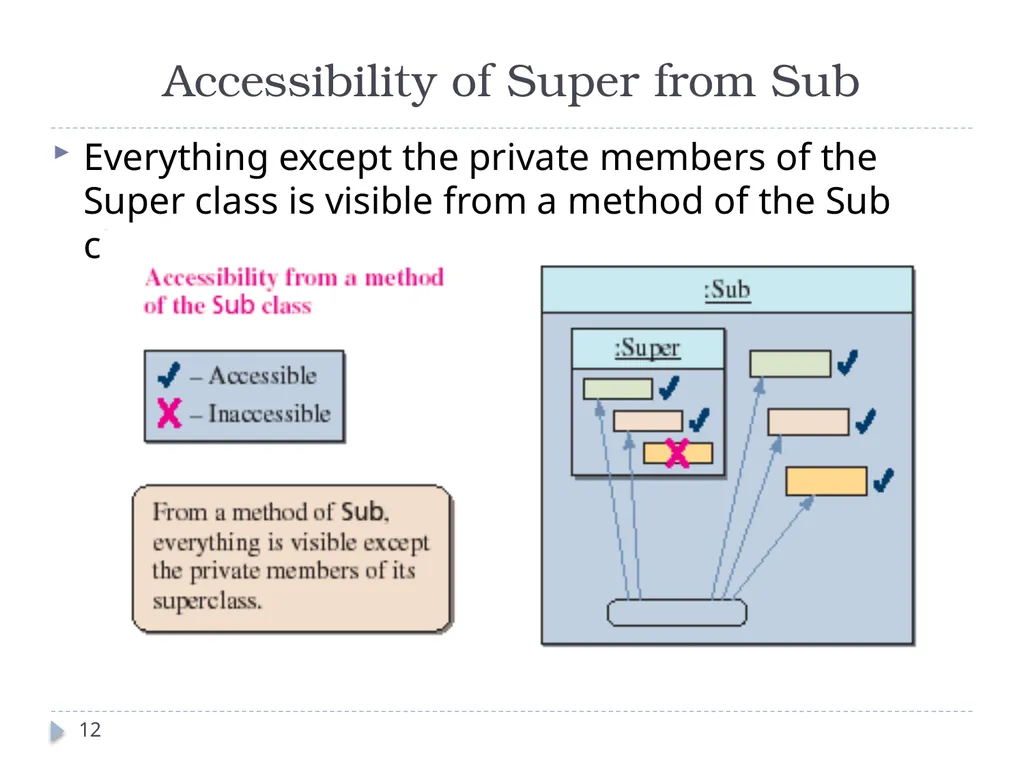
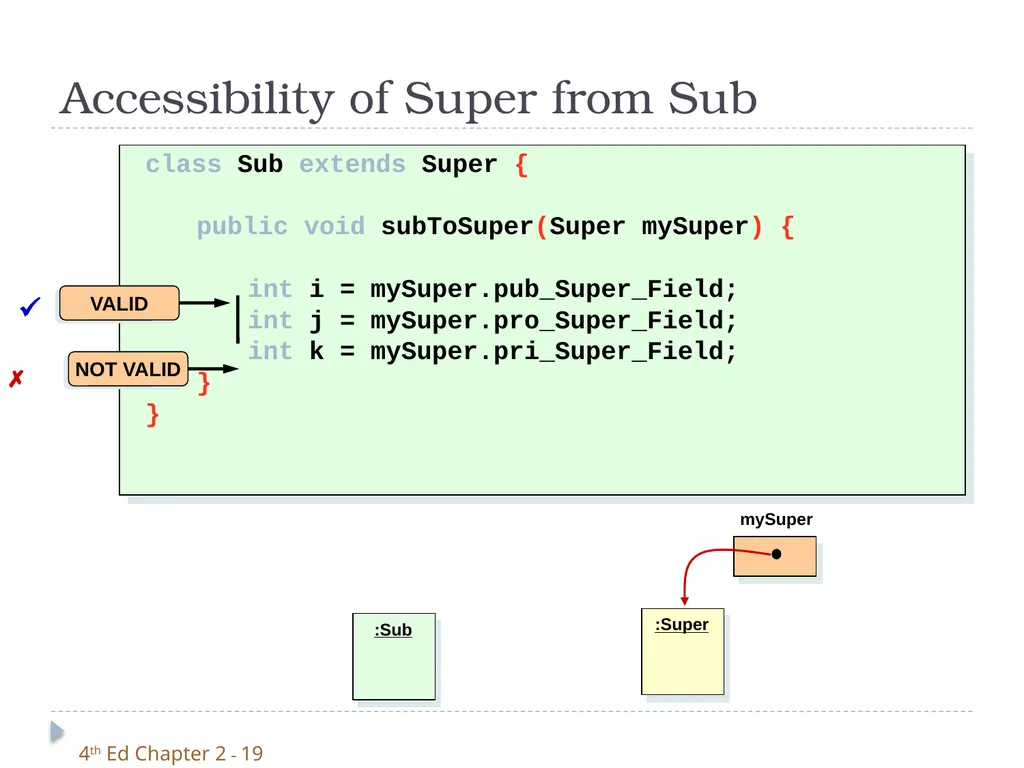
Accessibility of Super from Sub 12 Everything except the private members of the Super class is visible from a method of the Sub class.<br>
13
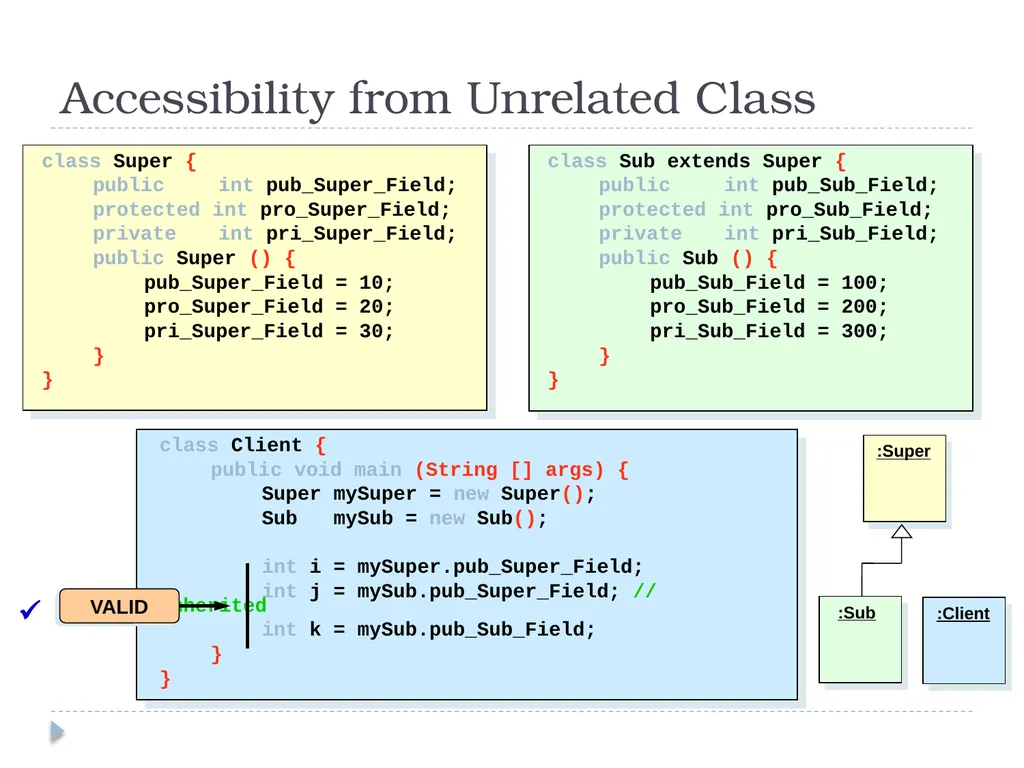
Accessibility from Unrelated Class <br>
14
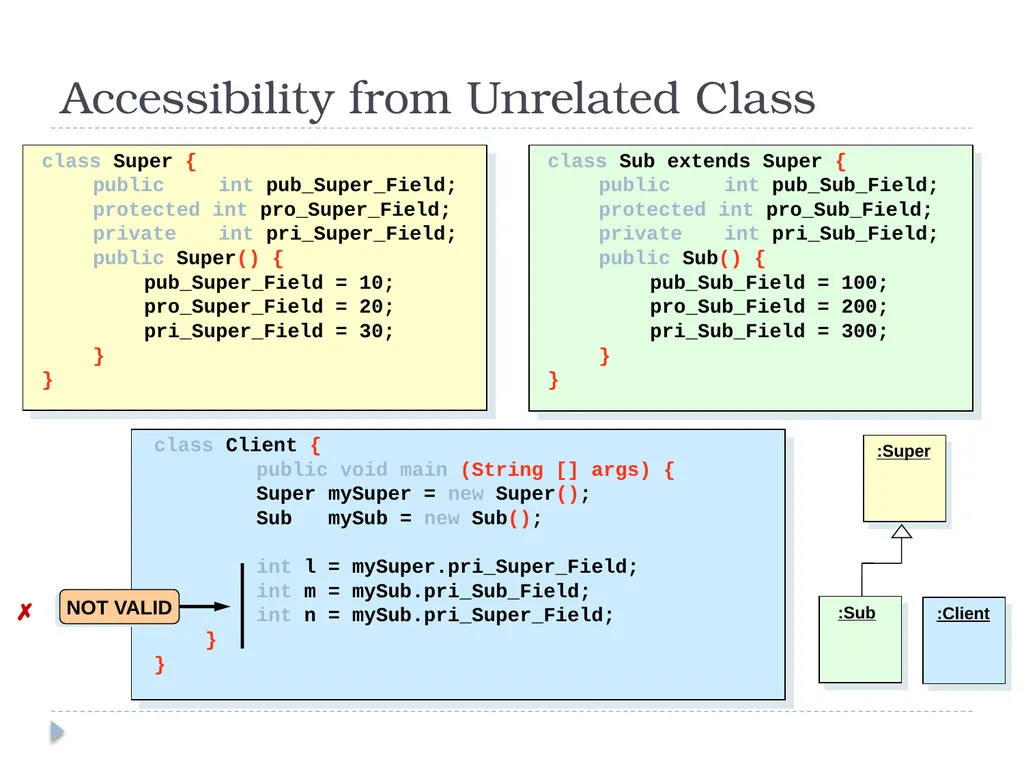
Accessibility from Unrelated Class <br>
15
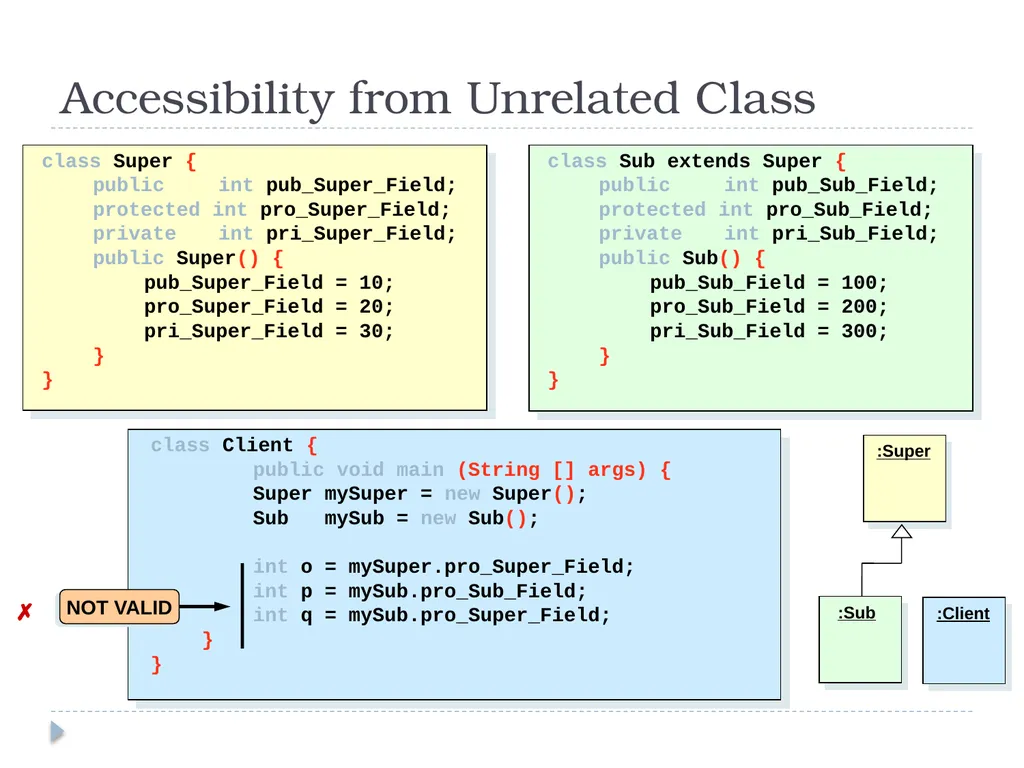
Accessibility from Unrelated Class <br>
16
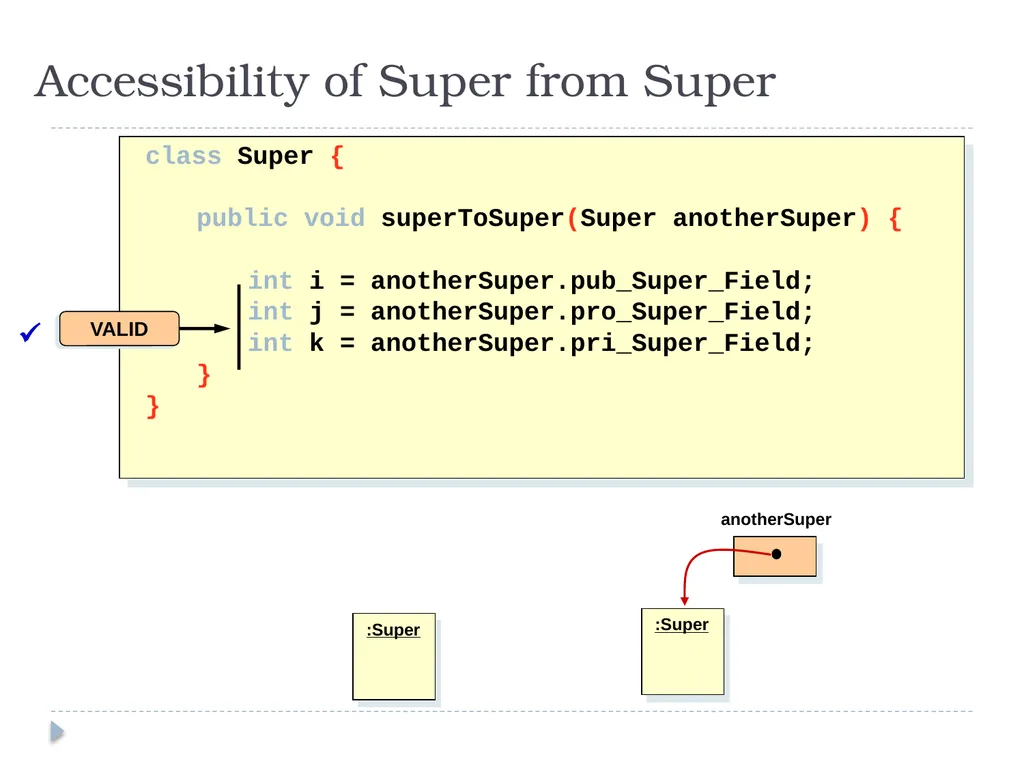
Accessibility of Super from Super <br>
17
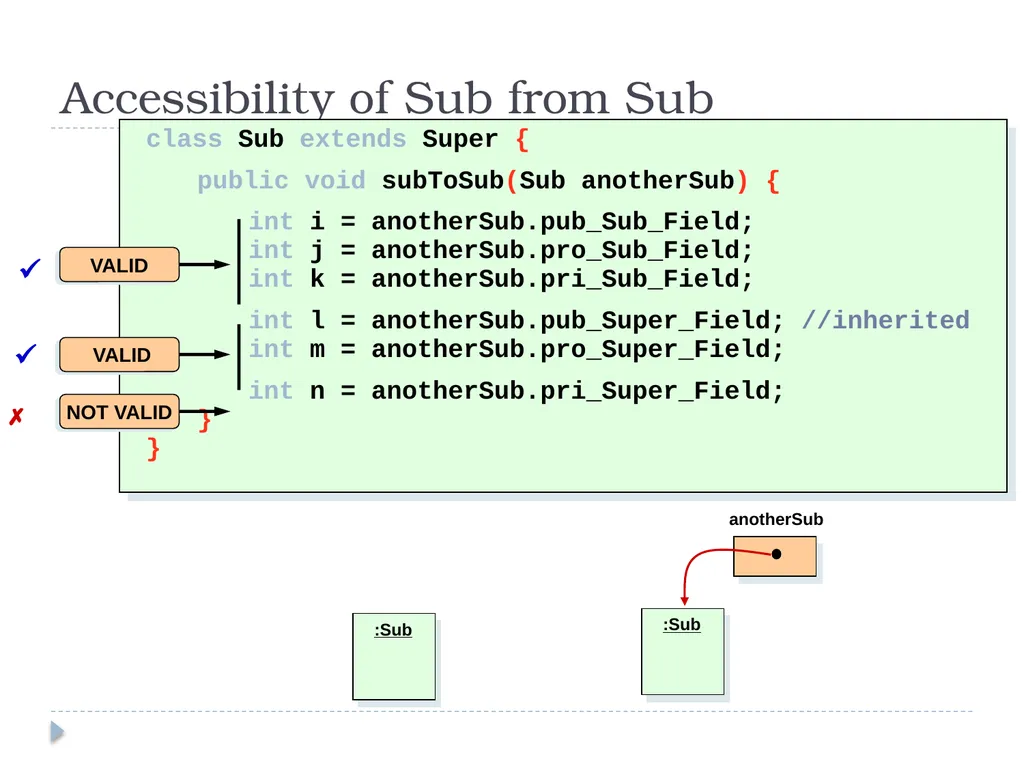
Accessibility of Sub from Sub <br>
18
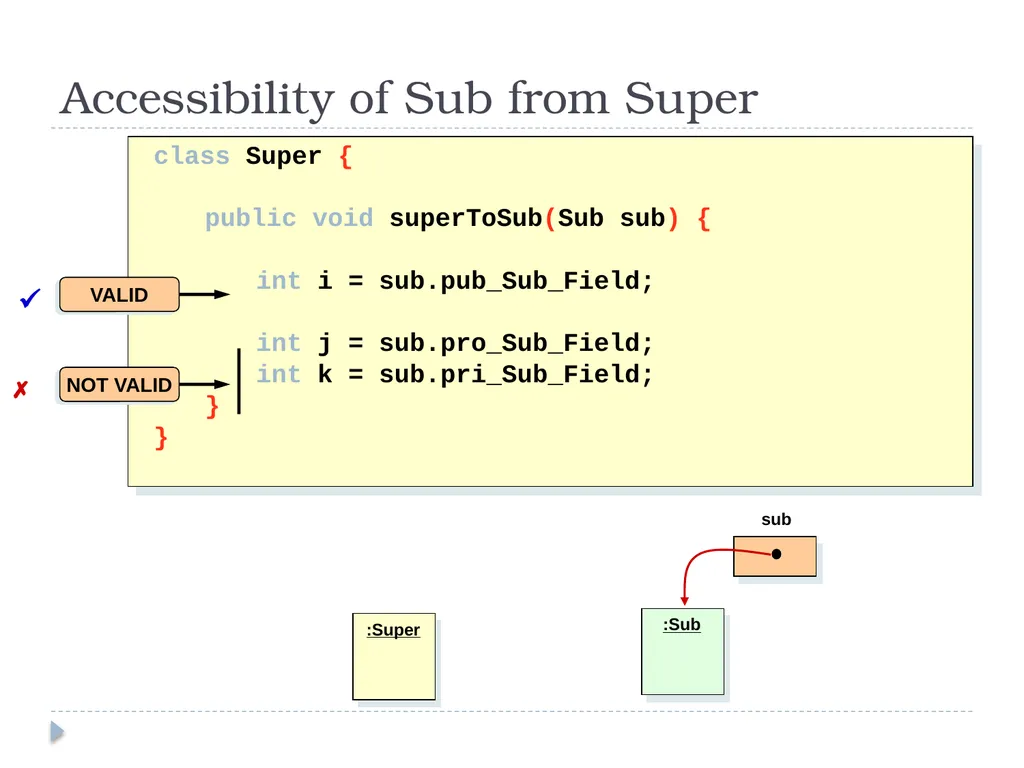
Accessibility of Sub from Super <br>
19
Accessibility of Super from Sub 4th Ed Chapter 2 - 19 <br>
21
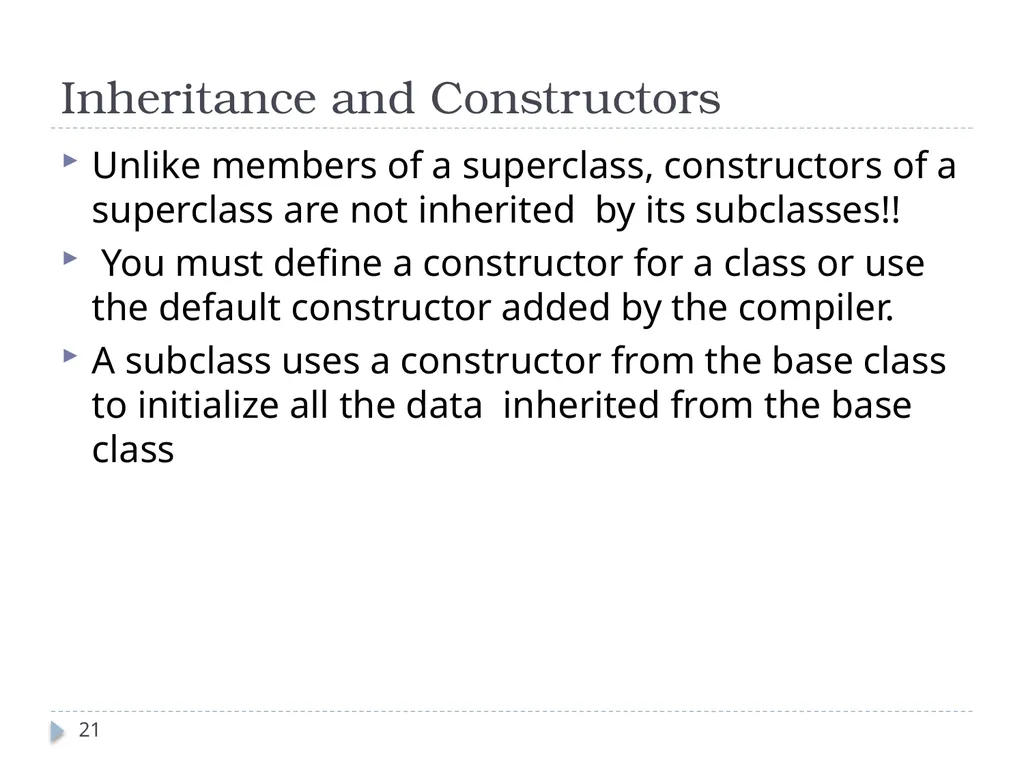
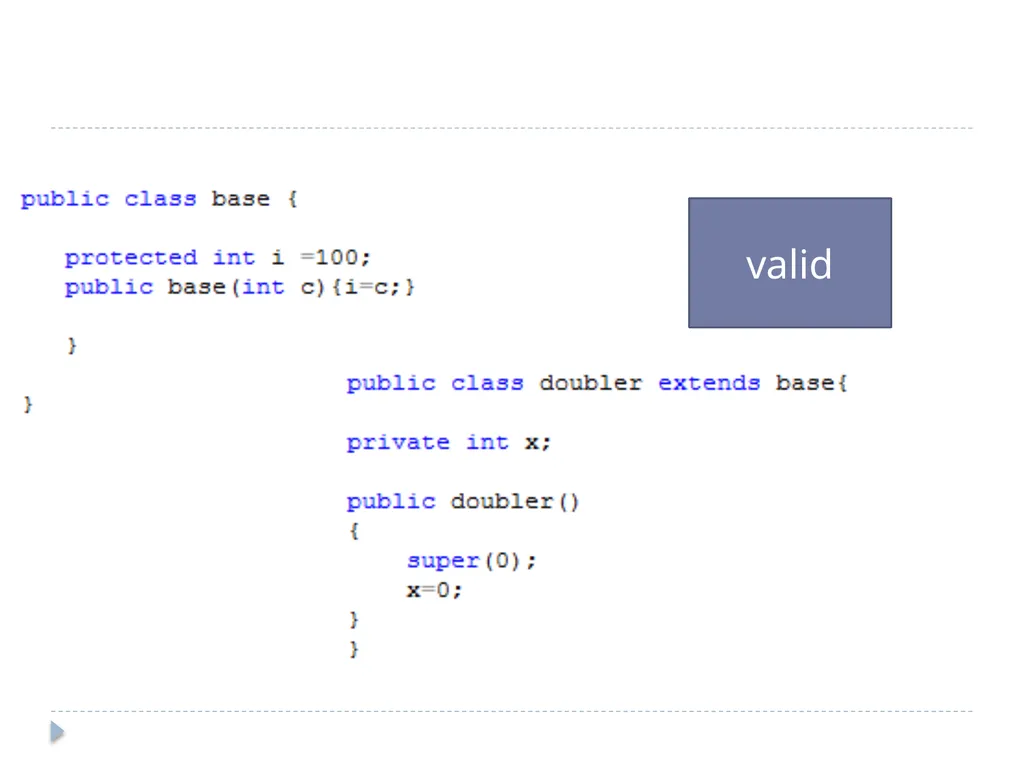
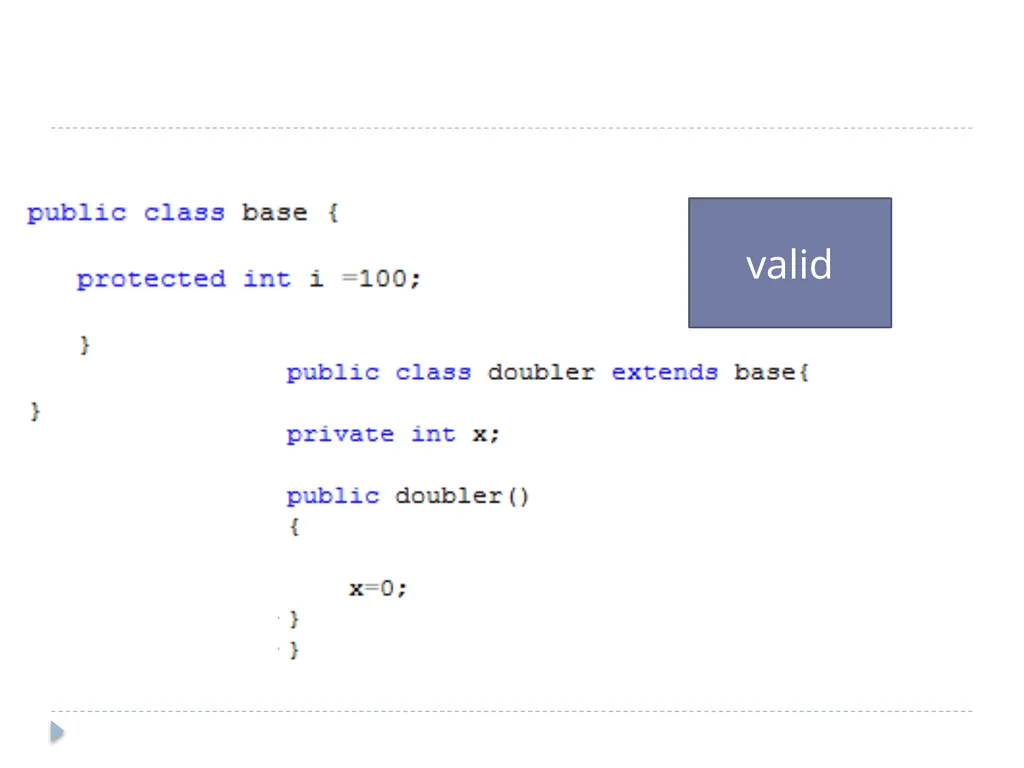
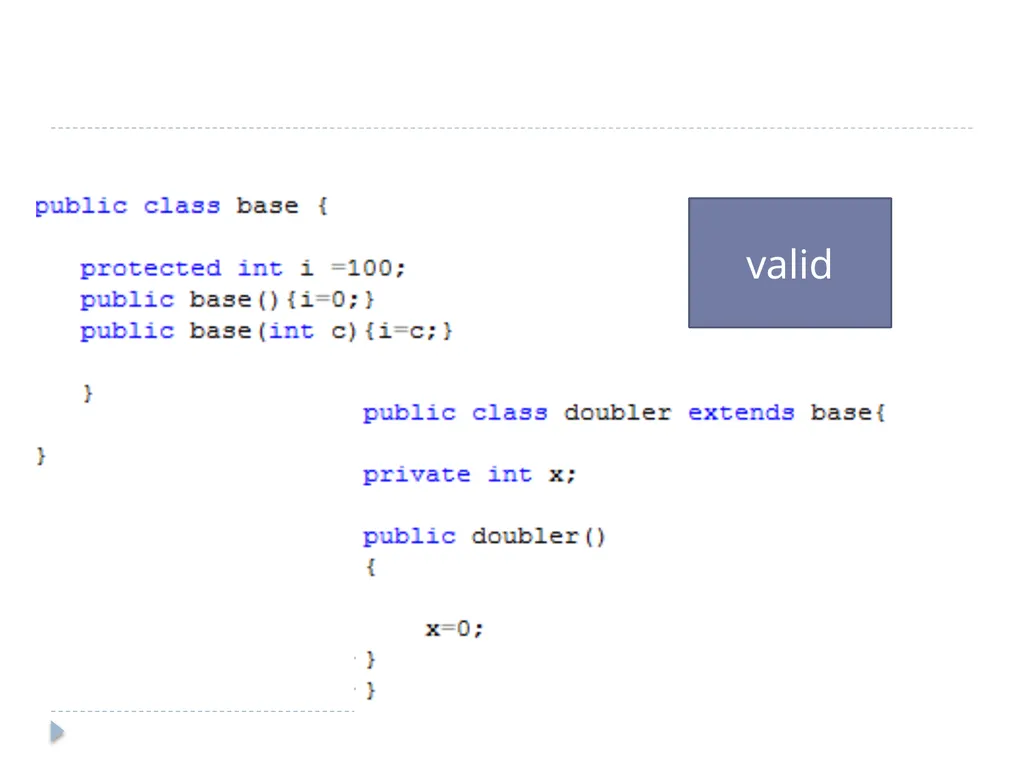
Inheritance and Constructors 21 Unlike members of a superclass, constructors of a superclass are not inherited by its subclasses!!
You must define a constructor for a class or use the default constructor added by the compiler.
A subclass uses a constructor from the base class to initialize all the data inherited from the base class<br>
22
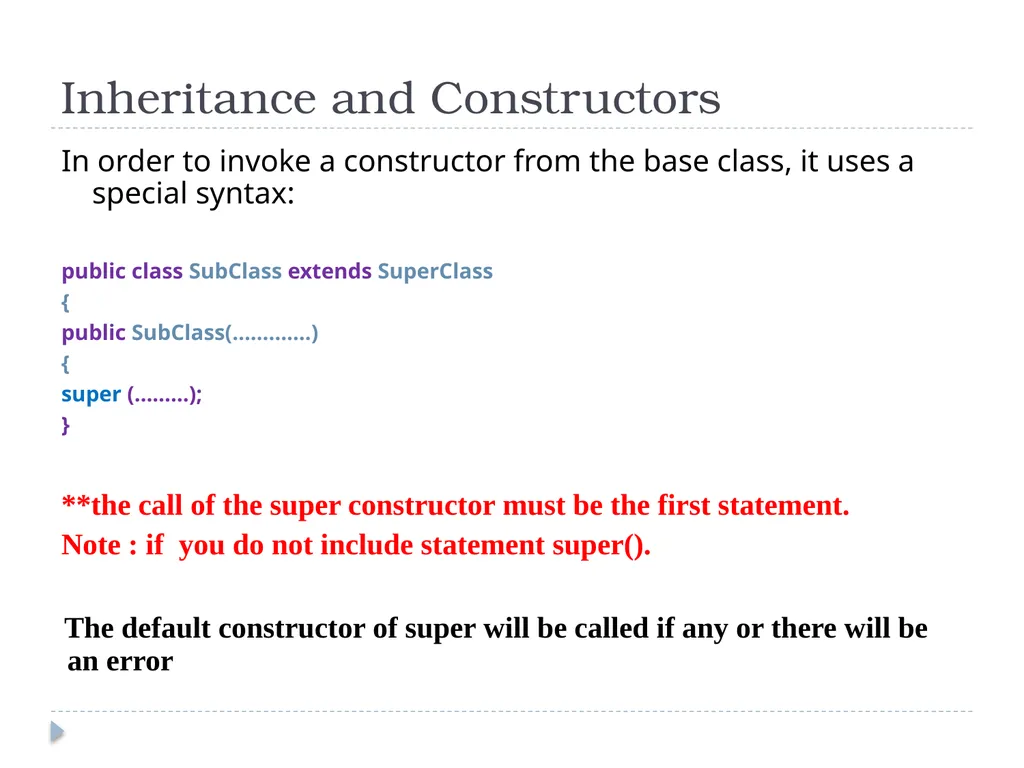
Inheritance and Constructors In order to invoke a constructor from the base class, it uses a special syntax:
public class SubClass extends SuperClass
{
public SubClass(………….)
{
super (………);
}
**the call of the super constructor must be the first statement.
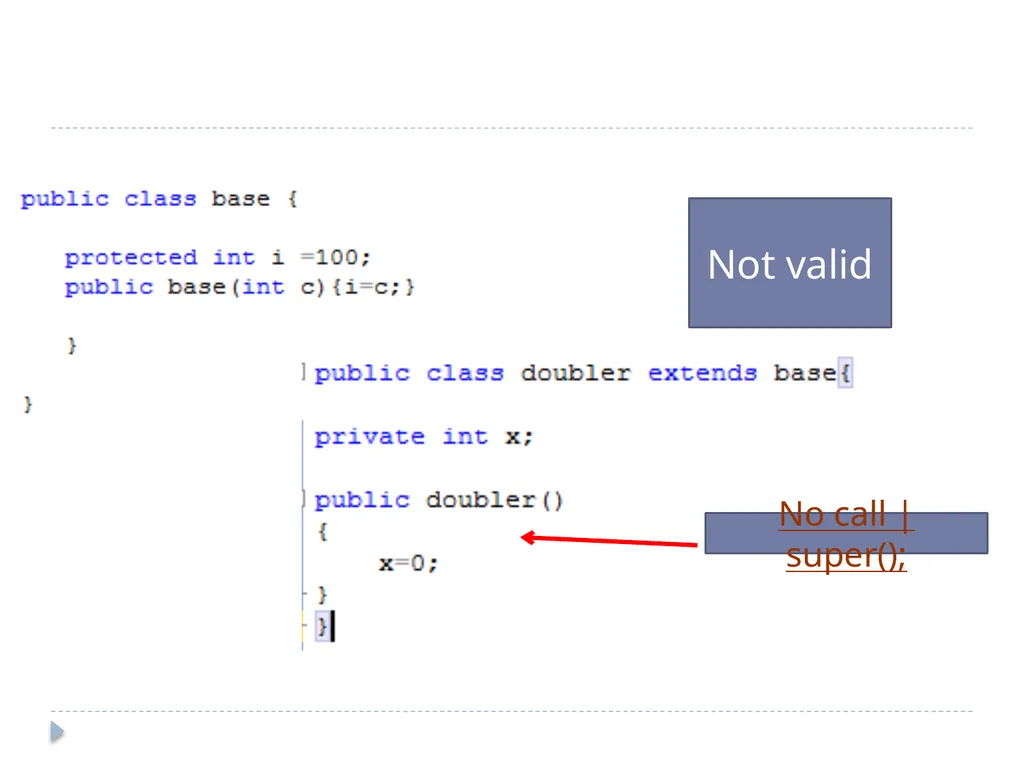
Note : if you do not include statement super().
The default constructor of super will be called if any or there will be an error<br>
23
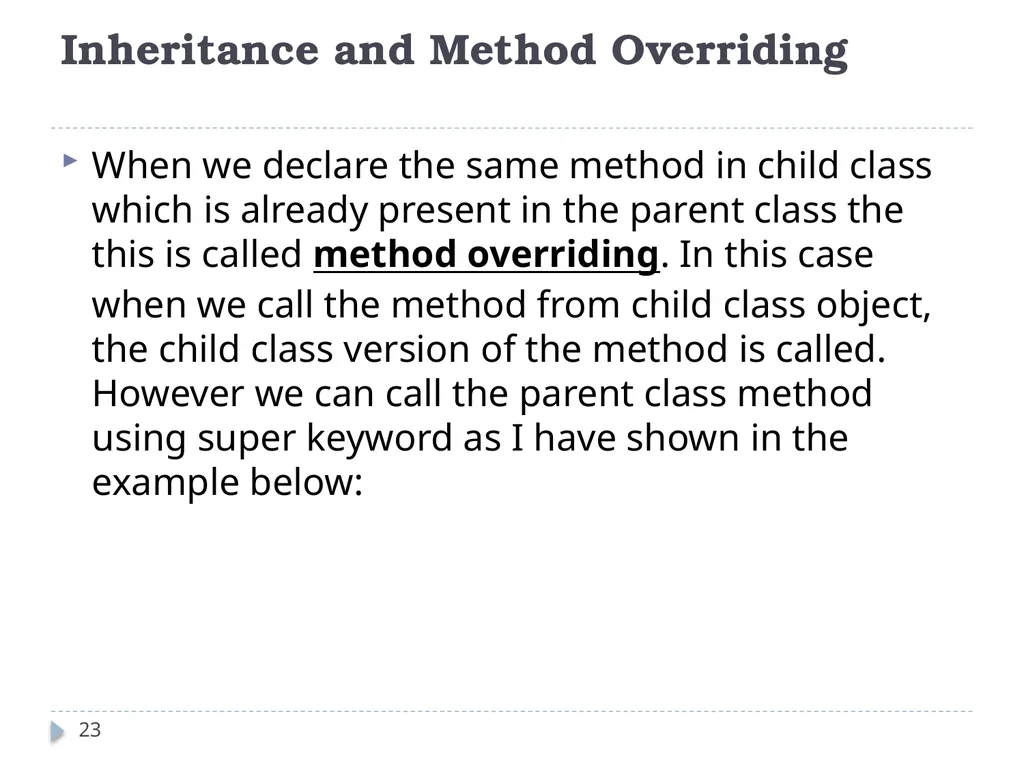
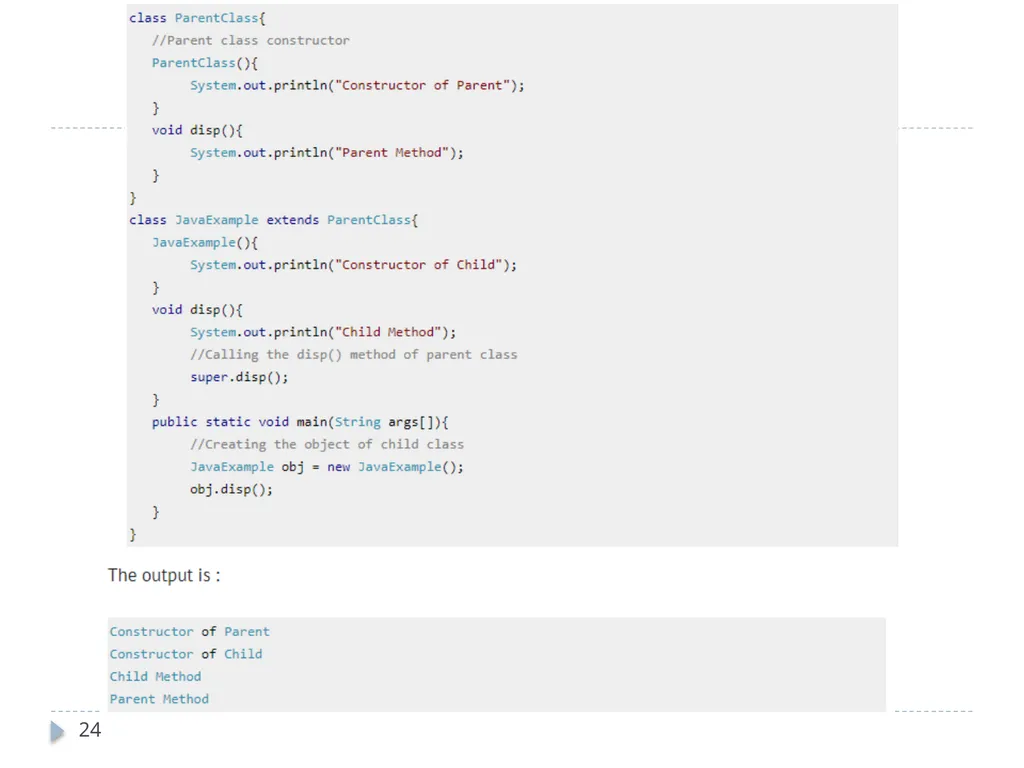
Inheritance and Method Overriding 23 When we declare the same method in child class which is already present in the parent class the this is called method overriding. In this case when we call the method from child class object, the child class version of the method is called. However we can call the parent class method using super keyword as I have shown in the example below:<br>
25
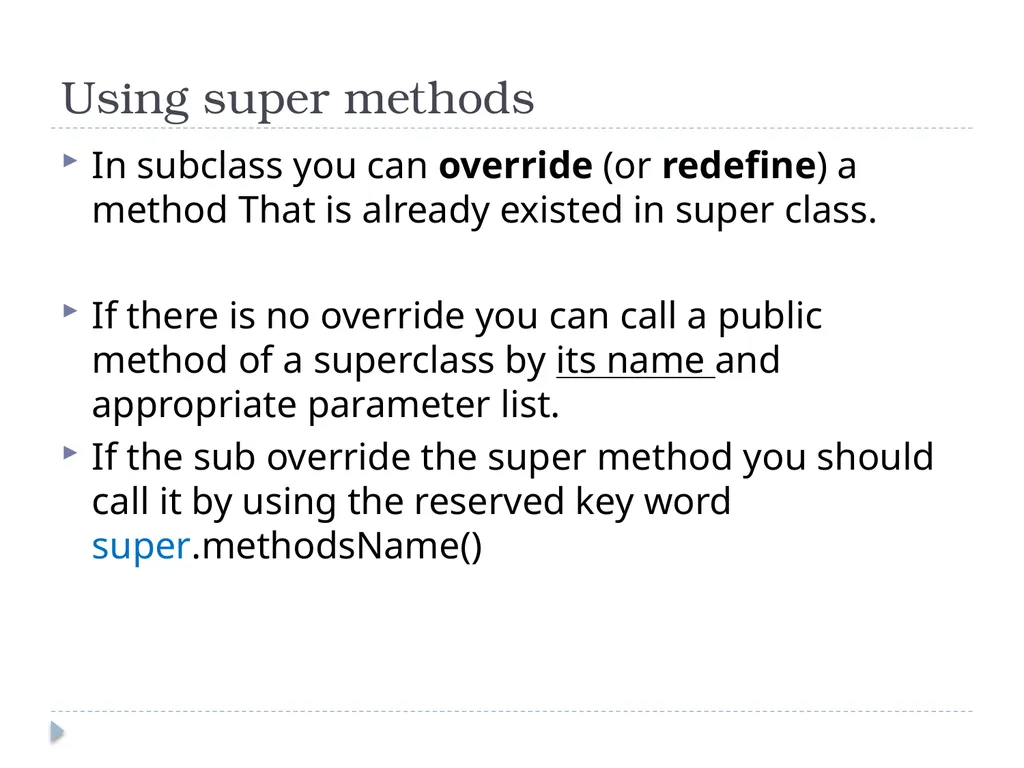
Using super methods In subclass you can override (or redefine) a method That is already existed in super class.
If there is no override you can call a public method of a superclass by its name and appropriate parameter list.
If the sub override the super method you should call it by using the reserved key word super.methodsName()<br>
26
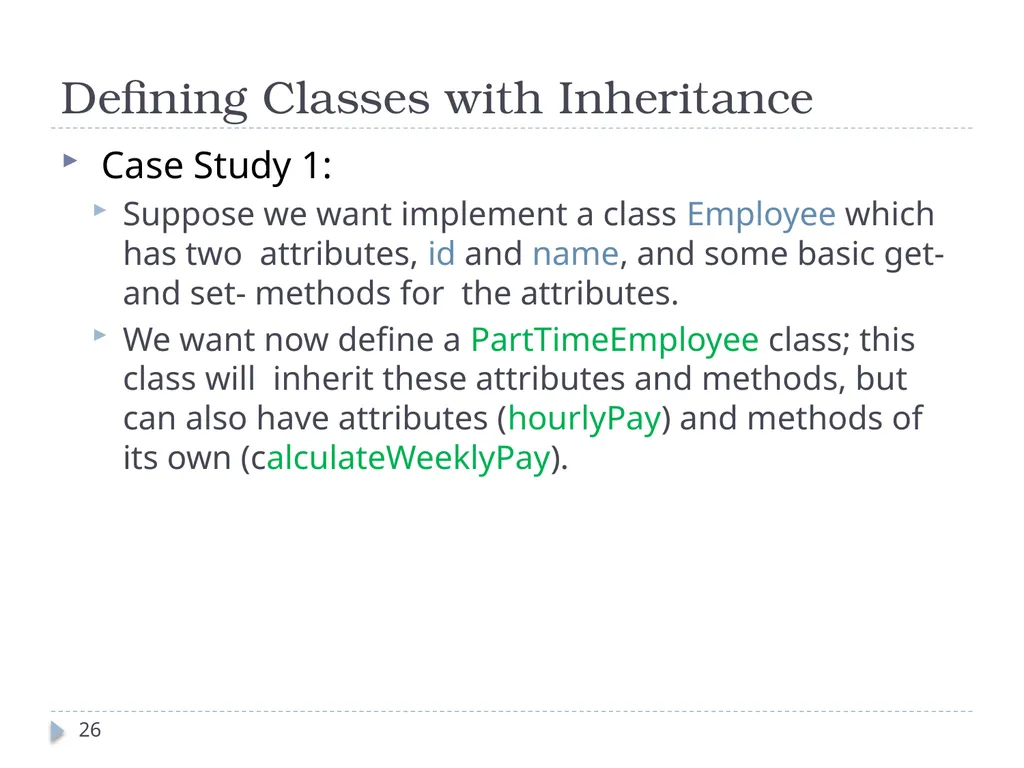
Defining Classes with Inheritance 26 Case Study 1:
Suppose we want implement a class Employee which has two attributes, id and name, and some basic get- and set- methods for the attributes.
We want now define a PartTimeEmployee class; this class will inherit these attributes and methods, but can also have attributes (hourlyPay) and methods of its own (calculateWeeklyPay).<br>
27
No call | super(); Not valid<br>
31
Defining Classes with Inheritance-Protected Modifier 31<br>
32
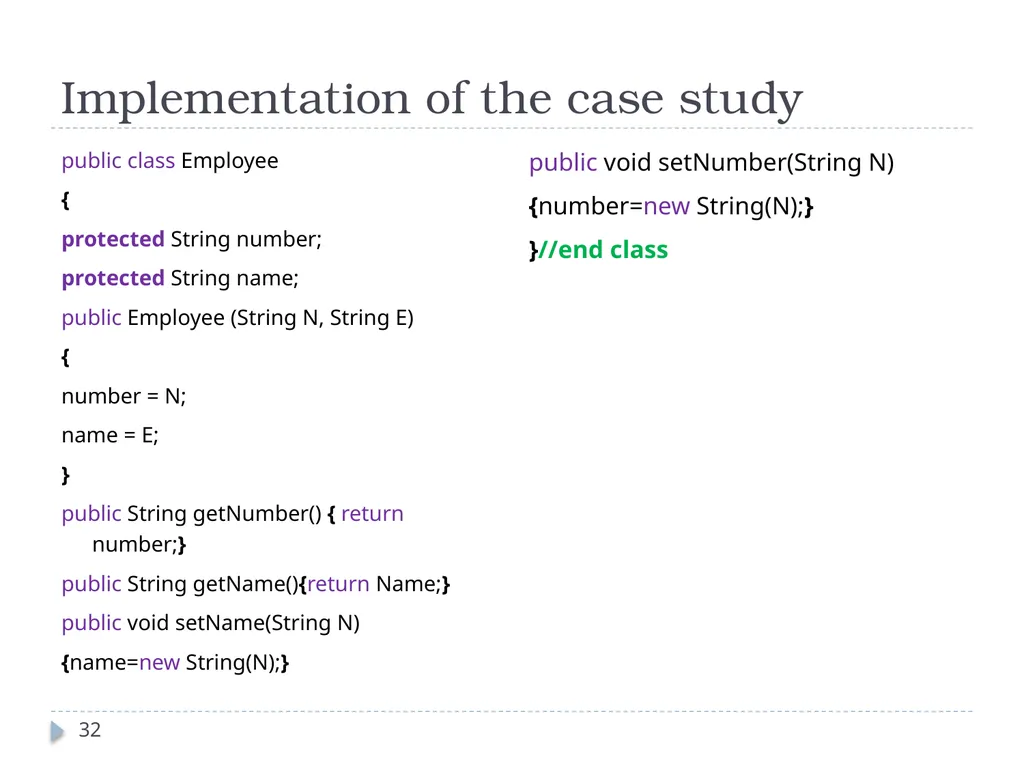
Implementation of the case study 32 public class Employee
{
protected String number;
protected String name;
public Employee (String N, String E)
{
number = N;
name = E;
}
public String getNumber() { return number;}
public String getName(){return Name;}
public void setName(String N)
{name=new String(N);} public void setNumber(String N)
{number=new String(N);}
}//end class<br>
33
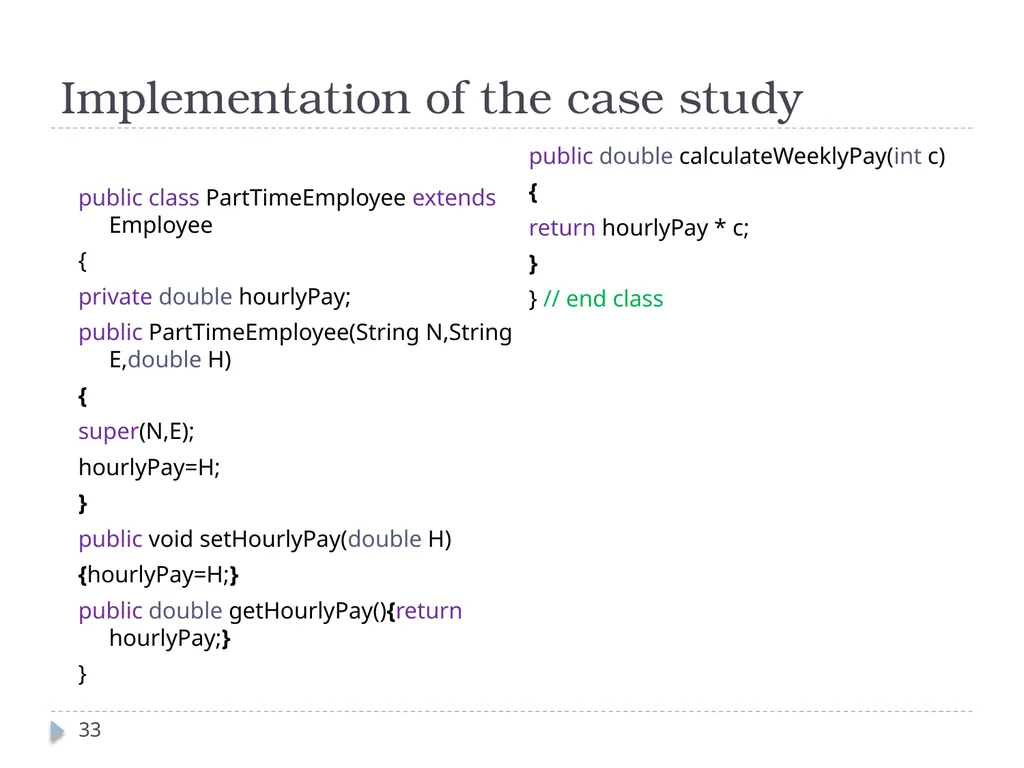
Implementation of the case study 33 public class PartTimeEmployee extends Employee
{
private double hourlyPay;
public PartTimeEmployee(String N,String E,double H)
{
super(N,E);
hourlyPay=H;
}
public void setHourlyPay(double H)
{hourlyPay=H;}
public double getHourlyPay(){return hourlyPay;}
} public double calculateWeeklyPay(int c)
{
return hourlyPay * c;
}
} // end class<br>
34
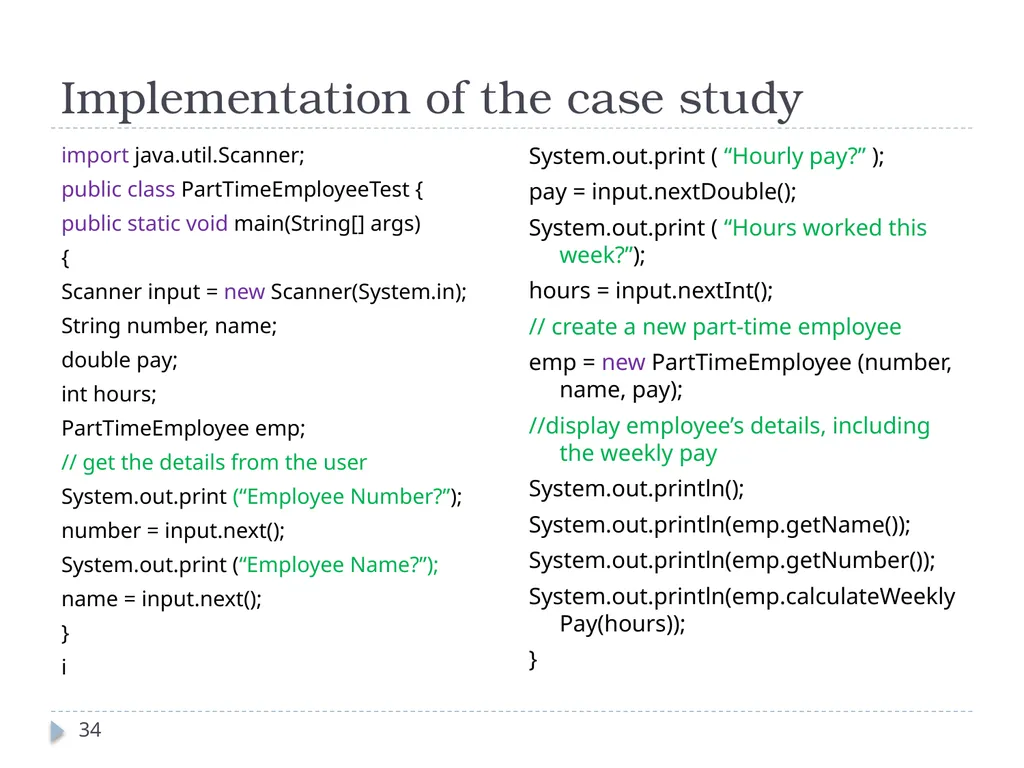
Implementation of the case study 34 import java.util.Scanner;
public class PartTimeEmployeeTest {
public static void main(String[] args)
{
Scanner input = new Scanner(System.in);
String number, name;
double pay;
int hours;
PartTimeEmployee emp;
// get the details from the user
System.out.print (“Employee Number?”);
number = input.next();
System.out.print (“Employee Name?”);
name = input.next();
}
i System.out.print ( “Hourly pay?” );
pay = input.nextDouble();
System.out.print ( “Hours worked this week?”);
hours = input.nextInt();
// create a new part-time employee
emp = new PartTimeEmployee (number, name, pay);
//display employee’s details, including the weekly pay
System.out.println();
System.out.println(emp.getName());
System.out.println(emp.getNumber());
System.out.println(emp.calculateWeeklyPay(hours));
}<br>
35
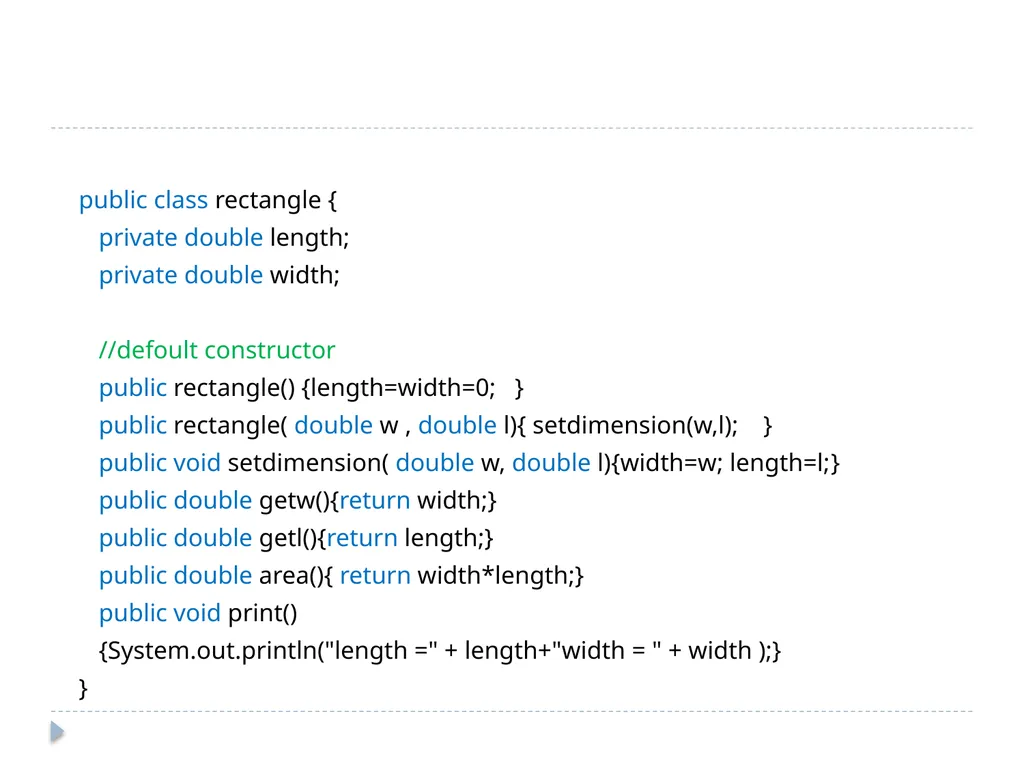
public class rectangle {
private double length;
private double width;
//defoult constructor
public rectangle() {length=width=0; }
public rectangle( double w , double l){ setdimension(w,l); }
public void setdimension( double w, double l){width=w; length=l; }
public double getw(){return width;}
public double getl(){return length;}
public double area(){ return width*length;}
public void print()
{System.out.println("length =" + length+"width = " + width );}
}<br>
36
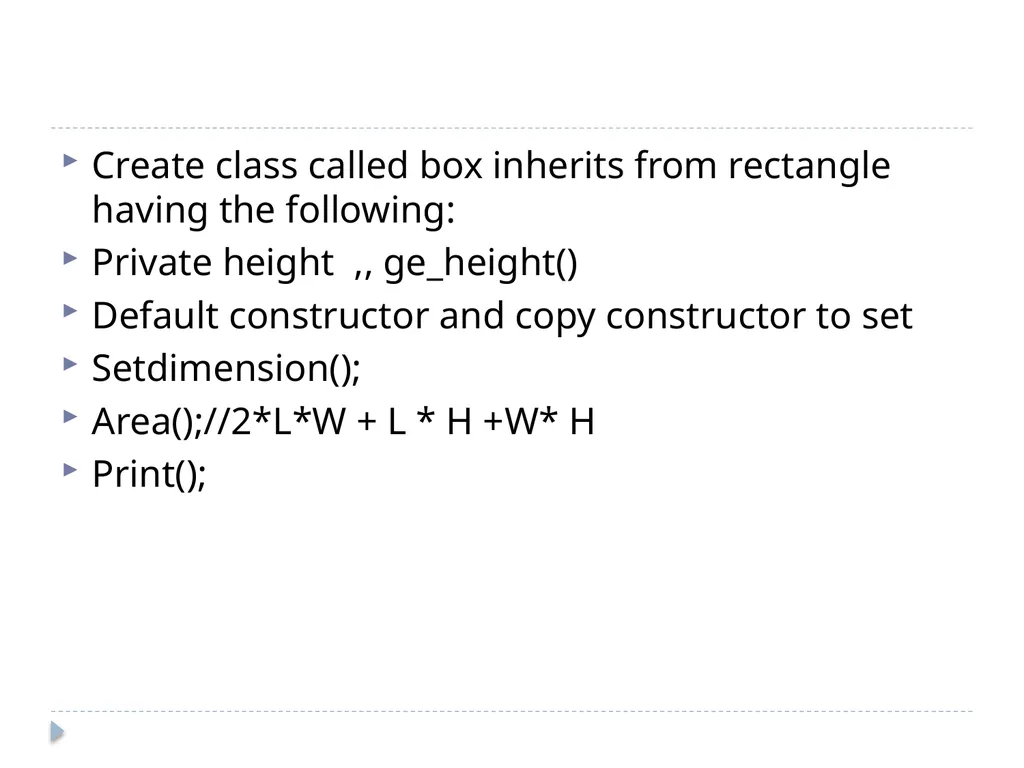
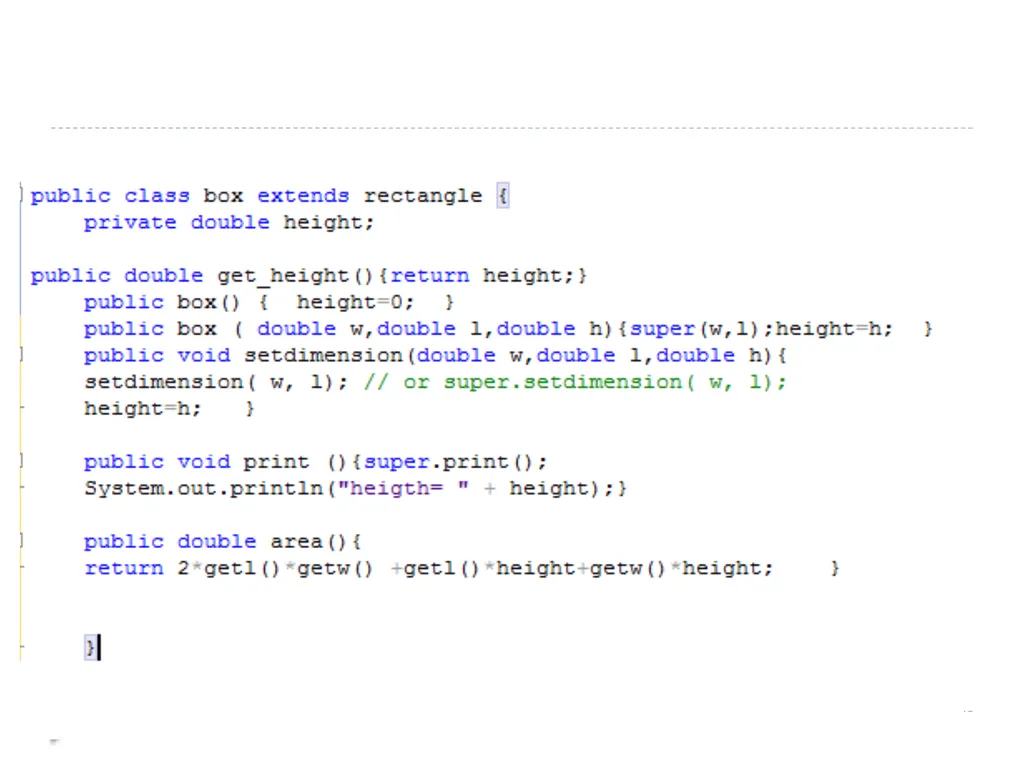
Create class called box inherits from rectangle having the following:
Private height ,, ge_height()
Default constructor and copy constructor to set
Setdimension();
Area();//2*L*W + L * H +W* H
Print();<br>