
Innovative Islamic Capital Market Instruments A
A
Published · 34 slides · 0 views

1 / 1


Description
Innovative Islamic Capital Market Instruments A Quasi Equity Instrument for Corporations Prof Dr Obiyathulla Ismath Bacha OIC Exchanges Forum September 26,2019 Istanbul, Turkey Source: Sovereign Wealth Fund Institute December 2016 Quo Vadis
Related Topics
Share
Embed code
Download this presentation From Below
"Innovative Islamic Capital Market Instruments A" is the property of its rightful owner. Permission is granted to download and print the materials on this website for personal, non-commercial use only, and to display it on your personal computer provided you do not modify the materials and that you retain all copyright notices contained in the materials. By downloading content from our website, you accept the terms of this agreement.
Presentation Transcript
01
Innovative Islamic Capital Market Instruments
A Quasi Equity Instrument for Corporations Prof Dr Obiyathulla Ismath Bacha
OIC Exchanges Forum
September 26,2019
Istanbul, Turkey<br>
OIC Exchanges Forum
September 26,2019
Istanbul, Turkey<br>
02
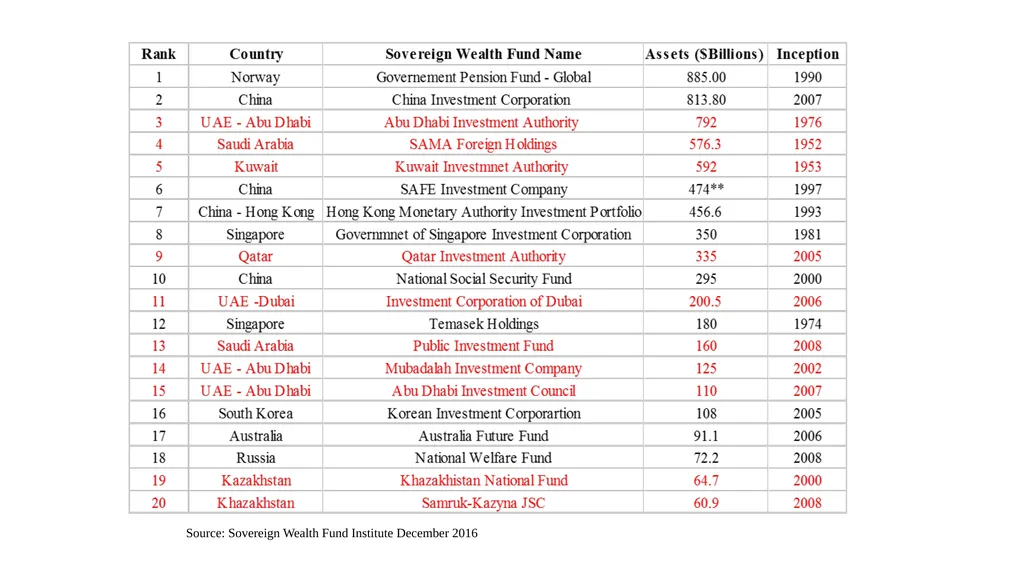
Source: Sovereign Wealth Fund Institute December 2016<br>
03
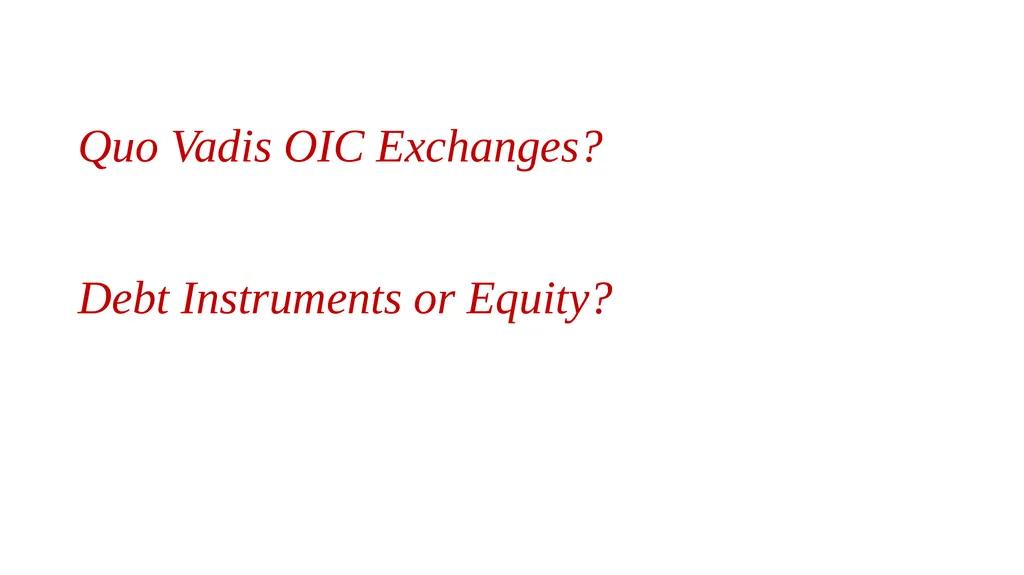
Quo Vadis OIC Exchanges?
Debt Instruments or Equity?<br>
04
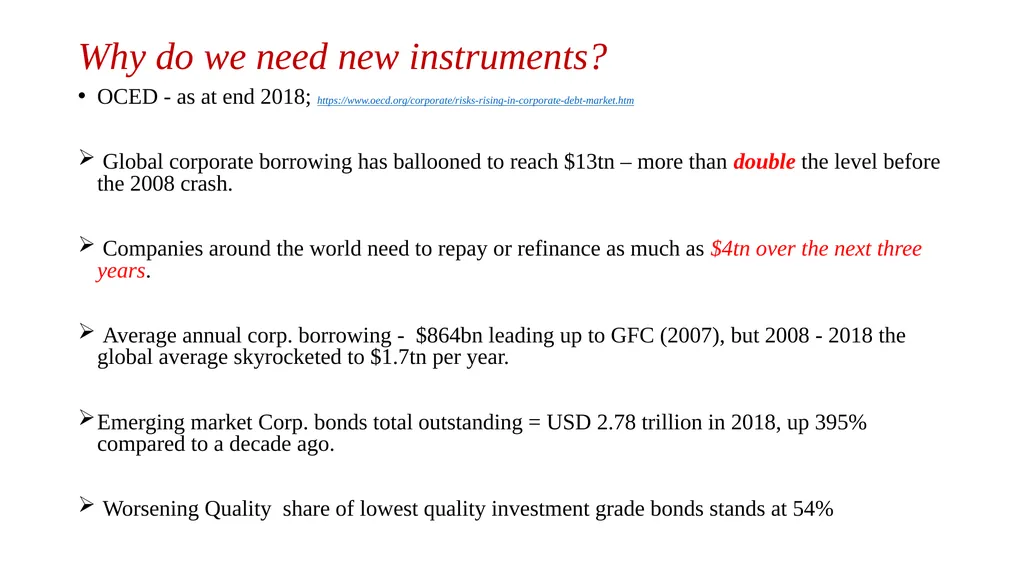
Why do we need new instruments? OCED - as at end 2018; https://www.oecd.org/corporate/risks-rising-in-corporate-debt-market.htm
Global corporate borrowing has ballooned to reach $13tn – more than double the level before the 2008 crash.
Companies around the world need to repay or refinance as much as $4tn over the next three years.
Average annual corp. borrowing - $864bn leading up to GFC (2007), but 2008 - 2018 the global average skyrocketed to $1.7tn per year.
Emerging market Corp. bonds total outstanding = USD 2.78 trillion in 2018, up 395% compared to a decade ago.
Worsening Quality share of lowest quality investment grade bonds stands at 54%<br>
Global corporate borrowing has ballooned to reach $13tn – more than double the level before the 2008 crash.
Companies around the world need to repay or refinance as much as $4tn over the next three years.
Average annual corp. borrowing - $864bn leading up to GFC (2007), but 2008 - 2018 the global average skyrocketed to $1.7tn per year.
Emerging market Corp. bonds total outstanding = USD 2.78 trillion in 2018, up 395% compared to a decade ago.
Worsening Quality share of lowest quality investment grade bonds stands at 54%<br>
05
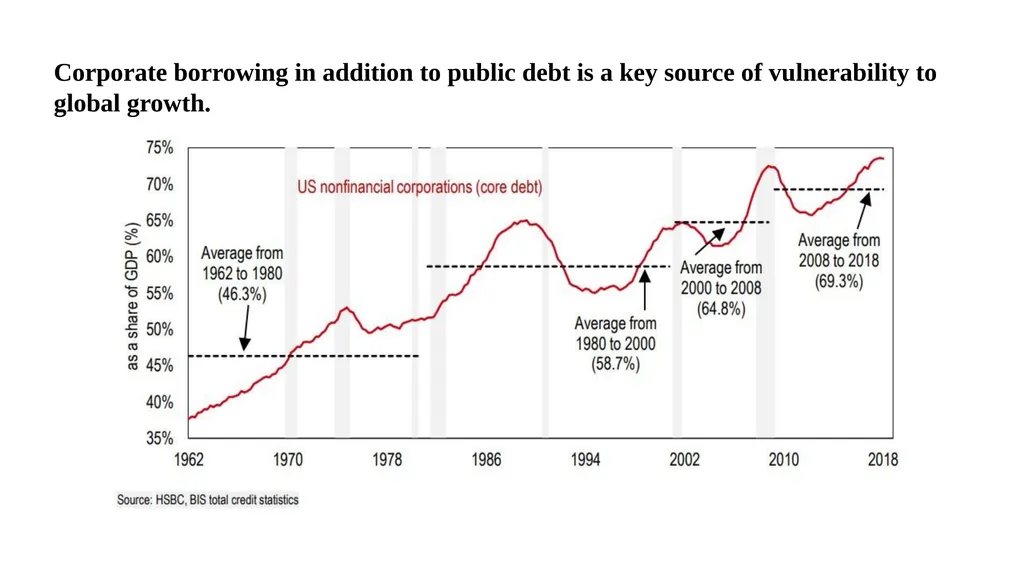
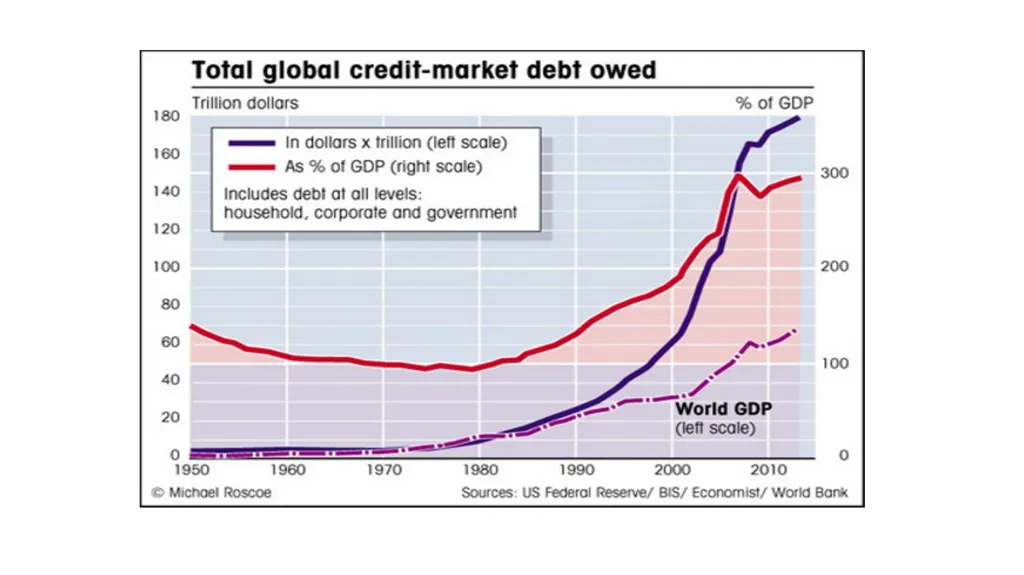
Corporate borrowing in addition to public debt is a key source of vulnerability to global growth.<br>
06
Hollowing out of the Corporation Source: Asia Times, 28th August,2019 As of the second quarter (2019), several S&P listed firms paid out more in dividends and buybacks than they earned<br>
07
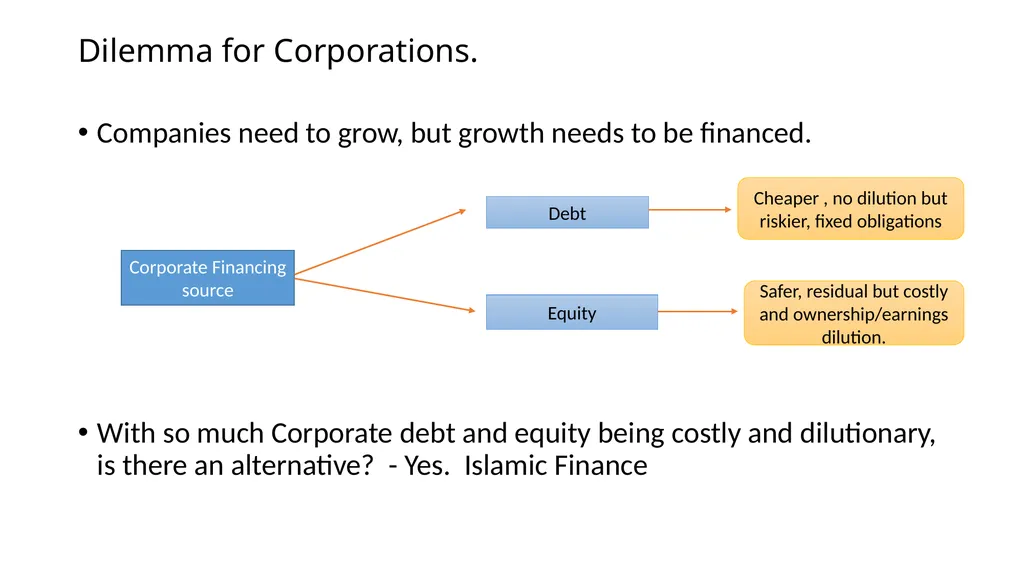
Dilemma for Corporations. Companies need to grow, but growth needs to be financed.
With so much Corporate debt and equity being costly and dilutionary, is there an alternative? - Yes. Islamic Finance Corporate Financing source Debt Equity Cheaper , no dilution but riskier, fixed obligations Safer, residual but costly and ownership/earnings dilution.<br>
With so much Corporate debt and equity being costly and dilutionary, is there an alternative? - Yes. Islamic Finance Corporate Financing source Debt Equity Cheaper , no dilution but riskier, fixed obligations Safer, residual but costly and ownership/earnings dilution.<br>
08
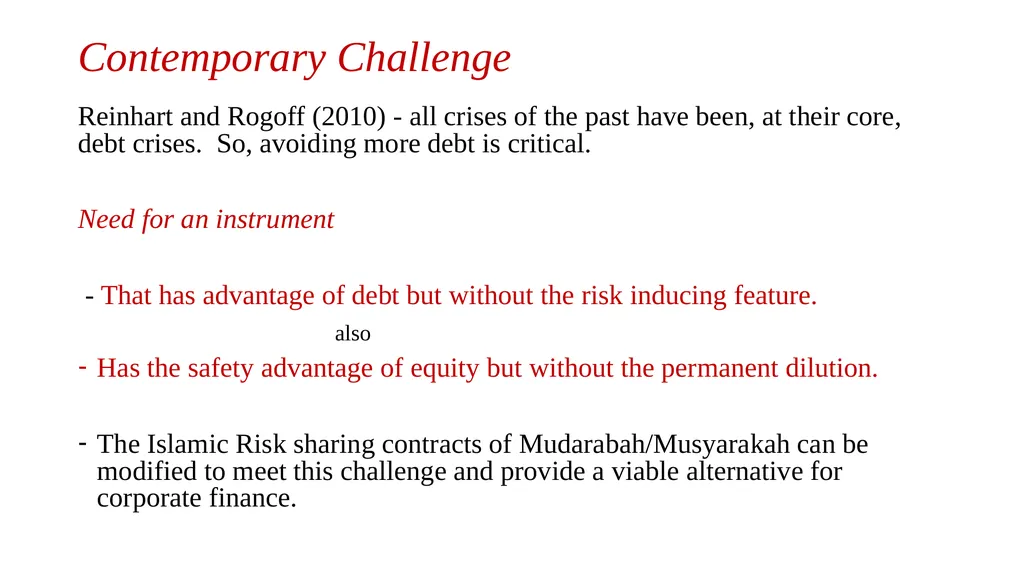
Contemporary Challenge Reinhart and Rogoff (2010) - all crises of the past have been, at their core, debt crises. So, avoiding more debt is critical.
Need for an instrument
- That has advantage of debt but without the risk inducing feature.
also
Has the safety advantage of equity but without the permanent dilution.
The Islamic Risk sharing contracts of Mudarabah/Musyarakah can be modified to meet this challenge and provide a viable alternative for corporate finance.<br>
Need for an instrument
- That has advantage of debt but without the risk inducing feature.
also
Has the safety advantage of equity but without the permanent dilution.
The Islamic Risk sharing contracts of Mudarabah/Musyarakah can be modified to meet this challenge and provide a viable alternative for corporate finance.<br>
09
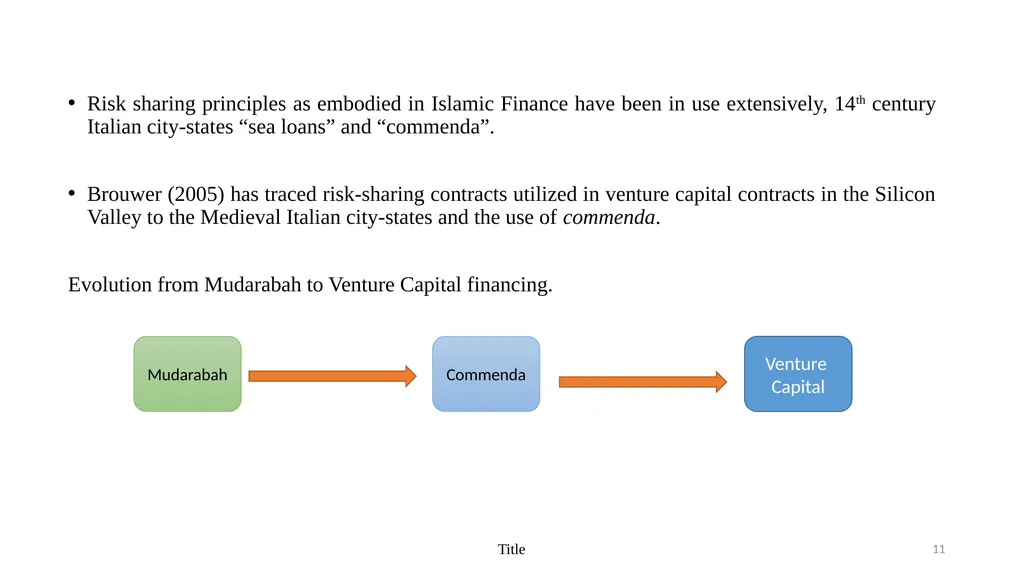
Title Risk sharing principles as embodied in Islamic Finance have been in use extensively, 14th century Italian city-states “sea loans” and “commenda”.
Brouwer (2005) has traced risk-sharing contracts utilized in venture capital contracts in the Silicon Valley to the Medieval Italian city-states and the use of commenda.
Evolution from Mudarabah to Venture Capital financing. 11 Mudarabah Commenda Venture
Capital<br>
Brouwer (2005) has traced risk-sharing contracts utilized in venture capital contracts in the Silicon Valley to the Medieval Italian city-states and the use of commenda.
Evolution from Mudarabah to Venture Capital financing. 11 Mudarabah Commenda Venture
Capital<br>
10
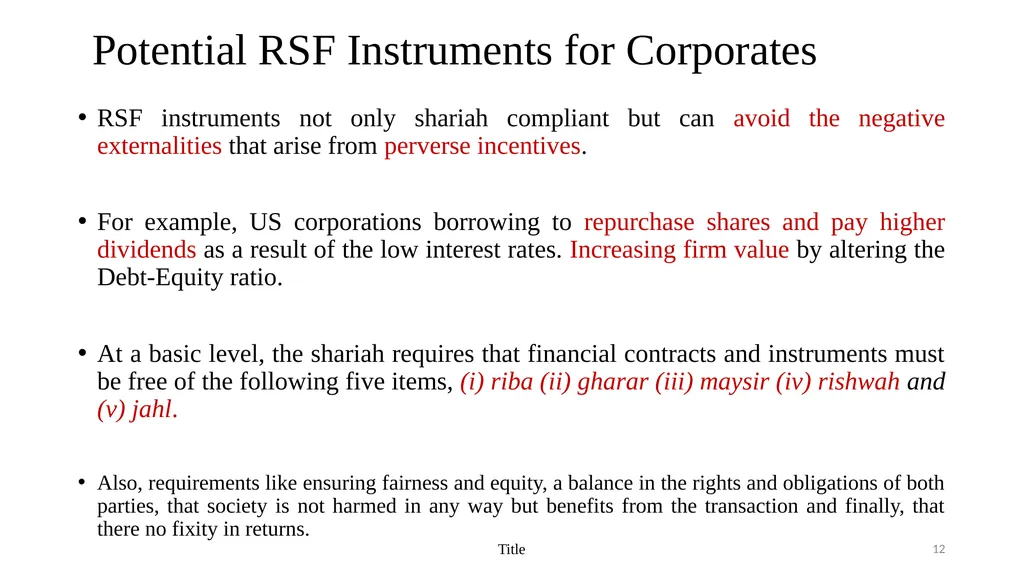
Title Potential RSF Instruments for Corporates RSF instruments not only shariah compliant but can avoid the negative externalities that arise from perverse incentives.
For example, US corporations borrowing to repurchase shares and pay higher dividends as a result of the low interest rates. Increasing firm value by altering the Debt-Equity ratio.
At a basic level, the shariah requires that financial contracts and instruments must be free of the following five items, (i) riba (ii) gharar (iii) maysir (iv) rishwah and (v) jahl.
Also, requirements like ensuring fairness and equity, a balance in the rights and obligations of both parties, that society is not harmed in any way but benefits from the transaction and finally, that there no fixity in returns. 12<br>
For example, US corporations borrowing to repurchase shares and pay higher dividends as a result of the low interest rates. Increasing firm value by altering the Debt-Equity ratio.
At a basic level, the shariah requires that financial contracts and instruments must be free of the following five items, (i) riba (ii) gharar (iii) maysir (iv) rishwah and (v) jahl.
Also, requirements like ensuring fairness and equity, a balance in the rights and obligations of both parties, that society is not harmed in any way but benefits from the transaction and finally, that there no fixity in returns. 12<br>
11
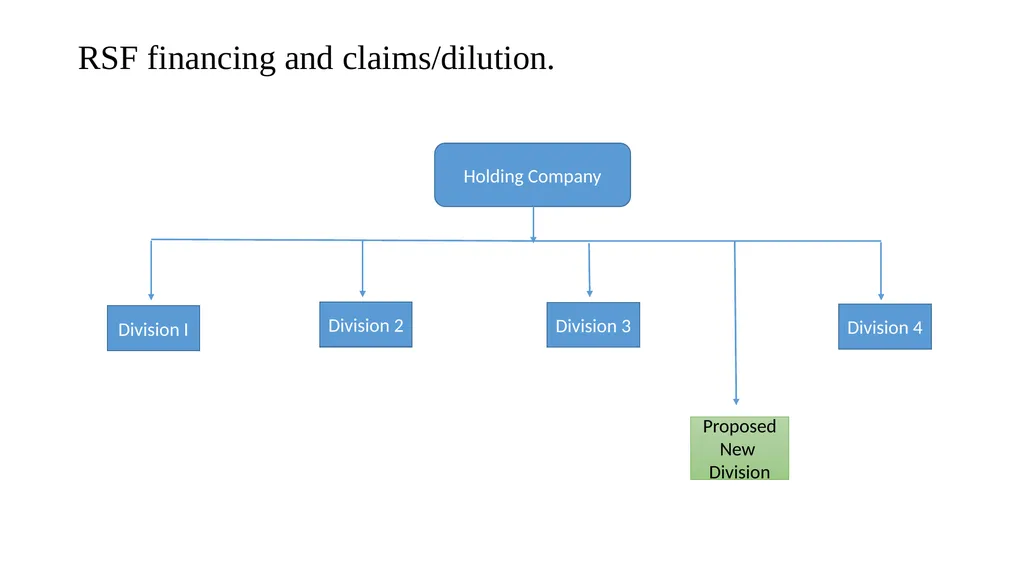
RSF financing and claims/dilution. Holding Company Division I Division 2 Division 3 Division 4 Proposed
New
Division<br>
New
Division<br>
12
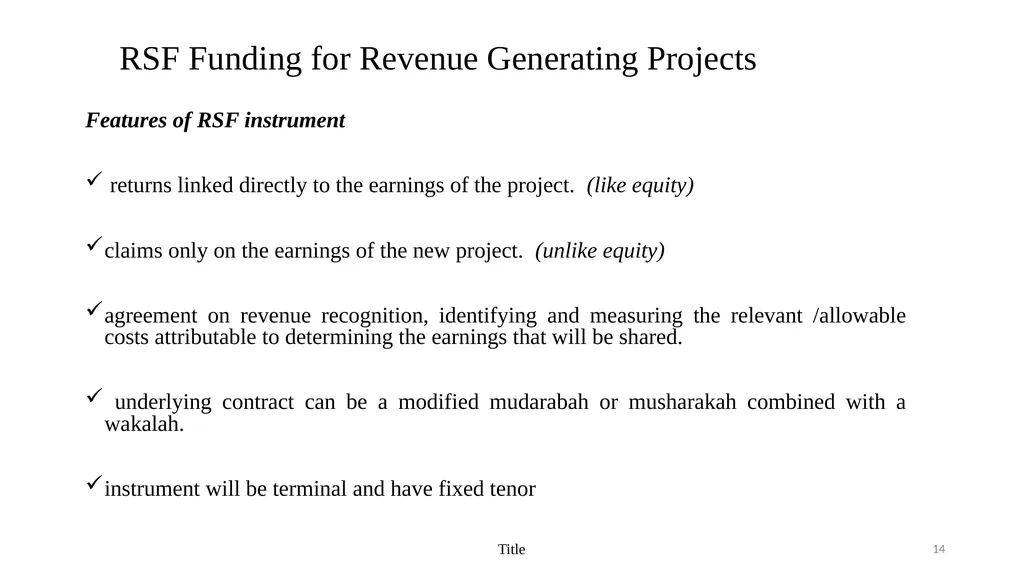
Title RSF Funding for Revenue Generating Projects Features of RSF instrument
returns linked directly to the earnings of the project. (like equity)
claims only on the earnings of the new project. (unlike equity)
agreement on revenue recognition, identifying and measuring the relevant /allowable costs attributable to determining the earnings that will be shared.
underlying contract can be a modified mudarabah or musharakah combined with a wakalah.
instrument will be terminal and have fixed tenor 14<br>
returns linked directly to the earnings of the project. (like equity)
claims only on the earnings of the new project. (unlike equity)
agreement on revenue recognition, identifying and measuring the relevant /allowable costs attributable to determining the earnings that will be shared.
underlying contract can be a modified mudarabah or musharakah combined with a wakalah.
instrument will be terminal and have fixed tenor 14<br>
13
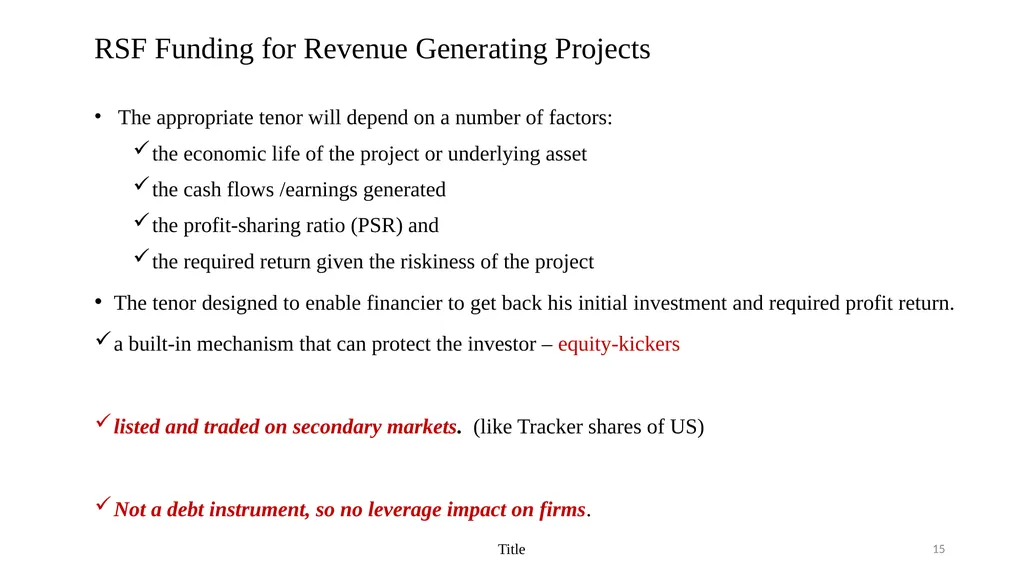
Title RSF Funding for Revenue Generating Projects The appropriate tenor will depend on a number of factors:
the economic life of the project or underlying asset
the cash flows /earnings generated
the profit-sharing ratio (PSR) and
the required return given the riskiness of the project
The tenor designed to enable financier to get back his initial investment and required profit return.
a built-in mechanism that can protect the investor – equity-kickers
listed and traded on secondary markets. (like Tracker shares of US)
Not a debt instrument, so no leverage impact on firms. 15<br>
the economic life of the project or underlying asset
the cash flows /earnings generated
the profit-sharing ratio (PSR) and
the required return given the riskiness of the project
The tenor designed to enable financier to get back his initial investment and required profit return.
a built-in mechanism that can protect the investor – equity-kickers
listed and traded on secondary markets. (like Tracker shares of US)
Not a debt instrument, so no leverage impact on firms. 15<br>
14
Pricing Risk Sharing Sukuk for Corporations to Fund Revenue Generating Projects<br>
15
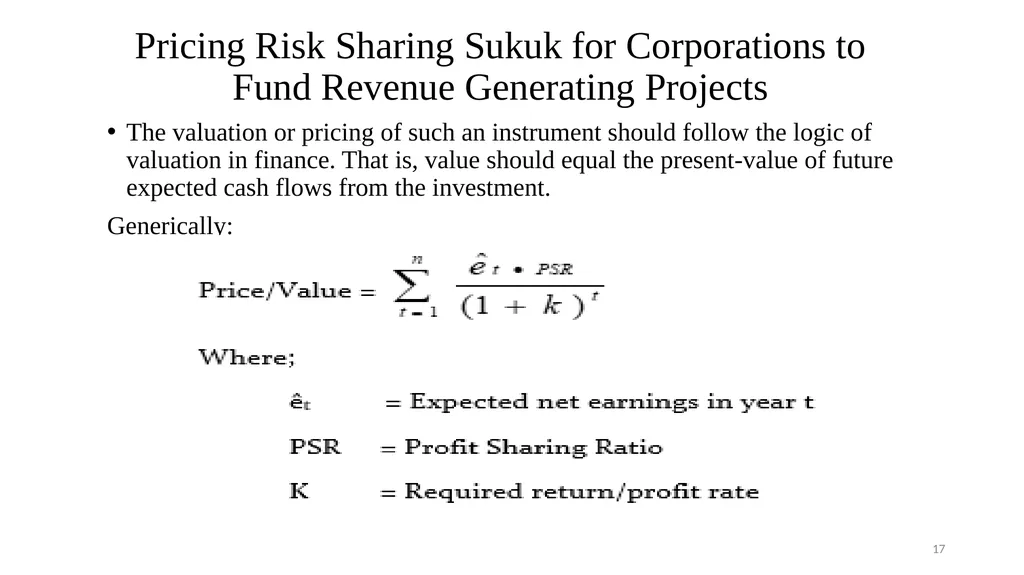
Pricing Risk Sharing Sukuk for Corporations to Fund Revenue Generating Projects The valuation or pricing of such an instrument should follow the logic of valuation in finance. That is, value should equal the present-value of future expected cash flows from the investment.
Generically: 17<br>
Generically: 17<br>
16
The (PSR) set such that the initial investment (I) is recoverable given the required profit rate and term.
The PSR, therefore, is a function of the term, average expected earnings, initial investment and the required profit rate:
PSR = ƒ (I, T, ē, K)
Where:
ē = average of expected annual earnings
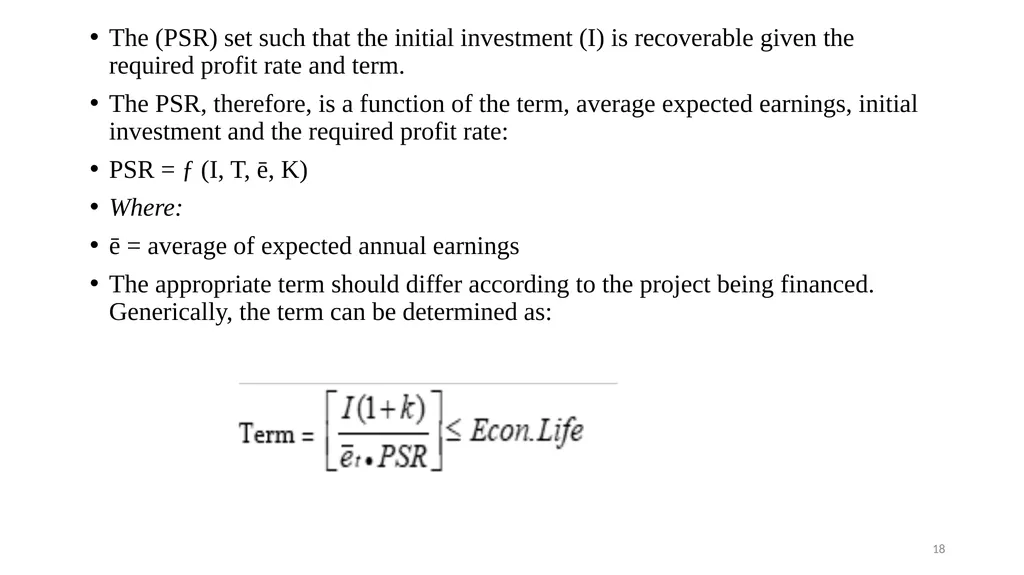
The appropriate term should differ according to the project being financed. Generically, the term can be determined as: 18<br>
The PSR, therefore, is a function of the term, average expected earnings, initial investment and the required profit rate:
PSR = ƒ (I, T, ē, K)
Where:
ē = average of expected annual earnings
The appropriate term should differ according to the project being financed. Generically, the term can be determined as: 18<br>
17
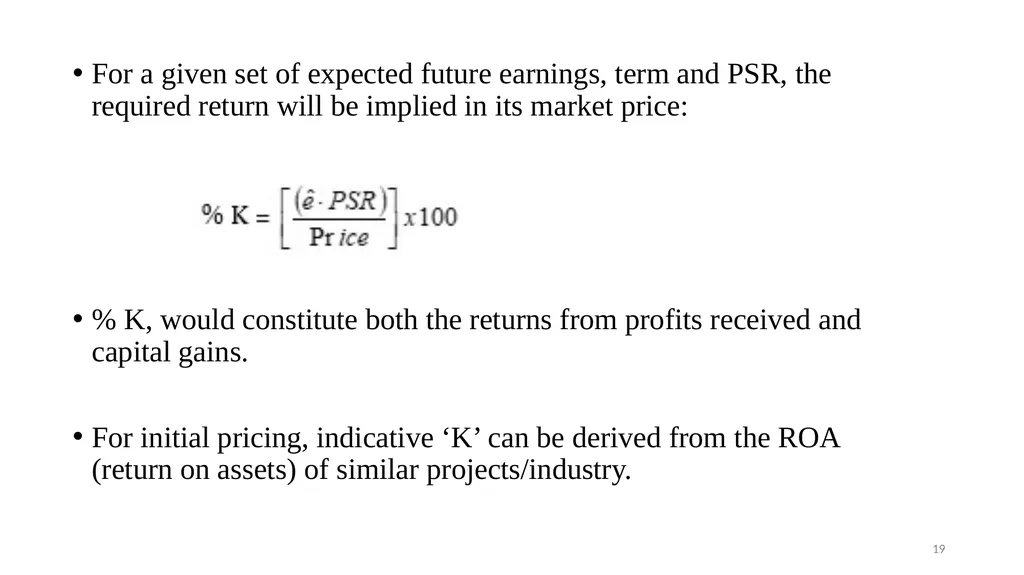
For a given set of expected future earnings, term and PSR, the required return will be implied in its market price:
% K, would constitute both the returns from profits received and capital gains.
For initial pricing, indicative ‘K’ can be derived from the ROA (return on assets) of similar projects/industry. 19<br>
% K, would constitute both the returns from profits received and capital gains.
For initial pricing, indicative ‘K’ can be derived from the ROA (return on assets) of similar projects/industry. 19<br>
18
Debt, Equity and Mudarabah;
Payoff Profiles.<br>
Payoff Profiles.<br>
19
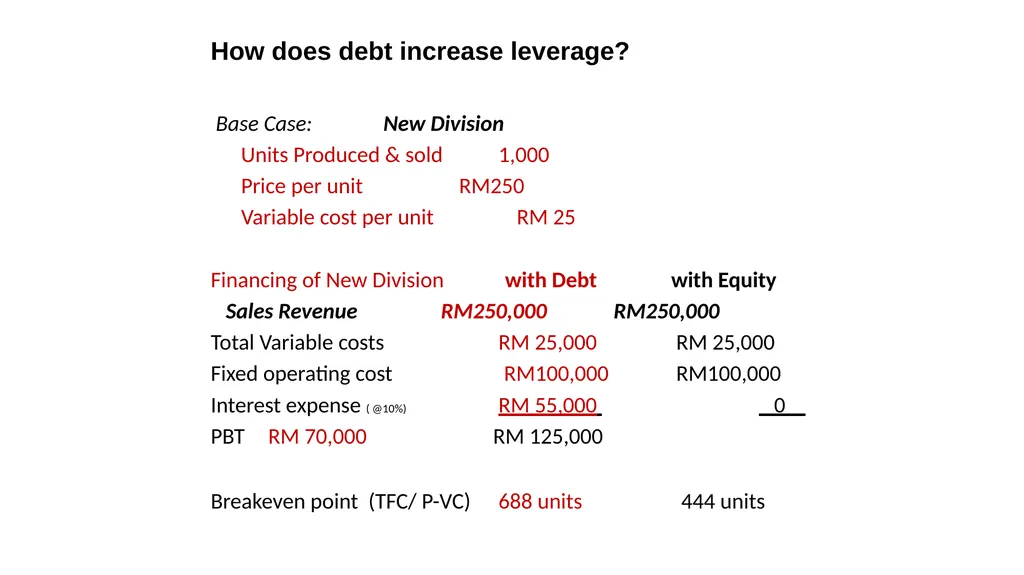
Base Case: New Division
Units Produced & sold 1,000
Price per unit RM250
Variable cost per unit RM 25
Financing of New Division with Debt with Equity
Sales Revenue RM250,000 RM250,000
Total Variable costs RM 25,000 RM 25,000
Fixed operating cost RM100,000 RM100,000
Interest expense ( @10%) RM 55,000 0
PBT RM 70,000 RM 125,000
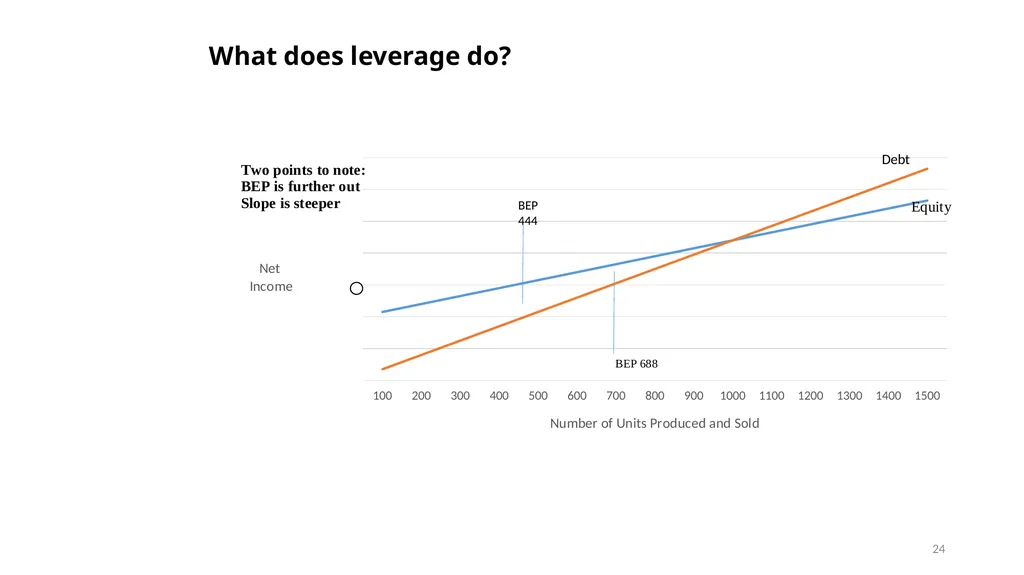
Breakeven point (TFC/ P-VC) 688 units 444 units How does debt increase leverage?<br>
Units Produced & sold 1,000
Price per unit RM250
Variable cost per unit RM 25
Financing of New Division with Debt with Equity
Sales Revenue RM250,000 RM250,000
Total Variable costs RM 25,000 RM 25,000
Fixed operating cost RM100,000 RM100,000
Interest expense ( @10%) RM 55,000 0
PBT RM 70,000 RM 125,000
Breakeven point (TFC/ P-VC) 688 units 444 units How does debt increase leverage?<br>
20
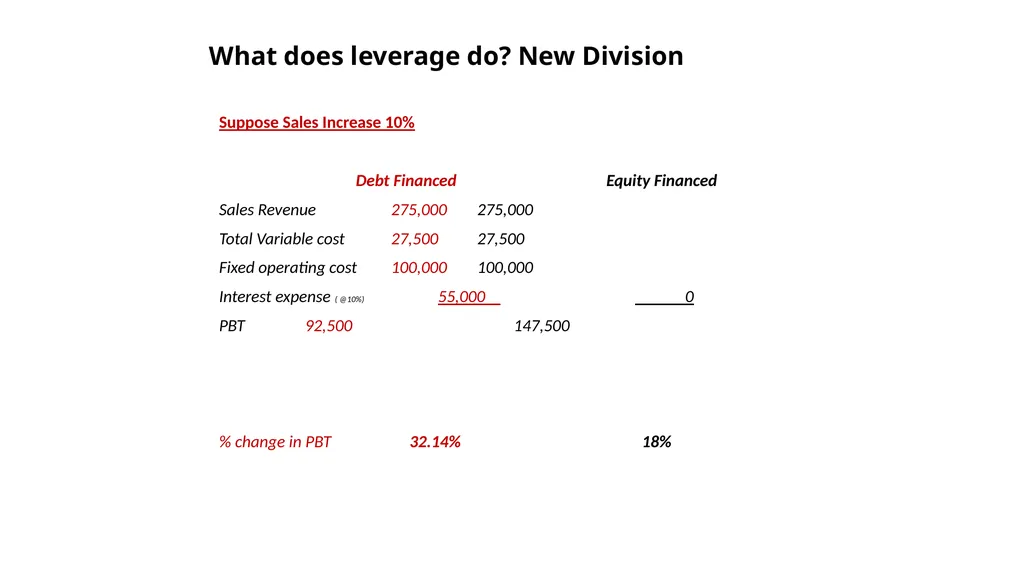
Suppose Sales Increase 10%
Debt Financed Equity Financed
Sales Revenue 275,000 275,000
Total Variable cost 27,500 27,500
Fixed operating cost 100,000 100,000
Interest expense ( @10%) 55,000 0
PBT 92,500 147,500
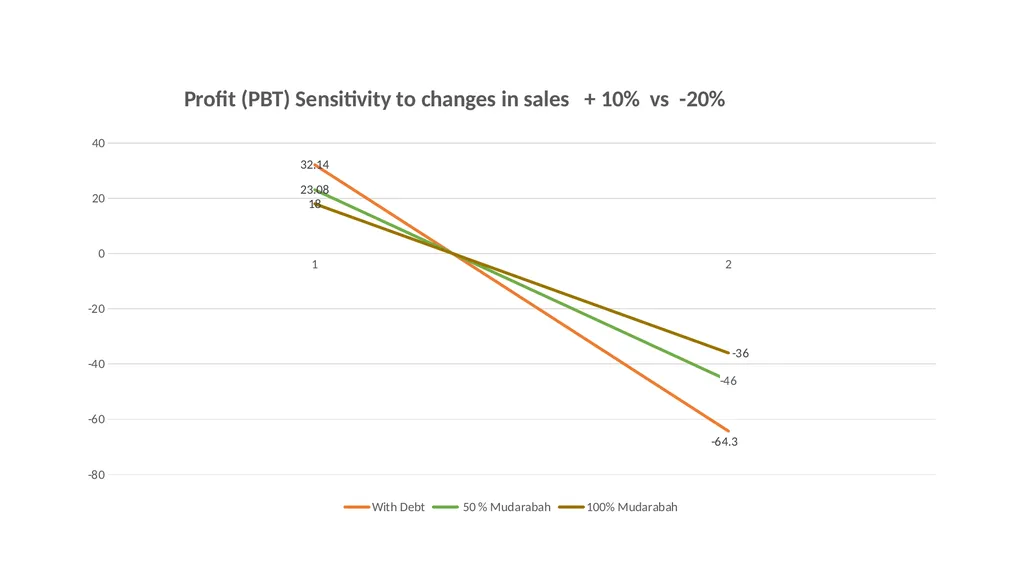
% change in PBT 32.14% 18% What does leverage do? New Division<br>
Debt Financed Equity Financed
Sales Revenue 275,000 275,000
Total Variable cost 27,500 27,500
Fixed operating cost 100,000 100,000
Interest expense ( @10%) 55,000 0
PBT 92,500 147,500
% change in PBT 32.14% 18% What does leverage do? New Division<br>
21
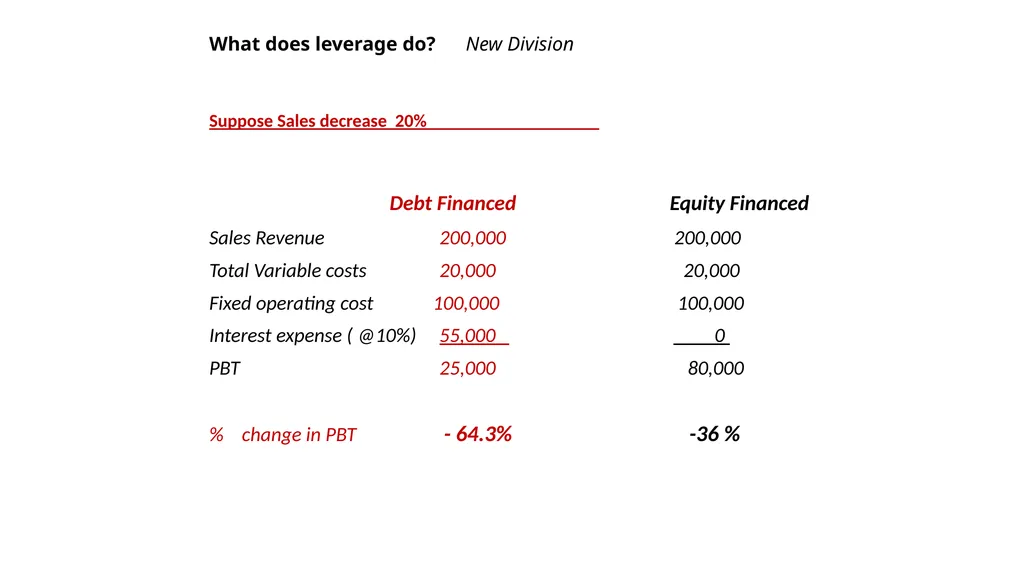
Suppose Sales decrease 20%
Debt Financed Equity Financed
Sales Revenue 200,000 200,000
Total Variable costs 20,000 20,000
Fixed operating cost 100,000 100,000
Interest expense ( @10%) 55,000 0
PBT 25,000 80,000
% change in PBT - 64.3% -36 % What does leverage do? New Division<br>
Debt Financed Equity Financed
Sales Revenue 200,000 200,000
Total Variable costs 20,000 20,000
Fixed operating cost 100,000 100,000
Interest expense ( @10%) 55,000 0
PBT 25,000 80,000
% change in PBT - 64.3% -36 % What does leverage do? New Division<br>
22
What does leverage do? 24 Debt BEP444<br>
23
Suppose each firm now replaced 50% of its debt with Mudarabah financing, What happens? What if we now had Mudarabah Financing? What does leverage do?<br>
24
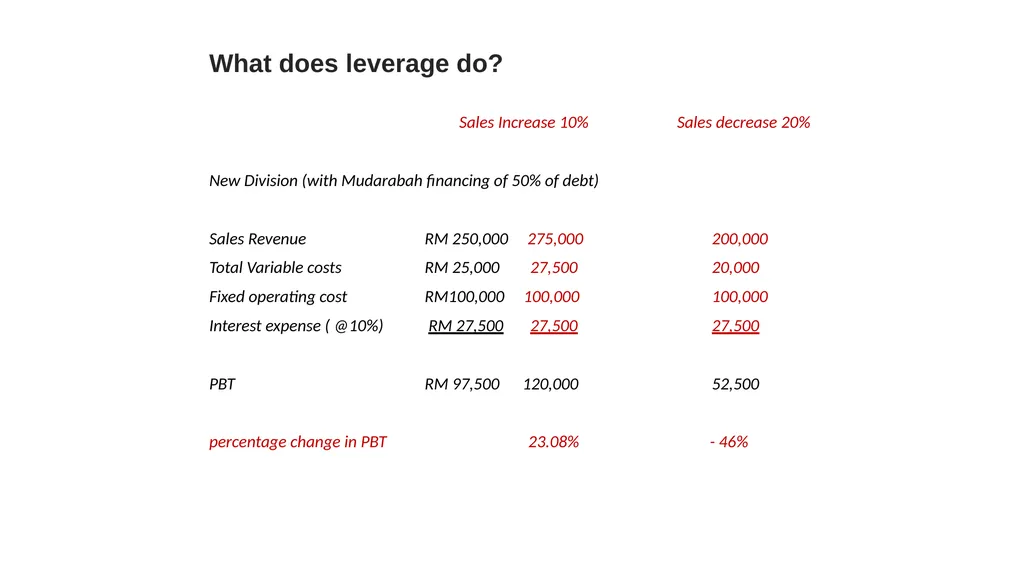
Sales Increase 10% Sales decrease 20%
New Division (with Mudarabah financing of 50% of debt)
Sales Revenue RM 250,000 275,000 200,000
Total Variable costs RM 25,000 27,500 20,000
Fixed operating cost RM100,000 100,000 100,000
Interest expense ( @10%) RM 27,500 27,500 27,500
PBT RM 97,500 120,000 52,500
percentage change in PBT 23.08% - 46% What does leverage do?<br>
New Division (with Mudarabah financing of 50% of debt)
Sales Revenue RM 250,000 275,000 200,000
Total Variable costs RM 25,000 27,500 20,000
Fixed operating cost RM100,000 100,000 100,000
Interest expense ( @10%) RM 27,500 27,500 27,500
PBT RM 97,500 120,000 52,500
percentage change in PBT 23.08% - 46% What does leverage do?<br>
25
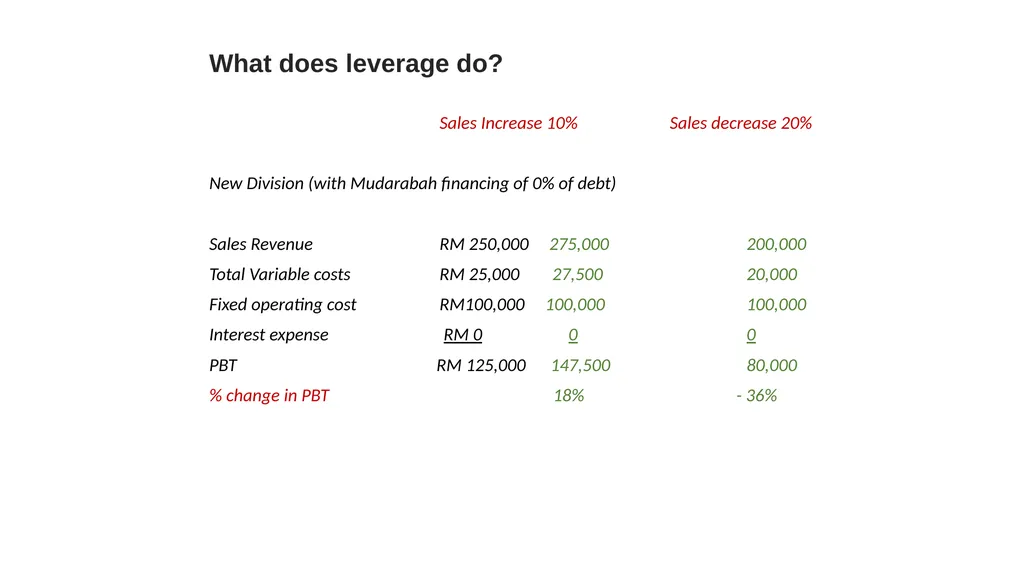
Sales Increase 10% Sales decrease 20%
New Division (with Mudarabah financing of 0% of debt)
Sales Revenue RM 250,000 275,000 200,000
Total Variable costs RM 25,000 27,500 20,000
Fixed operating cost RM100,000 100,000 100,000
Interest expense RM 0 0 0
PBT RM 125,000 147,500 80,000
% change in PBT 18% - 36% What does leverage do?<br>
New Division (with Mudarabah financing of 0% of debt)
Sales Revenue RM 250,000 275,000 200,000
Total Variable costs RM 25,000 27,500 20,000
Fixed operating cost RM100,000 100,000 100,000
Interest expense RM 0 0 0
PBT RM 125,000 147,500 80,000
% change in PBT 18% - 36% What does leverage do?<br>
26
29<br>
27
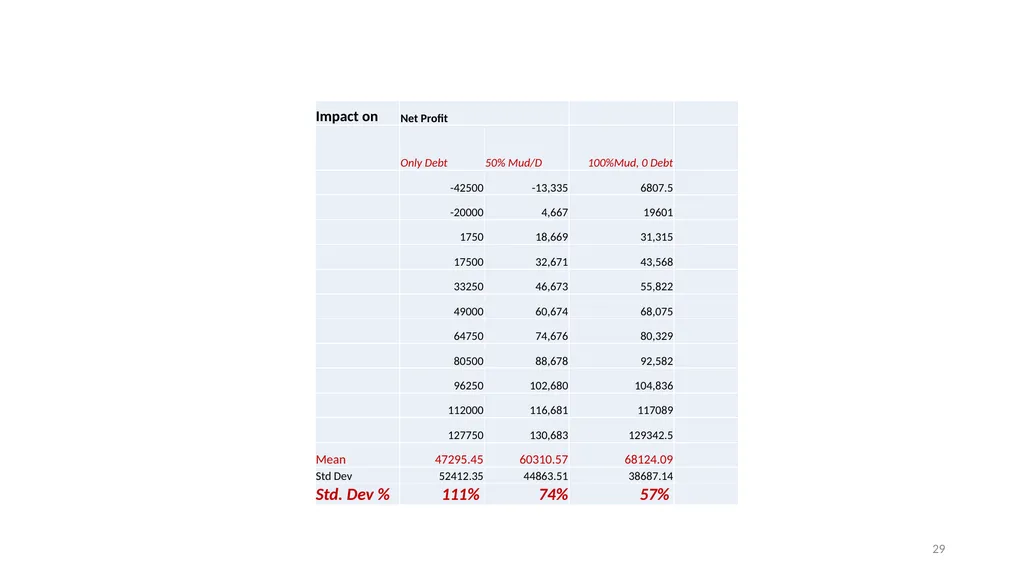
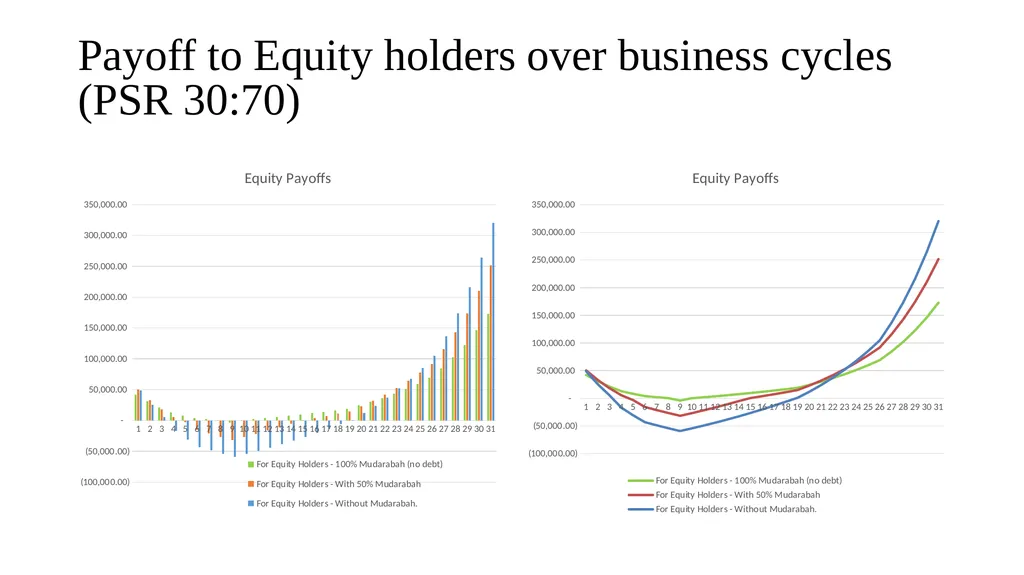
Payoff to Equity holders over business cycles (PSR 30:70)<br>
28
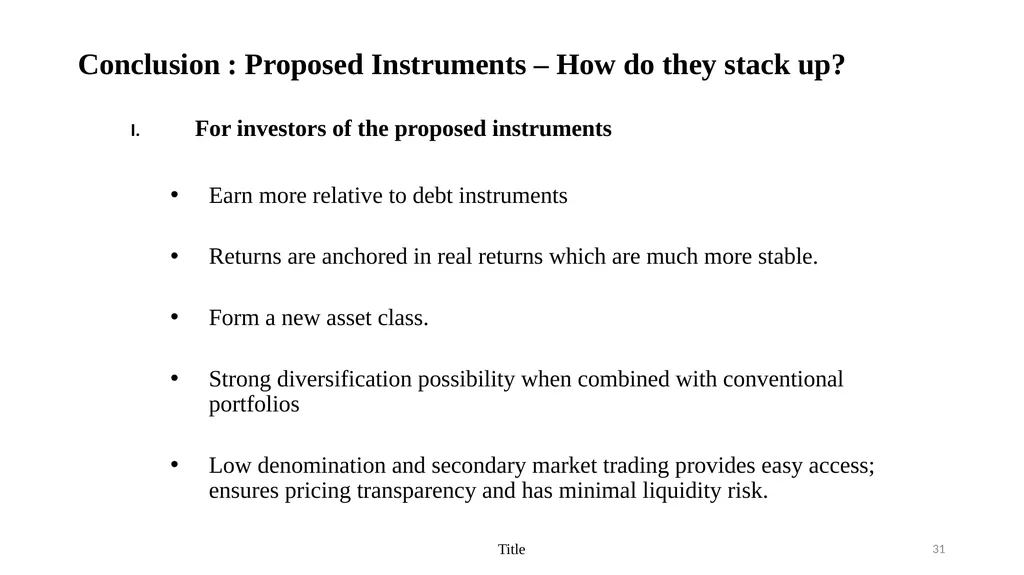
Title Conclusion : Proposed Instruments – How do they stack up? I. For investors of the proposed instruments
Earn more relative to debt instruments
Returns are anchored in real returns which are much more stable.
Form a new asset class.
Strong diversification possibility when combined with conventional portfolios
Low denomination and secondary market trading provides easy access; ensures pricing transparency and has minimal liquidity risk. 31<br>
Earn more relative to debt instruments
Returns are anchored in real returns which are much more stable.
Form a new asset class.
Strong diversification possibility when combined with conventional portfolios
Low denomination and secondary market trading provides easy access; ensures pricing transparency and has minimal liquidity risk. 31<br>
29
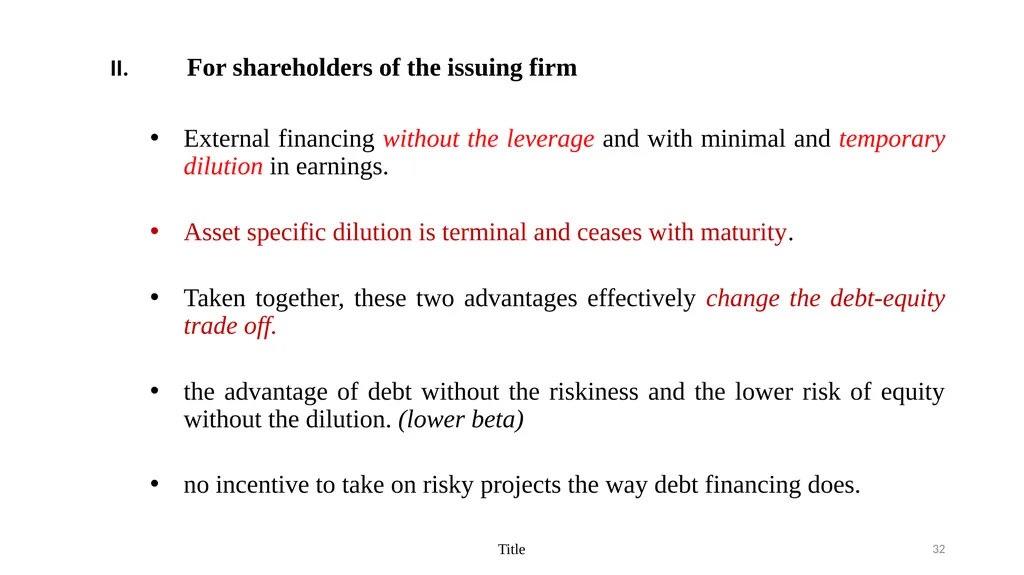
Title II. For shareholders of the issuing firm
External financing without the leverage and with minimal and temporary dilution in earnings.
Asset specific dilution is terminal and ceases with maturity.
Taken together, these two advantages effectively change the debt-equity trade off.
the advantage of debt without the riskiness and the lower risk of equity without the dilution. (lower beta)
no incentive to take on risky projects the way debt financing does. 32<br>
External financing without the leverage and with minimal and temporary dilution in earnings.
Asset specific dilution is terminal and ceases with maturity.
Taken together, these two advantages effectively change the debt-equity trade off.
the advantage of debt without the riskiness and the lower risk of equity without the dilution. (lower beta)
no incentive to take on risky projects the way debt financing does. 32<br>
30
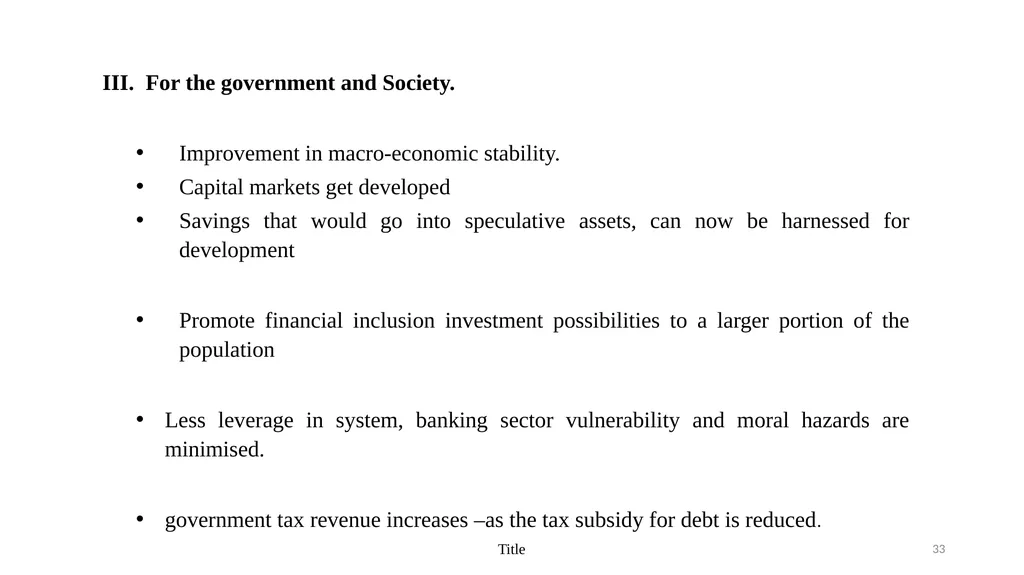
Title For the government and Society.
Improvement in macro-economic stability.
Capital markets get developed
Savings that would go into speculative assets, can now be harnessed for development
Promote financial inclusion investment possibilities to a larger portion of the population
Less leverage in system, banking sector vulnerability and moral hazards are minimised.
government tax revenue increases –as the tax subsidy for debt is reduced. 33<br>
Improvement in macro-economic stability.
Capital markets get developed
Savings that would go into speculative assets, can now be harnessed for development
Promote financial inclusion investment possibilities to a larger portion of the population
Less leverage in system, banking sector vulnerability and moral hazards are minimised.
government tax revenue increases –as the tax subsidy for debt is reduced. 33<br>
31
Obiyathulla Ismath Bacha obiya@inceif.org 603-76514188 34 Professor of Finance<br>