
Institutional Reforms for Sustainable Monetary and

Description: Institutional Reforms for Sustainable Monetary and Fiscal Policy In a democracy, it is easy enough to put forth proposals for reform in support of some larger goal. In an authoritarian regime, it could cost you your life. Our suggestions
Related Topics
Download Presentation
"Institutional Reforms for Sustainable Monetary and" is the property of its rightful owner. Permission is granted to download and print the materials on this website for personal, non-commercial use only, and to display it on your personal computer provided you do not modify the materials and that you retain all copyright notices contained in the materials. By downloading content from our website, you accept the terms of this agreement.
Presentation Transcript
slide1. Institutional Reforms for Sustainable Monetary and Fiscal Policy In a democracy, it is easy enough to put forth proposals for reform in support of some larger goal. In an authoritarian regime, it could cost you your life. Our suggestions thus are framed within the context of democratic institutions.
The first question is: Why undertake any reforms? There is a powerful set of incentives to extent the status quo. This arises typically from elected officials and special interests who stand to gain from keeping things as they are. Even if nothing constituting fraud is apparent, the fact that someone gains from keeping things as they are may simply reinforce rules and laws that prevent change that could bring about a greater level of public satisfaction.
The second question is: What kinds of reforms make sense? The world reform carries almost biblical weight in public discussions. Yet there is no guarantee that a particular reform would increase total public satisfaction. The simple explanation here is that voters often are less than fully informed as to the content and significance of any proposed reform, be it by a candidate running for office or someone already in office. The behavior of elected officials can be explained as much as anything as self-interest, even if couched in noble language.<br>
slide2. A catalog of economic reforms Economic reform has an enduring appeal, if for nothing else than the fact that it so often is so ill defined. Let us consider, at a macro and microeconomic level what principles should guide any list of reforms.
In the first instance, there is near universal agreement that a government gains political legitimacy when it achieves a measured degree of economic prosperity, as measured by the mean and median level of per capita income. In the second instance it increases when the mix of incentives also results in a minimization of an economy’s misery index. And third, it does so when economic growth is environmentally sustainable. In short, a simple benchmark is a minimization of the simple misery index that is compensated by increases in sustainable real per capita income.
To this, political legitimacy also is enhanced when a society judges that distributive justice has been achieved, a subject we have treated before, but placed only passing emphasis on here. How a society defines distributive justice is a function of which norms should apply: distributive justice as one in which the rules are applied equally and universally for any given outcome, or in the second instance, even when rules are fair, and a given goal is realized. And to all of this is the question of transparent and accountable inclusive governance, the hallmarks of a democratic society.<br>
slide3. Economic Reform Choices Capital Budgeting. As already noted, government expenditures make no distinction between recurrent and capital expenditures. Calling government spending “investment” can be quite misleading. Since there is neither a Constitutional mandate nor a Congressional one, the first step in achieving fiscal rationality is to adopt capital budgeting principles: This means that all recurrent expenditures are to be paid on a matching level of fiscal revenues, and in which borrowing is limited to only those expenditures that can be properly considered a capital expenditures. To be sure, infrastructure in the most limited sense of roads, bridges, and ports would meet a capital expenditure justification insofar as the social rate of return were were equal to the opportunity cost of capital.
Capital budgeting principles also would help to establish a standard by which deficits could be properly considered. Though now largely overlooked, when John Maynard Keynes (1883-1946) wrote his classic The General Theory of Employment, Interest, and Money in 1936, he argued for deliberate deficit spending when the private sector fails to respond to a reduction in interest rates. Such spending should be devoted to capital expenditures, though he was not explicit on this issue at the time. At the same time, he also argued that in times of prosperity, government should run deliberate budget surpluses, with the general idea that the overall public debt to GDP ratio remain relatively constant. This assumes that the optimal mix of government spending has been achieved. The lack of a consensus explains no doubt why there is no general governing principle that the ratio of public debt to the GDP should adhere to a specific number of interval. But little effort has been made other than the sometimes oblique debates that are now shaping the current federal infrastructure legislation in Congress.<br>
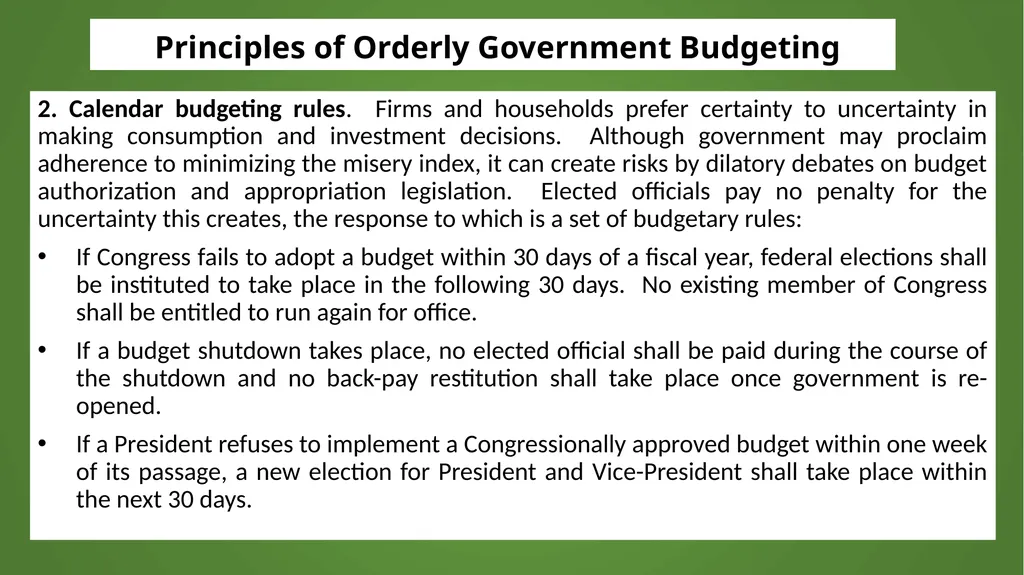
slide4. Principles of Orderly Government Budgeting 2. Calendar budgeting rules. Firms and households prefer certainty to uncertainty in making consumption and investment decisions. Although government may proclaim adherence to minimizing the misery index, it can create risks by dilatory debates on budget authorization and appropriation legislation. Elected officials pay no penalty for the uncertainty this creates, the response to which is a set of budgetary rules:
If Congress fails to adopt a budget within 30 days of a fiscal year, federal elections shall be instituted to take place in the following 30 days. No existing member of Congress shall be entitled to run again for office.
If a budget shutdown takes place, no elected official shall be paid during the course of the shutdown and no back-pay restitution shall take place once government is re-opened.
If a President refuses to implement a Congressionally approved budget within one week of its passage, a new election for President and Vice-President shall take place within the next 30 days.<br>
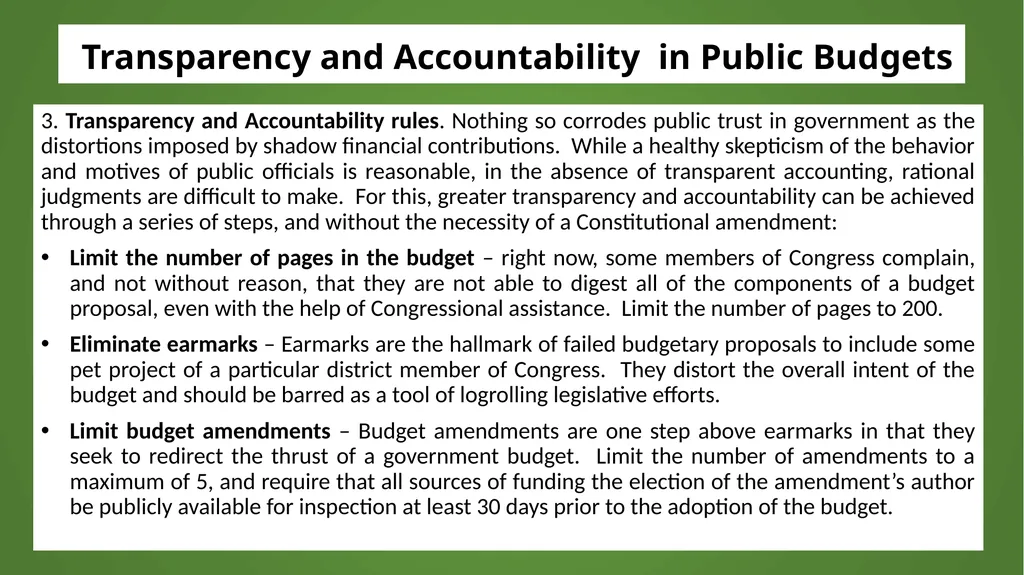
slide5. Transparency and Accountability in Public Budgets 3. Transparency and Accountability rules. Nothing so corrodes public trust in government as the distortions imposed by shadow financial contributions. While a healthy skepticism of the behavior and motives of public officials is reasonable, in the absence of transparent accounting, rational judgments are difficult to make. For this, greater transparency and accountability can be achieved through a series of steps, and without the necessity of a Constitutional amendment:
Limit the number of pages in the budget – right now, some members of Congress complain, and not without reason, that they are not able to digest all of the components of a budget proposal, even with the help of Congressional assistance. Limit the number of pages to 200.
Eliminate earmarks – Earmarks are the hallmark of failed budgetary proposals to include some pet project of a particular district member of Congress. They distort the overall intent of the budget and should be barred as a tool of logrolling legislative efforts.
Limit budget amendments – Budget amendments are one step above earmarks in that they seek to redirect the thrust of a government budget. Limit the number of amendments to a maximum of 5, and require that all sources of funding the election of the amendment’s author be publicly available for inspection at least 30 days prior to the adoption of the budget.<br>
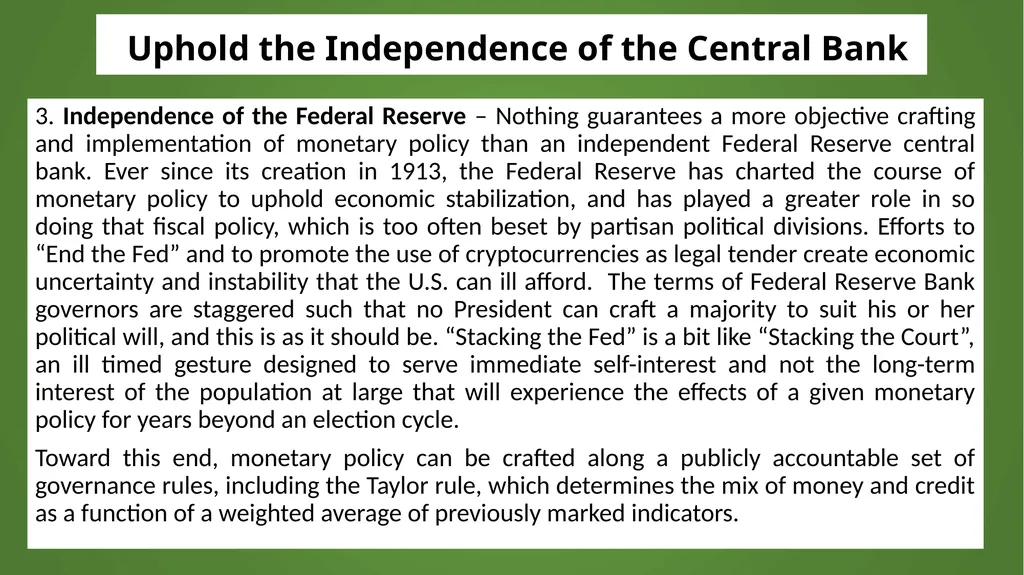
slide6. Uphold the Independence of the Central Bank 3. Independence of the Federal Reserve – Nothing guarantees a more objective crafting and implementation of monetary policy than an independent Federal Reserve central bank. Ever since its creation in 1913, the Federal Reserve has charted the course of monetary policy to uphold economic stabilization, and has played a greater role in so doing that fiscal policy, which is too often beset by partisan political divisions. Efforts to “End the Fed” and to promote the use of cryptocurrencies as legal tender create economic uncertainty and instability that the U.S. can ill afford. The terms of Federal Reserve Bank governors are staggered such that no President can craft a majority to suit his or her political will, and this is as it should be. “Stacking the Fed” is a bit like “Stacking the Court”, an ill timed gesture designed to serve immediate self-interest and not the long-term interest of the population at large that will experience the effects of a given monetary policy for years beyond an election cycle.
Toward this end, monetary policy can be crafted along a publicly accountable set of governance rules, including the Taylor rule, which determines the mix of money and credit as a function of a weighted average of previously marked indicators.<br>
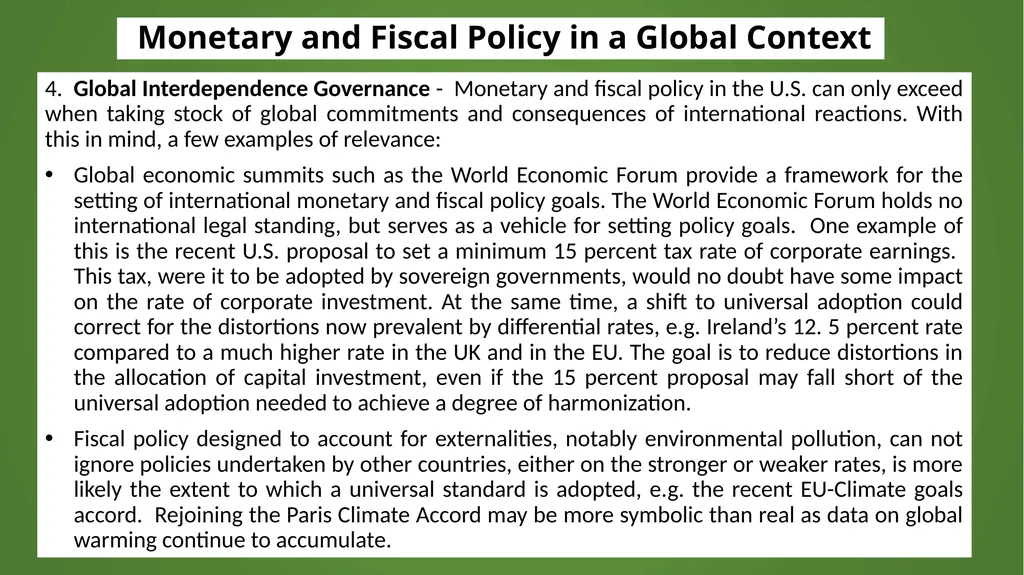
slide7. Monetary and Fiscal Policy in a Global Context 4. Global Interdependence Governance - Monetary and fiscal policy in the U.S. can only exceed when taking stock of global commitments and consequences of international reactions. With this in mind, a few examples of relevance:
Global economic summits such as the World Economic Forum provide a framework for the setting of international monetary and fiscal policy goals. The World Economic Forum holds no international legal standing, but serves as a vehicle for setting policy goals. One example of this is the recent U.S. proposal to set a minimum 15 percent tax rate of corporate earnings. This tax, were it to be adopted by sovereign governments, would no doubt have some impact on the rate of corporate investment. At the same time, a shift to universal adoption could correct for the distortions now prevalent by differential rates, e.g. Ireland’s 12. 5 percent rate compared to a much higher rate in the UK and in the EU. The goal is to reduce distortions in the allocation of capital investment, even if the 15 percent proposal may fall short of the universal adoption needed to achieve a degree of harmonization.
Fiscal policy designed to account for externalities, notably environmental pollution, can not ignore policies undertaken by other countries, either on the stronger or weaker rates, is more likely the extent to which a universal standard is adopted, e.g. the recent EU-Climate goals accord. Rejoining the Paris Climate Accord may be more symbolic than real as data on global warming continue to accumulate.<br>
slide8. Global Competition Choices 5. Global Competition standards In addition to the challenge of global environmental, and health, coordination and cooperation, how countries adopt competition policies also must consider the global context in which firms compete. Global firms compete on market shares and in a dynamic setting, look to shape the pace of technological evolution. R&D government expenditures may nurture basic research (e.g., exploration of Mars) but once some stage has been reached, it then falls largely to private firms to adopt a pace of applied technology advances (e.g., Richard Branson and Jeff Bezos in terms of space tourism). But what of market share competition policy?
Some governments may adopt policies that foster industrial concentration (e.g., Keretsu in Japan and Chaebol in South Korea) while others such as the U.S. may pursue policies that limit the degree of concentration, e.g. antitrust. The U.S., and to a lesser extent the EU, adhere to the principle of limiting industrial concentration in that it may deny potentially productive technological innovations, not to mention earning economic over normal rates of return. The evidence on rates of return is mixed, while the growth of large firm concentrations, especially in the internet and communications has led the U.S. to adopt a more aggressive policy towards Apple, Facebook, Microsoft, and Amazon, whose market capitalization levels are among the highest in the world. Interestingly, not one of these firms had anything approaching the level of market concentration just 30 years ago that they do today, which suggests that concentration may persist though the players may not. The key here is that if one country adopts a strong antitrust policy while others are promoting industrial concentration, it may be a case of one country inflicting lower economic performance on itself while others prosper. This is not to say that oversight of large and concentrated firms is unwarranted, but that a coherent policy makes sense only when taking global competition into consideration. Ignoring the WTO, and other international organizations is not a solution as much as an effort to dramatize an issue, similarly in the case of threats to withdraw from the UN, WHO, or NATO, as recent experience seemed to suggest.<br>
slide9. Global Fairness Considered 6. International Inequality Standards – When countries open their borders to international trade and investment, those with lesser levels of income and education are prone to even lower levels of income. International trade negotiation agreements such as the EU and the former NAFTA illustrate how some segments of an economy can be adversely affected by greater global integration. To compensate for such rising disparities, countries can pursue policies that reduce these inequalities. Such policies may or may not have adverse effects on aggregate per capita growth rates. Examples include:
Measures to enhance factor mobility – reducing corporate tax location incentives, reducing occupational barriers to entry,
Expanding access to education – encouraging technological innovation to contain educational costs, complementary measures to support child care for working parents,
Better community governance on housing, crime reduction, discrimination and related factors that shape socio-economic mobility.<br>
slide10. Measures to Improve democratic accountability - 1 A democracy survives and thrives to the extent that its citizens are informed, engaged, and enjoy voting rights. It also survives to the extent that its institutions of governance provide sufficient transparency and accountability that voters can adopt a measured degree of confidence in delegated responsibility that democracy confers. In the U.S., its constitutional history is a panorama of an expansion of voting rights: the abolition of slavery, voting rights for those born in the U.S., the right to vote for women, and inclusion of other minorities. Expanding these voting rights to a more universal standard of coverage is a necessary but insufficient basis for a sustainable democracy. Achieving more democratic governance will require:
Benefit and Health Care standards. All elected government officials are to be compensated on the same basis of standards applied to the rest of the citizenry, e.g., Social Security and Medicare benefits. An elected official is eligible for retirement benefits only in proportion to the time served and not based on a current salary.
Electoral College Popular Voting Standard. The Electoral College shall allocate votes in proportion to the popular vote majority of each respective state. There is no need for a constitutional amendment to abolish the Electoral College. As long as an Electoral College affirms a popular voting majority, it reinforces the political legitimacy of an election.<br>
slide11. Measures to Improve democratic accountability – 2 While retaining the filibuster in its present form, a time limit of 30 days is to be set after which a vote on legislation must be taken. It is reasonable to allow a measure of delay for purposes of debate and the consolidation of a voting majority, but not on an unlimited basis.
While a simple majority can determine the outcome of an election, all legislation must be adopted by a minimum of a 60 percent majority. Passing legislation with simple majorities only stirs the minority to overturn the majority in the next election, whereas political legitimacy requires a voting majority beyond 51 percent. A 60 percent voting majority standard will expand, not reduce, bipartisan voting.
While keeping the Constitutional standard of the first Tuesday in November for national elections, make that day a national holiday with no penalty for time off. Other countries have similar provisions for national day voting, and to do otherwise in the U.S. only limits the voter participation rate, thus weakening the political legitimacy of an election.<br>
slide12. Measures to Improve democratic accountability – 3 Adopt and enforce mail-in voting up to a week before in-person voting takes place. Putting pandemic measures aside, even if Tuesday becomes a national holiday, voters may not have the time to participate on the in-person voting day. Military personnel and citizens residing overseas have long had mail-in voting rights. Mail-in voting should be part of the universal standard of voting, as it increases the rate of voter participation, and thus the political legitimacy of elections.
Term limits. Many states have term limits for elected office, as does the Federal government for the President and Vice-President. While some elective experience is useful to understanding governance principles, if terms are unlimited, they may reinforce vested interests and the adoption of various legislative reforms. Government should have some form of the following term limits for federal elective positions:
Three terms for members of the Senate – at 18 years, this constitutes almost a voting generation
Six terms for members of the House – at 12 years, this reinforces electoral renewal
Supreme Court justices – Set a minimum age of 55, and a 25 year term limit.<br>
slide13. Measures to Improve democratic accountability – 4 Election funding transparency. In a democracy, the one-person one-vote standard does not reflect the intensity of voter preferences. Efforts to limit financial contributions such as McCain-Feingold have failed to achieve the stated objective. Instead, adopt a standard that every dollar of financial contributions be traced down the individual donor who writes the check. Any financial contribution that is intended to remain confidential and allocated through non-profit Political Action Committee groups is to be treated as a felony, with fines and jail terms in proportion to the donor’s income. This standard addresses the distortions underlying such laws as the Citizens United decision by the Supreme Court, wherein Corporations are treated as having a legitimate voice in elections but for which no individual is held accountable for campaign contributions. As long as campaign contributions can remain confidential in an election, the legitimacy of an election is undermined, as is the legitimacy of a government administration. Perpetuation of confidentiality of voter financial contributions in an election reduces the voter participation rate even as it may express voter intensity. Political legitimacy requires a significant degree of voter participation, even if the only standard now practiced is a comparison with other democratic countries.<br>
slide14. Measures to Improve democratic accountability – 5 Restore the Fairness Doctrine. In an age of silo-based informational proliferation, there is a tendency to channel information according to pre-conceived notions. This availability bias reduces the need for voters to consider a more inclusive range of considerations in viewing any electoral propositions. It further weakens voter capacity to discern and eliminate “fake news” from consideration, and thus the clarity, consistency, and legitimacy of voting decisions. Under a restored fairness doctrine, if a source posits a particular interpretation of an event, the medium through which it is communicated has an obligation for an alternative voice to respond. To the extent that a fairness doctrine is enforced, it is likely to reduce more extreme interpretations of an event, and thus the political partisanship that become so deepened through internet and comparable channels of communication. Private ownership of media is a key to democratic accountability, as it has been historically. With private ownership also comes public responsibility in terms of objectivity of information. Government should not serve as censor of media, and instead allow the court system to resolve inadequacies in the dissemination of false information. Journalists should not be required to reveal their sources, only to provide facts that may be objectively accounted for on an issue.<br>
slide15. Measures to Improve democratic accountability – 6 Mandatory disclosure of tax returns for elected office. Though far from universal, it has become a standard practice for many candidates for public office to disclose their tax returns for the previous ten years. This is as important as complete disclosure of financial contributions for an elected office. While no disclosure system may eliminate all potential sources of voting bias, a mandatory tax disclosure standard can reduce the likelihood of corruption of an elected official. Such disclosure should be made available not just to other elected officials or to the press, but also to voters via a mandatory posting on a publicly accessible internet site.
Mandatory posting of proposed legislation. In tandem with the above standard, all proposed legislation should be required to be publicly available at least ten days before a vote is taken. Voters should be able to see the provisions of legislation and to turn to the media to clarify the implications of a particular bill as it affects a given election district, the sources of financial contributors to an elected official, and the public at large. Such a disclosure standard might reduce the hyperbole attached to particular pieces of legislation now and in which content is less than fully conveyed to voters and other elected officials. It might even improve the language of legislative authors.<br>
slide16. Measures to Improve democratic accountability – 7 Use the Winner’s Curse to reduce gerrymandering. Gerrymandering has been a common practice ever since the eponymous creator was first noted so doing in the election of 1824. As now practiced, winning parties have a disproportionate influence in shaping election districts for the next election, thus perpetuating distortions in voter preferences. To reduce the effect of gerrymandering, adopt a winner’s curse standard for election redistricting: The largest losing party is guaranteed the right to draw up districts for the next election Once such a standard is adopted, it provides a powerful incentive for political parties to turn to more objective redistricting groups to draw up new boundaries for the next election. In so doing, these more representative boundaries reinforce the political legitimacy of an election in that they more accurately reflect the composition and preferences of the electorate. More objective districts also can reinforce the rate of voter participation, which also strengthens the legitimacy of an election.<br>
slide17. Measures to Improve democratic accountability – 8 Reduce the self-dealing dimensions of elected official compensation. As matters stand presently, elected officials can vote themselves pay increases at will. Voters can vote someone out of office for having so voted, but the problem then passes on to the successor. While elected officials often have become wealthier through their terms of service, their public compensation alone is but one component of the sources of wealth accumulation. This said, as long as elected officials can vote themselves increases in compensation, this undermines the credibility of the claim that they are serving the public interest.
One solution is to subject pay and benefits increases to voter approval. This is a complex
process, and not easily administered. Instead, a simpler, interim, solution would be to
tie the compensation of elected officials to the rate of consumer price increases, much
as is now done with Social Security benefits. Such increases would then be known publicly
readily available not just through posted tax returns, but also through publicly
available postings when an increase is to take place.<br>
slide18. Implementation of Governance Reforms The list of proposed governance reforms is far from exhaustive. How to establish a priority for implementation also is a challenge, as is the mechanism through implementation of reform. One principle that should help govern such reforms is how to avoid substantive changes to the Constitution through the usual amendment process. To the extent that they can be adopted and implemented through a series of votes and sustained by court decisions would be a step in reinforcing how governance is to take place, and thus, how monetary and fiscal policy decisions can be made more objective.
All democratic governments face the challenge of undertaking reforms that make them more transparent, inclusive, sustainable, and equitable. A useful and logical first step would be the formation and appointment of a reform commission to address either a single issue or a basket of issues which then are brought to government to vote upon. This has been done, for example, in the UK through issuance of White Papers that advise on major issues. In the U.S. it has taken place in terms of Commissions of Inquiry, e.g., the Kerner Commission on 1968, The 9/11 Commission, and the still evolving January 6 Inquiry, for example But the Commission model is usually in reference to an event rather than in terms of addressing proposals for reform of government institutions themselves. This said, one should reflect on the question of whether there are adverse consequences for doing nothing, or doing something, now rather than later.<br>
The first question is: Why undertake any reforms? There is a powerful set of incentives to extent the status quo. This arises typically from elected officials and special interests who stand to gain from keeping things as they are. Even if nothing constituting fraud is apparent, the fact that someone gains from keeping things as they are may simply reinforce rules and laws that prevent change that could bring about a greater level of public satisfaction.
The second question is: What kinds of reforms make sense? The world reform carries almost biblical weight in public discussions. Yet there is no guarantee that a particular reform would increase total public satisfaction. The simple explanation here is that voters often are less than fully informed as to the content and significance of any proposed reform, be it by a candidate running for office or someone already in office. The behavior of elected officials can be explained as much as anything as self-interest, even if couched in noble language.<br>
slide2. A catalog of economic reforms Economic reform has an enduring appeal, if for nothing else than the fact that it so often is so ill defined. Let us consider, at a macro and microeconomic level what principles should guide any list of reforms.
In the first instance, there is near universal agreement that a government gains political legitimacy when it achieves a measured degree of economic prosperity, as measured by the mean and median level of per capita income. In the second instance it increases when the mix of incentives also results in a minimization of an economy’s misery index. And third, it does so when economic growth is environmentally sustainable. In short, a simple benchmark is a minimization of the simple misery index that is compensated by increases in sustainable real per capita income.
To this, political legitimacy also is enhanced when a society judges that distributive justice has been achieved, a subject we have treated before, but placed only passing emphasis on here. How a society defines distributive justice is a function of which norms should apply: distributive justice as one in which the rules are applied equally and universally for any given outcome, or in the second instance, even when rules are fair, and a given goal is realized. And to all of this is the question of transparent and accountable inclusive governance, the hallmarks of a democratic society.<br>
slide3. Economic Reform Choices Capital Budgeting. As already noted, government expenditures make no distinction between recurrent and capital expenditures. Calling government spending “investment” can be quite misleading. Since there is neither a Constitutional mandate nor a Congressional one, the first step in achieving fiscal rationality is to adopt capital budgeting principles: This means that all recurrent expenditures are to be paid on a matching level of fiscal revenues, and in which borrowing is limited to only those expenditures that can be properly considered a capital expenditures. To be sure, infrastructure in the most limited sense of roads, bridges, and ports would meet a capital expenditure justification insofar as the social rate of return were were equal to the opportunity cost of capital.
Capital budgeting principles also would help to establish a standard by which deficits could be properly considered. Though now largely overlooked, when John Maynard Keynes (1883-1946) wrote his classic The General Theory of Employment, Interest, and Money in 1936, he argued for deliberate deficit spending when the private sector fails to respond to a reduction in interest rates. Such spending should be devoted to capital expenditures, though he was not explicit on this issue at the time. At the same time, he also argued that in times of prosperity, government should run deliberate budget surpluses, with the general idea that the overall public debt to GDP ratio remain relatively constant. This assumes that the optimal mix of government spending has been achieved. The lack of a consensus explains no doubt why there is no general governing principle that the ratio of public debt to the GDP should adhere to a specific number of interval. But little effort has been made other than the sometimes oblique debates that are now shaping the current federal infrastructure legislation in Congress.<br>
slide4. Principles of Orderly Government Budgeting 2. Calendar budgeting rules. Firms and households prefer certainty to uncertainty in making consumption and investment decisions. Although government may proclaim adherence to minimizing the misery index, it can create risks by dilatory debates on budget authorization and appropriation legislation. Elected officials pay no penalty for the uncertainty this creates, the response to which is a set of budgetary rules:
If Congress fails to adopt a budget within 30 days of a fiscal year, federal elections shall be instituted to take place in the following 30 days. No existing member of Congress shall be entitled to run again for office.
If a budget shutdown takes place, no elected official shall be paid during the course of the shutdown and no back-pay restitution shall take place once government is re-opened.
If a President refuses to implement a Congressionally approved budget within one week of its passage, a new election for President and Vice-President shall take place within the next 30 days.<br>
slide5. Transparency and Accountability in Public Budgets 3. Transparency and Accountability rules. Nothing so corrodes public trust in government as the distortions imposed by shadow financial contributions. While a healthy skepticism of the behavior and motives of public officials is reasonable, in the absence of transparent accounting, rational judgments are difficult to make. For this, greater transparency and accountability can be achieved through a series of steps, and without the necessity of a Constitutional amendment:
Limit the number of pages in the budget – right now, some members of Congress complain, and not without reason, that they are not able to digest all of the components of a budget proposal, even with the help of Congressional assistance. Limit the number of pages to 200.
Eliminate earmarks – Earmarks are the hallmark of failed budgetary proposals to include some pet project of a particular district member of Congress. They distort the overall intent of the budget and should be barred as a tool of logrolling legislative efforts.
Limit budget amendments – Budget amendments are one step above earmarks in that they seek to redirect the thrust of a government budget. Limit the number of amendments to a maximum of 5, and require that all sources of funding the election of the amendment’s author be publicly available for inspection at least 30 days prior to the adoption of the budget.<br>
slide6. Uphold the Independence of the Central Bank 3. Independence of the Federal Reserve – Nothing guarantees a more objective crafting and implementation of monetary policy than an independent Federal Reserve central bank. Ever since its creation in 1913, the Federal Reserve has charted the course of monetary policy to uphold economic stabilization, and has played a greater role in so doing that fiscal policy, which is too often beset by partisan political divisions. Efforts to “End the Fed” and to promote the use of cryptocurrencies as legal tender create economic uncertainty and instability that the U.S. can ill afford. The terms of Federal Reserve Bank governors are staggered such that no President can craft a majority to suit his or her political will, and this is as it should be. “Stacking the Fed” is a bit like “Stacking the Court”, an ill timed gesture designed to serve immediate self-interest and not the long-term interest of the population at large that will experience the effects of a given monetary policy for years beyond an election cycle.
Toward this end, monetary policy can be crafted along a publicly accountable set of governance rules, including the Taylor rule, which determines the mix of money and credit as a function of a weighted average of previously marked indicators.<br>
slide7. Monetary and Fiscal Policy in a Global Context 4. Global Interdependence Governance - Monetary and fiscal policy in the U.S. can only exceed when taking stock of global commitments and consequences of international reactions. With this in mind, a few examples of relevance:
Global economic summits such as the World Economic Forum provide a framework for the setting of international monetary and fiscal policy goals. The World Economic Forum holds no international legal standing, but serves as a vehicle for setting policy goals. One example of this is the recent U.S. proposal to set a minimum 15 percent tax rate of corporate earnings. This tax, were it to be adopted by sovereign governments, would no doubt have some impact on the rate of corporate investment. At the same time, a shift to universal adoption could correct for the distortions now prevalent by differential rates, e.g. Ireland’s 12. 5 percent rate compared to a much higher rate in the UK and in the EU. The goal is to reduce distortions in the allocation of capital investment, even if the 15 percent proposal may fall short of the universal adoption needed to achieve a degree of harmonization.
Fiscal policy designed to account for externalities, notably environmental pollution, can not ignore policies undertaken by other countries, either on the stronger or weaker rates, is more likely the extent to which a universal standard is adopted, e.g. the recent EU-Climate goals accord. Rejoining the Paris Climate Accord may be more symbolic than real as data on global warming continue to accumulate.<br>
slide8. Global Competition Choices 5. Global Competition standards In addition to the challenge of global environmental, and health, coordination and cooperation, how countries adopt competition policies also must consider the global context in which firms compete. Global firms compete on market shares and in a dynamic setting, look to shape the pace of technological evolution. R&D government expenditures may nurture basic research (e.g., exploration of Mars) but once some stage has been reached, it then falls largely to private firms to adopt a pace of applied technology advances (e.g., Richard Branson and Jeff Bezos in terms of space tourism). But what of market share competition policy?
Some governments may adopt policies that foster industrial concentration (e.g., Keretsu in Japan and Chaebol in South Korea) while others such as the U.S. may pursue policies that limit the degree of concentration, e.g. antitrust. The U.S., and to a lesser extent the EU, adhere to the principle of limiting industrial concentration in that it may deny potentially productive technological innovations, not to mention earning economic over normal rates of return. The evidence on rates of return is mixed, while the growth of large firm concentrations, especially in the internet and communications has led the U.S. to adopt a more aggressive policy towards Apple, Facebook, Microsoft, and Amazon, whose market capitalization levels are among the highest in the world. Interestingly, not one of these firms had anything approaching the level of market concentration just 30 years ago that they do today, which suggests that concentration may persist though the players may not. The key here is that if one country adopts a strong antitrust policy while others are promoting industrial concentration, it may be a case of one country inflicting lower economic performance on itself while others prosper. This is not to say that oversight of large and concentrated firms is unwarranted, but that a coherent policy makes sense only when taking global competition into consideration. Ignoring the WTO, and other international organizations is not a solution as much as an effort to dramatize an issue, similarly in the case of threats to withdraw from the UN, WHO, or NATO, as recent experience seemed to suggest.<br>
slide9. Global Fairness Considered 6. International Inequality Standards – When countries open their borders to international trade and investment, those with lesser levels of income and education are prone to even lower levels of income. International trade negotiation agreements such as the EU and the former NAFTA illustrate how some segments of an economy can be adversely affected by greater global integration. To compensate for such rising disparities, countries can pursue policies that reduce these inequalities. Such policies may or may not have adverse effects on aggregate per capita growth rates. Examples include:
Measures to enhance factor mobility – reducing corporate tax location incentives, reducing occupational barriers to entry,
Expanding access to education – encouraging technological innovation to contain educational costs, complementary measures to support child care for working parents,
Better community governance on housing, crime reduction, discrimination and related factors that shape socio-economic mobility.<br>
slide10. Measures to Improve democratic accountability - 1 A democracy survives and thrives to the extent that its citizens are informed, engaged, and enjoy voting rights. It also survives to the extent that its institutions of governance provide sufficient transparency and accountability that voters can adopt a measured degree of confidence in delegated responsibility that democracy confers. In the U.S., its constitutional history is a panorama of an expansion of voting rights: the abolition of slavery, voting rights for those born in the U.S., the right to vote for women, and inclusion of other minorities. Expanding these voting rights to a more universal standard of coverage is a necessary but insufficient basis for a sustainable democracy. Achieving more democratic governance will require:
Benefit and Health Care standards. All elected government officials are to be compensated on the same basis of standards applied to the rest of the citizenry, e.g., Social Security and Medicare benefits. An elected official is eligible for retirement benefits only in proportion to the time served and not based on a current salary.
Electoral College Popular Voting Standard. The Electoral College shall allocate votes in proportion to the popular vote majority of each respective state. There is no need for a constitutional amendment to abolish the Electoral College. As long as an Electoral College affirms a popular voting majority, it reinforces the political legitimacy of an election.<br>
slide11. Measures to Improve democratic accountability – 2 While retaining the filibuster in its present form, a time limit of 30 days is to be set after which a vote on legislation must be taken. It is reasonable to allow a measure of delay for purposes of debate and the consolidation of a voting majority, but not on an unlimited basis.
While a simple majority can determine the outcome of an election, all legislation must be adopted by a minimum of a 60 percent majority. Passing legislation with simple majorities only stirs the minority to overturn the majority in the next election, whereas political legitimacy requires a voting majority beyond 51 percent. A 60 percent voting majority standard will expand, not reduce, bipartisan voting.
While keeping the Constitutional standard of the first Tuesday in November for national elections, make that day a national holiday with no penalty for time off. Other countries have similar provisions for national day voting, and to do otherwise in the U.S. only limits the voter participation rate, thus weakening the political legitimacy of an election.<br>
slide12. Measures to Improve democratic accountability – 3 Adopt and enforce mail-in voting up to a week before in-person voting takes place. Putting pandemic measures aside, even if Tuesday becomes a national holiday, voters may not have the time to participate on the in-person voting day. Military personnel and citizens residing overseas have long had mail-in voting rights. Mail-in voting should be part of the universal standard of voting, as it increases the rate of voter participation, and thus the political legitimacy of elections.
Term limits. Many states have term limits for elected office, as does the Federal government for the President and Vice-President. While some elective experience is useful to understanding governance principles, if terms are unlimited, they may reinforce vested interests and the adoption of various legislative reforms. Government should have some form of the following term limits for federal elective positions:
Three terms for members of the Senate – at 18 years, this constitutes almost a voting generation
Six terms for members of the House – at 12 years, this reinforces electoral renewal
Supreme Court justices – Set a minimum age of 55, and a 25 year term limit.<br>
slide13. Measures to Improve democratic accountability – 4 Election funding transparency. In a democracy, the one-person one-vote standard does not reflect the intensity of voter preferences. Efforts to limit financial contributions such as McCain-Feingold have failed to achieve the stated objective. Instead, adopt a standard that every dollar of financial contributions be traced down the individual donor who writes the check. Any financial contribution that is intended to remain confidential and allocated through non-profit Political Action Committee groups is to be treated as a felony, with fines and jail terms in proportion to the donor’s income. This standard addresses the distortions underlying such laws as the Citizens United decision by the Supreme Court, wherein Corporations are treated as having a legitimate voice in elections but for which no individual is held accountable for campaign contributions. As long as campaign contributions can remain confidential in an election, the legitimacy of an election is undermined, as is the legitimacy of a government administration. Perpetuation of confidentiality of voter financial contributions in an election reduces the voter participation rate even as it may express voter intensity. Political legitimacy requires a significant degree of voter participation, even if the only standard now practiced is a comparison with other democratic countries.<br>
slide14. Measures to Improve democratic accountability – 5 Restore the Fairness Doctrine. In an age of silo-based informational proliferation, there is a tendency to channel information according to pre-conceived notions. This availability bias reduces the need for voters to consider a more inclusive range of considerations in viewing any electoral propositions. It further weakens voter capacity to discern and eliminate “fake news” from consideration, and thus the clarity, consistency, and legitimacy of voting decisions. Under a restored fairness doctrine, if a source posits a particular interpretation of an event, the medium through which it is communicated has an obligation for an alternative voice to respond. To the extent that a fairness doctrine is enforced, it is likely to reduce more extreme interpretations of an event, and thus the political partisanship that become so deepened through internet and comparable channels of communication. Private ownership of media is a key to democratic accountability, as it has been historically. With private ownership also comes public responsibility in terms of objectivity of information. Government should not serve as censor of media, and instead allow the court system to resolve inadequacies in the dissemination of false information. Journalists should not be required to reveal their sources, only to provide facts that may be objectively accounted for on an issue.<br>
slide15. Measures to Improve democratic accountability – 6 Mandatory disclosure of tax returns for elected office. Though far from universal, it has become a standard practice for many candidates for public office to disclose their tax returns for the previous ten years. This is as important as complete disclosure of financial contributions for an elected office. While no disclosure system may eliminate all potential sources of voting bias, a mandatory tax disclosure standard can reduce the likelihood of corruption of an elected official. Such disclosure should be made available not just to other elected officials or to the press, but also to voters via a mandatory posting on a publicly accessible internet site.
Mandatory posting of proposed legislation. In tandem with the above standard, all proposed legislation should be required to be publicly available at least ten days before a vote is taken. Voters should be able to see the provisions of legislation and to turn to the media to clarify the implications of a particular bill as it affects a given election district, the sources of financial contributors to an elected official, and the public at large. Such a disclosure standard might reduce the hyperbole attached to particular pieces of legislation now and in which content is less than fully conveyed to voters and other elected officials. It might even improve the language of legislative authors.<br>
slide16. Measures to Improve democratic accountability – 7 Use the Winner’s Curse to reduce gerrymandering. Gerrymandering has been a common practice ever since the eponymous creator was first noted so doing in the election of 1824. As now practiced, winning parties have a disproportionate influence in shaping election districts for the next election, thus perpetuating distortions in voter preferences. To reduce the effect of gerrymandering, adopt a winner’s curse standard for election redistricting: The largest losing party is guaranteed the right to draw up districts for the next election Once such a standard is adopted, it provides a powerful incentive for political parties to turn to more objective redistricting groups to draw up new boundaries for the next election. In so doing, these more representative boundaries reinforce the political legitimacy of an election in that they more accurately reflect the composition and preferences of the electorate. More objective districts also can reinforce the rate of voter participation, which also strengthens the legitimacy of an election.<br>
slide17. Measures to Improve democratic accountability – 8 Reduce the self-dealing dimensions of elected official compensation. As matters stand presently, elected officials can vote themselves pay increases at will. Voters can vote someone out of office for having so voted, but the problem then passes on to the successor. While elected officials often have become wealthier through their terms of service, their public compensation alone is but one component of the sources of wealth accumulation. This said, as long as elected officials can vote themselves increases in compensation, this undermines the credibility of the claim that they are serving the public interest.
One solution is to subject pay and benefits increases to voter approval. This is a complex
process, and not easily administered. Instead, a simpler, interim, solution would be to
tie the compensation of elected officials to the rate of consumer price increases, much
as is now done with Social Security benefits. Such increases would then be known publicly
readily available not just through posted tax returns, but also through publicly
available postings when an increase is to take place.<br>
slide18. Implementation of Governance Reforms The list of proposed governance reforms is far from exhaustive. How to establish a priority for implementation also is a challenge, as is the mechanism through implementation of reform. One principle that should help govern such reforms is how to avoid substantive changes to the Constitution through the usual amendment process. To the extent that they can be adopted and implemented through a series of votes and sustained by court decisions would be a step in reinforcing how governance is to take place, and thus, how monetary and fiscal policy decisions can be made more objective.
All democratic governments face the challenge of undertaking reforms that make them more transparent, inclusive, sustainable, and equitable. A useful and logical first step would be the formation and appointment of a reform commission to address either a single issue or a basket of issues which then are brought to government to vote upon. This has been done, for example, in the UK through issuance of White Papers that advise on major issues. In the U.S. it has taken place in terms of Commissions of Inquiry, e.g., the Kerner Commission on 1968, The 9/11 Commission, and the still evolving January 6 Inquiry, for example But the Commission model is usually in reference to an event rather than in terms of addressing proposals for reform of government institutions themselves. This said, one should reflect on the question of whether there are adverse consequences for doing nothing, or doing something, now rather than later.<br>