
Inter-American Telecommunication Commission















Description: Inter-American Telecommunication Commission (CITEL) Permanent Consultative Committee II USG Presenter Status of Preparations for WRC-19 Working Group - PCC.II Working Group for the Preparation of CITEL for Regional and World
Related Topics
Download Presentation
"Inter-American Telecommunication Commission" is the property of its rightful owner. Permission is granted to download and print the materials on this website for personal, non-commercial use only, and to display it on your personal computer provided you do not modify the materials and that you retain all copyright notices contained in the materials. By downloading content from our website, you accept the terms of this agreement.
Presentation Transcript
slide1. Inter-American Telecommunication Commission (CITEL)
Permanent Consultative Committee II
[USG Presenter] Status of Preparations for WRC-19<br>
slide2. Working Group - PCC.II “Working Group for the Preparation of CITEL for Regional and World Radiocommunication Conferences” Chair: Carmelo Rivera, United States
(carmelo.rivera@noaa.gov)
Vice-Chairs: Victor Martinez, Mexico
(victor.martinezv@ift.org.mx)
Martha Suarez, Colombia
(martha.suarez@ane.gov.co) 2<br>
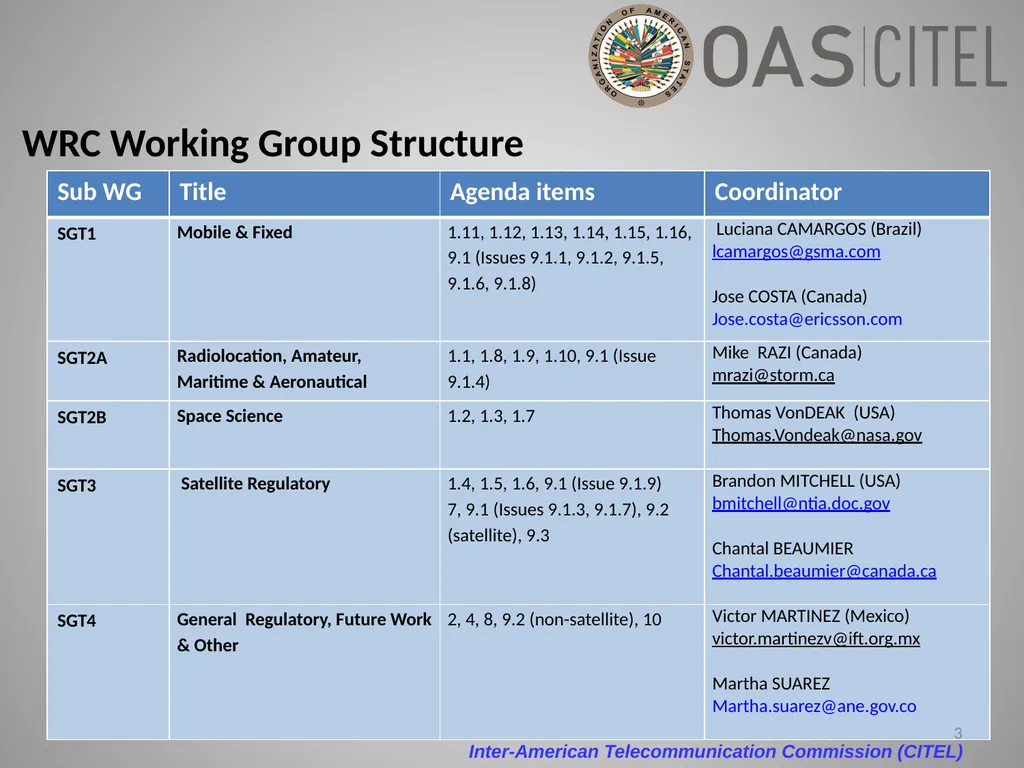
slide3. WRC Working Group Structure 3<br>
slide4. INTER – AMERICAN PROPOSALS : DEFINITIONS PRELIMINARY VIEWS (PV): a Member State’s initial view of an Agenda Item, indicating its view of a future proposal or position.
PRELIMINARY PROPOSAL (PP): Member State proposal that has yet to be supported by another Member State.
DRAFT INTER-AMERICAN PROPOSAL (DIAP): a Preliminary Proposal that has been supported by at least one other Member State, but not the number of Member States required for an Inter-American Proposal.
INTER-AMERICAN PROPOSAL (IAP): a Member State(s) proposal supported by at least six Members States and not opposed by more than 50% of the number of supports obtained (i.e., 8 support, 4 oppose = IAP; 8 support, 5 or more oppose = “not IAP”. 4<br>
slide5. WRC-19 – Issues of Primary Interest to Aviation 5 Agenda Item 1.10 – Global Aeronautical Distress and Safety System (GADSS) – Preliminary View
Agenda Item Issue 9.1.4 – Stations on Board Syb-Orbital Vehicles – Preliminary View
Agenda Item 1.8 – Introduction of Additional Satellite Systems into the Global Maritime Distress and Safety System (GMDSS) – Preliminary Proposal<br>
slide6. Preliminary Views
Brazil, Canada, United States of America
The quantification and characterization of the radiocommunications requirements for both the terrestrial and satellite components of GADSS are the responsibility of ICAO;
Based on those requirements, relevant studies should be conducted in the ITU-R to review existing regulatory provisions and determine if additional regulatory changes are needed;
ITU-R studies should be done in coordination with ICAO.
Issue Coordinator : Luís Fernando (B) lfsouza@embraer.com.br
Alt Coordinator : Sandra Wright (USA) sandra.a.wright@faa.gov Agenda Item 1.10: GADSS 6<br>
slide7. Issue 9.1.4: Stations on board sub-orbital vehicles Preliminary Views
Canada & United States of America
To support studies called for by Resolution 763 (WRC-15), noting that those studies need to be completed during this study cycle. Based on the outcome of those studies, consider a possible future agenda item for WRC-23.
Canada
Canada is of the view that existing station and service definitions in Article 1 of the Radio Regulations can be applied to sub-orbital vehicles (space planes).
Issue Coordinator: Sandra Wright (USA) sandra.a.wright@faa.gov 7<br>
slide8. Agenda Item 1.8: GMDSS additional satellite systems (1 of 9) 8 Preliminary Proposal
Canada
MOD CAN/1.8/1
Article 5 – Section IV – Table of Frequency Allocations
1610-1613.8 MHz Regions 1, 2 and 3 MOD 5.368
1613.8-1626.5 MHz Regions 1, 2 and 3 MOD 5.364 and 5.368
Reasons: To reference proposed modification to 5.364 and 5.368 to support the introduction of an additional satellite system into the GMDSS in accordance with Resolution 359 (Rev.WRC-15).<br>
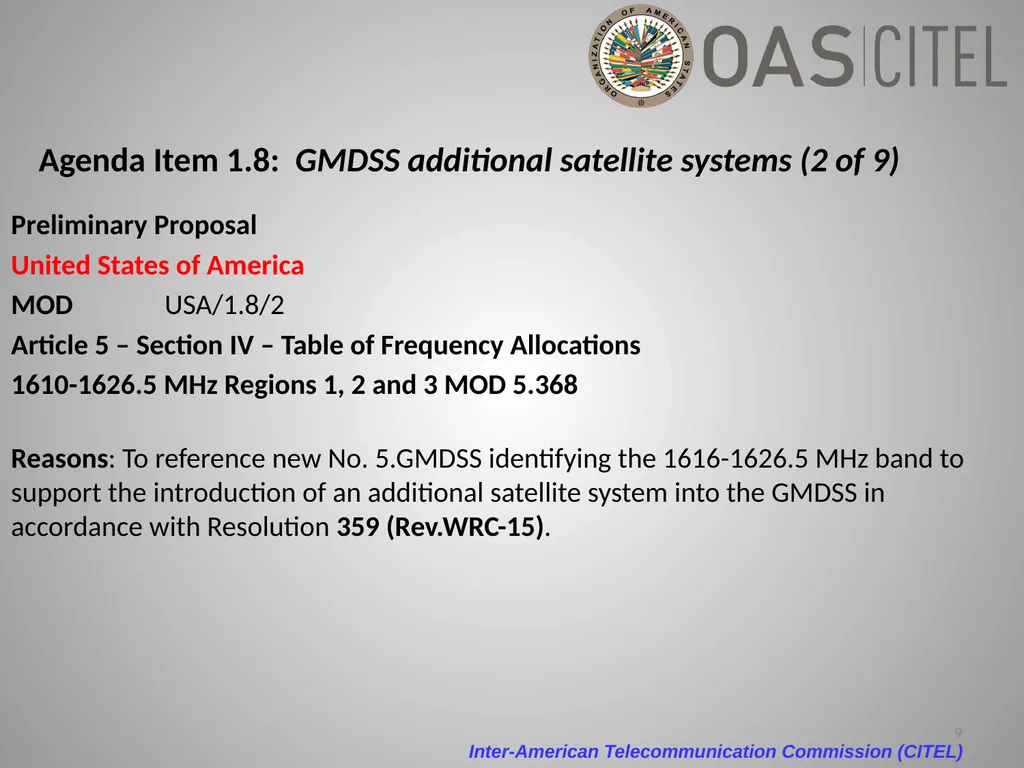
slide9. 9 Agenda Item 1.8: GMDSS additional satellite systems (2 of 9) Preliminary Proposal
United States of America
MOD USA/1.8/2
Article 5 – Section IV – Table of Frequency Allocations
1610-1626.5 MHz Regions 1, 2 and 3 MOD 5.368
Reasons: To reference new No. 5.GMDSS identifying the 1616-1626.5 MHz band to support the introduction of an additional satellite system into the GMDSS in accordance with Resolution 359 (Rev.WRC-15).<br>
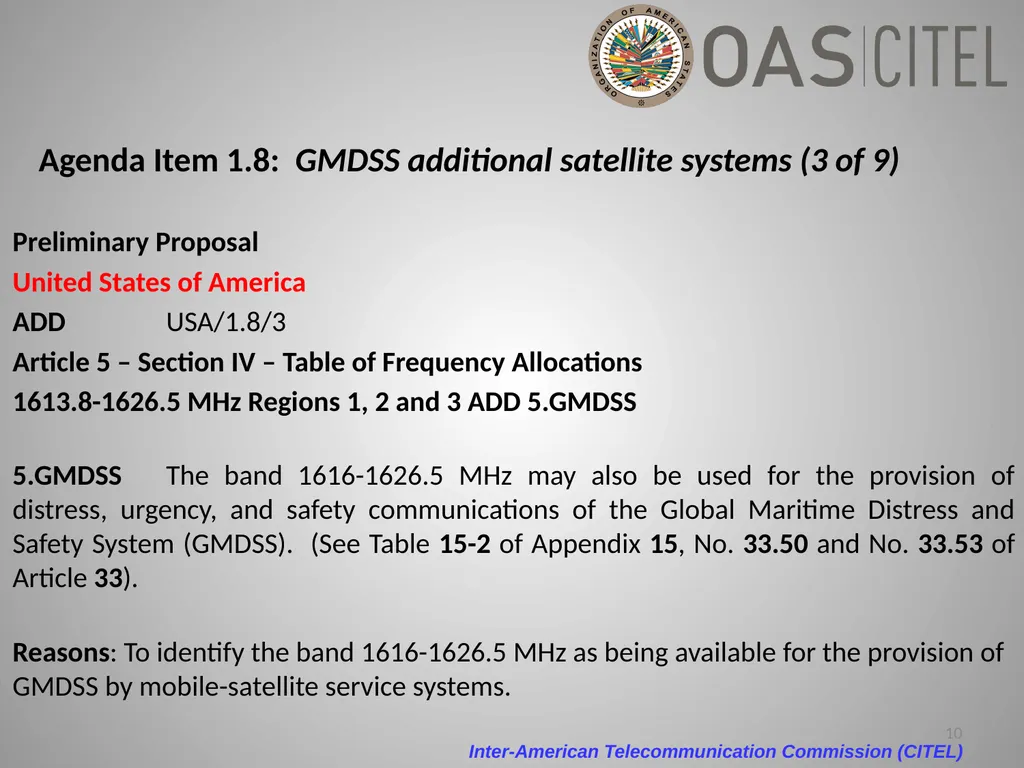
slide10. 10 Agenda Item 1.8: GMDSS additional satellite systems (3 of 9) Preliminary Proposal
United States of America
ADD USA/1.8/3
Article 5 – Section IV – Table of Frequency Allocations
1613.8-1626.5 MHz Regions 1, 2 and 3 ADD 5.GMDSS
5.GMDSS The band 1616-1626.5 MHz may also be used for the provision of distress, urgency, and safety communications of the Global Maritime Distress and Safety System (GMDSS). (See Table 15-2 of Appendix 15, No. 33.50 and No. 33.53 of Article 33).
Reasons: To identify the band 1616-1626.5 MHz as being available for the provision of GMDSS by mobile-satellite service systems.<br>
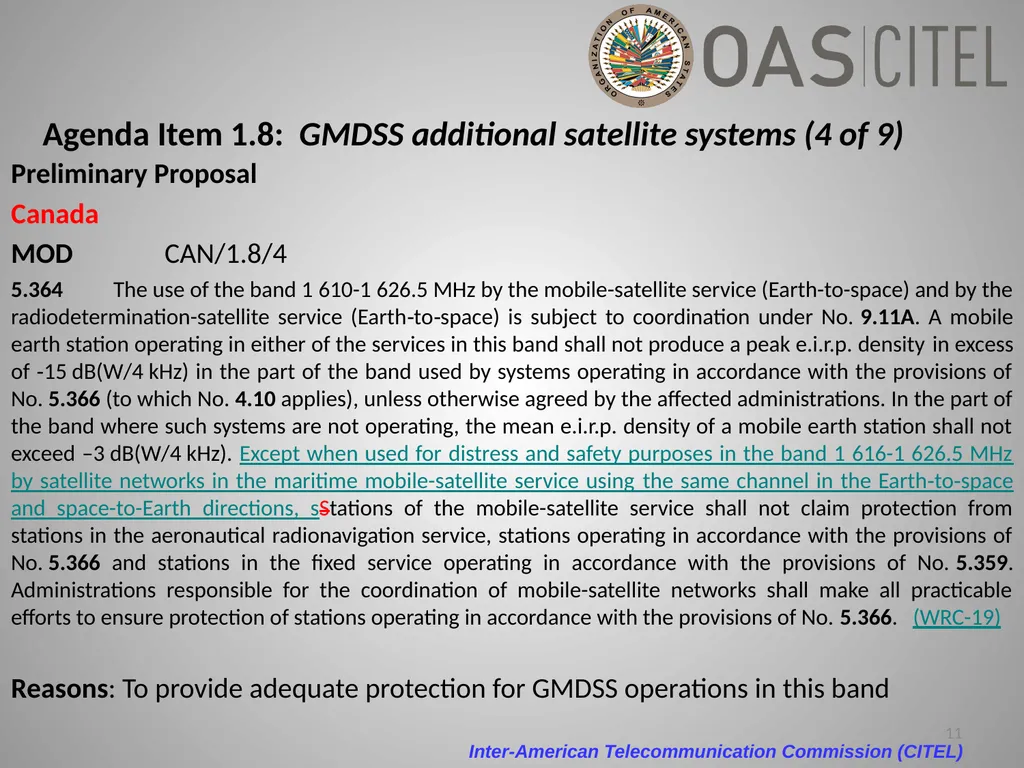
slide11. 11 Agenda Item 1.8: GMDSS additional satellite systems (4 of 9) Preliminary Proposal
Canada
MOD CAN/1.8/4
5.364 The use of the band 1 610-1 626.5 MHz by the mobile-satellite service (Earth-to-space) and by the radiodetermination-satellite service (Earth‑to‑space) is subject to coordination under No. 9.11A. A mobile earth station operating in either of the services in this band shall not produce a peak e.i.r.p. density in excess of ‑15 dB(W/4 kHz) in the part of the band used by systems operating in accordance with the provisions of No. 5.366 (to which No. 4.10 applies), unless otherwise agreed by the affected administrations. In the part of the band where such systems are not operating, the mean e.i.r.p. density of a mobile earth station shall not exceed –3 dB(W/4 kHz). Except when used for distress and safety purposes in the band 1 616-1 626.5 MHz by satellite networks in the maritime mobile-satellite service using the same channel in the Earth‑to‑space and space-to-Earth directions, sStations of the mobile-satellite service shall not claim protection from stations in the aeronautical radionavigation service, stations operating in accordance with the provisions of No. 5.366 and stations in the fixed service operating in accordance with the provisions of No. 5.359. Administrations responsible for the coordination of mobile-satellite networks shall make all practicable efforts to ensure protection of stations operating in accordance with the provisions of No. 5.366. (WRC-19)
Reasons: To provide adequate protection for GMDSS operations in this band<br>
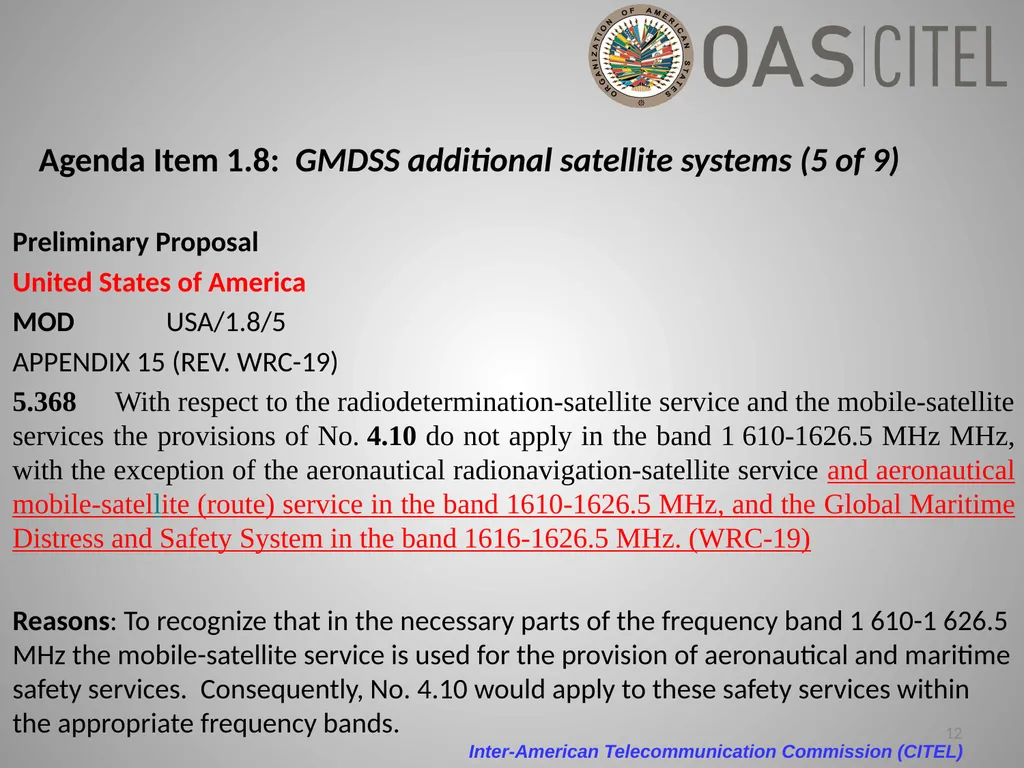
slide12. 12 Agenda Item 1.8: GMDSS additional satellite systems (5 of 9) Preliminary Proposal
United States of America
MOD USA/1.8/5
APPENDIX 15 (REV. WRC-19)
5.368 With respect to the radiodetermination-satellite service and the mobile-satellite services the provisions of No. 4.10 do not apply in the band 1 610-1626.5 MHz MHz, with the exception of the aeronautical radionavigation-satellite service and aeronautical mobile-satellite (route) service in the band 1610-1626.5 MHz, and the Global Maritime Distress and Safety System in the band 1616-1626.5 MHz. (WRC-19)
Reasons: To recognize that in the necessary parts of the frequency band 1 610-1 626.5 MHz the mobile-satellite service is used for the provision of aeronautical and maritime safety services. Consequently, No. 4.10 would apply to these safety services within the appropriate frequency bands.<br>
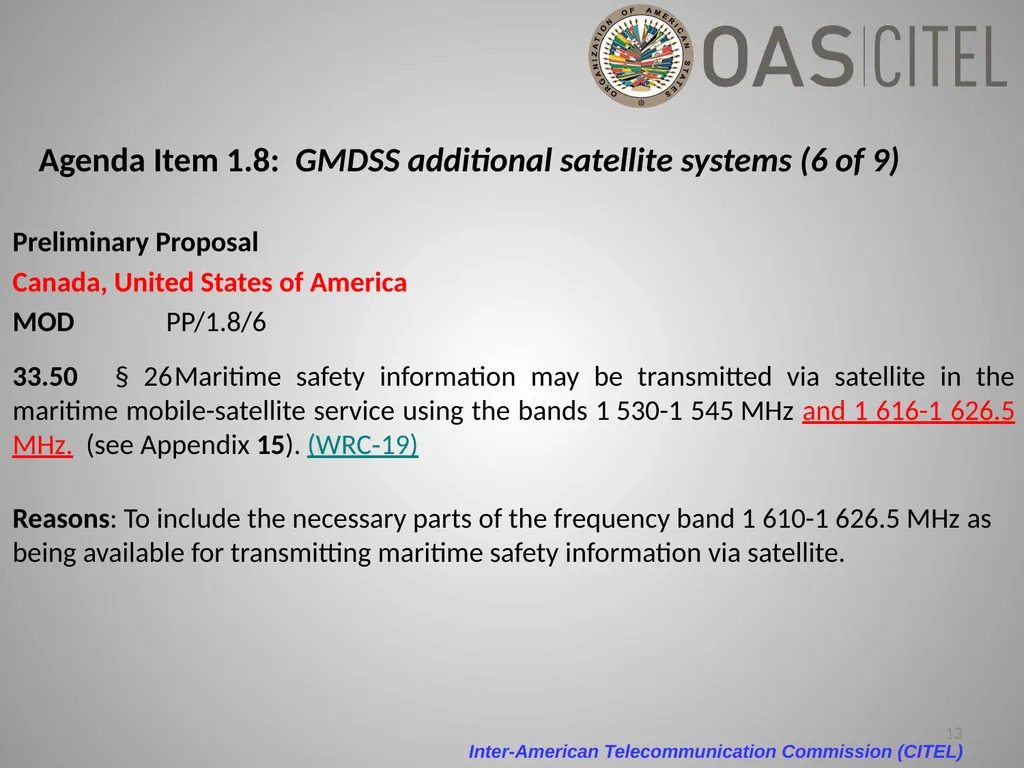
slide13. 13 Agenda Item 1.8: GMDSS additional satellite systems (6 of 9) Preliminary Proposal
Canada, United States of America
MOD PP/1.8/6
33.50 § 26 Maritime safety information may be transmitted via satellite in the maritime mobile-satellite service using the bands 1 530-1 545 MHz and 1 616-1 626.5 MHz. (see Appendix 15). (WRC‑19)
Reasons: To include the necessary parts of the frequency band 1 610-1 626.5 MHz as being available for transmitting maritime safety information via satellite.<br>
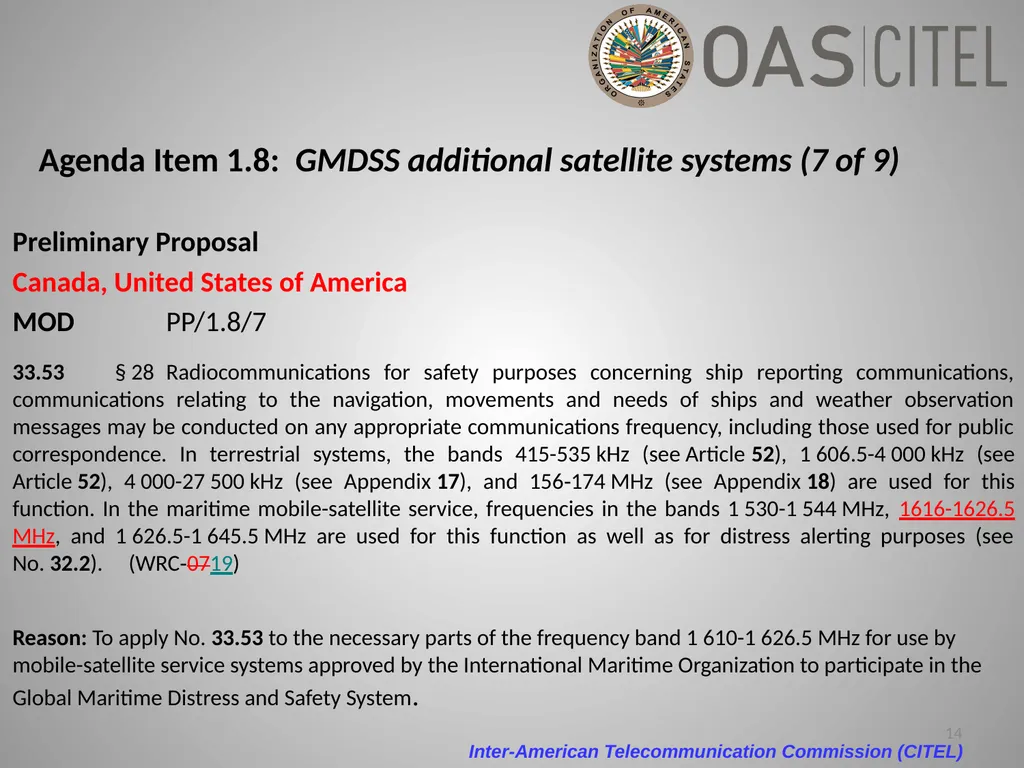
slide14. 14 Agenda Item 1.8: GMDSS additional satellite systems (7 of 9) Preliminary Proposal
Canada, United States of America
MOD PP/1.8/7
33.53 § 28 Radiocommunications for safety purposes concerning ship reporting communications, communications relating to the navigation, movements and needs of ships and weather observation messages may be conducted on any appropriate communications frequency, including those used for public correspondence. In terrestrial systems, the bands 415-535 kHz (see Article 52), 1 606.5-4 000 kHz (see Article 52), 4 000-27 500 kHz (see Appendix 17), and 156‑174 MHz (see Appendix 18) are used for this function. In the maritime mobile-satellite service, frequencies in the bands 1 530-1 544 MHz, 1616-1626.5 MHz, and 1 626.5-1 645.5 MHz are used for this function as well as for distress alerting purposes (see No. 32.2). (WRC‑0719)
Reason: To apply No. 33.53 to the necessary parts of the frequency band 1 610-1 626.5 MHz for use by mobile-satellite service systems approved by the International Maritime Organization to participate in the Global Maritime Distress and Safety System.<br>
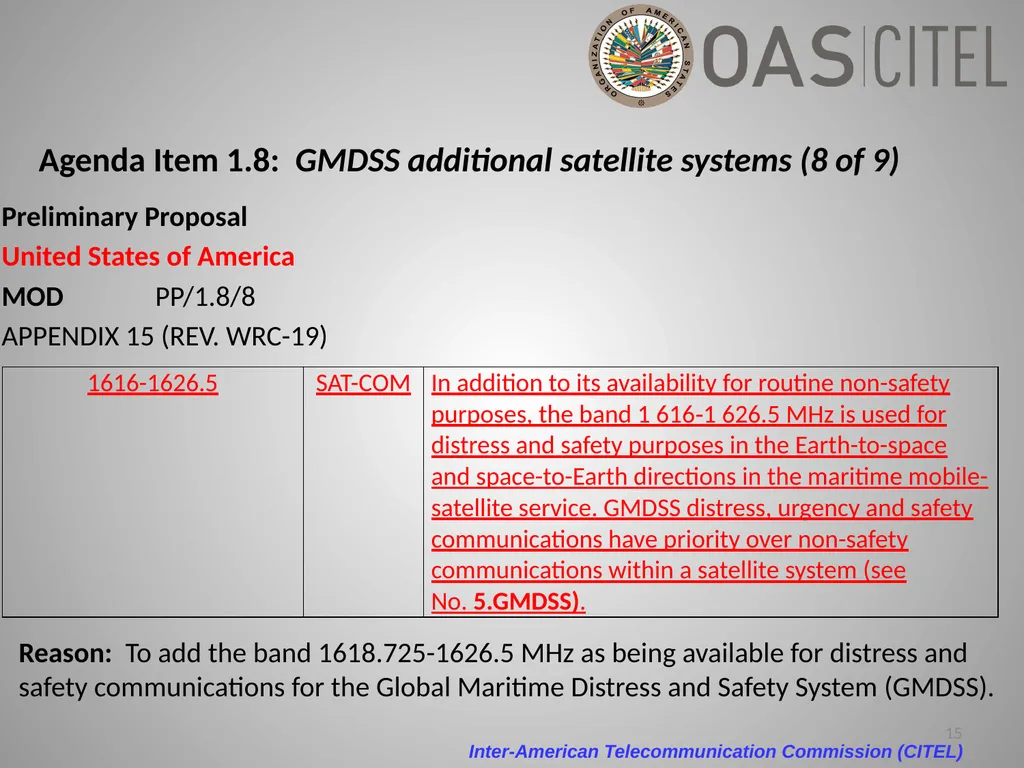
slide15. 15 Agenda Item 1.8: GMDSS additional satellite systems (8 of 9) Preliminary Proposal
United States of America
MOD PP/1.8/8
APPENDIX 15 (REV. WRC-19) Reason: To add the band 1618.725-1626.5 MHz as being available for distress and safety communications for the Global Maritime Distress and Safety System (GMDSS).<br>
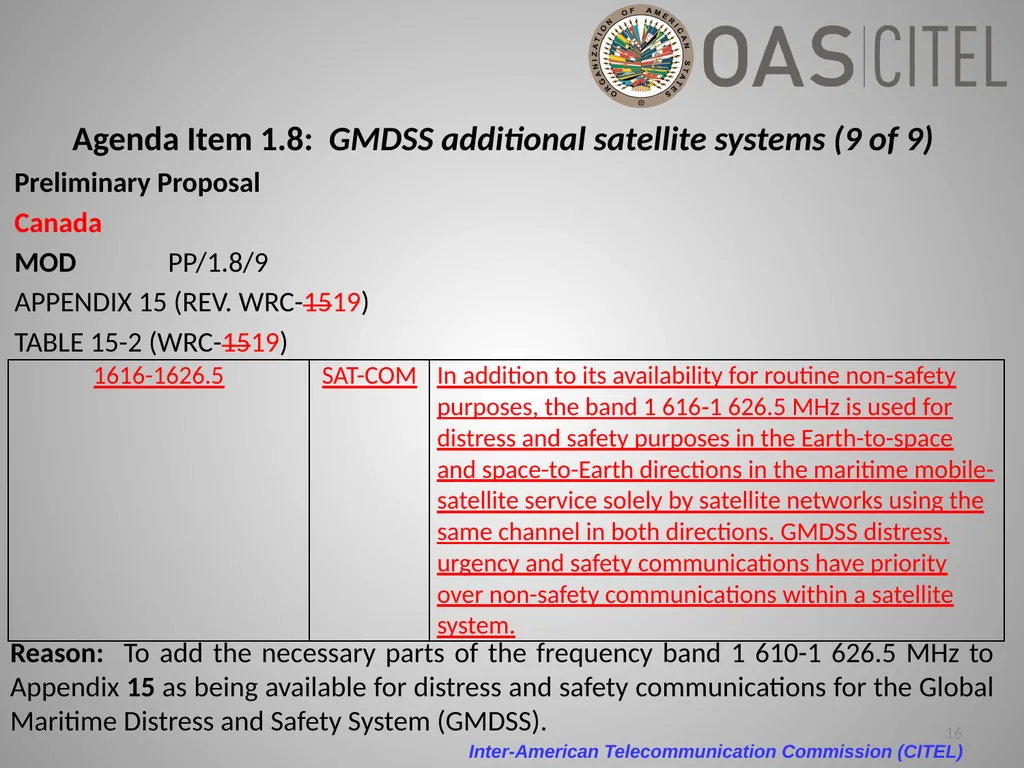
slide16. 16 Agenda Item 1.8: GMDSS additional satellite systems (9 of 9) Preliminary Proposal
Canada
MOD PP/1.8/9
APPENDIX 15 (REV. WRC-1519)
TABLE 15-2 (WRC-1519) Reason: To add the necessary parts of the frequency band 1 610-1 626.5 MHz to Appendix 15 as being available for distress and safety communications for the Global Maritime Distress and Safety System (GMDSS).<br>
slide17. 17 Other Agenda Items Inter-American Proposals: 1.1, 1.11, 9.1.2, 9.1.3, 9.1.8
Draft Inter-American Proposals: 1.12, 7 Issues C1, C5, D, G
Preliminary Proposals: 1.16, 7 Issue E, 9.1.7
Preliminary Views: 1.2, 1.3, 1.4, 1.5, 1.6, 1.7, 1.9.1, 1.9.2, 1.13, 1.14, 1.15, 1.16, 2, 4, 7 Issues A, C3, C5, C6, D, E, G<br>
slide18. 18 INTER-AMERICAN PROPOSALS
(IAP) INTER-AMERICAN PROPOSAL (IAP): DIAP for which the PCC II has ended its consideration and discussion, has been supported by at least six Members States and is not opposed by more than 50% of the number of supports obtained.<br>
slide19. 19 Agenda Item 1.1: Consideration of the band 50-54 MHz to the amateur service in Region 1 IAP
Support: Argentina, Brazil, Bahamas, Canada, Colombia, [Paraguay], [United States of America], Uruguay
NOC (for Region 2) IAP/1.1/1
Reasons: WRC-19 agenda item 1.1 is a Region 1 issue. Any changes made to the Radio Regulations under WRC-19 agenda item 1.1 must not impact the existing allocation to the Amateur Service in 50-54 MHz in Region 2, nor subject Region 2 to any changed procedural or regulatory provisions.
Coordinator : Flávio A. B. Archangelo (B)
flavio.archangelo@ties.itu.int
Alt. Coordinator: Jonathan Siverling (USA)
jsiverling@arrl.org
Issue Coordinator: Flávio ARCHANGELO (B) Flavio.archangelo@labre.org.br<br>
slide20. IAP
Argentina, Brazil, Canada, Ecuador, Guatemala, Mexico, United States of America, Uruguay
NOC IAP/1.11/1
Radio Regulations Volumes 1 & 2
Reason: The United States and Canada believe it is unnecessary to identify spectrum specifically for railway radiocommunication systems. Regional and global harmonization can be satisfied by developing applicable ITU-R Reports and Recommendations. Therefore, no change to the Radio Regulations or regulatory action is required under this agenda item.
Argentina, Brazil, Canada, Ecuador, Guatemala, Mexico, United States of America, Uruguay
SUP IAP/1.11/2
RESOLUTION 236 (WRC-15)
Railway radiocommunication systems between train and trackside
Reasons: The studies towards regional and global harmonization can be satisfied through ITU-R Recommendations and Reports.
Issue Coordinator :David TEJEDA (Mexico) david.tejeda@ift.org.mx Agenda Item 1.11: Railway Train and Trackside 20<br>
slide21. Issue 9.1.2: Compatibility of IMT and broadcasting-satellite service (sound) in the frequency band 1 452-1 492 MHz in Regions 1 and 3 IAP
Argentina, Brazil, Canada, Colombia, Ecuador, United States of America, Guatemala, Uruguay
NOC IAP/9.1.2/1
Article 5 – Section IV – Table of Frequency Allocations
Reasons: WRC-19 issue 9.1.2 is limited to technical and regulatory studies of the mobile (IMT) and broadcasting satellite (sound) services in the band 1452-1492 MHz in Regions 1 and 3 only. Therefore, there is no basis for any changes to the Radio Regulations that would impact the services in the frequency band1452-1492 MHz in Region 2 under this issue. Therefore, NOC is proposed with respect to any change to Article 5 that could impact Region 2 services in the frequency band 1452-1492 MHz.
Issue Coordinator: TBD 21<br>
slide22. Issue 9.1.3: technical and operational issues and regulatory provisions for new NGSO systems in the 3 700-4 200 MHz, 4 500-4 800 MHz, 5 925-6 425 MHz and 6 725-7 025 MHz bands allocated to FSS IAP
NOC IAP/9.1/9.1.3/1 – ARTICLE 21
NOC IAP/9.1/9.1.3/2 – ARTICLE 22
SUP IAP/9.1/9.1.3/3 – RESOLUTION 157 (WRC-15)
Brazil, Canada, Guatemala, Nicaragua, United States, Uruguay
ITU-R studies show that it would be very difficult to operate a non-GSO circular-orbit system for the purposes of a global broadband network in the 6/4 GHz frequency bands. Therefore, CITEL administrations support no revision to Article 21, Table 21-4 for non-GSO FSS satellites in the frequency band 3700-4200 MHz (space-to-Earth) and no modifications to Article 22 epfd limits applicable to non-GSO systems in the bands 3700-4200 MHz (space-to-Earth) and 5925-6425 MHz (Earth-to-Space). Similarly, CITEL administrations propose no change to the bands 4500-4800 MHz (space-to-Earth) and 6725-7025 MHz (Earth-to-space).
Issue Coordinator: [Hugo Mario Trivino (CLM) trivino@mintic.gov.co ]
[Manoel Almeida (B) manoel.almeida@intelsat.com ]
Alt Issue Coordinator: Marcella Ost (Canada) marcella.s.ost@boeing.com 22<br>
slide23. Issue 9.1.8: Narrowband and broadband machine-type communication infrastructures (1 of 2) IAP
Argentina, Brazil, Canada, Colombia, Dominican Republic, Ecuador, Guatemala, Mexico, Panama, United States of America, Uruguay
NOC IAP/9.1 Issue 9.1.8/1
Radio Regulations Volumes 1 & 2
Reasons: Analysis of the current and future spectrum use for narrowband and broadband machine type communications (MTC), also known as machine-to-machine (M2M) or Internet of Things (IoT), concluded that there is no need to identify specific spectrum for those applications. Therefore, no change to the Radio Regulations or regulatory action is required.
Issue Coordinator: Sergio Marquez (Mexico) sergio.marquez@ift.org.mx
Alt. Issue Coordinator: Jayne Stancavage (USA) jayne.stancavage@intel.com 23<br>
slide24. Issue 9.1.8: Narrowband and broadband machine-type communication infrastructures (2 of 2) IAP
Argentina, Brazil, Canada, Colombia, Dominican Republic, Ecuador, Guatemala, Mexico, Panama, United States of America, Uruguay
SUP IAP/9.1 Issue 9.1.8/2
ANNEX TO RESOLUTION 958 (WRC-15)
Urgent studies required in preparation for the 2019 World Radiocommunication Conference
3) Studies on the technical and operational aspects of radio networks and systems, as well as spectrum needed, including possible harmonized use of spectrum to support the implementation of narrowband and broadband machine-type communication infrastructures, in order to develop Recommendations, Reports and/or Handbooks, as appropriate, and to take appropriate actions within the ITU Radiocommunication Sector (ITU-R) scope of work.
Reasons: Analysis of the current and future spectrum use for narrowband and broadband machine type communications (MTC), also known as machine-to-machine (M2M) or Internet of Things (IoT), concluded that there is no need to identify specific spectrum for those applications. Therefore, no change to the Radio Regulations or regulatory action is required. No changes also apply to RR Volume 3, apart from the suppression proposed to parts of Resolution 958 (WRC-15).
Issue Coordinator: Sergio Marquez (Mexico) sergio.marquez@ift.org.mx
Alt. Issue Coordinator: Jayne Stancavage (USA) jayne.stancavage@intel.com 24<br>
slide25. 25 PRELIMINARY PROPOSALS
(PP) PRELIMINARY PROPOSAL (PP): aMember State proposal that has yet to be supported by another Member State.<br>
slide26. Agenda Item: 1.16 WAS/RLANs in 5 GHz Preliminary Proposal
Canada
NOC CAN/1.16/1
Article 5 – Section IV – Table of Frequency Allocations
Reasons: No change to the Table of Frequency Allocations in the band 5 350-5 470 MHz as further study of currently available mitigation measures indicate that there are no feasible mitigation techniques to facilitate sharing between RLAN and EESS (active) in the band 5 350-5 470 MHz.
Issue Coordinator: [Jose Francisco Lozano] [CLM] [jose.lozano@ane.gov.co]
Alt Coordinator: Jayne Stancavage (USA) jayne.stancavage@intel.com 26<br>
slide27. Agenda Item 7: Changes in response to Resolution 86 – Satellite network regulatory procedures 27 ISSUE E: Harmonization of RR Appendix 30B with RR Appendices 30 and 30A
Preliminary Proposal
United States of America
NOC USA/7/E/1
APPENDIX 30B (REV. WRC-15)
Reason: With respect to provision (§ 4.1.24) of Appendices 30 and 30A for Regions 1 and 3:
4.1.24 No assignment in the List shall have a period of operation exceeding 15 years, counted from the date of bringing into use, or 2 June 2000, whichever is later. Upon request by the responsible administration received by the Bureau at the latest three years before the expiry of this period, this period may be extended by up to 15 years, on condition that all the characteristics of the assignment remain unchanged.
This provision is limited to satellite networks serving Regions 1 and 3 only and there is no such provision in RR AP30/30A for networks serving Region 2. Therefore, any changes to RR AP30B should not be applicable to Region 2.
Moreover, there is no linkage between RR AP30/30A, which was created for the broadcasting-satellite service, and RR AP30B, which was created for the fixed-satellite service. Each of these appendices have its own set of conditions and procedures. Consequently, there is no need for harmonization amongst those plans. Those plans were established for two different satellite services for different purposes.<br>
slide28. Issue 9.1.7: Unauthorized operation of earth station terminals Preliminary Proposal
United States of America
NOC United States of America/9.1/9.1.7/1
Radio Regulations (WRC-15) Volumes 1 & 2
United States of America
SUP United States of America/9/1/9.1.7/2
ANNEX TO RESOLUTION 958 (WRC-15) No. 2
Urgent studies required in preparation for the
2019 World Radiocommunication Conference
Reasons: Earth station licensing and related issues are national matters and no changes to the Radio Regulations are necessary as Article 18 sufficiently addresses the required international regulatory measures. Instead, better training and monitoring capability, along with ITU developed reports and handbooks, can assist administrations in inhibiting the use of unauthorized uplink earth terminals and can enable administrations to locate and terminate the unauthorized transmissions.
Issue Coordinator: Hugo Mario TRIVIÑO (Colombia) htrivino@mintic.gov.co 28<br>
slide29. 29 DRAFT INTER-AMERICAN PROPOSALS
(DIAP) DRAFT INTER-AMERICAN PROPOSAL (DIAP): PP that has been supported by at least one other Member State.<br>
slide30. Agenda Item 1.12: ITS Harmonization DIAP
Canada, United States of America
NOC DIAP/1.12/1
Radio Regulations Volumes 1 & 2
Reason: It is unnecessary to identify spectrum specifically for Intelligent Transport Systems. Regional and global harmonization can be satisfied by developing applicable ITU-R Reports and Recommendations. Therefore, no change to the Radio Regulations or regulatory action is required under this agenda item.
Canada, United States of America
SUP DIAP/1.12/2
RESOLUTION 237 (WRC-15)
Intelligent Transport Systems applications
Issue Coordinator: TBD Argentina
Alt Issue Coordinator : Francisco Soares (B) fsoares@qti.qualcomm.com 30<br>
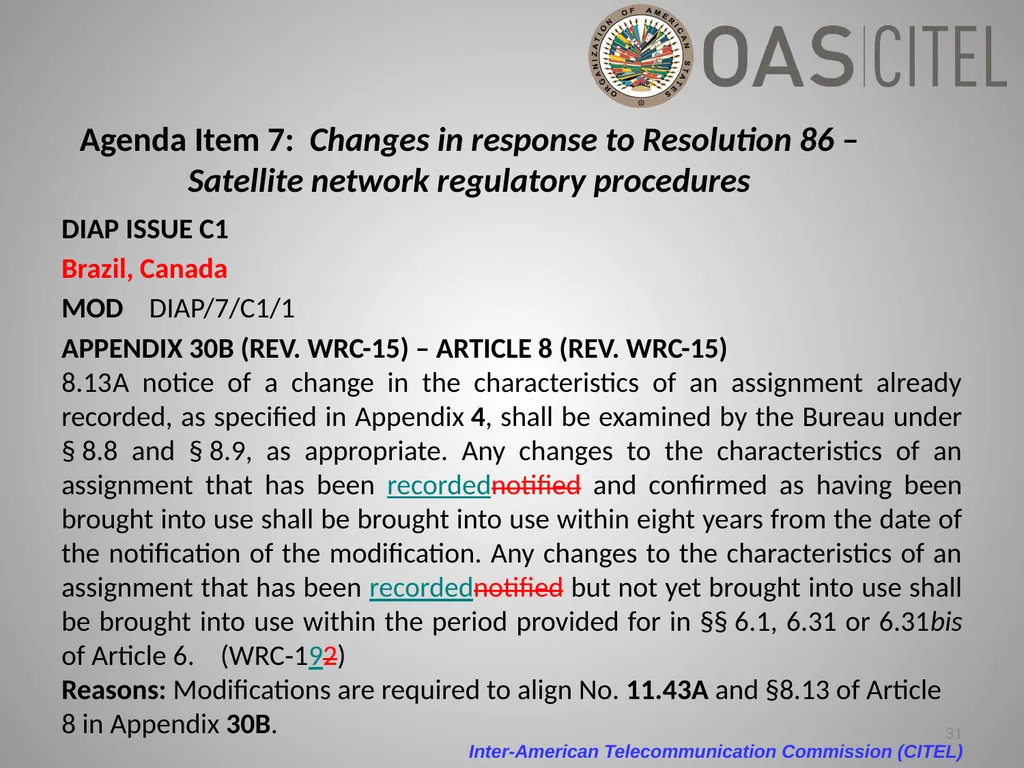
slide31. DIAP ISSUE C1
Brazil, Canada
MOD DIAP/7/C1/1
APPENDIX 30B (REV. WRC-15) – ARTICLE 8 (REV. WRC-15)
8.13 A notice of a change in the characteristics of an assignment already recorded, as specified in Appendix 4, shall be examined by the Bureau under § 8.8 and § 8.9, as appropriate. Any changes to the characteristics of an assignment that has been recordednotified and confirmed as having been brought into use shall be brought into use within eight years from the date of the notification of the modification. Any changes to the characteristics of an assignment that has been recordednotified but not yet brought into use shall be brought into use within the period provided for in §§ 6.1, 6.31 or 6.31bis of Article 6. (WRC‑192)
Reasons: Modifications are required to align No. 11.43A and §8.13 of Article 8 in Appendix 30B. 31 Agenda Item 7: Changes in response to Resolution 86 – Satellite network regulatory procedures<br>
slide32. DIAP ISSUE C5
Brazil, Canada
MOD DIAP/7/C5/1
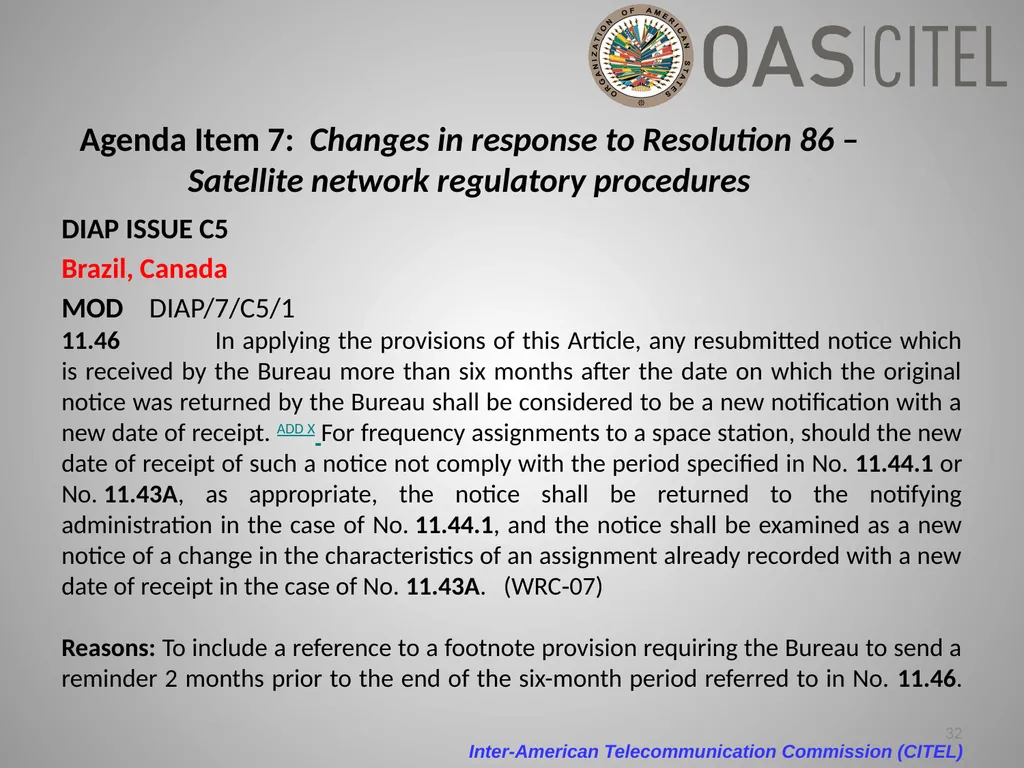
11.46 In applying the provisions of this Article, any resubmitted notice which is received by the Bureau more than six months after the date on which the original notice was returned by the Bureau shall be considered to be a new notification with a new date of receipt. ADD X For frequency assignments to a space station, should the new date of receipt of such a notice not comply with the period specified in No. 11.44.1 or No. 11.43A, as appropriate, the notice shall be returned to the notifying administration in the case of No. 11.44.1, and the notice shall be examined as a new notice of a change in the characteristics of an assignment already recorded with a new date of receipt in the case of No. 11.43A. (WRC‑07)
Reasons: To include a reference to a footnote provision requiring the Bureau to send a reminder 2 months prior to the end of the six-month period referred to in No. 11.46. 32 Agenda Item 7: Changes in response to Resolution 86 – Satellite network regulatory procedures<br>
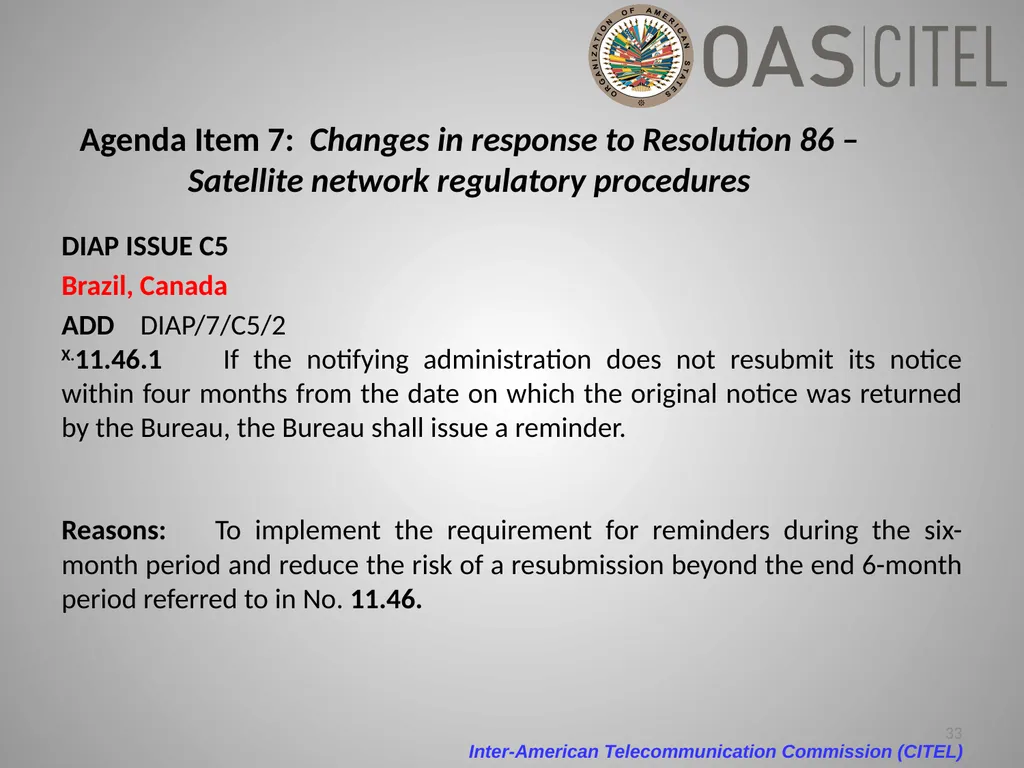
slide33. 33 Agenda Item 7: Changes in response to Resolution 86 – Satellite network regulatory procedures DIAP ISSUE C5
Brazil, Canada
ADD DIAP/7/C5/2
X.11.46.1 If the notifying administration does not resubmit its notice within four months from the date on which the original notice was returned by the Bureau, the Bureau shall issue a reminder.
Reasons: To implement the requirement for reminders during the six-month period and reduce the risk of a resubmission beyond the end 6-month period referred to in No. 11.46.<br>
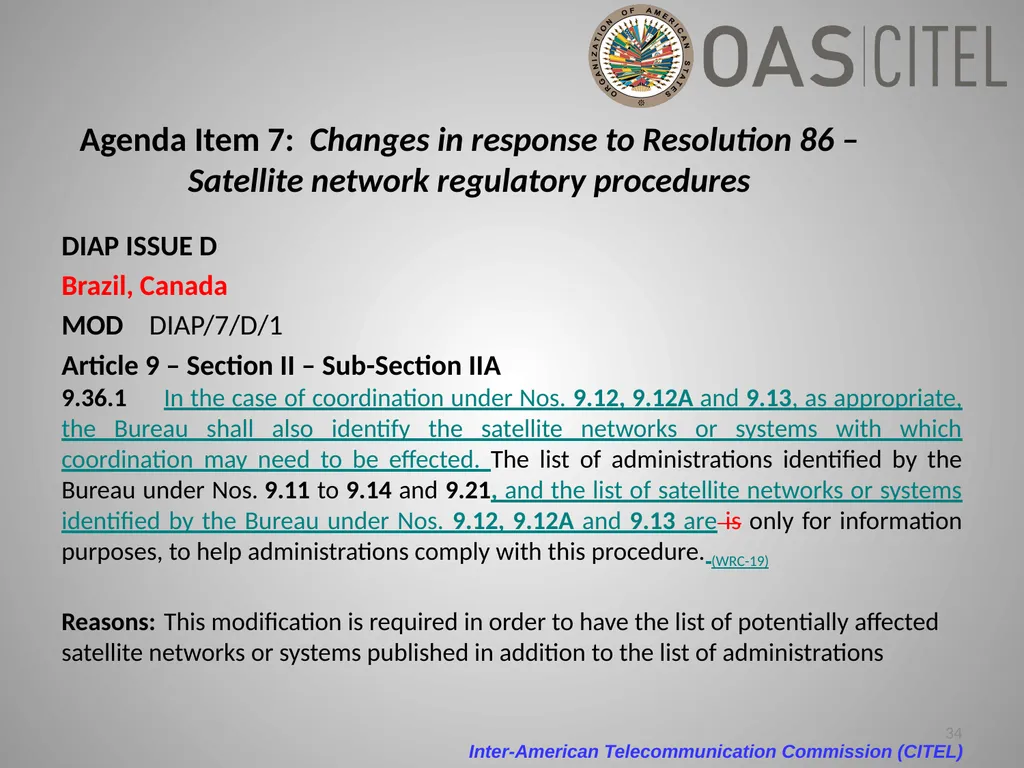
slide34. 34 Agenda Item 7: Changes in response to Resolution 86 – Satellite network regulatory procedures DIAP ISSUE D
Brazil, Canada
MOD DIAP/7/D/1
Article 9 – Section II – Sub-Section IIA
9.36.1 In the case of coordination under Nos. 9.12, 9.12A and 9.13, as appropriate, the Bureau shall also identify the satellite networks or systems with which coordination may need to be effected. The list of administrations identified by the Bureau under Nos. 9.11 to 9.14 and 9.21, and the list of satellite networks or systems identified by the Bureau under Nos. 9.12, 9.12A and 9.13 are is only for information purposes, to help administrations comply with this procedure. (WRC-19)
Reasons: This modification is required in order to have the list of potentially affected satellite networks or systems published in addition to the list of administrations<br>
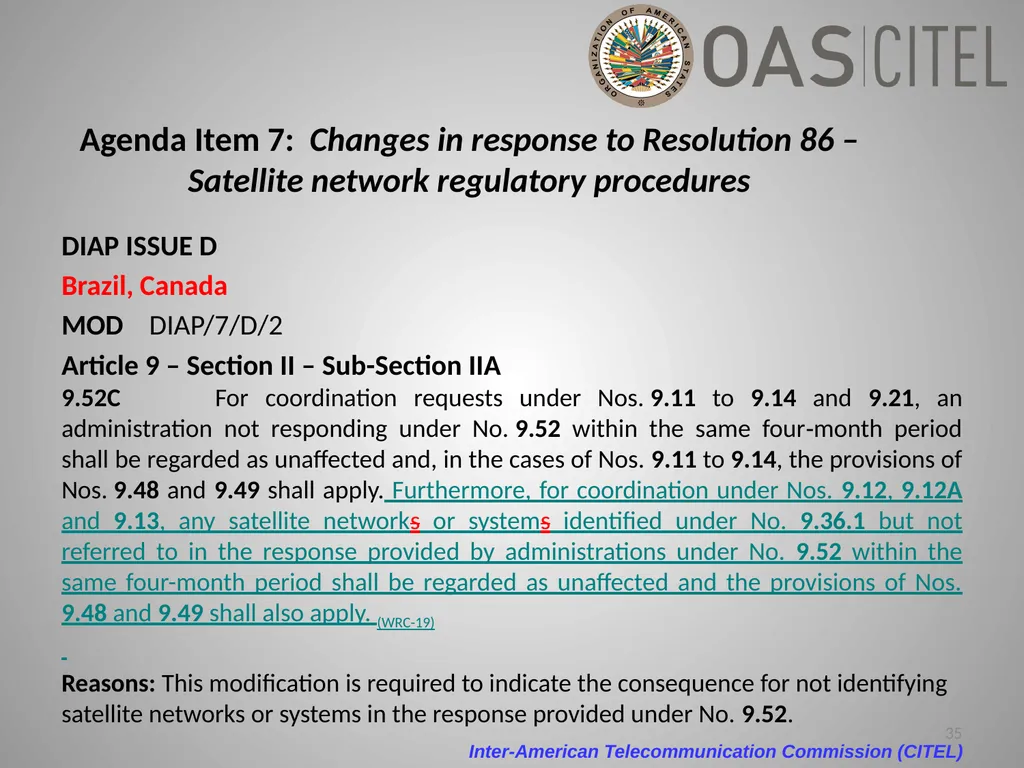
slide35. 35 Agenda Item 7: Changes in response to Resolution 86 – Satellite network regulatory procedures DIAP ISSUE D
Brazil, Canada
MOD DIAP/7/D/2
Article 9 – Section II – Sub-Section IIA
9.52C For coordination requests under Nos. 9.11 to 9.14 and 9.21, an administration not responding under No. 9.52 within the same four‑month period shall be regarded as unaffected and, in the cases of Nos. 9.11 to 9.14, the provisions of Nos. 9.48 and 9.49 shall apply. Furthermore, for coordination under Nos. 9.12, 9.12A and 9.13, any satellite networks or systems identified under No. 9.36.1 but not referred to in the response provided by administrations under No. 9.52 within the same four-month period shall be regarded as unaffected and the provisions of Nos. 9.48 and 9.49 shall also apply. (WRC-19)
Reasons: This modification is required to indicate the consequence for not identifying satellite networks or systems in the response provided under No. 9.52.<br>
slide36. 36 Agenda Item 7: Changes in response to Resolution 86 – Satellite network regulatory procedures DIAP ISSUE D
Brazil, Canada
MOD DIAP/7/D/4
Article 9 – Section II – Sub-Section IIA
9.53A Upon expiry of the deadline for comments in respect of a coordination request under Nos. 9.11 to 9.14 and 9.21, the Bureau shall, according to its records, publish a Special Section, indicating the list of administrations having submitted their disagreement and the list of satellite networks or systems upon which their disagreement is based, as appropriate, or other comments within the regulatory deadline. (WRC‑192000)
Reasons: This modification is required in order to have the definitive list of affected satellite networks or systems published in addition to the list of administrations.<br>
slide37. 37 Agenda Item 7: Changes in response to Resolution 86 – Satellite network regulatory procedures DIAP ISSUE G
Brazil, United States of America
NOC DIAP/7/G/1
APPENDIX 30 (REV. WRC-15) – ARTICLE 4 (REV. WRC-15)
Reasons: With the reactions of RRB-70 in mind, it is better to clarify the desired actions in the Radio Regulations rather than suggesting words in the minutes of a WRC-19 Plenary. However, there are notable differences between the application of the procedures § 4.2.21A for the Region 2 BSS and feeder-link Plans and the application of § 4.1.18 for the Regions 1 and 3 List, therefore NOC is needed for Region 2. For example, for Regions 1 and 3, § 4.1.18 may be applied to Regions 1 and 3 List assignments or pending List modifications or terrestrial or FSS assignments, while in Region 2, § 4.2.21A is applied in a much more limited fashion, solely to terrestrial or FSS or unplanned BSS assignments.<br>
slide38. 38 PRELIMINARY VIEWS (PV) PRELIMINARY VIEWS (PV): a Member State’s initial view of an Agenda Item, indicating its view of a future proposal or position.<br>
slide39. Agenda Item 1.2: to consider in-band power limits for earth stations operating in the mobile-satellite service, meteorological-satellite service and Earth exploration-satellite service in the frequency bands 401-403 MHz and 399.9-400.05 MHz Preliminary Views
Canada, United States of America
To support conducting and completing the necessary technical, operational, and regulatory studies on the possibility of establishing in-band power limits for earth stations in the EESS and MetSat service in the frequency band 401-403 MHz and the MSS in the frequency band 399.9-400.05 MHz.
Issue Coordinator: Alfredo Mistichelli (USA)
Alfredo.Mistichellia@noaa.gov 39<br>
slide40. Agenda Item 1.3: Possible upgrading met satellite service (space-to-Earth) to primary status and a possible primary allocation to the EESS (space-to-Earth) in the band 460-470 MHz United States of America
The United States supports conducting and completing sharing and compatibility studies with the co-primary fixed and mobile services, including IMT systems. These studies would determine the feasibility of potentially upgrading the MetSat (space-to-Earth) allocation to primary status, and the potential addition of a primary EESS (space-to-Earth) allocation in the frequency band 460-470 MHz, while protecting the current primary allocations for fixed and land mobile services including IMT systems and maintaining the conditions contained in No. 5.289.
Issue Coordinator: James Mentzer (USA)
jmentzer@doc.gov 40<br>
slide41. Agenda Item 1.4: Review, and revise if necessary, the limitations mentioned in Annex 7 to Appendix 30 Preliminary Views
Canada, United States of America
With respect to Agenda Item 1.4, the United States and Canada support the studies in accordance with Resolution 557 (WRC-15). Based upon successful conclusion of these activities, the United States and Canada support the review and revision, as necessary, of the limitations of Annex 7 to Appendix 30 (Rev.WRC‑12), while ensuring the protection of existing assignments in the Plan and the List and the future development of BSS service within the Plan, and existing and planned fixed-satellite service networks.
Issue Coordinator: TBD 41<br>
slide42. Agenda Item 1.5: ESIM Preliminary Views
Canada
Canada supports studies under the terms of Resolution 158 (WRC-15). Studies are necessary to determine compatibility of ESIMs with services allocated in the frequency bands 17.7-19.7 GHz and 27.5-29.5 GHz. Sharing and compatibility studies between ESIM and FSS networks should include consideration of both geostationary and non-geostationary satellite systems, including non-GSO MSS feeder links, to ensure their protection.
Brazil, United States of America
Support studies under the terms of Resolution 158 (WRC-15) on sharing and compatibility between ESIMs and current and planned stations of existing services allocated in the frequency bands 17.7-19.7 GHz and 27.5-29.5 GHz, while ensuring protection and not imposing undue constraints on these allocated services, and to take appropriate action based on the results of these studies.
Before identifying use of the frequency bands, or portions thereof, for ESIM operation, studies should address each operational type of earth stations in motion to include the appropriate technical and regulatory provisions necessary to ensure protection of existing and planned allocated services.
Issue Coordinator: TBD [USA]
Alt. Coordinator: Gustavo Vargas, (CLM) gustavo.vargas@ane.gov.co<br>
slide43. Preliminary Views
Canada
Canada supports the studies under Resolution 159 (WRC-15) to develop a regulatory framework for new non-GSO FSS satellite systems. For the band 36-37 GHz: Canada is of the view that based on the results of studies, EESS (passive) systems operating in the 36- 37 GHz band and non-GSO FSS systems are compatible and no regulatory measures are required to address the compatibility between these two services. For the band 50.2-50.4 GHz: Canada is of the view that based on the results of studies, mitigation techniques and/or regulatory measures may be required to ensure compatibility between EESS (passive) systems operating in the band 50.2-50.4 GHz and non-GSO FSS systems.
Canada is of the view that the use of the bands 37.5-39.5 GHz (space-to-Earth), 39.5-42.5 GHz (space-to-Earth), 47.2-50.2 GHz (Earth-to-space) and 50.4-51.4 GHz (Earth-to-space) by non-GSO FSS systems should be subject to coordination procedures under No. 9.12. Agenda Item 1.6 : to consider regulatory framework for non-GSO FSS satellite systems that may operate in the frequency bands 37.5-39.5 GHz (space-to-Earth), 39.5 42.5 GHz (space-to-Earth), 47.2-50.2 GHz (Earth-to-space) and 50.4-51.4 GHz (Earth-to-space), (1 of 2) 43<br>
slide44. Preliminary Views
United States of America
The United States supports studies under WRC-19 Agenda Item 1.6 regarding the development of a regulatory framework for non-GSO satellite systems in the existing FSS allocations in the 37.5-39.5 GHz (space-to-Earth), 39.5-42.5 GHz (space-to-Earth), 47.2-50.2 GHz (Earth-to-space) and 50.4-51.4 GHz (Earth-to-space) frequency bands under the terms of Resolution 159 (WRC-15) and to take appropriate action based on the results of these studies.
Issue Coordinator: Marcella Ost (Canada) marcella.s.ost@boeing.com
Alt. Coordinator: Carolina Daza (CLM) carolina.daza@ane.gov.co Agenda Item 1.6 : to consider regulatory framework for non-GSO FSS satellite systems that may operate in the frequency bands 37.5-39.5 GHz (space-to-Earth), 39.5 42.5 GHz (space-to-Earth), 47.2-50.2 GHz (Earth-to-space) and 50.4-51.4 GHz (Earth-to-space), (2 of 2) 44<br>
slide45. Preliminary view
Canada, United States of America
These administrations support completing sharing and compatibility studies between NGSO satellites with short duration missions and the incumbent services with respect to invites ITU-R 1, 2, and 3 of Resolution 659 (WRC-15), and supports that frequency bands below 1 GHz should be considered for allocation changes only if agreed ITU-R studies demonstrate sharing feasibility.
The frequency ranges described for consideration under invites ITU-R 3 overlap with allocations to critical global maritime distress and safety service (GMDSS) frequencies, identified in RR Appendix 15, and centered at 156.3 MHz, 156.525 MHz, 156.65 MHz, 156.8 MHz, 161.975 MHz, and 162.025 MHz, as well as frequencies used for the safety of life COSPAS/SARSAT system in the band 406-406.1 MHz. Therefore, these administrations are of the view that CPM text must exclude the GMDSS frequency bands stated above, the COSPAS-SARSAT frequency range 406-406.1 MHz and the 100 kHz adjacent bands above and below the COSPAS-SARSAT frequency range (Res. 205 (WRC-15)) from consideration for possible new allocations or an upgrade of the existing allocations to the space operation service. Additionally, the frequency ranges for fixed and land mobile (162.0375-173.2 MHz, 173.4-174 MHz, and 406.1-420.0 MHz), meteorological satellite (400.15-403 MHz), earth exploration satellite service (401-403 MHz) and meteorological aids (400.15-406 MHz) services are heavily used, and usage of the existing allocations is expected to increase in the future. These factors must be considered in any sharing and compatibility studies under this agenda item. Agenda Item 1.7: Non-GSO satellites with short duration missions (1 of 2) 45<br>
slide46. Preliminary view
Canada, United States of America
These administrations are of the view that a single spacecraft with a lifetime of less than typically three years, where the operator does not launch replenishment or replacement spacecraft is a short duration mission. The operation of multiple spacecraft simultaneously can qualify as short duration if all spacecraft have lifetimes less than typically three years and therefore the frequency and orbital characteristics and capabilities exist for less than 3 years – i.e., no replenishment/replacement. The case of a single (or multiple) spacecraft with a lifetime of less than typically three years, where the operator launches a single (or multiple) replenishment/replacement spacecraft(s) such that the operator has persistent frequency and orbital characteristics and capabilities longer than typically three years, is not considered a short duration mission.
Issue Coordinator: Carlos Flores (USA) – carlos.flores@noaa.gov
Alt. Coordinator: Nicholas LaFlamme (CAN) - nicholas.laflamme@canada.ca Agenda Item 1.7: Non-GSO satellites with short duration missions (2 of 2) 46<br>
slide47. Agenda Item 1.9.1: Maritime autonomous devices Preliminary Views
United States of America
The United States supports the ITU-R studies prescribed in Resolution 362 (WRC-15) and these studies should also take into account the protection of the GMDSS and AIS.
Issue Coordinator: Robert Denny (USA) rdenny@ntia.doc.gov
Alt Coordinator: Waldon Russell (BAH) wrussell@urcabahamas.bs 47<br>
slide48. Agenda Item 1.9.2: Satellite VDES Preliminary Views
Canada
Noting that the proposed alternatives are being discussed, Canada believes that other alternative channel plans must be explored. In order to establish a comprehensive VDES channel plan for all VDES components, Autonomous Maritime Radio Devices (AMRDs) operating within the same frequency band must also be taken into account.
These devices may use AIS technology; digital selective calling (DSC) technology; or transmit synthetic voice messages. Combinations of these technologies can be found in equipment already available on the market. AMRDs are being addressed under Agenda Item 1.9.1. In view of this, VDES channel plans should take into account frequencies for AMRDs.
United States of America
The United States supports the ITU-R studies prescribed in Resolution 360 (Rev. WRC-15) and these studies should also take into account the protection of existing terrestrial services which operate in these and adjacent frequency bands.
Issue Coordinator: Robert Denny (USA) rdenny@ntia.doc.gov
Alt Coordinator: Waldon Russell (BAH) wrussell@urcabahamas.bs 48<br>
slide49. Agenda Item 1.13: IMT in the frequency range 24.25 GHz to 86 GHz (1 of 5) Preliminary Views
Brazil
Agenda Item 1.13 is key to the future development of IMT systems for the delivery of IMT-2020 services. The aim of IMT-2020 is to create a more ‘hyper connected’ society by more comprehensively, and intelligently, integrating LTE, Wi-Fi and cellular IoT technologies, together with at least one new IMT-2020 radio interface. This will allow mobile networks to dynamically allocate resources to support the varying needs of a diverse set of connections – ranging from industrial machinery in factories, to automated vehicles as well as smartphones. A central component in the evolution of all mobile technology generations has been the use of increasingly wide frequency bands to support higher speeds and larger amounts of traffic. IMT-2020 is no different, ultra-fast IMT-2020 services will require large amounts of spectrum including above 24 GHz where wide bandwidths are more readily available. Spectrum above 24 GHz is well recognized worldwide as being the key component for the data intensive IMT-2020 services. Without them, IMT-2020 won’t be able to deliver significantly faster data speeds or support projected extensive mobile traffic growth.
With that in mind, we support appropriate sharing and compatibility studies under Agenda Item 1.13 in the bands 24.25-27.5 GHz, 31.8-33.4 GHz, 37-43.5 GHz, 45.5-50.2 GHz, 50.4-52.6 GHz, 66-76 GHz and 81-86 GHz. Such studies should consider that the significant extra capacity of IMT-2020 systems will need to be perfectly integrated with heterogenous networks, including fibre, satellite and microwave systems, taking into account their specific benefits which are crucial to developing countries. 49<br>
slide50. Agenda Item 1.13: IMT in the frequency range 24.25 GHz to 86 GHz (Continued 2 of 5) Preliminary Views
Canada
Canada supports and is participating in the studies under WRC-19 agenda item 1.13, taking place in ITU-R TG 5/1, in the following frequency bands:
24.25-27.5 GHz, 37-40.5 GHz, 42.5-43.5 GHz, 45.5-47 GHz, 47.2-50.2 GHz, 50.4-52.6 GHz, 66-76 GHz and 81-86 GHz, which have allocations to the mobile service on a primary basis; and 31.8-33.4 GHz, 40.5-42.5 GHz and 47-47.2 GHz, which may require additional allocations to the mobile service on a primary basis.
Canada is of the view that passive services in frequency bands adjacent to those under study in AI 1.13 should be protected taking into account the relevant provisions of the Radio Regulations. 50<br>
slide51. Agenda Item 1.13: IMT in the frequency range 24.25 GHz to 86 GHz (Continued 3 of 5) Preliminary Views
COLOMBIA
While all bands remain suitable for identification at this stage, Colombia would like to make the following observations regarding the lower portions of the range, from 24.25 GHz to 43.5 GHz:
Responses received until the previous meeting of CCP.II to the questionnaire show that, except for a few cases, there are either no services licensed in these bands or the services belong to the fixed service category. When they belong to other service categories (such as FSS), most of them occupy a relatively small (500MHz or less) bandwidth with-respect-to the total range being considered for study (e.g. 3.25 GHz for 24.25GHz – 27.5GHz).
Other regions initiated discussions on suitable bands among the lists of candidate bands. As an example, Europe ([2], [3]) identified the 24.25 GHz – 27.5 GHz as a “pioneer band”, while other bands up to 43.5 GHz have been positively considered. With the view of seeking not only regional but global frequency harmonization to the possible extent, it is positive to take under consideration activities of other regions.
The lower portions of the range would provide comparatively more suitable propagation characteristics for deployment compared to the upper portions, considering that some installations could cover outdoor and indoor environments with some Non-Line-of-Sight (NLoS) situations.
Based on the considerations above, Colombia is of the initial view that the lower portions of the frequency range (from 24.25 GHz to 43.5 GHz) provide good opportunities in terms of availability, technical performance and potential for global harmonization. Colombia would like to invite other members to consider this initial view for consideration and collaboration towards a regional (and possibly global) harmonization of the frequency bands. 51<br>
slide52. Agenda Item 1.13: IMT in the frequency range 24.25 GHz to 86 GHz (Continued 4 of 5) Preliminary Views
MEXICO.
Regional harmonization for this item on the agenda should consider similar approaches in terms of allocations and plans for the radio spectrum, in order to favor cost reduction and encourage the development of a sustainable ecosystem for the deployment of IMT systems.
A public survey is currently being prepared in Mexico to identify the IMT spectrum requirements from 24.25 GHz to 86 GHz. To this end, we plan to study the discussions and documents issued by the different working groups of both the International Telecommunication Union (ITU) and CITEL regarding regional and global spectral requirements for IMT at the frequencies of 24.25 to 86 GHz.
For this reason, we deem it necessary to conduct, in the best terms possible, the planned studies on sharing and compatibility in the bands agreed on through Resolution 238 (WRC-15), i.e., the segments of 24.25-27.5 GHz, 31.8-33.4 GHz, 37-43.5 GHz, 45.5-50.2 GHz, 50.4-52.6 GHz, 66-76 GHz and 81-86 GHz, in order for the CITEL administrations to make better, more fully-grounded decisions to achieve regional or global harmonization for the future development of IMT-2020 systems.
Issue Coordinator: Camilo Zamora (Colombia) camilo.zamora@ane.gov.co
Alt Coordinator: Juan Pablo Rocha (Mexico) juan.rocha@ift.org.mx 52<br>
slide53. Agenda Item 1.13: IMT in the frequency range 24.25 GHz to 86 GHz (Continued 5 of 5) Preliminary Views
United States of America
Support studies under WRC-19 agenda item 1.13 and take appropriate action based on the results of these sharing and compatibility studies in accordance with Resolution 238 in the following bands:
24.25-27.5 GHz, 37-40.5 GHz, 42.5-43.5 GHz, 45.5-47 GHz, 47.2-50.2 GHz, 50.4-52.6 GHz, 66-76 GHz and 81-86 GHz, which have allocations to the mobile service on a primary basis; and
31.8-33.4 GHz, 40.5-42.5 GHz and 47-47.2 GHz, which may require additional allocations to the mobile service on a primary basis. 53<br>
slide54. Agenda Item 1.14: High Altitude Platform Systems (HAPS 1 of 5) Preliminary Views
Brazil, Ecuador
Brazil supports studies in accordance to Resolution 160 (WRC-15).
Provided that these studies demonstrate sharing and compatibility
with existing services and candidate applications are feasible, and
future development of existing services is considered, Brazil
supports appropriate regulatory actions, including addressing
additional spectrum needs for HAPS.
Issue Coordinator: Ana Valadares (B) avaladares@fb.com
Alt Coordinator: Vassilios Mimis (Canada) vmimis@primus.ca 54<br>
slide55. 55 Agenda Item 1.14: High Altitude Platform Systems (HAPS 2 of 5) Preliminary Views
Bahamas, Canada
These administrations support the introduction of technologies that seek to provide broadband connectivity in un-served and underserved regions and therefore support the study of broadband HAPS systems by ITU-R according to Resolution 160 (WRC-15). Should studies demonstrate that sharing is feasible between HAPS systems and systems of the services in currently identified and candidate bands, these administrations support the adoption of appropriate regulatory provisions for HAPS to satisfy Resolution 160 (WRC-15). These regulatory provisions could include modifications to the regulatory requirements in existing frequency bands already identified for HAPS, as well as possible additional spectrum identifications in the candidate frequency bands, in accordance with Resolution 160 (WRC-15).<br>
slide56. 56 Agenda Item 1.14: High Altitude Platform Systems (HAPS 3 of 5) Preliminary Views
Mexico
Mexico supports the development of technologies to provide broadband connectivity in marginalized or underserved regions. With a view to satisfy this Agenda Item, Mexico supports sharing and compatibility studies between broadband HAPS systems and the fixed service within the framework of Working Group ITU-R 5C, in accordance with Resolution 160 (CMR- 15).
On condition that the compatibility studies demonstrate feasibility of sharing between HAPS and the fixed service, Mexico supports the adoption of appropriate regulatory measures to satisfy Resolution 160 (WRC-15) including additional identifications in candidate bands that are allocated to the fixed service.<br>
slide57. 57 Agenda Item 1.14: High Altitude Platform Systems (HAPS 4 of 5) Preliminary Views
United States of America
In order to facilitate the use of HAPS links on a global or regional level, the United States supports studies, in accordance with Resolution 160 (WRC-15), and appropriate WRC-19 action based on the results of these studies, including possible modifications to the existing provisions on HAPS identifications in the Radio Regulations and possible new HAPS identifications in the fixed service bands at 21.4-22 GHz and 24.25- 27.5 GHz in Region 2, and 38-39.5 GHz globally.<br>
slide58. 58 Agenda Item 1.14: High Altitude Platform Systems (HAPS 5 of 5) Preliminary Views
Uruguay
Uruguay supports the studies carried out within the framework of Resolution 160 (WRC-15). While these studies demonstrate the feasibility of sharing and compatibility with existing services and do not impose restrictions on their future development, Uruguay supports the adoption of the pertinent regulatory measures, including the eventual need for additional spectrum for HAPS.<br>
slide59. Agenda Item 1.15: to consider identification of frequency bands for use by administrations for the land-mobile and fixed services applications operating in the frequency range 275 450 GHz Preliminary Views
Canada, United States of America
These administrations are of the view that it may be possible to develop a similar footnote to that in No. 5.565 for land-mobile and fixed services, identifying bands for terrestrial active service use. To this end, these administrations support studies in the ITU-R on sharing and compatibility between passive and active services as well as spectrum needs for the land-mobile and fixed services for WRC-19 agenda item 1.15 under the terms of Resolution 767 (WRC-15).
Issue Coordinator: TBD 59<br>
slide60. Agenda Item 1.16: WAS/RLANs in 5 GHz Preliminary Views
Brazil
The Brazilian Administration supports the necessity for studies to consider possible additional spectrum allocation to be mobile service, including radio local area networks (WAS/RLAN), while ensuring the protection of the C band uplink and of all existing services in the candidate bands.
Canada
Canada is of the view that only the specific frequency bands 5 150-5 350 MHz, 5 350-5 470 MHz, 5 725-5 850 MHz and 5 850-5 925 MHz listed in the resolves and invites ITU-R of Resolution 239 (WRC-15) are to be considered and/or studied under WRC-19 agenda item 1.16 and not the entire 5 GHz frequency range (5 150-5 925 MHz).
Canada is assessing and may contribute to studies listed under invites ITU-R of Resolution 239 (WRC-15).
Mexico
WAS/RLANs have promoted the development of broadband access and have been deployed license-exempt, pursuant to the provisions of CITEL and ITU-R, in the frequency bands 5150-5250 MHz, 5250-5350 MHz, 5470-5600 MHz, 5650-5725 MHz, and 5725-5850 MHz. However, it is considered that a potential additional allocation to the mobile service should be based on evidence of spectrum saturation in existing bands, growth projections, and the non-affectation/degradation of any existing services that might operate in the potential additional spectrum.
Issue Coordinator: [Jose Francisco Lozano] [CLM] [jose.lozano@ane.gov.co]
Alt Coordinator: Jayne Stancavage (USA) jayne.stancavage@intel.com 60<br>
slide61. Agenda Item 2 : ITU-R Recommendations incorporated by reference (Resolutions 27 and 28) Preliminary Views
TBD
Issue Coordinator: TBD 61<br>
slide62. Agenda Item 4: Review of Resolutions and Recommendations (Resolution 95) Preliminary Views
TBD
Issue Coordinator: TBD 62<br>
slide63. Agenda Item 7: Changes in response to Resolution 86 – Satellite network regulatory procedures Preliminary Views
ISSUE A:
Canada
Canada is of the view that the current seven-year period may not be enough to deploy a “mega” non-GSO constellation. In trying to address this issue, it is important to adopt a balanced approach, taking into account the financial, technological and planning challenges posed by the multiple launches required to deploy this type of constellation but also the need to prevent any abuse that may lead to spectrum reservation. In this context, a milestone approach appears to be an appropriate solution.
Issue Coordinator: Michelle Caldeira (B) Michelle.caldeira@ses.com
Alt Coordinator: Angeles Gallego (Mexico) mgallego@satmex.com 63<br>
slide64. Agenda Item 7: Changes in response to Resolution 86 – Satellite network regulatory procedures Preliminary Views
ISSUE C3
Canada
Canada is of the view that the only procedure applicable for seeking the assistance of the Bureau in the case of requests for the inclusion of the territory of an administration within the service area of the satellite network is provided in No. 13.1. We also note that an absence of response to correspondences from the Bureau initiated under No. 13.1 for this type of request cannot be considered as an implicit agreement to be included in the service area. In this context, Canada is not convinced of the need to modified Appendix 30B and does not support the modification of §6.10 in article 6 of Appendix 30B.
Issue Coordinator: Michelle Caldeira (B) Michelle.caldeira@ses.com
Alt Coordinator: Angeles Gallego (Mexico) mgallego@satmex.com 64<br>
slide65. Agenda Item 7: Changes in response to Resolution 86 – Satellite network regulatory procedures Preliminary Views
ISSUE C5
Canada
Canada supports adding to the relevant provision of Article 11 the obligation for the Bureau to send a reminder to notifying administrations before the end of the six-month period provided in No. 11.46 for the resubmission of notice initially returned by the Bureau without a change to its original date of receipt.
Issue Coordinator: Michelle Caldeira (B) Michelle.caldeira@ses.com
Alt Coordinator: Angeles Gallego (Mexico) mgallego@satmex.com 65<br>
slide66. Agenda Item 7: Changes in response to Resolution 86 – Satellite network regulatory procedures Preliminary Views
ISSUE C6
Canada
Canada supports allowing notifying administrations to submit simultaneously the Appendix 4 data elements for the purposes of entering the frequency assignments in the List (§6.17) and recording them (§8.1)
Issue Coordinator: Michelle Caldeira (B) Michelle.caldeira@ses.com
Alt Coordinator: Angeles Gallego (Mexico) mgallego@satmex.com 66<br>
slide67. Agenda Item 7: Changes in response to Resolution 86 – Satellite network regulatory procedures Preliminary Views
ISSUE D
Brazil, Canada
These administrations support extending the current Bureau identification and publication of the satellite networks or systems to be considered when effecting coordination under No. 9.7 and 9.7A to other types of coordination, namely coordination under No. 9.12, 9.12A or 9.13 as appropriate.
Issue Coordinator: Michelle Caldeira (B) Michelle.caldeira@ses.com
Alt Coordinator: Angeles Gallego (Mexico) mgallego@satmex.com 67<br>
slide68. Agenda Item 7: Changes in response to Resolution 86 – Satellite network regulatory procedures Preliminary Views
ISSUE E
Canada
These administrations support extending the current Bureau identification and publication of the satellite networks or systems to be considered when effecting coordination under No. 9.7 and 9.7A to other types of coordination, namely coordination under No. 9.12, 9.12A or 9.13 as appropriate.
Issue Coordinator: Michelle Caldeira (B) Michelle.caldeira@ses.com
Alt Coordinator: Angeles Gallego (Mexico) mgallego@satmex.com 68<br>
slide69. Agenda Item 7: Changes in response to Resolution 86 – Satellite network regulatory procedures Preliminary Views
ISSUE G
Brazil, Canada
These administrations are of the view that the specifics of the Region 2 Plan for BSS and its associated feeder links should be maintained, thus, no modification to §4.2.21A of Appendices 30 and 30A is needed. There are notable differences between the application of the procedures §4.2.21A for the Region 2 BSS and feeder-link Plans and the application of §4.1.18 for the Regions 1 and 3 list. Therefore Issue G should be limited to Regions 1 and 3.
Issue Coordinator: Michelle Caldeira (B) Michelle.caldeira@ses.com
Alt Coordinator: Angeles Gallego (Mexico) mgallego@satmex.com 69<br>
slide70. Agenda Item 8: Deletion of country footnotes, deletion of country names from footnotes (Resolution 26) Preliminary Views
TBD
Issue Coordinator: TBD 70<br>
slide71. Agenda Item 9.1: on the activities of the Radiocommunication Sector since WRC-15 Issue 9.1.1 Terrestrial and Satellite Components of IMT in 2 GHz Preliminary Views
Canada
There should not be any impact from the outcome of these studies on the existing use of the frequency bands by the terrestrial component of IMT in 2 170-2 180 MHz (part of the 1 710-1 780 / 2 110-2 180 MHz IMT frequency band) nor on flexible MS/MSS use in 2 000-2 010 & 2 180-2 200 MHz.
Mexico
For the administration of Mexico, it is important to know the outcomes of these studies, since the bands 1710 - 1780/2110 - 2180 MHz and 1850 - 1920/1930 - 2000 MHz are designated for the terrestrial component of IMT in Mexico. The segmentation specified for these bands is based on an FDD scheme in which the 1710-1780 MHz and 1850-1920 MHz segments are used for base-mobile transmission and the 2110-2180 MHz and 1930-2000 MHz segments are used for base-mobile transmission. In addition, Mexico is authorized to exploit the emission and reception rights of signals and frequency bands associated with foreign satellite systems that cover—and can provide services within—its national territory at the 2000-2010/2190-2200 MHz frequency band. 71<br>
slide72. Mexico (Continued)
Accordingly, if the 1 980-2 000 MHz and 2 170-2 190 MHz frequency bands were used for the satellite component of IMT in a country with which Mexico shares borders, it would be necessary to set out the technical and operational measures to ensure coexistence and compatibility between the two IMT components.
United States of America
Support studies of technical and operational measures under agenda item 9.1/issue 9.1.1 in accordance with Resolution 212 (Rev. WRC-15), with the objective of ensuring compatible operations of both the terrestrial component of IMT in the mobile service and the satellite component of IMT in the mobile-satellite service in neighboring countries, without undue constraints on either service, in the frequency bands 1 980-2 010 MHz and 2 170-2 200 MHz.
Issue Coordinator: TBD
Alt Coordinator : Olmo Ramirez (Mexico) olmo.ramirez@ift.org.mx 72 Agenda Item 9.1: on the activities of the Radiocommunication Sector since WRC-15 Issue 9.1.1 Terrestrial and Satellite Components of IMT in 2 GHz<br>
slide73. Issue 9.1.3: technical and operational issues and regulatory provisions for new NGSO systems in the 3 700-4 200 MHz, 4 500-4 800 MHz, 5 925-6 425 MHz and 6 725-7 025 MHz bands allocated to FSS (3 of 3) Preliminary Views
United States of America
The United States supports the study of a regulatory framework, under the terms of Resolution 157 (WRC-15), to enable circular-orbit non-GSO FSS satellite systems to operate in the 3 700-4 200 MHz, 4 500-4 800 MHz, 5 925-6 425 MHz and 6 725-7 025 MHz frequency bands, while ensuring the protection of existing services and applications, and to take appropriate action based on the results of these studies
Issue Coordinator: Hugo Mario Trivino (CLM) htrivino@mintic.gov.co
Manoel Almeida (B) manoel.almeida@intelsat.com
Alt Coordinator: Marcella Ost (Canada) marcella.s.ost@boeing.com 73<br>
slide74. Issue 9.1.5: technical and regulatory impacts of referencing Recommendations M.1638-1 and ITU R M.1849-1 in Nos. 5.447F and 5.450A of the Radio Regulations Preliminary Views
TBD
Issue Coordinator: TBD 74<br>
slide75. Issue 9.1.6: Wireless Power Transfer for Electric Vehicles Preliminary Views
TBD
Issue Coordinator: William Zambelli (B) william.ivo@mctic.gov.br 75<br>
slide76. Issue 9.1.7: Unauthorized operation of earth station terminals Preliminary Views
TBD
Issue Coordinator: Hugo Mario TRIVIÑO (Colombia) htrivino@mintic.gov.co 76<br>
slide77. Issue 9.1.8: Narrowband and broadband machine-type communication infrastructures Preliminary Views
Mexico
This administration has analyzed the current and future spectrum use for MTC and IoT, also, are taking in to account the importance to know the development and eventual findings of the studies related to issue 9.1.8 of Agenda Item 9.1 of the WRC-19.
Accordingly, MTC and IoT applications and devices can be used effectively with all the benefits of the existent mobile broadband bands and the new frequency bands being studied for IMT. This approach avoids the necessity of stablish dedicated spectrum exclusively for MTC and IoT applications on identified IMT bands.
Issue Coordinator: Sergio Marquez (Mexico) sergio.marquez@ift.org.mx
Alt. Issue Coordinator: Jayne Stancavage (USA) jayne.stancavage@intel.com 77<br>
slide78. Issue 9.1.9: Studies relating to spectrum needs and possible allocation of the frequency band 51.4-52.4 GHz to the fixed-satellite service (Earth-to-space) Preliminary Views
United States of America
The United States supports the study of all aspects of spectrum needs for the development of the fixed-satellite service under Resolves 1 of Resolution 162. The United States further supports the study as appropriate of possible primary allocation to the FSS of the frequency band 51.4-52.4 GHz (Earth-to-space), limited to GSO FSS feeder links, under the terms of Resolution 162 (WRC-15) to ensure compatibility with existing services, including adjacent bands as appropriate. Such studies should determine the suitability, including protection of fixed and mobile services, of a new primary allocation to the FSS in the frequency band 51.4-52.4 GHz (Earth-to-space), limited to FSS feeder links for geostationary orbit use, and the possible associated regulatory actions based on the results of these studies.
Issue Coordinator: Jennifer Manner (USA) jennifer.manner@echostar.com
Alt Coordinator: Marc Dupuis (Canada) marc@oneweb.net 78<br>
slide79. Agenda Item 9.2: Difficulties and inconsistencies encountered in the application of the Radio Regulations Preliminary Views
TBD
Issue Coordinator: Marc Dupuis (Canada) marc@oneweb.net 79<br>
slide80. Agenda Item 9.3: on action in response to Resolution on action in response to Resolution 80 (Rev.WRC‑07) Preliminary Views
TBD
Issue Coordinator: TBD 80<br>
slide81. Agenda Item 10: Agenda Items for Future Conferences TBD
Issue Coordinator: Martha liliana Suarez (Colombia) Martha.suarez@ane.gov.co
Alt Coordinator: Miguel Munoz (Mexico) Miguel.munoz@sct.gob.mx 81<br>
slide82. Next PCCII meeting Mexico City, Mexico July 16 – 20, 2018<br>
slide83. Additional PCCII Information at: https://www.citel.oas.org/en/Pages/PCCII/default.aspx<br>
slide84. Thank you very much for your attention [USG Presenter]
http://www.citel.oas.org
citel@oas.org 84<br>
slide2. Working Group - PCC.II “Working Group for the Preparation of CITEL for Regional and World Radiocommunication Conferences” Chair: Carmelo Rivera, United States
(carmelo.rivera@noaa.gov)
Vice-Chairs: Victor Martinez, Mexico
(victor.martinezv@ift.org.mx)
Martha Suarez, Colombia
(martha.suarez@ane.gov.co) 2<br>
slide3. WRC Working Group Structure 3<br>
slide4. INTER – AMERICAN PROPOSALS : DEFINITIONS PRELIMINARY VIEWS (PV): a Member State’s initial view of an Agenda Item, indicating its view of a future proposal or position.
PRELIMINARY PROPOSAL (PP): Member State proposal that has yet to be supported by another Member State.
DRAFT INTER-AMERICAN PROPOSAL (DIAP): a Preliminary Proposal that has been supported by at least one other Member State, but not the number of Member States required for an Inter-American Proposal.
INTER-AMERICAN PROPOSAL (IAP): a Member State(s) proposal supported by at least six Members States and not opposed by more than 50% of the number of supports obtained (i.e., 8 support, 4 oppose = IAP; 8 support, 5 or more oppose = “not IAP”. 4<br>
slide5. WRC-19 – Issues of Primary Interest to Aviation 5 Agenda Item 1.10 – Global Aeronautical Distress and Safety System (GADSS) – Preliminary View
Agenda Item Issue 9.1.4 – Stations on Board Syb-Orbital Vehicles – Preliminary View
Agenda Item 1.8 – Introduction of Additional Satellite Systems into the Global Maritime Distress and Safety System (GMDSS) – Preliminary Proposal<br>
slide6. Preliminary Views
Brazil, Canada, United States of America
The quantification and characterization of the radiocommunications requirements for both the terrestrial and satellite components of GADSS are the responsibility of ICAO;
Based on those requirements, relevant studies should be conducted in the ITU-R to review existing regulatory provisions and determine if additional regulatory changes are needed;
ITU-R studies should be done in coordination with ICAO.
Issue Coordinator : Luís Fernando (B) lfsouza@embraer.com.br
Alt Coordinator : Sandra Wright (USA) sandra.a.wright@faa.gov Agenda Item 1.10: GADSS 6<br>
slide7. Issue 9.1.4: Stations on board sub-orbital vehicles Preliminary Views
Canada & United States of America
To support studies called for by Resolution 763 (WRC-15), noting that those studies need to be completed during this study cycle. Based on the outcome of those studies, consider a possible future agenda item for WRC-23.
Canada
Canada is of the view that existing station and service definitions in Article 1 of the Radio Regulations can be applied to sub-orbital vehicles (space planes).
Issue Coordinator: Sandra Wright (USA) sandra.a.wright@faa.gov 7<br>
slide8. Agenda Item 1.8: GMDSS additional satellite systems (1 of 9) 8 Preliminary Proposal
Canada
MOD CAN/1.8/1
Article 5 – Section IV – Table of Frequency Allocations
1610-1613.8 MHz Regions 1, 2 and 3 MOD 5.368
1613.8-1626.5 MHz Regions 1, 2 and 3 MOD 5.364 and 5.368
Reasons: To reference proposed modification to 5.364 and 5.368 to support the introduction of an additional satellite system into the GMDSS in accordance with Resolution 359 (Rev.WRC-15).<br>
slide9. 9 Agenda Item 1.8: GMDSS additional satellite systems (2 of 9) Preliminary Proposal
United States of America
MOD USA/1.8/2
Article 5 – Section IV – Table of Frequency Allocations
1610-1626.5 MHz Regions 1, 2 and 3 MOD 5.368
Reasons: To reference new No. 5.GMDSS identifying the 1616-1626.5 MHz band to support the introduction of an additional satellite system into the GMDSS in accordance with Resolution 359 (Rev.WRC-15).<br>
slide10. 10 Agenda Item 1.8: GMDSS additional satellite systems (3 of 9) Preliminary Proposal
United States of America
ADD USA/1.8/3
Article 5 – Section IV – Table of Frequency Allocations
1613.8-1626.5 MHz Regions 1, 2 and 3 ADD 5.GMDSS
5.GMDSS The band 1616-1626.5 MHz may also be used for the provision of distress, urgency, and safety communications of the Global Maritime Distress and Safety System (GMDSS). (See Table 15-2 of Appendix 15, No. 33.50 and No. 33.53 of Article 33).
Reasons: To identify the band 1616-1626.5 MHz as being available for the provision of GMDSS by mobile-satellite service systems.<br>
slide11. 11 Agenda Item 1.8: GMDSS additional satellite systems (4 of 9) Preliminary Proposal
Canada
MOD CAN/1.8/4
5.364 The use of the band 1 610-1 626.5 MHz by the mobile-satellite service (Earth-to-space) and by the radiodetermination-satellite service (Earth‑to‑space) is subject to coordination under No. 9.11A. A mobile earth station operating in either of the services in this band shall not produce a peak e.i.r.p. density in excess of ‑15 dB(W/4 kHz) in the part of the band used by systems operating in accordance with the provisions of No. 5.366 (to which No. 4.10 applies), unless otherwise agreed by the affected administrations. In the part of the band where such systems are not operating, the mean e.i.r.p. density of a mobile earth station shall not exceed –3 dB(W/4 kHz). Except when used for distress and safety purposes in the band 1 616-1 626.5 MHz by satellite networks in the maritime mobile-satellite service using the same channel in the Earth‑to‑space and space-to-Earth directions, sStations of the mobile-satellite service shall not claim protection from stations in the aeronautical radionavigation service, stations operating in accordance with the provisions of No. 5.366 and stations in the fixed service operating in accordance with the provisions of No. 5.359. Administrations responsible for the coordination of mobile-satellite networks shall make all practicable efforts to ensure protection of stations operating in accordance with the provisions of No. 5.366. (WRC-19)
Reasons: To provide adequate protection for GMDSS operations in this band<br>
slide12. 12 Agenda Item 1.8: GMDSS additional satellite systems (5 of 9) Preliminary Proposal
United States of America
MOD USA/1.8/5
APPENDIX 15 (REV. WRC-19)
5.368 With respect to the radiodetermination-satellite service and the mobile-satellite services the provisions of No. 4.10 do not apply in the band 1 610-1626.5 MHz MHz, with the exception of the aeronautical radionavigation-satellite service and aeronautical mobile-satellite (route) service in the band 1610-1626.5 MHz, and the Global Maritime Distress and Safety System in the band 1616-1626.5 MHz. (WRC-19)
Reasons: To recognize that in the necessary parts of the frequency band 1 610-1 626.5 MHz the mobile-satellite service is used for the provision of aeronautical and maritime safety services. Consequently, No. 4.10 would apply to these safety services within the appropriate frequency bands.<br>
slide13. 13 Agenda Item 1.8: GMDSS additional satellite systems (6 of 9) Preliminary Proposal
Canada, United States of America
MOD PP/1.8/6
33.50 § 26 Maritime safety information may be transmitted via satellite in the maritime mobile-satellite service using the bands 1 530-1 545 MHz and 1 616-1 626.5 MHz. (see Appendix 15). (WRC‑19)
Reasons: To include the necessary parts of the frequency band 1 610-1 626.5 MHz as being available for transmitting maritime safety information via satellite.<br>
slide14. 14 Agenda Item 1.8: GMDSS additional satellite systems (7 of 9) Preliminary Proposal
Canada, United States of America
MOD PP/1.8/7
33.53 § 28 Radiocommunications for safety purposes concerning ship reporting communications, communications relating to the navigation, movements and needs of ships and weather observation messages may be conducted on any appropriate communications frequency, including those used for public correspondence. In terrestrial systems, the bands 415-535 kHz (see Article 52), 1 606.5-4 000 kHz (see Article 52), 4 000-27 500 kHz (see Appendix 17), and 156‑174 MHz (see Appendix 18) are used for this function. In the maritime mobile-satellite service, frequencies in the bands 1 530-1 544 MHz, 1616-1626.5 MHz, and 1 626.5-1 645.5 MHz are used for this function as well as for distress alerting purposes (see No. 32.2). (WRC‑0719)
Reason: To apply No. 33.53 to the necessary parts of the frequency band 1 610-1 626.5 MHz for use by mobile-satellite service systems approved by the International Maritime Organization to participate in the Global Maritime Distress and Safety System.<br>
slide15. 15 Agenda Item 1.8: GMDSS additional satellite systems (8 of 9) Preliminary Proposal
United States of America
MOD PP/1.8/8
APPENDIX 15 (REV. WRC-19) Reason: To add the band 1618.725-1626.5 MHz as being available for distress and safety communications for the Global Maritime Distress and Safety System (GMDSS).<br>
slide16. 16 Agenda Item 1.8: GMDSS additional satellite systems (9 of 9) Preliminary Proposal
Canada
MOD PP/1.8/9
APPENDIX 15 (REV. WRC-1519)
TABLE 15-2 (WRC-1519) Reason: To add the necessary parts of the frequency band 1 610-1 626.5 MHz to Appendix 15 as being available for distress and safety communications for the Global Maritime Distress and Safety System (GMDSS).<br>
slide17. 17 Other Agenda Items Inter-American Proposals: 1.1, 1.11, 9.1.2, 9.1.3, 9.1.8
Draft Inter-American Proposals: 1.12, 7 Issues C1, C5, D, G
Preliminary Proposals: 1.16, 7 Issue E, 9.1.7
Preliminary Views: 1.2, 1.3, 1.4, 1.5, 1.6, 1.7, 1.9.1, 1.9.2, 1.13, 1.14, 1.15, 1.16, 2, 4, 7 Issues A, C3, C5, C6, D, E, G<br>
slide18. 18 INTER-AMERICAN PROPOSALS
(IAP) INTER-AMERICAN PROPOSAL (IAP): DIAP for which the PCC II has ended its consideration and discussion, has been supported by at least six Members States and is not opposed by more than 50% of the number of supports obtained.<br>
slide19. 19 Agenda Item 1.1: Consideration of the band 50-54 MHz to the amateur service in Region 1 IAP
Support: Argentina, Brazil, Bahamas, Canada, Colombia, [Paraguay], [United States of America], Uruguay
NOC (for Region 2) IAP/1.1/1
Reasons: WRC-19 agenda item 1.1 is a Region 1 issue. Any changes made to the Radio Regulations under WRC-19 agenda item 1.1 must not impact the existing allocation to the Amateur Service in 50-54 MHz in Region 2, nor subject Region 2 to any changed procedural or regulatory provisions.
Coordinator : Flávio A. B. Archangelo (B)
flavio.archangelo@ties.itu.int
Alt. Coordinator: Jonathan Siverling (USA)
jsiverling@arrl.org
Issue Coordinator: Flávio ARCHANGELO (B) Flavio.archangelo@labre.org.br<br>
slide20. IAP
Argentina, Brazil, Canada, Ecuador, Guatemala, Mexico, United States of America, Uruguay
NOC IAP/1.11/1
Radio Regulations Volumes 1 & 2
Reason: The United States and Canada believe it is unnecessary to identify spectrum specifically for railway radiocommunication systems. Regional and global harmonization can be satisfied by developing applicable ITU-R Reports and Recommendations. Therefore, no change to the Radio Regulations or regulatory action is required under this agenda item.
Argentina, Brazil, Canada, Ecuador, Guatemala, Mexico, United States of America, Uruguay
SUP IAP/1.11/2
RESOLUTION 236 (WRC-15)
Railway radiocommunication systems between train and trackside
Reasons: The studies towards regional and global harmonization can be satisfied through ITU-R Recommendations and Reports.
Issue Coordinator :David TEJEDA (Mexico) david.tejeda@ift.org.mx Agenda Item 1.11: Railway Train and Trackside 20<br>
slide21. Issue 9.1.2: Compatibility of IMT and broadcasting-satellite service (sound) in the frequency band 1 452-1 492 MHz in Regions 1 and 3 IAP
Argentina, Brazil, Canada, Colombia, Ecuador, United States of America, Guatemala, Uruguay
NOC IAP/9.1.2/1
Article 5 – Section IV – Table of Frequency Allocations
Reasons: WRC-19 issue 9.1.2 is limited to technical and regulatory studies of the mobile (IMT) and broadcasting satellite (sound) services in the band 1452-1492 MHz in Regions 1 and 3 only. Therefore, there is no basis for any changes to the Radio Regulations that would impact the services in the frequency band1452-1492 MHz in Region 2 under this issue. Therefore, NOC is proposed with respect to any change to Article 5 that could impact Region 2 services in the frequency band 1452-1492 MHz.
Issue Coordinator: TBD 21<br>
slide22. Issue 9.1.3: technical and operational issues and regulatory provisions for new NGSO systems in the 3 700-4 200 MHz, 4 500-4 800 MHz, 5 925-6 425 MHz and 6 725-7 025 MHz bands allocated to FSS IAP
NOC IAP/9.1/9.1.3/1 – ARTICLE 21
NOC IAP/9.1/9.1.3/2 – ARTICLE 22
SUP IAP/9.1/9.1.3/3 – RESOLUTION 157 (WRC-15)
Brazil, Canada, Guatemala, Nicaragua, United States, Uruguay
ITU-R studies show that it would be very difficult to operate a non-GSO circular-orbit system for the purposes of a global broadband network in the 6/4 GHz frequency bands. Therefore, CITEL administrations support no revision to Article 21, Table 21-4 for non-GSO FSS satellites in the frequency band 3700-4200 MHz (space-to-Earth) and no modifications to Article 22 epfd limits applicable to non-GSO systems in the bands 3700-4200 MHz (space-to-Earth) and 5925-6425 MHz (Earth-to-Space). Similarly, CITEL administrations propose no change to the bands 4500-4800 MHz (space-to-Earth) and 6725-7025 MHz (Earth-to-space).
Issue Coordinator: [Hugo Mario Trivino (CLM) trivino@mintic.gov.co ]
[Manoel Almeida (B) manoel.almeida@intelsat.com ]
Alt Issue Coordinator: Marcella Ost (Canada) marcella.s.ost@boeing.com 22<br>
slide23. Issue 9.1.8: Narrowband and broadband machine-type communication infrastructures (1 of 2) IAP
Argentina, Brazil, Canada, Colombia, Dominican Republic, Ecuador, Guatemala, Mexico, Panama, United States of America, Uruguay
NOC IAP/9.1 Issue 9.1.8/1
Radio Regulations Volumes 1 & 2
Reasons: Analysis of the current and future spectrum use for narrowband and broadband machine type communications (MTC), also known as machine-to-machine (M2M) or Internet of Things (IoT), concluded that there is no need to identify specific spectrum for those applications. Therefore, no change to the Radio Regulations or regulatory action is required.
Issue Coordinator: Sergio Marquez (Mexico) sergio.marquez@ift.org.mx
Alt. Issue Coordinator: Jayne Stancavage (USA) jayne.stancavage@intel.com 23<br>
slide24. Issue 9.1.8: Narrowband and broadband machine-type communication infrastructures (2 of 2) IAP
Argentina, Brazil, Canada, Colombia, Dominican Republic, Ecuador, Guatemala, Mexico, Panama, United States of America, Uruguay
SUP IAP/9.1 Issue 9.1.8/2
ANNEX TO RESOLUTION 958 (WRC-15)
Urgent studies required in preparation for the 2019 World Radiocommunication Conference
3) Studies on the technical and operational aspects of radio networks and systems, as well as spectrum needed, including possible harmonized use of spectrum to support the implementation of narrowband and broadband machine-type communication infrastructures, in order to develop Recommendations, Reports and/or Handbooks, as appropriate, and to take appropriate actions within the ITU Radiocommunication Sector (ITU-R) scope of work.
Reasons: Analysis of the current and future spectrum use for narrowband and broadband machine type communications (MTC), also known as machine-to-machine (M2M) or Internet of Things (IoT), concluded that there is no need to identify specific spectrum for those applications. Therefore, no change to the Radio Regulations or regulatory action is required. No changes also apply to RR Volume 3, apart from the suppression proposed to parts of Resolution 958 (WRC-15).
Issue Coordinator: Sergio Marquez (Mexico) sergio.marquez@ift.org.mx
Alt. Issue Coordinator: Jayne Stancavage (USA) jayne.stancavage@intel.com 24<br>
slide25. 25 PRELIMINARY PROPOSALS
(PP) PRELIMINARY PROPOSAL (PP): aMember State proposal that has yet to be supported by another Member State.<br>
slide26. Agenda Item: 1.16 WAS/RLANs in 5 GHz Preliminary Proposal
Canada
NOC CAN/1.16/1
Article 5 – Section IV – Table of Frequency Allocations
Reasons: No change to the Table of Frequency Allocations in the band 5 350-5 470 MHz as further study of currently available mitigation measures indicate that there are no feasible mitigation techniques to facilitate sharing between RLAN and EESS (active) in the band 5 350-5 470 MHz.
Issue Coordinator: [Jose Francisco Lozano] [CLM] [jose.lozano@ane.gov.co]
Alt Coordinator: Jayne Stancavage (USA) jayne.stancavage@intel.com 26<br>
slide27. Agenda Item 7: Changes in response to Resolution 86 – Satellite network regulatory procedures 27 ISSUE E: Harmonization of RR Appendix 30B with RR Appendices 30 and 30A
Preliminary Proposal
United States of America
NOC USA/7/E/1
APPENDIX 30B (REV. WRC-15)
Reason: With respect to provision (§ 4.1.24) of Appendices 30 and 30A for Regions 1 and 3:
4.1.24 No assignment in the List shall have a period of operation exceeding 15 years, counted from the date of bringing into use, or 2 June 2000, whichever is later. Upon request by the responsible administration received by the Bureau at the latest three years before the expiry of this period, this period may be extended by up to 15 years, on condition that all the characteristics of the assignment remain unchanged.
This provision is limited to satellite networks serving Regions 1 and 3 only and there is no such provision in RR AP30/30A for networks serving Region 2. Therefore, any changes to RR AP30B should not be applicable to Region 2.
Moreover, there is no linkage between RR AP30/30A, which was created for the broadcasting-satellite service, and RR AP30B, which was created for the fixed-satellite service. Each of these appendices have its own set of conditions and procedures. Consequently, there is no need for harmonization amongst those plans. Those plans were established for two different satellite services for different purposes.<br>
slide28. Issue 9.1.7: Unauthorized operation of earth station terminals Preliminary Proposal
United States of America
NOC United States of America/9.1/9.1.7/1
Radio Regulations (WRC-15) Volumes 1 & 2
United States of America
SUP United States of America/9/1/9.1.7/2
ANNEX TO RESOLUTION 958 (WRC-15) No. 2
Urgent studies required in preparation for the
2019 World Radiocommunication Conference
Reasons: Earth station licensing and related issues are national matters and no changes to the Radio Regulations are necessary as Article 18 sufficiently addresses the required international regulatory measures. Instead, better training and monitoring capability, along with ITU developed reports and handbooks, can assist administrations in inhibiting the use of unauthorized uplink earth terminals and can enable administrations to locate and terminate the unauthorized transmissions.
Issue Coordinator: Hugo Mario TRIVIÑO (Colombia) htrivino@mintic.gov.co 28<br>
slide29. 29 DRAFT INTER-AMERICAN PROPOSALS
(DIAP) DRAFT INTER-AMERICAN PROPOSAL (DIAP): PP that has been supported by at least one other Member State.<br>
slide30. Agenda Item 1.12: ITS Harmonization DIAP
Canada, United States of America
NOC DIAP/1.12/1
Radio Regulations Volumes 1 & 2
Reason: It is unnecessary to identify spectrum specifically for Intelligent Transport Systems. Regional and global harmonization can be satisfied by developing applicable ITU-R Reports and Recommendations. Therefore, no change to the Radio Regulations or regulatory action is required under this agenda item.
Canada, United States of America
SUP DIAP/1.12/2
RESOLUTION 237 (WRC-15)
Intelligent Transport Systems applications
Issue Coordinator: TBD Argentina
Alt Issue Coordinator : Francisco Soares (B) fsoares@qti.qualcomm.com 30<br>
slide31. DIAP ISSUE C1
Brazil, Canada
MOD DIAP/7/C1/1
APPENDIX 30B (REV. WRC-15) – ARTICLE 8 (REV. WRC-15)
8.13 A notice of a change in the characteristics of an assignment already recorded, as specified in Appendix 4, shall be examined by the Bureau under § 8.8 and § 8.9, as appropriate. Any changes to the characteristics of an assignment that has been recordednotified and confirmed as having been brought into use shall be brought into use within eight years from the date of the notification of the modification. Any changes to the characteristics of an assignment that has been recordednotified but not yet brought into use shall be brought into use within the period provided for in §§ 6.1, 6.31 or 6.31bis of Article 6. (WRC‑192)
Reasons: Modifications are required to align No. 11.43A and §8.13 of Article 8 in Appendix 30B. 31 Agenda Item 7: Changes in response to Resolution 86 – Satellite network regulatory procedures<br>
slide32. DIAP ISSUE C5
Brazil, Canada
MOD DIAP/7/C5/1
11.46 In applying the provisions of this Article, any resubmitted notice which is received by the Bureau more than six months after the date on which the original notice was returned by the Bureau shall be considered to be a new notification with a new date of receipt. ADD X For frequency assignments to a space station, should the new date of receipt of such a notice not comply with the period specified in No. 11.44.1 or No. 11.43A, as appropriate, the notice shall be returned to the notifying administration in the case of No. 11.44.1, and the notice shall be examined as a new notice of a change in the characteristics of an assignment already recorded with a new date of receipt in the case of No. 11.43A. (WRC‑07)
Reasons: To include a reference to a footnote provision requiring the Bureau to send a reminder 2 months prior to the end of the six-month period referred to in No. 11.46. 32 Agenda Item 7: Changes in response to Resolution 86 – Satellite network regulatory procedures<br>
slide33. 33 Agenda Item 7: Changes in response to Resolution 86 – Satellite network regulatory procedures DIAP ISSUE C5
Brazil, Canada
ADD DIAP/7/C5/2
X.11.46.1 If the notifying administration does not resubmit its notice within four months from the date on which the original notice was returned by the Bureau, the Bureau shall issue a reminder.
Reasons: To implement the requirement for reminders during the six-month period and reduce the risk of a resubmission beyond the end 6-month period referred to in No. 11.46.<br>
slide34. 34 Agenda Item 7: Changes in response to Resolution 86 – Satellite network regulatory procedures DIAP ISSUE D
Brazil, Canada
MOD DIAP/7/D/1
Article 9 – Section II – Sub-Section IIA
9.36.1 In the case of coordination under Nos. 9.12, 9.12A and 9.13, as appropriate, the Bureau shall also identify the satellite networks or systems with which coordination may need to be effected. The list of administrations identified by the Bureau under Nos. 9.11 to 9.14 and 9.21, and the list of satellite networks or systems identified by the Bureau under Nos. 9.12, 9.12A and 9.13 are is only for information purposes, to help administrations comply with this procedure. (WRC-19)
Reasons: This modification is required in order to have the list of potentially affected satellite networks or systems published in addition to the list of administrations<br>
slide35. 35 Agenda Item 7: Changes in response to Resolution 86 – Satellite network regulatory procedures DIAP ISSUE D
Brazil, Canada
MOD DIAP/7/D/2
Article 9 – Section II – Sub-Section IIA
9.52C For coordination requests under Nos. 9.11 to 9.14 and 9.21, an administration not responding under No. 9.52 within the same four‑month period shall be regarded as unaffected and, in the cases of Nos. 9.11 to 9.14, the provisions of Nos. 9.48 and 9.49 shall apply. Furthermore, for coordination under Nos. 9.12, 9.12A and 9.13, any satellite networks or systems identified under No. 9.36.1 but not referred to in the response provided by administrations under No. 9.52 within the same four-month period shall be regarded as unaffected and the provisions of Nos. 9.48 and 9.49 shall also apply. (WRC-19)
Reasons: This modification is required to indicate the consequence for not identifying satellite networks or systems in the response provided under No. 9.52.<br>
slide36. 36 Agenda Item 7: Changes in response to Resolution 86 – Satellite network regulatory procedures DIAP ISSUE D
Brazil, Canada
MOD DIAP/7/D/4
Article 9 – Section II – Sub-Section IIA
9.53A Upon expiry of the deadline for comments in respect of a coordination request under Nos. 9.11 to 9.14 and 9.21, the Bureau shall, according to its records, publish a Special Section, indicating the list of administrations having submitted their disagreement and the list of satellite networks or systems upon which their disagreement is based, as appropriate, or other comments within the regulatory deadline. (WRC‑192000)
Reasons: This modification is required in order to have the definitive list of affected satellite networks or systems published in addition to the list of administrations.<br>
slide37. 37 Agenda Item 7: Changes in response to Resolution 86 – Satellite network regulatory procedures DIAP ISSUE G
Brazil, United States of America
NOC DIAP/7/G/1
APPENDIX 30 (REV. WRC-15) – ARTICLE 4 (REV. WRC-15)
Reasons: With the reactions of RRB-70 in mind, it is better to clarify the desired actions in the Radio Regulations rather than suggesting words in the minutes of a WRC-19 Plenary. However, there are notable differences between the application of the procedures § 4.2.21A for the Region 2 BSS and feeder-link Plans and the application of § 4.1.18 for the Regions 1 and 3 List, therefore NOC is needed for Region 2. For example, for Regions 1 and 3, § 4.1.18 may be applied to Regions 1 and 3 List assignments or pending List modifications or terrestrial or FSS assignments, while in Region 2, § 4.2.21A is applied in a much more limited fashion, solely to terrestrial or FSS or unplanned BSS assignments.<br>
slide38. 38 PRELIMINARY VIEWS (PV) PRELIMINARY VIEWS (PV): a Member State’s initial view of an Agenda Item, indicating its view of a future proposal or position.<br>
slide39. Agenda Item 1.2: to consider in-band power limits for earth stations operating in the mobile-satellite service, meteorological-satellite service and Earth exploration-satellite service in the frequency bands 401-403 MHz and 399.9-400.05 MHz Preliminary Views
Canada, United States of America
To support conducting and completing the necessary technical, operational, and regulatory studies on the possibility of establishing in-band power limits for earth stations in the EESS and MetSat service in the frequency band 401-403 MHz and the MSS in the frequency band 399.9-400.05 MHz.
Issue Coordinator: Alfredo Mistichelli (USA)
Alfredo.Mistichellia@noaa.gov 39<br>
slide40. Agenda Item 1.3: Possible upgrading met satellite service (space-to-Earth) to primary status and a possible primary allocation to the EESS (space-to-Earth) in the band 460-470 MHz United States of America
The United States supports conducting and completing sharing and compatibility studies with the co-primary fixed and mobile services, including IMT systems. These studies would determine the feasibility of potentially upgrading the MetSat (space-to-Earth) allocation to primary status, and the potential addition of a primary EESS (space-to-Earth) allocation in the frequency band 460-470 MHz, while protecting the current primary allocations for fixed and land mobile services including IMT systems and maintaining the conditions contained in No. 5.289.
Issue Coordinator: James Mentzer (USA)
jmentzer@doc.gov 40<br>
slide41. Agenda Item 1.4: Review, and revise if necessary, the limitations mentioned in Annex 7 to Appendix 30 Preliminary Views
Canada, United States of America
With respect to Agenda Item 1.4, the United States and Canada support the studies in accordance with Resolution 557 (WRC-15). Based upon successful conclusion of these activities, the United States and Canada support the review and revision, as necessary, of the limitations of Annex 7 to Appendix 30 (Rev.WRC‑12), while ensuring the protection of existing assignments in the Plan and the List and the future development of BSS service within the Plan, and existing and planned fixed-satellite service networks.
Issue Coordinator: TBD 41<br>
slide42. Agenda Item 1.5: ESIM Preliminary Views
Canada
Canada supports studies under the terms of Resolution 158 (WRC-15). Studies are necessary to determine compatibility of ESIMs with services allocated in the frequency bands 17.7-19.7 GHz and 27.5-29.5 GHz. Sharing and compatibility studies between ESIM and FSS networks should include consideration of both geostationary and non-geostationary satellite systems, including non-GSO MSS feeder links, to ensure their protection.
Brazil, United States of America
Support studies under the terms of Resolution 158 (WRC-15) on sharing and compatibility between ESIMs and current and planned stations of existing services allocated in the frequency bands 17.7-19.7 GHz and 27.5-29.5 GHz, while ensuring protection and not imposing undue constraints on these allocated services, and to take appropriate action based on the results of these studies.
Before identifying use of the frequency bands, or portions thereof, for ESIM operation, studies should address each operational type of earth stations in motion to include the appropriate technical and regulatory provisions necessary to ensure protection of existing and planned allocated services.
Issue Coordinator: TBD [USA]
Alt. Coordinator: Gustavo Vargas, (CLM) gustavo.vargas@ane.gov.co<br>
slide43. Preliminary Views
Canada
Canada supports the studies under Resolution 159 (WRC-15) to develop a regulatory framework for new non-GSO FSS satellite systems. For the band 36-37 GHz: Canada is of the view that based on the results of studies, EESS (passive) systems operating in the 36- 37 GHz band and non-GSO FSS systems are compatible and no regulatory measures are required to address the compatibility between these two services. For the band 50.2-50.4 GHz: Canada is of the view that based on the results of studies, mitigation techniques and/or regulatory measures may be required to ensure compatibility between EESS (passive) systems operating in the band 50.2-50.4 GHz and non-GSO FSS systems.
Canada is of the view that the use of the bands 37.5-39.5 GHz (space-to-Earth), 39.5-42.5 GHz (space-to-Earth), 47.2-50.2 GHz (Earth-to-space) and 50.4-51.4 GHz (Earth-to-space) by non-GSO FSS systems should be subject to coordination procedures under No. 9.12. Agenda Item 1.6 : to consider regulatory framework for non-GSO FSS satellite systems that may operate in the frequency bands 37.5-39.5 GHz (space-to-Earth), 39.5 42.5 GHz (space-to-Earth), 47.2-50.2 GHz (Earth-to-space) and 50.4-51.4 GHz (Earth-to-space), (1 of 2) 43<br>
slide44. Preliminary Views
United States of America
The United States supports studies under WRC-19 Agenda Item 1.6 regarding the development of a regulatory framework for non-GSO satellite systems in the existing FSS allocations in the 37.5-39.5 GHz (space-to-Earth), 39.5-42.5 GHz (space-to-Earth), 47.2-50.2 GHz (Earth-to-space) and 50.4-51.4 GHz (Earth-to-space) frequency bands under the terms of Resolution 159 (WRC-15) and to take appropriate action based on the results of these studies.
Issue Coordinator: Marcella Ost (Canada) marcella.s.ost@boeing.com
Alt. Coordinator: Carolina Daza (CLM) carolina.daza@ane.gov.co Agenda Item 1.6 : to consider regulatory framework for non-GSO FSS satellite systems that may operate in the frequency bands 37.5-39.5 GHz (space-to-Earth), 39.5 42.5 GHz (space-to-Earth), 47.2-50.2 GHz (Earth-to-space) and 50.4-51.4 GHz (Earth-to-space), (2 of 2) 44<br>
slide45. Preliminary view
Canada, United States of America
These administrations support completing sharing and compatibility studies between NGSO satellites with short duration missions and the incumbent services with respect to invites ITU-R 1, 2, and 3 of Resolution 659 (WRC-15), and supports that frequency bands below 1 GHz should be considered for allocation changes only if agreed ITU-R studies demonstrate sharing feasibility.
The frequency ranges described for consideration under invites ITU-R 3 overlap with allocations to critical global maritime distress and safety service (GMDSS) frequencies, identified in RR Appendix 15, and centered at 156.3 MHz, 156.525 MHz, 156.65 MHz, 156.8 MHz, 161.975 MHz, and 162.025 MHz, as well as frequencies used for the safety of life COSPAS/SARSAT system in the band 406-406.1 MHz. Therefore, these administrations are of the view that CPM text must exclude the GMDSS frequency bands stated above, the COSPAS-SARSAT frequency range 406-406.1 MHz and the 100 kHz adjacent bands above and below the COSPAS-SARSAT frequency range (Res. 205 (WRC-15)) from consideration for possible new allocations or an upgrade of the existing allocations to the space operation service. Additionally, the frequency ranges for fixed and land mobile (162.0375-173.2 MHz, 173.4-174 MHz, and 406.1-420.0 MHz), meteorological satellite (400.15-403 MHz), earth exploration satellite service (401-403 MHz) and meteorological aids (400.15-406 MHz) services are heavily used, and usage of the existing allocations is expected to increase in the future. These factors must be considered in any sharing and compatibility studies under this agenda item. Agenda Item 1.7: Non-GSO satellites with short duration missions (1 of 2) 45<br>
slide46. Preliminary view
Canada, United States of America
These administrations are of the view that a single spacecraft with a lifetime of less than typically three years, where the operator does not launch replenishment or replacement spacecraft is a short duration mission. The operation of multiple spacecraft simultaneously can qualify as short duration if all spacecraft have lifetimes less than typically three years and therefore the frequency and orbital characteristics and capabilities exist for less than 3 years – i.e., no replenishment/replacement. The case of a single (or multiple) spacecraft with a lifetime of less than typically three years, where the operator launches a single (or multiple) replenishment/replacement spacecraft(s) such that the operator has persistent frequency and orbital characteristics and capabilities longer than typically three years, is not considered a short duration mission.
Issue Coordinator: Carlos Flores (USA) – carlos.flores@noaa.gov
Alt. Coordinator: Nicholas LaFlamme (CAN) - nicholas.laflamme@canada.ca Agenda Item 1.7: Non-GSO satellites with short duration missions (2 of 2) 46<br>
slide47. Agenda Item 1.9.1: Maritime autonomous devices Preliminary Views
United States of America
The United States supports the ITU-R studies prescribed in Resolution 362 (WRC-15) and these studies should also take into account the protection of the GMDSS and AIS.
Issue Coordinator: Robert Denny (USA) rdenny@ntia.doc.gov
Alt Coordinator: Waldon Russell (BAH) wrussell@urcabahamas.bs 47<br>
slide48. Agenda Item 1.9.2: Satellite VDES Preliminary Views
Canada
Noting that the proposed alternatives are being discussed, Canada believes that other alternative channel plans must be explored. In order to establish a comprehensive VDES channel plan for all VDES components, Autonomous Maritime Radio Devices (AMRDs) operating within the same frequency band must also be taken into account.
These devices may use AIS technology; digital selective calling (DSC) technology; or transmit synthetic voice messages. Combinations of these technologies can be found in equipment already available on the market. AMRDs are being addressed under Agenda Item 1.9.1. In view of this, VDES channel plans should take into account frequencies for AMRDs.
United States of America
The United States supports the ITU-R studies prescribed in Resolution 360 (Rev. WRC-15) and these studies should also take into account the protection of existing terrestrial services which operate in these and adjacent frequency bands.
Issue Coordinator: Robert Denny (USA) rdenny@ntia.doc.gov
Alt Coordinator: Waldon Russell (BAH) wrussell@urcabahamas.bs 48<br>
slide49. Agenda Item 1.13: IMT in the frequency range 24.25 GHz to 86 GHz (1 of 5) Preliminary Views
Brazil
Agenda Item 1.13 is key to the future development of IMT systems for the delivery of IMT-2020 services. The aim of IMT-2020 is to create a more ‘hyper connected’ society by more comprehensively, and intelligently, integrating LTE, Wi-Fi and cellular IoT technologies, together with at least one new IMT-2020 radio interface. This will allow mobile networks to dynamically allocate resources to support the varying needs of a diverse set of connections – ranging from industrial machinery in factories, to automated vehicles as well as smartphones. A central component in the evolution of all mobile technology generations has been the use of increasingly wide frequency bands to support higher speeds and larger amounts of traffic. IMT-2020 is no different, ultra-fast IMT-2020 services will require large amounts of spectrum including above 24 GHz where wide bandwidths are more readily available. Spectrum above 24 GHz is well recognized worldwide as being the key component for the data intensive IMT-2020 services. Without them, IMT-2020 won’t be able to deliver significantly faster data speeds or support projected extensive mobile traffic growth.
With that in mind, we support appropriate sharing and compatibility studies under Agenda Item 1.13 in the bands 24.25-27.5 GHz, 31.8-33.4 GHz, 37-43.5 GHz, 45.5-50.2 GHz, 50.4-52.6 GHz, 66-76 GHz and 81-86 GHz. Such studies should consider that the significant extra capacity of IMT-2020 systems will need to be perfectly integrated with heterogenous networks, including fibre, satellite and microwave systems, taking into account their specific benefits which are crucial to developing countries. 49<br>
slide50. Agenda Item 1.13: IMT in the frequency range 24.25 GHz to 86 GHz (Continued 2 of 5) Preliminary Views
Canada
Canada supports and is participating in the studies under WRC-19 agenda item 1.13, taking place in ITU-R TG 5/1, in the following frequency bands:
24.25-27.5 GHz, 37-40.5 GHz, 42.5-43.5 GHz, 45.5-47 GHz, 47.2-50.2 GHz, 50.4-52.6 GHz, 66-76 GHz and 81-86 GHz, which have allocations to the mobile service on a primary basis; and 31.8-33.4 GHz, 40.5-42.5 GHz and 47-47.2 GHz, which may require additional allocations to the mobile service on a primary basis.
Canada is of the view that passive services in frequency bands adjacent to those under study in AI 1.13 should be protected taking into account the relevant provisions of the Radio Regulations. 50<br>
slide51. Agenda Item 1.13: IMT in the frequency range 24.25 GHz to 86 GHz (Continued 3 of 5) Preliminary Views
COLOMBIA
While all bands remain suitable for identification at this stage, Colombia would like to make the following observations regarding the lower portions of the range, from 24.25 GHz to 43.5 GHz:
Responses received until the previous meeting of CCP.II to the questionnaire show that, except for a few cases, there are either no services licensed in these bands or the services belong to the fixed service category. When they belong to other service categories (such as FSS), most of them occupy a relatively small (500MHz or less) bandwidth with-respect-to the total range being considered for study (e.g. 3.25 GHz for 24.25GHz – 27.5GHz).
Other regions initiated discussions on suitable bands among the lists of candidate bands. As an example, Europe ([2], [3]) identified the 24.25 GHz – 27.5 GHz as a “pioneer band”, while other bands up to 43.5 GHz have been positively considered. With the view of seeking not only regional but global frequency harmonization to the possible extent, it is positive to take under consideration activities of other regions.
The lower portions of the range would provide comparatively more suitable propagation characteristics for deployment compared to the upper portions, considering that some installations could cover outdoor and indoor environments with some Non-Line-of-Sight (NLoS) situations.
Based on the considerations above, Colombia is of the initial view that the lower portions of the frequency range (from 24.25 GHz to 43.5 GHz) provide good opportunities in terms of availability, technical performance and potential for global harmonization. Colombia would like to invite other members to consider this initial view for consideration and collaboration towards a regional (and possibly global) harmonization of the frequency bands. 51<br>
slide52. Agenda Item 1.13: IMT in the frequency range 24.25 GHz to 86 GHz (Continued 4 of 5) Preliminary Views
MEXICO.
Regional harmonization for this item on the agenda should consider similar approaches in terms of allocations and plans for the radio spectrum, in order to favor cost reduction and encourage the development of a sustainable ecosystem for the deployment of IMT systems.
A public survey is currently being prepared in Mexico to identify the IMT spectrum requirements from 24.25 GHz to 86 GHz. To this end, we plan to study the discussions and documents issued by the different working groups of both the International Telecommunication Union (ITU) and CITEL regarding regional and global spectral requirements for IMT at the frequencies of 24.25 to 86 GHz.
For this reason, we deem it necessary to conduct, in the best terms possible, the planned studies on sharing and compatibility in the bands agreed on through Resolution 238 (WRC-15), i.e., the segments of 24.25-27.5 GHz, 31.8-33.4 GHz, 37-43.5 GHz, 45.5-50.2 GHz, 50.4-52.6 GHz, 66-76 GHz and 81-86 GHz, in order for the CITEL administrations to make better, more fully-grounded decisions to achieve regional or global harmonization for the future development of IMT-2020 systems.
Issue Coordinator: Camilo Zamora (Colombia) camilo.zamora@ane.gov.co
Alt Coordinator: Juan Pablo Rocha (Mexico) juan.rocha@ift.org.mx 52<br>
slide53. Agenda Item 1.13: IMT in the frequency range 24.25 GHz to 86 GHz (Continued 5 of 5) Preliminary Views
United States of America
Support studies under WRC-19 agenda item 1.13 and take appropriate action based on the results of these sharing and compatibility studies in accordance with Resolution 238 in the following bands:
24.25-27.5 GHz, 37-40.5 GHz, 42.5-43.5 GHz, 45.5-47 GHz, 47.2-50.2 GHz, 50.4-52.6 GHz, 66-76 GHz and 81-86 GHz, which have allocations to the mobile service on a primary basis; and
31.8-33.4 GHz, 40.5-42.5 GHz and 47-47.2 GHz, which may require additional allocations to the mobile service on a primary basis. 53<br>
slide54. Agenda Item 1.14: High Altitude Platform Systems (HAPS 1 of 5) Preliminary Views
Brazil, Ecuador
Brazil supports studies in accordance to Resolution 160 (WRC-15).
Provided that these studies demonstrate sharing and compatibility
with existing services and candidate applications are feasible, and
future development of existing services is considered, Brazil
supports appropriate regulatory actions, including addressing
additional spectrum needs for HAPS.
Issue Coordinator: Ana Valadares (B) avaladares@fb.com
Alt Coordinator: Vassilios Mimis (Canada) vmimis@primus.ca 54<br>
slide55. 55 Agenda Item 1.14: High Altitude Platform Systems (HAPS 2 of 5) Preliminary Views
Bahamas, Canada
These administrations support the introduction of technologies that seek to provide broadband connectivity in un-served and underserved regions and therefore support the study of broadband HAPS systems by ITU-R according to Resolution 160 (WRC-15). Should studies demonstrate that sharing is feasible between HAPS systems and systems of the services in currently identified and candidate bands, these administrations support the adoption of appropriate regulatory provisions for HAPS to satisfy Resolution 160 (WRC-15). These regulatory provisions could include modifications to the regulatory requirements in existing frequency bands already identified for HAPS, as well as possible additional spectrum identifications in the candidate frequency bands, in accordance with Resolution 160 (WRC-15).<br>
slide56. 56 Agenda Item 1.14: High Altitude Platform Systems (HAPS 3 of 5) Preliminary Views
Mexico
Mexico supports the development of technologies to provide broadband connectivity in marginalized or underserved regions. With a view to satisfy this Agenda Item, Mexico supports sharing and compatibility studies between broadband HAPS systems and the fixed service within the framework of Working Group ITU-R 5C, in accordance with Resolution 160 (CMR- 15).
On condition that the compatibility studies demonstrate feasibility of sharing between HAPS and the fixed service, Mexico supports the adoption of appropriate regulatory measures to satisfy Resolution 160 (WRC-15) including additional identifications in candidate bands that are allocated to the fixed service.<br>
slide57. 57 Agenda Item 1.14: High Altitude Platform Systems (HAPS 4 of 5) Preliminary Views
United States of America
In order to facilitate the use of HAPS links on a global or regional level, the United States supports studies, in accordance with Resolution 160 (WRC-15), and appropriate WRC-19 action based on the results of these studies, including possible modifications to the existing provisions on HAPS identifications in the Radio Regulations and possible new HAPS identifications in the fixed service bands at 21.4-22 GHz and 24.25- 27.5 GHz in Region 2, and 38-39.5 GHz globally.<br>
slide58. 58 Agenda Item 1.14: High Altitude Platform Systems (HAPS 5 of 5) Preliminary Views
Uruguay
Uruguay supports the studies carried out within the framework of Resolution 160 (WRC-15). While these studies demonstrate the feasibility of sharing and compatibility with existing services and do not impose restrictions on their future development, Uruguay supports the adoption of the pertinent regulatory measures, including the eventual need for additional spectrum for HAPS.<br>
slide59. Agenda Item 1.15: to consider identification of frequency bands for use by administrations for the land-mobile and fixed services applications operating in the frequency range 275 450 GHz Preliminary Views
Canada, United States of America
These administrations are of the view that it may be possible to develop a similar footnote to that in No. 5.565 for land-mobile and fixed services, identifying bands for terrestrial active service use. To this end, these administrations support studies in the ITU-R on sharing and compatibility between passive and active services as well as spectrum needs for the land-mobile and fixed services for WRC-19 agenda item 1.15 under the terms of Resolution 767 (WRC-15).
Issue Coordinator: TBD 59<br>
slide60. Agenda Item 1.16: WAS/RLANs in 5 GHz Preliminary Views
Brazil
The Brazilian Administration supports the necessity for studies to consider possible additional spectrum allocation to be mobile service, including radio local area networks (WAS/RLAN), while ensuring the protection of the C band uplink and of all existing services in the candidate bands.
Canada
Canada is of the view that only the specific frequency bands 5 150-5 350 MHz, 5 350-5 470 MHz, 5 725-5 850 MHz and 5 850-5 925 MHz listed in the resolves and invites ITU-R of Resolution 239 (WRC-15) are to be considered and/or studied under WRC-19 agenda item 1.16 and not the entire 5 GHz frequency range (5 150-5 925 MHz).
Canada is assessing and may contribute to studies listed under invites ITU-R of Resolution 239 (WRC-15).
Mexico
WAS/RLANs have promoted the development of broadband access and have been deployed license-exempt, pursuant to the provisions of CITEL and ITU-R, in the frequency bands 5150-5250 MHz, 5250-5350 MHz, 5470-5600 MHz, 5650-5725 MHz, and 5725-5850 MHz. However, it is considered that a potential additional allocation to the mobile service should be based on evidence of spectrum saturation in existing bands, growth projections, and the non-affectation/degradation of any existing services that might operate in the potential additional spectrum.
Issue Coordinator: [Jose Francisco Lozano] [CLM] [jose.lozano@ane.gov.co]
Alt Coordinator: Jayne Stancavage (USA) jayne.stancavage@intel.com 60<br>
slide61. Agenda Item 2 : ITU-R Recommendations incorporated by reference (Resolutions 27 and 28) Preliminary Views
TBD
Issue Coordinator: TBD 61<br>
slide62. Agenda Item 4: Review of Resolutions and Recommendations (Resolution 95) Preliminary Views
TBD
Issue Coordinator: TBD 62<br>
slide63. Agenda Item 7: Changes in response to Resolution 86 – Satellite network regulatory procedures Preliminary Views
ISSUE A:
Canada
Canada is of the view that the current seven-year period may not be enough to deploy a “mega” non-GSO constellation. In trying to address this issue, it is important to adopt a balanced approach, taking into account the financial, technological and planning challenges posed by the multiple launches required to deploy this type of constellation but also the need to prevent any abuse that may lead to spectrum reservation. In this context, a milestone approach appears to be an appropriate solution.
Issue Coordinator: Michelle Caldeira (B) Michelle.caldeira@ses.com
Alt Coordinator: Angeles Gallego (Mexico) mgallego@satmex.com 63<br>
slide64. Agenda Item 7: Changes in response to Resolution 86 – Satellite network regulatory procedures Preliminary Views
ISSUE C3
Canada
Canada is of the view that the only procedure applicable for seeking the assistance of the Bureau in the case of requests for the inclusion of the territory of an administration within the service area of the satellite network is provided in No. 13.1. We also note that an absence of response to correspondences from the Bureau initiated under No. 13.1 for this type of request cannot be considered as an implicit agreement to be included in the service area. In this context, Canada is not convinced of the need to modified Appendix 30B and does not support the modification of §6.10 in article 6 of Appendix 30B.
Issue Coordinator: Michelle Caldeira (B) Michelle.caldeira@ses.com
Alt Coordinator: Angeles Gallego (Mexico) mgallego@satmex.com 64<br>
slide65. Agenda Item 7: Changes in response to Resolution 86 – Satellite network regulatory procedures Preliminary Views
ISSUE C5
Canada
Canada supports adding to the relevant provision of Article 11 the obligation for the Bureau to send a reminder to notifying administrations before the end of the six-month period provided in No. 11.46 for the resubmission of notice initially returned by the Bureau without a change to its original date of receipt.
Issue Coordinator: Michelle Caldeira (B) Michelle.caldeira@ses.com
Alt Coordinator: Angeles Gallego (Mexico) mgallego@satmex.com 65<br>
slide66. Agenda Item 7: Changes in response to Resolution 86 – Satellite network regulatory procedures Preliminary Views
ISSUE C6
Canada
Canada supports allowing notifying administrations to submit simultaneously the Appendix 4 data elements for the purposes of entering the frequency assignments in the List (§6.17) and recording them (§8.1)
Issue Coordinator: Michelle Caldeira (B) Michelle.caldeira@ses.com
Alt Coordinator: Angeles Gallego (Mexico) mgallego@satmex.com 66<br>
slide67. Agenda Item 7: Changes in response to Resolution 86 – Satellite network regulatory procedures Preliminary Views
ISSUE D
Brazil, Canada
These administrations support extending the current Bureau identification and publication of the satellite networks or systems to be considered when effecting coordination under No. 9.7 and 9.7A to other types of coordination, namely coordination under No. 9.12, 9.12A or 9.13 as appropriate.
Issue Coordinator: Michelle Caldeira (B) Michelle.caldeira@ses.com
Alt Coordinator: Angeles Gallego (Mexico) mgallego@satmex.com 67<br>
slide68. Agenda Item 7: Changes in response to Resolution 86 – Satellite network regulatory procedures Preliminary Views
ISSUE E
Canada
These administrations support extending the current Bureau identification and publication of the satellite networks or systems to be considered when effecting coordination under No. 9.7 and 9.7A to other types of coordination, namely coordination under No. 9.12, 9.12A or 9.13 as appropriate.
Issue Coordinator: Michelle Caldeira (B) Michelle.caldeira@ses.com
Alt Coordinator: Angeles Gallego (Mexico) mgallego@satmex.com 68<br>
slide69. Agenda Item 7: Changes in response to Resolution 86 – Satellite network regulatory procedures Preliminary Views
ISSUE G
Brazil, Canada
These administrations are of the view that the specifics of the Region 2 Plan for BSS and its associated feeder links should be maintained, thus, no modification to §4.2.21A of Appendices 30 and 30A is needed. There are notable differences between the application of the procedures §4.2.21A for the Region 2 BSS and feeder-link Plans and the application of §4.1.18 for the Regions 1 and 3 list. Therefore Issue G should be limited to Regions 1 and 3.
Issue Coordinator: Michelle Caldeira (B) Michelle.caldeira@ses.com
Alt Coordinator: Angeles Gallego (Mexico) mgallego@satmex.com 69<br>
slide70. Agenda Item 8: Deletion of country footnotes, deletion of country names from footnotes (Resolution 26) Preliminary Views
TBD
Issue Coordinator: TBD 70<br>
slide71. Agenda Item 9.1: on the activities of the Radiocommunication Sector since WRC-15 Issue 9.1.1 Terrestrial and Satellite Components of IMT in 2 GHz Preliminary Views
Canada
There should not be any impact from the outcome of these studies on the existing use of the frequency bands by the terrestrial component of IMT in 2 170-2 180 MHz (part of the 1 710-1 780 / 2 110-2 180 MHz IMT frequency band) nor on flexible MS/MSS use in 2 000-2 010 & 2 180-2 200 MHz.
Mexico
For the administration of Mexico, it is important to know the outcomes of these studies, since the bands 1710 - 1780/2110 - 2180 MHz and 1850 - 1920/1930 - 2000 MHz are designated for the terrestrial component of IMT in Mexico. The segmentation specified for these bands is based on an FDD scheme in which the 1710-1780 MHz and 1850-1920 MHz segments are used for base-mobile transmission and the 2110-2180 MHz and 1930-2000 MHz segments are used for base-mobile transmission. In addition, Mexico is authorized to exploit the emission and reception rights of signals and frequency bands associated with foreign satellite systems that cover—and can provide services within—its national territory at the 2000-2010/2190-2200 MHz frequency band. 71<br>
slide72. Mexico (Continued)
Accordingly, if the 1 980-2 000 MHz and 2 170-2 190 MHz frequency bands were used for the satellite component of IMT in a country with which Mexico shares borders, it would be necessary to set out the technical and operational measures to ensure coexistence and compatibility between the two IMT components.
United States of America
Support studies of technical and operational measures under agenda item 9.1/issue 9.1.1 in accordance with Resolution 212 (Rev. WRC-15), with the objective of ensuring compatible operations of both the terrestrial component of IMT in the mobile service and the satellite component of IMT in the mobile-satellite service in neighboring countries, without undue constraints on either service, in the frequency bands 1 980-2 010 MHz and 2 170-2 200 MHz.
Issue Coordinator: TBD
Alt Coordinator : Olmo Ramirez (Mexico) olmo.ramirez@ift.org.mx 72 Agenda Item 9.1: on the activities of the Radiocommunication Sector since WRC-15 Issue 9.1.1 Terrestrial and Satellite Components of IMT in 2 GHz<br>
slide73. Issue 9.1.3: technical and operational issues and regulatory provisions for new NGSO systems in the 3 700-4 200 MHz, 4 500-4 800 MHz, 5 925-6 425 MHz and 6 725-7 025 MHz bands allocated to FSS (3 of 3) Preliminary Views
United States of America
The United States supports the study of a regulatory framework, under the terms of Resolution 157 (WRC-15), to enable circular-orbit non-GSO FSS satellite systems to operate in the 3 700-4 200 MHz, 4 500-4 800 MHz, 5 925-6 425 MHz and 6 725-7 025 MHz frequency bands, while ensuring the protection of existing services and applications, and to take appropriate action based on the results of these studies
Issue Coordinator: Hugo Mario Trivino (CLM) htrivino@mintic.gov.co
Manoel Almeida (B) manoel.almeida@intelsat.com
Alt Coordinator: Marcella Ost (Canada) marcella.s.ost@boeing.com 73<br>
slide74. Issue 9.1.5: technical and regulatory impacts of referencing Recommendations M.1638-1 and ITU R M.1849-1 in Nos. 5.447F and 5.450A of the Radio Regulations Preliminary Views
TBD
Issue Coordinator: TBD 74<br>
slide75. Issue 9.1.6: Wireless Power Transfer for Electric Vehicles Preliminary Views
TBD
Issue Coordinator: William Zambelli (B) william.ivo@mctic.gov.br 75<br>
slide76. Issue 9.1.7: Unauthorized operation of earth station terminals Preliminary Views
TBD
Issue Coordinator: Hugo Mario TRIVIÑO (Colombia) htrivino@mintic.gov.co 76<br>
slide77. Issue 9.1.8: Narrowband and broadband machine-type communication infrastructures Preliminary Views
Mexico
This administration has analyzed the current and future spectrum use for MTC and IoT, also, are taking in to account the importance to know the development and eventual findings of the studies related to issue 9.1.8 of Agenda Item 9.1 of the WRC-19.
Accordingly, MTC and IoT applications and devices can be used effectively with all the benefits of the existent mobile broadband bands and the new frequency bands being studied for IMT. This approach avoids the necessity of stablish dedicated spectrum exclusively for MTC and IoT applications on identified IMT bands.
Issue Coordinator: Sergio Marquez (Mexico) sergio.marquez@ift.org.mx
Alt. Issue Coordinator: Jayne Stancavage (USA) jayne.stancavage@intel.com 77<br>
slide78. Issue 9.1.9: Studies relating to spectrum needs and possible allocation of the frequency band 51.4-52.4 GHz to the fixed-satellite service (Earth-to-space) Preliminary Views
United States of America
The United States supports the study of all aspects of spectrum needs for the development of the fixed-satellite service under Resolves 1 of Resolution 162. The United States further supports the study as appropriate of possible primary allocation to the FSS of the frequency band 51.4-52.4 GHz (Earth-to-space), limited to GSO FSS feeder links, under the terms of Resolution 162 (WRC-15) to ensure compatibility with existing services, including adjacent bands as appropriate. Such studies should determine the suitability, including protection of fixed and mobile services, of a new primary allocation to the FSS in the frequency band 51.4-52.4 GHz (Earth-to-space), limited to FSS feeder links for geostationary orbit use, and the possible associated regulatory actions based on the results of these studies.
Issue Coordinator: Jennifer Manner (USA) jennifer.manner@echostar.com
Alt Coordinator: Marc Dupuis (Canada) marc@oneweb.net 78<br>
slide79. Agenda Item 9.2: Difficulties and inconsistencies encountered in the application of the Radio Regulations Preliminary Views
TBD
Issue Coordinator: Marc Dupuis (Canada) marc@oneweb.net 79<br>
slide80. Agenda Item 9.3: on action in response to Resolution on action in response to Resolution 80 (Rev.WRC‑07) Preliminary Views
TBD
Issue Coordinator: TBD 80<br>
slide81. Agenda Item 10: Agenda Items for Future Conferences TBD
Issue Coordinator: Martha liliana Suarez (Colombia) Martha.suarez@ane.gov.co
Alt Coordinator: Miguel Munoz (Mexico) Miguel.munoz@sct.gob.mx 81<br>
slide82. Next PCCII meeting Mexico City, Mexico July 16 – 20, 2018<br>
slide83. Additional PCCII Information at: https://www.citel.oas.org/en/Pages/PCCII/default.aspx<br>
slide84. Thank you very much for your attention [USG Presenter]
http://www.citel.oas.org
citel@oas.org 84<br>