Internal Structure of Earth based on Seismic Evidence Part 1 Seismic Waves and Interior of the Earth The behaviour of seismic waves in the different layers of the earth provides the most authentic evidence about the composition and
"Internal Structure of Earth based on Seismic" is the property of its rightful owner. Permission is granted to
download and print the materials on this website for personal, non-commercial use only, and to display it
on your personal computer provided you do not modify the materials and that you retain all copyright
notices contained in the materials. By downloading content from our website, you accept the terms of this
agreement.
Presentation Transcript
01
Internal Structure of Earth based on Seismic Evidence Part 1<br>
02
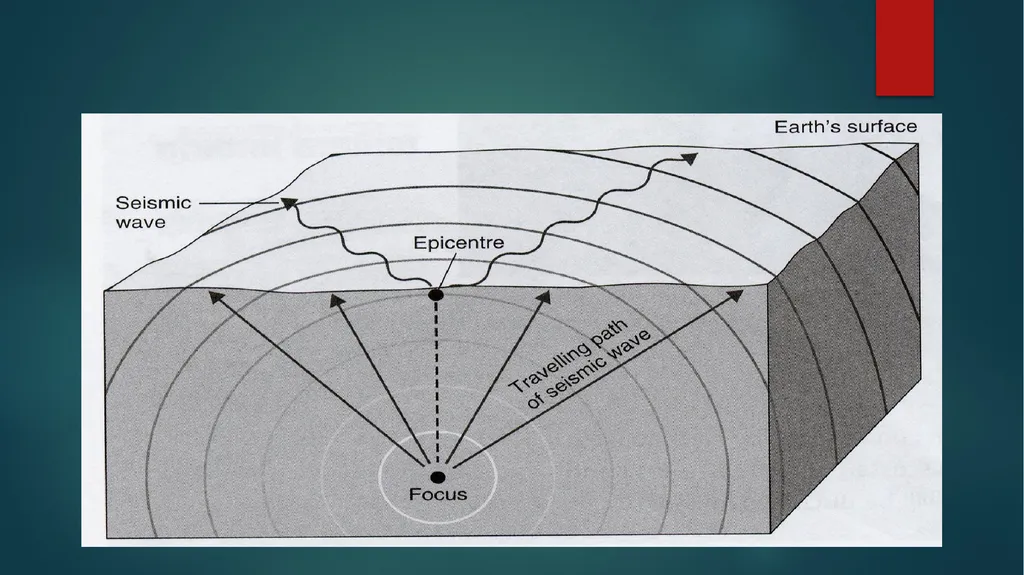
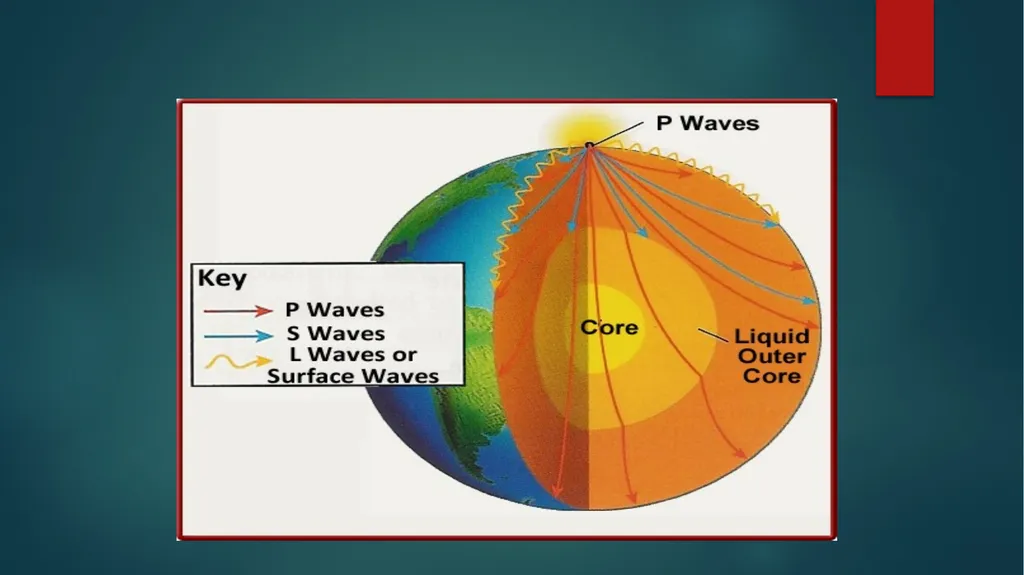
Seismic Waves and Interior of the Earth The behaviour of seismic waves in the different layers of the earth provides the most authentic evidence about the composition and structure of the earth. The different types of waves, generated during the occurrence of an earthquake, are generally divided into three broad categories:
Primary Waves
Secondary Waves, and
Surface Waves<br>
03
Seismic waves – both P-waves and S-waves travel faster through rigid material than through soft or plastic material. The velocities of these waves travelling through a specific part of earth thus give an indication of the type of rock there. Abrupt changes in the seismic wave velocities indicate significant changes in earth’s interior.<br>
04
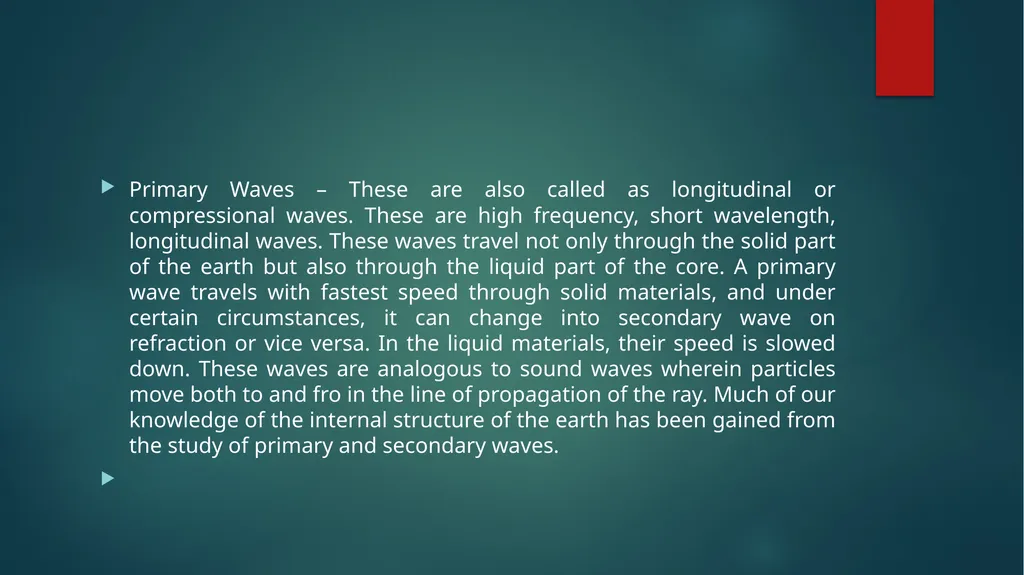
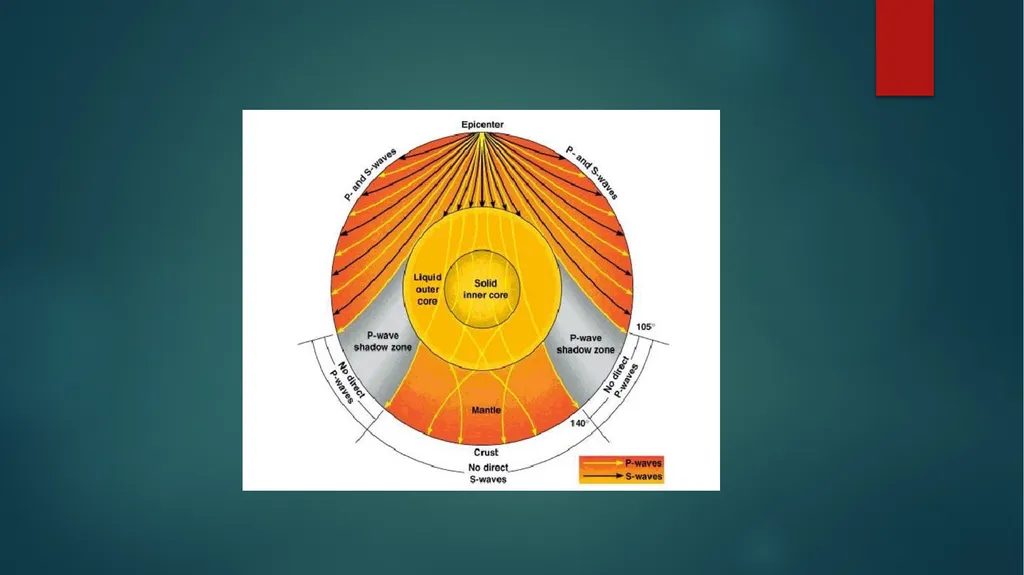
Primary Waves – These are also called as longitudinal or compressional waves. These are high frequency, short wavelength, longitudinal waves. These waves travel not only through the solid part of the earth but also through the liquid part of the core. A primary wave travels with fastest speed through solid materials, and under certain circumstances, it can change into secondary wave on refraction or vice versa. In the liquid materials, their speed is slowed down. These waves are analogous to sound waves wherein particles move both to and fro in the line of propagation of the ray. Much of our knowledge of the internal structure of the earth has been gained from the study of primary and secondary waves.<br>
05
Secondary Waves
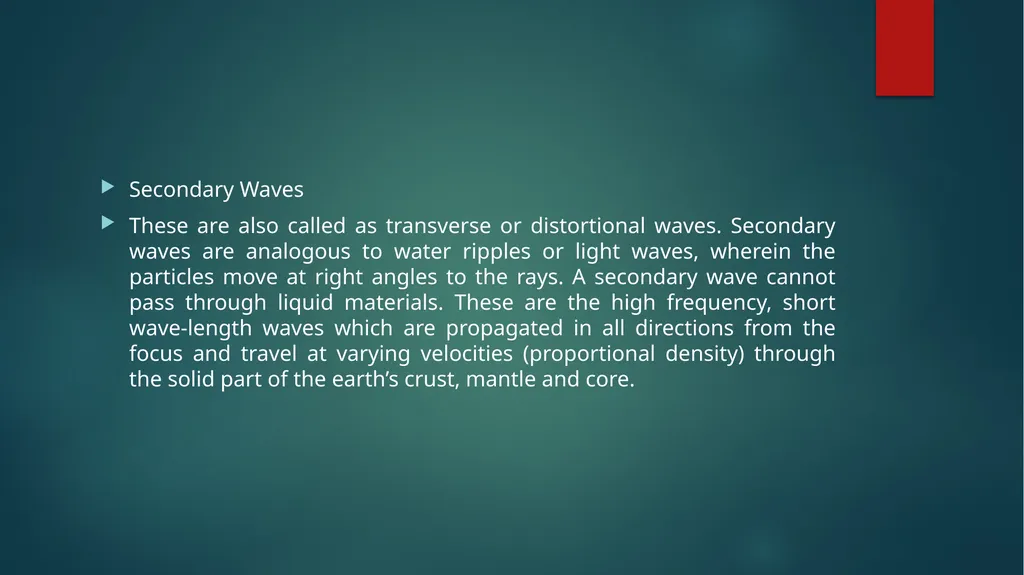
These are also called as transverse or distortional waves. Secondary waves are analogous to water ripples or light waves, wherein the particles move at right angles to the rays. A secondary wave cannot pass through liquid materials. These are the high frequency, short wave-length waves which are propagated in all directions from the focus and travel at varying velocities (proportional density) through the solid part of the earth’s crust, mantle and core.<br>
06
Surface Waves
Surface waves are called a long-period waves. These waves generally affect the surface of the earth only and die out at smaller depth.
The surface waves are characterised with low frequency, long wavelength, and transverse vibrations which develop in the immediate neighbourhood of the epicentre. The surface waves are responsible for most of the destructive force of earthquake. They are confined to the outer skin of the crust. They cover the longest distance of all the seismic waves.<br>
07
When an earthquake occurs, the seismic waves are recorded at the epicentre with the help of seismograph. In the beginning a few small and weak swings are recorded. Such tremors are called as ‘the first preliminary tremors’. After a brief interval ‘the second preliminary tremors’ are recorded and finally ‘the main tremors’ of strong waves are recorded.<br>