
INTERNATIONAL ADVOCACY PROGRAMME LIBRARIES,
CP
Published · 49 slides · 0 views
1 / 1


Description
INTERNATIONAL ADVOCACY PROGRAMME LIBRARIES, DEVELOPMENT, AND THE UN 2030 AGENDA TOPIC 3: THE SEVEN STEPS OF THE ADVOCACY PLANNING CYCLE Topic 3: The seven steps of the advocacy planning cycle Learning objectives To understand a structured
Related Topics
Share
Embed code
Download this presentation From Below
"INTERNATIONAL ADVOCACY PROGRAMME LIBRARIES," is the property of its rightful owner. Permission is granted to download and print the materials on this website for personal, non-commercial use only, and to display it on your personal computer provided you do not modify the materials and that you retain all copyright notices contained in the materials. By downloading content from our website, you accept the terms of this agreement.
Presentation Transcript
01
INTERNATIONAL ADVOCACY PROGRAMME LIBRARIES, DEVELOPMENT,
AND THE UN 2030 AGENDA TOPIC 3: THE SEVEN STEPS OF THE ADVOCACY PLANNING CYCLE<br>
02
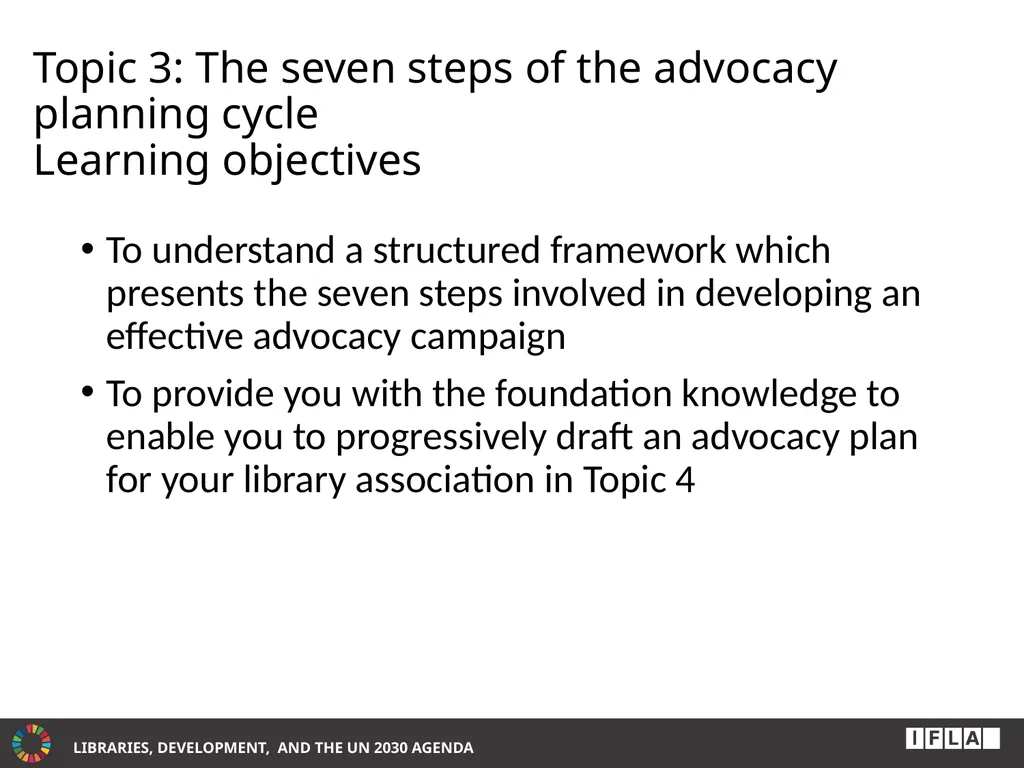
Topic 3: The seven steps of the advocacy planning cycle
Learning objectives To understand a structured framework which presents the seven steps involved in developing an effective advocacy campaign
To provide you with the foundation knowledge to enable you to progressively draft an advocacy plan for your library association in Topic 4<br>
To provide you with the foundation knowledge to enable you to progressively draft an advocacy plan for your library association in Topic 4<br>
03
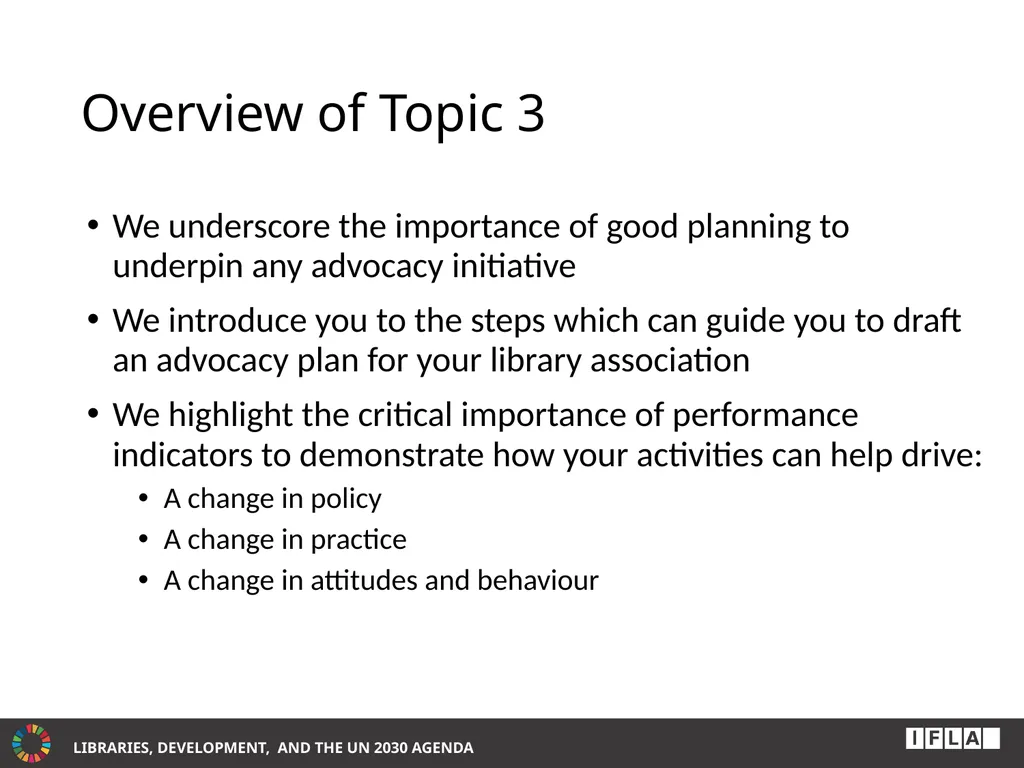
We underscore the importance of good planning to underpin any advocacy initiative
We introduce you to the steps which can guide you to draft an advocacy plan for your library association
We highlight the critical importance of performance indicators to demonstrate how your activities can help drive:
A change in policy
A change in practice
A change in attitudes and behaviour Overview of Topic 3<br>
We introduce you to the steps which can guide you to draft an advocacy plan for your library association
We highlight the critical importance of performance indicators to demonstrate how your activities can help drive:
A change in policy
A change in practice
A change in attitudes and behaviour Overview of Topic 3<br>
04
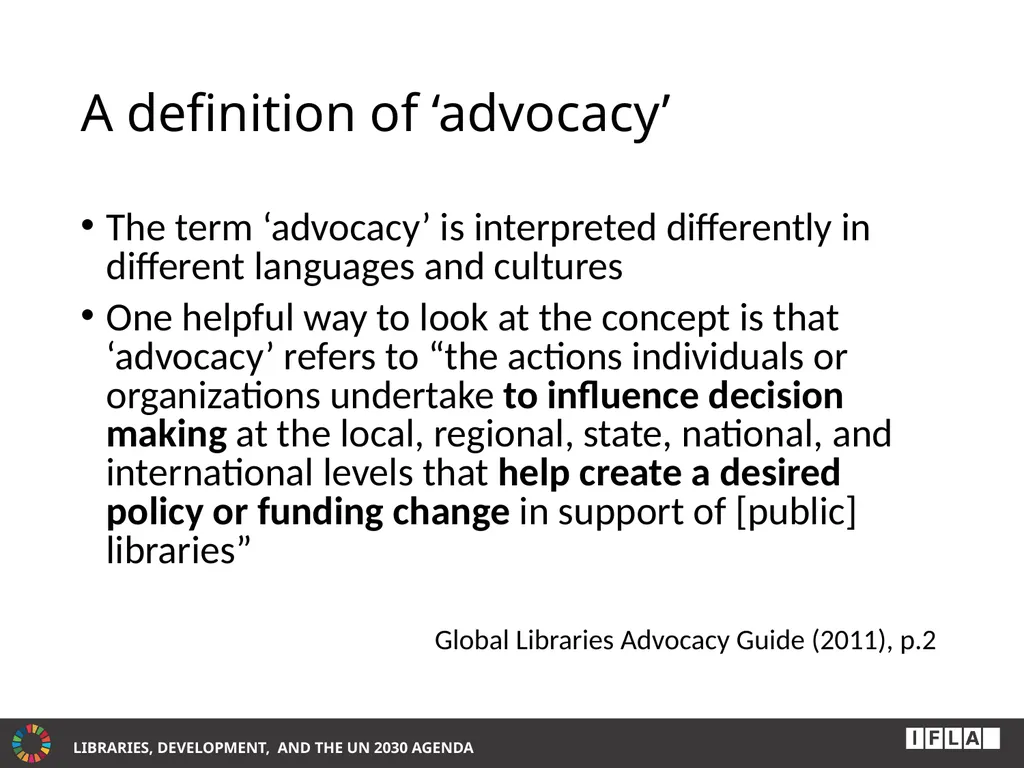
A definition of ‘advocacy’ The term ‘advocacy’ is interpreted differently in different languages and cultures
One helpful way to look at the concept is that ‘advocacy’ refers to “the actions individuals or organizations undertake to influence decision making at the local, regional, state, national, and international levels that help create a desired policy or funding change in support of [public] libraries”
Global Libraries Advocacy Guide (2011), p.2<br>
One helpful way to look at the concept is that ‘advocacy’ refers to “the actions individuals or organizations undertake to influence decision making at the local, regional, state, national, and international levels that help create a desired policy or funding change in support of [public] libraries”
Global Libraries Advocacy Guide (2011), p.2<br>
05
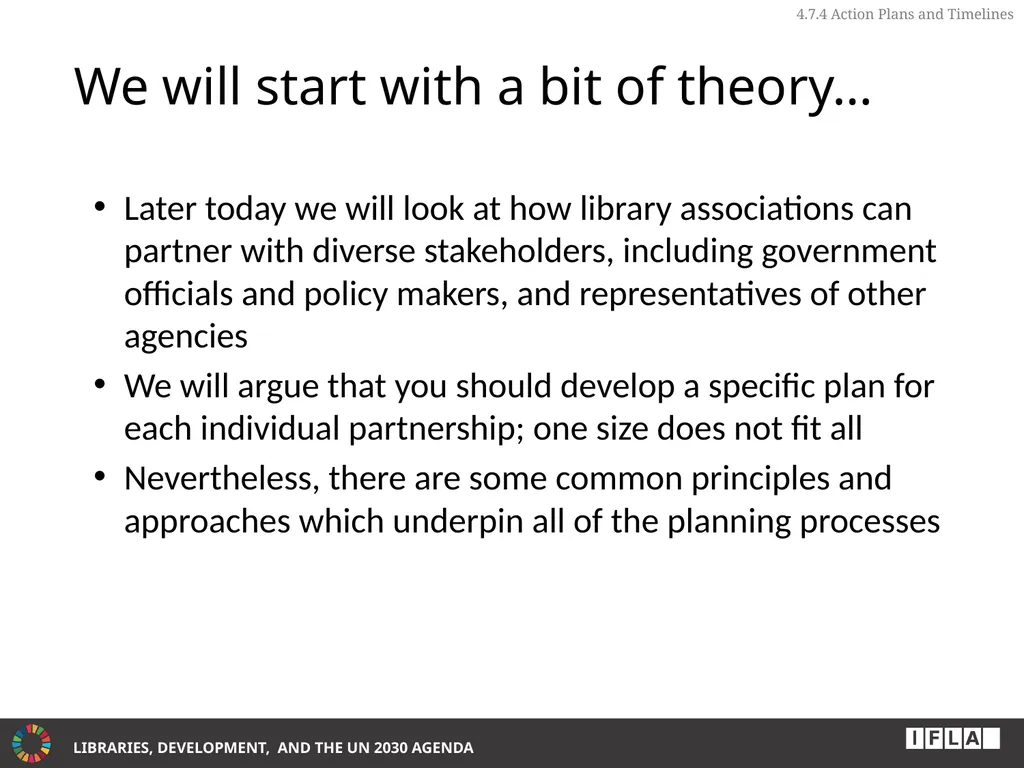
Later today we will look at how library associations can partner with diverse stakeholders, including government officials and policy makers, and representatives of other agencies
We will argue that you should develop a specific plan for each individual partnership; one size does not fit all
Nevertheless, there are some common principles and approaches which underpin all of the planning processes We will start with a bit of theory… 4.7.4 Action Plans and Timelines<br>
We will argue that you should develop a specific plan for each individual partnership; one size does not fit all
Nevertheless, there are some common principles and approaches which underpin all of the planning processes We will start with a bit of theory… 4.7.4 Action Plans and Timelines<br>
06
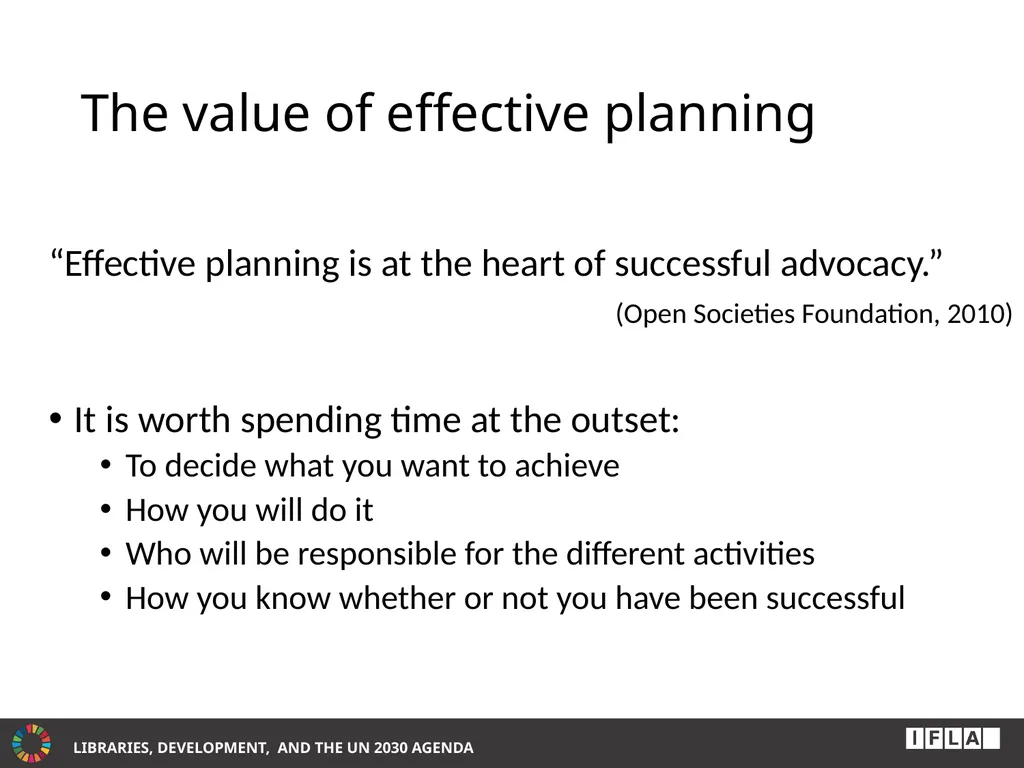
The value of effective planning “Effective planning is at the heart of successful advocacy.”
(Open Societies Foundation, 2010)
It is worth spending time at the outset:
To decide what you want to achieve
How you will do it
Who will be responsible for the different activities
How you know whether or not you have been successful<br>
(Open Societies Foundation, 2010)
It is worth spending time at the outset:
To decide what you want to achieve
How you will do it
Who will be responsible for the different activities
How you know whether or not you have been successful<br>
07
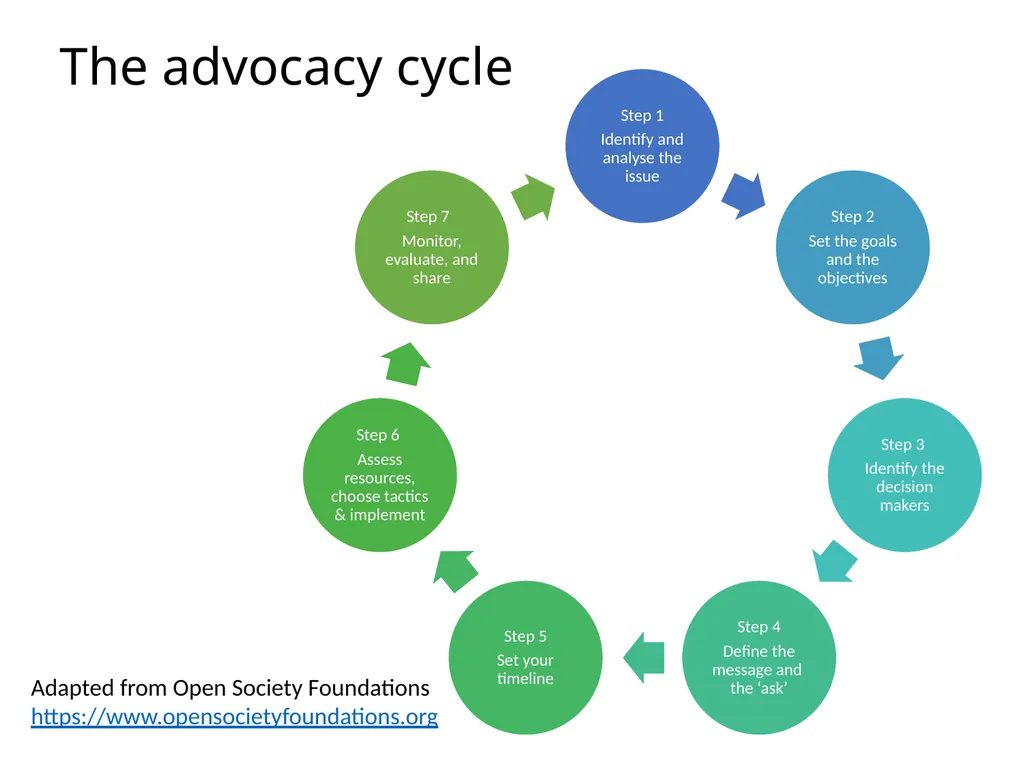
The advocacy cycle Adapted from Open Society Foundations
https://www.opensocietyfoundations.org<br>
08
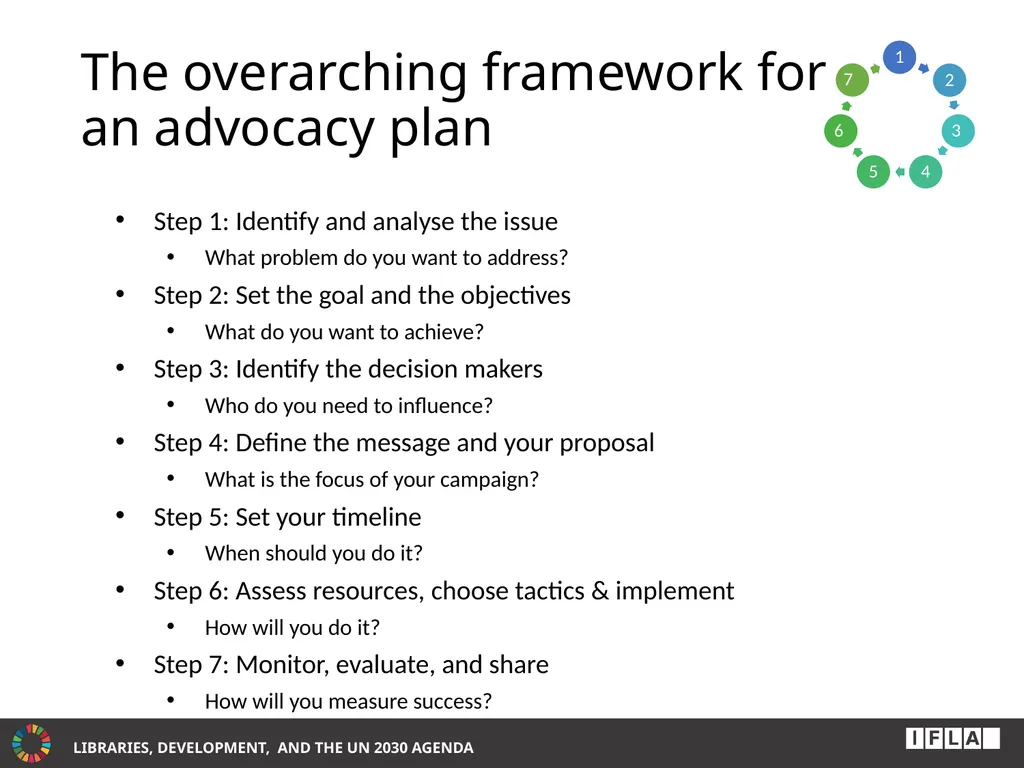
The overarching framework for
an advocacy plan Step 1: Identify and analyse the issue
What problem do you want to address?
Step 2: Set the goal and the objectives
What do you want to achieve?
Step 3: Identify the decision makers
Who do you need to influence?
Step 4: Define the message and your proposal
What is the focus of your campaign?
Step 5: Set your timeline
When should you do it?
Step 6: Assess resources, choose tactics & implement
How will you do it?
Step 7: Monitor, evaluate, and share
How will you measure success?<br>
What problem do you want to address?
Step 2: Set the goal and the objectives
What do you want to achieve?
Step 3: Identify the decision makers
Who do you need to influence?
Step 4: Define the message and your proposal
What is the focus of your campaign?
Step 5: Set your timeline
When should you do it?
Step 6: Assess resources, choose tactics & implement
How will you do it?
Step 7: Monitor, evaluate, and share
How will you measure success?<br>
09
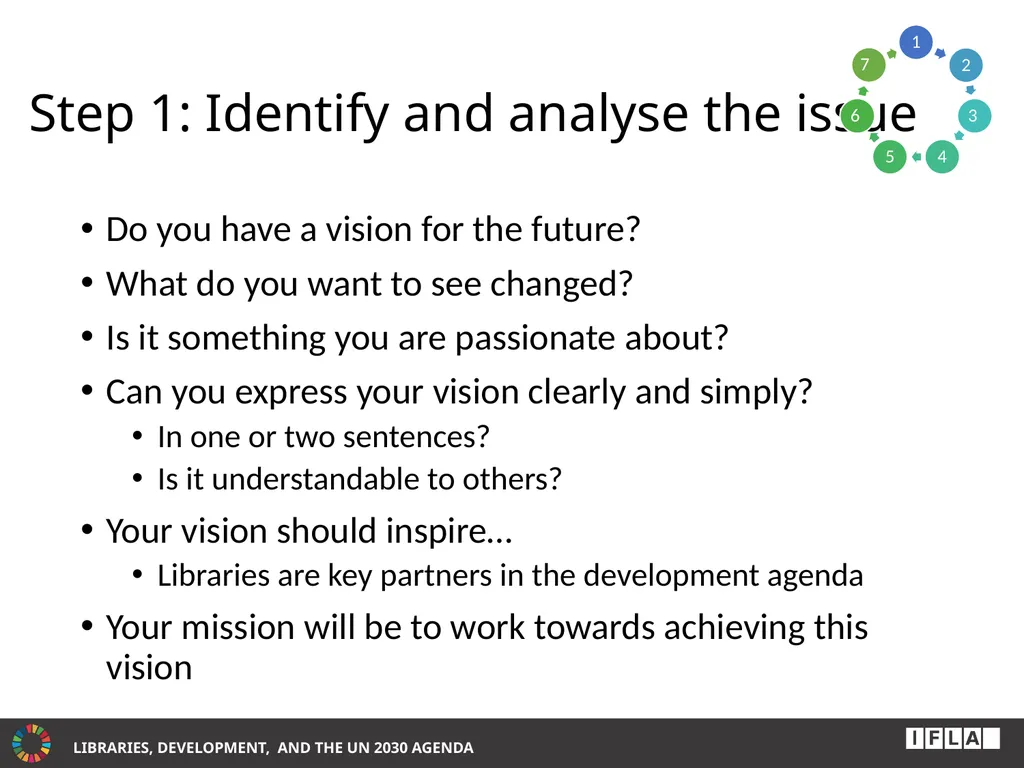
Do you have a vision for the future?
What do you want to see changed?
Is it something you are passionate about?
Can you express your vision clearly and simply?
In one or two sentences?
Is it understandable to others?
Your vision should inspire…
Libraries are key partners in the development agenda
Your mission will be to work towards achieving this vision Step 1: Identify and analyse the issue<br>
What do you want to see changed?
Is it something you are passionate about?
Can you express your vision clearly and simply?
In one or two sentences?
Is it understandable to others?
Your vision should inspire…
Libraries are key partners in the development agenda
Your mission will be to work towards achieving this vision Step 1: Identify and analyse the issue<br>
10
What problem do you want to address? Libraries are not yet fully acknowledged as integral partners in the UN 2030 Agenda
You need to think about this issue and how it plays out on different levels
At the local level
At the regional
At the national level
At the international level
What evidence do you have of this issue in your own country?
Are any other agencies or groups concerned about this issue?
It may be helpful to think critically and prepare a summary discussion document which focuses on your concerns<br>
You need to think about this issue and how it plays out on different levels
At the local level
At the regional
At the national level
At the international level
What evidence do you have of this issue in your own country?
Are any other agencies or groups concerned about this issue?
It may be helpful to think critically and prepare a summary discussion document which focuses on your concerns<br>
11
If you are going to conduct advocacy, especially at the national level, you will need strong, relevant evidence to show that this is an important issue and that existing policies are not working
You will also need strong evidence to reinforce your proposed solution(s)
In preparing your advocacy plan, you will need to develop a suitably persuasive argument which details the causes, effects, and proposed solution, presenting authoritative evidence from a range of sources
(Open Society Foundations, 2010, p.6)<br>
You will also need strong evidence to reinforce your proposed solution(s)
In preparing your advocacy plan, you will need to develop a suitably persuasive argument which details the causes, effects, and proposed solution, presenting authoritative evidence from a range of sources
(Open Society Foundations, 2010, p.6)<br>
12
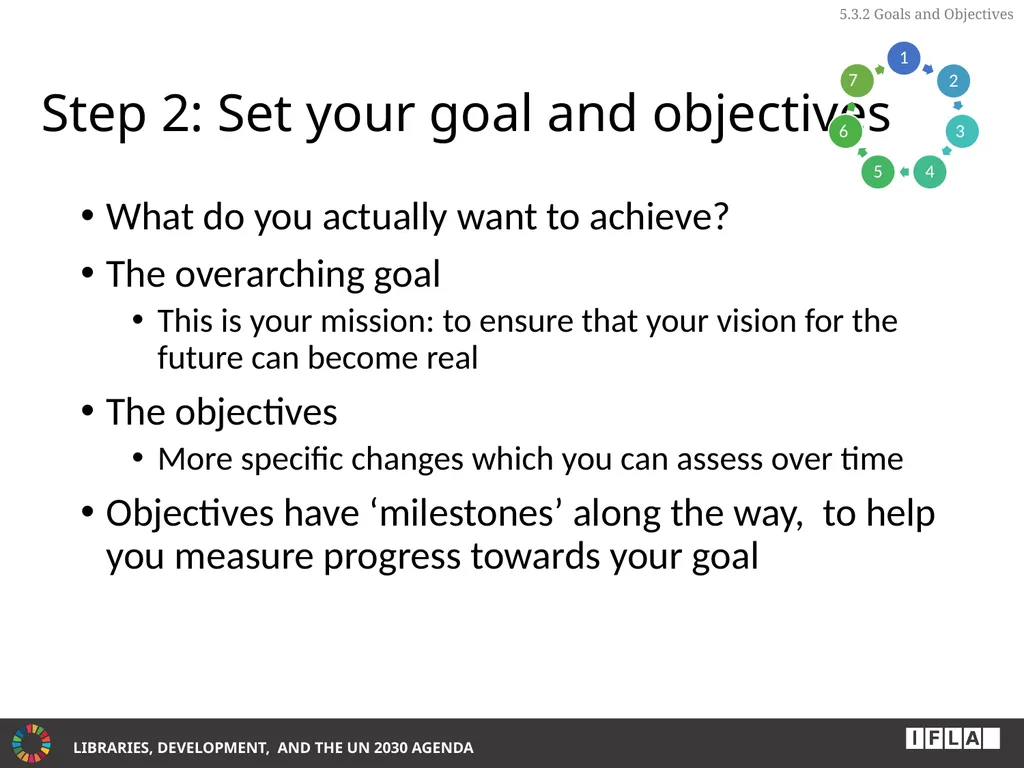
What do you actually want to achieve?
The overarching goal
This is your mission: to ensure that your vision for the future can become real
The objectives
More specific changes which you can assess over time
Objectives have ‘milestones’ along the way, to help you measure progress towards your goal Step 2: Set your goal and objectives 5.3.2 Goals and Objectives<br>
The overarching goal
This is your mission: to ensure that your vision for the future can become real
The objectives
More specific changes which you can assess over time
Objectives have ‘milestones’ along the way, to help you measure progress towards your goal Step 2: Set your goal and objectives 5.3.2 Goals and Objectives<br>
13
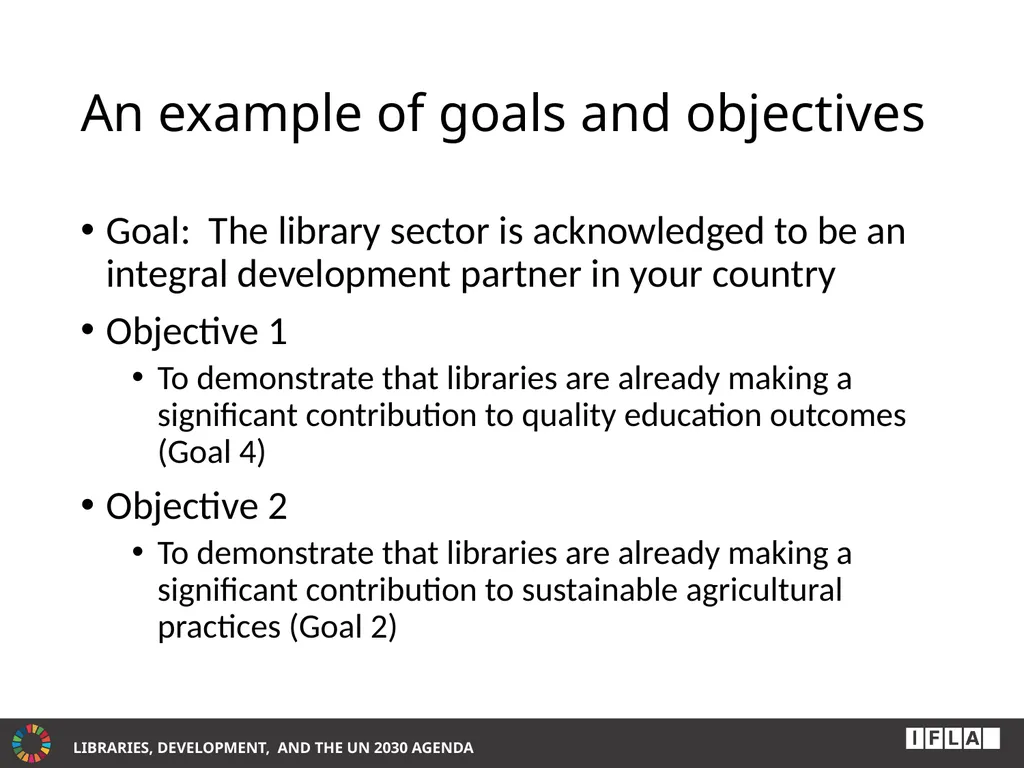
An example of goals and objectives Goal: The library sector is acknowledged to be an integral development partner in your country
Objective 1
To demonstrate that libraries are already making a significant contribution to quality education outcomes (Goal 4)
Objective 2
To demonstrate that libraries are already making a significant contribution to sustainable agricultural practices (Goal 2)<br>
Objective 1
To demonstrate that libraries are already making a significant contribution to quality education outcomes (Goal 4)
Objective 2
To demonstrate that libraries are already making a significant contribution to sustainable agricultural practices (Goal 2)<br>
14
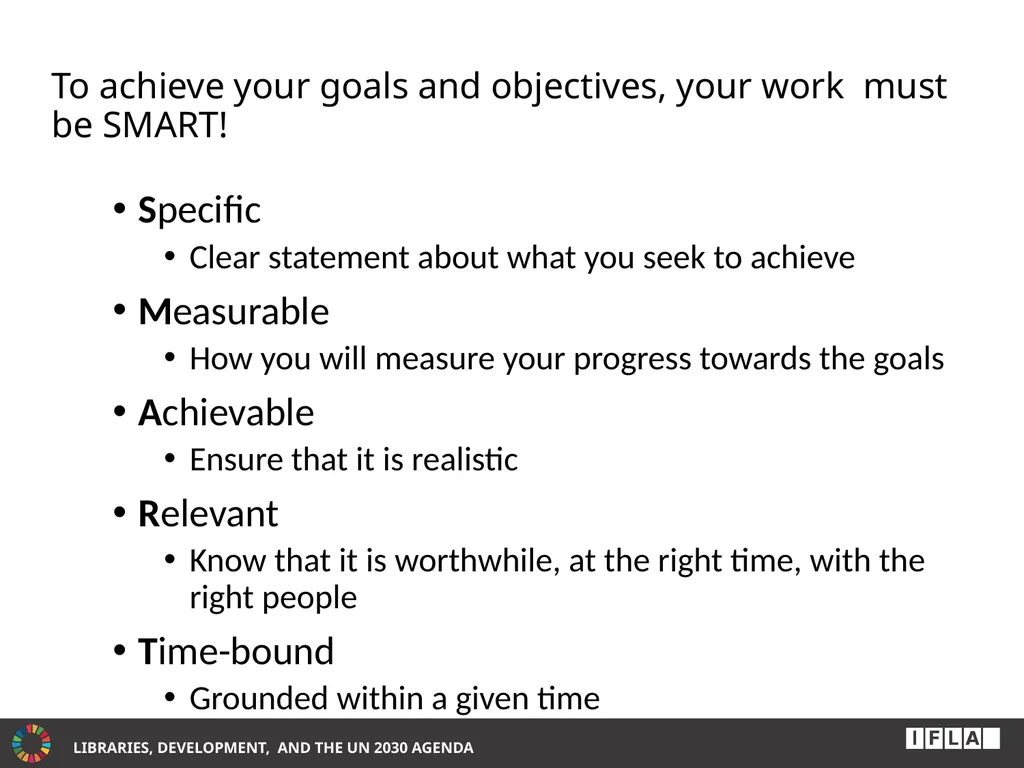
Specific
Clear statement about what you seek to achieve
Measurable
How you will measure your progress towards the goals
Achievable
Ensure that it is realistic
Relevant
Know that it is worthwhile, at the right time, with the right people
Time-bound
Grounded within a given time To achieve your goals and objectives, your work must be SMART!<br>
Clear statement about what you seek to achieve
Measurable
How you will measure your progress towards the goals
Achievable
Ensure that it is realistic
Relevant
Know that it is worthwhile, at the right time, with the right people
Time-bound
Grounded within a given time To achieve your goals and objectives, your work must be SMART!<br>
15
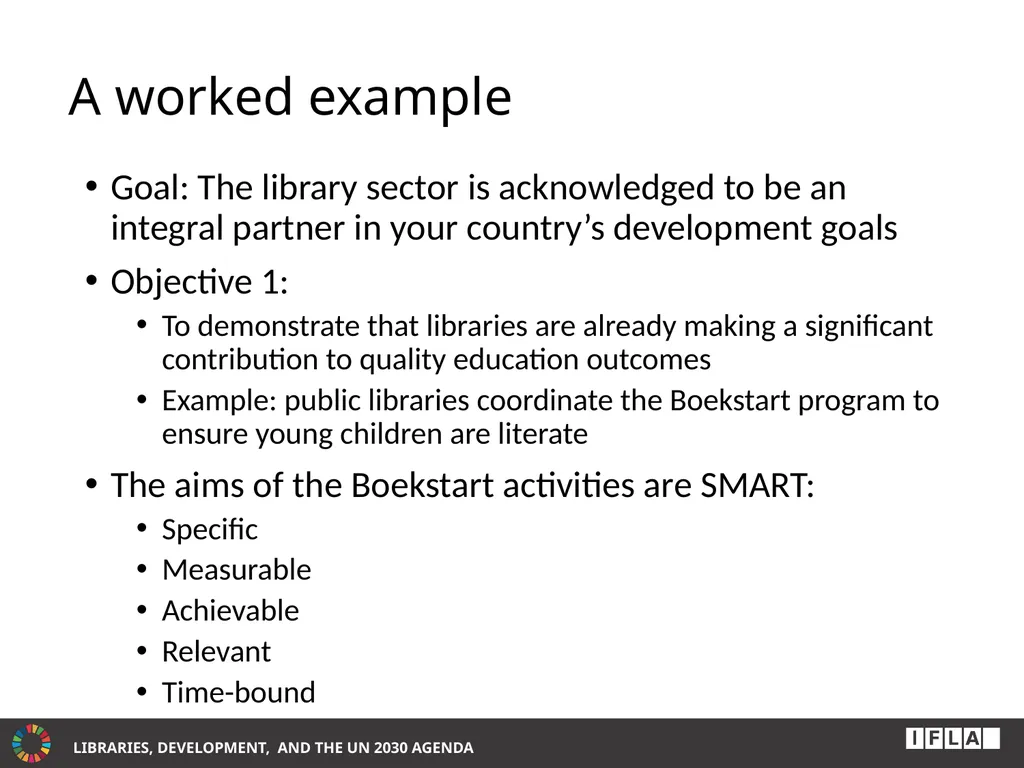
Goal: The library sector is acknowledged to be an integral partner in your country’s development goals
Objective 1:
To demonstrate that libraries are already making a significant contribution to quality education outcomes
Example: public libraries coordinate the Boekstart program to ensure young children are literate
The aims of the Boekstart activities are SMART:
Specific
Measurable
Achievable
Relevant
Time-bound A worked example<br>
Objective 1:
To demonstrate that libraries are already making a significant contribution to quality education outcomes
Example: public libraries coordinate the Boekstart program to ensure young children are literate
The aims of the Boekstart activities are SMART:
Specific
Measurable
Achievable
Relevant
Time-bound A worked example<br>
16
Specific:
To increase the level of literacy in the country
Measurable:
The level of children’s literacy at age 7 increases by 10%
Achievable:
The desired change is realistic, it is not overly ambitious
Note: you could look back at some of the reported achievements of the Millennium Development Goals
Relevant:
Government, education agencies and the community are all committed to a literate society
Time-bound:
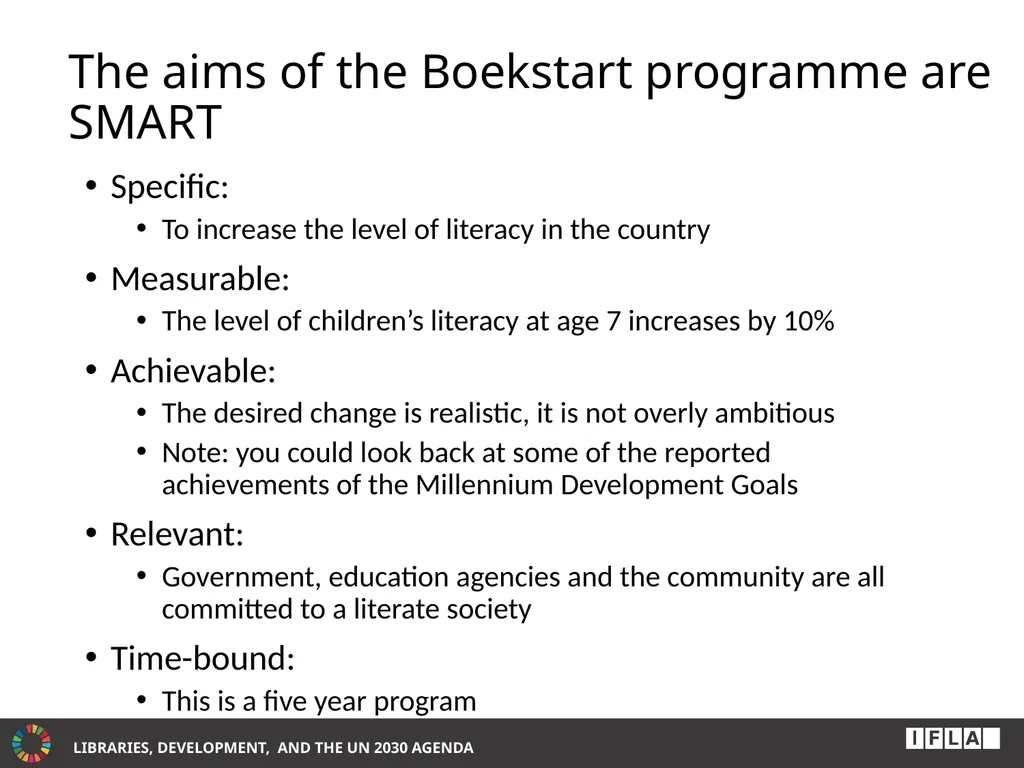
This is a five year program The aims of the Boekstart programme are SMART<br>
To increase the level of literacy in the country
Measurable:
The level of children’s literacy at age 7 increases by 10%
Achievable:
The desired change is realistic, it is not overly ambitious
Note: you could look back at some of the reported achievements of the Millennium Development Goals
Relevant:
Government, education agencies and the community are all committed to a literate society
Time-bound:
This is a five year program The aims of the Boekstart programme are SMART<br>
17
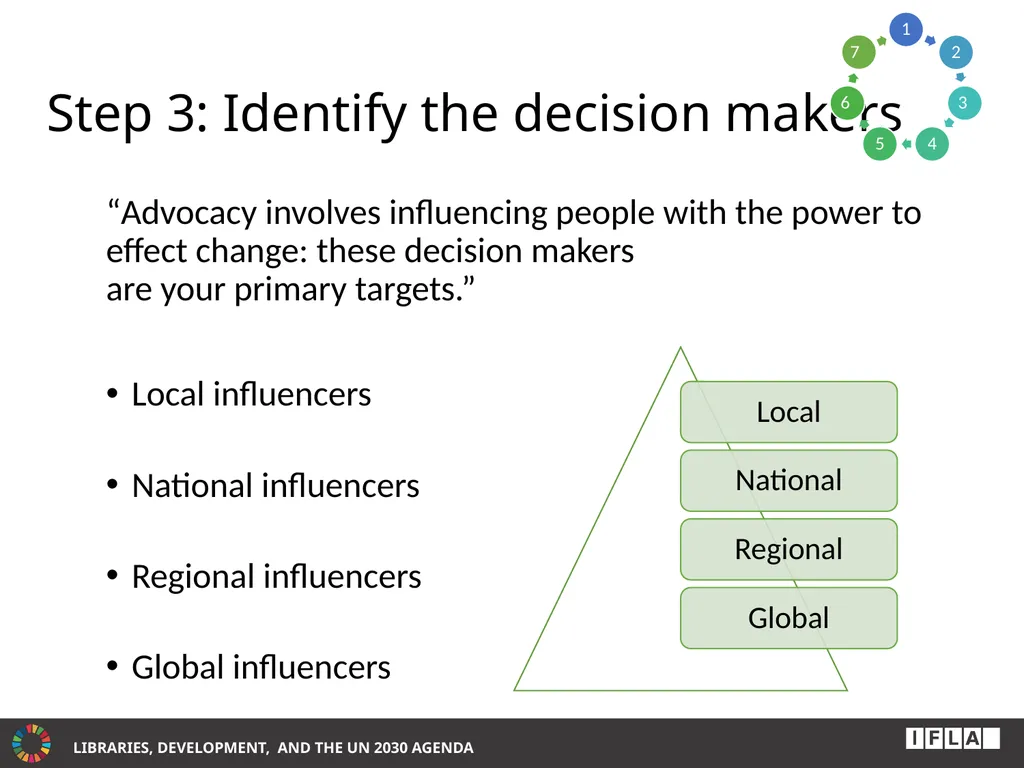
Step 3: Identify the decision makers “Advocacy involves influencing people with the power to effect change: these decision makers
are your primary targets.”
Local influencers
National influencers
Regional influencers
Global influencers<br>
Local influencers
National influencers
Regional influencers
Global influencers<br>
18
Who are the key decision makers? The particular issue you seek to address will determine the people with whom you need to engage
The next few slides provide a general overview of the range of stakeholders you may need to think about
You won’t need to try to work with all of them!<br>
The next few slides provide a general overview of the range of stakeholders you may need to think about
You won’t need to try to work with all of them!<br>
19
Local influencers Local government decision makers
Mayors and councillors
Key bridge between the community and the national government
Often more accessible and more willing to be engaged than decision makers at other levels<br>
Mayors and councillors
Key bridge between the community and the national government
Often more accessible and more willing to be engaged than decision makers at other levels<br>
20
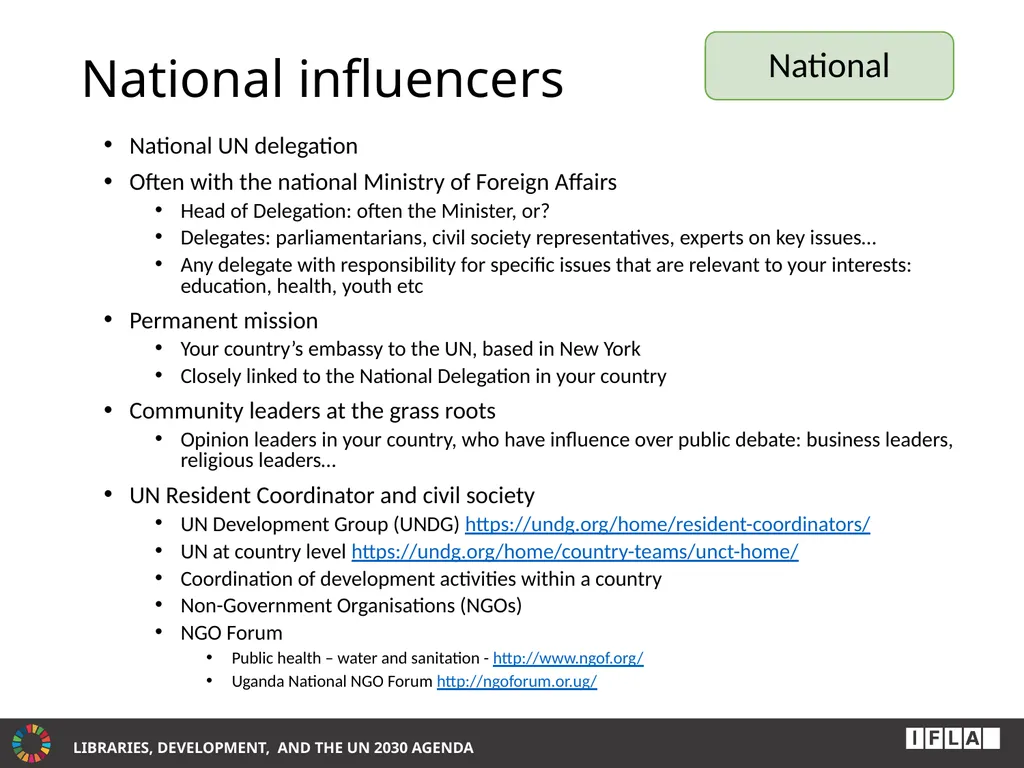
National influencers National UN delegation
Often with the national Ministry of Foreign Affairs
Head of Delegation: often the Minister, or?
Delegates: parliamentarians, civil society representatives, experts on key issues…
Any delegate with responsibility for specific issues that are relevant to your interests: education, health, youth etc
Permanent mission
Your country’s embassy to the UN, based in New York
Closely linked to the National Delegation in your country
Community leaders at the grass roots
Opinion leaders in your country, who have influence over public debate: business leaders, religious leaders…
UN Resident Coordinator and civil society
UN Development Group (UNDG) https://undg.org/home/resident-coordinators/
UN at country level https://undg.org/home/country-teams/unct-home/
Coordination of development activities within a country
Non-Government Organisations (NGOs)
NGO Forum
Public health – water and sanitation - http://www.ngof.org/
Uganda National NGO Forum http://ngoforum.or.ug/<br>
Often with the national Ministry of Foreign Affairs
Head of Delegation: often the Minister, or?
Delegates: parliamentarians, civil society representatives, experts on key issues…
Any delegate with responsibility for specific issues that are relevant to your interests: education, health, youth etc
Permanent mission
Your country’s embassy to the UN, based in New York
Closely linked to the National Delegation in your country
Community leaders at the grass roots
Opinion leaders in your country, who have influence over public debate: business leaders, religious leaders…
UN Resident Coordinator and civil society
UN Development Group (UNDG) https://undg.org/home/resident-coordinators/
UN at country level https://undg.org/home/country-teams/unct-home/
Coordination of development activities within a country
Non-Government Organisations (NGOs)
NGO Forum
Public health – water and sanitation - http://www.ngof.org/
Uganda National NGO Forum http://ngoforum.or.ug/<br>
21
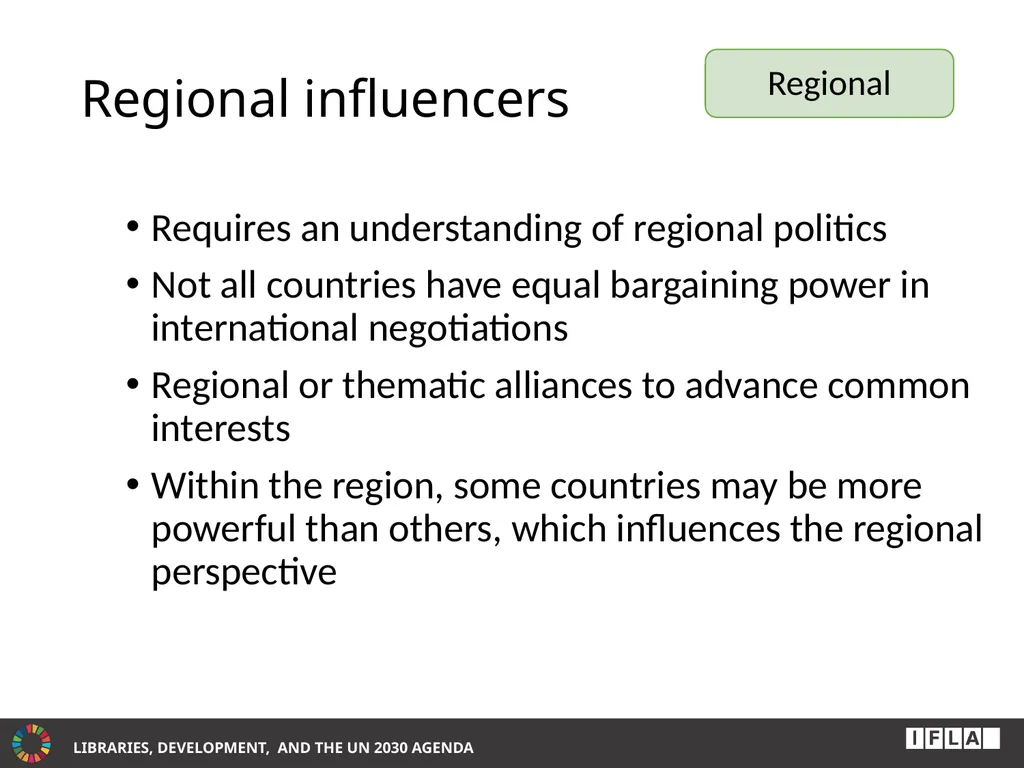
Regional influencers Requires an understanding of regional politics
Not all countries have equal bargaining power in international negotiations
Regional or thematic alliances to advance common interests
Within the region, some countries may be more powerful than others, which influences the regional perspective<br>
Not all countries have equal bargaining power in international negotiations
Regional or thematic alliances to advance common interests
Within the region, some countries may be more powerful than others, which influences the regional perspective<br>
22
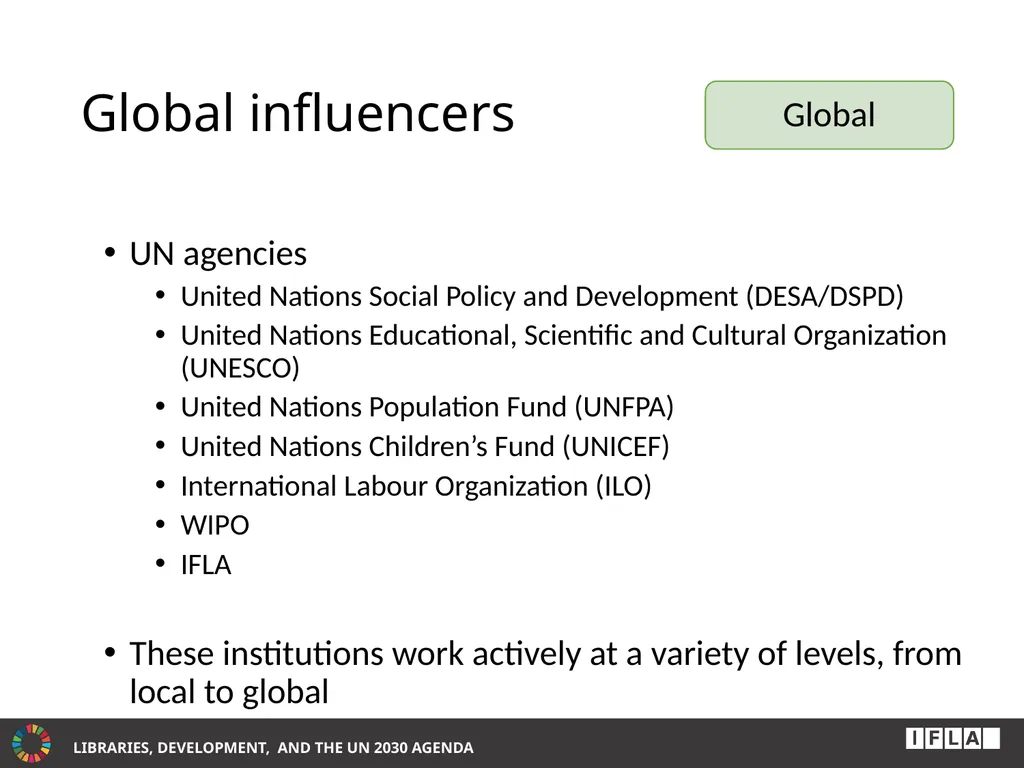
Global influencers UN agencies
United Nations Social Policy and Development (DESA/DSPD)
United Nations Educational, Scientific and Cultural Organization (UNESCO)
United Nations Population Fund (UNFPA)
United Nations Children’s Fund (UNICEF)
International Labour Organization (ILO)
WIPO
IFLA
These institutions work actively at a variety of levels, from local to global<br>
United Nations Social Policy and Development (DESA/DSPD)
United Nations Educational, Scientific and Cultural Organization (UNESCO)
United Nations Population Fund (UNFPA)
United Nations Children’s Fund (UNICEF)
International Labour Organization (ILO)
WIPO
IFLA
These institutions work actively at a variety of levels, from local to global<br>
23
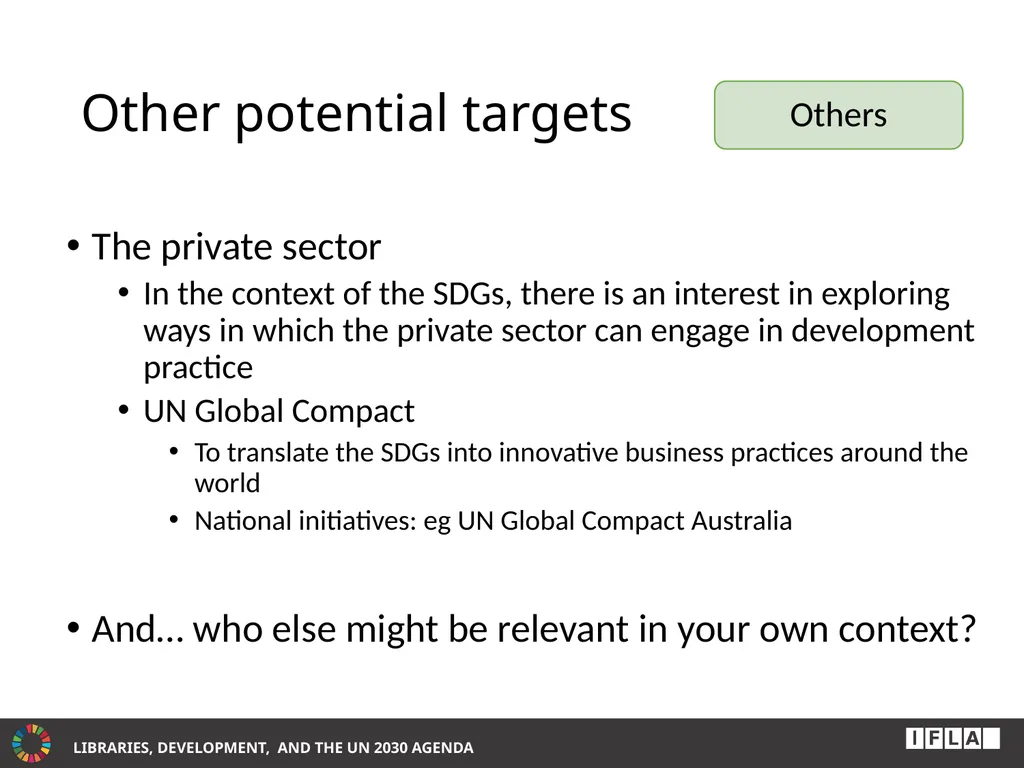
Other potential targets The private sector
In the context of the SDGs, there is an interest in exploring ways in which the private sector can engage in development practice
UN Global Compact
To translate the SDGs into innovative business practices around the world
National initiatives: eg UN Global Compact Australia
And… who else might be relevant in your own context?<br>
In the context of the SDGs, there is an interest in exploring ways in which the private sector can engage in development practice
UN Global Compact
To translate the SDGs into innovative business practices around the world
National initiatives: eg UN Global Compact Australia
And… who else might be relevant in your own context?<br>
24
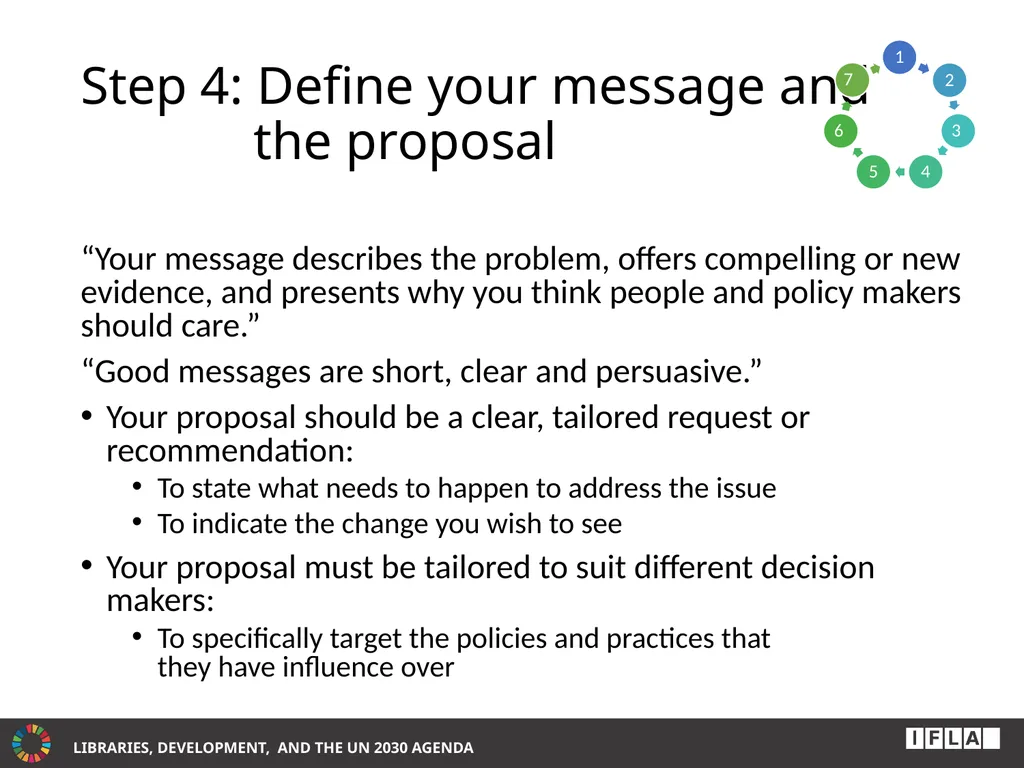
Step 4: Define your message and
the proposal “Your message describes the problem, offers compelling or new evidence, and presents why you think people and policy makers should care.”
“Good messages are short, clear and persuasive.”
Your proposal should be a clear, tailored request or recommendation:
To state what needs to happen to address the issue
To indicate the change you wish to see
Your proposal must be tailored to suit different decision makers:
To specifically target the policies and practices that they have influence over<br>
“Good messages are short, clear and persuasive.”
Your proposal should be a clear, tailored request or recommendation:
To state what needs to happen to address the issue
To indicate the change you wish to see
Your proposal must be tailored to suit different decision makers:
To specifically target the policies and practices that they have influence over<br>
25
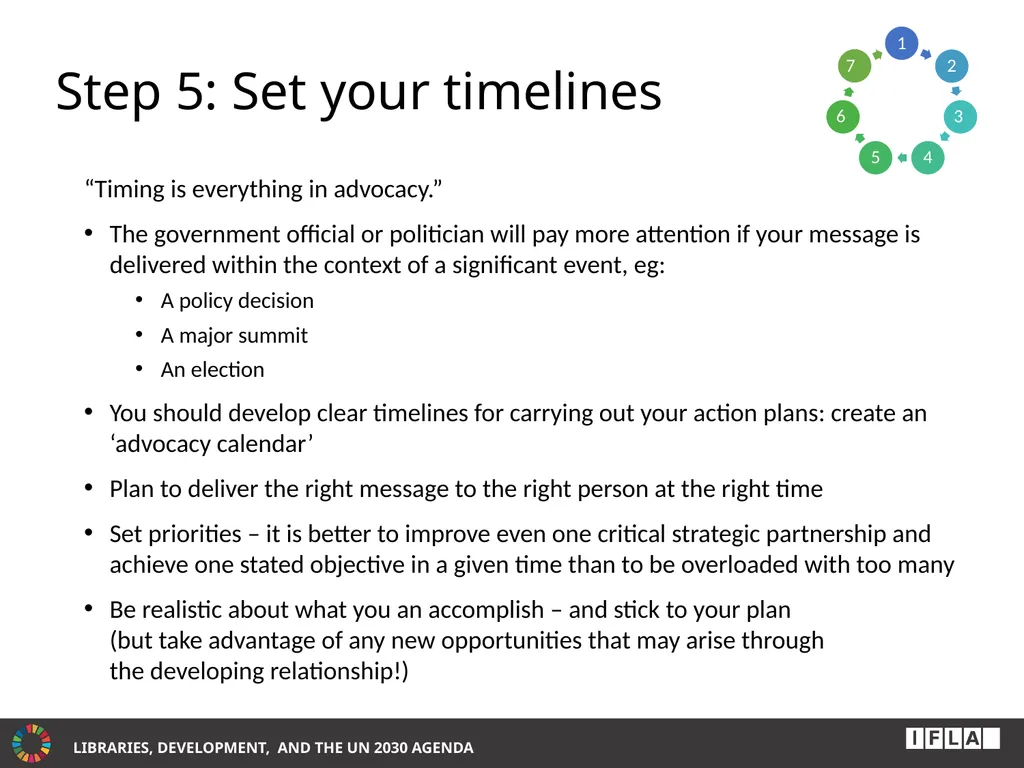
“Timing is everything in advocacy.”
The government official or politician will pay more attention if your message is delivered within the context of a significant event, eg:
A policy decision
A major summit
An election
You should develop clear timelines for carrying out your action plans: create an ‘advocacy calendar’
Plan to deliver the right message to the right person at the right time
Set priorities – it is better to improve even one critical strategic partnership and achieve one stated objective in a given time than to be overloaded with too many
Be realistic about what you an accomplish – and stick to your plan (but take advantage of any new opportunities that may arise through the developing relationship!) Step 5: Set your timelines<br>
The government official or politician will pay more attention if your message is delivered within the context of a significant event, eg:
A policy decision
A major summit
An election
You should develop clear timelines for carrying out your action plans: create an ‘advocacy calendar’
Plan to deliver the right message to the right person at the right time
Set priorities – it is better to improve even one critical strategic partnership and achieve one stated objective in a given time than to be overloaded with too many
Be realistic about what you an accomplish – and stick to your plan (but take advantage of any new opportunities that may arise through the developing relationship!) Step 5: Set your timelines<br>
26
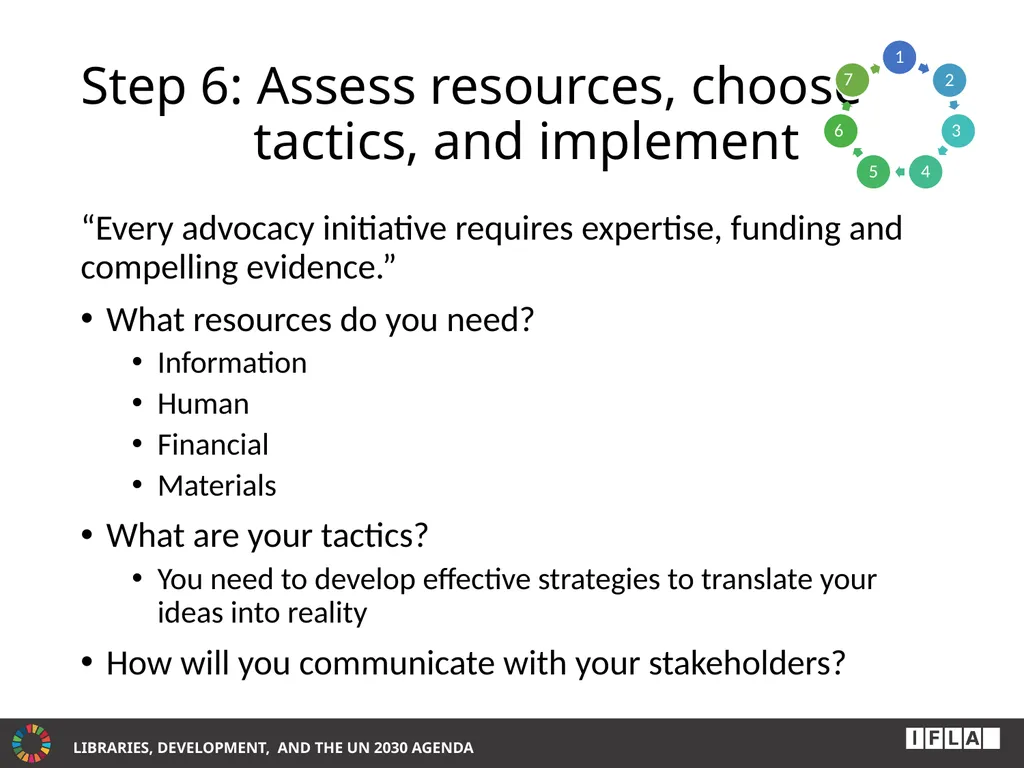
Step 6: Assess resources, choose
tactics, and implement “Every advocacy initiative requires expertise, funding and compelling evidence.”
What resources do you need?
Information
Human
Financial
Materials
What are your tactics?
You need to develop effective strategies to translate your ideas into reality
How will you communicate with your stakeholders?<br>
What resources do you need?
Information
Human
Financial
Materials
What are your tactics?
You need to develop effective strategies to translate your ideas into reality
How will you communicate with your stakeholders?<br>
27
The ‘right strategy’ To work to change policy
Preparing briefing packs
Meeting with decision makers
Providing evidence to argue the case for change
To build capacity
Developing the skills and building the structures required for effective advocacy
To run a campaign
Mobilising public support: petitions, demonstrations, letters to politicians, media
To leverage the media
Print, TV, radio, online
This will be part of your communications strategy<br>
Preparing briefing packs
Meeting with decision makers
Providing evidence to argue the case for change
To build capacity
Developing the skills and building the structures required for effective advocacy
To run a campaign
Mobilising public support: petitions, demonstrations, letters to politicians, media
To leverage the media
Print, TV, radio, online
This will be part of your communications strategy<br>
28
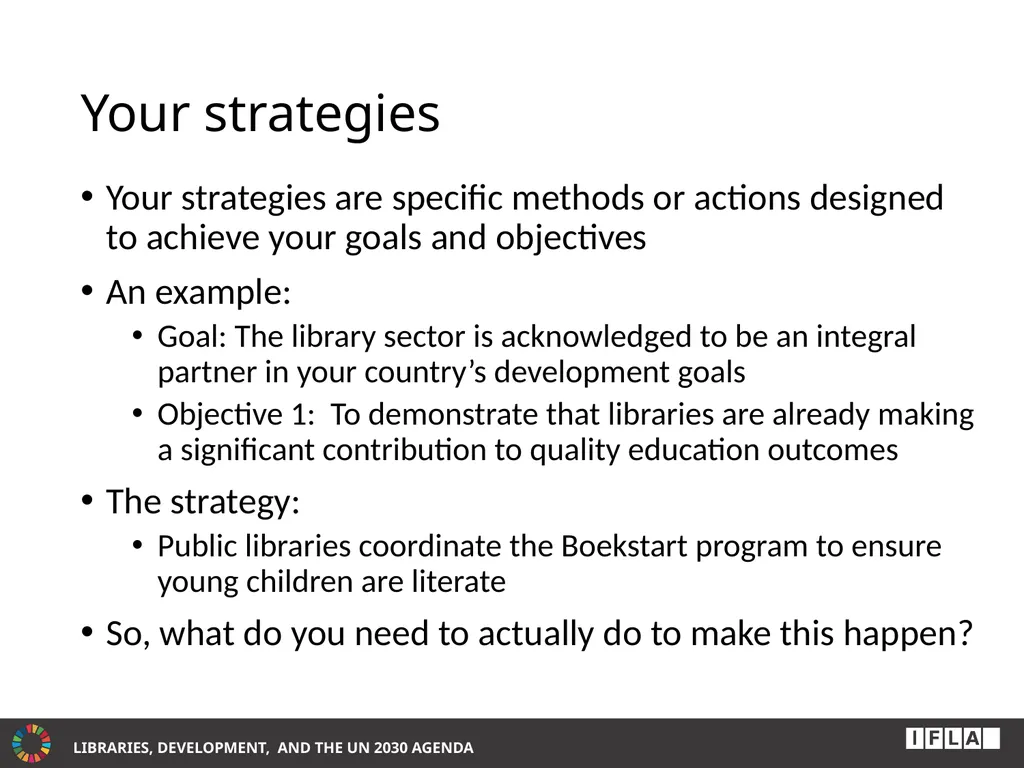
Your strategies are specific methods or actions designed to achieve your goals and objectives
An example:
Goal: The library sector is acknowledged to be an integral partner in your country’s development goals
Objective 1: To demonstrate that libraries are already making a significant contribution to quality education outcomes
The strategy:
Public libraries coordinate the Boekstart program to ensure young children are literate
So, what do you need to actually do to make this happen? Your strategies<br>
An example:
Goal: The library sector is acknowledged to be an integral partner in your country’s development goals
Objective 1: To demonstrate that libraries are already making a significant contribution to quality education outcomes
The strategy:
Public libraries coordinate the Boekstart program to ensure young children are literate
So, what do you need to actually do to make this happen? Your strategies<br>
29
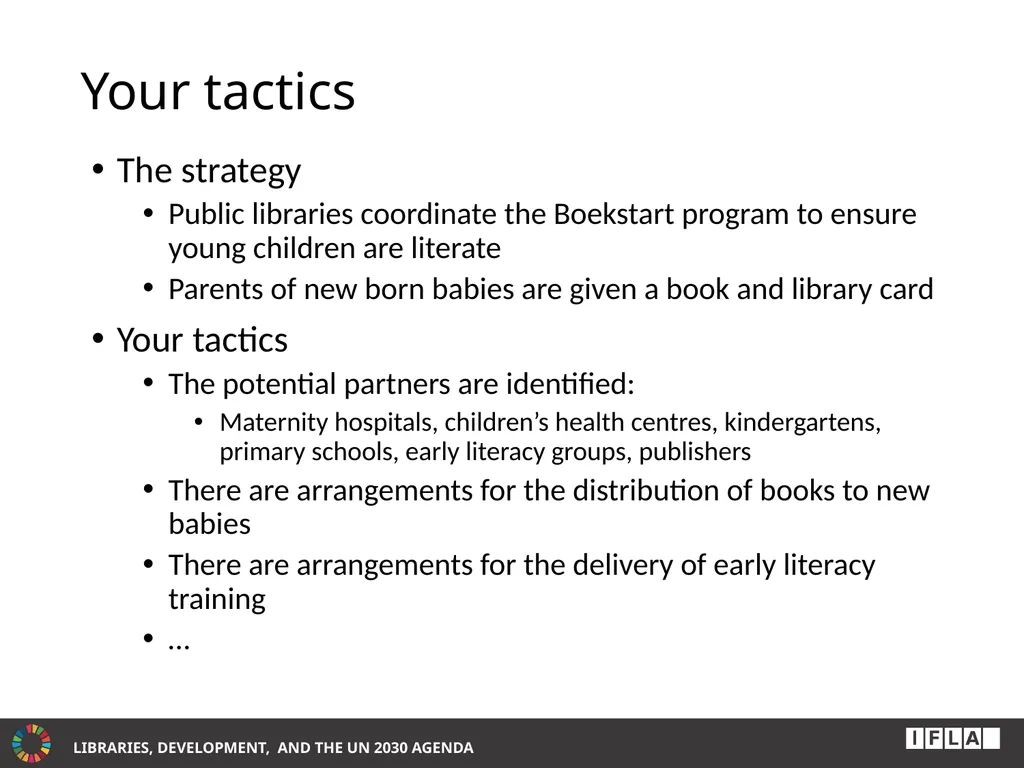
Your tactics The strategy
Public libraries coordinate the Boekstart program to ensure young children are literate
Parents of new born babies are given a book and library card
Your tactics
The potential partners are identified:
Maternity hospitals, children’s health centres, kindergartens, primary schools, early literacy groups, publishers
There are arrangements for the distribution of books to new babies
There are arrangements for the delivery of early literacy training
…<br>
Public libraries coordinate the Boekstart program to ensure young children are literate
Parents of new born babies are given a book and library card
Your tactics
The potential partners are identified:
Maternity hospitals, children’s health centres, kindergartens, primary schools, early literacy groups, publishers
There are arrangements for the distribution of books to new babies
There are arrangements for the delivery of early literacy training
…<br>
30
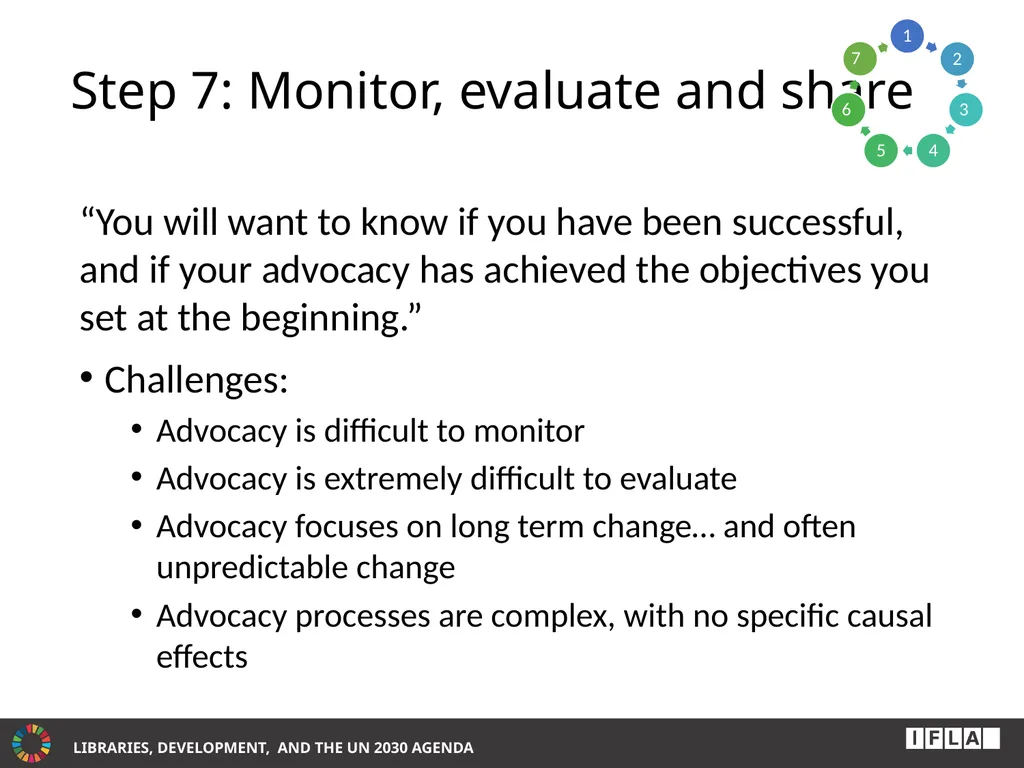
Step 7: Monitor, evaluate and share “You will want to know if you have been successful, and if your advocacy has achieved the objectives you set at the beginning.”
Challenges:
Advocacy is difficult to monitor
Advocacy is extremely difficult to evaluate
Advocacy focuses on long term change… and often unpredictable change
Advocacy processes are complex, with no specific causal effects<br>
Challenges:
Advocacy is difficult to monitor
Advocacy is extremely difficult to evaluate
Advocacy focuses on long term change… and often unpredictable change
Advocacy processes are complex, with no specific causal effects<br>
31
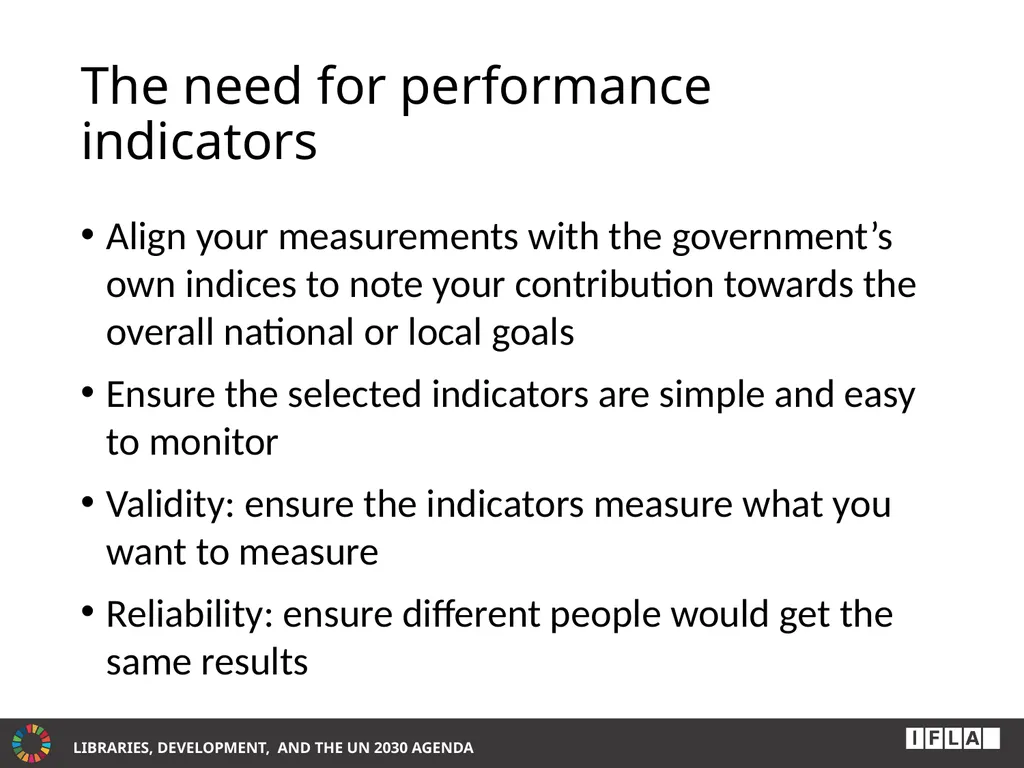
The need for performance indicators Align your measurements with the government’s own indices to note your contribution towards the overall national or local goals
Ensure the selected indicators are simple and easy to monitor
Validity: ensure the indicators measure what you want to measure
Reliability: ensure different people would get the same results<br>
Ensure the selected indicators are simple and easy to monitor
Validity: ensure the indicators measure what you want to measure
Reliability: ensure different people would get the same results<br>
32
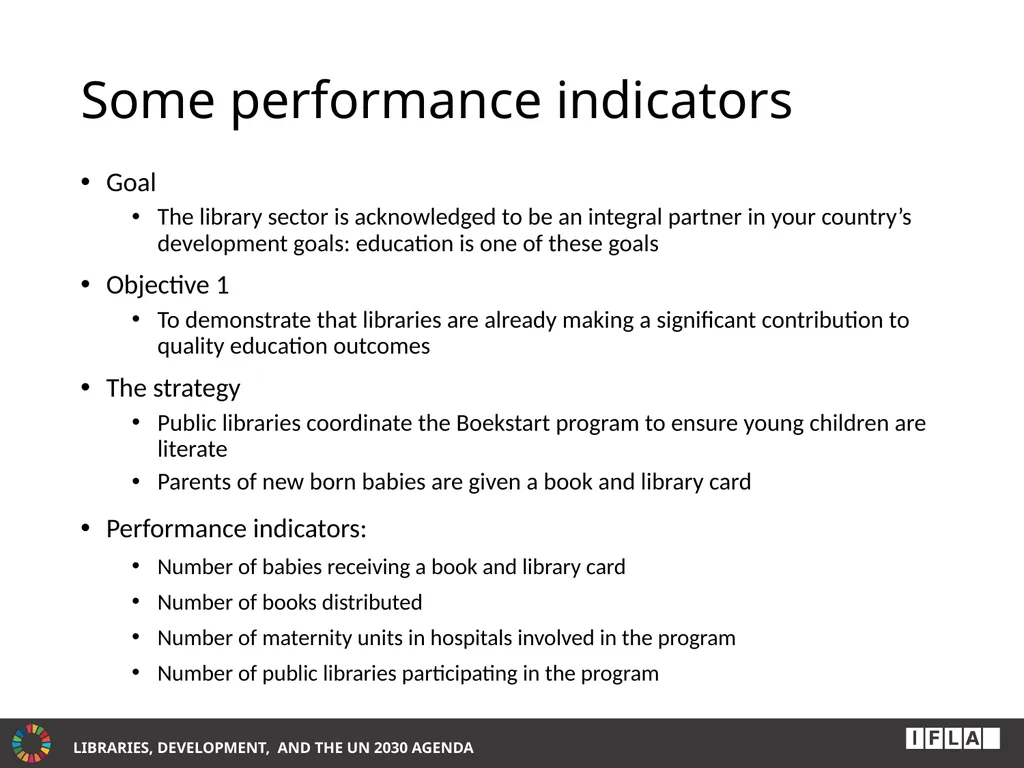
Some performance indicators Goal
The library sector is acknowledged to be an integral partner in your country’s development goals: education is one of these goals
Objective 1
To demonstrate that libraries are already making a significant contribution to quality education outcomes
The strategy
Public libraries coordinate the Boekstart program to ensure young children are literate
Parents of new born babies are given a book and library card
Performance indicators:
Number of babies receiving a book and library card
Number of books distributed
Number of maternity units in hospitals involved in the program
Number of public libraries participating in the program<br>
The library sector is acknowledged to be an integral partner in your country’s development goals: education is one of these goals
Objective 1
To demonstrate that libraries are already making a significant contribution to quality education outcomes
The strategy
Public libraries coordinate the Boekstart program to ensure young children are literate
Parents of new born babies are given a book and library card
Performance indicators:
Number of babies receiving a book and library card
Number of books distributed
Number of maternity units in hospitals involved in the program
Number of public libraries participating in the program<br>
33
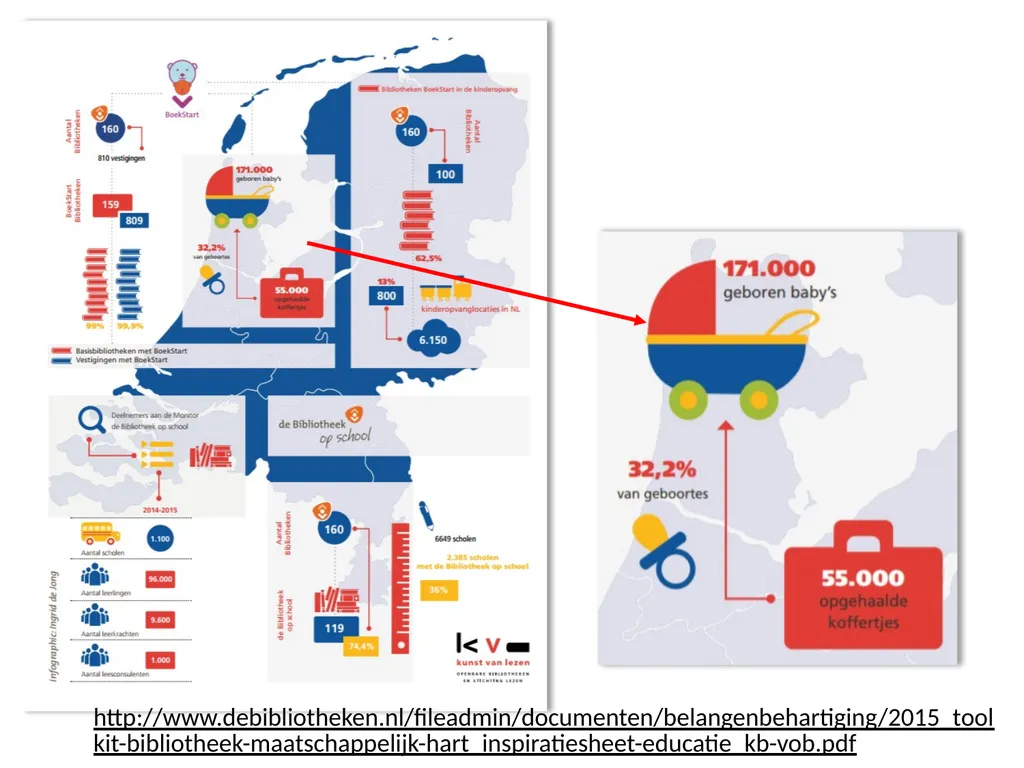
http://www.debibliotheken.nl/fileadmin/documenten/belangenbehartiging/2015_toolkit-bibliotheek-maatschappelijk-hart_inspiratiesheet-educatie_kb-vob.pdf<br>
34
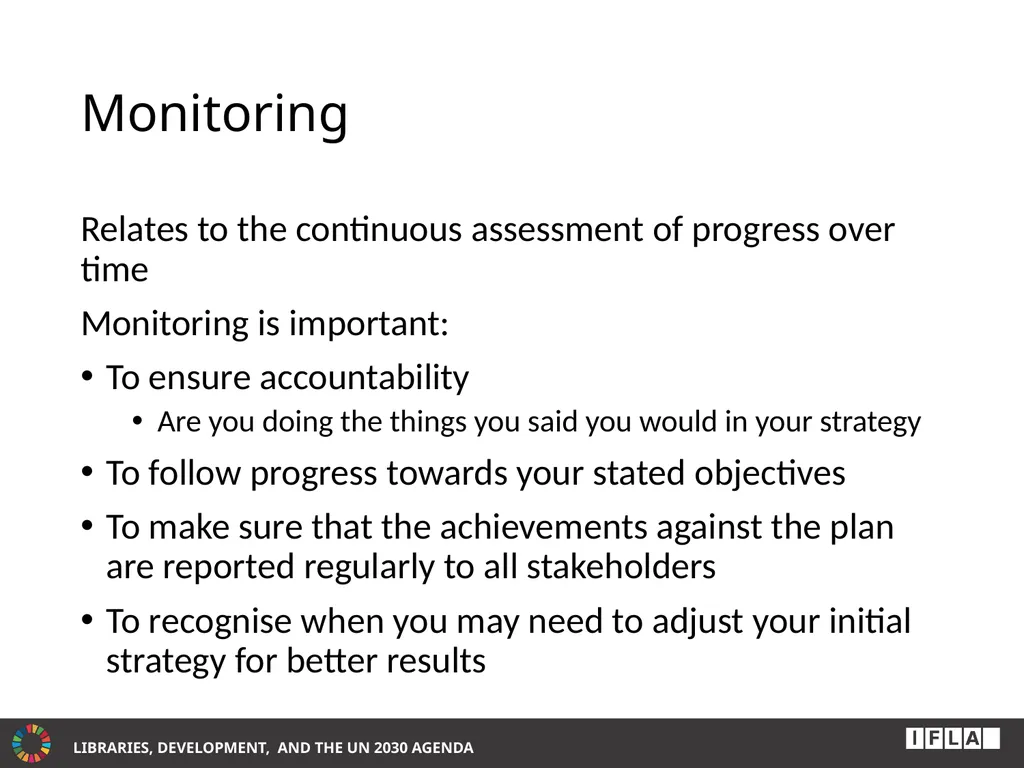
Monitoring Relates to the continuous assessment of progress over time
Monitoring is important:
To ensure accountability
Are you doing the things you said you would in your strategy
To follow progress towards your stated objectives
To make sure that the achievements against the plan are reported regularly to all stakeholders
To recognise when you may need to adjust your initial strategy for better results<br>
Monitoring is important:
To ensure accountability
Are you doing the things you said you would in your strategy
To follow progress towards your stated objectives
To make sure that the achievements against the plan are reported regularly to all stakeholders
To recognise when you may need to adjust your initial strategy for better results<br>
35
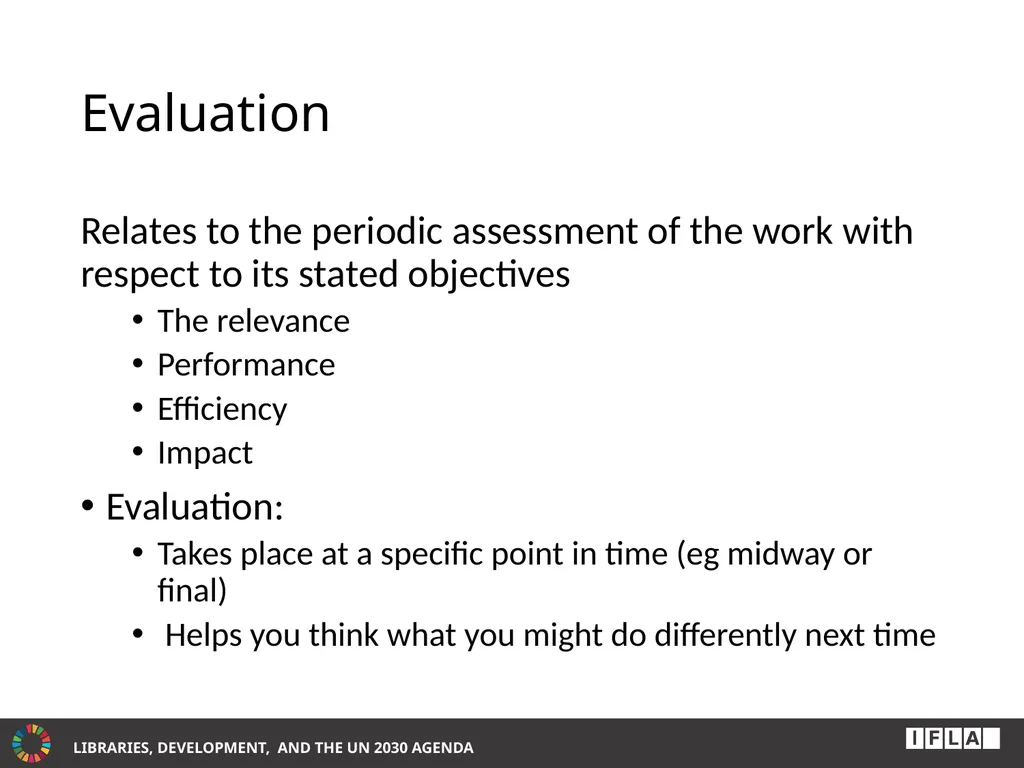
Evaluation Relates to the periodic assessment of the work with respect to its stated objectives
The relevance
Performance
Efficiency
Impact
Evaluation:
Takes place at a specific point in time (eg midway or final)
Helps you think what you might do differently next time<br>
The relevance
Performance
Efficiency
Impact
Evaluation:
Takes place at a specific point in time (eg midway or final)
Helps you think what you might do differently next time<br>
36
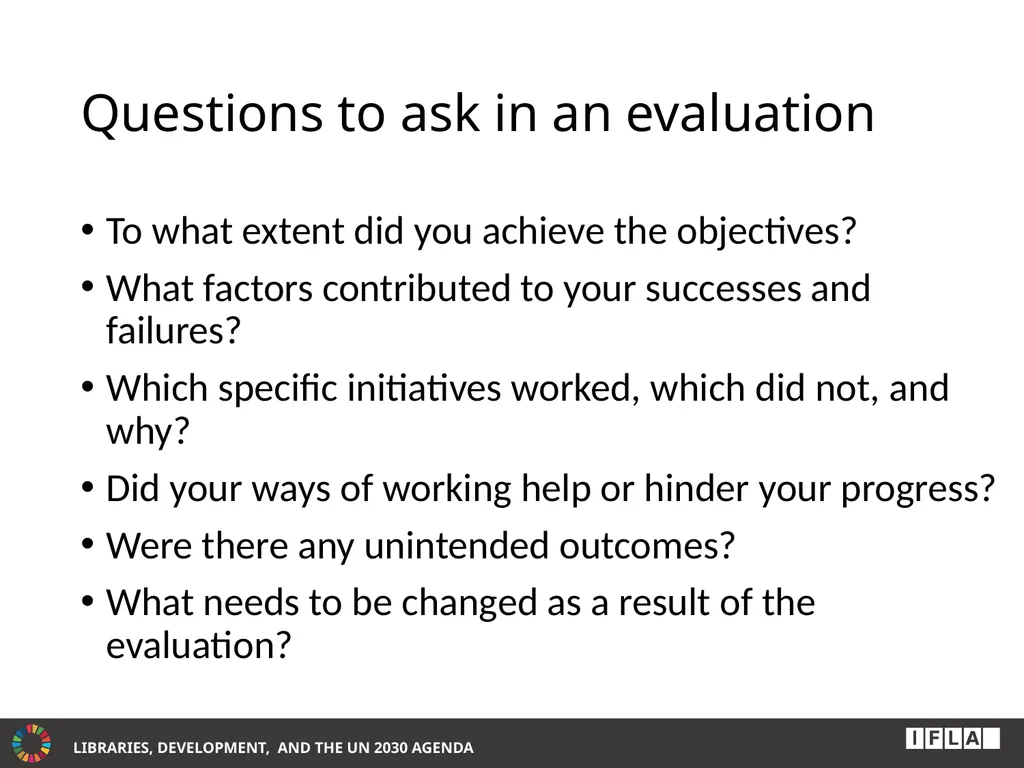
Questions to ask in an evaluation To what extent did you achieve the objectives?
What factors contributed to your successes and failures?
Which specific initiatives worked, which did not, and why?
Did your ways of working help or hinder your progress?
Were there any unintended outcomes?
What needs to be changed as a result of the evaluation?<br>
What factors contributed to your successes and failures?
Which specific initiatives worked, which did not, and why?
Did your ways of working help or hinder your progress?
Were there any unintended outcomes?
What needs to be changed as a result of the evaluation?<br>
37
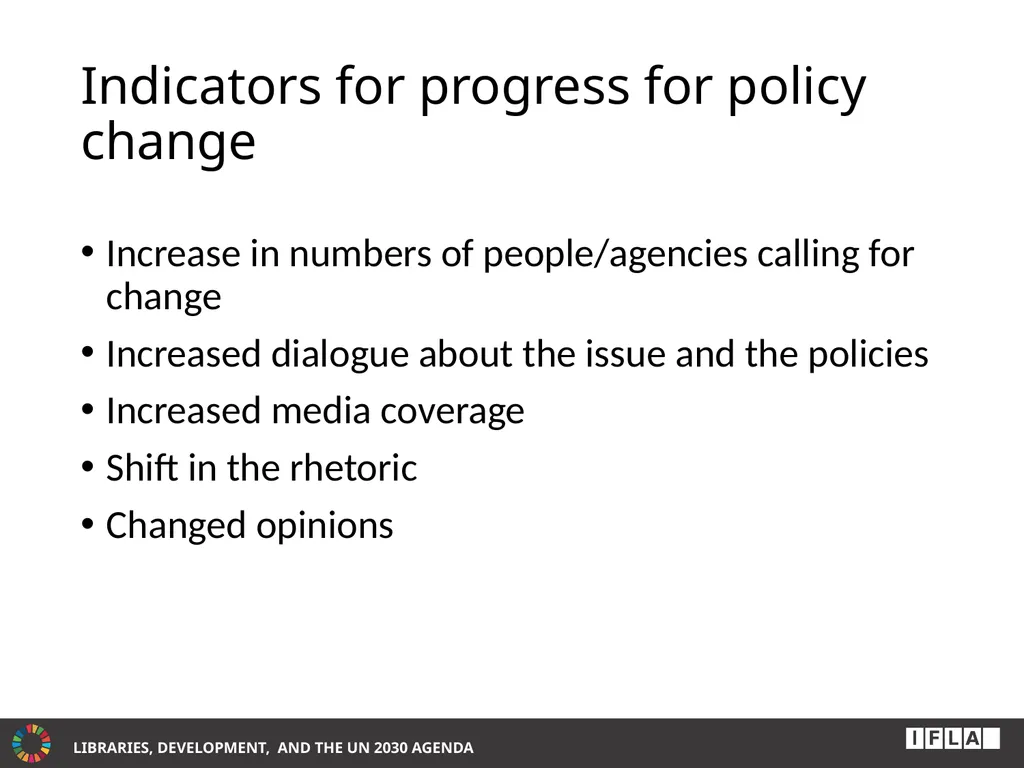
Indicators for progress for policy change Increase in numbers of people/agencies calling for change
Increased dialogue about the issue and the policies
Increased media coverage
Shift in the rhetoric
Changed opinions<br>
Increased dialogue about the issue and the policies
Increased media coverage
Shift in the rhetoric
Changed opinions<br>
38
Indicators for impact of policy change New policies have been introduced
Changes in legislation – and enacted to become law<br>
Changes in legislation – and enacted to become law<br>
39
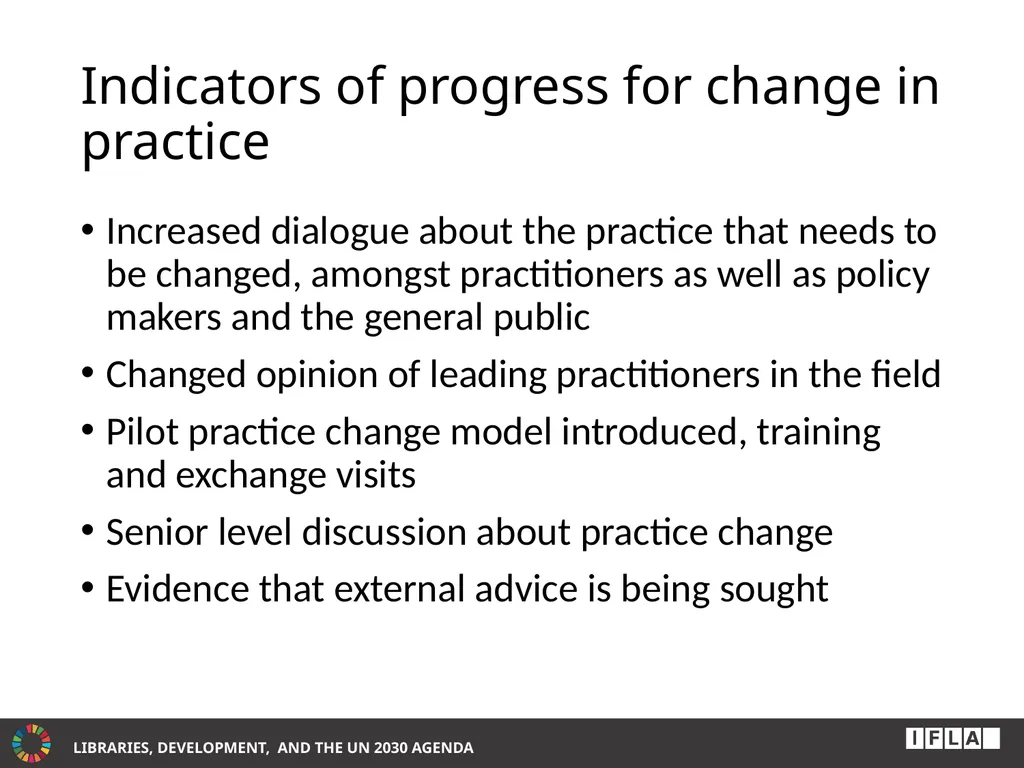
Indicators of progress for change in practice Increased dialogue about the practice that needs to be changed, amongst practitioners as well as policy makers and the general public
Changed opinion of leading practitioners in the field
Pilot practice change model introduced, training and exchange visits
Senior level discussion about practice change
Evidence that external advice is being sought<br>
Changed opinion of leading practitioners in the field
Pilot practice change model introduced, training and exchange visits
Senior level discussion about practice change
Evidence that external advice is being sought<br>
40
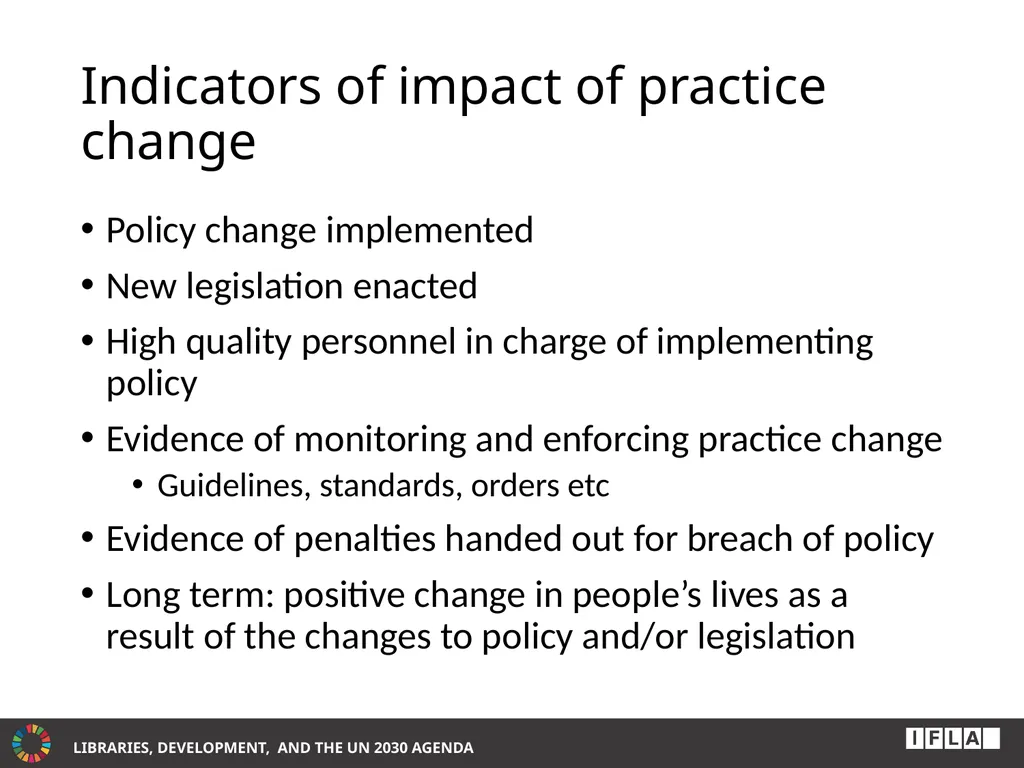
Indicators of impact of practice change Policy change implemented
New legislation enacted
High quality personnel in charge of implementing policy
Evidence of monitoring and enforcing practice change
Guidelines, standards, orders etc
Evidence of penalties handed out for breach of policy
Long term: positive change in people’s lives as a result of the changes to policy and/or legislation<br>
New legislation enacted
High quality personnel in charge of implementing policy
Evidence of monitoring and enforcing practice change
Guidelines, standards, orders etc
Evidence of penalties handed out for breach of policy
Long term: positive change in people’s lives as a result of the changes to policy and/or legislation<br>
41
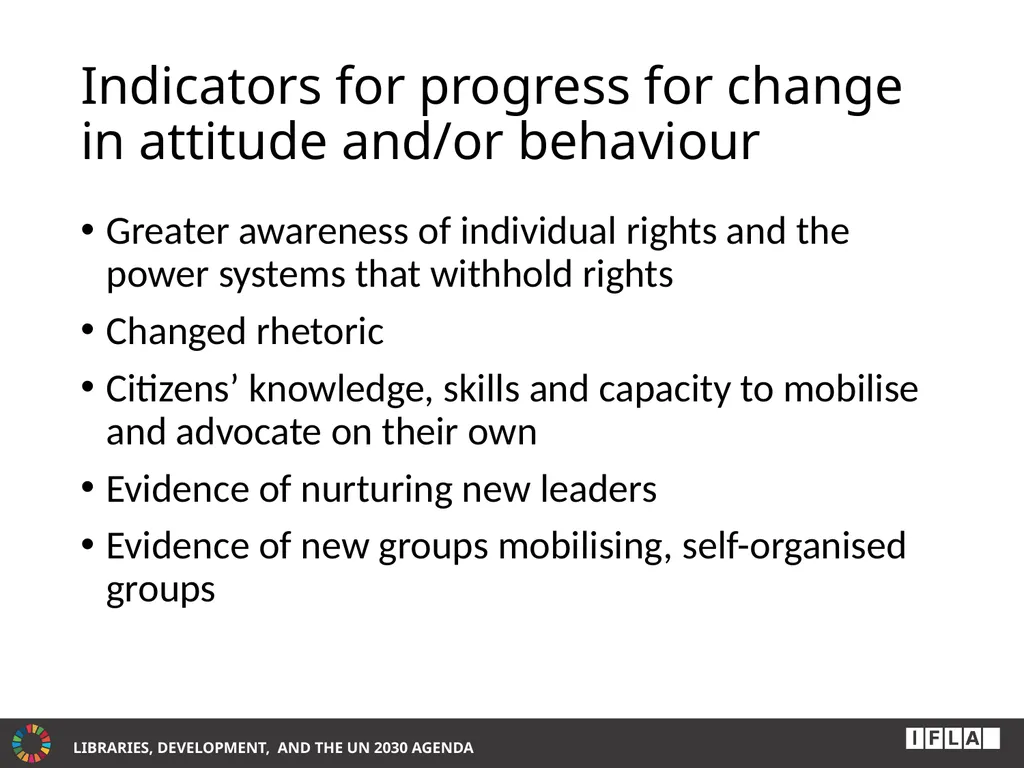
Indicators for progress for change in attitude and/or behaviour Greater awareness of individual rights and the power systems that withhold rights
Changed rhetoric
Citizens’ knowledge, skills and capacity to mobilise and advocate on their own
Evidence of nurturing new leaders
Evidence of new groups mobilising, self-organised groups<br>
Changed rhetoric
Citizens’ knowledge, skills and capacity to mobilise and advocate on their own
Evidence of nurturing new leaders
Evidence of new groups mobilising, self-organised groups<br>
42
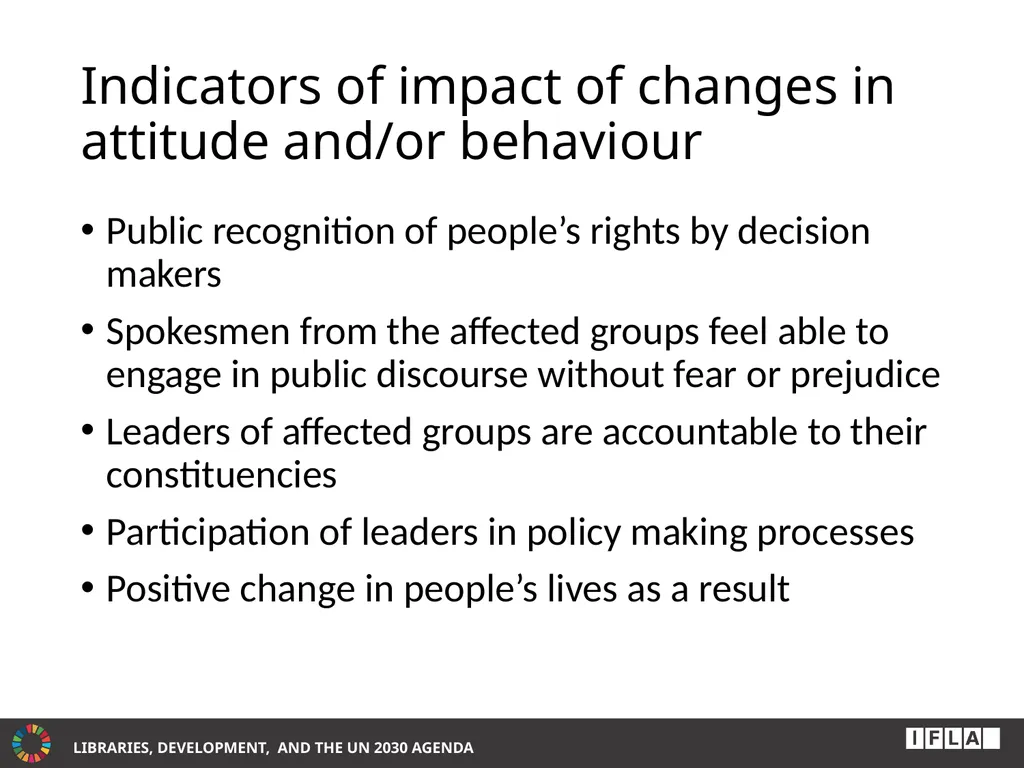
Indicators of impact of changes in attitude and/or behaviour Public recognition of people’s rights by decision makers
Spokesmen from the affected groups feel able to engage in public discourse without fear or prejudice
Leaders of affected groups are accountable to their constituencies
Participation of leaders in policy making processes
Positive change in people’s lives as a result<br>
Spokesmen from the affected groups feel able to engage in public discourse without fear or prejudice
Leaders of affected groups are accountable to their constituencies
Participation of leaders in policy making processes
Positive change in people’s lives as a result<br>
43
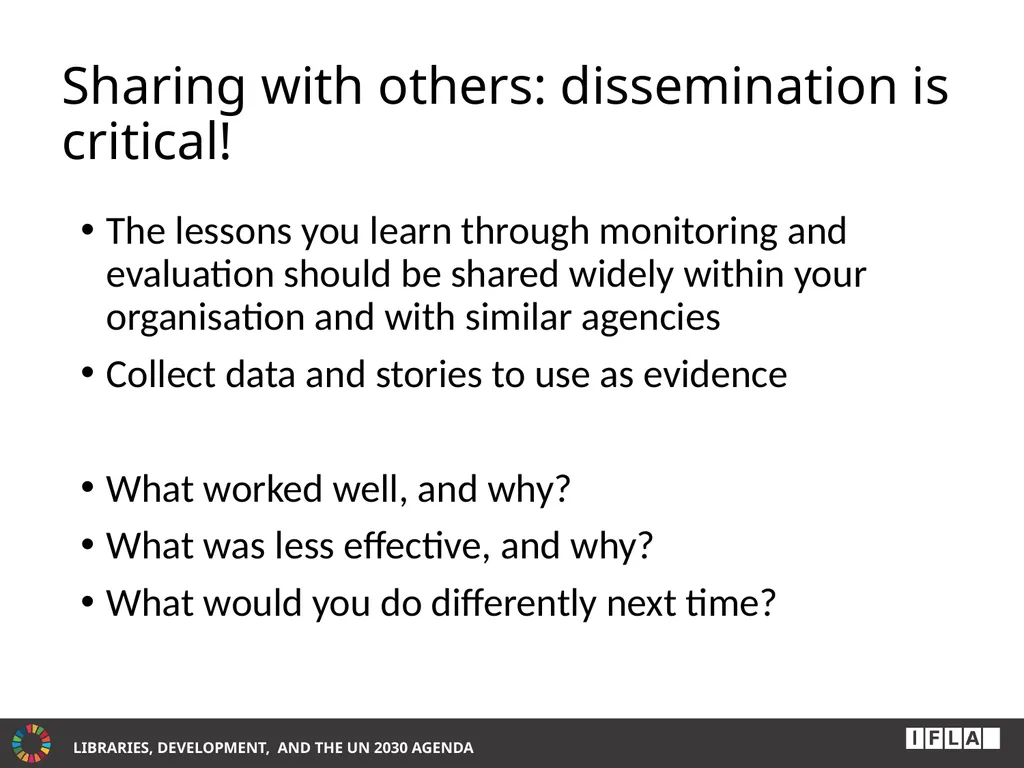
Sharing with others: dissemination is critical! The lessons you learn through monitoring and evaluation should be shared widely within your organisation and with similar agencies
Collect data and stories to use as evidence
What worked well, and why?
What was less effective, and why?
What would you do differently next time?<br>
Collect data and stories to use as evidence
What worked well, and why?
What was less effective, and why?
What would you do differently next time?<br>
44
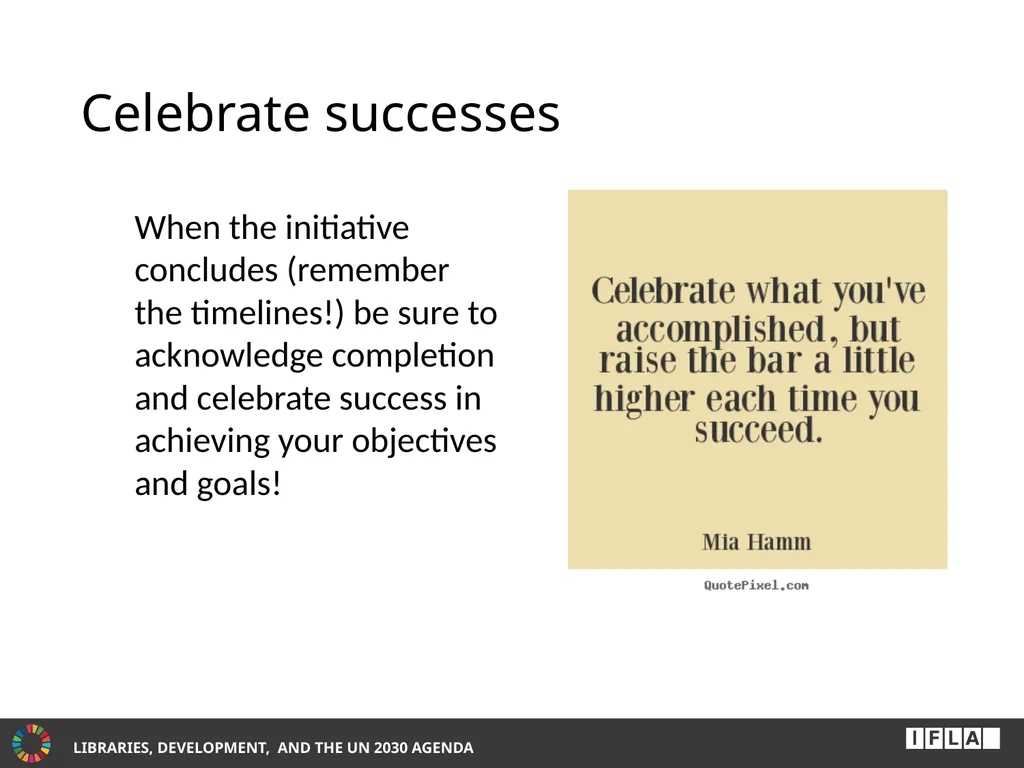
Celebrate successes When the initiative concludes (remember the timelines!) be sure to acknowledge completion and celebrate success in achieving your objectives and goals!<br>
45
As you work on your advocacy plan, you will need to think about many things, which will need to be linked across the different elements of your plan
Stakeholders – who are they?
Who are the decision makers?
What are your objectives, strategies, activities?
How might your strategies vary across stakeholders?
Risks - what are they and how they might be managed?
Budget – what will it cost?
Who will be responsible for the actions?
What are the timelines?
How will we communicate with stakeholders?
How will we evaluate the outcomes? The process to work through 5.3.6 Situational Analysis<br>
Stakeholders – who are they?
Who are the decision makers?
What are your objectives, strategies, activities?
How might your strategies vary across stakeholders?
Risks - what are they and how they might be managed?
Budget – what will it cost?
Who will be responsible for the actions?
What are the timelines?
How will we communicate with stakeholders?
How will we evaluate the outcomes? The process to work through 5.3.6 Situational Analysis<br>
46
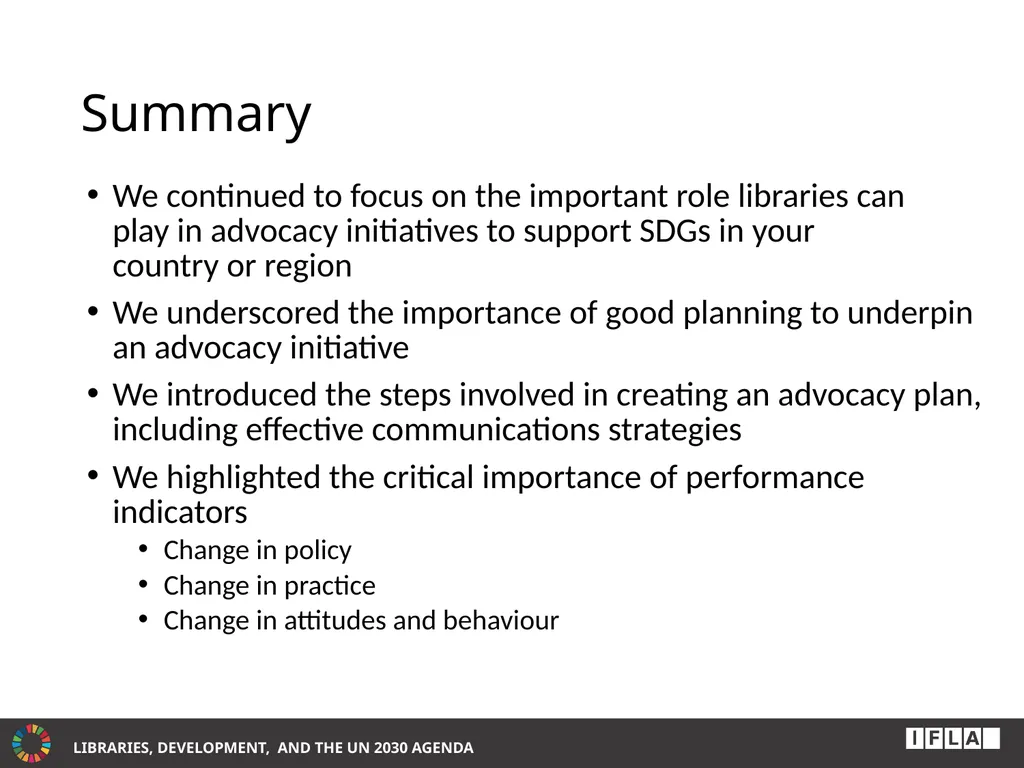
We continued to focus on the important role libraries can
play in advocacy initiatives to support SDGs in your
country or region
We underscored the importance of good planning to underpin an advocacy initiative
We introduced the steps involved in creating an advocacy plan, including effective communications strategies
We highlighted the critical importance of performance indicators
Change in policy
Change in practice
Change in attitudes and behaviour Summary<br>
We underscored the importance of good planning to underpin an advocacy initiative
We introduced the steps involved in creating an advocacy plan, including effective communications strategies
We highlighted the critical importance of performance indicators
Change in policy
Change in practice
Change in attitudes and behaviour Summary<br>
47
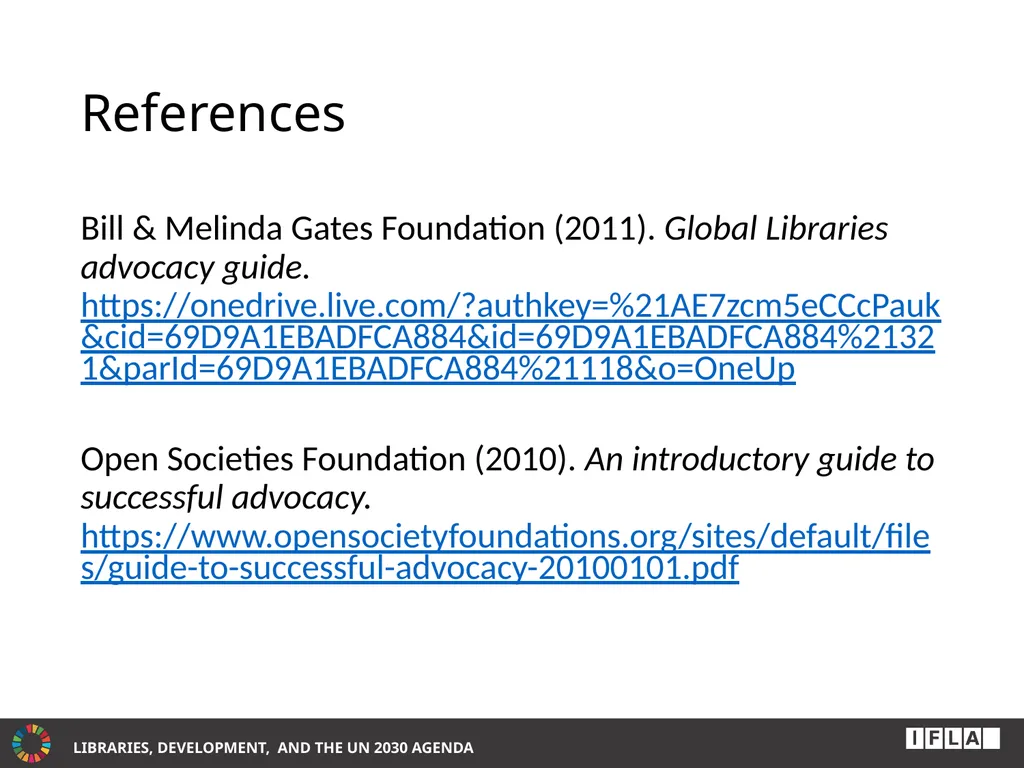
References Bill & Melinda Gates Foundation (2011). Global Libraries advocacy guide.
https://onedrive.live.com/?authkey=%21AE7zcm5eCCcPauk&cid=69D9A1EBADFCA884&id=69D9A1EBADFCA884%21321&parId=69D9A1EBADFCA884%21118&o=OneUp
Open Societies Foundation (2010). An introductory guide to successful advocacy. https://www.opensocietyfoundations.org/sites/default/files/guide-to-successful-advocacy-20100101.pdf<br>
Open Societies Foundation (2010). An introductory guide to successful advocacy. https://www.opensocietyfoundations.org/sites/default/files/guide-to-successful-advocacy-20100101.pdf<br>
48
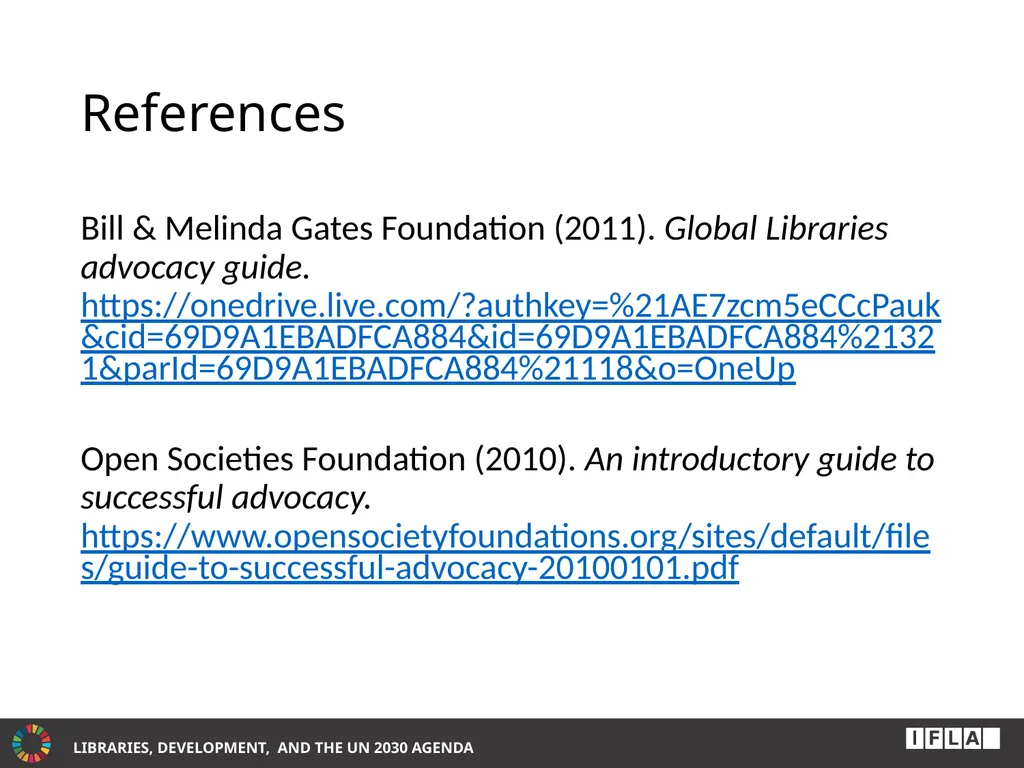
References Bill & Melinda Gates Foundation (2011). Global Libraries advocacy guide.
https://onedrive.live.com/?authkey=%21AE7zcm5eCCcPauk&cid=69D9A1EBADFCA884&id=69D9A1EBADFCA884%21321&parId=69D9A1EBADFCA884%21118&o=OneUp
Open Societies Foundation (2010). An introductory guide to successful advocacy. https://www.opensocietyfoundations.org/sites/default/files/guide-to-successful-advocacy-20100101.pdf<br>
Open Societies Foundation (2010). An introductory guide to successful advocacy. https://www.opensocietyfoundations.org/sites/default/files/guide-to-successful-advocacy-20100101.pdf<br>