
International Business Valuers Association Valuers
LD
Published · 60 slides · 0 views

1 / 1






Description
International Business Valuers Association Valuers Professional Ethics and Standards - CA Avineesh Matta Learning Objectives What Why of us? Role of Professional valuers Entry in profession Remaining Relevant? Competency framework How
Related Topics
Share
Embed code
Download this presentation From Below
"International Business Valuers Association Valuers" is the property of its rightful owner. Permission is granted to download and print the materials on this website for personal, non-commercial use only, and to display it on your personal computer provided you do not modify the materials and that you retain all copyright notices contained in the materials. By downloading content from our website, you accept the terms of this agreement.
Presentation Transcript
01
International Business Valuers Association Valuers – Professional Ethics and Standards
- CA Avineesh Matta<br>
- CA Avineesh Matta<br>
02
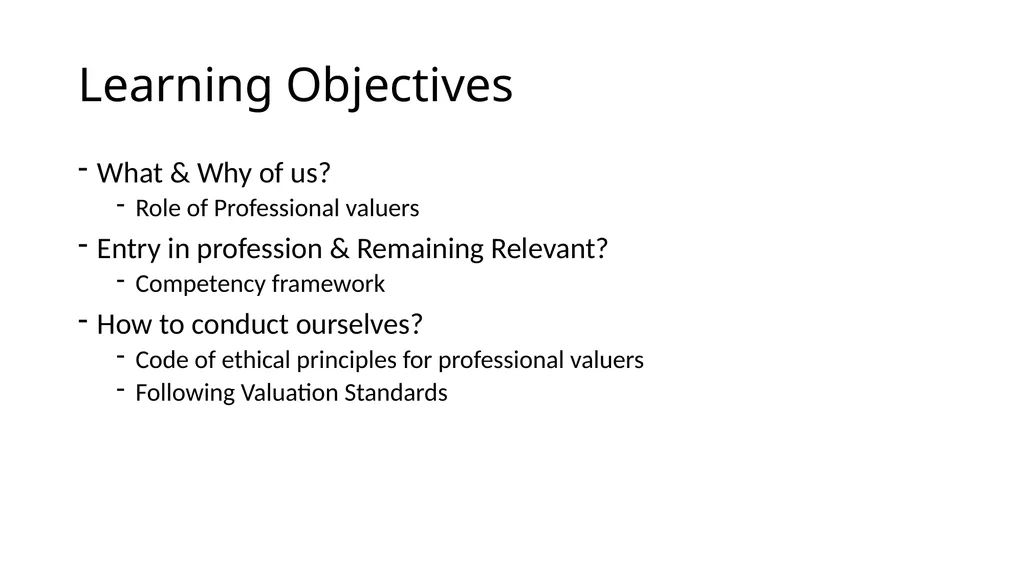
Learning Objectives What & Why of us?
Role of Professional valuers
Entry in profession & Remaining Relevant?
Competency framework
How to conduct ourselves?
Code of ethical principles for professional valuers
Following Valuation Standards<br>
Role of Professional valuers
Entry in profession & Remaining Relevant?
Competency framework
How to conduct ourselves?
Code of ethical principles for professional valuers
Following Valuation Standards<br>
03
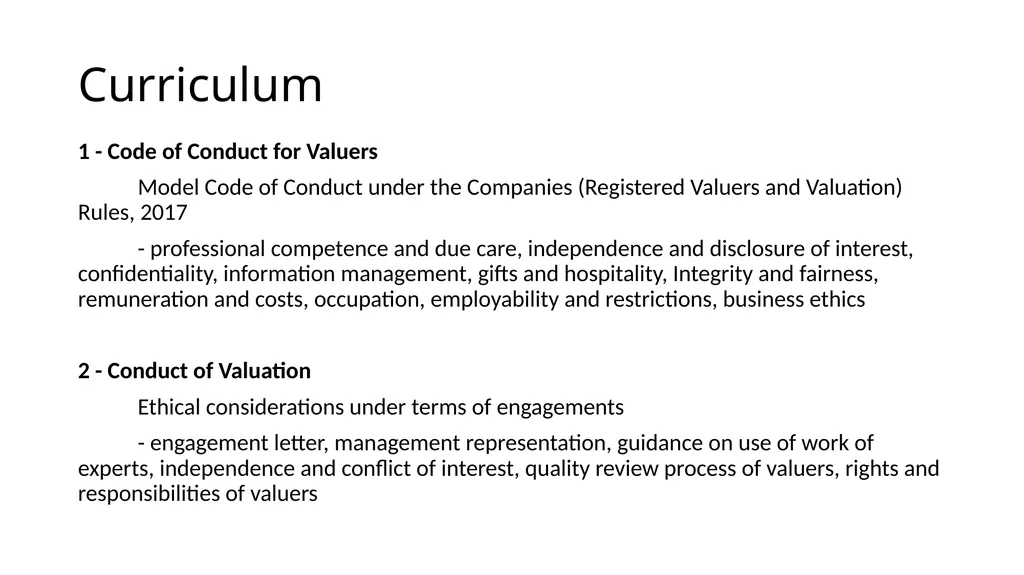
Curriculum 1 - Code of Conduct for Valuers
Model Code of Conduct under the Companies (Registered Valuers and Valuation) Rules, 2017
- professional competence and due care, independence and disclosure of interest, confidentiality, information management, gifts and hospitality, Integrity and fairness, remuneration and costs, occupation, employability and restrictions, business ethics
2 - Conduct of Valuation
Ethical considerations under terms of engagements
- engagement letter, management representation, guidance on use of work of experts, independence and conflict of interest, quality review process of valuers, rights and responsibilities of valuers<br>
Model Code of Conduct under the Companies (Registered Valuers and Valuation) Rules, 2017
- professional competence and due care, independence and disclosure of interest, confidentiality, information management, gifts and hospitality, Integrity and fairness, remuneration and costs, occupation, employability and restrictions, business ethics
2 - Conduct of Valuation
Ethical considerations under terms of engagements
- engagement letter, management representation, guidance on use of work of experts, independence and conflict of interest, quality review process of valuers, rights and responsibilities of valuers<br>
04
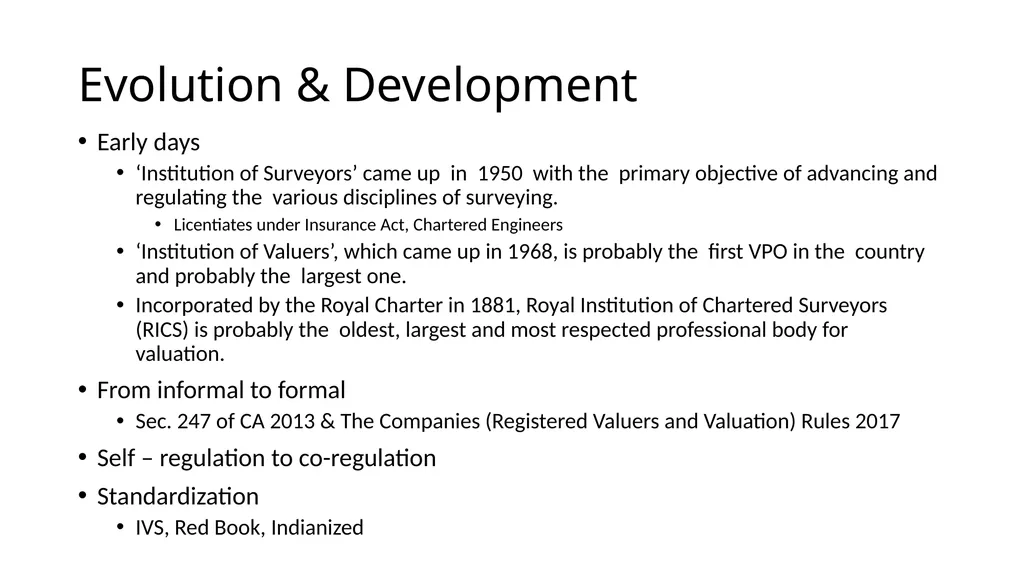
Evolution & Development Early days
‘Institution of Surveyors’ came up in 1950 with the primary objective of advancing and regulating the various disciplines of surveying.
Licentiates under Insurance Act, Chartered Engineers
‘Institution of Valuers’, which came up in 1968, is probably the first VPO in the country and probably the largest one.
Incorporated by the Royal Charter in 1881, Royal Institution of Chartered Surveyors (RICS) is probably the oldest, largest and most respected professional body for valuation.
From informal to formal
Sec. 247 of CA 2013 & The Companies (Registered Valuers and Valuation) Rules 2017
Self – regulation to co-regulation
Standardization
IVS, Red Book, Indianized<br>
‘Institution of Surveyors’ came up in 1950 with the primary objective of advancing and regulating the various disciplines of surveying.
Licentiates under Insurance Act, Chartered Engineers
‘Institution of Valuers’, which came up in 1968, is probably the first VPO in the country and probably the largest one.
Incorporated by the Royal Charter in 1881, Royal Institution of Chartered Surveyors (RICS) is probably the oldest, largest and most respected professional body for valuation.
From informal to formal
Sec. 247 of CA 2013 & The Companies (Registered Valuers and Valuation) Rules 2017
Self – regulation to co-regulation
Standardization
IVS, Red Book, Indianized<br>
05
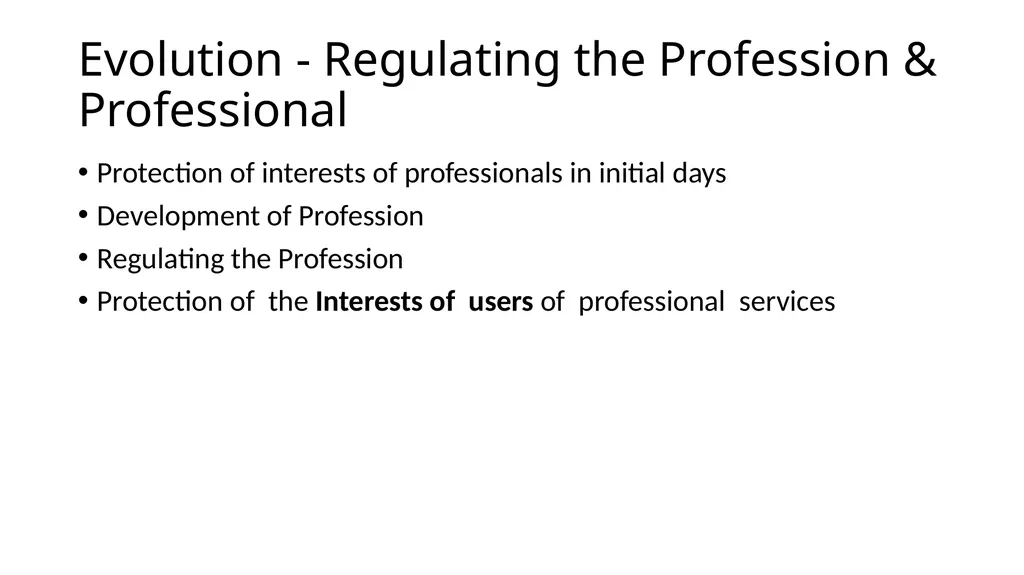
Evolution - Regulating the Profession & Professional Protection of interests of professionals in initial days
Development of Profession
Regulating the Profession
Protection of the Interests of users of professional services<br>
Development of Profession
Regulating the Profession
Protection of the Interests of users of professional services<br>
06
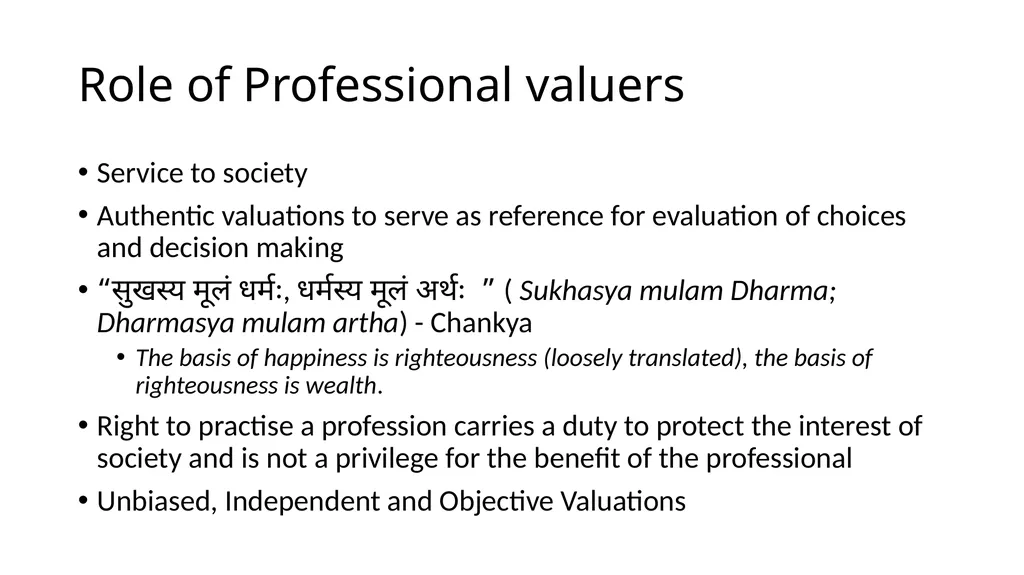
Role of Professional valuers Service to society
Authentic valuations to serve as reference for evaluation of choices and decision making
“सुखस्य मूलं धर्मः, धर्मस्य मूलं अर्थः ” ( Sukhasya mulam Dharma; Dharmasya mulam artha) - Chankya
The basis of happiness is righteousness (loosely translated), the basis of righteousness is wealth.
Right to practise a profession carries a duty to protect the interest of society and is not a privilege for the benefit of the professional
Unbiased, Independent and Objective Valuations<br>
Authentic valuations to serve as reference for evaluation of choices and decision making
“सुखस्य मूलं धर्मः, धर्मस्य मूलं अर्थः ” ( Sukhasya mulam Dharma; Dharmasya mulam artha) - Chankya
The basis of happiness is righteousness (loosely translated), the basis of righteousness is wealth.
Right to practise a profession carries a duty to protect the interest of society and is not a privilege for the benefit of the professional
Unbiased, Independent and Objective Valuations<br>
07
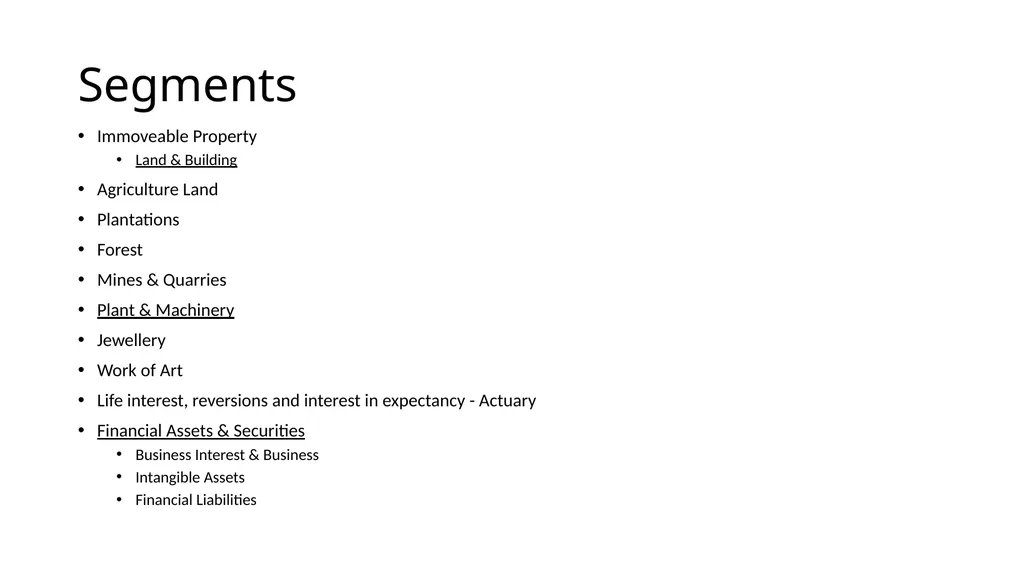
Segments Immoveable Property
Land & Building
Agriculture Land
Plantations
Forest
Mines & Quarries
Plant & Machinery
Jewellery
Work of Art
Life interest, reversions and interest in expectancy - Actuary
Financial Assets & Securities
Business Interest & Business
Intangible Assets
Financial Liabilities<br>
Land & Building
Agriculture Land
Plantations
Forest
Mines & Quarries
Plant & Machinery
Jewellery
Work of Art
Life interest, reversions and interest in expectancy - Actuary
Financial Assets & Securities
Business Interest & Business
Intangible Assets
Financial Liabilities<br>
08
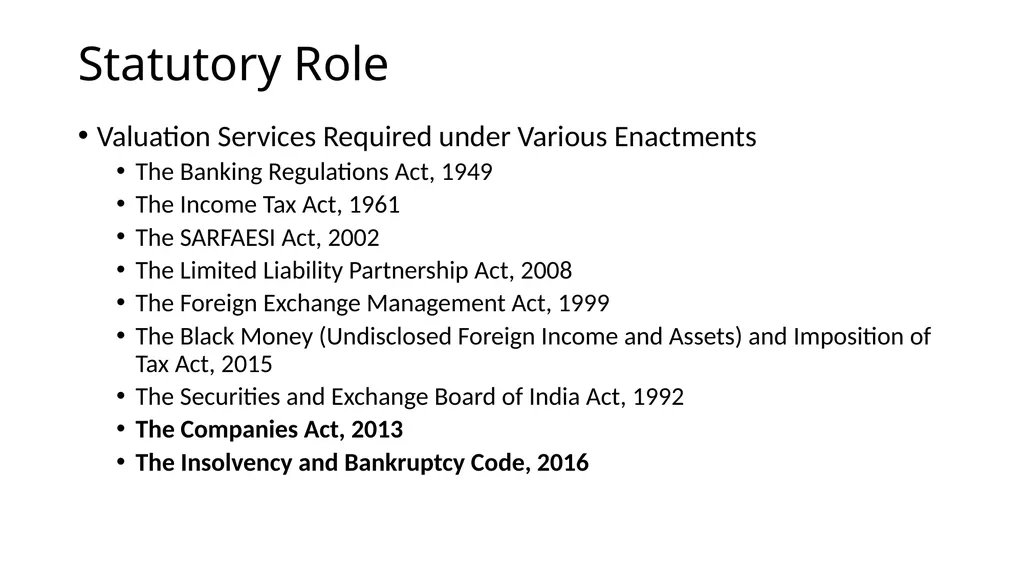
Statutory Role Valuation Services Required under Various Enactments
The Banking Regulations Act, 1949
The Income Tax Act, 1961
The SARFAESI Act, 2002
The Limited Liability Partnership Act, 2008
The Foreign Exchange Management Act, 1999
The Black Money (Undisclosed Foreign Income and Assets) and Imposition of Tax Act, 2015
The Securities and Exchange Board of India Act, 1992
The Companies Act, 2013
The Insolvency and Bankruptcy Code, 2016<br>
The Banking Regulations Act, 1949
The Income Tax Act, 1961
The SARFAESI Act, 2002
The Limited Liability Partnership Act, 2008
The Foreign Exchange Management Act, 1999
The Black Money (Undisclosed Foreign Income and Assets) and Imposition of Tax Act, 2015
The Securities and Exchange Board of India Act, 1992
The Companies Act, 2013
The Insolvency and Bankruptcy Code, 2016<br>
09
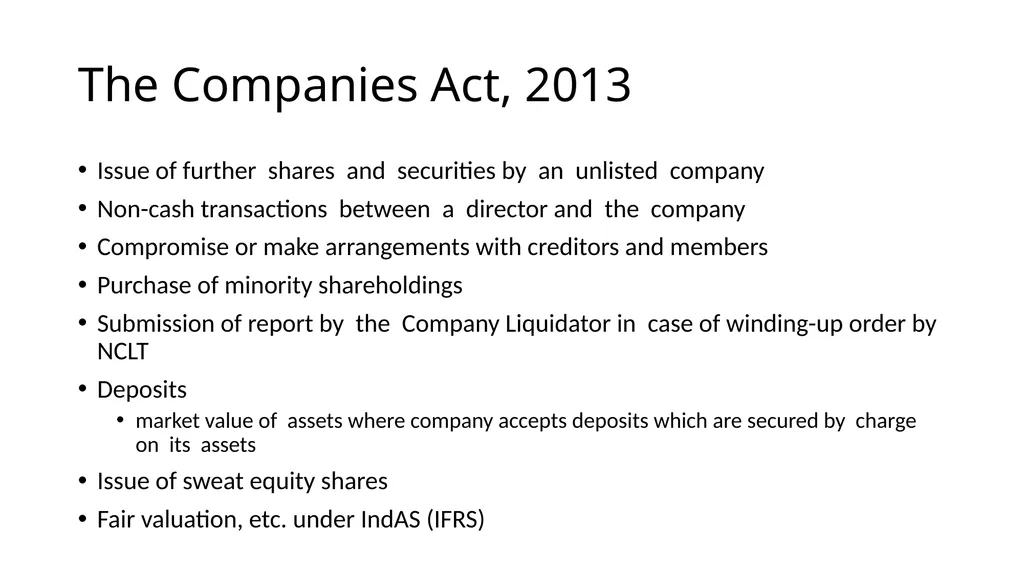
The Companies Act, 2013 Issue of further shares and securities by an unlisted company
Non-cash transactions between a director and the company
Compromise or make arrangements with creditors and members
Purchase of minority shareholdings
Submission of report by the Company Liquidator in case of winding-up order by NCLT
Deposits
market value of assets where company accepts deposits which are secured by charge on its assets
Issue of sweat equity shares
Fair valuation, etc. under IndAS (IFRS)<br>
Non-cash transactions between a director and the company
Compromise or make arrangements with creditors and members
Purchase of minority shareholdings
Submission of report by the Company Liquidator in case of winding-up order by NCLT
Deposits
market value of assets where company accepts deposits which are secured by charge on its assets
Issue of sweat equity shares
Fair valuation, etc. under IndAS (IFRS)<br>
10
The Insolvency and Bankruptcy Code, 2016 Corporate Insolvency Resolution Process of a corporate debtor, and
Fast Track Insolvency Resolution Process
determination of fair value and liquidation value
Liquidation of Corporate Person
Liquidation value
Voluntary liquidation of corporate persons
Directors solvency declaration to accompany valuation report
Avoidance Transactions
Adjudicating Authority may seek valuers report
IBBI registered valuers for specific class to provide valuation<br>
Fast Track Insolvency Resolution Process
determination of fair value and liquidation value
Liquidation of Corporate Person
Liquidation value
Voluntary liquidation of corporate persons
Directors solvency declaration to accompany valuation report
Avoidance Transactions
Adjudicating Authority may seek valuers report
IBBI registered valuers for specific class to provide valuation<br>
11
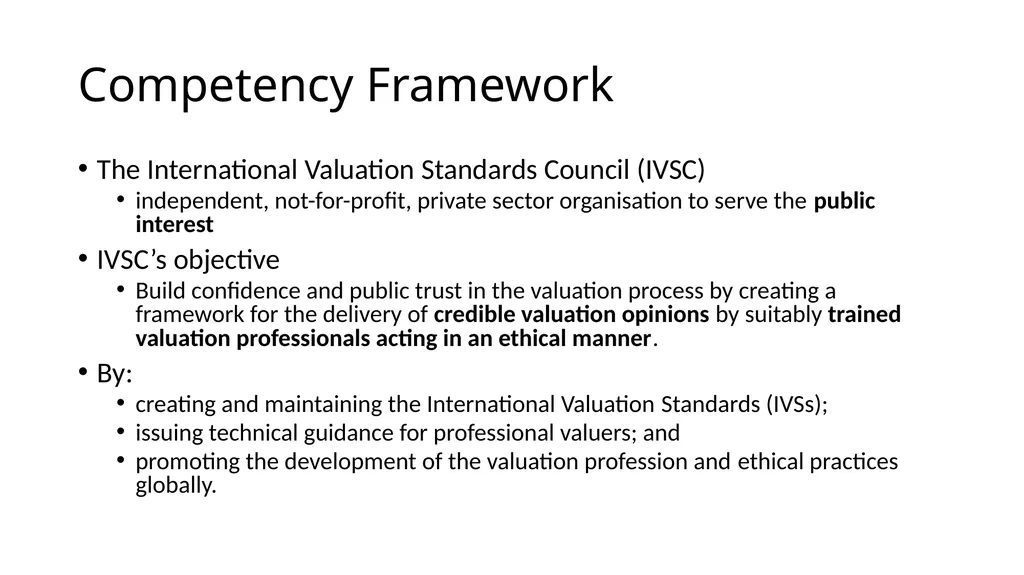
Competency Framework The International Valuation Standards Council (IVSC)
independent, not-for-profit, private sector organisation to serve the public interest
IVSC’s objective
Build confidence and public trust in the valuation process by creating a framework for the delivery of credible valuation opinions by suitably trained valuation professionals acting in an ethical manner.
By:
creating and maintaining the International Valuation Standards (IVSs);
issuing technical guidance for professional valuers; and
promoting the development of the valuation profession and ethical practices globally.<br>
independent, not-for-profit, private sector organisation to serve the public interest
IVSC’s objective
Build confidence and public trust in the valuation process by creating a framework for the delivery of credible valuation opinions by suitably trained valuation professionals acting in an ethical manner.
By:
creating and maintaining the International Valuation Standards (IVSs);
issuing technical guidance for professional valuers; and
promoting the development of the valuation profession and ethical practices globally.<br>
12
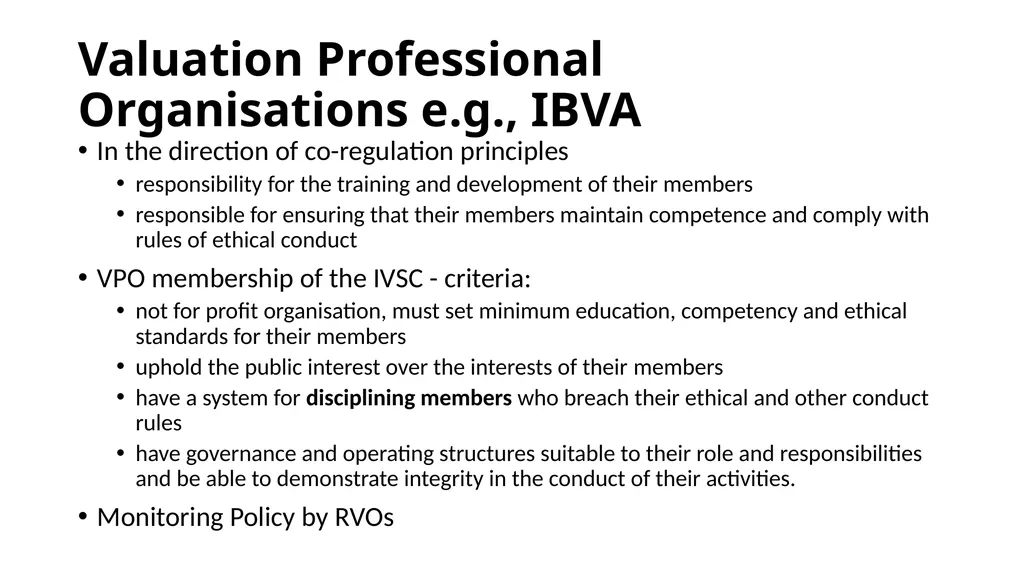
Valuation Professional Organisations e.g., IBVA In the direction of co-regulation principles
responsibility for the training and development of their members
responsible for ensuring that their members maintain competence and comply with rules of ethical conduct
VPO membership of the IVSC - criteria:
not for profit organisation, must set minimum education, competency and ethical standards for their members
uphold the public interest over the interests of their members
have a system for disciplining members who breach their ethical and other conduct rules
have governance and operating structures suitable to their role and responsibilities and be able to demonstrate integrity in the conduct of their activities.
Monitoring Policy by RVOs<br>
responsibility for the training and development of their members
responsible for ensuring that their members maintain competence and comply with rules of ethical conduct
VPO membership of the IVSC - criteria:
not for profit organisation, must set minimum education, competency and ethical standards for their members
uphold the public interest over the interests of their members
have a system for disciplining members who breach their ethical and other conduct rules
have governance and operating structures suitable to their role and responsibilities and be able to demonstrate integrity in the conduct of their activities.
Monitoring Policy by RVOs<br>
13
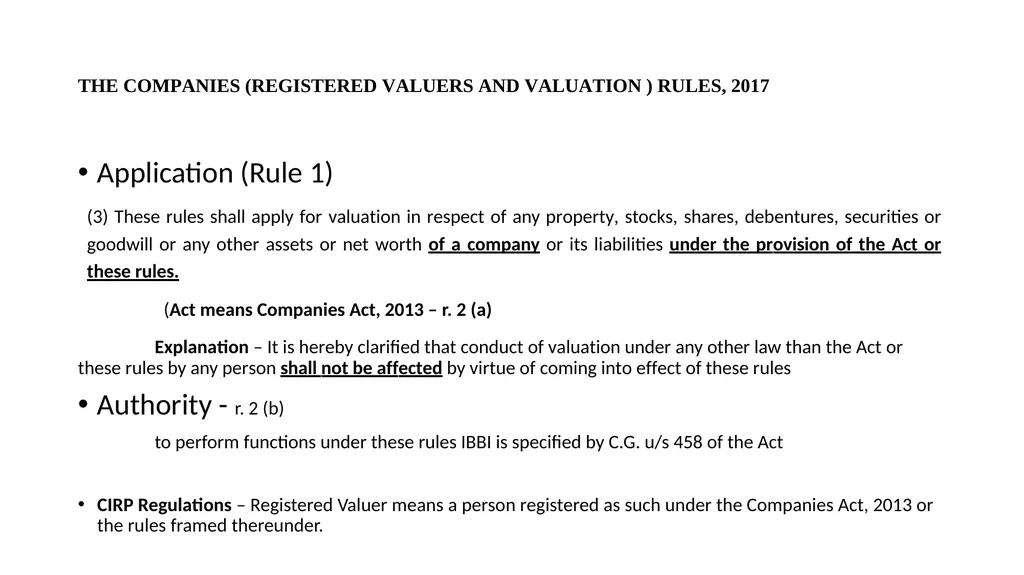
THE COMPANIES (REGISTERED VALUERS AND VALUATION ) RULES, 2017 Application (Rule 1)
(3) These rules shall apply for valuation in respect of any property, stocks, shares, debentures, securities or goodwill or any other assets or net worth of a company or its liabilities under the provision of the Act or these rules.
(Act means Companies Act, 2013 – r. 2 (a)
Explanation – It is hereby clarified that conduct of valuation under any other law than the Act or these rules by any person shall not be affected by virtue of coming into effect of these rules
Authority - r. 2 (b)
to perform functions under these rules IBBI is specified by C.G. u/s 458 of the Act
CIRP Regulations – Registered Valuer means a person registered as such under the Companies Act, 2013 or the rules framed thereunder.<br>
(3) These rules shall apply for valuation in respect of any property, stocks, shares, debentures, securities or goodwill or any other assets or net worth of a company or its liabilities under the provision of the Act or these rules.
(Act means Companies Act, 2013 – r. 2 (a)
Explanation – It is hereby clarified that conduct of valuation under any other law than the Act or these rules by any person shall not be affected by virtue of coming into effect of these rules
Authority - r. 2 (b)
to perform functions under these rules IBBI is specified by C.G. u/s 458 of the Act
CIRP Regulations – Registered Valuer means a person registered as such under the Companies Act, 2013 or the rules framed thereunder.<br>
14
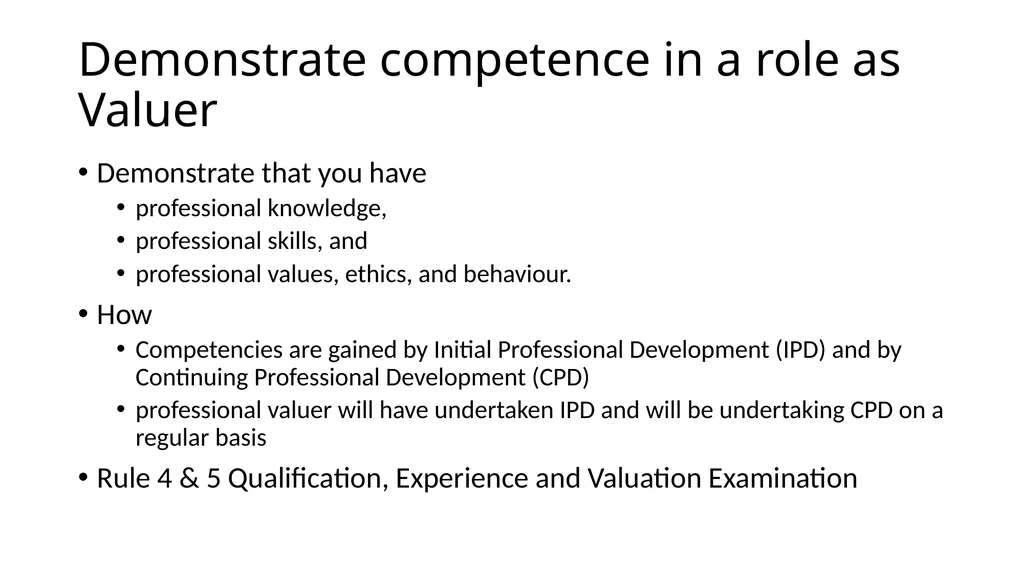
Demonstrate competence in a role as Valuer Demonstrate that you have
professional knowledge,
professional skills, and
professional values, ethics, and behaviour.
How
Competencies are gained by Initial Professional Development (IPD) and by Continuing Professional Development (CPD)
professional valuer will have undertaken IPD and will be undertaking CPD on a regular basis
Rule 4 & 5 Qualification, Experience and Valuation Examination<br>
professional knowledge,
professional skills, and
professional values, ethics, and behaviour.
How
Competencies are gained by Initial Professional Development (IPD) and by Continuing Professional Development (CPD)
professional valuer will have undertaken IPD and will be undertaking CPD on a regular basis
Rule 4 & 5 Qualification, Experience and Valuation Examination<br>
15
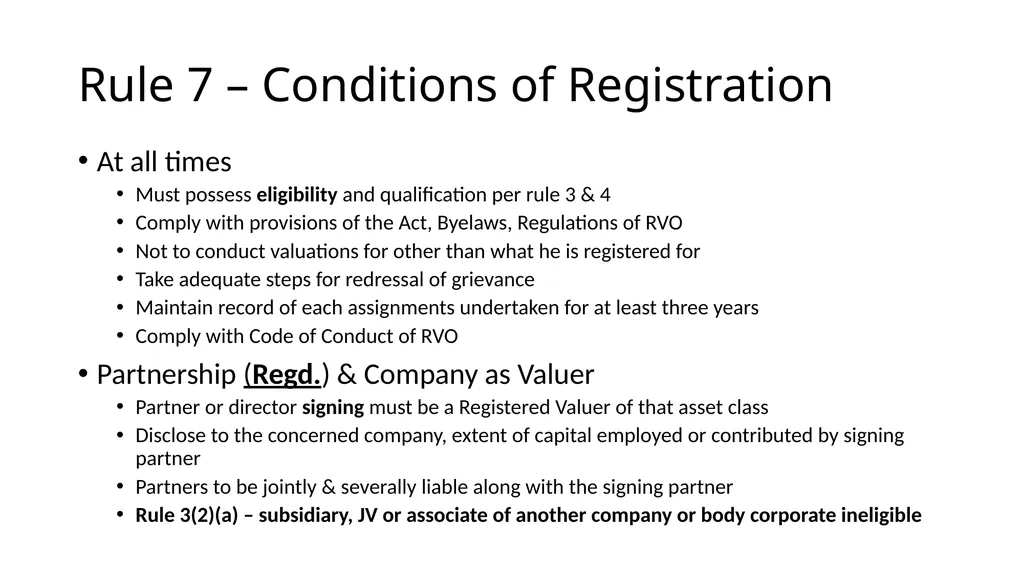
Rule 7 – Conditions of Registration At all times
Must possess eligibility and qualification per rule 3 & 4
Comply with provisions of the Act, Byelaws, Regulations of RVO
Not to conduct valuations for other than what he is registered for
Take adequate steps for redressal of grievance
Maintain record of each assignments undertaken for at least three years
Comply with Code of Conduct of RVO
Partnership (Regd.) & Company as Valuer
Partner or director signing must be a Registered Valuer of that asset class
Disclose to the concerned company, extent of capital employed or contributed by signing partner
Partners to be jointly & severally liable along with the signing partner
Rule 3(2)(a) – subsidiary, JV or associate of another company or body corporate ineligible<br>
Must possess eligibility and qualification per rule 3 & 4
Comply with provisions of the Act, Byelaws, Regulations of RVO
Not to conduct valuations for other than what he is registered for
Take adequate steps for redressal of grievance
Maintain record of each assignments undertaken for at least three years
Comply with Code of Conduct of RVO
Partnership (Regd.) & Company as Valuer
Partner or director signing must be a Registered Valuer of that asset class
Disclose to the concerned company, extent of capital employed or contributed by signing partner
Partners to be jointly & severally liable along with the signing partner
Rule 3(2)(a) – subsidiary, JV or associate of another company or body corporate ineligible<br>
16
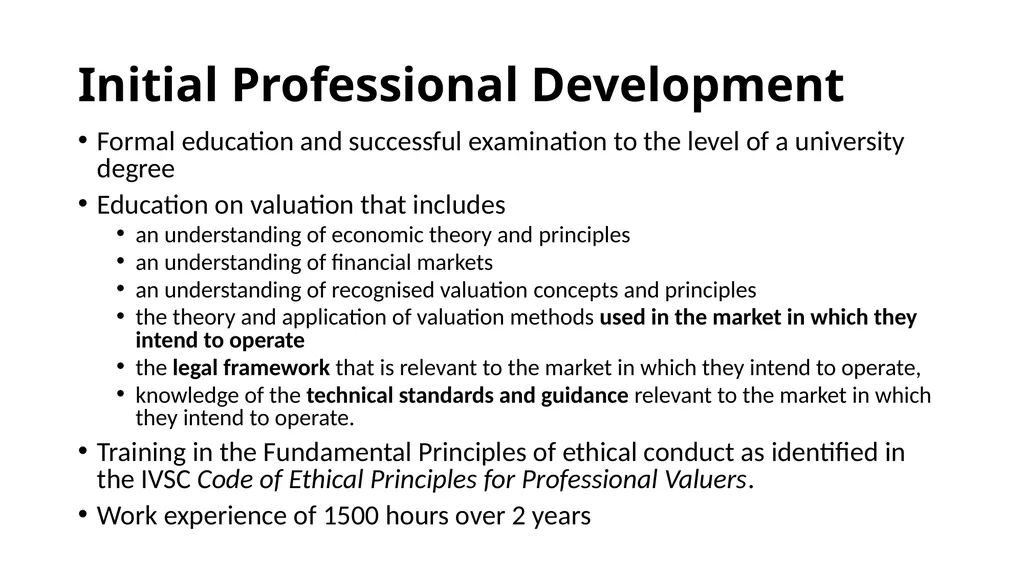
Initial Professional Development Formal education and successful examination to the level of a university degree
Education on valuation that includes
an understanding of economic theory and principles
an understanding of financial markets
an understanding of recognised valuation concepts and principles
the theory and application of valuation methods used in the market in which they intend to operate
the legal framework that is relevant to the market in which they intend to operate,
knowledge of the technical standards and guidance relevant to the market in which they intend to operate.
Training in the Fundamental Principles of ethical conduct as identified in the IVSC Code of Ethical Principles for Professional Valuers.
Work experience of 1500 hours over 2 years<br>
Education on valuation that includes
an understanding of economic theory and principles
an understanding of financial markets
an understanding of recognised valuation concepts and principles
the theory and application of valuation methods used in the market in which they intend to operate
the legal framework that is relevant to the market in which they intend to operate,
knowledge of the technical standards and guidance relevant to the market in which they intend to operate.
Training in the Fundamental Principles of ethical conduct as identified in the IVSC Code of Ethical Principles for Professional Valuers.
Work experience of 1500 hours over 2 years<br>
17
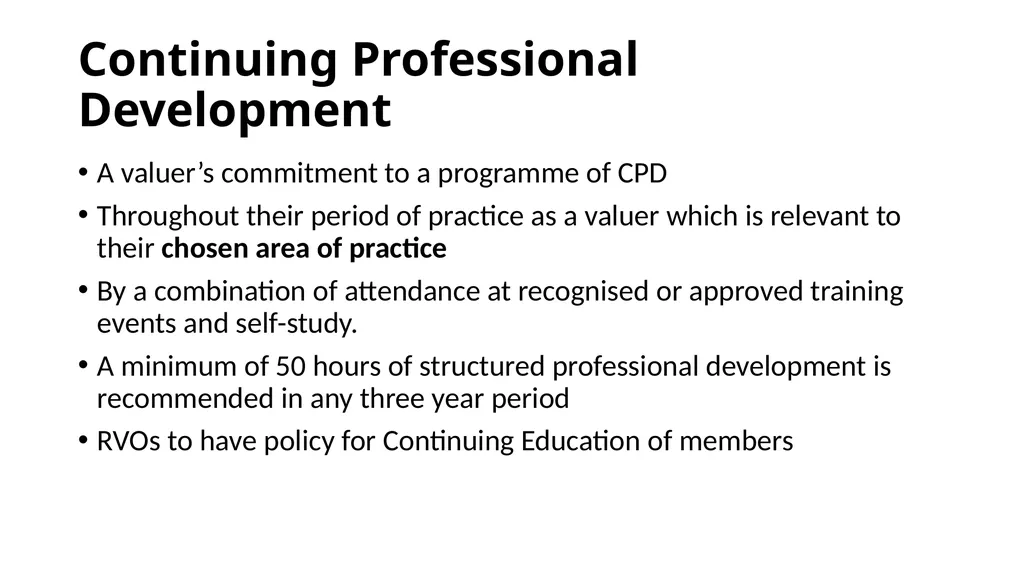
Continuing Professional Development A valuer’s commitment to a programme of CPD
Throughout their period of practice as a valuer which is relevant to their chosen area of practice
By a combination of attendance at recognised or approved training events and self-study.
A minimum of 50 hours of structured professional development is recommended in any three year period
RVOs to have policy for Continuing Education of members<br>
Throughout their period of practice as a valuer which is relevant to their chosen area of practice
By a combination of attendance at recognised or approved training events and self-study.
A minimum of 50 hours of structured professional development is recommended in any three year period
RVOs to have policy for Continuing Education of members<br>
18
Gandhi on Entrepreneurial Ethics Truthfulness in conduct of business is reflective of image of the Nation.
Seven Social Sins:
Politics without Principles
Wealth without Work
Commerce without Morality
Knowledge without Character
Pleasure without Conscience
Science without Humanity
Worship without Sacrifice
Everything finally belongs to the Society
Social Contract<br>
Seven Social Sins:
Politics without Principles
Wealth without Work
Commerce without Morality
Knowledge without Character
Pleasure without Conscience
Science without Humanity
Worship without Sacrifice
Everything finally belongs to the Society
Social Contract<br>
19
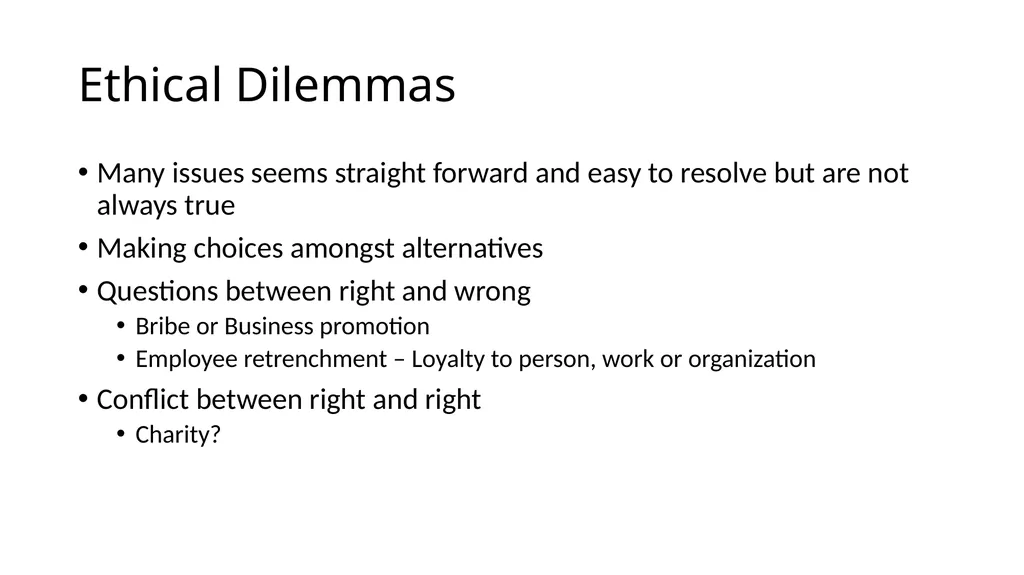
Ethical Dilemmas Many issues seems straight forward and easy to resolve but are not always true
Making choices amongst alternatives
Questions between right and wrong
Bribe or Business promotion
Employee retrenchment – Loyalty to person, work or organization
Conflict between right and right
Charity?<br>
Making choices amongst alternatives
Questions between right and wrong
Bribe or Business promotion
Employee retrenchment – Loyalty to person, work or organization
Conflict between right and right
Charity?<br>
20
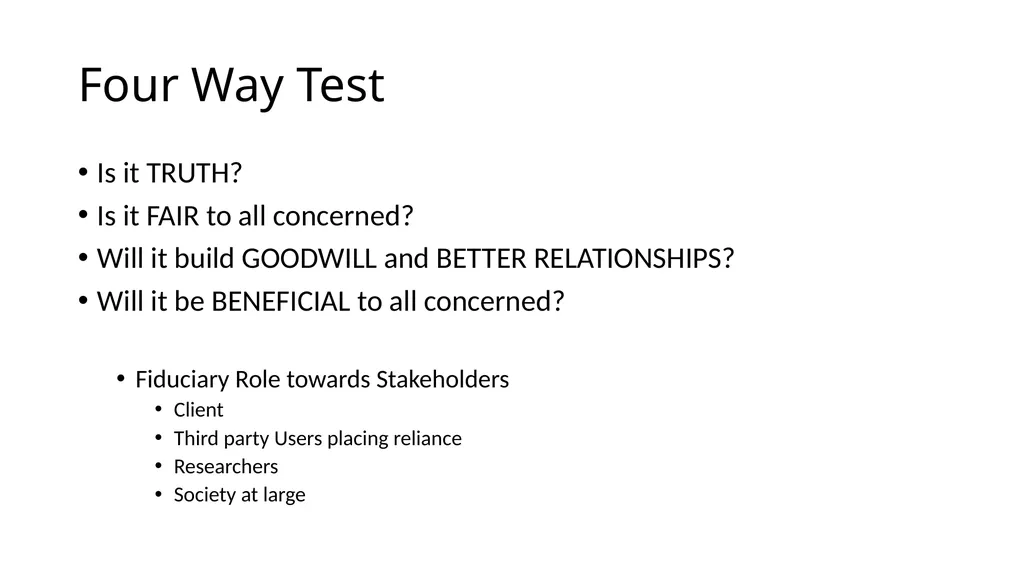
Four Way Test Is it TRUTH?
Is it FAIR to all concerned?
Will it build GOODWILL and BETTER RELATIONSHIPS?
Will it be BENEFICIAL to all concerned?
Fiduciary Role towards Stakeholders
Client
Third party Users placing reliance
Researchers
Society at large<br>
Is it FAIR to all concerned?
Will it build GOODWILL and BETTER RELATIONSHIPS?
Will it be BENEFICIAL to all concerned?
Fiduciary Role towards Stakeholders
Client
Third party Users placing reliance
Researchers
Society at large<br>
21
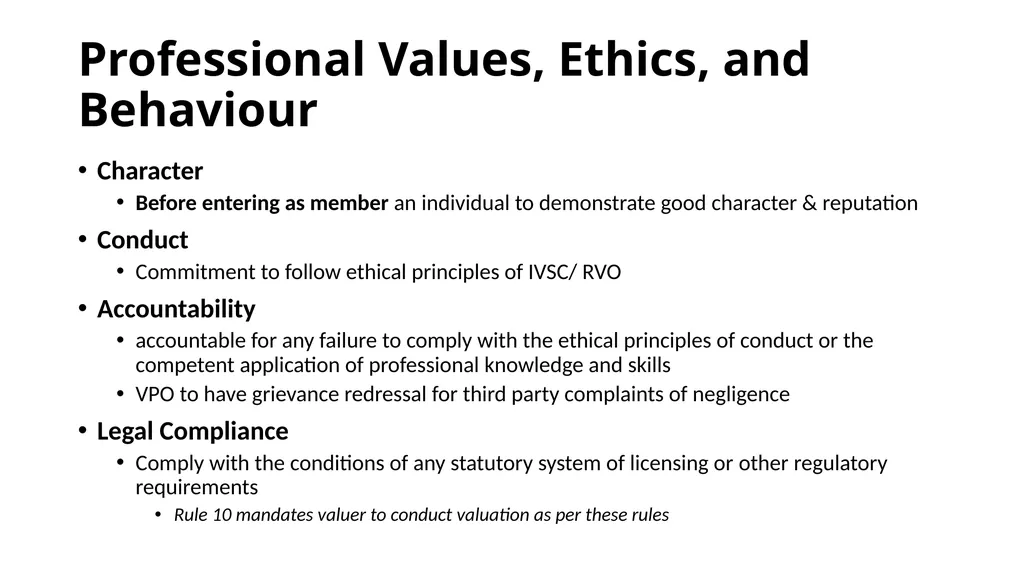
Professional Values, Ethics, and Behaviour Character
Before entering as member an individual to demonstrate good character & reputation
Conduct
Commitment to follow ethical principles of IVSC/ RVO
Accountability
accountable for any failure to comply with the ethical principles of conduct or the competent application of professional knowledge and skills
VPO to have grievance redressal for third party complaints of negligence
Legal Compliance
Comply with the conditions of any statutory system of licensing or other regulatory requirements
Rule 10 mandates valuer to conduct valuation as per these rules<br>
Before entering as member an individual to demonstrate good character & reputation
Conduct
Commitment to follow ethical principles of IVSC/ RVO
Accountability
accountable for any failure to comply with the ethical principles of conduct or the competent application of professional knowledge and skills
VPO to have grievance redressal for third party complaints of negligence
Legal Compliance
Comply with the conditions of any statutory system of licensing or other regulatory requirements
Rule 10 mandates valuer to conduct valuation as per these rules<br>
22
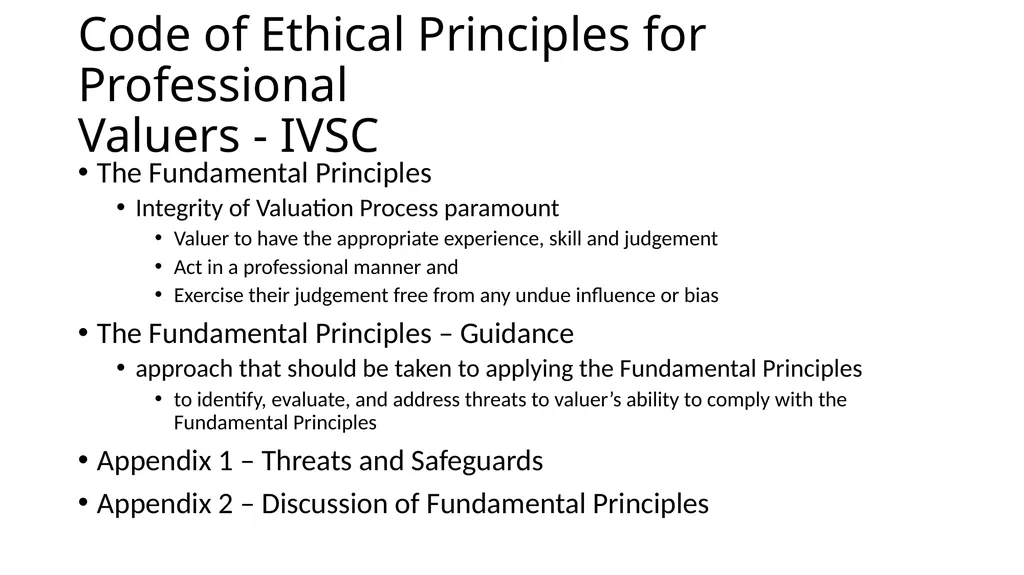
Code of Ethical Principles for Professional
Valuers - IVSC The Fundamental Principles
Integrity of Valuation Process paramount
Valuer to have the appropriate experience, skill and judgement
Act in a professional manner and
Exercise their judgement free from any undue influence or bias
The Fundamental Principles – Guidance
approach that should be taken to applying the Fundamental Principles
to identify, evaluate, and address threats to valuer’s ability to comply with the Fundamental Principles
Appendix 1 – Threats and Safeguards
Appendix 2 – Discussion of Fundamental Principles<br>
Integrity of Valuation Process paramount
Valuer to have the appropriate experience, skill and judgement
Act in a professional manner and
Exercise their judgement free from any undue influence or bias
The Fundamental Principles – Guidance
approach that should be taken to applying the Fundamental Principles
to identify, evaluate, and address threats to valuer’s ability to comply with the Fundamental Principles
Appendix 1 – Threats and Safeguards
Appendix 2 – Discussion of Fundamental Principles<br>
23
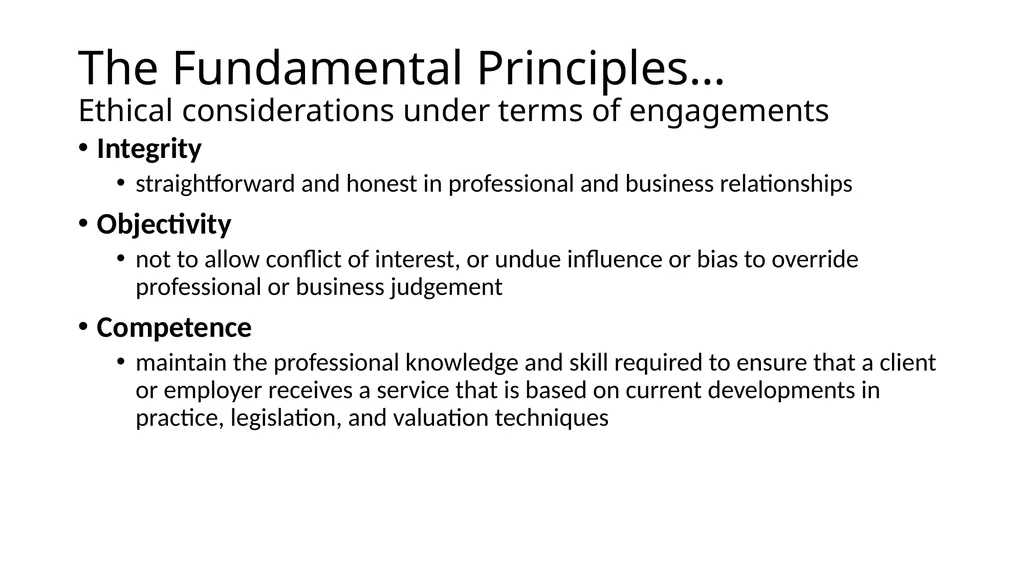
The Fundamental Principles…
Ethical considerations under terms of engagements Integrity
straightforward and honest in professional and business relationships
Objectivity
not to allow conflict of interest, or undue influence or bias to override professional or business judgement
Competence
maintain the professional knowledge and skill required to ensure that a client or employer receives a service that is based on current developments in practice, legislation, and valuation techniques<br>
straightforward and honest in professional and business relationships
Objectivity
not to allow conflict of interest, or undue influence or bias to override professional or business judgement
Competence
maintain the professional knowledge and skill required to ensure that a client or employer receives a service that is based on current developments in practice, legislation, and valuation techniques<br>
24
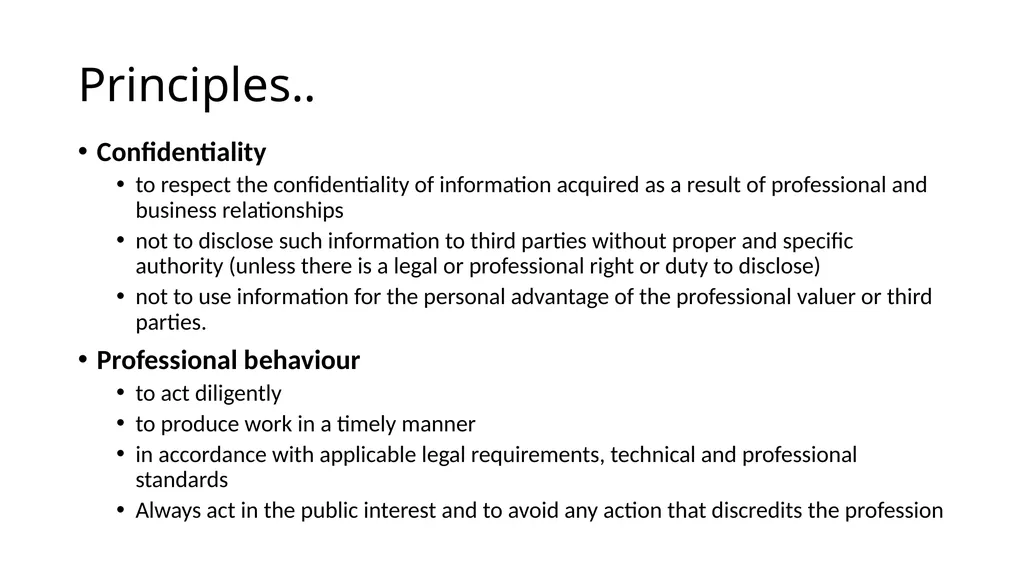
Principles.. Confidentiality
to respect the confidentiality of information acquired as a result of professional and business relationships
not to disclose such information to third parties without proper and specific authority (unless there is a legal or professional right or duty to disclose)
not to use information for the personal advantage of the professional valuer or third parties.
Professional behaviour
to act diligently
to produce work in a timely manner
in accordance with applicable legal requirements, technical and professional standards
Always act in the public interest and to avoid any action that discredits the profession<br>
to respect the confidentiality of information acquired as a result of professional and business relationships
not to disclose such information to third parties without proper and specific authority (unless there is a legal or professional right or duty to disclose)
not to use information for the personal advantage of the professional valuer or third parties.
Professional behaviour
to act diligently
to produce work in a timely manner
in accordance with applicable legal requirements, technical and professional standards
Always act in the public interest and to avoid any action that discredits the profession<br>
25
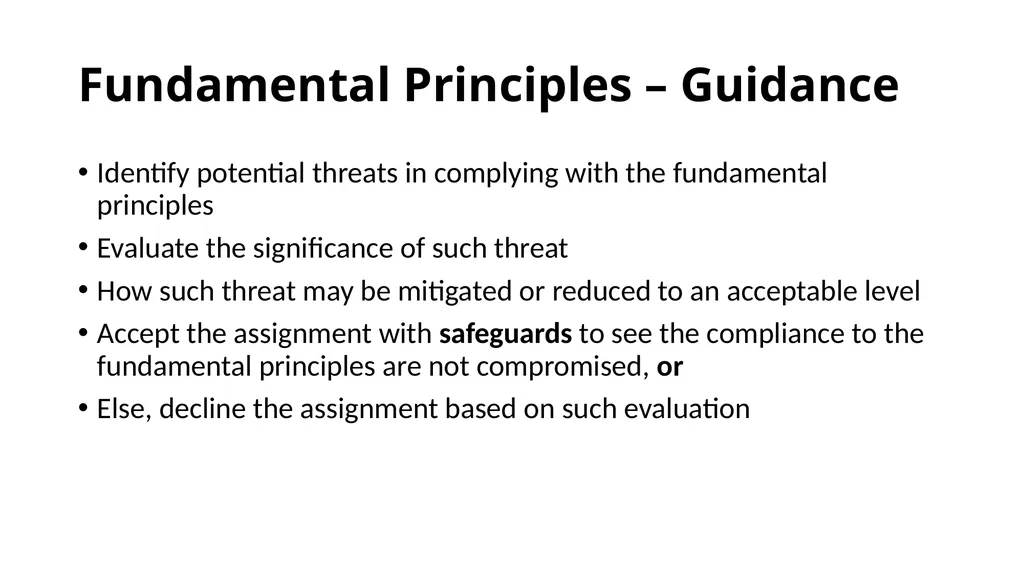
Fundamental Principles – Guidance Identify potential threats in complying with the fundamental principles
Evaluate the significance of such threat
How such threat may be mitigated or reduced to an acceptable level
Accept the assignment with safeguards to see the compliance to the fundamental principles are not compromised, or
Else, decline the assignment based on such evaluation<br>
Evaluate the significance of such threat
How such threat may be mitigated or reduced to an acceptable level
Accept the assignment with safeguards to see the compliance to the fundamental principles are not compromised, or
Else, decline the assignment based on such evaluation<br>
26
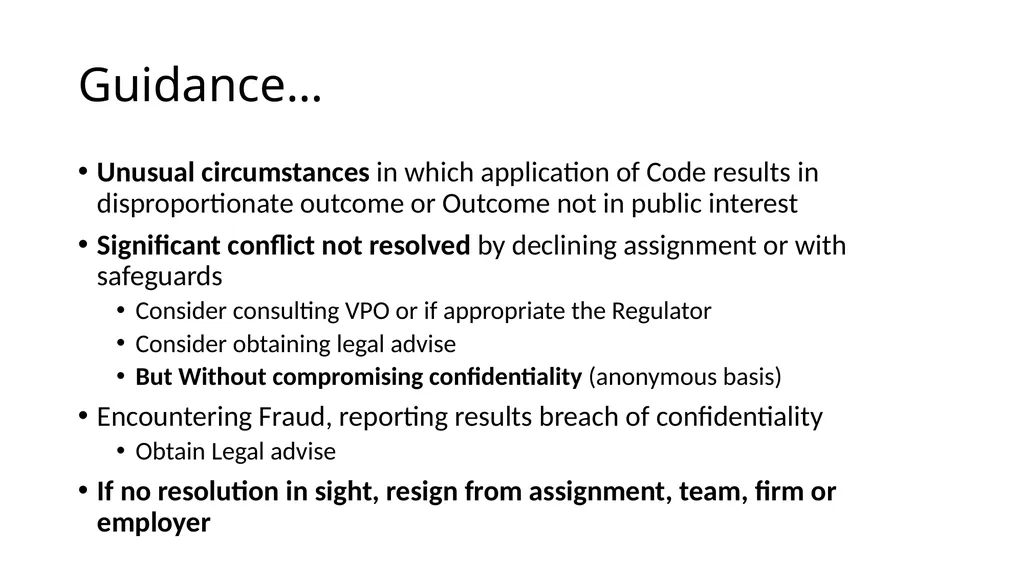
Guidance… Unusual circumstances in which application of Code results in disproportionate outcome or Outcome not in public interest
Significant conflict not resolved by declining assignment or with safeguards
Consider consulting VPO or if appropriate the Regulator
Consider obtaining legal advise
But Without compromising confidentiality (anonymous basis)
Encountering Fraud, reporting results breach of confidentiality
Obtain Legal advise
If no resolution in sight, resign from assignment, team, firm or employer<br>
Significant conflict not resolved by declining assignment or with safeguards
Consider consulting VPO or if appropriate the Regulator
Consider obtaining legal advise
But Without compromising confidentiality (anonymous basis)
Encountering Fraud, reporting results breach of confidentiality
Obtain Legal advise
If no resolution in sight, resign from assignment, team, firm or employer<br>
27
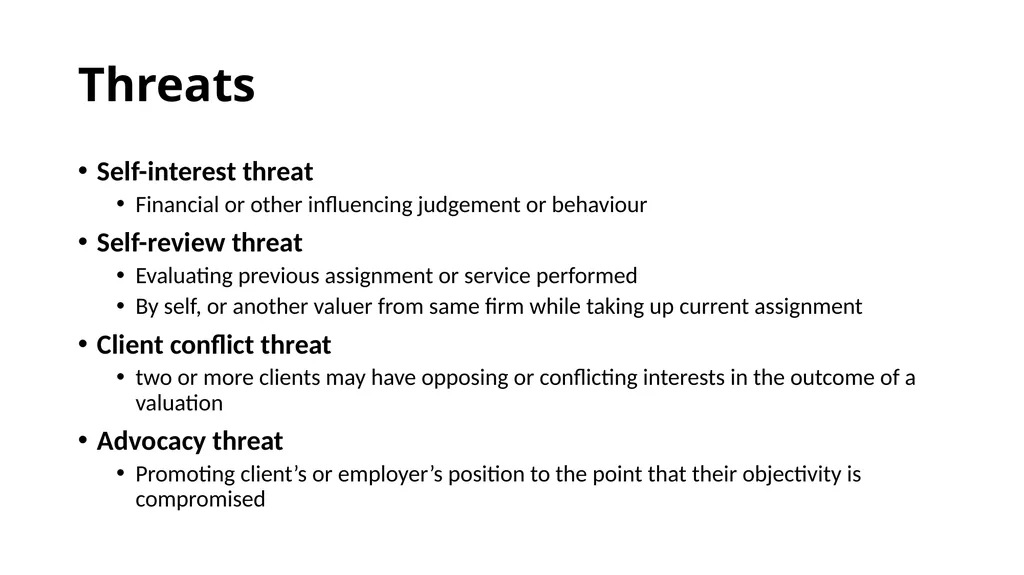
Threats Self-interest threat
Financial or other influencing judgement or behaviour
Self-review threat
Evaluating previous assignment or service performed
By self, or another valuer from same firm while taking up current assignment
Client conflict threat
two or more clients may have opposing or conflicting interests in the outcome of a valuation
Advocacy threat
Promoting client’s or employer’s position to the point that their objectivity is compromised<br>
Financial or other influencing judgement or behaviour
Self-review threat
Evaluating previous assignment or service performed
By self, or another valuer from same firm while taking up current assignment
Client conflict threat
two or more clients may have opposing or conflicting interests in the outcome of a valuation
Advocacy threat
Promoting client’s or employer’s position to the point that their objectivity is compromised<br>
28
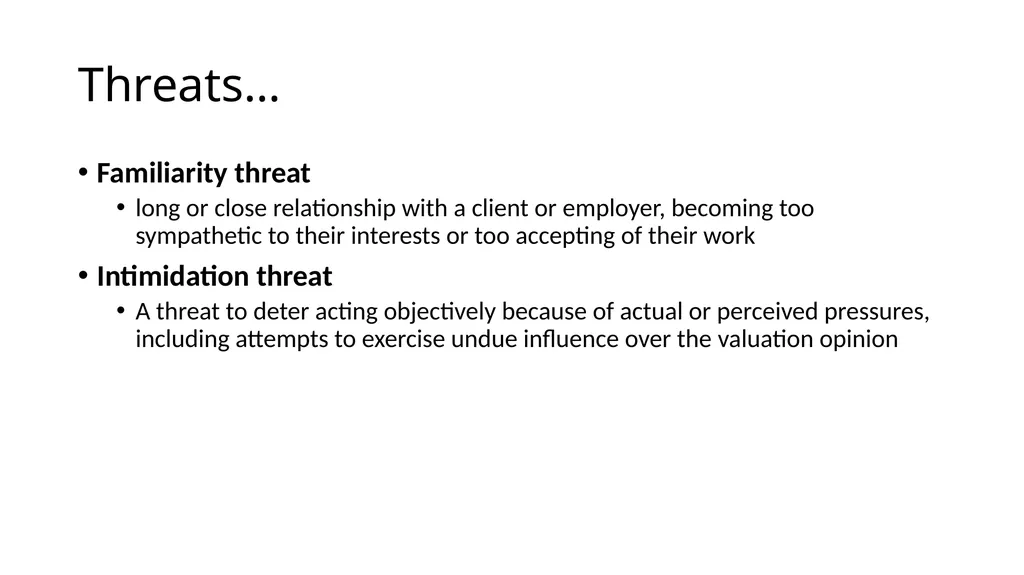
Threats… Familiarity threat
long or close relationship with a client or employer, becoming too sympathetic to their interests or too accepting of their work
Intimidation threat
A threat to deter acting objectively because of actual or perceived pressures, including attempts to exercise undue influence over the valuation opinion<br>
long or close relationship with a client or employer, becoming too sympathetic to their interests or too accepting of their work
Intimidation threat
A threat to deter acting objectively because of actual or perceived pressures, including attempts to exercise undue influence over the valuation opinion<br>
29
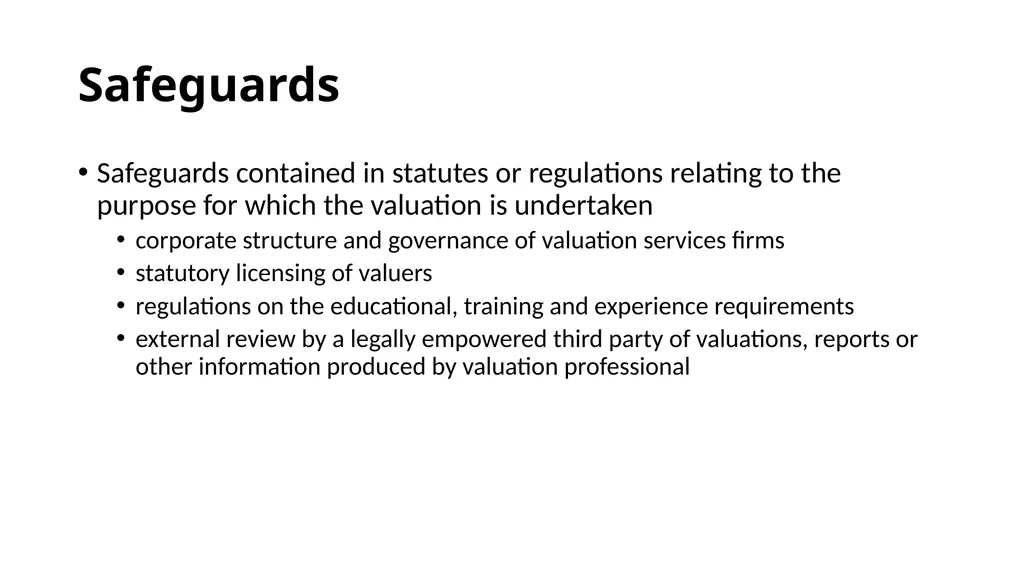
Safeguards Safeguards contained in statutes or regulations relating to the purpose for which the valuation is undertaken
corporate structure and governance of valuation services firms
statutory licensing of valuers
regulations on the educational, training and experience requirements
external review by a legally empowered third party of valuations, reports or other information produced by valuation professional<br>
corporate structure and governance of valuation services firms
statutory licensing of valuers
regulations on the educational, training and experience requirements
external review by a legally empowered third party of valuations, reports or other information produced by valuation professional<br>
30
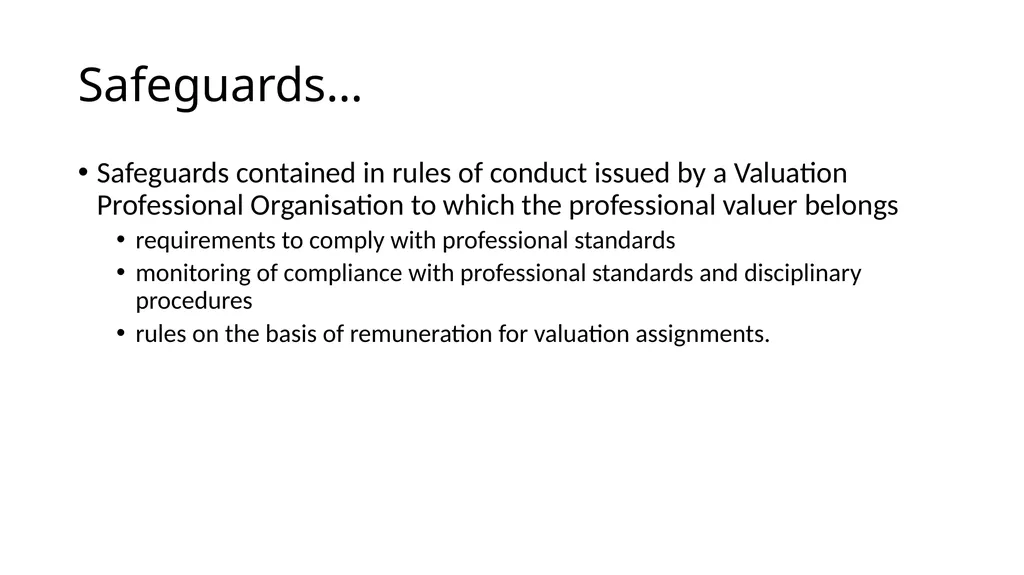
Safeguards… Safeguards contained in rules of conduct issued by a Valuation Professional Organisation to which the professional valuer belongs
requirements to comply with professional standards
monitoring of compliance with professional standards and disciplinary procedures
rules on the basis of remuneration for valuation assignments.<br>
requirements to comply with professional standards
monitoring of compliance with professional standards and disciplinary procedures
rules on the basis of remuneration for valuation assignments.<br>
31
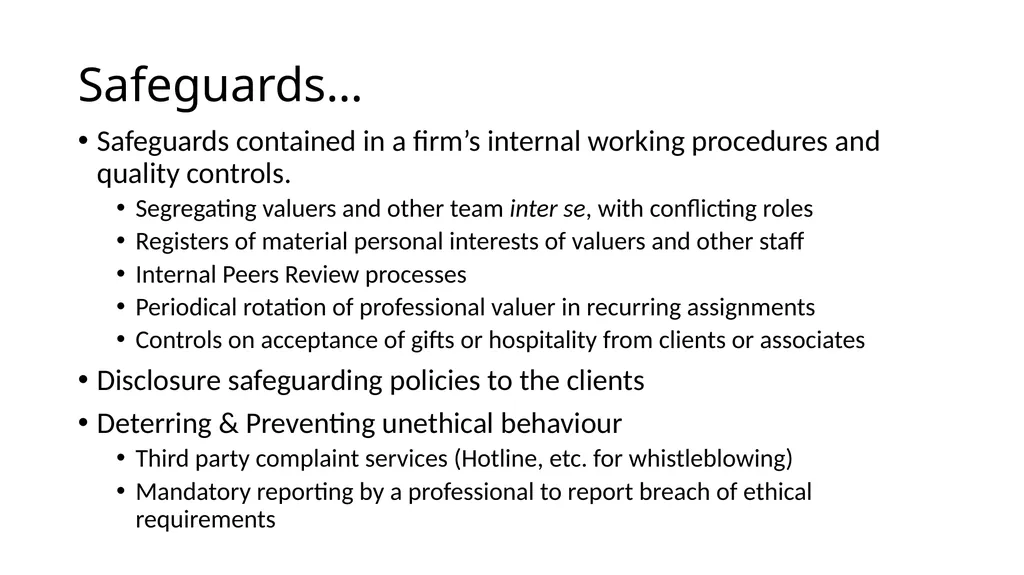
Safeguards… Safeguards contained in a firm’s internal working procedures and quality controls.
Segregating valuers and other team inter se, with conflicting roles
Registers of material personal interests of valuers and other staff
Internal Peers Review processes
Periodical rotation of professional valuer in recurring assignments
Controls on acceptance of gifts or hospitality from clients or associates
Disclosure safeguarding policies to the clients
Deterring & Preventing unethical behaviour
Third party complaint services (Hotline, etc. for whistleblowing)
Mandatory reporting by a professional to report breach of ethical requirements<br>
Segregating valuers and other team inter se, with conflicting roles
Registers of material personal interests of valuers and other staff
Internal Peers Review processes
Periodical rotation of professional valuer in recurring assignments
Controls on acceptance of gifts or hospitality from clients or associates
Disclosure safeguarding policies to the clients
Deterring & Preventing unethical behaviour
Third party complaint services (Hotline, etc. for whistleblowing)
Mandatory reporting by a professional to report breach of ethical requirements<br>
32
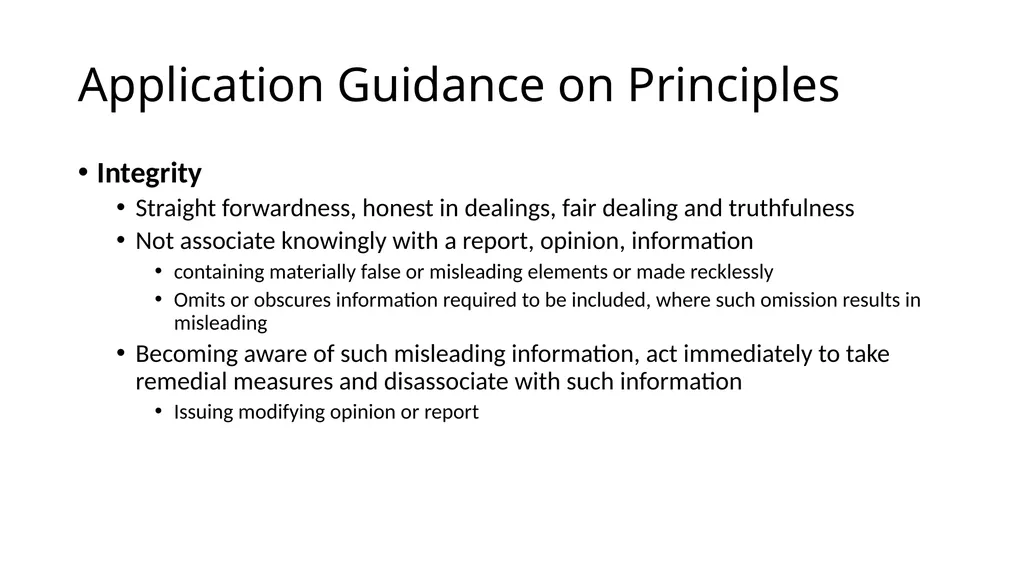
Application Guidance on Principles Integrity
Straight forwardness, honest in dealings, fair dealing and truthfulness
Not associate knowingly with a report, opinion, information
containing materially false or misleading elements or made recklessly
Omits or obscures information required to be included, where such omission results in misleading
Becoming aware of such misleading information, act immediately to take remedial measures and disassociate with such information
Issuing modifying opinion or report<br>
Straight forwardness, honest in dealings, fair dealing and truthfulness
Not associate knowingly with a report, opinion, information
containing materially false or misleading elements or made recklessly
Omits or obscures information required to be included, where such omission results in misleading
Becoming aware of such misleading information, act immediately to take remedial measures and disassociate with such information
Issuing modifying opinion or report<br>
33
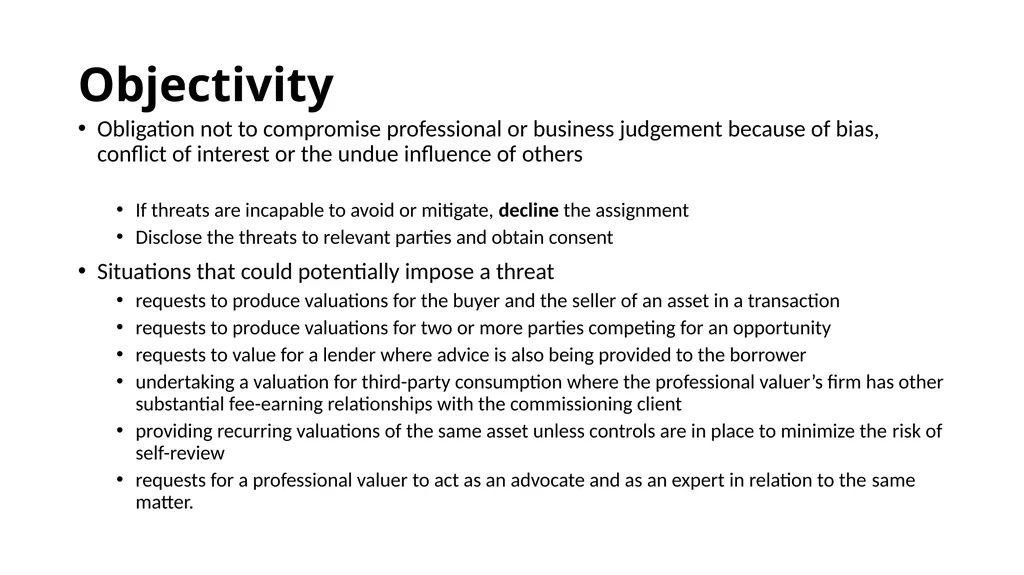
Objectivity Obligation not to compromise professional or business judgement because of bias, conflict of interest or the undue influence of others
If threats are incapable to avoid or mitigate, decline the assignment
Disclose the threats to relevant parties and obtain consent
Situations that could potentially impose a threat
requests to produce valuations for the buyer and the seller of an asset in a transaction
requests to produce valuations for two or more parties competing for an opportunity
requests to value for a lender where advice is also being provided to the borrower
undertaking a valuation for third-party consumption where the professional valuer’s firm has other substantial fee-earning relationships with the commissioning client
providing recurring valuations of the same asset unless controls are in place to minimize the risk of self-review
requests for a professional valuer to act as an advocate and as an expert in relation to the same matter.<br>
If threats are incapable to avoid or mitigate, decline the assignment
Disclose the threats to relevant parties and obtain consent
Situations that could potentially impose a threat
requests to produce valuations for the buyer and the seller of an asset in a transaction
requests to produce valuations for two or more parties competing for an opportunity
requests to value for a lender where advice is also being provided to the borrower
undertaking a valuation for third-party consumption where the professional valuer’s firm has other substantial fee-earning relationships with the commissioning client
providing recurring valuations of the same asset unless controls are in place to minimize the risk of self-review
requests for a professional valuer to act as an advocate and as an expert in relation to the same matter.<br>
34
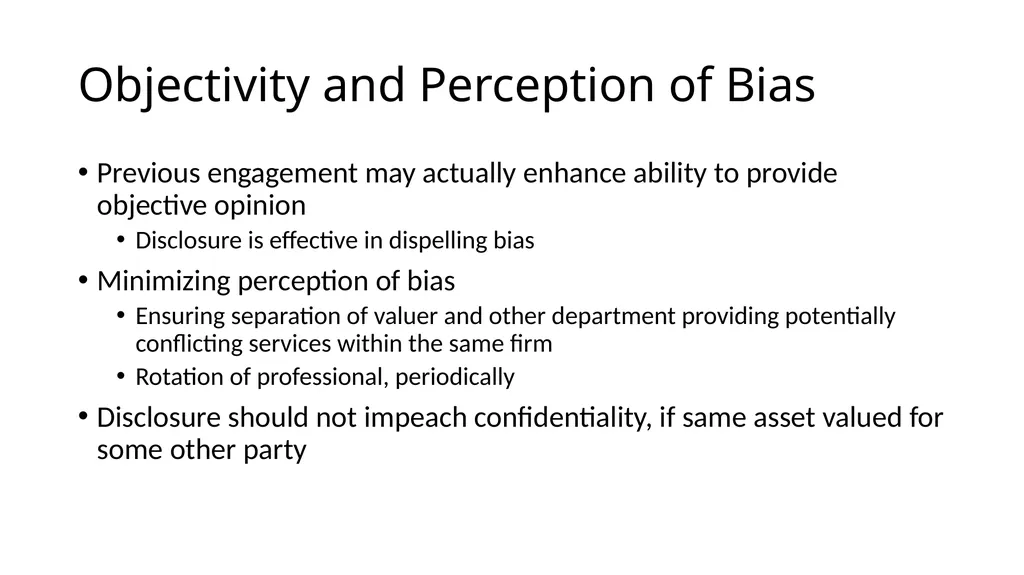
Objectivity and Perception of Bias Previous engagement may actually enhance ability to provide objective opinion
Disclosure is effective in dispelling bias
Minimizing perception of bias
Ensuring separation of valuer and other department providing potentially conflicting services within the same firm
Rotation of professional, periodically
Disclosure should not impeach confidentiality, if same asset valued for some other party<br>
Disclosure is effective in dispelling bias
Minimizing perception of bias
Ensuring separation of valuer and other department providing potentially conflicting services within the same firm
Rotation of professional, periodically
Disclosure should not impeach confidentiality, if same asset valued for some other party<br>
35
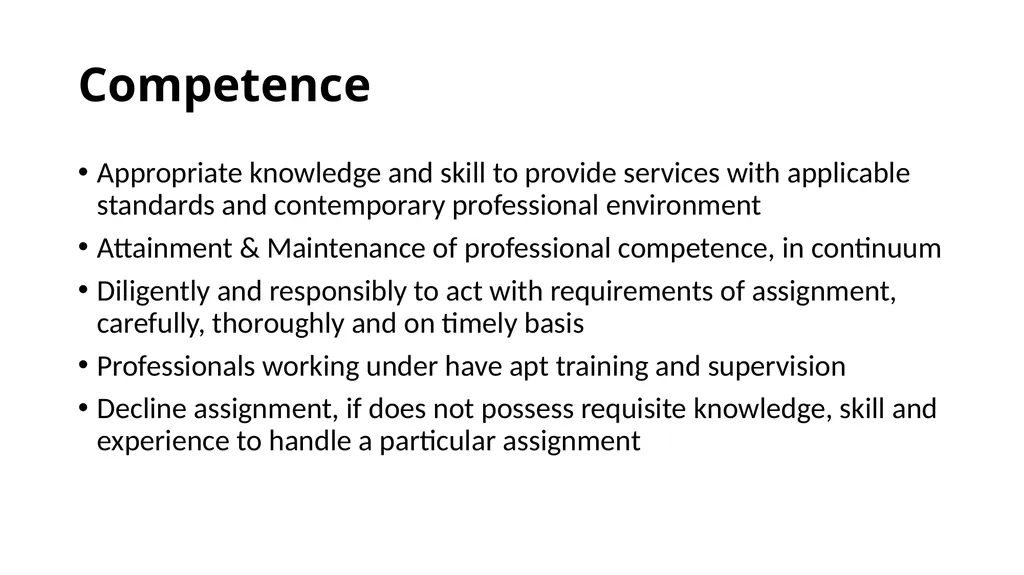
Competence Appropriate knowledge and skill to provide services with applicable standards and contemporary professional environment
Attainment & Maintenance of professional competence, in continuum
Diligently and responsibly to act with requirements of assignment, carefully, thoroughly and on timely basis
Professionals working under have apt training and supervision
Decline assignment, if does not possess requisite knowledge, skill and experience to handle a particular assignment<br>
Attainment & Maintenance of professional competence, in continuum
Diligently and responsibly to act with requirements of assignment, carefully, thoroughly and on timely basis
Professionals working under have apt training and supervision
Decline assignment, if does not possess requisite knowledge, skill and experience to handle a particular assignment<br>
36
Confidentiality Refraining disclosure to outsiders without proper and specific authority or under a legal or professional right
Not to use information for private gain
Be alert to the possibility of inadvertent disclosure including to close family member
Required even for the information obtained from the prospective client or employer
Necessary even within the firm or employing organization, and by his Staff
Maintain even after end of assignment at all times to come<br>
Not to use information for private gain
Be alert to the possibility of inadvertent disclosure including to close family member
Required even for the information obtained from the prospective client or employer
Necessary even within the firm or employing organization, and by his Staff
Maintain even after end of assignment at all times to come<br>
37
Disclosure of confidential information Permitted by law and is authorized by the client or the employer
Production of documents as evidence in legal proceedings
To public authorities where infringement of law comes to light
Professional duty or right to disclose, when not prohibited by law
To comply with Quality Review by VPO or other professional body
Responding to query or investigation by VPO
To protect professional interest of a valuer in legal proceeding
To comply with technical standards and ethical requirements
Carefully consider the third party interest to be affected, type of communication expected and apt recipients<br>
Production of documents as evidence in legal proceedings
To public authorities where infringement of law comes to light
Professional duty or right to disclose, when not prohibited by law
To comply with Quality Review by VPO or other professional body
Responding to query or investigation by VPO
To protect professional interest of a valuer in legal proceeding
To comply with technical standards and ethical requirements
Carefully consider the third party interest to be affected, type of communication expected and apt recipients<br>
38
Professional behaviour Obligation on valuers to act diligently to ensure service provided is in accordance with all legal, technical and professional standards as applicable to the subject and purpose or both
Acting in public interest
Opinion may have wider impact on unidentified third parties
Stockholders or investors in a fund
Not to accept any instruction from the client which appears to prejudicial to public interest or discredit own reputation or of the profession
While marketing themselves and their work, not to bring disrepute
No exaggerated claims of qualifications, work, attainment, etc.<br>
Acting in public interest
Opinion may have wider impact on unidentified third parties
Stockholders or investors in a fund
Not to accept any instruction from the client which appears to prejudicial to public interest or discredit own reputation or of the profession
While marketing themselves and their work, not to bring disrepute
No exaggerated claims of qualifications, work, attainment, etc.<br>
39
Model Code of Conduct for Registered Valuers Integrity and Fairness
Professional Competence & Due Care
Independence & Disclosure of Interest
Confidentiality
Information Management
Gifts & Hospitality
Remuneration & Costs
Occupation, employability and restrictions<br>
Professional Competence & Due Care
Independence & Disclosure of Interest
Confidentiality
Information Management
Gifts & Hospitality
Remuneration & Costs
Occupation, employability and restrictions<br>
40
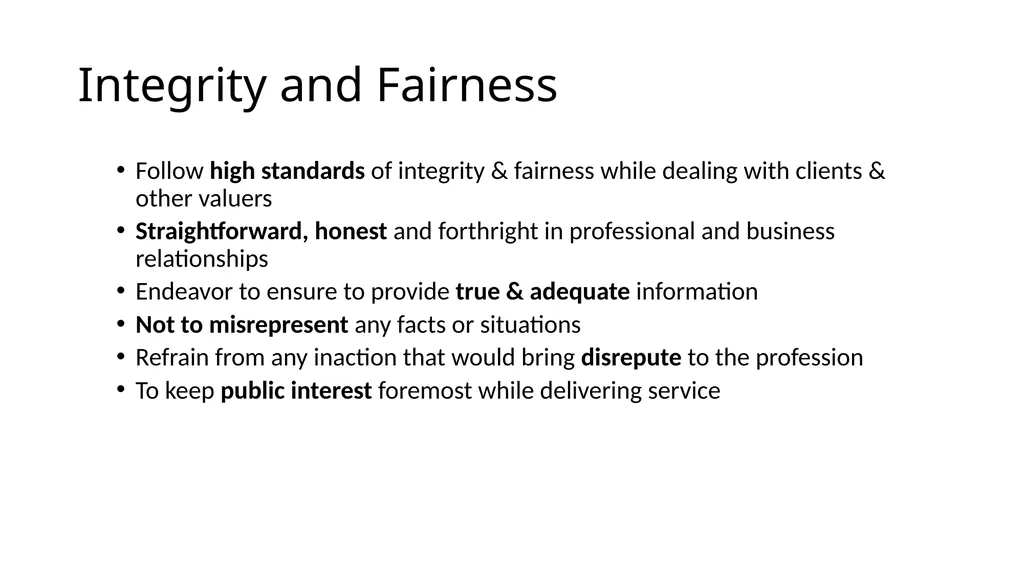
Integrity and Fairness Follow high standards of integrity & fairness while dealing with clients & other valuers
Straightforward, honest and forthright in professional and business relationships
Endeavor to ensure to provide true & adequate information
Not to misrepresent any facts or situations
Refrain from any inaction that would bring disrepute to the profession
To keep public interest foremost while delivering service<br>
Straightforward, honest and forthright in professional and business relationships
Endeavor to ensure to provide true & adequate information
Not to misrepresent any facts or situations
Refrain from any inaction that would bring disrepute to the profession
To keep public interest foremost while delivering service<br>
41
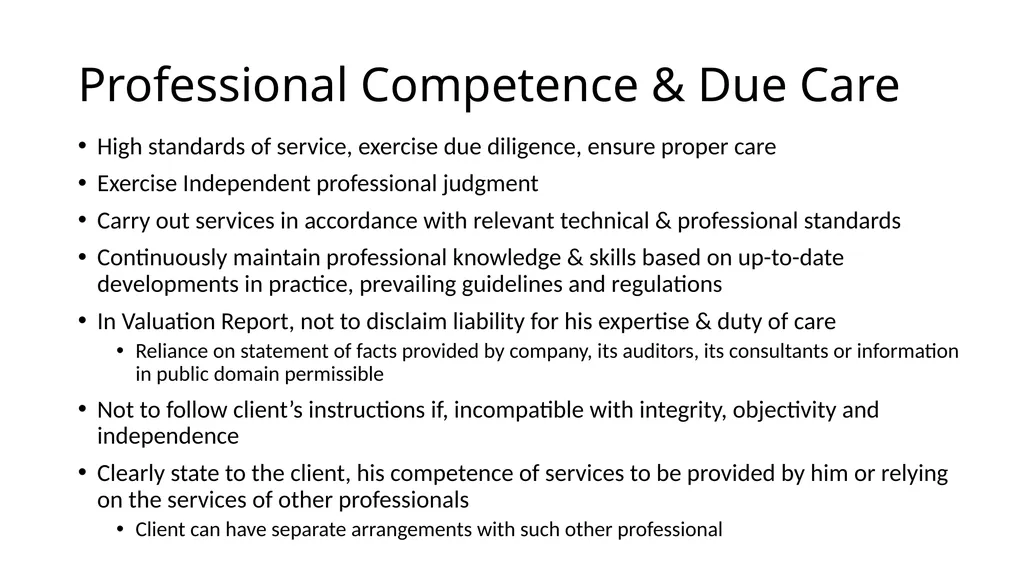
Professional Competence & Due Care High standards of service, exercise due diligence, ensure proper care
Exercise Independent professional judgment
Carry out services in accordance with relevant technical & professional standards
Continuously maintain professional knowledge & skills based on up-to-date developments in practice, prevailing guidelines and regulations
In Valuation Report, not to disclaim liability for his expertise & duty of care
Reliance on statement of facts provided by company, its auditors, its consultants or information in public domain permissible
Not to follow client’s instructions if, incompatible with integrity, objectivity and independence
Clearly state to the client, his competence of services to be provided by him or relying on the services of other professionals
Client can have separate arrangements with such other professional<br>
Exercise Independent professional judgment
Carry out services in accordance with relevant technical & professional standards
Continuously maintain professional knowledge & skills based on up-to-date developments in practice, prevailing guidelines and regulations
In Valuation Report, not to disclaim liability for his expertise & duty of care
Reliance on statement of facts provided by company, its auditors, its consultants or information in public domain permissible
Not to follow client’s instructions if, incompatible with integrity, objectivity and independence
Clearly state to the client, his competence of services to be provided by him or relying on the services of other professionals
Client can have separate arrangements with such other professional<br>
42
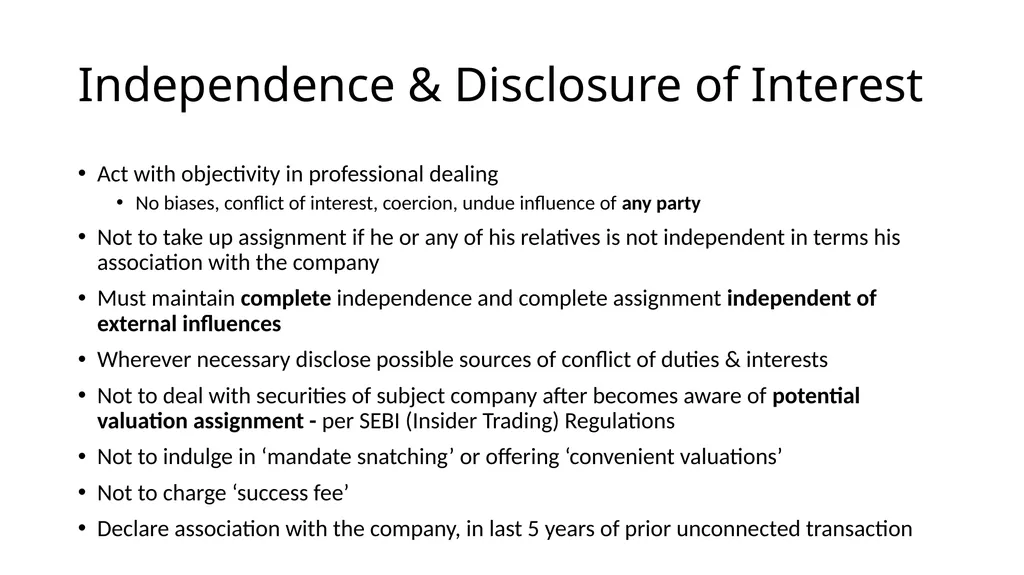
Independence & Disclosure of Interest Act with objectivity in professional dealing
No biases, conflict of interest, coercion, undue influence of any party
Not to take up assignment if he or any of his relatives is not independent in terms his association with the company
Must maintain complete independence and complete assignment independent of external influences
Wherever necessary disclose possible sources of conflict of duties & interests
Not to deal with securities of subject company after becomes aware of potential valuation assignment - per SEBI (Insider Trading) Regulations
Not to indulge in ‘mandate snatching’ or offering ‘convenient valuations’
Not to charge ‘success fee’
Declare association with the company, in last 5 years of prior unconnected transaction<br>
No biases, conflict of interest, coercion, undue influence of any party
Not to take up assignment if he or any of his relatives is not independent in terms his association with the company
Must maintain complete independence and complete assignment independent of external influences
Wherever necessary disclose possible sources of conflict of duties & interests
Not to deal with securities of subject company after becomes aware of potential valuation assignment - per SEBI (Insider Trading) Regulations
Not to indulge in ‘mandate snatching’ or offering ‘convenient valuations’
Not to charge ‘success fee’
Declare association with the company, in last 5 years of prior unconnected transaction<br>
43
Confidentiality Not to use or divulge to any client or any other party any confidential information, except
With proper and specific authority
Under legal or professional right or duty to disclose<br>
With proper and specific authority
Under legal or professional right or duty to disclose<br>
44
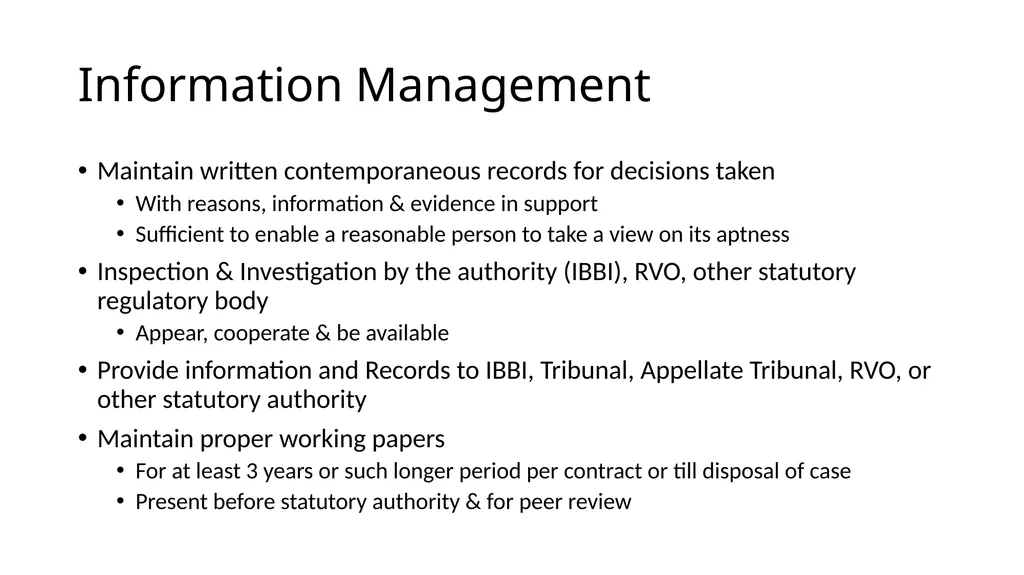
Information Management Maintain written contemporaneous records for decisions taken
With reasons, information & evidence in support
Sufficient to enable a reasonable person to take a view on its aptness
Inspection & Investigation by the authority (IBBI), RVO, other statutory regulatory body
Appear, cooperate & be available
Provide information and Records to IBBI, Tribunal, Appellate Tribunal, RVO, or other statutory authority
Maintain proper working papers
For at least 3 years or such longer period per contract or till disposal of case
Present before statutory authority & for peer review<br>
With reasons, information & evidence in support
Sufficient to enable a reasonable person to take a view on its aptness
Inspection & Investigation by the authority (IBBI), RVO, other statutory regulatory body
Appear, cooperate & be available
Provide information and Records to IBBI, Tribunal, Appellate Tribunal, RVO, or other statutory authority
Maintain proper working papers
For at least 3 years or such longer period per contract or till disposal of case
Present before statutory authority & for peer review<br>
45
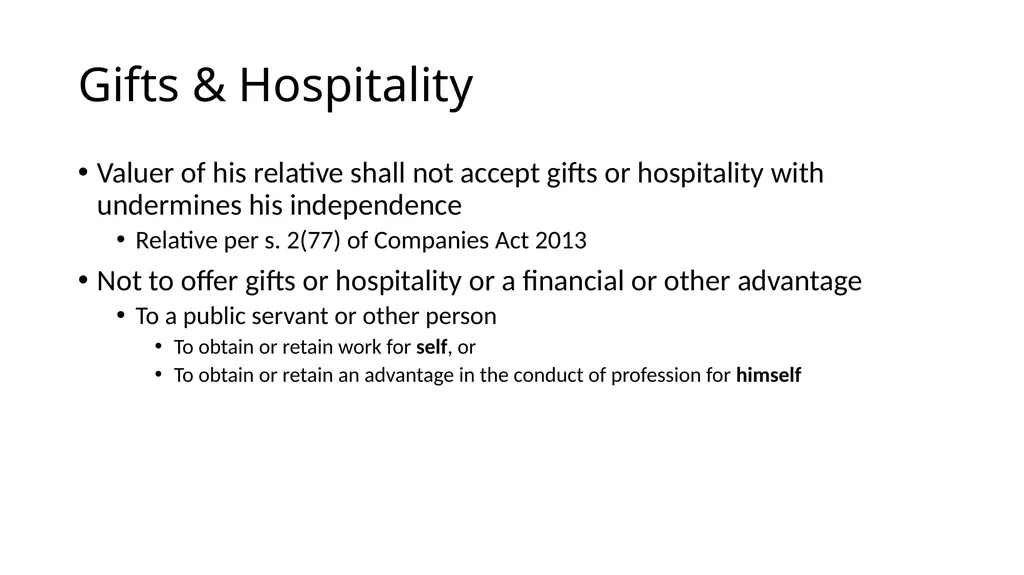
Gifts & Hospitality Valuer of his relative shall not accept gifts or hospitality with undermines his independence
Relative per s. 2(77) of Companies Act 2013
Not to offer gifts or hospitality or a financial or other advantage
To a public servant or other person
To obtain or retain work for self, or
To obtain or retain an advantage in the conduct of profession for himself<br>
Relative per s. 2(77) of Companies Act 2013
Not to offer gifts or hospitality or a financial or other advantage
To a public servant or other person
To obtain or retain work for self, or
To obtain or retain an advantage in the conduct of profession for himself<br>
46
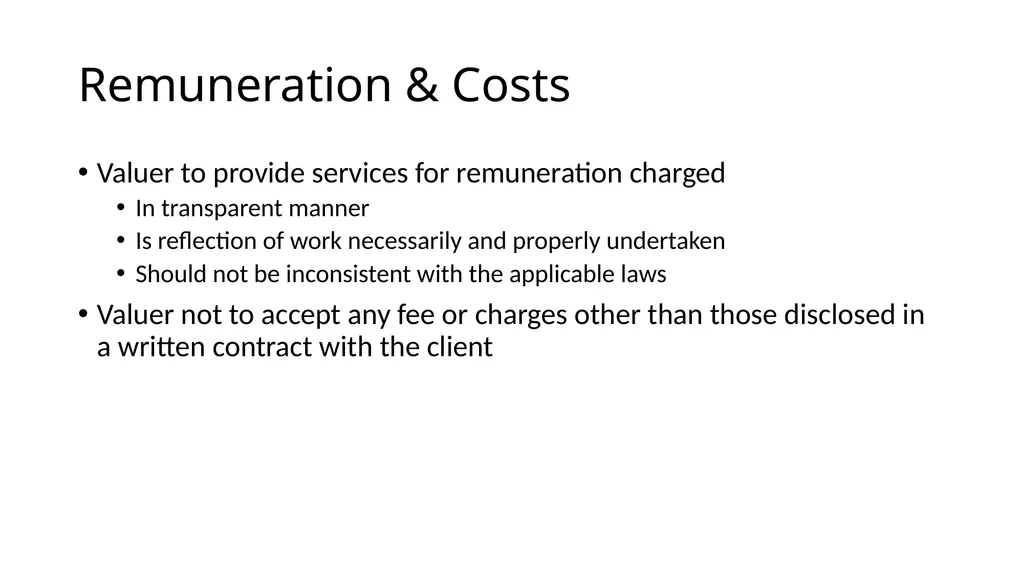
Remuneration & Costs Valuer to provide services for remuneration charged
In transparent manner
Is reflection of work necessarily and properly undertaken
Should not be inconsistent with the applicable laws
Valuer not to accept any fee or charges other than those disclosed in a written contract with the client<br>
In transparent manner
Is reflection of work necessarily and properly undertaken
Should not be inconsistent with the applicable laws
Valuer not to accept any fee or charges other than those disclosed in a written contract with the client<br>
47
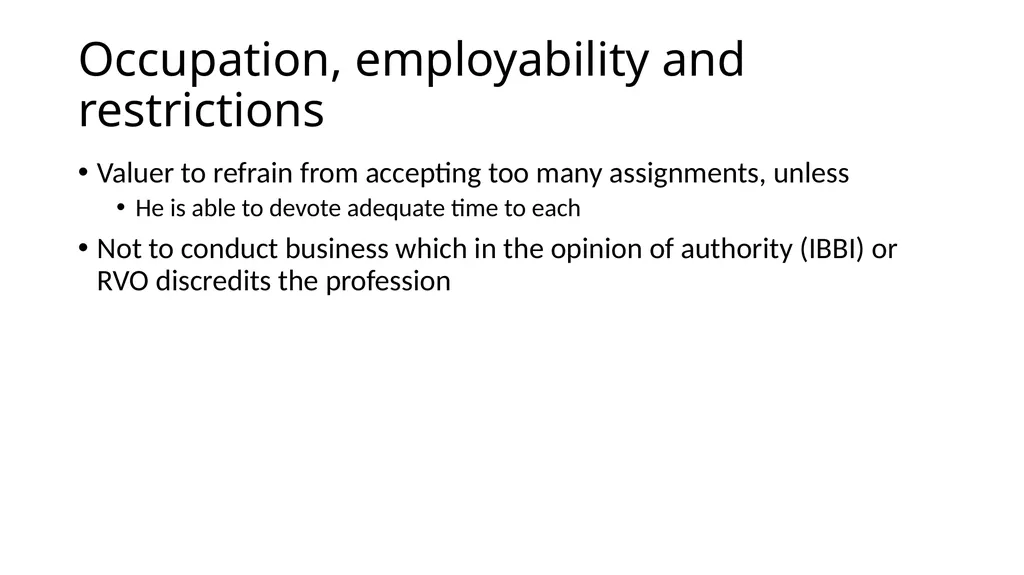
Occupation, employability and restrictions Valuer to refrain from accepting too many assignments, unless
He is able to devote adequate time to each
Not to conduct business which in the opinion of authority (IBBI) or RVO discredits the profession<br>
He is able to devote adequate time to each
Not to conduct business which in the opinion of authority (IBBI) or RVO discredits the profession<br>
48
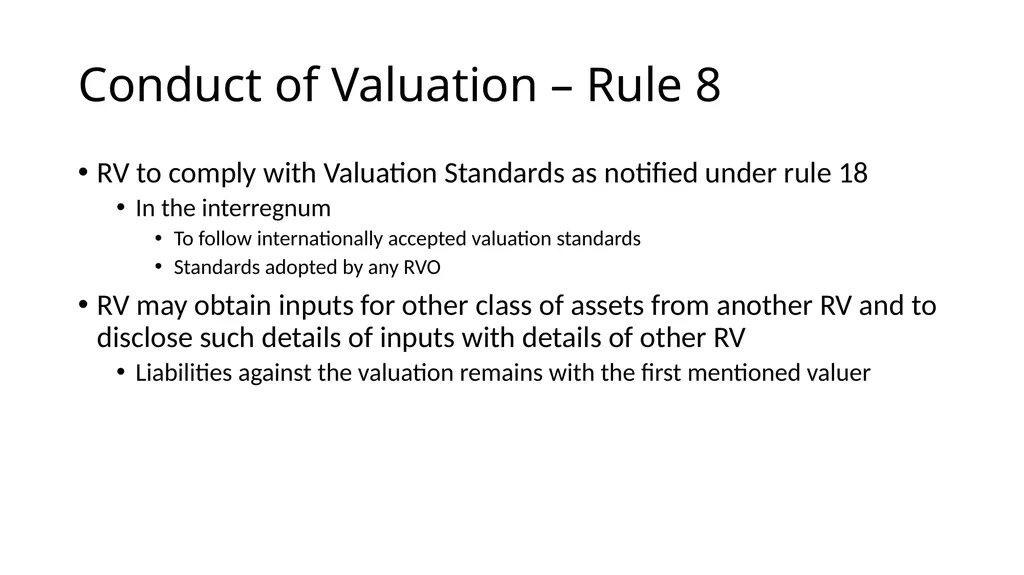
Conduct of Valuation – Rule 8 RV to comply with Valuation Standards as notified under rule 18
In the interregnum
To follow internationally accepted valuation standards
Standards adopted by any RVO
RV may obtain inputs for other class of assets from another RV and to disclose such details of inputs with details of other RV
Liabilities against the valuation remains with the first mentioned valuer<br>
In the interregnum
To follow internationally accepted valuation standards
Standards adopted by any RVO
RV may obtain inputs for other class of assets from another RV and to disclose such details of inputs with details of other RV
Liabilities against the valuation remains with the first mentioned valuer<br>
49
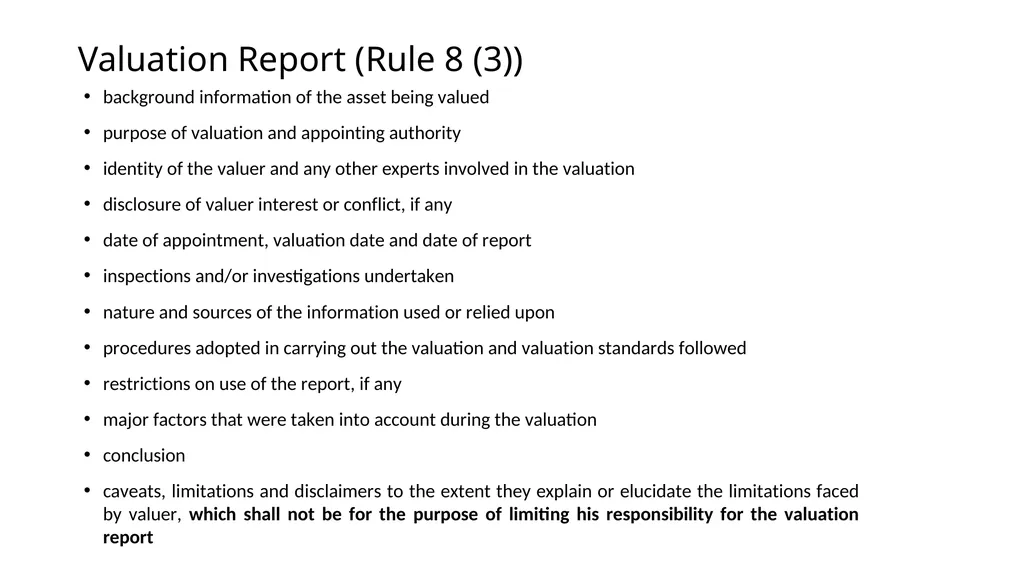
Valuation Report (Rule 8 (3)) background information of the asset being valued
purpose of valuation and appointing authority
identity of the valuer and any other experts involved in the valuation
disclosure of valuer interest or conflict, if any
date of appointment, valuation date and date of report
inspections and/or investigations undertaken
nature and sources of the information used or relied upon
procedures adopted in carrying out the valuation and valuation standards followed
restrictions on use of the report, if any
major factors that were taken into account during the valuation
conclusion
caveats, limitations and disclaimers to the extent they explain or elucidate the limitations faced by valuer, which shall not be for the purpose of limiting his responsibility for the valuation report<br>
purpose of valuation and appointing authority
identity of the valuer and any other experts involved in the valuation
disclosure of valuer interest or conflict, if any
date of appointment, valuation date and date of report
inspections and/or investigations undertaken
nature and sources of the information used or relied upon
procedures adopted in carrying out the valuation and valuation standards followed
restrictions on use of the report, if any
major factors that were taken into account during the valuation
conclusion
caveats, limitations and disclaimers to the extent they explain or elucidate the limitations faced by valuer, which shall not be for the purpose of limiting his responsibility for the valuation report<br>
50
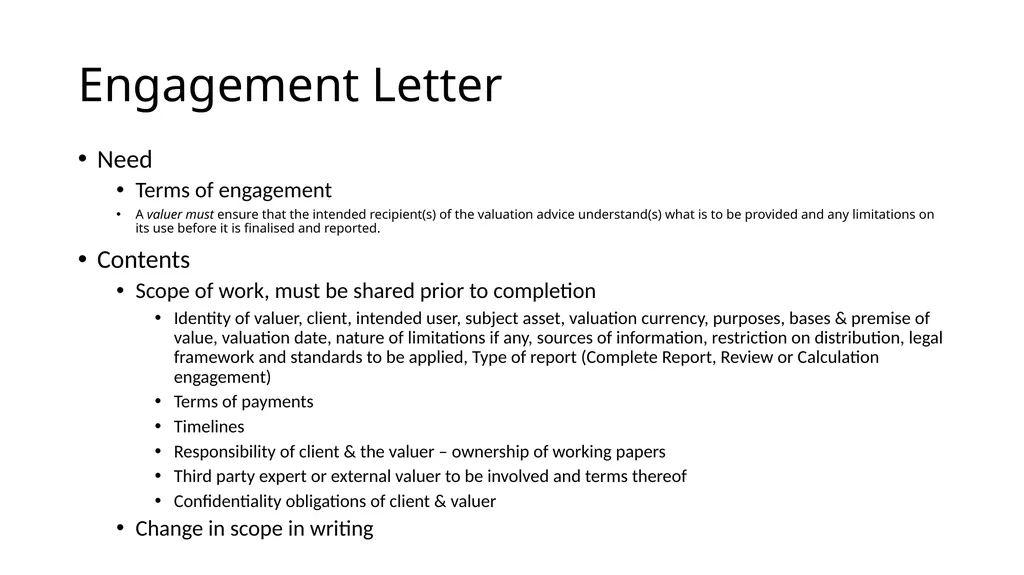
Engagement Letter Need
Terms of engagement
A valuer must ensure that the intended recipient(s) of the valuation advice understand(s) what is to be provided and any limitations on its use before it is finalised and reported.
Contents
Scope of work, must be shared prior to completion
Identity of valuer, client, intended user, subject asset, valuation currency, purposes, bases & premise of value, valuation date, nature of limitations if any, sources of information, restriction on distribution, legal framework and standards to be applied, Type of report (Complete Report, Review or Calculation engagement)
Terms of payments
Timelines
Responsibility of client & the valuer – ownership of working papers
Third party expert or external valuer to be involved and terms thereof
Confidentiality obligations of client & valuer
Change in scope in writing<br>
Terms of engagement
A valuer must ensure that the intended recipient(s) of the valuation advice understand(s) what is to be provided and any limitations on its use before it is finalised and reported.
Contents
Scope of work, must be shared prior to completion
Identity of valuer, client, intended user, subject asset, valuation currency, purposes, bases & premise of value, valuation date, nature of limitations if any, sources of information, restriction on distribution, legal framework and standards to be applied, Type of report (Complete Report, Review or Calculation engagement)
Terms of payments
Timelines
Responsibility of client & the valuer – ownership of working papers
Third party expert or external valuer to be involved and terms thereof
Confidentiality obligations of client & valuer
Change in scope in writing<br>
51
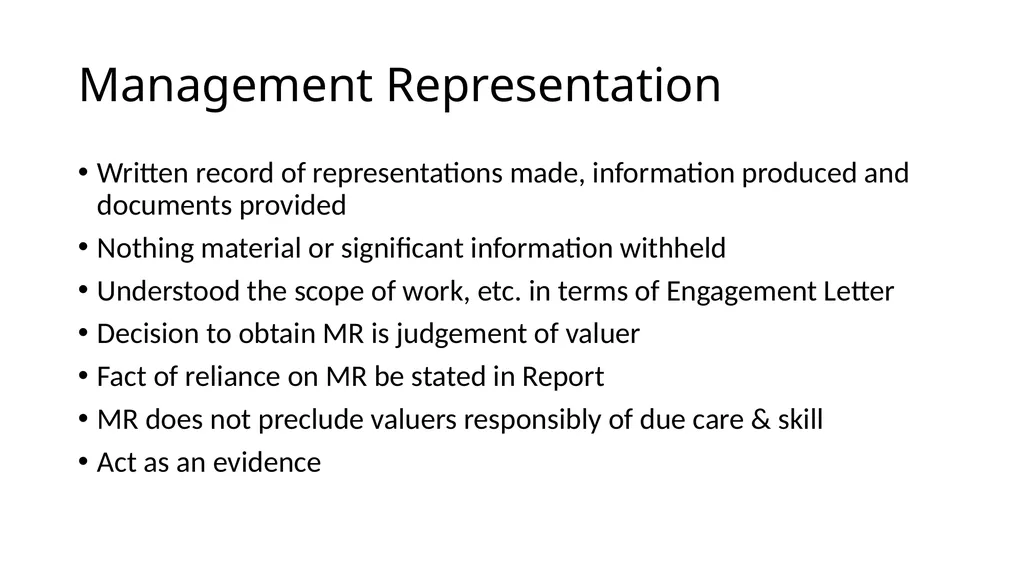
Management Representation Written record of representations made, information produced and documents provided
Nothing material or significant information withheld
Understood the scope of work, etc. in terms of Engagement Letter
Decision to obtain MR is judgement of valuer
Fact of reliance on MR be stated in Report
MR does not preclude valuers responsibly of due care & skill
Act as an evidence<br>
Nothing material or significant information withheld
Understood the scope of work, etc. in terms of Engagement Letter
Decision to obtain MR is judgement of valuer
Fact of reliance on MR be stated in Report
MR does not preclude valuers responsibly of due care & skill
Act as an evidence<br>
52
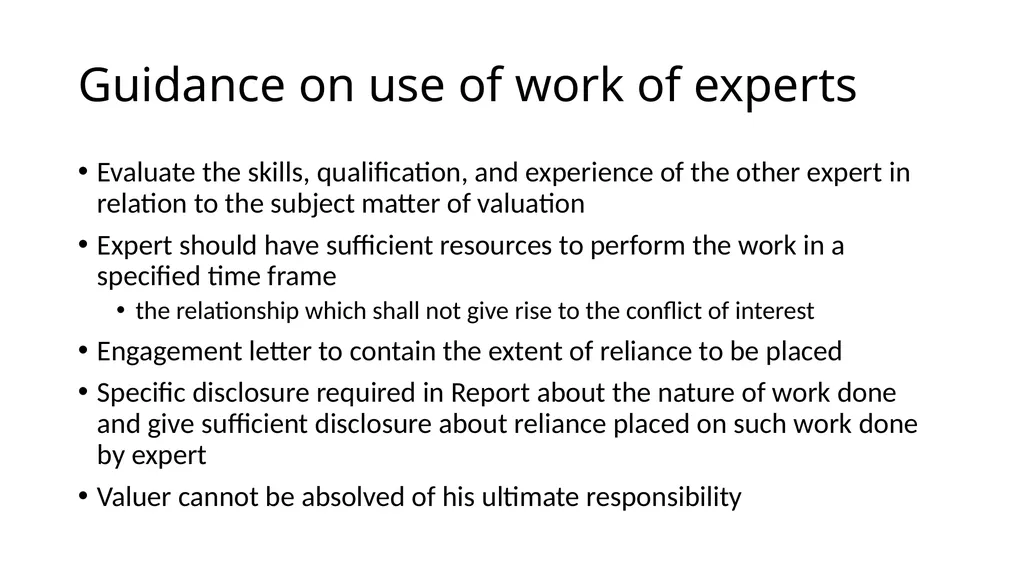
Guidance on use of work of experts Evaluate the skills, qualification, and experience of the other expert in relation to the subject matter of valuation
Expert should have sufficient resources to perform the work in a specified time frame
the relationship which shall not give rise to the conflict of interest
Engagement letter to contain the extent of reliance to be placed
Specific disclosure required in Report about the nature of work done and give sufficient disclosure about reliance placed on such work done by expert
Valuer cannot be absolved of his ultimate responsibility<br>
Expert should have sufficient resources to perform the work in a specified time frame
the relationship which shall not give rise to the conflict of interest
Engagement letter to contain the extent of reliance to be placed
Specific disclosure required in Report about the nature of work done and give sufficient disclosure about reliance placed on such work done by expert
Valuer cannot be absolved of his ultimate responsibility<br>
53
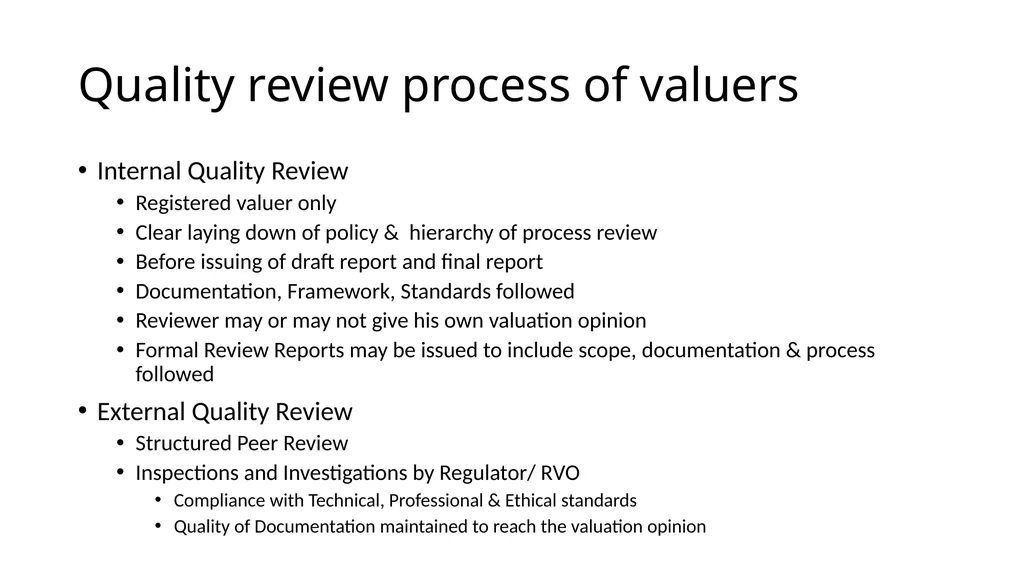
Quality review process of valuers Internal Quality Review
Registered valuer only
Clear laying down of policy & hierarchy of process review
Before issuing of draft report and final report
Documentation, Framework, Standards followed
Reviewer may or may not give his own valuation opinion
Formal Review Reports may be issued to include scope, documentation & process followed
External Quality Review
Structured Peer Review
Inspections and Investigations by Regulator/ RVO
Compliance with Technical, Professional & Ethical standards
Quality of Documentation maintained to reach the valuation opinion<br>
Registered valuer only
Clear laying down of policy & hierarchy of process review
Before issuing of draft report and final report
Documentation, Framework, Standards followed
Reviewer may or may not give his own valuation opinion
Formal Review Reports may be issued to include scope, documentation & process followed
External Quality Review
Structured Peer Review
Inspections and Investigations by Regulator/ RVO
Compliance with Technical, Professional & Ethical standards
Quality of Documentation maintained to reach the valuation opinion<br>
54
Rights and responsibilities of valuers A valuer does not invent value but derives value based on certain principles, standards and information
Duties
Perform work with ethical and technical standards to produce unbiased, and defendable value opinion within the scope of work
Keep updated on professional knowledge & skill, legal framework and market in which to perform
Wherever safeguards to threats cannot be achieved resign from the assignment
Present before authorities and provide information whenever required
Rights
Unfathomed right to retain working papers
Right to relent from assignment in case of conflict or threat to guiding principles<br>
Duties
Perform work with ethical and technical standards to produce unbiased, and defendable value opinion within the scope of work
Keep updated on professional knowledge & skill, legal framework and market in which to perform
Wherever safeguards to threats cannot be achieved resign from the assignment
Present before authorities and provide information whenever required
Rights
Unfathomed right to retain working papers
Right to relent from assignment in case of conflict or threat to guiding principles<br>
55
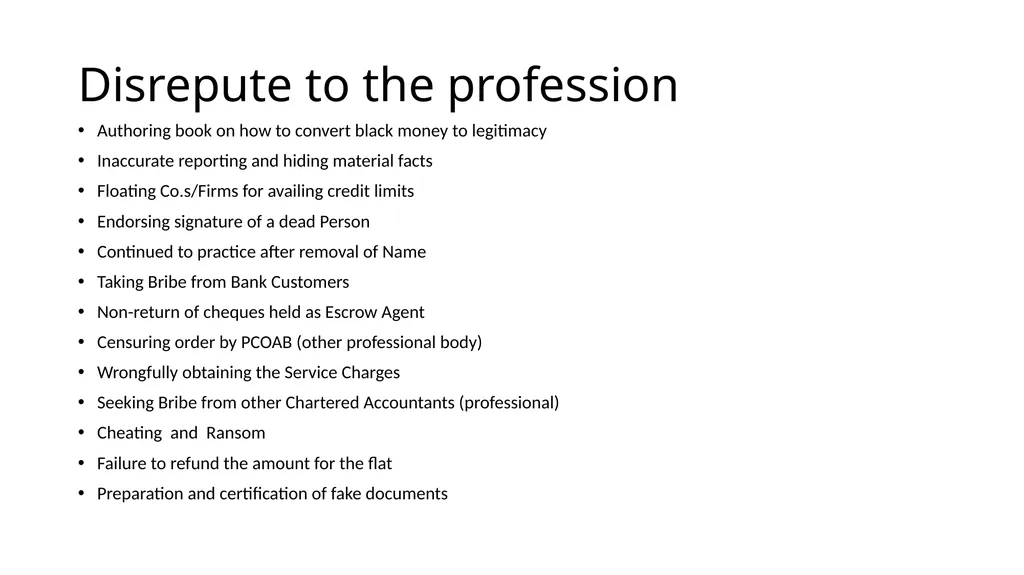
Disrepute to the profession Authoring book on how to convert black money to legitimacy
Inaccurate reporting and hiding material facts
Floating Co.s/Firms for availing credit limits
Endorsing signature of a dead Person
Continued to practice after removal of Name
Taking Bribe from Bank Customers
Non-return of cheques held as Escrow Agent
Censuring order by PCOAB (other professional body)
Wrongfully obtaining the Service Charges
Seeking Bribe from other Chartered Accountants (professional)
Cheating and Ransom
Failure to refund the amount for the flat
Preparation and certification of fake documents<br>
Inaccurate reporting and hiding material facts
Floating Co.s/Firms for availing credit limits
Endorsing signature of a dead Person
Continued to practice after removal of Name
Taking Bribe from Bank Customers
Non-return of cheques held as Escrow Agent
Censuring order by PCOAB (other professional body)
Wrongfully obtaining the Service Charges
Seeking Bribe from other Chartered Accountants (professional)
Cheating and Ransom
Failure to refund the amount for the flat
Preparation and certification of fake documents<br>
56
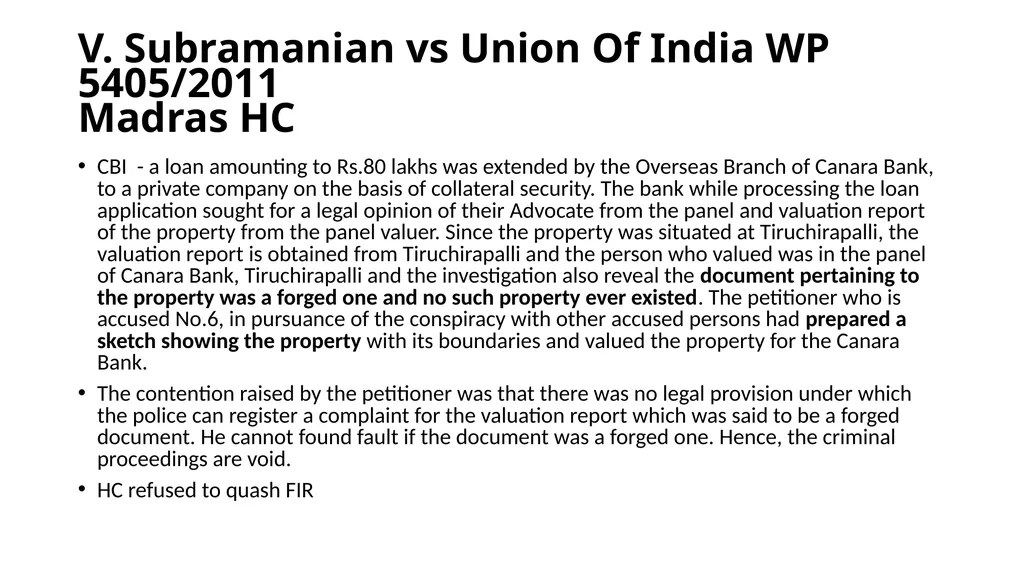
V. Subramanian vs Union Of India WP 5405/2011
Madras HC CBI - a loan amounting to Rs.80 lakhs was extended by the Overseas Branch of Canara Bank, to a private company on the basis of collateral security. The bank while processing the loan application sought for a legal opinion of their Advocate from the panel and valuation report of the property from the panel valuer. Since the property was situated at Tiruchirapalli, the valuation report is obtained from Tiruchirapalli and the person who valued was in the panel of Canara Bank, Tiruchirapalli and the investigation also reveal the document pertaining to the property was a forged one and no such property ever existed. The petitioner who is accused No.6, in pursuance of the conspiracy with other accused persons had prepared a sketch showing the property with its boundaries and valued the property for the Canara Bank.
The contention raised by the petitioner was that there was no legal provision under which the police can register a complaint for the valuation report which was said to be a forged document. He cannot found fault if the document was a forged one. Hence, the criminal proceedings are void.
HC refused to quash FIR<br>
The contention raised by the petitioner was that there was no legal provision under which the police can register a complaint for the valuation report which was said to be a forged document. He cannot found fault if the document was a forged one. Hence, the criminal proceedings are void.
HC refused to quash FIR<br>
57
Mrs. Renuka Dalta (Supreme Court) If the valuer adopts the method of valuation prescribed, or in the absence of any prescribed method, adopts any recognised method of valuation, his valuation cannot be assailed unless it is shown that the valuation was made on a fundamentally erroneous basis, or that a patent mistake had been committed, or the valuer adopted a demonstrably wrong approach or a fundamental error going to the root of the matter. Where a method of valuation is prescribed, the valuation must be made by adopting scrupulously the method prescribed, taking into account all relevant factors which may be enumerated as relevant for arriving at the valuation.<br>
58
Cushman and Wakefield India Private Limited v. UoI Delhi H. C. Facts of the case:
Cushman and Wakefield India Private Limited (‘Petitioner’) was engaged in the business of real estate consultancy services including provision of real estate valuation services.
The Petitioner was aggrieved by the notification of Rule 3(2)(a) of the RV Rules. It was alleged that the said notification impaired the right of the Petitioner by making the Petitioner ineligible from being a Registered Valuer on the mere ground that the Petitioner was a subsidiary of a body corporate. The Petitioner thus preferred the present writ petition alleging violation of Article 14, Article 19(1)(g) and Article 301 of the Constitution of India by Rule 3(2)(a) of the RV Rules.
High Court's observations and findings:
The High Court considered “whether exclusion of a subsidiary company, joint venture or associate of other company, for purpose of eligibility for registration as valuer is reasonable” and answered in the affirmative.
While disposing of the instant writ petition, the High Court at Delhi observed that “The objective and intention behind laying down the impugned Rule is clearly to introduce higher standards of professionalism in valuation industry, specifically in relation to valuations undertaken for the purpose of Companies Act and IBC, 2016. The impugned Rule obviates the possibility of conflict of interest on account of diverging interests of constituent / associate entities which resultantly shall undermine the very process of valuation, being one of the most essential elements of the proceedings before NCLT.”<br>
Cushman and Wakefield India Private Limited (‘Petitioner’) was engaged in the business of real estate consultancy services including provision of real estate valuation services.
The Petitioner was aggrieved by the notification of Rule 3(2)(a) of the RV Rules. It was alleged that the said notification impaired the right of the Petitioner by making the Petitioner ineligible from being a Registered Valuer on the mere ground that the Petitioner was a subsidiary of a body corporate. The Petitioner thus preferred the present writ petition alleging violation of Article 14, Article 19(1)(g) and Article 301 of the Constitution of India by Rule 3(2)(a) of the RV Rules.
High Court's observations and findings:
The High Court considered “whether exclusion of a subsidiary company, joint venture or associate of other company, for purpose of eligibility for registration as valuer is reasonable” and answered in the affirmative.
While disposing of the instant writ petition, the High Court at Delhi observed that “The objective and intention behind laying down the impugned Rule is clearly to introduce higher standards of professionalism in valuation industry, specifically in relation to valuations undertaken for the purpose of Companies Act and IBC, 2016. The impugned Rule obviates the possibility of conflict of interest on account of diverging interests of constituent / associate entities which resultantly shall undermine the very process of valuation, being one of the most essential elements of the proceedings before NCLT.”<br>
59
Journey begins… Develop Artificial Intelligence Resistant Skills
We may know how to calculate RoI and recite formula but how to apply it in a company like Amazon or Microsoft, while valuing it, where numerator and denominator are not defined?
How to harness growing power of AI
Values in Valuation
Ensuring Defence for yourself as valuer<br>
We may know how to calculate RoI and recite formula but how to apply it in a company like Amazon or Microsoft, while valuing it, where numerator and denominator are not defined?
How to harness growing power of AI
Values in Valuation
Ensuring Defence for yourself as valuer<br>
60
Thank you & Vande’ Matram
Avineesh Matta
matta@avaca.in, 9811052264<br>
Avineesh Matta
matta@avaca.in, 9811052264<br>