
International Classification of Headache Disorders
JO
Published · 166 slides · 0 views

1 / 1
























Description
International Classification of Headache Disorders 3rd edition (ICHD-3 alpha) ICHD 3. Cephalalgia 2018; 38: 1211. 2018 International Headache Society Lars Bendtsen, Denmark David Dodick, USA Anne Ducros, France Stefan Evers, Germany
Related Topics
Share
Embed code
Download this presentation From Below
"International Classification of Headache Disorders" is the property of its rightful owner. Permission is granted to download and print the materials on this website for personal, non-commercial use only, and to display it on your personal computer provided you do not modify the materials and that you retain all copyright notices contained in the materials. By downloading content from our website, you accept the terms of this agreement.
Presentation Transcript
01
International Classification
of
Headache Disorders
3rd edition (ICHD-3 alpha) ICHD 3. Cephalalgia 2018; 38: 1–211. © 2018 International Headache Society<br>
02
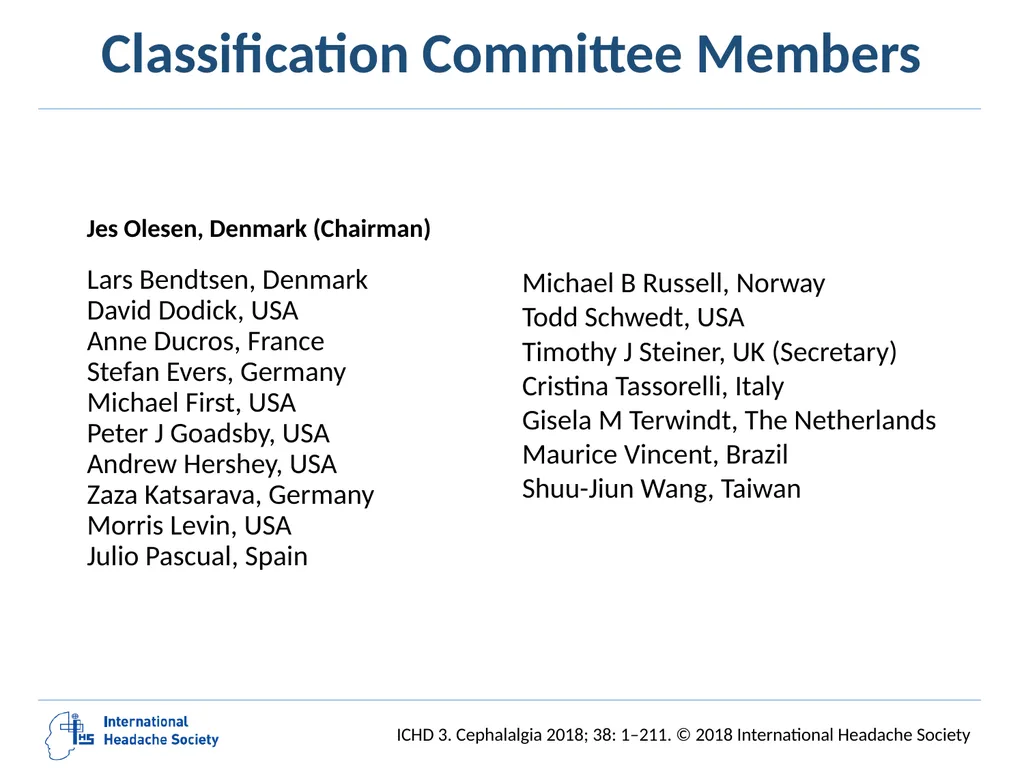
Lars Bendtsen, Denmark
David Dodick, USA
Anne Ducros, France
Stefan Evers, Germany
Michael First, USA
Peter J Goadsby, USA
Andrew Hershey, USA
Zaza Katsarava, Germany
Morris Levin, USA
Julio Pascual, Spain Michael B Russell, Norway
Todd Schwedt, USA
Timothy J Steiner, UK (Secretary)
Cristina Tassorelli, Italy
Gisela M Terwindt, The Netherlands
Maurice Vincent, Brazil
Shuu-Jiun Wang, Taiwan Jes Olesen, Denmark (Chairman) Classification Committee Members ICHD 3. Cephalalgia 2018; 38: 1–211. © 2018 International Headache Society<br>
David Dodick, USA
Anne Ducros, France
Stefan Evers, Germany
Michael First, USA
Peter J Goadsby, USA
Andrew Hershey, USA
Zaza Katsarava, Germany
Morris Levin, USA
Julio Pascual, Spain Michael B Russell, Norway
Todd Schwedt, USA
Timothy J Steiner, UK (Secretary)
Cristina Tassorelli, Italy
Gisela M Terwindt, The Netherlands
Maurice Vincent, Brazil
Shuu-Jiun Wang, Taiwan Jes Olesen, Denmark (Chairman) Classification Committee Members ICHD 3. Cephalalgia 2018; 38: 1–211. © 2018 International Headache Society<br>
03
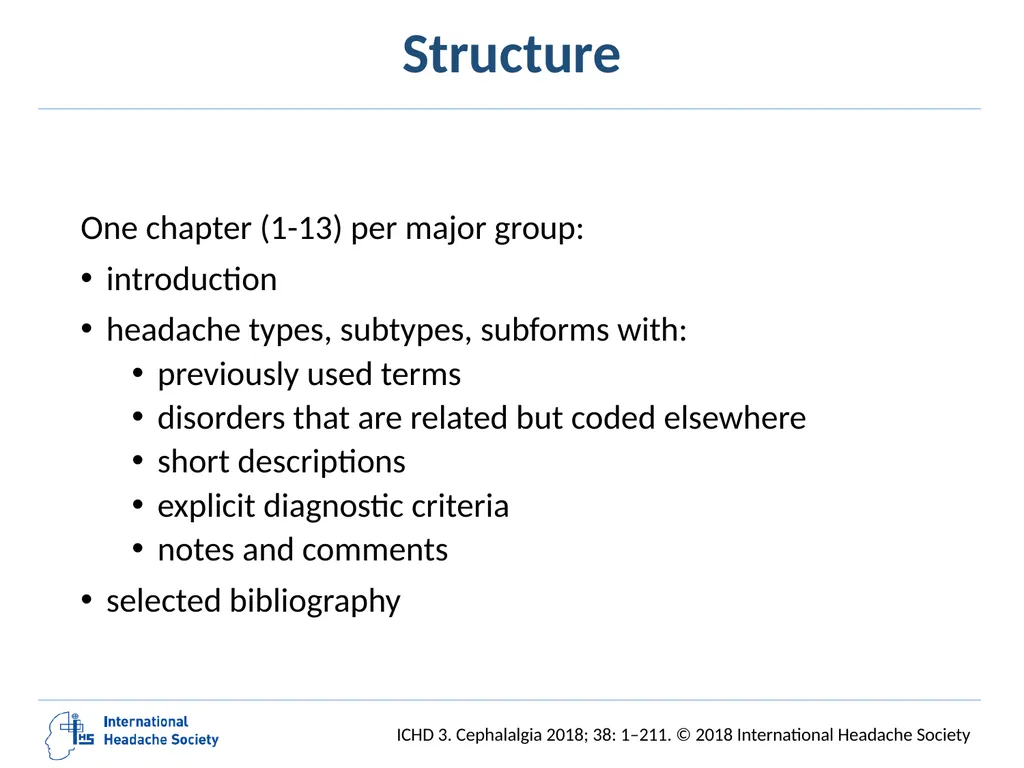
One chapter (1-13) per major group:
introduction
headache types, subtypes, subforms with:
previously used terms
disorders that are related but coded elsewhere
short descriptions
explicit diagnostic criteria
notes and comments
selected bibliography Structure ICHD 3. Cephalalgia 2018; 38: 1–211. © 2018 International Headache Society<br>
introduction
headache types, subtypes, subforms with:
previously used terms
disorders that are related but coded elsewhere
short descriptions
explicit diagnostic criteria
notes and comments
selected bibliography Structure ICHD 3. Cephalalgia 2018; 38: 1–211. © 2018 International Headache Society<br>
04
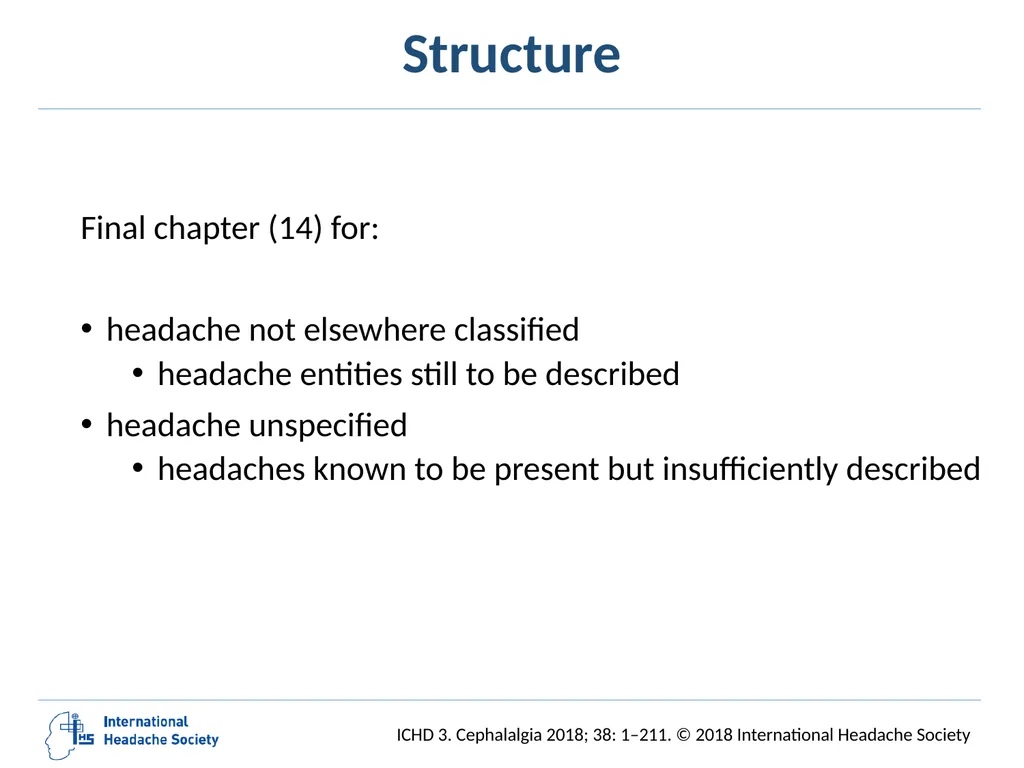
Final chapter (14) for:
headache not elsewhere classified
headache entities still to be described
headache unspecified
headaches known to be present but insufficiently described Structure ICHD 3. Cephalalgia 2018; 38: 1–211. © 2018 International Headache Society<br>
headache not elsewhere classified
headache entities still to be described
headache unspecified
headaches known to be present but insufficiently described Structure ICHD 3. Cephalalgia 2018; 38: 1–211. © 2018 International Headache Society<br>
05
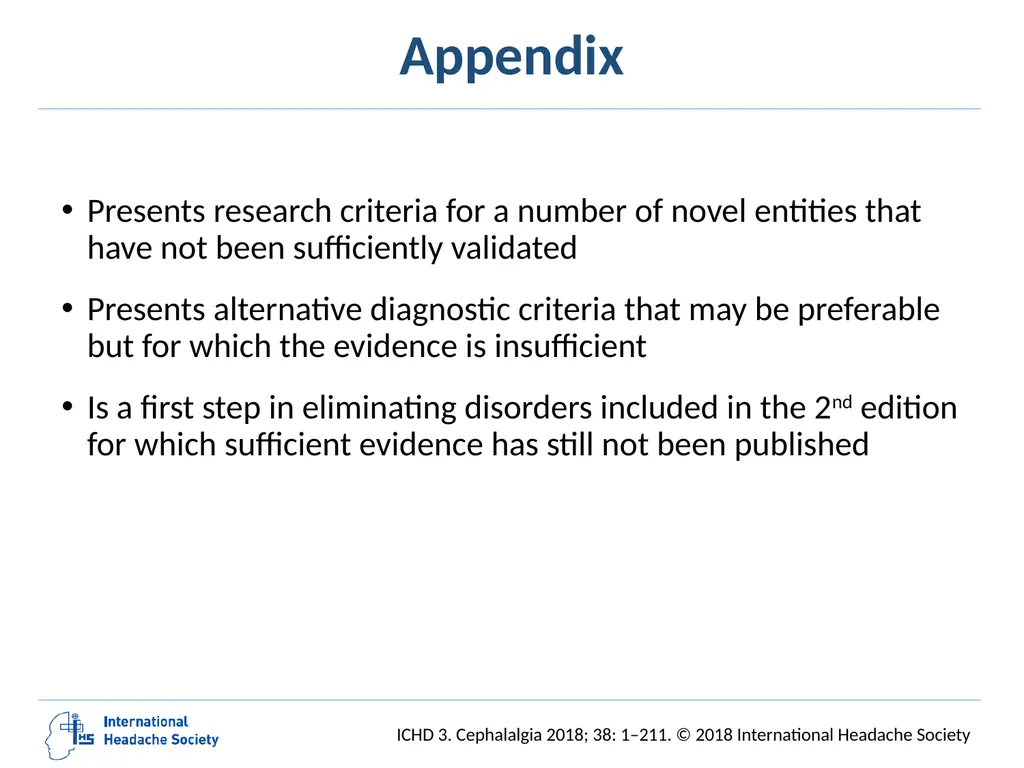
Appendix for:
research criteria for novel entities that have not been sufficiently validated
alternative diagnostic criteria that may be preferable but for which the evidence is insufficient
a first step in eliminating disorders included in the 2nd edition for which sufficient evidence has still not been published Structure ICHD 3. Cephalalgia 2018; 38: 1–211. © 2018 International Headache Society<br>
research criteria for novel entities that have not been sufficiently validated
alternative diagnostic criteria that may be preferable but for which the evidence is insufficient
a first step in eliminating disorders included in the 2nd edition for which sufficient evidence has still not been published Structure ICHD 3. Cephalalgia 2018; 38: 1–211. © 2018 International Headache Society<br>
06
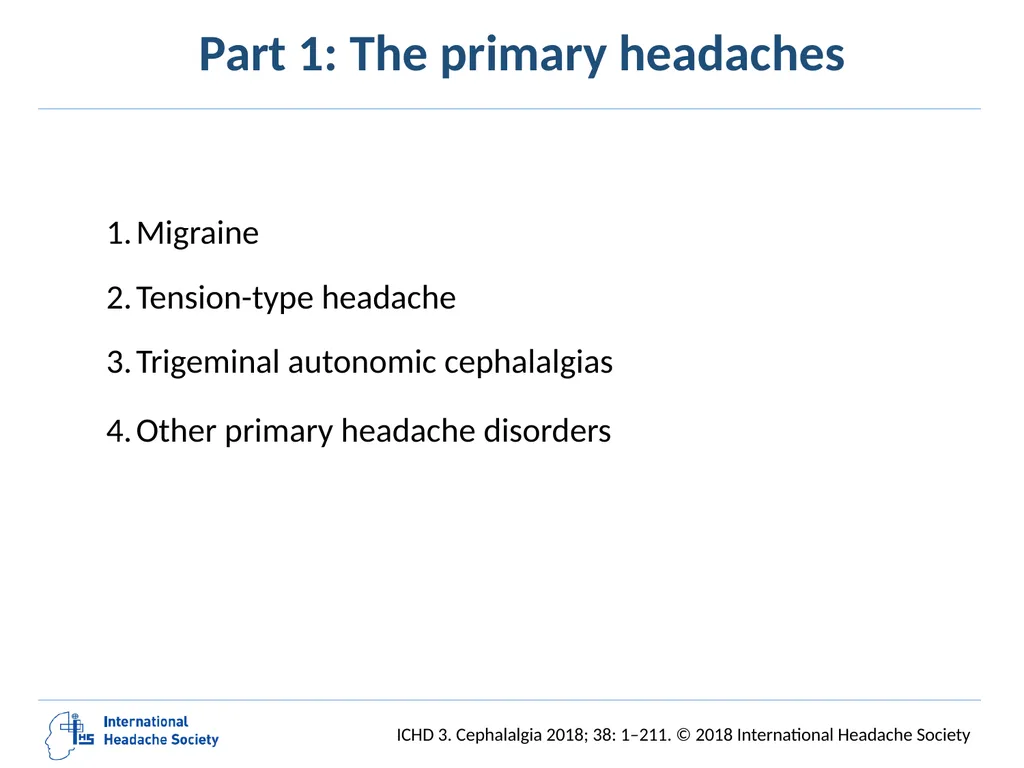
Part 1: The primary headaches
1. Migraine
2. Tension-type headache
3. Trigeminal autonomic cephalalgias
4. Other primary headache disorders Classification ICHD 3. Cephalalgia 2018; 38: 1–211. © 2018 International Headache Society<br>
1. Migraine
2. Tension-type headache
3. Trigeminal autonomic cephalalgias
4. Other primary headache disorders Classification ICHD 3. Cephalalgia 2018; 38: 1–211. © 2018 International Headache Society<br>
07
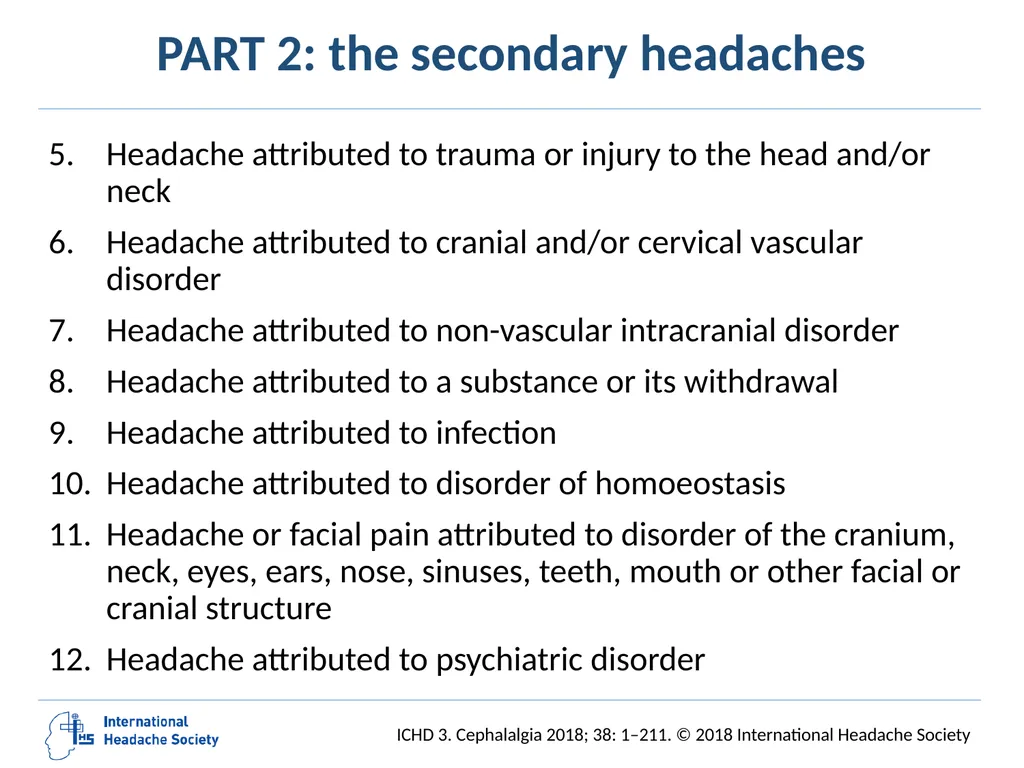
Part 2: The secondary headaches
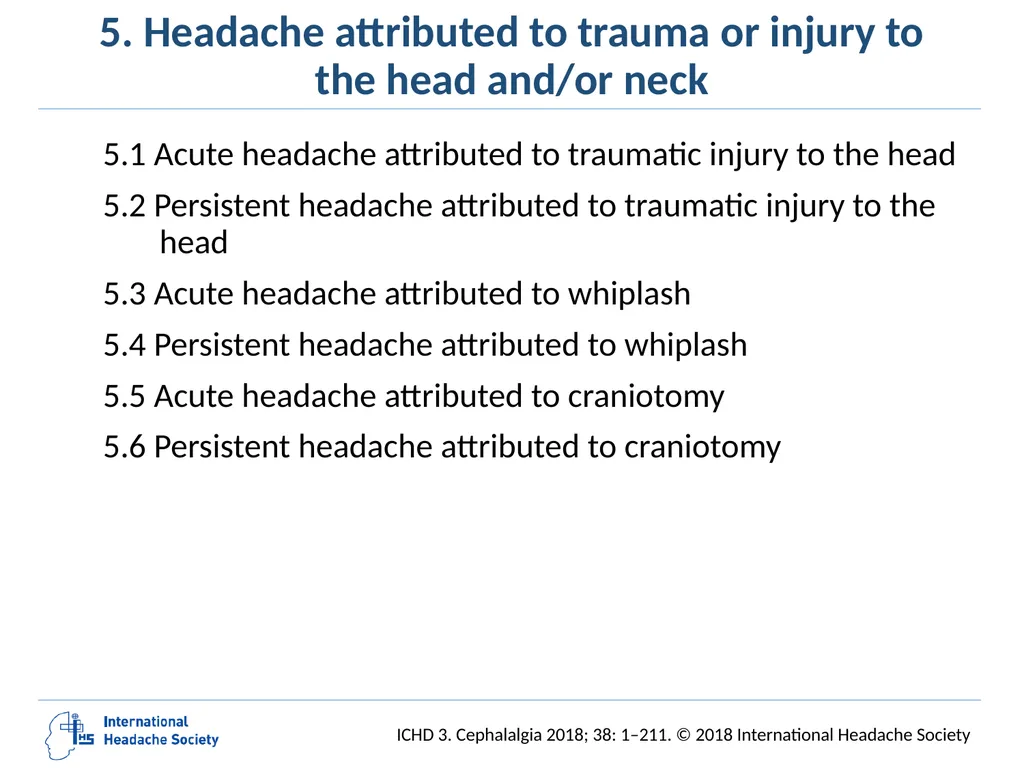
5. Headache attributed to trauma or injury to the head and/or neck
6. Headache attributed to cranial or cervical vascular disorder
7. Headache attributed to non-vascular intracranial disorder
8. Headache attributed to a substance or its withdrawal
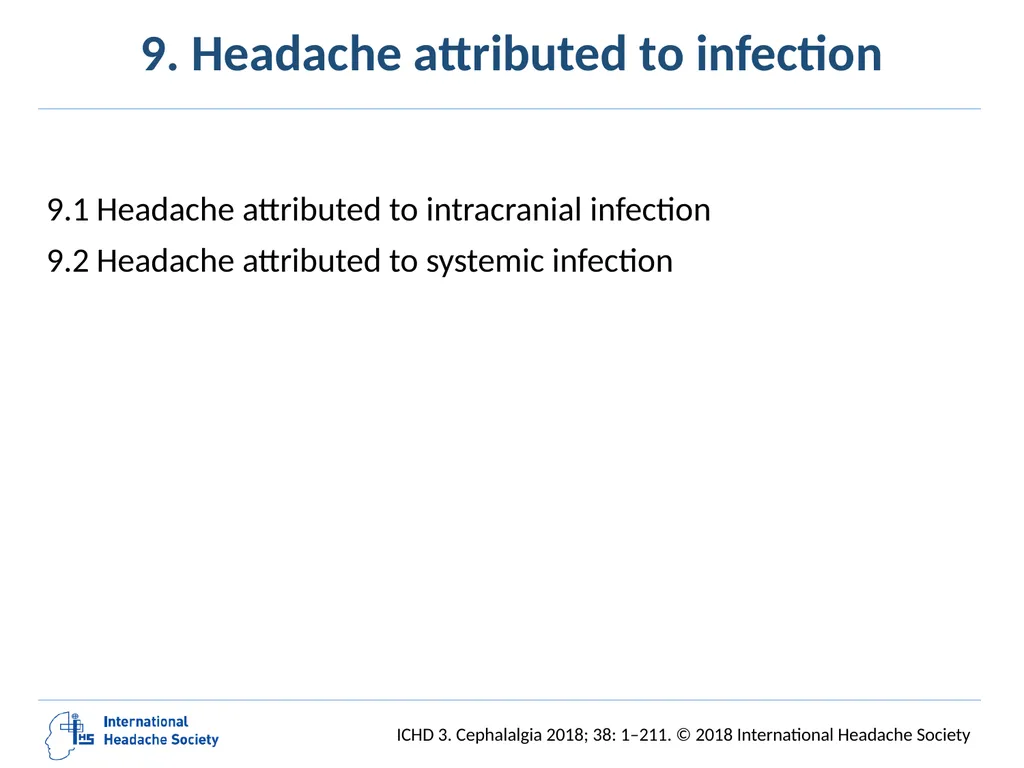
Headache attributed to infection
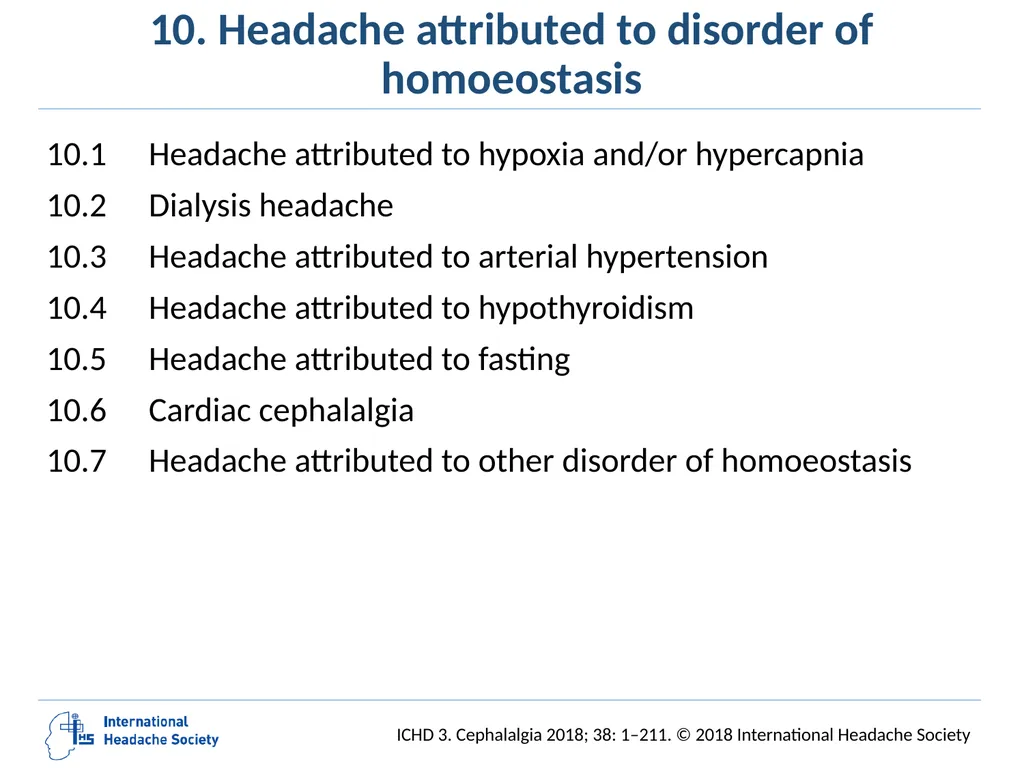
Headache attributed to disorder of homoeostasis
11. Headache or facial pain attributed to disorder of the cranium, neck, eyes, ears, nose, sinuses, teeth, mouth or other facial or cervical structure
12. Headache attributed to psychiatric disorder Classification ICHD 3. Cephalalgia 2018; 38: 1–211. © 2018 International Headache Society<br>
5. Headache attributed to trauma or injury to the head and/or neck
6. Headache attributed to cranial or cervical vascular disorder
7. Headache attributed to non-vascular intracranial disorder
8. Headache attributed to a substance or its withdrawal
Headache attributed to infection
Headache attributed to disorder of homoeostasis
11. Headache or facial pain attributed to disorder of the cranium, neck, eyes, ears, nose, sinuses, teeth, mouth or other facial or cervical structure
12. Headache attributed to psychiatric disorder Classification ICHD 3. Cephalalgia 2018; 38: 1–211. © 2018 International Headache Society<br>
08
Part 3: Painful cranial neuropathies and facial pain
Painful cranial neuropathies and other facial pains
Other headache disorders Classification ICHD 3. Cephalalgia 2018; 38: 1–211. © 2018 International Headache Society<br>
Painful cranial neuropathies and other facial pains
Other headache disorders Classification ICHD 3. Cephalalgia 2018; 38: 1–211. © 2018 International Headache Society<br>
09
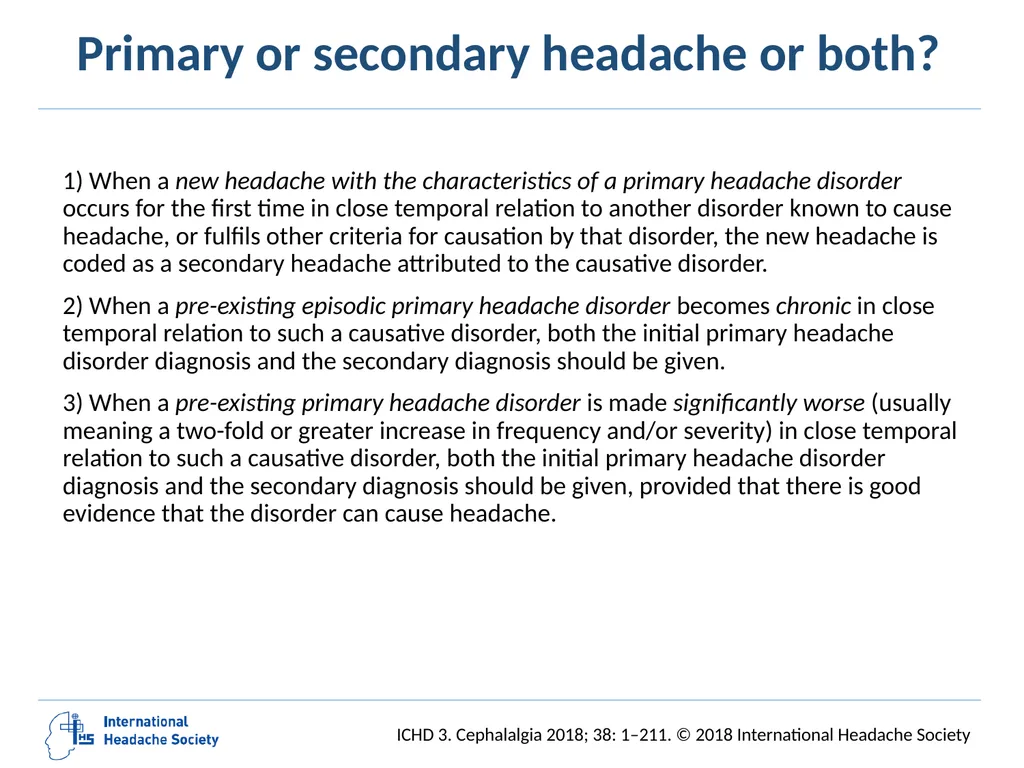
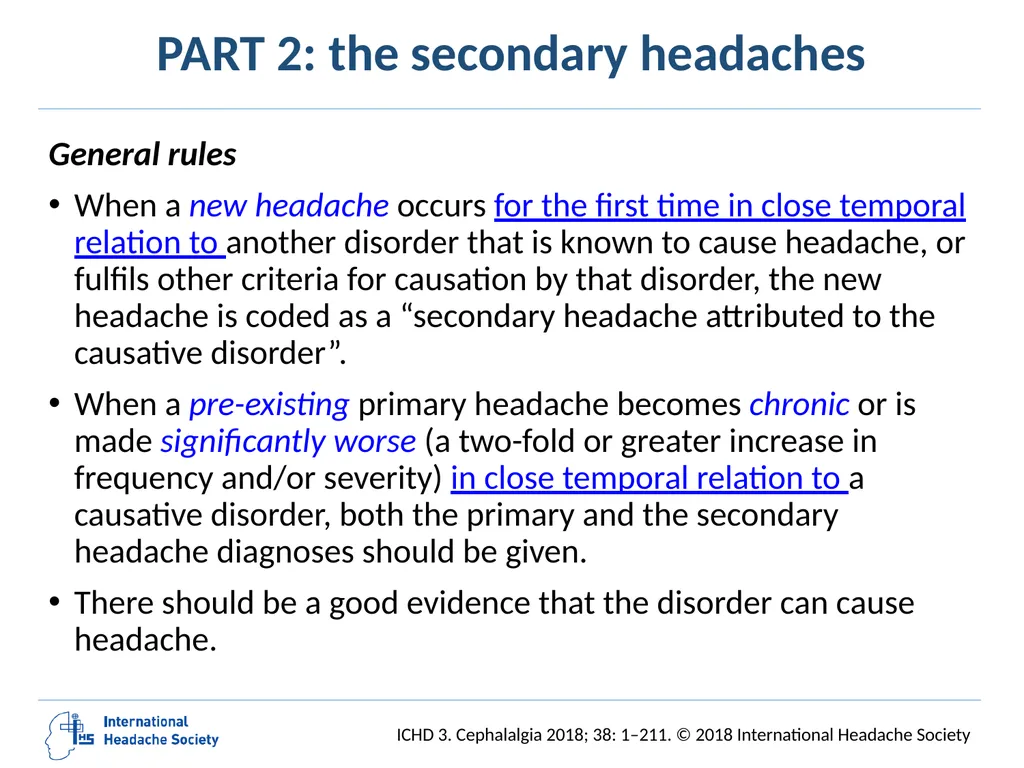
1) When a new headache with the characteristics of a primary headache disorder
occurs for the first time in close temporal relation to another disorder known to cause headache, or fulfils other criteria for causation by that disorder, the new headache is
coded as a secondary headache attributed to the causative disorder.
2) When a pre-existing episodic primary headache disorder becomes chronic in close temporal relation to such a causative disorder, both the initial primary headache disorder diagnosis and the secondary diagnosis should be given.
3) When a pre-existing primary headache disorder is made significantly worse (usually meaning a two-fold or greater increase in frequency and/or severity) in close temporal relation to such a causative disorder, both the initial primary headache disorder diagnosis and the secondary diagnosis should be given, provided that there is good evidence that the disorder can cause headache. Primary or secondary headache or both? ICHD 3. Cephalalgia 2018; 38: 1–211. © 2018 International Headache Society<br>
2) When a pre-existing episodic primary headache disorder becomes chronic in close temporal relation to such a causative disorder, both the initial primary headache disorder diagnosis and the secondary diagnosis should be given.
3) When a pre-existing primary headache disorder is made significantly worse (usually meaning a two-fold or greater increase in frequency and/or severity) in close temporal relation to such a causative disorder, both the initial primary headache disorder diagnosis and the secondary diagnosis should be given, provided that there is good evidence that the disorder can cause headache. Primary or secondary headache or both? ICHD 3. Cephalalgia 2018; 38: 1–211. © 2018 International Headache Society<br>
10
Part 1: The primary headaches 1. Migraine
2. Tension-type headache
3. Trigeminal autonomic cephalalgias
4. Other primary headache disorders ICHD 3. Cephalalgia 2018; 38: 1–211. © 2018 International Headache Society<br>
2. Tension-type headache
3. Trigeminal autonomic cephalalgias
4. Other primary headache disorders ICHD 3. Cephalalgia 2018; 38: 1–211. © 2018 International Headache Society<br>
11
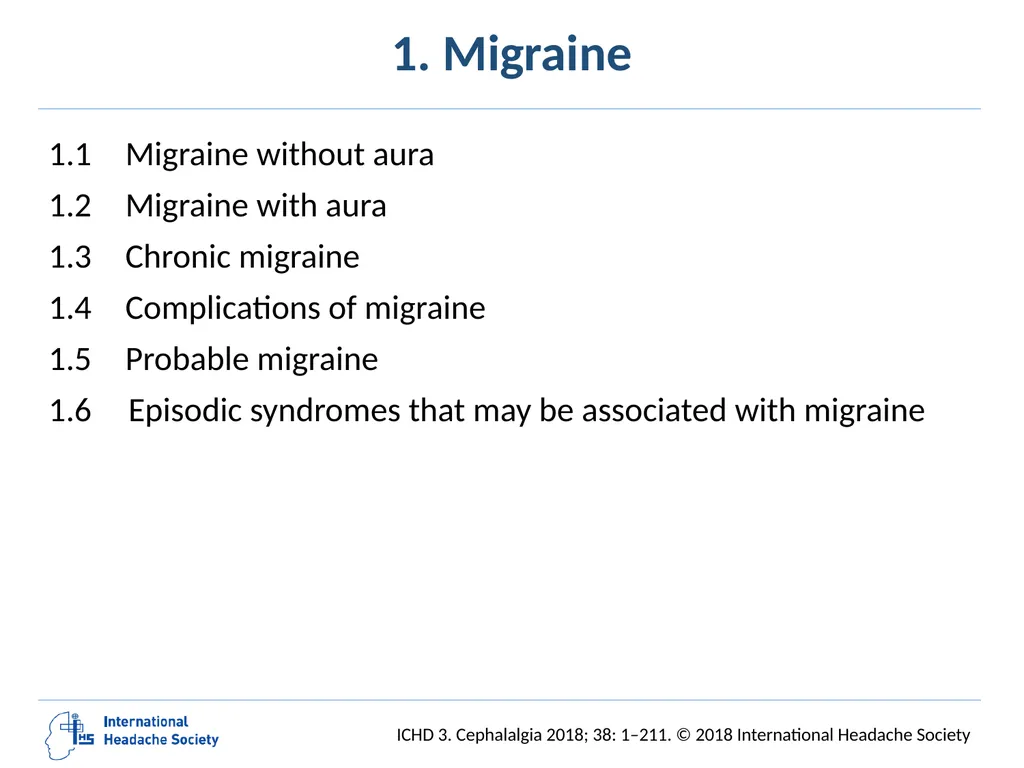
1. Migraine 1.1 Migraine without aura
1.2 Migraine with aura
1.3 Chronic migraine
1.4 Complications of migraine
1.5 Probable migraine
1.6 Episodic syndromes that may be associated with migraine ICHD 3. Cephalalgia 2018; 38: 1–211. © 2018 International Headache Society<br>
1.2 Migraine with aura
1.3 Chronic migraine
1.4 Complications of migraine
1.5 Probable migraine
1.6 Episodic syndromes that may be associated with migraine ICHD 3. Cephalalgia 2018; 38: 1–211. © 2018 International Headache Society<br>
12
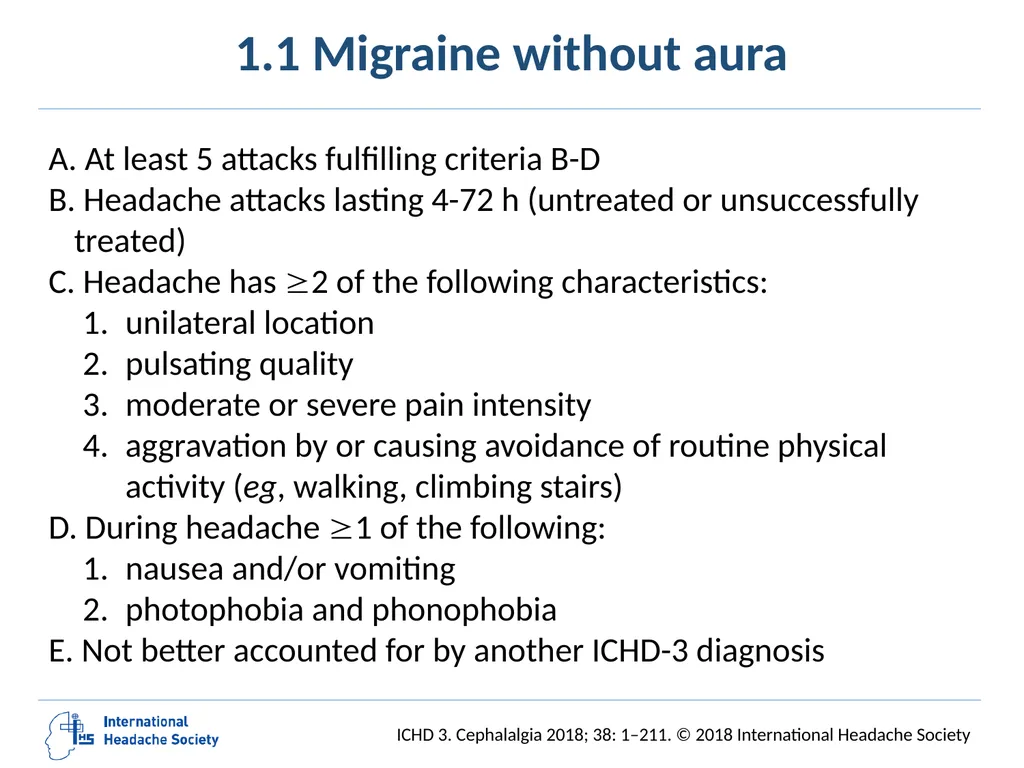
1.1 Migraine without aura A. At least 5 attacks fulfilling criteria B-D
B. Headache attacks lasting 4-72 h (untreated or unsuccessfully treated)
C. Headache has 2 of the following characteristics:
1. unilateral location
2. pulsating quality
3. moderate or severe pain intensity
4. aggravation by or causing avoidance of routine physical activity (eg, walking, climbing stairs)
D. During headache 1 of the following:
1. nausea and/or vomiting
2. photophobia and phonophobia
E. Not better accounted for by another ICHD-3 diagnosis ICHD 3. Cephalalgia 2018; 38: 1–211. © 2018 International Headache Society<br>
B. Headache attacks lasting 4-72 h (untreated or unsuccessfully treated)
C. Headache has 2 of the following characteristics:
1. unilateral location
2. pulsating quality
3. moderate or severe pain intensity
4. aggravation by or causing avoidance of routine physical activity (eg, walking, climbing stairs)
D. During headache 1 of the following:
1. nausea and/or vomiting
2. photophobia and phonophobia
E. Not better accounted for by another ICHD-3 diagnosis ICHD 3. Cephalalgia 2018; 38: 1–211. © 2018 International Headache Society<br>
13
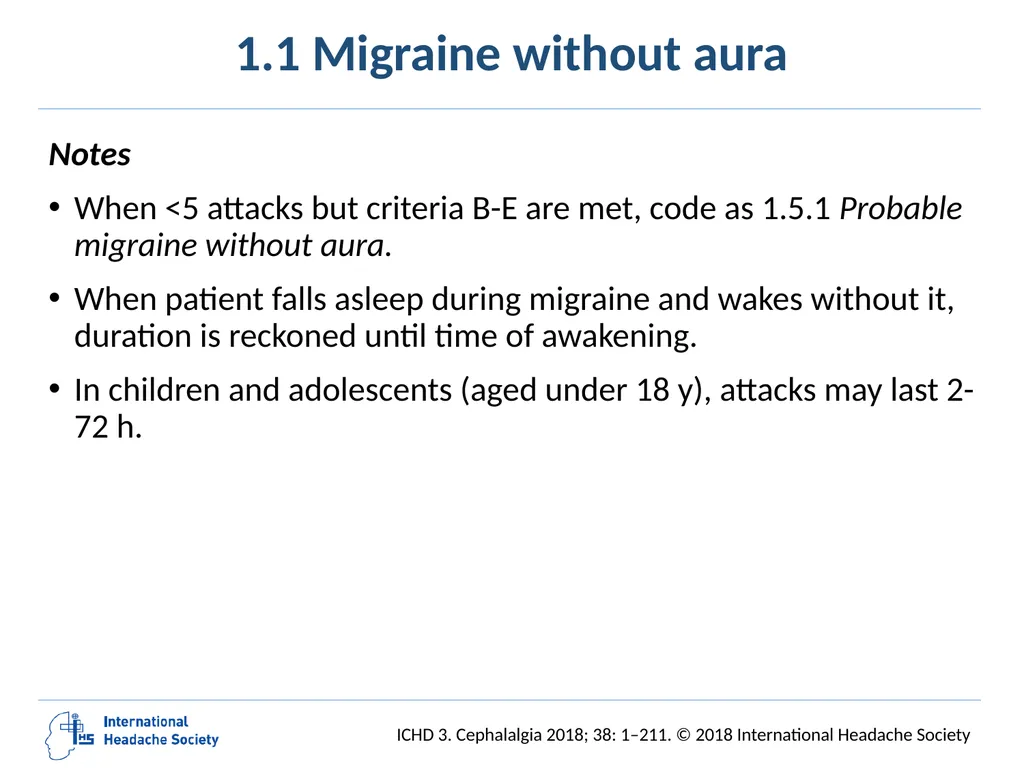
1.1 Migraine without aura Notes
When <5 attacks but criteria B-E are met, code as 1.5.1 Probable migraine without aura.
When patient falls asleep during migraine and wakes without it, duration is reckoned until time of awakening.
In children and adolescents (aged under 18 y), attacks may last 2-72 h. ICHD 3. Cephalalgia 2018; 38: 1–211. © 2018 International Headache Society<br>
When <5 attacks but criteria B-E are met, code as 1.5.1 Probable migraine without aura.
When patient falls asleep during migraine and wakes without it, duration is reckoned until time of awakening.
In children and adolescents (aged under 18 y), attacks may last 2-72 h. ICHD 3. Cephalalgia 2018; 38: 1–211. © 2018 International Headache Society<br>
14
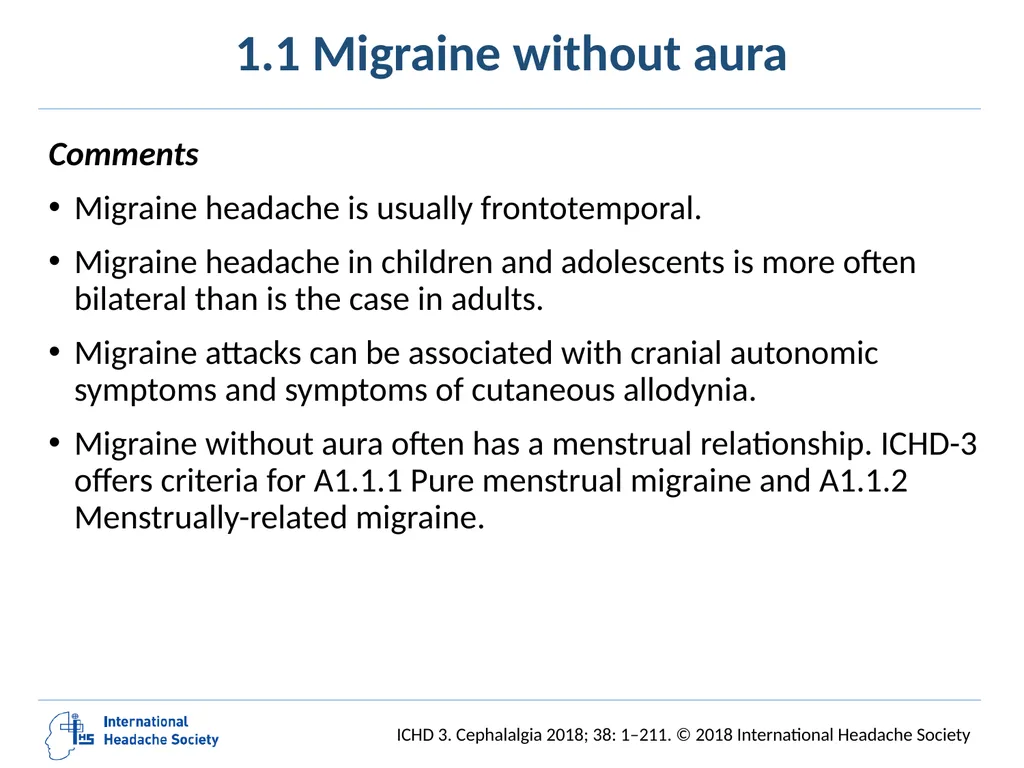
1.1 Migraine without aura Comments
Migraine headache is usually frontotemporal.
Migraine headache in children and adolescents is more often bilateral than is the case in adults.
Migraine attacks can be associated with cranial autonomic symptoms and symptoms of cutaneous allodynia.
Migraine without aura often has a menstrual relationship. ICHD-3 offers criteria for A1.1.1 Pure menstrual migraine and A1.1.2 Menstrually-related migraine. ICHD 3. Cephalalgia 2018; 38: 1–211. © 2018 International Headache Society<br>
Migraine headache is usually frontotemporal.
Migraine headache in children and adolescents is more often bilateral than is the case in adults.
Migraine attacks can be associated with cranial autonomic symptoms and symptoms of cutaneous allodynia.
Migraine without aura often has a menstrual relationship. ICHD-3 offers criteria for A1.1.1 Pure menstrual migraine and A1.1.2 Menstrually-related migraine. ICHD 3. Cephalalgia 2018; 38: 1–211. © 2018 International Headache Society<br>
15
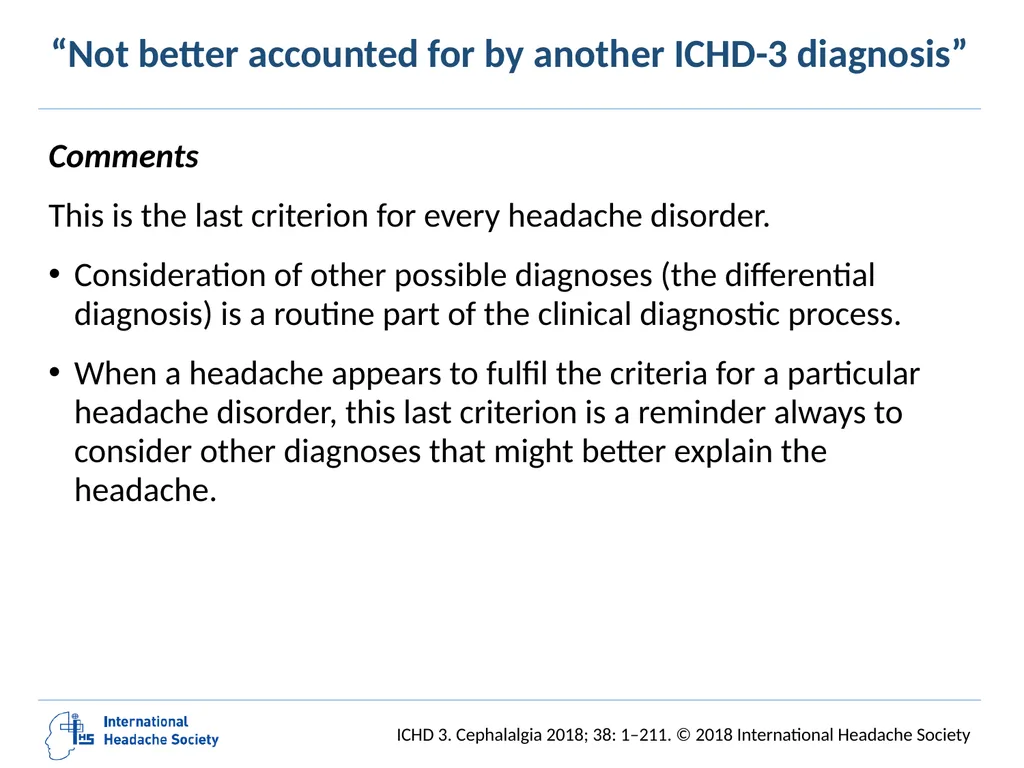
ICHD 3. Cephalalgia 2018; 38: 1–211. © 2018 International Headache Society “Not better accounted for by another ICHD-3 diagnosis” Comments
This is the last criterion for every headache disorder.
Consideration of other possible diagnoses (the differential diagnosis) is a routine part of the clinical diagnostic process.
When a headache appears to fulfil the criteria for a particular headache disorder, this last criterion is a reminder always to consider other diagnoses that might better explain the headache.<br>
This is the last criterion for every headache disorder.
Consideration of other possible diagnoses (the differential diagnosis) is a routine part of the clinical diagnostic process.
When a headache appears to fulfil the criteria for a particular headache disorder, this last criterion is a reminder always to consider other diagnoses that might better explain the headache.<br>
16
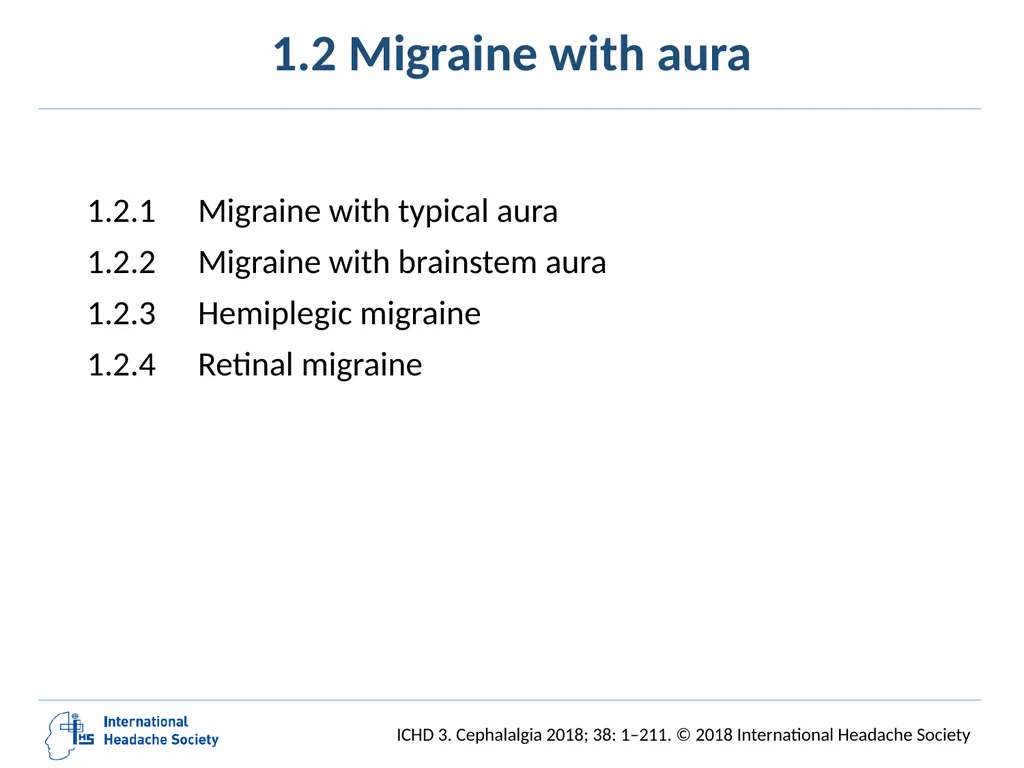
1.2 Migraine with aura 1.2.1 Migraine with typical aura
1.2.2 Migraine with brainstem aura
1.2.3 Hemiplegic migraine
1.2.4 Retinal migraine ICHD 3. Cephalalgia 2018; 38: 1–211. © 2018 International Headache Society<br>
1.2.2 Migraine with brainstem aura
1.2.3 Hemiplegic migraine
1.2.4 Retinal migraine ICHD 3. Cephalalgia 2018; 38: 1–211. © 2018 International Headache Society<br>
17
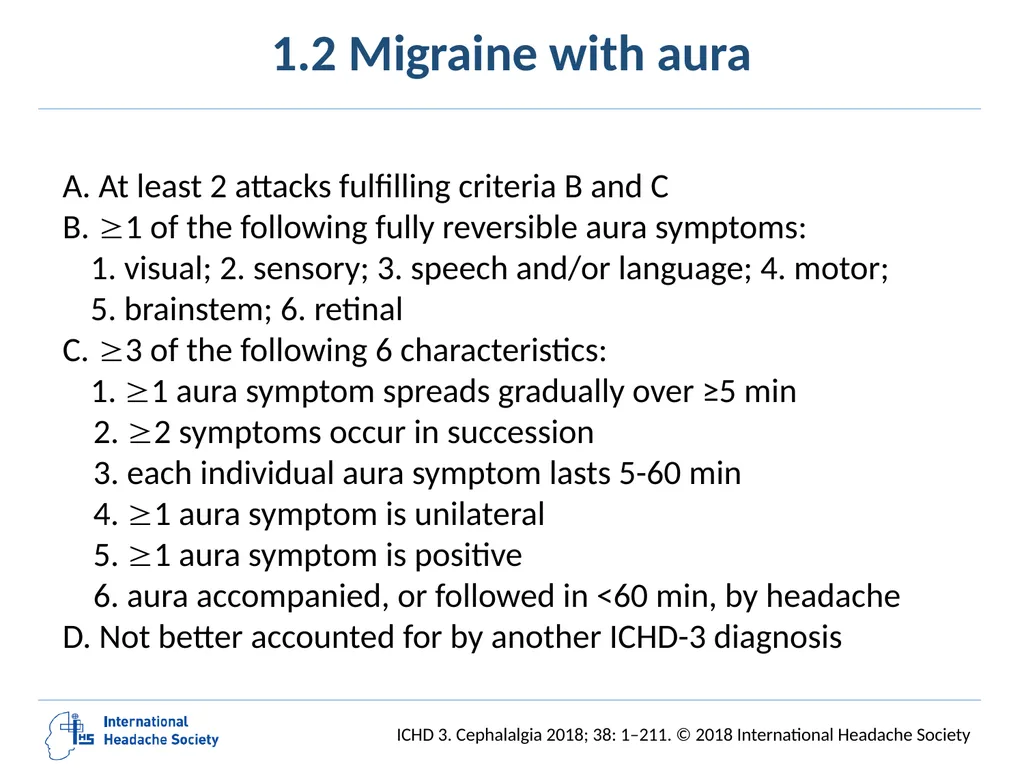
1.2 Migraine with aura ICHD 3. Cephalalgia 2018; 38: 1–211. © 2018 International Headache Society A. At least 2 attacks fulfilling criteria B and C
B. 1 of the following fully reversible aura symptoms:
1. visual; 2. sensory; 3. speech and/or language; 4. motor; 5. brainstem; 6. retinal
C. 3 of the following 6 characteristics:
1. 1 aura symptom spreads gradually over ≥5 min
2. 2 symptoms occur in succession
3. each individual aura symptom lasts 5-60 min
4. 1 aura symptom is unilateral
5. 1 aura symptom is positive
6. aura accompanied, or followed in <60 min, by headache
D. Not better accounted for by another ICHD-3 diagnosis<br>
B. 1 of the following fully reversible aura symptoms:
1. visual; 2. sensory; 3. speech and/or language; 4. motor; 5. brainstem; 6. retinal
C. 3 of the following 6 characteristics:
1. 1 aura symptom spreads gradually over ≥5 min
2. 2 symptoms occur in succession
3. each individual aura symptom lasts 5-60 min
4. 1 aura symptom is unilateral
5. 1 aura symptom is positive
6. aura accompanied, or followed in <60 min, by headache
D. Not better accounted for by another ICHD-3 diagnosis<br>
18
1.2 Migraine with aura Notes
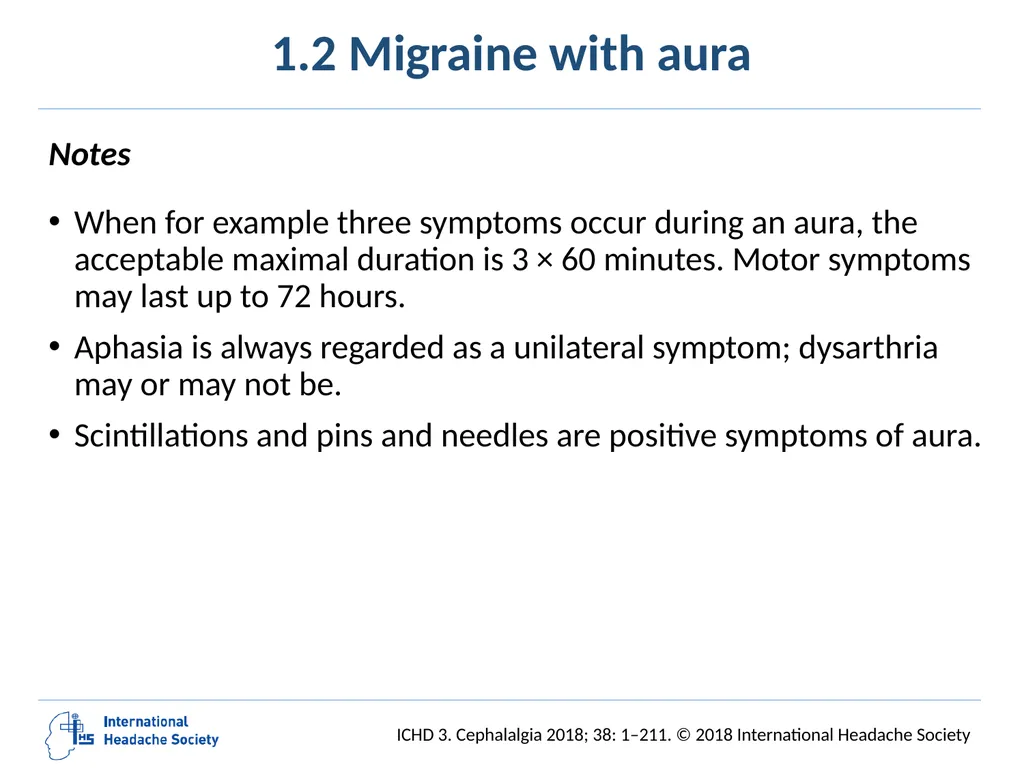
When for example three symptoms occur during an aura, the acceptable maximal duration is 3 × 60 minutes. Motor symptoms may last up to 72 hours.
Aphasia is always regarded as a unilateral symptom; dysarthria may or may not be.
Scintillations and pins and needles are positive symptoms of aura. ICHD 3. Cephalalgia 2018; 38: 1–211. © 2018 International Headache Society<br>
When for example three symptoms occur during an aura, the acceptable maximal duration is 3 × 60 minutes. Motor symptoms may last up to 72 hours.
Aphasia is always regarded as a unilateral symptom; dysarthria may or may not be.
Scintillations and pins and needles are positive symptoms of aura. ICHD 3. Cephalalgia 2018; 38: 1–211. © 2018 International Headache Society<br>
19
1.2 Migraine with aura Comments
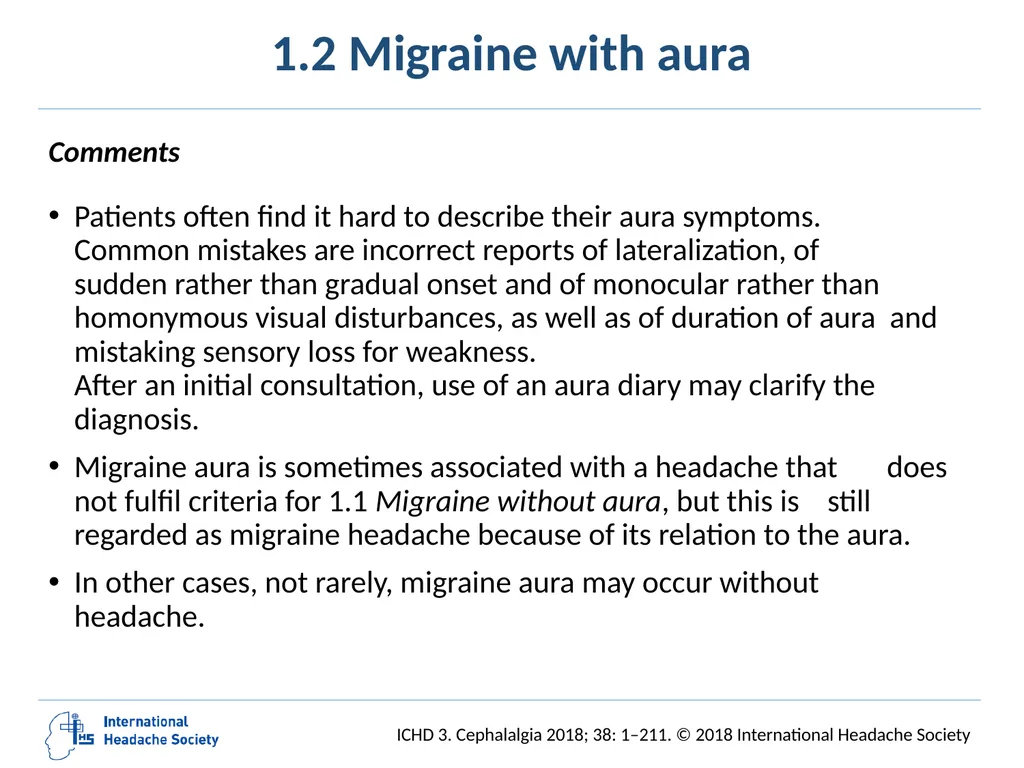
Patients often find it hard to describe their aura symptoms. Common mistakes are incorrect reports of lateralization, of sudden rather than gradual onset and of monocular rather than homonymous visual disturbances, as well as of duration of aura and mistaking sensory loss for weakness. After an initial consultation, use of an aura diary may clarify the diagnosis.
Migraine aura is sometimes associated with a headache that does not fulfil criteria for 1.1 Migraine without aura, but this is still regarded as migraine headache because of its relation to the aura.
In other cases, not rarely, migraine aura may occur without headache. ICHD 3. Cephalalgia 2018; 38: 1–211. © 2018 International Headache Society<br>
Patients often find it hard to describe their aura symptoms. Common mistakes are incorrect reports of lateralization, of sudden rather than gradual onset and of monocular rather than homonymous visual disturbances, as well as of duration of aura and mistaking sensory loss for weakness. After an initial consultation, use of an aura diary may clarify the diagnosis.
Migraine aura is sometimes associated with a headache that does not fulfil criteria for 1.1 Migraine without aura, but this is still regarded as migraine headache because of its relation to the aura.
In other cases, not rarely, migraine aura may occur without headache. ICHD 3. Cephalalgia 2018; 38: 1–211. © 2018 International Headache Society<br>
20
A. Attacks fulfilling criteria for 1.2 Migraine with aura and
criterion B below
B. Aura with both of the following:
1. fully reversible visual, sensory and/or speech/language symptoms
2. no motor, brainstem or retinal symptoms. 1.2.1 Migraine with typical aura Two subtypes
1.2.1.1 Typical aura with headache
1.2.1.2 Typical aura without headache ICHD 3. Cephalalgia 2018; 38: 1–211. © 2018 International Headache Society<br>
1. fully reversible visual, sensory and/or speech/language symptoms
2. no motor, brainstem or retinal symptoms. 1.2.1 Migraine with typical aura Two subtypes
1.2.1.1 Typical aura with headache
1.2.1.2 Typical aura without headache ICHD 3. Cephalalgia 2018; 38: 1–211. © 2018 International Headache Society<br>
21
A. Attacks fulfilling criteria for 1.2 Migraine with aura and
criterion B below
B. Aura with both of the following:
1. at least two of the following fully reversible brainstem symptoms:
a. dysarthria; b. vertigo; c. tinnitus; d. hypacusis; e. diplopia; f. ataxia not attributable to sensory deficit; g. decreased level of consciousness (GCS < 13)
2. no motor or retinal symptoms 1.2.2 Migraine with brainstem aura ICHD 3. Cephalalgia 2018; 38: 1–211. © 2018 International Headache Society<br>
B. Aura with both of the following:
1. at least two of the following fully reversible brainstem symptoms:
a. dysarthria; b. vertigo; c. tinnitus; d. hypacusis; e. diplopia; f. ataxia not attributable to sensory deficit; g. decreased level of consciousness (GCS < 13)
2. no motor or retinal symptoms 1.2.2 Migraine with brainstem aura ICHD 3. Cephalalgia 2018; 38: 1–211. © 2018 International Headache Society<br>
22
1.2.2 Migraine with brainstem aura Notes
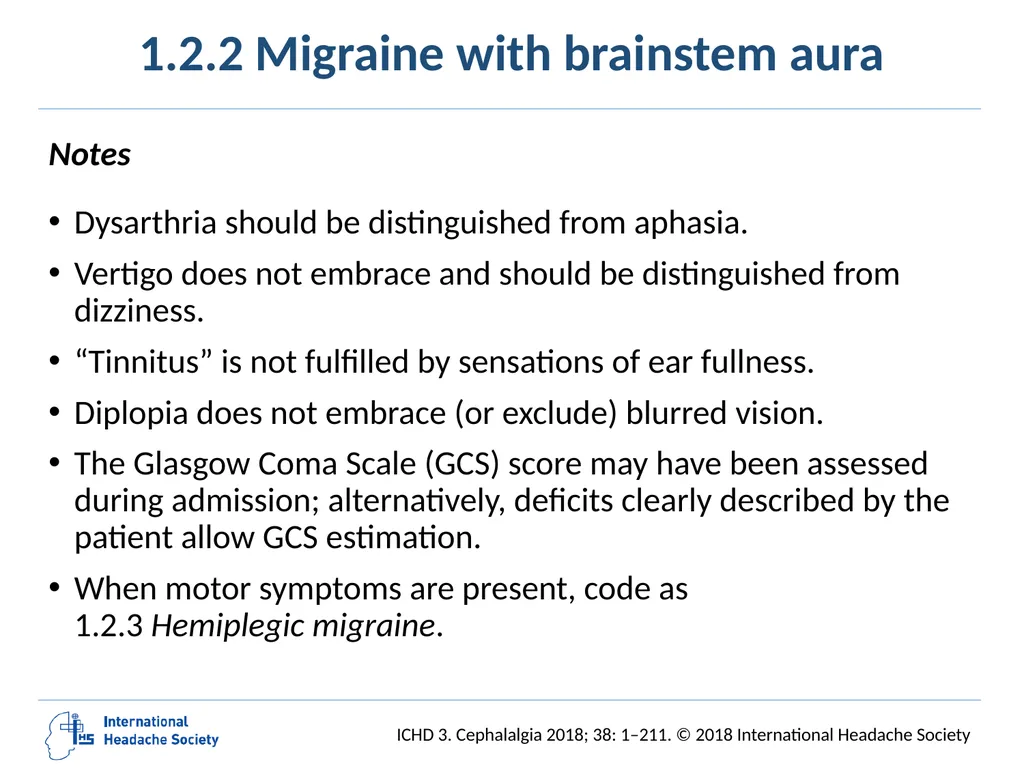
Dysarthria should be distinguished from aphasia.
Vertigo does not embrace and should be distinguished from dizziness.
“Tinnitus” is not fulfilled by sensations of ear fullness.
Diplopia does not embrace (or exclude) blurred vision.
The Glasgow Coma Scale (GCS) score may have been assessed during admission; alternatively, deficits clearly described by the patient allow GCS estimation.
When motor symptoms are present, code as 1.2.3 Hemiplegic migraine. ICHD 3. Cephalalgia 2018; 38: 1–211. © 2018 International Headache Society<br>
Dysarthria should be distinguished from aphasia.
Vertigo does not embrace and should be distinguished from dizziness.
“Tinnitus” is not fulfilled by sensations of ear fullness.
Diplopia does not embrace (or exclude) blurred vision.
The Glasgow Coma Scale (GCS) score may have been assessed during admission; alternatively, deficits clearly described by the patient allow GCS estimation.
When motor symptoms are present, code as 1.2.3 Hemiplegic migraine. ICHD 3. Cephalalgia 2018; 38: 1–211. © 2018 International Headache Society<br>
23
1.2.2 Migraine with brainstem aura Comments
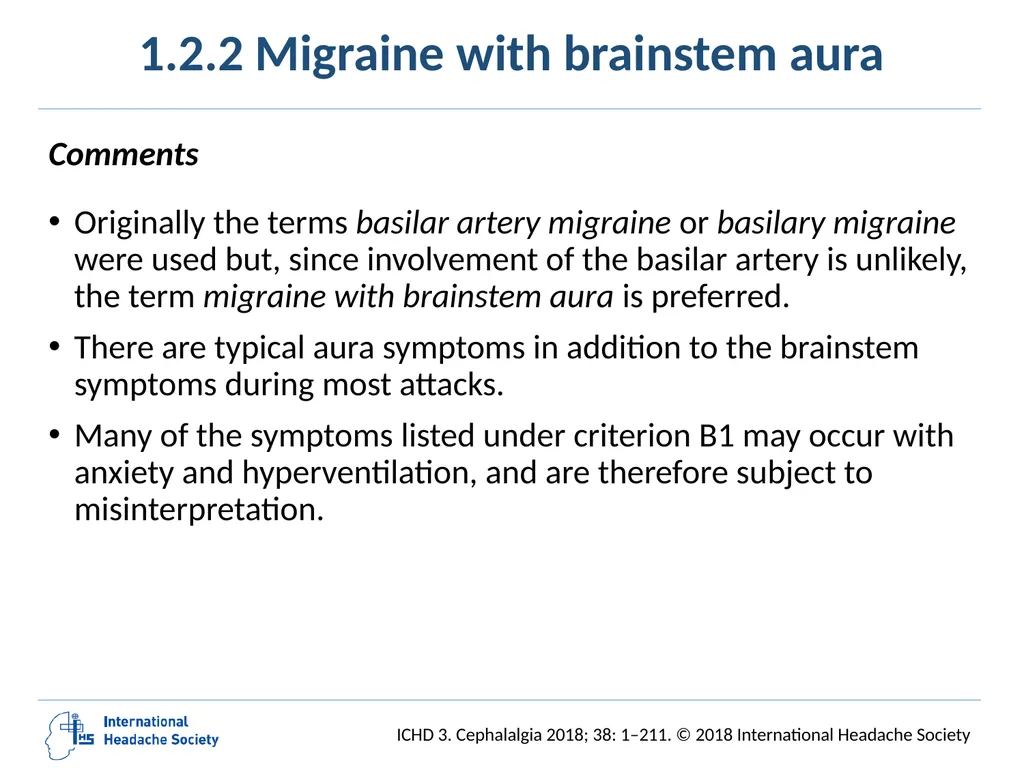
Originally the terms basilar artery migraine or basilary migraine were used but, since involvement of the basilar artery is unlikely, the term migraine with brainstem aura is preferred.
There are typical aura symptoms in addition to the brainstem symptoms during most attacks.
Many of the symptoms listed under criterion B1 may occur with anxiety and hyperventilation, and are therefore subject to misinterpretation. ICHD 3. Cephalalgia 2018; 38: 1–211. © 2018 International Headache Society<br>
Originally the terms basilar artery migraine or basilary migraine were used but, since involvement of the basilar artery is unlikely, the term migraine with brainstem aura is preferred.
There are typical aura symptoms in addition to the brainstem symptoms during most attacks.
Many of the symptoms listed under criterion B1 may occur with anxiety and hyperventilation, and are therefore subject to misinterpretation. ICHD 3. Cephalalgia 2018; 38: 1–211. © 2018 International Headache Society<br>
24
Attacks fulfilling criteria for 1. Migraine with aura and criterion B below
Aura consisting of both of the following:
fully reversible motor weakness
fully reversible visual, sensory and/or speech/language symptoms 1.2.3 Hemiplegic migraine ICHD 3. Cephalalgia 2018; 38: 1–211. © 2018 International Headache Society<br>
Aura consisting of both of the following:
fully reversible motor weakness
fully reversible visual, sensory and/or speech/language symptoms 1.2.3 Hemiplegic migraine ICHD 3. Cephalalgia 2018; 38: 1–211. © 2018 International Headache Society<br>
25
Notes
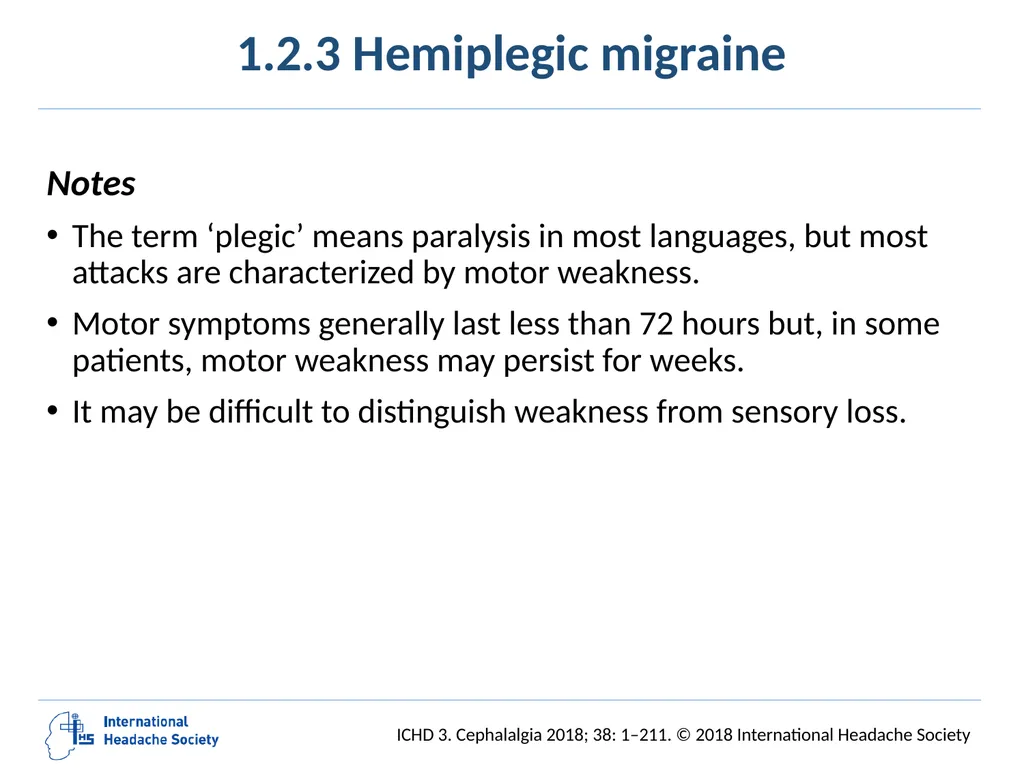
The term ‘plegic’ means paralysis in most languages, but most attacks are characterized by motor weakness.
Motor symptoms generally last less than 72 hours but, in some patients, motor weakness may persist for weeks.
It may be difficult to distinguish weakness from sensory loss. 1.2.3 Hemiplegic migraine ICHD 3. Cephalalgia 2018; 38: 1–211. © 2018 International Headache Society<br>
The term ‘plegic’ means paralysis in most languages, but most attacks are characterized by motor weakness.
Motor symptoms generally last less than 72 hours but, in some patients, motor weakness may persist for weeks.
It may be difficult to distinguish weakness from sensory loss. 1.2.3 Hemiplegic migraine ICHD 3. Cephalalgia 2018; 38: 1–211. © 2018 International Headache Society<br>
26
A. Fulfils criteria for 1.2.3 Hemiplegic migraine
B. At least one first- or second-degree relative has had attacks fulfilling criteria for 1.2.3 Hemiplegic migraine 1.2.3.1 Familial hemiplegic migraine (FHM) Three specific genetic subforms have been identified.
1.2.3.1.1 FHM type 1 (FHM1): CACNA1A
1.2.3.1.2 FHM type 2 (FHM2): ATP1A2
1.2.3.1.3 FHM type 3 (FHM3): SCN1A
1.2.3.1.4 no mutations in CACNA1A, ATP1A2 and SCN1A ICHD 3. Cephalalgia 2018; 38: 1–211. © 2018 International Headache Society<br>
B. At least one first- or second-degree relative has had attacks fulfilling criteria for 1.2.3 Hemiplegic migraine 1.2.3.1 Familial hemiplegic migraine (FHM) Three specific genetic subforms have been identified.
1.2.3.1.1 FHM type 1 (FHM1): CACNA1A
1.2.3.1.2 FHM type 2 (FHM2): ATP1A2
1.2.3.1.3 FHM type 3 (FHM3): SCN1A
1.2.3.1.4 no mutations in CACNA1A, ATP1A2 and SCN1A ICHD 3. Cephalalgia 2018; 38: 1–211. © 2018 International Headache Society<br>
27
1.2.3.1 Familial hemiplegic migraine (FHM) Comments
Three specific genetic subforms have been identified. There may be other loci not yet identified.
It has been shown that 1.2.3.1 Familial hemiplegic migraine very often presents with brainstem symptoms in addition to the typical aura symptoms, and that headache almost always occurs.
During FHM attacks, disturbances of consciousness (sometimes including coma), confusion, fever and CSF pleocytosis can occur.
FHM attacks can be triggered by (mild) head trauma.
In approximately 50% of FHM families, chronic progressive cerebellar ataxia occurs independently of the migraine attacks. ICHD 3. Cephalalgia 2018; 38: 1–211. © 2018 International Headache Society<br>
Three specific genetic subforms have been identified. There may be other loci not yet identified.
It has been shown that 1.2.3.1 Familial hemiplegic migraine very often presents with brainstem symptoms in addition to the typical aura symptoms, and that headache almost always occurs.
During FHM attacks, disturbances of consciousness (sometimes including coma), confusion, fever and CSF pleocytosis can occur.
FHM attacks can be triggered by (mild) head trauma.
In approximately 50% of FHM families, chronic progressive cerebellar ataxia occurs independently of the migraine attacks. ICHD 3. Cephalalgia 2018; 38: 1–211. © 2018 International Headache Society<br>
28
A. Fulfils criteria for 1.2.3 Hemiplegic migraine
B. No first- or second-degree relative has had attacks fulfilling criteria for 1.2.3 Hemiplegic migraine 1.2.3.2 Sporadic hemiplegic migraine ICHD 3. Cephalalgia 2018; 38: 1–211. © 2018 International Headache Society<br>
B. No first- or second-degree relative has had attacks fulfilling criteria for 1.2.3 Hemiplegic migraine 1.2.3.2 Sporadic hemiplegic migraine ICHD 3. Cephalalgia 2018; 38: 1–211. © 2018 International Headache Society<br>
29
Comments:
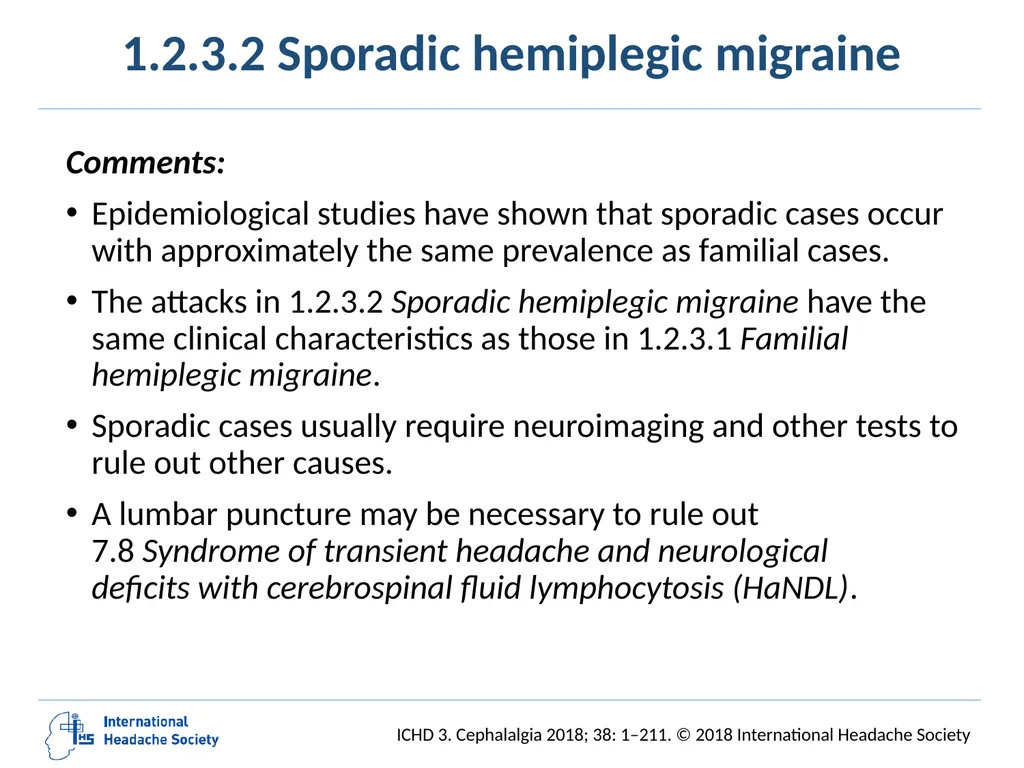
Epidemiological studies have shown that sporadic cases occur with approximately the same prevalence as familial cases.
The attacks in 1.2.3.2 Sporadic hemiplegic migraine have the same clinical characteristics as those in 1.2.3.1 Familial hemiplegic migraine.
Sporadic cases usually require neuroimaging and other tests to rule out other causes.
A lumbar puncture may be necessary to rule out 7.8 Syndrome of transient headache and neurological deficits with cerebrospinal fluid lymphocytosis (HaNDL). 1.2.3.2 Sporadic hemiplegic migraine ICHD 3. Cephalalgia 2018; 38: 1–211. © 2018 International Headache Society<br>
Epidemiological studies have shown that sporadic cases occur with approximately the same prevalence as familial cases.
The attacks in 1.2.3.2 Sporadic hemiplegic migraine have the same clinical characteristics as those in 1.2.3.1 Familial hemiplegic migraine.
Sporadic cases usually require neuroimaging and other tests to rule out other causes.
A lumbar puncture may be necessary to rule out 7.8 Syndrome of transient headache and neurological deficits with cerebrospinal fluid lymphocytosis (HaNDL). 1.2.3.2 Sporadic hemiplegic migraine ICHD 3. Cephalalgia 2018; 38: 1–211. © 2018 International Headache Society<br>
30
A. Attacks fulfilling criteria for 1.2 Migraine with aura and criterion B
below
B. Aura characterized by both of the following:
1. fully reversible, monocular, positive and/or negative visual phenomena (e. g. scintillations, scotomata or blindness) confirmed during an attack by either or both of the following: a. clinical visual field examination; b. the patient’s drawing of a monocular field defect (made after clear instruction)
2. at least two of the following: a. spreading gradually over 5 minutes; b. symptoms last 5-60 minutes; c. accompanied, or followed within 60 minutes, by headache
C. Not better accounted for by another ICHD-3 diagnosis, and other causes of amaurosis fugax have been excluded 1.2.4 Retinal migraine ICHD 3. Cephalalgia 2018; 38: 1–211. © 2018 International Headache Society<br>
B. Aura characterized by both of the following:
1. fully reversible, monocular, positive and/or negative visual phenomena (e. g. scintillations, scotomata or blindness) confirmed during an attack by either or both of the following: a. clinical visual field examination; b. the patient’s drawing of a monocular field defect (made after clear instruction)
2. at least two of the following: a. spreading gradually over 5 minutes; b. symptoms last 5-60 minutes; c. accompanied, or followed within 60 minutes, by headache
C. Not better accounted for by another ICHD-3 diagnosis, and other causes of amaurosis fugax have been excluded 1.2.4 Retinal migraine ICHD 3. Cephalalgia 2018; 38: 1–211. © 2018 International Headache Society<br>
31
Comments:
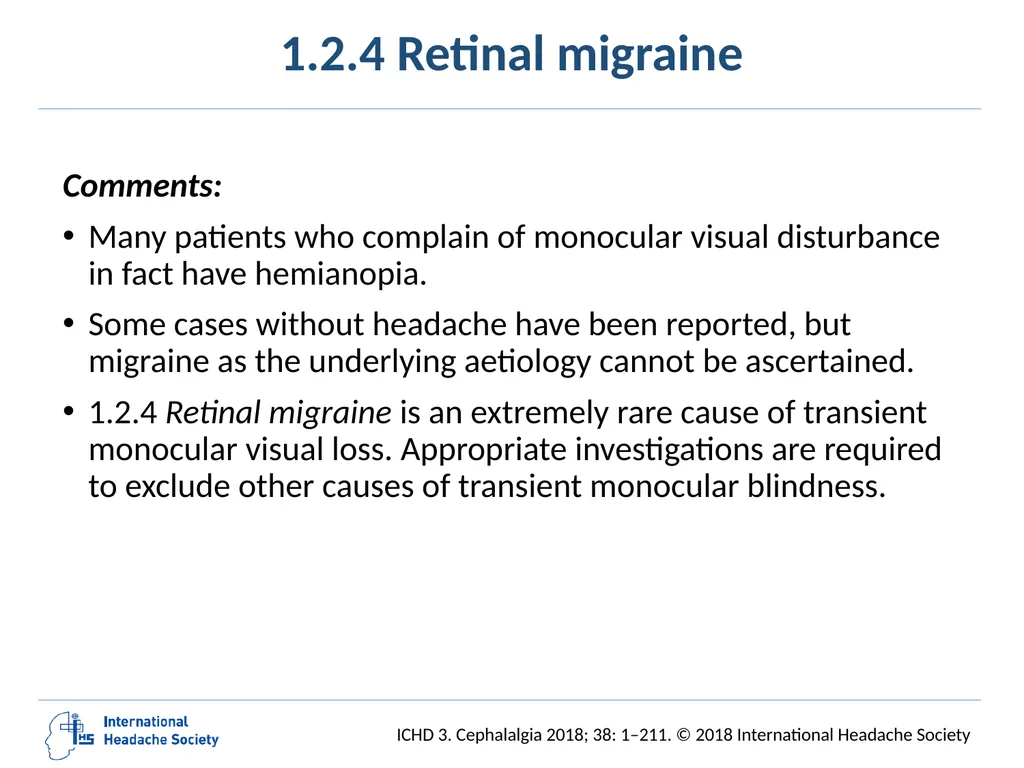
Many patients who complain of monocular visual disturbance in fact have hemianopia.
Some cases without headache have been reported, but migraine as the underlying aetiology cannot be ascertained.
1.2.4 Retinal migraine is an extremely rare cause of transient monocular visual loss. Appropriate investigations are required to exclude other causes of transient monocular blindness. 1.2.4 Retinal migraine ICHD 3. Cephalalgia 2018; 38: 1–211. © 2018 International Headache Society<br>
Many patients who complain of monocular visual disturbance in fact have hemianopia.
Some cases without headache have been reported, but migraine as the underlying aetiology cannot be ascertained.
1.2.4 Retinal migraine is an extremely rare cause of transient monocular visual loss. Appropriate investigations are required to exclude other causes of transient monocular blindness. 1.2.4 Retinal migraine ICHD 3. Cephalalgia 2018; 38: 1–211. © 2018 International Headache Society<br>
32
A. Headache (TTH-like and/or migraine-like) on ≥15 d/mo for >3 mo
and fulfilling criteria B and C
B. In a patient who has had ≥5 attacks fulfilling criteria B-D for 1.1 Migraine without aura and/or criteria B and C for 1.2 Migraine with aura
C. On ≥8 d/mo for >3 mo fulfilling any of the following:
1. criteria C and D for 1.1 Migraine without aura
2. criteria B and C for 1.2 Migraine with aura
3. believed by the patient to be migraine at onset and relieved by a triptan or ergot derivative
D. Not better accounted for by another ICHD-3 diagnosis 1.3 Chronic migraine ICHD 3. Cephalalgia 2018; 38: 1–211. © 2018 International Headache Society<br>
B. In a patient who has had ≥5 attacks fulfilling criteria B-D for 1.1 Migraine without aura and/or criteria B and C for 1.2 Migraine with aura
C. On ≥8 d/mo for >3 mo fulfilling any of the following:
1. criteria C and D for 1.1 Migraine without aura
2. criteria B and C for 1.2 Migraine with aura
3. believed by the patient to be migraine at onset and relieved by a triptan or ergot derivative
D. Not better accounted for by another ICHD-3 diagnosis 1.3 Chronic migraine ICHD 3. Cephalalgia 2018; 38: 1–211. © 2018 International Headache Society<br>
33
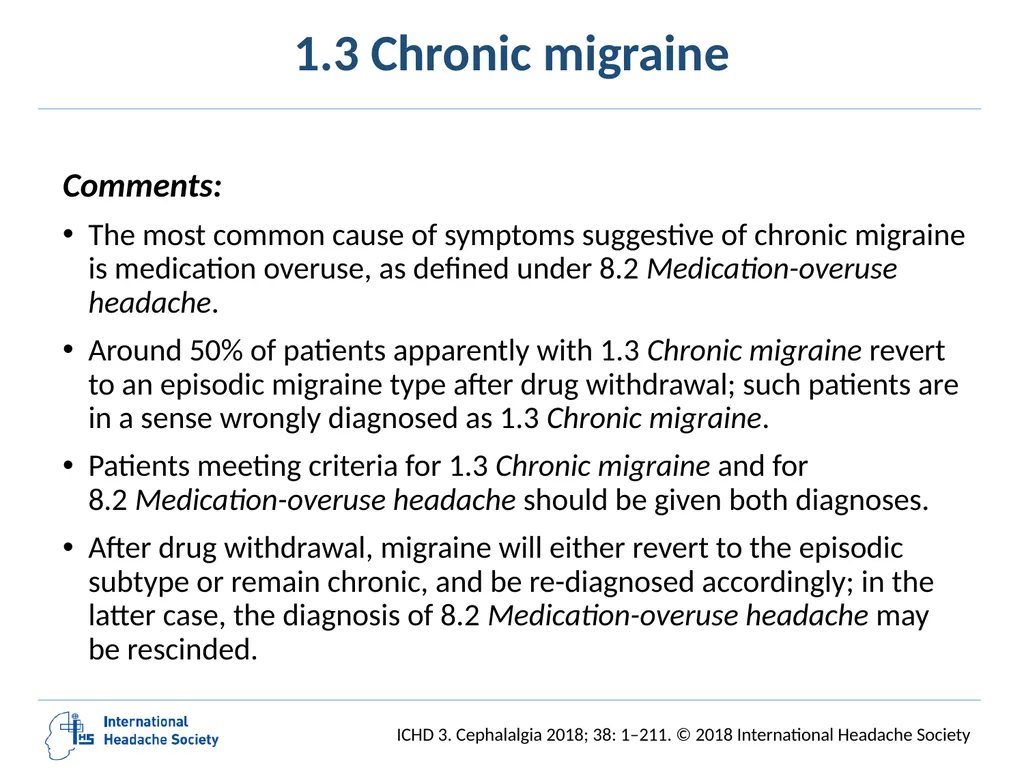
1.3 Chronic migraine Comments:
The most common cause of symptoms suggestive of chronic migraine is medication overuse, as defined under 8.2 Medication-overuse headache.
Around 50% of patients apparently with 1.3 Chronic migraine revert to an episodic migraine type after drug withdrawal; such patients are in a sense wrongly diagnosed as 1.3 Chronic migraine.
Patients meeting criteria for 1.3 Chronic migraine and for 8.2 Medication-overuse headache should be given both diagnoses.
After drug withdrawal, migraine will either revert to the episodic subtype or remain chronic, and be re-diagnosed accordingly; in the latter case, the diagnosis of 8.2 Medication-overuse headache may be rescinded. ICHD 3. Cephalalgia 2018; 38: 1–211. © 2018 International Headache Society<br>
The most common cause of symptoms suggestive of chronic migraine is medication overuse, as defined under 8.2 Medication-overuse headache.
Around 50% of patients apparently with 1.3 Chronic migraine revert to an episodic migraine type after drug withdrawal; such patients are in a sense wrongly diagnosed as 1.3 Chronic migraine.
Patients meeting criteria for 1.3 Chronic migraine and for 8.2 Medication-overuse headache should be given both diagnoses.
After drug withdrawal, migraine will either revert to the episodic subtype or remain chronic, and be re-diagnosed accordingly; in the latter case, the diagnosis of 8.2 Medication-overuse headache may be rescinded. ICHD 3. Cephalalgia 2018; 38: 1–211. © 2018 International Headache Society<br>
34
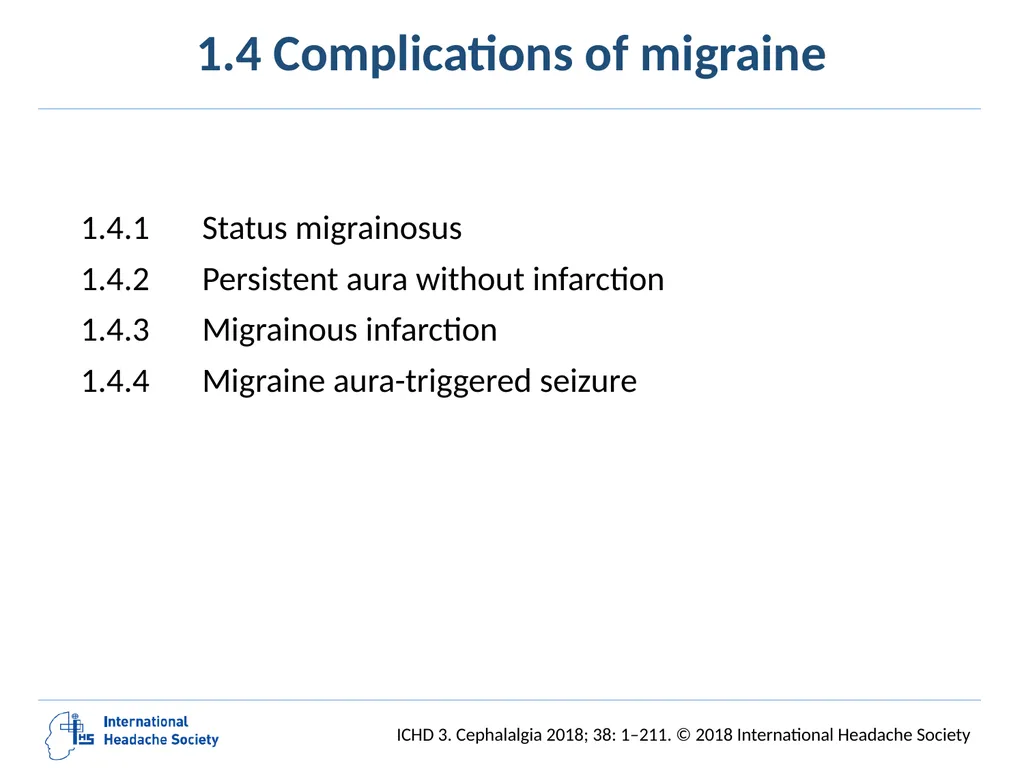
1.4.1 Status migrainosus
1.4.2 Persistent aura without infarction
1.4.3 Migrainous infarction
1.4.4 Migraine aura-triggered seizure 1.4 Complications of migraine ICHD 3. Cephalalgia 2018; 38: 1–211. © 2018 International Headache Society<br>
1.4.2 Persistent aura without infarction
1.4.3 Migrainous infarction
1.4.4 Migraine aura-triggered seizure 1.4 Complications of migraine ICHD 3. Cephalalgia 2018; 38: 1–211. © 2018 International Headache Society<br>
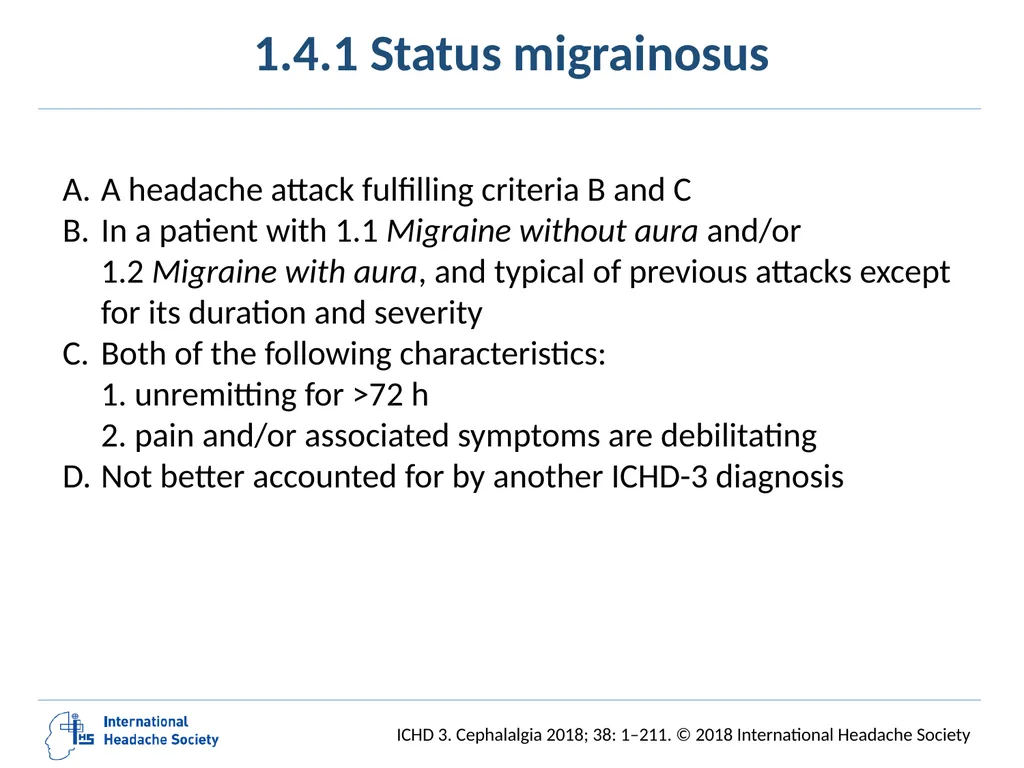
35
A. A headache attack fulfilling criteria B and C
B. In a patient with 1.1 Migraine without aura and/or 1.2 Migraine with aura, and typical of previous attacks except for its duration and severity
C. Both of the following characteristics:
1. unremitting for >72 h
2. pain and/or associated symptoms are debilitating
D. Not better accounted for by another ICHD-3 diagnosis 1.4.1 Status migrainosus ICHD 3. Cephalalgia 2018; 38: 1–211. © 2018 International Headache Society<br>
B. In a patient with 1.1 Migraine without aura and/or 1.2 Migraine with aura, and typical of previous attacks except for its duration and severity
C. Both of the following characteristics:
1. unremitting for >72 h
2. pain and/or associated symptoms are debilitating
D. Not better accounted for by another ICHD-3 diagnosis 1.4.1 Status migrainosus ICHD 3. Cephalalgia 2018; 38: 1–211. © 2018 International Headache Society<br>
36
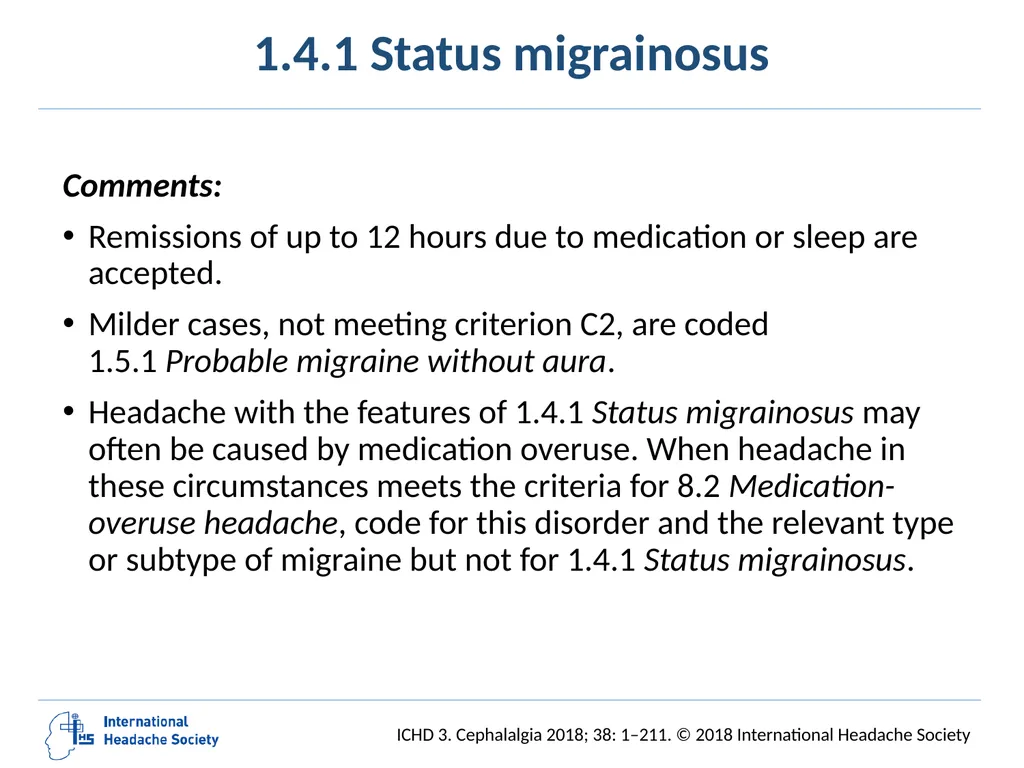
1.4.1 Status migrainosus Comments:
Remissions of up to 12 hours due to medication or sleep are accepted.
Milder cases, not meeting criterion C2, are coded 1.5.1 Probable migraine without aura.
Headache with the features of 1.4.1 Status migrainosus may often be caused by medication overuse. When headache in these circumstances meets the criteria for 8.2 Medication- overuse headache, code for this disorder and the relevant type or subtype of migraine but not for 1.4.1 Status migrainosus. ICHD 3. Cephalalgia 2018; 38: 1–211. © 2018 International Headache Society<br>
Remissions of up to 12 hours due to medication or sleep are accepted.
Milder cases, not meeting criterion C2, are coded 1.5.1 Probable migraine without aura.
Headache with the features of 1.4.1 Status migrainosus may often be caused by medication overuse. When headache in these circumstances meets the criteria for 8.2 Medication- overuse headache, code for this disorder and the relevant type or subtype of migraine but not for 1.4.1 Status migrainosus. ICHD 3. Cephalalgia 2018; 38: 1–211. © 2018 International Headache Society<br>
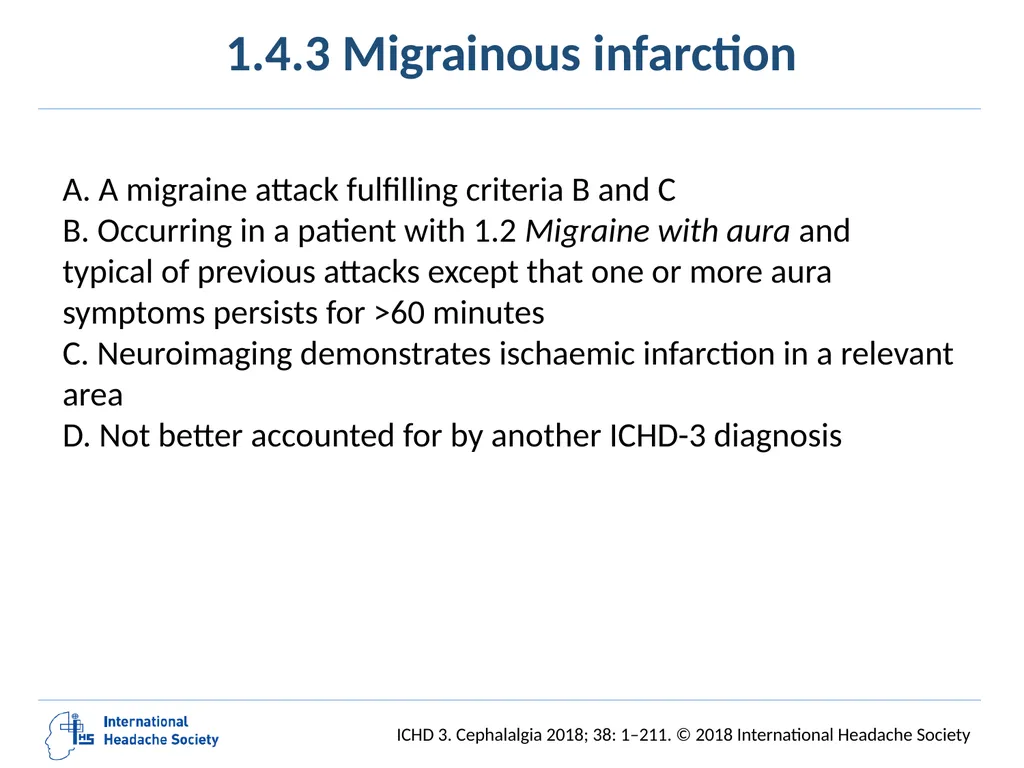
37
A. A migraine attack fulfilling criteria B and C
B. Occurring in a patient with 1.2 Migraine with aura and typical of previous attacks except that one or more aura symptoms persists for >60 minutes
C. Neuroimaging demonstrates ischaemic infarction in a relevant area
D. Not better accounted for by another ICHD-3 diagnosis 1.4.3 Migrainous infarction ICHD 3. Cephalalgia 2018; 38: 1–211. © 2018 International Headache Society<br>
B. Occurring in a patient with 1.2 Migraine with aura and typical of previous attacks except that one or more aura symptoms persists for >60 minutes
C. Neuroimaging demonstrates ischaemic infarction in a relevant area
D. Not better accounted for by another ICHD-3 diagnosis 1.4.3 Migrainous infarction ICHD 3. Cephalalgia 2018; 38: 1–211. © 2018 International Headache Society<br>
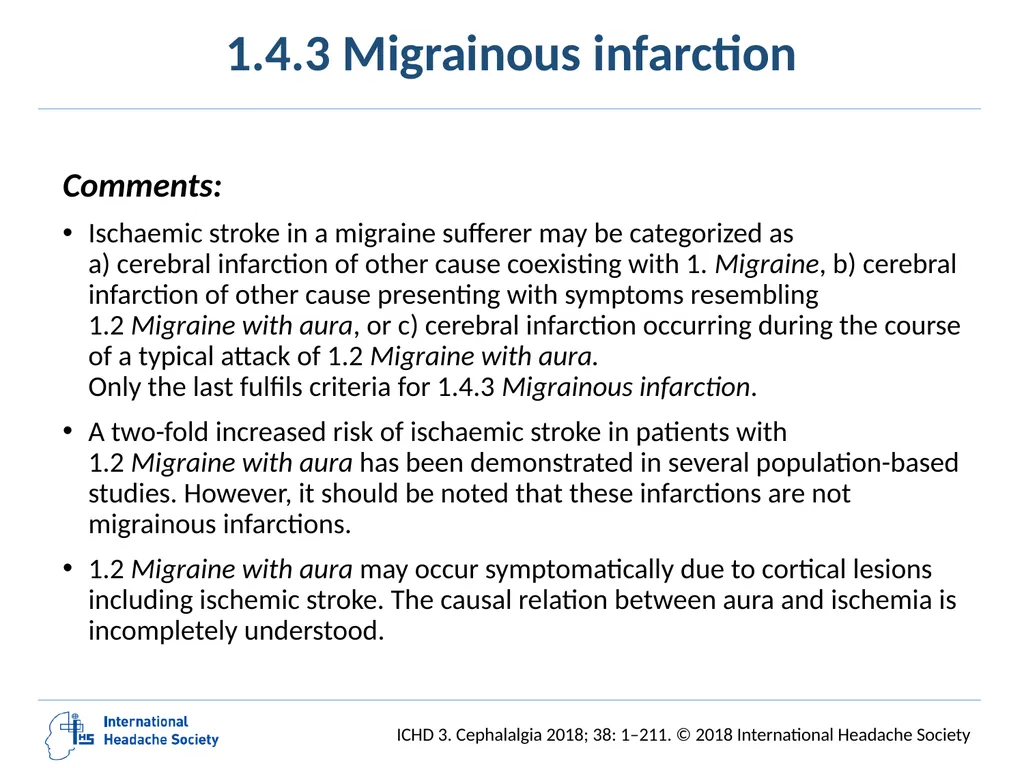
38
1.4.3 Migrainous infarction Comments:
Ischaemic stroke in a migraine sufferer may be categorized as a) cerebral infarction of other cause coexisting with 1. Migraine, b) cerebral infarction of other cause presenting with symptoms resembling 1.2 Migraine with aura, or c) cerebral infarction occurring during the course of a typical attack of 1.2 Migraine with aura. Only the last fulfils criteria for 1.4.3 Migrainous infarction.
A two-fold increased risk of ischaemic stroke in patients with 1.2 Migraine with aura has been demonstrated in several population-based studies. However, it should be noted that these infarctions are not migrainous infarctions.
1.2 Migraine with aura may occur symptomatically due to cortical lesions including ischemic stroke. The causal relation between aura and ischemia is incompletely understood. ICHD 3. Cephalalgia 2018; 38: 1–211. © 2018 International Headache Society<br>
Ischaemic stroke in a migraine sufferer may be categorized as a) cerebral infarction of other cause coexisting with 1. Migraine, b) cerebral infarction of other cause presenting with symptoms resembling 1.2 Migraine with aura, or c) cerebral infarction occurring during the course of a typical attack of 1.2 Migraine with aura. Only the last fulfils criteria for 1.4.3 Migrainous infarction.
A two-fold increased risk of ischaemic stroke in patients with 1.2 Migraine with aura has been demonstrated in several population-based studies. However, it should be noted that these infarctions are not migrainous infarctions.
1.2 Migraine with aura may occur symptomatically due to cortical lesions including ischemic stroke. The causal relation between aura and ischemia is incompletely understood. ICHD 3. Cephalalgia 2018; 38: 1–211. © 2018 International Headache Society<br>
39
1.5.1 Probable migraine without aura
1.5.2 Probable migraine with aura 1.5 Probable migraine ICHD 3. Cephalalgia 2018; 38: 1–211. © 2018 International Headache Society<br>
1.5.2 Probable migraine with aura 1.5 Probable migraine ICHD 3. Cephalalgia 2018; 38: 1–211. © 2018 International Headache Society<br>
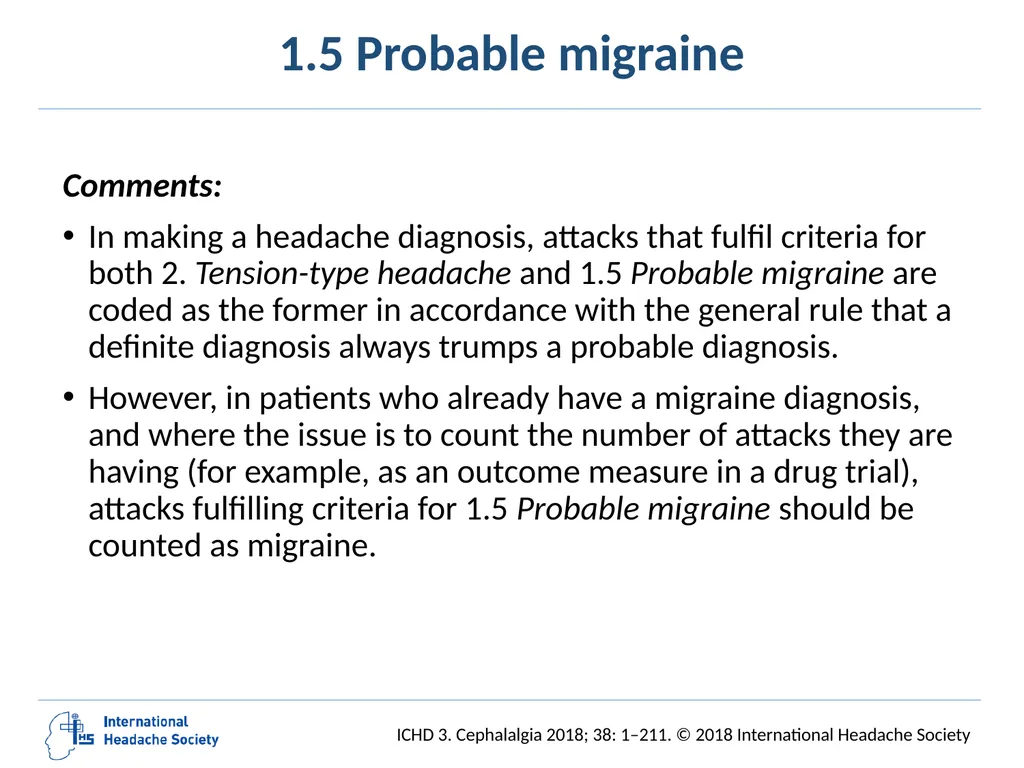
40
1.5 Probable migraine Comments:
In making a headache diagnosis, attacks that fulfil criteria for both 2. Tension-type headache and 1.5 Probable migraine are coded as the former in accordance with the general rule that a definite diagnosis always trumps a probable diagnosis.
However, in patients who already have a migraine diagnosis, and where the issue is to count the number of attacks they are having (for example, as an outcome measure in a drug trial), attacks fulfilling criteria for 1.5 Probable migraine should be counted as migraine. ICHD 3. Cephalalgia 2018; 38: 1–211. © 2018 International Headache Society<br>
In making a headache diagnosis, attacks that fulfil criteria for both 2. Tension-type headache and 1.5 Probable migraine are coded as the former in accordance with the general rule that a definite diagnosis always trumps a probable diagnosis.
However, in patients who already have a migraine diagnosis, and where the issue is to count the number of attacks they are having (for example, as an outcome measure in a drug trial), attacks fulfilling criteria for 1.5 Probable migraine should be counted as migraine. ICHD 3. Cephalalgia 2018; 38: 1–211. © 2018 International Headache Society<br>
41
A. Attacks fulfilling all but one of criteria A-D for
1.1 Migraine without aura
B. Not fulfilling ICHD-3 criteria for any other headache disorder
C. Not better accounted for by another ICHD-3 diagnosis 1.5.1 Probable migraine without aura ICHD 3. Cephalalgia 2018; 38: 1–211. © 2018 International Headache Society<br>
B. Not fulfilling ICHD-3 criteria for any other headache disorder
C. Not better accounted for by another ICHD-3 diagnosis 1.5.1 Probable migraine without aura ICHD 3. Cephalalgia 2018; 38: 1–211. © 2018 International Headache Society<br>
42
A. Attacks fulfilling all but one of criteria A-C for
1.2 Migraine with aura or any of its subforms
B. Not fulfilling ICHD-3 criteria for any other headache disorder
C. Not better accounted for by another ICHD-3 diagnosis 1.5.2 Probable migraine with aura ICHD 3. Cephalalgia 2018; 38: 1–211. © 2018 International Headache Society<br>
B. Not fulfilling ICHD-3 criteria for any other headache disorder
C. Not better accounted for by another ICHD-3 diagnosis 1.5.2 Probable migraine with aura ICHD 3. Cephalalgia 2018; 38: 1–211. © 2018 International Headache Society<br>
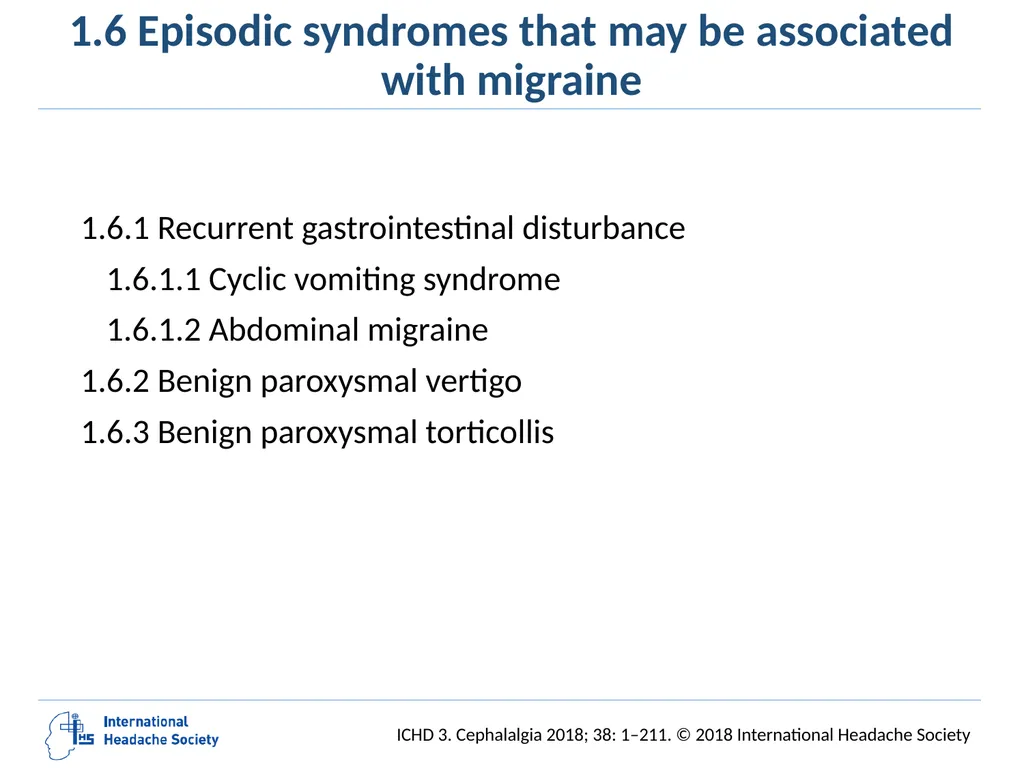
43
1.6.1 Recurrent gastrointestinal disturbance
1.6.1.1 Cyclic vomiting syndrome
1.6.1.2 Abdominal migraine
1.6.2 Benign paroxysmal vertigo
1.6.3 Benign paroxysmal torticollis 1.6 Episodic syndromes that may be associated with migraine ICHD 3. Cephalalgia 2018; 38: 1–211. © 2018 International Headache Society<br>
1.6.1.1 Cyclic vomiting syndrome
1.6.1.2 Abdominal migraine
1.6.2 Benign paroxysmal vertigo
1.6.3 Benign paroxysmal torticollis 1.6 Episodic syndromes that may be associated with migraine ICHD 3. Cephalalgia 2018; 38: 1–211. © 2018 International Headache Society<br>
44
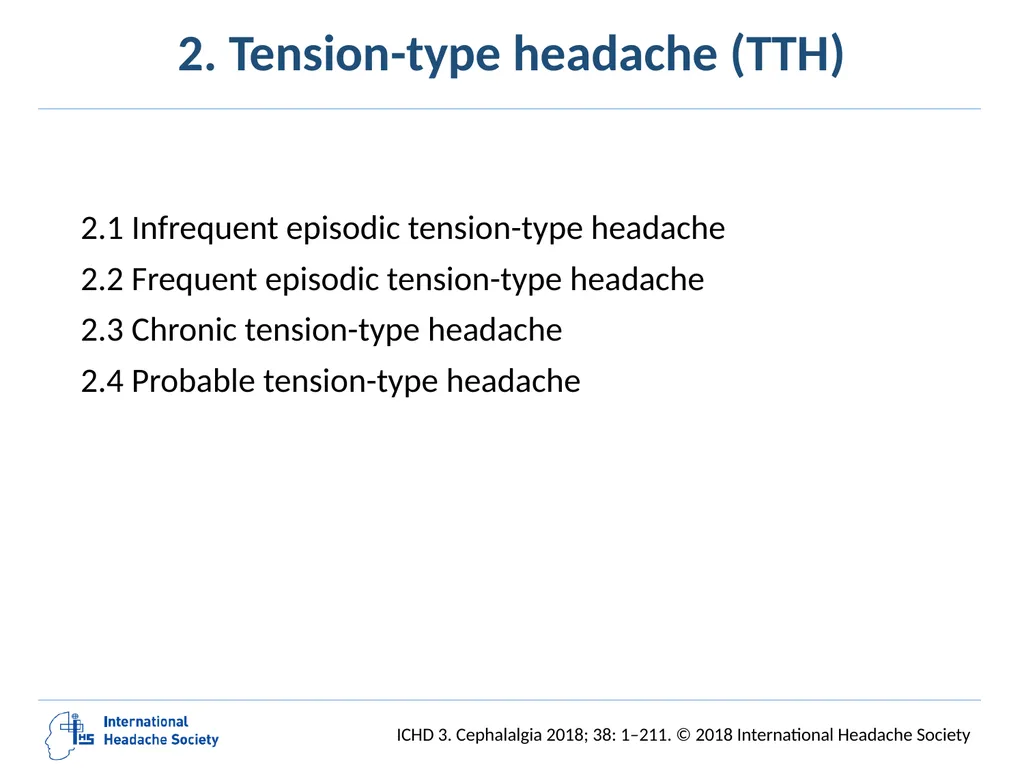
2.1 Infrequent episodic tension-type headache
2.2 Frequent episodic tension-type headache
2.3 Chronic tension-type headache
2.4 Probable tension-type headache 2. Tension-type headache (TTH) ICHD 3. Cephalalgia 2018; 38: 1–211. © 2018 International Headache Society<br>
2.2 Frequent episodic tension-type headache
2.3 Chronic tension-type headache
2.4 Probable tension-type headache 2. Tension-type headache (TTH) ICHD 3. Cephalalgia 2018; 38: 1–211. © 2018 International Headache Society<br>
45
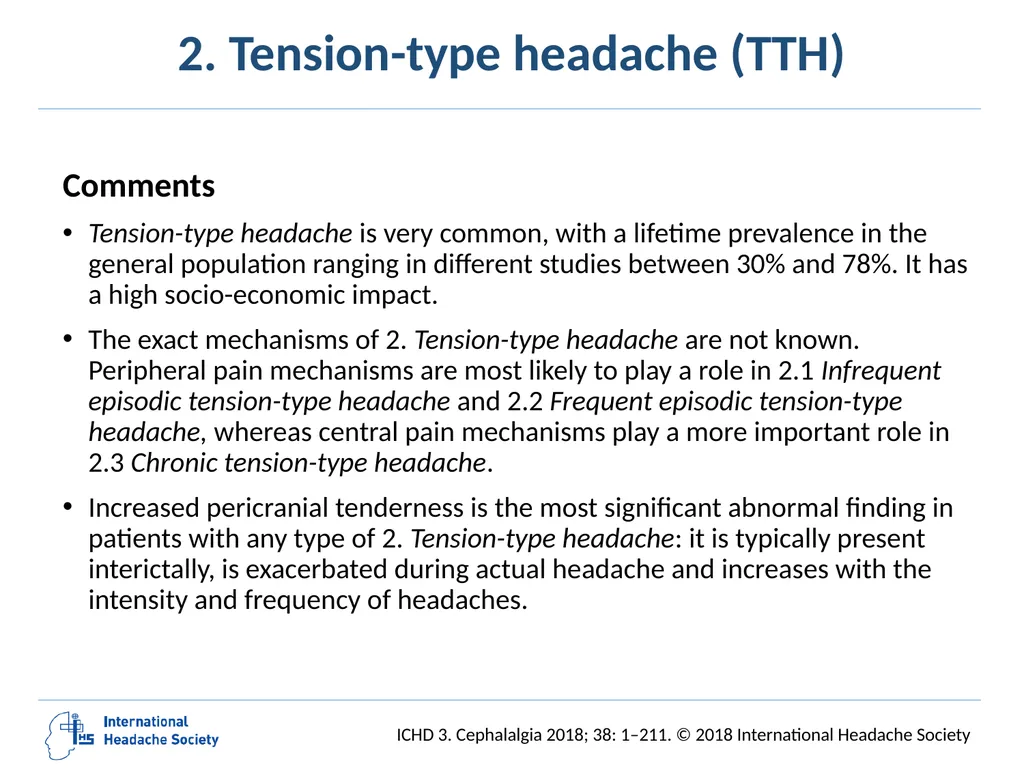
2. Tension-type headache (TTH) Comments
Tension-type headache is very common, with a lifetime prevalence in the general population ranging in different studies between 30% and 78%. It has a high socio-economic impact.
The exact mechanisms of 2. Tension-type headache are not known. Peripheral pain mechanisms are most likely to play a role in 2.1 Infrequent episodic tension-type headache and 2.2 Frequent episodic tension-type headache, whereas central pain mechanisms play a more important role in 2.3 Chronic tension-type headache.
Increased pericranial tenderness is the most significant abnormal finding in patients with any type of 2. Tension-type headache: it is typically present interictally, is exacerbated during actual headache and increases with the intensity and frequency of headaches. ICHD 3. Cephalalgia 2018; 38: 1–211. © 2018 International Headache Society<br>
Tension-type headache is very common, with a lifetime prevalence in the general population ranging in different studies between 30% and 78%. It has a high socio-economic impact.
The exact mechanisms of 2. Tension-type headache are not known. Peripheral pain mechanisms are most likely to play a role in 2.1 Infrequent episodic tension-type headache and 2.2 Frequent episodic tension-type headache, whereas central pain mechanisms play a more important role in 2.3 Chronic tension-type headache.
Increased pericranial tenderness is the most significant abnormal finding in patients with any type of 2. Tension-type headache: it is typically present interictally, is exacerbated during actual headache and increases with the intensity and frequency of headaches. ICHD 3. Cephalalgia 2018; 38: 1–211. © 2018 International Headache Society<br>
46
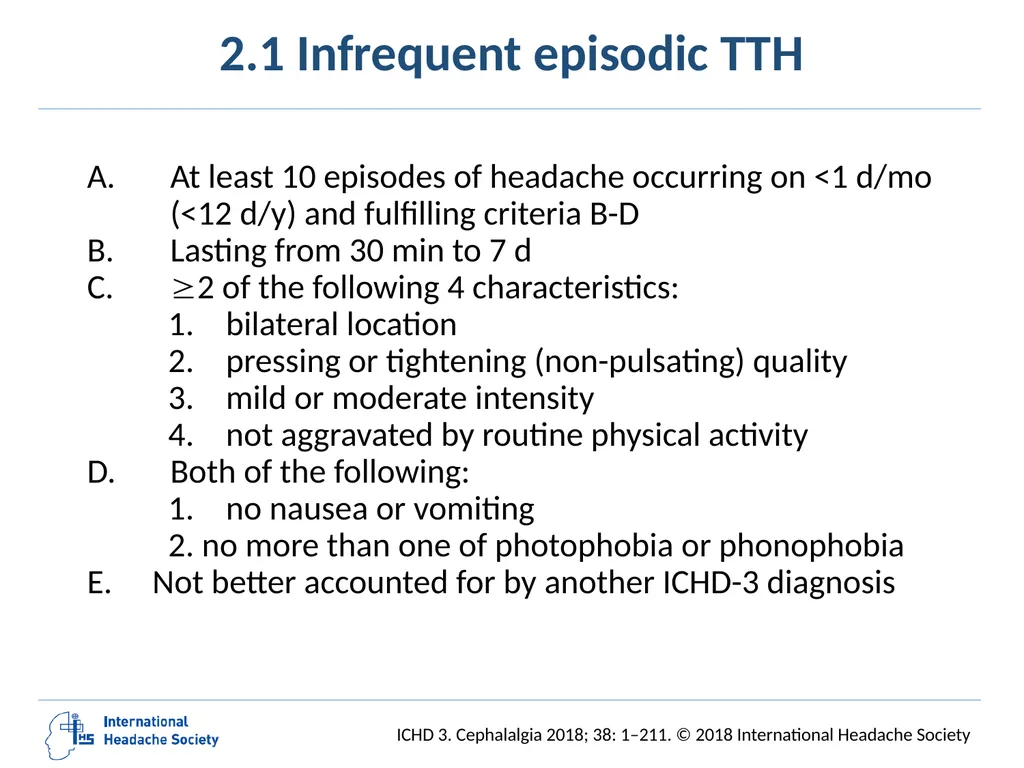
A. At least 10 episodes of headache occurring on <1 d/mo
(<12 d/y) and fulfilling criteria B-D
B. Lasting from 30 min to 7 d
C. 2 of the following 4 characteristics:
1. bilateral location
2. pressing or tightening (non-pulsating) quality
3. mild or moderate intensity
4. not aggravated by routine physical activity
D. Both of the following:
1. no nausea or vomiting
2. no more than one of photophobia or phonophobia
E. Not better accounted for by another ICHD-3 diagnosis 2.1 Infrequent episodic TTH ICHD 3. Cephalalgia 2018; 38: 1–211. © 2018 International Headache Society<br>
B. Lasting from 30 min to 7 d
C. 2 of the following 4 characteristics:
1. bilateral location
2. pressing or tightening (non-pulsating) quality
3. mild or moderate intensity
4. not aggravated by routine physical activity
D. Both of the following:
1. no nausea or vomiting
2. no more than one of photophobia or phonophobia
E. Not better accounted for by another ICHD-3 diagnosis 2.1 Infrequent episodic TTH ICHD 3. Cephalalgia 2018; 38: 1–211. © 2018 International Headache Society<br>
47
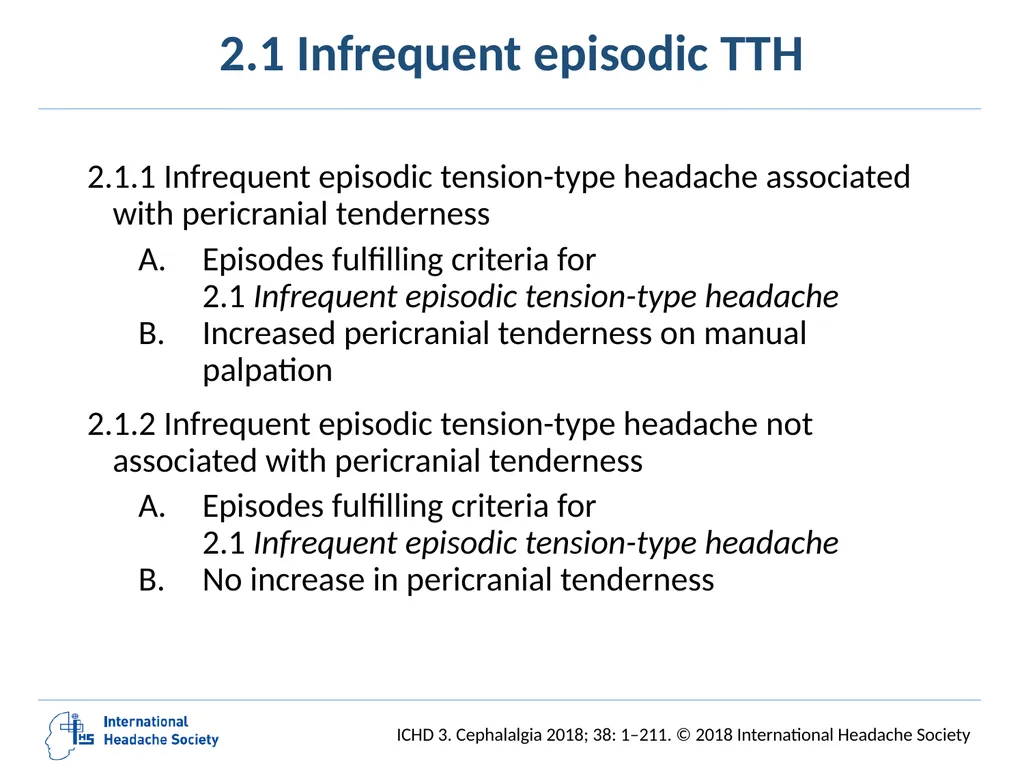
2.1 Infrequent episodic TTH 2.1.1 Infrequent episodic tension-type headache associated
with pericranial tenderness
A. Episodes fulfilling criteria for 2.1 Infrequent episodic tension-type headache
B. Increased pericranial tenderness on manual palpation
2.1.2 Infrequent episodic tension-type headache not associated with pericranial tenderness
A. Episodes fulfilling criteria for 2.1 Infrequent episodic tension-type headache
B. No increase in pericranial tenderness ICHD 3. Cephalalgia 2018; 38: 1–211. © 2018 International Headache Society<br>
A. Episodes fulfilling criteria for 2.1 Infrequent episodic tension-type headache
B. Increased pericranial tenderness on manual palpation
2.1.2 Infrequent episodic tension-type headache not associated with pericranial tenderness
A. Episodes fulfilling criteria for 2.1 Infrequent episodic tension-type headache
B. No increase in pericranial tenderness ICHD 3. Cephalalgia 2018; 38: 1–211. © 2018 International Headache Society<br>
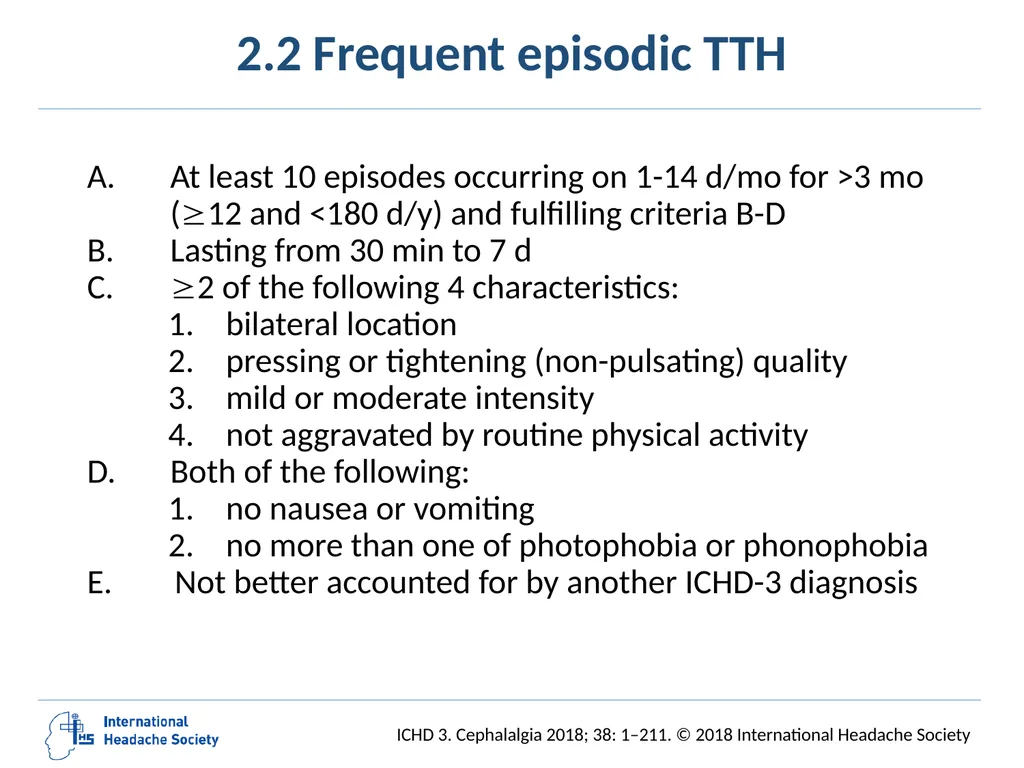
48
A. At least 10 episodes occurring on 1-14 d/mo for >3 mo
(12 and <180 d/y) and fulfilling criteria B-D
B. Lasting from 30 min to 7 d
C. 2 of the following 4 characteristics:
1. bilateral location
2. pressing or tightening (non-pulsating) quality
3. mild or moderate intensity
4. not aggravated by routine physical activity
D. Both of the following:
1. no nausea or vomiting
2. no more than one of photophobia or phonophobia
E. Not better accounted for by another ICHD-3 diagnosis 2.2 Frequent episodic TTH ICHD 3. Cephalalgia 2018; 38: 1–211. © 2018 International Headache Society<br>
B. Lasting from 30 min to 7 d
C. 2 of the following 4 characteristics:
1. bilateral location
2. pressing or tightening (non-pulsating) quality
3. mild or moderate intensity
4. not aggravated by routine physical activity
D. Both of the following:
1. no nausea or vomiting
2. no more than one of photophobia or phonophobia
E. Not better accounted for by another ICHD-3 diagnosis 2.2 Frequent episodic TTH ICHD 3. Cephalalgia 2018; 38: 1–211. © 2018 International Headache Society<br>
49
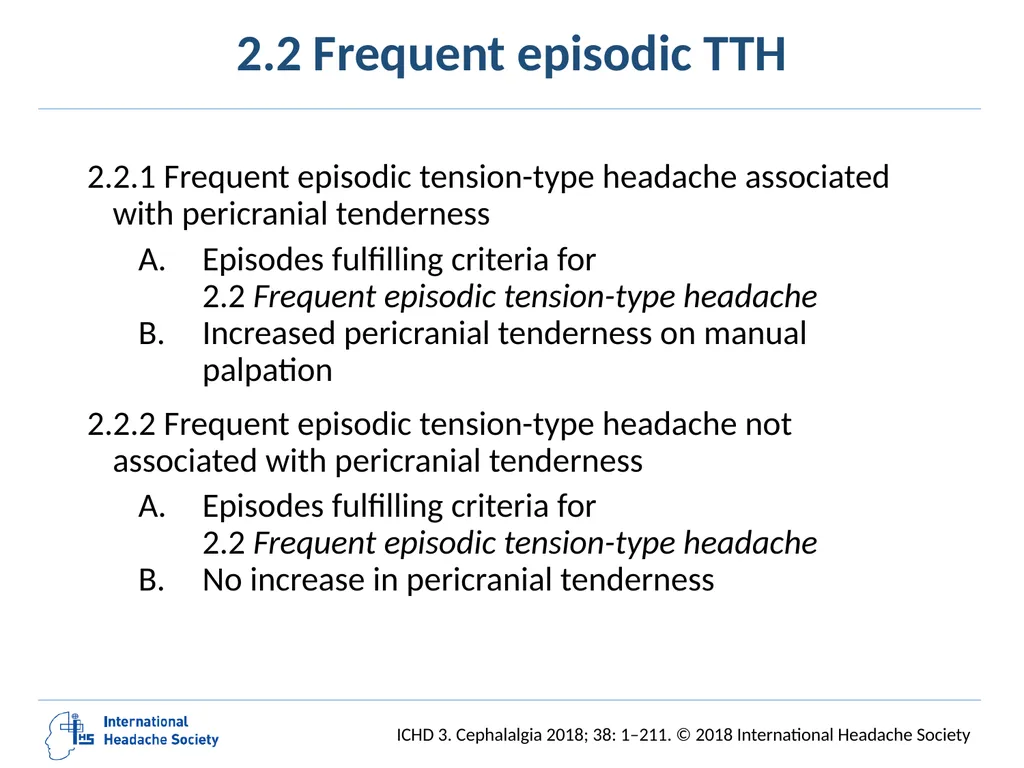
2.2 Frequent episodic TTH 2.2.1 Frequent episodic tension-type headache associated
with pericranial tenderness
A. Episodes fulfilling criteria for 2.2 Frequent episodic tension-type headache
B. Increased pericranial tenderness on manual palpation
2.2.2 Frequent episodic tension-type headache not associated with pericranial tenderness
A. Episodes fulfilling criteria for 2.2 Frequent episodic tension-type headache
B. No increase in pericranial tenderness ICHD 3. Cephalalgia 2018; 38: 1–211. © 2018 International Headache Society<br>
A. Episodes fulfilling criteria for 2.2 Frequent episodic tension-type headache
B. Increased pericranial tenderness on manual palpation
2.2.2 Frequent episodic tension-type headache not associated with pericranial tenderness
A. Episodes fulfilling criteria for 2.2 Frequent episodic tension-type headache
B. No increase in pericranial tenderness ICHD 3. Cephalalgia 2018; 38: 1–211. © 2018 International Headache Society<br>
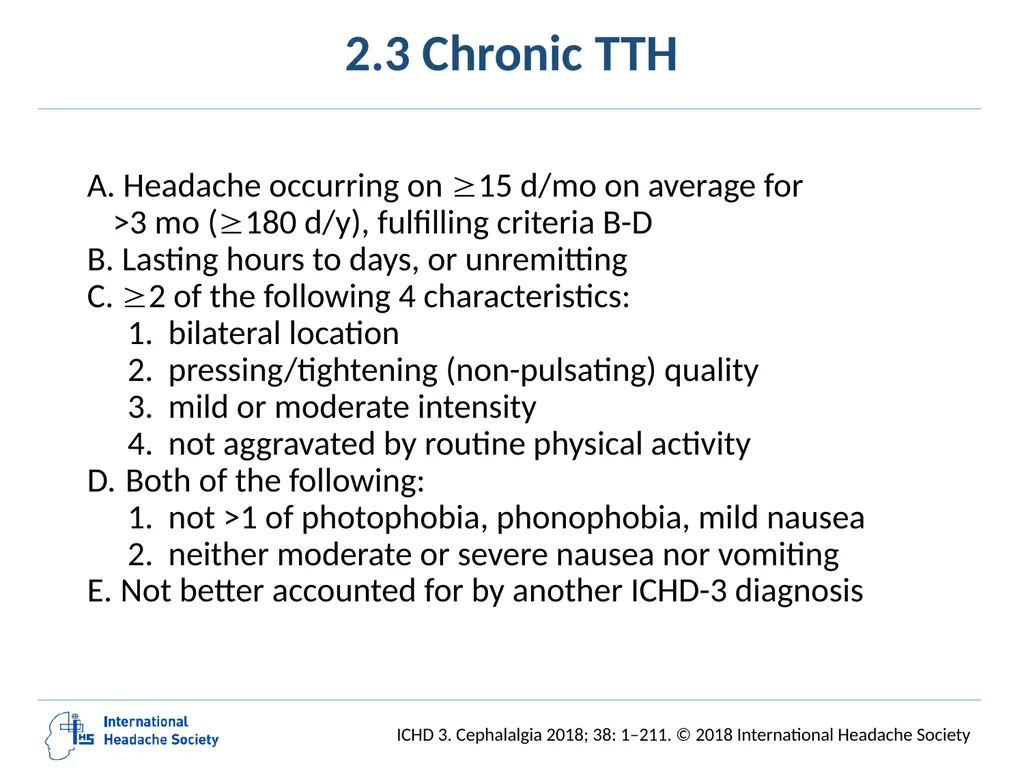
50
A. Headache occurring on 15 d/mo on average for
>3 mo (180 d/y), fulfilling criteria B-D
B. Lasting hours to days, or unremitting
C. 2 of the following 4 characteristics:
1. bilateral location
2. pressing/tightening (non-pulsating) quality
3. mild or moderate intensity
not aggravated by routine physical activity
D. Both of the following:
1. not >1 of photophobia, phonophobia, mild nausea
2. neither moderate or severe nausea nor vomiting
E. Not better accounted for by another ICHD-3 diagnosis 2.3 Chronic TTH ICHD 3. Cephalalgia 2018; 38: 1–211. © 2018 International Headache Society<br>
B. Lasting hours to days, or unremitting
C. 2 of the following 4 characteristics:
1. bilateral location
2. pressing/tightening (non-pulsating) quality
3. mild or moderate intensity
not aggravated by routine physical activity
D. Both of the following:
1. not >1 of photophobia, phonophobia, mild nausea
2. neither moderate or severe nausea nor vomiting
E. Not better accounted for by another ICHD-3 diagnosis 2.3 Chronic TTH ICHD 3. Cephalalgia 2018; 38: 1–211. © 2018 International Headache Society<br>
51
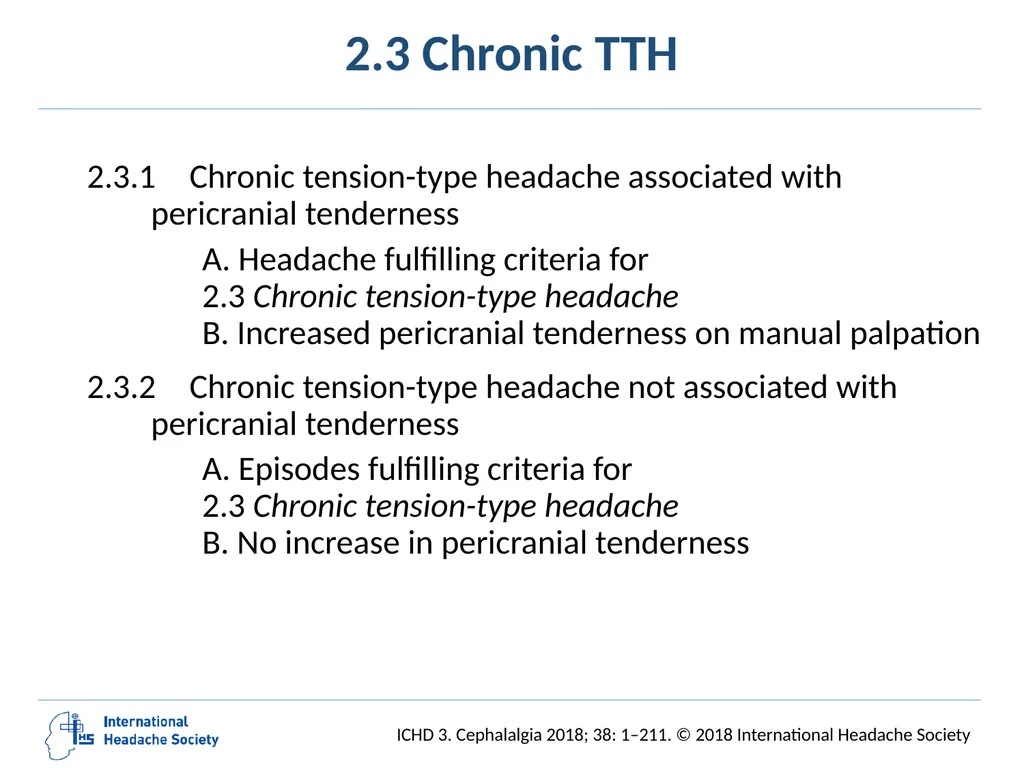
2.3 Chronic TTH 2.3.1 Chronic tension-type headache associated with
pericranial tenderness
A. Headache fulfilling criteria for 2.3 Chronic tension-type headache
B. Increased pericranial tenderness on manual palpation
2.3.2 Chronic tension-type headache not associated with pericranial tenderness
A. Episodes fulfilling criteria for 2.3 Chronic tension-type headache
B. No increase in pericranial tenderness ICHD 3. Cephalalgia 2018; 38: 1–211. © 2018 International Headache Society<br>
A. Headache fulfilling criteria for 2.3 Chronic tension-type headache
B. Increased pericranial tenderness on manual palpation
2.3.2 Chronic tension-type headache not associated with pericranial tenderness
A. Episodes fulfilling criteria for 2.3 Chronic tension-type headache
B. No increase in pericranial tenderness ICHD 3. Cephalalgia 2018; 38: 1–211. © 2018 International Headache Society<br>
52
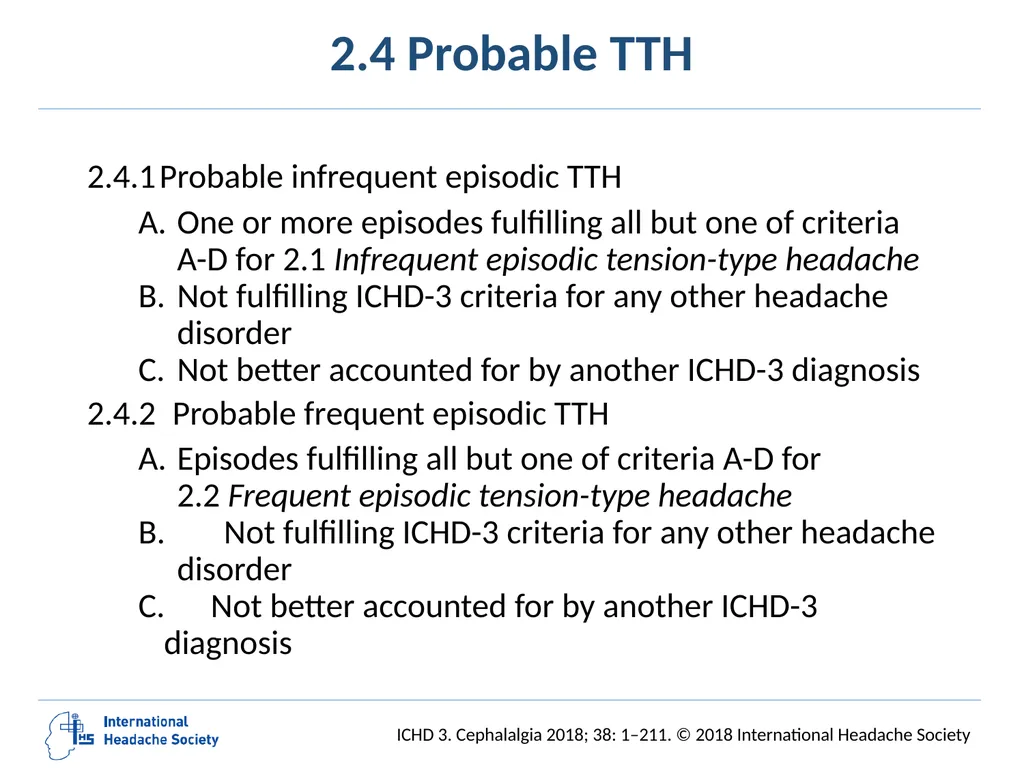
2.4 Probable TTH 2.4.1 Probable infrequent episodic TTH
A. One or more episodes fulfilling all but one of criteria A-D for 2.1 Infrequent episodic tension-type headache
B. Not fulfilling ICHD-3 criteria for any other headache disorder
C. Not better accounted for by another ICHD-3 diagnosis
2.4.2 Probable frequent episodic TTH
A. Episodes fulfilling all but one of criteria A-D for 2.2 Frequent episodic tension-type headache
B. Not fulfilling ICHD-3 criteria for any other headache disorder
C. Not better accounted for by another ICHD-3 diagnosis ICHD 3. Cephalalgia 2018; 38: 1–211. © 2018 International Headache Society<br>
A. One or more episodes fulfilling all but one of criteria A-D for 2.1 Infrequent episodic tension-type headache
B. Not fulfilling ICHD-3 criteria for any other headache disorder
C. Not better accounted for by another ICHD-3 diagnosis
2.4.2 Probable frequent episodic TTH
A. Episodes fulfilling all but one of criteria A-D for 2.2 Frequent episodic tension-type headache
B. Not fulfilling ICHD-3 criteria for any other headache disorder
C. Not better accounted for by another ICHD-3 diagnosis ICHD 3. Cephalalgia 2018; 38: 1–211. © 2018 International Headache Society<br>
53
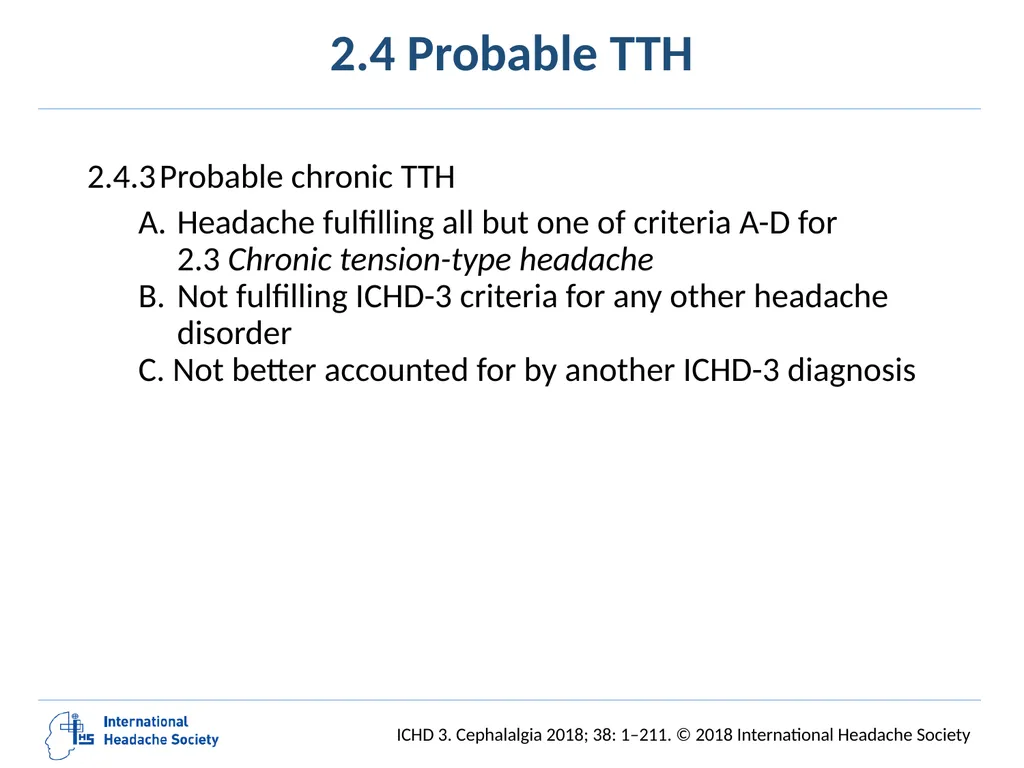
2.4 Probable TTH 2.4.3 Probable chronic TTH
A. Headache fulfilling all but one of criteria A-D for 2.3 Chronic tension-type headache
B. Not fulfilling ICHD-3 criteria for any other headache disorder
C. Not better accounted for by another ICHD-3 diagnosis ICHD 3. Cephalalgia 2018; 38: 1–211. © 2018 International Headache Society<br>
A. Headache fulfilling all but one of criteria A-D for 2.3 Chronic tension-type headache
B. Not fulfilling ICHD-3 criteria for any other headache disorder
C. Not better accounted for by another ICHD-3 diagnosis ICHD 3. Cephalalgia 2018; 38: 1–211. © 2018 International Headache Society<br>
54
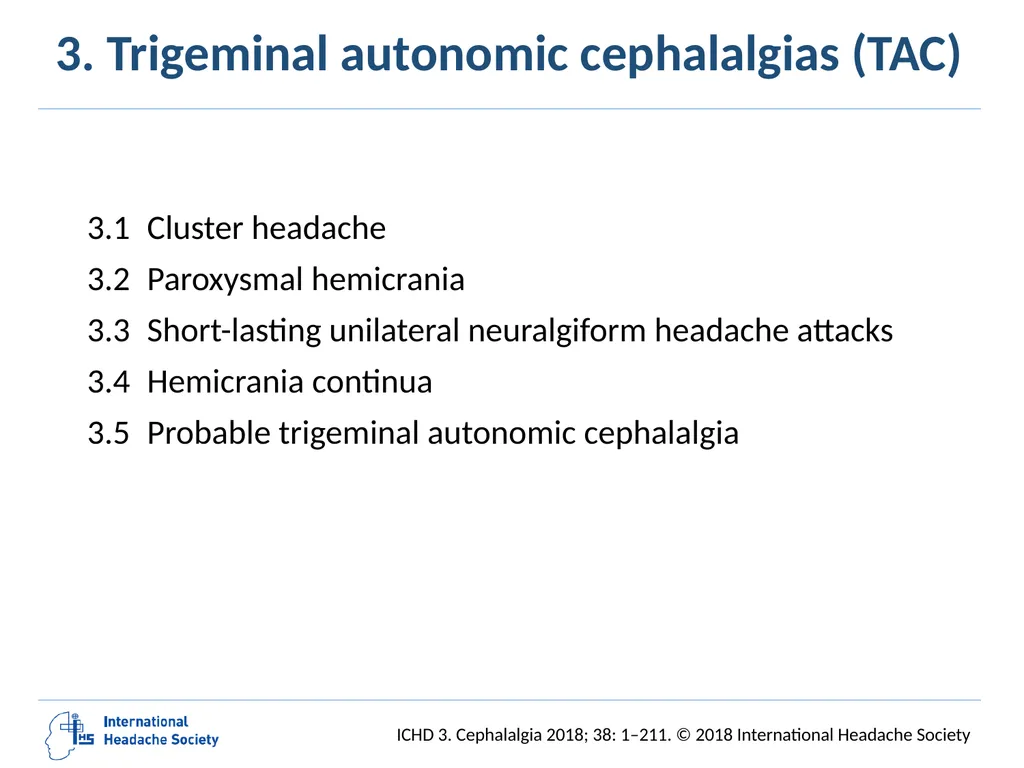
3.1 Cluster headache
3.2 Paroxysmal hemicrania
3.3 Short-lasting unilateral neuralgiform headache attacks
3.4 Hemicrania continua
3.5 Probable trigeminal autonomic cephalalgia 3. Trigeminal autonomic cephalalgias (TAC) ICHD 3. Cephalalgia 2018; 38: 1–211. © 2018 International Headache Society<br>
3.2 Paroxysmal hemicrania
3.3 Short-lasting unilateral neuralgiform headache attacks
3.4 Hemicrania continua
3.5 Probable trigeminal autonomic cephalalgia 3. Trigeminal autonomic cephalalgias (TAC) ICHD 3. Cephalalgia 2018; 38: 1–211. © 2018 International Headache Society<br>
55
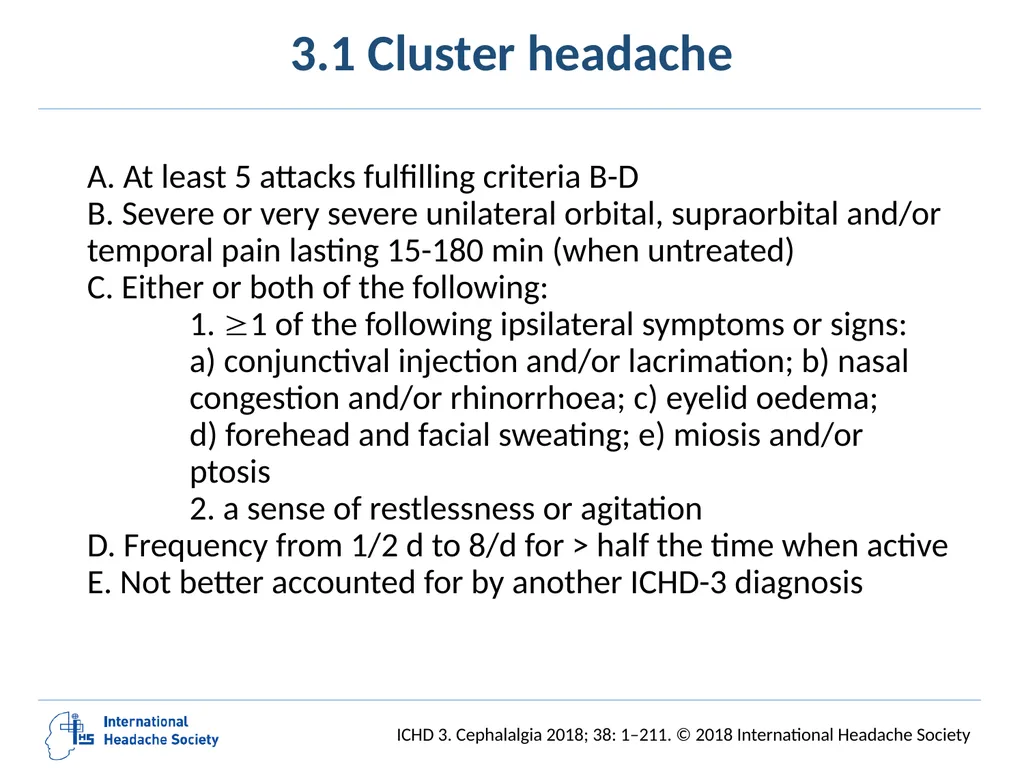
3.1 Cluster headache A. At least 5 attacks fulfilling criteria B-D
B. Severe or very severe unilateral orbital, supraorbital and/or temporal pain lasting 15-180 min (when untreated)
C. Either or both of the following:
1. 1 of the following ipsilateral symptoms or signs: a) conjunctival injection and/or lacrimation; b) nasal congestion and/or rhinorrhoea; c) eyelid oedema; d) forehead and facial sweating; e) miosis and/or ptosis
2. a sense of restlessness or agitation
D. Frequency from 1/2 d to 8/d for > half the time when active
E. Not better accounted for by another ICHD-3 diagnosis ICHD 3. Cephalalgia 2018; 38: 1–211. © 2018 International Headache Society<br>
B. Severe or very severe unilateral orbital, supraorbital and/or temporal pain lasting 15-180 min (when untreated)
C. Either or both of the following:
1. 1 of the following ipsilateral symptoms or signs: a) conjunctival injection and/or lacrimation; b) nasal congestion and/or rhinorrhoea; c) eyelid oedema; d) forehead and facial sweating; e) miosis and/or ptosis
2. a sense of restlessness or agitation
D. Frequency from 1/2 d to 8/d for > half the time when active
E. Not better accounted for by another ICHD-3 diagnosis ICHD 3. Cephalalgia 2018; 38: 1–211. © 2018 International Headache Society<br>
56
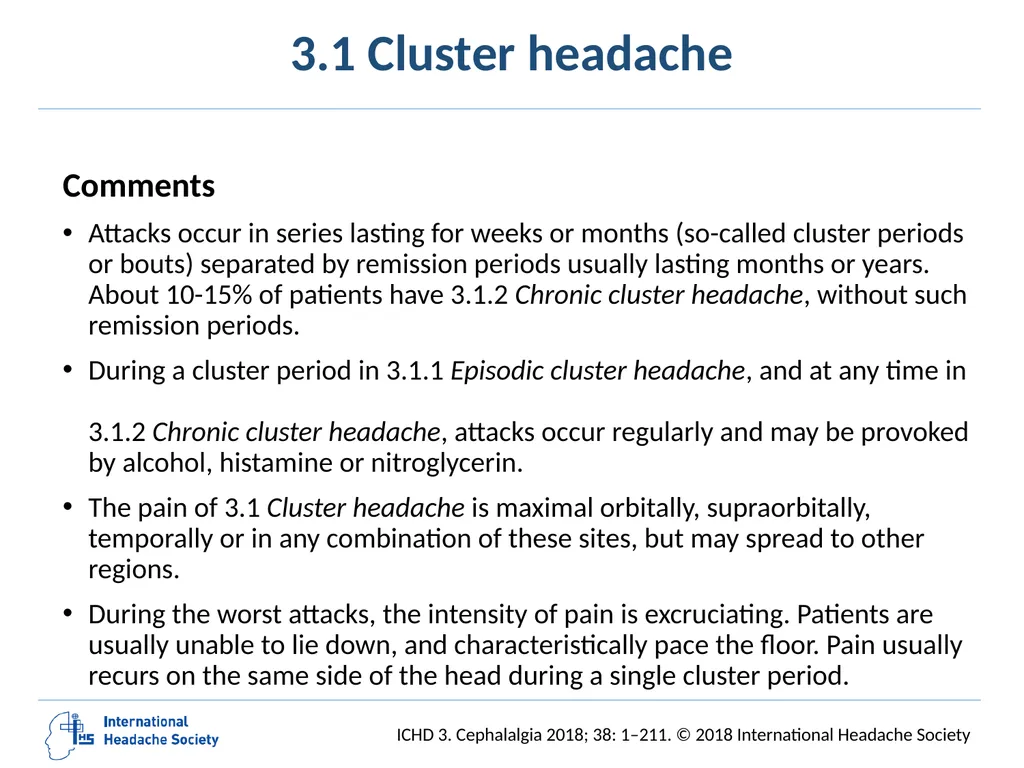
3.1 Cluster headache Comments
Attacks occur in series lasting for weeks or months (so-called cluster periods or bouts) separated by remission periods usually lasting months or years. About 10-15% of patients have 3.1.2 Chronic cluster headache, without such remission periods.
During a cluster period in 3.1.1 Episodic cluster headache, and at any time in 3.1.2 Chronic cluster headache, attacks occur regularly and may be provoked by alcohol, histamine or nitroglycerin.
The pain of 3.1 Cluster headache is maximal orbitally, supraorbitally, temporally or in any combination of these sites, but may spread to other regions.
During the worst attacks, the intensity of pain is excruciating. Patients are usually unable to lie down, and characteristically pace the floor. Pain usually recurs on the same side of the head during a single cluster period. ICHD 3. Cephalalgia 2018; 38: 1–211. © 2018 International Headache Society<br>
Attacks occur in series lasting for weeks or months (so-called cluster periods or bouts) separated by remission periods usually lasting months or years. About 10-15% of patients have 3.1.2 Chronic cluster headache, without such remission periods.
During a cluster period in 3.1.1 Episodic cluster headache, and at any time in 3.1.2 Chronic cluster headache, attacks occur regularly and may be provoked by alcohol, histamine or nitroglycerin.
The pain of 3.1 Cluster headache is maximal orbitally, supraorbitally, temporally or in any combination of these sites, but may spread to other regions.
During the worst attacks, the intensity of pain is excruciating. Patients are usually unable to lie down, and characteristically pace the floor. Pain usually recurs on the same side of the head during a single cluster period. ICHD 3. Cephalalgia 2018; 38: 1–211. © 2018 International Headache Society<br>
57
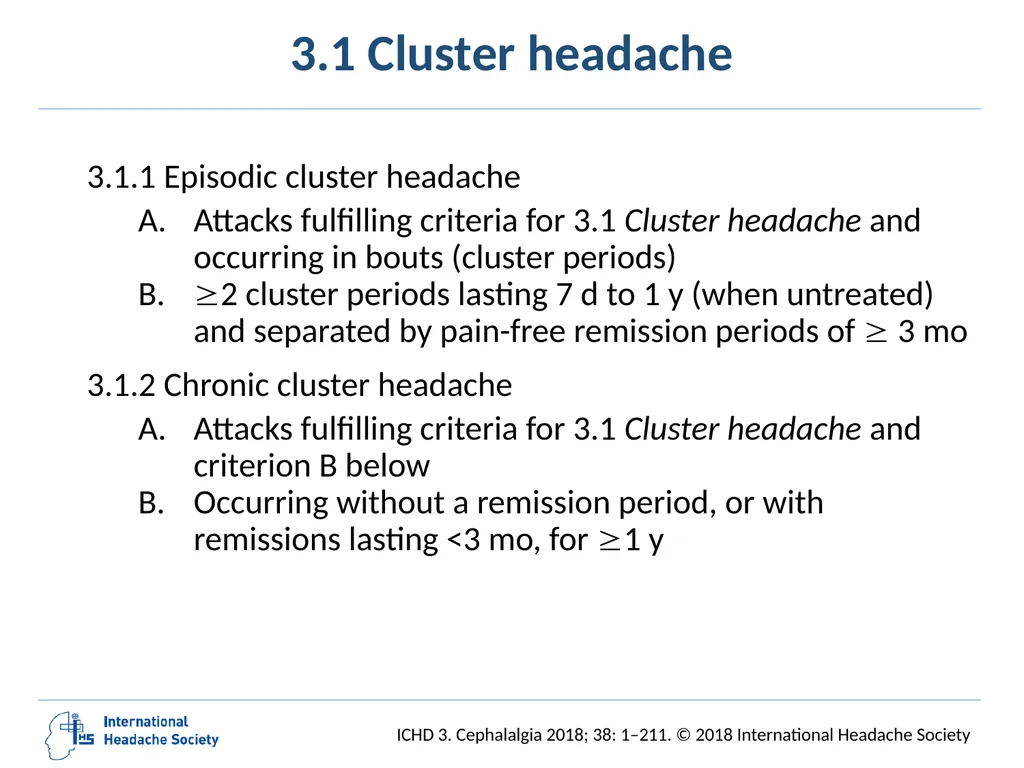
3.1 Cluster headache 3.1.1 Episodic cluster headache
A. Attacks fulfilling criteria for 3.1 Cluster headache and occurring in bouts (cluster periods)
B. 2 cluster periods lasting 7 d to 1 y (when untreated) and separated by pain-free remission periods of 3 mo
3.1.2 Chronic cluster headache
A. Attacks fulfilling criteria for 3.1 Cluster headache and criterion B below
B. Occurring without a remission period, or with remissions lasting <3 mo, for 1 y ICHD 3. Cephalalgia 2018; 38: 1–211. © 2018 International Headache Society<br>
A. Attacks fulfilling criteria for 3.1 Cluster headache and occurring in bouts (cluster periods)
B. 2 cluster periods lasting 7 d to 1 y (when untreated) and separated by pain-free remission periods of 3 mo
3.1.2 Chronic cluster headache
A. Attacks fulfilling criteria for 3.1 Cluster headache and criterion B below
B. Occurring without a remission period, or with remissions lasting <3 mo, for 1 y ICHD 3. Cephalalgia 2018; 38: 1–211. © 2018 International Headache Society<br>
58
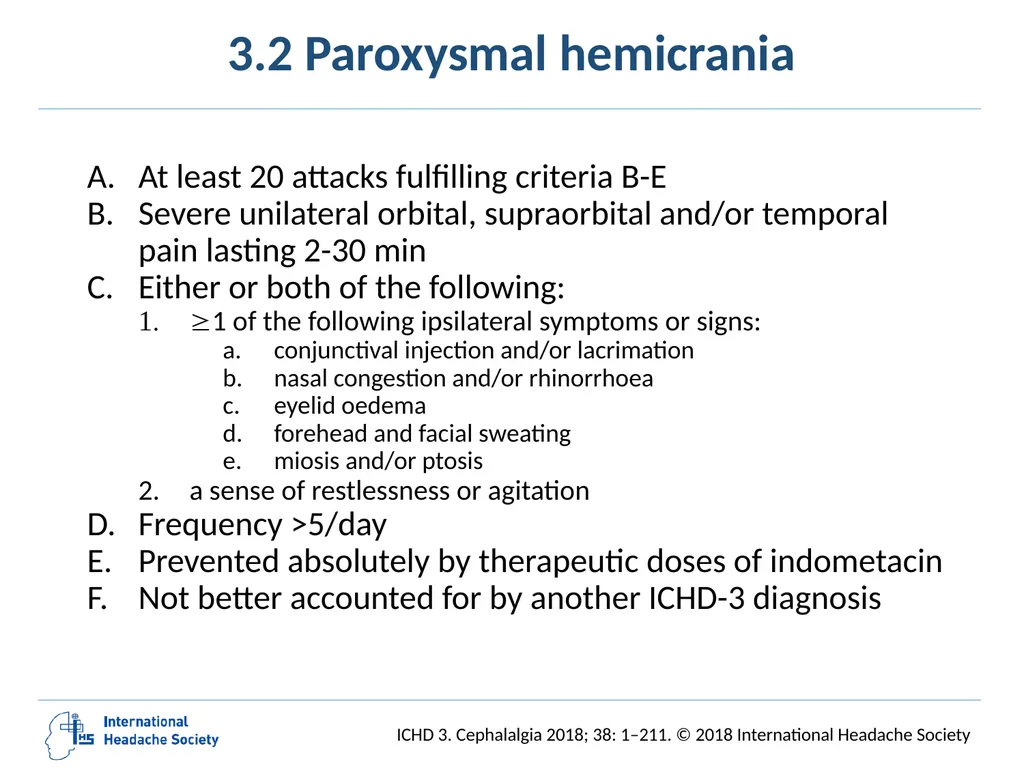
3.2 Paroxysmal hemicrania At least 20 attacks fulfilling criteria B-E
Severe unilateral orbital, supraorbital and/or temporal pain lasting 2-30 min
Either or both of the following:
1 of the following ipsilateral symptoms or signs:
conjunctival injection and/or lacrimation
nasal congestion and/or rhinorrhoea
eyelid oedema
forehead and facial sweating
miosis and/or ptosis
a sense of restlessness or agitation
Frequency >5/day
Prevented absolutely by therapeutic doses of indometacin
Not better accounted for by another ICHD-3 diagnosis ICHD 3. Cephalalgia 2018; 38: 1–211. © 2018 International Headache Society<br>
Severe unilateral orbital, supraorbital and/or temporal pain lasting 2-30 min
Either or both of the following:
1 of the following ipsilateral symptoms or signs:
conjunctival injection and/or lacrimation
nasal congestion and/or rhinorrhoea
eyelid oedema
forehead and facial sweating
miosis and/or ptosis
a sense of restlessness or agitation
Frequency >5/day
Prevented absolutely by therapeutic doses of indometacin
Not better accounted for by another ICHD-3 diagnosis ICHD 3. Cephalalgia 2018; 38: 1–211. © 2018 International Headache Society<br>
59
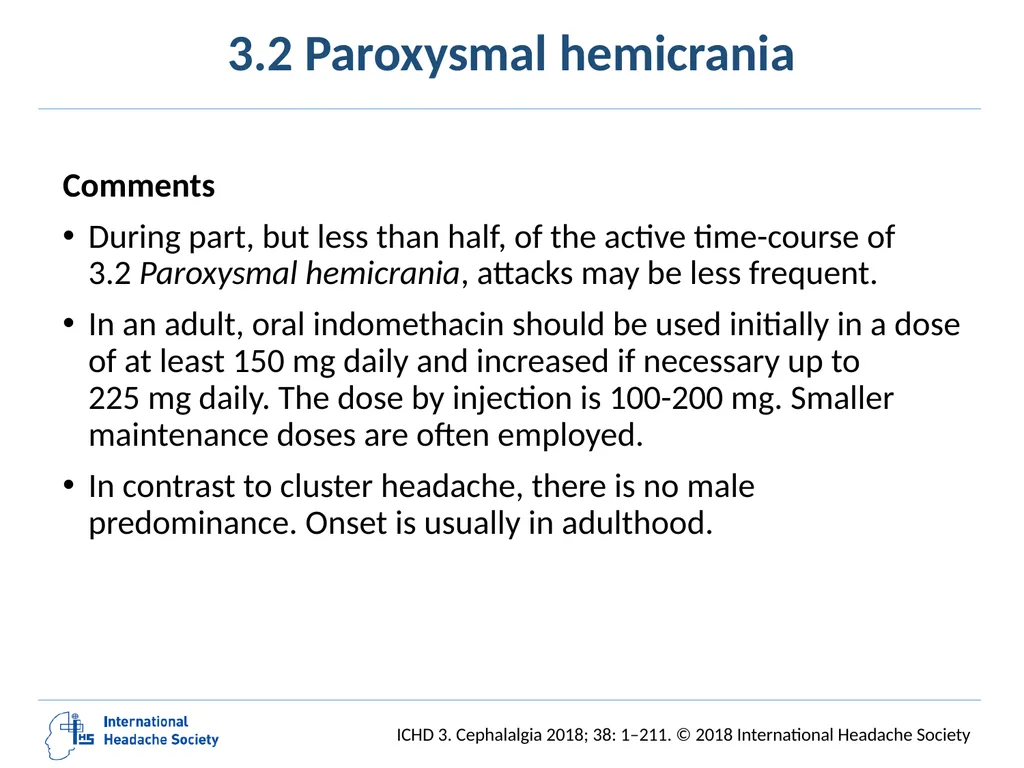
3.2 Paroxysmal hemicrania Comments
During part, but less than half, of the active time-course of 3.2 Paroxysmal hemicrania, attacks may be less frequent.
In an adult, oral indomethacin should be used initially in a dose of at least 150 mg daily and increased if necessary up to 225 mg daily. The dose by injection is 100-200 mg. Smaller maintenance doses are often employed.
In contrast to cluster headache, there is no male predominance. Onset is usually in adulthood. ICHD 3. Cephalalgia 2018; 38: 1–211. © 2018 International Headache Society<br>
During part, but less than half, of the active time-course of 3.2 Paroxysmal hemicrania, attacks may be less frequent.
In an adult, oral indomethacin should be used initially in a dose of at least 150 mg daily and increased if necessary up to 225 mg daily. The dose by injection is 100-200 mg. Smaller maintenance doses are often employed.
In contrast to cluster headache, there is no male predominance. Onset is usually in adulthood. ICHD 3. Cephalalgia 2018; 38: 1–211. © 2018 International Headache Society<br>
60
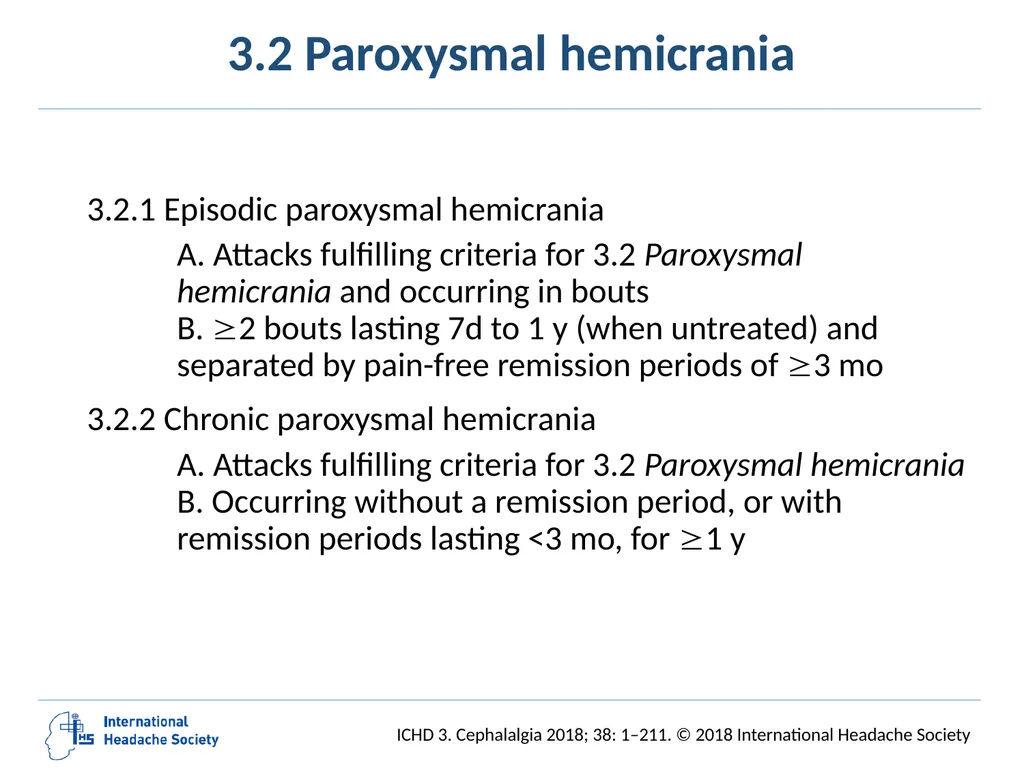
3.2 Paroxysmal hemicrania 3.2.1 Episodic paroxysmal hemicrania
A. Attacks fulfilling criteria for 3.2 Paroxysmal hemicrania and occurring in bouts
B. 2 bouts lasting 7d to 1 y (when untreated) and separated by pain-free remission periods of 3 mo
3.2.2 Chronic paroxysmal hemicrania
A. Attacks fulfilling criteria for 3.2 Paroxysmal hemicrania
B. Occurring without a remission period, or with remission periods lasting <3 mo, for 1 y ICHD 3. Cephalalgia 2018; 38: 1–211. © 2018 International Headache Society<br>
A. Attacks fulfilling criteria for 3.2 Paroxysmal hemicrania and occurring in bouts
B. 2 bouts lasting 7d to 1 y (when untreated) and separated by pain-free remission periods of 3 mo
3.2.2 Chronic paroxysmal hemicrania
A. Attacks fulfilling criteria for 3.2 Paroxysmal hemicrania
B. Occurring without a remission period, or with remission periods lasting <3 mo, for 1 y ICHD 3. Cephalalgia 2018; 38: 1–211. © 2018 International Headache Society<br>
61
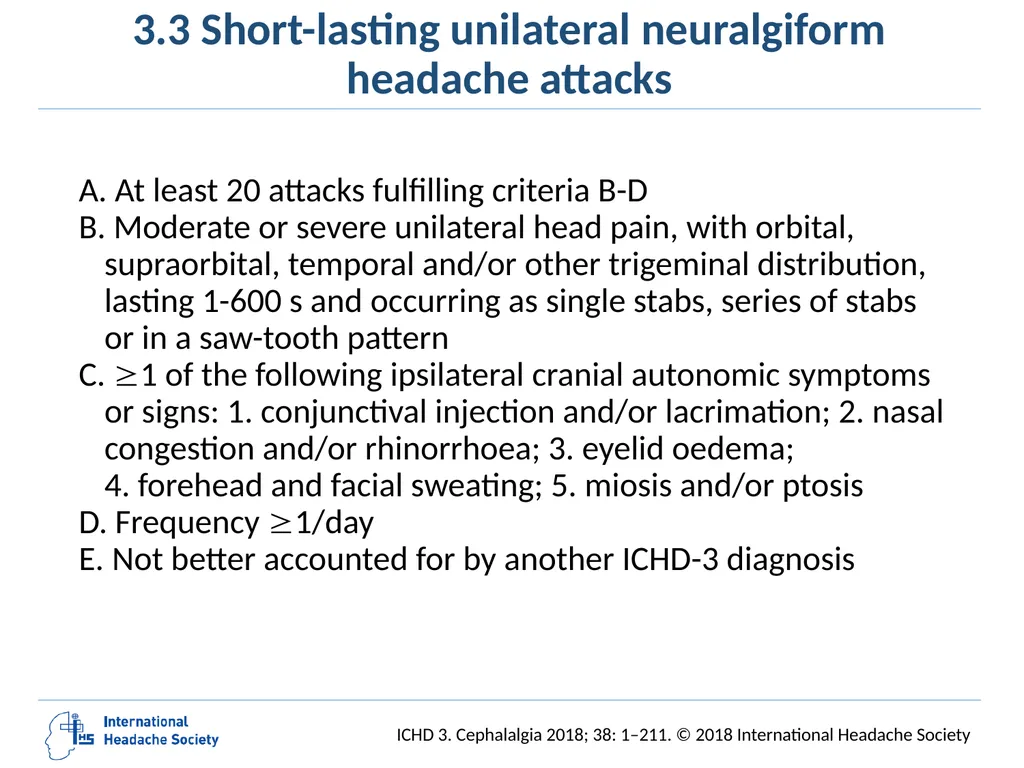
A. At least 20 attacks fulfilling criteria B-D
B. Moderate or severe unilateral head pain, with orbital, supraorbital, temporal and/or other trigeminal distribution, lasting 1-600 s and occurring as single stabs, series of stabs or in a saw-tooth pattern
C. 1 of the following ipsilateral cranial autonomic symptoms or signs: 1. conjunctival injection and/or lacrimation; 2. nasal congestion and/or rhinorrhoea; 3. eyelid oedema; 4. forehead and facial sweating; 5. miosis and/or ptosis
D. Frequency 1/day
E. Not better accounted for by another ICHD-3 diagnosis 3.3 Short-lasting unilateral neuralgiform headache attacks ICHD 3. Cephalalgia 2018; 38: 1–211. © 2018 International Headache Society<br>
B. Moderate or severe unilateral head pain, with orbital, supraorbital, temporal and/or other trigeminal distribution, lasting 1-600 s and occurring as single stabs, series of stabs or in a saw-tooth pattern
C. 1 of the following ipsilateral cranial autonomic symptoms or signs: 1. conjunctival injection and/or lacrimation; 2. nasal congestion and/or rhinorrhoea; 3. eyelid oedema; 4. forehead and facial sweating; 5. miosis and/or ptosis
D. Frequency 1/day
E. Not better accounted for by another ICHD-3 diagnosis 3.3 Short-lasting unilateral neuralgiform headache attacks ICHD 3. Cephalalgia 2018; 38: 1–211. © 2018 International Headache Society<br>
62
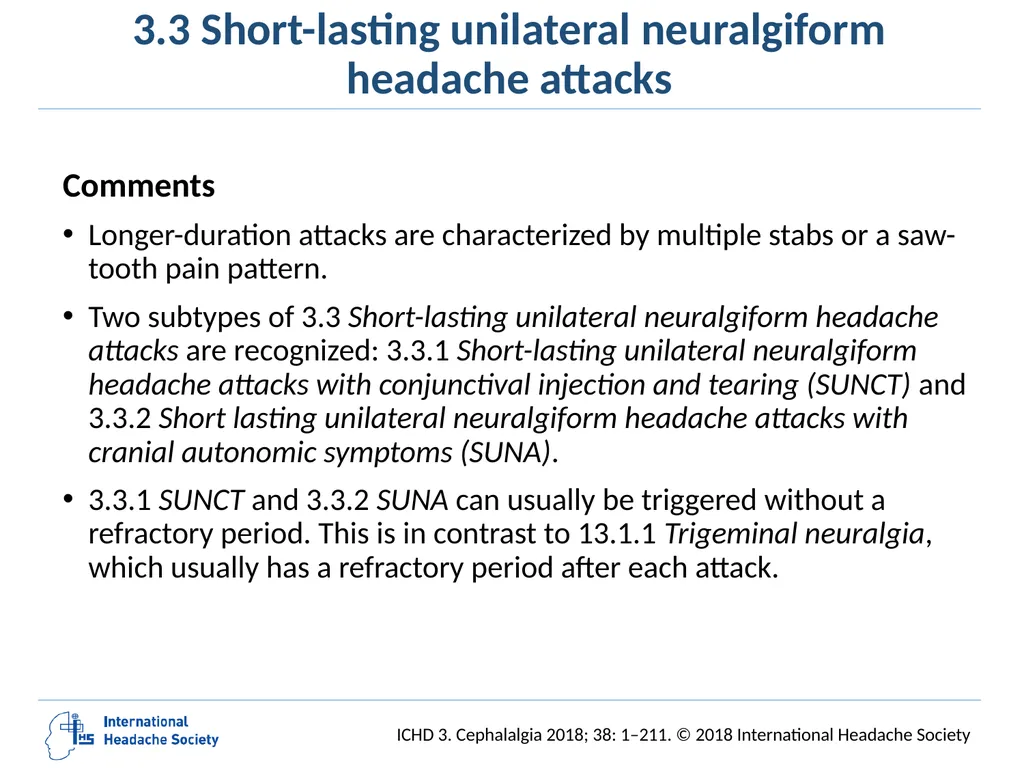
Comments
Longer-duration attacks are characterized by multiple stabs or a saw-tooth pain pattern.
Two subtypes of 3.3 Short-lasting unilateral neuralgiform headache attacks are recognized: 3.3.1 Short-lasting unilateral neuralgiform headache attacks with conjunctival injection and tearing (SUNCT) and 3.3.2 Short lasting unilateral neuralgiform headache attacks with cranial autonomic symptoms (SUNA).
3.3.1 SUNCT and 3.3.2 SUNA can usually be triggered without a refractory period. This is in contrast to 13.1.1 Trigeminal neuralgia, which usually has a refractory period after each attack. 3.3 Short-lasting unilateral neuralgiform headache attacks ICHD 3. Cephalalgia 2018; 38: 1–211. © 2018 International Headache Society<br>
Longer-duration attacks are characterized by multiple stabs or a saw-tooth pain pattern.
Two subtypes of 3.3 Short-lasting unilateral neuralgiform headache attacks are recognized: 3.3.1 Short-lasting unilateral neuralgiform headache attacks with conjunctival injection and tearing (SUNCT) and 3.3.2 Short lasting unilateral neuralgiform headache attacks with cranial autonomic symptoms (SUNA).
3.3.1 SUNCT and 3.3.2 SUNA can usually be triggered without a refractory period. This is in contrast to 13.1.1 Trigeminal neuralgia, which usually has a refractory period after each attack. 3.3 Short-lasting unilateral neuralgiform headache attacks ICHD 3. Cephalalgia 2018; 38: 1–211. © 2018 International Headache Society<br>
63
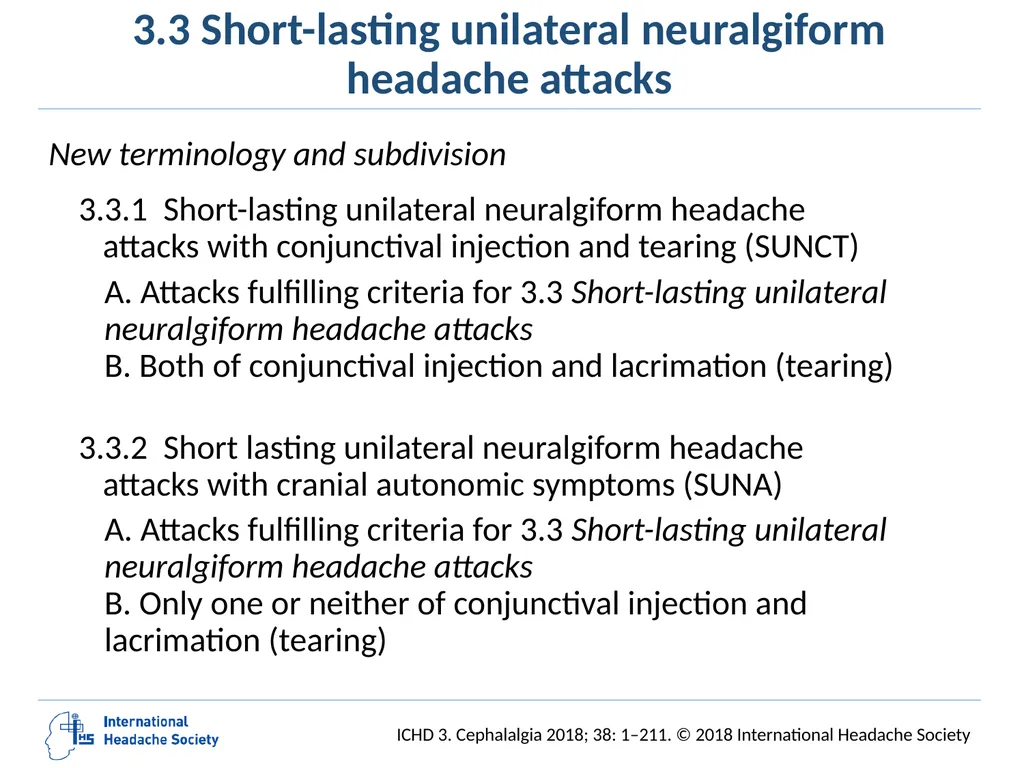
3.3.1 Short-lasting unilateral neuralgiform headache attacks with conjunctival injection and tearing (SUNCT)
A. Attacks fulfilling criteria for 3.3 Short-lasting unilateral neuralgiform headache attacks
B. Both of conjunctival injection and lacrimation (tearing)
3.3.2 Short lasting unilateral neuralgiform headache attacks with cranial autonomic symptoms (SUNA)
A. Attacks fulfilling criteria for 3.3 Short-lasting unilateral neuralgiform headache attacks
B. Only one or neither of conjunctival injection and lacrimation (tearing) New terminology and subdivision 3.3 Short-lasting unilateral neuralgiform headache attacks ICHD 3. Cephalalgia 2018; 38: 1–211. © 2018 International Headache Society<br>
A. Attacks fulfilling criteria for 3.3 Short-lasting unilateral neuralgiform headache attacks
B. Both of conjunctival injection and lacrimation (tearing)
3.3.2 Short lasting unilateral neuralgiform headache attacks with cranial autonomic symptoms (SUNA)
A. Attacks fulfilling criteria for 3.3 Short-lasting unilateral neuralgiform headache attacks
B. Only one or neither of conjunctival injection and lacrimation (tearing) New terminology and subdivision 3.3 Short-lasting unilateral neuralgiform headache attacks ICHD 3. Cephalalgia 2018; 38: 1–211. © 2018 International Headache Society<br>
64
A. Attacks fulfilling criteria for 3.3 Short-lasting unilateral
neuralgiform headache attacks
B. Both of conjunctival injection and lacrimation (tearing) 3.3.1 Short-lasting unilateral neuralgiform headache attacks with conjunctival injection and tearing (SUNCT) ICHD 3. Cephalalgia 2018; 38: 1–211. © 2018 International Headache Society<br>
B. Both of conjunctival injection and lacrimation (tearing) 3.3.1 Short-lasting unilateral neuralgiform headache attacks with conjunctival injection and tearing (SUNCT) ICHD 3. Cephalalgia 2018; 38: 1–211. © 2018 International Headache Society<br>
65
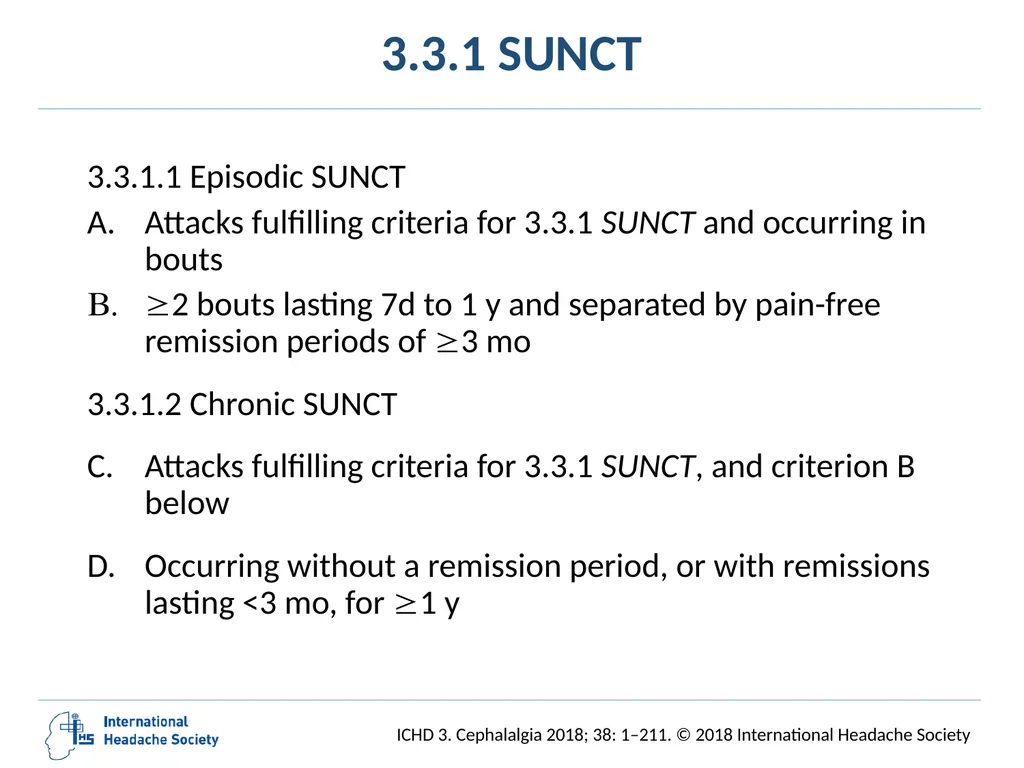
3.3.1 SUNCT 3.3.1.1 Episodic SUNCT
Attacks fulfilling criteria for 3.3.1 SUNCT and occurring in bouts
2 bouts lasting 7d to 1 y and separated by pain-free remission periods of 3 mo
3.3.1.2 Chronic SUNCT
Attacks fulfilling criteria for 3.3.1 SUNCT, and criterion B below
Occurring without a remission period, or with remissions lasting <3 mo, for 1 y ICHD 3. Cephalalgia 2018; 38: 1–211. © 2018 International Headache Society<br>
Attacks fulfilling criteria for 3.3.1 SUNCT and occurring in bouts
2 bouts lasting 7d to 1 y and separated by pain-free remission periods of 3 mo
3.3.1.2 Chronic SUNCT
Attacks fulfilling criteria for 3.3.1 SUNCT, and criterion B below
Occurring without a remission period, or with remissions lasting <3 mo, for 1 y ICHD 3. Cephalalgia 2018; 38: 1–211. © 2018 International Headache Society<br>
66
A. Attacks fulfilling criteria for 3.3 Short-lasting unilateral
neuralgiform headache attacks
B. Only one or neither of conjunctival injection and lacrimation (tearing) 3.3.2 Short-lasting unilateral neuralgiform headache attacks with cranial autonomic symptoms (SUNA) ICHD 3. Cephalalgia 2018; 38: 1–211. © 2018 International Headache Society<br>
B. Only one or neither of conjunctival injection and lacrimation (tearing) 3.3.2 Short-lasting unilateral neuralgiform headache attacks with cranial autonomic symptoms (SUNA) ICHD 3. Cephalalgia 2018; 38: 1–211. © 2018 International Headache Society<br>
67
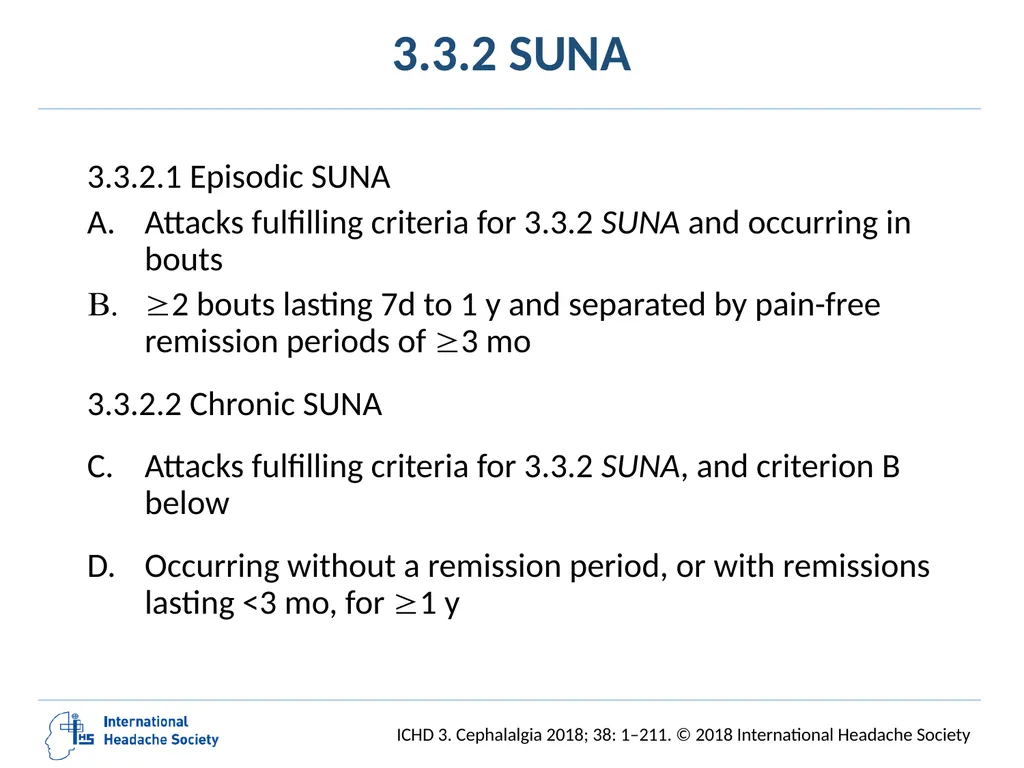
3.3.2 SUNA 3.3.2.1 Episodic SUNA
Attacks fulfilling criteria for 3.3.2 SUNA and occurring in bouts
2 bouts lasting 7d to 1 y and separated by pain-free remission periods of 3 mo
3.3.2.2 Chronic SUNA
Attacks fulfilling criteria for 3.3.2 SUNA, and criterion B below
Occurring without a remission period, or with remissions lasting <3 mo, for 1 y ICHD 3. Cephalalgia 2018; 38: 1–211. © 2018 International Headache Society<br>
Attacks fulfilling criteria for 3.3.2 SUNA and occurring in bouts
2 bouts lasting 7d to 1 y and separated by pain-free remission periods of 3 mo
3.3.2.2 Chronic SUNA
Attacks fulfilling criteria for 3.3.2 SUNA, and criterion B below
Occurring without a remission period, or with remissions lasting <3 mo, for 1 y ICHD 3. Cephalalgia 2018; 38: 1–211. © 2018 International Headache Society<br>
68
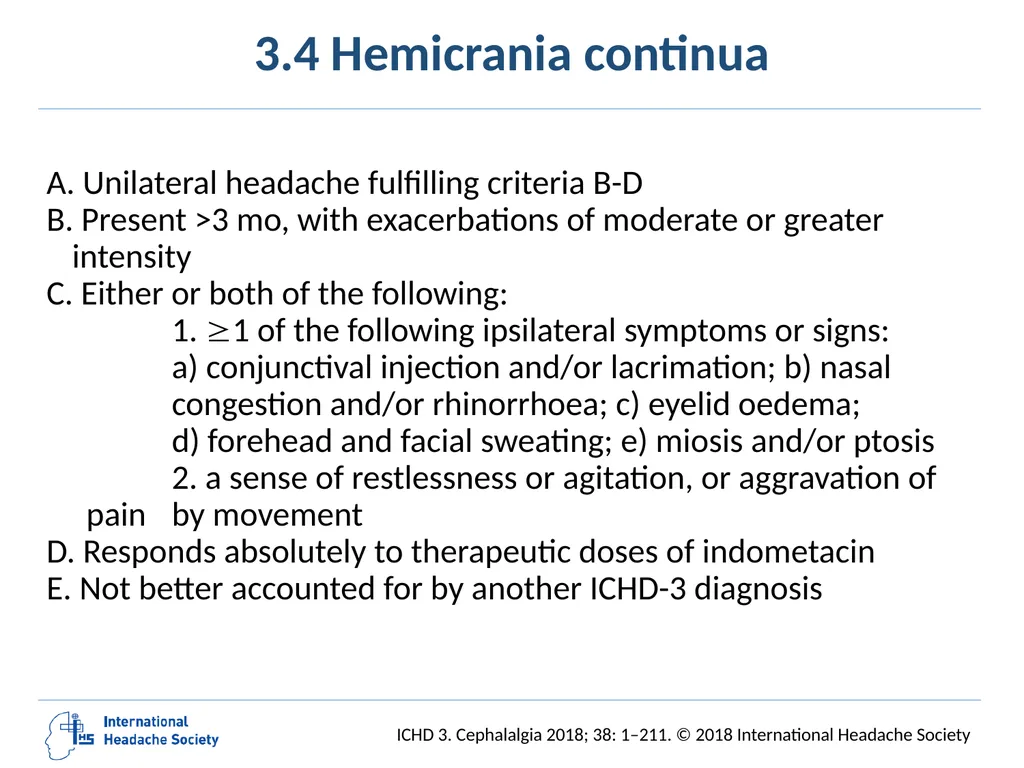
A. Unilateral headache fulfilling criteria B-D
B. Present >3 mo, with exacerbations of moderate or greater intensity
C. Either or both of the following:
1. 1 of the following ipsilateral symptoms or signs: a) conjunctival injection and/or lacrimation; b) nasal congestion and/or rhinorrhoea; c) eyelid oedema; d) forehead and facial sweating; e) miosis and/or ptosis
2. a sense of restlessness or agitation, or aggravation of pain by movement
D. Responds absolutely to therapeutic doses of indometacin
E. Not better accounted for by another ICHD-3 diagnosis 3.4 Hemicrania continua ICHD 3. Cephalalgia 2018; 38: 1–211. © 2018 International Headache Society<br>
B. Present >3 mo, with exacerbations of moderate or greater intensity
C. Either or both of the following:
1. 1 of the following ipsilateral symptoms or signs: a) conjunctival injection and/or lacrimation; b) nasal congestion and/or rhinorrhoea; c) eyelid oedema; d) forehead and facial sweating; e) miosis and/or ptosis
2. a sense of restlessness or agitation, or aggravation of pain by movement
D. Responds absolutely to therapeutic doses of indometacin
E. Not better accounted for by another ICHD-3 diagnosis 3.4 Hemicrania continua ICHD 3. Cephalalgia 2018; 38: 1–211. © 2018 International Headache Society<br>
69
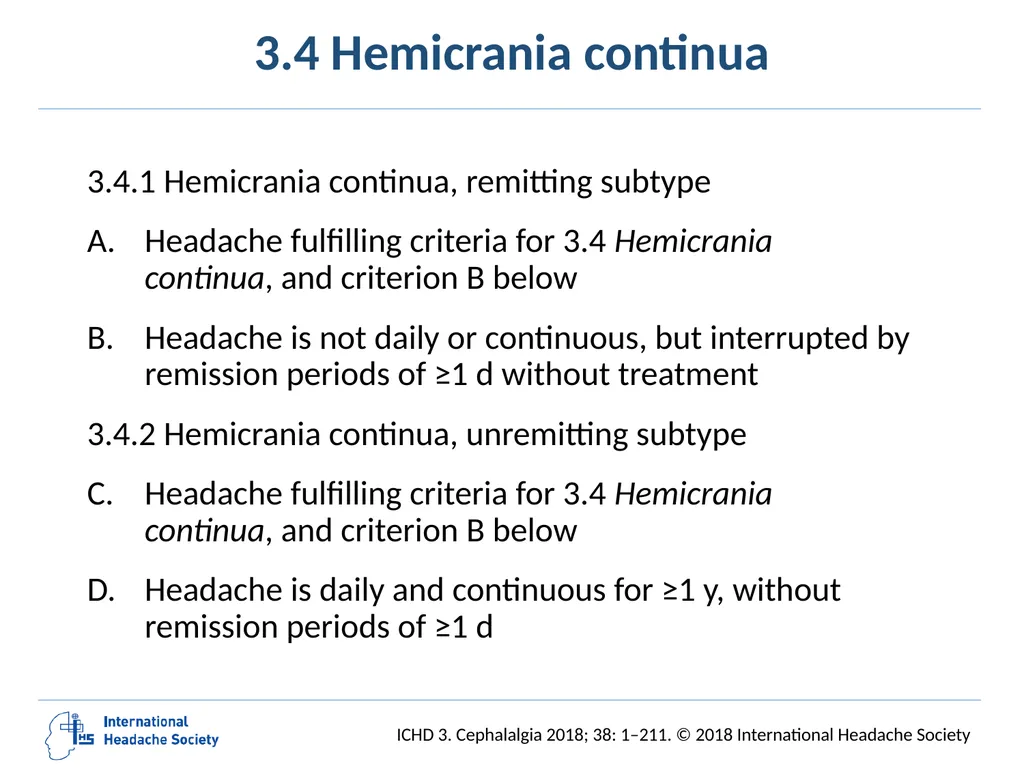
3.4 Hemicrania continua 3.4.1 Hemicrania continua, remitting subtype
Headache fulfilling criteria for 3.4 Hemicrania continua, and criterion B below
Headache is not daily or continuous, but interrupted by remission periods of ≥1 d without treatment
3.4.2 Hemicrania continua, unremitting subtype
Headache fulfilling criteria for 3.4 Hemicrania continua, and criterion B below
Headache is daily and continuous for ≥1 y, without remission periods of ≥1 d ICHD 3. Cephalalgia 2018; 38: 1–211. © 2018 International Headache Society<br>
Headache fulfilling criteria for 3.4 Hemicrania continua, and criterion B below
Headache is not daily or continuous, but interrupted by remission periods of ≥1 d without treatment
3.4.2 Hemicrania continua, unremitting subtype
Headache fulfilling criteria for 3.4 Hemicrania continua, and criterion B below
Headache is daily and continuous for ≥1 y, without remission periods of ≥1 d ICHD 3. Cephalalgia 2018; 38: 1–211. © 2018 International Headache Society<br>
70
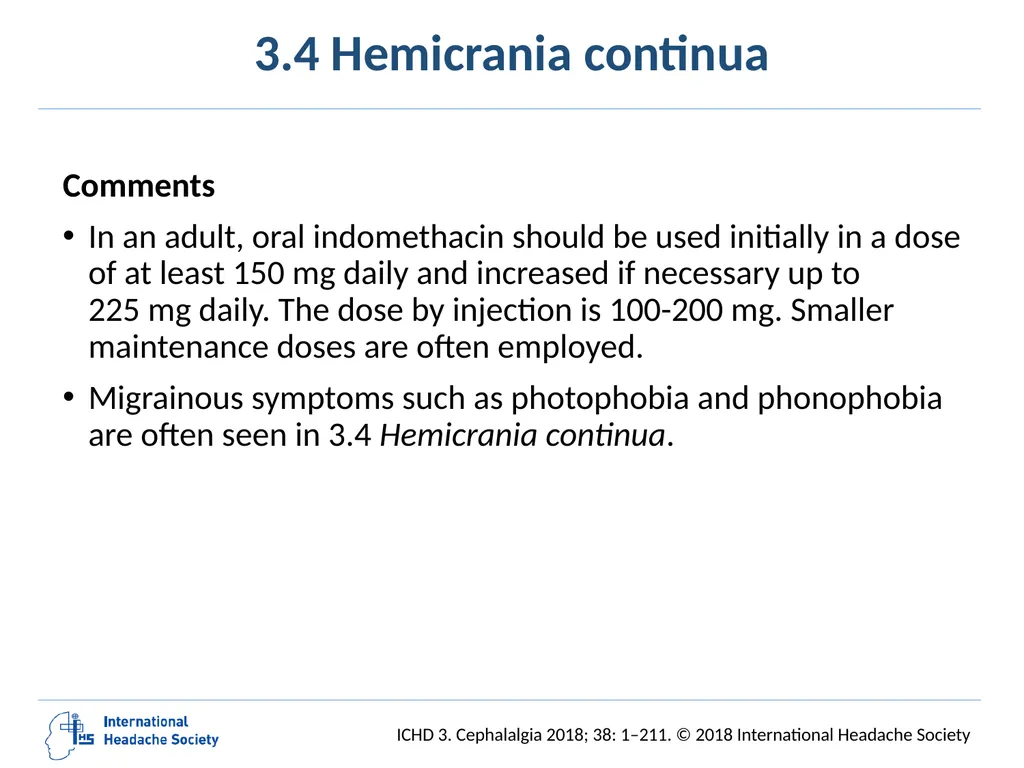
3.4 Hemicrania continua Comments
In an adult, oral indomethacin should be used initially in a dose of at least 150 mg daily and increased if necessary up to 225 mg daily. The dose by injection is 100-200 mg. Smaller maintenance doses are often employed.
Migrainous symptoms such as photophobia and phonophobia are often seen in 3.4 Hemicrania continua. ICHD 3. Cephalalgia 2018; 38: 1–211. © 2018 International Headache Society<br>
In an adult, oral indomethacin should be used initially in a dose of at least 150 mg daily and increased if necessary up to 225 mg daily. The dose by injection is 100-200 mg. Smaller maintenance doses are often employed.
Migrainous symptoms such as photophobia and phonophobia are often seen in 3.4 Hemicrania continua. ICHD 3. Cephalalgia 2018; 38: 1–211. © 2018 International Headache Society<br>
71
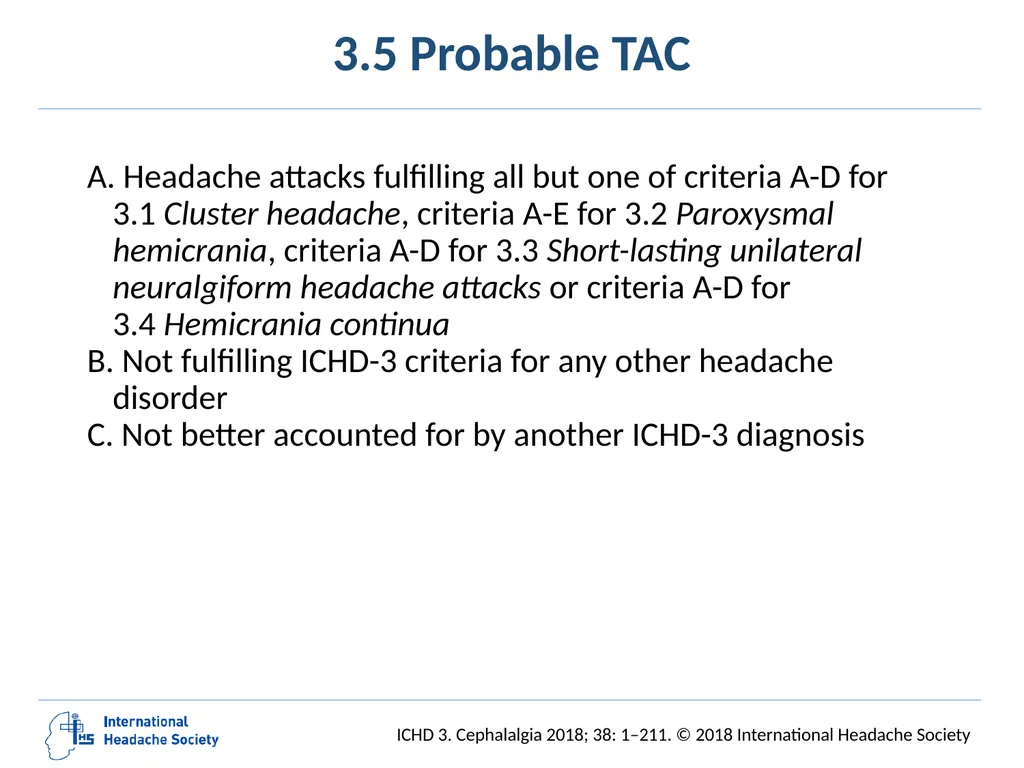
3.5 Probable TAC A. Headache attacks fulfilling all but one of criteria A-D for
3.1 Cluster headache, criteria A-E for 3.2 Paroxysmal
hemicrania, criteria A-D for 3.3 Short-lasting unilateral
neuralgiform headache attacks or criteria A-D for
3.4 Hemicrania continua
B. Not fulfilling ICHD-3 criteria for any other headache disorder
C. Not better accounted for by another ICHD-3 diagnosis ICHD 3. Cephalalgia 2018; 38: 1–211. © 2018 International Headache Society<br>
B. Not fulfilling ICHD-3 criteria for any other headache disorder
C. Not better accounted for by another ICHD-3 diagnosis ICHD 3. Cephalalgia 2018; 38: 1–211. © 2018 International Headache Society<br>
72
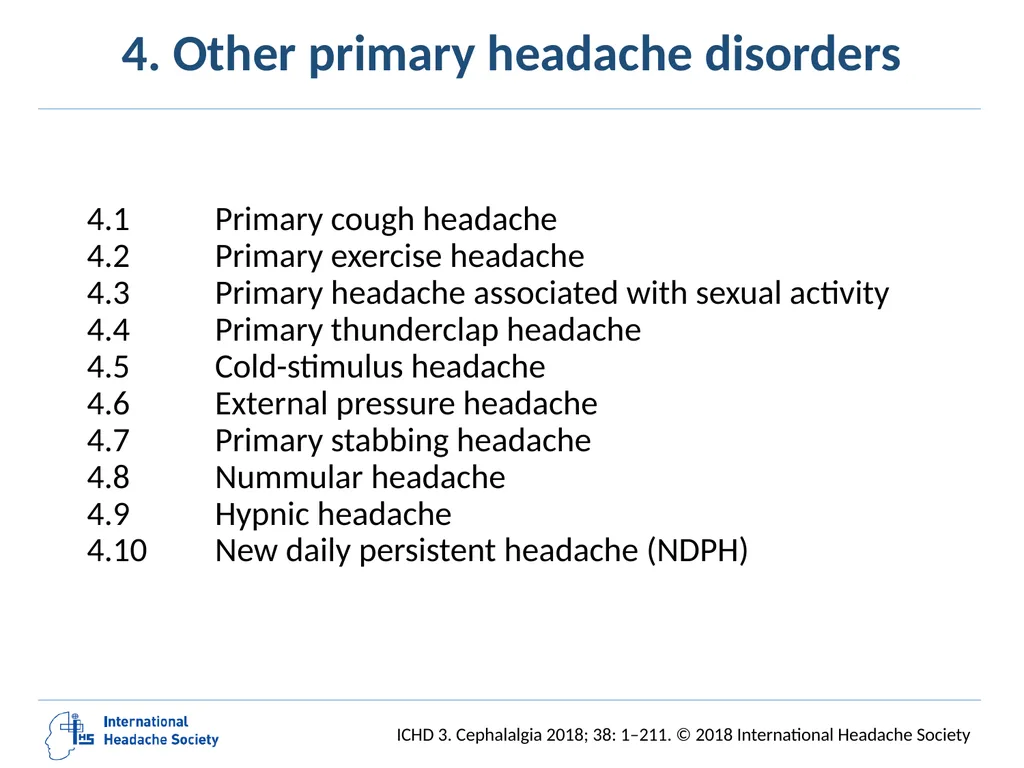
4.1 Primary cough headache
4.2 Primary exercise headache
4.3 Primary headache associated with sexual activity
4.4 Primary thunderclap headache
4.5 Cold-stimulus headache
4.6 External pressure headache
4.7 Primary stabbing headache
4.8 Nummular headache
4.9 Hypnic headache
4.10 New daily persistent headache (NDPH) 4. Other primary headache disorders ICHD 3. Cephalalgia 2018; 38: 1–211. © 2018 International Headache Society<br>
4.2 Primary exercise headache
4.3 Primary headache associated with sexual activity
4.4 Primary thunderclap headache
4.5 Cold-stimulus headache
4.6 External pressure headache
4.7 Primary stabbing headache
4.8 Nummular headache
4.9 Hypnic headache
4.10 New daily persistent headache (NDPH) 4. Other primary headache disorders ICHD 3. Cephalalgia 2018; 38: 1–211. © 2018 International Headache Society<br>
73
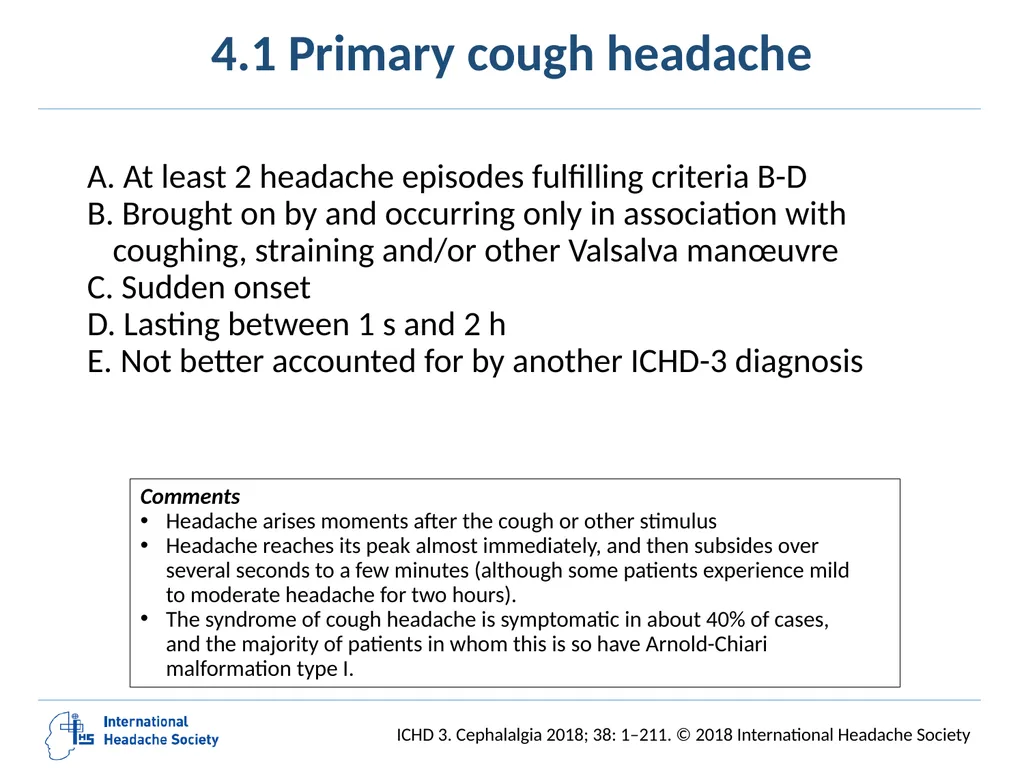
4.1 Primary cough headache A. At least 2 headache episodes fulfilling criteria B-D
B. Brought on by and occurring only in association with coughing, straining and/or other Valsalva manœuvre
C. Sudden onset
D. Lasting between 1 s and 2 h
E. Not better accounted for by another ICHD-3 diagnosis Comments
Headache arises moments after the cough or other stimulus
Headache reaches its peak almost immediately, and then subsides over several seconds to a few minutes (although some patients experience mild to moderate headache for two hours).
The syndrome of cough headache is symptomatic in about 40% of cases, and the majority of patients in whom this is so have Arnold-Chiari malformation type I. ICHD 3. Cephalalgia 2018; 38: 1–211. © 2018 International Headache Society<br>
B. Brought on by and occurring only in association with coughing, straining and/or other Valsalva manœuvre
C. Sudden onset
D. Lasting between 1 s and 2 h
E. Not better accounted for by another ICHD-3 diagnosis Comments
Headache arises moments after the cough or other stimulus
Headache reaches its peak almost immediately, and then subsides over several seconds to a few minutes (although some patients experience mild to moderate headache for two hours).
The syndrome of cough headache is symptomatic in about 40% of cases, and the majority of patients in whom this is so have Arnold-Chiari malformation type I. ICHD 3. Cephalalgia 2018; 38: 1–211. © 2018 International Headache Society<br>
74
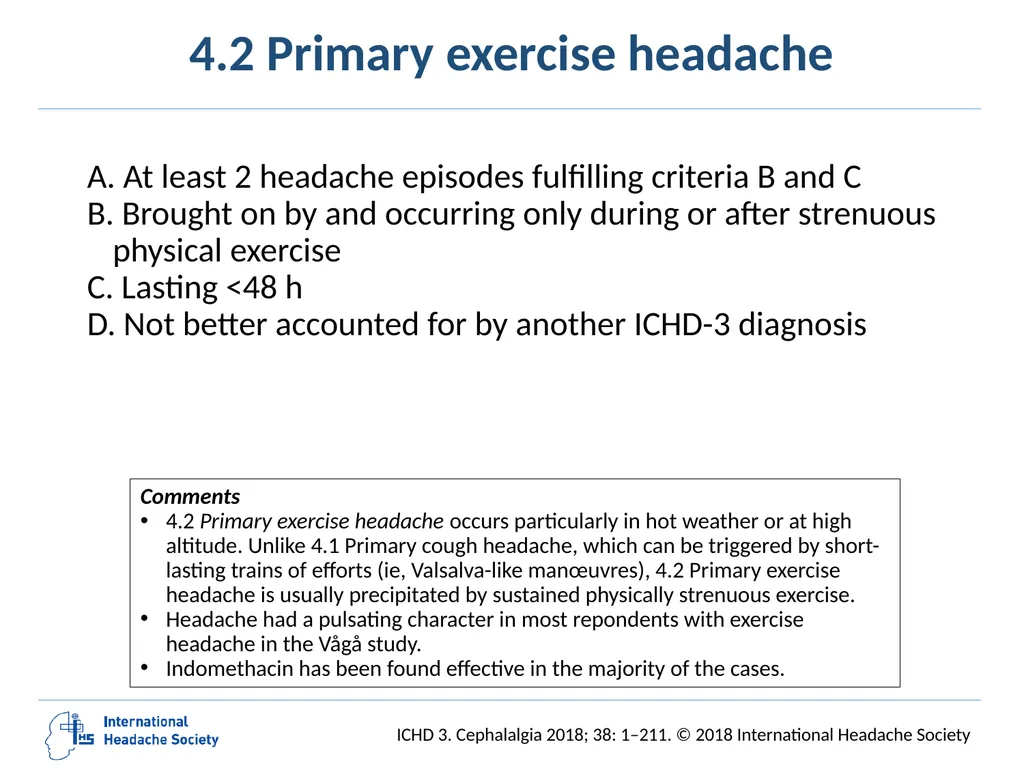
4.2 Primary exercise headache A. At least 2 headache episodes fulfilling criteria B and C
B. Brought on by and occurring only during or after strenuous physical exercise
C. Lasting <48 h
D. Not better accounted for by another ICHD-3 diagnosis Comments
4.2 Primary exercise headache occurs particularly in hot weather or at high altitude. Unlike 4.1 Primary cough headache, which can be triggered by short-lasting trains of efforts (ie, Valsalva-like manœuvres), 4.2 Primary exercise headache is usually precipitated by sustained physically strenuous exercise.
Headache had a pulsating character in most repondents with exercise headache in the Vågå study.
Indomethacin has been found effective in the majority of the cases. ICHD 3. Cephalalgia 2018; 38: 1–211. © 2018 International Headache Society<br>
B. Brought on by and occurring only during or after strenuous physical exercise
C. Lasting <48 h
D. Not better accounted for by another ICHD-3 diagnosis Comments
4.2 Primary exercise headache occurs particularly in hot weather or at high altitude. Unlike 4.1 Primary cough headache, which can be triggered by short-lasting trains of efforts (ie, Valsalva-like manœuvres), 4.2 Primary exercise headache is usually precipitated by sustained physically strenuous exercise.
Headache had a pulsating character in most repondents with exercise headache in the Vågå study.
Indomethacin has been found effective in the majority of the cases. ICHD 3. Cephalalgia 2018; 38: 1–211. © 2018 International Headache Society<br>
75
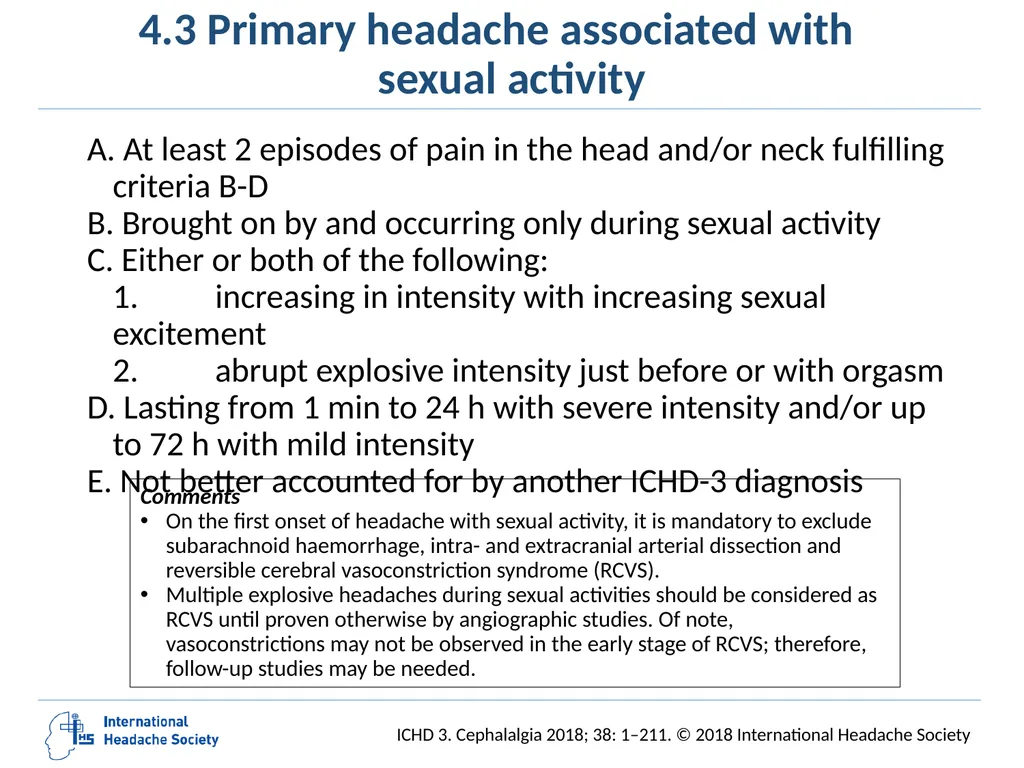
4.3 Primary headache associated with sexual activity A. At least 2 episodes of pain in the head and/or neck fulfilling criteria B-D
B. Brought on by and occurring only during sexual activity
C. Either or both of the following:
1. increasing in intensity with increasing sexual excitement
2. abrupt explosive intensity just before or with orgasm
D. Lasting from 1 min to 24 h with severe intensity and/or up to 72 h with mild intensity
E. Not better accounted for by another ICHD-3 diagnosis Comments
On the first onset of headache with sexual activity, it is mandatory to exclude subarachnoid haemorrhage, intra- and extracranial arterial dissection and reversible cerebral vasoconstriction syndrome (RCVS).
Multiple explosive headaches during sexual activities should be considered as RCVS until proven otherwise by angiographic studies. Of note, vasoconstrictions may not be observed in the early stage of RCVS; therefore, follow-up studies may be needed. ICHD 3. Cephalalgia 2018; 38: 1–211. © 2018 International Headache Society<br>
B. Brought on by and occurring only during sexual activity
C. Either or both of the following:
1. increasing in intensity with increasing sexual excitement
2. abrupt explosive intensity just before or with orgasm
D. Lasting from 1 min to 24 h with severe intensity and/or up to 72 h with mild intensity
E. Not better accounted for by another ICHD-3 diagnosis Comments
On the first onset of headache with sexual activity, it is mandatory to exclude subarachnoid haemorrhage, intra- and extracranial arterial dissection and reversible cerebral vasoconstriction syndrome (RCVS).
Multiple explosive headaches during sexual activities should be considered as RCVS until proven otherwise by angiographic studies. Of note, vasoconstrictions may not be observed in the early stage of RCVS; therefore, follow-up studies may be needed. ICHD 3. Cephalalgia 2018; 38: 1–211. © 2018 International Headache Society<br>
76
Two subforms (preorgasmic headache and orgasmic
headache) were included in ICHD-1 and ICHD-2, but clinical
studies have since been unable to distinguish these;
therefore, 4.3 Primary headache associated with sexual activity is now regarded as a single entity with variable presentation. 4.3 Primary headache associated with sexual activity ICHD 3. Cephalalgia 2018; 38: 1–211. © 2018 International Headache Society<br>
therefore, 4.3 Primary headache associated with sexual activity is now regarded as a single entity with variable presentation. 4.3 Primary headache associated with sexual activity ICHD 3. Cephalalgia 2018; 38: 1–211. © 2018 International Headache Society<br>
77
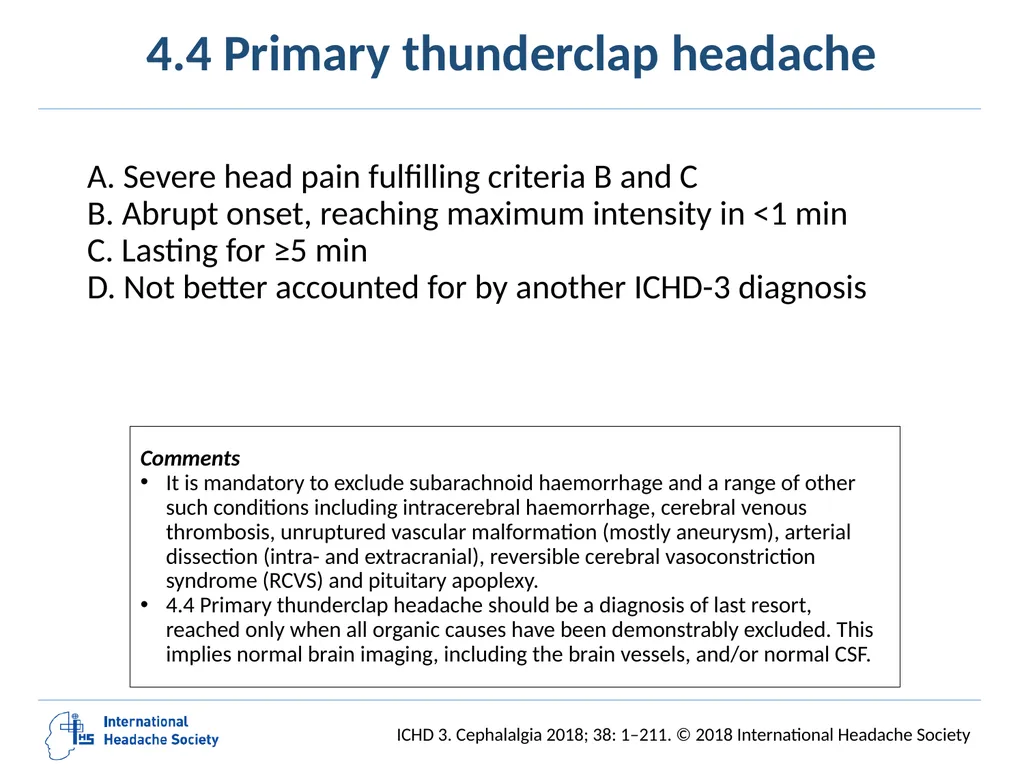
4.4 Primary thunderclap headache A. Severe head pain fulfilling criteria B and C
B. Abrupt onset, reaching maximum intensity in <1 min
C. Lasting for ≥5 min
D. Not better accounted for by another ICHD-3 diagnosis Comments
It is mandatory to exclude subarachnoid haemorrhage and a range of other such conditions including intracerebral haemorrhage, cerebral venous thrombosis, unruptured vascular malformation (mostly aneurysm), arterial dissection (intra- and extracranial), reversible cerebral vasoconstriction syndrome (RCVS) and pituitary apoplexy.
4.4 Primary thunderclap headache should be a diagnosis of last resort, reached only when all organic causes have been demonstrably excluded. This implies normal brain imaging, including the brain vessels, and/or normal CSF. ICHD 3. Cephalalgia 2018; 38: 1–211. © 2018 International Headache Society<br>
B. Abrupt onset, reaching maximum intensity in <1 min
C. Lasting for ≥5 min
D. Not better accounted for by another ICHD-3 diagnosis Comments
It is mandatory to exclude subarachnoid haemorrhage and a range of other such conditions including intracerebral haemorrhage, cerebral venous thrombosis, unruptured vascular malformation (mostly aneurysm), arterial dissection (intra- and extracranial), reversible cerebral vasoconstriction syndrome (RCVS) and pituitary apoplexy.
4.4 Primary thunderclap headache should be a diagnosis of last resort, reached only when all organic causes have been demonstrably excluded. This implies normal brain imaging, including the brain vessels, and/or normal CSF. ICHD 3. Cephalalgia 2018; 38: 1–211. © 2018 International Headache Society<br>
78
4.5.1 Headache attributed to external application of a cold
stimulus
4.5.2 Headache attributed to ingestion or inhalation of a cold stimulus 4.5 Cold-stimulus headache ICHD 3. Cephalalgia 2018; 38: 1–211. © 2018 International Headache Society<br>
4.5.2 Headache attributed to ingestion or inhalation of a cold stimulus 4.5 Cold-stimulus headache ICHD 3. Cephalalgia 2018; 38: 1–211. © 2018 International Headache Society<br>
79
4.5.1 Headache attributed to external application of a cold stimulus A. At least 2 acute headache episodes fulfilling criteria B and C
B. Brought on by and occurring only during application of an external cold stimulus to the head
C. Resolving within 30 min after removal of the cold stimulus
D. Not better accounted for by another ICHD-3 diagnosis ICHD 3. Cephalalgia 2018; 38: 1–211. © 2018 International Headache Society<br>
B. Brought on by and occurring only during application of an external cold stimulus to the head
C. Resolving within 30 min after removal of the cold stimulus
D. Not better accounted for by another ICHD-3 diagnosis ICHD 3. Cephalalgia 2018; 38: 1–211. © 2018 International Headache Society<br>
80
4.5.2 Headache attributed to ingestion or inhalation of a cold stimulus A. At least 2 episodes of acute frontal or temporal headache
fulfilling criteria B and C
B. Brought on by and occurring immediately after a cold stimulus to the palate and/or posterior pharyngeal wall from ingestion of cold food or drink or inhalation of cold air
C. Resolving within 10 min after removal of the cold stimulus
D. Not better accounted for by another ICHD-3 diagnosis ICHD 3. Cephalalgia 2018; 38: 1–211. © 2018 International Headache Society<br>
B. Brought on by and occurring immediately after a cold stimulus to the palate and/or posterior pharyngeal wall from ingestion of cold food or drink or inhalation of cold air
C. Resolving within 10 min after removal of the cold stimulus
D. Not better accounted for by another ICHD-3 diagnosis ICHD 3. Cephalalgia 2018; 38: 1–211. © 2018 International Headache Society<br>
81
4.6.1 External-compression headache
4.6.2 External-traction headache 4.6 External-pressure headache ICHD 3. Cephalalgia 2018; 38: 1–211. © 2018 International Headache Society<br>
4.6.2 External-traction headache 4.6 External-pressure headache ICHD 3. Cephalalgia 2018; 38: 1–211. © 2018 International Headache Society<br>
82
A. At least 2 episodes of headache fulfilling criteria B-D
B. Brought on by and occurring within 1 h during sustained external compression of the forehead or scalp
C. Maximal at the site of external compression
D. Resolving within 1 h after external compression is relieved
E. Not better accounted for by another ICHD-3 diagnosis 4.6.1 External-compression headache ICHD 3. Cephalalgia 2018; 38: 1–211. © 2018 International Headache Society<br>
B. Brought on by and occurring within 1 h during sustained external compression of the forehead or scalp
C. Maximal at the site of external compression
D. Resolving within 1 h after external compression is relieved
E. Not better accounted for by another ICHD-3 diagnosis 4.6.1 External-compression headache ICHD 3. Cephalalgia 2018; 38: 1–211. © 2018 International Headache Society<br>
83
A. At least 2 episodes of headache fulfilling criteria B-D
B. Brought on by and occurring within 1 h during sustained external traction on the scalp
C. Maximal at the traction site
D. Resolving within 1 h after traction is relieved
E. Not better accounted for by another ICHD-3 diagnosis 4.6.2 External-traction headache ICHD 3. Cephalalgia 2018; 38: 1–211. © 2018 International Headache Society<br>
B. Brought on by and occurring within 1 h during sustained external traction on the scalp
C. Maximal at the traction site
D. Resolving within 1 h after traction is relieved
E. Not better accounted for by another ICHD-3 diagnosis 4.6.2 External-traction headache ICHD 3. Cephalalgia 2018; 38: 1–211. © 2018 International Headache Society<br>
84
4.7 Primary stabbing headache A. Head pain occurring spontaneously as a single stab or
series of stabs and fulfilling criteria B-D
B. Each stab lasts for up to a few seconds
C. Stabs recur with irregular frequency, from one to many per day
D. No cranial autonomic symptoms
E. Not better accounted for by another ICHD-3 diagnosis Comments
4.7 Primary stabbing headache involves extratrigeminal regions in 70% of cases.
It may move from one area to another, in either the same or the opposite hemicranium: in only one third of patients it has a fixed location.
4.7 Primary stabbing headache is more commonly experienced by people with 1. Migraine. ICHD 3. Cephalalgia 2018; 38: 1–211. © 2018 International Headache Society<br>
B. Each stab lasts for up to a few seconds
C. Stabs recur with irregular frequency, from one to many per day
D. No cranial autonomic symptoms
E. Not better accounted for by another ICHD-3 diagnosis Comments
4.7 Primary stabbing headache involves extratrigeminal regions in 70% of cases.
It may move from one area to another, in either the same or the opposite hemicranium: in only one third of patients it has a fixed location.
4.7 Primary stabbing headache is more commonly experienced by people with 1. Migraine. ICHD 3. Cephalalgia 2018; 38: 1–211. © 2018 International Headache Society<br>
85
A. Continuous or intermittent head pain fulfilling criterion B
B. Felt exclusively in an area of the scalp, with all of the following 4 characteristics:
1. sharply-contoured
2. fixed in size and shape
3. round or elliptical
4. 1-6 cm in diameter
C. Not better accounted for by another ICHD-3 diagnosis 4.8 Nummular headache Comments
The painful area may be localized in any part of the scalp, but is usually in the parietal region.
Pain intensity is generally mild to moderate, but occasionally severe.
Up to 75% of published cases, the disorder has been chronic (present for longer than 3 months).
The affected area commonly shows variable combinations of hypaesthesia, dysaesthesia, paraesthesia, allodynia and/or tenderness. ICHD 3. Cephalalgia 2018; 38: 1–211. © 2018 International Headache Society<br>
B. Felt exclusively in an area of the scalp, with all of the following 4 characteristics:
1. sharply-contoured
2. fixed in size and shape
3. round or elliptical
4. 1-6 cm in diameter
C. Not better accounted for by another ICHD-3 diagnosis 4.8 Nummular headache Comments
The painful area may be localized in any part of the scalp, but is usually in the parietal region.
Pain intensity is generally mild to moderate, but occasionally severe.
Up to 75% of published cases, the disorder has been chronic (present for longer than 3 months).
The affected area commonly shows variable combinations of hypaesthesia, dysaesthesia, paraesthesia, allodynia and/or tenderness. ICHD 3. Cephalalgia 2018; 38: 1–211. © 2018 International Headache Society<br>
86
4.9 Hypnic headache A. Recurrent headache attacks fulfilling criteria B-E
B. Developing only during sleep, and causing wakening
C. Occurring on ≥10 d/mo for >3 mo
D. Lasting ≥15 min and for up to 4 h after waking
E. No cranial autonomic symptoms or restlessness
F. Not better accounted for by another ICHD-3 diagnosis Comments
4.9 Hypnic headache usually begins after age 50 years, but may occur in younger people.
The pain is usually mild to moderate, but severe pain is reported by one fifth of patients. Pain is bilateral in about two-thirds of cases. Most cases are persistent, with daily or near daily headaches, but an episodic subtype may occur.
Lithium, caffeine, melatonin and indomethacin have been effective treatments in several reported cases. ICHD 3. Cephalalgia 2018; 38: 1–211. © 2018 International Headache Society<br>
B. Developing only during sleep, and causing wakening
C. Occurring on ≥10 d/mo for >3 mo
D. Lasting ≥15 min and for up to 4 h after waking
E. No cranial autonomic symptoms or restlessness
F. Not better accounted for by another ICHD-3 diagnosis Comments
4.9 Hypnic headache usually begins after age 50 years, but may occur in younger people.
The pain is usually mild to moderate, but severe pain is reported by one fifth of patients. Pain is bilateral in about two-thirds of cases. Most cases are persistent, with daily or near daily headaches, but an episodic subtype may occur.
Lithium, caffeine, melatonin and indomethacin have been effective treatments in several reported cases. ICHD 3. Cephalalgia 2018; 38: 1–211. © 2018 International Headache Society<br>
87
A. Persistent headache fulfilling criteria B and C
B. Distinct and clearly-remembered onset, with pain becoming continuous and unremitting within 24 h
C. Present for >3 mo
D. Not better accounted for by another ICHD-3 diagnosis 4.10 New daily persistent headache (NDPH) ICHD 3. Cephalalgia 2018; 38: 1–211. © 2018 International Headache Society<br>
B. Distinct and clearly-remembered onset, with pain becoming continuous and unremitting within 24 h
C. Present for >3 mo
D. Not better accounted for by another ICHD-3 diagnosis 4.10 New daily persistent headache (NDPH) ICHD 3. Cephalalgia 2018; 38: 1–211. © 2018 International Headache Society<br>
88
4.10 New daily persistent headache (NDPH) Comments
Patients with prior headache (1. Migraine or 2. Tension-type headache) are not excluded from this diagnosis, but they should not describe increasing headache frequency prior to its onset. Similarly, patients with prior headache should not describe exacerbation associated with or followed by medication overuse. ICHD 3. Cephalalgia 2018; 38: 1–211. © 2018 International Headache Society<br>
Patients with prior headache (1. Migraine or 2. Tension-type headache) are not excluded from this diagnosis, but they should not describe increasing headache frequency prior to its onset. Similarly, patients with prior headache should not describe exacerbation associated with or followed by medication overuse. ICHD 3. Cephalalgia 2018; 38: 1–211. © 2018 International Headache Society<br>
89
PART 2: the secondary headaches Headache attributed to trauma or injury to the head and/or neck
Headache attributed to cranial and/or cervical vascular disorder
Headache attributed to non-vascular intracranial disorder
Headache attributed to a substance or its withdrawal
Headache attributed to infection
Headache attributed to disorder of homoeostasis
Headache or facial pain attributed to disorder of the cranium, neck, eyes, ears, nose, sinuses, teeth, mouth or other facial or cranial structure
Headache attributed to psychiatric disorder ICHD 3. Cephalalgia 2018; 38: 1–211. © 2018 International Headache Society<br>
Headache attributed to cranial and/or cervical vascular disorder
Headache attributed to non-vascular intracranial disorder
Headache attributed to a substance or its withdrawal
Headache attributed to infection
Headache attributed to disorder of homoeostasis
Headache or facial pain attributed to disorder of the cranium, neck, eyes, ears, nose, sinuses, teeth, mouth or other facial or cranial structure
Headache attributed to psychiatric disorder ICHD 3. Cephalalgia 2018; 38: 1–211. © 2018 International Headache Society<br>
90
PART 2: the secondary headaches General rules
When a new headache occurs for the first time in close temporal relation to another disorder that is known to cause headache, or fulfils other criteria for causation by that disorder, the new headache is coded as a “secondary headache attributed to the causative disorder”.
When a pre-existing primary headache becomes chronic or is made significantly worse (a two-fold or greater increase in frequency and/or severity) in close temporal relation to a causative disorder, both the primary and the secondary headache diagnoses should be given.
There should be a good evidence that the disorder can cause headache. ICHD 3. Cephalalgia 2018; 38: 1–211. © 2018 International Headache Society<br>
When a new headache occurs for the first time in close temporal relation to another disorder that is known to cause headache, or fulfils other criteria for causation by that disorder, the new headache is coded as a “secondary headache attributed to the causative disorder”.
When a pre-existing primary headache becomes chronic or is made significantly worse (a two-fold or greater increase in frequency and/or severity) in close temporal relation to a causative disorder, both the primary and the secondary headache diagnoses should be given.
There should be a good evidence that the disorder can cause headache. ICHD 3. Cephalalgia 2018; 38: 1–211. © 2018 International Headache Society<br>
91
PART 2: the secondary headaches General Diagnostic Criteria
Any headache fulfilling criterion C
Another disorder scientifically documented to be able to cause headache has been diagnosed1
Evidence of causation demonstrated by at least two of the following2:
headache has developed in temporal relation to the onset of the presumed causative disorder
either or both of the following:
headache has significantly worsened in parallel with worsening of the presumed causative disorder
headache has significantly improved in parallel with improvement of the presumed causative disorder
headache has characteristics typical for the causative disorder3
other evidence exists of causation4
Not better accounted for by another ICHD-3 diagnosis ICHD 3. Cephalalgia 2018; 38: 1–211. © 2018 International Headache Society<br>
Any headache fulfilling criterion C
Another disorder scientifically documented to be able to cause headache has been diagnosed1
Evidence of causation demonstrated by at least two of the following2:
headache has developed in temporal relation to the onset of the presumed causative disorder
either or both of the following:
headache has significantly worsened in parallel with worsening of the presumed causative disorder
headache has significantly improved in parallel with improvement of the presumed causative disorder
headache has characteristics typical for the causative disorder3
other evidence exists of causation4
Not better accounted for by another ICHD-3 diagnosis ICHD 3. Cephalalgia 2018; 38: 1–211. © 2018 International Headache Society<br>
92
5. Headache attributed to trauma or injury to the head and/or neck 5.1 Acute headache attributed to traumatic injury to the head
5.2 Persistent headache attributed to traumatic injury to the head
5.3 Acute headache attributed to whiplash
5.4 Persistent headache attributed to whiplash
5.5 Acute headache attributed to craniotomy
5.6 Persistent headache attributed to craniotomy ICHD 3. Cephalalgia 2018; 38: 1–211. © 2018 International Headache Society<br>
5.2 Persistent headache attributed to traumatic injury to the head
5.3 Acute headache attributed to whiplash
5.4 Persistent headache attributed to whiplash
5.5 Acute headache attributed to craniotomy
5.6 Persistent headache attributed to craniotomy ICHD 3. Cephalalgia 2018; 38: 1–211. © 2018 International Headache Society<br>
93
5. Headache attributed to trauma or injury to the head and/or neck Introduction
During the first 3 months from onset they are considered acute; if they continue beyond that period they are designated persistent (adopted in place of chronic).
Headache must be reported to have developed within 7 days following trauma or injury, or within 7 days after regaining consciousness and/or within 7 days after recovering the ability to sense and report pain. ICHD 3. Cephalalgia 2018; 38: 1–211. © 2018 International Headache Society<br>
During the first 3 months from onset they are considered acute; if they continue beyond that period they are designated persistent (adopted in place of chronic).
Headache must be reported to have developed within 7 days following trauma or injury, or within 7 days after regaining consciousness and/or within 7 days after recovering the ability to sense and report pain. ICHD 3. Cephalalgia 2018; 38: 1–211. © 2018 International Headache Society<br>
94
5.1 Acute headache attributed to traumatic injury to the head Diagnostic Criteria
Any headache fulfilling criteria C and D
Traumatic injury to the head has occurred
Headache is reported to have developed within 7 days after one of the following:
the injury to the head
regaining of consciousness following the injury to the head
discontinuation of medication(s) impairing ability to sense or report headache following the injury to the head
Either of the following:
headache has resolved within 3 months after its onset
headache has not yet resolved but 3 months have not yet passed since its onset
Not better accounted for by another ICHD-3 diagnosis ICHD 3. Cephalalgia 2018; 38: 1–211. © 2018 International Headache Society<br>
Any headache fulfilling criteria C and D
Traumatic injury to the head has occurred
Headache is reported to have developed within 7 days after one of the following:
the injury to the head
regaining of consciousness following the injury to the head
discontinuation of medication(s) impairing ability to sense or report headache following the injury to the head
Either of the following:
headache has resolved within 3 months after its onset
headache has not yet resolved but 3 months have not yet passed since its onset
Not better accounted for by another ICHD-3 diagnosis ICHD 3. Cephalalgia 2018; 38: 1–211. © 2018 International Headache Society<br>
95
5.2 Persistent headache attributed to traumatic injury to the head Diagnostic Criteria
Any headache fulfilling criteria C and D
Traumatic injury to the head has occurred
Headache is reported to have developed within 7 days after one of the following:
the injury to the head
regaining of consciousness following the injury to the head
discontinuation of medication(s) impairing ability to sense or report headache following the injury to the head
Headache persists for >3 months after its onset
Not better accounted for by another ICHD-3 diagnosis ICHD 3. Cephalalgia 2018; 38: 1–211. © 2018 International Headache Society<br>
Any headache fulfilling criteria C and D
Traumatic injury to the head has occurred
Headache is reported to have developed within 7 days after one of the following:
the injury to the head
regaining of consciousness following the injury to the head
discontinuation of medication(s) impairing ability to sense or report headache following the injury to the head
Headache persists for >3 months after its onset
Not better accounted for by another ICHD-3 diagnosis ICHD 3. Cephalalgia 2018; 38: 1–211. © 2018 International Headache Society<br>
96
6. Headache attributed to cranial or cervical vascular disorder Introduction
The diagnosis of headache and its causal link is easy in most of the vascular conditions listed here because the headache presents both acutely and with neurological signs and because it often remits rapidly.
Headache can be overshadowed by focal signs and/or disorders of consciousness in many of these conditions.
In some disorders, headache can be an initial warning symptom. It is crucial to recognize the association of headache with these disorders in order to diagnose correctly the underlying vascular disease and start appropriate treatment as early as possible. ICHD 3. Cephalalgia 2018; 38: 1–211. © 2018 International Headache Society<br>
The diagnosis of headache and its causal link is easy in most of the vascular conditions listed here because the headache presents both acutely and with neurological signs and because it often remits rapidly.
Headache can be overshadowed by focal signs and/or disorders of consciousness in many of these conditions.
In some disorders, headache can be an initial warning symptom. It is crucial to recognize the association of headache with these disorders in order to diagnose correctly the underlying vascular disease and start appropriate treatment as early as possible. ICHD 3. Cephalalgia 2018; 38: 1–211. © 2018 International Headache Society<br>
97
6. Headache attributed to cranial or cervical vascular disorder 6.1 Headache attributed to cerebral ischaemic event
6.2 Headache attributed to non-traumatic intracranial haemorrhage
6.3 Headache attributed to unruptured vascular malformation
6.4 Headache attributed to arteritis
6.5 Headache attributed to cervical carotid or vertebral artery disorder
6.6 Headache attributed to cranial venous disorder
6.7 Headache attributed to other acute intracranial arterial disorder
6.8 Headache and/or migraine-like aura attributed to chronic intracranial vasculopathy
6.9 Headache attributed to pituitary apoplexy ICHD 3. Cephalalgia 2018; 38: 1–211. © 2018 International Headache Society<br>
6.2 Headache attributed to non-traumatic intracranial haemorrhage
6.3 Headache attributed to unruptured vascular malformation
6.4 Headache attributed to arteritis
6.5 Headache attributed to cervical carotid or vertebral artery disorder
6.6 Headache attributed to cranial venous disorder
6.7 Headache attributed to other acute intracranial arterial disorder
6.8 Headache and/or migraine-like aura attributed to chronic intracranial vasculopathy
6.9 Headache attributed to pituitary apoplexy ICHD 3. Cephalalgia 2018; 38: 1–211. © 2018 International Headache Society<br>
98
6.1 Headache attributed to cerebral ischaemic event 6.1.1 Headache attributed to ischaemic stroke (cerebral infarction)
6.1.2 Headache attributed to transient ischaemic attack (TIA) ICHD 3. Cephalalgia 2018; 38: 1–211. © 2018 International Headache Society<br>
6.1.2 Headache attributed to transient ischaemic attack (TIA) ICHD 3. Cephalalgia 2018; 38: 1–211. © 2018 International Headache Society<br>
99
6.2 Headache attributed to non-traumatic intracranial haemorrhage 6.2.1 Headache attributed to non-traumatic intracerebral haemorrhage
6.2.2 Acute headache attributed to non-traumatic subarachnoid haemorrhage (SAH)
6.2.3 Acute headache attributed to non-traumatic acute subdural haemorrhage (ASDH)
6.2.4 Persistent headache attributed to past non-traumatic intracranial haemorrhage ICHD 3. Cephalalgia 2018; 38: 1–211. © 2018 International Headache Society<br>
6.2.2 Acute headache attributed to non-traumatic subarachnoid haemorrhage (SAH)
6.2.3 Acute headache attributed to non-traumatic acute subdural haemorrhage (ASDH)
6.2.4 Persistent headache attributed to past non-traumatic intracranial haemorrhage ICHD 3. Cephalalgia 2018; 38: 1–211. © 2018 International Headache Society<br>
100
6.3 Headache attributed to unruptured vascular malformation 6.3.1 Headache attributed to unruptured saccular aneurysm
6.3.2 Headache attributed to arteriovenous malformation (AVM)
6.3.3 Headache attributed to dural arteriovenous fistula (DAVF)
6.3.4 Headache attributed to cavernous angioma
6.3.5 Headache attributed to encephalotrigeminal or leptomeningeal angiomatosis (Sturge Weber syndrome) ICHD 3. Cephalalgia 2018; 38: 1–211. © 2018 International Headache Society<br>
6.3.2 Headache attributed to arteriovenous malformation (AVM)
6.3.3 Headache attributed to dural arteriovenous fistula (DAVF)
6.3.4 Headache attributed to cavernous angioma
6.3.5 Headache attributed to encephalotrigeminal or leptomeningeal angiomatosis (Sturge Weber syndrome) ICHD 3. Cephalalgia 2018; 38: 1–211. © 2018 International Headache Society<br>
101
6.4 Headache attributed to arteritis 6.4.1 Headache attributed to giant cell arteritis (GCA)
6.4.2 Headache attributed to primary angiitis of the central nervous system (PACNS)
6.4.3 Headache attributed to secondary angiitis of the central nervous system (SACNS) ICHD 3. Cephalalgia 2018; 38: 1–211. © 2018 International Headache Society<br>
6.4.2 Headache attributed to primary angiitis of the central nervous system (PACNS)
6.4.3 Headache attributed to secondary angiitis of the central nervous system (SACNS) ICHD 3. Cephalalgia 2018; 38: 1–211. © 2018 International Headache Society<br>
102
6.4.1 Headache attributed to giant cell arteritis (GCA) Any new headache fulfilling criterion C
Giant cell arteritis (GCA) has been diagnosed
Evidence of causation demonstrated by at least two of the following:
headache has developed in close temporal relation to other symptoms and/or clinical or biological signs of onset of GCA, or has led to the diagnosis of GCA
either or both of the following:
a) headache has significantly worsened in parallel with worsening of GCA
b) headache has significantly improved or resolved within 3 days of high-dose steroid treatment
headache is associated with scalp tenderness and/or jaw claudication
Not better accounted for by another ICHD-3 diagnosis ICHD 3. Cephalalgia 2018; 38: 1–211. © 2018 International Headache Society<br>
Giant cell arteritis (GCA) has been diagnosed
Evidence of causation demonstrated by at least two of the following:
headache has developed in close temporal relation to other symptoms and/or clinical or biological signs of onset of GCA, or has led to the diagnosis of GCA
either or both of the following:
a) headache has significantly worsened in parallel with worsening of GCA
b) headache has significantly improved or resolved within 3 days of high-dose steroid treatment
headache is associated with scalp tenderness and/or jaw claudication
Not better accounted for by another ICHD-3 diagnosis ICHD 3. Cephalalgia 2018; 38: 1–211. © 2018 International Headache Society<br>
103
6.4.1 Headache attributed to giant cell arteritis (GCA) Comments
Any recent persisting headache in a patient over 60 years of age should suggest GCA and lead to appropriate investigations.
Recent repeated attacks of amaurosis fugax associated with headache are very suggestive of GCA and should prompt urgent investigations.
Histological diagnosis can be difficult, because the temporal artery may appear uninvolved in some areas (skip lesions), pointing to the necessity of serial sectioning. ICHD 3. Cephalalgia 2018; 38: 1–211. © 2018 International Headache Society<br>
Any recent persisting headache in a patient over 60 years of age should suggest GCA and lead to appropriate investigations.
Recent repeated attacks of amaurosis fugax associated with headache are very suggestive of GCA and should prompt urgent investigations.
Histological diagnosis can be difficult, because the temporal artery may appear uninvolved in some areas (skip lesions), pointing to the necessity of serial sectioning. ICHD 3. Cephalalgia 2018; 38: 1–211. © 2018 International Headache Society<br>
104
6.4.2 Headache attributed to primary angiitis of the central nervous system (PACNS) Any new headache fulfilling criterion C
Primary angiitis of the central nervous system (PACNS) has been diagnosed
Evidence of causation demonstrated by either or both of the following:
headache has developed in close temporal relation to other symptoms and/or clinical signs of onset of PACNS, or has led to the diagnosis of PACNS
either or both of the following:
a) headache has significantly worsened in parallel with worsening of PACNS
b) headache has significantly improved in parallel with improvement in PACNS resulting from steroid and/or immunosuppressive treatment
Not better accounted for by another ICHD-3 diagnosis ICHD 3. Cephalalgia 2018; 38: 1–211. © 2018 International Headache Society<br>
Primary angiitis of the central nervous system (PACNS) has been diagnosed
Evidence of causation demonstrated by either or both of the following:
headache has developed in close temporal relation to other symptoms and/or clinical signs of onset of PACNS, or has led to the diagnosis of PACNS
either or both of the following:
a) headache has significantly worsened in parallel with worsening of PACNS
b) headache has significantly improved in parallel with improvement in PACNS resulting from steroid and/or immunosuppressive treatment
Not better accounted for by another ICHD-3 diagnosis ICHD 3. Cephalalgia 2018; 38: 1–211. © 2018 International Headache Society<br>
105
6.4.2 Headache attributed to primary angiitis of the central nervous system (PACNS) Note:
In particular, CNS infection, CNS neoplasia and reversible cerebral vasoconstriction syndrome have been excluded by appropriate investigations.
Comments
Headache is the dominant symptom in CNS angiitis (either primary or secondary). Nevertheless it has no specific features.
Primary angiitis of the central nervous system (PACNS) can present with angiographic findings similar to those of reversible cerebral vasoconstriction syndrome (RCVS) recurrent thunderclap headaches should suggest a diagnosis of RCVS and not PACNS. ICHD 3. Cephalalgia 2018; 38: 1–211. © 2018 International Headache Society<br>
In particular, CNS infection, CNS neoplasia and reversible cerebral vasoconstriction syndrome have been excluded by appropriate investigations.
Comments
Headache is the dominant symptom in CNS angiitis (either primary or secondary). Nevertheless it has no specific features.
Primary angiitis of the central nervous system (PACNS) can present with angiographic findings similar to those of reversible cerebral vasoconstriction syndrome (RCVS) recurrent thunderclap headaches should suggest a diagnosis of RCVS and not PACNS. ICHD 3. Cephalalgia 2018; 38: 1–211. © 2018 International Headache Society<br>
106
6.5 Headache attributed to cervical carotid or vertebral artery disorder 6.5.1 Headache or facial or neck pain attributed to cervical carotid or vertebral artery dissection
6.5.2 Post-endarterectomy headache
6.5.3 Headache attributed to carotid or vertebral angioplasty or stenting ICHD 3. Cephalalgia 2018; 38: 1–211. © 2018 International Headache Society<br>
6.5.2 Post-endarterectomy headache
6.5.3 Headache attributed to carotid or vertebral angioplasty or stenting ICHD 3. Cephalalgia 2018; 38: 1–211. © 2018 International Headache Society<br>
107
6.6 Headache attributed to cranial venous disorder 6.6.1 Headache attributed to cerebral venous thrombosis (CVT)
6.6.2 Headache attributed to cranial venous sinus stenting ICHD 3. Cephalalgia 2018; 38: 1–211. © 2018 International Headache Society<br>
6.6.2 Headache attributed to cranial venous sinus stenting ICHD 3. Cephalalgia 2018; 38: 1–211. © 2018 International Headache Society<br>
108
6.6.1 Headache attributed to cerebral venous thrombosis (CVT) Any new headache, fulfilling criterion C
Cerebral venous thrombosis (CVT) has been diagnosed
Evidence of causation demonstrated by both of the following:
headache has developed in close temporal relation to other symptoms and/or clinical signs of CVT, or has led to the discovery of CVT
either or both of the following:
a) headache has significantly worsened in parallel with clinical or radiological signs of extension of the CVT
b) headache has significantly improved or resolved after improvement of the CVT
Not better accounted for by another ICHD-3 diagnosis ICHD 3. Cephalalgia 2018; 38: 1–211. © 2018 International Headache Society<br>
Cerebral venous thrombosis (CVT) has been diagnosed
Evidence of causation demonstrated by both of the following:
headache has developed in close temporal relation to other symptoms and/or clinical signs of CVT, or has led to the discovery of CVT
either or both of the following:
a) headache has significantly worsened in parallel with clinical or radiological signs of extension of the CVT
b) headache has significantly improved or resolved after improvement of the CVT
Not better accounted for by another ICHD-3 diagnosis ICHD 3. Cephalalgia 2018; 38: 1–211. © 2018 International Headache Society<br>
109
6.6.1 Headache attributed to cerebral venous thrombosis (CVT) Comments
6.6.1 Headache attributed to CVT has no specific characteristics: it is most often diffuse, progressive and severe, but can be unilateral and sudden (even thunderclap), or mild, and sometimes is migraine-like.
Given the absence of specific characteristics, any recent persisting headache should raise suspicion, particularly in the presence of an underlying prothrombotic condition.
Diagnosis is based on neuroimaging (MRI with T2*-weighted images plus MRV, or CT scan plus CT venography, and conventional angiography in doubtful cases). ICHD 3. Cephalalgia 2018; 38: 1–211. © 2018 International Headache Society<br>
6.6.1 Headache attributed to CVT has no specific characteristics: it is most often diffuse, progressive and severe, but can be unilateral and sudden (even thunderclap), or mild, and sometimes is migraine-like.
Given the absence of specific characteristics, any recent persisting headache should raise suspicion, particularly in the presence of an underlying prothrombotic condition.
Diagnosis is based on neuroimaging (MRI with T2*-weighted images plus MRV, or CT scan plus CT venography, and conventional angiography in doubtful cases). ICHD 3. Cephalalgia 2018; 38: 1–211. © 2018 International Headache Society<br>
110
6.7 Headache attributed to other acute intracranial arterial disorder 6.7.1 Headache attributed to an intracranial endarterial procedure
6.7.2 Angiography headache
6.7.3 Headache attributed to reversible cerebral vasoconstriction syndrome (RCVS)
6.7.4 Headache attributed to intracranial artery dissection ICHD 3. Cephalalgia 2018; 38: 1–211. © 2018 International Headache Society<br>
6.7.2 Angiography headache
6.7.3 Headache attributed to reversible cerebral vasoconstriction syndrome (RCVS)
6.7.4 Headache attributed to intracranial artery dissection ICHD 3. Cephalalgia 2018; 38: 1–211. © 2018 International Headache Society<br>
111
6.7.2 Angiography headache Diagnostic Criteria
Any new headache fulfilling criterion C
Intra-arterial carotid or vertebral angiography has been performed
Evidence of causation demonstrated by at least two of the following:
headache has developed during or within 24 hours of the angiography
headache has resolved within 72 hours after the angiography
headache has one of the following sets of characteristics:
a) developing during contrast injection and lasting <1 hour
b) developing a few hours after the angiography and lasting >24 hours
c) occurring in a patient with 1. Migraine and having the features of 1.1 Migraine without aura or 1.2 Migraine with aura
Not better accounted for by another ICHD-3 diagnosis Comment: Contrast angiography is contraindicated in patients affected by any subform of 1.2.3 Hemiplegic migraine because it may trigger a life-threatening attack, with prolonged hemiplegia and coma. ICHD 3. Cephalalgia 2018; 38: 1–211. © 2018 International Headache Society<br>
Any new headache fulfilling criterion C
Intra-arterial carotid or vertebral angiography has been performed
Evidence of causation demonstrated by at least two of the following:
headache has developed during or within 24 hours of the angiography
headache has resolved within 72 hours after the angiography
headache has one of the following sets of characteristics:
a) developing during contrast injection and lasting <1 hour
b) developing a few hours after the angiography and lasting >24 hours
c) occurring in a patient with 1. Migraine and having the features of 1.1 Migraine without aura or 1.2 Migraine with aura
Not better accounted for by another ICHD-3 diagnosis Comment: Contrast angiography is contraindicated in patients affected by any subform of 1.2.3 Hemiplegic migraine because it may trigger a life-threatening attack, with prolonged hemiplegia and coma. ICHD 3. Cephalalgia 2018; 38: 1–211. © 2018 International Headache Society<br>
112
6.7.3.1 Acute headache attributed to reversible cerebral vasoconstriction syndrome (RCVS) Any new headache fulfilling criterion C
Reversible cerebral vasoconstriction syndrome (RCVS) has been diagnosed
Evidence of causation demonstrated by either or both of the following:
headache, with or without focal deficits and/or seizures, has led to angiography (with “string of beads” appearance) and diagnosis of RCVS
headache has one or more of the following characteristics:
a) thunderclap onset
b) triggered by sexual activity, exertion, Valsalva manœuvres, emotion, bathing and/or showering
c) present or recurrent during ≤1 month after onset, with no new significant headache after >1 month
Either of the following:
headache has resolved within 3 months of onset
headache has not yet resolved but 3 months from onset have not yet passed
Not better accounted for by another ICHD-3 diagnosis ICHD 3. Cephalalgia 2018; 38: 1–211. © 2018 International Headache Society<br>
Reversible cerebral vasoconstriction syndrome (RCVS) has been diagnosed
Evidence of causation demonstrated by either or both of the following:
headache, with or without focal deficits and/or seizures, has led to angiography (with “string of beads” appearance) and diagnosis of RCVS
headache has one or more of the following characteristics:
a) thunderclap onset
b) triggered by sexual activity, exertion, Valsalva manœuvres, emotion, bathing and/or showering
c) present or recurrent during ≤1 month after onset, with no new significant headache after >1 month
Either of the following:
headache has resolved within 3 months of onset
headache has not yet resolved but 3 months from onset have not yet passed
Not better accounted for by another ICHD-3 diagnosis ICHD 3. Cephalalgia 2018; 38: 1–211. © 2018 International Headache Society<br>
113
6.7.3.1 Acute headache attributed to reversible cerebral vasoconstriction syndrome (RCVS) Note:
In particular, aneurysmal subarachnoid haemorrhage has been excluded by appropriate investigations.
Comments
RCVS is the most frequent cause of thunderclap headache recurring over a few days or weeks.
Angiography in RCVS can be normal during the first week after clinical onset.
Patients with recurring thunderclap headache and a normal angiogram, but fulfilling all other criteria for RCVS, should be considered as having 6.7.3.2 Acute headache probably attributed to reversible cerebral vasoconstriction syndrome. ICHD 3. Cephalalgia 2018; 38: 1–211. © 2018 International Headache Society<br>
In particular, aneurysmal subarachnoid haemorrhage has been excluded by appropriate investigations.
Comments
RCVS is the most frequent cause of thunderclap headache recurring over a few days or weeks.
Angiography in RCVS can be normal during the first week after clinical onset.
Patients with recurring thunderclap headache and a normal angiogram, but fulfilling all other criteria for RCVS, should be considered as having 6.7.3.2 Acute headache probably attributed to reversible cerebral vasoconstriction syndrome. ICHD 3. Cephalalgia 2018; 38: 1–211. © 2018 International Headache Society<br>
114
6.7.4 Headache attributed to intracranial artery dissection Any new headache fulfilling criterion C
An intracranial arterial dissection has been diagnosed
Evidence of causation demonstrated by at least two of the following:
headache has developed in close temporal relation to other symptoms and/or clinical signs of intracranial arterial dissection, or has led to its diagnosis
headache resolves within 1 month of its onset
headache has either or both of the following characteristics:
a) sudden or thunderclap onset
b) severe intensity
c) headache is unilateral and ipsilateral to the dissection
Not better accounted for by another ICHD-3 diagnosis Comment: Dissection can affect any intracranial artery. In Asians, intracranial arterial dissection is more frequent than cervical artery dissection. Acute headache can be the sole symptom of this disorder. ICHD 3. Cephalalgia 2018; 38: 1–211. © 2018 International Headache Society<br>
An intracranial arterial dissection has been diagnosed
Evidence of causation demonstrated by at least two of the following:
headache has developed in close temporal relation to other symptoms and/or clinical signs of intracranial arterial dissection, or has led to its diagnosis
headache resolves within 1 month of its onset
headache has either or both of the following characteristics:
a) sudden or thunderclap onset
b) severe intensity
c) headache is unilateral and ipsilateral to the dissection
Not better accounted for by another ICHD-3 diagnosis Comment: Dissection can affect any intracranial artery. In Asians, intracranial arterial dissection is more frequent than cervical artery dissection. Acute headache can be the sole symptom of this disorder. ICHD 3. Cephalalgia 2018; 38: 1–211. © 2018 International Headache Society<br>
115
6.8 Headache attributed to genetic vasculopathy 6.8.1 Headache attributed to Cerebral Autosomal Dominant Arteriopathy with Subcortical Infarcts and Leukoencephalopathy (CADASIL)
6.8.2 Headache attributed to Mitochondrial Encephalopathy, Lactic Acidosis and Stroke-like episodes (MELAS)
6.8.3 Headache attributed to Moyamoya angiopathy (MMA)
6.8.4 Migraine-like aura attributed to cerebral amyloid angiopathy (CAA)
6.8.5 Headache attributed to syndrome of retinal vasculopathy with cerebral leukoencephalopathy and systemic manifestations (RVCLSM)
6.8.6 Headache attributed to other chronic intracranial vasculopathy ICHD 3. Cephalalgia 2018; 38: 1–211. © 2018 International Headache Society<br>
6.8.2 Headache attributed to Mitochondrial Encephalopathy, Lactic Acidosis and Stroke-like episodes (MELAS)
6.8.3 Headache attributed to Moyamoya angiopathy (MMA)
6.8.4 Migraine-like aura attributed to cerebral amyloid angiopathy (CAA)
6.8.5 Headache attributed to syndrome of retinal vasculopathy with cerebral leukoencephalopathy and systemic manifestations (RVCLSM)
6.8.6 Headache attributed to other chronic intracranial vasculopathy ICHD 3. Cephalalgia 2018; 38: 1–211. © 2018 International Headache Society<br>
116
7. Headache attributed to non-vascular intracranial disorder 7.1 Headache attributed to increased cerebrospinal fluid (CSF) pressure
7.2 Headache attributed to low cerebrospinal fluid (CSF) pressure
7.3 Headache attributed to non-infectious inflammatory intracranial disease
7.4 Headache attributed to intracranial neoplasia
7.5 Headache attributed to intrathecal injection
7.6 Headache attributed to epileptic seizure
7.7 Headache attributed to Chiari malformation type I (CM1)
7.8 Headache attributed to other non-vascular intracranial disorder ICHD 3. Cephalalgia 2018; 38: 1–211. © 2018 International Headache Society<br>
7.2 Headache attributed to low cerebrospinal fluid (CSF) pressure
7.3 Headache attributed to non-infectious inflammatory intracranial disease
7.4 Headache attributed to intracranial neoplasia
7.5 Headache attributed to intrathecal injection
7.6 Headache attributed to epileptic seizure
7.7 Headache attributed to Chiari malformation type I (CM1)
7.8 Headache attributed to other non-vascular intracranial disorder ICHD 3. Cephalalgia 2018; 38: 1–211. © 2018 International Headache Society<br>
117
7.1 Headache attributed to increased cerebrospinal fluid (CSF) pressure 7.1.1 Headache attributed to idiopathic intracranial hypertension (IIH)
7.1.2 Headache attributed to intracranial hypertension secondary to metabolic, toxic or hormonal cause
7.1.3 Headache attributed to intracranial hypertension secondary to chromosomal disorder
7.1.4 Headache attributed to intracranial hypertension secondary to hydrocephalus ICHD 3. Cephalalgia 2018; 38: 1–211. © 2018 International Headache Society<br>
7.1.2 Headache attributed to intracranial hypertension secondary to metabolic, toxic or hormonal cause
7.1.3 Headache attributed to intracranial hypertension secondary to chromosomal disorder
7.1.4 Headache attributed to intracranial hypertension secondary to hydrocephalus ICHD 3. Cephalalgia 2018; 38: 1–211. © 2018 International Headache Society<br>
118
7.1.1 Headache attributed to idiopathic intracranial hypertension (IIH) Diagnostic Criteria
New headache, or a significant worsening of a pre-existing headache, fulfilling criterion C
Both of the following:
idiopathic intracranial hypertension (IIH) has been diagnosed
cerebrospinal fluid (CSF) pressure exceeds 250 mm CSF (or 280 mm CSF in obese children)
Either or both of the following:
headache has developed or significantly worsened in temporal relation to the IIH, or led to its discovery
headache is accompanied by either or both of the following:
a) pulsatile tinnitus
b) papilloedema
Not better accounted for by another ICHD-3 diagnosis ICHD 3. Cephalalgia 2018; 38: 1–211. © 2018 International Headache Society<br>
New headache, or a significant worsening of a pre-existing headache, fulfilling criterion C
Both of the following:
idiopathic intracranial hypertension (IIH) has been diagnosed
cerebrospinal fluid (CSF) pressure exceeds 250 mm CSF (or 280 mm CSF in obese children)
Either or both of the following:
headache has developed or significantly worsened in temporal relation to the IIH, or led to its discovery
headache is accompanied by either or both of the following:
a) pulsatile tinnitus
b) papilloedema
Not better accounted for by another ICHD-3 diagnosis ICHD 3. Cephalalgia 2018; 38: 1–211. © 2018 International Headache Society<br>
119
Comments
Idiopathic intracranial hypertension (IIH) most commonly occurs in obese females of childbearing age.
7.1.1 Headache attributed to idiopathic intracranial hypertension lacks specific features, and commonly resembles 1. Migraine or 2. Tension type headache. Daily occurrence is not required for diagnosis.
Neuroimaging findings consistent with the diagnosis of IIH include empty sella turcica, distention of the perioptic subarachnoid space, flattening of the posterior sclerae, protrusion of the optic nerve papillae into the vitreous and transverse cerebral venous sinus stenosis. 7.1.1 Headache attributed to idiopathic intracranial hypertension (IIH) ICHD 3. Cephalalgia 2018; 38: 1–211. © 2018 International Headache Society<br>
Idiopathic intracranial hypertension (IIH) most commonly occurs in obese females of childbearing age.
7.1.1 Headache attributed to idiopathic intracranial hypertension lacks specific features, and commonly resembles 1. Migraine or 2. Tension type headache. Daily occurrence is not required for diagnosis.
Neuroimaging findings consistent with the diagnosis of IIH include empty sella turcica, distention of the perioptic subarachnoid space, flattening of the posterior sclerae, protrusion of the optic nerve papillae into the vitreous and transverse cerebral venous sinus stenosis. 7.1.1 Headache attributed to idiopathic intracranial hypertension (IIH) ICHD 3. Cephalalgia 2018; 38: 1–211. © 2018 International Headache Society<br>
120
7.2 Headache attributed to low cerebrospinal fluid (CSF) pressure 7.2.1 Post-dural puncture headache
7.2.2 Cerebrospinal fluid (CSF) fistula headache
7.2.3 Headache attributed to spontaneous intracranial hypotension ICHD 3. Cephalalgia 2018; 38: 1–211. © 2018 International Headache Society<br>
7.2.2 Cerebrospinal fluid (CSF) fistula headache
7.2.3 Headache attributed to spontaneous intracranial hypotension ICHD 3. Cephalalgia 2018; 38: 1–211. © 2018 International Headache Society<br>
121
7.2.3 Headache attributed to spontaneous intracranial hypotension Diagnostic Criteria
Headache fulfilling criteria for 7.2 Headache attributed to low cerebrospinal fluid (CSF) pressure, and criterion C below
Absence of a procedure or trauma known to be able to cause CSF leakage
Headache has developed in temporal relation to occurrence of low CSF pressure or CSF leakage, or has led to its discovery
Not better accounted for by another ICHD-3 diagnosis 7.2.3 Headache attributed to spontaneous intracranial hypotension cannot be diagnosed in a patient who has had a dural puncture within the prior month.
Dural puncture to measure CSF pressure directly is not necessary in patients with positive MRI signs of leakage such as dural enhancement with contrast. ICHD 3. Cephalalgia 2018; 38: 1–211. © 2018 International Headache Society<br>
Headache fulfilling criteria for 7.2 Headache attributed to low cerebrospinal fluid (CSF) pressure, and criterion C below
Absence of a procedure or trauma known to be able to cause CSF leakage
Headache has developed in temporal relation to occurrence of low CSF pressure or CSF leakage, or has led to its discovery
Not better accounted for by another ICHD-3 diagnosis 7.2.3 Headache attributed to spontaneous intracranial hypotension cannot be diagnosed in a patient who has had a dural puncture within the prior month.
Dural puncture to measure CSF pressure directly is not necessary in patients with positive MRI signs of leakage such as dural enhancement with contrast. ICHD 3. Cephalalgia 2018; 38: 1–211. © 2018 International Headache Society<br>
122
Comments
7.2.3 Headache attributed to spontaneous intracranial hypotension may occur immediately or within seconds of assuming an upright position and resolve quickly (within 1 minute) after lying horizontally, resembling 7.2.1 Post-dural puncture headache, or it may show delayed response to postural change, worsening after minutes or hours of being upright and improving, but not necessarily resolving, after minutes or hours of being horizontal. The orthostatic nature of the headache at its onset should be sought when eliciting a history, as this feature may become much less obvious over time. 7.2.3 Headache attributed to spontaneous intracranial hypotension ICHD 3. Cephalalgia 2018; 38: 1–211. © 2018 International Headache Society<br>
7.2.3 Headache attributed to spontaneous intracranial hypotension may occur immediately or within seconds of assuming an upright position and resolve quickly (within 1 minute) after lying horizontally, resembling 7.2.1 Post-dural puncture headache, or it may show delayed response to postural change, worsening after minutes or hours of being upright and improving, but not necessarily resolving, after minutes or hours of being horizontal. The orthostatic nature of the headache at its onset should be sought when eliciting a history, as this feature may become much less obvious over time. 7.2.3 Headache attributed to spontaneous intracranial hypotension ICHD 3. Cephalalgia 2018; 38: 1–211. © 2018 International Headache Society<br>
123
7.3 Headache attributed to non-infectious inflammatory intracranial disease 7.3.1 Headache attributed to neurosarcoidosis
7.3.2 Headache attributed to aseptic (non-infectious) meningitis
7.3.3 Headache attributed to other non-infectious inflammatory intracranial disease
7.3.4 Headache attributed to lymphocytic hypophysitis
7.3.5 Syndrome of transient Headache and Neurological Deficits with cerebrospinal fluid Lymphocytosis (HaNDL) ICHD 3. Cephalalgia 2018; 38: 1–211. © 2018 International Headache Society<br>
7.3.2 Headache attributed to aseptic (non-infectious) meningitis
7.3.3 Headache attributed to other non-infectious inflammatory intracranial disease
7.3.4 Headache attributed to lymphocytic hypophysitis
7.3.5 Syndrome of transient Headache and Neurological Deficits with cerebrospinal fluid Lymphocytosis (HaNDL) ICHD 3. Cephalalgia 2018; 38: 1–211. © 2018 International Headache Society<br>
124
7.4 Headache attributed to intracranial neoplasia 7.4.1 Headache attributed to intracranial neoplasm
7.4.2 Headache attributed to carcinomatous meningitis
7.4.3 Headache attributed to hypothalamic or pituitary hyper- or hyposecretion ICHD 3. Cephalalgia 2018; 38: 1–211. © 2018 International Headache Society<br>
7.4.2 Headache attributed to carcinomatous meningitis
7.4.3 Headache attributed to hypothalamic or pituitary hyper- or hyposecretion ICHD 3. Cephalalgia 2018; 38: 1–211. © 2018 International Headache Society<br>
125
7.4.1 Headache attributed to intracranial neoplasm Diagnostic Criteria
Any headache fulfilling criterion C
A space-occupying intracranial neoplasm has been demonstrated
Evidence of causation demonstrated by at least two of the following:
headache has developed in temporal relation to development of the neoplasm, or led to its discovery
either or both of the following:
a) headache has significantly worsened in parallel with worsening of the neoplasm
b) headache has significantly improved in temporal relation to successful treatment of the neoplasm
headache has at least one of the following four characteristics:
a) progressive
b) worse in the morning and/or when lying down
c) aggravated by Valsalva-like manœuvres
d) accompanied by nausea and/or vomiting
Not better accounted for by another ICHD-3 diagnosis ICHD 3. Cephalalgia 2018; 38: 1–211. © 2018 International Headache Society<br>
Any headache fulfilling criterion C
A space-occupying intracranial neoplasm has been demonstrated
Evidence of causation demonstrated by at least two of the following:
headache has developed in temporal relation to development of the neoplasm, or led to its discovery
either or both of the following:
a) headache has significantly worsened in parallel with worsening of the neoplasm
b) headache has significantly improved in temporal relation to successful treatment of the neoplasm
headache has at least one of the following four characteristics:
a) progressive
b) worse in the morning and/or when lying down
c) aggravated by Valsalva-like manœuvres
d) accompanied by nausea and/or vomiting
Not better accounted for by another ICHD-3 diagnosis ICHD 3. Cephalalgia 2018; 38: 1–211. © 2018 International Headache Society<br>
126
7.4.1.1 Headache attributed to colloid cyst of the third ventricle Diagnostic Criteria
Headache fulfilling criterion C
A colloid cyst of the third ventricle has been demonstrated
Evidence of causation demonstrated by both of the following:
headache has developed in temporal relation to development of the colloid cyst, or led to its discovery
either or both of the following:
a)headache is recurrent, with thunderclap onset and accompanied by reduced level or loss of consciousness
b)headache has significantly improved or resolved in temporal relation to successful treatment of the colloid cyst
Not better accounted for by another ICHD-3 diagnosis. ICHD 3. Cephalalgia 2018; 38: 1–211. © 2018 International Headache Society<br>
Headache fulfilling criterion C
A colloid cyst of the third ventricle has been demonstrated
Evidence of causation demonstrated by both of the following:
headache has developed in temporal relation to development of the colloid cyst, or led to its discovery
either or both of the following:
a)headache is recurrent, with thunderclap onset and accompanied by reduced level or loss of consciousness
b)headache has significantly improved or resolved in temporal relation to successful treatment of the colloid cyst
Not better accounted for by another ICHD-3 diagnosis. ICHD 3. Cephalalgia 2018; 38: 1–211. © 2018 International Headache Society<br>
127
8. Headache attributed to a substance or its withdrawal Introduction
People with 1. Migraine are physiologically and perhaps psychologically hyperresponsive to a variety of internal and external stimuli. Alcohol, food and food additives, and chemical and drug ingestion and withdrawal, have all been reported to provoke or activate migraine in susceptible individuals. ICHD 3. Cephalalgia 2018; 38: 1–211. © 2018 International Headache Society<br>
People with 1. Migraine are physiologically and perhaps psychologically hyperresponsive to a variety of internal and external stimuli. Alcohol, food and food additives, and chemical and drug ingestion and withdrawal, have all been reported to provoke or activate migraine in susceptible individuals. ICHD 3. Cephalalgia 2018; 38: 1–211. © 2018 International Headache Society<br>
128
8. Headache attributed to a substance or its withdrawal General Criteria
Headache fulfilling criterion C
Use of, exposure to or withdrawal from a substance known to be able to cause headache has occurred
Evidence of causation demonstrated by at least two of the following:
headache has developed in temporal relation to use of, exposure to or withdrawal from the substance
either of the following:
a) headache has significantly improved or resolved in close temporal relation to cessation of use of or exposure to the substance
b) headache has significantly improved or resolved within a defined period after withdrawal from the substance
headache has characteristics typical for use of, exposure to or withdrawal from the substance
other evidence exists of causation
Not better accounted for by another ICHD-3 diagnosis ICHD 3. Cephalalgia 2018; 38: 1–211. © 2018 International Headache Society<br>
Headache fulfilling criterion C
Use of, exposure to or withdrawal from a substance known to be able to cause headache has occurred
Evidence of causation demonstrated by at least two of the following:
headache has developed in temporal relation to use of, exposure to or withdrawal from the substance
either of the following:
a) headache has significantly improved or resolved in close temporal relation to cessation of use of or exposure to the substance
b) headache has significantly improved or resolved within a defined period after withdrawal from the substance
headache has characteristics typical for use of, exposure to or withdrawal from the substance
other evidence exists of causation
Not better accounted for by another ICHD-3 diagnosis ICHD 3. Cephalalgia 2018; 38: 1–211. © 2018 International Headache Society<br>
129
8. Headache attributed to a substance or its withdrawal 8.1 Headache attributed to use of or exposure to a substance
8.2 Medication-overuse headache (MOH)
8.3 Headache attributed to substance withdrawal ICHD 3. Cephalalgia 2018; 38: 1–211. © 2018 International Headache Society<br>
8.2 Medication-overuse headache (MOH)
8.3 Headache attributed to substance withdrawal ICHD 3. Cephalalgia 2018; 38: 1–211. © 2018 International Headache Society<br>
130
8.1 Headache attributed to use of or exposure to a substance 8.1.1 Nitric oxide (NO) donor-induced headache
8.1.2 Phosphodiesterase (PDE) inhibitor-induced headache
8.1.3 Carbon monoxide (CO)-induced headache
8.1.4 Alcohol-induced headache
8.1.5 Cocaine-induced headache
8.1.6 Histamine-induced headache
8.1.7 Calcitonin gene-related peptide (CGRP)-induced headache ICHD 3. Cephalalgia 2018; 38: 1–211. © 2018 International Headache Society<br>
8.1.2 Phosphodiesterase (PDE) inhibitor-induced headache
8.1.3 Carbon monoxide (CO)-induced headache
8.1.4 Alcohol-induced headache
8.1.5 Cocaine-induced headache
8.1.6 Histamine-induced headache
8.1.7 Calcitonin gene-related peptide (CGRP)-induced headache ICHD 3. Cephalalgia 2018; 38: 1–211. © 2018 International Headache Society<br>
131
8.1 Headache attributed to use of or exposure to a substance 8.1.8 Headache attributed to exogenous acute pressor agent
8.1.9 Headache attributed to occasional use of non-headache medication
8.1.10 Headache attributed to long-term use of non- headache medication
8.1.11 Headache attributed to use of or exposure to other substance ICHD 3. Cephalalgia 2018; 38: 1–211. © 2018 International Headache Society<br>
8.1.9 Headache attributed to occasional use of non-headache medication
8.1.10 Headache attributed to long-term use of non- headache medication
8.1.11 Headache attributed to use of or exposure to other substance ICHD 3. Cephalalgia 2018; 38: 1–211. © 2018 International Headache Society<br>
132
8.2 Medication-overuse headache (MOH) 8.2.1 Ergotamine-overuse headache
8.2.2 Triptan-overuse headache
8.2.3 Non-opioid analgesic-overuse headache
8.2.4 Opioid-overuse headache
8.2.5 Combination-analgesic-overuse headache
8.2.6 Medication-overuse headache attributed to multiple drug classes not individually overused
8.2.7 Medication-overuse headache attributed to unspecified or unverified overuse of multiple drug classes
8.2.8 Medication-overuse headache attributed to other medication ICHD 3. Cephalalgia 2018; 38: 1–211. © 2018 International Headache Society<br>
8.2.2 Triptan-overuse headache
8.2.3 Non-opioid analgesic-overuse headache
8.2.4 Opioid-overuse headache
8.2.5 Combination-analgesic-overuse headache
8.2.6 Medication-overuse headache attributed to multiple drug classes not individually overused
8.2.7 Medication-overuse headache attributed to unspecified or unverified overuse of multiple drug classes
8.2.8 Medication-overuse headache attributed to other medication ICHD 3. Cephalalgia 2018; 38: 1–211. © 2018 International Headache Society<br>
133
Diagnostic Criteria
Headache occurring on 15 days/month in a patient with a pre-existing headache disorder
Regular overuse for >3 months of one or more drugs that can be taken for acute and/or symptomatic treatment of headache
Not better accounted for by another ICHD-3 diagnosis 8.2 Medication-overuse headache (MOH) Regular intake on 10 days/month for >3 months:
8.2.1 Ergotamine-overuse headache
8.2.2 Triptan-overuse headache
8.2.4 Opioid-overuse headache
8.2.5 Combination-analgesic-overuse headache
Regular intake on 15 days/month for >3 months
8.2.3 Non-opioid analgesic-overuse headache (Paracetamol (Acetaminophen), Acetylsalicylic acid, NSAIDS) ICHD 3. Cephalalgia 2018; 38: 1–211. © 2018 International Headache Society<br>
Headache occurring on 15 days/month in a patient with a pre-existing headache disorder
Regular overuse for >3 months of one or more drugs that can be taken for acute and/or symptomatic treatment of headache
Not better accounted for by another ICHD-3 diagnosis 8.2 Medication-overuse headache (MOH) Regular intake on 10 days/month for >3 months:
8.2.1 Ergotamine-overuse headache
8.2.2 Triptan-overuse headache
8.2.4 Opioid-overuse headache
8.2.5 Combination-analgesic-overuse headache
Regular intake on 15 days/month for >3 months
8.2.3 Non-opioid analgesic-overuse headache (Paracetamol (Acetaminophen), Acetylsalicylic acid, NSAIDS) ICHD 3. Cephalalgia 2018; 38: 1–211. © 2018 International Headache Society<br>
134
8.3 Headache attributed to substance withdrawal 8.3.1 Caffeine-withdrawal headache
8.3.2 Opioid-withdrawal headache
8.3.3 Oestrogen-withdrawal headache
8.3.4 Headache attributed to withdrawal from chronic use of other substance ICHD 3. Cephalalgia 2018; 38: 1–211. © 2018 International Headache Society<br>
8.3.2 Opioid-withdrawal headache
8.3.3 Oestrogen-withdrawal headache
8.3.4 Headache attributed to withdrawal from chronic use of other substance ICHD 3. Cephalalgia 2018; 38: 1–211. © 2018 International Headache Society<br>
135
Diagnostic Criteria
Headache fulfilling criterion C
Caffeine consumption of >200 mg/day for >2 weeks, which has been interrupted or delayed
Evidence of causation demonstrated by both of the following:
Headache has developed within 24 hours after last caffeine intake
Either or both of the following:
headache is relieved within one hour by intake of caffeine 100 mg
headache has resolved within seven days after total caffeine withdrawal
Not better accounted for by another ICHD-3 diagnosis 8.3.1 Caffeine-withdrawal headache ICHD 3. Cephalalgia 2018; 38: 1–211. © 2018 International Headache Society<br>
Headache fulfilling criterion C
Caffeine consumption of >200 mg/day for >2 weeks, which has been interrupted or delayed
Evidence of causation demonstrated by both of the following:
Headache has developed within 24 hours after last caffeine intake
Either or both of the following:
headache is relieved within one hour by intake of caffeine 100 mg
headache has resolved within seven days after total caffeine withdrawal
Not better accounted for by another ICHD-3 diagnosis 8.3.1 Caffeine-withdrawal headache ICHD 3. Cephalalgia 2018; 38: 1–211. © 2018 International Headache Society<br>
136
9. Headache attributed to infection 9.1 Headache attributed to intracranial infection
9.2 Headache attributed to systemic infection ICHD 3. Cephalalgia 2018; 38: 1–211. © 2018 International Headache Society<br>
9.2 Headache attributed to systemic infection ICHD 3. Cephalalgia 2018; 38: 1–211. © 2018 International Headache Society<br>
137
9.1 Headache attributed to intracranial infection 9.1.1 Headache attributed to bacterial meningitis or meningoencephalitis
9.1.2 Headache attributed to viral meningitis or encephalitis
9.1.3 Headache attributed to intracranial fungal or other parasitic infection
9.1.4 Headache attributed to localized brain infection ICHD 3. Cephalalgia 2018; 38: 1–211. © 2018 International Headache Society<br>
9.1.2 Headache attributed to viral meningitis or encephalitis
9.1.3 Headache attributed to intracranial fungal or other parasitic infection
9.1.4 Headache attributed to localized brain infection ICHD 3. Cephalalgia 2018; 38: 1–211. © 2018 International Headache Society<br>
138
9.2 Headache attributed to systemic infection 9.2.1 Headache attributed to systemic bacterial infection
9.2.1.1 Acute headache attributed to systemic bacterial infection
9.2.1.2 Chronic headache attributed to systemic bacterial infection
9.2.2 Headache attributed to systemic viral infection
9.2.2.1 Acute headache attributed to systemic viral infection
9.2.2.2 Chronic headache attributed to systemic viral infection
9.2.3 Headache attributed to other systemic infection
9.2.3.1 Acute headache attributed to other systemic infection
9.2.3.2 Chronic headache attributed to other systemic infection ICHD 3. Cephalalgia 2018; 38: 1–211. © 2018 International Headache Society<br>
9.2.1.1 Acute headache attributed to systemic bacterial infection
9.2.1.2 Chronic headache attributed to systemic bacterial infection
9.2.2 Headache attributed to systemic viral infection
9.2.2.1 Acute headache attributed to systemic viral infection
9.2.2.2 Chronic headache attributed to systemic viral infection
9.2.3 Headache attributed to other systemic infection
9.2.3.1 Acute headache attributed to other systemic infection
9.2.3.2 Chronic headache attributed to other systemic infection ICHD 3. Cephalalgia 2018; 38: 1–211. © 2018 International Headache Society<br>
139
10. Headache attributed to disorder of homoeostasis 10.1 Headache attributed to hypoxia and/or hypercapnia
10.2 Dialysis headache
10.3 Headache attributed to arterial hypertension
10.4 Headache attributed to hypothyroidism
10.5 Headache attributed to fasting
10.6 Cardiac cephalalgia
10.7 Headache attributed to other disorder of homoeostasis ICHD 3. Cephalalgia 2018; 38: 1–211. © 2018 International Headache Society<br>
10.2 Dialysis headache
10.3 Headache attributed to arterial hypertension
10.4 Headache attributed to hypothyroidism
10.5 Headache attributed to fasting
10.6 Cardiac cephalalgia
10.7 Headache attributed to other disorder of homoeostasis ICHD 3. Cephalalgia 2018; 38: 1–211. © 2018 International Headache Society<br>
140
10.1 Headache attributed to hypoxia and/or hypercapnia 10.1.1 High-altitude headache
10.1.2 Headache attributed to aeroplane travel
10.1.3 Diving headache
10.1.4 Sleep apnoea headache ICHD 3. Cephalalgia 2018; 38: 1–211. © 2018 International Headache Society<br>
10.1.2 Headache attributed to aeroplane travel
10.1.3 Diving headache
10.1.4 Sleep apnoea headache ICHD 3. Cephalalgia 2018; 38: 1–211. © 2018 International Headache Society<br>
141
10.3 Headache attributed to arterial hypertension 10.3.1 Headache attributed to phaeochromocytoma
10.3.2 Headache attributed to hypertensive crisis without hypertensive encephalopathy
10.3.3 Headache attributed to hypertensive encephalopathy
10.3.4 Headache attributed to pre-eclampsia or eclampsia
10.3.5 Headache attributed to autonomic dysreflexia ICHD 3. Cephalalgia 2018; 38: 1–211. © 2018 International Headache Society<br>
10.3.2 Headache attributed to hypertensive crisis without hypertensive encephalopathy
10.3.3 Headache attributed to hypertensive encephalopathy
10.3.4 Headache attributed to pre-eclampsia or eclampsia
10.3.5 Headache attributed to autonomic dysreflexia ICHD 3. Cephalalgia 2018; 38: 1–211. © 2018 International Headache Society<br>
142
Diagnostic Criteria
Any headache fulfilling criterion C
Acute myocardial ischaemia has been demonstrated
Evidence of causation demonstrated by at least two of the following:
Headache has developed in temporal relation to the onset of acute myocardial ischaemia
Either or both of the following:
a) headache has significantly worsened in parallel with worsening of the myocardial ischaemia
b) headache has significantly improved or resolved in parallel with improvement in or resolution of the myocardial ischaemia
headache has at least two of the following four characteristics:
a) moderate to severe intensity b) accompanied by nausea
c) Not accompanied by phototophia or phonophobia d) aggravated by exertion
headache is relieved by nitroglycerine or derivatives of it
Not better accounted for by another ICHD-3 diagnosis 10.6 Cardiac cephalalgia ICHD 3. Cephalalgia 2018; 38: 1–211. © 2018 International Headache Society<br>
Any headache fulfilling criterion C
Acute myocardial ischaemia has been demonstrated
Evidence of causation demonstrated by at least two of the following:
Headache has developed in temporal relation to the onset of acute myocardial ischaemia
Either or both of the following:
a) headache has significantly worsened in parallel with worsening of the myocardial ischaemia
b) headache has significantly improved or resolved in parallel with improvement in or resolution of the myocardial ischaemia
headache has at least two of the following four characteristics:
a) moderate to severe intensity b) accompanied by nausea
c) Not accompanied by phototophia or phonophobia d) aggravated by exertion
headache is relieved by nitroglycerine or derivatives of it
Not better accounted for by another ICHD-3 diagnosis 10.6 Cardiac cephalalgia ICHD 3. Cephalalgia 2018; 38: 1–211. © 2018 International Headache Society<br>
143
11. Headache or facial pain attributed to disorder of the cranium, neck, eyes, ears, nose, sinuses, teeth, mouth or other facial or cervical structure 11.1 Headache attributed to disorder of cranial bone
11.2 Headache attributed to disorder of the neck
11.3 Headache attributed to disorder of the eyes
11.4 Headache attributed to disorder of the ears
11.5 Headache attributed to disorder of the nose or paranasal sinuses ICHD 3. Cephalalgia 2018; 38: 1–211. © 2018 International Headache Society<br>
11.2 Headache attributed to disorder of the neck
11.3 Headache attributed to disorder of the eyes
11.4 Headache attributed to disorder of the ears
11.5 Headache attributed to disorder of the nose or paranasal sinuses ICHD 3. Cephalalgia 2018; 38: 1–211. © 2018 International Headache Society<br>
144
11. Headache or facial pain attributed to disorder of the cranium, neck, eyes, ears, nose, sinuses, teeth, mouth or other facial or cervical structure 11.6 Headache attributed to disorder of the teeth
11.7 Headache attributed to temporomandibular disorder (TMD)
11.8 Head or facial pain attributed to inflammation of the stylohyoid ligament
11.9 Headache or facial pain attributed to other disorder of cranium, neck, eyes, ears, nose, sinuses, teeth, mouth or other facial or cervical structure ICHD 3. Cephalalgia 2018; 38: 1–211. © 2018 International Headache Society<br>
11.7 Headache attributed to temporomandibular disorder (TMD)
11.8 Head or facial pain attributed to inflammation of the stylohyoid ligament
11.9 Headache or facial pain attributed to other disorder of cranium, neck, eyes, ears, nose, sinuses, teeth, mouth or other facial or cervical structure ICHD 3. Cephalalgia 2018; 38: 1–211. © 2018 International Headache Society<br>
145
Diagnostic Criteria
Any headache fulfilling criterion C
Clinical and/or imaging evidence of a disorder or lesion within the cervical spine or soft tissues of the neck, known to be able to cause headache
Evidence of causation demonstrated by at least two of the following:
headache has developed in temporal relation to the onset of the cervical disorder or appearance of the lesion
headache has significantly improved or resolved in parallel with improvement in or resolution of the cervical disorder or lesion
Cervical range of motion is reduced and headache is made significantly worse by provocative manœuvres
headache is abolished following diagnostic blockade of a cervical structure or its nerve supply
Not better accounted for by another ICHD-3 diagnosis 11.2.1 Cervicogenic headache ICHD 3. Cephalalgia 2018; 38: 1–211. © 2018 International Headache Society<br>
Any headache fulfilling criterion C
Clinical and/or imaging evidence of a disorder or lesion within the cervical spine or soft tissues of the neck, known to be able to cause headache
Evidence of causation demonstrated by at least two of the following:
headache has developed in temporal relation to the onset of the cervical disorder or appearance of the lesion
headache has significantly improved or resolved in parallel with improvement in or resolution of the cervical disorder or lesion
Cervical range of motion is reduced and headache is made significantly worse by provocative manœuvres
headache is abolished following diagnostic blockade of a cervical structure or its nerve supply
Not better accounted for by another ICHD-3 diagnosis 11.2.1 Cervicogenic headache ICHD 3. Cephalalgia 2018; 38: 1–211. © 2018 International Headache Society<br>
146
Diagnostic Criteria
Any headache fulfilling criterion C
Acute angle-closure glaucoma has been diagnosed, with proof of increased intraocular pressure
Evidence of causation demonstrated by at least two of the following:
Headache has developed in temporal relation to the onset of the glaucoma
Headache has significantly worsened in parallel with progression of the glaucoma
Headache has significantly improved or resolved in parallel with improvement in or resolution of the glaucoma
Pain location includes the affected eye
Not better accounted for by another ICHD-3 diagnosis 11.3.1 Headache attributed to acute angle-closure glaucoma ICHD 3. Cephalalgia 2018; 38: 1–211. © 2018 International Headache Society<br>
Any headache fulfilling criterion C
Acute angle-closure glaucoma has been diagnosed, with proof of increased intraocular pressure
Evidence of causation demonstrated by at least two of the following:
Headache has developed in temporal relation to the onset of the glaucoma
Headache has significantly worsened in parallel with progression of the glaucoma
Headache has significantly improved or resolved in parallel with improvement in or resolution of the glaucoma
Pain location includes the affected eye
Not better accounted for by another ICHD-3 diagnosis 11.3.1 Headache attributed to acute angle-closure glaucoma ICHD 3. Cephalalgia 2018; 38: 1–211. © 2018 International Headache Society<br>
147
Diagnostic Criteria
Any headache fulfilling criterion C
Clinical evidence of a painful pathological process affecting elements of the temporomandibular joint(s), muscles of mastication and/or associated structures on one or both sides
Evidence of causation demonstrated by at least two of the following:
the headache has developed in temporal relation to the onset of the temporomandibular disorder, or led to its discovery
the headache is aggravated by jaw motion, jaw function (e.g. chewing) and/or jaw parafunction (e.g. bruxism)
the headache is provoked on physical examination by temporalis muscle palpation and/or passive movement of the jaw
Not better accounted for by another ICHD-3 diagnosis 11.3.1 Headache attributed to acute angle-closure glaucoma ICHD 3. Cephalalgia 2018; 38: 1–211. © 2018 International Headache Society<br>
Any headache fulfilling criterion C
Clinical evidence of a painful pathological process affecting elements of the temporomandibular joint(s), muscles of mastication and/or associated structures on one or both sides
Evidence of causation demonstrated by at least two of the following:
the headache has developed in temporal relation to the onset of the temporomandibular disorder, or led to its discovery
the headache is aggravated by jaw motion, jaw function (e.g. chewing) and/or jaw parafunction (e.g. bruxism)
the headache is provoked on physical examination by temporalis muscle palpation and/or passive movement of the jaw
Not better accounted for by another ICHD-3 diagnosis 11.3.1 Headache attributed to acute angle-closure glaucoma ICHD 3. Cephalalgia 2018; 38: 1–211. © 2018 International Headache Society<br>
148
PART 3: Painful cranial neuropathies, other facial pain and other headaches Painful lesions of the cranial nerves and other facial pain
Other headache disorders ICHD 3. Cephalalgia 2018; 38: 1–211. © 2018 International Headache Society<br>
Other headache disorders ICHD 3. Cephalalgia 2018; 38: 1–211. © 2018 International Headache Society<br>
149
13. Painful lesions of the cranial nerves and other facial pain ICHD-3 axes of chapter 13 classification
Syndromology: neuralgia or neuropathy
Location: central or peripheral neuropathic pain
Aetiology: classical, idiopathic or secondary
For the trigeminal, glossopharyngeal and intermedius neuralgias, the term classical is reserved for cases where imaging or surgery has revealed vascular compression of the respective nerve.
When the cause of a neuropathic pain may be clear (e.g. varicella-zoster virus or multiple sclerosis plaque), such pain is termed secondary. In other cases no cause is apparent (termed idiopathic). ICHD 3. Cephalalgia 2018; 38: 1–211. © 2018 International Headache Society<br>
Syndromology: neuralgia or neuropathy
Location: central or peripheral neuropathic pain
Aetiology: classical, idiopathic or secondary
For the trigeminal, glossopharyngeal and intermedius neuralgias, the term classical is reserved for cases where imaging or surgery has revealed vascular compression of the respective nerve.
When the cause of a neuropathic pain may be clear (e.g. varicella-zoster virus or multiple sclerosis plaque), such pain is termed secondary. In other cases no cause is apparent (termed idiopathic). ICHD 3. Cephalalgia 2018; 38: 1–211. © 2018 International Headache Society<br>
150
13. Painful lesions of the cranial nerves and other facial pain 13.1 Pain attributed to a lesion or disease of the trigeminal nerve
13.2 Pain attributed to a lesion or disease of the glossopharyngeal nerve
13.3 Pain attributed to a lesion or disease of nervus intermedius
13.4 Occipital neuralgia
13.5 Neck-tongue syndrome
13.6 Painful optic neuritis
13.7 Headache attributed to ischaemic ocular motor nerve palsy
13.8 Tolosa-Hunt syndrome
13.9 Paratrigeminal oculosympathetic (Raeder’s) syndrome ICHD 3. Cephalalgia 2018; 38: 1–211. © 2018 International Headache Society<br>
13.2 Pain attributed to a lesion or disease of the glossopharyngeal nerve
13.3 Pain attributed to a lesion or disease of nervus intermedius
13.4 Occipital neuralgia
13.5 Neck-tongue syndrome
13.6 Painful optic neuritis
13.7 Headache attributed to ischaemic ocular motor nerve palsy
13.8 Tolosa-Hunt syndrome
13.9 Paratrigeminal oculosympathetic (Raeder’s) syndrome ICHD 3. Cephalalgia 2018; 38: 1–211. © 2018 International Headache Society<br>
151
13. Painful lesions of the cranial nerves and other facial pain 13.10 Recurrent painful ophthalmoplegic neuropathy
13.11 Burning mouth syndrome (BMS)
13.12 Persistent idiopathic facial pain (PIFP)
13.13 Central neuropathic pain ICHD 3. Cephalalgia 2018; 38: 1–211. © 2018 International Headache Society<br>
13.11 Burning mouth syndrome (BMS)
13.12 Persistent idiopathic facial pain (PIFP)
13.13 Central neuropathic pain ICHD 3. Cephalalgia 2018; 38: 1–211. © 2018 International Headache Society<br>
152
13.1 Pain attributed to a lesion or disease of the trigeminal nerve 13.1.1 Trigeminal neuralgia
13.1.1.1 Classical trigeminal neuralgia
13.1.1.2 Secondary trigeminal neuralgia
13.1.1.3 Idiopathic trigeminal neuralgia
13.1.2 Painful trigeminal neuropathy
13.1.2.1 Painful trigeminal neuropathy attributed to herpes zoster
13.1.2.2 Trigeminal post-herpetic neuralgia
13.1.2.3 Painful post-traumatic trigeminal neuropathy
13.1.2.4 Painful trigeminal neuropathy attributed to other disorder
13.1.2.5 Idiopathic painful trigeminal neuropathy ICHD 3. Cephalalgia 2018; 38: 1–211. © 2018 International Headache Society<br>
13.1.1.1 Classical trigeminal neuralgia
13.1.1.2 Secondary trigeminal neuralgia
13.1.1.3 Idiopathic trigeminal neuralgia
13.1.2 Painful trigeminal neuropathy
13.1.2.1 Painful trigeminal neuropathy attributed to herpes zoster
13.1.2.2 Trigeminal post-herpetic neuralgia
13.1.2.3 Painful post-traumatic trigeminal neuropathy
13.1.2.4 Painful trigeminal neuropathy attributed to other disorder
13.1.2.5 Idiopathic painful trigeminal neuropathy ICHD 3. Cephalalgia 2018; 38: 1–211. © 2018 International Headache Society<br>
153
13.1.1 Trigeminal neuralgia Diagnostic Criteria
Recurrent paroxysms of unilateral facial pain in the distribution(s) of one or more divisions of
the trigeminal nerve, with no radiation beyond, and fulfilling criteria B and C
Pain has all of the following characteristics:
Lasting from a fraction of a second to two minutes
Severe intensity
Electric shock-like, shooting, stabbing or sharp in quality
Precipitated by innocuous stimuli within the affected trigeminal distribution
Not better accounted for by another ICHD-3 diagnosis ICHD 3. Cephalalgia 2018; 38: 1–211. © 2018 International Headache Society<br>
Recurrent paroxysms of unilateral facial pain in the distribution(s) of one or more divisions of
the trigeminal nerve, with no radiation beyond, and fulfilling criteria B and C
Pain has all of the following characteristics:
Lasting from a fraction of a second to two minutes
Severe intensity
Electric shock-like, shooting, stabbing or sharp in quality
Precipitated by innocuous stimuli within the affected trigeminal distribution
Not better accounted for by another ICHD-3 diagnosis ICHD 3. Cephalalgia 2018; 38: 1–211. © 2018 International Headache Society<br>
154
Comments
The diagnosis of 13.1.1 Trigeminal neuralgia must be established clinically.
Most patients with 13.1.1 Trigeminal neuralgia fail to show sensory abnormalities within the trigeminal distribution. However, in some, clinical neurological examination may show sensory deficits, which should prompt neuroimaging investigations to explore possible cause.
When very severe, the pain often evokes contraction of the muscles of the face on the affected side (tic douloureux).
Following a painful paroxysm there is usually a refractory period during which pain cannot be triggered. 13.1.1 Trigeminal neuralgia ICHD 3. Cephalalgia 2018; 38: 1–211. © 2018 International Headache Society<br>
The diagnosis of 13.1.1 Trigeminal neuralgia must be established clinically.
Most patients with 13.1.1 Trigeminal neuralgia fail to show sensory abnormalities within the trigeminal distribution. However, in some, clinical neurological examination may show sensory deficits, which should prompt neuroimaging investigations to explore possible cause.
When very severe, the pain often evokes contraction of the muscles of the face on the affected side (tic douloureux).
Following a painful paroxysm there is usually a refractory period during which pain cannot be triggered. 13.1.1 Trigeminal neuralgia ICHD 3. Cephalalgia 2018; 38: 1–211. © 2018 International Headache Society<br>
155
Diagnostic Criteria
Recurrent paroxysms of unilateral facial pain fulfilling criteria for 13.1.1 Trigeminal neuralgia
Demonstration on MRI or during surgery of neurovascular compression (not simply contact), with morphological changes in the trigeminal nerve root. 13.1.1.1 Classical trigeminal neuralgia Note:
Typically atrophy or displacement.
Comments:
MRI techniques to measure volume and cross-sectional area of the root are available. ICHD 3. Cephalalgia 2018; 38: 1–211. © 2018 International Headache Society<br>
Recurrent paroxysms of unilateral facial pain fulfilling criteria for 13.1.1 Trigeminal neuralgia
Demonstration on MRI or during surgery of neurovascular compression (not simply contact), with morphological changes in the trigeminal nerve root. 13.1.1.1 Classical trigeminal neuralgia Note:
Typically atrophy or displacement.
Comments:
MRI techniques to measure volume and cross-sectional area of the root are available. ICHD 3. Cephalalgia 2018; 38: 1–211. © 2018 International Headache Society<br>
156
13.1.2.1 Painful trigeminal neuropathy attributed to herpes zoster Diagnostic Criteria
Unilateral facial pain in the distribution(s) of a trigeminal nerve branch or branches, lasting <3 months
One or more of the following:
Herpetic eruption has occurred in the same trigeminal distribution
Varicella-zoster virus (VZV) has been detected in the cerebrospinal fluid (CSF) by polymerase chain reaction (PCR)
Direct immunofluorescence assay for VZV antigen or PCR assay for VZV DNA is positive in cells obtained from the base of lesions
Not better accounted for by another ICHD-3 diagnosis ICHD 3. Cephalalgia 2018; 38: 1–211. © 2018 International Headache Society<br>
Unilateral facial pain in the distribution(s) of a trigeminal nerve branch or branches, lasting <3 months
One or more of the following:
Herpetic eruption has occurred in the same trigeminal distribution
Varicella-zoster virus (VZV) has been detected in the cerebrospinal fluid (CSF) by polymerase chain reaction (PCR)
Direct immunofluorescence assay for VZV antigen or PCR assay for VZV DNA is positive in cells obtained from the base of lesions
Not better accounted for by another ICHD-3 diagnosis ICHD 3. Cephalalgia 2018; 38: 1–211. © 2018 International Headache Society<br>
157
13.2.1 Glossopharyngeal neuralgia Diagnostic Criteria
Recurring paroxysmal attacks of unilateral pain in the distribution of the glossopharyngeal nerve and fulfilling criterion B
Pain has all of the following characteristics:
Lasting from a few seconds to two minutes
Severe intensity
Electric shock-like, shooting, stabbing or sharp in quality
Precipitated by swallowing, coughing, talking or yawning
Not better accounted for by another ICHD-3 diagnosis Note:
Within the posterior part of the tongue, tonsillar fossa, pharynx or angle of the lower jaw and/or in the ear. ICHD 3. Cephalalgia 2018; 38: 1–211. © 2018 International Headache Society<br>
Recurring paroxysmal attacks of unilateral pain in the distribution of the glossopharyngeal nerve and fulfilling criterion B
Pain has all of the following characteristics:
Lasting from a few seconds to two minutes
Severe intensity
Electric shock-like, shooting, stabbing or sharp in quality
Precipitated by swallowing, coughing, talking or yawning
Not better accounted for by another ICHD-3 diagnosis Note:
Within the posterior part of the tongue, tonsillar fossa, pharynx or angle of the lower jaw and/or in the ear. ICHD 3. Cephalalgia 2018; 38: 1–211. © 2018 International Headache Society<br>
158
13.3.1 Nervus intermedius neuralgia Diagnostic Criteria
Paroxysmal attacks of unilateral pain in the distribution of nervus intermedius and fulfilling criterion B
Pain has all of the following characteristics:
Lasting from a few seconds to minutes
Severe in intensity
Shooting, stabbing or sharp in quality
Precipitated by stimulation of a trigger area in the posterior wall of the auditory canal and/or periauricular region
Not better accounted for by another ICHD-3 diagnosis ICHD 3. Cephalalgia 2018; 38: 1–211. © 2018 International Headache Society<br>
Paroxysmal attacks of unilateral pain in the distribution of nervus intermedius and fulfilling criterion B
Pain has all of the following characteristics:
Lasting from a few seconds to minutes
Severe in intensity
Shooting, stabbing or sharp in quality
Precipitated by stimulation of a trigger area in the posterior wall of the auditory canal and/or periauricular region
Not better accounted for by another ICHD-3 diagnosis ICHD 3. Cephalalgia 2018; 38: 1–211. © 2018 International Headache Society<br>
159
13.4 Occipital neuralgia Diagnostic Criteria
Unilateral or bilateral pain in the distribution(s) of the greater, lesser and/or third occipital nerves and fulfilling criteria B–D
Pain has at least two of the following three characteristics:
Recurring in paroxysmal attacks lasting from a few seconds to minutes
Severe in intensity
Shooting, stabbing or sharp in quality
Pain is associated with both of the following:
Dysaesthesia and/or allodynia apparent during innocuous stimulation of the scalp and/or hair
either or both of the following:
Tenderness over the affected nerve branches
trigger points at the emergence of the greater occipital nerve or in the distribution of C2
Pain is eased temporarily by local anaesthetic block of the affected nerve(s)
Not better accounted for by another ICHD-3 diagnosis ICHD 3. Cephalalgia 2018; 38: 1–211. © 2018 International Headache Society<br>
Unilateral or bilateral pain in the distribution(s) of the greater, lesser and/or third occipital nerves and fulfilling criteria B–D
Pain has at least two of the following three characteristics:
Recurring in paroxysmal attacks lasting from a few seconds to minutes
Severe in intensity
Shooting, stabbing or sharp in quality
Pain is associated with both of the following:
Dysaesthesia and/or allodynia apparent during innocuous stimulation of the scalp and/or hair
either or both of the following:
Tenderness over the affected nerve branches
trigger points at the emergence of the greater occipital nerve or in the distribution of C2
Pain is eased temporarily by local anaesthetic block of the affected nerve(s)
Not better accounted for by another ICHD-3 diagnosis ICHD 3. Cephalalgia 2018; 38: 1–211. © 2018 International Headache Society<br>
160
13.8 Tolosa–Hunt syndrome Diagnostic Criteria
Unilateral orbital or periorbital headache fulfilling criterion C
Both of the following:
Granulomatous inflammation of the cavernous sinus, superior orbital fissure or orbit, demonstrated by MRI or biopsy
Paresis of one or more of the ipsilateral IIIrd, IVth and/or VIth cranial nerves
Evidence of causation demonstrated by both of the following:
Headache is ipsilateral to the granulomatous inflammation
Headache has preceded paresis of the IIIrd, IVth and/or VIth nerves by 2 weeks, or developed with it
Not better accounted for by another ICHD-3 diagnosis ICHD 3. Cephalalgia 2018; 38: 1–211. © 2018 International Headache Society<br>
Unilateral orbital or periorbital headache fulfilling criterion C
Both of the following:
Granulomatous inflammation of the cavernous sinus, superior orbital fissure or orbit, demonstrated by MRI or biopsy
Paresis of one or more of the ipsilateral IIIrd, IVth and/or VIth cranial nerves
Evidence of causation demonstrated by both of the following:
Headache is ipsilateral to the granulomatous inflammation
Headache has preceded paresis of the IIIrd, IVth and/or VIth nerves by 2 weeks, or developed with it
Not better accounted for by another ICHD-3 diagnosis ICHD 3. Cephalalgia 2018; 38: 1–211. © 2018 International Headache Society<br>
161
13.11 Burning mouth syndrome (BMS) Diagnostic Criteria
Oral pain fulfilling criteria B and C
Recurring daily for >2 hours/day for >3 months
Pain has both of the following characteristics:
Burning quality
Felt superficially in the oral mucosa
Oral mucosa is of normal appearance and clinical examination including sensory testing is normal
Not better accounted for by another ICHD-3 diagnosis Note:
1. The pain is usually bilateral; the most common site is the tip of the tongue.
2. Pain intensity fluctuates. ICHD 3. Cephalalgia 2018; 38: 1–211. © 2018 International Headache Society<br>
Oral pain fulfilling criteria B and C
Recurring daily for >2 hours/day for >3 months
Pain has both of the following characteristics:
Burning quality
Felt superficially in the oral mucosa
Oral mucosa is of normal appearance and clinical examination including sensory testing is normal
Not better accounted for by another ICHD-3 diagnosis Note:
1. The pain is usually bilateral; the most common site is the tip of the tongue.
2. Pain intensity fluctuates. ICHD 3. Cephalalgia 2018; 38: 1–211. © 2018 International Headache Society<br>
162
13.12 Persistent idiopathic facial pain (PIFP) Diagnostic Criteria
Facial and/or oral pain fulfilling criteria B and C
Recurring daily for >2 hours/day for >3 months
Pain has both of the following characteristics:
poorly localized, and not following the distribution of a peripheral nerve
dull, aching or nagging quality
Clinical neurological examination is normal
A dental cause has been excluded by appropriate investigations
Not better accounted for by another ICHD-3 diagnosis ICHD 3. Cephalalgia 2018; 38: 1–211. © 2018 International Headache Society<br>
Facial and/or oral pain fulfilling criteria B and C
Recurring daily for >2 hours/day for >3 months
Pain has both of the following characteristics:
poorly localized, and not following the distribution of a peripheral nerve
dull, aching or nagging quality
Clinical neurological examination is normal
A dental cause has been excluded by appropriate investigations
Not better accounted for by another ICHD-3 diagnosis ICHD 3. Cephalalgia 2018; 38: 1–211. © 2018 International Headache Society<br>
163
14. Other headache disorders 14.1 Headache not elsewhere classified
14.2 Headache unspecified ICHD 3. Cephalalgia 2018; 38: 1–211. © 2018 International Headache Society<br>
14.2 Headache unspecified ICHD 3. Cephalalgia 2018; 38: 1–211. © 2018 International Headache Society<br>
164
Presents research criteria for a number of novel entities that
have not been sufficiently validated
Presents alternative diagnostic criteria that may be preferable but for which the evidence is insufficient
Is a first step in eliminating disorders included in the 2nd edition for which sufficient evidence has still not been published Appendix ICHD 3. Cephalalgia 2018; 38: 1–211. © 2018 International Headache Society<br>
Presents alternative diagnostic criteria that may be preferable but for which the evidence is insufficient
Is a first step in eliminating disorders included in the 2nd edition for which sufficient evidence has still not been published Appendix ICHD 3. Cephalalgia 2018; 38: 1–211. © 2018 International Headache Society<br>
165
The International Classification of Headache Disorders, 3rd
edition, is published in Cephalalgia 2018; 38: 1–211
It may be reproduced freely for scientific or clinical uses by institutions, societies or individuals
Otherwise, copyright (including all translations) belongs exclusively to International Headache Society which can transfer it to national member societies Copyright ICHD 3. Cephalalgia 2018; 38: 1–211. © 2018 International Headache Society<br>
It may be reproduced freely for scientific or clinical uses by institutions, societies or individuals
Otherwise, copyright (including all translations) belongs exclusively to International Headache Society which can transfer it to national member societies Copyright ICHD 3. Cephalalgia 2018; 38: 1–211. © 2018 International Headache Society<br>
166
This slide kit on The International Classification of Headache Disorders, 3rd edition, was prepared by Anders Hougaard (Denmark) and MiJi Lee (South Korea)
The slide kit was reviewed by Stefan Evers (Germany)
The slide kit is free to be used for scientific and educational purposes Acknowledgement ICHD 3. Cephalalgia 2018; 38: 1–211. © 2018 International Headache Society<br>
The slide kit was reviewed by Stefan Evers (Germany)
The slide kit is free to be used for scientific and educational purposes Acknowledgement ICHD 3. Cephalalgia 2018; 38: 1–211. © 2018 International Headache Society<br>